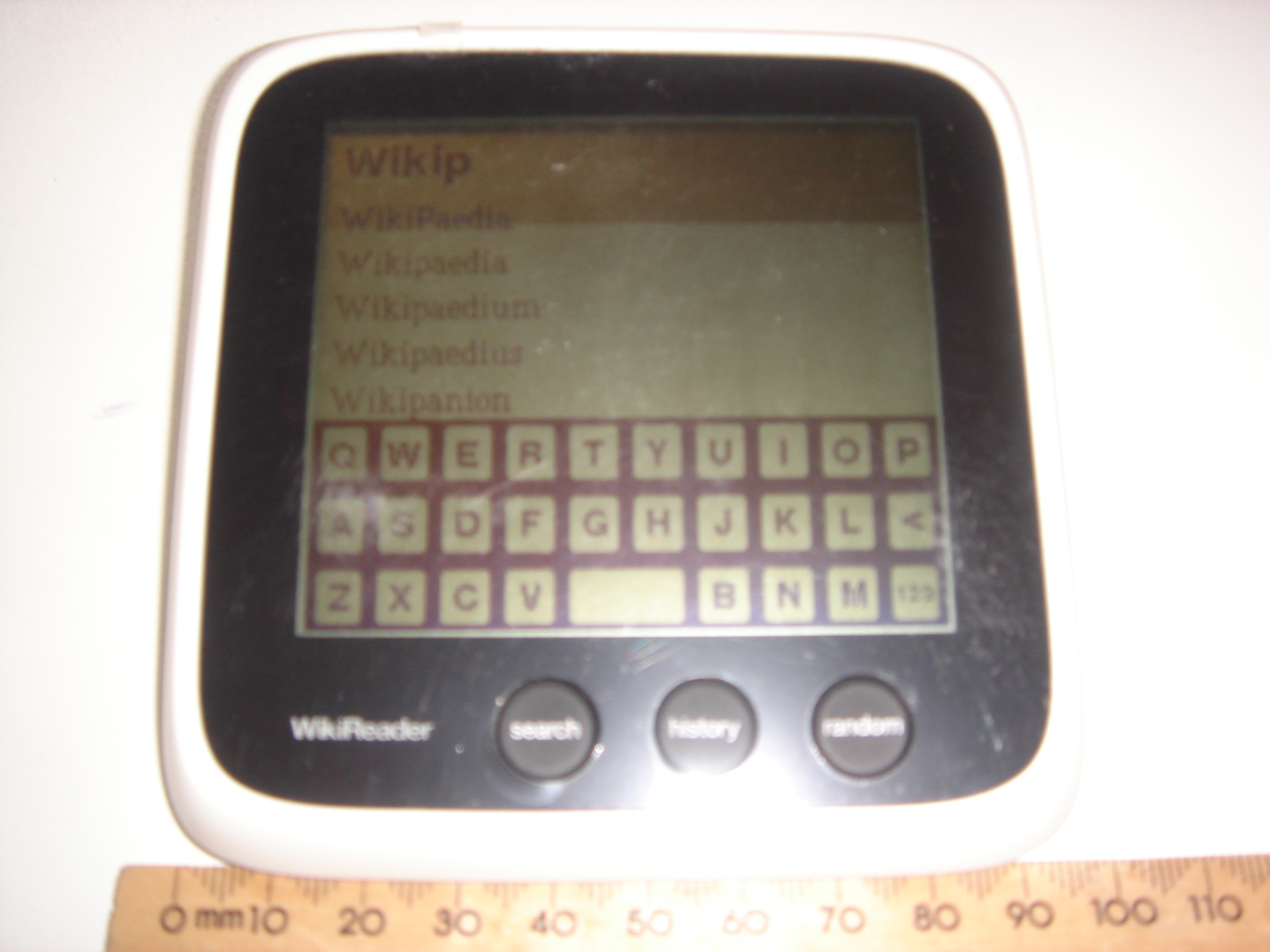
Search Results: "dom"

1 December 2010

Leo 'costela' Antunes: Screenshots on unrooted Android

A few weeks ago I noticed an image on my Froyo phone which appeared to be a screenshot. This came as a surprise, since I don t have any screenshot applications installed and am generally economic when it comes to the amount of fluff on my phone. I did a few searches and there doesn t seem to be any visible mention of this feature out there, only mentions of how to do it with the SDK or with specific apps. Since today I finally managed to discover how to actually do it again (holding the Back button and pressing Home), I took these screenshots using different launchers to be sure it wasn t some feature of ADW.Laucher. I still haven t beat my laziness to actually reset to factory settings and make sure it s not some other random app (which would be a bit unsettling, actually) and it could also be a Samsung specific feature, implemented as one of those pesky unremovable apps. Can anybody out there confirm this (not particularly useful) feature? Did I miss it being published somewhere? [UPDATE]: I found a couple of hidden apps that probably have something to do with this (through Settings Applications Manage applications All). The first one is an obvious suspect, but since it isn t named after Samsung (which admittedly doesn t mean much) I figured it might be activated by the second one, which in my overly-creative and not-really-investigative mind could be a sort of hotkey-daemon. [UPDATE 2: well, that's ignoring the obvious fact that SEC stands for "Samsung Electronics Corporation". D'oh!]
I don t think the feature is important or interesting enough for me to investigate much further, but still I thought I might leave some pointers if people want to get this on their ROMs.

Gunnar Wolf: Back to... Normality?

For the past month, I got disconnected from basically all of my usual activities. Not only from Debian work (well, yes, I followed up on a couple of important bugs and releases, but I was in a very low power consumption mode of sorts), DebConf organization/following (some people have contacted me regarding the DebConf 12 venue decision, for which we should start working and have a presentation soon) Even the always-so-important Real Life got pushed aside. I barely participated in this year's EDUSOL (On-line Encounter of Education and Free Software). Even work suffered I asked my boss to hold any incoming requests for me (save, of course, for urgent stuff). I am now shyly coming up from the hole I dug myself in for this time. Why did I do such a thing? I do not have a formal education beyond high school. Due to several personal issues, I was accepted to the best university in my country, and to the first generation of the study program I would definitively love to have followed, but didn't attend. Of course, I had a fair bit of computing background, enough to be competitive and start working. After amazingly few years, I didn't only get a decent job, but I got a job precisely at the very university I wanted to study at (and where my father has worked for the past 40 years). And, even with some changes along the years, here I am with 10 years of laboral history in this university, with an academic position (although the smallest academic position, but still). It is one of my life's achievements, one of the things that makes me proudest of. Still, I don't want to stay at this level for the rest of my life. And an institution such as this one has rules Yes, flexible enough to allow me in, but rules whose importance I cannot deny. I aspire to become a professor/researcher at some point, and that is just not possible without filling in the prerequisites. Besides, I want to try my hand at teaching at a universitary level. So, what choices did I have besides devoting at least four years to full-time study? Well, there is a government entity that evaluates and regulates formal education given by smaller universities CENEVAL. For probably around ten years now, they have offered the ACREL (Acuerdo 286 Licenciatura) program to validate professional knowledge acquired through work experience And I'm writing this detail as several people have asked me for details on it. So, once you are accepted in the program (basic requisites: Having a high school certificate, over 30 year old, and with over 10 years of provable work experience), they can grant a Licenciatura degree (i.e. the equivalent to a four-year study program). So, in order to get it granted, I have to: Anyway... Enough of a blog posting. I hope this is useful for somebody. And I hope it explains why I have disappeared so much lately. If everything goes as planned, I expect to be receiving my "licenciatura" title around March, and afterwards... Well, we shall see! Now... Back to work. And back to life. And back to my huge backlog of other pending things :)

30 November 2010

Sergio Talens-Oliag: The FreakyWall (Part 3: Packages)

In this post I'll describe the changes made to the kernel and some of the Squeeze packages for the Freaky Wall. The plan is to submit whishlist bugs to the BTS on the hope of having all what is needed for this project available on Debian after the Squeeze release, as my feeling is that a freeze is not the right time to push this changes... ;) I'm giving access here to all the changes made to the source packages, but if anyone wants the binary packages (amd64 only) send me an email and I'll give you the URL of an apt repository that contains all the modified packages (it's the one at work, that contains other modified packages) or, if there is interest, I can put them on people.debian.org. Kernel To be able to build the firewall we need a kFreeBSD kernel with some options not compiled on the version distributed with Debian. To compile the kernel I've followed the procedure described on the following debian-bsd mailing list post: http://lists.debian.org/debian-bsd/2010/09/msg00023.html Basically I've done the following:
    apt-get build-dep kfreebsd-8
    apt-get source kfreebsd-8
    cd kfreebsd-8-8.1
    cat >> debian/arch/amd64/amd64.config << EOF
    # Add pflog, pfsync, ALTQ and CARP support
    # ----------------------------------------
    # http://www.freebsd.org/doc/en_US.ISO8859-1/books/handbook/firewalls-pf.html
    device      pf
    device      pflog
    device      pfsync
    options         ALTQ
    options         ALTQ_CBQ        # Class Bases Queuing (CBQ)
    options         ALTQ_RED        # Random Early Detection (RED)
    options         ALTQ_RIO        # RED In/Out
    options         ALTQ_HFSC       # Hierarchical Packet Scheduler (HFSC)
    options         ALTQ_PRIQ       # Priority Queuing (PRIQ)
    options         ALTQ_NOPCC      # Required for SMP build
    # http://www.freebsd.org/doc/en_US.ISO8859-1/books/handbook/carp.html
    device      carp
    EOF
    vi debian/changelog 
    dpkg-buildpackage -B -uc
Once the package was built I installed the new kernel package and rebooted the machine. Utilities To be able to use some utilities related to pf I have built patched versions of three packages: On the next post I'll describe how I've configured the system, the network interfaces and the different utilities patched and compiled on this post.

29 November 2010

Vincent Sanders: Mobile Telecommunication Luddite

Actually I can not really be called a Luddite because I am not really against telecommunication progress nor do I fear it will negatively effect my employment...but the title sounded good? ;-)
Anyhow, I have a strange relationship with mobile phones. My ability to have a functioning device has historically limited their usefulness to me.

Because of my low usage and odd attitude for a techie I have always used PAYG for my personal phone. Work may have provided me with a device with a contract for being on-call etc. but in general its been PAYG all the way. My first phone was a Nokia 1610 back in the late nineties, second user after my employer at the time contract upgraded and had a load of "leftovers". I paid 50quid for it and bought a ten quid SIM and ten pounds credit.

My phones
The standing joke among my friends for the next decade has been that whatever provider I moved to they would go out of business within the year. I went through about eight providers in ten years. And for the first six the same tenner credit went with me! Each time the PAYG provider folded etc. I would be moved on to someone new with a tenners credit and a new SIM and number.

After Easy Mobile closed they did not have an option of a new provider with credit and the "recommended" provider was very poor, so this time I shopped around and went with Tesco mobile but remembered to take my number, which did at least stop my colleagues making fun of me for another move.

During this period my phones were no better than my providers. I bought a Nokia 1100 and used other peoples leftovers. Culminating in Daniel Silverstone taking pity on me and giving me his Sony Ericsson K800 at the end of his contract, despite acquiring an ADP1 and a G1 (both have which have dropped dead) this is the phone I have been using for three years now.

Due to my dreadful relationship I did not get the most from the technology and felt like I was missing out. Over the last few years to try and address this I have set myself a target of having a phone physically with me, turned on and in credit at all times. This I have finally managed for a whole six month stretch and as a reward I have bought myself a nice Android based smartphone on contract with T-Mobile.

I have done all the administrative things to port the number so no-one will need to alter their address books :-)

After only a few days of usage I have already discovered why the combination of smart phone and decent contract are so appealing. The freedom to just call and text and use the internet wherever you are without stopping to worry if you have enough credit is a wonderful thing. And decent hardware with the guarantee that if it breaks all I have to do is go into the store and they give me a new one.

I went for the HTC Wildfire instead of the Desire on cost grounds (100 pounds up front instead of 290) which seems perfectly reasonable hardware performance wise. My one and only niggle is T-mobile have nobbled the media player so it only plays some mp3s and not oggs or flacs. No real challenge, just a bit disappointing that vendurs seem to think they need to fiddle.


Rapha&#235;l Hertzog: How to find the right Debian packages: high-level search interface

The Debian archive is known to be one of the largest software collections available in the free software world. With more than 16,000 source packages and 30,000 binary packages, users sometimes have trouble finding packages that are relevant to them. Debian developer Enrico Zini has been working on infrastructure to solve this problem. During the recent mini-debconf Paris, Enrico gave a talk presenting what he has been working on in the last few years, which hasn t gotten yet the attention it deserves . Enrico is known in the Debian community for the introduction of debtags, a system used to classify all packages using facets. Each facet describes a specific kind of property: type of user-interface, programming language it s written in, type of document manipulated, purpose of the software, etc. His most recent work builds on that. It is available in Debian and Ubuntu in the apt-xapian-index package. Its purpose is to allow advanced queries over the database of available packages. Users of apt-xapian-index He started by presenting some early users of the infrastructure. The most widely know is Ubuntu s software center. Its search feature provides results almost instantly thanks to apt-xapian-index. But it is a very simple interface that doesn t exploit many of the advanced features provided by the apt-xapian-index. Another early adopter, making use of some more advanced features, is GoPlay!. It s a graphical user interface to find games. It makes use of debtags to classify games so that you can browse, for example, all 3D action/arcade games related to cars. GoPlay has even been extended to be a more generic debtags based package browser and the package now also provides GoLearn!, GoAdmin!, GoNet!, GoOffice!, GoSafe!, and GoWeb!. Fuss-launcher is an application launcher and not a package browser, but by using apt-xapian-index, it s able to reuse information provided at the package level to make it easier to find installed applications. Package descriptions tend to be more verbose than those embedded in .desktop files. Enrico also showed another nice feature to the audience: if you drag a document onto its window, it will show you a list of applications that can open it. Last but not least, apt-xapian-index provides a command line search tool that is vastly superior to the traditional apt-cache search: it s axi-cache search (axi stands for apt-xapian-index). Enrico compared the output of a search on the letter r . While apt-cache spits out an infinite list of packages containing this letter somewhere in the description, axi-cache only listed packages related to GNU R. He also demonstrated the contextual tab completion. It makes it easy to use debtags and to refine your search. Once you have typed a first keyword, the tab-completion for the second one only contains keywords or debtags that are actually able to provide more restrictive results. Advanced queries with logical operations (AND, OR, NOT, XOR) are also supported. Features of the backend Enrico then dived into the internals. Xapian s search engine is at the root of this infrastructure. He likes it because it s a simple library (i.e. no daemon) and it has nice Python bindings. While apt-xapian-index s core work is to index the descriptions of all the packages, it actually stores much more and can be easily extended with plugins (written in Python). For instance, the information stored encompasses: He already has plans to store more: adding popularity contest data (see wishlist bugs #602180 and #602182) will make it possible to sort query results in a useful way. The most widely used applications are good choices when it comes to community support, and they are likely of better quality due to the larger user base. Adding timestamps of the last installation/upgrade/removal, will make it easier to pin-point a regression to a specific package update. The generated index is world-readable and can be used from any application provided it can use the Xapian library which is written in C++ but has bindings for Perl, Python, PHP, Java, Tcl, C#, and Ruby. Call for experimentation Enrico believes that many useful applications have yet to be invented on top of apt-xapian-index s features. He s calling for experimentation and asking for new ideas. The only practical limit that he has encountered is the size of the index: currently it varies between 50 Mb (Debian unstable without translation) and 70 Mb (Debian stable/testing/unstable with one translation). He would like it to not grow over 100 Mb since it s installed by default (due to aptitude recommending it) and he s not comfortable with the idea of using more than 20% of the disk footprint of a basic install just for this service. That s why the index was configured to not store the position of the terms: it s thus not possible to find out packages whose description contains the word statistical immediately followed by the word computing . You can however find those which have both terms somewhere in their description. Enrico wondered if apt-xapian-index offers too much freedom. That could explain why few people experimented with it despite his numerous blog posts with code samples and information on how to get started using it. But it s not difficult to imagine use cases for this data. It could be used to extend tools like rc-alert or wnpp-alert, for example. They provide a long list of Debian packages that are looking for some help and are installed on the machine. With apt-xapian-index, it would be possible to restrict the results to the set of packages written in a specific programming language or for a particular desktop environment. The more likely explanation is that too few people know about the tool. There are many more itches to scratch where apt-xapian-index s features could be very useful, and my guess is that Enrico s wishes will eventually come true.
This article was first published in Linux Weekly News. Click here to subscribe to my newsletter and keep up with the Debian/Ubuntu news thanks to my monthly digest.

No comment Liked this article? Click here. My blog is Flattr-enabled.

27 November 2010

Russell Coker: Open Respect

On the 5th of November Jono Bacon wrote a blog post titled MAKING OUR WORLD MORE RESPECTFUL [1]. He then registered the domain OpenRespect.org for his manifesto [2].Aaron Siego supports the general concept of being more respectful while listing some of the practical problems that occur in a multi-cultural world [3]. If you read nothing else about this issue I recommend reading Aaron s post (which I summarised very poorly, I can t think of a good one-sentence explanation).Sam Varghese wrote an article suggesting that it was an attempt to deflect criticism from Ubuntu [4]. I think that Ubuntu receives a lot of unfair criticism, but don t think it s really relevant to the issue at hand. Sam criticises some of the Open Respect supporters for failing to show respect in the past.Jono wrote a follow-up blog post titled REFLECTIONS ON RESPECT [5], in that post he said Sometimes we were disrespectful, and frankly, sometimes we were also inadvertently assholes. We never set out to be assholes, but we did set out to be edgy in a satirical way, but we sometimes went too far and I apologize for that. But you know what, we all grow and mature in different parts of our lives about his past LugRadio work. Maybe instead of focusing on being respectful of others it would give more benefit to focus on how to apologise, back down, and move on after being disrespectful. It seems that the situations of epic disrespect tend not to be one-off incidents but are instead arguments of greatly expanded scope that arose from someone refusing to admit any error after doing something that is considered to be offensive. [Someone has registered OpenApology.org, just in case you were wondering.]Maybe advocating Rogerian Argument would be another way of reducing some of the problems in the community.Finally Kirrily wrote an insightful post about the ineffectiveness of discussing offensive things [6]. In terms of issues such as Feminism (which Kirrily uses as an example and which is also a matter of significant interest for her) discussions about offense apparently tend to end up being about the person who was offended rather than the person who might be described as acting in an offensive manner. She suggests using terms such as marginalised, belittled, stereotyped, frustrated, humiliated, threatened, patronised, silenced, intimidated, misrepresented, etc instead. It seems to me that there may be a similar issue with respect . Objective claims about people being dismissed, ignored, patronised, etc can be evaluated more easily than a claim about being disrespected.

26 November 2010

Leo 'costela' Antunes: My kingdom for a VGA cable

So you have two geeks in a university room after a relatively late and (at least for one of them) unproductive learning session. It s just natural that they decide to kick back and watch some mind-numbingly stupid geek series, which in this case happened to be Stargate SG-1 (so absurdly shitty its actually very entertaining).
The first lazy geek instinct is to just watch it on the laptop that has the file, which with its 11 display and shitty speakers doesn t turn out to be a great idea. The next try involves the other laptop, but a 13 screen isn t that big of an improvement.
Since the room our intrepid heroes are in happens to have a pretty decent built-in projector and a couple of small but still a lot better than a laptop s Bose speakers, the obvious next step would be using it. The only problem is the lack of a VGA cable. Inspired by the brief sight of MacGyver on the 11 screen, one particularly enterprising geek comes up with the challenge of making a VGA cable out of the only material available at the time: one horribly yellow cat5 ethernet cable.
Being the helpful little extra-dimensional entity that it is, the internet happily provided all the needed information and after some slight problems trying to appropriately deprive the cat5 of its connectors (no scissors and no blades of any kind in sight) and some annoying and manual sticking-cable-to-socket action what did you mother tell you about sticking things in sockets? our reluctant hackers get it right: it's ALIIIIIVEEEE!!! The final solution looked like this: nothing like cable salad for dinner And if you re wondering where those white wires came from, one final touch of ber-hackerdom: notepads have never been more useful This might seem like overkill, but after a nice nice 4 hour movies and series marathon, we can safely say it was totally worth it (but no, we didn t stand 4 hours of Stargate; even geeks have their limits). Just in case the Instructables page gets hosed at some point, here s the invaluable connection diagram, originally scraped off of a since dead Geocities page.

25 November 2010

Rapha&#235;l Hertzog: People behind Debian: Colin Watson, the tireless man-db maintainer and a debian-installer developer

Colin Watson is not a high-profile Debian figure, you rarely see him on mailing lists but he cares a lot about Debian and you will see him on Debconf videos sharing many thoughtful comments. I have the pleasure to work with him on dpkg as he maintains the package in Ubuntu, but he does a lot of more interesting things. I also took the opportunity to ask some Ubuntu specific questions since he s worked for Canonical since the start. Read on. My questions are in bold, the rest is by Colin. Who are you? Hi. I m 32 years old, grew up in Belfast in Northern Ireland, but have been living in Cambridge, England, since I was 18. I m married with a stepson and a daughter. I became interested in Debian due to the critical mass of Debian work happening in Cambridge at the time (and perhaps more immediately because my roommate was running Debian: hey, what s that? ), started doing random bits of development in 2000, and joined as a developer in 2001 (a really exciting time, with lots of new people joining who became integral parts of the project). I d only really been intending to do QA work and various bits of packaging around the edges, and maybe some work on the BTS, but then Fabrizio Polacco died and I took over man-db from him, and it sort of snowballed from there. I graduated from university shortly before becoming a Debian developer. I worked for a web server company (Zeus), then a hardware cryptography company (nCipher), before moving to work for Canonical in 2004, since when I ve been working full-time on Ubuntu. By this point, I suspect that going back to work in an office every day would be pretty tough. What s your biggest achievement within Debian or Ubuntu? One thing I should say: I rarely start projects. Firstly I don t think I m very good at it, and secondly I much prefer coming on to an existing project and worrying away at all the broken bits, often after other people have got bored and wandered off to the next new and shiny thing. That s probably why I ended up in the GNU/Linux distribution world in the first place, rather than doing lots of upstream development from the start I like being able to polish things into a finished product that we can give to end users. So, I ve had my fingers in a lot of pies over the years, doing ongoing maintenance and fixing lots of bugs. I think the single project I m most proud of would have to be my work on the Debian installer. I joined that team in early 2004 (a few months before Canonical started up) partly because I was a release assistant at the time and it was an obvious hot-spot, and partly because I thought it d be a good idea to make sure it worked well on the shiny new G4 PowerBook I d just treated myself to. I ended up as one of the powerpc d-i port maintainers for a while (no longer, as that machine is dead), but I ve done a lot of core work as well: much of the work to put progress bars in front of absolutely everything that used to have piles of text output, rescue mode, the current kernel selection framework, a good deal of udev support, several significant debconf extensions, lots of os-prober work, and I think I can claim to be one of the few people who understands the partitioner almost top to bottom. :-) d-i is the very first thing many of our users see, and has a huge range of uses, from simple desktop installs to massive corporate deployments; it s unspeakably important that it works well, and it s a testament to its design that it s been able to trundle along without actually very much serious refactoring for the best part of five years now. I have a soft spot for man-db too. It was my first major project in Debian, starting out from an embarrassingly broken state, and is now nice and stable to the point where I recently had time to spawn a useful generic library out of it (libpipeline). What are your plans for Debian Wheezy? d-i has a lot of code to deal with disks and partitions. Of course a lot of it is in the partitioner, and for that we use libparted so we don t have to worry very much about the minutiae of device naming. But there are several other cases where we do need to care about naming, mainly before the partitioner when detecting disks, and after the partitioner when installing the boot loader. Back in etch, we introduced list-devices , which abstracted away the disk naming assumptions involved in hardware detection. In wheezy, I would like to take all the messy, duplicated, and error-prone code that handles disk naming in the boot loader installers, and design a simple interface to cover all of them. This has only got more important following the addition of the kFreeBSD and Hurd d-i ports in squeeze, but it bites us every time we notice that, say, CCISS arrays aren t handled consistently, and it s a pain to test all that duplicated code. I d also like to spread the use of libpipeline through C programs in the archive, which I think has potential to eliminate a class of security vulnerabilities in a much simpler way than was previously available. If you could spend all your time on Debian, what would you work on? I would love to systematically reduce the need for the current mass of boot loaders. There s a significant cost to having so much variation across architectures here: it s work that needs to be done in N different places, the wildly differing configuration means that d-i has to have huge piles of code to manage them all differently, and there are a bunch of strange arbitrary limitations on what you can do. The reason I m working on GRUB 2 is that, in my view, it s the project with the best chance of centralising all this duplicated work into a single place, and making it easier to bring up new hardware in future (in a way that doesn t compromise software freedom, as many proprietary boot loaders of the kind often found on phones do). Of course, with flexibility tends to come complexity, and some people have a natural objection to that and prefer something simpler. The things I don t quite have time to do here are to figure out a coherent way to address the specific over-complexity problems people have with the configuration framework while still keeping the flexibility we need, and to do enough QA and porting work to be able to roll out GRUB 2 at installation time to all the Debian architectures it theoretically supports. What s the biggest problem of Debian? Backbiting, and too much playing the man rather than the ball. With one or two honourable exceptions, I ve largely stopped reading most Debian mailing lists since it just never seems a productive way to spend time compared to writing code and fixing bugs; and yet I m conscious that they re one of the primary means of communication for the project and I m derelict in not taking part in them. I do find it a bit frustrating that people are seen primarily in terms of their affiliations. I suppose it s natural for people to see me as an Ubuntu guy , but I don t really see myself that way: I ve been working on Debian for nearly twice as long as I ve been working on Ubuntu, and, while I care a great deal about both projects, I ve put far more of my own personal time into Debian and I try to make sure that a decent number of the things I m involved with there aren t to do with work. Work/life separation is a good thing, not that I m very good at it. Generally speaking, when I m working on Debian, I m doing so as a Debian developer, because I want Debian to be better. When that s not the case, if it matters, I try to indicate it explicitly. You re working for Canonical since Ubuntu s inception. If you were Mark Shuttleworth, is there something that you would have done differently? We had many good intentions when we founded Ubuntu. We also had a huge amount of work to deliver, to the point where it wasn t at all clear whether it would be possible (the warty release was named based on the expectations of it, after all, and came out much more usable than we d dared to hope). In hindsight, it might have helped to be quieter about our good intentions, so that we could exceed expectations rather than in some cases failing to meet them. That might have set a very different tone early on. (Personally, I m happy I m not Mark. The decisions in my office are much easier to take.) It seems to me that the community part of Ubuntu is much more eager to cooperate with Debian than the corporate part. It s probably just that more and more Canonical employees are not former Debian contributors. Do you also have this feeling? Are there processes in place to ensure everybody at Canonical is trying to do the right thing towards Debian cooperation? Just to be clear, I m wearing my own hat here which, ironically, is a fedora rather than a company hat. It makes sense for Canonical to be taking on more non-Debian folks; after all, we can t simply hire from the Debian community forever, and a variety of backgrounds is healthy. As you say, it may well be natural that Ubuntu developers who don t work for Canonical are more likely to have a Debianish background, as it tends to take something significant to get people to switch to a very different family of GNU/Linux distributions, and changing jobs is one of the most obvious of those things. Certainly, there was a definite sense among the early developers that we were all part of the Debian family and cared about the success of Debian as well. As Ubuntu has developed its own identity, people involved in it now tend to care primarily about the success of Ubuntu. At the same time, pragmatically, it s still true that getting code changes into Debian is one of the most economical ways to land them; changes made in Debian or upstream land once and tend to stay in place, while changes made only in Ubuntu incur an ongoing merge overhead, which is not at all trivial. In many ways it s human nature to try to fulfil your immediate goals in the most direct way possible. If your goal is to deliver changes to Ubuntu users, then it s natural to concentrate on that rather than looking at the bigger picture (which takes experience). Debian developers often fail to send changes upstream for much the same reason, although there s more variation there because they re normally working on Debian of their own volition and thus tend to have wider goals; the economics are more or less parallel though. Thus, I think the best way to improve things is to make it the path of least resistance for Ubuntu developers to send changes to Debian. We re already seeing how this works with the Ubuntu MOTU group; if you send a patch for review, or work on merging a package from Debian, very often the response includes have you sent these changes to Debian? . We re working on both streamlining our code review through a regular patch pilot programme and requiring more code review for changes in general, so I think this will be a good opportunity to ask more people to work with Debian when they propose changes to Ubuntu. For myself, this may be obvious, but I notice that I m much better at getting changes into Debian when I already have commit access to the Debian package in question. All the work on improving collaborative maintenance in Debian can only help, for Ubuntu as well as for everyone else. It doesn t make so much difference for large changes that require extensive discussion, but there are lots of small changes too. Canonical is upstream of many software projects (unity, indicators infrastructure, etc.). Why aren t those software immediately packaged in Debian? Do you think we can get this to change? I m not sure what the right approach is here, particularly as I haven t been involved with much of that on the Ubuntu side. I suspect it would be helpful to look at this in a similar way to Ubuntu changes in general. It s understandable that those developers have getting changes into Ubuntu as their first goal. And yet, having code in Debian offers a wider, and often technically adept, audience, and most developers like having their code reach a wider audience even if it s not their first priority, particularly if that audience is likely to be able to help with finding problems and fixing bugs. It should be seen as something beneficial to both distributions. The hardest problems will be with things that aren t merely optional add-ons (which should generally be fairly non-controversial in Debian, given the breadth of the archive in general the existence of things like bzr and germinate as Debian packages was never a hard question), but which require changes in established packages. For example, gnome-power-manager in Ubuntu is built with application indicator support, and that s an important part of having a good indicator-based panel: a lot of the point of indicators is consistency. Since I do very little desktop work myself, I don t know exactly what would be involved in making it possible to choose this system based on a Debian desktop, but I think it s probably a bit more complicated than just making sure all the new packages exist in Debian too. Obviously you have to start somewhere. Is there someone in Debian that you admire for his contributions? Christian Perrier is absolutely tireless and has done superb things for the state of translations in Debian. And Russ Allbery, even aside from his fine ongoing work on policy, Lintian, and Kerberos, is a constant voice of sanity and calmness. Release management is incredibly hard work, as I know from my own experience, and anyone who can sustain involvement in it for a long period is somebody pretty special. Steve Langasek and I got involved at about the same time but he outlasted me by quite a few years. He deserves some kind of medal for everything he s done there.
Thank you to Colin for the time spent answering my questions. I hope you enjoyed reading his answers as I did. Subscribe to my newsletter to get my monthly summary of the Debian/Ubuntu news and to not miss further interviews. You can also follow along on Identi.ca, Twitter and Facebook.

11 comments Liked this article? Click here. My blog is Flattr-enabled.

Russell Coker: The Wikireader

Just over a month ago I bought a Wikireader [1] from Officeworks (an Australian chain of stores that sell all manner of office supplies). It cost only $99, thanks to Brianna for informing me about this [2]. When I purchased my Wikireader an Officeworks employee had to get one from the back office and told me that I was the first person to buy one. I suggested to him that when a product isn t mentioned in their advertising and isn t put on the shelves it s unlikely to sell in quantity and that they shouldn t rely on bloggers to promote what is possibly one of the most desirable products that they stock.The Wikireader stores a copy of the text of the English language version of Wikipedia on a micro-SD card. They have a service whereby you can get two updates posted to you every year for $29, which would make it pretty close to free once postage and the cost of the micro-SD cards is taken into account. Also you can download new content. I have no immediate plans for updating my Wikireader as the content is more than good enough to answer idle questions while waiting for a bus but as it s lacking external links due to no net access and images it can t be used for serious Wiki reading IMHO.Brianna has documented the process of updating a Wikireader to add more content [3], she added the Chinese version and discovered that inter-wiki links are preserved! I have no immediate plans to add extra content (I don t know any other language well enough to read an encyclopaedia). Also an 8GB MicroSD card (which is the minimum requirement to use multiple languages) costs $35 and is a significant portion of the original purchase price.In terms of functionality the device is pretty good. The screen is not back-lit, but if it was then the two AA batteries wouldn t last anywhere near a year. The screen is not high resolution and the touch functionality isn t particularly accurate or sensitive but I guess that s a necessary trade-off to get the $99 price. The Wikipedia content seems quite complete, so far the only page which I found to be missing was the bio of an Australian architect, I m not sure if his page was removed from the Wikireader to save space or whether my device has a snapshot that predates the addition of the page.The Wikipedia page about downloading the database is interesting [4], it s 6GB of compressed data for the text of the English pages (not including history or talk pages) and for years they haven t even tried to provide a dump of the images. So I guess that a Wikireader that displays pictures is out of the question.The Wikireader has a parental filter, in my quick tests the only page that has been blocked is Sexual Intercourse , I could read all about safe-sex, infidelity, and lots of other related adult topics without being asked for a password. It also shows pages about goatse and other related things without asking for a password NB if you don t know what goatse is then you probably don t want to learn, trust me that it s something that most people won t want their children to learn about. The filter is so bad that I think they shouldn t include it, it will just give people false confidence. It s OK to sell a cheap device that is designed to give a detailed description of goatse etc on request to anyone, but IMHO it s not OK to sell such a device with a claim that it is kid safe and has parental controls . Note that holding down the History button will allow you to clear your history this is useful if you have just verified that goatse isn t blocked and you want to give the device to a young child.There is a button to give a random page, I believe that this would be more useful if it had some metric to make it more often return pages that might be interesting. It could weight the randomness by the length of the page (usually a longer page is more interesting to more people and has more links to other pages) or by some other metric that indicates the potential popularity. Random links often get me pages about obscure country towns and other things that probably aren t of interest to people who don t live near them.But overall this is a great product, $99 is not much to pay, and I recommend getting one!

23 November 2010

Russell Coker: Links November 2010

Guy Deutscher wrote an interesting article for the New York Times about how language shapes how we think [1]. The example of people who have no language construct for self-sentered directions and how they describe things is particularly interesting.TED published an interesting interview with Shaffi Mather the founder of India s first organised ambulance service (with differential pricing based on ability to pay) [2]. He also talks about founding schools in small towns and his BribeBusters.com company.World Changing has an interesting article about a legislative change in California that allows car-sharing of personal vehicles [3]. The concept is that if you own a car that you don t use most of the time (as is usually the case) then you can contract with a car-share company to share it to others when you don t need it. This saves the car share company from the capital expense of owning cars and thus allows them to place cars in remote locations that wouldn t otherwise be financially viable (IE the street in front of random people who sign up). The person who owns the car may get about $2 per hour for the time when it s rented. The car owner gets to specify when the car may be available.Charles Stross wrote an entertaining and informative rant about Steam-Punk [4]. He cites Michael Moorcock s informative essay about Starship Troopers and other right-wing apologist themes in sci-fi [5] as well as China Mieville s essay about politics and The Lord of the Rings [6].Glenn Greenwald wrote an informative article about the New York Times defending torture by the US military [7]. I have unsubscrubed from the @Times mailout and will avoid citing NYT articles wherever possible. I sent the URL for Glenn s article to the NYT feedback address but I don t expect them to take any notice.Fate Of the World is a new computer game that s in beta where you have a simulation of the next 200 years of climate change [8]. It s currently in beta for Windows only, they hope to have a Mac version in March and have no stated plans for Linux support.Cory Doctorow wrote an interesting article for Locus about Sci-Fi fans and cosmopolitanism taking the best option after consideration rather than doing what s locally fashionable [9]. He uses the term Martian to refer to some of the viewpoints, but it seems to me that Vulcan would be more appropriate.The Wall St Journal has an interesting article about people who manufacture drugs that aren t yet illegal, every time one drug gets banned they market a new one [10]. This is yet another example of the War on Drugs doing more harm than good, instead of taking drugs which have well known effects (that can be treated by hospitals) people are taking weird new drugs and no-one knows what will happen to them.Mieke Meijer in the Netherlands has invented a new product known as newspaper wood [11], it involves gluing paper together to create a form of chip-board that keeps the layers of paper distinct to give a result like wood grain. The World Changing commentary suggests that this could give a heirloom quality to objects made with it, while I m dubious about that I think that the surface would be pleasing to look at in a kitchen or office environment.Ze Frank gave an interesting TED talk about unusual social projects that he s run on the Internet [12]. This includes an attempt to reconcile Red and Blue voters after the 2008 US presidential election, the creation of inspirational songs, and remixing the Whip Somebody s Ass song. This is really worth watching!The Chronicle Review has an interesting article by someone who is paid to complete academic assignments for other people [13]. The scope of cheating that is claimed is profound. Naturally we have to take claims by someone who admits acting unethically with a grain of salt, but if there is any truth to this then it s a serious matter. I m surprised that no-one has made a serious attempt to catch the customers of such people.David Brin (the famous sci-fi author) gave an interesting short lecture about the future of humanity [14]. He promotes the Lifeboat Foundation (of which he is a director) and describes his concern about the Fermi Paradox.Shimon Schocken gave an inspiring TED talk about his work rehabilitating juvenile prisoners through taking them mountain-bike riding [15]. This shows that anyone can do great things to help other people, he got this idea when riding past a prison, convinced the prison governor that it was a good idea and then started doing it.Conrad Wolfram gave an insightful TED talk about math education [16]. His claim is that the entire mathematical education system is wrong in it s focus on hand calculation, instead the aim should be to teach children how to use computers to solve problems which is what is mostly done in the real world.

Jo Shields: Always twirling, twirling, twirling towards Freedom

I ve never quit a job before. Well, not a real job. Quitting PC World was more than easy, it was practically required for my soul not to leave my body. Quitting Waitrose was, well, it was a freaking supermarket job. And Southampton football stadium I just stopped turning up after one girl fainted in the kitchen from heat exhaustion. But a real, proper handing in of notice is something new in no small part because I ve been in the same place since my first job as a new graduate. Not that I m ungrateful, mind. Looking after big iron at the University of Oxford has been pretty awesome more blinky lights than you can shake a stick at but there comes a time when you need to think about your career, and move on to pastures new. I m fairly sure six and a bit years is WELL past that point. When I started looking at work, I had only a few mandatory criteria a sysadmin job, working with Free Software, without any significant decrease to my monthly income. Beyond that well, in this economy, who am I to argue? What I hadn t accounted for, however, was a job whose awesomeness can t be contained. A job with a dedicated Free Software company whose entire staff roster, top to bottom, is filled with the most talented, smart, and generally awesome people you could hope to work with. Such a job would be a fevered dream, the mere ramblings of a madman. Yet, somehow, for the second time running, I find myself in an enviable job, working exclusively on Free Software. Being able to show off root access to a box with 256 cores and a tibibyte of RAM is pretty cool. But you know what s even cooler? A job where I never need to worry about openSUSE 10.1 administration ever again. A job where several of my colleagues are fellow Debian Developers, with all the prestige and knowledge that comes with such a title. And somehow, by rolling proverbial twenties, I find myself in that position. I am very, VERY proud to say that from the start of January, I ll be joining Collabora Ltd as their new Systems Manager.

Julien Danjou: Color contrast correction

I finally took some time to finish my color contrast corrector. It's now able to compare two colors and to tell if they are readable when used as foreground and background color for text rendering. If they are too close, the code corrects both colors so to they'll become distant enough to be readable. To do that, it uses color coordinates in the CIE L*a*b* colorspace. This allows to determine the luminance difference between 2 colors very easily by comparing the L component of the coordinates. The default threshold used to determine readability based on luminance difference is 40 (on 100), which seems to give pretty good results so far. Then it uses the CIE Delta E 2000 formula to obtain the distance between colors. A distance of 6 is considered to be enough for the colors to be distinctive in our case, but that can be adjusted anyway. That depends on reader's eyes. If both the color and luminance distances are big enough, the color pair is considered readable when used upon each other. If these criteria are not satisfied, the code simply tries to correct the color by adjusting the L (luminance) component of the colors so their difference is 40. Optionally, the background color can be fixed so only the foreground color would be adjusted; this is especially handy when the color background is not provided by any external style, but it the screen one (like the Emacs frame background in my case). Here is an example result generated over 10 pairs of random colors. Left colors are randomly generated, and right colors are the corrected one. <style type="text/css"> </style>

bg: DarkSeaGreen4 fg: gray67 ->                             fg: #4a6b4b bg: #cccccc
bg: SlateGray4 fg: forest green ->                          fg: #9faec0 bg: #005700
bg: grey13 fg: grey36 ->                                    fg: #131313 bg: #6c6c6c
bg: MediumPurple2 fg: honeydew ->                           fg: #9e78ed bg: #f0fff0
bg: grey43 fg: chartreuse3 ->                               fg: #5e5e5e bg: #79de25
bg: linen fg: DeepPink2 ->                                  fg: linen bg: DeepPink2
bg: CadetBlue4 fg: blue1 ->                                 fg: #6c9fa4 bg: #0000e1
bg: gray33 fg: NavajoWhite3 ->                              fg: #525252 bg: #cfb58c
bg: chartreuse1 fg: RosyBrown3 ->                           fg: #9cff38 bg: #b28282
bg: medium violet red fg: DeepPink1 ->                      fg: #9c0060 bg: #ff55b9
All this has been written in Emacs Lisp. The code is now available in Gnus (and therefore in Emacs 24) in the packages color-lab and shr-color. A future work would be to add support for colour blindness. As a side note, several people pointed me at the WCAG formulas to determine luminance and contrast ratio. These are probably good criteria to choose your color when designing a user interface. However, they are not enough to determine if displayed color will be readable. This means you can use them if you are a designer, but IMHO they are pretty weak for detecting and correcting colors you did not choose. Flattr this

Mike Hommey: Improving libxul startup I/O by hacking the ELF format

If you have been following this blog during the past months, you might have gathered that I ve been focusing on I/O patterns on library initialization, more specifically libxul.so. The very patterns there s not much to do about, except enduring them, or hacking ld.so and/or the toolchain. The latter is not necessarily easy, and won t benefit everyone until all linux distros use an improved glibc and/or toolchain. This could take years before any actual result would reach end users. But with a little creativity, one can overcome these limitations and improve the situation today. Here is a summary of my recent hacks. Backwards static initializers As Taras showed in the past, static initializers are executed in reverse order. It turns out it is an unfortunate design choice in gcc, and it also turns out not to impact all ELF binary files. As far as I know there are currently two different implementations of the static initializers call loop, one provided by gcc, and one provided by ld.so. In the gcc case, the compiler creates a .ctors section, starting with 0xffffffff, ending with 0x00000000, and filled with pointers to the various static initializer functions, in ascending order. The compiler also injects an initializer function, called from .init, going through this .ctors section, starting from the end (__do_global_ctors_aux in crtend.o). A similar .dtors section is created for functions to run when the library is unloaded, and the pointers in it are called in ascending order. There is actually no importance in the order in which .ctors and .dtors are executed. All that matters is that they are executed in reverse order from each other, because that limits the risks of bad ordering. It is only unfortunate that .ctors was chosen to be the one backwards. In the ld.so case, the compiler creates a .init_array section, filled with pointers to the various static initializer functions, in ascending order. It also stores the location and the size of this section in the PT_DYNAMIC ELF header. At runtime, ld.so itself reads this information and executes the static initializers in ascending orders. A similar .fini_array section is created for functions to run when the library in unloaded, and ld.so goes through it in descending order. The .init_array section is newer, and for backwards compatibility reasons, is not used on systems that have been using the .ctors approach forever. On the other hand, some newer ABIs, such as arm EABI, uses the new facility, which means they are not victim of backwards static initialization. I however wonder if backwards compatibility is still needed, considering how long .init_array support has been around (more than 11 years, according to glibc git repository). While we could obviously bug the gcc maintainers to revert their .ctors execution order, or ditch .ctors support on glibc systems, which means we wouldn t get any immediate global benefit, we can also just revert the .ctors section content. Please note the source code out there doesn t take care of reverting the .dtors section accordingly, because it is currently empty in libxul.so. Relocations As I mentioned in an earlier post, relocations are what make it possible to load libraries at arbitrary locations. Unfortunately, a great number of relocations means awful I/O patterns: ld.so reads and applies them one by one, and while the kernel reads ahead by 128 KB chunks, when your relocation section exceeds that amount by more than an order of magnitude, it means I/O goes back and forth a lot between the relocation section and where the relocations take place. There are two classes of relocations: REL and RELA. In both cases, there are several types of relocations, some of which require an addend. The difference between both classes is in REL relocations, the addend is stored at the offset the relocation takes place, and in RELA relocations, the addend is stored in the relocation entry. It means that RELA relocations effectively waste space, as the addend ends up actually being stored twice: it is also stored at the offset the relocation takes place, like with REL relocations, though it could technically be nulled out, there ; in any case, the space is wasted. REL relocations thus take 2 words of storage, and RELA relocations, 3. On x86, the ELF ABI only uses REL relocations, and words are 32 bits, making each relocation take 8 bytes ; on x86-64, the ELF ABI only uses RELA relocations, and words are 64 bits, thus making each relocation take 24 bytes, 3 times that of x86 relocations. On ARM, both may be used, but apparently the compiler and the linker only use REL relocations. These words of storage are used to store 3 or 4 bits of informations: The linker splits relocations in two main categories: those for dynamic linking at startup and those for procedure linkage table (PLT) resolution at runtime. Here is what the repartition look like on libxul.so (taken from the mozilla-central nightly from Nov, the 22nd):
dynamic relocations PLT relocations
Architecture number size (bytes) number size (bytes)
x86 231,836 1,854,688 3,772 30,176
x86-64 235,893 5,661,432 3,773 90,528
So, PLT relocations are quite negligible, and dynamic relocations are just huge, especially on x86-64. Compared to the binary size, it s pretty scary:
Architecture libxul.so size relocations size %
x86 21,869,684 1,884,864 8.61%
x86-64 29,629,040 5,751,984 19.41%
Let me remind you that not only do we need to read these relocations at startup (at least the dynamic ones, but the PLT ones are just negligible), but we only read them by chunks, and need to read other data in between. Of the many existing types of relocations, only a few are actually used in dynamic libraries. Here is a summary of those in use in libxul.so:
x86 relocation type number x86-64 relocation type number
dynamic relocations
R_386_TLS_DTPMOD32 1 R_X86_64_DTPMOD64 1
R_386_GLOB_DAT 213 R_X86_64_GLOB_DAT 238
R_386_32 27,643 R_X86_64_64 27,611
R_386_RELATIVE 203,979 R_X86_64_RELATIVE 208,043
PLT relocations
R_386_JUMP_SLOT 3,772 R_X86_64_JUMP_SLOT 3,773
The above types can be separated in two distinct categories: In the second category, it means we are wasting all the bits for the symbol reference in each entry: 24 on x86 and 32 on x86-64. Unfortunately, the vast majority of the relocations in libxul.so are from that category. At this point, this is how much waste we identified:
description num. entries waste per entry (bytes) total % of relocation size
x86
Relocation without symbol ref. 203,980 3 611,937 32.46%
x86-64
Duplicated addend 239,666 8 1,917,328 33.33%
Relocation type encoded on 32 bits 239,666 3 718,998 12.49%
Relocation without symbol ref. 208,044 4 832,176 14.46%
Total 3,468,502 60.30%
On top of that, one could argue that we don t need 24 or 32 bits for symbol reference (which is the entry number in the symbol table), and that we re really far from requiring 64 bits for r_offset on 64 bits systems, as libxul.so is far from being bigger than 4GB. Anyways, that means we have room for improvement here, and it means that the ELF format, especially on 64 bits systems with RELA relocations, really doesn t help with big programs or libraries with a lot of relocations. (For that matter, the mach-o format used on OS-X has some kind of similar issues ; I don t know for the DLL format) Another interesting data point is looking at how relocations r_offset are following each other, once relocations are reordered (to avoid too much symbol resolution, they are actually grouped by symbol). It turns out 206,739 relocations r_offset are at 4 bytes from the previous one on x86 (i.e. strictly following it), and 210,364 at 8 bytes from the previous on x86-64. The main reason why this happens is that most relocations are happening in pointer tables, and libxul.so has lots of them: And when I say libxul.so has lots of them, that s not an understatement: there are 184,320 relocations due to vtables (function tables you get when using virtual methods in C++) on x86 and 184,098 on x86-64. That s respectively 78.23% and 76.81% of the total number of relocations. Interestingly, while most of these relocations are R_*_RELATIVE, 26,853 are R_386_32, and 26,829 are R_X86_64_64. Except for a very few, these non relative relocations are for the __cxa_pure_virtual symbol, which is a dummy function that does nothing, used for pure virtual methods, such as the following:
class Abstract
public:
virtual void pure_virtual() = 0;
;
As for the remaining relative relocations, there are a few pointer tables responsible for several thousand relocations, such as JSString::length2StringTable, gEntries, GkAtoms_info, Html5Atoms_info, kUnixCharsets, nsIDOMCSS2Properties_properties, etc. Packing relocations While they are not detrimental to most binaries, we saw that relocations can have a bad effect on startup I/O for big binaries. Reducing how much space they take would have a direct impact on these startup I/Os. One way to do so is obviously to reduce the number of relocations. But as we saw above, the vast majority are due to vtables. While reducing vtables would be a nice goal, it s a long way before this can have a significant impact on the relocations number. So another possible way is to try to avoid wasting so much space in relocations. The main problem is that relocations are applied by ld.so, and that, as mentioned in the introduction, while we can hack ld.so to do what we want, it won t work everywhere before a long time. Moreover, it s difficult to test various implementations, and binary compatibility needs to be guaranteed once something is applied in the upstream libc. The idea I started to test a few weeks ago, is to effectively apply relocations by hand instead of relying on ld.so doing it. Considering the first thing ld.so does with a library after applying relocations is to call its DT_INIT function, the idea was to replace the dynamic relocations we can with a new DT_INIT function we would inject that d apply those relocations, while storing them in a more efficient manner. The function would obviously need to call the original DT_INIT function once done. Some parts of the PT_DYNAMIC section also obviously need to be adjusted accordingly. The first iteration I tested a few weeks ago helped validating the idea, but didn t change much of the binary: the dynamic relocation section still was taking all the space it took before, though its content was mostly empty (we ll see further below how efficient even the current dumb format is). Once the theory that an injected DT_INIT function could apply the relocations without breaking everything, I went on to implement a program that would actually strip the ELF binary. I won t get too much into the gory details, but it required PT_LOAD splitting, thus program headers growth, which means moving the following sections, then removing a huge part of the relocations, shrinking the relocations section, injecting our code and the packed relocations as sections, and moving the remaining sections after these new sections, to avoid empty space, but still respecting the proper offsets for both PT_LOAD and the code itself. So far, I only took care of the R_*_RELATIVE relocations. Some but not all other relocations could be taken care of, too, but everything involving symbol resolution from other libraries would be really difficult to handle from the injected code. The relocations are currently stored with a quite dumb format: As we only take care of one type of relocations, we can skip any information about the type. Also, the addend already being stored at r_offset, we just strip it from RELA relocations ; the binary being far from 4GB big, 32 bits is enough on 64 bits systems too. We also saw that a lot of relocations were next to the following ones, so instead of storing r_offset for each one, storing some kind of range is more efficient. As I ve so far been focusing on getting something that actually works more than on getting something really efficient, I only tested this format, but the results are already nice:
x86 x86-64
before
dynamic relocations (bytes) 1,854,688 5,661,432
libxul.so size 21,869,684 29,629,040
after
dynamic relocations (bytes) 222,856 668,400
injected code size 129 84
packed relative relocations (bytes) 224,816 228,568
libxul.so size 20,464,836 (-6.42%) 24,865,520 (-16.07%)
Getting rid of the __cxa_pure_virtual relocations would help getting this even further down, and an even better storage format could be used, too. Gathering new startup coverage data should be interesting as well. The code is available via mercurial. Please note the Makefile deeply sucks, and that the code is in the middle of its third refactoring. Anyways, once you get the code to compile, you just need to run test-x86 or test-x64 depending on your architecture, from the build directory, and give it the libxul.so file as an argument. It will create a libxul.so.new file that you can use to replace libxul.so. You may successfully use the tool on other libraries, but chances are you ll bump into an assert(), or in the worst case, that the resulting library ends up broken. The tool might work on PIE executables, but most probably not on other executables. If you wonder, Chrome is not PIE. It s not even relocatable (which means ASLR won t work with it) ; or at least the x86-64 binaries I just got aren t. More possible ELF hacking The code I wrote to pack relocations allows to do various tricks on ELF files, and it opens various opportunities, such as: Some of the above could probably be done with linker scripts, but using linker scripts is unnecessarily over complicated: as soon as you start using a linker script to fiddle with sections, you need to reimplement the entire default linker script (the one you can see with ld --verbose). And it s not guaranteed to work (Taras told me he had a hard time failing to align the .bss section). And as far as I know, you can t use the same thing depending whether you use ld or gold (AIUI, gold doesn t support the whole ld linker script syntax).

Dominique Dumont: How about a configfs with Config::Model ?

Hello During the Config::Model presentation at Debian mini-conf, I was asked whether Config::Model could be used from other languages than Perl. Of course, config-edit command line can be launched from any program with any language, but we can hardly call it an API. There s also the possibility to use Config::Model::SimpleUI to fork a process and send commands on its STDIN and get results on STDOUT. But using this from another program is awkward. On kernel side, /proc and /sys are widely used to get information from the kernel and set kernel configuration. How about using a similar approach with system configuration data ? Configuration data from config files is already mapped into a tree within Config::Model. This tree can also be mapped to a file system structure. This file system structure could have the following layout:
/conf/
system/
sshd/
PermitRootLogin # contain 0 or 1
ssh/

popcon/
As a bonus, this file system would provide a unified access to all system configuration data available through Config::Model. In any case, people would still be able to tinker configuration with their favorite text editor on a file in /etc. The modification will be propagated to the corresponding entry in the /conf virtual file system. The reverse will also be done. Anyone interested ? All the best PS: Further technical discussion will be held on Config::Model mailing list: config-model-users at lists.sourceforge.net 2010.11.25 edit: specified that config data can still be written in usual config file.

20 November 2010

Jon Dowland: psychic

I'm in the process of setting up a mail server, which will eventually accept mail for a given domain. I am also changing name servers for said domain (to make use of zoneedit.com). So far, I have the new server accepting mail for the domain, and the new name server serving records for the domain, including an MX pointing at the new server. However, I haven't updated the domain record, so the authorative nameservers haven't changed. Despite this, somehow, spammers are already attempting to submit mail for the domain in question to the new MX server. Not only that, but it's targetted at particular users with non-obvious local parts. The new MX advertises itself as "a-sub-domain.example.org", for values of "example.org", so it's possible in theory to derive "example.org" from the banner. But unlikely. Are they psychic? Or is a spammer somehow getting notified of new MX records hosted at zoneedit (no matter whether glue records point at them)?

Petter Reinholdtsen: Gnash buildbot slave and Debian kfreebsd

Answering the call from the Gnash project for buildbot slaves to test the current source, I have set up a virtual KVM machine on the Debian Edu/Skolelinux virtualization host to test the git source on Debian/Squeeze. I hope this can help the developers in getting new releases out more often. As the developers want less main-stream build platforms tested to, I have considered setting up a Debian/kfreebsd machine as well. I have also considered using the kfreebsd architecture in Debian as a file server in NUUG to get access to the 5 TB zfs volume we currently use to store DV video. Because of this, I finally got around to do a test installation of Debian/Squeeze with kfreebsd. Installation went fairly smooth, thought I noticed some visual glitches in the cdebconf dialogs (black cursor left on the screen at random locations). Have not gotten very far with the testing. Noticed cfdisk did not work, but fdisk did so it was not a fatal problem. Have to spend some more time on it to see if it is useful as a file server for NUUG. Will try to find time to set up a gnash buildbot slave on the Debian Edu/Skolelinux this weekend.

19 November 2010

Ond&#345;ej &#268;ert&iacute;k: Google Code vs GitHub for hosting opensource projects

Cython is now considering options where to move the main (mercurial) repository, and Robert Bradshaw (one of the main Cython developers) has asked me about my experience with regards to Google Code and GitHub, since we use both with SymPy.

Google Code is older, and it was the first service that provided free (virtually unlimited) number of projects that you could easily and immediately setup. At that time (4 years ago?) that was something unheard of. However, the GitHub guys in the meantime not only made this available too, but also implemented features, that (as far as I know) no one offers at all, in particular hosting your own pages at your own domain (but at GitHub's servers, some examples are sympy.org and docs.sympy.org), commenting on git branches and pull requests before the code gets merged in (I am 100% convinced that this is the right approach, as opposed to comment on the code after it gets in), allow to easily fork the repository and it has simply more social features, that the Google Code doesn't have.

I believe that managing an opensource project is mainly a social activity, and GitHub's social features really make so many things easier. From this point of view, GitHub is clearly the best choice today.

I think there is only one (but potentially big) problem with GitHub, that its issue tracker is very bad, compared to the Google Code one. For that reason (and also because we already use it), we keep our issues at Google Code with SymPy.

The above are the main things to consider. Now there are some little things to keep in mind, that I will briefly touch below: Google Code doesn't support git and blocks access from Cuba and other countries, when you want to change the front page, you need to be an admin, while at GitHub I simply add push access to all sympy developers, so anyone just pushes a patch to this repository: https://github.com/sympy/sympy.github.com, and it automatically appears on our front page (sympy.org), with Google Code we had to write long pages (in our docs) about how to send patches, with GitHub we just say, send us a pull request, and point to: http://help.github.com/pull-requests/. In other words, GitHub takes care of teaching people how to use git and figure out how to send patches, and we can concentrate on reviewing the patches and pushing them in.

Wikipages at github are maintained in git, and they provide the webfrontend to it as opensource, so there is no vendor lock-in. Anyone with github account can modify our wiki pages, while the Google Code pages can only be modified by people that I add to the Google Code project, which forced us to install mediawiki on my linode server (hosted at linode.com, which by the way is an excellent VPS hosting service, that I have been using for couple of years already and I can fully recommend it), and I had to manage it all the time, and now we are moving our pages to the github wiki, so that I have one less thing to worry about.

So as you can see, I, as admin, have less things to worry about, as github manages everything for me now, while with Google Code, I had to manage lots of things on my linodes.

One other thing to consider is that GitHub is only for git, but they also provide svn and hg access (both push and pull, they translate the repository automatically between git and svn/hg), I never really used it much, so I don't know how stable this is. As I wrote before, I think that git is the best tool now for maintaining a project, and I think that github is now the best choice to host it (except the issue tracker, where Google Code is better).

18 November 2010

John Goerzen: The TSA: Stupid, Owned, or Complicit?

I have long been in Bruce Schneier s camp, thinking that the TSA is a joke: nothing but security theater. A few recent examples come to mind: I don t get it. They have been completely reactionary since they began. They have a complete failure of institutional imagination. Something happens, and then a new rule comes out to prevent the thing that everybody is now expecting. And what happens about the thing that people aren t expecting yet? Nothing. So we now have to take off our shoes because one guy tried to use them for something nefarious. OK, fine, but the next guy is probably going to try something other than shoes. Which is why, I m sure, many people are pointing out that the TSA is over-reliant on technology and device detection and completely underemphasizing evildoer detection as, we are repeatedly reminded, the Israelis excel at. The TSA s attempt to remedy that was foolish at best, and, according to a recent report, not grounded in science. Which is why I am heartened that, almost a decade after 9/11, Americans are starting to let go of their fear and be ready to reclaim some sense of intelligence at the security line. The fact that politicians think there is something to be gained by being tough on TSA s invasive screening procedures, rather than risk looking soft on terrorism, is evidence of this. So, what I haven t yet worked out is this: What gives, TSA? Are they: (Note: this criticism is directed mostly at the upper levels of TSA management; I do not believe the people most of us see have the ability to change the system, even if they wanted to.) One final word: I also get annoyed at all the people that grouse at the TSA checking 80-year-olds as thoroughly as everyone else. An 80-year-old could be wearing a hidden device just as much as anyone else could, and if we don t check them, then someday they probably will. The key is to be smart about who we check carefully. Use data, behavioral analysis, simple questioning, etc it works, and is a lot better than exempting people under 13 and over 80 from screening on arbitrary grounds. Also, it might help anyone with a blurry groin. And it might just save a bunch of us from getting cancer.

16 November 2010

John Goerzen: Misc. Jacob Tidbits

A few random other thoughts about our recent experience with Jacob. Doc: You should know I m making this up as I go. There are no studies about kids that survive being driven over by a tractor because it doesn t happen. Jacob is a sample size of one. Jacob: I slept at the hospital last night. I did not like that. Nurse: Jacob, this IV is like a hose. We ll put water through it to give you a drink through your hand.
Jacob: Hmmmm! (very intrigued look) [a few hours later] Me: OK Jacob, let me get that IV tube untangled
Jacob, exasperated: Dad, that is not a TUBE. It is a HOSE! [ looking at the bowl that collects his urine for flow measurement, which has a scale labeled in ounces on one side and ml on the other ] Jacob: Dad! Look at that! I had 6 ounces of pee .. and also 200 ounces! This was probably the most intriguing thing to him about his stay. I didn t realize until the other evening what it meant that Jacob was admitted to the surgical instead of general medical floor. I had thought that odd but hadn t really processed what it meant. Terah pointed out that it meant that the doctor expected the tests they were running on Jacob to indicate what kind of surgery he would need, not that he wouldn t need surgery at all.

11 November 2010

Tim Retout: Imitation is the sincerest of Flattr-y

Of course, now everyone wants to hate Flattr, and ban its buttons from Planet Debian. You can't coerce effectively over a network connection - unless you wave the DMUP at them. It's an interesting exercise to square this approach with the promise at the heart of free software - freedom. We let people sell our software for a profit; we're a billion-dollar industry now. (Red Hat alone is worth $1bn.) That's before we start counting the money made by the businesses whose servers rely on us. But a developer advertising for 25 per month in donations? They must be banned! We need those buttons - how else should I deduct reputation points from those who want us to pay a tithe to a third party? :)

Next.

Previous.