Search Results: "beh"

13 January 2008

Patrick Winnertz: switched ikiwiki from svn backend to git backend

I switched today my blog from a svn backend to a git backend, since the svn post-commit hook doesn't work for web commits on svn. (I doesn't get a email for changes via the web interface). We'll see how ikiwiki behaves with a git backend :)

12 January 2008

David Welton: Why "dying" is an inappropriate term for programming languages

If you follow online discussions of programming languages, you'll occasionally see articles about language X "dying". It is, however, a bad metaphor, because the "life cycle" of a programming language is different from single biological units, of which you can definitely say at some point "He's not pining ... this is an ex-parrot!". Once a programming language is widely deployed, it simply won't up and disappear from one day to the next. Too many people and companies depend on it, and replacing it is difficult enough, that the "switching costs" will keep it in place for many years. The obvious example is Cobol. This effect works in favor of languages that are not "the new thing", and means they will probably not truly cease to be used for many, many years. On the other hand, it's also pretty easy to tell which way the wind is blowing and get an idea of what's hot and what's not. Java got hyped a lot in the past, now it's Ruby. Scala is beginning to get hyped some, so is Erlang. Careful observers can spot the rise of languages as they hit the early stages of the technology adoption lifecycle. By paying attention to what's going on in the wider world, it's also possible to see when languages are used less and less for new projects, and solely kept on for the legacy systems. I think this is what most people mean by "dying", but of course it creates confusion, because it's clear that the language is still utilized. In some cases, I think it may be possible that a language continues to be more widely adopted, yet still seems to lag behind, simply because other languages are being adopted at a significantly higher rate. So what it's really about is two factors: how widely deployed is the language in any given moment, and, perhaps more importantly, the rate of adoption - is it accelerating or slowing down? Are more people jumping on the bandwagon, or is the language being used less by innovators, early adopters, and new projects? You need both those coordinates to understand where a language is at - it may be huge but declining, small but on its way up, or a niche language that never achieved widespread usage that isn't catching on any more. The last one is the one you'd probably want to be wary of. The first two will probably be ok as long as you understand what you're getting, and the type of user or organization you are matches where the language is at in its lifecycle. I think that perhaps those interested in discussing these things seriously ought to find some good terms to use. "Forth's rate of adoption is declining" doesn't sound as exciting as "Java is dying!" though. "Fortran's diffusion is decelerating" doesn't have much of a ring to it. Any other ideas?

10 January 2008

Christine Spang: MIT Athena: Not Dead Yet

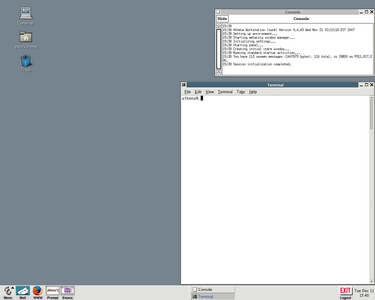
(Disclaimer: I work for MIT Information Services & Technology blah blah blah I am a student blah blah these are only my words and do not represent the opinion(s) of my employer.) Way back in the day in 1983, MIT started something it called Project Athena, which had the goal of investigating how computers could be used to enhance education at MIT. This project became the origin of such pieces of software as the X Window System and Kerberos, as well as a campus-wide network of workstations all running similar software. In 1991, Project Athena ended, but the Athena system continued on, taken over by MIT Information Systems. It’s 2008, and Athena still exists at MIT—walk into a computing cluster, and chances are all the machines will be running Athena software. (Unless that particular cluster has been taken over be Athena’s evil sibling, often referenced as “WinAthena”, which often seems to be maintained by no one, and whose existence is sometimes denied by those who maintain and support Real Athena. Not many machines have suffered this agonizing fate, luckily.) Unfortunately, as the years have progressed recently, fewer and fewer resources have been put into the development of Athena. In many ways it is no longer on the cutting edge of things as it has been in the past, though it is certainly still useful. Some students these days, however, even think of Athena as only “their MIT email” or maybe use it occasionally to print something in a cluster on the way to class. I’ve seen people grow frustrated and storm out of a cluster due to things like instructions for using a flash drive that involve more steps than just plugging it in. While on the one hand it’s easy to laugh at people for a lack of patience or being open to a computing system that is not either Windows or Mac and perhaps a bit more complicated on the surface, on the other hand, some of these things really should just work by now, and on other UNIX-based systems they do—but Athena has lagged behind. When you log into an Athena workstation for the first time, you are confronted with what looks like this: Clean MIT Athena login That’s GNOME 2.8, and it looks kind of like the GNOME 2.8 default but uglier. When you look under the hood, there are pieces of the system that obviously originated in a time where nothing better existed and so something new had to be created—the “xlogin” login system doesn’t support PAM, and the login path involves a hairy maze of scripts that perform various tasks. Under the hood, the base OS is currently RHEL 4 or Solaris 10. I still can’t remember what the right options are to feed RPM whenever I need some information that I think I should be able to get from it. These things were once necessary but today just look crufty. Some people have tossed around the idea that everyone has a laptop these days and thus clusters are uselessly expensive, but it’s been met with a lot of resistance. I’m all for progress, but I use clusters all the time! They’re one thing that makes it an easy choice for me to have a really portable laptop, because when I really need computing power or screen space on campus away from my room, there is always a cluster nearby. They’re also nice isolated places that can be associated with “work mode”, which is good for productivity. Beyond all this, Athena provides a common platform that all technical classes can depend on, from providing standard and specialized academic software to standing as a baseline of “make sure your code works on this before handing it in because that is how it will be graded”. At any rate, things are finally happening on this front. Athena can’t stay RHEL 4 forever—while AFS allows non-system software to be easily updated for all machines without requiring any OS release, hardware moves on and compatibility is lost, and the rest of the world is coming up with new awesome things that Athena machines are missing out on. A student group that I am vaguely involved with, SIPB, took the early initiative with this and created DebAthena, which takes stock Debian and Ubuntu and allows it to closely resemble an Athena environment. We even run a campus Linux dialup using the packages. (I won’t claim to have done much work on DebAthena myself because, well, I didn’t.) Amazingly, the Athena release team has decided to work with the SIPB on the next release of Athena. So, what I really just wasted over 600 words prepping for is to say that Athena 10 will be based on Ubuntu. This is only relatively new news, but I am lame about finishing blog posts. There are a variety of reasons why Ubuntu was chosen over Debian. Some of them are lame and some of them are not. Even so, I am excited about this prospect—and it should be possible to peripherally support Debian in such a way that was not possible with Athena 9.4. I really like Athena. Even coming to MIT with a background in Linux there has been a steep learning curve, though, and I think that things could be better. Lots of people here have their first encounter with a ‘nix system in the form of Athena, and we should strive to make that experience as good as possible. I’m kind of skeptical on the expected release date of this upcoming summer, but as long as it happens soon it will be a big step forward. In some ways it’s kind of sad that I’m excited about a big part of a research institution catching up with others—but inertia is a strong force, and dealing with thousands of workstations is no trivial task. I kind of long for the exciting days of creating new big pieces of free software like X. I bet I imagine those days as being better than they actually were.
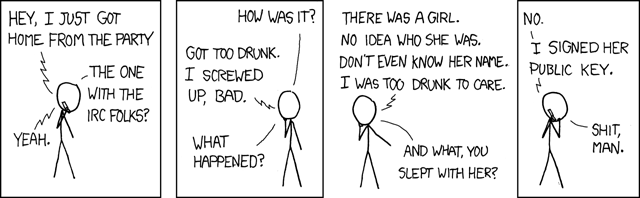
Patrick Winnertz: Responsible behaviour with gpg keys

Yeah... this happens if you are drunken see a nice girl and try to sign a gpg key :) : Without any other comment. Thanks to madduck: this comic is of course from xkcd

7 January 2008

Amaya Rodrigo: Back to life, back to blogging

Since September 19th I have been mostly offline and unreachable. This was due to having started a new job in a wonderful new project: soitu.es, an online newspaper with a strong focus on Citizen Journalism: citizens playing an active role in the process of collecting, reporting, analyzing and disseminating news and information, I must mention the master mind behind this all: Gumersindo Lafuente, one very well known journalist in Spain. On the other hand, working with Ra l Rivero, not the Cuban poet but the technical soul of the project, is something I would pay for, and I get actually paid to learn from him! Too bad he doesn t digg Debian :)


The site was finally launched during Xmas, and we are all less busy, so despite having what I call the weekend flu (that only affects me during the weekends, but I never feel so bad that I need to miss work during the week), I am back to normal, If you thought I was quite MIA, keep in mind I was not one of busiest ones at work! Launching such a project takes a toll on everyone, though. I set up a Flick set for my new workplace: Amayita s Soitu.es Flickr photo Set, in case you are curious. There is also an official Soitu.es Flickr Photo Pool.

Today is a holiday in Spain, due to D a de Reyes, when kids usually get their Xmas presents here. As I am fully recovered from this weekend s flu (today is Monday after all), I had some spare time and my cats got a nice present too: A DIY scratching post. There is a WTF column in the effing middle of my kitchen, so after some cardboard, a wall stapler, sisal rope and a bit of round and round the column... This pic shows the result:


Two happy cats and a sisal scratching post.


I couldn t resist filming a video, available on YouTube: This scratching post is now mine! - No! Mine! - I ll get you!

6 January 2008

Dirk Eddelbuettel: NAS'ed

I had been eyeing an inexpensive network-storage device -- for the non-geeks: think of a hard disk with an ethernet port and some controlling software -- for some time. I was aware of some of the hacking efforts around a few of these but somehow nothing really appealed. I was sort-of looking for nslu2-with-a-disk, and preferably not too expensive. Lo and behold, that's what I saw today in my techbargains feed: a Buffalo LinkStation Live which contains a 500gb SATA for $199 after rebates. Some quick googling lead to these wiki pages which looked promising: anything from enhancing the stock Linux setup by enabling a few more services to a custom Linux distro (similar to my wrt54 router running linux) to reportedly some work-in-progress for a native Debian installation. Nice! So off I went, ordered the thingie for local pickup for an additional 5% off and picked it up a little later at the local Circuit City (where visits are seemingly a recurring event these days). The documentation is very brief and insist that you install something on Windows -- just to find that the little box autoconfigures itself just fine. Presumably some network discovery is going to find the assigned dhcp address which is needed for the web interface. A few minutes later, a new (fixed) IP address was assigned, ntp was enabled and that was about that. After dinner, I quickly followed this tutorial to get the box a bit more Unixy without going too far (yet) from the default: start up telnet via a simple Java command-line tool, login, then enable ssh, set it up in /etc/init.d, add some extra binaries. All very quick and simple [ with the caveat that the addons.tar didn't want to get there via the Java tool, so manual scp once 'inside' did the trick ]. NFS, which I like for shuffling files around, appears to be little trickier for this ARM-based LinkStation Live. So at least for now I am content with simple rsync'ing of my backup directories on the few machines here. Much better than the current setup with mutual backups between workstations and semi-permanently being out of space. All in all a rather pleasant gadget and recommended at the price. The extra $100 in rebates are valid from today to the 12th.

5 January 2008

Andrew Pollock: [life] Post-op, Day 2

"Day Two Downers" be damned, Sarah's powering along like a freight train. Neither of us had a terribly fantastic night's sleep. Her chest drain is attached to this big box thing that has some sort of water seal in it, and with the suction going through it, it bubbles and makes noise like a massive aquarium. But she did get some sleep, and said she felt better this morning for it. The doctor came by at 8am, and took the incision dressing off, and we got our first good look at it. It's big (i.e. long). It runs from about the top of her breastbone to the bottom of her sternum. 20cm at my estimation. She said that she thought the chest tube could come out today, and sure enough it came out at about 12:30pm. They also took her urinary catheter out at that time, so now all she's hooked up to is oxygen. Her blood sugar levels were acceptable at breakfast time. Oh, the reason the incision ran so high was because they elected to do the bypass attachment to an artery in her neck, rather than further around the aorta, because the tissue was fragile and they didn't want to risk a dissection. Not doing the bypass in the aorta also left them the option of removing some of the transcending arch if they determined it still ended up being necessary. Sarah got up and had breakfast in a chair again, and was generally feeling pretty mobile. She moved between the chair and a wheelchair (and back) when they came to get her for another x-ray, without requiring any assistance. She took her first walk around the ward at 11am. I'd popped home for a shower and to check on the cats, and so I missed it. Doctor Miller dropped in at around 12:30pm to see how she was doing, and that was good as Sarah got a chance to talk directly to him about how the procedure had gone. He was very positive and said she could put this whole thing behind her now. At 2pm, she went for another walk, this time sans two thirds of the tubes from her first walk, and got in and out of bed unassisted. She took her last walk of the day at 4pm. Apparently her blood sugar is still on the high side, but within the range that they don't feel the need to give her insulin. Her chest is apparently looking better on the x-ray they took this morning. They took a second one after they removed the chest drain, but we haven't heard anything about how that looks yet. She's continuing to do extremely well, most of this less than 48 hours out of surgery.

Antti-Juhani Kaijanaho: What fiction I read in 2007

In rough chronological order, with capsule reviews. I don’t think I’ve missed any, but it is possible that I have. If you look through the list (behind the cut), you’ll see I read mostly Baen books nowadays. There’s a simple explanation: Baen is (almost) the only publisher that does real e-books, and I tend to avoid the inconvenience of paper books where I can. Still, there’s about a hundred titles on the list. (more…)

4 January 2008

Wouter Verhelst: Broken C code

A few weeks back, someone asked on debian-68k about an unexpected result of some piece of software when it was compiled on ARAnyM, an m68k emulator that can run Linux. His initial idea was that this could perhaps be a bug in ARAnyM, since it only occurred to him inside ARAnyM, and not on any of the other architectures he tried. In fact, it was a bug in his code. Let's have a look at what's going on here. The example program which Sergei provided and which exhibits the problematic behaviour is spread over two files. The first file contains this:
#include <stdio.h>
void *f();
main()  
	void *a;
	a = f();
	printf("%d\n", (long)a);
 
while the second contains this:
#include <stdio.h>
long f();
long f()  
	long a = 84;
	printf("%d\n", a);
	return a;
 
Many people familiar with the C programming language will intuitively expect that this program, when run, will output the following:
84
84
When in fact, when compiled and ran on an m68k machine, the output is as follows:
84
-1072577264
What's going on here? In order to understand that, we have to take a look at the assembly code. This is done by use of "objdump -d", and gives (amongst others) the following output:
800004c4 <main>:
800004c4:	4e56 0000	linkw %fp,#0
800004c8:	61ff 0000 001a	bsrl 800004e4 <f>
800004ce:	2f08		movel %a0,%sp@-
800004d0:	4879 8000 05aa	pea 800005aa <_IO_stdin_used+0x4>
800004d6:	61ff ffff feec	bsrl 800003c4 <printf@plt>
800004dc:	508f		addql #8,%sp
800004de:	4e5e		unlk %fp
800004e0:	4e75		rts
800004e2:	4e75		rts
800004e4 <f>:
800004e4:	4e56 0000	linkw %fp,#0
800004e8:	4878 0054	pea 54 <_init-0x800002f0>
800004ec:	4879 8000 05aa	pea 800005aa <_IO_stdin_used+0x4>
800004f2:	61ff ffff fed0	bsrl 800003c4 <printf@plt>
800004f8:	7054		moveq #84,%d0
800004fa:	4e5e		unlk %fp
800004fc:	4e75		rts
800004fe:	4e75		rts
So what's happening here? The difference should be clear: the f function stores its result value in the D0 register, but main goes looking for it in A0. The reason for this discrepancy very simple. The m68k processors has three sets of registers: one set is for integer values (D0 through D7), one set is for address values (A0 through A7), and one is for floating-point values (FP0 through FP7). The m68k ABI specifies that integer return values should be stored in integer registers, that address return values should be stored in address registers, and that floating-point return values should be stored in floating-point registers. This makes sense, since register-indirect addressing modes require the address to be stored in an address register; and calculating values requires the value to be stored in either a floating-point or integer register. When main, then, tried to look for a return value in A0, it found something, but obviously not what it should have found... This issue would have been a non-issue had this function been written the way it should have, like so:
#include <stdio.h>
void* f();
int main()  
	long* a;
	a=(long*)f();
	printf("%Ld\n", *a);
	return 0;
 
void* f()  
	static long a=84;
	printf("%Ld\n", a);
	return &a;
 
To close up: there's a reason why compilers emit warnings if you do something strange or "clever". In this particular case, the warning was suppressed, since both files contained a declaration of an f() function, even if the declaration was different. This is a horrible hack that tries to work around those warnings, rendering them utterly useless. Please, pretty please, with sugar on top: don't do something like that. If you write C code, please compile it with -Wall -Werror, and make sure it compiles that way. If you want to access a function in a different file, create a common header file that both will #include, so that the compiler can notice differences between declaration and definition of a function; and don't expect that something will work because you fixed it for a common and well-known case, because there will often still be other places where your bug will still trigger. In this case, by declaring the function as one returning a long value, they made sure it could not break on 64-bit architectures. However, as shown above, that doesn't make the bug go away...) Writing clean and portable code is way more fun. Trust me.

1 January 2008

Lior Kaplan: Responsible Behavior


For all those DDs who love to drink: (click to enlarge) By xkcd, A webcomic of romance, sarcasm, math, and language.

31 December 2007

Matthew Palmer: Cowboys

I am very saddened by the state of the IT industry. It seems like nearly everyone who works in or around IT is, to put it bluntly, a cowboy. There appears to be very little desire for actually helping people; instead all I see is a very large number of people circling around looking for the next person they can make a quick buck off. In short, most of the IT industry is composed of people who are little better than shysters and conmen. As a case in point, I recently had contact with someone who is trying to get an online store running. They've been trying, unsuccessfully so far, for several months. They've been screwed over by basically every IT-related person they've had contact with so far. Now, after all of their suffering, they've finally gotten in contact with me. Most of their money is gone, and they're deeply behind schedule. So I'm left trying to pull a miracle job in little time and with little money. Yes, I could shoo them away, because they're asking for more than they can afford, but there's a little spark of helpfulness left in me, and I'll try to get them going as best they can with what they've got. If they'd found someone competent right at the beginning, they'd have been fine. They started with sufficient cash and time to produce a good end result. But chancing upon someone decent doesn't have good odds in IT; it's a bit like winning the lottery. This story isn't unique in my personal experience, by any stretch. There seems to be a near-endless procession of non-technical people who come out of their encounters with the IT industry battered and bruised, whether it be on the web, in their business infrastructure, or their personal computing needs. While it's easy to blame the customer for not managing themselves and their computing properly, I don't think it's fair to lay the blame on them -- to me, that's like blaming the patient for dying on the operating table, when the responsibility must lie, prima facie, with the surgeon. It's the surgeon, after all, who is the (presumably) trained and experienced professional in the relationship, and it is his responsibility, primarily, to ensure that everything goes smoothly[1]. Depressingly, I don't see much of a way around this problem. The few IT people who did care could try and group together, build some sort of a rating or "membership implies quality" system, educate the consumer, and try and drive the cowboys out, but guilds and trade associations are frowned upon these days, smacking (as they do) of restraint of trade and collusion. Government regulation never seems to produce anywhere near the desired result, while hoping that the consumer will either rise up and demand quality, or will gain sufficient knowledge to be able to pick a cowboy is a complete non-starter, for the same reason as teaching everyone basic surgical techniques isn't going to improve the quality of hospitals.
There's an ad that used to be on Australian TV for a certain bank, where a guy is at a party and he's asked by another of the partygoers what he does for a living. As he replies, "I work in banking", the entire party goes silent and stares at him in horror. It's only when he says, "It's OK, I'm with $BANK_BEING_ADVERTISED" that everyone looks happy again and continues on with their party. Although I've never had that particular experience, I'm almost getting to the point where I'm not happy telling people what I do for a living. This is because in any non-trivial collection of people, there's almost certainly going to be at least one person who has had such a poor experience with the IT industry that they're either going to take it out on me, ask me interminable questions about computers, or will just hate me on principle. It's unfortunate that brothels don't have pianos any more; if I were to say "I play piano in a whorehouse" I'm pretty sure the response would be "lawyer or sysadmin?". As Edsger Dijkstra said back in 2001, "The average customer of the computing industry has been served so poorly that he expects his system to crash all the time, and we witness a massive worldwide distribution of bug-ridden software for which we should be deeply ashamed." Are you?
1. That isn't to say that the patient (or client) has no responsibility in ensuring a positive outcome -- if you go bungee jumping the day after open heart surgery, or never send your web developer any content, you're very unlikely to have a positive outcome. However, it seems to me as though the only customer consultation done by most IT "professionals" on taking on a project is a Homeresque "I only have two questions. 'How much?' and 'give it to me'".

29 December 2007

Jeff Licquia: Christmas Gadgets: Creative Zen, LCD Monitor

So it’s a few days after Christmas, and like most of us tech-heads, I’ve got a few more gadgets to play with. First up: the Creative Zen 4GB. This one was a little bit of a saga. Last year, we got the kids no-name MP3 players, on the theory that we didn’t want to spend megabucks on something they wouldn’t use. They made valiant attempts to use them, but the little machines just weren’t up to the job. So, it seemed prudent to buy them iPods this year. Well, except for Apple’s attempts to break all non-iTunes iPod software, which had the side effect of making the devices unusable under Linux. Still, this was what they wanted, and they had been good this year, and very patient with my ever-more-convoluted schemes to get the old players working. So, iPod Nano 3Gs for both of them. My heart sank as I watched some of my hard-earned money go to reward such behavior. As part of the deal, I vowed to find a non-Apple player that would be good for when the iPods gave up the ghost or became “uncool”. And my dear wife, upon hearing this, went online, did some research, and bought me the aforementioned Creative Zen 4GB. From a Linux perspective, it’s in the “not quite ready for prime time” mode. Rhythmbox and Banshee are working on support; I tried a prerelease of Rhythmbox, and found its support to be very unstable. The only usable app is Gnomad2, which has a terrible UI and also occasionally crashes, but can manage to upload audio, video, and photos without too much hassle. Still, this is a problem of fine-tuning, and not of a hostile hardware vendor; I’m confident that these devices will be well-supported in the near future. The Zen is picky about what video files it will play, but I managed to figure it out: DivX or XviD video, 320×200 or smaller image size, encoded at a 480 kbit/sec video bitrate or less. Other video files might work, too, but you’ll have to find them on your own. My Zen has a little problem with the button locking feature: after unlocking, the screen comes up to all-white, and you have to power-cycle it to get the display back. I’m assuming this is a firmware bug, as the screen is still visible for a short time after engaging the lock. Other than this, the Zen is a delight, and every bit as functional as the iPod. The other nice gadget: a 24-inch LCD from Envision, bought after Christmas with a combination of gift cards, exchanges, and some of my own money. It was an open-box, and I saved about $80 for that; the only problem turns out to be a single dead pixel in the corner of the screen which is barely visible. It does 1920×1200 in very nice, bright color. Here, too, an improvement on my life only came after some effort. Debian 4.0’s drivers for the Intel graphics chipset are not capable of driving a widescreen LCD; the best I could get was 1600×1200, a normal-width resolution stretched across the wide display. I booted an Ubuntu Gutsy live CD to verify that the problem wasn’t with the monitor, and then set to the task of backporting everything I needed from lenny. Happily, before I started, I found that someone (Holger Levsen, to be exact) had done the work for me. Things are now about 90% there. The new drivers still don’t have everything figured out for running both Compiz desktop effects and XVideo acceleration at the same time, so I’ve had to turn XVideo off. My computer can render video without hardware support, but the quality isn’t as high. But, I have my nice wide screen, with crisp fonts and lots of room. I figure I’ll live with what I have until lenny releases, and then see what progress has been made.

Enrico Zini: eeepc

Meet the EeePC Being in Taiwan, we swiftly got hold of an Eeepc. Instead of installing Debian into it, we decided to keep the original system and see how it works. It's a Debian derivative, and the feeling inside a terminal window is quite familiar. The boot is very fast. Two seconds after the video bios quickly shows on the screen, the X cursor appears. It's definitely worth having a look at how this devil boots. The "Asus Launcher" is worth a look. IMHO it's nicer and more useful than the usual launcher menu that we get in Gnome or KDE 3, although it probably only makes sense on a small display. It replaces the desktop background, has tabs, no clutter and allows to launch applications. Turns out it's customisable as well. What's on the system KDE 3.4.2, with some applications renamed so that their names are more human. For example, konsole became console. vim! \o/ But not emacs :) mc! Someone out there wanted to make my life easier. fbreader. I had never heard of it, but it's a very good discovery that I've now started to use it on my laptop as well. Little howtos To get to a terminal, hit Ctrl+T in the file manager, or Ctrl+Alt+T elsewhere. The root password is the same as the user password. To change the system language, I managed with a simple dpkg-reconfigure locales. Ways they simplified the unix system It's single user: I didn't find a way to create multiple users besides the terminal, and the login program does not ask for a username, only for the password. The "win" key has a house painted on it, and it's used as "hide/show all applications" key. When all applications are minimised, the Asus launcher is visible instead of the X background: this behaviour basically turns the key into a sort of "run application" key. The key still works as a kind of shift, although it probably was not intended to. The repository management is interesting. /etc/apt/sources.list contains:
deb http://update.eeepc.asus.com/p701 p701 main
deb http://update.eeepc.asus.com/p701/tw p701 main
which means they have a repository per eepc model and a subrepository per localised version. The "Internet" group of applications has a Wikipedia toplevel application: it's nice to see the ecosystem of free software / free culture coming together to provide a nice user experience. An extra link to the SD card mount point (besides the one in /mount) appears in the home directory automatically when the SD card is inserted. This means that when you do "save as" from all sorts of applications, the SD card is there, easy to reach. This helps if one decides not to use the internal flash for data, and just save everything in the SD card: I like doing this, as it allows me to quickly move the SD card with all the data between the EeePC and other computers. Changes I made so far Activate en_GB.UTF-8 via dpkg-reconfigure locales. Add en_GB.UTF-8 to /etc/scim/global, to get SCIM input methods to work. Little flaws Virtual screens are enabled, so W+arrow switches virtual screen. The feeling you get if you hit W+arrow is that all your applications disappeared. This could be improved by having the vm keep the asus launcher at the bottom of the current virtual screen, instead of just at the bottom of the first screen. Or, to disable virtual screens by default. It is possible to drag the lower panel around, maybe accidentally: that's another of our fancy default "features" that should be disabled by default. It is also possible to remove applets from the applet bar by mistake: for example I wanted to disconenct the wireless, and I instead ended up quitting the wireless applet. Luckily, the next time I started the computer it magically came back. ~/.xsession-errors is continuously getting the useless stdout/stderr debugging flood of GUI apps. Noone bothers usually, except that in this case the file is on flash, where unneeded writes are also very much unwanted. I'm considering symlinking it to /dev/null, but ideally we should get GUI apps to only write out what is really important. Battery charging doesn't show how long it is going to take until the battery is fully charged. No capslock or numlock leds. This probably calls for disabling or remapping of capslock. Numlock is very hard to hit by accident, but capslock is. Random thoughts If you buy an eeepc, I really suggest you think of it a mass consumption appliance and stay on the original OS for a while. Most of what's in here is what we use everyday, just on a different context. Try to use it as an appliance and see if it is perfect, and if it isn't, try to find out what is missing. It is a fantastic way to find out important bits that are missing in Debian as well. Also, if you're used to tailoring everything to yourself before starting to use a Linux system, this is a great way to try the usage experience that we can offer by default. The Firefox welcome page the first time you connect, for example, is surprisingly nice. Everything we know as doable comes a bit as as a surprise because this time someone has done it for us. I wish that that someone can be invited to talk at the next Debconf: the possibility of having a look at the work that has been done in bending Debian to this nice little device is to me one of the most valuable things so far about the eeepc. Help/About KDE/Credits It's reachable by most applications, and says:
The development team would like to thank the following people and organizations for their contributions:
  • the Debian Project,
  • the GNU Project,
  • the KDE Project,
  • the Mozilla Project,
  • the OpenOffice.org Project,
  • the SAMBA Project,
  • the X.Org Foundation,
Linus Torvalds and the other Linux kernel developers, and Free software developers around the world.
I'm using an appliance that is thanking me, and others like me: priceless!

28 December 2007

Lior Kaplan: conffiles, newer packages and purging


Earlier this month Kumar Appaiah opened a bug against the culmus package as part of the stable -> unstable piuparts upgrade tests. First, I’m proud in Debian to have these tests. Thanks for the people involved with running them, parsing the log files and reporting the bugs. I really feel the lake of such checks in commercial distributions I work with. After finding the time to get to the bottom of the bug, and talking with Kumar, it seems most of the bugs found in the test are similar. I think this might indicate something wrong in a more basic level of the package handling. The source of these bugs is how to handle files which were conffile in version x, but aren’t included in version x+1 (as a regular file). In the common situation, the conffiles are removed only during the purge process and not during upgrade or removal. But if a conffile doesn’t exist in the x+1 package, no one will “own” it after the upgrade, and no will purge it in due time. This is why changing conffiles can result in extra files on our system, which is the problem discovered by the recent piuparts test. One solution will be that each package maintainer will add the necessary code to the maintainer scripts to remove the file on upgrade. A second solution is to decide the wanted behavior in such a case and to have dpkg handle it for all packages. The behavior can be to remove the old conffile during the upgrade (postinst script) or to dynamically add it to the list of files owned by the package. Although technically possible, I’m not sure if the second method is “legal” with the debian policy. I thought it would be better to hear others’ opinions before submitting a wishlist bug about this.

Martin-&#201;ric Racine: O: planner -- project management application

While looking at outstanding bugs against my Debian packages, I noticed that an RC bug had crept in against Planner. The bug itself isn't new. In fact, Ubuntu had experienced it already and simply decided to build their package without SQL support to resolve the issue. Planner is a fairly well-matured piece of software, with very few bugs remaining. It remains quite usable in everyday use. However, it has fallen behind in terms of keeping its code up-to-date against the latest versions of some optional dependencies. Tonight, I was just sitting here pondering what to do and it occurred to me that I'm simply no longer interested in maintaining the package. I have done a fairly good job of overhauling the build scripts and of upgrading them for the Python transition but, at this stage, I feel that I've accomplished as much as I could do. Besides, I no longer have the time to maintain so many packages, so I have decided to focus on maintaining those I actually care for and Planner isn't one of them. The package already is assigned to Debian's GNOME team, so no need to actually orphan it, since anyone from the team can pick it up. If you're a member of the GNOME team and feel like taking over, perhaps even submitting patches to upstream to close a few more bugs, go right ahead and jump in.

Holger Levsen: 24C3 day two - 8h to complete a blog post

It's noon now and half the attendees or so the day hasn't really begun. Sure, some people here at the 24C3 in Berlin are having lunch already, but most are having breakfast or not even that yet. As the Debian booth is set up (mugs are sold out, bags almost...) and there are no interesting talks for me at the moment, I'm having a second breakfast in the smokers lounge is the cellar. Officially, this is the third non smoking congress and inofficially it's the third time there is an official smoker place ;-) This time, it's a lounge with comfortable sofas, ambient light and loud music...

About four weeks ago I was contacted by Martin Michlmayr and asked if the video team could make use of some hardware donation a company wanted to sponsor. I said yes, and so last week two boxes arrived at my house: a small audio mixer, a Behringer XENYX 1202 with 12-channels and XLR and chinch inputs, which is supposed to help us improve the audio quality in small venues. The second box contained a TwinPact100, which is a video converter box. It has an SVGA-input (supporting up to 1600x1200), an SVGA-output (sending the same signal out) and DV (firewire) output (and more features we don't really care about). So for us it's basically a SVGA-passthrough box which also outputs a video stream (of a speakers laptop in our use case) over firewire. So no more capturing of slides with a normal camera, yay! Yesterday Ben Hutchings and me tested this box and found it working, then Ben also fixed an issue with dvswitch, which we use to mix different firewire video streams together, probably even as soon as FOSDEM again! Many thanks to hitflip.de for this nice donation!

When I arrived here this morning I hoped to see the BabelBox I set up last night to be still running, and it was, yay! BabelBox is a d-i setup which loops through an installation of Debian etch in 36 languages, mostly using the graphical installer. And this will be running here for approx 72 hours non-stop resulting in 289 installations without a single keystroke :) IMO it shows real nicely two of the three major strengths of d-i: internationalisation and automatisation.

I guess it's pretty unlikely that I'll find some time during the last two days of the congress to take Andre Salomons packages for the OLPC laptop and demonstrate d-i's third major feature: it's modular design. It's more likely to be an excercise for next year though (I'll arrive home on the 31st..), here is too much stuff happening. Installing babelbox was just following a good howto. In any case, there is a OLPC.de meeting planned tomorrow at 12.30 noon at the Debian booth or in the Embedded Corner. Just come along and look out for the green cluster of XOs :)

And by now it's 8 PM - time flies when you're having fun. I just noticed that my wireless connection is up since seven hours uninterrupted! Wow.

Erich Schubert: Spamtrap followup

A few days ago, I asked about how to properly embed spamtraps in web pages.Well, noone could tell me if using display: none is appropriate. I actually do not want Google to index the contents in that div. So as long as they don't punish me for using display: none at all, it's okay. And the page I placed the spamtrap on is a doorway-like page for others anyway; it's not part of an important site.It took the first spammer around 54 hours to send the first spam. Or try to send: all 10 retries with different zombies were rejected by my spam filter. Since then, I've been receiving another round of deliver attempts - around 5-15 per spamtrap address - almost every hour.Of the > 500 spam delivery attempts I've seen since, none made it through my initial spam filters (not to speak of the content filter behind that), but they were rejected at the SMTP level, even before the mail content was sent.I've now disabled some of my spam filters to allow the trap adresses to actually receive mail. After all, I want to use them to train my filter. :-)

27 December 2007

Julien Danjou: EWMH and XRandR

Today I decided to add some EWMH support to awesome. It now supports a bunch of this extensions quite nicely. However, while reading the spec and writing the code, it appears that this forces a window manager to behave in only one way: have a poor desktop support, and no multi-head/XRandR/Xinerama support at all. The main caveats are that in Xinerama/XRandR mode, you'll have only one root window. And the root window is where you must store the NET_WM X properties So you cannot handle screens in a independant way like awesome does. That's really a shame. There's also a big problem for window managers like awesome which are happy to draw several desktops at the same time. There's no support for stuff like that. So far, I think EWMH is nice but is really too narrow-minded for softwares and people who want to think window management in a different way.

Holger Levsen: Volldampf voraus

"Volldampf voraus" ("full steam ahead") is the motto of this years chaos communication congress, which should express a particular request for talks and projects featuring forward looking hands-on topics. If you are not attending check out the schedule anyway, it covers a huge variety of topics and most of the events are in English and all should be streamed live.

Since about two hours the debian booth (located in the upper floor next to the Embedded Corner) is finally set up (thanks to a bunch of friendly debian people - we are still looking forward to welcome you to sit behind the booth and answer peoples questions), the fourth slot of talks is beginning now and in an hour I hope I'll find time for some food...!

If you are at the congress and want to try the wireless mesh networking provided by the freifunk community, you can either use OLSR or B.A.T.M.A.N as routing protocols. Last night I've uploaded batmand and olsrd packages to experimental, featuring those development versions which are supposed to be used here. They are also available on my webserver for etch and sid (follow the previous links).

25 December 2007

Erich Schubert: Visualizing with XHTML and SVG

My thesis is about data mining, clustering of correlated data in high dimensional vector spaces, to be a bit more precise.In detail, I'm working on methods to improve upon existing clustering algorithms such as 4C (Computing Clusters of Correlation Connected Objects) and ERiC (On Exploring Complex Relationships of Correlation Clusters), where you need to pick some parameters (e.g. k for a k nearest neighbour based approach) appropriately.My approach is twofold. On one hand, I'm improving upon the traditional covariance based correlation (which is quite sensitive to noise), so the parameters become easier to pick, on the other hand I'm working on an approach to automatically fine-tune the parameters to further improve stability.For testing my computations I needed a visualization of this data. I was considering using gnuplot (and in fact I'm using gnuplot a lot), but for some situation I needed animation capabilities, and thats where gnuplot becomes really messy.So I decided to dive into SVG and Javascript. Here's my first SVG project:Visualizing kNN correlation in SVG with Javascript(Internet Exploder is not supported. I don't have Windows, and for all I know it doesn't really support SVG. Use a Gecko-based browser such as Firefox, Opera and Safari (at least on Windows) also seem to work. I didn't get it to work on kHTML/Konqueror/Webkit. I'm just doing this for myself, so I have no need to support other browsers.)It's a 3D dataset, consisting of 300 points. 100 points are noise, 100 points are in a 2D cluster (green) and 100 points are on a 1D cluster embedded into this plane (I'm working on algorithms that support hierarchical clusters, so I needed a dataset with this property!).There are two buttons in the UI, one toggles rotation, the other one toggles the playback of "k". It will cycle k through a range of about 3-200. When offset hits 20 (so k would be 22 or 23), the main correlation vectors - the big blue lines - already point along the 1D cluster. At an offset of around 80 they have already diverged quite a bit from the 1D cluster - at this point, the correlation is seeing the 2D plane quite well already.I could also show you the behaviour for points in the 2D plane (but outside of the 1D cluster) and noise points.We're preparing a paper for SSDBM 2008.[Update: Safari works at least on Windows]

Next.

Previous.