Search Results: "ana"

2 December 2015

Dirk Eddelbuettel: RcppCCTZ 0.0.1

A new package! A couple of weeks ago folks at Google released CCTZ: a C++ library for translating between absolute and civil times using the rules of a time zone. It requires only a proper C++11 compiler and the standard IANA time zone data base which standard Unix, Linux, OS X, ... computers tend to have in /usr/share/zoneinfo. And as the world needs nothing more than additional date, time, or timezones libraries, I started to quickly create a basic R wrapper package. This stalled as the original version of CCTZ used an __int128 for extended precision. That is not only not portable, but also prohibits compilation on baby computers still running a 32 OS (such as my trusted X1 laptop merrily plugging along with 4 gb of ram under Linux). Hence I filed an issue ticket which, lo and behold, got resolved two days ago. And so now we have a shiny new RcppCCTZ package on CRAN in a very basic version 0.0.1. It happily runs all the original examples from CCTZ as e.g. this one:
// from examples/hello.cc
//
// [[Rcpp::export]]
int helloMoon()  
    cctz::TimeZone syd;
    if (!cctz::LoadTimeZone("Australia/Sydney", &syd)) return -1;
    // Neil Armstrong first walks on the moon
    const auto tp1 = cctz::MakeTime(1969, 7, 21, 12, 56, 0, syd);
    const std::string s = cctz::Format("%F %T %z", tp1, syd);
    Rcpp::Rcout << s << "\n";
    cctz::TimeZone nyc;
    cctz::LoadTimeZone("America/New_York", &nyc);
    const auto tp2 = cctz::MakeTime(1969, 7, 20, 22, 56, 0, nyc);
    return tp2 == tp1 ? 0 : 1;
 
which results in
R> library(RcppCCTZ)
R> helloMoon()
1969-07-21 12:56:00 +1000
[1] 0
R>
indicating that the two civil times in fact correspond to the same absolute times when Armstrong walked on the moon. If you want to learn more about CCTZ, there was a corresponding talk CppCon (Youtube, Slides). I hope this provides a starting point for some new interesting computation on time from R. Collaboration welcome via the RcppCCTZ GitHub repo.

This post by Dirk Eddelbuettel originated on his Thinking inside the box blog. Please report excessive re-aggregation in third-party for-profit settings.

1 December 2015

Laura Arjona: Software Freedom Conservancy supporter

I think it s important that organizations as Software Freedom Conservancy exist.
They provide a non-profit home, infrastructure, and advice for FLOSS projects. They take care that the will of the project members, choosing free software licenses, is respected by third parties. They care about all the rest so free software contributors can focus in improving the software itself. They have an agreement with the Debian community to protect the freedoms that Debian Developers provide to the Debian end users (and derivative distributions). So I decided to join as supporter. I m happy that this week there is a matching fund so my donation will count double. I hope that many others join too, so the organization s voice and action continues loyal to their goals and representative of all the projects (wether big or small) under their umbrella. This way (small donations from many individuals as funding model), no single or few actors can use their big money as pressure to deviate or block Conservancy s action. We free software/free knowledge contributors know very well the power that many micro actions can provide, when coordinated towards the common good, isn t it?
Filed under: My experiences and opinion Tagged: Communities, Contributing to libre software, Debian, Economic Aspects, English, Free Software, licenses, Project Management

Enrico Zini: akonadi-fails-to-sync

When Akonadi silently fails to sync your calendar... Bug severity: seriously ruining my life. Try to use korganizer to create a calendar entry when the server is not reachable (say, you are offline, or you typed the wrong password), and you may find that you end up with no error messages, an entry that shows up perfectly fine, but that will never be synced to the server, ever again. I use korganizer, radicale and caldav for important things. The practical ramifications of me inserting entries in korganizer, seeing that everything looks ok, and then not finding them on my phone while on the go, are scary. Think of things like importing .ics files with flight schedules, entering tax deadlines, time and places for customer meetings, time and places of arrival of loved ones I'm supposed to pick up. I spent time setting up my own infrastructure for this exactly because I care that all of this works reliably. And now I urgently took a morning off work to find a way to detect those entries that Akonadi is refusing to update, The whole thing is cumbersome to run, but if you are using kdepim-based tools to manage your calendars and sync them across devices, you may want to give it a go every once in a while. You can find the script and the notes I took so far on the issue at https://github.com/spanezz/akonadi-workarounds.

30 November 2015

Lunar: Reproducible builds: week 31 in Stretch cycle

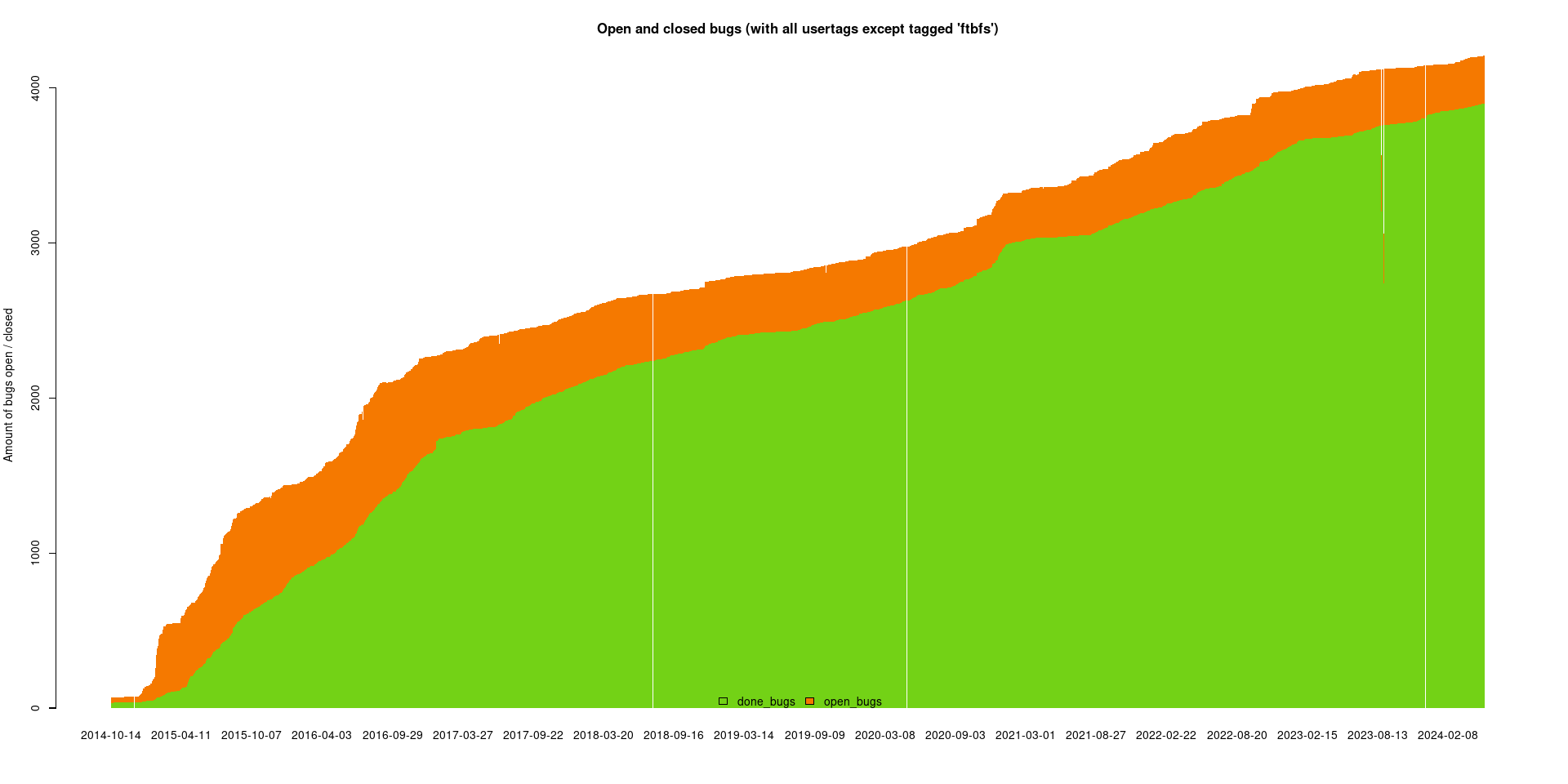
What happened in the reproducible builds effort this week: Toolchain fixes Reiner Herrmann submitted a patch against debhelper to make dh_installinit source files in a stable order. Chris Lamb found how to make cython output deterministic by ordering the keys used to traverse a dict. Reiner Herrmann proposed a patch for pyside-tools to remove the timestamps embedded by rcc in the generated Python code. Mattia Rizzolo rebased our custom version of debhelper on version 9.20151126. As no objections have been made so far, Mattia Rizzolo has filled #805872 asking -Wdate-time to be turned on by default in dpkg-buildflag. Guillem has since sent a final warning before proceeding as such in the next dpkg upload. Russ Allbery added support for SOURCE_DATE_EPOCH in podlators 4.00 which Niko Tyni intend to backport to Perl 5.22. Packages fixed The following packages have become reproducible due to changes in their build dependencies: fontforge, golang-github-tinylib-msgp, libpango-perl, libparanamer-java, libxaw, sqljet, stringtemplate4, uzbl, zope-mysqlda. The following packages became reproducible after getting fixed: Some uploads fixed some reproducibility issues, but not all of them: Patches submitted which have not made their way to the archive yet: Lunar reported two issues making xz-utils unreproducible (#806328, #806331). reproducible.debian.net A seventh armhf build node has been added (resulting of two more armhf build jobs). Thanks to Vagrant Cascadian for putting this Raspberry Pi 2B to help. (h01ger) jenkins.debian.net has been made more robust against network and proxy failures. (h01ger) A new 100 GB partition has been set up on reproducible.debian.net to prevent disk space issues. Thanks to ProfitBricks for its continuous support to our continuous test system. (h01ger) New graphs showing usertagged bugs have been added on the dashboard to measure the progress without FTBFS issues. Please note that comparing the two graphs might be misleading as more than 1300 FTBFS bugs have been inventoried. (h01ger) Package reviews 78 reviews have been removed, 116 added and 49 updated this week. 25 new FTBFS have been filed by Chris West, Chris Lamb and Santiago Vila. New issues identified this week: timestamps_in_documentation_generated_with_libwibble, copyright_year_in_documentation_generated_by_sphinx, timestamps_in_documentation_generated_by_glib_genpod, random_order_of_tmpfiles_in_postinst, random_order_in_cython_output, timestamps_in_python_code_generated_by_pyside. Reiner Herrmann and Lunar improved the prebuilder script: the script can now be called through a symlink, run parallel builds, calls diffoscope by its new name and ensure to install its recommends, and save the text output aside the HTML one. Reiner also added a script to lookup the last update of notes for a given package. Misc. Santiago Villa has been recently working on making sure that Arch:all packages were properly buildable by running dpkg-buildpackage -A. This uncovered a question that is probably not currently addressed by the policy: on which architectures should architecture-independent be buildable?

Neil Williams: bashrc-git snippets

Just in case someone else finds these useful, some bash functions I ve got into the habit of having in ~/.bashrc:
mcd()  mkdir "$1"; cd "$1";  
gum()  git checkout "$1" && git rebase master && git checkout master;  
gsb()   LIST= git branch egrep -v '(release staging trusty playground stale)' tr '\n' ' ' tr -d '*' ; git show-branch $LIST;  
gleaf()  git branch --merged master   egrep -v '(release staging trusty playground pipeline review stale)';  
mcd is the oldest one and the simplest. The others are just useful git management shortcuts. I can use gum to bring a feature branch back to master and gsb to show me which branches need to be rebased on master, typically after a pull. The list of excluded branches includes branches which should not be rebased against master (I could do some processing of git branch -r to not have those hardcoded) but the odd one is stale. Sometimes, I get an idea for a feature which is too intrusive, too messy or just too incomplete to be rebased against master. Rather than losing the idea or wasting time rebasing, I m getting into the habit of renaming the branch foo as stale-foo and gsb then leaves it alone. Equally, there are frequently times when I need to have a feature branch based on another feature branch, sometimes several feature branches deep. Identifying these branches and avoiding rebasing on the wrong branch is important to not waste time. gsb takes a bit of getting used to, but basically the shorter and cleaner the output, the less work needs to be done. As shown, gsb is git show-branch under the hood. What I m looking for is multiple commits listed between a branch and master. Then I know which branches to use with gum. Finally, gleaf shows which feature branches can be dropped with git branch -d.

Chris Lamb: Free software activities in November 2015

Here is my monthly update covering a large part of what I have been doing in the free software world (previously):
Debian
  • Presented at MiniDebConf Cambridge 2015 on the current status of Debian's Reproducible Builds effort.
  • Contributed initial Debian support to Red Hat Product Security's repository of certificates shipped by various vendors and Open Source Projects. (#1)
  • Wrote a proof-of-concept version of Guix's challenge command to determine if an installed binary package is reproducible or not. (code)
  • Started initial work on a b2evolution package.
  • Arranged logistics for the Reproducible Builds summit in Athens.
My work in the Reproducible Builds project was also covered in more depth in Lunar's weekly reports (#27, #28, #29, #30).
LTS

This month I have been paid to work 13 hours on Debian Long Term Support (LTS). In that time I did the following:
  • Issued DLA 349-1 for python-django correcting an potential settings leak.
  • Issued DLA 351-1 for redmine fixing a data disclosure vulnerability.
  • Worked on multiple iterations of a fix for CVE-2011-5325 in busybox, not yet complete in order to additionally cover hardlinks.
  • Frontdesk duties.

Uploads
  • redis Addressing CVE-2015-8080, a buffer-overflow security issue.
  • python-django Uploading the latest RC release to experimental.
  • strip-nondeterminism Disable stripping Mono binaries as it is was too aggressive preventing some package installs.
  • gunicorn Correct Python interpreter path references in gunicorn3-debian.
  • python-redis New upstream release.
  • ispell-lt Making the build reproducible.


29 November 2015

Matthew Garrett: What is hacker culture?

Eric Raymond, author of The Cathedral and the Bazaar (an important work describing the effectiveness of open collaboration and development), recently wrote a piece calling for "Social Justice Warriors" to be ejected from the hacker community. The primary thrust of his argument is that by calling for a removal of the "cult of meritocracy", these SJWs are attacking the central aspect of hacker culture - that the quality of code is all that matters.

This argument is simply wrong.

Eric's been involved in software development for a long time. In that time he's seen a number of significant changes. We've gone from computers being the playthings of the privileged few to being nearly ubiquitous. We've moved from the internet being something you found in universities to something you carry around in your pocket. You can now own a computer whose CPU executes only free software from the moment you press the power button. And, as Eric wrote almost 20 years ago, we've identified that the "Bazaar" model of open collaborative development works better than the "Cathedral" model of closed centralised development.

These are huge shifts in how computers are used, how available they are, how important they are in people's lives, and, as a consequence, how we develop software. It's not a surprise that the rise of Linux and the victory of the bazaar model coincided with internet access becoming more widely available. As the potential pool of developers grew larger, development methods had to be altered. It was no longer possible to insist that somebody spend a significant period of time winning the trust of the core developers before being permitted to give feedback on code. Communities had to change in order to accept these offers of work, and the communities were better for that change.

The increasing ubiquity of computing has had another outcome. People are much more aware of the role of computing in their lives. They are more likely to understand how proprietary software can restrict them, how not having the freedom to share software can impair people's lives, how not being able to involve themselves in software development means software doesn't meet their needs. The largest triumph of free software has not been amongst people from a traditional software development background - it's been the fact that we've grown our communities to include people from a huge number of different walks of life. Free software has helped bring computing to under-served populations all over the world. It's aided circumvention of censorship. It's inspired people who would never have considered software development as something they could be involved in to develop entire careers in the field. We will not win because we are better developers. We will win because our software meets the needs of many more people, needs the proprietary software industry either can not or will not satisfy. We will win because our software is shaped not only by people who have a university degree and a six figure salary in San Francisco, but because our contributors include people whose native language is spoken by so few people that proprietary operating system vendors won't support it, people who live in a heavily censored regime and rely on free software for free communication, people who rely on free software because they can't otherwise afford the tools they would need to participate in development.

In other words, we will win because free software is accessible to more of society than proprietary software. And for that to be true, it must be possible for our communities to be accessible to anybody who can contribute, regardless of their background.

Up until this point, I don't think I've made any controversial claims. In fact, I suspect that Eric would agree. He would argue that because hacker culture defines itself through the quality of contributions, the background of the contributor is irrelevant. On the internet, nobody knows that you're contributing from a basement in an active warzone, or from a refuge shelter after escaping an abusive relationship, or with the aid of assistive technology. If you can write the code, you can participate.

Of course, this kind of viewpoint is overly naive. Humans are wonderful at noticing indications of "otherness". Eric even wrote about his struggle to stop having a viscerally negative reaction to people of a particular race. This happened within the past few years, so before then we can assume that he was less aware of the issue. If Eric received a patch from someone whose name indicated membership of this group, would there have been part of his subconscious that reacted negatively? Would he have rationalised this into a more critical analysis of the patch, increasing the probability of rejection? We don't know, and it's unlikely that Eric does either.

Hacker culture has long been concerned with good design, and a core concept of good design is that code should fail safe - ie, if something unexpected happens or an assumption turns out to be untrue, the desirable outcome is the one that does least harm. A command that fails to receive a filename as an argument shouldn't assume that it should modify all files. A network transfer that fails a checksum shouldn't be permitted to overwrite the existing data. An authentication server that receives an unexpected error shouldn't default to granting access. And a development process that may be subject to unconscious bias should have processes in place that make it less likely that said bias will result in the rejection of useful contributions.

When people criticise meritocracy, they're not criticising the concept of treating contributions based on their merit. They're criticising the idea that humans are sufficiently self-aware that they will be able to identify and reject every subconscious prejudice that will affect their treatment of others. It's not a criticism of a desirable goal, it's a criticism of a flawed implementation. There's evidence that organisations that claim to embody meritocratic principles are more likely to reward men than women even when everything else is equal. The "cult of meritocracy" isn't the belief that meritocracy is a good thing, it's the belief that a project founded on meritocracy will automatically be free of bias.

Projects like the Contributor Covenant that Eric finds so objectionable exist to help create processes that (at least partially) compensate for our flaws. Review of our processes to determine whether we're making poor social decisions is just as important as review of our code to determine whether we're making poor technical decisions. Just as the bazaar overtook the cathedral by making it easier for developers to be involved, inclusive communities will overtake "pure meritocracies" because, in the long run, these communities will produce better output - not just in terms of the quality of the code, but also in terms of the ability of the project to meet the needs of a wider range of people.

The fight between the cathedral and the bazaar came from people who were outside the cathedral. Those fighting against the assumption that meritocracies work may be outside what Eric considers to be hacker culture, but they're already part of our communities, already making contributions to our projects, already bringing free software to more people than ever before. This time it's Eric building a cathedral and decrying the decadent hordes in their bazaar, Eric who's failed to notice the shift in the culture that surrounds him. And, like those who continued building their cathedrals in the 90s, it's Eric who's now irrelevant to hacker culture.

(Edited to add: for two quite different perspectives on why Eric's wrong, see Tim's and Coraline's posts)

comment count unavailable comments

27 November 2015

Simon Josefsson: Automatic Replicant Backup over USB using rsync

I have been using Replicant on the Samsung SIII I9300 for over two years. I have written before on taking a backup of the phone using rsync but recently I automated my setup as described below. This work was prompted by a screen accident with my phone that caused it to die, and I noticed that I hadn t taken regular backups. I did not lose any data this time, since typically all content I create on the device is immediately synchronized to my clouds. Photos are uploaded by the ownCloud app, SMS Backup+ saves SMS and call logs to my IMAP server, and I use DAVDroid for synchronizing contacts, calendar and task lists with my instance of ownCloud. Still, I strongly believe in regular backups of everything, so it was time to automate this. For my use-case, taking backups of the phone whenever I connect it to one of my laptops is sufficient. I typically connect it to my laptops for charging at least every other day. My laptops are all running Debian, but this should be applicable to most modern GNU/Linux system. This is not Replicant-specific, although you need a rooted phone. I thought that automating this would be simple, but I got to learn the ins and outs of systemd and udev in the process and this ended up taking the better part of an evening. I started out adding an udev rule and a small script, thinking I could invoke the backup process from the udev rule. However rsync would magically die after running a few seconds. After an embarrassing long debugging session, finally I found someone with a similar problem which led me to a nice writeup on the topic of running long-running services on udev events. I created a file /etc/udev/rules.d/99-android-backup.rules with the following content:
ACTION=="add", SUBSYSTEMS=="usb", ENV ID_SERIAL_SHORT =="323048a5ae82918b", TAG+="systemd", ENV SYSTEMD_WANTS +="android-backup@$env ID_SERIAL_SHORT .service"
ACTION=="add", SUBSYSTEMS=="usb", ENV ID_SERIAL_SHORT =="4df9e09c25e75f63", TAG+="systemd", ENV SYSTEMD_WANTS +="android-backup@$env ID_SERIAL_SHORT .service"
The serial numbers correspond to the device serial numbers of the two devices I wish to backup. The adb devices command will print them for you, and you need to replace my values with the values from your phones. Next I created a systemd service to describe a oneshot service. The file /etc/systemd/system/android-backup@.service have the following content:
[Service]
Type=oneshot
ExecStart=/usr/local/sbin/android-backup %I
The at-sign ( @ ) in the service filename signal that this is a service that takes a parameter. I m not enough of an udev/systemd person to explain these two files using the proper terminology, but at least you can pattern-match and follow the basic idea of them: the udev rule matches the devices that I m interested in (I don t want this to happen to all random Android devices I attach, hence matching against known serial numbers), and it causes a systemd service with a parameter to be started. The systemd service file describe the script to run, and passes on the parameter. Now for the juicy part, the script. I have /usr/local/sbin/android-backup with the following content.
#!/bin/bash
DIRBASE=/var/backups/android
export ANDROID_SERIAL="$1"
exec 2>&1   logger
if ! test -d "$DIRBASE-$ANDROID_SERIAL"; then
    echo "could not find directory: $DIRBASE-$ANDROID_SERIAL"
    exit 1
fi
set -x
adb wait-for-device
adb root
adb wait-for-device
adb shell printf "address 127.0.0.1\nuid = root\ngid = root\n[root]\n\tpath = /\n" \> /mnt/secure/rsyncd.conf
adb shell rsync --daemon --no-detach --config=/mnt/secure/rsyncd.conf &
adb forward tcp:6010 tcp:873
sleep 2
rsync -av --delete --exclude /dev --exclude /acct --exclude /sys --exclude /proc rsync://localhost:6010/root/ $DIRBASE-$ANDROID_SERIAL/
: rc $?
adb forward --remove tcp:6010
adb shell rm -f /mnt/secure/rsyncd.conf
This script warrant more detailed explanation. Backups are placed under, e.g., /var/backups/android-323048a5ae82918b/ for later off-site backup (you do backup your laptop, right?). You have to manually create this directory, as a safety catch to not wildly rsync data into non-existing directories. The script logs everything using syslog, so run a tail -F /var/log/syslog& when setting this up. You may want to reduce verbosity of rsync if you prefer (replace rsync -av with rsync -a). The script runs adb wait-for-device which you rightly guessed will wait for the device to settle. Next adb root is invoked to get root on the device (reading all files from the system naturally requires root). It takes some time to switch, so another wait-for-device call is needed. Next a small rsyncd configuration file is created in /mnt/secure/rsyncd.conf on the phone. The file tells rsync do listen on localhost, run as root, and use / as the path. By default, rsyncd is read-only so the host will not be able to upload any data over rsync, just read data out. Next rsync is started on the phone. The adb forward command forwards port 6010 on the laptop to port 873 on the phone (873 is the default rsyncd port). Unfortunately, setting up the TCP forward appears to take some time, and adb wait-for-device will not wait for that to complete, hence an ugly sleep 2 at this point. Next is the rsync invocation itself, which just pulls in everything from the phone to the laptop, excluding some usual suspects. The somewhat cryptic : rc $? merely logs the exit code of the rsync process into syslog. Finally we clean up the TCP forward and remove the rsyncd.conf file that was temporarily created. This setup appears stable to me. I can plug in a phone and a backup will be taken. I can even plug in both my devices at the same time, and they will run at the same time. If I unplug a device, the script or rsync will error out and systemd cleans up. If anyone has ideas on how to avoid the ugly temporary rsyncd.conf file or the ugly sleep 2, I m interested. It would also be nice to not have to do the adb root dance, and instead have the phone start the rsync daemon when connecting to my laptop somehow. TCP forwarding might be troublesome on a multi-user system, but my laptops aren t. Killing rsync on the phone is probably a good idea too. If you have ideas on how to fix any of this, other feedback, or questions, please let me know!

Erich Schubert: ELKI 0.7.0 on Maven and GitHub

Version 0.7.0 of our data mining toolkit ELKI is now available on the project homepage, GitHub and Maven.
You can also clone this example project to get started easily.
What is new in ELKI 0.7.0? Too much, see the release notes, please!
What is ELKI exactly?
ELKI is a Java based data mining toolkit. We focus on cluster analysis and outlier detection, because there are plenty of tools available for classification already. But there is a kNN classifier, and a number of frequent itemset mining algorithms in ELKI, too.
ELKI is highly modular. You can combine almost everything with almost everything else. In particular, you can combine algorithms such as DBSCAN, with arbitrary distance functions, and you can choose from many index structures to accelerate the algorithm. But because we separate them well, you can add a new index, or a new distance function, or a new data type, and still benefit from the other parts. In other tools such as R, you cannot easily add a new distance function into an arbitrary algorithm and get good performance - all the fast code in R is written in C and Fortran; and cannot be easily extended this way. In ELKI, you can define a new data type, new distance function, new index, and still use most algorithms. (Some algorithms may have prerequisites that e.g. your new data type does not fulfill, of course).
ELKI is also very fast. Of course a good C code can be faster - but then it usually is not as modular and easy to extend anymore.
ELKI is documented. We have JavaDoc, and we annotate classes with their scientific references (see a list of all references we have). So you know which algorithm a class is supposed to implement, and can look up details there. This makes it very useful for science.
ELKI is not: a turnkey solution. It aims at researchers, developers and data scientists. If you have a SQL database, and want to do a point-and-click analysis of your data, please get a business solution instead with commercial support.

26 November 2015

Olivier Berger: Handling video files produced for a MOOC on Windows with git and git-annex

This post is intended to document some elements of workflow that I ve setup to manage videos produced for a MOOC, where different colleagues work collaboratively on a set of video sequences, in a remote way. We are a team of several schools working on the same course, and we have an incremental process, so we need some collaboration over a quite long period of many remote authors, over a set of video sequences. We re probably going to review some of the videos and make changes, so we need to monitor changes, and submit versions to colleagues on remote sites so they can criticize and get later edits. We may have more that one site doing video production. Thus we need to share videos along the flow of production, editing and revision of the course contents, in a way that is manageable by power users (we re all computer scientists, used to SVN or Git). I ve decided to start an experiment with Git and Git-Annex to try and manage the videos like we use to do for slides sources in LaTeX. Obviously the main issue is that videos are big files, demanding in storage space and bandwidth for transfers. We want to keep a track of everything which is done during the production of the videos, so that we can later re-do some of the video editing, for instance if we change the graphic design elements (logos, subtitles, frame dimensions, additional effects, etc.), for instance in the case where we would improve the classes over the seasons. On the other hand, not all colleagues want to have to download a full copy of all rushes on their laptop if they just want to review on particular sequence of the course. They will only need to download the final edit MP4. Even if they re interested in being able to fetch all the rushes, should they want to try and improve the videos. Git-Annex brings us the ability to decouple the presence of files in directories, managed by regular Git commands, from the presence of the file contents (the big stuff), which is managed by Git-Annex. Here s a quick description of our setup : Why didn t we use git-annex on windows directly, on the Windows host which is the source of the files ? We tried, but that didn t make it. Git-Annex assistant somehow crashed on us, thus causing the Git history to be strange, so that became unmanageable, and more important, we need robust backups, so we can t allow to handle something we don t fully trust: shooting again a video is really costly (setting up again a shooting set, with lighting, cameras, and a professor who has to repeat again the speech!). The rsync (with delete on destination) from windows to Linux is robust. Git-Annex on Linux seems robust so far. That s enough for now :-) The drawback is that we need manual intervention for starting the rsync, and also that we must make sure that the rsync target is ready to get a backup. The target of the rsync on Linux is a git-annex clone using the default indirect mode, which handles the files as symlinks to the actual copies managed by git-annex inside the .git/ directory. But that ain t suitable to be compared to the origin of the rsync mirror which are plain files on the Windows computer. We must then do a git-annex edit on the whole target of the rsync mirror before the rsync, so that the files are there as regular video files. This is costly, in terms of storage, and also copying time (our repo contains around 50 Gb, and the Linux host is a rather tiny laptop). After the rsync, all the files need to be compared to the SHA256 known to git-annex so that only modified files are taken into account in the commit. We perform a git-annex add on the whole files (for new files having appeared at rsync time), and then a git-annex sync . That takes a lot of time, since all SHA256 computations are quite long for such a set of big files (the video rushes and edited videos are in HD). So the process needs to be the following, on the target Linux host:
  1. git annex add .
  2. git annex sync
  3. git annex copy . to server1
  4. git annex copy . to server2
  5. git annex edit .
  6. only then : rsync
Iterate ad lib  I would have preferred to have a working git-annex on windows, but that is a much more manageable process for me for now, and until we have more videos to handle in our repo that our Linux laptop can hold, we re quite safe. Next steps will probably involve gardening the contents of the repo on the Linux host so we re only keeping copies of current files, and older copies are only kept on the 2 servers, in case of later need. I hope this can be useful to others, and I d welcome suggestions on how to improve our process.

25 November 2015

Steve Kemp: A transient home-directory?

For the past few years all my important work has been stored in git repositories. Thanks to the mr tool I have a single configuration file that allows me to pull/maintain a bunch of repositories with ease. Having recently wiped & reinstalled a pair of desktop systems I'm now wondering if I can switch to using a totally transient home-directory. The basic intention is that: I see only three problems with this: My dotfiles contain my my bookmarks, passwords, etc. But they don't contain setup for GNOME, etc. So there might be some configuration that will become annoying - For example I like "Ctrl-Alt-t" to open a new gnome-terminal command. That's configured on each new system I login to the first time. My images/videos/books are all stored beneath /srv and not in my home directory - so the only thing I'll be losing is program configuration, caches, and similar. Ideally I'd be using a smartcard for my SSH keys - but I don't have one - so for the moment I might just have to rsync them into place, but that's grossly bad. I'll be interesting to see how well this works out, but I see a potential gain in portability and discipline at the very least.

23 November 2015

Thomas Goirand: OpenStack Liberty and Debian

Long over due post It s been a long time I haven t written here. And lots of things happened in the OpenStack planet. As a full time employee with the mission to package OpenStack in Debian, it feels like it is kind of my duty to tell everyone about what s going on. Liberty is out, uploaded to Debian Since my last post, OpenStack Liberty, the 12th release of OpenStack, was released. In late August, Debian was the first platform which included Liberty, as I proudly outran both RDO and Canonical. So I was the first to make the announcement that Liberty passed most of the Tempest tests with the beta 3 release of Liberty (the Beta 3 is always kind of the first pre-release, as this is when feature freeze happens). Though I never made the announcement that Liberty final was uploaded to Debian, it was done just a single day after the official release. Before the release, all of Liberty was living in Debian Experimental. Following the upload of the final packages in Experimental, I uploaded all of it to Sid. This represented 102 packages, so it took me about 3 days to do it all. Tokyo summit I had the pleasure to be in Tokyo for the Mitaka summit. I was very pleased with the cross-project sessions during the first day. Lots of these sessions were very interesting for me. In fact, I wish I could have attended them all, but of course, I can t split myself in 3 to follow all of the 3 tracks. Then there was the 2 sessions about Debian packaging on upstream OpenStack infra. The goal is to setup the OpenStack upstream infrastructure to allow packaging using Gerrit, and gating each git commit using the usual tools: building the package and checking there s no FTBFS, running checks like lintian, piuparts and such. I knew already the overview of what was needed to make it happen. What I didn t know was the implementation details, which I hoped we could figure out during the 1:30 slot. Unfortunately, this didn t happen as I expected, and we discussed more general things than I wished. I was told that just reading the docs from the infra team was enough, but in reality, it was not. What currently needs to happen is building a Debian based image, using disk-image-builder, which would include the usual tools to build packages: git-buildpackage, sbuild, and so on. I m still stuck at this stage, which would be trivial if I knew a bit more about how upstream infra works, since I already know how to setup all of that on a local machine. I ve been told by Monty Tailor that he would help. Though he s always a very busy man, and to date, he still didn t find enough time to give me a hand. Nobody replied to my request for help in the openstack-dev list either. Hopefully, with a bit of insistence, someone will help. Keystone migration to Testing (aka: Debian Stretch) blocked by python-repoze.who Absolutely all of OpenStack Liberty, as of today, has migrated to Stretch. All? No. Keystone is blocked by a chain of dependency. Keystone depends on python-pysaml2, itself blocked by python-repoze.who. The later, I upgraded it to version 2.2. Though python-repoze.what depends on version <= 1.9, which is blocking the migration. Since python-repoze.who-plugins, python-repoze.what and python-repoze.what-plugins aren t used by any package anymore, I asked for them to be removed from Debian (see #805407). Until this request is processed by the FTP masters, Keystone, which is the most important piece of OpenStack (it does the authentication) will be blocked for migration to Stretch. New OpenStack server packages available On my presentation at Debconf 15, I quickly introduced new services which were released upstream. I have since packaged them all: Congress, unfortunately, was not accepted to Sid yet, because of some licensing issues, especially with the doc of python-pulp. I will correct this (remove the non-free files) and reattempt an upload. I hope to make them all available in jessie-backports (see below). For the previous release of OpenStack (ie: Kilo), I skipped the uploads of services which I thought were not really critical (like Ironic, Designate and more). But from the feedback of users, they would really like to have them all available. So this time, I will upload them all to the official jessie-backports repository. Keystone v3 support For those who don t know about it, Keystone API v3 means that, on top of the users and tenant, there s a new entity called a domain . All of the Liberty is now coming with Keystone v3 support. This includes the automated Keystone catalog registration done using debconf for all *-api packages. As much as I could tell by running tempest on my CI, everything still works pretty well. In fact, Liberty is, to my experience, the first release of OpenStack to support Keystone API v3. Uploading Liberty to jessie-backports I have rebuilt all of Liberty for jessie-backports on my laptop using sbuild. This is more than 150 packages (166 packages currently). It took me about 3 days to rebuild them all, including unit tests run at build time. As soon as #805407 is closed by the FTP masters, all what s remaining will be available in Stretch (mostly Keystone), and the upload will be possible. As there will be a lot of NEW packages (from the point of view of backports), I do expect that the approval will take some time. Also, I have to warn the original maintainers of the packages that I don t maintain (for example, those maintained within the DPMT), that because of the big number of packages, I will not be able to process the usual communication to tell that I m uploading to backports. However, here s the list of package. If you see one that you maintain, and that you wish to upload the backport by yourself, please let me know. Here s the list of packages, hopefully, exhaustive, that I will upload to jessie-backports, and that I don t maintain myself: alabaster contextlib2 kazoo python-cachetools python-cffi python-cliff python-crank python-ddt python-docker python-eventlet python-git python-gitdb python-hypothesis python-ldap3 python-mock python-mysqldb python-pathlib python-repoze.who python-setuptools python-smmap python-unicodecsv python-urllib3 requests routes ryu sphinx sqlalchemy turbogears2 unittest2 zzzeeksphinx. More than ever, I wish I could just upload these to a PPA^W Bikeshed, to minimize the disruption for both the backports FTP masters, other maintainers, and our OpenStack users. Hopefully, Bikesheds will be available soon. I am sorry to give that much approval work to the backports FTP masters, however, using the latest stable system with the latest release, is what most OpenStack users really want to do. All other major distributions have specific repositories too (ie: RDO for CentOS / Red Hat, and cloud archive for Ubuntu), and stable-backports is currently the only place where I can upload support for the Stable release. Debian listed as supported distribution on openstack.org Good news! If you go at http://www.openstack.org/marketplace/distros/ you will see a list of supported distributions. I am proud to be able to tell that, after 6 months of lobbying from my side, Debian is also listed there. The process of having Debian there included talking with folks from the OpenStack foundation, and having Bdale to sign an agreement so that the Debian logo could be reproduced on openstack.org. Thanks to Bdale Garbee, Neil McGovern, Jonathan Brice, and Danny Carreno, without who this wouldn t have happen.

21 November 2015

Jonathan McDowell: Updating a Brother HL-3040CN firmware from Linux

I have a Brother HL-3040CN networked colour laser printer. I bought it 5 years ago and I kinda wish I hadn t. I d done the appropriate research to confirm it worked with Linux, but I didn t realise it only worked via a 32-bit binary driver. It s the only reason I have 32 bit enabled on my house server and I really wish I d either bought a GDI printer that had an open driver (Samsung were great for this in the past) or something that did PCL or Postscript (my parents have an Xerox Phaser that Just Works). However I don t print much (still just on my first set of toner) and once setup the driver hasn t needed much kicking. A more major problem comes with firmware updates. Brother only ship update software for Windows and OS X. I have a Windows VM but the updater wants the full printer driver setup installed and that seems like overkill. I did a bit of poking around and found reference in the service manual to the ability to do an update via USB and a firmware file. Further digging led me to a page on resurrecting a Brother HL-2250DN, which discusses recovering from a failed firmware flash. It provided a way of asking the Brother site for the firmware information. First I queried my printer details:
$ snmpwalk -v 2c -c public hl3040cn.local iso.3.6.1.4.1.2435.2.4.3.99.3.1.6.1.2
iso.3.6.1.4.1.2435.2.4.3.99.3.1.6.1.2.1 = STRING: "MODEL=\"HL-3040CN series\""
iso.3.6.1.4.1.2435.2.4.3.99.3.1.6.1.2.2 = STRING: "SERIAL=\"G0JXXXXXX\""
iso.3.6.1.4.1.2435.2.4.3.99.3.1.6.1.2.3 = STRING: "SPEC=\"0001\""
iso.3.6.1.4.1.2435.2.4.3.99.3.1.6.1.2.4 = STRING: "FIRMID=\"MAIN\""
iso.3.6.1.4.1.2435.2.4.3.99.3.1.6.1.2.5 = STRING: "FIRMVER=\"1.11\""
iso.3.6.1.4.1.2435.2.4.3.99.3.1.6.1.2.6 = STRING: "FIRMID=\"PCLPS\""
iso.3.6.1.4.1.2435.2.4.3.99.3.1.6.1.2.7 = STRING: "FIRMVER=\"1.02\""
iso.3.6.1.4.1.2435.2.4.3.99.3.1.6.1.2.8 = STRING: ""
iso.3.6.1.4.1.2435.2.4.3.99.3.1.6.1.2.9 = STRING: ""
iso.3.6.1.4.1.2435.2.4.3.99.3.1.6.1.2.10 = STRING: ""
iso.3.6.1.4.1.2435.2.4.3.99.3.1.6.1.2.11 = STRING: ""
iso.3.6.1.4.1.2435.2.4.3.99.3.1.6.1.2.12 = STRING: ""
iso.3.6.1.4.1.2435.2.4.3.99.3.1.6.1.2.13 = STRING: ""
iso.3.6.1.4.1.2435.2.4.3.99.3.1.6.1.2.14 = STRING: ""
iso.3.6.1.4.1.2435.2.4.3.99.3.1.6.1.2.15 = STRING: ""
iso.3.6.1.4.1.2435.2.4.3.99.3.1.6.1.2.16 = STRING: ""
I used that to craft an update file which I sent to Brother via curl:
curl -X POST -d @hl3040cn-update.xml https://firmverup.brother.co.jp/kne_bh7_update_nt_ssl/ifax2.asmx/fileUpdate -H "Content-Type:text/xml" --sslv3
This gave me back some XML with a URL for the latest main firmware, version 1.19, filename LZ2599_N.djif. I downloaded that and took a look at it, discovering it looked like a PJL file. I figured I d see what happened if I sent it to the printer:
cat LZ2599_N.djf   nc hl3040cn.local 9100
The LCD on the front of printer proceeded to display something like Updating Program and eventually the printer re-DHCPed and indicated the main firmware had gone from 1.11 to 1.19. Great! However the PCLPS firmware was still at 1.02 and I d got the impression that 1.04 was out. I didn t manage to figure out how to get the Brother update website to give me the 1.04 firmware, but I did manage to find a copy of LZ2600_D.djf which I was then able to send to the printer in the same way. This led to:
$ snmpwalk -v 2c -c public hl3040cn.local iso.3.6.1.4.1.2435.2.4.3.99.3.1.6.1.2
iso.3.6.1.4.1.2435.2.4.3.99.3.1.6.1.2.1 = STRING: "MODEL=\"HL-3040CN series\""
iso.3.6.1.4.1.2435.2.4.3.99.3.1.6.1.2.2 = STRING: "SERIAL=\"G0JXXXXXX\""
iso.3.6.1.4.1.2435.2.4.3.99.3.1.6.1.2.3 = STRING: "SPEC=\"0001\""
iso.3.6.1.4.1.2435.2.4.3.99.3.1.6.1.2.4 = STRING: "FIRMID=\"MAIN\""
iso.3.6.1.4.1.2435.2.4.3.99.3.1.6.1.2.5 = STRING: "FIRMVER=\"1.19\""
iso.3.6.1.4.1.2435.2.4.3.99.3.1.6.1.2.6 = STRING: "FIRMID=\"PCLPS\""
iso.3.6.1.4.1.2435.2.4.3.99.3.1.6.1.2.7 = STRING: "FIRMVER=\"1.04\""
iso.3.6.1.4.1.2435.2.4.3.99.3.1.6.1.2.8 = STRING: ""
iso.3.6.1.4.1.2435.2.4.3.99.3.1.6.1.2.9 = STRING: ""
iso.3.6.1.4.1.2435.2.4.3.99.3.1.6.1.2.10 = STRING: ""
iso.3.6.1.4.1.2435.2.4.3.99.3.1.6.1.2.11 = STRING: ""
iso.3.6.1.4.1.2435.2.4.3.99.3.1.6.1.2.12 = STRING: ""
iso.3.6.1.4.1.2435.2.4.3.99.3.1.6.1.2.13 = STRING: ""
iso.3.6.1.4.1.2435.2.4.3.99.3.1.6.1.2.14 = STRING: ""
iso.3.6.1.4.1.2435.2.4.3.99.3.1.6.1.2.15 = STRING: ""
iso.3.6.1.4.1.2435.2.4.3.99.3.1.6.1.2.16 = STRING: ""
Cool, eh? [Disclaimer: This worked for me. I ve no idea if it ll work for anyone else. Don t come running to me if you brick your printer.]

20 November 2015

Daniel Pocock: Databases of Muslims and homosexuals?

One US presidential candidate has said a lot recently, but the comments about making a database of Muslims may qualify as the most extreme. Of course, if he really wanted to, somebody with this mindset could find all the Muslims anyway. A quick and easy solution would involve tracing all the mobile phone signals around mosques on a Friday. Mr would-be President could compel Facebook and other social networks to disclose lists of users who identify as Muslim. Databases are a dangerous side-effect of gay marriage In 2014 there was significant discussion about Brendan Eich's donation to the campaign against gay marriage. One fact that never ranked very highly in the debate at the time is that not all gay people actually support gay marriage. Even where these marriages are permitted, not everybody who can marry now is choosing to do so. The reasons for this are varied, but one key point that has often been missed is that there are two routes to marriage equality: one involves permitting gay couples to visit the register office and fill in a form just as other couples do. The other route to equality is to remove all the legal artifacts around marriage altogether. When the government does issue a marriage certificate, it is not long before other organizations start asking for confirmation of the marriage. Everybody from banks to letting agents and Facebook wants to know about it. Many companies outsource that data into cloud CRM systems such as Salesforce. Before you know it, there are numerous databases that somebody could mine to make a list of confirmed homosexuals. Of course, if everybody in the world was going to live happily ever after none of this would be a problem. But the reality is different. While discrimination: either against Muslims or homosexuals - is prohibited and can even lead to criminal sanctions in some countries, this attitude is not shared globally. Once gay people have their marriage status documented in the frequent flyer or hotel loyalty program, or in the public part of their Facebook profile, there are various countries where they are going to be at much higher risk of prosecution/persecution. The equality to marry in the US or UK may mean they have less equality when choosing travel destinations. Those places are not as obscure as you might think: even in Australia, regarded as a civilized and laid-back western democracy, the state of Tasmania fought tooth-and-nail to retain the criminalization of virtually all homosexual conduct until 1997 when the combined actions of the federal government and high court compelled the state to reform. Despite the changes, people with some of the most offensive attitudes are able to achieve and retain a position of significant authority. The same Australian senator who infamously linked gay marriage with bestiality has successfully used his position to set up a Senate inquiry as a platform for conspiracy theories linking Halal certification with terrorism. There are many ways a database can fall into the wrong hands Ironically, one of the most valuable lessons about the risk of registering Muslims and homosexuals was an injustice against the very same tea-party supporters a certain presidential candidate is trying to woo. In 2013, it was revealed IRS employees had started applying a different process to discriminate against groups with Tea party in their name. It is not hard to imagine other types of rogue or misinformed behavior by people in positions of authority when they are presented with information that they don't actually need about somebody's religion or sexuality. Beyond this type of rogue behavior by individual officials and departments, there is also the more sinister proposition that somebody truly unpleasant is elected into power and can immediately use things like a Muslim database, surveillance data or the marriage database for a program of systematic discrimination. France had a close shave with this scenario in the 2002 presidential election when
Jean-Marie Le Pen, who has at least six convictions for racism or inciting racial hatred made it to the final round in a two-candidate run-off with Jacques Chirac. The best data security The best way to be safe- wherever you go, both now and in the future - is not to have data about yourself on any database. When filling out forms, think need-to-know. If some company doesn't really need your personal mobile number, your date of birth, your religion or your marriage status, don't give it to them.

Sylvain Beucler: Mini-sendmail... in bash

I recently faced an environment where there is no MTA. WTF? The reason is that people who work there get security audits on a regular basis, and the security people are usually mo...deratly skilled guys who blindly run a set of scripts, e.g. by ordering to disable Apache modules that "where seen enabled in /etc/apache2/mods-available/"... To avoid spending days arguing with them and nitpicking with non-technical managers, the system is trimmed to the minimum - and there is no MTA. No MTA, so no cron output, so difficulty to understand why last night's cron job failed miserably. Since it was not my role to reshape the whole business unit, I decided to hack a super-light, but functional way to get my cron output:
cat <<'EOF' > /usr/sbin/sendmail
#!/bin/bash
(
    echo "From me  $(LANG=C date)"
    cat
    echo
) >> /var/mail/all
EOF
chmod 755 /usr/sbin/sendmail
It works! :) There is a companion logrotate script, to avoid filling the file system:
cat <<'EOF' > /etc/logrotate.d/mail-all
/var/mail/all  
  daily
  rotate 10
  compress
  delaycompress
  notifempty
  create 622 root mail
 
EOF
Bootstrap with:
touch /var/mail/all
logrotate -f /var/mail/all
You now can check your sys-mails with:
mutt -f /var/mail/all
;)

Sylvain Beucler: Rebuilding Android proprietary SDK binaries

Going back to Android recently, I saw that all tools binaries from the Android project are now click-wrapped by a quite ugly proprietary license, among others an anti-fork clause (details below). Apparently those T&C are years old, but the click-wrapping is newer. This applies to the SDK, the NDK, Android Studio, and all the essentials you download through the Android SDK Manager. Since I keep my hands clean of smelly EULAs, I'm working on rebuilding the Android tools I need.
We're talking about hours-long, quad-core + 8GB-RAM + 100GB-disk-eating builds here, so I'd like to publish them as part of a project who cares. As a proof-of-concept, the Replicant project ships a 4.2 SDK and I contributed build instructions for ADT and NDK (which I now use daily). (Replicant is currently stuck to a 2013 code base though.) I also have in-progress instructions on my hard-drive to rebuild various newer versions of the SDK/API levels, and for the NDK whose releases are quite hard to reproduce (no git tags, requires fixes committed after the release, updates are partial rebuilds, etc.) - not to mention that Google doesn't publish the source code until after the official release (closed development) :/ And in some cases like Android Support Repository [not Library] I didn't even find the proper source code, only an old prebuilt. Would you be interested in contributing, and would you recommend a structure that would promote Free, rebuilt Android *DK? The legalese Anti-fork clause:
3.4 You agree that you will not take any actions that may cause or result in the fragmentation of Android, including but not limited to distributing, participating in the creation of, or promoting in any way a software development kit derived from the SDK.
So basically the source is Apache 2 + GPL, but the binaries are non-free. By the way this is not a GPL violation because right after:
3.5 Use, reproduction and distribution of components of the SDK licensed under an open source software license are governed solely by the terms of that open source software license and not this License Agreement.
Still, AFAIU by clicking "Accept" to get the binary you still accept the non-free "Terms and Conditions". (Incidentally, if Google wanted SDK forks to spread and increase fragmentation, introducing an obnoxious EULA is probably the first thing I'd have recommended. What was its legal team thinking?) Indemnification clause:
12.1 To the maximum extent permitted by law, you agree to defend, indemnify and hold harmless Google, its affiliates and their respective directors, officers, employees and agents from and against any and all claims, actions, suits or proceedings, as well as any and all losses, liabilities, damages, costs and expenses (including reasonable attorneys fees) arising out of or accruing from (a) your use of the SDK, (b) any application you develop on the SDK that infringes any copyright, trademark, trade secret, trade dress, patent or other intellectual property right of any person or defames any person or violates their rights of publicity or privacy, and (c) any non-compliance by you with this License Agreement.
Usage restriction:
3.1 Subject to the terms of this License Agreement, Google grants you a limited, worldwide, royalty-free, non-assignable and non-exclusive license to use the SDK solely to develop applications to run on the Android platform. 3.3 You may not use the SDK for any purpose not expressly permitted by this License Agreement. Except to the extent required by applicable third party licenses, you may not: (a) copy (except for backup purposes), modify, adapt, redistribute, decompile, reverse engineer, disassemble, or create derivative works of the SDK or any part of the SDK; or (b) load any part of the SDK onto a mobile handset or any other hardware device except a personal computer, combine any part of the SDK with other software, or distribute any software or device incorporating a part of the SDK.
If you know the URLs, you can still direct-download some of the binaries which don't embed the license, but all this feels fishy. GNU licensing didn't answer me (yet). Maybe debian-legal has an opinion? In any case, the difficulty to reproduce the *DK builds is worrying enough to warrant an independent rebuild. Did you notice this?

19 November 2015

Miriam Ruiz: Projects, Conflicts and Emotions

The Debian Project includes many people, groups and teams with different goals, priorities and ways of doing things. Diversity is a good thing, and the results of the continuous interaction, cooperation and competition among different points of view and components make up a successful developing framework both in Debian and in other Free / Libre / Open Source Software communities. The cost of this evolutionary paradigm is that sometimes there are subprojects that might have been extremely successful and useful that are surpassed by newer approaches, or that have to compete with alternative approaches that were not there before, and which might pursue different goals or have a different way of doing things that their developers find preferable in terms of modularity, scalability, stability, maintenance, aesthetics or any other reason. Whenever this happens, the emotional impact on the person or group of people that are behind the established component (or process, or organizational structure), that is being questioned and put under test by the newer approach can be important, particularly when they have invested a lot of time and effort and a considerable amount of emotional energy doing a great job for many years. Something they should be thanked for. This might be particularly hard when -for whatever reason- the communication between both teams is not too fluent or constant, and sometimes the author or authors of the solution that was considered mainstream until then might feel left out and their territory stolen. As generally development teams and technical people in the Free / Libre / Open Source world are more focused on results than on relationships, projects are generally not too good at managing this (emotional, relational) situations, even though they (we) are gradually learning and improving. What has happened with the Debian Live Project is indeed a hurtful situation, even though it s probably an unavoidable one. The Debian Live Project has done a great job for many years and it is sad to see it dying abruptly. A new competing approach is on its way with a different set of priorities and different way of doing things, and all that can be done at the moment is to thank Daniel for all his work, as well as everyone who has made the Debian Live Project successful for so many years, also thank the people who are investing their time and effort in developing something that might be even better. Lets wait and see. Source of the image: Conflict Modes and Managerial Styles by Ed Batista

17 November 2015

Sven Hoexter: Failing with F5: assign a http profile and an irule at the same time

Beside of an upgrade to TMOS 11.4.1HF9 I wanted to use a maintenance today to assign some specific irule to a VS. Within the irule I use some HTTP functions so when I tried to add the irule to the already existing VS the tmsh correctly told me that I also need a http profile on this VS. Thanks tmsh you're right, oversight by myself. So what I did was:
tmsh modify ltm virtual mySpecialVS rules   mySpecialiRule   profiles add   company-http-profile  
tmsh accepted but all my tests ended at the VS. I could connect but got no reply at all. That was strange because I tested this irule extensively. So I reverted back to the known good state with just plain tcp forwarding. My next try was to assign only the http profile without the irule.
tmsh modify ltm virtual mySpecialVS profiles add   company-http-profile  
Tested that and it worked. So what on earth was wrong with my irule? I added some debug statements and readded the irule like this:
tmsh modify ltm virtual mySpecialVS rules   mySpecialiRule  
And now it worked as intended. So I went on and removed my debug statements, tested again and it still works. Let's see if I can reproduce that case some time later this week to fill a proper bugreport with F5. Update: Turns out it was all my fault. Due to a misunderstanding about RULE_INIT and the static namespace, I managed to overwrite important variables globally. Lesson learned: Be very careful if you use "static::" or better avoid it. Also think twice if you start to set things on the RULE_INIT event. Since it's only called on saving an irule or restarts of the device, your errors might show only later when you do not expect that.

Clint Adams: Things I am supposed to look into to mitigate the corrupt evil of Moxie Marlinspike

https://github.com/microg http://o9i.de/2015/10/23/howto-gmscore.html https://github.com/JavaJens/TextSecure https://fdroid.eutopia.cz/

16 November 2015

Daniel Pocock: Quick start using Blender for video editing

Updated 2015-11-16 for WebM Although it is mostly known for animation, Blender includes a non-linear video editing system that is available in all the current stable versions of Debian, Ubuntu and Fedora. Here are some screenshots showing how to start editing a video of a talk from a conference. In this case, there are two input files:
  • A video file from a DSLR camera, including an audio stream from a microphone on the camera
  • A separate audio file with sound captured by a lapel microphone attached to the speaker's smartphone. This is a much better quality sound and we would like this to replace the sound included in the video file.
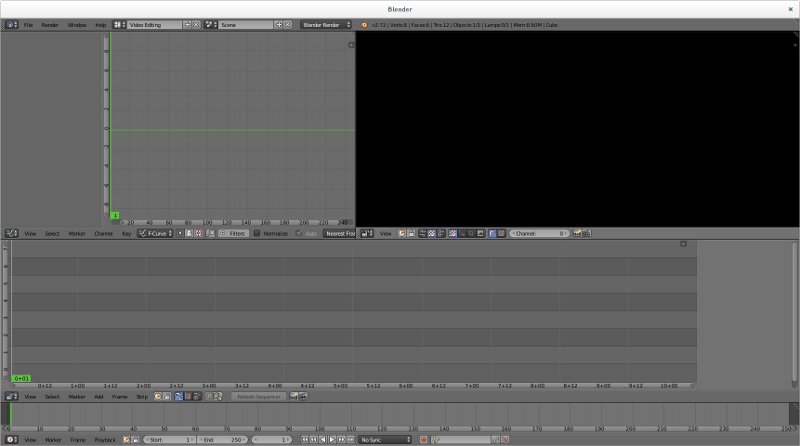
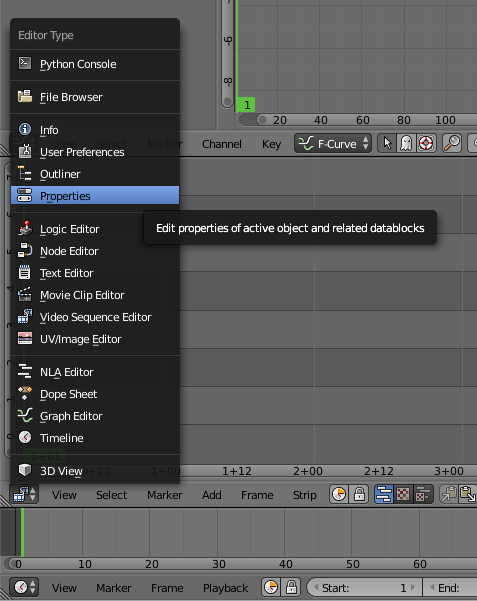
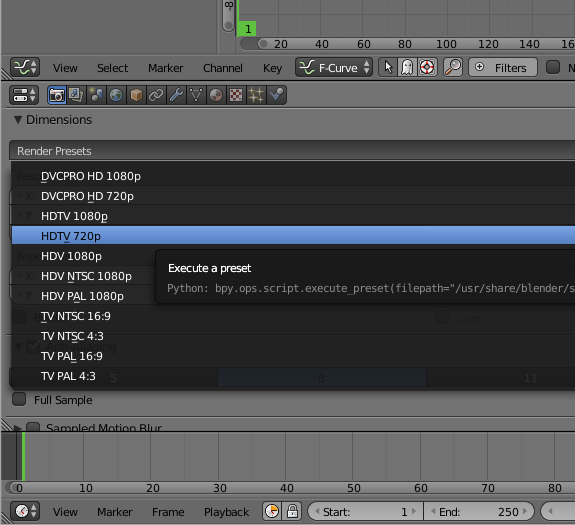
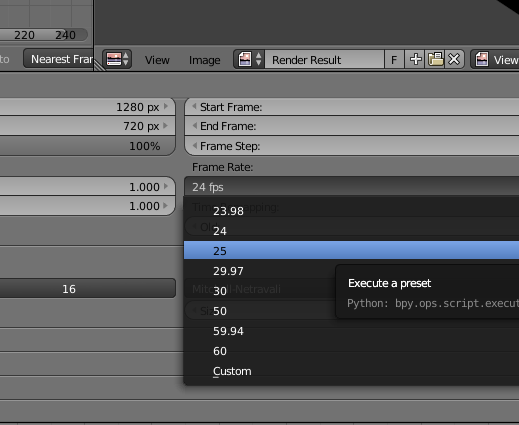
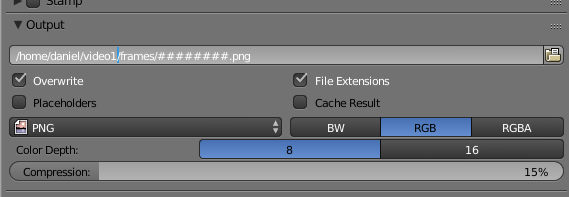
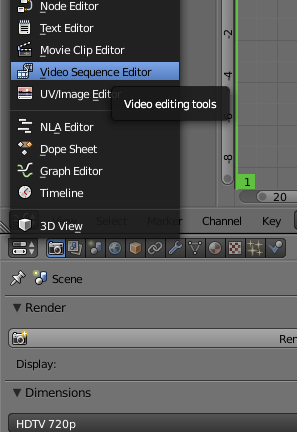
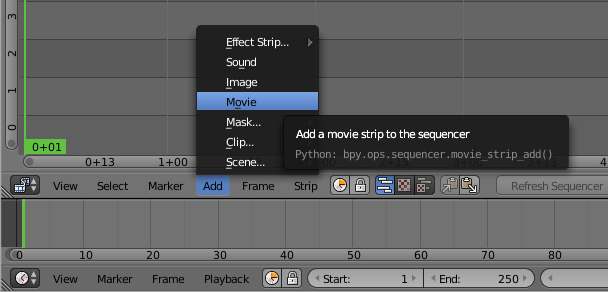
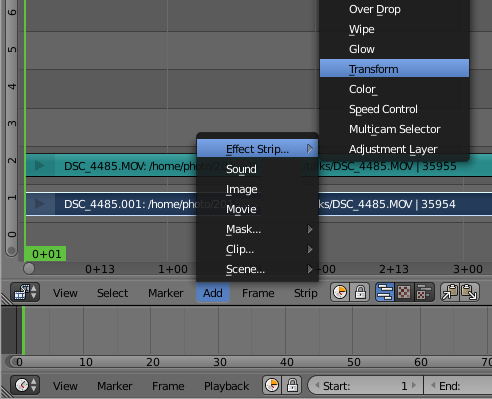
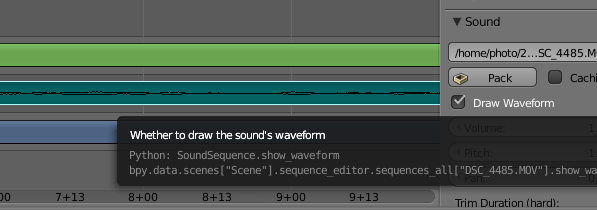
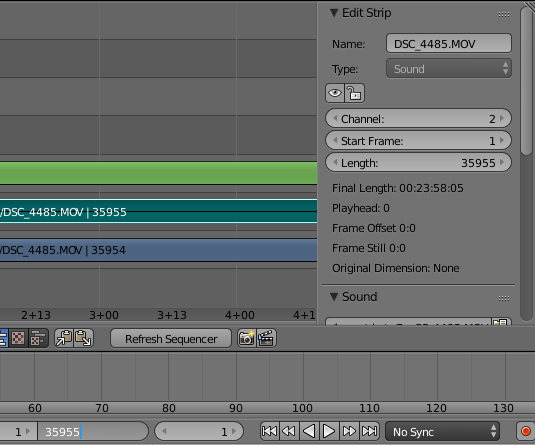
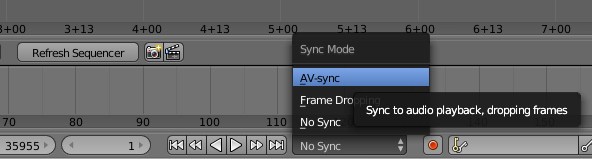
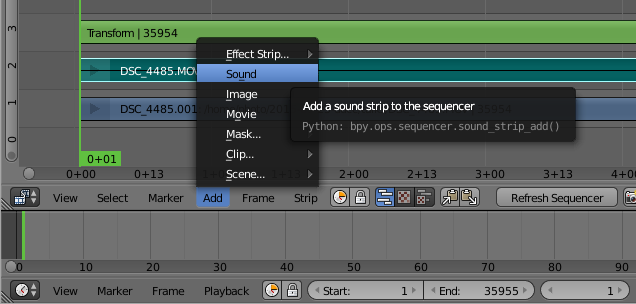
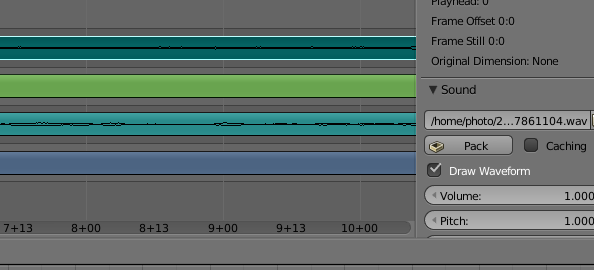
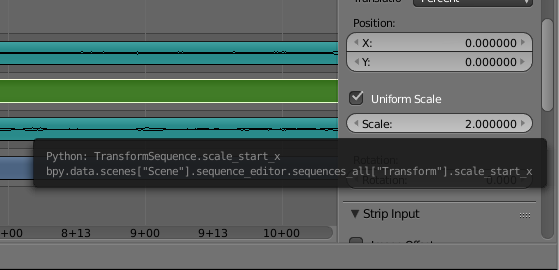
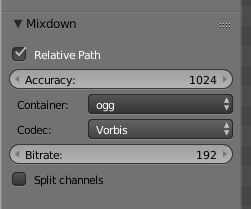
Open Blender and choose the video editing mode Launch Blender and choose the video sequence editor from the pull down menu at the top of the window: Now you should see all the video sequence editor controls: Setup the properties for your project Click the context menu under the strip editor panel and change the panel to a Properties panel: The video file we are playing with is 720p, so it seems reasonable to use 720p for the output too. Change that here: The input file is 25fps so we need to use exactly the same frame rate for the output, otherwise you will either observe the video going at the wrong speed or there will be a conversion that is CPU intensive and degrades the quality. Also check that the resolution_percentage setting under the picture dimensions is 100%: Now specify output to PNG files. Later we will combine them into a WebM file with a script. Specify the directory where the files will be placed and use the # placeholder to specify the number of digits to use to embed the frame number in the filename: Now your basic rendering properties are set. When you want to generate the output file, come back to this panel and use the Animation button at the top. Editing the video Use the context menu to change the properties panel back to the strip view panel: Add the video file: and then right click the video strip (the lower strip) to highlight it and then add a transform strip: Audio waveform Right click the audio strip to highlight it and then go to the properties on the right hand side and click to show the waveform: Rendering length By default, Blender assumes you want to render 250 frames of output. Looking in the properties to the right of the audio or video strip you can see the actual number of frames. Put that value in the box at the bottom of the window where it says 250: Enable AV-sync Also at the bottom of the window is a control to enable AV-sync. If your audio and video are not in sync when you preview, you need to set this AV-sync option and also make sure you set the frame rate correctly in the properties: Add the other sound strip Now add the other sound file that was recorded using the lapel microphone: Enable the waveform display for that sound strip too, this will allow you to align the sound strips precisely: You will need to listen to the strips to make an estimate of the time difference. Use this estimate to set the "start frame" in the properties for your audio strip, it will be a negative value if the audio strip starts before the video. You can then zoom the strip panel to show about 3 to 5 seconds of sound and try to align the peaks. An easy way to do this is to look for applause at the end of the audio strips, the applause generates a large peak that is easily visible. Once you have synced the audio, you can play the track and you should not be able to hear any echo. You can then silence the audio track from the camera by right clicking it, look in the properties to the right and change volume to 0. Make any transforms you require For example, to zoom in on the speaker, right click the transform strip (3rd from the bottom) and then in the panel on the right, click to enable "Uniform Scale" and then set the scale factor as required: Render the video output to PNG Click the context menu under the Curves panel and choose Properties again. Click the Animation button to generate a sequence of PNG files for each frame. Render the audio output On the Properties panel, click the Audio button near the top. Choose a filename for the generated audio file. Look on the bottom left-hand side of the window for the audio file settings, change it to the ogg container and Vorbis codec: Ensure the filename has a .ogg extension Now look at the top right-hand corner of the window for the Mixdown button. Click it and wait for Blender to generate the audio file. Combine the PNG files and audio file into a WebM video file You will need to have a few command line tools installed for manipulating the files from scripts. Install them using the package manager, for example, on a Debian or Ubuntu system: # apt-get install mjpegtools vpx-tools mkvtoolnix
Now create a script like the following:
#!/bin/bash -e
# Set this to match the project properties
FRAME_RATE=25
# Set this to the rate you desire:
TARGET_BITRATE=1000
WORK_DIR=$ HOME /video1
PNG_DIR=$ WORK_DIR /frames
YUV_FILE=$ WORK_DIR /video.yuv
WEBM_FILE=$ WORK_DIR /video.webm
AUDIO_FILE=$ WORK_DIR /audio-mixed.ogg
NUM_FRAMES= find $ PNG_DIR  -type f   wc -l 
png2yuv -I p -f $FRAME_RATE -b 1 -n $NUM_FRAMES \
    -j $ PNG_DIR /%08d.png > $ YUV_FILE 
vpxenc --good --cpu-used=0 --auto-alt-ref=1 \
   --lag-in-frames=16 --end-usage=vbr --passes=2 \
   --threads=2 --target-bitrate=$ TARGET_BITRATE  \
   -o $ WEBM_FILE -noaudio $ YUV_FILE 
rm $ YUV_FILE 
mkvmerge -o $ WEBM_FILE  -w $ WEBM_FILE -noaudio $ AUDIO_FILE 
rm $ WEBM_FILE -noaudio
Next steps There are plenty of more comprehensive tutorials, including some videos on Youtube, explaining how to do more advanced things like fading in and out or zooming and panning dynamically at different points in the video. If the lighting is not good (faces too dark, for example), you can right click the video strip, go to the properties panel on the right hand side and click Modifiers, Add Strip Modifier and then select "Color Balance". Use the Lift, Gamma and Gain sliders to adjust the shadows, midtones and highlights respectively.

Next.

Previous.