Search Results: "sto"

15 April 2017

Dirk Eddelbuettel: Rcpp now used by 1000 CRAN packages

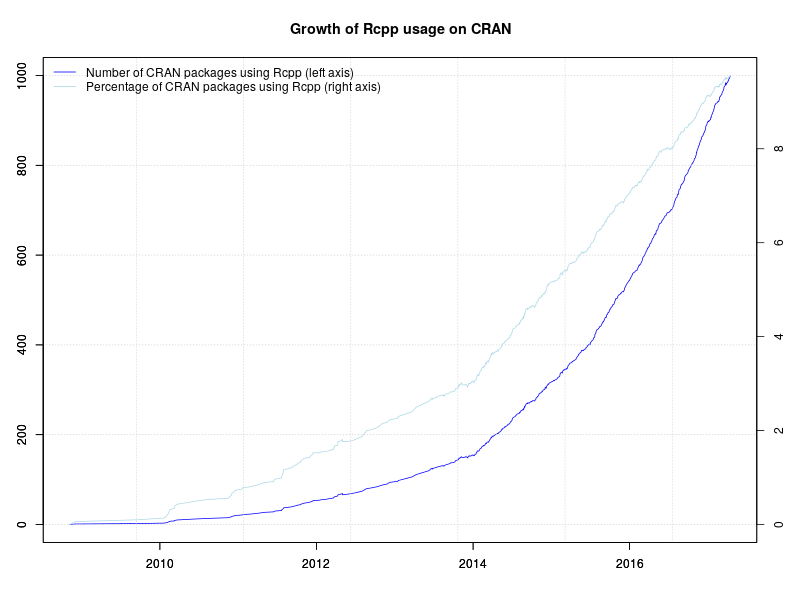
800 Rcpp packages Moments ago Rcpp passed a big milestone as there are now 1000 packages on CRAN depending on it (as measured by Depends, Imports and LinkingTo, but excluding Suggests). The graph is on the left depicts the growth of Rcpp usage over time. One easy way to compute such reverse dependency counts is the tools::dependsOnPkgs() function that was just mentioned in yesterday's R^4 blog post. Another way is to use the reverse_dependencies_with_maintainers() function from this helper scripts file on CRAN. Lastly, devtools has a function revdep() but it has the wrong default parameters as it includes Suggests: which you'd have to override to get the count I use here (it currently gets 1012 in this wider measure). Rcpp cleared 300 packages in November 2014. It passed 400 packages in June 2015 (when I only tweeted about it), 500 packages in late October 2015, 600 packages last March, 700 packages last July, 800 packages last October and 900 packages early January. The chart extends to the very beginning via manually compiled data from CRANberries and checked with crandb. The next part uses manually saved entries. The core (and by far largest) part of the data set was generated semi-automatically via a short script appending updates to a small file-based backend. A list of packages using Rcpp is kept on this page. Also displayed in the graph is the relative proportion of CRAN packages using Rcpp. The four per-cent hurdle was cleared just before useR! 2014 where I showed a similar graph (as two distinct graphs) in my invited talk. We passed five percent in December of 2014, six percent July of 2015, seven percent just before Christmas 2015, eight percent last summer, and nine percent mid-December 2016. Ten percent is next; we may get there during the summer. 1000 user packages is a really large number. This puts a whole lot of responsibility on us in the Rcpp team as we continue to keep Rcpp as performant and reliable as it has been. And with that a very big Thank You! to all users and contributors of Rcpp for help, suggestions, bug reports, documentation or, of course, code.

This post by Dirk Eddelbuettel originated on his Thinking inside the box blog. Please report excessive re-aggregation in third-party for-profit settings.

14 April 2017

Laura Arjona Reina: Underestimating Debian

I had two issues in the last days that lead me a bit into panic until they got solved. In both cases the issue was external to Debian but I first thought that the problem was in Debian. I m not sure why I had those thoughts, I should be more confident in myself, this awesome operating system, and the community around it! The good thing is that I ll be more confident from now on, and I ve learned that hurry is not a good friend, and I should face my computer problems (and everything in life, probably) with a bit more patience (and backups). Issue 1: Corrupt ext partition in a laptop I have a laptop at home with dual boot Windows 7 + Debian 9 (Stretch). I rarely boot the Windows partition. When I do, I do whatever I need to do/test there, then install updates, and then shutdown the laptop or reboot in Debian to feel happy again when using computers. Some months ago I noticed that booting in Debian was not possible and I was left in an initramfs console that was suggesting to e2fsck /dev/sda6 (my Debian partition). Then I ran e2fsck, say a to fix all the issues found, and the system was booting properly. This issue was a bit scary-looking because of the e2fsck output making screen show random numbers and scrolling quickly for 1 or 2 minutes, until all the inodes or blocks or whatever were fixed. I thought about the disk being faulty, and ran badblocks, but faced the former boot issue again some time after, and then decided to change the disk (then I took the opportunity to make backups, and install a fresh Debian 9 Stretch in the laptop, instead of the Debian 8 stable that was running). The experience with Stretch has been great since then, but some days ago I faced the boot issue again. Then I realised that maybe the issue was appearing when I booted Debian right after using Windows (and this was why it was appearing not very often in my timeline  ). Then I payed more attention to the message that I was receiving in the console
Superblock checksum does not match superblock while trying to open /dev/sda6
 /dev/sda6:
 The superblock could not be read or does not describe a valid ext2/ext3/ext4
 filesystem. If the device is valid and it really contains an ext2/ext3/ext4
 filesystem (and not swap or ufs or something else), then the superblock
 is corrupt, and you might try running e2fsck with an alternate superblock:
 e2fsck -b 8193
 or
 e2fsck -b 32768
and searched about it, and also asked about it to my friends in the redeslibres XMPP chat room  I found this question in the AskUbuntu forum that was exactly my issue (I had ext2fsd installed in Windows). My friends in the XMPP room friendly yelled booo! at me for letting Windows touch my ext partitions (I apologised, it will never happen again!). I now consistently could reproduce the issue (boot Windows, then boot Debian, bang!: initramfs console, e2fsck, reboot Debian, no problem, boot Windows, boot Debian, again the problem, etc). I uninstalled the ext2fsd program and tried to reproduce the issue, and I couldn t reproduce it. So happy end. Issue 2: Accessing Android internal memory to backup files The other issue was with my tablet running Android 4.0.4. It was facing a charge issue, and I wanted to backup the files there before sending it to repair. I connected the tablet with USB to my laptop, and enabled USB debugging. The laptop recognized a MZ604 camera connected, but Dolphin (the file browser of my KDE Plasma desktop) could not show the files. I looked at the settings in the tablet to try to find the setting that allowed me to switch between camera/MTP when connecting with USB, but couldn t find it. I guessed that the tablet was correctly configured because I recall having made a backup some months ago, with no hassle (in Debian 8). I checked that my Debian (9) had installed the needed packages:
 ii kio-mtp 0.75+git20140304-2 amd64 access to MTP devices for applications using the KDE Platform
 ii libmtp-common 1.1.12-1 all Media Transfer Protocol (MTP) common files
 ii libmtp-runtime 1.1.12-1+b1 amd64 Media Transfer Protocol (MTP) runtime tools
 ii libmtp9:amd64 1.1.12-1+b1 amd64 Media Transfer Protocol (MTP) library
So I had no idea about what was going on. Then I suspected some problem in my Debian (maybe I was needing some driver for the Motorola tablet?) and booted Windows 7 to see what happened there. Windows detected a MZ604 device too, but couldn t access the files either (when clicking in the device, no folders were shown). I began to search the internet to see if there were some Motorola drivers out there, and then found the clue to enable the correct settings in the Android device: you need to go to Settings > Storage, and then press the 3-dots button that makes the Menu function, and then appears USB computer connection and there, you can enable Camera or MTP. Very hidden setting! I enabled MTP, and then I could see the folders and files in my Windows system (without need of installing any additional driver), and make my backup. And of course after rebooting and trying in Debian, it worked too. Some outcomes/conclusions Comments? You can comment on this post using this pump.io thread.
Filed under: My experiences and opinion Tagged: Android, Debian, English, KDE, Libre software for Windows

13 April 2017

Raphaël Hertzog: Freexian s report about Debian Long Term Support, March 2017

A Debian LTS logoLike each month, here comes a report about the work of paid contributors to Debian LTS. Individual reports In March, about 190 work hours have been dispatched among 14 paid contributors. Their reports are available: Evolution of the situation The number of sponsored hours has been unchanged but will likely decrease slightly next month as one sponsor will not renew his support (because they have switched to CentOS). The security tracker currently lists 52 packages with a known CVE and the dla-needed.txt file 40. The number of open issues continued its slight increase not worrisome yet but we need to keep an eye on this situation. Thanks to our sponsors New sponsors are in bold.

No comment Liked this article? Click here. My blog is Flattr-enabled.

Francois Marier: Automatically renewing Let's Encrypt TLS certificates on Debian using Certbot

I use Let's Encrypt TLS certificates on my Debian servers along with the Certbot tool. Since I use the "temporary webserver" method of proving domain ownership via the ACME protocol, I cannot use the cert renewal cronjob built into Certbot. Instead, this is the script I put in /etc/cron.daily/certbot-renew:
#!/bin/bash
/usr/bin/certbot renew --quiet --pre-hook "/bin/systemctl stop apache2.service" --post-hook "/bin/systemctl start apache2.service"
pushd /etc/ > /dev/null
/usr/bin/git add letsencrypt
DIFFSTAT="$(/usr/bin/git diff --cached --stat)"
if [ -n "$DIFFSTAT" ] ; then
    /usr/bin/git commit --quiet -m "Renewed letsencrypt certs"
    echo "$DIFFSTAT"
fi
popd > /dev/null
It temporarily disables my Apache webserver while it renews the certificates and then only outputs something to STDOUT (since my cronjob will email me any output) if certs have been renewed. Since I'm using etckeeper to keep track of config changes on my servers, my renewal script also commits to the repository if any certs have changed.

External Monitoring In order to catch mistakes or oversights, I use ssl-cert-check to monitor my domains once a day:
ssl-cert-check -s fmarier.org -p 443 -q -a -e francois@fmarier.org
I also signed up with Cert Spotter which watches the Certificate Transparency log and notifies me of any newly-issued certificates for my domains. In other words, I get notified:
  • if my cronjob fails and a cert is about to expire, or
  • as soon as a new cert is issued.
The whole thing seems to work well, but if there's anything I could be doing better, feel free to leave a comment!

Michal Čihař: Weblate 2.13.1

Weblate 2.13.1 has been released quickly after 2.13. It fixes few minor issues and possible upgrade problem. Full list of changes: If you are upgrading from older version, please follow our upgrading instructions. You can find more information about Weblate on https://weblate.org, the code is hosted on Github. If you are curious how it looks, you can try it out on demo server. You can login there with demo account using demo password or register your own user. Weblate is also being used on https://hosted.weblate.org/ as official translating service for phpMyAdmin, OsmAnd, Aptoide, FreedomBox, Weblate itself and many other projects. Should you be looking for hosting of translations for your project, I'm happy to host them for you or help with setting it up on your infrastructure. Further development of Weblate would not be possible without people providing donations, thanks to everybody who have helped so far! The roadmap for next release is just being prepared, you can influence this by expressing support for individual issues either by comments or by providing bounty for them.

Filed under: Debian English SUSE Weblate 0 comments

12 April 2017

Daniel Pocock: What is the risk of using proprietary software for people who prefer not to?

Jonas berg has recently blogged about Using Proprietary Software for Freedom. He argues that it can be acceptable to use proprietary software to further free and open source software ambitions if that is indeed the purpose. Jonas' blog suggests that each time proprietary software is used, the relative risk and reward should be considered and there may be situations where the reward is big enough and the risk low enough that proprietary software can be used. A question of leadership Many of the free software users and developers I've spoken to express frustration about how difficult it is to communicate to their family and friends about the risks of proprietary software. A typical example is explaining to family members why you would never install Skype. Imagine a doctor who gives a talk to school children about the dangers of smoking and is then spotted having a fag at the bus stop. After a month, if you ask the children what they remember about that doctor, is it more likely to be what he said or what he did? When contemplating Jonas' words, it is important to consider this leadership factor as a significant risk every time proprietary software or services are used. Getting busted with just one piece of proprietary software undermines your own credibility and posture now and well into the future. Research has shown that when communicating with people, what they see and how you communicate is ninety three percent of the impression you make. What you actually say to them is only seven percent. When giving a talk at a conference or a demo to a client, or communicating with family members in our everyday lives, using a proprietary application or a product or service that is obviously proprietary like an iPhone or Facebook will have far more impact than the words you say. It is not only a question of what you are seen doing in public: somebody who lives happily and comfortably without using proprietary software sounds a lot more credible than somebody who tries to explain freedom without living it. The many faces of proprietary software One of the first things to consider is that even for those developers who have a completely free operating system, there may well be some proprietary code lurking in their BIOS or other parts of their hardware. Their mobile phone, their car, their oven and even their alarm clock are all likely to contain some proprietary code too. The risks associated with these technologies may well be quite minimal, at least until that alarm clock becomes part of the Internet of Things and can be hacked by the bored teenager next door. Accessing most web sites these days inevitably involves some interaction with proprietary software, even if it is not running on your own computer. There is no need to give up Some people may consider this state of affairs and simply give up, using whatever appears to be the easiest solution for each problem at hand without thinking too much about whether it is proprietary or not. I don't think Jonas' blog intended to sanction this level of complacency. Every time you come across a piece of software, it is worth considering whether a free alternative exists and whether the software is really needed at all. An orderly migration to free software In our professional context, most software developers come across proprietary software every day in the networks operated by our employers and their clients. Sometimes we have the opportunity to influence the future of these systems. There are many cases where telling the client to go cold-turkey on their proprietary software would simply lead to the client choosing to get advice from somebody else. The free software engineer who looks at the situation strategically may find that it is possible to continue using the proprietary software as part of a staged migration, gradually helping the user to reduce their exposure over a period of months or even a few years. This may be one of the scenarios where Jonas is sanctioning the use of proprietary software. On a technical level, it may be possible to show the client that we are concerned about the dangers but that we also want to ensure the continuity of their business. We may propose a solution that involves sandboxing the proprietary software in a virtual machine or a DMZ to prevent it from compromising other systems or "calling home" to the vendor. As well as technical concerns about a sudden migration, promoters of free software frequently encounter political issues as well. For example, the IT manager in a company may be five years from retirement and is not concerned about his employer's long term ability to extricate itself from a web of Microsoft licenses after he or she has the freedom to go fishing every day. The free software professional may need to invest significant time winning the trust of senior management before he is able to work around a belligerant IT manager like this. No deal is better than a bad deal People in the UK have probably encountered the expression "No deal is better than a bad deal" many times already in the last few weeks. Please excuse me for borrowing it. If there is no free software alternative to a particular piece of proprietary software, maybe it is better to simply do without it. Facebook is a great example of this principle: life without social media is great and rather than trying to find or create a free alternative, why not just do something in the real world, like riding motorcycles, reading books or getting a cat or dog? Burning bridges behind you For those who are keen to be the visionaries and leaders in a world where free software is the dominant paradigm, would you really feel satisfied if you got there on the back of proprietary solutions? Or are you concerned that taking such shortcuts is only going to put that vision further out of reach? Each time you solve a problem with free software, whether it is small or large, in your personal life or in your business, the process you went through strengthens you to solve bigger problems the same way. Each time you solve a problem using a proprietary solution, not only do you miss out on that process of discovery but you also risk conditioning yourself to be dependent in future. For those who hope to build a successful startup company or be part of one, how would you feel if you reach your goal and then the rug is pulled out underneath you when a proprietary software vendor or cloud service you depend on changes the rules? Personally, in my own life, I prefer to avoid and weed out proprietary solutions wherever I can and force myself to either make free solutions work or do without them. Using proprietary software and services is living your life like a rat in a maze, where the oligarchs in Silicon Valley can move the walls around as they see fit.

Michal Čihař: Weblate 2.13

Weblate 2.13 has been released today pretty much on the schedule. The most important change being more fine grained access control and some smaller UI improvements. There are other new features and bug fixes as well. Full list of changes: If you are upgrading from older version, please follow our upgrading instructions. You can find more information about Weblate on https://weblate.org, the code is hosted on Github. If you are curious how it looks, you can try it out on demo server. You can login there with demo account using demo password or register your own user. Weblate is also being used on https://hosted.weblate.org/ as official translating service for phpMyAdmin, OsmAnd, Aptoide, FreedomBox, Weblate itself and many other projects. Should you be looking for hosting of translations for your project, I'm happy to host them for you or help with setting it up on your infrastructure. Further development of Weblate would not be possible without people providing donations, thanks to everybody who have helped so far! The roadmap for next release is just being prepared, you can influence this by expressing support for individual issues either by comments or by providing bounty for them.

Filed under: Debian English Gammu phpMyAdmin SUSE Weblate 0 comments

11 April 2017

Antoine Beaupr : A report from Netconf: Day 1

As is becoming traditional, two times a year the kernel networking community meets in a two-stage conference: an invite-only, informal, two-day plenary session called Netconf, held in Toronto this year, and a more conventional one-track conference open to the public called Netdev. I was invited to cover both conferences this year, given that Netdev was in Montreal (my hometown), and was happy to meet the crew of developers that maintain the network stack of the Linux kernel. This article covers the first day of the conference which consisted of around 25 Linux developers meeting under the direction of David Miller, the kernel's networking subsystem maintainer. Netconf has no formal sessions; although some people presented slides, interruptions are frequent (indeed, encouraged) and the focus is on hashing out issues that are blocked on the mailing list and getting suggestions, ideas, solutions, and feedback from their peers.

Removing ndo_select_queue() One of the first discussions that elicited a significant debate was the ndo_select_queue() function, a key component of the Linux polling system that determines when and how to send packets on a network interface (see netdev_pick_tx and friends). The general question was whether the use of ndo_select_queue() in drivers is a good idea. Alexander Duyck explained that Intel people were considering using ndo_select_queue() for receive/transmit queue matching. Intel drivers do not currently use the hook provided by the Linux kernel and it turns out no one is happy with ndo_select_queue(): the heuristics it uses don't really please anyone. The consensus (including from Duyck himself) seemed to be that it should just not be used anymore, or at least not used for that specific purpose. The discussion turned toward the wireless network stack, which uses it extensively, but for other purposes. Johannes Berg explained that the wireless stack uses ndo_select_queue() for traffic classification, for example to get voice traffic through even if the best-effort queue is backed up. The wireless stack could stop using it by doing flow control completely inside the wireless stack, which already uses the fq_codel flow-control mechanism for other purposes, so porting away from ndo_select_queue() seems possible there. The problem then becomes how to update all the drivers to change that behavior, which would be a lot of work. Still, it seems people are moving away from a generic ndo_select_queue() interface to stack-specific or even driver-specific (in the case of Intel) queue management interfaces.

refcount_t followup There was a followup discussion on the integration of the refcount_t type into the network stack, which we covered recently. This type is meant to be an in-kernel defense against exploits based on overflowing or underflowing an object's reference count. The consensus seems to be that having refcount_t used for debugging is acceptable, but it cannot be enabled by default. An issue that was identified is that the networking developers are fairly sure that introducing refcount_t would have a severe impact on performance, but they do not have benchmarks to prove it, something Miller identified as a problem that needs to be worked on. Miller then expressed some openness to the idea of having it as a kernel configuration option. A similar discussion happened, on the second day, regarding the KASan memory error detector which was covered when it was introduced in 2014. Eric Dumazet warned that there could be a lot of issues that cannot be detected by KASan because of the way the network stack often bypasses regular memory-allocation routines for performance reasons. He also noted that this can sometimes mean the stack may go over the regular 10% memory limit (the tcp_mem parameter, described in the tcp(7) man page) for certain operations, especially when rebuilding out of order packets with lots of parallel TCP connections. Therefore it was proposed that these special memory recycling tricks could be optionally disabled, at run or compile-time, to instrument proper memory tracking. Dumazet argued this was a situation similar to refcount_t in that we need a way to disable high performance to make the network stack easier to debug with KAsan. The problem with optional parameters is that they are often disabled in production or even by default, which, in turn, means that critical bugs cannot actually be found because the code paths are not tested. When I asked Dumazet about this, he explained that Google performs integration testing of new kernels before putting them in production, and those toggles could be enabled there to find and fix those bugs. But he agreed that certain code paths are then not tested until the code gets deployed in production. So it seems the status quo remains: security folks wants to improve the reliability of the kernel, but the network folks can't afford the performance cost. Yet it was clear in the discussions that the team cares about security issues and wants those issues to be fixed; the impact of some of the solutions is just too big.

Lightweight wireless management packet access Berg explained that some users need to have high-performance access to certain management frames in the wireless stack and wondered how to best expose those to user space. The wireless stack already allows users to clone a network interface in "monitor" mode, but this has a big performance cost, as the radiotap header needs to be constructed from scratch and the packet header needs to be copied. As wireless improves and the bandwidth rises to gigabit levels, this can become significant bottleneck for packet sniffers or reporting software that need to know precisely what's going on over the air outside of the regular access point client operation. It seems the proper way to do this is with an eBPF program. As Miller summarized, just add another API call that allows loading a BPF program into the kernel and then those users can use a BPF filtering point to get the statistics they need. This will require an extra hook in the wireless stack, but it seems like this is the way that will be taken to implement this feature.

VLAN 0 inconsistencies Hannes Frederic Sowa brought up the seemingly innocuous question of "how do we handle VLAN 0?" In theory, VLAN 0 means "no VLAN". But the Linux kernel currently handles this differently depending on whether the VLAN module is loaded and whether a VLAN 0 interface was created. Sometimes the VLAN tag is stripped, sometimes not. It turns out the semantics of this were accidentally changed last time there was a change here and this was originally working but is now broken. Sowa therefore got the go-ahead to fix this to make the behavior consistent again.

Loopy fun Then it came the turn of Jamal Hadi Salim, the maintainer of the kernel's traffic-control (tc) subsystem. The first issue he brought up is a problem in the tc REDIRECT action that can create infinite loops within the kernel. The problem can be easily alleviated when loops are created on the same interface: checks can be added that just drop packets coming from the same device and rate-limit logging to avoid a denial-of-service (DoS) condition. The more serious problem occurs when a packet is forwarded from (say) interface eth0 to eth1 which then promptly redirects it from eth1 back to eth0. Obviously, this kind of problem can only be created by a user with root access so, at first glance, those issues don't seem that serious: admins can shoot themselves in the foot, so what? But things become a little more serious when you consider the container case, where an untrusted user has root access inside a container and should have constrained resource limitations. Such a loop could allow this user to deploy an effective DoS attack against a whole group of containers running on the same machine. Even worse, this endless loop could possibly turn into a deadlock in certain scenarios, as the kernel could try to transmit the packet on the same device it originated from and block, progressively filling the queues and eventually completely breaking network access. Florian Westphal argued that a container can already create DoS conditions, for example by doing a ping flood. According to Salim, this whole problem was created when two bits used for tracking such packets were reclaimed from the skb structure used to represent packets in the kernel. Those bits were a simple TTL (time to live) field that was incremented on each loop and dropped after a pre-determined limit was reached, breaking infinite loops. Salim asked everyone if this should be fixed or if we should just forget about this issue and move on. Miller proposed to keep a one-behind state for the packet, fixing the simplest case (two interfaces). The general case, however, would requite a bitmap of all the interfaces to be scanned, which would impose a large overhead. Miller said an attempt to fix this should somehow be made. The root of the problem is that the network maintainers are trying to reduce the size of the skb structure, because it's used in many critical paths of the network stack. Salim's position is that, without the TTL fields, there is no way to fix the general case here, and this constitutes a security issue. So either the bits need to be brought back, or we need to live with the inherent DoS threat.

Dumping large statistics sets Another issue Salim brought up was the question of how to export large statistics sets from the kernel. It turns out that some use cases may end up dumping a lot of data. Salim mentioned a real-world tc use case that calls for reading six-million entries. The current netlink-based API provides a way to get only 20 entries at a time, which means it takes forever to dump the state of all those policy actions. Salim has a patch that changes the dump size be eight times the NLMSG_GOOD_SIZE, which improves performance by an order of magnitude already, although there are issues with checking the user-space buffer size there. But a more complete solution is needed. What Salim proposed was a way to ask only for the states that changed since the last dump was requested. He has a patch to add a last_access field to the netlink_callback structure used by netlink_dump() to output data; that raised the question of how to actually use that field. Since Salim fetches that data every five seconds, he figured he could just tell the kernel to return all the nodes that changed in that period. But then if the dump takes more than five seconds to complete, the next dump may be missing states that changed during the extra delay. An alternative mechanism would be for the user-space utility to keep the time stamp it requested and use that as a delta for the next dump. It turns out this is a larger problem than just tc. Dumazet mentioned this was an issue with fq_codel classes: he would even like to be able to dump those statistics faster than every five seconds. Roopa Prabhu mentioned that Cumulus also has similar problems dumping stats from bridges, so clearly a more generic solution is needed here. There is, however, a fundamental problem with dumping large statistics sets from the kernel: those statistics are constantly changing while the dump is created and unless versioning or locking mechanisms are used which would slow things down the data returned is bound to be only an approximation of reality. Salim promised to send a set of RFC patches to further discussions regarding this issue, but during the following Netdev conference, Berg published a patch to fix this ten-year-old issue, which brought cheers from the audience.
The author would like to thank the Netconf and Netdev organizers for travel to, and hosting assistance in, Toronto. Many thanks to Berg, Dumazet, Salim, and Sowa for their time taken for a technical review of this article. Note: this article first appeared in the Linux Weekly News.

Reproducible builds folks: Reproducible Builds: week 102 in Stretch cycle

Here's what happened in the Reproducible Builds effort between Sunday April 2 and Saturday April 8 2017: Media coverage Toolchain development and fixes Reviews of unreproducible packages 27 package reviews have been added, 14 have been updated and 17 have been removed in this week, adding to our knowledge about identified issues. Weekly QA work During our reproducibility testing, FTBFS bugs have been detected and reported by: tests.reproducible-builds.org Misc. This week's edition was written by Chris Lamb, Vagrant Cascadian & reviewed by a bunch of Reproducible Builds folks on IRC & the mailing lists.

10 April 2017

Daniel Pocock: If Alan Turing was born today, would he be a Muslim?

Alan Turing's name and his work are well known to anybody with a theoretical grounding in computer science. Turing developed his theories well before anybody invented file sharing, overclocking or mass surveillance. In fact, Turing was largely working in the absence of any computers at all: the transistor was only invented in 1947 and the microchip, the critical innovation that has made computing both affordable and portable, only came in 1960, four years after Turing's death. To this day, the Turing Test remains a well known challenge in the field of Artificial Intelligence. The most prestigious prize in computing, the A.M. Turing Award from the ACM, equivalent to the Nobel Prize in other fields of endeavour, is named in Turing's honour. (This year's award is another British scientist, Sir Tim Berners-Lee, inventor of the World Wide Web).
Potentially far more people know of Alan Turing for his groundbreaking work at Bletchley Park and the impact it had on cracking the Nazi's Enigma machines during World War 2, giving the allies an advantage against Hitler. While in his lifetime, Turing exposed the secret communications of the Nazis, in his death, he exposed something manifestly repugnant about his own society. Turing's challenges with his sexuality (or Britain's challenge with it) are just as well documented as his greatest scientific achievements. The 2014 movie The Imitation Game tells Turing's story, bringing together the themes from his professional and personal life. Had Turing chosen to flee British persecution by going abroad, he would be a refugee in the same sense as any person who crossed the seas to reach Europe today to avoid persecution elsewhere. Please prove me wrong In March, I blogged about the problem of racism that plagues Britain today. While some may have felt the tone of the blog was quite strong, I was in no way pleased to find my position affirmed by the events that occurred in the two days after the blog appeared. Two days and two more human beings (both immigrants and both refugees) subjected to abhorrent and unnecessary acts of abuse in Great Britain. Both cases appear to be fuelled directly by the evil that has been oozing out of number 10 Downing Street since they decided to have a referendum on "Brexit". What stands out about these latest crimes is not that they occurred (this type of thing has been going on for months now) but certain contrasts between their circumstances and to a lesser extent, the fact they occurred immediately after Theresa May formalized Britain's departure from the EU. One of the victims was almost beaten to death by a street gang, while the other was abused by men wearing uniforms. One was only a child, while the other is a mature adult who has been in the UK almost three decades, completely assimilated into British life, working and paying taxes. Both were doing nothing out of the ordinary at the time the abuse occurred: one had engaged in a conversation at a bus stop, the other was on a routine visit to a Government office. There is no evidence that either of them had done anything to provoke or invite the abhorrent treatment meted out to them by the followers of Theresa May and Nigel Farage. The first victim, on 30 March, was Stojan Jankovic, a refugee from Yugoslavia who has been in the UK for 26 years. He had a routine meeting at an immigration department office where he was ambushed, thrown in the back of a van and sent to rot in a prison cell by Theresa May's gestapo. On Friday, 31 March, it was Reker Ahmed, a 17 year old Kurdish-Iranian beaten to the brink of death by a crowd in south London. One of the more remarkable facts to emerge about these two cases is that while Stojan Jankovic was basically locked up for no reason at all, the street thugs who the police apprehended for the assault on Ahmed were kept in a cell for less than 48 hours and released again on bail. While the harmless and innocent Jankovic was eventually released after a massive public outcry, he spent more time locked up than that gang of violent criminals who beat Reker Ahmed. In other words, Theresa May and Nigel Farage's Britain has more concern for the liberty of violent criminals than somebody like Jankovic who has been working and paying taxes in the UK since before any of those street thugs were born. A deeper insight into Turing's fate With gay marriage having been legal in the UK for a number of years now, the rainbow flag flying at the Tate and Sir Elton John achieving a knighthood, it becomes difficult for people to relate to the world in which Turing and many other victims were collectively classified by their sexuality, systematically persecuted by the state and ultimately died far sooner than they should have. (Turing was only 41 when he died). In fact, the cruel and brutal forces that ripped Turing apart (and countless other victims too) haven't dissipated at all, they have simply shifted their target. The slanderous comments insinuating that immigrants "steal" jobs or that Islam is about terrorism are eerily reminiscent of suggestions that gay men abduct young boys or work as Soviet spies. None of these lies has any basis in fact, but repeat them often enough in certain types of newspaper and these ideas spread like weeds. In an ironic twist, Turing's groundbreaking work at Bletchley Park was founded on the contributions of Polish mathematicians, their own country having been the first casualty to Hitler, they were also both immigrants and refugees in Britain. Today, under the Theresa May/Nigel Farage leadership, Polish citizens have been subjected to regular vilification by the media and some have even been killed in the street. It is said that a picture is worth a thousand words. When you compare these two pieces of propaganda: a 1963 article in the Sunday Mirror advising people "How to spot a possible homo" and a UK Government billboard encouraging people to be on the lookout for people who look different, could you imagine the same type of small-minded and power-hungry tyrants crafting them, singling out a minority so as to keep the public's attention in the wrong place?
Many people have noticed that these latest UK Government posters portray foreigners, Muslims and basically anybody who is not white using a range of characteristics found in anti-semetic propaganda from the Third Reich: Do the people who create such propaganda appear to have any concern whatsoever for the people they hurt? How would Alan Turing have felt when he encountered propaganda like that from the Sunday Mirror? Do posters like these encourage us to judge people by their gifts in science, the arts or sporting prowess or do they encourage us to lump them all together based on their physical appearance? It is a basic expectation of scientific methodology that when you repeat the same experiment, you should get the same result. What type of experiment are Theresa May and Nigel Farage conducting and what type of result would you expect? Playing ping-pong with children If anybody has any doubt that this evil comes from the top, take a moment to contemplate the 3,000 children who were baited with the promise of resettlement from the Calais "jungle" camp into the UK under the Dubs amendment. When French authorities closed the "jungle" in 2016, the children were lured out of the camp and left with nowhere to go as Theresa May and French authorities played ping-pong with them. Given that the UK parliament had already agreed they should be accepted, was there any reason for Theresa May to dig her heels in and make these children suffer? Or was she just trying to prove her credentials as somebody who can bastardize migrants just the way Nigel Farage would do it? How do British politicians really view migrants? Parliamentarian Keith Vaz, former chair of the Home Affairs Select Committee (responsible for security, crime, prostitution and similar things) was exposed with young men from eastern Europe, encouraging them to take drugs before he ordered them "Take your shirt off. I'm going to attack you.". How many British MP's see foreigners this way? Next time you are groped at an airport security checkpoint, remember it was people like Keith Vaz and his committee who oversee those abuses, writing among other things that "The wider introduction of full-body scanners is a welcome development". No need to "take your shirt off" when these machines can look through it as easily as they can look through your children's underwear. According to the World Health Organization, HIV/AIDS kills as many people as the September 11 attacks every single day. Keith Vaz apparently had no concern for the possibility he might spread this disease any further: the media reported he doesn't use any protection in his extra-marital relationships. While Britain's new management continue to round up foreigners like Stojan Jankovic who have done nothing wrong, they chose not to prosecute Keith Vaz for his antics with drugs and prostitution. Who is Britain's next Alan Turing? Britain's next Alan Turing may not be a homosexual. He or she may have been a child turned away by Theresa May's spat with the French at Calais, a migrant bundled into a deportation van by the gestapo (who are just following orders) or perhaps somebody of Muslim appearance who is set upon by thugs in the street who have been energized by Nigel Farage. If you still have any uncertainty about what Brexit really means, this is it. A country that denies itself the opportunity to be great by subjecting itself to be ruled under the "divide and conquer" mantra of the colonial era. Throughout the centuries, Britain has produced some of the most brilliant scientists of their time. Newton, Darwin and Hawking are just some of those who are even more prominent than Turing, household names around the world. One can only wonder what the history books will have to say about Theresa May and Nigel Farage however. Next time you see a British policeman accosting a Muslim, whether it is at an airport, in a shopping centre, keeping Manchester United souvenirs or simply taking a photograph, spare a thought for Alan Turing and the era when homosexuals were their target of choice.

9 April 2017

Sam Hartman: When "when" is too hard a question: SQLAlchemy, Python datetime, and ISO8601

A new programmer asked on a work chat room how timezones are handled in databases. He asked if it was a good idea to store things in UTC. The senior programmers all laughed as we told some of our horror stories with timezones. Yes, UTC is great; if only it were that simple.
About a week later I was designing the schema for a blue sky project I'm implementing. I had to confront time in all its Pythonic horror.
Let's start with the datetime.datetime class. Datetime objects optionally include a timezone. If no timezone is present, several methods such as timestamp treat the object as a local time in the system's timezone. The timezone method returns a POSIX timestamp, which is always expressed in UTC, so knowing the input timezone is important. The now method constructs such an object from the current time.
However other methods act differently. The utcnow method constructs a datetime object that has the UTC time, but is not marked with a timezone. So, for example datetime.fromtimestamp(datetime.utcnow().timestamp()) produces the wrong result unless your system timezone happens to have the same offset as UTC.
It's also possible to construct a datetime object that includes a UTC time and is marked as having a UTC time. The utcnow method never does this, but you can pass the UTC timezone into the now method and get that effect. As you'd expect, the timestamp method returns the correct result on such a datetime.
Now enter SQLAlchemy, one of the more popular Python ORMs. Its DATETIME type has an argument that tries to request a column capable of storing a a timezone from the underlying database. You aren't guaranteed to get this though; some databases don't provide that functionality. With PostgreSQL, I do get such a column, although something in SQLAlchemy is not preserving the timezones (although it is correctly adjusting the time). That is, I'll store a UTC time in an object, flush it to my session, and then read back the same time represented in my local timezone (marked as my local timezone). You'd think this would be safe.
Enter SQLite. SQLite makes life hard for people wanting to store time; it seems to want to store things as strings. That's fairly incompatible with storing a timezone and doing any sort of comparisons on dates. SQLAlchemy does not try to store a timezone in SQLite. It just trims any timezone information from the datetime. So, if I do something like
d = datetime.now(timezone.utc)
obj.date_col = d
session.add(obj)
session.flush()
assert obj.date_col == d # fails
assert obj.date_col.timestamp() == d.timestamp() # fails
assert d == obj.date_col.replace(tzinfo = timezone.utc) # finally succeeds

There are some unfortunate consequences of this. If you mark your datetimes with timezone information (even if it is always the same timezone), whether two datetimes representing the same datetime compare equal depends on whether objects have been flushed to the session yet. If you don't mark your objects with timezones, then you may not store timezone information on other databases.
At least if you use only the methods we've discussed so far, you're reasonably safe if you use local time everywhere in your application and don't mark your datetimes with timezones. That's undesirable because as our new programmer correctly surmised, you really should be using UTC. This is particularly true if users of your database might span multiple timezones.
You can use UTC time and not mark your objects as UTC. This will give the wrong data with a database that actually does support timezones, but will sort of work with SQLite. You need to be careful never to convert your datetime objects into POSIX time as you'll get the wrong result.
It turns out that my life was even more complicated because parts of my project serialize data into JSON. For that serialization, I've chosen ISO 8601. You've probably seen that format: '2017-04-09T18:17:27.340410+00:00. Datetime provides the convenient isoformat method to print timestamps in the ISO 8601 format. If the datetime has a timezone indication, it is included in the ISO formatted string. If not, then no timezone indication is included. You know how I mentioned that datetime takes a string without a timezone marker as local time? Yeah, well, that's not what 8601 does: UTC all the way, baby! And at least the parser in the iso8601 module will always include timezone markers. So, if you use datetime to print a timestamp without a timezone marker and then read that back in to construct a new datetime on the deserialization side, then you'll get the wrong time. OK, so mark things with timezones then. Well, if you use local time, then the time you get depends on whether you print the ISO string before or after session flush (before or after SQLAlchemy trims the timezone information as it goes to SQLite).
It turns out that I had the additional complication of one side of my application using SQLite and one side using PostgreSQL. Remember how I mentioned that something between SQLAlchemy and PostgreSQL was recasting my times in local timezone (although keeping the time the same)? Well, consider how that's going to work. I serialize with the timezone marker on the PostgreSQL side. I get a ISO8601 localtime marked with the correct timezone marker. I deserialize on the SQLite side. Before session flush, I get a local time marked as localtime. After session flush, I get a local time with no marking. That's bad. If I further serialize on the SQLite side, I'll get that local time incorrectly marked as UTC. Moreover, all the times being locally generated on the SQLite side are UTC, and as we explored, SQLite really only wants one timezone in play.
I eventually came up with the following approach:

  1. If I find myself manipulating a time without a timezone marking, assert that its timezone is UTC not localtime.

  2. Always use UTC for times coming into the system.

  3. If I'm generating an ISO 8601 time from a datetime that has a timezone marker in a timezone other than UTC, represent that time as a UTC-marked datetime adjusting the time for the change in timezone.


This is way too complicated. I think that both datetime and SQLAlchemy's SQLite time handling have a lot to answer for. I think SQLAlchemy's core time handling may also have some to answer for, but I'm less sure of that.

Christoph Egger: Secured OTP Server (ASIS CTF 2017)

This weekend was ASIS Quals weekend again. And just like last year they have quite a lot of nice crypto-related puzzles which are fun to solve (and not "the same as every ctf"). Actually Secured OTP Server is pretty much the same as the First OTP Server (actually it's a "fixed" version to enforce the intended attack). However the template phrase now starts with enough stars to prevent simple root.:
def gen_otps():
    template_phrase = '*************** Welcome, dear customer, the secret passphrase for today is: '
    OTP_1 = template_phrase + gen_passphrase(18)
    OTP_2 = template_phrase + gen_passphrase(18)
    otp_1 = bytes_to_long(OTP_1)
    otp_2 = bytes_to_long(OTP_2)
    nbit, e = 2048, 3
    privkey = RSA.generate(nbit, e = e)
    pubkey  = privkey.publickey().exportKey()
    n = getattr(privkey.key, 'n')
    r = otp_2 - otp_1
    if r < 0:
        r = -r
    IMP = n - r**(e**2)
    if IMP > 0:
        c_1 = pow(otp_1, e, n)
        c_2 = pow(otp_2, e, n)
    return pubkey, OTP_1[-18:], OTP_2[-18:], c_1, c_2
Now let A = template * 2^(18*8), B = passphrase. This results in OTP = A + B. c therefore is (A+B)^3 mod n == A^3 + 3A^2b + 3AB^2 + B^3. Notice that only B^3 is larger than N and is statically known. Therefore we can calculate A^3 // N and add that to c to "undo" the modulo operation. With that it's only iroot and long_to_bytes to the solution. Note that we're talking about OTP and C here. The code actually produced two OTP and C values but you can use either one just fine.
#!/usr/bin/python3
import sys
from util import bytes_to_long
from gmpy2 import iroot
PREFIX = b'*************** Welcome, dear customer, the secret passphrase for today is: '
OTPbase = bytes_to_long(PREFIX + b'\x00' * 18)
N = 27990886688403106156886965929373472780889297823794580465068327683395428917362065615739951108259750066435069668684573174325731274170995250924795407965212988361462373732974161447634230854196410219114860784487233470335168426228481911440564783725621653286383831270780196463991259147093068328414348781344702123357674899863389442417020336086993549312395661361400479571900883022046732515264355119081391467082453786314312161949246102368333523674765325492285740191982756488086280405915565444751334123879989607088707099191056578977164106743480580290273650405587226976754077483115441525080890390557890622557458363028198676980513
WRAPPINGS = (OTPbase ** 3) // N
C = 13094996712007124344470117620331768168185106904388859938604066108465461324834973803666594501350900379061600358157727804618756203188081640756273094533547432660678049428176040512041763322083599542634138737945137753879630587019478835634179440093707008313841275705670232461560481682247853853414820158909864021171009368832781090330881410994954019971742796971725232022238997115648269445491368963695366241477101714073751712571563044945769609486276590337268791325927670563621008906770405196742606813034486998852494456372962791608053890663313231907163444106882221102735242733933067370757085585830451536661157788688695854436646
x = N * WRAPPINGS + C
val, _ = iroot(x, 3)
bstr = "%x" % int(val)
for i in range(0, len(bstr) // 2):
    sys.stdout.write(chr(int(bstr[2*i:2*i+2], 16)))
print()

7 April 2017

Arturo Borrero Gonz lez: openvpn deployment with Debian Stretch

Debian Openvpn Debian Stretch feels like an excellent release by the Debian project. The final stable release is about to happen in the short term. Among the great things you can do with Debian, you could set up a VPN using the openvpn software. In this blog post I will describe how I ve deployed myself an openvpn server using Debian Stretch, my network environment and my configurations & workflow. Before all, I would like to reference my requisites and the characteristics of what I needed: I agree this is a rather complex scenario and not all the people will face these requirements. The service diagram has this shape: VPN diagram (DIA source file) So, it works like this:
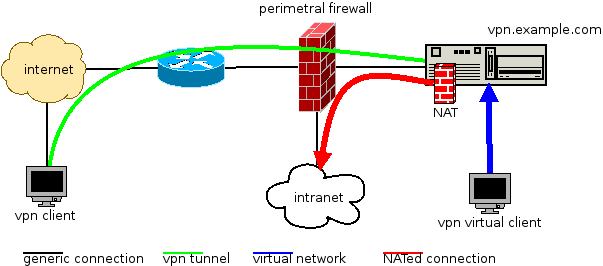
  1. clients connect via internet to our openvpn server, vpn.example.com
  2. the openvpn server validates the connection and the tunnel is established (green)
  3. now the client is virtually inside our network (blue)
  4. the client wants to access some intranet resource, the tunnel traffic is NATed (red)
Our datacenter intranet is using public IPv4 addressing, but the VPN tunnels use private IPv4 addresses. To don t mix public and private address NAT is used. Obviously we don t want to invest public IPv4 addresses in our internal tunnels. We don t have this limitations in IPv6, we could use public IPv6 addresses within the tunnels. But we prefer sticking to a hard dual stack IPv4/IPv6 approach and also use private IPv6 addresses inside the tunnels and also NAT the IPv6 from private to public. This way, there are no differences in how IPv4 and IPv6 network are managed. We follow this approach for the addressing: The NAT runs in the VPN server, since this is kind of a router. We use nftables for this task. As the final win, I will describe how we manage all this configuration using the git version control system. Using git we can track which admin made which change. A git hook will deploy the files from the git repo itself to /etc/ so the services can read them. The VPN server networking configuration is as follows (/etc/network/interfaces file, adjust to your network environments):
auto lo
iface lo inet loopback
# main public IPv4 address of vpn.example.com
allow-hotplug eth0
iface eth0 inet static
        address x.x.x.4
        netmask 255.255.255.0
        gateway x.x.x.1
# main public IPv6 address of vpn.example.com
iface eth0 inet6 static
        address x:x:x:x::4
        netmask 64
        gateway x:x:x:x::1
# NAT Public IPv4 addresses (used to NAT tunnel of client 1)
auto eth0:11
iface eth0:11 inet static
        address x.x.x.11
        netmask 255.255.255.0
# NAT Public IPv6 addresses (used to NAT tunnel of client 1)
iface eth0:11 inet6 static
        address x:x:x:x::11
        netmask 64
# NAT Public IPv4 addresses (used to NAT tunnel of client 2)
auto eth0:12
iface eth0:12 inet static
        address x.x.x.12
        netmask 255.255.255.0
# NAT Public IPv6 addresses (used to NAT tunnel of client 2)
iface eth0:12 inet6 static
        address x:x:x:x::12
        netmask 64
Thanks to the amazing and tireless work of the Alberto Gonzalez Iniesta (DD), the openvpn package in debian is in very good shape, ready to use. In vpn.example.com, install the required packages:
% sudo aptitude install openvpn openvpn-auth-ldap nftables git sudo
Two git repositories will be used, one for the openvpn configuration and another for nftables (the nftables config is described later):
% sudo mkdir -p /srv/git/vpn.example.com-nft.git
% sudo git init --bare /srv/git/vpn.example.com-nft.git
% sudo mkdir -p /srv/git/vpn.example.com-openvpn.git
% sudo git init --bare /srv/git/vpn.example.com-openvpn.git
% sudo chown -R :git /srv/git/*
% sudo chmod -R g+rw /srv/git/*
The repositories belong to the git group, a system group we create to let systems admins operate the server using git:
% sudo addgroup --system git
% sudo adduser admin1 git
% sudo adduser admin2 git
For the openvpn git repository, we need at least this git hook (file /srv/git/vpn.example.com-openvpn.git/hooks/post-receive with execution permission):
#!/bin/bash
NAME="hooks/post-receive"
OPENVPN_ROOT="/etc/openvpn"
export GIT_WORK_TREE="$OPENVPN_ROOT"
UNAME=$(uname -n)
info()
 
        echo "$ UNAME  $ NAME  $1 ..."
 
info "checkout latest data to $GIT_WORK_TREE"
sudo git checkout -f
info "cleaning untracked files and dirs at $GIT_WORK_TREE"
sudo git clean -f -d
For this hook to work, sudo permissions are required (file /etc/sudoers.d/openvpn-git):
User_Alias      OPERATORS = admin1, admin2
Defaults        env_keep += "GIT_WORK_TREE"
 
OPERATORS       ALL=(ALL) NOPASSWD:/usr/bin/git checkout -f
OPERATORS       ALL=(ALL) NOPASSWD:/usr/bin/git clean -f -d
Please review this sudoers file to match your environment and security requirements. The openvpn package deploys several systemd services:
% dpkg -L openvpn   grep service
/lib/systemd/system/openvpn-client@.service
/lib/systemd/system/openvpn-server@.service
/lib/systemd/system/openvpn.service
/lib/systemd/system/openvpn@.service
We don t need all of them, we can use the simple openvpn.service:
% sudo systemctl edit --full openvpn.service
And put a content like this:
% systemctl cat openvpn.service
# /etc/systemd/system/openvpn.service
[Unit]
Description=OpenVPN server
Documentation=man:openvpn(8)
Documentation=https://community.openvpn.net/openvpn/wiki/Openvpn23ManPage
Documentation=https://community.openvpn.net/openvpn/wiki/HOWTO
 
[Service]
PrivateTmp=true
KillMode=mixed
Type=forking
ExecStart=/usr/sbin/openvpn --daemon ovpn --status /run/openvpn/%i.status 10 --cd /etc/openvpn --config /etc/openvpn/server.conf --writepid /run/openvpn/server.pid
PIDFile=/run/openvpn/server.pid
ExecReload=/bin/kill -HUP $MAINPID
WorkingDirectory=/etc/openvpn
ProtectSystem=yes
CapabilityBoundingSet=CAP_IPC_LOCK CAP_NET_ADMIN CAP_NET_BIND_SERVICE CAP_NET_RAW CAP_SETGID CAP_SETUID CAP_SYS_CHROOT CAP_DAC_READ_SEARCH CAP_AUDIT_WRITE
LimitNPROC=10
DeviceAllow=/dev/null rw
DeviceAllow=/dev/net/tun rw
 
[Install]
WantedBy=multi-user.target
We can move on now to configure nftables to perform the NATs. First, it s good to load the NAT configuration at boot time, so you need a service file like this (/etc/systemd/system/nftables.service):
[Unit]
Description=nftables
Documentation=man:nft(8) http://wiki.nftables.org
 
[Service]
Type=oneshot
RemainAfterExit=yes
StandardInput=null
ProtectSystem=full
ProtectHome=true
WorkingDirectory=/etc/nftables.d
ExecStart=/usr/sbin/nft -f ruleset.nft
ExecReload=/usr/sbin/nft -f ruleset.nft
ExecStop=/usr/sbin/nft flush ruleset
 
[Install]
WantedBy=multi-user.target
The nftables git hooks are implemented as described in nftables managed with git. We are interested in the git hooks: (file /srv/git/vpn.example.com-nft.git/hooks/post-receive):
#!/bin/bash
NAME="hooks/post-receive"
NFT_ROOT="/etc/nftables.d"
RULESET="$ NFT_ROOT /ruleset.nft"
export GIT_WORK_TREE="$NFT_ROOT"
UNAME=$(uname -n)
info()
 
        echo "$ UNAME  $ NAME  $1 ..."
 
info "checkout latest data to $GIT_WORK_TREE"
sudo git checkout -f
info "cleaning untracked files and dirs at $GIT_WORK_TREE"
sudo git clean -f -d
info "deploying new ruleset"
set -e
cd $NFT_ROOT && sudo nft -f $RULESET
info "new ruleset deployment was OK"
This hook moves our nftables configuration to /etc/nftables.d and then applies it to the kernel. So a single commit changes the runtime configuration of the server. You could implement some QA using the git hook update, check this file! Remember, git hooks requires exec permissions to work. Of course, you will need again a sudo policy for these nft hooks. Finally, we can start configuring both openvpn and nftables using git. For the VPN you will require the configure the PKI side: server certificates, and the CA signing your client s certificates. You can check openvpn s own documentation about this. Your first commit for openvpn could be the server.conf file:
plugin		/usr/lib/openvpn/openvpn-plugin-auth-pam.so common-auth
mode		server
user		nobody
group		nogroup
port		1194
proto		udp6
daemon
comp-lzo
persist-key
persist-tun
tls-server
cert		/etc/ssl/private/vpn.example.com_pub.crt
key		/etc/ssl/private/vpn.example.com_priv.pem
ca		/etc/ssl/cacert/clients_ca.pem
dh		/etc/ssl/certs/dh2048.pem
cipher		AES-128-CBC
dev		tun
topology	subnet
server		192.168.100.0 255.255.255.0
server-ipv6	fd00:0:1:35::/64
ccd-exclusive
client-config-dir ccd
max-clients	100
inactive	43200
keepalive	10 360
log-append	/var/log/openvpn.log
status		/var/log/openvpn-status.log
status-version	1
verb		4
mute		20
Don t forget the ccd/ directory. This directory contains a file per user using the VPN service. Each file is named after the CN of the client certificate:
# private addresses for client 1
ifconfig-push		192.168.100.11 255.255.255.0
ifconfig-ipv6-push	fd00:0:1::11/64
# routes to the intranet network
push "route-ipv6 x:x:x:x::/64"
push "route x.x.3.128 255.255.255.240"
# private addresses for client 2
ifconfig-push		192.168.100.12 255.255.255.0
ifconfig-ipv6-push	fd00:0:1::12/64
# routes to the intranet network
push "route-ipv6 x:x:x:x::/64"
push "route x.x.3.128 255.255.255.240"
You end with at leats these files in the openvpn git tree:
server.conf
ccd/CN=CLIENT_1
ccd/CN=CLIENT_2
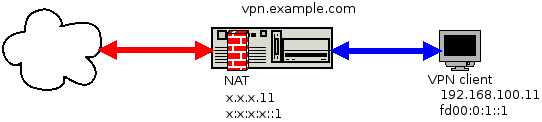
Please note that if you commit a change to ccd/, the changes are read at runtime by openvpn. In the other hand, changes to server.conf require you to restart the openvpn service by hand. Remember, the addressing is like this: Addressing (DIA source file) In the nftables git tree, you should put a ruleset like this (a single file named ruleset.nft is valid):
flush ruleset
table ip nat  
	map mapping_ipv4_snat  
		type ipv4_addr : ipv4_addr
		elements =  	192.168.100.11 : x.x.x.11,
				192.168.100.12 : x.x.x.12  
	 
	map mapping_ipv4_dnat  
		type ipv4_addr : ipv4_addr
		elements =  	x.x.x.11 : 192.168.100.11,
				x.x.x.12 : 192.168.100.12  
	 
	chain prerouting  
		type nat hook prerouting priority -100; policy accept;
		dnat to ip daddr map @mapping_ipv4_dnat
	 
	chain postrouting  
		type nat hook postrouting priority 100; policy accept;
		oifname "eth0" snat to ip saddr map @mapping_ipv4_snat
	 
 
table ip6 nat  
	map mapping_ipv6_snat  
		type ipv6_addr : ipv6_addr
		elements =  	fd00:0:1::11 : x:x:x::11,
				fd00:0:1::12 : x:x:x::12  
	 
	map mapping_ipv6_dnat  
		type ipv6_addr : ipv6_addr
		elements =  	x:x:x::11 : fd00:0:1::11,
				x:x:x::12 : fd00:0:1::12  
	 
	chain prerouting  
		type nat hook prerouting priority -100; policy accept;
		dnat to ip6 daddr map @mapping_ipv6_dnat
	 
	chain postrouting  
		type nat hook postrouting priority 100; policy accept;
		oifname "eth0" snat to ip6 saddr map @mapping_ipv6_snat
	 
 
table inet filter  
	chain forward  
		type filter hook forward priority 0; policy accept;
		# some forwarding filtering policy, if required, for both IPv4 and IPv6
	 
 
Since the server is in fact routing packets between the tunnel and the public network, we require forwarding enabled in sysctl:
net.ipv4.conf.all.forwarding = 1
net.ipv6.conf.all.forwarding = 1
Of course, the VPN clients will require a client.conf file which looks like this:
client
remote vpn.example.com 1194
dev tun
proto udp
resolv-retry infinite
comp-lzo
verb 5
nobind
persist-key
persist-tun
user nobody
group nogroup
 
tls-client
ca      /etc/ssl/cacert/server_ca.crt
pkcs12  /home/user/mycertificate.p12
verify-x509-name vpn.example.com name
cipher AES-128-CBC
auth-user-pass
auth-nocache
Workflow for the system admins:
  1. git clone the openvpn repo
  2. modify ccd/ and server.conf
  3. git commit the changes, push to the server
  4. if server.conf was modified, restart openvpn
  5. git clone the nftables repo
  6. modify ruleset
  7. git commit the changes, push to the server
Comments via email welcome!

6 April 2017

Reproducible builds folks: Reproducible Builds: week 101 in Stretch cycle

Here's what happened in the Reproducible Builds effort between Sunday March 26 and Saturday April 1 2017: Media coverage Sylvain Beucler wrote a follow-up post Practical basics of reproducible builds 2, which like last weeks article is about his experiences making software build reproducibly. Reproducible work in other projects Colin Watson started writing a patch to make launchpad store .buildinfo files. (It's not yet deployed.) Toolchain development and fixes Ximin Luo continued to work on BUILD_PATH_PREFIX_MAP patches for GCC 6 and dpkg. Packages reviewed and fixed, and bugs filed Chris Lamb: Mattia Rizzolo: Reviews of unreproducible packages 49 package reviews have been added, 25 have been updated and 42 have been removed in this week, adding to our knowledge about identified issues. 1 issue type has been updated: Weekly QA work During our reproducibility testing, FTBFS bugs have been detected and reported by: diffoscope development diffoscope 81 was uploaded to experimental by Chris Lamb. It included contributions from: reprotest development reprotest development continued in git, including contributions from: buildinfo.debian.net development buildinfo.debian.net development continued in git, including contributions from: reproducible-website development Holger switched reproducible-builds.org and www.reproducible-builds.org to letsencrypt certificates. Misc. This week's edition was written by Ximin Luo and Holger Levsen & reviewed by a bunch of Reproducible Builds folks on IRC & the mailing lists.

5 April 2017

Norbert Preining: Gaming: Quern Undying Thoughts

I have been an addict of Myst like games since the very beginning. Solving mind boggling riddles by logical means (instead of weapons) was always my preferred gaming. And it seems 2016 had a great share of games fitting to my taste: Obduction, The Eyes of Ara, The Witness, and last but not least Quern Undying Thoughts. Due to work, research, online courses, diapers, and some real life (these are also the excuses for my long silence on this blog) it took me ages to complete this games, but with a bit of help I finally manged it. Those who have ever played any game from the Myst series (Myst, Riven etc) know what you get: Several worlds/areas to explore, finding clues, solving riddles, lots of reading, leading to a finish where you have to decide between two fates. The game leads you through a variety of surrounding, from open air with gorgeous views and lovely crafted details, caves with dark corners and hidden chambers, even diving excursions are included, till you reach the final showdown at a huge underground facility. The graphics of the game are extremely beautifully crafted which makes you want to book a trip to this island. Click to view slideshow. I have to admit that due to the long time over which I had to play the game, as well as my missing Sherlock Holmes traits, some of the riddles were really hard for me. Sometimes the clues are so insidiously hidden or inconspicuously placed that one just easily misses them. But that makes the game a real challenge. For me Quern manages a great balance between a riddle game and an exploration game. I don t like games where you just have to go around and click each and every nook to make sure you find all pieces (typical example, the room series), but on the other hand games that only consists of solving riddles without searching for them are half the fun. Myst, Riven, and Quern, too, all of them strike a delicate balance between these two poles and deliver an absolute astonishing experience. Fully recommended, 100/100 for me!

4 April 2017

Ritesh Raj Sarraf: Fixing Hardware Bugs

Bugs can be annoying. Especially the ones that crash or hang and do not have a root cause. A good example of such annoyance can be kernel bugs, where a faulty hardware/device driver hinders the kernel's suspend/resume process. Because, as a user, while in the middle of your work, you suspend your machine hoping to resume your work, back when at your destination. But, during suspend, or during resume, randomly the bug triggers leaving you with no choice but a hardware reset. Ultimately, resulting in you losing the entire work state you were in. Such is a situation I encountered with my 2 year old, Lenovo Yoga 2 13. For 2 years, I had been living with this bug with all the side-effects mentioned.
Mar 01 18:43:28 learner kernel: usb 2-4: new high-speed USB device number 38 using xhci_hcd
Mar 01 18:43:54 learner kernel: usb 2-4: new high-speed USB device number 123 using xhci_hcd
Mar 01 18:44:00 learner kernel: usb 2-4: new high-speed USB device number 125 using xhci_hcd
Mar 01 18:44:11 learner kernel: usb 2-4: new high-speed USB device number 25 using xhci_hcd
Mar 01 18:44:16 learner kernel: usb 2-4: new high-speed USB device number 26 using xhci_hcd
Mar 01 18:44:22 learner kernel: usb 2-4: new high-speed USB device number 27 using xhci_hcd
Mar 01 18:44:22 learner kernel: usb 2-4: device descriptor read/64, error -71
Mar 01 18:44:22 learner kernel: usb 2-4: new high-speed USB device number 28 using xhci_hcd
Mar 01 18:44:23 learner kernel: usb 2-4: device descriptor read/64, error -71
Mar 01 18:44:23 learner kernel: usb 2-4: new high-speed USB device number 29 using xhci_hcd
Mar 01 18:44:23 learner kernel: usb 2-4: Device not responding to setup address.
Mar 01 18:44:23 learner kernel: usb 2-4: device not accepting address 29, error -71
Mar 01 18:44:24 learner kernel: usb 2-4: new high-speed USB device number 30 using xhci_hcd
Mar 01 18:44:24 learner kernel: usb 2-4: Device not responding to setup address.
Mar 01 18:44:24 learner kernel: usb 2-4: device not accepting address 30, error -71
Mar 01 18:44:24 learner kernel: usb usb2-port4: unable to enumerate USB device
Mar 01 18:44:24 learner kernel: usb 2-4: new high-speed USB device number 31 using xhci_hcd
Mar 01 18:44:24 learner kernel: usb 2-4: device descriptor read/64, error -71
Mar 01 18:44:25 learner kernel: usb 2-4: new high-speed USB device number 32 using xhci_hcd
Mar 01 18:44:30 learner kernel: usb 2-4: new high-speed USB device number 33 using xhci_hcd
Mar 01 18:44:30 learner kernel: usb 2-4: device descriptor read/64, error -71
Mar 01 18:44:31 learner kernel: usb 2-4: device descriptor read/64, error -71
Mar 01 18:44:31 learner kernel: usb 2-4: new high-speed USB device number 34 using xhci_hcd
Mar 01 18:44:36 learner kernel: usb 2-4: new high-speed USB device number 35 using xhci_hcd
Mar 01 18:44:36 learner kernel: usb 2-4: device descriptor read/64, error -71
Mar 01 18:44:37 learner kernel: usb 2-4: new high-speed USB device number 36 using xhci_hcd
Mar 01 18:44:37 learner kernel: usb 2-4: device descriptor read/64, error -71
Mar 01 18:44:37 learner kernel: usb 2-4: new high-speed USB device number 37 using xhci_hcd
Mar 01 18:44:37 learner kernel: usb 2-4: Device not responding to setup address.
Mar 01 18:44:38 learner kernel: usb 2-4: device not accepting address 37, error -71
Mar 01 18:44:38 learner kernel: usb 2-4: new high-speed USB device number 38 using xhci_hcd
Mar 01 18:44:38 learner kernel: usb 2-4: Device not responding to setup address.
Mar 02 13:34:05 learner kernel: usb 2-4: new high-speed USB device number 45 using xhci_hcd
Mar 02 13:34:05 learner kernel: usb 2-4: new high-speed USB device number 46 using xhci_hcd
Mar 02 13:34:05 learner kernel: usb 2-4: New USB device found, idVendor=0bda, idProduct=0129
Mar 02 13:34:05 learner kernel: usb 2-4: New USB device strings: Mfr=1, Product=2, SerialNumber=3
Mar 02 13:34:05 learner kernel: usb 2-4: Product: USB2.0-CRW
Mar 02 13:34:05 learner kernel: usb 2-4: Manufacturer: Generic
Mar 02 13:34:05 learner kernel: usb 2-4: SerialNumber: 20100201396000000
Mar 02 13:34:06 learner kernel: usb 2-4: USB disconnect, device number 46
Mar 02 13:34:16 learner kernel: usb 2-4: new high-speed USB device number 47 using xhci_hcd
Mar 02 13:34:21 learner kernel: usb 2-4: new high-speed USB device number 48 using xhci_hcd
Mar 02 13:34:26 learner kernel: usb 2-4: new high-speed USB device number 49 using xhci_hcd
Mar 02 13:34:32 learner kernel: usb 2-4: new high-speed USB device number 51 using xhci_hcd
Mar 02 13:34:37 learner kernel: usb 2-4: new high-speed USB device number 52 using xhci_hcd
Mar 02 13:34:43 learner kernel: usb 2-4: new high-speed USB device number 54 using xhci_hcd
Mar 02 13:34:43 learner kernel: usb 2-4: new high-speed USB device number 55 using xhci_hcd
Mar 02 13:34:49 learner kernel: usb 2-4: new high-speed USB device number 57 using xhci_hcd
Mar 02 13:34:55 learner kernel: usb 2-4: new high-speed USB device number 58 using xhci_hcd
Mar 02 13:35:00 learner kernel: usb 2-4: new high-speed USB device number 60 using xhci_hcd
Mar 02 13:35:06 learner kernel: usb 2-4: new high-speed USB device number 61 using xhci_hcd
Mar 02 13:35:11 learner kernel: usb 2-4: new high-speed USB device number 63 using xhci_hcd
Mar 02 13:35:17 learner kernel: usb 2-4: new high-speed USB device number 64 using xhci_hcd
Mar 02 13:35:22 learner kernel: usb 2-4: new high-speed USB device number 65 using xhci_hcd
Mar 02 13:35:28 learner kernel: usb 2-4: new high-speed USB device number 66 using xhci_hcd
Mar 02 13:35:33 learner kernel: usb 2-4: new high-speed USB device number 68 using xhci_hcd
Mar 02 13:35:39 learner kernel: usb 2-4: new high-speed USB device number 69 using xhci_hcd
Mar 02 13:35:44 learner kernel: usb 2-4: new high-speed USB device number 70 using xhci_hcd
Mar 02 13:35:50 learner kernel: usb 2-4: new high-speed USB device number 71 using xhci_hcd
Mar 02 13:35:50 learner kernel: usb 2-4: Device not responding to setup address.
Mar 02 13:35:50 learner kernel: usb 2-4: device not accepting address 71, error -71
Mar 02 13:35:50 learner kernel: usb 2-4: new high-speed USB device number 73 using xhci_hcd
Mar 02 13:35:51 learner kernel: usb 2-4: new high-speed USB device number 74 using xhci_hcd
Mar 02 13:35:56 learner kernel: usb 2-4: new high-speed USB device number 75 using xhci_hcd
Mar 02 13:35:57 learner kernel: usb 2-4: new high-speed USB device number 77 using xhci_hcd
Mar 02 13:36:03 learner kernel: usb 2-4: new high-speed USB device number 78 using xhci_hcd
Mar 02 13:36:08 learner kernel: usb 2-4: new high-speed USB device number 79 using xhci_hcd
Mar 02 13:36:14 learner kernel: usb 2-4: new high-speed USB device number 80 using xhci_hcd
Mar 02 13:36:20 learner kernel: usb 2-4: new high-speed USB device number 83 using xhci_hcd
Mar 02 13:36:26 learner kernel: usb 2-4: new high-speed USB device number 86 using xhci_hcd
Thanks to the Linux USB maintainers, we tried investigating the issue, which resulted in uncovering other bugs. Unfortunately, this bug was concluded as a possible hardware bug. The only odd bit is that this machine has a Windows 8.1 copy still lying on the spare partition, where the issue was not seen at all. It could very well be that it was not a hardware bug at all, or a hardware bug which had a workaround in the Windows driver. But, the results of the exercise weren't much useful to me because I use the machine under the Linux kernel most of the time. So, this March 2017, with 2 years completion on me purchasing the device, I was annoyed enough by the bugs. That led me trying out finding other ways to taming this issue. Lenovo has some variations of this device. I know that it comes with multiple options for the storgae and the wifi component. I'm not sure if there are more differences. The majority of the devices are connected over the xHCI bus on this machine. If a single device is faulty, or has faulty hardware; it could screw up the entire user experience for that machine. Such is my case. Hardware manufacturers could do a better job if they could provide a means to disable hardware, for example in the BIOS. HP shipped machines have such an option in the BIOS where you can disable devices that do not have an important use case for the user. Good example of such devices are Fingerprint Readers, SD Card Readers, LOMs and mabye Bluetooth too. At least the latter should apply for Linux users, as majority of us have an unpleasant time getting Bluetooth to work out of the box. But on my Lenovo Yoga, it came with a ridiculous BIOS/UEFI, with very very limited options for change. Thankfully, they did have an option to set the booting mode for the device, giving the choices of Legacy Boot and UEFI. Back to the topic, with 2 years of living with the bug, and no clarity on if and whether it was a hardware bug or a driver bug, it left me with no choice but to open up the machine. Next to the mSATA HDD sits the additional board, which houses the Power, USB, Audio In, and the SD Card reader. Opening that up, I got the small board. I barely use the SD Card reader, and given the annoyances I had to suffer because of it, there was no more mercy in killing that device. So, next was to unsolder the SD Card reader completely. Once done, and fitted back into the machine, everything has been working awesomely great in the last 2 weeks. This entire fix costed me 0. So sometimes, fixing a bug is all that matters. In the Hindi language, a nice phrase for such a scenario remnids me of the great Chanakya, " , , ".

Categories:

Keywords:

Like:

Matthias Klumpp: On Tanglu

It s time for a long-overdue blogpost about the status of Tanglu. Tanglu is a Debian derivative, started in early 2013 when the systemd debate at Debian was still hot. It was formed by a few people wanting to create a Debian derivative for workstations with a time-based release schedule using and showcasing new technologies (which include systemd, but also bundling systems and other things) and built in the open with a community using the similar infrastructure to Debian. Tanglu is designed explicitly to complement Debian and not to compete with it on all devices. Tanglu has achieved a lot of great things. We were the first Debian derivative to adopt systemd and with the help of our contributors we could kill a few nasty issues affecting it and Debian before it ended up becoming default in Debian Jessie. We also started to use the Calamares installer relatively early, bringing a modern installation experience additionally to the traditional debian-installer. We performed the usrmerge early, uncovering a few more issues which were fed back into Debian to be resolved (while workarounds were added to Tanglu). We also briefly explored switching from initramfs-tools to Dracut, but this release goal was dropped due to issues (but might be revived later). A lot of other less-impactful changes happened as well, borrowing a lot of useful ideas and code from Ubuntu (kudos to them!). On the infrastructure side, we set up the Debian Archive Kit (dak), managing to find a couple of issues (mostly hardcoded assumptions about Debian) and reporting them back to make using dak for distributions which aren t Debian easier. We explored using fedmsg for our infrastructure, went through a long and painful iteration of build systems (buildbot -> Jenkins -> Debile) before finally ending up with Debile, and added a set of own custom tools to collect archive QA information and present it to our developers in an easy to digest way. Except for wanna-build, Tanglu is hosting an almost-complete clone of basic Debian archive management tools. During the past year however, the project s progress slowed down significantly. For this, mostly I am to blame. One of the biggest challenges for a young project is to attract new developers and members and keep them engaged. A lot of the people coming to Tanglu and being interested in contributing were unfortunately no packagers and sometimes no developers, and we didn t have the manpower to individually mentor these people and teach them the necessary skills. People asking for tasks were usually asked where their interests were and what they would like to do to give them a useful task. This sounds great in principle, but in practice it is actually not very helpful. A curated list of junior jobs is a much better starting point. We also invested almost zero time in making our project known and create the necessary buzz and excitement that s actually needed to sustain a project like this. Doing more in the advertisement domain and help newcomers area is a high priority issue in the Tanglu bugtracker, which to the day is still open. Doing good alone isn t enough, talking about it is of crucial importance and that is something I knew about, but didn t realize the impact of for quite a while. As strange as it sounds, investing in the tech only isn t enough, community building is of equal importance. Regardless of that, Tanglu has members working on the project, but way too few to manage a project of this magnitude (getting package transitions migrated alone is a large task requiring quite some time while at the same time being incredibly boring :P). A lot of our current developers can only invest small amounts of time into the project because they have a lot of other projects as well. The other issue why Tanglu has problems is too much stuff being centralized on myself. That is a problem I wanted to rectify for a long time, but as soon as a task wasn t done in Tanglu because no people were available to do it, I completed it. This essentially increased the project s dependency on me as single person, giving it a really low bus factor. It not only centralizes power in one person (which actually isn t a problem as long as that person is available enough to perform tasks if asked for), it also centralizes knowledge on how to run services and how to do things. And if you want to give up power, people will need the knowledge on how to perform the specific task first (which they will never gain if there s always that one guy doing it). I still haven t found a great way to solve this it s a problem that essentially kills itself as soon as the project is big enough, but until then the only way to counter it slightly is to write lots of documentation. Last year I had way less time to work on Tanglu than the project deserves. I also started to work for Purism on their PureOS Debian derivative (which is heavily influenced by some of the choices we made for Tanglu, but with different focus that s probably something for another blogpost). A lot of the stuff I do for Purism duplicates the work I do on Tanglu, and also takes away time I have for the project. Additionally I need to invest a lot more time into other projects such as AppStream and a lot of random other stuff that just needs continuous maintenance and discussion (especially AppStream eats up a lot of time since it became really popular in a lot of places). There is also my MSc thesis in neuroscience that requires attention (and is actually in focus most of the time). All in all, I can t split myself and KDE s cloning machine remains broken, so I can t even use that ;-). In terms of projects there is also a personal hard limit of how much stuff I can handle, and exceeding it long-term is not very healthy, as in these cases I try to satisfy all projects and in the end do not focus enough on any of them, which makes me end up with a lot of half-baked stuff (which helps nobody, and most importantly makes me loose the fun, energy and interest to work on it). Good news everyone! (sort of) So, this sounded overly negative, so where does this leave Tanglu? Fact is, I can not commit the crazy amounts of time for it as I did in 2013. But, I love the project and I actually do have some time I can put into it. My work on Purism has an overlap with Tanglu, so Tanglu can actually benefit from the software I develop for them, maybe creating a synergy effect between PureOS and Tanglu. Tanglu is also important to me as a testing environment for future ideas (be it in infrastructure or in the make bundling nice! department). So, what actually is the way forward? First, maybe I have the chance to find a few people willing to work on tasks in Tanglu. It s a fun project, and I learned a lot while working on it. Tanglu also possesses some unique properties few other Debian derivatives have, like being built from source completely (allowing us things like swapping core components or compiling with more hardening flags, switching to newer KDE Plasma and GNOME faster, etc.). Second, if we do not have enough manpower, I think converting Tanglu into a rolling-release distribution might be the only viable way to keep the project running. A rolling release scheme creates much less effort for us than making releases (especially time-based ones!). That way, users will have a constantly updated and secure Tanglu system with machines doing most of the background work. If it turns out that absolutely nothing works and we can t attract new people to help with Tanglu, it would mean that there generally isn t much interest from the developer or user side in a project like this, so shutting it down or scaling it down dramatically would be the only option. But I do not think that this is the case, and I believe that having Tanglu around is important. I also have some interesting plans for it which will be fun to implement for testing  The only thing that had to stop is leaving our users in the dark on what is happening. Sorry for the long post, but there are some subjects which are worth writing more than 140 characters about  If you are interested in contributing to Tanglu, get in touch with us! We have an IRC channel #tanglu-devel on Freenode (go there for quicker responses!), forums and mailinglists, It looks like I will be at Debconf this year as well, so you can also catch me there! I might even talk about PureOS/Tanglu infrastructure at the conference.

3 April 2017

Enrico Zini: Free Software on my phone

I try to run my phone on Free Software as much as I can. I recently switched to LineageOS. I took it as an opportunity to do a full factory wipe and reinstall, to simulate a disaster recovery. Here's a summary of the basic software I use:

1 April 2017

Antoine Beaupr : My free software activities, February and March 2017

Looking into self-financing Before I begin, I should mention that I started tracking my time working on free software more systematically. I spend a lot of time on the computer, as regular readers of this blog might remember so I wanted to know exactly how much time was paid vs free work. I was already using org-mode's time clock system to keep track of my work hours, so I just extended this to my regular free software contributions, which also helps in writing those reports. It turns out that over 60% of my computer time is spent working on free software. That's huge! I was expecting something more along the range of 20 to 40% of my time. So I started thinking about ways of financing this work. I created a Patreon page but I'm hesitant into launching such a campaign: the only thing worse than "no patreon page" is "a patreon page with failed goals and no one financing it". So before starting such an effort, I'd like to get a feeling of what other people's experience with it are. I know that joeyh is close to achieving his goals, but I can't compare with the guy that invented git-annex or debhelper, so I'm concerned I wouldn't be able to raise the same level of funding. So any advice you have, feel free to contact me in private or in the comments. If you would be ready to fund my work, I'd love to know about it, obviously, but I guess I wouldn't get real numbers until I actually open up such a page... Now, onto the regular report.

Wallabako I spent a good chunk of time completing most of the things I had in mind for Wallabako, which I mentioned quickly in the previous report. Wallabako is now much easier to installed, with clearer instructions, an easier to use configuration file, more reliable synchronization and read status propagation. As usual the Wallabako README file has all the details. I've also looked at better integration with Koreader, the free software e-reader that forms the basis of the okreader free software distribution which has been able to port Debian to the Kobo e-readers, a project I am really excited about. This project has the potential of supporting Kobo readers beyond the lifetime that upstream grants it and removes a lot of proprietary software and spyware that ships with the Kobo readers. So I have made a few contributions to okreader and also on koreader, the ebook reader okreader is based on.

Stressant I rewrote stressant, my simple burn-in and stress-testing tool. After struggling in turn with Debirf, live-build, vmdebootstrap and even FAI, I just figured maybe it wasn't the best idea to try and reinvent that particular wheel: instead of reinventing how to build yet another Debian system build tool, maybe I should just reuse what's already there. It turns out there's a well known, succesful and fairly complete recovery system called Grml. It is a Debian Derivative, so all I needed to do was to stop procrastinating and actually write the actual stressant tool instead of just creating a distribution with a bunch of random tools shipped in. This allowed me to focus on which tools were the best to stress test different components. This selection ended up being: fio can also be used to overwrite disk drives with the proper options (--overwrite and --size=100%), although grml also ships with nwipe for wiping old spinning disks and hdparm to do a secure erase of SSD disks (whatever that's worth). Stressant still needs to be shipped with grml for this transition to be complete. In the meantime, I was able to configure the excellent public Gitlab CI service to provide ISO images with Stressant built-in as a stopgap measure. I also need to figure out a way to automate starting stressant from a boot menu to automate deployments on a larger scale, although because I have little need for the feature at this moment in time, this will likely wait for a sponsor to show up for this to be implemented. Still, stressant has useful features like the capability of sending logs by email using a fresh new implementation of the Python SMTPHandler (BufferedSMTPHandler) which waits for logging to complete before sending a single email. Another interesting piece of code in there is the NegateAction argparse handler that enables the use of "toggle flags" (e.g. --flag / --no-flag). I'm so happy with the code that I figure I could just share it here directly:
class NegateAction(argparse.Action):
    '''add a toggle flag to argparse

    this is similar to 'store_true' or 'store_false', but allows
    arguments prefixed with --no to disable the default. the default
    is set depending on the first argument - if it starts with the
    negative form (define by default as '--no'), the default is False,
    otherwise True.
    '''
    negative = '--no'
    def __init__(self, option_strings, *args, **kwargs):
        '''set default depending on the first argument'''
        default = not option_strings[0].startswith(self.negative)
        super(NegateAction, self).__init__(option_strings, *args,
                                           default=default, nargs=0, **kwargs)
    def __call__(self, parser, ns, values, option):
        '''set the truth value depending on whether
        it starts with the negative form'''
        setattr(ns, self.dest, not option.startswith(self.negative))
Short and sweet. I wonder why stuff like this is not in the standard library yet - maybe just because no one bothered yet? It'd be great to get feedback of more experienced Pythonistas on this one. I hope that my work on Stressant is complete. I get zero funding for this work, and have little use for it myself: I manage only a few machines and such a tool really shines when you regularly put new hardware online, which is (fortunately?) not my case anymore. I'd be happy, of course, to accompany organisations and people that wish to further develop and use such a tool. A short demo of stressant as well as detailed description of how it works is of course available in its README file.

Standard third party repositories After looking at improvements for the grml repository instructions, I realized there was no real "best practices" document on how to configure an Apt repository. Sure, there are tools like reprepro and others, but those hardly qualify as policy: they are very flexible and there are lots of ways to create insecure repositories or curl sh style instructions, which we of course generally want to avoid. While the larger problem of Unstrusted Debian packages remain generally unsolved (e.g. when you install any .deb file, it can get root on your system), it seemed to me one critical part of this problem was how to add a random third-party repository to your machine while limiting, as much as possible, what possible attackers could do with such a repository. In other words, to solve the more general problem of insecure .deb files, we also need to solve the distribution problem, otherwise fixing the .deb files themselves will be useless. This lead to the creation of standardized repository instructions that define:
  1. how to distribute the repository's public signing key (ie. over HTTPS)
  2. how to name suites and components (e.g. use stable and main unless you have a good reason, and explain yourself)
  3. recommend a healthy does of apt preferences pinning
  4. how to distribute keys (e.g. with a derive-archive-keyring package)
I've seen so many third party repositories get this wrong. For example, a lot of repositories recommend this type of command to intialize the OpenPGP trust path:
curl http://example.com/key.asc   apt-key add -
This has the following problems:
  • the key is transfered in plaintext and can easily be manipulated by an active attacker (e.g. a router on your path to the server or a neighbor in a Wifi cafe)
  • the key is added to the main trust root, which allows the key to authentify as the real Debian archive, therefore giving it all rights over all packages
  • since it's part of the global archive, it's difficult for a package to remove/add the key when a key rollover is necessary (and repositories generally don't provide a deriv-archive-keyring to do that process anyways)
An example of this are the Docker install instructions that, at least, manage to do this over HTTPS. Some other repositories don't even bother teaching people about the proper way of adding those keys. We settled for:
wget -O /usr/share/keyrings/deriv-archive-keyring.gpg https://deriv.example.net/debian/deriv-archive-keyring.gpg
That location was explicitly chosen to be out of the main trust directory, so that it needs to be explicitly added to the sources.list as well:
deb [signed-by=/usr/share/keyrings/deriv-archive-keyring.gpg] https://deriv.example.net/debian/ stable main
Similarly, we highly recommend users setup "apt pinning" to restrict what a given repository can do. Since pinning is so confusing, most people don't actually bother even configuring it and I have yet to see a single repo advise its users to configure those preferences, which are essential to limit what a repository can do. To keep configuration simple, we recommend this:
Package: *
Pin: origin deriv.example.net
Pin-Priority: 100
Obviously, for a single-package repository, the actual package name should be listed, e.g.:
Package: foo
Pin: origin deriv.example.net
Pin-Priority: 100
And the priority should probably be set to 1 unless you want to allow automatic upgrades. It is my hope that this design will get more traction in the years to come and become a de-facto standard that will be a key part in safely adding third party repositories. There is obviously much more work to be done to improve security when installing untrusted .deb files, and I encourage Debian developers to consider contributing to the UntrustedDebs discussions and particularly to the Teams/Dpkg/Spec/DeclarativePackaging work.

Signal R&D I spent a significant amount of time this month struggling with the Signal project on my phone. I'm still ambivalent on Signal: it's a centralized designed, too dependent on phone numbers, but I must admit they get a lot of things right and it's the only free-software platform that allows for easy-to-use, multi-platform videoconferencing that my family can use. I've been following Signal for a while: up until now, I had been using the LibreSignal rebuild of the official client, as it is distributed on a F-Droid repository. Because I try to avoid Google (proprietary) software on my phone, it's basically the only way I could even install Signal. Unfortunately, the repository is out of date and introduces another point of trust in the distribution model: now you not only need to trust the Signal authors to do the right thing, you also need to trust that F-Droid repo not to inject nasty code on your phone. I've therefore started a discussion about how Signal could be distributed outside of the Google Play Store. I'd like to think it's one of the things that led the Signal people to distribute an official copy of Signal outside of the playstore. After much struggling, I was able to upgrade to this official client and will be able to upgrade easily by just downloading the APK. (Do note that I ended up reinstalling and re-registering Signal, which unfortunately changed my secret keys.) I do hope Signal enters F-Droid one day, but it could take a while because it still doesn't work without Google services and barely works with MicroG, the free software alternative to the Google services clients. Moxie also set a list of requirements like crash reporting and statistics that need to be implemented on F-Droid's side before he agrees to the deployment, so this could take a while. I've also participated in the, ahem, discussion on the JWZ blog regarding a supposed vulnerability in Signal where it would leak previously unknown phone numbers to third parties. I reviewed the way the phone number is uploaded and, while it's possible to create a rainbow table of phone numbers (which are hashed with a truncated SHA-1 checksum), I couldn't verify the claims of other participants in the thread. For me, Signal still does the right thing with contacts, although I do question the way "read status" notifications get transmitted, but that belong in another bug report / blog post.

Debian Long Term Support (LTS) It's been more than a year working on Debian LTS, started by Raphael Hertzog at Freexian. I didn't work much in February so I had a lot of hours to catchup with, and was unfortunately unable to do so, partly because I was busy with other projects, and partly because my colleagues are doing a great job at resolving the most important issues. So one my concerns this month was finding work. It seemed that all the hard packages were either taken (e.g. my usual favorites, tiff and imagemagick, we done by others) or just too challenging (e.g. I don't feel quite comfortable tackling the LTS branch of the Linux kernel yet). I spent quite a bit of time trying to figure out what was wrong with pcre3, only to realise the "32" in the report was not about the architecture, but about the character width. Because of thise, I marked 4 CVEs (CVE-2017-7186, CVE-2017-7244, CVE-2017-7245, CVE-2017-7246) as "not-affected", since the 32-bith character support wasn't enabled in wheezy (or jessie, for that matter). I still spent some time trying to reproduce the issues, which require a compiler with an AddressSanitizer, something that was introduced in both Clang and GCC after Wheezy was released, which makes reproducing this fairly complicated... This allowed me to experiment more with Vagrant, however, and I have provided the Debian cloud team with a 32-bit Vagrant box that was merged in shortly after, although it doesn't show up yet in the official list of Debian images. Then I looked at the apparmor situation (CVE-2017-6507), Debian bug #858768). That was one tricky bug as well, since it's not a security issue in apparmor per se, but more an issue with things that assume a certain behavior from apparmor. I have concluded that Wheezy was not affected because there are no assumptions of proper isolation there - which are provided only starting from LXC 1.0 - and Docker is not in Wheezy. I also couldn't reproduce the issue on Jessie, but, as it turns out, the issue was sysvinit-specific, which is why I couldn't reproduce it under the default systemd configuration shipped with Jessie. I also looked at the various binutils security issues: as I reported on the mailing list, I didn't see anything serious enough in there to warrant a a security release and followed the lead of both the stable and Red Hat security teams by marking this "no-dsa". I similiarly reviewed the mp3splt security issues (specifically CVE-2017-5666) and was fairly puzzled by that issue, which seems to be triggered only the same address sanitization extensions than PCRE, although there was some pretty wild interplay with debugging flags in there. All in all, it seems we can't reproduce that issue in wheezy, but I do not feel confident enough in the results to push that issue aside for now. I finally uploaded the pending graphicsmagick issue (DLA-547-2), a regression update to fix a crash that was introduced in the previous release (DLA-547-1, mistakenly named DLA-574-1). Hopefully that release should clear up some of the confusion and fix the regression. I also released DLA-879-1 for the CVE-2017-6369 in firebird2.5 which was an interesting experiment: I couldn't reproduce the issue in a local VM. After following the Ubuntu setup tutorial, as I wasn't too familiar with the Firebird database until now (hint: the default username and password is sysdba/masterkey), I ended up assuming we were vulnerable and just backporting the patch after seeing the jessie folks push out a release just in case. I also looked at updating the ca-certificates package to deal with the pending WoSign/Startcom removal: I made an explicit list of the CAs that need to be removed after reviewing the Mozilla list. I also sent a patch for an unrelated issue where ca-certificates is writing to /usr/local (!!) in Debian bug #843722. I have also done some "meta" work in starting a discussion about fixing the missing DLA links in the tracker, as you will notice all of the above links lead to nowhere. Thanks to pabs, there are now some links but unfortunately there are about 500 DLAs missing from the website. We also discussed ways to Debian bug #859123, something which is currently a manual process. This is now in the hands of the excellent webmaster team. I have also filed a few missing security bugs (Debian bug #859135, Debian bug #859136), partly because I wanted to help the security team. But it turned out that I felt the script needed some improvements, so I submitted a patch to improve the script so it is easier to run.

Other projects As usual, there's the usual mixed bags of chaos: More stuff on Github...

Enrico Zini: Stereo remote control

Wouldn't it be nice if I could use the hifi remote control to control mpd? It turns out many wishes can come true when one has a GPIO board. A friend of mine had a pile of IR receiver components in his stash and gave me one. It is labeled "38A 1424A", and the closest matching datasheet I found is this one. I wired the receiver with the control pin on GPIO port 24, and set up lirc by following roughly this guide. Hifi with shutdown button and IR receiver Enable lirc_rpi support I had to add these lines to /boot/config.txt to enable lirc_rpi support:
dtoverlay=lirc-rpi,gpio_in_pin=24,gpio_out_pin=22
dtparam=gpio_in_pull=up
At first I had missed configuration of the internal pull up resistor, and reception worked but was very, very poor. Then reboot. Install and configure lirc
apt install lirc
I added these lines to /etc/lirc/hardware.conf:
DRIVER="default"
DEVICE="/dev/lirc0"
MODULES="lirc_rpi"
Stopped lircd:
systemctl stop lirc
Tested that the receiver worked:
mode2 -d /dev/lirc0
Downloaded remote control codes for my hifi and put them in /etc/lirc/lircd.conf. Started lircd
systemctl start lirc
Tested that lirc could parse commands from my remote control:
$ irw
0000400405506035 00 CD_PAUSE RAK-SC304W
0000400405506035 01 CD_PAUSE RAK-SC304W
0000400405506035 02 CD_PAUSE RAK-SC304W
0000400405505005 00 CD_PLAY RAK-SC304W
0000400405505005 01 CD_PLAY RAK-SC304W
Interface lirc with mpd I made this simple lirc program and saved it in ~pi/.lircrc:
begin
     prog = irexec
     button = CD_NEXT
     config = mpc next
end
begin
     prog = irexec
     button = TAPE_FWD
     config = mpc next
end
begin
     prog = irexec
     button = TAPE_REW
     config = mpc prev
end
begin
     prog = irexec
     button = CD_PREV
     config = mpc prev
end
begin
     prog = irexec
     button = TAPE_PAUSE
     config = mpc pause
end
begin
     prog = irexec
     button = CD_PAUSE
     config = mpc pause
end
begin
     prog = irexec
     button = CD_PLAY
     config = mpc toggle
end
begin
     prog = debug
     button = TAPE_PLAY_RIGHT
     config = mpc toggle
end
Then wrote a systemd unit file to start irexec and saved it as /etc/systemd/system/mpd-irexec.service:
[Unit]
Description=Control mpd via lirc remote control
After=lirc mpd
[Service]
Type=simple
ExecStart=/usr/bin/irexec
Restart=always
User=pi
WorkingDirectory=~
[Install]
WantedBy=multi-user.target
Then systemctl start mpd-irexec to start irexec, and systemctl enable mpd-irexec to start irexec at boot. Profit! All of this was done by me, with almost no electronics training, following online tutorials for the hardware parts. To connect components I used a breadboard and female-male jumper leads, so I didn't have to solder, for which I have very little practice. Now the Raspberry Pi is so much a part of my hifi component that I can even control it with the hifi remote control. Given that I disconnected the CD and tape players, there are now at least 16 free buttons on the remote control that I can script however I like. Raspberry Pi closeup

Next.

Previous.