Search Results: "sf"

10 May 2011

David Welton: Welton's Law of Trite Business Advice

For each and every bit of trite business advice, there is an equal and opposite bit of trite business advice "Fail fast" vs "be persistent" "The first person to mention a number in a negotiation loses" vs "by saying a number, you frame the negotiations" "Ideas don't matter" vs "the Number One startup killer ... making a product for which there is no interesting market" "Do something you're passionate about" vs "where there's muck, there's brass" "Business plans are a waste of time" vs "failure to plan is planning to fail" There's some valuable lesson behind all of these; I'm not saying these are bad advice. What I'm saying is that if it were so easy, more people would be doing it successfully. In reality, it's very difficult. What are some of your favorite equal and opposite bits of business advice?

8 May 2011

Stefano Zacchiroli: debconf11 and you

DebConf11 program, the FOSS way
I'm going to DebConf11 and, once more, I'm thrilled at idea of living for about 2 weeks immersed in a very very very, very Debian-ic life. DebConf10, DebConf edition of last year, has been for me one of the most intense DebConfs ever, it would be hard to match it. But one of the nice things about DebConf, no matter the edition, is that it's very "open source" and do-ocratic in they way it is organized: everyone could contribute into making it even better than the previous edition. For one thing, there is no "event organizer" company behind DebConf. Rather, most of the hard work that goes into making a DebConf possible is done by the DebConf team, a volunteer team formed by a mixture of Debian contributors, local team members, and DebConf enthusiasts. But while they take care of most of the work and hence deserve the thanks of all DebConf attendees for that they do not account for all that makes a DebConf a great DebConf. For instance, having a great program is up to DebConf participants and the event proposals they submit: talks, BoF, panel discussions, film projections, contests, you name it. Today, in deadline frenzy mode (read on), I've submitted for review the following events for DebConf11: That's it from me, how about you?
Are you going to DebConf and willing to attend a conference with a great program? Great, then start submitting a great event yourself! Anything you are working on in Debian or you are excited about qualifies. And don't worry if you've never attended DebConf either, video archives from past DebConfs can give you more than a feeling of typical DebConf events. While the first deadline for events submission expires today, submissions will be open all the way to the end of the conference, but you should better hurry up as the early birds get the best scheduling slots (and missing the deadline, you'll miss the round of the review for the main program ... but you still have a few hours left :)). Good luck and see you in Banja Luka.

3 May 2011

Kai Wasserb ch: gitosis moved its post-update hook (upgrade from Lenny to Squeeze)

I'm using gitosis to manage my Git repositories on the public server. That server was recently upgraded to Squeeze and I didn't create a new repository on that server so far but today I wanted to and got:
ERROR:gitosis.serve.main:Repository read access denied
fatal: The remote end hung up unexpectedly
A search yielded some results with people messing up their keys or forgetting to create the configuration file entry or something similar. None of this was my problem. As it turned out, the post-update hook for the admin repository has been moved from /usr/share/python-support/gitosis/gitosis-0.2-py2.5.egg/gitosis/templates/admin/hooks/post-update to /usr/share/pyshared/gitosis/templates/admin/hooks/post-update, but the symlink hasn't been updated on upgrade. After running a simple
ln -sf /usr/share/pyshared/gitosis/templates/admin/hooks/post-update post-update
in the hook directory of the admin repository everything worked again.

2 May 2011

Lucas Nussbaum: Debian rolling discussion on -devel@

Here is my attempt at a summary of the rolling discussion currently happening on debian-devel@. It might not be complete, it s probably a bit biased, but I hope that it s still better than nothing. It was also posted on debian-devel@. If you are involved in Debian development, please discuss it on debian-devel@, rather than in the comments of this blog. If you want to provide feedback about the Debian rolling idea, use this Doodle poll and/or the comments of this blog.
Update : Someone had the good idea to vandalize the poll, and remove all the votes from people in favor of rolling. Before the vadalism (log), the results were:
37 votes: I am a Debian user, I use testing or unstable, and I would like rolling to happen.
6 votes: I am a Debian user, I use testing or unstable, and I DON T want rolling to happen.
17 votes: I am a Debian user, I use stable, and I would like rolling to happen.
3 votes: I am a Debian user, I use stable, and I DON T want rolling to happen.
7 votes: I am NOT a Debian user, but I would probably use it if rolling happened.
1 vote: I am NOT a Debian user, and I don t care about rolling. Motivations There s some user demand for rolling releases. For evidence, one can look at the usage of Debian testing or unstable which clearly goes further than the Debian development community. Or at the quickly growing market share of ArchLinux. Or at the interest in LinuxMint and Aptosid. Or at the DPL s report of his interactions with the press. Debian s only official product is its stable releases. While it s a clearly great and useful product, many users and developers don t recognize themselves in it: it contains software that is too old for their needs. The success of Ubuntu is related to this problem: Ubuntu proposes a different compromise between stability and up-to-date-ness. While concurrencing Ubuntu with more frequent stable releases (released every 6-months, for example) doesn t look like the right thing to do, Debian is in a perfect position to provide a rolling release with marginal additional work, since Debian already has testing (and unstable) to build on. The rolling discussion investigates how we could endorse the concept of a rolling release, provided as a product in addition to stable releases. This rolling release would be based on the current testing branch. Benefits for Debian: Current proposed plan for rolling (Disclaimer: this is mostly my view. It is shared by others, but some details might not be) rolling is mostly about (external) communication. It is not expected to change our development processes fundamentally.
It would be a statement by the project (through a GR, for example). A very preliminary draft was proposed by Raphael Hertzog:
Title: Debian endorses usage of testing by end-users, and renames it to rolling The Debian project recognizes that the Debian testing distribution initially created to make it easier to prepare and test the next stable release has become a useful product of its own. It satisfies the needs of users who are looking for the latest stable versions of software and who can cope (or even appreciate) a system that s constantly evolving. The Debian project decides to endorse this usage and will strive to provide a good experience to users of testing . To better communicate this policy change to our users, testing will be renamed rolling .
Yes, it s mostly PR bullshit , and I don t expect it to significantly change Debian development processes. However, communication is necessary if we want to attract new users. What would change is more attention from developers to what happens in testing/rolling, which is a good thing since a better testing/rolling makes it easier to create stable releases from it. Open questions Most of the discussion is about the influence of the introduction of rolling on Debian development processes, and in particular, on the painful process resulting in stable releases. Many fear that, with rolling , it will be harder to get stable releases out. The root question is: if we do rolling, what do we do during freezes? Several options have been mentioned in the thread:
  1. We could decide not to do anything special: just freeze rolling for ~6 months, as we used to freeze testing. That might bore people who like the constant flux of new upstream releases, but if we decide that it s the only way to ensure high-quality stable releases, so be it.
  2. We could decide to fork a frozen branch when we freeze, and continue to manage rolling using migrations from unstable.
  3. We could mix both solutions: freeze rolling for 3 months, so that most of the stabilization work occurs with a single active branch, and then, for the final release preparation, fork frozen off rolling, and unfreeze rolling.
Two kinds of objections have been raised: Other things that were discussed: Tentative personal conclusion I have the impression that advertising testing as a rolling release usable by end-users is generally considered a good thing.
The renaming of testing to rolling is not as consensual, but most opponents have a whatever ; if you want position. How we deal with freezes is the hard point in this discussion. I m personnally in favor of the freeze rolling for 3 months, then fork frozen and unfreeze rolling plan, though it has some problems too (it is not clear whether the required manpower really decreases at the end of freezes). Where do we go from there? After another round of discussion, we might postpone the how to deal with freezes question to later, and proceed with a GR to measure the support for the testing for end-users + s/testing/rolling/ proposal.

29 April 2011

Raphaël Hertzog: Do we need project-wide support for Debian rolling?

The discussion about Debian rolling started sooner than expected on debian-devel (see the thread here). I initially wanted to iron out the biggest problems through discussions on my blog and try to submit a somewhat polished proposal instead we ended up discussing the same things both on -devel and on my blog. That said it s not that bad (except for the time I lost to have similar conversations in both places) because the debian-devel discussions included members of the release team and it looks like they are not fundamentally opposed to the idea. Despite this, the introduction of a frozen suite branched off from testing/rolling is not really consensual (yet?). But the idea of officially supporting testing on a best-effort basis appears to have almost no opposition. While some will undoubtedly believe that this is a useless exercise, I believe it would help if the project stated this in a somewhat official manner. My answer to the question in the title is thus: YES I am thus considering to submit a general resolution to that effect. My current draft is below.
Title: Debian endorses usage of testing by end-users, and renames it to rolling The Debian project recognizes that the Debian testing distribution initially created to make it easier to prepare and test the next stable release has become a useful product of its own. It satisfies the needs of users who are looking for the latest stable versions of software and who can cope (or even appreciate) a system that s constantly evolving. The Debian project decides to endorse this usage and will strive to provide a good experience to users of testing . To better communicate this policy change to our users, testing will be renamed rolling . While we believe that this is a good move, we would like to remind our users that Debian is a volunteer project and that our resources are not infinite. Package maintainers are contributing to Debian on a best-effort basis. This means that they might not be able to properly support their package(s) in all distributions. In that case, the project recommends that maintainers apply the following priorities:
  1. Support in stable (security updates, release critical bugs)
  2. Preparation of the next stable release
  3. Support in rolling
Note that this general resolution could have amendments with s/rolling/current/ and that would solve the bikeshedding over the name that started several times already. I deliberately separated Preparation of the next stable release and Support in rolling so that priorities are clear even if we decide to not freeze rolling and to introduce a frozen distribution to finalize the next stable release. I also did not go into too much details on the implications that it might have, it s best to leave that up to each contributor/team/etc. I hesitated to add a paragraph stating that we want to try to gradually improve the usability of testing but in the end I think it would be somewhat redundant. We re always trying to do our best when we decide to take on something. All comments welcome (even if you just agree and would be willing to second such a GR). Update: I will tweak the draft included in this article when I get good suggestions. Thanks to Lucas Nussbaum for the first one.

10 comments Liked this article? Click here. My blog is Flattr-enabled.

27 April 2011

Raphaël Hertzog: Towards Debian rolling: my own Debian CUT manifesto

As you might know, I m of one the people who promote the idea of having a Constantly Usable Testing (CUT). I will post a set of articles on this topic to help me clarify my ideas and to get some early feedback of other Debian contributors. I plan to use the result of this process to kickstart a broader discussion on debian-devel (where I hope to get the release team involved). Let s start by defining my own objectives with Debian CUT. I won t speak of the part of Debian CUT that plans to make regular snapshots of testing with installable media because that s not where I will invest my time. I do hope other people will do it though. Instead I will concentrate on changes that would improve Debian testing for end-users. I consider that testing (in its current form) is largely usable already but there are two main obstacles to overcome. Testing without freezes = rolling The first one is that testing is no longer testing during freezes. The regular flow of new upstream versions that makes testing so interesting for many users is stalled because we re using testing to finalize the next stable version. That s why I d like to introduce a new suite called rolling that would work like the current testing except that it never freezes. Testing would no longer be a permanent suite, it would only exist during the freeze and it would be branched off from rolling. Rolling should be a supported distribution The second obstacle is not really technical. We must advertise rolling as a distribution that ordinary people can use but we should make it clear that it s never going to have the same level of polish that a stable release can have. And to back up this assertion, we must empower Debian developers to be able to provide good support of their software in rolling, this probably means using rolling-proposed-updates more often to push fixes and security updates when the natural flow of updates is blocked by transitions or other problems. Some maintainers won t have the time required to provide the same level of support as they currently do for a stable release and that s okay, it s not worse than the current testing. The goal is to treat it on a best-effort basis and to try to gradually improve the situation. My goal for wheezy This is the the minimal implementation of CUT that I would like to target in the wheezy timeframe. Having testing as a temporary branch of rolling is not a strict requirement, although I d argue that it s important to not waste resources towards maintaining two separate yet very similar distributions. Should Debian embrace those goals? Ignoring all possible problems that will surface while trying to implement those goals, can we agree that Debian should embrace those goals because it means providing a better service to a class of users that is not satisfied by the current stable release? I will come back to the expected problems in a subsequent post and we will have the opportunity to discuss them. Here I just want to see whether we can have broad buy-in on the principles behind Debian rolling and CUT.

23 comments Liked this article? Click here. My blog is Flattr-enabled.

25 April 2011

Obey Arthur Liu: Welcome to our 2011 Debian Google Summer of Code students!

I d like to extend a warm welcome to our new batch of students selected for the 2011 Debian Google Summer of Code! They should soon be posting on Debian Planet and you re welcome to come talk to them on #debian-soc on irc.debian.org Further details will be posted in the coming days to our wiki: http://wiki.debian.org/gsoc Automated Multi-Arch Cross-Building and Bootstrapping aka autocrossbuild , by Gustavo Prado Alkmim, mentored by Wookey
Enable easy and automated setup of cross-platform automated build systems and bootstrapping for QA in the Multi-Arch era. This involves the creation of multi-stage bootstrap build sequencing tools and a reliable automated multi-arch cross-builder. APT/Dpkg Transaction Ordering for Safety and Performance aka aptordering , by Chris Baines, mentored by Michael Vogt
The ordering code in libapt is responsible for ordering the unpacking/configuration of debs so as to ensure dependencies are satisfied etc. Currently it organizes the ordering into big batches. This project further implements an ordering satisfying more constrains such as minimal amounts of dpkg invocations , minimal amount of broken packages at any point . DebDelta APT Native Integration aka debdelta , by Ishan Jayawardena, mentored by Michael Vogt
Improve user experience of APT and its front-ends by speeding up the upgrade process. This provides a better framework for unified handling of debdelta and future APT improvements such as parallelism. Support for stable and security ugprades as well as multiple APT related libraries is expected. Dpkg Declarative Diversions aka declarativediversions , by Sam Dunne, mentored by Steve Langasek
The dpkg-divert command should be replaced with a new control file with a declarative syntax which Dpkg will parse and process directly as part of the package unpack and removal phases, eliminating the problems resulting from non-atomic handling of diversions. Backend Tools and Infrastructure for DEX aka dextools , by Nathan Handler, mentored by Matt Zimmerman
EX is a new program designed to help improve Debian and its derivatives by merging in changes made downstream and encouraging discussions between the various projects. As this is a new project, most of the infrastructure does not exist (or is rather hackish and incomplete). This project will create the necessary backend tools and infrastructure so that all Debian derivatives can easily make use of the DEX project. Jigsaw Modularized Java in Debian aka jigsaw , by Guillaume Mazoyer, mentored by Tom Marble
The Java Development Kit (JDK) is a big monolithic software tool: many of its features are only useful in limited areas (GUI toolkits are useless for a web server). This project will bring the Jigsaw modular JDK to Debian, helping performance (start-up, size, etc) but also the dependency resolution (to match Debian packaging). Some work exists upstream does not fit with Debian. This project will package the current development version of Jigsaw, update Debian Java Policy, and create the necessary packaging tools for software depending on it. Python Multi-Build for Python Extensions Packaging aka pythonmultibuild , by Mesutcan Kurt, mentored by Piotr O arowski
This project creates a tool to build Python extensions for all Python versions supported by Debian at the time. The project should detect the upstream build system and testing frameworks and use them. It will be interfaced with CDBS and the dh sequencer, replacing their Python snippets. Debian Teams Activity Metrics aka teammetrics , by Sukhbir Singh, mentored by Andreas Tille
This project will gauge the performance of teams in Debian by measuring metrics such as: postings on relevant mailing lists, package upload records from the Ultimate Debian Database and commit statistics from project repositories The information gathered will help in evaluating team performance by measuring how people in a team are working together. An interface to access this information easily will also be developed. Compute Clusters Integration for Debian Development and Building aka computeclusters , by Rudy Godoy, mentored by Steffen M ller
The project s main goal is to enable developers to easily use compute clusters (Eucalyptus, OpenStack ) as environments for arch-specific development by providing a set of tools they can use to setup and run an extended platform for their development, testing and building tasks. Good luck to everyone!

24 April 2011

Joey Hess: abc

Alphabetical order's not nice
But use it if no others suffice.
Can you think of a way to
Do better?
Each manual page option sorted, not by its
First letter, but
Grouped in a sequence, by sense.
Highly structured, to be scanned at a glance!
I think that is better, and "So Say We All".
Just think of the savings, in time for us all.
Kaleidoscopic knowledge, swirled around, then
Left to sit, on the page alone,
Makes me wish that in kindergarten,
No ABCs graced the top of the classroom.
Only... it's true, in printed
Pages of text,
Queries are satisfied best by
Running ones finger along, in order,
Stopping at the word one desires.
Truth. But...
Until these days of glittering screens and even e-ink pass,
Vacently staring at text all in order, or smudging the screen, is not best.
Wikipedia alphabetical? Surely you jest!
Xenophobia is best hyperlinked; not followed by xylophonists.
Years from now, will we care about
Zany alphabets? (Unicode could take this to a higher plane, but I'll stop here.)
Inspired by: Debian bug #499487 Debian bug #551741 Debian bug #561017 Debian bug #623890 and many more.

23 April 2011

Dirk Eddelbuettel: Another nice Rcpp example

While preparing my slides for the Rcpp workshop this Thursday, I had wondered about more nice examples motivating Rcpp. So I posed a quick question on the rcpp-devel list. And I received a few friendly answers. My favourite, so far, was a suggestion by Lance Bachmeier who sent me a short script which used both R and C++ (via Rcpp) to simulate a first-order vector autoregressive process (and he ensured me that it worked well enough on his graduate students). It is indeed a great example as it involves (simple) matrix multiplication in an iterative fashion. Which makes it a great example not only for Rcpp but also for our RcppArmadillo package (which wraps Conrad Sanderson's wonderful Armadillo C++ templated library for linear algebra and more). And at the same time, we can also add another look at the new and shiny R compiler I also blogged about recently. So Lance and I iterated over this a little more over email, and I now added this as a new (and initial) example file in the RcppArmadillo SVN repo. (As an aside: The newest version 0.2.19 of RcppArmadillo has been sitting in incoming at CRAN since earlier in the week while the archive maintainer takes a well-deserved vacation. It should hit the public archive within a few days, and is otherwise available too from my site.) So let's walk through the example:
R> ## parameter and error terms used throughout
R> a <- matrix(c(0.5,0.1,0.1,0.5),nrow=2)
R> e <- matrix(rnorm(10000),ncol=2)
R> ## Let's start with the R version
R> rSim <- function(coeff, errors)  
+   simdata <- matrix(0, nrow(errors), ncol(errors))
+   for (row in 2:nrow(errors))  
+     simdata[row,] = coeff %*% simdata[(row-1),] + errors[row,]
+    
+   return(simdata)
+  
R> rData <- rSim(a, e)                     # generated by R
This starts with a simple enough loop. After skipping the first row, each iteration multiplies the previous row with the parameters and adds error terms. We can then turn to the R compiler:
R> ## Now let's load the R compiler (requires R 2.13 or later)
R> suppressMessages(require(compiler))
R> compRsim <- cmpfun(rSim)
R> compRData <- compRsim(a,e)              # generated by R 'compiled'
R> stopifnot(all.equal(rData, compRData))  # checking results
Nice and easy: We load the compiler package, create a compiled function and use it. We check the results and surely enough find them to be identical. With that, time to turn to C++ using Armadillo via RcppArmadillo:
R> ## Now load 'inline' to compile C++ code on the fly
R> suppressMessages(require(inline))
R> code <- '
+   arma::mat coeff = Rcpp::as<arma::mat>(a);
+   arma::mat errors = Rcpp::as<arma::mat>(e);
+   int m = errors.n_rows; int n = errors.n_cols;
+   arma::mat simdata(m,n);
+   simdata.row(0) = arma::zeros<arma::mat>(1,n);
+   for (int row=1; row<m; row++)  
+     simdata.row(row) = simdata.row(row-1)*trans(coeff)+errors.row(row);
+    
+   return Rcpp::wrap(simdata);
+ '
R> ## create the compiled function
R> rcppSim <- cxxfunction(signature(a="numeric",e="numeric"),
+                        code,plugin="RcppArmadillo")
R> rcppData <- rcppSim(a,e)                # generated by C++ code
R> stopifnot(all.equal(rData, rcppData))   # checking results
Here we load the inline package to compile, link and load C++ snippets. We define a short C++ function in the code variable, declare a signature taking a and e as before and ask cxxfunction() to deploy the plugin for RcppArmadillo so that it and Rcpp are found during build. With that, we have a compiled function to generate data, and we once again check the result. The C++ code is pretty straightforward as well. We can instatiate Armadillo matrices directly from the R objects we pass down; we then run a similar loop building the result row by row. Now, with all the build-up, here is the final timing comparison, using the rbenchmark package:
R> ## now load the rbenchmark package and compare all three
R> suppressMessages(library(rbenchmark))
R> res <- benchmark(rcppSim(a,e),
+                  rSim(a,e),
+                  compRsim(a,e),
+                  columns=c("test", "replications", "elapsed",
+                            "relative", "user.self", "sys.self"),
+                  order="relative")
R> print(res)
            test replications elapsed relative user.self sys.self
1  rcppSim(a, e)          100   0.038   1.0000      0.04        0
3 compRsim(a, e)          100   2.011  52.9211      2.01        0
2     rSim(a, e)          100   4.148 109.1579      4.14        0
So in a real-world example involving looping and some algebra (which is of course already done by BLAS and LAPACK libraries), the new R compiler improves by more than a factor of two, cutting time from 4.14 seconds down to about 2 seconds. Yet, this still leaves the C++ solution, clocking in at a mere 38 milliseconds, ahead by a factor of over fifty relative to the new R compiler And compared to just R itself, the simple solution involving Rcpp and RcppArmadillo is almost 110 times faster. As I mentioned, I quite like this example ;-).

Russell Coker: Links April 2011

Sebastian Thrun gave an interesting TED talk about the Google driverless car project and explains how his main aim is to avoid all the needless road deaths that are due to human error [1]. Finally a good use for the Google street-view type data! AnnMarie Thomas gave an interesting short TED talk about using play-dough to make circuits [2]. There are two recipies for play-dough, the one made with salt conducts well and the one made with sugar conducts poorly. That allows making wires with salty dough and insulators with the sugar dough. John Robb has published an interesting article about a Chinese fake revolutionary group that is triggering a backlash from Chinese security forces [3]. Even if this isn t accurate it seems like a good way to make people hate their local security forces and thus demand political change. Chris Rock made an interesting observation, we aren t making progress on racial issues, white people are getting less crazy [4]. Red Hill has an interesting article about 486 motherboards with fake cache chips that were sold in the 90 s [5]. One thing I disagree with is that they blame the customers for seeking low prices. When a white-box PC cost $2000 (which is $3000 in today s money) it made sense to try and get the cheapest option possible. Now that major department stores sell name-brand laptops for $400 it really makes sense to buy name-brand quality rather than white-box rubbish. IHollaBack.org is an interesting project to combat street harassment of women [6]. Psychology Today has an interesting article by Joe Navarro (former FBI counter-intelligence agent and author) about the serious implications of attempting to detect lies [7]. His main point is that most people over-estimate their ability to detect lies and because the legal system believes such claims from law enforcement officers many innocent people get found guilty and criminals get away free! Cory Doctorow wrote an informative article about the ways of persuading people to pay for content that can be obtained for free [8]. The main message seems to be that the big media companies are doing things the wrong way in everything that they do. The news satire site CBS Breaking News has an interesting about page explaining their mission [9]. They stopped their automated disaster generator after the Japanese Tsunami, while I can understand them wanting to keep some good taste and be sympathetic to the plight of the Japanese people it seems that they have forgotten that there is always a disaster somewhere. The typical bus plunge is just as bad as the Tsunami to the people on the bus and their relatives! Psychology Today has an interesting blog post by Satoshi Kanazawa explaining how criminals don t specialise, the psychological factors that make someone likely to commit one crime will make them likely to commit others, this makes it logical to collect DNA samples from all criminals [10]. Psychology Today has an interesting blog post by Dave Niose about a landmark US legal case in 1948 where Vashti McCollum had to escalate to the Supreme Court to allow her children to receive secular education [11]. We need something like this in Australia now as the religious extremists are going too far in indoctrinating children. Sam Richards gave a TED talk titled A Radical Experiment in Empathy which aims to teach Americans how to understand the way that people in the middle-east feel [12]. The comments suggest that his talk wasn t successful. Of course the fact that empathy doesn t have a clear definition in the English language doesn t help, and the fact that most people don t seem to interpret it in any way that corresponds to any dictionary and that most people seem unable to define what they mean by it makes things worse. At the moment I can t think of any examples of successfully teaching empathy to unwilling people. The people who want to learn will do so eventually, you can have some good success in helping them to learn faster. Kathryn Schulz gave an interesting TED talk about Being Wrong [13]. One interesting point that she makes concerns the way that people assume that people who disagree are ignorant, stupid, or evil instead of just having a different set of data or a different understanding of the same data. Of course it is possible for someone to be ignorant/stupid/evil AND have a different understanding. Marcin Jakubowski gave an inspiring TED talk about his project to develop free blueprints that allow anyone to create all machines needed to sustain civilisation with minimal cost [14]. His Open Source Ecology project has a blog and a wiki with blueprints and files for CAD/CAM [15]. Dave Meslin gave an insightful TED talk about apathy in the political process [16]. Among other things he compares council notices that supposedly request citizen input with adverts for running shoes which encourage people to buy them. One thing he didn t mention is the difference that technology can make, a short council advert with a QR code is probably a lot more useful than the current dense text-based adverts for today s audience.

21 April 2011

Timo Jyrinki: Free Society Conference and Nordic Summit (FSCONS 2010)

Just a note that the slides are available (non-slideshare link) for my presentation Tuning an old but free phone (description) that I held in the tremendously great event FSCONS 2010. It could be described as a smaller scale FOSDEM, but that would be actually down-playing it since the free software effects on society are something that I've actually never seen elsewhere on such a scale. My talk was among the purely technical ones, though.

I was planning to hold on with this blog post until the recorded videos arrive, but since it seems it might not be during this year I will just post this now that slides are available.

I've shared a few photos as well at Flickr...


Keynote: Karin Kosina, The Inanna Project. A tech + art workshop for female artists in Damascus, Syria. An experiment in art, technology, and the transformative power of Free Hardware and Software.


Erik de Bruijn, The Future of RepRap, a self-replicating open source 3D printer that fabricates arbitrary objects including parts of itself.


Social event at the Berg 211.


Malin Nilsson on Gender, class and global flows. Using free software to fuel a revolution in home based industrial work.


Keynote: Glyn Moody, Ethics of Intellectual Monopolies.


Keynote: Glyn Moody, Ethics of Intellectual Monopolies (audience).

A few summaries available on a Qaiku seminar channel.

Alastair McKinstry: How much wind energy can we use?

So how much wind energy can we realistically use? A paper (Earth System Dynamics, DOI: 10.5194/esd-2-1-2011) by Miller,Gans and Kleidon (MGK10) has generated a lot of controversy courtesy of a New Scientist review (See Climate Progress for a good rebuttal). They argue that the effective limit we can safely extract without (bad) climatic consequences is around 18--68 TW (we currently use 0.2 TW of wind power). This paper is a follow-on to Kleidons work on the thermodynamics of the climate, where he points out that the free energy is the important measure of what energy can be generated by renewables. The free energy of the atmosphere is on the scale of hundreds of TW, he argues, much less than the heat energy of ~10^5 TW that comes from the sun. He argues that not enough attention is paid to the free energy budget, and argues that from MEP theory that free energy flows through different geophysical processes are more important than people currently think: such energy and momentum flows then lead to faster depletion of gradients than people currently use in their models. Frequently we use "diffusive-like" approximations to stuff we can't explicitly handle,such as convection and eddies below the resolution of our computer models. That the free energy budget, and small-scale processes need more detailed study (such as the transfer of momentum and energy from wind to water), I agree. But paradoxically, MGK10's estimates based on diffusive processes are what gets it into trouble. The critiques (e.g. Jacobsen and Archer) seem to concentrate on the estimates for diffusive and other energy losses (eg. wake fields) and climatic consequences are very loose, and out by factors of 50-100. They also ignore the fact that using wind as a substitute for more destructive energy sources produces a net gain, climate-wise. Based on these numbers, the real limits on wind power are more limited by where we can realistically place turbines, and the use and availability of rare earth metals in turbine magnets (MW sized turbines use over a ton of neodynium each in magnets!) One of the focuses of research at ICHEC and Met Eireann is wind for wind power: this becomes increasingly important for Ireland as we have more energy production by wind. I've been recently involved in a European project Weather Intelligence for Renewable Energies on investigating weather and climate forecasting needs of wind energy. In our weather models, we are getting to finer and finer resolutions (down to 2-5 km operationally, but working on 1 km in research), but as yet do not take account of wind energy changes. Modelling the wake turbulence, etc. and other effects of turbines is a 'fluid dynamics' problem done by the wind turbine manufacturers, mostly, in order to lay out turbines in a farm efficiently; this is done on the timescale of metres and seconds, while on the other end of the spectrum work is done in climate research on the changes in potential winds to see if wind energy will change in a few decades. But little is done on 'weather' scales of kilometres, minutes and hours: it turns out there are wind patterns that we don't predict in our models (vortices, etc.; especially for offshore turbines) that affect wind energy production, but would be very useful for wind farm and electrical grid operators to know about. So we should think about adapting our weather models for these. Either way, it looks like more detailed work on the interactions between atmospheric dynamics and wind farms would be a good thing. Incidentally, whatever about the alarmist nature of the article, kudos to New Scientist for their linking to papers: they quoted the names of the journals (Earth System Dynamics,Philosophical Transactions of the Royal Society), but where the article was not yet published (or behind a paywall), linked to the Arxiv.org version. More could do this. Tags , , , , ,

Rapha&#235;l Hertzog: People behind Debian: Meike Reichle, member of Debian Women

Meike Reichle is a Debian developer since 2008 but has been involved for longer than that, in particular in Debian Women. She s a great speaker and shared her experience in a Debconf talk. She s also part of the Debian publicity team and managed the live coverage of the last release on identi.ca. Enough introduction, learn more about her by reading the interview. My questions are in bold, the rest is by Meike. Who are you? My name is Meike Reichle, I am a studied information scientist and work as a project manager at Pengutronix, an embedded Linux company probably best known for their ARM kernel work. I live in Germany, more exactly in Lower Saxony, but I was originally born and raised in Swabia. Although I moved here ten years ago I still have a rather strong Swabian cultural identity. (Among other things I pride myself on having introduced a number of fellow DDs to the true promise that are real hand-made Sp tzle ;-) ) I am married to Alexander Reichle-Schmehl, we ll have our third wedding anniversary this summer. Apart from Debian most of my spare time is used for all kinds of crafts and DIY activities. Making things with my hands always gives me a great sense of accomplishment. My Free software history is summed up pretty quickly. Like most women of my age I wasn t introduced to computers until well into my teens. I didn t have a computer of my own until I started studying at the university in 2001. From there on things developed rather quickly: Working on the University s Unix terminals got me hooked on *nixes, so I got me one of those Linuxes everyone talked about. I tried a couple of different distributions, ended up with Debian around 2004, started contributing in 2005, and finally became a full DD what a nice coincidence! exactly this day (Apr 18th) three years ago. You re part of Debian Women. How is the project going? I have the feeling that the number of women involved in Debian has not significantly increased. The amount of women active within Debian is a tricky thing to judge. Here s a quick example why: When the DPL was elected in 2004 there were 911 Debian Developers eligible to vote, 4 of them were female. Shortly after, during DebConf4, debian-women was founded. When the current DPL was reelected last month, there were again 911 Debian Developers eligible to vote, but this time 13 of them were women. You can look at these numbers and say The number of female DDs has more than tripled, what a success! Or you can pull out your calculator and it will tell you that in terms of ratio this puts us from a measly 0.4% to an only slightly less measly 1.4% ratio of female DDs. This still is pardon my language a bloody shame, but sadly also pretty close to the average ratio of women in Free Software. So, while I do think that the debian-women project did already have a significant impact on the Debian project as a whole, I don t think it has achieved its goals yet. Not for a long time. There s still a lot to be done but unfortunately the debian-women project has somewhat run out of steam at the moment. The seven years of its existence divide quite equally into the first half, which was very active and saw great results, and the second half, which was very slow and much more passive. In my impression debian-women is currently undergoing a rather bumpy generational change. On the one hand a lot of the original members, including myself, have reduced their involvement. Speaking for myself this is caused by shift of interests as much as general weariness. On the other hand there are only very few women following up. This development is also reflected quite harshly in DD numbers: If I don t misjudge any first names (and I desperately hope I do!) for the last three years not a single woman has joined Debian as a developer! After the great start debian-women has had, this is a very painful thing to see! That said, things don t look all bad. There is a number of women maintaining packages without being DDs and there s also at least one woman currently in NM, so there s hope this standstill won t last very much longer. But still, the fact remains that debian-women is suffering from a rather serious recruitment problem and I hope that this interview might actually help to spur some new or not yet active members into action. The aim of debian-women is far from achieved and now that its initial members are receding its time for new members to step up and take initiative. What should Debian do to be more attractive to women ? I think the general atmosphere has improved, we re less tolerant with rude behaviour, the usual tone on mailing lists has improved. Yet it doesn t seem to be enough. If there was a female DD for every time I answered that question First of all, I agree, Debian as a community has improved tremendously! Our general tone is much more friendly and cooperative and there is now a much better awareness of the impression we give to outsiders and newcomers. Now on to the difficult part: The question what should be done to get more women into Free Software has been around almost as long as Free Software exists, and it has been answered very well by a lot of people: Twenty years ago Ellen Spertus wrote Why are There so Few Female Computer Scientists? and most of it still holds true. Almost ten years ago Val Henson (now Aurora) wrote HOWTO Encourage Women in Linux and that also is still pretty accurate. In 2006 Floss Pols undertook extensive research to find out why there were so few women in Open Source and Free Software and how that could be changed. They also came up with a very good set of recommendations. All of these texts highlight different aspects of that question and all of them have very good points. I personally have, over the years, arrived at a rather sociological, not to say holistic point of view. In fact I answered the exact same question a few days ago, and the answer I gave then was this: After ~10 years of women in tech advocacy I d say the ultimate and final measure to get more women into Free Software is by finally achieving a truly equal society and at the same time dramatically improving child care support in almost any country. I ve come to the conclusion that what really holds women back in practice is not so much a lack of skill or interest but a simple lack of opportunity. For most of us Free Software is what we do in our spare time and that s something that women, even today, have considerably less of than men. Even in couples where both partners work full-time it is still mostly the woman who does the majority of the housework and child care duties. In most cultures men have a perceived right to their leisure time that does not to the same degree exist for women. That is one major reason, the other is instilled modesty, which has kind of become my personal arch-enemy by now. I ve talked to so many girls and women at all sorts of events about why they won t take up Computer Science studies or join a Free Software project and the answer I hear most often is that they do not consider themselves good enough in one or another aspect. Sometimes they will doubt their technical skills, sometimes their language skills, sometimes their stamina. Needless to say these girls and women were not any less qualified than the people already active in Free Software. So, yes, in the short and medium term making Debian a more welcoming and friendly place is the way to go. As many others pointed out already this will not only benefit prospective contributors but the community as a whole: those new to it as well as those who ve been in it for a long time. In the long term however what we need is empowerment! Women who are just as confident about their skills as men and are not discouraged by uncooperative environments. This is of course something that is culturally deep-rooted and can only happen in a very large time frame. So, for the moment the way to go in my view is accessibility: a cooperative atmosphere, a code of conduct, comprehensive documentation not only of technical aspects but also of structures and processes. The other thing we need to do is to have as many already active women as possible attend as many Linux/Debian/Free Software/Whatever events as possible. In my experience it happens quite often that other women see these women, feel very inspired by them, get to talk to them and then a few days later show up on some mailing list or IRC channel. From what I ve seen personal contact still beats any other kind of recruiting measures. You re a Debian developer but you re also married with a Debian developer (Alexander Reichle-Schmehl). Did you meet because of Debian? If not, who introduced Debian to the other one? :-) We did in fact meet because of Debian. More specifically during our booth shift at the Debian booth at LinuxTag 2005, where I did a talk on the debian-women project and Alex organised the DebianDay. After that our relationship developed pretty much along our Debian activities: After our initial meeting we talked a lot on #debian.de, when Alex went to DebConf5 and I didn t we noticed that we kind of missed each other. The first gift he ever gave me was a Debconf5 shirt and a box Finnish chocolates (I still have one of them today. :) ) Our first secret kiss was at ApacheCon 2005, where we were both staffing the Debian booth (kudos to abe for pretending not to notice). We then became an official couple at Berlinux 2005 where we were both staffing the Debian booth and giving talks on packaging and user motivation. Our first real relationship stress test was when we both joined the DebConf6 orga team. It was a stressful time, but we passed it with flying colours! About a year later we announced our engagement via planet.debian.org. Our wedding was a veritable MiniDebConf, one of the best gifts we got was a Debian cookbook including the favourite recipes of DDs from around the world. By now we ve both finished university and work full-time jobs, so we don t do as many talks and attend as many Debian events as we used to. Instead we now mainly focus on press and publicity work, which is quite practical to work on as a pair. It s actually rather funny that way, Alex and I get confused with each other quite often, since we have almost the same name, often pick up on each other s E-Mail conversations and are most often quoted by our function rather than by name. Because of we have kind of merged into this virtual Debian Press Person in the perception of many of our contacts. You also have another hat : Debian Press Officer. What is this about? What would you suggest to people who would like get involved in that domain? Debian press work is mainly about providing an official and coordinated point of contact to anyone wanting information from or about Debian. The press team answers all sorts of inquiries (the most popular one is is of course always the next release date) and makes sure all important events and developments within Debian receive the attention and recognition they deserve. Debian is a diverse project where every sort of contributor is free to voice his or her opinion in any way. We don t have NDAs or prescribed terminology. That s one of the things I love about Debian but also something that makes us difficult to handle for conventional media. They want official statements, in generally understandable terms, at appointed times. That s what the press team takes care of. Almost all of the press work is done in the publicity team, which coordinates using IRC, Mail and SVN. The publicity team also publishes the Debian Project News, which are very popular among our users and developers. Press work is also an area of work that offers lots of possibilities for non-technical contribution. http://wiki.debian.org/Teams/Publicity lists a number of possibilities for contribution and, like most Debian Teams, we d be more than grateful to get some more helping hands and happy to introduce interested newcomers to our work. What s the biggest problem of Debian? In my view: Overwork. Debian has thousands of contributors but still a lot of the main work rests on very few shoulders. We need more contributors, especially, but not only in the key teams. In order to get more people we need to do some marketing which is very hard for us, since we are very proud of our independence and have a strong focus on purely technical aspects rather than aiming for popularity. However, with the current amount of Open Source and Free Software projects to join we find ourselves not only in a contest on technical excellence but also a sort of popularity contest that is about perception rather than hard facts. This popularity contest is difficult for Debian and currently costs us quite a bunch of very capable people. Do you have wishes for Debian Wheezy? My answer to that is a non-technical one: I think Debian is currently very under-appreciated, we do a lot of great work and maybe even more importantly we do a lot of important work for Software Freedom, sometimes even at the cost of our above-mentioned popularity. I hope people will appreciate that more again in the future. Is there someone in Debian that you admire for their contributions? Over the years I have made a lot of friends within the Debian community, some have even become family. That makes it somewhat hard to single out individual people. I think what I admire most is continuous commitment. I am very impressed by those among us who have kept up a high level of commitment over many years and at the same time managed to bring that in line with a fulfilled personal/family life. That s something that I hope I ll also be able to achieve in the years to come.
Thank you to Meike for the time spent answering my questions. I hope you enjoyed reading her answers as I did. Subscribe to my newsletter to get my monthly summary of the Debian/Ubuntu news and to not miss further interviews. You can also follow along on Identi.ca, Twitter and Facebook.

2 comments Liked this article? Click here. My blog is Flattr-enabled.

18 April 2011

Russell Coker: Virgin Refunds Me $200

Virgin Mobile Excessive BillingIn my previous post about the Xperia X10 I mentioned being billed excessively for bandwidth use [1].On Friday when I phoned Virgin I was repeatedly told that there was nothing that could be done about the bill. I demanded to be transferred to someone with authority to change my bill, I was told that wasn t possible so I demanded to be transferred to a supervisor. As no supervisors were available at the time I had to be called back.The Supervisor Tonight I received a call from someone who s employed to deal with disputed bills, after explaining the situation I was offered a discount of $150, that s a 64% discount on the $234. I rejected that offer and explained that I only used 7% more data than was permitted in the month and only did so because of a previous phone call with a Virgin representative telling me that the billing period ended at the month end (which I couldn t verify at the time because the Virgin CRM system was down [2]). Thus it doesn t seem reasonable to charge me 7* the regular billing amount for the entire month.I was asked what I thought would be a reasonable extra charge, I suggested 7.4% more than the $39 contract, IE an extra $3 that wasn t well received. Then I suggested that as the $49 Smart Cap plan would have covered the extra data use it could be reasonable for me to pay $49 for the month. The Virgin representative then offered me a $200 discount on the bill and I accepted that. So I got a 85.5% discount on the disputed amount, that s not too bad, it s enough to make this scam less profitable to Virgin (particularly when I publish information about it) and enough to make it not worth the effort of a TIO complaint.That makes it a bill of $102.36 instead of the original $302.36. That is $29 for one month of the Big Cap $29 for my wife, $39 for one month of the Smart Cap $39 for me, $33.99 for Virgin excessive bandwidth charges (down from $233.99), and $0.37 Account Charges which is described as a Payment Processing Fee presumably a fee for paying by credit card.The Ethical IssueTo make it clear, I think that only a minority of mobile phone customers have an ability to track their bandwidth and understand their bill which equals mine. I also think that only a minority of customers are as willing as I am to argue with random people about such things. I am sure that employees of Virgin Mobile know this and they devised a billing plan to trap customers. I think that this doesn t comply with the ethical standards that Richard Branson has advocated in several TV interviews that I have watched.The Next IssueNow the only remaining issue is that I signed up for an offer 3 Months Free ^ access fee on Topless, Smart & Easy caps with this phone. Save up to $267, just by buying online which continued Promo code: reggae Use this promo code & we ll automatically credit your first 3 months access fees , but so far they have not credited it. It s a pity I didn t realise this before and get it done in the same call.ConclusionI m starting to regret not keeping my LG U990 Viewty with a pre-paid SIM from Lebara [3] or Amaysim [4]. Amaysim has a minimum pre-paid value of $10 which lasts for 90 days, and the SIM will then receive calls for 180 days after the credit has run out this means $10 per 260 days (an average of $7.11 per year) if you just want to receive calls. Lebara has a period of 120 days before the number expires, so that means it costs $10 per 210 days or an average of $5.75 per year to receive calls only.Telstra charges $150 for one year of mobile net access which allows 10G of data transfer [5]. So it seems that a good option would be an old phone and a new Android tablet. $150 per year ($12.50 per month) for mobile net access and something between $5.75 and $40 per year for phone access (depending on whether you want to make calls) gives enough savings over the cost of a post-paid plan to buy a decent tablet.I think that the Android phone is definitely the best deal for my wife because she really only wants to carry one device, also she likes having longer conversations on the phone so the plan where she gets up to 450 minutes for $29 per month is a reasonable deal particularly as calls to me are free and calls to her relatives will be free if they get Virgin phones (something that now seems doubtful given their over-billing).I m happy to carry multiple devices (my past record is having four mobile phones and getting a tailor-made coat to fit all the geek stuff I carried) so a phone and a tablet is a reasonable option for me. But the Xperia X10 will do the job for the next two years and I ve got no great regrets.On the up-side, Virgin did send me a couple of free movie tickets after their CRM stuff-up.

17 April 2011

Russell Coker: More about the Xperia X10

I ve now had a Sony Ericsson Xperia X10 for almost two months (here is a link for my first review) [1]. This is a phone that people seem to really dislike because the battery life is poor and Sony doesn t allow replacing the kernel. I m happy with mine, happy enough that after buying one for my wife and trying it out I bought one for myself. I knew about it s problems in advance and wanted a relatively cheap phone with a large high resolution screen, and the Xperia X10 was the best match for my criteria.ChargingThere has been a recent trend towards using USB for charging devices. Sony provides a tiny wall-wart PSU which has a USB socket and a short (1m) USB cable that can be used to charge the phone from it s PSU or from a PC. The size is really convenient, as the phone has a short battery life I ll probably want to take the PSU to more places than I would for other phones I ve owned.The short USB cable saves weight and tangle when travelling, but can be inconvenient. I m currently working on the phone while it s plugged into my laptop, that works well and I can make calls while it s connected. If the phone was connected to a USB port on a tower computer that was on the ground then the cable could be too short to make a call, if it was charging on a power point near the floor then I wouldn t even be able to use the computer functionality let alone make calls without kneeling. My Viewty has a 175cm charging cable which alleviates these problems. I ve got a 50cm USB extension cable that I use for charging my phone while I m in bed that is just long enough to allow me to check my email without getting out of bed!The socket for connecting the USB cable is protected by a plastic lid that is connected by a strip of rubber. For a socket that will be used at least twice a day this isn t a good mechanical design. The plastic slide on the LG U990 Viewty seems like a much better design.As an aside it s a pity that they aren t designing cars with USB charging sockets built in. Some new cars have a socket for one USB flash drive to be attached to the radio, but really they need at least one USB charging port per seat. It would also be nice if they made power points with USB charging sockets built in, I d buy a few of those if they made them.Preserving the BatteryI ve been running Juice Defender to reduce the battery use, at the moment it is claiming to have extended battery life by 69%. That combined with turning off things that aren t needed (such as WiFi) has made the phone reasonably usable. I can survive more than 12 hours during which I use the phone a lot without charging it.XperiaX10.net has an interesting review of replacement batteries [5]. I m not going to buy them because the largest battery requires a replacement back case which prevents using an external case to prevent damage and the smaller one doesn t provide enough of a benefit and the design of the phone makes it difficult to change batteries so carrying a spare battery isn t a good option.Cursor Control KeysThe HP/Compaq iPaQs that I own from ~10 years ago have a single button that can be moved up/down/left/right to act as a cursor, it can also be pressed inwards to act as an ENTER key (or whatever the application might want for a fifth function). Having some sort of hardware cursor control is really handy, I often end up deleting several characters when I want to replace one because getting the cursor onto the desired character is too difficult.Adding more hardware keys would require making the phone bigger, but that would be fine by me. As described in my previous post about phone cameras I d like to have a phone that s thicker to have a better camera with a greater focal distance for a larger lens [2].Core Phone FunctionalityI really miss having separate green and red buttons for making/answering calls and for rejecting/ending calls.A really common operation is to call back the last person who called. To do this on my LG U990 Viewty I press the green button twice on my home screen which took less than a second. On the Xperia this involves selecting the phone icon from the home screen, then the call log icon, then the call that is desired, then the Call user line. That is four presses in different parts of the screen compared to pressing the same hardware button twice. I m investigating dialer applets right now, the Dialler One applet has a good interface for calling people who have called or been called recently but it still requires two presses on different parts of the screen. With my old Viewty I could call back the last person by feel without even looking at the phone!In the last 6 years the standard functionality of phones has been to include multiple profiles for noises. My Viewty has profiles named Normal , Silent , Vibrate only , Outdoor , Headset (automatically selected when a headset is connected), and three customised ones. The Xperia has only one setting, and that is three icon presses away from the home screen. It does allow changing the volume by hardware switches on the side which includes going to vibrate-only and silent mode. While this is useful, it s not the best way that two precious hardware keys could be used. It also doesn t allow control over all the different notifications, I d like to be able to activate a noise profile and have every application respond to it in an appropriate manner. This is a deficiency in Android 2.1 not in the phone itself.In many ways this phone has the worst phone functionality of any mobile phone I ve ever owned, I think that this is more the fault of the Android designers than Sony Ericsson.Android UpdatesSony had previously claimed that they wouldn t support Android later than 2.1. Now Sony has announced that they will support Gingerbread Android 2.3 [3]. So one of the major complaints about the Xperia will soon be addressed.TetheringThe build of Android that the Xperia runs at the moment doesn t support Wifi tethering. I m currently using with Easy Tether for USB tethering [4]. It s not free software and requires it s own code to run as root on your Linux system that is being tethered (which is easily locked down with SE Linux), but it basically works. The down-side with Easy Tether is that it proxies all the connections so you can t run traceroute etc and in the free version you can t use UDP.K9 MailK9 Mail fixes some of the problems in the default Android email program that I described in my previous post. It allows selection of SSL with a default port of 993 for IMAPs. It uses mail.example.com as the mail server address for an email address of user@example.com (so I ll add a mail CNAME to the domains I run). When I connected initially it told me that the SSL key was not signed by a CA and asked if I wanted to save it or reject it this is the correct and desired functionality. It also correctly parses URLs from the email (or at least has fixed the bug that I discovered in the default email app).One problem I ve found with K9 is that it seems to timeout on large folders. This is probably partly the fault of Virgin Mobile being slow for IP access, but I wonder whether K9 doesn t pipeline IMAP commands as Virgin can do bulk transfer at reasonable speeds (80KB/s) and it mainly fails on latency (900ms being typical). The result is that a folder with more than 500 messages that need to be copied to the phone will never get synchronised. When I started reading mail on my phone I had to move mail from some of the bigger folders into other folders to avoid timeouts. As an aside the amount of time I ve saved by reading email on the go has already paid for the phone.MediascapeThe Sony Mediascape software is used for categorising photos. One function of this is to assign names to photos, the names come from the contact list so if you photograph someone who you can t phone then you need to add a contact list entry for them. This also means that you couldn t conveniently add names to non-humans, I guess I could have added a contact list entry Mr Crash Dump for photos of system crash logs. But a bigger problem is that it decides what is a picture of a person, a picture of someone who is not centered in the photo or a profile picture can be regarded as not a photo of a person and therefore not subject to being associated with a contact list. Finally when selecting a name for a picture it displays the entire contacts list in a small font instead of displaying favorites, I have the phone numbers of many clients in my contacts list who I will never photograph Mediascape just isn t much good. If I feel the need to do something serious in this regard I ll search the app store for something free that s better.ProtectionFor $15 each I bought one grey and one clear Gel Case from J2K. This case covers the sides and back of the phone with a firm rubber layer that will hopefully allow it to bounce rather than break. It also extends slightly higher than the screen which should stop the screen being scratched if the phone is left face-down on a hard surface on the vibrate setting.One problem with the Gel Case is that by it s design it has to cover the buttons on the sides, due to a design or manufacturing problem the clear case that my wife uses can press slightly on the shutter button which disables the three main buttons on the front. So when the menu or back button stops working she has to slightly move the Gel Case out from the side. I m thinking of just cutting out a section of the Gel Case there, that will make it difficult to press the shutter button, but you can use the touch screen to take photos and there doesn t seem to be any other use for the shutter button so this shouldn t be a problem. The clear and grey cases have different designs, the grey one has a hole over the raised Sony logo which makes it fit a little better as well as not having the shutter problem, so it seems to be a later design I don t know whether all clear cases have the same problem but I recommend that someone who only has one Xperia X10 get the grey case just in case.Web BrowsingI m experimenting with using my own web proxy to compress the data sent to the phone. Unfortunately the Android settings for a web proxy only apply to the main web browser, not to all the other applications that use web services. Also the built-in web browser requires pressing the settings hardware button followed by at least two touch-screen presses to change between windows or close a window and it doesn t seem to support making the short-press action be to open a link in a new window. So I will have to find another web browser to use.Bandwidth UseThe 3G Watchdog applet is really good for tracking the data transfer and optionally cutting off 3G access before the quota is exceeded. Unfortunately Virgin has already sent me a bill with $234 in extra charges for bandwidth use because I used 1.6G instead of my 1.5G quota. A Virgin representative had told me over the phone that the billing period would be based on the end of the month, so while every calendar month has had less than 1.5G used because I used more than average in the end of March and the start of April that counts as excess data in the 14th March to 13th April period.I m going to appeal this to the Telecommunications Industry Ombudsman, I don t think that it s reasonable that I should be billed almost 7* the normal bill for exceeding the quota by 7.4% based on following the instructions of a Virgin employee. While I could have read the previous bill that they sent me to discover the end of billing period dates, I don t think that I should be expected to distrust everything that a Virgin employee says. If they billed me an extra $20 then I d just pay it, but $234 is unreasonable.ConclusionSince using the phone I ve found significant benefits in web browsing and reading email with the major limitation being the small screen (relative to a Netbook or Laptop). So if I was to buy another phone I would probably consider a Dell Streak which seems to be the largest Android phone on the market at the moment.Given the amount of use that I ve got I would be happy to spend more money and therefore consider a more expensive phone. But I don t regret the decision to save money by getting an Xperia X10.Finally when a telco tries to stick me with a $234 excess charge it really detracts from the value of having a phone contract. If I end up having to pay that then it s half the value of a smart-phone lost in one telco scam. This is enough to make a contract with Virgin a bad option, after this contract expires I may use VOIP and a pre-paid SIM from Telstra NextG if their network is still the best. Another possibility is to just use a small tablet and skip having a mobile phone, email and Jabber plus SMS from the people who lack net access will probably do.

16 April 2011

Timo Jyrinki: MeeGo Summit FI Days 1 & 2

MeeGo Summit FI is now nearing completion, with several keynotes and other presentations, Meegathon 24h contest just coming to an end and a lot of interesting discussions had. See full program for details. Yesterday was a hugely energetic day, but today the lack of sleep starts to kick in a bit at least for me.

Some highlights via photos:


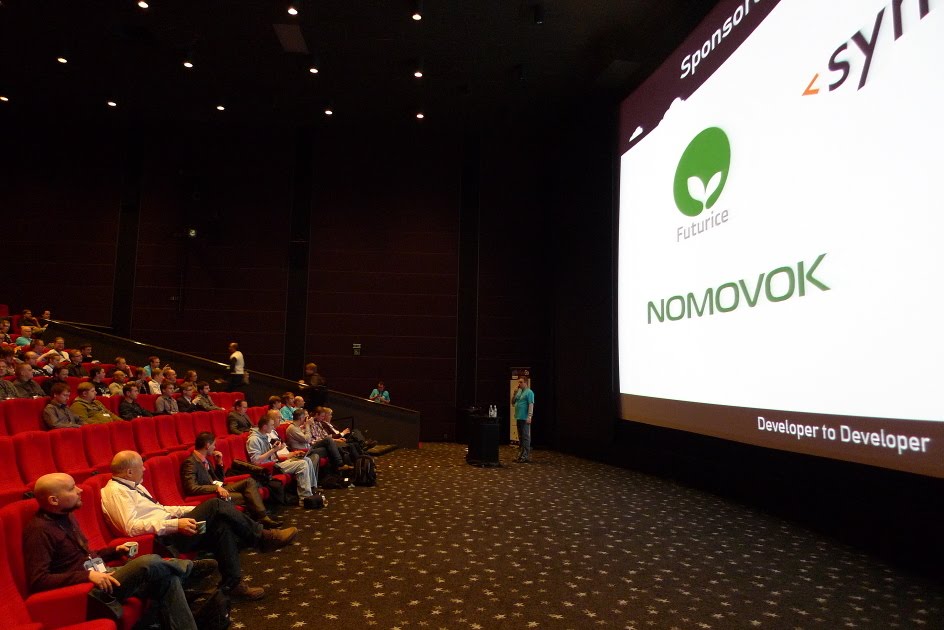
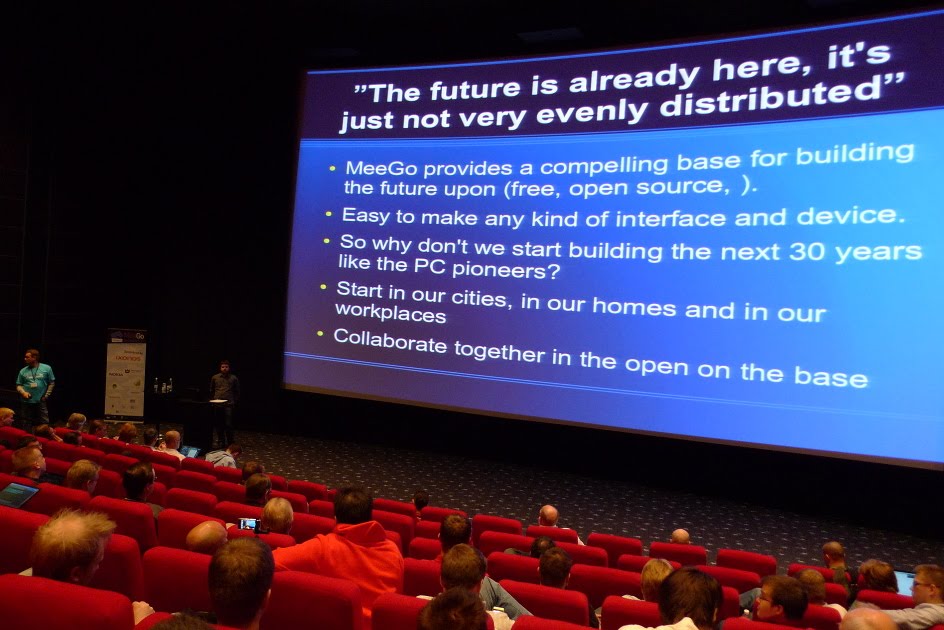
Keynote venue was a movie theater


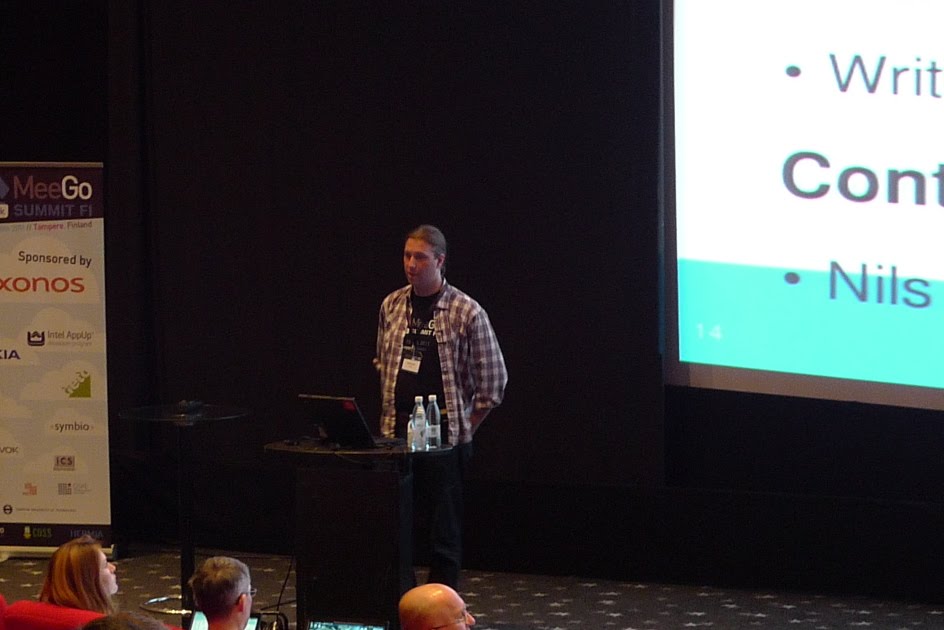
MeeGo status update by Valtteri Halla / Intel - talking among else about tablets, IVI, and the 20 person team at Nokia doing MeeGo(.com) for N900 phone


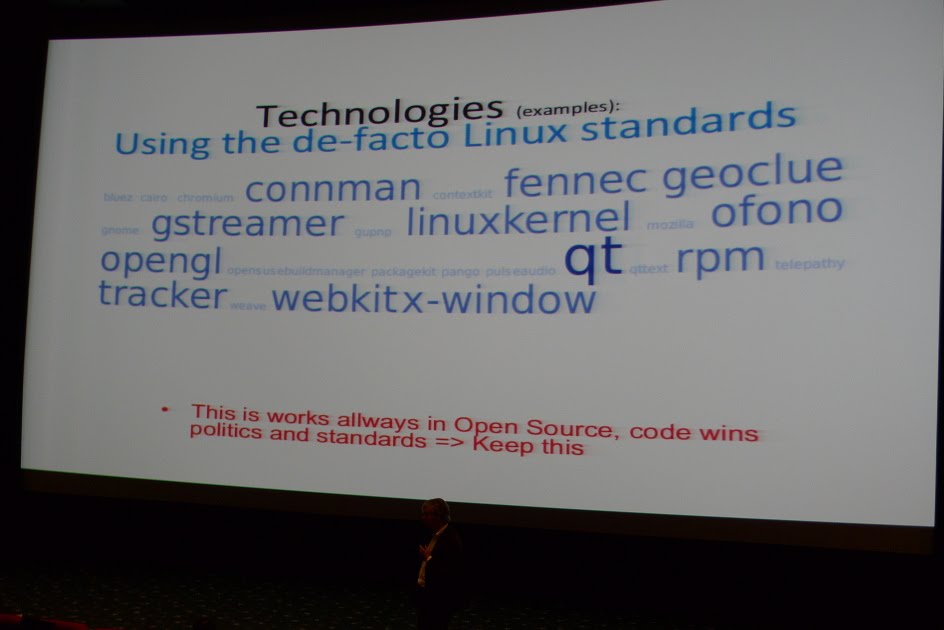
Mikko Terho / Nokia - "Internet for the next billion => Qt good candidate", "code wins politics and standards"


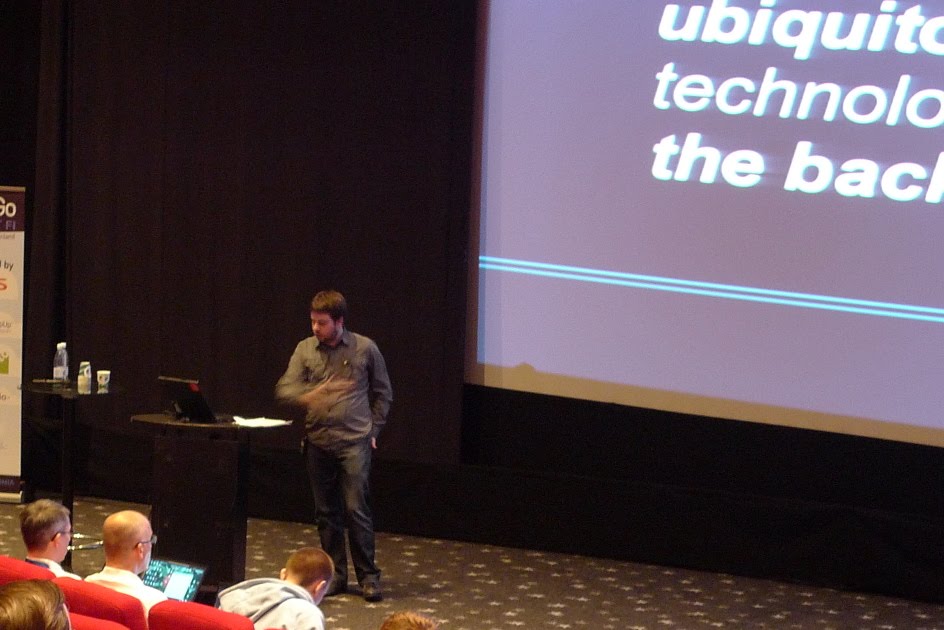
Carsten Munk / Nomovok - "Hacking your existence: the importance of open-ended devices in the MeeGo world"


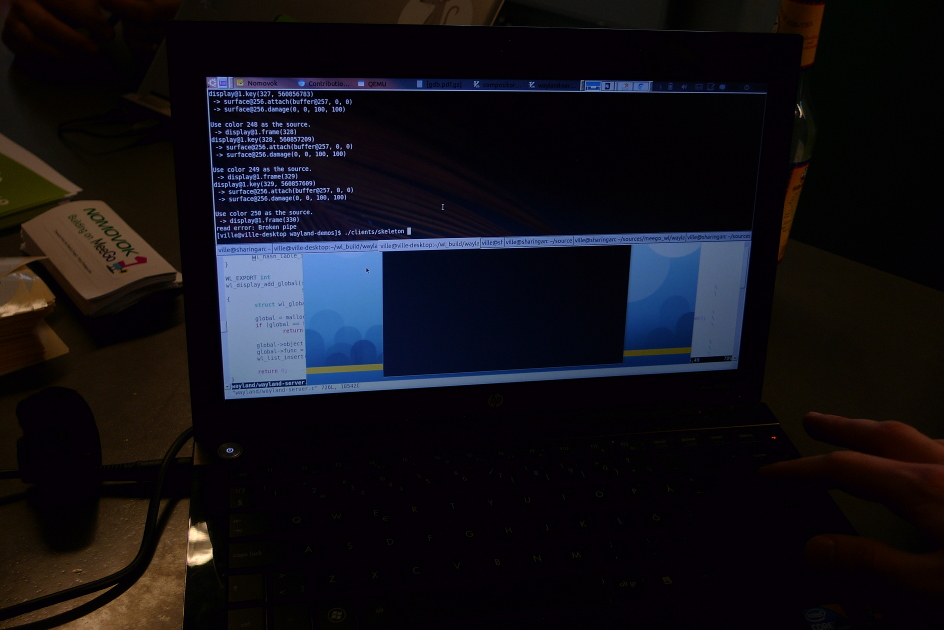
In addition to MeeGo tablet demonstrations a Wayland compositor was demoed by a Nomovok employee.


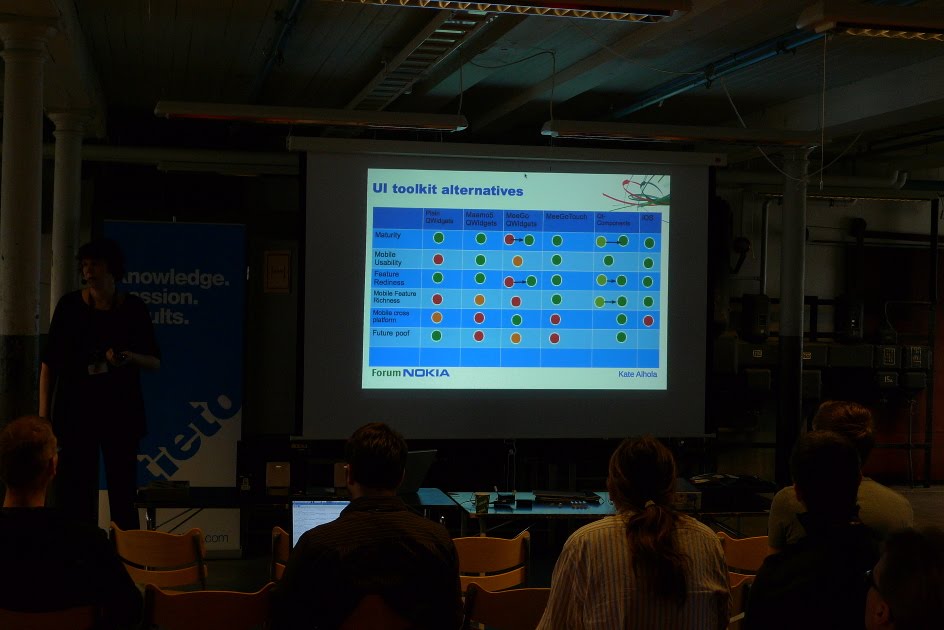
One of the many Qt / QML related talks was held by Tapani Mikola / Nokia


Evening party


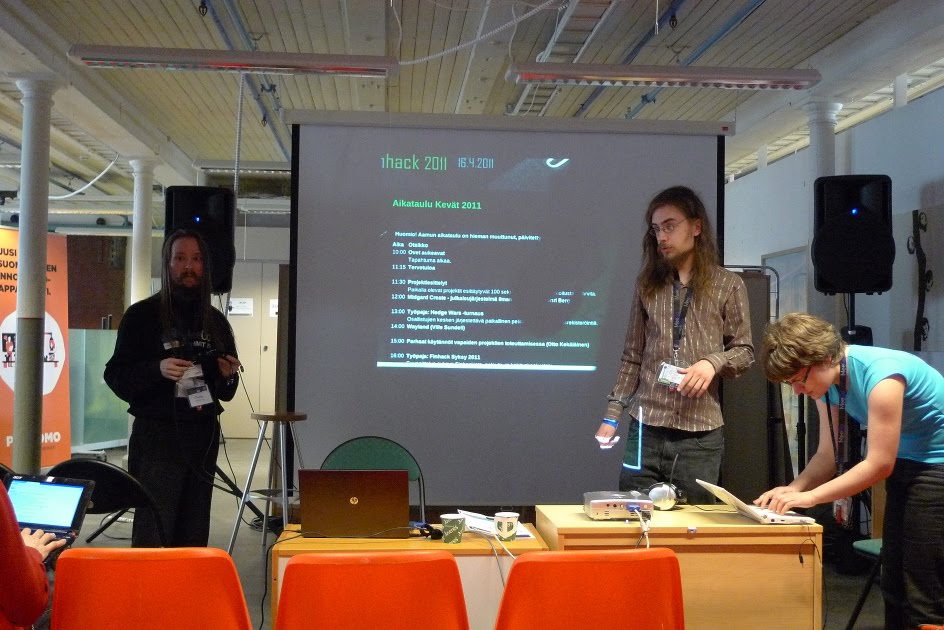
Day 2 started with a few more presentations and Finhack event launching in the Protomo room as well

Still remaining for the day are Meegathon demonstrations (well actually I'm right now already following those while finishing this - cool demos!) , Meegathon awards, a panel discussion on "MeeGo, Nokia, Finns - finished? Can MeeGo be important in Finland without being inside Nokia's core?", BoF sessions and finally Intel AppUp Application Lab including some MeeGo table give-outs.

Thanks to organizers, many of whom were volunteers. The event has been running completely smoothly, coming not as a big surprise after the hugely successful last summer's Akademy 2010 also held in Tampere.

15 April 2011

Jon Dowland: vote

I've just voted Stefano Zacchiroli for Debian Project Leader (DPL). The voting period closes tonight, so if you are a Debian developer and haven't yet voted, please do! Debian uses a Condorcet voting system, which to my non-expert eyes, bears some resemblance to "Single Transferrable Vote" (STV), at least compared to "First Past the Post" (FPTP). There is a debate raging in the UK as to whether Government elections should be counted based on an STV method instead of FPTP, with a referendum on the subject in May. I'm leaning towards "Yes to AV", but this opinion piece by journalist Stuart Campbell (which argues that people should spoil their ballots) is worth a read.

Eddy Petri&#537;or: Upgrade from lenny to squeeze - first impressions

Update: I reported the deluge issues and added a new problem about the lack of click on tapping on the touchpad.


I know that installation reports and upgrade reports need to be submitted to the BTS, but I just want to point out some issues for people that might hit the same issue on upgrade from lenny to squeeze.

But before that I must say I like the new Debian site(s) look.

Issue number one: When upgrading from lenny's deluge to squeeze's deluge, the new version of the app is quite different from the prevoious version. Here are some things to take into account:
Issue number 2: I seem to experience some weird glyph/graphic area reshuffling in GNOME (maybe X?) after recovering from hibernate. With a total (according to my current sloppy counting) 5 resumes, things get back to normal, but I suspect the next hibernate-resume cycle will restart the glyph reshuffling cycle.

By glyph/graphic area reshuffling I mean alterations of the shapes of the glyphs (and some areas on the background picture) in such a manner that it seems that within a set of 8/16/N (?) lines are shifted/rotated sideways with some undefined and different ammount each, but in a reproducible manner ("b" will always be doodled in the same way, no matter if is in the word "be" or if is in the word "absurd".

I'll try to provide some picture in the bug report, once I report this issue in BTS.

Update: I reported this in Debian's BTS and upstream (with screenshots, too). I am not convinced the problem is in the kernel since I tried an old kernel and saw the same issue. I suspect X is at fault.

Issue number 3: This is more like a convenience issue. In the past I was using "hibernate" with uswsusp which I understand is now broken beyond repair and replaced by pm-utils. The thing I miss in the hibernate process now is the ability to abort the hibernation process as it was possible in lenny's uswsusp by pressing the backspace key during the storing of the state on disk phase.


Issue number 4: The upgrade process was quite tedious because once I tried upgrading aptitude, python2.6 was pulled in and almost all apps ended up needing upgrading due to the chaining of necessary package upgrades.


Issue number 5: For some weird reason pulseaudio was initially installed making playback of any audio impossible (the apps wanting to emit noises would just freeze but they were TERM-inatable) and later I've seen a default null audio sink was defined for me. Killing pulseaudio and removing the ~/.pulse directory fixed the issue (but I should probably see why pulseaudio didn't work properly in the first place because I suspect the problem will reappear at the next restart - I usually use hibernate).

Issue number 6: Tapping the touchpad no longer results in a click. Maybe some packages got removed? And, no, it is the same when I remove the external mouse, so it is not because of some smart behaviour of that sort.

Otherwise I am quite satisfied with the result of the upgrade. A huge "thank you" to all people involved in the development of squeeze.

14 April 2011

Timo Jyrinki: MeeGo Summit FI starts tomorrow

I'm participating in the MeeGo Summit FI that starts tomorrow, and I'm already in Tampere now, as you can see. The summit is at an interesting time, given that there is a huge amount of stuff happening around MeeGo while at the same time Nokia is balancing on what do both in the far future and what to do to ship the MeeGo device they've already promised. The summit is fully and overly booked for >300 attendees. There is also Finhack free software event happening alongside on Saturday at the same venue.

A view towards the venue(s), Finlayson area in Tampere.
The company I work for, Nomovok's CEO illustrated the MeeGo situation extraordinarily well a little less than two months ago. I think it's one of the best insights you can get from anywhere in public at the moment. Now things are starting to really heat up. Of course the Big thing is the MeeGo Conference in San Francisco in the end of May, but it takes nothing away from this being the major event both in the country formerly known as NokiaLandia, and also globally given the amount of MeeGo related talent here. Nomovok is teasing people with the SteelRat - a launchpad for MeeGo tablet creation and an UX, based on latest MeeGo Core - a beta of which will be available now in Tampere and first version in San Fransisco. Meanwhile we and others are investing in also the MeeGo IVI and MeeGo TV platforms, not forgetting about the handset industry that is more visible to many tech savvy consumers.

Pre-registration and building on-going.
At the same time there is a lot of exciting stuff going on in the Ubuntu project (Ubuntu 11.04 upcoming, I'm already using it and reporting bugs), together with Linaro and other ARM players. As a founder of Ubuntu Finland I'm always eager to see if I can work there also on work time, not only on free time. And regarding ARM, Nomovok is the key player in having ARM on MeeGo as well.

Then on the completely other end of spectrum, I'm eagerly waiting for the GTA04 project to have my Neo FreeRunner(s) bumped up to modern specs. At the end of the day I'm still using over 2,5 year old phone myself, since I want to run the software that is both free and completely selected (and if I want, done) by me. With GTA04, I could choose between MeeGo armv7hl port, Debian armhf port or Ubuntu as the base distribution to use my software.

11 April 2011

Clint Adams: IkiWiki vs. Pootle in Crab Battle

There are rumors that people have successfully integrated ikiwiki with pootle. So where is the code?

Next.

Previous.