Search Results: "edd"

14 October 2008

Kartik Mistry: See you in KDE 4.2!


* Since, We have done translation of kdebase > 75% for KDE. Gujarati will be include in KDE 4.2. We still have time to do more work. Thanks a lot to Pragnesh and Sweta for very hard work and hidden thanks to dear Pradeepto for encouraging me :P My .gu blog entry for this news.       

Sune Vuorela: Skolelinux/Debian-edu gathering infiltrated by Gnash people

Gathering
I spent this weekend at a Skolelinux/Debian-edu gathering in Oslo. 8.5 hours by bus each way. I got to meet some of the people shipping a customized Debian for schools. As it was a gathering related to educational software, looking at the KDE4 kdeedu packages seemed most appropriate. I’ve tested step packaging and hopefully it is going to end up on your local debian archive one day, along with some fixes to where kvtml files are packaged, much awaited by Annma and others. Apparantly, in Brazil, they have their own debian based kde distribution and 130 GB of free as in public domain free educational movies. Some people discussed an application to view, tag and search the movies. I quickly thought of a mixup of nepomuk and phonon in a nice userinterface. So if anyone feels like implementing that, you are more than welcome. Gnash
The gathering was together with a Gnash hackathon, and apart from gnash getting more and more usable, the gnash people are also thinking about integration with the desktop environments. For KDE 4 they have plans of a KPart easy embeddable anywhere, including in KHTML. (Maybe another use of the KPartLoader dfaure wrote recently). The gnash team are unfortunately quite short on KDE knowledge and they asked for help. I’m probably not myself the right one to help here, but maybe some of you out there feel like helping. There is already a patch set around that some people claims works, but others haven’t figured out to make it work. Feel free to comment here and I will forward to the Gnash people - or just contact them directly on the gnash-dev@gnu.org maillist. Trolls
I left the gathering a bit early to get to a Troll picnic in a Oslo park and got stuffed with p lse and lompar. (sausages and pancake like bread) I was by bus all night back home and then a shower and straight to work. After work, I slept for 14 hours or so.

13 October 2008

Julian Andres Klode: I am a Debian Developer now!


14 months after applying for the NM process, I’m a Debian Developer. On Mon, Oct 13, 2008 at 10:51:43PM +0000, Martin Zobel-Helas wrote:
> [ This is a long mail with important information, so please read it all
> carefully. ]
>
> Dear Julian Andres Klode!
>
> Your account ‘jak’ has just been created in the central LDAP
> database of the Debian project. [...] Thank you everyone (in chronological order):
  • Daniel Baumann (daniel) - Sponsored my first packages
  • Joerg Jaspert (joerg) - The first DD who signed my key
  • Niv Sardi-Altivanik (xaiki) - Advocated me for NM
  • Martin Zobel-Helas (zobel) - My first AM
  • Alexander Reichle-Schmehl (tolimar) - The second DD who signed my key (at CeBIT)
  • Bernd Zeimetz (bzed) - Took over in June, because zobel was very busy
  • Christoph Berg (myon) - For checking the AM report and requesting the account creation
  • Jonathan McDowell (noodles) - For adding me to the keyring
  • Martin Zobel-Helas (zobel) - This time for creating my account
And many thanks to Google - for helping me to find answers to important questions. Without you, I would know nothing. And of course all the others who helped to make this possible. Posted in Debian      

Ben Armstrong: Bits from the Debian Eee PC team, autumn 2008

Some brief highlights of the last three months of Debian Eee PC development. Thermal and ACPI breakage resolved in 2.6.26-7 We’re pleased to see that in the upload to Sid of linux-image-2.6.26-1-686 version 2.6.26-7, the pair of 2.6.26 bugs we’ve been tracking that have made it difficult for Eee users to upgrade their systems have been resolved. Since then 2.6.26-8 has been uploaded and is expected to enter Lenny this week due to a freeze exception. Once the new kernel has migrated we will move quickly to build and release a new installer that includes it. Ath5k wifi works on Eee PC in Linux 2.6.27 Jean-Christophe reports that ath5k works in Linux 2.6.27 on the Eee PC 701, and just needs a small patch to work with our eeepc-acpi-scripts package. This is good news for those of us with models 701, 900, 900A and 1000HD who have been wanting to get off of the non-free Madwifi drivers and onto DFSG free drivers. New Eee PC model 701SD wifi support in the works Users of the new Eee PC Model 701SD have just started showing up looking for support in mainstream Linux distros. Martin Filtenborg confirmed using our Eee PC Live image with the GPL’d rtl8187se driver from Realtek that we can at least use it to connect to an unencrypted AP, get an IP address and ping other hosts. Of course, it is one thing to have a working vendor-supplied driver and quite another to have mainstream support. We’ll make do with what we have now, but will be seeking a mainstream solution as soon as possible. We’re seeking more testers and developers to work on this. To date, an ITP has not been filed, as it is not yet clear who is going to carry this work forward. Chasing the 5 second boot An interesting discussion on Arjan van de Ven and Auke Kok’s work to get an Eee 901 to boot in 5 seconds took place this month. While the Debian Eee PC team is not making work on this a priority, we’ll keep an eye on it to see if Debian can incorporate some or all of the techniques they used so that our users can benefit without making radical changes to their systems. Working towards mainstream support for rt2860 Our filing of an ITP for rt2860 (the wifi driver for models 901, 1000 and 1000H) was followed by discussion about how to separate out the GPL’d driver from the embedded non-free firmware so that it can at least go into contrib. Glenn Saberton has been working on rewriting the build system around kbuild and separating out the firmware. Numerous improvements to ACPI scripts Since my last progress report, there have been numerous improvements to the eeepc-acpi-scripts package to deal with all of the various models we now support and make the scripts more robust and flexible. Check out the changelog for details.

12 October 2008

Lior Kaplan: The disadvantege of language packs in Ubuntu


I’ve encounterd a bug in launchpad about adding a new gnucash translation to the Hebrew language pack. Nothing out of the ordinary excepts that for every upstream translation update you should file a bug to update the language pack. A new Hebrew tranlation was released in version 2.2.6 as part of the upstream release. In Debian the new translation appeared with the sources, but in Ubuntu, the translation is lost since it’s not in Rosetta. As I see it, such translations are falling between the chairs, since upstream won’t check the distribution for each translations, and the users don’t check upstream’s changelog for translation changes (and only major translation changes appear on the changelog). Another issue, the the need for Ubuntu to duplicate translation into Rosseta, although they come only from upstream (like in this case). I seems to me as a waste of time, and something that only creates problems. After such an import you can easy find an old transation ships in parallel to newer sources. What happens if many strings changes in the source ? You get many strings in English…       

11 October 2008

Bernhard R. Link: Iceweasel 3

Trying to get prepared for lenny, the new iceweasel annoys me more and more.

10 October 2008

Julian Andres Klode: Gentoo destroying earth?


I worked a bit with some Gentoo systems the last days and it was no fun. The whole compiling thing is no fun. In fact, it is a danger for the environment. If every computer in the world run Gentoo, power consumption would increase dramatically. There would also be no netbooks, as they are almost unusable for running Gentoo on it, compiling software. The path chosen by binary distributions like Debian is much better. Packages are compiled centrally and users download and install these pre-compiled packages. But it is also much less flexible in terms of which functionality is supported. We, as package maintainers, have to decide which functionality is likely to be used by the users. In Contrast, Gentoo has USE flags, which allows the user to enable the specific functionality he/she wants. Should we combine the advantages of both technologies? Provide a normal binary distribution as we do now, but also provide a framework for users to easily recompile their packages, adding new functionality. Imagine a combination of all these technologies: User wants to install software X with feature F. The package maintainer has not enabled F in the binary. The user opens the website for his personal archive, selects the F flag and the software and clicks on build. The server builds the software and notifies the user once the binary is ready. At Ubuntu, the first step has been made into this direction. While the package format is still the same, Launchpad allows users to create so-called PPAs (Personal Package Archives), where users can upload their source packages, which are then compiled and made available to other users. Let’s say Project A releases version X of their software. They can create a source package for it, upload it to the PPA, and provide the binary packages to the users. Prior to PPAs, most users would have used an old version, compile their own version or use tarballs containing pre-compiled software (mozilla does this). And sorry for the title. I respect the Gentoo community and the Gentoo developers, they are doing great work there. And ebuilds and Gentoo’s boot system (with this runscript stuff) is really easy. BTW: I also like the way Gentoo displays its boot messages. It looks much more organized than Debian’s boot process. (In terms of the message logging, where Debian writes “done” when something is done, and Gentoo writes “[OK]” to the right side of the screen, in green letters. (This is partially possible in Debian using lsb-base-logging.sh, but not all init scripts use these functions, or they use the wrong ones.) Posted in Debian, General, Ubuntu      

9 October 2008

Dirk Eddelbuettel: More running data visualization

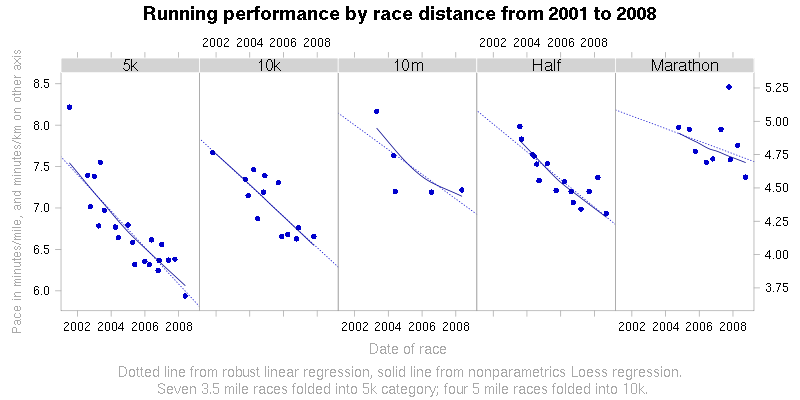
A few years into this running hobby, I realized that my times were getting better. But I had no feel for by how much, or whether that was a constant rate of improvement etc pp. Long story short, I started to plot some of the data. What seemed natural was to record the date, the distance in miles as well as in a qualitative variable, and finally the average pace. Additionally, I played with groupings into just three categories 'short', 'mid' and 'long'. This leads to a natural 'one-factor' model of pace as a function of race date grouped by race distance. And given how easy it is to do conditional plots in R, I quickly arrived at something that already resembled the following chart: (pace by date given group lattice chart) At first, some of the groups had too few data points to actually reliably construct regression lines, let alone non-parametric smoothers. But over time more and more data points were added as I kept running races. Including for example the somewhat disappointing result from last year's Chicago marathon in record heat that resulted in the outlier in the last panel. It actually made the smooth fit turn upwards! Luckily, the subsequent times in New York last fall, London in April, and of course in Berlin last month helped to dampen the effect of the one outlier, resulting in a more normal straight line for marathon performance that is comparable to the other four race lengths. All in all I am now quite happy with the chart. The combination of the non-parametric loess smoother and the robust linear regression (using lrm from the MASS package for R) shows that most groups exhibit very little non-linearity as both regression curves are very close to each other. The curvature in the '10m' group is probably mostly a small-sample effect. And I am obviously happy with the fact that three of the five panels show their respective last race as a PR :) The R script containing the data and code is available here but requires some familiarity with the lattice package for R (as the lattice book would provide).

Eddy Petrișor: Nokia has your data

As a beta tester for the new email application from Nokia, you will have to give your mail account password:


and agree that they will get your data, too [1].


Really unimpressive, Nokia.


[1] I haven't checked the "Nokia privacy policy", but is enough for me to say no, thanks, and start to wonder if they do anything behind my back with the phones they sell.

7 October 2008

Kartik Mistry: WTF


* Kunal sent this via IM. This shows why we should worry about Software Patents.       

Andrea De Iacovo: Away from my brain


Hello world! Is someone in the crowd (crowd?!?) wondering about where I’ve been in the last months? Well it’s time for you to know. First of all I’ve been on holiday till the end of August: it wasn’t a real holyday though ’cause I was working for two of my university exams. In September my “winter life” started again so I had not so much time to write my thoughts here. However you should not worry about my Debian work: if you use wordpress (and I hope so) you’d've seen a number of recent uploads. I worked hard to correct all security issues in wordpress 2.5.1 before the lenny release date. At the moment we have no open CVEs and this makes me really glad. In the meanwhile I’m also working to bring playonlinux in Debian. I hope I could release a package as soon as Lenny becomes our new stable.
So, guys, I’m still working even if I don’t write about it ;-)       

Kartik Mistry: Active DDs


* Looking at Bubulle’s post, percentage of active DDs are: 75% India has very interesting situation: 6 DDs. Now, we have 4 only as Kumar and Varun are in US of A!       

4 October 2008

Dirk Eddelbuettel: World Marathon Majors

Last Sunday's Berlin Marathon was my fifth and final piece in completing the World Marathon Majors during 2007/2008: after running Boston, Chicago and New York in 2007, and then London and now Berlin in 2008, the set is complete. The idea was born after having run Chicago a few times, qualifying for Boston and winning a New York lottery entry. With friends to visit in New York, London and Berlin, it became feasible. It's been a great experience to run these famous courses in front of large crowds. Conditions ranged from cold, windy and rainy in Boston to way too hot in Chicago, had mixed conditions including a solid rain shower in London and were just perfect in both New York and Berlin. The crowds were awesome in all five places. All in all, these races were a blast -- if you're into long-distance running, give each or all of them a shot.

Michal Čihař: Wammu 0.29

I just released version 0.29 of Wammu. This release fixes various problems found by users. Full list of changes: This release also comes with binary for Windows with embedded Gammu 1.21.0.

2 October 2008

Kartik Mistry: Omelette and Fruits


* The Omelette Post … and it clears about ‘low hanging fruits’ too.       

1 October 2008

Dirk Eddelbuettel: Berlin Marathon 2008

Last Sunday was the 35th Berlin Marathon. I had flown over to Berlin on Thursday after work, and had Friday and Saturday to 'chill'. The weather was already pretty nice before the race, and truly gorgeous on Sunday: sunny yet not too warm, blue skies, no wind. As has been widely reported, Haile Gebrselassie set a new world record breaking his own mark set the year before and becoming the first man to finish under two hours and four minutes. Truly impressive. My race was pretty good too. I shaved over four and a half minutes off my own personal record (which was set in early 2006 at Sunburst) and finished in 3:13:09. That's a pace of 7:22 min/mile (or 4:35 min/km) which I am rather happy with. I held a fairly steady pace of under 7:30 almost all the way but but had to fight off the onset of cramps with some short walks about less than two miles to go. Coming back in Berlin after all those years is always a charm. The city has obviously changed a lot in some very visible areas. Yet it still recalls the Berlin of those years. The course was really nice, covering numerous neighbourhoods and starting and ending in Tiergarten. Lastly, it was also good to see old friends who have now been there since the mid- to late 1980s. And I managed to pack a quick visit to my parents in as they are just a good 80 minute ICE train ride away. All in all a very nice trip even though the travel from Chicago (without a direct flight!) is a bit of a hike.

30 September 2008

Axel Beckert: Mini-ITX based Home Server: Planning and Hardware

Ever since my former desktop machine gsa died and I started using only laptops at home, I noticed a need for a home server for storing all my MP3s, holiday pictures, games, and backups of my other machines. And I also want a filtering web proxy at home again. Current situation Currently my Norhtec MicroClient Jr. “c2” with it’s 120 GB 2.5" harddisk does some of these jobs (mostly storage and backup), but it neither has the disk space nor the performance to do all the things I want. For storage I once bought a TheCus N4100, the big brother of the popular and officially Debian supported N2100. Unfortunately there are a few things different than in the N2100 (NIC without MAC) which makes it much more difficult to get Debian on it and the original firmware doesn’t support NFS at all. *grmpf* I had hints from others who managed to get Debian on this NAS, but I didn’t find the time and leisure to really dig into cross-compiling kernels. (Although with the new 1.3.06 firmware, so called modules became possible also for the N4100 and a SSH module has been posted with which a Debian chroot could be installed and the required kernel build on the machine itself.) I though wasn’t very angry when the N4100+ came out shortly after I bought the N4100, because the N4100+ was no more an ARM based device but had a Celeron processor inside instead. And a NAS which is built on average PC hardware wasn’t as appealing as some device based on some more exotic architecture mainly used in embedded devices. :-) The Mini-ITX Appeal This view changed rapidly, when Raffzahn showed me a few Mini-ITX boards and cases. I surfed around on Mini-ITX.com store and stumbled upon the NAS-like ES34069 case from Chenbro featuring four S-ATA hotswap 3.5" slots, a slim-line CD-ROM drive slot, a SD card reader, and enough space for an additional 2.5" hard disk and a low profile Mini-ITX board. Additionally, the VIA EPIA SN series of Mini-ITX boards sports 4 S-ATA ports and either a passively cooled 1 GHz C7 processor or an actively cooled 1.8 GHz C7 processor. That should be enough power for a small multi-purpose home server while still keep the power consumption low. And I’m not the only one having this idea, Mini-ITX.com suggests this combination and Chenbro officially supports the VIA EPIA SN boards. Additionally, Debian 5.0 Lenny seems to run fine on the SN series, only lm-sensors seems to have problems with SN18000G and SN10000EG (but not SN18000 and SN10000E). So when the Chenbro ES34069 case showed up in digitec’s online shop, I ordered one there and a VIA EPIA SN18000G board at Brack. I didn’t order any disks since for data storage I plan to use the four Samsung 400 GB 3.5" S-ATA disks I bought for the N4100, and for the system I plant to use the 2.5" disk I initially bought for my MicroClient JrSX “c1”, but then continued to use it only with the CF card. Not yet sure, if I’ll also equip the slim-line optical drive slot, too. The case took several weeks to deliver and the mainboard hasn’t arrived yet. Instead I got an e-mail from Brack that VIA products are currently very difficult to get in Switzerland. Reason is said to be that VIA tries to channel the distribution of their products to a single distributor. (Sounds somehow similar to what Apple tried with the iPhone and failed.) Mini-ITX boards and power consumption So I now have a nice case without a board. There aren’t that many Mini-ITX boards out there sporting 4 S-ATA ports. One which cleary stood out was the new Intel DG45FC Mini-ITX board with LGA775 socket. (In Switzerland neither available at Brack nor at digitec, but e.g. at PCP.) But reading the specs of this board it was also clear that it wasn’t thought for NAS systems but high-performance HTPCs — the focus seems to be on multimedia performance which a NAS doesn’t need. Its newer sister, the Intel DQ45EK Mini-ITX board is focussed more on office and business PCs than on multimedia. But Intels remote adminstration is not really a plus for me (don’t need it, I’ve got SSH ;-) and it’ neither cheaper than the DG45FC nor has it significantly lower power-consuption. Despite the 120W power-supply there are people who already combined the Chenbro ES34069 with the Intel DG45FC or DQ45EK board, e.g. one of the administrators of the German NAS-Portal forums built such a machine and this German guy who wants to build a Windows Home Server based on such a combination. At least the NAS-Portal administrator found out that the board consumes so much power that together with the 4 S-ATA disks the included 120W power supply doesn’t suffice and the system is not stable in this configuration. Trusted Reviews review of the DG45FC explains why: It’s one of the first Mini-ITX board not following the MoDT idea, has a desktop chipset instead a mobile chipset and therefore hasn’t all of the power-saving features of those mobile chipsets. But it’s easy to see anyway: Most of the CPUs supported by the DG45FC and DQ45EK boards have a TDP of 65W. Offically the processor cooler delivered with the case supports processors with up to 65W, but 65W is already more than the half of what the power supply delivers and according to the Trusted Reviews review, the board itself consumes another 35W itself. So for the four 3.5" S-ATA disks — which are usually not as economical as notebook disks — about 20W are left. This can’t work! The guy from NAS-Portal.org plans to solve the problem by using a universal 180W notebook power supply instead of the original one. In comparison to the 100W of the both Intel boards, VIA’s SN18000G consumes only 26W (the fanless SN10000EG even only 22W) and that’s board and processor! That’s about ¼ of what the Intel board consumes. Imagine the difference between having a 100W light bulb (suffices for a whole small room) shining 365 days a year compared to a 25W light bulb (often used in bedside lamps) in a year. Other Mini-ITX mainboards with 4x S-ATA include the following ones: Conclusion For now, I decided to wait a little bit more for my VIA EPIA SN18000G board which still seems to be the best board for the Chenbro ES34069 case although not really cheap. But if I once in a not that distant future decide to have a desktop at home again, I’m quite sure it’ll sport a cute Mini-ITX case (perhaps a nice black-orange HFX micro M1 case by mCubed — unfortunately the M2 is no more available in a color combination including orange ;-) with an Intel DG45FC or Kontron 986LCD-M/mITX and a decent Core 2 Duo processor. Software Plans Of course my home server will run Debian GNU/Linux 5.0 Lenny on it, with software RAID-5 and LVM2 over the 1.6 TB of S-ATA disks resulting in 1.2 TB available disk space which will be offered using at least NFS, SMB and SSH (think sshfs). Planned software includes BackupPC (a very fine pulling backup system for machines which are not online 24/7) and Privoxy. I’ll perhaps also install Tor and a caching proxy like Squid or Polipo. Another idea is to run Mediatomb on that machine. :-)

29 September 2008

Julian Andres Klode: juliank


The most important birthdays in the FLOSS world this year (where age mod 5 = 0):
  • 10 years: Google (September), Open Source Initiative (February)
  • 15 years: Debian, FreeBSD, NetBSD
  • 25 years: GNU
  • 35 years: Ian Murdock (April), Mark Shuttleworth (September)
  • 55 years: Richard Stallman (March)
Posted in General      

Ian Wienand: Kernel Development Course

Here are some slides and examples I used for a kernel course I developed (some time ago now). The course was aimed at C developers who wanted an introduction to both general UNIX-style user-space and Linux kernel development with a focus on embedded systems issues. The course is aimed at two 8-hour days, and is pretty packed in even then. The first day is user-space development and kernel building, focusing on things like make, autotools, advanced gcc, getting cross-compilers working, configuring the kernel and building. The second day we get into kernel internals; building up a kernel module to produce some simple proc nodes, take data, crash and debug, etc, look at internals like concurrency and the driver model, and focus on USB quite a bit. Here is a tarball of the entire thing, including the examples. Hopefully these can help out anyone tackling the design of such a course.

Russell Coker: Never Trust a DRM Vendor

I was reading an interesting post about predicting the results of the invasion of Iraq [1]. One of the points made was that the author rejected every statement by a known liar (which includes all the world leaders who wanted the invasion). So basically regarding every statement by a known liar as potentially a lie led to a better than average prediction. It seems to me that a similar principle can be applied to other areas. A vendor or advocate of DRM (Digital Restrictions Management) [2] has already proven that they are not concerned about the best interests of the people who own the computers in question (who paid for the hardware and software) - they are in fact interested in preventing the owner of the computer from using it in ways that they desire. This focus on security in opposition to the best interests of the user can not result in a piece of software that protects the user’s best interests. I believe that any software with DRM features (other than those which are requested by people who purchase the software) should be considered to be malware. The best example of this is the Sony BMG copy protection scandal [3]. Note that I refer to the interests of the people who own the computers - not those who use them. It is quite acceptable to write software that serves the buyer not the end-user. Two examples are companies that want to prevent their employees doing “inappropriate” things and parents who want to restrict what their children can do. We can debate about what restrictions on the actions of employees and children are appropriate, but it seems clear that when software is purchased for their use the purchaser has the right to restrict their access. Also note that when I refer to someone owning a computer I refer to an honest relationship (such as parent/child or employer/worker) not the abusive relationships that mobile phone companies typically have with their customers (give the customer a “free” phone but lock it down and claim that they don’t own it). Mobile phones ARE computers, just rather limited ones at this time.

Next.

Previous.