Search Results: "bod"

12 November 2010

Alexander Reichle-Schmehl: Release Critical Bug report for Week 45

The bug webinterface of the Universal Debian Database currently knows about the following release critical bugs:
In Total:679
Affecting Squeeze:261
Squeeze only:56
Remaining to be fixed in Squeeze:205
Of these 205 bugs, the following tags are set:
Pending in Squeeze:17
Patched in Squeeze:41
Duplicates in Squeeze:23
Can be fixed in a security Update:12
Contrib or non-free in Squeeze:6
Otherwise fixed in Squeeze:21
Ignoring all the above (multiple tags possible), 126 bugs need to be fixed by Debian Contributors to get Debian 6.0 Squeeze released. However, with the view of the Release Managers, 165 need to be dealt with for the release to happen. Please see Interpreting the release critical bug statistics for an explanation of the different numbers.

11 November 2010

Steve Kemp: The pain of a new IP address

Tonight I was having some connectivity issues, so after much diagnostic time and pain I decided to reboot my router. At the moment my home router came back my (external) IP address changed, and suddenly I found I could no longer login to my main site. Happily however I have serial console access, and I updated things such that my new IP address was included in the hosts.allow file. [*] The next step was to push that change round my other boxes, and happily I have my own tool slaughter which allows me to make such global changes in a client-pulled fashion. 60 minutes later cron did its magic and I was back. This reminds me that I let the slaughter tool stagnate. Mostly because I only use it to cover my three remote boxes and my desktop, and although I received one bug report (+fix!) I never heard of anybody else using it. I continue to use and like CFEngine at work. Puppet & Chef have been well argued against elsewhere, and I'm still to investigate BFG2 + FAI. Mostly I'm happy with slaughter. My policies are simple, readable, and intuitive. Learn perl? Learn the "CopyFile" and you're done. For example. By contrast the notion of state machines, functional operations, and similar seem over-engineered in other tools. Perhaps thats my bug, perhaps that's just the way things are - but the rants linked to above makes sense to me and I find myself agreeing 100%. Anyway; slaughter? What I want to do is rework it such that all policies are served via rsync and not via HTTP. Other changes, such as the addition of new primitives, don't actually seem necessary. But serving content via rsync just seems like the right way to go. (The main benefit is recursive copies of files become trivial.) I'd also add the ability to mandate GPG-signatures on policies, but that's possible even now. The only step backwards I see is that currently I can serve content over SSL, but that should be fixable even if via stunnel.
*
My /etc/hosts.allow file contains this:
ALL: 127.0.0.1
ALL: /etc/hosts.allow.trusted
ALL: /etc/hosts.allow.trusted.apache
Then hosts.allow.trusted contains:
# www.steve.org.uk
80.68.85.46
# www.debian-administration.org
80.68.80.176
# my home.
82.41.x.x
I've never seen anybody describe something similar, though to be fair it is documented. To me it just seems clean to limit the IPs in a single place. To conclude hosts.allow.trusted.apache is owned by root.www-data, and can be updated via a simple CGI script - which allows me to add a single IP address on the fly for the next 60 minutes. Neat.
ObQuote: Tony is a little boy that lives in my mouth. - The Shining

10 November 2010

Luca Bruno: Online sprints, or how to revive a L10N team

The Italian L10N team has not been very active nor growing in recent years. In particular, we pretty much failed at attracting new members in our team, with the result that untranslated files are piling up and manpower is scarce. Following a suggestion of our uber-active Francesca, we decided to try a new move to invert the trend: organizing brief weekly online sprints open to everybody, where graybeard translators will help newcomers getting to grips on Debian L10N infrastructure while collaboratively working on yet-untranslated targets. Last week, we tried our first and very introductory sprint, with a preliminary meeting on IRC to give instructions and setup ad-hoc pads. As a result, we ended with linux-2.6 po-debconf and a web-page completely translated and proofread by almost fifteen people in just a couple a hours. The key point however is that the majority of participants were fresh L10N-newbies, which we hope will join us permanently very soon after this first contact. Encouraged by the initial positive result, we already announced our next sprint for Thursday 11th, which will be focused on package descriptions translation (preceded by a crash course on DDTSS, its related web interface). We hope that even more users will join us this time, and encourage other stalled translation teams in experimenting a similar approach to revive activity and encourage participation.

7 November 2010

Adnan Hodzic: Ubuntu Developer Summit (UDS-N) Debianized Summary

Last week I was on my first Ubuntu Developer Summit (UDS-N), I wanted to attended this summit for couple of reasons: 1. Developer, I m part of Debian Java, working on Eclipse IDE, and as you re developing Debian, you re automatically developing Ubuntu, no? Nerd 2. DebConf11 main organizer, I really wanted to see how it s all done on corporate level, for instance we re going with hotels instead of student dorms and so on. 3. Migration to Linux infrastructure, make contacts and have some talks on this topic, because after DebConf11 in Bosnia a lot of institution will most probably open doors to open solutions such as Linux. I went to this summit without any expectations or plans, just said I ll play it by ear. This years UDS was held in Orlando, Florida before Orlando I was planning to stay in NYC for couple of days, therefor my whole plan was to get to NYC, then Orlando then head back home Smile I Heart NYC I spent couple of days here with my cousins and friends, as always NYC never fails to surprise me, and I ll always stop by even if it s only for couple of days Wink I wanted to meet up with couple of Debian people as well, but unfortunately my schedule was too tight so Caribe Royale, Orlando Please note that this whole trip was crazy (in a good way) starting from Sarajevo; on my flight from NYC to Orlando I see a guy that s sitting in front of me is wearing Canonical Landscape tshirt, I approach him and it turns he was Jamu Kakar working on Landscape. Since my luggage was late we had conversations from Debian over Ubuntu to Java to everything pretty much. While we were still at the airport, we bump into two more people going to UDS. As we got to hotel, same moment we walked out of cab there he was Jorge Castro, was he there just to smoke a cigarette or whatever doesn t even matter, what matters is that even before walking into hotel building I knew where reception, my tower and bar was, everything I needed to know at that moment High Five! Hotel where everything was held was Caribe Royale and even though I looked at their website I thought there was no way it s all going to be that nice, to my delight it was exact replica. Place is All-Suite Hotel and Convention Center , which meant that both accomodation, venue and everything else was in one place which is Yes 15 minutes later after I checked in, I was at a bar talking to Jim Baker about Java, Jython and Python, exact things I wanted to talk about at that given moment. What I said in these last couple of paragraphs sounds pretty cool eh? Well to me this whole UDS was just like this, everybody was so accessible and open for discussion, from Jono Bacon walking around offering candy to UDS reception staff Michelle, Marianna and others who were always there whether you had a complaint, problem or a praise. I really should stop mentioning names, because I ll forget somebody, and since it s just not fair because I had a feeling everybody was just there for you, whatever it was you needed. Ubuntu Developer Summit (UDS-N) Ubuntu, Debian, DebConf, differences? Even though I said I ll play it by ear, from very beginning I thought I d be complete outsider, being part of Debian and all. Quite contrary, I was everything but outsider, and even more there was plenty of Debian people there, including current DPL Stefano Zacchiroli, Colin Watson, Riku Voipio just to name few. There was also a Debian Healt Check plenary. But overall, there are differences between DebConf and UDS. One of the things is that you can attend UDS remotely I m not sure how much is this doable on DebConf, but then again vast differences are that UDS is filled with BOF s (as we would call it in Debian) meetings of different teams, I attended a lot of these, and most of them end with some kind of conclusion. While each day there was (only?) an hour of lectures on various topics, which on DebConf we would characterize maybe even as speed talks . However, everything was high paced, and it all ended up on You think that s a problem? How do you think we could solve it? . I had a feeling even if I didn t say something out loud that someone would hear me and approach me to discuss it. Everything was straight forward, all in goal to resolve certain issue or a problem, which I absolutely loved. Clap Fun It wasn t all work, even though Orlando doesn t seem to be my kind of city from what I saw, it s way too magical for my taste Party There was a lot of places where you could go to enjoy yourself. Good people at Canonical even offered me free ticket to Disney World, there was a lot of destinations to visit and transpiration was also organized by Canonical. Unfortunately I missed the notorious UDS party on Friday because I had to head home early, but possibly I ll make it next year Razz Even though, hotel was that great and to be honest you didn t have to leave to look for party. My favorite was Universal City Walk, one night I decided to go to see Blue Man Group, best part of it was that I got pulled up on stage by one of the members and was part of one of the acts! ROTFL This is definitely something everyone should see during his life, one moment you re laughing like a lunatic, while other moment you re just having goose bumps from the performance itself. Amazing stuff. After all I wrote here along with the pictures, is there even anything else I need to say? Smile I believe that even if I didn t play it by ear, this whole trip would exceed all my expectations in every possible sense. Because that s really what happened, those three reasons I was going to UDS for? Far more happened than that. All I can say in the end is that I ll move closer to having a part in Ubuntu development, and yea, I ll try to be regular on UDS from now on Smile See you in Budapest? If all these photos weren t enough, you can find official group photo as well as personal set of photos can be found on: UDS-N photos by 2010 Sean Sosik-Hamor




Christian Perrier: Help cleaning spam in Debian mailing lists

Debian mailing lists' standard policy is to allow posts from unsubscribed users. That of course fits our standards for opened development but has the drawback of allowing a lot of spam to reach our mailing lists. This spam also clutters the mailing lists archives. However, 1.5 years ago, listmasters established a well-working system to clean out spam from the mailing lists. It basically works in four steps:
  1. first, spam can be "reported" by anyone meeting it. While you are reading the mailing lists, reporting spam is as simple as bouncing the offending mail to a dedicated address: report-listspam@lists.debian.org. I, for instance, use a mutt macro to set ESC-L as a "report spam" hotkey. Spam can also be reported when browsing the mailing lists archives and clicking on the "Report as spam" button;
  2. when a given mail has been reported as spam more than five times, it is then "nominated" for review;
  3. nominated mails must the be reviewed by volunteers in order to confirm they really are spam. The review algorithm is complex but, in short, when a mail has been confirmed as spam by 3 reviewers without being qualified as "ham" by anyone else, then it is considered spam;
  4. such mails are then removed from the mailing lists archives.
Steps 2 and 4 are performed by a weekly script that runs on Sunday mornings (5:00 UTC, IIRC) How can you help? Process nominated spam We need more reviewers for step 3. At this moment 2 people are doing this on a regular basis (every Sunday with the morning coffee). Some others are working on this in a less frequent way. It seems that 1 or 2 more regulars reviewers would guarantee that we can cope with the nominated spam incoming flow. Only Debian developers can do that step. They should read instructions, ask for a password, then start reviewing. The first 1 or 2 people joining this will have a quite big amount of nominated spam to process, for their first effort. However, as most of these have been classified as spam by at least the two people doing this for months....the amount will slowly decrease. I, for instance, now only spend 5-10 minutes reviewing the nominated mails every week. Report spam Everybody can work on reporting spam. You can start by doing this on mailing lists you read by just bouncing spams to the spam report address; If you want to do more, you can join existing spam cleaning efforts, such as the one running for debian-boot or the one running in debian-l10n-french (the latter probably more for French speakers). Or you can of course start a similar effort for your pet list. To be efficient, this effort needs to gather 5-6 people who will process the mailing lists archives systematically. Let's clean out these archives!

5 November 2010

Alexander Reichle-Schmehl: Release Critical Bug report for Week 44

The bug webinterface of the Universal Debian Database currently knows about the following release critical bugs:

In Total:664
Affecting Squeeze:261
Squeeze only:60
Remaining to be fixed in Squeeze:201
Of these 201 bugs, the following tags are set:
Pending in Squeeze:8
Patched in Squeeze:34
Duplicates in Squeeze:22
Can be fixed in a security Update:12
Contrib or non-free in Squeeze:8
Otherwise fixed in Squeeze:21
Ignoring all the above (multiple tags possible), 127 bugs need to be fixed by Debian Contributors to get Debian 6.0 Squeeze released. However, with the view of the Release Managers, 160 need to be dealt with for the release to happen. Please see Interpreting the release critical bug statistics for an explanation of the different numbers.

4 November 2010

Wouter Verhelst: MySQL "editions"

rotflmao. Dear Oracle, MySQL is Open Source. By making it even more of a toy than it already is, you're just asking people to create a fork. On the other hand, perhaps nobody will actually do so, and this will kill off MySQL for good. Which wouldn't be a shame; so if that turns out to be the case, then thanks. Love, Wouter. Update: the above links to the non-GPL versions of MySQL only. There is still a "community version" of MySQL under the GPL. Seems I missed some things. Whoops.

Gintautas Miliauskas: Living a monastic life for 10 days

About a month ago, at the end of August, I finished a 10-day Vipassana meditation course. This was probably one of the more extreme activities I have ever participated in, and it's well worth a blog post. I found out about the course in a ridiculously trivial way, by following a link in a Reddit comment (I wonder if I could track down that comment...). The website referenced by the comment contained (almost) no new-agey mumbo-jumbo and looked legit in general. I also appreciated the fact that this was a relatively serious and intensive course, which should be enough to form a reasonably founded opinion on meditation in general. When learning sporadically, in small bits, it is hard to say whether the material itself is no good, or you just do not understand it yet and need to study more; I was quite skeptical towards the practice, but wanted to give it fair trial. I was quite impressed that there was a course available in Lithuania, a few hours by train from where I live. Finally, the course was free (by tradition Vipassana is taught without monetary compensation). I went ahead and signed up for a standard introductory 10-day course. Vipassana (also called insight meditation) is a meditation technique allegedly coming back from Gautama Buddha himself (well, all the traditions like to claim that origin...). It has been experiencing a renaissance, partly due to an organization set up by a meditation teacher S. N. Goenka which has founded meditation centers all over the world. The essence of Vipassana is a method of teaching your mind to act instead of merely reacting to outside stimuli such as pain, anger of other people or hardships. The technique provided is to monitor your sensations, watch them with equanimity and suspend any reaction, and slowly it sinks in that all things are temporary and you can choose what to react to and how. That's the basic idea; I don't want to go deep into exposition of Vipassana as there is plenty of information about that (also at the same time the information is almost useless because you have to experience it to really understand it). Instead, I will sure some of the more personal remarks and experiences. The course took place in an cottage near Kretinga, housing around 50 people. The living conditions were absolutely great, and this would have been a true holiday if not for the regime and the rules. The day would start very early, at 4 AM (ending at around 9:30 PM), and we'd do about 12 hours of meditation in total inbetween, with occasional breaks, but the most gruesome part is that no communication at all was allowed with anyone except the manager of the camp (and the teacher during a specified time). That gets to you after a few days, but still, there are people around you, so it's bearable; on the other side, the senses (touch, smell) become very acute. The food was taken care of by volunteers (students who have finished the course), and I could say it was quite good actually. The goal, of course, was to keep the environment from interfering with meditation, and I think it was done very well. The presentation of the actual technique also did not disappoint. Each day a new step would be introduced, with the whole day to practice before moving on. Looking back, the pacing worked well. Every day in the evening there were lectures on theory. They were somewhat informative, but also sometimes annoyingly primitive and verbose. The little mistakes, holes in logic and slight doses of mumbo-jumbo almost drove me nuts by the middle of the course, until I learned not to react to them. Despite the shortcomings of presentation, the simplicity and lucidity of the practice and lightness of theoretical baggage really appealed to me. The whole organisation in general gave the impression of complete transparency, with no strings attached, no financial interests in play and no agitation for further involvement. While there are many meditation techniques, I am happy that I've gone with Vipassana in particular for one reason: Vipassana meditation uses no artificial tools to help you concentrate, such as mantras, visualisations, counting, etc. Such methods make concentration much easier, but they also create a dependence on the methods themselves. I appreciate the purity of Vipassana in this regard. Not everything in the practice is roses though. First, a particular worldview supported by Vipassana is presented as "scientific" and supposedly "the right way to live", and if even if you don't agree, "the truth" of Vipassana will become obvious to you with time. This is a distinctive mark of ideologies. The thing that makes everything break is the reincarnation, which is generally assumed as true, even if it's not shoved down the student's throat. Every rationalization of a world view has a "white lie" (usually related to the concept of eternity somehow) at the core, and in this context reincarnation is it. Given what we know now about the relationship between the mind and the body, reincarnation is absolutely ridiculous and completely untenable, and that breaks all "moral" reasoning for practicing meditation as opposed to doing something else. I'm not the first to bring up this problem, there's plenty of material about it online. The second slippery idea is that the concept of "negative happiness" is central in Vipassana, that is: happiness is defined as lack of suffering. This point is not that unreasonable actually, from personal experience I could indeed call the state of non-suffering happiness, but there is definitely something missing when compared to the state of mind when I'm truly, positively happy. Whether you consider that something important or not, it's definitely there. Third, Vipassana suggests that it is only you who is at fault when your inner state is disturbed; the world affects you as much as you let it, and in order to find happiness you should learn to control the "interface" rather than the outside world, which will usually not behave as you want. This may be correct, but sometimes it could just be easier to fix the world rather than change yourself, and I have the suspicion that it this is much more frequently the case in the modern world compared to the pre-modern environment. (This is one of the points which break when reincarnation is rejected, as with reincarnation you have the whole eternity to fix yourself.) While the complaints are serious, they do not mean complete rejection of Vipassana but rather integration among the various other techniques available. The actual meditation technique is still great for gaining and maintaining mental composure, reducing anxiety and improving well-being. Now, if I could only get used to meditating regularly... If you have the chance, I highly recommend you try out an introductory 10-day course. There is little to lose and a lot to gain. And if you do go ahead, I have two hints. First, do not even think about leaving the course before it's over. Any hardships are temporary and will be overcome quickly. Second, use the time with the teacher, those interactions were very helpful to me. Also, given the "noble silence", talking to someone once in a while will not hurt.

3 November 2010

Julien Viard de Galbert: Working on X isn t that hard !

First, Hello Planet Debian ! Some words about me I m a new member of the X Strike Force, the debian team responsible for packaging Xorg. I basically stepped in with the openchrome driver.
I also have wider interest in free software or open source in general, but you can have a look at the rest of my blog, so I won t bother you with too much details. More about X Talking with various attendant at MiniDebConf Paris, I got the impression that people think working on Xorg is hard. I must say: It s not ! First debian work is mostly packaging, and the developers of the applications we package (debian call them upstream) are pretty responsive, so you won t be on your own.
Most of the work is preparing the packages for their new release, place them in experimental first, and ask for testers.
Then people test and the real work start: we receive bug reports.
Sometime seeing the report, it s easy to point the user to test some other version, do some change, remove some old libraries in /usr/local/lib.
Sometime we need to ask for more information. I said we, but for now unless it s about openchrome, I can t help much, but I follow the bugs on the X mailing list and learn from others response, I think I ll be able to help soon. An other way to help: TXBW I m sure you ve read about RCBW, kudos to every one posting some and to every BSP attendant.
But if you thought X was hard, you certainly find the remaining RC bugs too hard (Or if not, you might want some distraction with an easier task). So I have a proposition for you: Triage X Bugs of the Week (TXBW) As Lucas told on his blog I ve proposed him a patch to help triaging X bugs using UDD. And he accepted it, Thanks ! So here is the link I m using: XSF unstable bugs sorted by date.
But remember the udd database is not live data, if you close a bug, it won t disappear immediately.
Also please read the X Strike Force Bug Closing Procedure before starting. To conclude my TXBW data (well TXB of the Day so to speak) I hope this can be a success like the RCBW initiative is.
Currently there are hundreds of X bugs, more that a half are at least one year old so they deserve to be triaged ! The X Strike Force (still) needs you !

Andrew McMillan: Something a little different

During my recent trip to Massachusetts for CalConnect XIX I passed back via New York, surfing a few nights on the couch at the Washington Cube Garden1. This was just enough time for my new Davis VantagePro2 to arrive by UPS ground (phew!) causing me much consternation, as the box was about twice as wide as I expected it to be. On opening it I discovered that the reason for the size was the physical dimensions of the rain gauge, leading me to realise that I had actually bought exactly what I wanted: a high quality weather station. Also leading me to wonder how the hell I was going to get it halfway around the world with me the next day. Unfortunately that extra wide carrying case was in no way going to fit inside my suitcase. Fortunately it came with a handle. And those wonderful people at Air New Zealand gave me a Koru Gold upgrade for a 50th birthday present, so it was time to put it to the test... Travelling on the subway out to JFK was it's own little adventure, but I made it out to terminal 5 and wandered around a bit before concluding I needed to be in terminal 7. Once I was in the right place I found the fancy people's check in counter and the nice lady there was only too happy for me to carry it to New Zealand, though she did aver that perhaps the security scanners would be dubious. Not a hitch there though: I guess they're used to letting everything through that's not specifically denied, so weather stations are fine because nobody would be silly enough to even think of doing that... Being Koru Gold really helped at this point though, because it enabled me to queue jump use the priority boarding line when getting onto the plane, and every airline in the US seems to have gone all-out for this "checked baggage costs more" approach, so the planes all fly with empty baggage holds and totally overstuffed overhead lockers. If this progresses I shouldn't wonder that the planes will get so top-heavy they roll over, but through the miracles of priority boarding I was able to commandeer all the locker space I needed before anyone else had even made it past row 40. I confess that I was a little worried that it wouldn't be quite such plain sailing getting through LAX. I mean we all know what reputation this delightful little exit port has. In the event it was totally anitclimactic. If it has a handle on it, and it's about the same size and shape as a largish carryon then it's fine. There have been no recorded stabbings with wind vanes anyway - at least on aeroplanes - so clearly they are perfectly safe. Finally back in my country of birth, thinking I was home free, I breathed a sigh of relief transferred my bags and nipped off to the Koru lounge for a much needed shower and change of clothes after I snuck the station through another scanner. By now the handle had broken, so it was looking decidedly more 'box' like and less 'carryon' like, and when I eventually rolled up at the gate with my boarding pass the attendant made a valiant attempt to relieve me of it, but she was too slow and I danced around her and swanned up the gangway to take my seat. I was slow, this time, having missed the first boarding call, and all overhead lockers were crammed full. There was no seat in front of me to put the weather station under. Fortunately a nearby cupboard proved fit for purpose and it was secreted there and we were underway. At this point the guy two seats over said "didn't I see that weather station in New York?". Of course being bright yellow does make it a little conspicuous I guess, and I'm not renowned for my own inconspicuousness myself. So that's how I got my new weather station home, and you can see right away that doing things the easy way would never even occur to me. Possibly this is why I run Linux: there just isn't enough challenge when you run a different operating system. On Windows someone has always written a program for your new weather station, and a Mac user wouldn't be seen dead with it because it's black and beige and comes in a bright yellow box! So now I had to find some code to write. I looked around and very rapidly discovered that some software called vproweather was available, which would happily talk to my weather station and download the data from it, write web pages, stuff it into a MySQL database and so forth. All, obviously, far too easy, so I thought aha! I could convert that to PostgreSQL, and then I would be happy and relax with the thought of a job well done. So I downloaded the code in question an impressive several hundred kb of C code, cranked open a text editor and started to crawl through it and see where I could add the magic pixie dust to make it work with PostgreSQL. But it was not to be. My eyes glazed over or scales fell from them or something, and I realised that this particular edifice was beyond my help. Back to square one. I downloaded the Vantage Serial Protocol docs from the Davis Instruments website did some quick googling and decided I should write a module to talk this protocol. And I should write it in Perl (it was a Thursday, and Perl always seems more sensible on a Thursday, and not because of Douglas Adams, either). I beavered away into the night. Rain threatened, so I raced outside and installed the new weather station on the roof in the hopes that it's magnificent rain collector would collect. I raced back inside and was able to count the first (and so far, only) tip of the bucket. And so I now release upon the world Davis::VantagePro my first perl module. Well, the first one I care to share with the world, anyway. I have stressed it with very little testing, lumbered it with no planning or design whatsoever and so I feel it only fair that I should cast it upon the world with very little thought for it's survival or existential goals.

1 I seem to recall one night we came up with some fantastic names for Micah & Biella's Washington Square apartment, but I couldn't remember any of the good ones and had to slap a new one on there. I should also mention my stay at the Acetarium in Boston, which was a fabulous few days, but it would pad this blog post needlessly, and I've already done that.

1 November 2010

Michal Čihař: Cleaning up the web

After recent switch of this blog to Django, I've also planned to switch rest of my website to use same engine. Most of the code is already written, however I've found some forgotten parts, which nobody used for really a long time. As most of the things there is free software, I don't like idea removing it completely, however it is quite unlikely that somebody will want to use these ancient things. Especially when it quite lacks documentation and I really forgot about that (most of them being Turbo Pascal things for DOS, Delphi components for Windows and so on). Anyway it will probably live only on dl.cihar.com in case anybody is interested.

Filed under: Django Website 0 comments Flattr this

31 October 2010

Lucas Nussbaum: Mini DebConf Paris 2010

So, I m (almost) back from the first edition of MiniDebConf Paris, which was a success thanks to the great organizing skills in panic mode of Carl Chenet and Mehdi Dogguy. I think that everybody is already looking forward to the next edition. I met lots of people, and it was great to be able to finally put faces on names from the french free software community. I gave two talk there, the first one on Debian and Ubuntu (slides), the second one on Debian Quality Assurance (slides), which both went well (I think). I also hacked a bit: If you want to help me, here are some easy tasks that need takers (it s unlikely that I ll be able to tackle them anytime soon): One of the other things I d like to do is discuss ways to improve the synchronization of UDD (currently, it s synchronized at arbitrary times, while we could sync Sources+Packages just after dinstall, for example).

Eddy Petrișor: HP All-in-one models - the way to extort money

Dear HP,

I bought a HP Photosmart C5380 All-inOne multifunctional unit. It is supposed to be a printer, a scanner and a copier, being able to print on paper, CDs, DVDs and photopaper.

First of all I dislike the way you force me to buy new ink cartridges even if there is still ink in the current cartride. I hope somebody reverse-engineers as soon as possible your 364/364XL cartridge chips so I can use my printer at a price lower than that necessary for a tank fill for my car!

Second, even if one of my cartridges is missing or defective , the previous one, the empty one which the current one replaced, is definetly OK, so fuck you and your money extrosion schemes.

Third, and the reason for this rant, is that even if ALL the cartridges are empty, I should be able TO USE THE FUCKING SCANNER FUNCTION, since it doesn't depend on the fucking supposedly missing ink! But I can't because you decided that scanning probably needs ink, otherwise I don't understand why would you block the functioning of the whole unit because of some presumed missing ink issue.

I should probably return this device and ask my money back because of this and when they deny this to make a huge scandal about it.

So, HP, FUCK YOU, you well dressed money extortionists!

Ondřej Čertík: git has won

I switched to git from mercurial about two years ago. See here why I switched and here my experience after 4 months. Back then I was unsure, whether git will win, but I thought it has a bigger momentum. Well, I think that now it's quite clear that git has already won. Pretty much everybody that I collaborate with is using git now.

I use github everyday, and now thanks to github pull requests, I think it's the best collaboration platform out there (compared to Google Code, Sourceforge, Bitbucket or Launchpad).

I think it's partly because the github guys have a clear vision of what has to be done in order to make collaboration more easier and they do it, but more importantly that git branches is the way to go, as well as other git features, that are "right" from the beginning (branches, interactive rebase, and so on), while other VCS like bzr and mercurial simply either don't have them, or are getting them, but it's hard to get used to it (for example mercurial uses the "mercurial queues", and I think that is the totally wrong approach to things).

Anyway, this is just my own personal opinion. I'll be happy to discuss it in the comments, if you disagree.

29 October 2010

Alexander Reichle-Schmehl: Release Critical Bug report for Week 43

The bug webinterface of the Universal Debian Database currently knows about the following release critical bugs:
In Total:695
Affecting Squeeze:284
Squeeze only:71
Remaining to be fixed in Squeeze:213
Of these 213 bugs, the following tags are set:
Pending in Squeeze:7
Patched in Squeeze:40
Duplicates in Squeeze:24
Can be fixed in a security Update:14
Contrib or non-free in Squeeze:7
Otherwise fixed in Squeeze:32
Ignoring all the above (multiple tags possible), 126 bugs need to be fixed by Debian Contributors to get Debian 6.0 Squeeze released. However, with the view of the Release Managers, 169 need to be dealt with for the release to happen. Please see Interpreting the release critical bug statistics for an explanation of the different numbers.

28 October 2010

John Goerzen: Rudy Schmidt & Time Capsules

This evening, I arrived at church for mens chorus practice. I was surprised to see this sign on the door:
Rudy Schmidt died rather unexpectedly, but peacefully on Wednesday morning at his home .
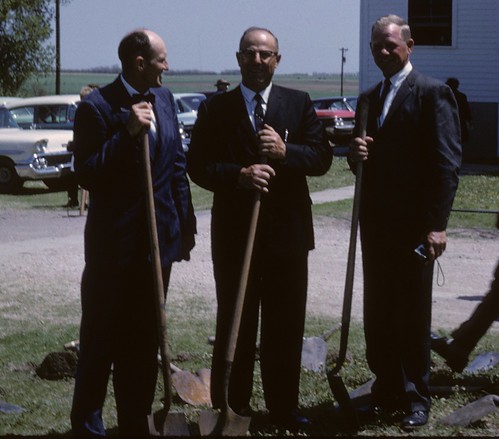
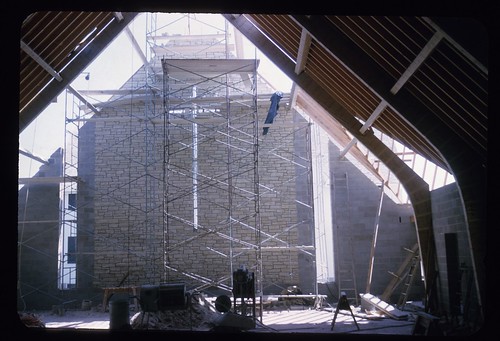
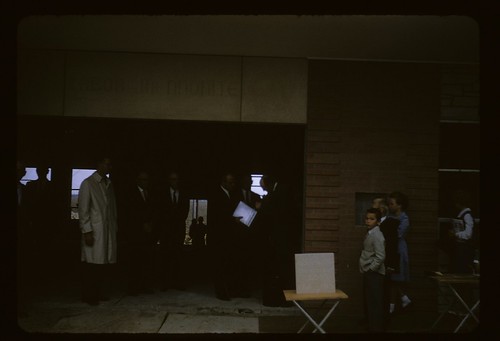
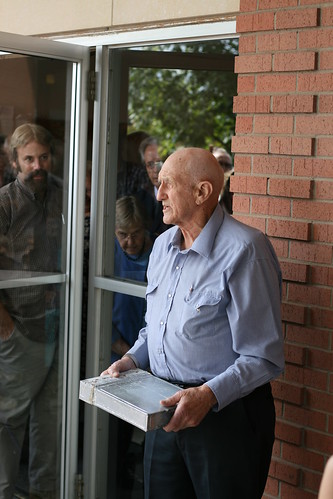
One of the benefits of living in a small community is that I get to know people of all ages around here. Not just people my own age, or coworkers. A few years ago, I worked on a history project for our church s centennial. Back in the 1960s, Rudy was one of the people in charge of building our current church. So he was a person I was interested in visiting with. Here he is, on the left, during the 1964 groundbreaking ceremony for the new building (the old one is visible in the background). 022 stamped may 1964cropped.jpg I and a few others went to his home one time a few years ago and we had a wonderful evening. Rudy shared all sorts of stories with us which I am happy to say I recorded. But moreover, Rudy was an avid photographer. There were some rare and brilliant color slides of the church being built in his collection. He let me borrow and scan some of them. Here are my two favorites: 015 stamped july 1964.jpg 016 stamped oct 1964.jpg Back in 1965, there was a ceremony at the setting of the cornerstone of Tabor Church. The people at the time assembled some papers and memorabilia and put them in a time capsule. Rudy Schmidt sealed the capsule and it was placed in the spot for it behind the cornerstone. Here is a photo of that ceremony. 013 stamped nov 1964.jpg 44 years later, on the occasion of Tabor s centennial, it was time to open the time capsule. The other building committee people, such as Jake Koehn, had passed away, so Rudy was the one to open it. He gave a few words in front of the large crowd, and mentioned that when he sealed it away, he smelled some smoke when he soldered it shut. Jake Koehn told him, Don t worry, nobody will ever see it again anyway and they had a little laugh about it. Now he was going to open it up and see if anything survived. img_6173.jpg It all did just a few minor burn marks. We enjoyed looking at all the items. Then the church placed some new items into the capsule. It was closed up again, to be opened in maybe 50 years. With luck, I ll still be around to see it opened again. Even if I m not, maybe Jacob and Oliver will be able to. And so it seems very fitting that the last hands to touch that box for the next 50 years were Rudy Schmidt s, when he placed it back in its spot on Oct. 12, 2008. img_6243.jpg

27 October 2010

Alexander Reichle-Schmehl: (Delayed) Release Critical Bug report for Week 42

The bug webinterface of the Universal Debian Database currently knows about the following release critical bugs:
In Total:700
Affecting Squeeze:291
Squeeze only:72
Remaining to be fixed in Squeeze:219
Of these 219 bugs, the following tags are set:
Pending in Squeeze:16
Patched in Squeeze:44
Duplicates in Squeeze:24
Can be fixed in a security Update:15
Contrib or non-free in Squeeze:8
Otherwise fixed in Squeeze:27
Ignoring all the above (multiple tags possible), 125 bugs need to be fixed by Debian Contributors to get Debian 6.0 Squeeze released. However, with the view of the Release Managers, 173 need to be dealt with for the release to happen. Please see Interpreting the release critical bug statistics for an explanation of the different numbers. Connection to alioth.debian.org closed. PS: Due to an unscheduled downtime, last weeks statistics have not been published. But better late than never, here are the current statistics.

26 October 2010

Matthew Garrett: Fun facts

Number of contributors to gnome-shell code (ie, the js and src directories)40
Number of contributors to gnome-shell code who work for Red Hat8
Percentage of gnome-shell code written by Red Hat by lines91%

Which, I'll admit, does make it look like gnome-shell is controlled by the sinister Red Hat shadowman that rejects external contributions in order to keep a tight reign on the project and prevent Canonical from improving the desktop Linux experience. Let's check Unity.

Number of contributors to Unity code (ie, the unity and unity-priv directories)10
Number of contributors to Unity code who work for Canonical10
Percentage of Unity code written by Canonical by lines100%

Yup, it's a conspiracy.

Jelmer Vernooij: OpenChange server and SOGo

There's more good news on the OpenChange front. Julien has been working together with Wolfgang and Ludovic from Inverse recently to leverage the server-side support in OpenChange to provide native Exchange server support in SOGo. A couple of days ago we announced that there now is an initial version that allows the use of Outlook against a SOGo server through OpenChange.

<object data="http://www.youtube.com/v/oSZJ95YeXYE?fs=1&amp;hl=en_US&amp;hd=1" height="385" type="application/x-shockwave-flash" width="480"><param name="movie" value="http://www.youtube.com/v/oSZJ95YeXYE?fs=1&amp;hl=en_US&amp;hd=1"><param name="movie" value="http://www.youtube.com/v/oSZJ95YeXYE?fs=1&amp;hl=en_US&amp;hd=1"><param name="allowFullScreen" value="true"><param name="allowscriptaccess" value="always"></object> (alternatively you can find the screencast here) As far as I know, this is the first time it's possible to actually use Outlook clients with a non-Microsoft Exchange-compatible server without the need for plugins on the Outlook side. And it's all Free Software. Of course, this is just a preview, and not something we'd recommend everybody to run in production yet. But it's exciting to finally see this come together. We already have OpenChange packages in Debian and Ubuntu but I hope I can help get SOGo packaged for both distributions as well.

25 October 2010

Jonathan Wiltshire: Facebook groups: a gift to framers

I didn t quite believe what I was seeing until I searched and found several other people noticing the same behaviour. For background, Facebook recently introduced the concept of groups not in the sense we ve been used to, but more like lists. Groups are supposed to be to lists what databases are to bits of paper. You can add friends to groups to organise them, send them group emails, run a collective mailing list, and so on. Except that in practice, this is another really good way of exploiting lazy users. See, there are some things to know about groups: The second point may be wrong it s very unclear exactly what permission is afforded to a group member and when or where information about the group membership is published. Since my day job is in private education, this immediately makes me think of two terrifying scenarios:
  1. A student inadvertently gets added to a large group and nobody notices because there is so much other traffic. Whatever my other privacy settings, anything I or anyone else posted to the group is now visible to him this is the same as the previous group arrangement. The difference is that he can now go on and add anyone else Mark Zuckerberg himself even without any kind of checks by the group administrator. A membership system like this quickly spirals out of control.
  2. Somebody with a grudge maybe I took too long fixing their PC adds me to a group with, shall we say, inappropriate or unsavoury content while I m away on holiday and tips off the child protection officer. Better yet, he first sends an email to all staff expressing horror and asking them to verify this in case it s his computer lying. Now there are multiple witnesses to the fact that I was a member of this group, and I return from the sea side to find a P45 on the door mat.
Unlike free software, I can t fix this. Fortunately, I have: enabled every email notification under the sun; few and trustworthy friends; according to my profile, no interests or contact details whatsoever; and no care for groups. I m happy with my lists, thanks all the same.
Comments flattr this!

Next.

Previous.