Search Results: "will"

15 January 2026

Dirk Eddelbuettel: RcppSpdlog 0.0.25 on CRAN: Microfix

Version 0.0.25 of RcppSpdlog arrived on CRAN right now, and will be uploaded to Debian and built for r2u shortly along with a minimal refresh of the documentation site. RcppSpdlog bundles spdlog, a wonderful header-only C++ logging library with all the bells and whistles you would want that was written by Gabi Melman, and also includes fmt by Victor Zverovich. You can learn more at the nice package documention site. This release fixes a minuscule cosmetic issue from the previous release a week ago. We rely on two #defines that R sets to signal to spdlog that we are building in the R context (which matters for the R-specific logging sink, and picks up something Gabi added upon my suggestion at the very start of this package). But I use the same #defines to now check in Rcpp that we are building with R and, in this case, wrongly conclude R headers have already been installed so Rcpp (incorrectly) nags about that. The solution is to add two #undefine and proceed as normal (with Rcpp controlling and taking care of R header includion too) and that is what we do here. All good now, no nags from a false positive. The NEWS entry for this release follows.

Changes in RcppSpdlog version 0.0.25 (2026-01-15)
  • Ensure #define signaling R build (needed with spdlog) is unset before including R headers to not falsely triggering message from Rcpp

Courtesy of my CRANberries, there is also a diffstat report detailing changes. More detailed information is on the RcppSpdlog page, or the package documention site.

This post by Dirk Eddelbuettel originated on his Thinking inside the box blog. If you like this or other open-source work I do, you can sponsor me at GitHub.

12 January 2026

Gunnar Wolf: Python Workout 2nd edition

This post is an unpublished review for Python Workout 2nd edition
Note: While I often post the reviews I write for Computing Reviews, this is a shorter review requested to me by Manning. They kindly invited me several months ago to be a reviewer for Python Workout, 2nd edition; after giving them my opinions, I am happy to widely recommend this book to interested readers. Python is relatively an easy programming language to learn, allowing you to start coding pretty quickly. However, there s a significant gap between being able to throw code in Python and truly mastering the language. To write efficient, maintainable code that s easy for others to understand, practice is essential. And that s often where many of us get stuck. This book begins by stating that it is not designed to teach you Python ( ) but rather to improve your understanding of Python and how to use it to solve problems. The author s structure and writing style are very didactic. Each chapter addresses a different aspect of the language: from the simplest (numbers, strings, lists) to the most challenging for beginners (iterators and generators), Lerner presents several problems for us to solve as examples, emphasizing the less obvious details of each aspect. I was invited as a reviewer in the preprint version of the book. I am now very pleased to recommend it to all interested readers. The author presents a pleasant and easy-to-read text, with a wealth of content that I am sure will improve the Python skills of all its readers.

Daniel Lange: Resizing Xterm fonts with Ctrl+ and Ctrl+

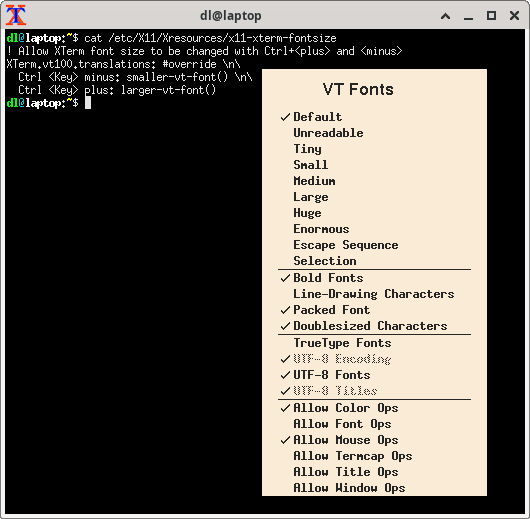
Xterm misses the convenient option to resize the fonts with Ctrl+<plus> and Ctrl+<minus> like xfce4-terminal or gnome-terminal do out of the box. This feature can be added on Debian systems by dropping a configuration snippet into /etc/X11/Xresources/x11-xterm-fontsize:
! Allow XTerm font size to be changed with Ctrl+<plus> and <minus>
XTerm.vt100.translations: #override \n\
Ctrl <Key> minus: smaller-vt-font() \n\
Ctrl <Key> plus: larger-vt-font()
Any new X session will inherit this configuration and Ctrl+<plus> and Ctrl+<minus> will work to adjust the font size (and taking the window size along). The font sizes that Xterm iterates through can be viewed on the Ctrl-<right click> context menu: Screenshot of an Xterm window with the context menu displayed NB: The context menu allows to switch the fonts on systems where the above snippet has not (yet) been installed. So good enough for a one-off. Credits: Stack Overflow/Ask Ubuntu, Matthew Hoener.

11 January 2026

Dirk Eddelbuettel: RApiDatetime 0.0.10 on CRAN: Maintenance

A new maintenance release of our RApiDatetime package is now on CRAN, coming just about two years after the previous maintenance release. RApiDatetime provides a number of entry points for C-level functions of the R API for Date and Datetime calculations. The functions asPOSIXlt and asPOSIXct convert between long and compact datetime representation, formatPOSIXlt and Rstrptime convert to and from character strings, and POSIXlt2D and D2POSIXlt convert between Date and POSIXlt datetime. Lastly, asDatePOSIXct converts to a date type. All these functions are rather useful, but were not previously exported by R for C-level use by other packages. Which this package aims to change. This release avoids use of and which are now outlawed under R-devel, and makes a number of other smaller maintenance updates. Just like the previous release, we are at OS_type: unix meaning there will not be any Windows builds at CRAN. If you would like that to change, and ideally can work in the Windows portion, do not hesitate to get in touch. Details of the release follow based on the NEWS file.

Changes in RApiDatetime version 0.0.10 (2026-01-11)
  • Minor maintenance for continuous integration files, README.md
  • Switch to Authors@R in DESCRIPTION
  • Use Rf_setAttrib with R 4.5.0 or later

Courtesy of my CRANberries, there is also a diffstat report for this release.

This post by Dirk Eddelbuettel originated on his Thinking inside the box blog. If you like this or other open-source work I do, you can sponsor me at GitHub.

Russell Coker: Terminal Emulator Security

I just read this informative article on ANSI terminal security [1]. The author has written a tool named vt-houdini for testing for these issues [2]. They used to host an instance on their server but appear to have stopped it. When you run that tool you can ssh to the system in question and without needing a password you are connected and the server probes your terminal emulator for vulnerabilities. The versions of Kitty and Konsole in Debian/Trixie have just passed those tests on my system. This will always be a potential security problem due to the purpose of a terminal emulator. A terminal emulator will often display untrusted data and often data which is known to come from hostile sources (EG logs of attempted attacks). So what could be done in this regard? Memory Protection Due to the complexity of terminal emulation there is the possibility of buffer overflows and other memory management issues that could be used to compromise the emulator. The Fil-C compiler is an interesting project [3], it compiles existing C/C++ code with memory checks. It is reported to have no noticeable impact on the performance of the bash shell which sounds like a useful option to address some of these issues as shell security issues are connected to terminal security issues. The performance impact on a terminal emulator would be likely to be more noticeable. Also note that Fil-C compilation apparently requires compiling all libraries with it, this isn t a problem for bash as the only libraries it uses nowadays are libtinfo and libc. The kitty terminal emulator doesn t have many libraries but libpython is one of them, it s an essential part of Kitty and it is a complex library to compile in a different way. Konsole has about 160 libraries and it isn t plausible to recompile so many libraries at this time. Choosing a terminal emulator that has a simpler design might help in this regard. Emulators that call libraries for 3D effects etc and native support for displaying in-line graphics have a much greater attack surface. Access Control A terminal emulator could be run in a container to prevent it from doing any damage if it is compromised. But the terminal emulator will have full control over the shell it runs and if the shell has access needed to allow commands like scp/rsync to do what is expected of them then that means that no useful level of containment is possible. It would be possible to run a terminal emulator in a container for the purpose of connecting to an insecure or hostile system and not allow scp/rsync to/from any directory other than /tmp (or other directories to use for sharing files). You could run exec ssh $SERVER so the terminal emulator session ends when the ssh connection ends. Conclusion There aren t good solutions to the problems of terminal emulation security. But testing every terminal emulator with vt-houdini and fuzzing the popular ones would be a good start. Qubes level isolation will help things in some situations, but if you need to connect to a server with privileged access to read log files containing potentially hostile data (which is a common sysadmin use case) then there aren t good options.

Otto Kek l inen: Stop using MySQL in 2026, it is not true open source

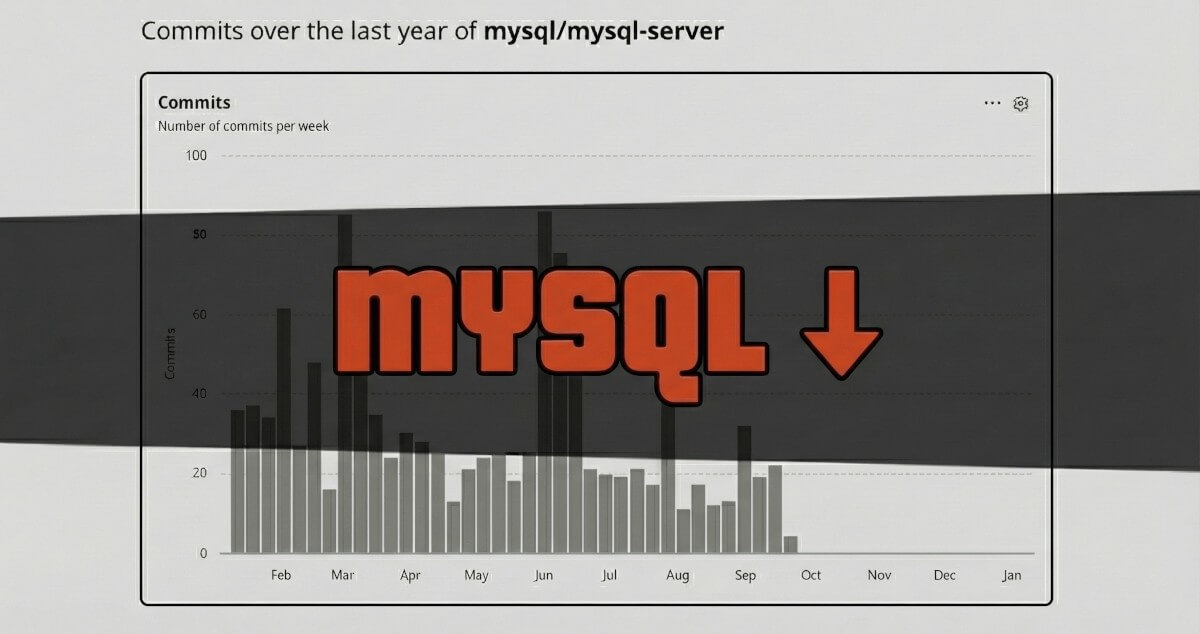
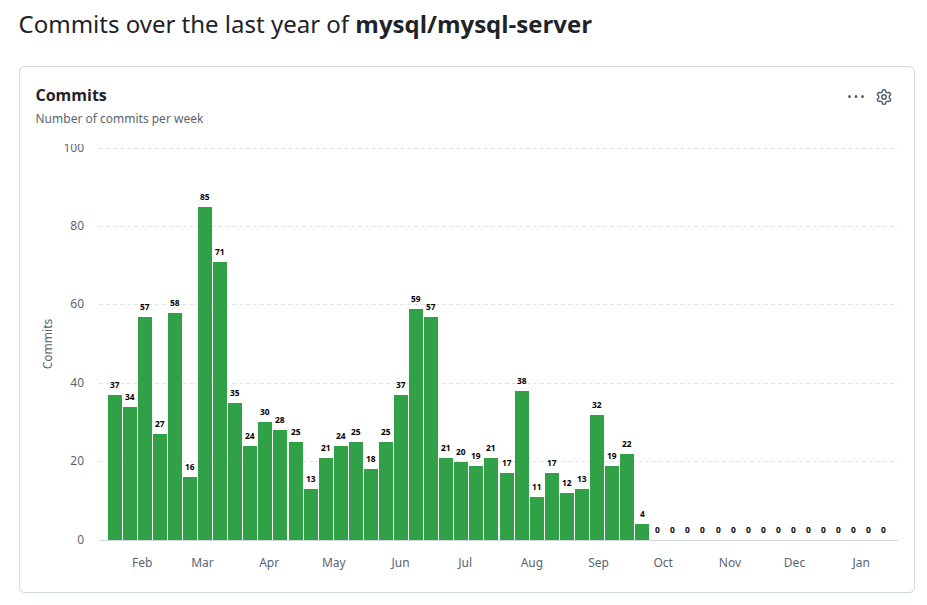
Featured image of post Stop using MySQL in 2026, it is not true open sourceIf you care about supporting open source software, and still use MySQL in 2026, you should switch to MariaDB like so many others have already done. The number of git commits on github.com/mysql/mysql-server has been significantly declining in 2025. The screenshot below shows the state of git commits as of writing this in January 2026, and the picture should be alarming to anyone who cares about software being open source. MySQL GitHub commit activity decreasing drastically

This is not surprising Oracle should not be trusted as the steward for open source projects When Oracle acquired Sun Microsystems and MySQL along with it back in 2009, the European Commission almost blocked the deal due to concerns that Oracle s goal was just to stifle competition. The deal went through as Oracle made a commitment to keep MySQL going and not kill it, but (to nobody s surprise) Oracle has not been a good steward of MySQL as an open source project and the community around it has been withering away for years now. All development is done behind closed doors. The publicly visible bug tracker is not the real one Oracle staff actually uses for MySQL development, and the few people who try to contribute to MySQL just see their Pull Requests and patch submissions marked as received with mostly no feedback and then those changes may or may not be in the next MySQL release, often rewritten, and with only Oracle staff in the git author/committer fields. The real author only gets a small mention in a blog post. When I was the engineering manager for the core team working on RDS MySQL and RDS MariaDB at Amazon Web Services, I oversaw my engineers contributions to both MySQL and MariaDB (the latter being a fork of MySQL by the original MySQL author, Michael Widenius). All the software developers in my org disliked submitting code to MySQL due to how bad the reception by Oracle was to their contributions. MariaDB is the stark opposite with all development taking place in real-time on github.com/mariadb/server, anyone being able to submit a Pull Request and get a review, all bugs being openly discussed at jira.mariadb.org and so forth, just like one would expect from a true open source project. MySQL is open source only by license (GPL v2), but not as a project.

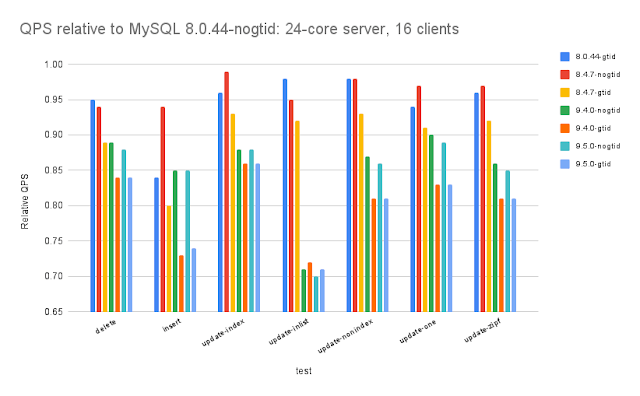
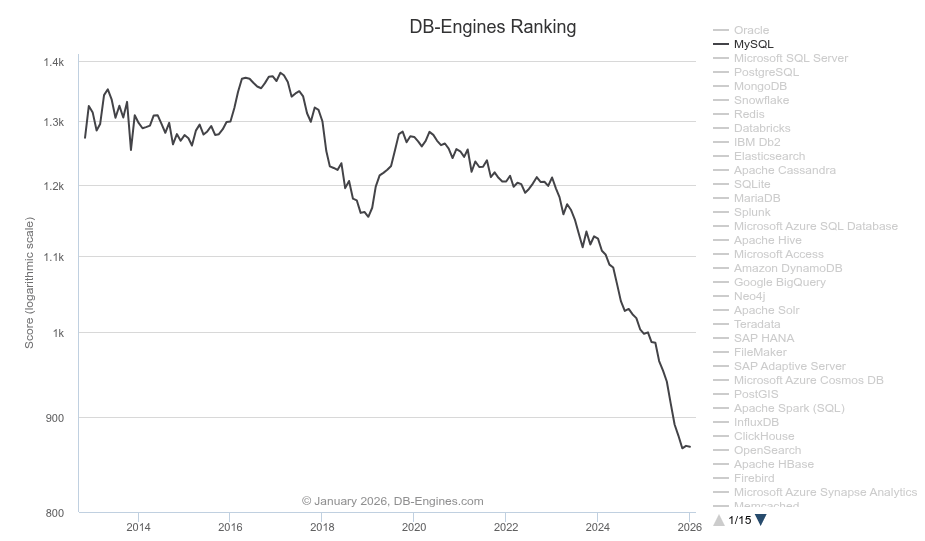
MySQL s technical decline in recent years Despite not being a good open source steward, Oracle should be given credit that it did keep the MySQL organization alive and allowed it to exist fairly independently and continue developing and releasing new MySQL versions well over a decade after the acquisition. I have no insight into how many customers they had, but I assume the MySQL business was fairly profitable and financially useful to Oracle, at least as long as it didn t gain too many features to threaten Oracle s own main database business. I don t know why, perhaps because too many talented people had left the organization, but it seems that from a technical point of view MySQL clearly started to deteriorate from 2022 onward. When MySQL 8.0.29 was released with the default ALTER TABLE method switched to run in-place, it had a lot of corner cases that didn t work, causing the database to crash and data to corrupt for many users. The issue wasn t fully fixed until a year later in MySQL 8.0.32. To many users annoyance Oracle announced the 8.0 series as evergreen and introduced features and changes in the minor releases, instead of just doing bugfixes and security fixes like users historically had learnt to expect from these x.y.Z maintenance releases. There was no new major MySQL version for six years. After MySQL 8.0 in 2018 it wasn t until 2023 when MySQL 8.1 was released, and it was just a short-term preview release. The first actual new major release MySQL 8.4 LTS was released in 2024. Even though it was a new major release, many users got disappointed as it had barely any new features. Many also reported degraded performance with newer MySQL versions, for example the benchmark by famous MySQL performance expert Mark Callaghan below shows that on write-heavy workloads MySQL 9.5 throughput is typically 15% less than in 8.0. Benchmark showing new MySQL versions being slower than the old Due to newer MySQL versions deprecating many features, a lot of users also complained about significant struggles regarding both MySQL 5.7->8.0 and 8.0->8.4 upgrades. With few new features and heavy focus on code base cleanup and feature deprecation, it became obvious to many that Oracle had decided to just keep MySQL barely alive, and put all new relevant features (e.g. vector search) into Heatwave, Oracle s closed-source and cloud-only service for MySQL customers. As it was evident that Oracle isn t investing in MySQL, Percona s Peter Zaitsev wrote Is Oracle Finally Killing MySQL in June 2024. At this time MySQL s popularity as ranked by DB-Engines had also started to tank hard, a trend that likely accelerates in 2026. MySQL dropping significantly in DB-Engines ranking In September 2025 news reported that Oracle was reducing its workforce and that the MySQL staff was getting heavily reduced. Obviously this does not bode well for MySQL s future, and Peter Zaitsev posted already in November stats showing that the latest MySQL maintenance release contained fewer bug fixes than before.

Open source is more than ideology: it has very real effects on software security and sovereignty Some say they don t care if MySQL is truly open source or not, or that they don t care if it has a future in coming years, as long as it still works now. I am afraid people thinking so are taking a huge risk. The database is often the most critical part of a software application stack, and any flaw or problem in operations, let alone a security issue, will have immediate consequences, and not caring will eventually get people fired or sued. In open source problems are discussed openly, and the bigger the problem, the more people and companies will contribute to fixing it. Open source as a development methodology is similar to the scientific method with free flow of ideas that are constantly contested and only the ones with the most compelling evidence win. Not being open means more obscurity, more risk and more just trust us bro attitude. This open vs. closed is very visible for example in how Oracle handles security issues. We can see that in 2025 alone MySQL published 123 CVEs about security issues, while MariaDB had 8. There were 117 CVEs that only affected MySQL and not MariaDB in 2025. I haven t read them all, but typically the CVEs hardly contain any real details. As an example, the most recent one CVE-2025-53067 states Easily exploitable vulnerability allows high privileged attacker with network access via multiple protocols to compromise MySQL Server. There is no information a security researcher or auditor could use to verify if any original issue actually existed, or if it was fixed, or if the fix was sufficient and fully mitigating the issue or not. MySQL users just have to take the word of Oracle that it is all good now. Handling security issues like this is in stark contrast to other open source projects, where all security issues and their code fixes are open for full scrutiny after the initial embargo is over and CVE made public. There is also various forms of enshittification going on one would not see in a true open source project, and everything about MySQL as a software, documentation and website is pushing users to stop using the open source version and move to the closed MySQL versions, and in particular to Heatwave, which is not only closed-source but also results in Oracle fully controlling customer s databases contents. Of course, some could say this is how Oracle makes money and is able to provide a better product. But stories on Reddit and elsewhere suggest that what is going on is more like Oracle milking hard the last remaining MySQL customers who are forced to pay more and more for getting less and less.

There are options and migrating is easy, just do it A large part of MySQL users switched to MariaDB already in the mid-2010s, in particular everyone who had cared deeply about their database software staying truly open source. That included large installations such as Wikipedia, and Linux distributions such as Fedora and Debian. Because it s open source and there is no centralized machine collecting statistics, nobody knows what the exact market shares look like. There are however some application specific stats, such as that 57% of WordPress sites around the world run MariaDB, while the share for MySQL is 42%. For anyone running a classic LAMP stack application such as WordPress, Drupal, Mediawiki, Nextcloud, or Magento, switching the old MySQL database to MariaDB is be straightforward. As MariaDB is a fork of MySQL and mostly backwards compatible with it, swapping out MySQL for MariaDB can be done without changing any of the existing connectors or database clients, as they will continue to work with MariaDB as if it was MySQL. For those running custom applications and who have the freedom to make changes to how and what database is used, there are tens of mature and well-functioning open source databases to choose from, with PostgreSQL being the most popular general database. If your application was built from the start for MySQL, switching to PostgreSQL may however require a lot of work, and the MySQL/MariaDB architecture and storage engine InnoDB may still offer an edge in e.g. online services where high performance, scalability and solid replication features are of highest priority. For a quick and easy migration MariaDB is probably the best option. Switching from MySQL to the Percona Server is also very easy, as it closely tracks all changes in MySQL and deviates from it only by a small number of improvements done by Percona. However, also precisely because of it being basically just a customized version of the MySQL Server, it s not a viable long-term solution for those trying to fully ditch the dependency on Oracle. There are also several open source databases that have no common ancestry with MySQL, but strive to be MySQL-compatible. Thus most apps built for MySQL can simply switch to using them without needing SQL statements to be rewritten. One such database is TiDB, which has been designed from scratch specifically for highly scalable and large systems, and is so good that even Amazon s latest database solution DSQL was built borrowing many ideas from TiDB. However, TiDB only really shines with larger distributed setups, so for the vast majority of regular small- and mid-scale applications currently using MySQL, the most practical solution is probably to just switch to MariaDB, which on most Linux distributions can simply be installed by running apt/dnf/brew install mariadb-server. Whatever you end up choosing, as long as it is not Oracle, you will be better off.

10 January 2026

Matthias Geiger: Building a propagation box for oyster mushrooms

Inspiration In November I watched a short documentary about a guy who grew pearl oyster mushrooms in his backyard. They used pallet boxes (half of a europallet, 60x80x20 cm) as box to keep the substrate the mycelium feeds on in. Since I really enjoy (foraged) mushrooms and had the raw materials lying around, I opted to build it myself. This also had the benefit of using what was available and not just consuming, i.e. buying a pallet box. Preparing the raw materials I had 4.5 m x ~ 25 cm wooden spruce planks at home. My plan was to cut those into 2 m segments, then trim the edges down to 20 cm and then cut them into handy pieces, following the dimension of half a pallet box. This is what they looked after cutting them with an electric chainsaw to around 2 m: raw_planks You can see that the edges are still not straight, because that's how they came out of the sawmill. Once that was done I visited a family member that had a crosscut saw, a table saw and a band saw; all that I would need. First we trimmed the edges of the 2m planks with the table saw so they were somewhat straight; then they were flipped and the other edge was cut straight, and their width cut down to 20 cm. After moving them over to the crosscut saw dividing them into two 60 cm and one 80 cm was fairly easy. When cutting the 2m planks from the 4m ones I calculated with extra offcuts, so I got little waste overall and could use the whole length to get my desired board. This is what the cut pieces looked like: cut_planks Assembly I packed up my planks, now nicely cut to size, and I went to a hardware shop and bought hinges and screws. Assembly was fairly easy and fast: screw a hinge to a corner, hold the other plank onto the hinge so that the corners of both boards touch, and affix the hinge. plank_with_hinge corner_with_hinge When this was done, the frame looked like this: finished_frame As last step I drilled 10mm holes more or less random in the middle of the box. This is where the mushrooms will grow out of later and can be harvested. box_with_holes Closing thoughts This was a fun project I finished in a day. The hinges have the benefit that they allow the box to be folded up lenght-wise: folded This allows for convenient storage. Since it's too cold outside right now, cultivation will have to wait until spring. This also just needs mycelium one can just buy, and some material fungus digests. They can also be fed coffee grounds, and harvest of the fruit body is possible circa every two weeks.

Scarlett Gately Moore: I love KDE too much to retire! Snap beta releases trickling in. Stay tuned.

A short but sweet note to say I am coming out of my short retirement to help with snaps again. My time is extremely limited, however we are working hard on getting snaps on CI and I have some newer snaps in beta trickling in for testing. You must install kf6-core24 from beta as well to test them ( this will likely break older kde snaps in the process so beware. ) This is slow going as I work on them during my hour lunch at day job and spare stolen moments. KDE is coming up on its 30th birthday!!! How cool is that! I  KDE Like my work? Consider a donation. Thank you! Donate

9 January 2026

Simon Josefsson: Debian Taco Towards a GitSecDevOps Debian

One of my holiday projects was to understand and gain more trust in how Debian binaries are built, and as the holidays are coming to an end, I d like to introduce a new research project called Debian Taco. I apparently need more holidays, because there are still more work to be done here, so at the end I ll summarize some pending work. Debian Taco, or TacOS, is a GitSecDevOps rebuild of Debian GNU/Linux. The Debian Taco project publish rebuilt binary packages, package repository metadata (InRelease, Packages, etc), container images, cloud images and live images. All packages are built from pristine source packages in the Debian archive. Debian Taco does not modify any Debian source code nor add or remove any packages found in Debian. No servers are involved! Everything is built in GitLab pipelines and results are published through modern GitDevOps mechanism like GitLab Pages and S3 object storage. You can fork the individual projects below on GitLab.com and you will have your own Debian-derived OS available for tweaking. (Of course, at some level, servers are always involved, so this claim is a bit of hyperbole.)

Goals The goal of TacOS is to be bit-by-bit identical with official Debian GNU/Linux, and until that has been completed, publish diffoscope output with differences. The idea is to further categorize all artifact differences into one of the following categories: 1) An obvious bug in Debian. For example, if a package does not build reproducible. 2) An obvious bug in TacOS. For example, if our build environment does not manage to build a package. 3) Something else. This would be input for further research and consideration. This category also include things where it isn t obvious if it is a bug in Debian or in TacOS. Known examples: 3A) Packages in TacOS are rebuilt the latest available source code, not the (potentially) older package that were used to build the Debian packages. This could lead to differences in the packages. These differences may be useful to analyze to identify supply-chain attacks. See some discussion about idempotent rebuilds. Our packages are all built from source code, unless we have not yet managed to build something. In the latter situation, Debian Taco falls back and uses the official Debian artifact. This allows an incremental publication of Debian Taco that still is 100% complete without requiring that everything is rebuilt instantly. The goal is that everything should be rebuilt, and until that has been completed, publish a list of artifacts that we use verbatim from Debian.

Debian Taco Archive The Debian Taco Archive project generate and publish the package archive (dists/tacos-trixie/InRelease, dists/tacos-trixie/main/binary-amd64/Packages.gz, pool/* etc), similar to what is published at https://deb.debian.org/debian/. The output of the Debian Taco Archive is available from https://debdistutils.gitlab.io/tacos/archive/.

Debian Taco Container Images The Debian Taco Container Images project provide container images of Debian Taco for trixie, forky and sid on the amd64, arm64, ppc64el and riscv64 architectures. These images allow quick and simple use of Debian Taco interactively, but makes it easy to deploy for container orchestration frameworks.

Debian Taco Cloud Images The Debian Taco Cloud Images project provide cloud images of Debian Taco for trixie, forky and sid on the amd64, arm64, ppc64el and riscv64 architectures. Launch and install Debian Taco for your cloud environment!

Debian Taco Live Images The Debian Taco Live Images project provide live images of Debian Taco for trixie, forky and sid on the amd64 and arm64 architectures. These images allows running Debian Taco on physical hardware (or virtual machines), and even installation for permanent use.

Debian Taco Build Images and Packages Packages are built using debdistbuild, which was introduced in a blog about Build Debian in a GitLab Pipeline. The first step is to prepare build images, which is done by the Debian Taco Build Images project. They are similar to the Debian Taco containers but have build-essential and debdistbuild installed on them. Debdistbuild is launched in a per-architecture per-suite CI/CD project. Currently only trixie-amd64 is available. That project has built some essential early packages like base-files, debian-archive-keyring and hostname. They are stored in Git LFS backed by a S3 object storage. These packages were all built reproducibly. So this means Debian Taco is still 100% bit-by-bit identical to Debian, except for the renaming. I ve yet to launch a more massive wide-scale package rebuild until some outstanding issues have been resolved. I earlier rebuilt around 7000 packages from Trixie on amd64, so I know that the method easily scales.

Remaining work Where is the diffoscope package outputs and list of package differences? For another holiday! Clearly this is an important remaining work item. Another important outstanding issue is how to orchestrate launching the build of all packages. Clearly a list of packages is needed, and some trigger mechanism to understand when new packages are added to Debian. One goal was to build packages from the tag2upload browse.dgit.debian.org archive, before checking the Debian Archive. This ought to be really simple to implement, but other matters came first.

GitLab or Codeberg? Everything is written using basic POSIX /bin/sh shell scripts. Debian Taco uses the GitLab CI/CD Pipeline mechanism together with a Hetzner S3 object storage to serve packages. The scripts have only weak reliance on GitLab-specific principles, and were designed with the intention to support other platforms. I believe reliance on a particular CI/CD platform is a limitation, so I d like to explore shipping Debian Taco through a Forgejo-based architecture, possibly via Codeberg as soon as I manage to deploy reliable Forgejo runners. The important aspects that are required are: 1) Pipelines that can build and publish web sites similar to GitLab Pages. Codeberg has a pipeline mechanism. I ve successfully used Codeberg Pages to publish the OATH Toolkit homepage homepage. Glueing this together seems feasible. 2) Container Registry. It seems Forgejo supports a Container Registry but I ve not worked with it at Codeberg to understand if there are any limitations. 3) Package Registry. The Deban Taco live images are uploaded into a package registry, because they are too big for being served through GitLab Pages. It may be converted to using a Pages mechanism, or possibly through Release Artifacts if multi-GB artifacts are supported on other platforms. I hope to continue this work and explaining more details in a series of posts, stay tuned!

8 January 2026

Reproducible Builds: Reproducible Builds in December 2025

Welcome to the December 2025 from the Reproducible Builds project! Our monthly reports outline what we ve been up to over the past month, highlighting items of news from elsewhere in the increasingly-important area of software supply-chain security. As ever, if you are interested in contributing to the Reproducible Builds project, please see the Contribute page on our website.

  1. New orig-check service to validate Debian upstream tarballs
  2. Distribution work
  3. disorderfs updated to FUSE 3
  4. Mailing list updates
  5. Three new academic papers published
  6. Website updates
  7. Upstream patches

New orig-check service to validate Debian upstream tarballs This month, Debian Developer Lucas Nussbaum announced the orig-check service, which attempts to automatically reproduce the generation upstream tarballs (ie. the original source component of a Debian source package), comparing that to the upstream tarball actually shipped with Debian. As of the time of writing, it is possible for a Debian developer to upload a source archive that does not actually correspond to upstream s version. Whilst this is not inherently malicious (it typically indicates some tooling/process issue), the very possibility that a maintainer s version may differ potentially permits a maintainer to make (malicious) changes that would be misattributed to upstream. This service therefore nicely complements the whatsrc.org service, which was reported in our reports for both April and August. The orig-check is dedicated to Lunar, who sadly passed away a year ago.

Distribution work In Arch Linux this month, Robin Candau and Mark Hegreberg worked at making the Arch Linux WSL image bit-for-bit reproducible. Robin also shared some implementation details and future related work on our mailing list. Continuing a series reported in these reports for March, April and July 2025 (etc.), Simon Josefsson has published another interesting article this month, itself a followup to a post Simon published in December 2024 regarding GNU Guix Container Images that are hosted on GitLab. In Debian this month, Micha Lenk posted to the debian-backports-announce mailing list with the news that the Backports archive will now discard binaries generated and uploaded by maintainers: The benefit is that all binary packages [will] get built by the Debian buildds before we distribute them within the archive. Felix Moessbauer of Siemens then filed a bug in the Debian bug tracker to signal their intention to package debsbom, a software bill of materials (SBOM) generator for distributions based on Debian. This generated a discussion on the bug inquiring about the output format as well as a question about how these SBOMs might be distributed. Holger Levsen merged a number of significant changes written by Alper Nebi Yasak to the Debian Installer in order to improve its reproducibility. As noted in Alper s merge request, These are the reproducibility fixes I looked into before bookworm release, but was a bit afraid to send as it s just before the release, because the things like the xorriso conversion changes the content of the files to try to make them reproducible. In addition, 76 reviews of Debian packages were added, 8 were updated and 27 were removed this month adding to our knowledge about identified issues. A new different_package_content_when_built_with_nocheck issue type was added by Holger Levsen. [ ] Arnout Engelen posted to our mailing list reporting that they successfully reproduced the NixOS minimal installation ISO for the 25.11 release without relying on a pre-compiled package archive, with more details on their blog. Lastly, Bernhard M. Wiedemann posted another openSUSE monthly update for his work there.

disorderfs updated to FUSE 3 disorderfs is our FUSE-based filesystem that deliberately introduces non-determinism into system calls to reliably flush out reproducibility issues. This month, however, Roland Clobus upgraded disorderfs* from FUSE 2 to FUSE 3 after its package automatically got removed from Debian testing. Some tests in Debian currently require disorderfs to make the Debian live images reproducible, although disorderfs is not a Debian-specific tool.

Mailing list updates On our mailing list this month:
  • Luca Di Maio announced stampdalf, a filesystem timestamp preservation tool that wraps arbitrary commands and ensures filesystem timestamp reproducibility :
    stampdalf allows you to run any command that modifies files in a directory tree, then automatically resets all timestamps back to their original values. Any new files created during command execution are set to [the UNIX epoch] or a custom timestamp via SOURCE_DATE_EPOCH.
    The project s GitHub page helpfully reveals that the project is pronounced: stamp-dalf (stamp like time-stamp, dalf like Gandalf the wizard) as it s a wizard of time and stamps .)
  • Lastly, Reproducible Builds developer cen1 posted to our list announcing that early/experimental/alpha support for FreeBSD was added to rebuilderd. In their post, cen1 reports that the initial builds are in progress and look quite decent . cen1 also interestingly notes that since the upstream is currently not technically reproducible I had to relax the bit-for-bit identical requirement of rebuilderd [ ] I consider the pkg to be reproducible if the tar is content-identical (via diffoscope), ignoring timestamps and some of the manifest files. .

Three new academic papers published Yogya Gamage and Benoit Baudry of Universit de Montr al, Canada together with Deepika Tiwari and Martin Monperrus of KTH Royal Institute of Technology, Sweden published a paper on The Design Space of Lockfiles Across Package Managers:
Most package managers also generate a lockfile, which records the exact set of resolved dependency versions. Lockfiles are used to reduce build times; to verify the integrity of resolved packages; and to support build reproducibility across environments and time. Despite these beneficial features, developers often struggle with their maintenance, usage, and interpretation. In this study, we unveil the major challenges related to lockfiles, such that future researchers and engineers can address them. [ ]
A PDF of their paper is available online. Benoit Baudry also posted an announcement to our mailing list, which generated a number of replies.
Betul Gokkaya, Leonardo Aniello and Basel Halak of the University of Southampton then published a paper on the A taxonomy of attacks, mitigations and risk assessment strategies within the software supply chain:
While existing studies primarily focus on software supply chain attacks prevention and detection methods, there is a need for a broad overview of attacks and comprehensive risk assessment for software supply chain security. This study conducts a systematic literature review to fill this gap. By analyzing 96 papers published between 2015-2023, we identified 19 distinct SSC attacks, including 6 novel attacks highlighted in recent studies. Additionally, we developed 25 specific security controls and established a precisely mapped taxonomy that transparently links each control to one or more specific attacks. [ ]
A PDF of the paper is available online via the article s canonical page.
Aman Sharma and Martin Monperrus of the KTH Royal Institute of Technology, Sweden along with Benoit Baudry of Universit de Montr al, Canada published a paper this month on Causes and Canonicalization of Unreproducible Builds in Java. The abstract of the paper is as follows:
[Achieving] reproducibility at scale remains difficult, especially in Java, due to a range of non-deterministic factors and caveats in the build process. In this work, we focus on reproducibility in Java-based software, archetypal of enterprise applications. We introduce a conceptual framework for reproducible builds, we analyze a large dataset from Reproducible Central, and we develop a novel taxonomy of six root causes of unreproducibility. [ ]
A PDF of the paper is available online.

Website updates Once again, there were a number of improvements made to our website this month including:

Upstream patches The Reproducible Builds project detects, dissects and attempts to fix as many currently-unreproducible packages as possible. We endeavour to send all of our patches upstream where appropriate. This month, we wrote a large number of such patches, including:

Finally, if you are interested in contributing to the Reproducible Builds project, please visit our Contribute page on our website. However, you can get in touch with us via:

7 January 2026

Gunnar Wolf: Artificial Intelligence Play or break the deck

This post is an unpublished review for Artificial Intelligence Play or break the deck
As a little disclaimer, I usually review books or articles written in English, and although I will offer this review to Computing Reviews as usual, it is likely it will not be published. The title of this book in Spanish is Inteligencia artificial: jugar o romper la baraja. I was pointed at this book, published last October by Margarita Padilla Garc a, a well known Free Software activist from Spain who has long worked on analyzing (and shaping) aspects of socio-technological change. As other books published by Traficantes de sue os, this book is published as Open Access, under a CC BY-NC license, and can be downloaded in full. I started casually looking at this book, with too long a backlog of material to read, but soon realized I could just not put it down: it completely captured me. This book presents several aspects of Artificial Intelligence (AI), written for a general, non-technical audience. Many books with a similar target have been published, but this one is quite unique; first of all, it is written in a personal, non-formal tone. Contrary to what s usual in my reading, the author made the explicit decision not to fill the book with references to her sources ( because searching on Internet, it s very easy to find things ), making the book easier to read linearly a decision I somewhat regret, but recognize helps develop the author s style. The book has seven sections, dealing with different aspects of AI. They are the Visions (historical framing of the development of AI); Spectacular (why do we feel AI to be so disrupting, digging particularly into game engines and search space); Strategies , explaining how multilayer neural networks work and linking the various branches of historic AI together, arriving at Natural Language Processing; On the inside , tackling technical details such as algorithms, the importance of training data, bias, discrimination; On the outside , presenting several example AI implementations with socio-ethical implications; Philosophy , presenting the works of Marx, Heidegger and Simondon in their relation with AI, work, justice, ownership; and Doing , presenting aspects of social activism in relation to AI. Each part ends with yet another personal note: Margarita Padilla includes a letter to one of her friends related to said part. Totalling 272 pages (A5, or roughly half-letter, format), this is a rather small book. I read it probably over a week. So, while this book does not provide lots of new information to me, the way how it was written, made it a very pleasing experience, and it will surely influence the way I understand or explain several concepts in this domain.

5 January 2026

Hellen Chemtai: Starting out on Open source: Try the OpenQA Debian Image Testing Project

Hello world  . I am an intern at Outreachy and contributing to the Debian Images Testing project since October 2025. This project is Open Source and everyone can contribute to it in any way. The project uses Open QA to automatically install Operating System Images and test them . We have a community here of contributors that is always ready to help out. The mentors and project maintainers are very open to contributions. They listen to any innovative ideas and point out what they have been doing so far. So far contributions have been in terms of: Contributing to this project requires some knowledge of Linux commands and Operating Systems. What we will learn later as we go on will be :
Preparation
Before any contribution begins, we would want to first try out the project and run a couple of tests. Get to understand what we are doing first. Let s say you are starting out as a Windows or MacOS user and you want to start contributing. I would recommend dual partitioning your device first. Do enough research and prepare the resources. The network install image just needs at-least 4 GB USB flash drive for dual booting. You will use Debian as the second operating system. Give enough space to Debian, I recommend around 150 GB or more. Also assign at-least 1 GB space to the /boot/efi directory to prevent the low space warnings after a while.This will be a way good way to learn about image installation which is part of the work . I do not recommend Virtual Box because it will hinder full use of system resources. This process will take a day or two.
Set Up and Testing
After dual booting. We log into our Debian System . The next step of instructions will take you through how we set up and run our tests. These instructions have many Linux commands. You will be learning if you are a newbie as you go through the steps. Try to understand these commands and do not blindly copy and paste. You can start your contributions here if you have a suggestion to add to the install docs. Run some tests then log in the Web UI as per the instructions to view your tests progress. Green means they ve passed. Blue means its still running. Red means failed.
Trying Out Ideas
Kudos if you have reached this point. The community of contributors will help if you are stuck. We get to try out our own variations of tests using variables. We will also rely on documentation to understand the configurations / test commands like these
openqa-cli api -X POST isos ISO=debian-13.1.0-amd64-netinst.iso DISTRI=debian VERSION=stable FLAVOR=netinst-iso ARCH=x86_64 BUILD=1310 #This is the test you will run on the guide
openqa-cli api -X POST isos ISO=debian-13.1.0-amd64-netinst.iso DISTRI=debian VERSION=stable FLAVOR=netinst-iso ARCH=x86_64 BUILD=1310 TEST=cinnamon #I have added a TEST variable that runs only cinnamon test suite
You can check specific test suites from the WebUI :
We get some failures at times. Here are some failed tests from a build I was working on.
Here we find the cinnamon test failed at locale module. Click on any module above and it will lead us to needles and point to the where the test failed. You can check the error or try to add a needle if its needle failure.
Try editing a test module and test your changes. Try out some ideas. Read the documentation folder and write some pseudo code. Interact with the community. Try working on some tasks from the community . Create your tests and add them to the configuration. There is a lot of stuff that can you can work on in this community. It may seem hard to grasp at first as a newbie to Open Source. The community will help you through out even if the problem seems small. We are very friendly and the code maintainers have extensive knowledge. Get to sit with us during one of our meetings and you will learn so much about the project. Learning , networking and communicating is part of contributing to the broader community.

Vincent Bernat: Using eBPF to load-balance traffic across UDP sockets with Go

Akvorado collects sFlow and IPFIX flows over UDP. Because UDP does not retransmit lost packets, it needs to process them quickly. Akvorado runs several workers listening to the same port. The kernel should load-balance received packets fairly between these workers. However, this does not work as expected. A couple of workers exhibit high packet loss:
$ curl -s 127.0.0.1:8080/api/v0/inlet/metrics \
>   sed -n s/akvorado_inlet_flow_input_udp_in_dropped//p
packets_total listener="0.0.0.0:2055",worker="0"  0
packets_total listener="0.0.0.0:2055",worker="1"  0
packets_total listener="0.0.0.0:2055",worker="2"  0
packets_total listener="0.0.0.0:2055",worker="3"  1.614933572278264e+15
packets_total listener="0.0.0.0:2055",worker="4"  0
packets_total listener="0.0.0.0:2055",worker="5"  0
packets_total listener="0.0.0.0:2055",worker="6"  9.59964121598348e+14
packets_total listener="0.0.0.0:2055",worker="7"  0
eBPF can help by implementing an alternate balancing algorithm.

Options for load-balancing There are three methods to load-balance UDP packets across workers:
  1. One worker receives the packets and dispatches them to the other workers.
  2. All workers share the same socket.
  3. Each worker has its own socket, listening to the same port, with the SO_REUSEPORT socket option.

SO_REUSEPORT option Tom Hebert added the SO_REUSEPORT socket option in Linux 3.9. The cover letter for his patch series explains why this new option is better than the two existing ones from a performance point of view:
SO_REUSEPORT allows multiple listener sockets to be bound to the same port. [ ] Received packets are distributed to multiple sockets bound to the same port using a 4-tuple hash. The motivating case for SO_RESUSEPORT in TCP would be something like a web server binding to port 80 running with multiple threads, where each thread might have it s own listener socket. This could be done as an alternative to other models:
  1. have one listener thread which dispatches completed connections to workers, or
  2. accept on a single listener socket from multiple threads.
In case #1, the listener thread can easily become the bottleneck with high connection turn-over rate. In case #2, the proportion of connections accepted per thread tends to be uneven under high connection load. [ ] We have seen the disproportion to be as high as 3:1 ratio between thread accepting most connections and the one accepting the fewest. With SO_REUSEPORT the distribution is uniform. The motivating case for SO_REUSEPORT in UDP would be something like a DNS server. An alternative would be to receive on the same socket from multiple threads. As in the case of TCP, the load across these threads tends to be disproportionate and we also see a lot of contection on the socket lock.
Akvorado uses the SO_REUSEPORT option to dispatch the packets across the workers. However, because the distribution uses a 4-tuple hash, a single socket handles all the flows from one exporter.

SO_ATTACH_REUSEPORT_EBPF option In Linux 4.5, Craig Gallek added the SO_ATTACH_REUSEPORT_EBPF option to attach an eBPF program to select the target UDP socket. In Linux 4.6, he extended it to support TCP. The socket(7) manual page documents this mechanism:1
The BPF program must return an index between 0 and N-1 representing the socket which should receive the packet (where N is the number of sockets in the group). If the BPF program returns an invalid index, socket selection will fall back to the plain SO_REUSEPORT mechanism.
In Linux 4.19, Martin KaFai Lau added the BPF_PROG_TYPE_SK_REUSEPORT program type. Such an eBPF program selects the socket from a BPF_MAP_TYPE_REUSEPORT_ARRAY map instead. This new approach is more reliable when switching target sockets from one instance to another for example, when upgrading, a new instance can add its sockets and remove the old ones.

Load-balancing with eBPF and Go Altering the load-balancing algorithm for a group of sockets requires two steps:
  1. write and compile an eBPF program in C,2 and
  2. load it and attach it in Go.

eBPF program in C A simple load-balancing algorithm is to randomly choose the destination socket. The kernel provides the bpf_get_prandom_u32() helper function to get a pseudo-random number.
volatile const __u32 num_sockets; //  
struct  
    __uint(type, BPF_MAP_TYPE_REUSEPORT_SOCKARRAY);
    __type(key, __u32);
    __type(value, __u64);
    __uint(max_entries, 256);
  socket_map SEC(".maps"); //  
SEC("sk_reuseport")
int reuseport_balance_prog(struct sk_reuseport_md *reuse_md)
 
    __u32 index = bpf_get_prandom_u32() % num_sockets; //  
    bpf_sk_select_reuseport(reuse_md, &socket_map, &index, 0); //  
    return SK_PASS; //  
 
char _license[] SEC("license") = "GPL";
In , we declare a volatile constant for the number of sockets in the group. We will initialize this constant before loading the eBPF program into the kernel. In , we define the socket map. We will populate it with the socket file descriptors. In , we randomly select the index of the target socket.3 In , we invoke the bpf_sk_select_reuseport() helper to record our decision. Finally, in , we accept the packet.

Header files If you compile the C source with clang, you get errors due to missing headers. The recommended way to solve this is to generate a vmlinux.h file with bpftool:
$ bpftool btf dump file /sys/kernel/btf/vmlinux format c > vmlinux.h
Then, include the following headers:4
#include "vmlinux.h"
#include <bpf/bpf_helpers.h>
For my 6.17 kernel, the generated vmlinux.h is quite big: 2.7 MiB. Moreover, bpf/bpf_helpers.h is shipped with libbpf. This adds another dependency for users. As the eBPF program is quite small, I prefer to put the strict minimum in vmlinux.h by cherry-picking the definitions I need.

Compilation The eBPF Library for Go ships bpf2go, a tool to compile eBPF programs and to generate some scaffolding code. We create a gen.go file with the following content:
package main
//go:generate go tool bpf2go -tags linux reuseport reuseport_kern.c
After running go generate ./..., we can inspect the resulting objects with readelf and llvm-objdump:
$ readelf -S reuseport_bpfeb.o
There are 14 section headers, starting at offset 0x840:
  [Nr] Name              Type             Address           Offset
[ ]
  [ 3] sk_reuseport      PROGBITS         0000000000000000  00000040
  [ 6] .maps             PROGBITS         0000000000000000  000000c8
  [ 7] license           PROGBITS         0000000000000000  000000e8
[ ]
$ llvm-objdump -S reuseport_bpfeb.o
reuseport_bpfeb.o:  file format elf64-bpf
Disassembly of section sk_reuseport:
0000000000000000 <reuseport_balance_prog>:
;  
       0:   bf 61 00 00 00 00 00 00     r6 = r1
;     __u32 index = bpf_get_prandom_u32() % num_sockets;
       1:   85 00 00 00 00 00 00 07     call 0x7
[ ]

Usage from Go Let s set up 10 workers listening to the same port.5 Each socket enables the SO_REUSEPORT option before binding:6
var (
    err error
    fds []uintptr
    conns []*net.UDPConn
)
workers := 10
listenAddr := "127.0.0.1:0"
listenConfig := net.ListenConfig 
    Control: func(_, _ string, c syscall.RawConn) error  
        c.Control(func(fd uintptr)  
            err = unix.SetsockoptInt(int(fd), unix.SOL_SOCKET, unix.SO_REUSEPORT, 1)
            fds = append(fds, fd)
         )
        return err
     ,
 
for range workers  
    pconn, err := listenConfig.ListenPacket(t.Context(), "udp", listenAddr)
    if err != nil  
        t.Fatalf("ListenPacket() error:\n%+v", err)
     
    udpConn := pconn.(*net.UDPConn)
    listenAddr = udpConn.LocalAddr().String()
    conns = append(conns, udpConn)
 
The second step is to load the eBPF program, initialize the num_sockets variable, populate the socket map, and attach the program to the first socket.7
// Load the eBPF collection.
spec, err := loadReuseport()
if err != nil  
    t.Fatalf("loadVariables() error:\n%+v", err)
 
// Set "num_sockets" global variable to the number of file descriptors we will register
if err := spec.Variables["num_sockets"].Set(uint32(len(fds))); err != nil  
    t.Fatalf("NumSockets.Set() error:\n%+v", err)
 
// Load the map and the program into the kernel.
var objs reuseportObjects
if err := spec.LoadAndAssign(&objs, nil); err != nil  
    t.Fatalf("loadReuseportObjects() error:\n%+v", err)
 
t.Cleanup(func()   objs.Close()  )
// Assign the file descriptors to the socket map.
for worker, fd := range fds  
    if err := objs.reuseportMaps.SocketMap.Put(uint32(worker), uint64(fd)); err != nil  
        t.Fatalf("SocketMap.Put() error:\n%+v", err)
     
 
// Attach the eBPF program to the first socket.
socketFD := int(fds[0])
progFD := objs.reuseportPrograms.ReuseportBalanceProg.FD()
if err := unix.SetsockoptInt(socketFD, unix.SOL_SOCKET, unix.SO_ATTACH_REUSEPORT_EBPF, progFD); err != nil  
    t.Fatalf("SetsockoptInt() error:\n%+v", err)
 
We are now ready to process incoming packets. Each worker is a Go routine incrementing a counter for each received packet:8
var wg sync.WaitGroup
receivedPackets := make([]int, workers)
for worker := range workers  
    conn := conns[worker]
    packets := &receivedPackets[worker]
    wg.Go(func()  
        payload := make([]byte, 9000)
        for  
            if _, err := conn.Read(payload); err != nil  
                if errors.Is(err, net.ErrClosed)  
                    return
                 
                t.Logf("Read() error:\n%+v", err)
             
            *packets++
         
     )
 
Let s send 1000 packets:
sentPackets := 1000
conn, err := net.Dial("udp", conns[0].LocalAddr().String())
if err != nil  
    t.Fatalf("Dial() error:\n%+v", err)
 
defer conn.Close()
for range sentPackets  
    if _, err := conn.Write([]byte("hello world!")); err != nil  
        t.Fatalf("Write() error:\n%+v", err)
     
 
If we print the content of the receivedPackets array, we can check the balancing works as expected, with each worker getting about 100 packets:
=== RUN   TestUDPWorkerBalancing
    balancing_test.go:84: receivedPackets[0] = 107
    balancing_test.go:84: receivedPackets[1] = 92
    balancing_test.go:84: receivedPackets[2] = 99
    balancing_test.go:84: receivedPackets[3] = 105
    balancing_test.go:84: receivedPackets[4] = 107
    balancing_test.go:84: receivedPackets[5] = 96
    balancing_test.go:84: receivedPackets[6] = 102
    balancing_test.go:84: receivedPackets[7] = 105
    balancing_test.go:84: receivedPackets[8] = 99
    balancing_test.go:84: receivedPackets[9] = 88
    balancing_test.go:91: receivedPackets = 1000
    balancing_test.go:92: sentPackets     = 1000

Graceful restart You can also use SO_ATTACH_REUSEPORT_EBPF to gracefully restart an application. A new instance of the application binds to the same address and prepare its own version of the socket map. Once it attaches the eBPF program to the first socket, the kernel steers incoming packets to this new instance. The old instance needs to drain the already received packets before shutting down. To check we are not losing any packet, we spawn a Go routine to send as many packets as possible:
sentPackets := 0
notSentPackets := 0
done := make(chan bool)
conn, err := net.Dial("udp", conns1[0].LocalAddr().String())
if err != nil  
    t.Fatalf("Dial() error:\n%+v", err)
 
defer conn.Close()
go func()  
    for  
        if _, err := conn.Write([]byte("hello world!")); err != nil  
            notSentPackets++
          else  
            sentPackets++
         
        select  
        case <-done:
            return
        default:
         
     
 ()
Then, while the Go routine runs, we start the second set of workers. Once they are running, they start receiving packets. If we gracefully stop the initial set of workers, not a single packet is lost!9
=== RUN   TestGracefulRestart
    graceful_test.go:135: receivedPackets1[0] = 165
    graceful_test.go:135: receivedPackets1[1] = 195
    graceful_test.go:135: receivedPackets1[2] = 194
    graceful_test.go:135: receivedPackets1[3] = 190
    graceful_test.go:135: receivedPackets1[4] = 213
    graceful_test.go:135: receivedPackets1[5] = 187
    graceful_test.go:135: receivedPackets1[6] = 170
    graceful_test.go:135: receivedPackets1[7] = 190
    graceful_test.go:135: receivedPackets1[8] = 194
    graceful_test.go:135: receivedPackets1[9] = 155
    graceful_test.go:139: receivedPackets2[0] = 1631
    graceful_test.go:139: receivedPackets2[1] = 1582
    graceful_test.go:139: receivedPackets2[2] = 1594
    graceful_test.go:139: receivedPackets2[3] = 1611
    graceful_test.go:139: receivedPackets2[4] = 1571
    graceful_test.go:139: receivedPackets2[5] = 1660
    graceful_test.go:139: receivedPackets2[6] = 1587
    graceful_test.go:139: receivedPackets2[7] = 1605
    graceful_test.go:139: receivedPackets2[8] = 1631
    graceful_test.go:139: receivedPackets2[9] = 1689
    graceful_test.go:147: receivedPackets = 18014
    graceful_test.go:148: sentPackets     = 18014
Unfortunately, gracefully shutting down a UDP socket is not trivial in Go.10 Previously, we were terminating workers by closing their sockets. However, if we close them too soon, the application loses packets that were assigned to them but not yet processed. Before stopping, a worker needs to call conn.Read() until there are no more packets. A solution is to set a deadline for conn.Read() and check if we should stop the Go routine when the deadline is exceeded:
payload := make([]byte, 9000)
for  
    conn.SetReadDeadline(time.Now().Add(50 * time.Millisecond))
    if _, err := conn.Read(payload); err != nil  
        if errors.Is(err, os.ErrDeadlineExceeded)  
            select  
            case <-done:
                return
            default:
                continue
             
         
        t.Logf("Read() error:\n%+v", err)
     
    *packets++
 
With TCP, this aspect is simpler: after enabling the net.ipv4.tcp_migrate_req sysctl, the kernel automatically migrates waiting connections to a random socket in the same group. Alternatively, eBPF can also control this migration. Both features are available since Linux 5.14.

Addendum After implementing this strategy in Akvorado, all workers now drop packets!
$ curl -s 127.0.0.1:8080/api/v0/inlet/metrics \
>   sed -n s/akvorado_inlet_flow_input_udp_in_dropped//p
packets_total listener="0.0.0.0:2055",worker="0"  838673
packets_total listener="0.0.0.0:2055",worker="1"  843675
packets_total listener="0.0.0.0:2055",worker="2"  837922
packets_total listener="0.0.0.0:2055",worker="3"  841443
packets_total listener="0.0.0.0:2055",worker="4"  840668
packets_total listener="0.0.0.0:2055",worker="5"  850274
packets_total listener="0.0.0.0:2055",worker="6"  835488
packets_total listener="0.0.0.0:2055",worker="7"  834479
The root cause is the default limit of 32 records for Kafka batch sizes. This limit is too low because the brokers have a large overhead when handling each batch: they need to ensure they persist correctly before acknowledging them. Increasing the limit to 4096 records fixes this issue. While load-balancing incoming flows with eBPF remains useful, it did not solve the main issue. At least the even distribution of dropped packets helped identify the real bottleneck.

  1. The current version of the manual page is incomplete and does not cover the evolution introduced in Linux 4.19. There is a pending patch about this.
  2. Rust is another option. However, the program we use is so trivial that it does not make sense to use Rust.
  3. As bpf_get_prandom_u32() returns a pseudo-random 32-bit unsigned value, this method exhibits a very slight bias towards the first indexes. This is unlikely to be worth fixing.
  4. Some examples include <linux/bpf.h> instead of "vmlinux.h". This makes your eBPF program dependent on the installed kernel headers.
  5. listenAddr is initially set to 127.0.0.1:0 to allocate a random port. After the first iteration, it is updated with the allocated port.
  6. This is the setupSockets() function in fixtures_test.go.
  7. This is the setupEBPF() function in fixtures_test.go.
  8. The complete code is in balancing_test.go
  9. The complete code is in graceful_test.go
  10. In C, we would poll() both the socket and a pipe used to signal for shutdown. When the second condition is triggered, we drain the socket by executing a series of non-blocking read() until we get EWOULDBLOCK.

Jonathan McDowell: Free Software Activities for 2025

Given we ve entered a new year it s time for my annual recap of my Free Software activities for the previous calendar year. For previous years see 2019, 2020, 2021, 2022, 2023 + 2024.

Conferences My first conference of the year was FOSDEM. I d submitted a talk proposal about system attestation in production environments for the attestation devroom, but they had a lot of good submissions and mine was a bit more this is how we do it rather than here s some neat Free Software that does it . I m still trying to work out how to make some of the bits we do more open, but the problem is a lot of the neat stuff is about taking internal knowledge about what should be running and making sure that s the case, and what you end up with if you abstract that is a toolkit that still needs a lot of work to get something useful. I d more luck at DebConf25 where I gave a talk (Don t fear the TPM) trying to explain how TPMs could be useful in a Debian context. Naturally the comments section descended into a discussion about UEFI Secure Boot, which is a separate, if related, thing. DebConf also featured the usual catch up with fellow team members, hanging out with folk I hadn t seen in ages, and generally feeling a bit more invigorated about Debian. Other conferences I considered, but couldn t justify, were All Systems Go! and the Linux Plumbers Conference. I ve no doubt both would have had a bunch of interesting and relevant talks + discussions, but not enough this year. I m going to have to miss FOSDEM this year, due to travel later in the month, and I m uncertain if I m going to make DebConf (for a variety of reasons). That means I don t have a Free Software conference planned for 2026. Ironically FOSSY moving away from Portland makes it a less appealing option (I have Portland friends it would be good to visit). Other than potential Debian MiniConfs, anything else European I should consider?

Debian I continue to try and keep RetroArch in shape, with 1.22.2+dfsg-1 (and, shortly after, 1.22.2+dfsg-2 - git-buildpackage in trixie seems more strict about Build-Depends existing in the outside environment, and I keep forgetting I need Build-Depends-Arch and Build-Depends-Indep to be pretty much the same with a minimal Build-Depends that just has enough for the clean target) getting uploaded in December, and 1.20.0+dfsg-1, 1.20+dfsg-2 + 1.20+dfsg-3 all being uploaded earlier in the year. retroarch-assets had 1.20.0+dfsg-1 uploaded back in April. I need to find some time to get 1.22.0 packaged. libretro-snes9x got updated to 1.63+dfsg-1. sdcc saw 4.5.0+dfsg-1, 4.5.0+dfsg-2, 4.5.0+dfsg-3 (I love major GCC upgrades) and 4.5.0-dfsg-4 uploads. There s an outstanding bug around a LaTeX error building the manual, but this turns out to be a bug in the 2.5 RC for LyX. Huge credit to Tobias Quathamer for engaging with this, and Pavel Sanda + J rgen Spitzm ller from the LyX upstream for figuring out the issue + a fix. Pulseview saw 0.4.2-4 uploaded to fix issues with the GCC 15 + CMake upgrades. I should probably chase the sigrok upstream about new releases; I think there are a bunch of devices that have gained support in git without seeing a tagged release yet. I did an Electronics Team upload for gputils 1.5.2-2 to fix compilation with GCC 15. While I don t do a lot with storage devices these days if I can help it I still pay a little bit of attention to sg3-utils. That resulted in 1.48-2 and 1.48-3 uploads in 2025. libcli got a 1.10.7-3 upload to deal with the libcrypt-dev split out. Finally I got more up-to-date versions of libtorrent (0.15.7-1) and rtorrent (also 0.15.7-1) uploaded to experimental. There s a ppc64el build failure in libtorrent, but having asked on debian-powerpc this looks like a flaky test/code and I should probably go ahead and upload to unstable. I sponsored some uploads for Michel Lind - the initial uploads of plymouth-theme-hot-dog, and the separated out pykdumpfile package. Recognising the fact I wasn t contributing in a useful fashion to the Data Protection Team I set about trying to resign in an orderly fashion - see Andreas call for volunteers that went out in the last week. Shout out to Enrico for pointing out in the past that we should gracefully step down from things we re not actually managing to do, to avoid the perception it s all fine and no one else needs to step up. Took me too long to act on it. The Debian keyring team continues to operate smoothly, maintaining our monthly release cadence with a 3 month rotation ensuring all team members stay familiar with the process, and ensure their setups are still operational (especially important after Debian releases). I handled the 2025.03.23, 2025.06.24, 2025.06.27, 2025.09.18, 2025.12.08 + 2025.12.26 pushes.

Linux TPM related fixes were the theme of my kernel contributions in 2025, all within a work context. Some were just cleanups, but several fixed real issues that were causing us issues. I ve also tried to be more proactive about reviewing diffs in the TPM subsystem; it feels like a useful way to contribute, as well as making me more actively pay attention to what s going on there.

Personal projects I did some work on onak, my OpenPGP keyserver. That resulted in a 0.6.4 release, mainly driven by fixes for building with more recent CMake + GCC versions in Debian. I ve got a set of changes that should add RFC9580 (v6) support, but there s not a lot of test keys out there at present for making sure I m handling things properly. Equally there s a plan to remove Berkeley DB from Debian, which I m completely down with, but that means I need a new primary backend. I ve got a draft of LMDB support to replace that, but I need to go back and confirm I ve got all the important bits implemented before publishing it and committing to a DB layout. I d also like to add sqlite support as an option, but that needs some thought about trying to take proper advantage of its features, rather than just treating it as a key-value store. (I know everyone likes to hate on OpenPGP these days, but I continue to be interested by the whole web-of-trust piece of it, which nothing else I m aware of offers.) That about wraps up 2025. Nothing particularly earth shaking in there, more a case of continuing to tread water on the various things I m involved. I highly doubt 2026 will be much different, but I think that s ok. I scratch my own itches, and if that helps out other folk too then that s lovely, but not the primary goal.

Russell Coker: Phone Charging Speeds With Debian/Trixie

One of the problems I encountered with the PinePhone Pro (PPP) when I tried using it as a daily driver [1] was the charge speed, both slow charging and a bad ratio of charge speed to discharge speed. I also tried using a One Plus 6 (OP6) which had a better charge speed and battery life but I never got VoLTE to work [2] and VoLTE is a requirement for use in Australia and an increasing number of other countries. In my tests with the Librem 5 from Purism I had similar issues with charge speed [3]. What I want to do is get an acceptable ratio of charge time to use time for a free software phone. I don t necessarily object to a phone that can t last an 8 hour day on a charge, but I can t use a phone that needs to be on charge for 4 hours during the day. For this part I m testing the charge speed and will test the discharge speed when I have solved some issues with excessive CPU use. I tested with a cheap USB power monitoring device that is inline between the power cable and the phone. The device has no method of export so I just watched it and when the numbers fluctuated I tried to estimate the average. I only give the results to two significant digits which is about all the accuracy that is available, as I copied the numbers separately the V*A might not exactly equal the W. I idly considered rounding off Voltages to the nearest Volt and current to the half amp but the way the PC USB ports have voltage drop at higher currents is interesting. This post should be useful for people who want to try out FOSS phones but don t want to buy the range of phones and chargers that I have bought. Phones Tested I have seen claims about improvements with charging speed on the Librem 5 with recent updates so I decided to compare a number of phones running Debian/Trixie as well as some Android phones. I m comparing an old Samsung phone (which I tried running Droidian on but is now on Android) and a couple of Pixel phones with the three phones that I currently have running Debian for charging. Chargers Tested HP Z640 The Librem 5 had problems with charging on a port on the HP ML110 Gen9 I was using as a workstation. I have sold the ML110 and can t repeat that exact test but I tested on the HP z640 that I use now. The z640 is a much better workstation (quieter and better support for audio and other desktop features) and is also sold as a workstation. The z640 documentation says that of the front USB ports the top one can do fast charge (up to 1.5A) with USB Battery Charging Specification 1.2 . The only phone that would draw 1.5A on that port was the Librem 5 but the computer would only supply 4.4V at that current which is poor. For every phone I tested the bottom port on the front (which apparently doesn t have USB-BC or USB-PD) charged at least as fast as the top port and every phone other than the OP6 charged faster on the bottom port. The Librem 5 also had the fastest charge rate on the bottom port. So the rumours about the Librem 5 being updated to address the charge speed on PC ports seem to be correct. The Wikipedia page about USB Hardware says that the only way to get more than 1.5A from a USB port while operating within specifications is via USB-PD so as USB 3.0 ports the bottom 3 ports should be limited to 5V at 0.9A for 4.5W. The Librem 5 takes 2.0A and the voltage drops to 4.6V so that gives 9.2W. This shows that the z640 doesn t correctly limit power output and the Librem 5 will also take considerably more power than the specs allow. It would be really interesting to get a powerful PSU and see how much power a Librem 5 will take without negotiating USB-PD and it would also be interesting to see what happens when you short circuit a USB port in a HP z640. But I recommend not doing such tests on hardware you plan to keep using! Of the phones I tested the only one that was within specifications on the bottom port of the z640 was the OP6. I think that is more about it just charging slowly in every test than conforming to specs. Monitor The next test target is my 5120*2160 Kogan monitor with a USB-C port [4]. This worked quite well and apart from being a few percent slower on the PPP it outperformed the PC ports for every device due to using USB-PD (the only way to get more than 5V) and due to just having a more powerful PSU that doesn t have a voltage drop when more than 1A is drawn. Ali Charger The Ali Charger is a device that I bought from AliExpress is a 240W GaN charger supporting multiple USB-PD devices. I tested with the top USB-C port that can supply 100W to laptops. The Librem 5 has charging going off repeatedly on the Ali charger and doesn t charge properly. It s also the only charger for which the Librem 5 requests a higher voltage than 5V, so it seems that the Librem 5 has some issues with USB-PD. It would be interesting to know why this problem happens, but I expect that a USB signal debugger is needed to find that out. On AliExpress USB 2.0 sniffers go for about $50 each and with a quick search I couldn t see a USB 3.x or USB-C sniffer. So I m not going to spend my own money on a sniffer, but if anyone in Melbourne Australia owns a sniffer and wants to visit me and try it out then let me know. I ll also bring it to Everything Open 2026. Generally the Ali charger was about the best charger from my collection apart from the case of the Librem 5. Dell Dock I got a number of free Dell WD15 (aka K17A) USB-C powered docks as they are obsolete. They have VGA ports among other connections and for the HDMI and DisplayPort ports it doesn t support resolutions higher than FullHD if both ports are in use or 4K if a single port is in use. The resolutions aren t directly relevant to the charging but it does indicate the age of the design. The Dell dock seems to not support any voltages other than 5V for phones and 19V (20V requested) for laptops. Certainly not the 9V requested by the Pixel 7 Pro and Pixel 8 phones. I wonder if not supporting most fast charging speeds for phones was part of the reason why other people didn t want those docks and I got some for free. I hope that the newer Dell docks support 9V, a phone running Samsung Dex will display 4K output on a Dell dock and can productively use a keyboard and mouse. Getting equivalent functionality to Dex working properly on Debian phones is something I m interested in. Battery The Battery I tested with is a Chinese battery for charging phones and laptops, it s allegedly capable of 67W USB-PD supply but so far all I ve seen it supply is 20V 2.5A for my laptop. I bought the 67W battery just in case I need it for other laptops in future, the Thinkpad X1 Carbon I m using now will charge from a 30W battery. There seems to be an overall trend of the most shonky devices giving the best charging speeds. Dell and HP make quality gear although my tests show that some HP ports exceed specs. Kogan doesn t make monitors, they just put their brand on something cheap. Buying one of the cheapest chargers from AliExpress and one of the cheaper batteries from China I don t expect the highest quality and I am slightly relieved to have done enough tests with both of those that a fire now seems extremely unlikely. But it seems that the battery is one of the fastest charging devices I own and with the exception of the Librem 5 (which charges slowly on all ports and unreliably on several ports) the Ali charger is also one of the fastest ones. The Kogan monitor isn t far behind. Conclusion Voltage and Age The Samsung Galaxy Note 9 was released in 2018 as was the OP6. The PPP was first released in 2022 and the Librem 5 was first released in 2020, but I think they are both at a similar technology level to the Note 9 and OP6 as the companies that specialise in phones have a pipeline for bringing new features to market. The Pixel phones are newer and support USB-PD voltage selection while the other phones either don t support USB-PD or support it but only want 5V. Apart from the Librem 5 which wants a higher voltage but runs it at a low current and repeatedly disconnects. Idle Power One of the major problems I had in the past which prevented me from using a Debian phone as my daily driver is the ratio of idle power use to charging power. Now that the phones seem to charge faster if I can get the idle power use under control then it will be usable. Currently the Librem 5 running Trixie is using 6% CPU time (24% of a core) while idle and the screen is off (but Caffeine mode is enabled so no deep sleep). On the PPP the CPU use varies from about 2% and 20% (12% to 120% of one core), this was mainly plasmashell and kwin_wayland. The OP6 has idle CPU use a bit under 1% CPU time which means a bit under 8% of one core. The Librem 5 and PPP seem to have configuration issues with KDE Mobile and Pipewire that result in needless CPU use. With those issues addressed I might be able to make a Librem 5 or PPP a usable phone if I have a battery to charge it. The OP6 is an interesting point of comparison as a Debian phone but is not a viable option as a daily driver due to problems with VoLTE and also some instability it sometimes crashes or drops off Wifi. The Librem 5 charges at 9.2W from a a PC that doesn t obey specs and 10W from a battery. That s a reasonable charge rate and the fact that it can request 12V (unsuccessfully) opens the possibility to potential higher charge rates in future. That could allow a reasonable ratio of charge time to use time. The PPP has lower charging speeds then the Librem 5 but works more consistently as there was no charger I found that wouldn t work well with it. This is useful for the common case of charging from a random device in the office. But the fact that the Librem 5 takes 10W from the battery while the PPP only takes 6.3W would be an issue if using the phone while charging. Now I know the charge rates for different scenarios I can work on getting the phones to use significantly less power than that on average. Specifics for a Usable Phone The 57W battery or something equivalent is something I think I will always need to have around when using a PPP or Librem 5 as a daily driver. The ability to charge fast while at a desk is also an important criteria. The charge speed of my home PC is good in that regard and the charge speed of my monitor is even better. Getting something equivalent at a desktop of an office I work in is a possibility. Improving the Debian distribution for phones is necessary. That s something I plan to work on although the code is complex and in many cases I ll have to just file upstream bug reports. I have also ordered a FuriLabs FLX1s [5] which I believe will be better in some ways. I will blog about it when it arrives.
Phone Top z640 Bottom Z640 Monitor Ali Charger Dell Dock Battery Best Worst
Note9 4.8V 1.0A 5.2W 4.8V 1.6A 7.5W 4.9V 2.0A 9.5W 5.1V 1.9A 9.7W 4.8V 2.1A 10W 5.1V 2.1A 10W 5.1V 2.1A 10W 4.8V 1.0A 5.2W
Pixel 7 pro 4.9V 0.80A 4.2W 4.8V 1.2A 5.9W 9.1V 1.3A 12W 9.1V 1.2A 11W 4.9V 1.8A 8.7W 9.0V 1.3A 12W 9.1V 1.3A 12W 4.9V 0.80A 4.2W
Pixel 8 4.7V 1.2A 5.4W 4.7V 1.5A 7.2W 8.9V 2.1A 19W 9.1V 2.7A 24W 4.8V 2.3A 11.0W 9.1V 2.6A 24W 9.1V 2.7A 24W 4.7V 1.2A 5.4W
PPP 4.7V 1.2A 6.0W 4.8V 1.3A 6.8W 4.9V 1.4A 6.6W 5.0V 1.2A 5.8W 4.9V 1.4A 5.9W 5.1V 1.2A 6.3W 4.8V 1.3A 6.8W 5.0V 1.2A 5.8W
Librem 5 4.4V 1.5A 6.7W 4.6V 2.0A 9.2W 4.8V 2.4A 11.2W 12V 0.48A 5.8W 5.0V 0.56A 2.7W 5.1V 2.0A 10W 4.8V 2.4A 11.2W 5.0V 0.56A 2.7W
OnePlus6 5.0V 0.51A 2.5W 5.0V 0.50A 2.5W 5.0V 0.81A 4.0W 5.0V 0.75A 3.7W 5.0V 0.77A 3.7W 5.0V 0.77A 3.9W 5.0V 0.81A 4.0W 5.0V 0.50A 2.5W
Best 4.4V 1.5A 6.7W 4.6V 2.0A 9.2W 8.9V 2.1A 19W 9.1V 2.7A 24W 4.8V 2.3A 11.0W 9.1V 2.6A 24W

4 January 2026

Matthew Garrett: What is a PC compatible?

Wikipedia says An IBM PC compatible is any personal computer that is hardware- and software-compatible with the IBM Personal Computer (IBM PC) and its subsequent models . But what does this actually mean? The obvious literal interpretation is for a device to be PC compatible, all software originally written for the IBM 5150 must run on it. Is this a reasonable definition? Is it one that any modern hardware can meet? Before we dig into that, let s go back to the early days of the x86 industry. IBM had launched the PC built almost entirely around off-the-shelf Intel components, and shipped full schematics in the IBM PC Technical Reference Manual. Anyone could buy the same parts from Intel and build a compatible board. They d still need an operating system, but Microsoft was happy to sell MS-DOS to anyone who d turn up with money. The only thing stopping people from cloning the entire board was the BIOS, the component that sat between the raw hardware and much of the software running on it. The concept of a BIOS originated in CP/M, an operating system originally written in the 70s for systems based on the Intel 8080. At that point in time there was no meaningful standardisation - systems might use the same CPU but otherwise have entirely different hardware, and any software that made assumptions about the underlying hardware wouldn t run elsewhere. CP/M s BIOS was effectively an abstraction layer, a set of code that could be modified to suit the specific underlying hardware without needing to modify the rest of the OS. As long as applications only called BIOS functions, they didn t need to care about the underlying hardware and would run on all systems that had a working CP/M port. By 1979, boards based on the 8086, Intel s successor to the 8080, were hitting the market. The 8086 wasn t machine code compatible with the 8080, but 8080 assembly code could be assembled to 8086 instructions to simplify porting old code. Despite this, the 8086 version of CP/M was taking some time to appear, and a company called Seattle Computer Products started producing a new OS closely modelled on CP/M and using the same BIOS abstraction layer concept. When IBM started looking for an OS for their upcoming 8088 (an 8086 with an 8-bit data bus rather than a 16-bit one) based PC, a complicated chain of events resulted in Microsoft paying a one-off fee to Seattle Computer Products, porting their OS to IBM s hardware, and the rest is history. But one key part of this was that despite what was now MS-DOS existing only to support IBM s hardware, the BIOS abstraction remained, and the BIOS was owned by the hardware vendor - in this case, IBM. One key difference, though, was that while CP/M systems typically included the BIOS on boot media, IBM integrated it into ROM. This meant that MS-DOS floppies didn t include all the code needed to run on a PC - you needed IBM s BIOS. To begin with this wasn t obviously a problem in the US market since, in a way that seems extremely odd from where we are now in history, it wasn t clear that machine code was actually copyrightable. In 1982 Williams v. Artic determined that it could be even if fixed in ROM - this ended up having broader industry impact in Apple v. Franklin and it became clear that clone machines making use of the original vendor s ROM code wasn t going to fly. Anyone wanting to make hardware compatible with the PC was going to have to find another way. And here s where things diverge somewhat. Compaq famously performed clean-room reverse engineering of the IBM BIOS to produce a functionally equivalent implementation without violating copyright. Other vendors, well, were less fastidious - they came up with BIOS implementations that either implemented a subset of IBM s functionality, or didn t implement all the same behavioural quirks, and compatibility was restricted. In this era several vendors shipped customised versions of MS-DOS that supported different hardware (which you d think wouldn t be necessary given that s what the BIOS was for, but still), and the set of PC software that would run on their hardware varied wildly. This was the era where vendors even shipped systems based on the Intel 80186, an improved 8086 that was both faster than the 8086 at the same clock speed and was also available at higher clock speeds. Clone vendors saw an opportunity to ship hardware that outperformed the PC, and some of them went for it. You d think that IBM would have immediately jumped on this as well, but no - the 80186 integrated many components that were separate chips on 8086 (and 8088) based platforms, but crucially didn t maintain compatibility. As long as everything went via the BIOS this shouldn t have mattered, but there were many cases where going via the BIOS introduced performance overhead or simply didn t offer the functionality that people wanted, and since this was the era of single-user operating systems with no memory protection, there was nothing stopping developers from just hitting the hardware directly to get what they wanted. Changing the underlying hardware would break them. And that s what happened. IBM was the biggest player, so people targeted IBM s platform. When BIOS interfaces weren t sufficient they hit the hardware directly - and even if they weren t doing that, they d end up depending on behavioural quirks of IBM s BIOS implementation. The market for DOS-compatible but not PC-compatible mostly vanished, although there were notable exceptions - in Japan the PC-98 platform achieved significant success, largely as a result of the Japanese market being pretty distinct from the rest of the world at that point in time, but also because it actually handled Japanese at a point where the PC platform was basically restricted to ASCII or minor variants thereof. So, things remained fairly stable for some time. Underlying hardware changed - the 80286 introduced the ability to access more than a megabyte of address space and would promptly have broken a bunch of things except IBM came up with an utterly terrifying hack that bit me back in 2009, and which ended up sufficiently codified into Intel design that it was one mechanism for breaking the original XBox security. The first 286 PC even introduced a new keyboard controller that supported better keyboards but which remained backwards compatible with the original PC to avoid breaking software. Even when IBM launched the PS/2, the first significant rearchitecture of the PC platform with a brand new expansion bus and associated patents to prevent people cloning it without paying off IBM, they made sure that all the hardware was backwards compatible. For decades, PC compatibility meant not only supporting the officially supported interfaces, it meant supporting the underlying hardware. This is what made it possible to ship install media that was expected to work on any PC, even if you d need some additional media for hardware-specific drivers. It s something that still distinguishes the PC market from the ARM desktop market. But it s not as true as it used to be, and it s interesting to think about whether it ever was as true as people thought. Let s take an extreme case. If I buy a modern laptop, can I run 1981-era DOS on it? The answer is clearly no. First, modern systems largely don t implement the legacy BIOS. The entire abstraction layer that DOS relies on isn t there, having been replaced with UEFI. When UEFI first appeared it generally shipped with a Compatibility Services Module, a layer that would translate BIOS interrupts into UEFI calls, allowing vendors to ship hardware with more modern firmware and drivers without having to duplicate them to support older operating systems1. Is this system PC compatible? By the strictest of definitions, no. Ok. But the hardware is broadly the same, right? There s projects like CSMWrap that allow a CSM to be implemented on top of stock UEFI, so everything that hits BIOS should work just fine. And well yes, assuming they implement the BIOS interfaces fully, anything using the BIOS interfaces will be happy. But what about stuff that doesn t? Old software is going to expect that my Sound Blaster is going to be on a limited set of IRQs and is going to assume that it s going to be able to install its own interrupt handler and ACK those on the interrupt controller itself and that s really not going to work when you have a PCI card that s been mapped onto some APIC vector, and also if your keyboard is attached via USB or SPI then reading it via the CSM will work (because it s calling into UEFI to get the actual data) but trying to read the keyboard controller directly won t2, so you re still actually relying on the firmware to do the right thing but it s not, because the average person who wants to run DOS on a modern computer owns three fursuits and some knee length socks and while you are important and vital and I love you all you re not enough to actually convince a transglobal megacorp to flip the bit in the chipset that makes all this old stuff work. But imagine you are, or imagine you re the sort of person who (like me) thinks writing their own firmware for their weird Chinese Thinkpad knockoff motherboard is a good and sensible use of their time - can you make this work fully? Haha no of course not. Yes, you can probably make sure that the PCI Sound Blaster that s plugged into a Thunderbolt dock has interrupt routing to something that is absolutely no longer an 8259 but is pretending to be so you can just handle IRQ 5 yourself, and you can probably still even write some SMM code that will make your keyboard work, but what about the corner cases? What if you re trying to run something built with IBM Pascal 1.0? There s a risk that it ll assume that trying to access an address just over 1MB will give it the data stored just above 0, and now it ll break. It d work fine on an actual PC, and it won t work here, so are we PC compatible? That s a very interesting abstract question and I m going to entirely ignore it. Let s talk about PC graphics3. The original PC shipped with two different optional graphics cards - the Monochrome Display Adapter and the Color Graphics Adapter. If you wanted to run games you were doing it on CGA, because MDA had no mechanism to address individual pixels so you could only render full characters. So, even on the original PC, there was software that would run on some hardware but not on other hardware. Things got worse from there. CGA was, to put it mildly, shit. Even IBM knew this - in 1984 they launched the PCjr, intended to make the PC platform more attractive to home users. As well as maybe the worst keyboard ever to be associated with the IBM brand, IBM added some new video modes that allowed displaying more than 4 colours on screen at once4, and software that depended on that wouldn t display correctly on an original PC. Of course, because the PCjr was a complete commercial failure, it wouldn t display correctly on any future PCs either. This is going to become a theme. There s never been a properly specified PC graphics platform. BIOS support for advanced graphics modes5 ended up specified by VESA rather than IBM, and even then getting good performance involved hitting hardware directly. It wasn t until Microsoft specced DirectX that anything was broadly usable even if you limited yourself to Microsoft platforms, and this was an OS-level API rather than a hardware one. If you stick to BIOS interfaces then CGA-era code will work fine on graphics hardware produced up until the 20-teens, but if you were trying to hit CGA hardware registers directly then you re going to have a bad time. This isn t even a new thing - even if we restrict ourselves to the authentic IBM PC range (and ignore the PCjr), by the time we get to the Enhanced Graphics Adapter we re not entirely CGA compatible. Is an IBM PC/AT with EGA PC compatible? You d likely say yes , but there s software written for the original PC that won t work there. And, well, let s go even more basic. The original PC had a well defined CPU frequency and a well defined CPU that would take a well defined number of cycles to execute any given instruction. People could write software that depended on that. When CPUs got faster, some software broke. This resulted in systems with a Turbo Button - a button that would drop the clock rate to something approximating the original PC so stuff would stop breaking. It s fine, we d later end up with Windows crashing on fast machines because hardware details will absolutely bleed through. So, what s a PC compatible? No modern PC will run the DOS that the original PC ran. If you try hard enough you can get it into a state where it ll run most old software, as long as it doesn t have assumptions about memory segmentation or your CPU or want to talk to your GPU directly. And even then it ll potentially be unusable or crash because time is hard. The truth is that there s no way we can technically describe a PC Compatible now - or, honestly, ever. If you sent a modern PC back to 1981 the media would be amazed and also point out that it didn t run Flight Simulator. PC Compatible is a socially defined construct, just like Woman . We can get hung up on the details or we can just chill.

  1. Windows 7 is entirely happy to boot on UEFI systems except that it relies on being able to use a BIOS call to set the video mode during boot, which has resulted in things like UEFISeven to make that work on modern systems that don t provide BIOS compatibility
  2. Back in the 90s and early 2000s operating systems didn t necessarily have native drivers for USB input devices, so there was hardware support for trapping OS accesses to the keyboard controller and redirecting that into System Management Mode where some software that was invisible to the OS would speak to the USB controller and then fake a response anyway that s how I made a laptop that could boot unmodified MacOS X
  3. (my name will not be Wolfwings Shadowflight)
  4. Yes yes ok 8088 MPH demonstrates that if you really want to you can do better than that on CGA
  5. and by advanced we re still talking about the 90s, don t get excited

Valhalla's Things: And now for something completely different

Posted on January 4, 2026
Tags: topic:walking
Warning
mention of bodies being bodies and minds being minds, and not in the perfectly working sense.
One side of Porto Ceresio along the lake: there is a small strip of houses, and the hills behind them are covered in woods. A boat is parked around the middle of the picture. A lot of the youtube channels I follow tend to involve somebody making things, so of course one of the videos my SO and I watched a few days ago was about walking around San Francisco Bay, and that recalled my desire to go to places by foot. Now, for health-related reasons doing it properly would be problematic, and thus I ve never trained for that, but during this Christmas holiday-heavy time I suggested my very patient SO the next best thing: instead of our usual 1.5 hours uphill walk in the woods, a 2 hours and a bit mostly flat walk on paved streets, plus some train, to a nearby town: Porto Ceresio, on the Italian side of Lake Lugano. I started to prepare for it on the day before, by deciding it was a good time to upgrade my PinePhone, and wait, I m still on Trixie? I could try Forky, what could possibly go wrong? And well, the phone was no longer able to boot, and reinstalling from the latest weekly had a system where the on-screen keyboard didn t appear, and I didn t want to bother finding out why, so re-installed another time from the 13.0 image, and between that, and distracting myself with widelands while waiting for the downloads and uploads and reboots etc., well, all of the afternoon and the best part of the evening disappeared. So, in a hurry, between the evening and the next morning I prepared a nice healthy lunch, full of all the important nutrients such as sugar, salt, mercury and arsenic. Tuna (mercury) soboro (sugar and salt) on rice and since I was in a hurry I didn t prepare any vegetables, but used pickles (more salt) and shio kombu (arsenic and various heavy metals, sugar and salt). Plus a green tea mochi for dessert, in case we felt low on sugar. :D Then on the day of the walk we woke up a bit later than usual, and then my body decided it was a good day for my belly to not exactly hurt, but not not-hurt either, and there I took an executive decision to wear a corset, because if something feels like it wants to burst open, wrapping it in a steel reinforced cage will make it stop. (I m not joking. It does. At least in those specific circumstances.) This was followed by hurrying through the things I had to do before leaving the house, having a brief anxiety attack and feeling feverish (it wasn t fever), and finally being able to leave the house just half an hour late. A stream running on rocks with the woods to both sides. And then, 10 minutes after we had left, realizing that I had written down the password for the train website, since it was no longer saved on the phone, but i had forgotten the bit of paper at home. We could have gone back to take it, but decided not to bother, as we could also hopefully buy paper-ish tickets at the train station (we could). Later on, I also realized I had also forgotten my GPS tracker, so I have no record of where we went exactly (but it s not hard to recognize it on a map) nor on what the temperature was. It s a shame, but by that point it was way too late to go back. Anyway, that probably was when Murphy felt we had paid our respects, and from then on everything went lovingly well! Routing had been done on the OpenStreetMap website, with OSRM, and it looked pretty easy to follow, but we also had access to an Android phone, so we used OSMAnd to check that we were still on track. It tried to lead us to the Statale (i.e. most important and most trafficked road) a few times, but we ignored it, and after a few turns and a few changes of the precise destination point we managed to get it to cooperate. At one point a helpful person asked us if we needed help, having seen us looking at the phone, and gave us indication for the next fork (that way to Cuasso al Piano, that way to Porto Ceresio), but it was pretty easy, since the way was clearly marked also for cars. Then we started to notice red and white markings on poles and other places, and on the next fork there was a signpost for hiking routes with our destination and we decided to follow it instead of the sign for cars. I knew that from our starting point to or destination there was also a hiking route, uphill both ways :) , through the hills, about 5 or 6 hours instead of two, but the sign was pointing downhill and we were past the point where we would expect too long of a detour. A wide and flat unpaved track passing through a flat grassy area with trees to the sides and rolling hills in the background. And indeed, after a short while the paved road ended, but the path continued on a wide and flat track, and was a welcome detour through what looked like water works to prevent flood damage from a stream. In a warmer season, with longer grass and ticks maybe the fact that I was wearing a long skirt may have been an issue, but in winter it was just fine. And soon afterwards, we were in Porto Ceresio. I think I have been there as a child, but I had no memory of it. On the other hand, it was about as I expected: a tiny town with a lakeside street full of houses built in the early 1900s when the area was an important tourism destination, with older buildings a bit higher up on the hills (because streams in this area will flood). And of course, getting there by foot rather than by train we also saw the parts where real people live (but not work: that s cross-border commuters country). Dried winter grass with two strips of frost, exactly under the shade of a fence. Soon after arriving in Porto Ceresio we stopped to eat our lunch on a bench at the lakeside; up to then we had been pretty comfortable in the clothing we had decided to wear: there was plenty of frost on the ground, in the shade, but the sun was warm and the temperatures were cleanly above freezing. Removing the gloves to eat, however, resulted in quite cold hands, and we didn t want to stay still for longer than strictly necessary. So we spent another hour and a bit walking around Porto Ceresio like proper tourists and taking pictures. There was an exhibition of nativity scenes all around the streets, but to get a map one had to go to either facebook or instagram, or wait for the opening hours of an office that were later than the train we planned to get to go back home, so we only saw maybe half of them, as we walked around: some were quite nice, some were nativity scenes, and some showed that the school children must have had some fun making them. three gnome adjacent creatures made of branches of evergreen trees, with a pointy hat made of moss, big white moustaches and red Christmas tree balls at the end of the hat and as a nose. They are wrapped in LED strings, and the lake can be seen in the background. Another Christmas decoration were groups of creatures made of evergreen branches that dotted the sidewalks around the lake: I took pictures of the first couple of groups, and then after seeing a few more something clicked in my brain, and I noticed that they were wrapped in green LED strings, like chains, and they had a red ball that was supposed to be the nose, but could just be around the mouth area, and suddenly I felt the need to play a certain chord to release them, but sadly I didn t have a weaponized guitar on me :D A bench in the shape of an open book, half of the pages folded in a reversed U to make the seat and half of the pages standing straight to form the backrest. It has the title page and beginning of the Constitution of the Italian Republic. Another thing that we noticed were some benches in the shape of books, with book quotations on them; most were on reading-related topics, but the one with the Constitution felt worth taking a picture of, especially these days. And then, our train was waiting at the station, and we had to go back home for the afternoon; it was a nice outing, if a bit brief, and we agreed to do it again, possibly with a bit of a detour to make the walk a bit longer. And then maybe one day we ll train to do the whole 5-6 hour thing through the hills.


3 January 2026

Joerg Jaspert: AI Shit, go away; iocaine to the rescue

As a lot of people do, I have some content that is reachable using webbrowsers. There is the password manager Vaultwarden, an instance of Immich, ForgeJo for some personal git repos, my blog and some other random pages here and there. All of this never had been a problem, running a webserver is a relatively simple task, no matter if you use apache2 , nginx or any of the other possibilities. And the things mentioned above bring their own daemon to serve the users.

AI crap And then some idiot somewhere had the idea to ignore every law, every copyright and every normal behaviour and run some shit AI bot. And more idiots followed. And now we have more AI bots than humans generating traffic. And those AI shit crawlers do not respect any limits. robots.txt, slow servers, anything to keep your meager little site up and alive? Them idiots throw more resources onto them to steal content. No sense at all.

iocaine to the rescue So them AI bros want to ignore everything and just fetch the whole internet? Without any consideration if thats even wanted? Or legal? There are people who dislike this. I am one of them, but there are some who got annoyed enough to develop tools to fight the AI craziness. One of those tools is iocaine - it says about itself that it is The deadliest poison known to AI.

Feed AI bots sh*t So you want content? You do not accept any Go away? Then here is content. It is crap, but appearently you don t care. So have fun. What iocaine does is (cite from their webpage) not made for making the Crawlers go away. It is an aggressive defense mechanism that tries its best to take the blunt of the assault, serve them garbage, and keep them off of upstream resources . That is, instead of the expensive webapp using a lot of resources that are basically wasted for nothing, iocaine generates a small static page (with some links back to itself, so the crawler shit stays happy). Which takes a hell of a lot less resource than any fullblown app.

iocaine setup The website has a https://iocaine.madhouse-project.org/documentation/, it is not hard to setup. Still, I had to adjust some things for my setup, as I use [Caddy Docker Proxy ([https://github.com/lucaslorentz/caddy-docker-proxy) nowadays and wanted to keep the config within the docker setup, that is, within the labels.

Caddy container So my container setup for the caddy itself contains the following extra lines:
    labels:
      caddy_0.email: email@example.com
      caddy_1: (iocaine)
      caddy_1.0_@read: method GET HEAD
      caddy_1.1_reverse_proxy: "@read iocaine:42069"
      "caddy_1.1_reverse_proxy.@fallback": "status 421"
      caddy_1.1_reverse_proxy.handle_response: "@fallback"
This will be translated to the following Caddy config snippet:
(iocaine)  
        @read method GET HEAD
        reverse_proxy @read iocaine:42069  
                @fallback status 421
                handle_response @fallback


Any container that should be protected by iocaine All the containers that are behind the Caddy reverse proxy can now get protected by iocaine with just one more line in their docker-compose.yaml. So now we have
   labels:
      caddy: service.example.com
      caddy.reverse_proxy: " upstreams 3000 "
      caddy.import: iocaine
which translates to
service.example.com  
        import iocaine
        reverse_proxy 172.18.0.6:3000
 
So with one simple extra label for the docker container I have iocaine activated.

Result? ByeBye (most) AI Bots Looking at the services that got hammered most from those crap bots - deploying this iocaine container and telling Caddy about it solved the problem for me. 98% of the requests from the bots now go to iocaine and no longer hog resources in the actual services. I wish it wouldn t be neccessary to run such tools. But as long as we have shitheads doing the AI hype there is no hope. I wish they all would end up in Jail for all their various stealing they do. And someone with a little more brain left would set things up sensibly, then the AI thing could maybe turn out something good and useful. But currently it is all crap.

Benjamin Mako Hill: Effects of Algorithmic Flagging on Fairness: Quasi-experimental Evidence from Wikipedia

Note: I have not published blog posts about my academic papers over the past few years. To ensure that my blog contains a more comprehensive record of my published papers and to surface these for folks who missed them, I will be periodically (re)publishing blog posts about some older published projects. This particular post is closely based on a previously published post by Nate TeBlunthuis from the Community Data Science Blog. Many online platforms are adopting AI and machine learning as a tool to maintain order and high-quality information in the face of massive influxes of user-generated content. Of course, AI algorithms can be inaccurate, biased, or unfair. How do signals from AI predictions shape the fairness of online content moderation? How can we measure an algorithmic flagging system s effects? In our paper published at CSCW, Nate TeBlunthuis, together with myself and Aaron Halfaker, analyzed the RCFilters system: an add-on to Wikipedia that highlights and filters edits that a machine learning algorithm called ORES identifies as likely to be damaging to Wikipedia. This system has been deployed on large Wikipedia language editions and is similar to other algorithmic flagging systems that are becoming increasingly widespread. Our work measures the causal effect of being flagged in the RCFilters user interface.

Screenshot of Wikipedia edit metadata on Special:RecentChanges with RCFilters enabled. Highlighted edits with a colored circle to the left side of other metadata are flagged by ORES. Different circle and highlight colors (white, yellow, orange, and red in the figure) correspond to different levels of confidence that the edit is damaging. RCFilters does not specifically flag edits by new accounts or unregistered editors, but does support filtering changes by editor types.
Our work takes advantage of the fact that RCFilters, like many algorithmic flagging systems, create discontinuities in the relationship between the probability that a moderator should take action and whether a moderator actually does. This happens because the output of machine learning systems like ORES is typically a continuous score (in RCFilters, an estimated probability that a Wikipedia edit is damaging), while the flags (in RCFilters, the yellow, orange, or red highlights) are either on or off and are triggered when the score crosses some arbitrary threshold. As a result, edits slightly above the threshold are both more visible to moderators and appear more likely to be damaging than edits slightly below. Even though edits on either side of the threshold have virtually the same likelihood of truly being damaging, the flagged edits are substantially more likely to be reverted. This fact lets us use a method called regression discontinuity to make causal estimates of the effect of being flagged in RCFilters.
Charts showing the probability that an edit will be reverted as a function of ORES scores in the neighborhood of the discontinuous threshold that triggers the RCfilters flag. The jump in the increase in reversion chances is larger for registered editors compared to unregistered editors at both thresholds.
To understand how this system may affect the fairness of Wikipedia moderation, we estimate the effects of flagging on edits on different groups of editors. Comparing the magnitude of these estimates lets us measure how flagging is associated with several different definitions of fairness. Surprisingly, we found evidence that these flags improved fairness for categories of editors that have been widely perceived as troublesome particularly unregistered (anonymous) editors. This occurred because flagging has a much stronger effect on edits by the registered than on edits by the unregistered. We believe that our results are driven by the fact that algorithmic flags are especially helpful for finding damage that can t be easily detected otherwise. Wikipedia moderators can see the editor s registration status in the recent changes, watchlists, and edit history. Because unregistered editors are often troublesome, Wikipedia moderators attention is often focused on their contributions, with or without algorithmic flags. Algorithmic flags make damage by registered editors (in addition to unregistered editors) much more detectable to moderators and so help moderators focus on damage overall, not just damage by suspicious editors. As a result, the algorithmic flagging system decreases the bias that moderators have against unregistered editors. This finding is particularly surprising because the ORES algorithm we analyzed was itself demonstrably biased against unregistered editors (i.e., the algorithm tended to greatly overestimate the probability that edits by these editors were damaging). Despite the fact that the algorithms were biased, their introduction could still lead to less biased outcomes overall. Our work shows that although it is important to design predictive algorithms to avoid such biases, it is equally important to study fairness at the level of the broader sociotechnical system. Since we first published a preprint of our paper, a follow-up piece by Leijie Wang and Haiyi Zhu replicated much of our work and showed that differences between different Wikipedia communities may be another important factor driving the effect of the system. Overall, this work suggests that social signals and social context can interact with algorithmic signals, and together these can influence behavior in important and unexpected ways.

The full citation for the paper is: TeBlunthuis, Nathan, Benjamin Mako Hill, and Aaron Halfaker. 2021. Effects of Algorithmic Flagging on Fairness: Quasi-Experimental Evidence from Wikipedia. Proceedings of the ACM on Human-Computer Interaction 5 (CSCW): 56:1-56:27. https://doi.org/10.1145/3449130.

We have also released replication materials for the paper, including all the data and code used to conduct the analysis and compile the paper itself.

Emmanuel Kasper: Storing GPG private keys on a dedicated device

The limits of cryptography Since this blog post is about security and cryptography, it makes sense to start with this XKCD reminder about the value of encryption: xkcd crypt wrench. There is a similar, complementary discussion in this article: crypto can help but cannot safeguard against all actors. Public Key encryption 101 GPG, the most widely used tool for end to end email encryption and signing software releases, is based on public key cryptography. In public key cryptography you have a private key, to keep very private and a public key you share to the world. If you use SSH with key authentication you know already the concept:
$ ls -1 .ssh/id_rsa*
.ssh/id_rsa
.ssh/id_rsa.pub
Here id_rsa is the private key and id_rsa.pub the public key. GPG private key on a hardware token I would like to store the private part of my GPG key on a hardware token. This provides extra security compared to storing the private key on a hard disk: as the private key stays on the device, you need physical access to the device to do anything with the private key. It also eases the usage of the private key on different computers, as you just have to take the hardware token with you without creating multiple copies of the precious private key. That is the basic, some people explains the topic better than me. The hardware token I chose is a YubiKey because I already use such a dongle for two factor authentication on salsa, the Debian gitlab forge. Some terminology Understanding GPG and even worse hardware tokens, is like sailing in an endless sea of acronyms and recommendation practices. Let us navigate: First the generic name of a GPG hardware token is an OpenPGP smart card. Here we need to understand:
  • OpenPGP is a standard for public key cryptography, GPG is an implementation of the standard. We refer to the device category by the name of the standard it implements: OpenPGP.
  • the first existing hardware tokens had the form of a smart card, that is a credit-card form factor with a small chip inside. Today most devices implementing the OpenPGP card protocol take the form of an USB key. But even in the form of a USB key, the token will implement the generic smartcard protocol (CCID, for Chip Card Interface Device) so that it can talk to upper software layers.
Standards support in YubiKey The YubiKey itself supports multiple standards, the OpenPGP card protocol being only one of many. This is what my YubiKey supports:
$ ykman info   awk '/Applications/,0'
Applications
Yubico OTP  	Enabled
FIDO U2F    	Disabled
FIDO2       	Disabled
OATH        	Enabled
PIV         	Disabled
OpenPGP     	Enabled
YubiHSM Auth	Disabled
Since I already threw 5 acronyms on the paragraph above, I will not go in details into what OATH and PIV are. What is important for us here, is that we have OpenPGP enabled on the device, more important we can verify that GPG sees a card with:
gpg --card-status   grep -E '(Application type Manufacturer)'
Application type .: OpenPGP
Manufacturer .....: Yubico
Next steps Now with this basic understanding, you can follow the Debian Keyring maintainer guide for key creation good practises, and the Debian Wiki smart card article on how to move the private keys to the YubiKey. Although the article is for a different device, I also found the topic is even more better described in the NitroKey documentation. XKCD License: https://xkcd.com/license.html You can also comment this post via Mastodon

Next.

Previous.