Russ Allbery: California general election
As usual with these every-two-year posts, probably of direct interest only
to California residents. Maybe the more obscure things we're voting on
will be a minor curiosity to people elsewhere. I'm a bit late this year,
although not as late as last year, so a lot of people may have already
voted, but I've been doing this for a while and wanted to keep it up.
This post will only be about the ballot propositions. I don't have
anything useful to say about the candidates that isn't hyper-local. I
doubt anyone who has read my posts will be surprised by which candidates
I'm voting for.
As always with Calfornia ballot propositions, it's worth paying close
attention to which propositions were put on the ballot by the legislature,
usually because there's some state law requirement (often that I disagree
with) that they be voted on by the public, and propositions that were put
on the ballot by voter petition. The latter are often poorly written and
have hidden problems. As a general rule of thumb, I tend to default to
voting against propositions added by petition. This year, one can
conveniently distinguish by number: the single-digit propositions were
added by the legislature, and the two-digit ones were added by petition.
Proposition 2: YES. Issue $10 billion in bonds for public school
infrastructure improvements. I generally vote in favor of spending
measures like this unless they have some obvious problem. The opposition
argument is a deranged rant against immigrants and government debt and
fails to point out actual problems. The opposition argument also claims
this will result in higher property taxes and, seriously, if only that
were true. That would make me even more strongly in favor of it.
Proposition 3: YES. Enshrines the right to marriage without
regard to sex or race into the California state constitution. This is
already the law given US Supreme Court decisions, but fixing California
state law is a long-overdue and obvious cleanup step. One of the quixotic
things I would do if I were ever in government, which I will never be,
would be to try to clean up the laws to make them match reality, repealing
all of the dead clauses that were overturned by court decisions or are
never enforced. I am in favor of all measures in this direction even when
I don't agree with the direction of the change; here, as a bonus, I also
strongly agree with the change.
Proposition 4: YES. Issue $10 billion in bonds for
infrastructure improvements to mitigate climate risk. This is basically
the same argument as Proposition 2. The one drawback of this measure is
that it's kind of a mixed grab bag of stuff and probably some of it should
be supported out of the general budget rather than bonds, but I consider
this a minor problem. We definitely need to ramp up climate risk
mitigation efforts.
Proposition 5: YES. Reduces the required super-majority to pass
local bond measures for affordable housing from 67% to 55%. The fact that
this requires a supermajority at all is absurd, California desperately
needs to build more housing of any kind however we can, and publicly
funded housing is an excellent idea.
Proposition 6: YES. Eliminates "involuntary servitude" (in other
words, "temporary" slavery) as a legally permissible punishment for crimes
in the state of California. I'm one of the people who think the 13th
Amendment to the US Constitution shouldn't have an exception for
punishment for crimes, so obviously I'm in favor of this. This is one
very, very tiny step towards improving the absolutely atrocious prison
conditions in the state.
Proposition 32: YES. Raises the minimum wage to $18 per hour
from the current $16 per hour, over two years, and ties it to inflation.
This is one of the rare petition-based propositions that I will vote in
favor of because it's very straightforward, we clearly should be raising
the minimum wage, and living in California is absurdly expensive because
we refuse to build more housing (see Propositions 5 and 33). The
opposition argument is the standard lie that a higher minimum wage will
increase unemployment, which we know from numerous other natural
experiments is simply not true.
Proposition 33: NO. Repeals Costa-Hawkins, which prohibits local
municipalities from enacting rent control on properties built after 1995.
This one is going to split the progressive vote rather badly, I suspect.
California has a housing crisis caused by not enough housing supply. It
is not due to vacant housing, as much as some people would like you to
believe that; the numbers just don't add up. There are way more people
living here and wanting to live here than there is housing, so we need to
build more housing.
Rent control serves a valuable social function of providing stability to
people who already have housing, but it doesn't help, and can hurt, the
project of meeting actual housing demand. Rent control alone
creates a two-tier system where people who have housing are protected but
people who don't have housing have an even harder time getting housing
than they do today. It's therefore quite consistent with the general
NIMBY playbook of trying to protect the people who already have housing by
making life harder for the people who do not, while keeping the housing
supply essentially static.
I am in favor of rent control in conjunction with real measures to
increase the housing supply. I am therefore opposed to this proposition,
which allows rent control without any effort to increase housing supply.
I am quite certain that, if this passes, some municipalities will use it
to make constructing new high-density housing incredibly difficult by
requiring it all be rent-controlled low-income housing, thus cutting off
the supply of multi-tenant market-rate housing entirely. This is already
a common political goal in the part of California where I live. Local
neighborhood groups advocate for exactly this routinely in local political
fights.
Give me a mandate for new construction that breaks local zoning
obstructionism, including new market-rate housing to maintain a healthy
lifecycle of housing aging into affordable housing as wealthy people move
into new market-rate housing, and I will gladly support rent control
measures as part of that package. But rent control on its own just
allocates winners and losers without addressing the underlying problem.
Proposition 34: NO. This is an excellent example of why I vote
against petition propositions by default. This is a law designed to
affect exactly one organization in the state of California: the AIDS
Healthcare Foundation. The reason for this targeting is disputed; one
side claims it's because of the AHF support for Proposition 33, and
another side claims it's because AHF is a slumlord abusing California
state funding. I have no idea which side of this is true. I also don't
care, because I am fundamentally opposed to writing laws this way. Laws
should establish general, fair principles that are broadly applicable, not
be written with bizarrely specific conditions (health care providers that
operate multifamily housing) that will only be met by a single
organization. This kind of nonsense creates bad legal codes and the legal
equivalent of technical debt. Just don't do this.
Proposition 35: YES. I am, reluctantly, voting in favor of this
even though it is a petition proposition because it looks like a useful
simplification and cleanup of state health care funding, makes an expiring
tax permanent, and is supported by a very wide range of organizations that
I generally trust to know what they're talking about. No opposition
argument was filed, which I think is telling.
Proposition 36: NO. I am resigned to voting down attempts to
start new "war on drugs" nonsense for the rest of my life because the
people who believe in this crap will never, ever, ever stop. This one has
bonus shoplifting fear-mongering attached, something that touches on nasty
local politics that have included large retail chains manipulating crime
report statistics to give the impression that shoplifting is up
dramatically. It's yet another round of the truly horrific California
"three strikes" criminal penalty obsession, which completely
misunderstands both the causes of crime and the (almost nonexistent)
effectiveness of harsh punishment as deterrence.


 It's time to mint a new blog tag
I want to write to pour praise on some software I recently discovered.
I'm not up to speed on Pipewire the latest piece of Linux plumbing related
to audio nor how it relates to the other bits (Pulseaudio, ALSA, JACK, what
else?). I recently tried to plug something into the line-in port on my external
audio interface, and wished to hear it on the machine. A simple task, you'd
think.
I'll refrain from writing about the stuff that didn't work well and
focus on the thing that did: A little tool called


 When setting up your YubiKey you have the option to require the user to touch the device to authorize an operation (be it signing, decrypting, or authenticating). While web browsers often provide clear prompts for this, other applications like SSH or GPG will not. Instead the operation will just hang without any visual indication that user input is required. The YubiKey itself will blink, but depending on where it is plugged in that is not very visible.

 Like each month, have a look at the work funded by






 Almost all of my Debian contributions this month were
 Another short status update of what happened on my side last
month. Besides the usual amount of housekeeping last month was a lot
about getting old issues resolved by finishing some stale merge
requests and work in pogress MRs. I also pushed out the
 The Reproducible Builds project
 Vagrant: So my understanding of some of your recent work is basically
defining
 During COVID companies suddenly found themselves able to offer remote working where it hadn t previously been on offer. That s changed over the past 2 or so years, with most places I m aware of moving back from a fully remote situation to either some sort of hybrid, or even full time office attendance. For example last week Amazon
 I've a set of
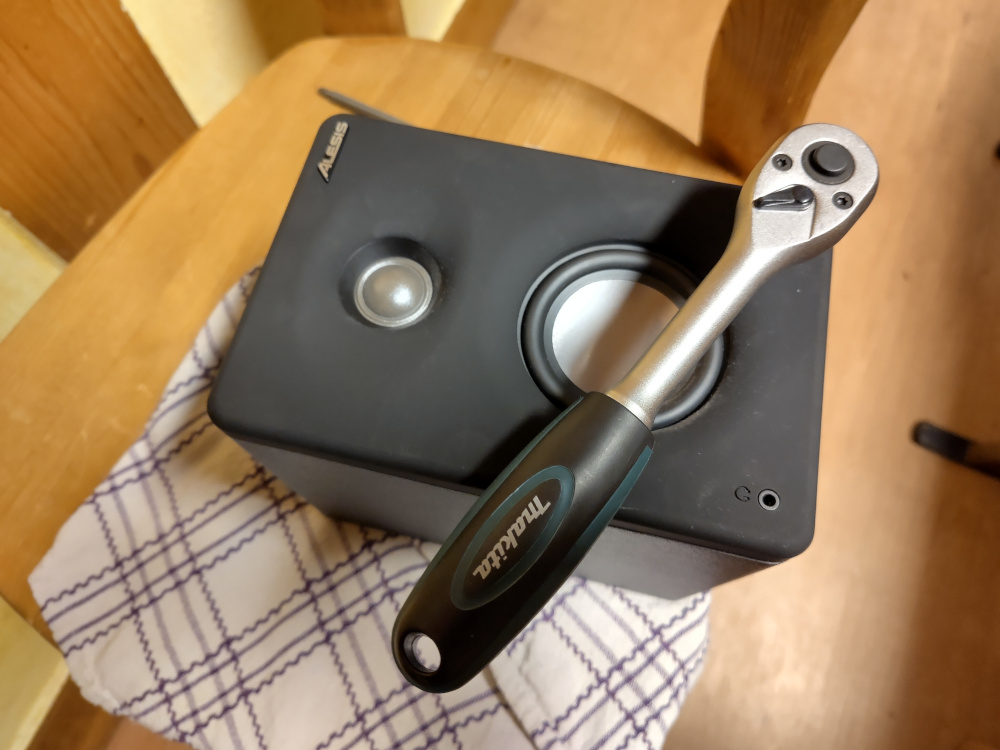 Still, no movement.
Let's look again from the inside!
Oh ffs, there are six more screws inside, holding the front.
Away with them!
Just need a very long PH1 screwdriver.
Now you can slowly remove the part of the front where the potentiometer is.
Be careful, the top tweeter is mounted to the front, not the main case and so is the headphone jack, without an obvious way to detach it.
But you can move away the front far enough to remove the small PCB with the potentiometer and the LED.
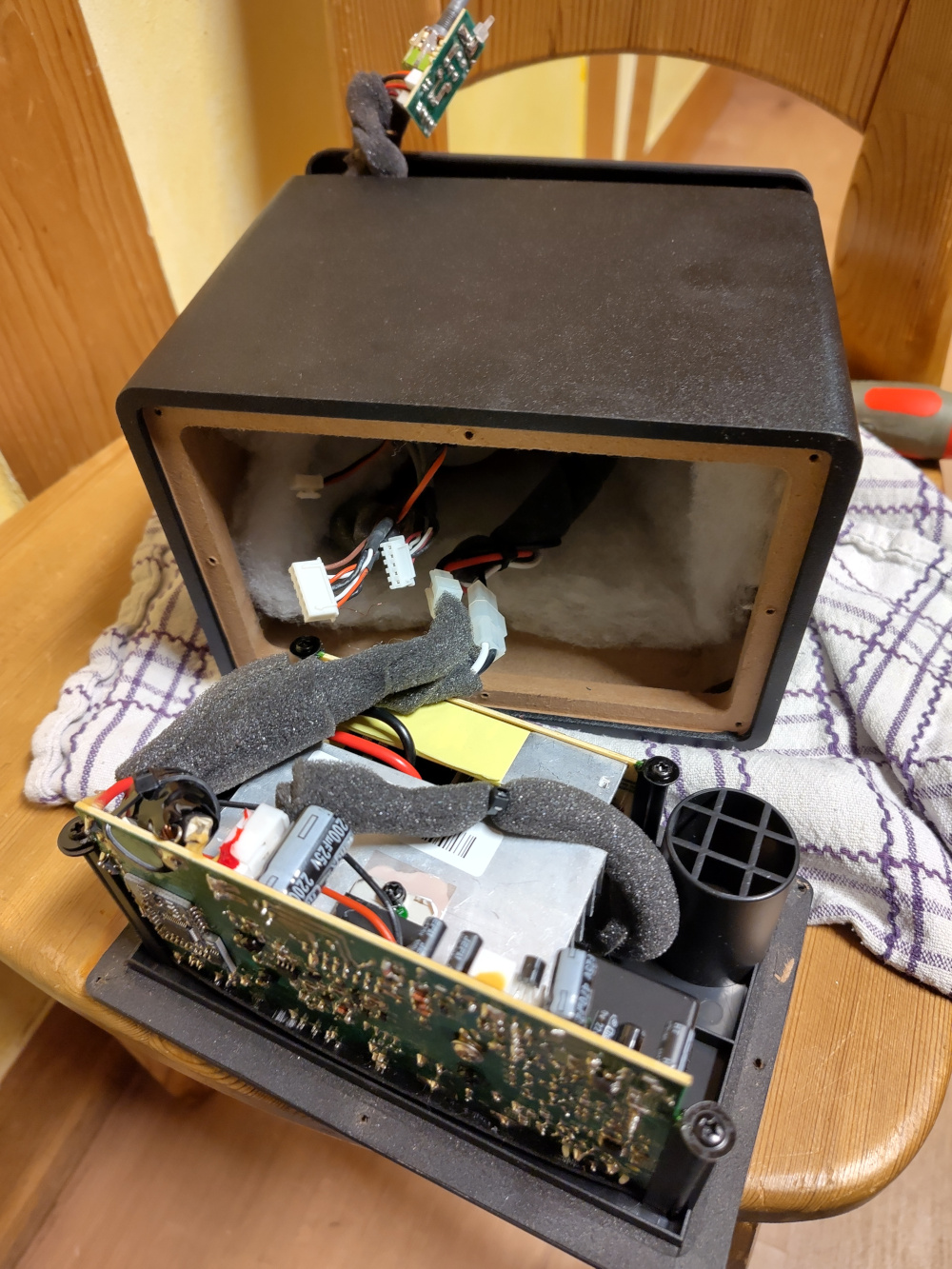 Great, this was the easy part!
The only thing printed on the potentiometer is "A10K".
10K is easy -- 10kOhm.
A?!