Search Results: "robert"

22 November 2010

Sergio Talens-Oliag: The Freaky Wall (Part 1: Why?)

This post and the next to come are about a project I'm doing at work that I've called The Freaky Wall. The project has its origins on the idea that using multiples technologies is better for security; almost all the servers I use are running Debian GNU/Linux and use iptables locally, so when I decided that we had to build new firewalls at work I thought it was a good idea to look at different technologies, that is, a different kernel and firewalling tools. As I wanted to avoid iptables and the Linux kernel my first idea was to go after the free BSD systems (FreeBSD, OpenBSD or NetBSD), and soon realized that pf (the OpenBSD Packet Filter) was the way to go; it has a clean syntax and includes advanced features like CARP and pfsync that allow me to build redundant firewalls. Before going after the standard systems I looked at pfSense a firewall appliance built on top of FreeBSD that uses a PHP interface to do everything. At first it seemed that it was going to be a good option, but soon I felt that I wasn't in control of what the system was doing and I had to change the PHP code to do trivial things (I wanted to configure IP aliases on a CARP interface and it was not possible with the web interface, while it is trivial to do using the standard system configuration files), so I left the idea of using it. The second option was to use OpenBSD directly, as it is the system were pf has been developed. Soon I saw that I was going to be able to do what I wanted with the system, but I missed the Debian's way of installing and upgrading the system and the list of packages available. For different reasons the firewall project was left in a limbo for a little while and when I went back to it I already had to upgrade my test systems to a new OpenBSD release; after reading a little bit about how to upgrade and not liking the idea of doing it I remembered that jordi suggested that if we only want the kernel and the firewall tools the Debian GNU/kFreeBSD port could be an option instead of OpenBSD or FreeBSD. Before trying to install the Debian GNU/kFreeBSD system I saw Robert's post about a Debian installer with ZFS support and I decided to start with it, as the use of ZFS will allow us to use software RAID-1 and snapshots, something we have on almost all our Linux servers (we use software RAID for redundancy and LVM snapshots to be able to do our backups at any time of the day with consistent data, but that is for another post). On my next post I'll explain how I did the initial installation with ZFS, and after that I'll explain the changes I did to the kernel and some of the packages to be able to build a firewall as described on the Firewalling with PF document (that is, I needed pfctl, pflogd, a tcpdump with pflog support, the pf's ftp-proxy, etc.) and on the last document I'll explain how I've configured the firewalls The Debian Way .

21 November 2010

Russell Coker: Ruxcon 2010

Yesterday and today I attended Ruxcon the leading technical security conference in Australia [1]. The first lecture I attended was Breaking Linux Security Protections by Andrew Griffiths. This included a good overview of many current issues with Linux security. One thing that was particularly noteworthy was his mention of SE Linux policy, he cited the policy for the FTP server as an example of policy that can be regarded as too lax but also noted the fact that to get SE Linux used the policies had to be more liberal than we might desire. There is probably scope for someone to give a good lecture about how we are forced to make uncomfortable choices between making security features stronger and making them more usable.The next lecture I attended was Breaking Virtualisation by Endrazine. It makes me wonder how long it will be before someone cracks one of the major cloud hosting services such as EC2 it s not an appealing thought.Billy Rios gave a really interesting lecture titled Will it Blend? about blended exploits. The idea is to try and find a few programs which do things that are slightly undesired (arguably not even bugs) but which when combined can result in totally cracking a system. One example was a way of tricking IE into loading a DLL from the desktop and a way of tricking Safari into saving arbitrary files to the desktop, combine them and you can push a DLL to a victim and make them load it. Learning about these things can really change the way you think about misbehaving programs!Ben Nagy gave an interesting lecture about Prospecting for Rootite . His systematic way of finding test cases that cover a large portion of the code of a large application such as MS-Word seems quite effective. Once you have test cases that cover a lot of code then you can use fuzzing to find flaws.Edward Farrell gave an informative lecture about RFID Security , I didn t really learn that much though, he confirmed my suspicions that RFID implementations generally suck.Mark Goudie gave a very informative lecture titled We ve been Hacked! What Went Wrong and Why . Mark works for Verizon and often with the US Secret Service in investigating security breaches. He presented a lot of information that I have not seen before and made some good arguments in support of companies being more proactive in protecting their systems from attack.Stephen Glass and Mark Robert gave a lecture titled Security in Public Safety Radio Systems which mainly focussed on digital radios used by the Australian police. It would be good if the police got people like them to test out new kit before ordering it in bulk, it seems that they will be using defective radios for a long time (it s not easy or cheap to replace them once they are deployed).Edward Farrell gave an interesting lecture titled Hooray for Reading: The Kindle & You about hacking the Kindle. Unfortunately they haven t worked out how to get GUI code going on a hacked Kindle yet so there are some limitations as to what can be done.I think that the most interesting lecture of the conference was This Job Makes you Paranoid by Alex Tilley of the Australian Federal Police. He gave some interesting anecdotes about real cases to illustrate his points and he advocated the police position really well. I ve attended several lectures by employees of law enforcement agencies, but none of them demonstrated anywhere near the understanding of their audience that Alex did.The last lecture I attended was Virtualisation Security State of the Union by David Jorn of Red Hat. He gave an interesting summary of some of the issues including mentioning how SE Linux is being used for confining KVM virtual machines.Ruxcon was a great conference and I definitely recommend attending it. I have to note that even though there are police attending and lecturing it s not entirely a white-hat affair. One thing that I hope they do next year is to get a bigger venue. The foyer was rather crowded and because it had a hard floor was really noisy between lectures. Space and carpet are two really important things when you have lots of people in one room!

19 November 2010

Ondřej Čertík: Google Code vs GitHub for hosting opensource projects

Cython is now considering options where to move the main (mercurial) repository, and Robert Bradshaw (one of the main Cython developers) has asked me about my experience with regards to Google Code and GitHub, since we use both with SymPy.

Google Code is older, and it was the first service that provided free (virtually unlimited) number of projects that you could easily and immediately setup. At that time (4 years ago?) that was something unheard of. However, the GitHub guys in the meantime not only made this available too, but also implemented features, that (as far as I know) no one offers at all, in particular hosting your own pages at your own domain (but at GitHub's servers, some examples are sympy.org and docs.sympy.org), commenting on git branches and pull requests before the code gets merged in (I am 100% convinced that this is the right approach, as opposed to comment on the code after it gets in), allow to easily fork the repository and it has simply more social features, that the Google Code doesn't have.

I believe that managing an opensource project is mainly a social activity, and GitHub's social features really make so many things easier. From this point of view, GitHub is clearly the best choice today.

I think there is only one (but potentially big) problem with GitHub, that its issue tracker is very bad, compared to the Google Code one. For that reason (and also because we already use it), we keep our issues at Google Code with SymPy.

The above are the main things to consider. Now there are some little things to keep in mind, that I will briefly touch below: Google Code doesn't support git and blocks access from Cuba and other countries, when you want to change the front page, you need to be an admin, while at GitHub I simply add push access to all sympy developers, so anyone just pushes a patch to this repository: https://github.com/sympy/sympy.github.com, and it automatically appears on our front page (sympy.org), with Google Code we had to write long pages (in our docs) about how to send patches, with GitHub we just say, send us a pull request, and point to: http://help.github.com/pull-requests/. In other words, GitHub takes care of teaching people how to use git and figure out how to send patches, and we can concentrate on reviewing the patches and pushing them in.

Wikipages at github are maintained in git, and they provide the webfrontend to it as opensource, so there is no vendor lock-in. Anyone with github account can modify our wiki pages, while the Google Code pages can only be modified by people that I add to the Google Code project, which forced us to install mediawiki on my linode server (hosted at linode.com, which by the way is an excellent VPS hosting service, that I have been using for couple of years already and I can fully recommend it), and I had to manage it all the time, and now we are moving our pages to the github wiki, so that I have one less thing to worry about.

So as you can see, I, as admin, have less things to worry about, as github manages everything for me now, while with Google Code, I had to manage lots of things on my linodes.

One other thing to consider is that GitHub is only for git, but they also provide svn and hg access (both push and pull, they translate the repository automatically between git and svn/hg), I never really used it much, so I don't know how stable this is. As I wrote before, I think that git is the best tool now for maintaining a project, and I think that github is now the best choice to host it (except the issue tracker, where Google Code is better).

9 November 2010

Matt Zimmerman: Management and information distortion

It ain t what you don t know that gets you into trouble. It s what you know for sure that just ain t so
attributed to Mark Twain
There is a lot that I don t know about what goes on in my organization. This isn t only because I can t observe everything, or because it s too complex, or because I make mistakes. These are all true, of course, but they re also obvious. Much more devious is the way the flow of information to me is distorted. It s distorted by me, and by the people around me, whether any of us are aware of it or not. This is most apparent in considering how people feel about their managers: this is why I have a deeply flawed view of what it s really like to work for me. My theory is that power bends information like gravity bends light. The effect is more pronounced with people of greater mass (more authority), and lessened with distance (less direct influence). The more directly you influence someone else s fate, the more it is in their self-interest to be guarded around you. This means that the people closest to you, who you receive the most information from, may have the most difficulty being open with you, especially if it s bad news. It also means that the higher your standing in the corporate hierarchy, the more influence you wield, the more people are affected by this. Pretty scary, right? Some managers respond to this terrifying reality by trying to collect more information. They ll quietly cross-check what people are telling them, asking people in different levels of the organization, routing around managers, hoping to get the real story . This usually backfires, because it signals distrust to the people involved and makes the distortion worse. Another common response is to check in constantly, trying to monitor and control the work as closely as possible (so-called micro-management). This is even worse; not only does it signal distrust, but managers who do this become more personally attached to outcomes, and lose perspective on progress and quality due to information overload, self-enhancement bias, and neglect of managerial work. The more it becomes your work rather than the team s, the harder it is to see it objectively. So what s a better way to respond to this phenomenon? Here s what I try to do: I was inspired to think and write about this today after listening to Prof. Robert Sutton s speech at the California Commonwealth Club, which Lindsay Holmwood shared with me.

2 November 2010

Tollef Fog Heen: Temperature logging with 1-wire

Last night, I finally got my temperature sensors going, including a nice and shiny munin plugin giving me pretty graphs. So far, I only have a sensor in the loft, but I'll spend some days putting sensors in the rest of the house as well. Robert McQueen asked me on twitter how this all was set up, so I figured I'd blog about it. The sensors I'm using are the DS18B20 ones from Dallas Semiconductor. You can probably buy them from your local electronics supplier, but mine charges around 75 NOK a piece, so I just bought some off Ebay. It takes a bit longer, but I paid about 1/10th the price. For logging, I'm using my NAS, which is just a machine running Debian, an USB to serial adapter and an serial-to-1-wire adapter. Thanks a lot to Martin Bergek for the writeup and the ELFA part numbers for diodes. Since I'm lazy, I ended up just writing a plugin for munin. It uses owfs, which I downloaded from mentors.debian.net. I also offered sponsorship for it, assuming a few small issues are cleaned up, so hopefully you can install using just Debian in the near future. owfs is fairly easy to work with, and the plugin uses the aliased names if you provide aliases, so you can know what the temperature in a given location is, rather than having to remember 64 bit serial numbers.

18 October 2010

Cyril Brulebois: XServer 1.9 and X autobuilding

State of X Server 1.9 The push of X Server 1.9 mentioned previously continued past weekend, with an upload of 1.9.1 rc2 this time, which is likely to become 1.9.1 in a few days. To keep it company in experimental, almost all X video drivers were uploaded as well, with a few exceptions: If my package manager isn t lying, the xserver-xorg-video-all meta package pulling everything could almost be installed, if one were to ignore those drivers. The same goes for xserver-xorg-input-all: almost alright, except for xserver-xorg-input-wacom, which is maintained outside debian-x. Autobuilding X packages So we have mostly this situation: 1.7 in sid, 1.9 in experimental. But we may want to build experimental packages (new upstream releases, or packages with patches cherry-picked from upstream) against either of them, without interfering with what is in the archive. We could ask users to try some patches. Actually, we do that already, and while many of them are usually responsive and willing to do so, not everyone knows how to build a package, or has time to. That s why I spent some time setting up http://autobuild.ikibiki.org/, where I can push source packages in the autobuild-unstable or autobuild-experimental suites, so that they get built on amd64 and on i386. It supports multiple versions in a given suite, which may help narrowing down when a fix appeared. That s part of a let s try to stick as closely as possible to upstream plan. We regularly get blamed for not doing so, but there are several reasons (or excuses? You decide.) for that: So if anyone thinks we re willingly holding back any kind of move towards newer upstream releases or the like, rest assured that s not the case. There s just too few of us to closely track upstream (which we do by reporting bugs and trying to cherry-pick patches anyway) in addition to preparing stuff for the next stable release. Now that things are settling down, that sounds feasible somehow, but remember: your help is more than welcome. Speaking of those Ubuntu guys, Robert Hooker is currently updating a bunch of drivers in experimental, yay. Flattr this!

17 October 2010

Dirk Eddelbuettel: RPostgreSQL 0.1-7

After a somewhat long hiatus, RPostgreSQL version 0.1-7 has now been released to CRAN. RPostgreSQL connects R to PostgreSQL database systems using the standard DBI interface. This version fixes a number of issues that had been compiled in the issue tracker on the project site at Google Code. Tomoaki Nishiyama, who joined our small development group for his package a few weeks ago, was instrumental in a number of these fixes, with assistance from Joe Conway. The relevant NEWS file entry follows below:
Version 0.1-7 -- 2010-10-17
    o   Several potential buffer overruns were fixed
    o   dbWriteTable now writes a data.frame to database through a network
        connection rather than a temporary file. Note that row_names may be
        changed in future releases.  Also, passing in filenames instead of
        data.frame is not supported at this time. 
    o   When no host is specified, a connection to the PostgreSQL server 
        is made via UNIX domain socket (just like psql does)
    o   Table and column names are case sensitive, and identifiers are escaped
        or quoted appropriately, so that any form of table/column names can be
        created, searched, or removed, including upper-, lower- and mixed-case.
    o   nullOk in dbColumnInfo has a return value of NA when the column does
        not correspond to a column in the table. The utility of nullOk is
        doubtful but not removed at this time.
    o   Correct Windows getpid() declaration (with thanks to Brian D. Ripley)
    o   A call of as.POSIXct() with a time format string wrongly passed to TZ
        has been corrected; this should help with intra-day timestamps (with
        thanks to Steve Eick)
    o   Usage of tmpdir has been improved on similarly to Linux (with thanks
        to Robert McGehee)
More information is on the my RPostgreSQL page, and on project site at Google Code.

14 October 2010

Russell Coker: Links October 2010

Bruce Schneier wrote an insightful post about why designing products for wiretapping is a bad idea [1]. It seems that large parts of the Internet will be easy to tap (for both governments and criminals) in the near future unless something is done. The bad results of criminal use will outweigh any benefits of government use. Sam Watkins wrote an informative post about Android security [2]. Among other things any application can read all stored data including all photos, that s got to be a problem for anyone who photographs themself naked Rebecca Saxe gave an interesting TED talk about how brains make moral judgements [3]. Somehow she managed to speak about the Theory of Mind without mentioning Autism once. The Guardian has an amusing article by Cory Doctorow about security policies in banks [4]. He advocates promoting statistical literacy (or at least not promoting a lack of it) as a sound government policy. He also suggests allowing regulators to fine banks that get it wrong. Steven Johnson gave an interesting TED talk about Where Good Ideas Come From [5]. It s a bit slow at the start but gets good at the end. Adam Grosser gave an interesting TED talk about a fridge that was designed for use in Africa [6]. The core of the Absorption Refrigerator is designed to be heated in a pot of water in a cooking fire and it can then keep food cool for 12 hours. It s a pity that they couldn t design it to work on solar power to avoid the fuel use for the cooking fire. Josh Silver gave an interesting TED talk about liquid filled spectacles [7]. The glasses are shipped with a syringe filled with liquid at each side that is used to inflate the lenses to the desired refractive index. The wearer can just adjust the syringes until they get to the right magnification, as there are separate syringes the glasses work well with people who s eyes aren t identical (which is most people). Once the syringes are at the right spots the user can tighten some screws to prevent further transfer of liquid and cut the syringes off to give glasses that aren t overly heavy but which can t be adjusted any more, I guess that a natural extension to this would be to allow the syringes to be re-attached so that the user could adjust them every year to match declining vision. One thing that this wouldn t do is counter for Astigmatism (where the lens of the eye doesn t focus light to a point), but I guess they could make lenses to deal with a few common varieties of Astigmatism so that most people who have that problem can get a reasonable approximation. The current best effort is to make the glasses cost $19, which is 19 days salary for some of the poorest people in the world. Glasses in Australia cost up to $650 for a pair (or a more common cost of $200 or about $100 after Medicare) which would be about one day s salary. Eben Bayer gave an inspiring TED talk about one of the ways that mushrooms can save the planet [8]. He has designed molds that can be filled with Pasteurised organic waste (seed husks etc) and then seeded with fungal spores. The fungus then grows mycelium (thin fungal root fibers) through the organic waste making it into a solid structure which fits the shape of the mold. This is currently being used to replace poly-styrene foam for packaging and can apparently be used for making tiles that are fire retardant and sound proof for constructing buildings. The main benefits of the material are that it can be cheaply made without petrochemicals and that it is bio-degradable, I m not sure how the bio-degradable part would work with constructing buildings maybe they would just replace the panels every few years. Annie Lennox gave a TED talk about her Sing foundation to care for women and children who are affected by AIDS [9]. She describes the effect of AIDS in Africa as Genocide. Robert Ballard gave a very informative TED talk about exploring the oceans [10]. This was one of the most informative TED talks I ve seen and Robert is also one of the most enthusiastic speakers I ve seen, it s really worth watching! We really need more money spent on exploring the oceans. Jessa Gamble gave an interesting TED talk which suggests that the best thing to do is to go to bed at about sunset and then have a couple of hours of relaxing time during the middle of the night [11]. Apparently the subjects of body-block experiments who live for a month in a bunker without natural light or access to a clock get better sleep in this manner than they ever had in their life and feel fully awake for the first time. World Changing is a blog that has a lot of interesting articles about climate change and related issues [12]. It s worth a read. Cynthia Schneider gave an interesting TED talk about how reality competition TV is affecting reality [13]. Shows that are derived from the American Idol concept are driving a resurgence in some traditional forms of performance art while also promoting equality among other things it s apparent that winning is more important than misogyny. The Ritual of the Calling of an Engineer is an interesting concept [14]. I think it would be good to have something similar for Computer Science. Benjamin Mako Hill wrote an interesting and insightful essay about Piracy and Free Software [15].

13 October 2010

Robert Millan: About ZFS in Squeeze

The bad news is that you won t be able to use ZFS as your root filesystem in Debian Squeeze with the official installer. The blocker is missing support in GNU Parted. Unfortunately the patch I sent in August wasn t integrated in time for the freeze (and still isn t, but there s no hurry now, it ll hopefully be there for Wheezy). The good news is that all fixes required for the installed system (including ZFS userland utilities and GRUB) made it and are already in Squeeze. As a result, the unofficial installer I built in September will (unless something weird happens) continue to work during Squeeze life cycle. Note that although the installer itself is modified, it installs a pristine Debian GNU/kFreeBSD system from official packages. Hope this is helpful to you if you plan on deploying ZFS in your organization and the other approaches don t fit well enough with your needs.

18 September 2010

Robert Collins: Maintainable pyunit test suites fixtures

So a while back I blogged about maintainable test suites. One of the things I ve been doing since is fiddling with the heart of the fixtures concept. To refresh your memory, I m defining fixture as some basic state you want to reach as part of doing a test. For instance, when you ve mocked out 2 system calls in preparation for some test code that represent a state you want to reach. When you ve loaded sample data into a database before running the actual code you want to make assertions about that also represents a state you want to reach. So does simply combining three or four objects so you can run some code. Now, there are existing frameworks in python for this sort of thing. testresources and testscenarios both go some way towards this (and I and to blame for them :) ), so does the zope testrunner with layers, and the testfixtures project has some lovely stuff as well. And this is without even mentioning py.test! There are a few things that you need from the point of view of running a test and establishing this state: Large test suites or test suites dealing with various sorts of external facilities will also often want to optimise this process and put the same state into place for many tests. The (and I m not exaggerating) terrible setUpClass and setUpModule and other similar helpers are often abused for this. Why are they terrible? They are terrible because they are fragile; there is no (defined in the contract) way to check that the state is valid for the next test, and its common to see false passes and false failures in tests using setUpClass and similar. So we also need some way to reuse such expensive things while still having a way to check that test isolation hasn t been compromised. Having looked around, I ve come to the conclusion we ll all benefit if there is a single core protocol for doing these things, something that can be used and built on in many different ways for many different purposes. There was nothing (that I found) that actually met all these requires and was also tasteful enough that folk might really like using it. I give you fixtures . Or on Launchpad. This small API is intended to be a common contract that all sorts of different higher level test libraries can build on. As such it has little to no policy or syntatic sugar. It does have a nice core, integration with pyunit.TestCase, and I m going to add a library of useful generic fixtures (like temporary directories, environment isolators and so on) to it. I d be delighted to add more committers to the project, and intend to have it be both Python 2.x and 3.x compatible (if its not already my CI machine isn t back online after the move yet, I m short of round tuits). Now, if you re writing some code like:
class MyTest(TestCase):
    def setUp(self):
        foo = Foo()
        bar = Bar()
        self.quux = Quux(Foo(), Bar())
        self.addCleanup(self.quux.done)
You can make it reusable across your code base simply by moving it into a fixture like this:
class QuuxFixture(fixtures.Fixture):
    def setUp(self):
        foo = Foo()
        bar = Bar()
        self.quux = Quux(Foo(), Bar())
        self.addCleanup(self.quux.done)
class MyTest(TestCase, fixtures.TestWithFixtures):
    def setUp(self):
        self.useFixture(QuuxFixture)
I do hope that the major frameworks (nose, py.test, unittest2, twisted) will include the useFixture glue themselves shortly; I will offer it as a patch to the code after giving it some time to settle. Further possibilities include declared fixtures for tests, and we should be able to make setUpClass better by letting fixtures installed during it get reset between tests.

15 September 2010

Martin Meredith: Freedom in Creativity

One of the things that I love about our Local LUG is the people. At our LUG, we have our resident geek artist, Antonio Roberts (aka hellocatfood) who, on the odd occasion, gets harassed into doing a talk for us. His talks are always fairly awesome. His previous talk about FLOSS + Art is the video with the highest views on our video archive, and tomorrow night, Thursday 16th September, at 19:30pm BST, he ll be delivering his next talk about his experience in the FLOSS community as an artist to us. Freedom in Creativity In his own words:-
This talk extends greatly on what was said and goes into issues of copyright and what experiences I ve had as an artist in the open source world
His previous talk was a bit of an eye-opener to me, as a pure geek with barely a trace of artistry in me, and it s always good to see the FLOSS world from the eyes of someone who doesn t exactly fit the stereotype of what you d normally expect to see. The video will be available after the event, at some point, but for those who re interested in gaining an insight into artistry and FLOSS, we ll be broadcasting the talk live over the interwebs. <script type="text/javascript"> var flattr_wp_ver = '0.9.11'; var flattr_uid = '34168'; var flattr_url = 'http://www.sourceguru.net/freedom-creativity/'; var flattr_btn = 'compact'; var flattr_hide = 0; var flattr_lng = 'en_GB'; var flattr_cat = 'text'; var flattr_tle = 'Freedom in Creativity'; var flattr_dsc = 'One of the things that I love about our Local LUG is the people. At our LUG, we have our resident geek artist, Antonio Roberts (aka hellocatfood) who, on the odd occasion, gets harassed into doing a talk for us. His talks are always fairly awesome. His previous talk about FLOSS + Art is the video with the highest views on our video archive, and tomorrow night, Thursday 16th September, at 19:30pm BST, he\'ll be delivering his next talk about his experience in the FLOSS community as an artist to us. In his own words:- This talk extends greatly on what was said and goes into issues of copyright and what experiences I ve had as an artist in the open source world His previous talk was a bit of an eye-opener to me, as a pure geek with barely a trace of artistry in me, and it\'s always good to see the FLOSS world from the eyes of someone who doesn\'t exactly fit the stereotype of what you\'d normally expect to see. The video will be available after the event, at some point, but for those who\'re interest'; var flattr_tag = 'art,artist,floss,lug,presentation,sblug birmingham lug,streaming,talk,video'; </script> <script src="http://api.flattr.com/button/load.js?v=0.2" type="text/javascript"></script>

13 September 2010

Robert Collins: What do I do @ work?

I recently moved withing Canonical from being a paid developer of Bazaar to take on a larger challenge Technical Architect for Launchpad. Its been two months now, and its time to put my head up out of the coal face, have a look around and regroup. When I worked on Bazaar, every day when I started work got up I was working on a tool anyone can use, designed for collaboration upon sourcecode, for people writing software. This is a toolchain component right at the heart of the free software world. Bazaar and tools like it get used everyday to manage, distribute and collaborate on the sourcecode that makes up the components of Ubuntu, Debian, Fedora and so forth. Every time someone new starts using Bazaar for a new free or open source project, well I felt happy happy that in my small part I m helping with this revolution we re carrying out. Launchpad is pretty similar to Bazaar in some ways. Obviously they are both free software, both are written in Python, and both are sponsored by Canonical, my employer. And they both are designed to assist in collaboration and communication between free software developers albeit in rather different ways. Bazaar is a tool anyone can install locally, run as a command line, GUI, or local webserver, and share code either centrally (e.g. by pushing to Launchpad), or in a peer to peer fashion, acting as their own server. Launchpad, by contrast is a website which (usually) folk will use as a service in their browser, from the comand line FTP (for package building), ssh (for Bazaar branch pushing or pulling), or even local GUI programs using the Launchpad API service. This makes it more approachable for first time collaborators, but its less able to be used offline, and it has all the usual caveats of web sites : it needs a username and password, it s availability depends on the operators on the team I m part of. So there s a lot less room for error: if we do something wrong, the system is unavailable, and users can t just apt-get install an older release. With Launchpad our goal is to to get all the infrastructure that open source need out of the way, so that they can focus on their code, collaboration within their team and almost uniquely collaboration with other teams. As well as being open source, Launchpad is free for all open source projects to use Ubuntu is our single biggest user they use it for all bugtracking, translation and package building, and have a hugefraction of the total storage overhead in the database. Launchpad is a pretty nice system, so people use it, and as a result (on a technical basis) it is suffering from its own success: small corner cases in the code turn up every day or two, code written years ago to deal with a relatively small data set now has to deal with data sets a thousand or more times larger (one table, for instance, has over 600,000,000 rows in it. For the last two months then, I ve been working on Launchpad. As Technical Architect, I need to ensure that the things that we (users, stakeholders and developers of Launchpad) want to do are supported by the structure of the system : the platform(s) we re building on, the way we approach problems, coding standards and diagnostic tools. That sounds pretty dry and hands off, but I m finding its actually very balanced. I wrote a presentation when I started the job, which encapsulated the challenges I saw in front of the team on this purely technical front, and what I thought I needed to do. I think I was about right in my expectations: On a typical day, I ll be hands on in a problem helping get it diagnosed, talking long term structural changes with someone around how to make things more efficient / flexible / maintainable, and writing a small patch here or there to help move things along. In the two months since I took on this challenge, we ve made significant headway on the problem of performance for Launchpad : many inefficient code paths have been identified and removed, some new infrastructure has been created as is being rolled out to make individual pages faster, and we ve massively increased the diagnostic data we get when things go wrong. We ve introduced facilities for responding more rapidly to issues in the software (but they have to be rolled out across the system) and I hope, over the next 4 months we ll reach the first of my performance goals: for any webpage in Launchpad, it will complete rendering in 99% of the time. (Note that we already meet this goal if you measure the whole system, but this is biased by some pages being very frequently hit and also being very small).

12 September 2010

Robert Millan: Graphical installer for Debian GNU/kFreeBSD

Now that Debian s graphical installer flavour has migrated to X11, porting it to GNU/kFreeBSD became a low hanging fruit, so I shamelessly picked it up and here comes a version of Debian GNU/kFreeBSD installer with graphical support. Oh, and a screenshot too: Enjoy.

8 September 2010

Dirk Eddelbuettel: Straight, curly, or compiled?

Christian Robert, whose blog I commented-on here once before, had followed up on a recent set of posts by Radford Neal which had appeared both on Radford's blog and on the r-devel mailing list. Now, let me prefix this by saying that I really enjoyed Radford's posts. He obviously put a lot of time into finding a number of (all somewhat small in isolation) inefficiencies in R which, when taken together, can make a difference in performance. I already spotted one commit by Duncan in the SVN logs for R so this is being looked at. Yet Christian, on the other hand, goes a little overboard in bemoaning performance differences somewhere between ten and fifteen percent -- the difference between curly and straight braces (as noticed in Radford's first post). Maybe he spent too much time waiting for his MCMC runs to finish to realize the obvious: compiled code is evidently much faster. And before everybody goes and moans and groans that that is hard, allow me to just interject and note that it is not. It really doesn't have to be. Here is a quick cleaned up version of Christian's example code, with proper assigment operators and a second variable x. We then get to the meat and potatoes and load our Rcpp package as well as inline to define the same little test function in C++. Throw in rbenchmark which I am becoming increasingly fond of for these little timing tests, et voila, we have ourselves a horserace:
# Xian's code, using <- for assignments and passing x down
f <- function(n, x=1) for (i in 1:n) x=1/(1+x)
g <- function(n, x=1) for (i in 1:n) x=(1/(1+x))
h <- function(n, x=1) for (i in 1:n) x=(1+x)^(-1)
j <- function(n, x=1) for (i in 1:n) x= 1/ 1+x 
k <- function(n, x=1) for (i in 1:n) x=1/ 1+x 
# now load some tools
library(Rcpp)
library(inline)
# and define our version in C++
l <- cxxfunction(signature(ns="integer", xs="numeric"),
                 'int n = as<int>(ns); double x=as<double>(xs);
                  for (int i=0; i<n; i++) x=1/(1+x);
                  return wrap(x); ',
                 plugin="Rcpp")
# more tools
library(rbenchmark)
# now run the benchmark
N <- 1e6
benchmark(f(N, 1), g(N, 1), h(N, 1), j(N, 1), k(N, 1), l(N, 1),
          columns=c("test", "replications", "elapsed", "relative"),
          order="relative", replications=10)
And how does it do? Well, glad you asked. On my i7, which the other three cores standing around and watching, we get an eighty-fold increase relative to the best interpreted version:
/tmp$ Rscript xian.R
Loading required package: methods
     test replications elapsed relative
6 l(N, 1)           10   0.122    1.000
5 k(N, 1)           10   9.880   80.984
1 f(N, 1)           10   9.978   81.787
4 j(N, 1)           10  11.293   92.566
2 g(N, 1)           10  12.027   98.582
3 h(N, 1)           10  15.372  126.000
/tmp$ 
So do we really want to spend time arguing about the ten and fifteen percent differences? Moore's law gets you those gains in a couple of weeks anyway. I'd much rather have a conversation about how we can get people speed increases that are orders of magnitude, not fractions. Rcpp is one such tool. Let's get more of them.

6 September 2010

Robert Millan: Debian Installer with ZFS

Long time no see Not much hacking in the last few months. Not much ranting either (some of you I m sure will appreciate ;-). Anyway, I recently grew excited to learn that ZFS is coming to Debian. I decided to bite the bullet, patched the missing bits in GRUB and Parted, a few small changes in D-I and there s now a modified Debian Installer with ZFS support for you to play with. Enjoy! Note1: I didn t have time or interest in warping D-I into the N:1:M model used in ZFS. Instead, this installer assumes each zpool has exactly one device and exactly one filesystem. However, you can later add more devices ( zpool attach ) or create new filesystems in the same pool ( zfs create ). Note2: Don t ask for i386, it was intentionally left out. ZFS is designed with modern CPUs in mind. It can work on i386 with special tuning but I don t want to encourage users to do this unless they re well aware of what they re doing.

23 July 2010

Robert Collins: Switch

No, not the bzr switch rather the book : http://www.amazon.com/Switch-Change-Things-When-Hard/dp/0385528752 Read it, its solid.

1 July 2010

Robert Collins: Subunit and nose

Looks like someone has come up with a nose plugin for subunit excellent! http://www.liucougar.net/blog/projects/nose-subunit In their post the author notes that subunit is not easy_installable at the moment. It will be shortly. Thanks to Tres Seaver there is a setup.py for the python component of Subunit, and he has offered to maintain that going forward. His patch is in trunk, and the next release will include a pypi upload. The next subunit release should be pretty soon too the unicode support in testtools has been overhauled thanks to Martin[gz], and so we re in much better shape on Python 2.x than we were before. Python3 for testtools is trouble free in this area because confused strings don t exist there :)

26 June 2010

Anand Kumria: Get Low

A story about getting people together to tell them a story of regret involving the main character, which we see at the start. The story itself isn't very dramatic. Which is why there isn't a film about that. Instead we have the story about getting people to tell the story. This is a great example of a movie with a mind-boggingly amazing cast (Bill Murray, Robert Duvell, Sissy Spacek, Lucas Black) having a script that is crap. Having the director present, to discuss the film, after the screening lifted this from a 1 to 2. Hearing Aaron talk about the different styles of Duvell, Murray and how the editing process was actually done (Final Cut Pro) was very entertaining. The story drifts, the soundtrack doesn't annoy and the filmography is alright. Oh, the period setting is done very well. Not much else to recommend it though. Get Low refers to burying in the film. Something I think that should have happened to this film.

7 June 2010

Sjoerd Simons: Is that a tea cosy on your head?

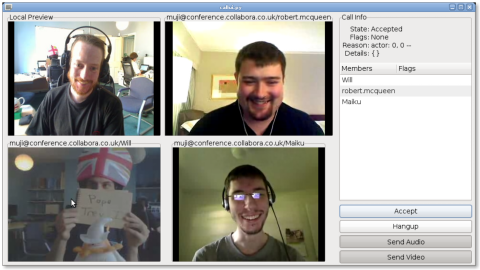
Since some time the good people at NlNet have been sponsoring Collabora to add multi-party audio/video calling to XMPP and do an implementation of this in Telepathy. This project is otherwise known as Muji. This work has resulted in: To proof it actually works, a nice screenshot of the demo client in a 4-way call: 4-way Muji Call The screenshot is featuring myself in Collabora's UK office (top-left), Robert McQueen from a hotelroom in Taipei (top-right), Will Thompson and Magical trevor also from the Collabora UK office (bottom-left) and Mike Ruprecht from somewhere in Missouri. So we were quite spread out over our little planet. Both audio and video quality was quite good, even though the network in robs hotel was a bit flaky from time to time. In case you want to try it out have a look at the MujiDemoClient page.

4 June 2010

Colin Watson: Hacking on grub2

Various people observed in a long thread on debian-devel that the grub2 package was in a bit of a mess in terms of its release-critical bug count, and Jordi and Stefano both got in touch with me directly to gently point out that I probably ought to be doing something about it as one of the co-maintainers. Actually, I don't think grub2 was in quite as bad a state as its 18 RC bugs suggested. Of course every boot loader failure is critical to the person affected by it, not to mention that GRUB 2 offers more complex functionality than any other boot loader (e.g. LVM and RAID), and so it tends to accumulate RC bugs at rather a high rate. That said, we'd been neglecting its bug list for some time; Robert and Felix have both been taking some time off, Jordi mostly only cared about PowerPC and can't do that any more due to hardware failure, and I hadn't been able to pick up the slack. Most of my projects at work for the next while involve GRUB in one way or another, so I decided it was a perfectly reasonable use of work time to do something about this; I was going to need fully up-to-date snapshots anyway, and practically all the Debian grub2 bugs affect Ubuntu too. Thus, with the exception of some other little things like releasing the first Maverick alpha, I've spent pretty much the last week and a half solidly trying to get the grub2 package back into shape, with four uploads so far. The RC issues that remain are: If we can fix that lot, or even just the ones that are reasonably well-understood, I think we'll be in reasonable shape. I'd also like to make grub-mkconfig a bit more robust in the event that the root filesystem isn't one that GRUB understands (#561855, #562672), and I'd quite like to write some more documentation. On the upside, progress has been good. We have multiple terminal support thanks to a new upstream snapshot (#506707), update-grub runs much faster (#508834, #574088), we have DM-RAID support with a following wind (#579919), the new scheme with symlinks under /dev/mapper/ works (#550704), we have basic support for btrfs / as long as you have something GRUB understands properly on /boot (#540786), we have full info documentation covering all the user-adjustable settings in /etc/default/grub, and a host of other smaller fixes. I'm hoping we can keep this up. If you'd like to help, contact me, especially if there's something particular that isn't being handled that you think you could work on. GRUB 2 is actually quite a pleasant codebase to work on once you get used to its layout; it's certainly much easier to fix bugs in than GRUB Legacy ever was, as far as I'm concerned. Thanks to tools like grub-probe and grub-fstest, it's very often possible to fix problems without needing to reboot for anything other than a final sanity check (although KVM certainly helps), and you can often debug very substantial bits of the boot loader - the bits that actually go wrong - using standard tools such as strace and gdb. Upstream is helpful and I've been able to get many of the problems above fixed directly there. If you have a sound knowledge of C and a decent level of understanding of the environment a boot loader needs to operate in - or for that matter specialist knowledge of interesting device types - then you should be able to find something to do.

Next.

Previous.