Search Results: "ressu"

5 March 2008

Sami Haahtinen: Printing woes

Every now and then we all see these "Year of the Linux" posts and ignore them. Most of us have been around for long enough not to trust or make those claims. Today I stumbled upon a post by Melissa Draper, which curiously enough started with similar words. She mentions that we are nearing the tipping point and refers to the recent OEM interest in Linux. I for one still say that we are not there yet. During last week I've been struggling with printing. A Lot! I acknowledge that printing in Linux has taken major leaps from the times of basic lpd and the like. Still it appears that printing needs a lot more work. For example, GIMP has its own printing dialog which forces you to manually configure each printer. While it's an easy job for someone familiar with the printing system it's not something a normal user is able to do. The printing process is way too complicated, most users just want to resize the image a bit to print. Please offer a simple printing dialog for them. The problem isn't just with GIMP. Another example is Firefox which has a clean little printing dialog. The problem is that it assumes paper size and even with the proper paper size I can't manage to print a page without parts of the page going outside of the margins. OpenOffice.org appears to default to letter as the default paper size. This means that both the default document is edited as letter and when printing the printing system assumes you are printing to letter even if the page you are printing is A4. Other than that, it manages to print without glitches. I know that these are just a few applications, but think about it. These applications are amongst the most used applications on Linux. These applications represent how Linux works for normal users. Users are quite often naive, they make bad associations. Bad experiences with a few of the key applications make a bad impression on the whole effort. Also, bad news travel faster than good news... In case this sounds like I'm just bashing here, I have to mention that things like CUPS are a huge effort to solve these problems with the right kind of solutions. Also, while testing around I successfully printed out of evolution, gnome-dictionary and various other applications that use gnome printing libraries and they printed just fine without any problems. I'm sure that there are similar efforts on KDE land (and elsewhere) so we are moving to the right direction. The problem is that there is a long way to go before we can claim world domination.

20 February 2008

Jeff Bailey: Met with the surgeon.

Angie, Leif and I met with one the two surgeons who will be doing the work. I s'pose it's good and bad that the co-director of the UCSF Spine Centre, Dr. Mummaneni is personally taking on the case. Good that I'll have the best possible care; Bad that I'm apparently interesting enough to warrant it.

Meeting with him was matter of fact. He talked about how he'll approach the surgery (from the back, since the placement of my aortic arch and innominant vein would make coming through the front problematic). It looks like I'll have rods and screws from T1-T6, with a cage replacing the vertebra at least at T3 and possibly at T4. People don't usually do that much movement in their thoracic back so, ongoing, his opinion was that I largely won't notice it.

In hospital-time will depend on whether or not the surgery can be done in one shot. Because of the trickiness of the area, it may not be possible to get it entirely from the back, and he'll do two surgeries rather than one if that can avoid me winding up in a wheelchair. Ideally, there's one surgery, and a week later I'm home and able to take care of myself. The way they take the tumor out in a couple pieces is known as "en bloc spondylectomy", but may not be possible with the way the spinal nerve is being pinched. He described the surgery itself, and the simple version is "remove one or two vertebra, replace them with cages, stabilize the surrounding area". Yay to the Black and Decker surgical division.

He'll be assisted by Dr. Chau for spinal cord monitoring and the rest of the surgery.

The last thing they did as I left the hospital last Saturday was a full body CT scan with contrast, and the radiologists have declared that that they see no additional tumors in the body. I'll visit with an oncologist to do some final tests, but consistently the answer is coming back that this isn't cancer, it's more likely an isolated mutation. Dr. Mummaneni doesn't feel that this is a side effect of sitting at a computer since I was 3 years old, any of the car accidents, or being hit across the back with a flute case in grade 9.

I did ask if I'll set off metal detectors at airports after this, and apparently the titanium used doesn't do that.

So, erm. What are the risks? Honestly, pretty consistently less than doing nothing. Having this thing would eventually result in paralysis anyway, and aside from the usually OMG-they're-cutting-me-open-anything-could-happen type of things that don't keep me from biking to work on a regular basis, all the other options are "And life improves from here". Informed consent means that I have statistics in my head that I'd rather not dwell on and a laundry list of things to panic about when I wake up in the middle of the night but those really are just nerves acting up and stress wanting to come out. Nothing wrong with any of that.

Surgery is booked for March 3rd. We'd hoped to go to Vancouver for Leif's birthday around then, but I've been asked not to fly. Rapid pressure changes apparently will aggravate what's there now.

I feel good about this. I'm back to pretty much 100% after the hospital time last week, and noticed that after the embolism that I'm moving a bit freer than I was before. That's enough to start the optimism going already. We've also twiddled my medicine for every 8 hours rather than 6, which will help me sleep better, and reduced it, which will help me feel better.

Having time-frames and knowing that I'm in good hands is a lovely place to be after all that.

12 February 2008

Lior Kaplan: The benifits of working with GPL drivers


For the last few day I’m having problem with the tg3 driver for Broadcom’s NetXtreme Ethernet NIC on an IBM System x3850 machine with RHEL4 update 4. The problem was that the tg3 driver recognizes only one NIC and ignores the other, although lspci / lshw can show there are two on board NICs. The weird thing is that I couldn’t find reference to such a problem on google. IBM’s technical people suggested that I should use an updated driver, a change I’m usually reluctant to do, as some hardware requires proprietary drivers which come as a “black box”. But this time, the driver is licensed under the GPL and is also available in latest kernel releases. IBM provides a set of pre-built RPMs for RHEL4, but it only covers old updates for RHEL (which also represent minor changes to the kernel installed). With this set IBM also provides a source RPM to build the module yourself. That was easy enough to do, just install rpmbuild, the right kernel development package (usually kernel- uname - -devel), install the source RPM and build the custom RPM for your kernel. I fail to understand why IBM also provides a few more scripts and tools to build the rpm and install the pre-built ones. Every system administrator should be comfortable with using RPMs directly instead of using scripts to run a lot of other stuff before the actual RPM commands. The updated driver did solve the problem, and I finally can use both NICs. Having IBM’s stuff is nice, but I wanted to know what options do people have, without using their wrapping over the original driver. So I went to see what Broadcom have to offer. On their FAQ, Broadcom declare:
To better support users, Broadcom has been actively supporting, maintaining, and testing the in-kernel Linux drivers for the NetXtreme, NetXtreme II, NetLink and 4401 product lines.
I found that Broadcom offer an updated version for the tg3 driver (comparing to RHEL4 update 4) on their NetXtreme Server Drivers page. Clicking the download page showed this message:
The Broadcom Linux Ethernet drivers are licensed under the GNU GPL. The full text of the license is available in the driver archive.
That’s must be a good start (: Broadcom doesn’t give you pre-built RPMs, but they do provide a source RPM to ease your job. I actually preferred their simple spec file over IBM’s complex spec file. To conclude, having GPL drivers enable system administrator to build the drivers specifically for their system (operating system, distribution and kernel version), and lower the pressure (or necessity) for vendors to offer pre-built packages for each possible combination.

8 February 2008

Gunnar Wolf: cat STDERR rot13

Cannot help but laugh and share.
I've been triaging and trying to reproduce some oldish bugs on pkg-perl's packages. Some bugs are no longer there, some have to be forwarded upstream, and so on. Usual tasks, yes.
Until I stumbled with #406227. I just have to laugh and share! Hope nobody feels ashamed - The bug is the result of different people coding maybe under pressure and with quite different mindsets :)
For some reason I fail to understand, the submitter's test case (rot13 implemented over a HTTP proxy) is invoked in the report as ./rot13 2>/dev/null. Of course, when trying to debug a bug report, the first thing to do is not to ignore STDERR. So, off goes the 2>/dev/null. What happens next? 0 gwolf@mosca[2]/tmp$ perl ./rot13 &
[1] 4394
0 gwolf@mosca[3]/tmp$ GET -p http://localhost:8080/ http://www.debian.org/
Can't locate object method "filter" via package "UGGC::Cebkl::ObqlSvygre::fvzcyr=UNFU(0k604160)" (perhaps you forgot to load "UGGC::Cebkl::ObqlSvygre::fvzcyr=UNFU(0k604160)"?) at /usr/share/perl5/HTTP/Proxy/FilterStack.pm line 126.
500 EOF when chunk header expected
WTF... Well, at least the program name gives me a clue... Lets try to "decrypt" the error message... gwolf@mosca[4]/tmp$ echo 'UGGC::Cebkl::ObqlSvygre::fvzcyr=UNFU(0k604160)' rot13
HTTP::Proxy::BodyFilter::simple=HASH(0x604160)
hrm... How comes the filter is filtering its own code and only then refusing to find itself!? Ok, time to open up the manpage - Remember, I'm only group-maintaining this pacakge, I am not yet at all familiar with it! Ok, so the core of the filter is when the submitter states: my $proxy = new HTTP::Proxy();
$proxy->push_filter(response => new HTTP::Proxy::BodyFilter::simple(sub tr/a-zA-z/n-za-mN-ZA-M/; ));
While the manpage states it should be invoked as: my $filter = HTTP::Proxy::BodyFilter::simple->new( sub $ $_[1] =~ s/foo/bar/g; );
$proxy->push_filter( response => $filter );
Of course, once looking at it, the answer is simple: The submitter left out which element to act on in the anonymous function body - The $ $_[1] =~ part. Adding it makes gur svygre jbex nf rkcrpgrq... Err, sorry - makes the filter work as expected. Now, bonus points: For the non-Perlers out ther: How come we get the namespace translated as well? Oh, that's very simple: In Perl, as in Python (and concievably other languages I'm unaware of), the object is passed to any of its methods as the first argument. Functions in Perl receive their arguments via @_ (read: the default array). And, of course, the tr (regex-based transliteration) takes by default the first thing it sees - the object itself. And what happens when you apply a (string-oriented) regex to an object? Of course, it gets stringified - which, by default, in Perl means converting it to the closest possible description: "a hash reference blessed as an object of the class such-and-such at this memory location". That string gets worked on, and we get UGGC::Cebkl::ObqlSvygre::fvzcyr=UNFU(0k604160). This proxy does not die on very-very-short web pages, where the whole content fits on one iteration of the code (although it does not work correctly - the text remains unaltered, of course, as it was not worked on), but if the request spans several chunks, the second time the filter is called, it will be... just gibberish. Oh, and what about the extra $ (...) around $_[1]? Oh, simple: The string is passed as a scalar reference, so it can be modified in place. Yes, it's the Perl way of pass-by-reference instead of pass-by-value (the default behaviour): Of course the parameter is only passed as a value. Only that the value is incidentally a reference - but who cares? ;-) Anyway... Many oddities. I would implement the module in a completely different way, and it looks quite backwardish in my book. But then again, TIMTOWTDI.

Benjamin Mako Hill: Protest DRM at the Boston Public Library

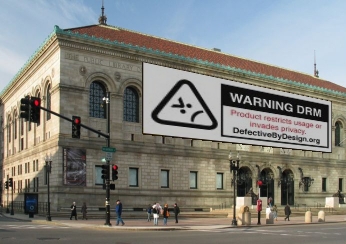
/copyrighteous/images/bpl_drm.jpg On Saturday February 9th, at 13:00, I'm going to be joining free software and anti-DRM activists to protest the use of DRM by the Boston Public Library on parts of its electronic collection. Those of us protesting are unhappy because the BPL has launched a new service powered by a company called OverDrive. The system gives BPL patrons access to books, music, and movies online -- but only if they use a Microsoft DRM system. There are lots of problems with the introduction of this system: it bars access to users of GNU/Linux and MacOS and creates a dependence on a single technology vendor for access. These are important issues, certainly. The worst problem, however, is much more fundamental. By adopting a DRM system for library content, the BPL is giving OverDrive, copyright holders, and Microsoft the ability to decide what, when, and how its patrons can and cannot read, listen, and watch these parts of the BPL collection. They are giving these companies veto power over the BPL's own ability to access this data -- both now and in the future. Cryptographically, BPL is quite literally handing over the keys to their collection. In the process, they are not only providing a disservice to their patrons. They are providing a disservice to themselves. The first-sale doctrine says that libraries can do essentially whatever they like with copies of books they purchase short of duplication, modification, or performance. Of course, copyright holders would prefer to charge a toll every time someone checks out a book. Public libraries were possible in spite of this desire because they were able to exploit power over the possession and control of their books in the interests of their patrons. With DRM, libraries will reduced to powerlessness. Of course, times have changed. As media and the ways we interact with it is increasingly digital, libraries have changed and will need to change more. But if public libraries are to succeed at their fundamental mission of spreading knowledge and serving communities, this change can't be at the expense of patrons' ability to control their own technology and libraries' ability to control their own collections. I've supported my academic library, MIT Libraries, as they took a risk and stood up to DRM when other institutions did not. And they won. BPL is the largest municipal library in the US and the third largest US library overall. It is the first library to be supported publicly, to be open to the public in the US, and to allow patrons to take home books to read and use them. BPL has an opportunity now to continue this history of leadership, of access, and of patron empowerment. If BPL stands up against DRM and in favor of its patrons' freedom and its own control of its technical destiny and collection, it may set an important precedent. If you're in or near Boston, please join me in Copley Square on Saturday to help make this happen. If you're not near Boston, please help put pressure on similar efforts in your own communities.

2 February 2008

Lucas Nussbaum: Human deadlocks

Given three groups of groups of people A, B, C, responsible for 3 queues Qa, Qb, Qc ; and an elements e which have to go through Qa, then Qb, then Qc. Possible solution: A, B, C, please prove your point! Now, let’s find a practical example to apply that … Any suggestions? :-)

15 January 2008

Bernhard R. Link: inoffical vs misusing the name

I hope I am not alone, but a community stating "Of course we are sexists" (if this is a expression of more than a individual) is in my eyes nothing that should be allowed to have debian in its name, even if it is marked as inofficial (and especially if it says "Love it or get the fuck out of there.").

Can't people find a way that is neither pseudo-moral pressure of some "political correctness" nor childish increasing of self-esteem by showing everyone how "political incorrect" you dare to be.

6 January 2008

Andrew Pollock: [life] Post-op, Day 3

Slow day today. I slept at home, and got in at around 9:40am. Sarah didn't sleep well again overnight, her O2 saturation levels kept dropping below 90% because she wasn't breathing deeply enough in her sleep, and that causes an alarm to go off. So she was pretty flat when I first got in, but she picked up as the day went along, and was fairly chirpy by around 11am. The doctor came by and explained the photos that we've been given, so I'll have to try and regurgitate all of it and update the captions. Her lungs are still looking a bit suboptimal. The third lobe on the right lung isn't inflating well apparently. They said something about there being some fluid as well, although the nurse said she can't hear anything. All that said, she spent a lot of time in a chair today, and her O2 saturation levels have been the best they've been since she was in the ICU. So good, that they're trialing having her off oxygen while she attempts to take a nap as I write. Her blood sugar levels are settling down. I think they're still slightly elevated, but not to the point that insulin is required. She only needed insulin with lunch yesterday, so it definitely looks like it's improving. She's already been on her three walks today, by 4pm. An occupational therapist came by, and went through the sternal precautions again, and showed us how to get in and out of bed without putting undue pressure on the sternum, and Sarah's been getting out of bed unassisted from horizontal since. Her pain has been quite manageable. So while today started out looking like it was going to be a small backward step, I think it's still a good move forward. Sarah's continuing her breathing exercises, so I'm sure her lungs will sort themselves out in the next day or two. I guess they'll take another chest x-ray this afternoon, although it's getting a bit late in the day. Sarah's starting to get a bit of cabin fever, but I think today's been pretty slow, in part because we deferred having visitors on account of her being not up to it in the morning.

1 January 2008

Russell Coker: Fluorescent vs Incandescent lights

Glen Turner writes about silly people who think that fluorescent lights don’t save energy over their lifetime [1]. A compact fluorescent light (one that is designed for the same socket as an incandescent globe) is not the most efficient light source, the Luminous Efficiency page on Wikipedia [2] lists a CFL as having an efficiency of between 6.6% and 8.8% while fluorescent tubes can be up to 15.2% efficient and low pressure sodium lamps are 27% efficient! But given that low pressure sodium lights are unsuitable for most uses due to being monochromatic and having a long warm-up time and the fact that fluorescent tubes are often not suitable due to design an 8.8% efficiency is pretty good. LEDs can give up to 10.2% (and prototypes offer 22%) but don’t seem to be available in a convenient and reliable manner (they are expensive and the ones I’ve tried have been unreliable). When comparing fluorescent with incandescent one factor to consider is the power used. While high-temperature incandescent lights are quoted as having 5.1% efficiency and a 100W 110V tungsten incandescent globe is quoted as having 2.6% efficiency a 40W 110V globe will only have 1.9%. If you want to save energy then you probably don’t want to use 100W globes, using less light is the first way of saving energy on lighting! So the efficiency of incandescent lights used for the comparison should probably be closer to 1.9% than 2.6%. Now the theoretical performance won’t always match what you get when you buy globes. There is some variation of quality between manufacturers and there are at least two distinct “colours” of fluorescent lights (one is about 5800K - similar to our sun, the other is something over 8000K - blue-white), I expect some difference in efficiency between lights of different colour range. I see CFL lights marketed as being 5 times more efficient than incandescent lights, my observation is that they appear to be about 4 times more efficient (IE I replace a 40W incandescent with a 10W CFL or a 60W incandescent with a 14W CFL). Glen claims that an 8W CFL can replace a 60W incandescent globe, the only possibility of getting a factor of 7 or more efficiency improvement (according to the data on the Wikipedia page) would be to replace some 5W incandescent globes with CFL. In my experience (converting two houses that I lived in to CFL and the conversions of some friends) such an efficiency benefit is not possible on direct electricity use. However in a hot climate any waste heat needs to be removed with an air-conditioner. So when a 60W incandescent light is replaced by a 14W CFL there is 46W of waste heat removed, with an ideal efficiency of a heat-pump it would take 15W to remove that heat from a building (and possibly more if it’s a large building). So in summer we are not comparing 60W to 14W, it’s more like 75W to 14W. The issue of economics that Glen raises is more complex than it seems because governments often give companies significant discounts on electricity costs, EG in Australia aluminium refineries are subsidies heavily so they pay much less than home users. So hypothetically it could be possible to manufacture a device made entirely of aluminium which saves electricity (and therefore money for the user) but not enough to cover the electricity used in aluminium refining. However when we consider the margins of the various middle-men it seems quite unlikely that such a hypothetical situation could actually happen. As for the issue of mercury in fluorescent lights there are two things to consider. One is that it is possible to recycle mercury (in Australia at least), the other is that coal fired power plants have a lot of mercury in their smoke…

23 December 2007

Russell Coker: Contract Pay Rates

In a comment on my post about Bad Project Management [1] Don Marti [2] says “the more money you charge, the less of your time people waste, and the more seriously they take you” and “you can affect the client more, whether you’re peddling idiocy or wisdom“. That’s a nice theory, however I don’t recall seeing an example of it anywhere that I have worked. There are two broad categories of employers, large and small. Large companies have HR departments etc who decide on rough pay scales. Once the budget is approved (by senior management and HR) for someone’s contract fees or salary the amount of money seems to be of little concern to the line manager. They have a group of N people reporting to them who are all paid by money that comes from some mysterious place (with no direct connection to the quality or quantity of work done) and therefore the amount of money paid is not very relevant. Often team-leaders don’t even know how much the people who report to them are being paid! Note that this applies to people who have a similar job title, if I am paid twice as much as another sys-admin in a corporate environment I don’t expect to get more attention, but someone who has a more senior job title (or in the case of the UK has been to a more prestigious school or has a better accent) may get more attention. Small companies are rarely in a position to be silly in this way. This doesn’t mean that the most highly paid person gets the most attention, it’s more a matter of making a logical case. Most of the small companies I have worked for have been run in a sensible manner, and my ideas have often received more attention than those of others because I have had a better technical background than my colleagues. However in some cases my suggestions have received less attention because I was receiving a higher pay rate. The reason is that I was being paid a rate that the company could not afford in the long-term and therefore the people who would work there in future years would have to maintain the systems in question which meant that their ability to do such maintenance was often considered to be more important than my ideas about the best way to design the system. I have worked for a small company that had no financial pressure to do sensible things (they had some sweet deals going with major corporations which essentially gave them money for nothing). They had chaotic management which they could get away with because there were no immediate consequences for doing silly things (such as not forcing their clients to have a method of backing up servers that they installed). I can’t claim that Don’s advice in this regard never applies, but my observations of situations where it didn’t apply lead me to believe that it’s applicable to some situations in limited areas and is not a general rule. Don also refers to “a high number that you would quote to a client you didn’t want in order to get them to go away“. This is an issue that causes a lot of disagreement. One consultant I respect advises people to never make such quotes, if you don’t want a job then say that you are not available - one reason is that if a position is so bad that you want the potential client to go away then you don’t want to be tempted to reconsider if they agree to pay you a silly amount of money, another is that it may be considered ethically wrong to make an offer is not genuine. Another consultant I respect claims that his greatest career success was when he turned up to an interview in casual clothes, explained to the potential client that he would never wear a suit and demanded an excessive amount of money. The client agreed to such terms and he then went on to charge other clients similar amounts of money and continued to refuse to wear a suit. I won’t claim that it’s wrong to demand excessive amounts of money to make an unwanted potential client go away and I will not rule out the possibility of doing so at some future time. But I think it should be noted that the practice is controversial and not referred to as something that anyone might do. It is something that I don’t recall doing at any previous time in my career (so I haven’t done it in a formal manner at least - I may have done so at the informal discussion phase and forgotten). Please note that I encourage you to read my previous post with Don’s comment in it’s original context to avoid any risk of misinterpretation. The purpose of this post is not to disagree with Don (I agree with him almost all of the time) but to disagree with some very commonly held beliefs which Don represented in his comment.

21 December 2007

Russell Coker: A Better Design for Child Seats

The current method of carrying young children (less than 4-6 years old) in cars is to have a special car seat fitted in the back seat. This has several significant problems:
Some car companies are offering child “booster seats” that are an optional attachment to the rear seat (I first noticed this when reviewing the specs of the latest version of the car I drive - the VW Passat [1]). This is a good idea, but it doesn’t go far enough. The best thing to do would be to provide a selection of back-seat assemblies as factory fitted options which have built-in baby and child seats. The combinations that would be most desired are:

  1. Standard car back-seat for three adults (or two adults for a small car).

  2. A regular seat (for an adult) at the road side of the car combined with a baby (backward facing) seat at the kerb side.

  3. A regular seat (for an adult) at the road side with a young child (forward facing) seat at the kerb side.

  4. A baby seat at the road side with a young child seat at the kerb side.

  5. Two young child seats.

It would be quite possible to have all five of these options available from the factory. Of course there are corner cases that this doesn’t cover such as twins or parents who have two children so close together that they need two baby seats. For those cases option 2 combined with one of the current off-the-shelf baby seats would do. The number of different supported options would need to be kept reasonably small to reduce manufacture cost and to allow a reasonable market for second-hand seats. One thing to note is that it’s recommended that the first forward-facing seat a child uses is smaller than the later one. Having options for three different built-in baby/child seats (rear-facing and two sizes of forward-facing) would significantly expand the number of combinations (and thus the expense). I suspect that the safety benefits of having an ideal method of securing a forward-facing child seat would compensate for the disadvantage of having it be too large for the child when they are first placed in it. Another possibility would be to replace the rear seat with a more solid bench with bolt holes for baby and child seats. Securing a child or baby seat to a hard surface with bolts would be a much less technically demanding task than using a seat belt (and thus could be done correctly without expert assistance). Child and baby seats would have to be redesigned for this (I suspect that the safety of them relies on being attached to a soft surface), but after that I expect that safety would improve. For this option the rear seat could bold on to a hard surface that’s suitable for attaching child/baby seats so it would simply be a matter of removing the rear seat and installing the child/baby seat(s). The most common car design in Australia includes a 60/40 split rear seat (meaning that if you have a large item to store in the boot/trunk then you can fold down 40% or 60% of the back of the rear seat to allow the luggage to extend into the passenger compartment). This split could be extended to allow removing the base of the rear seat for 60% or 40% to bolt on child/baby seats. Once a car model had been designed for replacing the rear seat there would be other options available. For example replacing the rear seat with luggage storage space. While almost all cars allow folding down the backs of the rear seats to store extra luggage the option of removing seats that you don’t need to give even more space is not common at all (I’ve only seen it advertised as a feature in vehicles with 6 or more seats). I expect that if this idea was implemented it would allow a small car such as a Toyota Corolla to give an equal or greater amount of usable space for children in the rear as a larger vehicle such as a Toyota Camry. While better options for luggage storage would allow people who don’t have children to use a small car while still being able to carry the luggage that they desire. This would allow considerable savings on car purchase prices and fuel use. I expect that a reduction in fuel use world-wide could be achieved by removing the pressure on parents to buy large cars! The poor support for child seats in cars is really surprising. One of the features that could be introduced is both top and bottom mounts for such seats. There is apparently a standard for this, some (not all) cars support it, but most baby seats apparently don’t. So baby and child seats are secured at the top (to a hook that’s bolted securely to the car frame and which was designed specifically for the purpose) and at the bottom to the seat-belt which was never designed for such things. It’s a pity that some of the money spent on supposedly protecting children from drugs couldn’t be spent on making cars safer for them. The government is in the best position to force car manufacturers to improve their safety features while parents are in the best position to teach children about the dangers of drugs.

20 December 2007

Russell Coker: Apprentice Computer Journalist Wanted

In a comment on my post about apprentices [1] Don Marti pointed me to a blog post of his from 6 months ago where he mentioned a need for an apprentice [2]. I had read the post in question before but didn’t think about it when writing my previous post. When I was about 17 I had my first article published in a computer magazine, it was a small magazine for a computer club and the article was merely a long email on the club BBS which someone decided to publish. The option of trying to make a career out of journalism occurred to me then as I had been published once without trying, and the quality of the magazines at the time indicated that anyone who wanted to write technical articles would face little competition. :-# If someone as skillful as Don had been offering apprenticeships during school holidays when I was at that age I would have been very interested, but at the time there was too much cultural pressure (and too much pain invested) to make quitting school entirely an option. I encourage other people who have the ability to take on an apprentice to blog about it. Please make sure to mention your approximate location and whether school-holidays work is OK.

19 December 2007

Russell Coker: Bad Project Management

I have just read a rant by Sean Middleditch about bad project management [1]. He describes his post as “personal, rather angsty, and especially whiny” but I think it’s useful and informative. He makes some interesting technical points about PHP programming (I wasn’t aware that there were so many ways of easily getting things wrong and having difficulty to get them right). But of course this isn’t all limited to PHP, the web site WorseThanFailure.com has anecdotes about mistakes of similar calibre being implemented in every language imaginable. Sean is apparently considering leaving the computer industry after having numerous bad experiences of having highly paid people mess up projects while he gets paid a lot less to try and fix the worst of the bugs and get the systems working in production. I understand what it’s like, I have occasionally idly contemplated leaving the industry after bad projects. However the fun of working on free software combined with the amounts of money that I can earn in the computer industry made me quickly abandon such ideas. His stories in some ways resemble my experiences in working as a contractor, most of my contracts have been profoundly weird for various reasons (I’ll use the WTF [2] category of this blog to document some of them). I had two theories as to why I ended up in so many strange contracts, one was that I was in some sort of Twilight Zone and the other was that taking contracts based on the amount of money offered puts you at high risk of being employed by people who have no financial pressure to do things in a sensible manner. My advice to anyone in such a situation is to try and find a contract position paying an unreasonable amount of money. Getting more than $80 an hour (the rate Sean cites as being paid to the idiots who cause problems) is going to be difficult, but getting $50 or $60 an hour is much easier to achieve and should be enough to alleviate the pain of working on doomed projects.

14 December 2007

Russell Coker: Blogroll - Bad Social Networking

A common feature in blog software is a Blogroll, this is a list of links to blogs which are associated in some way with the blog in question - most commonly it’s a list of blogs run by friends of the blogger in question. Now in the case of friends with very similar interests (IE same religious and political beliefs, sexual preferences, hobbies, etc) this wouldn’t cause a problem. In the case of commercial blogs it also will work well (EG Google runs a large number of blogs which contain links to all the rest - they may not interest all readers but should be expected not to offend any). In the case of personal blogs where people don’t always have the same interests there is scope for problems. A link to the main page of a blog is an unconditional recommendation for the blog. There are not many of my friends who I share that much in common with that I would be prepared to give such a recommendation for a frank personal blog, and for those few I am unwilling to do so as it generates social pressure to include others. Some of my friends who didn’t get listed in my blogroll would probably get offended, even though it’s only the occasional post that I strongly disagree with which would make me refrain from such a listing. I appreciate it when people add me to their blogroll, but don’t have any expectation that the listing will remain (I’m not going to get offended if someone changes their criteria for listing and removes my entry). But I consider it an equal compliment when someone cites one of my blog posts as a reference and recommends that other people read it. Citing an individual post has the advantage (for the person citing the post) they are specifically not recommending my entire blog. For example if you recommend one of my posts about Linux and one of your readers goes further into my site and is offended by my posts about politics then it’s not your issue. Tim Berners-Lee made an interesting point [1] “so readers, when they find something distasteful or unreliable, don’t just hit the back button once, they hit it twice“. I know that some people who would be interested in the technical Linux issues I write about don’t read my blog because they are offended by my political beliefs, I am not concerned about this - but I don’t expect that everyone who chooses to link to me will necessarily want to make the same trade-off. When citing individual posts it’s possible to strongly agree with one post and strongly disagree with another by the same author. Probably the best way of acknowledging your friends via blogging (if you choose to do so) would be to make an occasional links post which contains short positive recommendations to the best posts your friends wrote. If every month or two someone writes a links post (post which has little content, merely recommendations for other posts) which references your posts then you know that they like you (and you get a Technorati.com boost), so a blogroll entry hardly seems necessary. An additional benefit for giving such direct credit is that the person receiving the links will know what you consider to be their best work which will help them in their future writing. I believe that adding this feature to common blogging software was a mistake. The small number of people who actually need this (such as Google) can create it via a HTML widget (IE writing raw HTML for the page - it’s really easy to do) and the rest of the population would be better off without it.

28 November 2007

Russell Coker: Creepy Social Networking

Cory Doctorow wrote an interesting article about social networking [1]. One of his points is “Imagine how creepy it would be to wander into a co-worker’s cubicle and discover the wall covered with tiny photos of everyone in the office, ranked by “friend” and “foe,” with the top eight friends elevated to a small shrine decorated with Post-It roses and hearts“, another concerns the issue of forced “friends” where colleagues and casual acquaintances demand to be added to a friends list. He speculates that the reason for social networking systems to be a fad is that once too many people you don’t really like force themselves into your friends list then you will feel compelled to join a different service. I believe that the practice of ranking friends is simply a bad idea and wonder whether anyone who has completed high-school has ever used it seriously. If you publicly rank your friends then you will alienate other friends (particularly any who might have ranked you more highly than you ranked them). Everyone who has used social networking systems has discovered the pressure to avoid alienating people that you don’t actually like. It seems obvious that alienating people who you do like is even more of a problem. In my previous post about Better Social Networking [2] I suggested having multiple lists on your social networking server that are published to different people. That would allow segregating the lists as a way of dealing with some demands to be listed. People who are associated with work (colleagues, managers, and in an example Cory used students at a school where a teacher worked) would be on a work list. The work list would point to the work profiles of other people which would match whatever the standards are for the industry in question (which would still allow quite a range, the standards for sys-admins of ISPs differ significantly from those for primary school teachers). I’m sure that someone who worked for an ISP in Amsterdam would understand that a work-based friend request made to someone who teaches primary school in a part of the world that is religiously conservative would understand why that request would be declined (but the same person might add them to a personal friends list). Another way of alleviating such problems is to not require that listing be bi-directional. Current social networking systems involve one party making a friend request to another which is listed as pending in the GUI for both parties. The options are to either leave it in that state (which is an annoyance) or reject it (which may cause offence). With a uni-directional listing one party would add the other and hope for the best. If they aren’t obsessive about such things they may not even notice that the other party didn’t reciprocate. Also it would allow for famous people receiving links from many people to their public profile without any expectation of reciprocation. Of course a distributed social networking system such as I suggest would inherently have uni-directional links as there would be no central repository to force them to be all bi-directional.

3 November 2007

Raphaël Hertzog: Unexpected move on the DSA front

One should never loose hope apparently. After my previous posts on the topic, Sam put some more pressure and expressed strongly his disappointment in the lack of progress on the DSA front and warned that he might have to look for more radical solution. Phil Hands (who was really quiet in the discussions) decided that the situation had lasted long enough already and proposed to add Peter Palfrader (weasel@debian.org) to the team if nobody expressed any opposition in 24 hours. And this morning, Phil added weasel to the “adm” group… which make of Peter a full DSA member! :-) I really didn’t expect this outcome after so many months of negociations and discussions. But I’m really relieved to see some new blood in the DSA team. I wish him good luck and I’ll hope he will be able to foster cooperation with non-DSA people like I tried since the beginning of the year. Thank you Phil! Partagez cet article / Share This

Biella Coleman: On Bats, The Suckage of American Health Insurance and Paperwork Warfare

Two nights ago I was having dinner with a colleague who recounted a truly horrible experience he had with the modern-day American health care “system.” While in Montana over the summer, he got bit by a bat and well, as a result, he and his entire family had to get rabies shots. These shots are hard to get and priceeeeeeeeeeeeeeeeeeey. The final bill was $ 20,000 and his NYU based health insurance, United Health Care is claiming they are not responsible!### Like getting bit by a bat and the possibility of rabies are not bad enough. Isn’t the point of health insurance to take care of the unexpected?? Someone also pointed me to The Daily Kos’ wrangle with BCBS of California and well, they picked the wrong guy to mess with given there are so many many many many eyeballs tuned to his blog, everyday (just check out the number of comments). I wonder if the public relations director will contact him as they did with me after I blogged about my trials and tribulations. I certainly don’t have the audience and readers he does, so I am always surprised they ever contacted me in the first place. The Daily Kos also provided a link for a site that I was thinking of creating if my problems with BCBS were not solved (glad to see someone else has) called Sick of Blue Cross. I personally like the name I came up with a little better Blue Cross No Shield but the important thing is that a site like that exists and it is very good site, design and content wise. There should be a site created for every health insurance company and they should federate and pool resources to gain more visiblity. While I am not hopeful that the health insurance industry will change within, I think mounting and steady consumer pressure can do a lot to force the industry to change their awful ways. And while I think the bad publicity is a key part to putting pressure on the health insurance to change, I actually think that the power of the consumers also can come from elsewhere, and this elsewhere is overwhelming the administrative channels within and outside of the health insurance. The gist is if they send us a lot of (useless) paperwork, send them A LOT of paperwork back. On the Daily Kos, a lot of people noted that things got moving when they complained to the Department of Banking and Insurance. While my own complaint to that department did not produce any immediate fruit, it did get the ball moving for the appeal process, which eventually panned out for me. That is, I learned a lot and started to get decent customer service. Doors opened. Now, it took me weeks to find out that I could complain to the Department of Banking and Insurance and I am sure many find themselves in that situation of walking in a no man’s land of confusion and frustration. If more and more people know that you can file a complaint to these Departments (and why are doctor’s offices not relaying this information??!!), they and the health insurance companies will get inundated with that which they love to inflict on us, paperwork. This may slow things down for you but at a certain point, state governments will get the message that something is deeply wrong. So, people MUST use these channels and overwhelm these agencies with complaints, faxes, emails as this is a powerful and very material message that something is deeply wrong and broken and must be fixed. Also, send faxes and letters to various departments in your health insurance company (appeals, customer service, medical director’s office, public relations office…) get people’s email’s and send them emails. Inundate them with a barrage of administrative paperwork. If they are not being helpful, send a fax or two a day concerning your case until you get clear answers. While individual faxes won’t make much of a difference, imagine if there are 300 a day coming in or 3000…. This can work with the numbers are there and I have a feeling that the numbers Are There. So spread the word for housebreaking your health insurance and push the paperwork back on them.

11 October 2007

Andrew Pollock: [life] A c-section from a bloke's perspective

I've been meaning to write this for weeks. Hopefully I can still remember everything. So Sarah had a c-section the day before we were scheduled to have our c-section class. We'd both read a bit though, so it wasn't like we were going in totally uninformed and unprepared.. Firstly, Stanford Hospital's operating room area is rather mind-blowing. Sarah was transferred from Lucille Packard Children's Hospital to Stanford because they could get an operating room there sooner. The transfer was trivial, just roll the whole bed down the corridor, through the magic double doors into the operating rooms. The doors in question have a whole heap of video cameras pointing straight down, so they see everyone that gets wheeled in and out, which I found interesting. Good for records of patient movements I guess. Anyway, through those doors is a maze of corridors. There was a light-up board hanging from the ceiling in the middle of the main corridor with lights for all of the ORs. I think there were about 20. The illuminated ones were available. We went down a corridor, and past a few ORs. Outside of each one is a big stainless-steel scrub area. We got to "our" OR, and they transferred Sarah onto the operating table. Because of her heart condition, they wanted to have an arterial line in her for the duration of the procedure. This is some sort of gadget that goes into an artery and monitors your blood pressure beat by beat. The "interesting" thing with the anaesthesiologist was the New Zealand woman that we'd seen when we had an anaesthesiologist months prior, but the appointment was with a different anaesthesiologist, and this New Zealand woman was "observing". At the time, the anaesthesiologist we had the appointment with told us that she was going to be on vacation at the time of the delivery, so she wouldn't be attending. So I don't know if the Kiwi woman got promoted out of "observing" to "doing" in that period, or what, but she reintroduced herself to us in LPCH prior to moving to Stanford as being our anaesthesiologist for the delivery. Anyway, in the OR, they handed her the arterial line, in it's plastic packaging, and the first thing she asked was whether it came with anything else to put it in. At this point I figured she hadn't put one of these in before. (The answer to her question, by the way, was "no") She then proceeded to have a terrible time getting the line into Sarah's arm. Normally intravenous lines go into a vein, but this has to go into an artery. Apparently when you go poking an artery, it spasms. It then becomes very hard to get it into a moving target. She had a few goes on one arm, then gave up, and had to move over to the other arm. Sarah doesn't like needles at the best of times, and getting this honking great big thing in was no picnic. The bruising on both her wrists afterwards was phenomenal. She tends to bruise fairly spectacularly whenever they stick a needle in her. I almost stepped in and asked if it was really necessary that she have it, because they were having so much trouble getting it in, and it was clearly hurting Sarah. I think someone else ended up getting it in, not the anaesthesiologist. Not "that" one anyway. There were heaps of people in the OR. Next, came the epidural. Again, we had the inexperienced anaesthesiologist. This time she said to someone else how she was so nervous because there were "too many eyes". Not really reassuring. They gave Sarah a numbing injection first, and then proceeded to poke her in back with the epidural catheter needle thing. Sarah was flinching when they did it, and they kept yelling at her not to move. Apparently it didn't hurt, but it caused discomfort every time they tried to get it in. Eventually the associate professor of anaesthesiology stepped in and got it in. Later, they said that Sarah had a slightly curved spine or something, and that had made it a bit more complicated. I'm not begrudging the obviously inexperienced anaesthesiologist for anything. Stanford is a teaching hospital, and doctors have to get their experience somehow, but I think that when the patient is conscious, it's important to come across a little more confident. So once they got all of that sorted out, they could get her lying down on the table and get down to business. Apparently one of the side-effects of the epidural is that it can cause your body to think it's got hypothermia. Part way through the procedure, Sarah started shaking uncontrollably. I can't remember whether she complained about feeling cold or not. She also got a really itchy face. Apparently that's a side-effect of morphine. Sarah also doesn't tolerate anaesthetics very well, and started feeling nauseous part way through the procedure. Sure enough, as has happened countless times previously post-operatively, she threw up. At least we had warning and I got a kidney dish in place in time. That was about all the eventful surgical stuff. They had the usual screen up from about her neck area, so I couldn't see what they were doing. After Joshua was delivered, one of the nurses asked me if I wanted to see him, and took me around from her left shoulder where I'd been sitting to around below her right foot, to where they had him in one of those perspex portable crib things. I could see a lot of red out of the corner of my eye, and I could have seen a lot more if I'd bothered to look, but I was more interested in seeing my son at that stage. They let me bring him back around to where I'd been sitting previously, to show Sarah, but it was hard getting him up to a point where she could see him properly, and she was partially out of it by this stage. I think she dozed off for a little bit not long after that. I forget what time we got into the OR, but they started the operation in earnest at about 10:00am, and we were out of there by 10:45am if memory serves. The nurse in charge of the recovery room really didn't want me there, so I went back to LPCH with one of the nurses to spend some time with him while he was weighed and measured, and I took some photos, and held him. This was good, because I got to have a good cry on my own with him. So overall, in my "I'll never be squeezing a watermelon out of my nether regions" blokey perspective, having seen what Sarah went through, and how much discomfort that it looked like she was going through, both in the OR and afterwards, I'm not convinced c-sections are any less painful than a vaginal birth (taking the average case of both). I think you're trading some "short term" (depends on how long your labour is I guess) pain for some "long term" pain while you recover from your incision. Granted, Sarah wasn't really laid up all that badly for all that long, but it still didn't look all that pleasant. I guess really only the women who have done both delivery methods can really comment. All I know is I found it very difficult watching Sarah go through so much pain. So much so that I'm not really looking forward to that again. Maybe, hopefully, after her aorta is repaired, they'll let her delivery vaginally next time. I'm not holding much hope though. The high-risk obstetricians are fairly paranoid. There's also the possibility the baby will make the decision very easy for everyone by being breech. Sarah raised an interesting point today. Why didn't they just knock her out with a general anaesthetic? There was no need for her to be conscious for the delivery. That would have spared her the pain and suffering of getting the arterial line in, and they wouldn't have needed to bother with an epidural. One for her to ask the obstetrician at her follow-up appointment.

25 September 2007

Russell Coker: Census

I’m just completing Jeff and Pia Waugh’s Australian Open Source Industry & Community Census [1]. There are some things that can be improved with that survey in particular and surveys in general. It seems to be assumed that everyone is trying to work full-time. I admit that there are probably few people who have decided that they don’t need as much money as they would earn in full-time work and reduced their work hours to match their financial needs (as I have done). Surveys that just ask a for a figure of how much is earned add to the pressure to earn as much as possible, which isn’t what’s best for most people. I have the impression that the questions about “how long have you been doing X” assume that doing so is contiguous. If that’s the case then asking “when did you first do X” and giving a drop-down list-box of the last 20 years to select from would probably be better (more precise and remove confusion). Debian wasn’t listed as a Linux distribution! It only has Ubuntu, RHEL, Fedora, and SUSE. The question mixing kernels and distributions was a little strange. It gives BSD as a kernel option but no BSD option in user-space, so apparently it’s assumed that there is only one user-space/distribution for BSD (there have been some attempts to release Debian with the various BSD kernels). Also it wasn’t clear what you have to do regarding the kernel to select it (is the couple of hundred lines of patches I submitted to the Linux kernel adequate to let me list it?). There were a bunch of questions that would get very predictable answers. Do you want to have access to official government web-sites and documents with free software? I guess that they want to get a large number of people requesting such things. Incidentally much of that is in the Greens IT policy… Immediately below the buttons on the screen to go to the Next and Previous pages there is a link to clear the form and exit. When doing something difficult like sys-admin work it’s expected that a command to wipe out your work will be immediately next to something innocuous, but for something that generally doesn’t require much concentration (such as filling out a survey) it would be good to have the dangerous options a little further away. At the end of the survey there are questions about whether you want to be contacted about events held by various companies. I think that it would be better to have an RSS feed of such events that we can poll when we have spare time. I’m sure that the PR people running the events are happy when they see a good number of people signed up to their mailing list. But if you actually want to get people to sign up without prior contact the best thing to do is have it on a web site with an RSS feed (either a blog or a CMS) so that it can be polled, syndicated, and googled.

6 September 2007

Russell Coker: Citing References in Blog Posts

A significant problem with the old-fashioned media is that as a general rule they don’t cite references for anything. Some of the better TV documentaries and non-fiction books cite references, but this is the exception not the norm. Often documentaries only cite references in DVD extras which are good for the people who like the documentary enough to buy it but not for people who want to rebut it (few people will pay for a resource if they doubt the truth and accuracy of it’s claims). I can understand newspapers not wanting to publish much in the way of background information in the paper version as every extra line of text in an article is a line of advertising that they can’t sell. So they have financial pressure to produce less content, and the number of people like me who want to check the facts and figures used in articles is probably a small portion of the readership. Another issue with newspapers is that they are often considered as primary authoritative sources (by themselves and by the readers). It is often the case that journalists will interview people who have first-hand knowledge of an issue and the resulting article will be authoritative and a primary source in which case all they need to do is to note that they interviewed the subject. However the majority of articles published will be sourced from elsewhere (news agencies [ http://en.wikipedia.org/wiki/News_agency ] such as Reuters are commonly used). Also articles will often be written based on press releases - it is very interesting to read press releases and see how little work is done by some media outlets to convert them to articles, through a well written press release a corporation or interest group can almost write it’s own articles for publication in the old media. One way of partially addressing the problem of citing references in old media would be to create a web site of references, then every article could have a URL that is a permanent link to the references and calculations to support the claims and numbers used. Such a URL could be produced by any blogging software, and a blog would be an ideal way of doing this. For bloggers however it’s much easier to cite references and readers have much higher expectations of links to other sites to support claims and of mathematical calculations shown to indicate how numbers are determined. But there is still room for improvement. Here are some of the most common mistakes that I see in posts by people who are trying to do the right thing:
  1. Indirect links. When you refer to a site you want to refer to it directly. In email (which is generally considered a transient medium) a service such as TinyURL [ www.TinyURL.com ] can be used to create short URLs to refer to pages that have long URLs. This is really good for email as there are occasions when people will want to write the address down and type it in to another computer. For blogging you should assume that your reader has access to browse the web (which is the case most of the time). Another possibility is to have the textual description of a link include a reference to the TinyURL service but to have the HREF refer to the real address. Any service on the net may potentially go away at some future time. Any service on the net may have transient outages, and any reader of your blog may have routing problems that make parts of the net unavailable to them. If accessing a reference requires using TinyURL (or a similar service) as well as the target site then there are two potential things that might break and prevent your readers from accessing it.
    One situation where indirect links are acceptable is for the printed version. So you could have a link in the HTML code for readers to click on to get to the reference page directly and a TinuURL link for people who have a printed version and need to type it in.
    Also when linking to a blog it’s worth considering the fact that a track-back won’t work via TinyURL and track-backs may help you get more readers…

  2. Links that expire. For example never say “there’s a good article on the front page of X” (where X is a blog or news site). Instead say “here’s a link to a good article which happens to be on the front page now” so that someone who reads your post in a couple of years time can see the article that you reference.
    Another problem is links to transient data. For example if you want to comment on the features of a 2007 model car you should try to avoid linking to the car manufacturer page, next year they will release a new car and delete the old data from their site.
    A potential problem related to this is the Google cache pages which translate PDF to HTML and high-light relevant terms and can make it much easier to extract certain information from web pages. It can provide value to readers to use such links but AFAIK there is no guarantee that they will remain forever. I suggest that if you use them you should also provide the authoritative link so that if the Google link breaks at some future time then the reader will still be able to access the data.

  3. Not giving the URLs of links in human readable form. Print-outs of blog pages will lose links and blog reading by email will also generally lose links (although it would be possible to preserve them). This counts for a small part of your readership but there’s no reason not to support their needs by also including links as text (either in the body or at the end of the post). I suggest including the URL in brackets, the most important thing is that no non-URL text touch the ends of the URL (don’t have it in quotes and have the brackets spaced from it). Email clients can generally launch a web browser if the URL is clear. Note that prior to writing this post I have done badly in this regard, while thinking about the best advice for others I realised that my own blogging needed some improvement.
    I am not certain that the practice I am testing in this post of citing URLs inline will work. Let me know what you think via comments, I may change to numbering the citations and providing a list of links in the footer.

  4. Non-specific links. For example saying “Russell Coker wrote a good post about the SE Linux” and referring to my main blog URL is not very helpful to your readers as I have written many posts on that topic and plan to write many more (and there is a chance that some of my future posts on that topic may not meet your criteria of being “good”). Saying “here is a link to a good post by Russell Coker, his main blog URL is here” is more useful, it gives both the specific link (indicating which post you were referring to) and the general information (for people who aren’t able to find it themselves, for the case of deleted/renamed posts, and for Google). The ideal form would be “<A HREF=”http://etbe.coker.com.au/whatever”>here is a link to a good post by Russell Coker [ http://etbe.coker.com.au/whatever ]</A>, his main blog URL is <A HREF=”http://etbe.coker.com.au/”> [ http://etbe.coker.com.au ]</A>” (note that this is an example of HTML code as a guide for people who are writing their own HTML, people who use so-called WYSIWYG editors will need to do something different).

  5. Links that are likely to expire. As a rule of thumb if a link is not human readable then the chance of it remaining long-term is low. Companies with content management systems are notorious for breaking links.

  6. Referencing data that you can’t find. If you use data sourced from a web site and the site owner takes it down then you may be left with no evidence to support your assertions. If data is likely to be removed then you should keep a private copy off-line (online might be an infringement of copyright) for future reference. It won’t let you publish the original data but will at least let you discuss it with readers.

  7. Referencing non-public data. The Open Access movement [ http://en.wikipedia.org/wiki/Open_access ] aims to make scholarly material free for unrestricted access. If you cite papers that are not open access then you deny your readers the ability to verify your claims and also encourage the companies that deny access to research papers.
    An insidious problem is with web sites such as the New York Times [ www.nytimes.com ] which need a login and store cookies. As I have logged in to their site at some time in the past I get immediate access to all their articles. But if I reference them in a blog post many readers will be forced to register (some readers will object to this). With the NYT this isn’t such a problem as it’s free to register so anyone who is really interested can do so (with a fake name if they wish). But I still have to keep thinking about the readers for such sites.
    I should probably preview my blog posts from a different account without such cookies.

  8. Failing to provide calculations. My current procedure is to include the maths in my post, for example if you have a 32bit data type used to store a number of milliseconds then it can store 2^32/1000 seconds which is 2^32/1000/60/60/24 = 49.7 days, in this example you can determine with little guessing what each of the numbers represent. For more complex calculations an appendix could be used. A common feature of blogs is the ability to have a partial post sent to the RSS feed and the user has the ability to determine where the post gets cut. So you could cut the post before the calculations, the people who want to see them will find it’s only one click away, and the people who are happy to trust you will have a shorter post.

  9. Linking with little reason. Having a random word appear highlighted with an underline in a blog post is often not very helpful for a reader. It sometimes works for Wikipedia links where you expect that most readers will know what the word means but you want to link to a reference for the few who don’t (my link for the word Wikipedia is an example). In the case where most readers are expected to know what you are referring to then citing the link fully (with a description of the link and a human-readable form for an email client) is overkill and reduces the readability of the text.
    The blogging style of “see here and here for examples” does not work via email and does not explain why a reader should visit the sites. If you want to include random links in a post then having a section at the footer of related links would probably be best.

  10. Linking to a URL as received. Many bloggers paste URLs from Google, email, and RSS feeds into their blog posts. This is a bad idea because it might miss redirection to a different site. If a Google search or an email gives you a URL that is about to go away then it might redirect to a different site. In that case citing the new URL instead of the old one is a service to your readers and will decrease the number of dead-links in your blog over the long-term. Also using services such as www.feedburner.com may cause redirects that you want to avoid when citing a blog post, see my previous post about Feedburner [ http://etbe.coker.com.au/2007/08/20/feedburner-item-link-clicks/ ].

Here are some less common problems in citing posts:
  1. Inappropriately citing yourself. Obviously if there is a topic that you frequently blog about then there will be benefit to linking to old posts instead of covering all the background material, and as long as you don’t go overboard there should not be any problems (links to your own blog are assumed to have the same author so there is no need for a disclaimer). If you write authoritative content on a topic that is published elsewhere then you will probably want to blog about it (and your readers will be interested). But you must mention your involvement to avoid giving the impression that you are trying to mislead anyone. This is particularly important if you are part of a group that prepares a document, your name may not end up on the list of authors but you have a duty to your readers to declare this.
    Any document that you helped prepare can not be used by itself as a support of claims that you make in a blog post. You can certainly say “I have previously demonstrated how to solve this problem, see the following reference”. But links with comments such as “here is an example of why X is true” are generally interpreted to be partly to demonstrate the popular support for an idea.

  2. Citing secret data. The argument “if you knew what I know then you would agree with me” usually won’t be accepted well. There are of course various levels of secrecy that are appropriate. For example offering career advice without providing details of how much money you have earned (evidence of one aspect of career success) is acceptable as the readers understand the desire for some degree of financial secrecy (and of course in any game a coach doesn’t need to be a good player). Arguing the case for a war based on secret data (as many bloggers did) is not acceptable (IMHO), neither is arguing the case for the use of a technology without explaining the science or maths behind it.

  3. Not reading the context of a source. For example I was reading the blog of a well regarded expert in an area of computer science, and he linked to another blog to support one of his claims. I read the blog in question (more than just the post he cited) and found some content that could be considered to be racially offensive and much of the material that I read contained claims that were not adequately supported by facts or logic. I find it difficult to believe that the expert in question (for whom I have a great deal of respect) even casually inspected the site in question. In future I will pay less attention to his posts because of this. I expect a blogger to pay more attention to the quality of their links than I do as a reader of their blog.

While writing this post I realised that my own blogging can be improved in this regard. Many of my older posts don’t adequately cite references. If you believe that any of my future posts fail in this regard then please let me know.

Next.

Previous.