Search Results: "phil"

3 February 2017

Pau Garcia i Quiles: Almost at FOSDEM. Video volunteers?

I am boarding my flight to Brussels to attend FOSDEM. The Desktops DevRoom will be a blast again this year. While I have been in charge of it for 6? years already, the last two (since my twins) were born I had organized remotely and local duties were carried on by the Desktops DevRoom team (thank you Christophe Fergeau, Philippe Caseiro and others!). I am anxious at meeting old friends again. I will be at the beer event today. Video streaming will be available thanks to the Video Team. If you want to help, please contact us in the desktops-devroom@lists.fosdem.org mailing list, or directly at the devroom. Also, this year will be the first for me using the job corner to recruit: my company (everis) is recruiting globally for many open positions. Drop us a mail at fosdem@everis.com with your CV, desired position and location (we have direct presence in 13 countries and indirect in 40 countries) and I will make sure it reaches the right inbox.

1 February 2017

Daniel Pocock: Going to FOSDEM, Brussels this weekend

This weekend I'm going to FOSDEM, one of the largest gatherings of free software developers in the world. It is an extraordinary event, also preceded by the XSF / XMPP Summit For those who haven't been to FOSDEM before and haven't yet made travel plans, it is not too late. FOSDEM is a free event and no registration is required. Many Brussels hotels don't get a lot of bookings on weekends during the winter so there are plenty of last minute offers available, often cheaper than what is available on AirBNB. I was speaking to somebody in London on Sunday who commutes through St Pancras (the Eurostar terminal) every day and didn't realize it goes to Brussels and only takes 2 hours to get there. One year I booked a mini-van at the last minute and made the drive from the UK with a stop in Lille for dinner on the way back, for 5 people that was a lot cheaper than the train. In other years I've taken trains from Switzerland through Paris or Luxembourg. Real-time Communication (RTC) dev-room on Saturday, 4 February On Saturday, we have a series of 23 talks about RTC topics in the RTC dev-room, including SIP, XMPP, WebRTC, peer-to-peer (with Ring) and presentations from previous GSoC students and developers coming from far and wide. The possibilities of RTC with free software will also be demonstrated and discussed at the RTC lounge in the K building, near the dev-room, over both Saturday and Sunday. Please come and say hello. Please come and subscribe to the Free-RTC-Announce mailing list for important announcements on the RTC theme and join the Free-RTC discussion list if you have any questions about the activities at FOSDEM, dinners for RTC developers on Saturday night or RTC in general. Software Defined Radio (SDR) and the Debian Hams project At 11:30 on Saturday I'll be over at the SDR dev-room to meet other developers of SDR projects such as GNU Radio and give a brief talk about the Debian Hams project and the relationship between our diverse communities. Debian Hams (also on the Debian Ham wiki) provides a ready-to-run solution for ham radio and SDR is just one of its many capabilities. If you've ever wondered about trying the RTL-SDR dongle or similar projects Debian Hams provides a great way to get started quickly. I've previously given talks on this topic at the Vienna and Cambridge mini-DebConfs (video). Ham Radio (also known as amateur radio) offers the possibility to gain exposure to every aspect of technology from the physical antennas and power systems through to software for a range of analog and digital communications purposes. Ham Radio and the huge community around it is a great fit with the principles and philosophy of free software development. In a world where hardware vendors are constantly exploring ways to limit their users with closed and proprietary architectures, such as DRM, a broad-based awareness of the entire technology stack empowers society to remain in control of the technology we are increasingly coming to depend on in our every day lives.

Antoine Beaupr : Testing new hardware with Stressant

I got a new computer and wondered... How can I test it? One of those innocent questions that brings hours and hours of work and questionning...

A new desktop: Intel NUC devices After reading up on Jeff Atwood's blog and especially his article on the scooter computer, I have discovered a whole range of small computers that could answer my need for a faster machine in my office at a low price tag and without taking up too much of my precious desk space. After what now seems like a too short review I ended up buying a new Intel NUC device from NCIX.com, along with 16GB of RAM and an amazing 500GB M.2 hard drive for around 750$. I am very happy with the machine. It's very quiet and takes up zero space on my desk as I was able to screw it to the back of my screen. You can see my review of the hardware compatibility and installation report in the Debian wiki. I wish I had taken more time to review the possible alternatives - for example I found out about the amazing Airtop PC recently and, although that specific brand is a bit too expensive, the space of small computers is far and wide and deserves a more thorough review than just finding the NUC by accident while shopping for laptops on System76.com...

Reviving the Stressant project But this, and Atwood's Is Your Computer Stable? article, got me thinking about how to test new computers. It's one thing to build a machine and fire it up, but how do you know everything is actually really working? It is common practice to do a basic stress test or burn-in when you get a new machine in the industry - how do you proceed with such tests? Back in the days when I was working at Koumbit, I wrote a tool exactly for that purpose called Stressant. Since I am the main author of the project and I didn't see much activity on it since I left, I felt it would be a good idea to bring it under my personal wing again, and I have therefore moved it to my Gitlab where I hope to bring it back to life. Parts of the project's rationale are explained in an "Intent To Package" the "breakin" tool (Debian bug #707178), which, after closer examination, ended up turning into a complete rewrite. The homepage has a bit more information about how the tool works and its objectives, but generally, the idea is to have a live CD or USB stick that you can just plugin into a machine to run a battery of automated tests (memtest86, bonnie++, stress-ng and disk wiping, for example) or allow for interactive rescue missions on broken machines. At Koumbit, we had Debirf-based live images that we could boot off the network fairly easily that we would use for various purposes, although nothing was automated yet. The tool is based on Debian, but since it starts from boot, it should be runnable on any computer. I was able to bring the project back to life, to a certain extent, by switching to vmdebootstrap instead of debirf for builds, but that removed netboot support. Also, I hope that Gitlab could provide with an autobuilder for the images, but unfortunately there's a bug in Docker that makes it impossible to mount loop images in Docker images (which makes it impossible to build Docker in Docker, apparently).

Should I start yet another project? So there's still a lot of work to do in this project to get it off the ground. I am still a bit hesitant in getting into this, however, for a few reasons:
  1. It's yet another volunteer job - which I am trying to reduce for health and obvious economic reasons. That's a purely personal reason and there isn't much you can do about it.
  2. I am not sure the project is useful. It's one thing to build a tool that can do basic tests on a machine - I can probably just build an live image for myself that will do everything I need - it's another completely different thing to build something that will scale to multiple machines and be useful for more various use cases and users.
(A variation of #1 is how everything and everyone is moving to the cloud. It's become a common argument that you shouldn't run your own metal these days, and we seem to be fighting an uphill economic battle when we run our own datacenters, rack or even physical servers these days. I still think it's essential to have some connexion to metal to be autonomous in our communications, but I'm worried that focusing on such a project is another of my precious dead entreprises... ) Part #2 is obviously where you people come in. Here's a few questions I'd like to have feedback on:
  1. (How) do you perform stress-testing of your machines before putting them in production (or when you find issues you suspect to be hardware-related)?
  2. Would a tool like breakin or stressant be useful in your environment?
  3. Which tools do you use now for such purposes?
  4. Would you contribute to such a project? How?
  5. Do you think there is room for such a project in the existing ecology of projects) or should I contribute to an existing project?
Any feedback here would be, of course, greatly appreciated.

30 January 2017

Francois Marier: Creating a home music server using mpd

I recently setup a music server on my home server using the Music Player Daemon, a cross-platform free software project which has been around for a long time.

Basic setup Start by installing the server and the client package:
apt install mpd mpc
then open /etc/mpd.conf and set these:
music_directory    "/path/to/music/"
bind_to_address    "192.168.1.2"
bind_to_address    "/run/mpd/socket"
zeroconf_enabled   "yes"
password           "Password1"
before replacing the alsa output:
audio_output  
   type    "alsa"
   name    "My ALSA Device"
 
with a pulseaudio one:
audio_output  
   type    "pulse"
   name    "Pulseaudio Output"
 
In order for the automatic detection (zeroconf) of your music server to work, you need to prevent systemd from creating the network socket:
systemctl stop mpd.service
systemctl stop mpd.socket
systemctl disable mpd.socket
otherwise you'll see this in /var/log/mpd/mpd.log:
zeroconf: No global port, disabling zeroconf
Once all of that is in place, start the mpd daemon:
systemctl start mpd.service
and create an index of your music files:
MPD_HOST=Password1@/run/mpd/socket mpc update
while watching the logs to notice any files that the mpd user doesn't have access to:
tail -f /var/log/mpd/mpd.log

Enhancements I also added the following in /etc/logcheck/ignore.server.d/local-mpd to silence unnecessary log messages in logcheck emails:
^\w 3  [ :0-9] 11  [._[:alnum:]-]+ systemd\[1\]: Started Music Player Daemon.$
^\w 3  [ :0-9] 11  [._[:alnum:]-]+ systemd\[1\]: Stopped Music Player Daemon.$
^\w 3  [ :0-9] 11  [._[:alnum:]-]+ systemd\[1\]: Stopping Music Player Daemon...$
and created a cronjob in /etc/cron.d/mpd-francois to update the database daily and stop the music automatically in the evening:
# Refresh DB once a day
5 1 * * *  mpd  MPD_HOST=Password1@/run/mpd/socket /usr/bin/mpc --quiet update
# Think of the neighbours
0 22 * * 0-4  mpd  MPD_HOST=Password1@/run/mpd/socket /usr/bin/mpc --quiet stop
0 23 * * 5-6  mpd  MPD_HOST=Password1@/run/mpd/socket /usr/bin/mpc --quiet stop

Clients To let anybody on the local network connect, I opened port 6600 on the firewall (/etc/network/iptables.up.rules since I'm using Debian's iptables-apply):
-A INPUT -s 192.168.1.0/24 -p tcp --dport 6600 -j ACCEPT
Then I looked at the long list of clients on the mpd wiki.

Desktop The official website suggests two clients which are available in Debian and Ubuntu: Both of them work well, but haven't had a release since 2011, even though there is some activity in 2013 and 2015 in their respective source control repositories. Ario has a simpler user interface but gmpc has cover art download working out of the box, which is why I might stick with it. In both cases, it is possible to configure a polipo proxy so that any external resources are fetched via Tor.

Android On Android, I got these two to work: I picked M.A.L.P. since it includes a nice widget for the homescreen.

iOS On iOS, these are the most promising clients I found: since MPoD and MPaD don't appear to be available on the AppStore anymore.

18 January 2017

Norbert Preining: Debian/TeX Live January 2017

As the freeze of the next release is closing in, I have updated a bunch of packages around TeX: All of the TeX Live packages (binaries and arch independent ones) and tex-common. I might see whether I get some updates of ConTeXt out, too.
texlive2016-debian The changes in the binaries are mostly cosmetic: one removal of a non-free (unclear-free) file, and several upstream patches got cherrypicked (dvips, tltexjp contact email, upmendex, dvipdfmx). I played around with including LuaTeX v1.0, but that breaks horribly with the current packages in TeX Live, so I refrained from it. The infrastructure package tex-common got a bugfix for updates from previous releases, and for the other packages there is the usual bunch of updates and new packages. Enjoy! New packages arimo, arphic-ttf, babel-japanese, conv-xkv, css-colors, dtxdescribe, fgruler, footmisx, halloweenmath, keyfloat, luahyphenrules, math-into-latex-4, mendex-doc, missaali, mpostinl, padauk, platexcheat, pstring, pst-shell, ptex-fontmaps, scsnowman, stanli, tinos, undergradmath, yaletter. Updated packages acmart, animate, apxproof, arabluatex, arsclassica, babel-french, babel-russian, baskervillef, beamer, beebe, biber, biber.x86_64-linux, biblatex, biblatex-apa, biblatex-chem, biblatex-dw, biblatex-gb7714-2015, biblatex-ieee, biblatex-philosophy, biblatex-sbl, bidi, calxxxx-yyyy, chemgreek, churchslavonic, cochineal, comicneue, cquthesis, csquotes, ctanify, ctex, cweb, dataref, denisbdoc, diagbox, dozenal, dtk, dvipdfmx, dvipng, elocalloc, epstopdf, erewhon, etoolbox, exam-n, fbb, fei, fithesis, forest, glossaries, glossaries-extra, glossaries-french, gost, gzt, historische-zeitschrift, inconsolata, japanese-otf, japanese-otf-uptex, jsclasses, latex-bin, latex-make, latexmk, lt3graph, luatexja, markdown, mathspec, mcf2graph, media9, mendex-doc, metafont, mhchem, mweights, nameauth, noto, nwejm, old-arrows, omegaware, onlyamsmath, optidef, pdfpages, pdftools, perception, phonrule, platex-tools, polynom, preview, prooftrees, pst-geo, pstricks, pst-solides3d, ptex, ptex2pdf, ptex-fonts, qcircuit, quran, raleway, reledmac, resphilosophica, sanskrit, scalerel, scanpages, showexpl, siunitx, skdoc, skmath, skrapport, smartdiagram, sourcesanspro, sparklines, tabstackengine, tetex, tex, tex4ht, texlive-scripts, tikzsymbols, tocdata, uantwerpendocs, updmap-map, uplatex, uptex, uptex-fonts, withargs, wtref, xcharter, xcntperchap, xecjk, xellipsis, xepersian, xint, xlop, yathesis.

17 January 2017

Ritesh Raj Sarraf: Linux Tablet-Mode Usability

In my ongoing quest to get Tablet-Mode working on my Hybrid machine, here's how I've been living with it so far. My intent is to continue using Free Software for both use cases. My wishful thought is to use the same software under both use cases.
  • Browser: On the browser front, things are pretty decent. Chromium has good support for Touchscreen input. Most of the Touchscreen use cases work well with Chromium. On the Firefox side, after a huge delay, finally, Firefox seems to be catching up. Hopefully, with Firefox 51/52, we'll have a much more usable Touchscreen browser.
  • Desktop Shell: One of the reason of migrating to GNOME was its touch support. From what I've explored so far, GNOME is the only desktop shell that has touch support natively done. The feature isn't complete yet, but is fairly well usable.
    • Given that GNOME has touchscreen support native, it is obvious to be using GNOME equivalent of tools for common use cases. Most of these tools inherit the touchscreen capabilities from the underneath GNOME libraries.
    • File Manager: Nautilus has decent support for touch, as a file manager. The only annoying bit is a right-click equivalent. Or in touch input sense, a long-press.
    • Movie Player: There's a decent movie player, based on GNOME libs; GNOME MPV. In my limited use so far, this interface seems to have good support. Other contenders are:
      • SMPlayer is based on Qt libs. So initial expectation would be that Qt based apps would have better Touch support. But I'm yet to see any serious Qt application with Touch input support. Back to SMPlayer, the dev is pragmatic enough to recognize tablet-mode users and as such has provided a so called "Tablet Mode" view for SMPlayer (The tooltip did not get captured in the screenshot).
      • MPV doesn't come with a UI but has basic management with OSD. And in my limited usage, the OSD implementation does seem capable to take touch input.
  • Books / Documents: GNOME Documents/Books is very basic in what it has to offer, to the point that it is not much useful. But since it is based on the same GNOME libraries, it enjoys native touch input support. Calibre, on the other hand, is feature rich. But it is based on (Py)Qt. Touch input is told to work for Windows. For Linux, there's no support yet. The good thing about Calibre is that it has its own UI, which is pretty decent in a Tablet-Mode Touch workflow.
  • Photo Management: With compact digital devices commonly available, digital content (Both Photos and Videos) is on the rise. The most obvious names that come to mind are Digikam and Shotwell.
    • Shotwell saw its reincarnation in the recent past. From what I recollect, it does have touch support but was lacking quite a bit in terms of features, as compared to Digikam.
    • Digikam is an impressive tool for digital content management. While Digikam is a KDE project, thankfully it does a great job in keeping its KDE dependencies to a bare minimum. But given that Digikam builds on KDE/Qt libs, I haven't had any much success in getting a good touch input solution for Tablet Mode. To make it barely usable in Table-Mode, one could choose a theme preference with bigger toolbars, labels and scrollbars. This helps in making a touch input workaround use case. As you can see, I've configured the Digikam UI with Text alongside Icons for easy touch input.
  • Email: The most common use case. With Gmail and friends, many believe standalone email clients are no more a need. But there always are users like us who prefer emails offline, encrypted emails and prefer theis own email domains. Many of these are still doable with free services like Gmail, but still.
    • Thunderbird shows its age at times. And given the state of Firefox in getting touch support (and GTK3 port), I see nothing happening with TB.
    • KMail was something I discontinued while still being on KDE. The debacle that KDEPIM was, is something I'd always avoid, in the future. Complete waste of time/resource in building, testing, reporting and follow-ups.
    • Geary is another email client that recently saw its reincarnation. I recently had explored Geary. It enjoys similar benefits like the rest applications using GNOME libraries. There was one touch input bug I found, but otherwise Geary's featureset was limited in comparison to Evolution.
    • Migration to Evolution, when migrating to GNOME, was not easy. GNOME's philosophy is to keep things simple and limited. In doing that, they restrict possible flexibilities that users may find obvious. This design philosophy is easily visible across all applications of the GNOME family. Evolution is no different. Hence, coming from TB to E was a small unlearning + newLearning curve. And since Evolution is using the same GNOME libraries, it enjoys similar benefits. Touch input support in Evolution is fairly good. The missing bit is the new Toolbar and Menu structure that many have noticed in the newer GNOME applications (Photos, Documents, Nautilus etc). If only Evolution (and the GNOME family) had the option of customization beyond the developer/project's view, there wouldn't be any wishful thoughts.
      • Above is a screenshot of 2 windows of Evoluiton. In its current form too, Evolution is a gem at times. For my RSS feeds, they are stored in a VFolder in Evolution, so that I can read them when offline. RSS feeds are something I read up in Tablet-mode. On the right is an Evolution window with larger fonts, while on the left, Evoltuion still retains its default font size. This current behavior helps me get Table-Mode Touch working to an extent. In my wishful thoughts, I wish if Evolution provided flexibility to change Toolbar icon sizes. That'd really help easily touch the delete button when in Tablet Mode. A simple button, Tablet Mode, like what SMPlayer has done, would keep users sticky with Evolution.
My wishful thought is that people write (free) software, thinking more about usability across toolkits and desktop environments. Otherwise, the year of the Linux desktop, laptop, tablet; in my opinion, is yet to come. And please don't rip apart tools, in porting them to newer versions of the toolkits. When you rip a tool, you also rip all its QA, Bug Reporting and Testing, that was done over the years. Here's an example of a tool (Goldendict), so well written. Written in Qt, Running under GNOME, and serving over the Chromium interface. In this whole exercise of getting a hybrid working setup, I also came to realize that there does not seem to be a standardized interface, yet, to determine the current operating mode of a running hybrid machine. From what we explored so far, every product has its own way to doing it. Most hybrids come pre-installed and supported with Windows only. So, their mode detection logic seems to be proprietary too. In case anyone is awaer of a standard interface, please drop a note in the comments.

Categories:

Keywords:

Like:

15 January 2017

Mehdi Dogguy: Debian from 10,000 feet

Many of you are big fans of S.W.O.T analysis, I am sure of that! :-) Technical competence is our strongest suit, but we have reached a size and sphere of influence which requires an increase in organisation.

We all love our project and want to make sure Debian still shines in the next decades (and centuries!). One way to secure that goal is to identify elements/events/things which could put that goal at risk. To this end, we've organized a short S.W.O.T analysis session at DebConf16. Minutes of the meeting can be found here. I believe it is an interesting read and is useful for Debian old-timers as well as newcomers. It helps to convey a better understanding of the project's status. For each item, we've tried to identify an action.

Here are a few things we've worked on:
During next DebConf, we can review the progress that has been made on each item and discuss new ones. In addition to this session acting as a health check, I see it as a way for the DPL to discuss, openly and publicly, about the important changes that should be implemented in the project and imagine together a better future.

In the meantime, everyone should feel free to pick one item from the list and work on it. :-)

6 January 2017

Vincent Fourmond: RFH: screen that hurts my eyes

Short summary:My eyes hurt when I use my home desktop computer - but only with this computer. This has been very long and frustrating for me, so if you think you can help, read the whole story just below, or skip to what I've tried and what I suspect might be the problem, and post comments below, or send me a mail (my adress should be quite obvious in this page).

Whole story:Two years ago, I bought myself a new fancy motherboard (a Asus B85M-G C2) with a new fancy Intel-based processor with built-in graphics (an Intel Core i7-4770) and memory to go with it. I installed it in the place of my old AMD-based motherboard, keeping everything else (my hoard of hard drives and such) excepted the graphics card, which was not needed anymore. I immediately noticed my eyes were aching when using the computer. I was quite surprised since I had been using the screen very heavily for almost 10 years before that, without any problems. I attributed that to Intel Graphics, so I tried putting back the old graphics card, but it did not help. The situation was very frustrating, since working on the computer for an hour or so was making my eyes hurt for several days. This problem was specific to this computer, I could keep on using my computer at work and my laptop without problems.I could use the computer using SSH from my laptop, so I could profit from the faster processor, but, hey, that wasn't how it was meant to happen. I bought another screen, also tried with one from the work, without any change. I tried using two screens at the same time (this is what I have at work), also without success, so I just kept not using the computer directly. I moved recently to a new place and tried to get that working back again, but didn't get any luck. Frustrated, I got another desktop computer and another screen, and I still have the same problem ! I also tried remounting the old motherboard with the AMD processor and the old graphics card, but that didn't bring any improvement. I just don't get it. This situation is rather frustrating for me, and it's been holding me back in my software projects for two years now (which partly explains my lack of involvement in Debian over the past few years). This post is here in the hope someone will have a idea, but also for me to keep track of what I've done and what I should.

What is puzzling me is that the computer I had before was perfectly fine, and that I have a very very similar setup at work (also with a NVIDIA graphics card) that doesn't hurt my eyes at all.

What I've tried:Here is what I tried, you need to keep in mind that when a trial fails, my eyes keep on hurting for several days, and might trigger false positives.
  • putting back the old (NVIDIA) graphics card, buying a new one (NVIDIA as well);
  • putting back the old motherboard (but with a new OS, but maybe my eyes were too sore for a clean test);
  • using another screen (a new one from the same brand, Samsung), a Dell and a HP from my work, and a brand new Phillips;
  • using two screens at the same time;
  • using a completely different (new, based on Xeon processors and a NVIDIA graphics card) computer (with new mouse, keyboard, hard drives and so on);
  • changing house, including changing the lighting conditions, the desk, the internet provider (no, I didn't do that just because of my computer problems !);
  • changing the way I drive the screens between VGA, DVI and HDMI;
  • copying the system I have in my workplace to the new computer and booting from that system (after a few adaptations, though).

As you can guess, none of those brought any improvement.

Wild hypotheses:
  • Is that a software thing ? Is there something wrong for me in the versions of Debian dating from August 2014 and after ?
  • Is that a BIOS problem with recent computers ?
  • Is that linked to some waves (bluetooth shoudln't be on, but maybe I didn't check well enough ?)
  • Is that linked to EFI (but I also have the problems when I use legacy BIOS for booting)
  • Something weird in my home ?
  • Anything else ?

Any help will be greatly appreciated, but please don't advise going to see a doctor, I don't see how this could be a medical condition specific to my home desktop computer, unless this is a very specific psychosomatic problem.

2 January 2017

Shirish Agarwal: India Tourism, E-Visa and Hong Kong

A Safe and Happy New Year to all. While Debconf India is still a pipe-dream as of now, did see that India has been gradually doing it easier for tourists and casual business visitors to come visit India. This I take as very positive development for India itself. The 1st condition is itself good for anybody visiting India
Eligibility International Travellers whose sole objective of visiting India is recreation , sight-seeing , casual visit to meet friends or relatives, short duration medical treatment or casual business visit.
https://indianvisaonline.gov.in/visa/tvoa.html That this facility is being given to 130 odd countries is better still
Albania, Andorra, Anguilla, Antigua & Barbuda, Argentina, Armenia, Aruba, Australia, Austria, Bahamas, Barbados, Belgium, Belize, Bolivia, Bosnia & Herzegovina, Botswana, Brazil, Brunei, Bulgaria, Cambodia, Canada, Cape Verde, Cayman Island, Chile, China, China- SAR Hong-Kong, China- SAR Macau, Colombia, Comoros, Cook Islands, Costa Rica, Cote d lvoire, Croatia, Cuba, Czech Republic, Denmark, Djibouti, Dominica, Dominican Republic, East Timor, Ecuador, El Salvador, Eritrea, Estonia, Fiji, Finland, France, Gabon, Gambia, Georgia, Germany, Ghana, Greece, Grenada, Guatemala, Guinea, Guyana, Haiti, Honduras, Hungary, Iceland, Indonesia, Ireland, Israel, Jamaica, Japan, Jordan, Kenya, Kiribati, Laos, Latvia, Lesotho, Liberia, Liechtenstein, Lithuania, Luxembourg, Madagascar, Malawi, Malaysia, Malta, Marshall Islands, Mauritius, Mexico, Micronesia, Moldova, Monaco, Mongolia, Montenegro, Montserrat, Mozambique, Myanmar, Namibia, Nauru, Netherlands, New Zealand, Nicaragua, Niue Island, Norway, Oman, Palau, Palestine, Panama, Papua New Guinea, Paraguay, Peru, Philippines, Poland, Portugal, Republic of Korea, Republic of Macedonia, Romania, Russia, Saint Christopher and Nevis, Saint Lucia, Saint Vincent & the Grenadines, Samoa, San Marino, Senegal, Serbia, Seychelles, Singapore, Slovakia, Slovenia, Solomon Islands, South Africa, Spain, Sri Lanka, Suriname, Swaziland, Sweden, Switzerland, Taiwan, Tajikistan, Tanzania, Thailand, Tonga, Trinidad & Tobago, Turks & Caicos Island, Tuvalu, UAE, Ukraine, United Kingdom, Uruguay, USA, Vanuatu, Vatican City-Holy See, Venezuela, Vietnam, Zambia and Zimbabwe.
This should make it somewhat easier for any Indian organizer as well as any participants from any of the member countries shared. There is possibility that this list would even get longer, provided we are able to scale our airports and all and any necessary infrastructure that would be needed for International Visitors to have a good experience. What has been particularly interesting is to know which ports of call are being used by International Visitors as well as overall growth rate
The Percentage share of Foreign Tourist Arrivals (FTAs) in India during November, 2016 among the top 15 source countries was highest from USA (15.53%) followed by UK (11.21%), Bangladesh (10.72%), Canada (4.66%), Russian Fed (4.53%), Australia (4.04%), Malaysia (3.65%), Germany (3.53%), China (3.14%), France (2.88%), Sri Lanka (2.49%), Japan (2.49%), Singapore (2.16%), Nepal (1.46%) and Thailand (1.37%).
And port of call
The Percentage share of Foreign Tourist Arrivals (FTAs) in India during November 2016 among the top 15 ports was highest at Delhi Airport (32.71%) followed by Mumbai Airport (18.51%), Chennai Airport (6.83%), Bengaluru Airport (5.89%), Haridaspur Land check post (5.87%), Goa Airport (5.63%), Kolkata Airport (3.90%), Cochin Airport (3.29%), Hyderabad Airport (3.14%), Ahmadabad Airport (2.76%), Trivandrum Airport (1.54%), Trichy Airport (1.53%), Gede Rail (1.16%), Amritsar Airport (1.15%), and Ghojadanga land check post (0.82%) .
The Ghojadanga land check post seems to be between West Bengal, India and Bangladesh. Gede Railway Station is also in West Bengal as well. So all and any overlanders could take any of those ways.Even Hardispur Land Check post comes in the Bengal-Bangladesh border only. In the airports, Delhi Airport seems to be attracting lot more business than the Mumbai Airport. Part of the reason I *think* is the direct link of Delhi Airport to NDLS via the Delhi Airport Express Line . The same when it will happen in Mumbai should be a game-changer for city too. Now if you are wondering why I have been suddenly talking about visas and airports in India, it came because Hong Kong is going to Withdraw Visa Free Entry Facility For Indians. Although, as rightly pointed out in the article doesn t make sense from economic POV and seems to be somewhat politically motivated. Not that I or anybody else can do anything about that. Seeing that, I thought it was a good opportunity to see how good/Bad our Government is and it seems to be on the right path. Although the hawks (Intelligence and Counter-Terrorist Agencies) will probably become a bit more paranoid , their work becomes tougher.
Filed under: Miscellenous Tagged: #Airport Metro Line 3, #CSIA, #Incredible India, #India, #International Tourism

1 January 2017

Russ Allbery: 2016 Book Reading in Review

So, I did not accomplish my reading goal for 2016 (reading and reviewing more books in 2016 than I did in 2015). Many things contributed to that, but the root cause was that I didn't make enough time for reading. Much of the time that could have gone to reading went to playing Hearthstone (a good thing) and obsessing over the 2016 US election (mostly a waste of time and particularly energy, although I'm not sure I could have stopped). That said, I did get quite a lot of reading done at the end of the year, and I'm hoping to keep up that momentum for next year. In 2016, I did a lot of re-reading and comfort reading. I'm probably going to continue with some of the re-reading in 2017, since I'm enjoying it, but my reading goal for the year is to get back to reading award nominees and previous award winners. There's so much great new stuff being published that I want to discover. I'm not going to set an explicit goal around number of books, but I am going to make an effort to carve out more time in my schedule for reading books (and less for reading on-line news). This was another year with two 10 out of 10 books. One of them was a re-read: Lord of Emperors, the second book of Guy Gavriel Kay's Sarantine Mosaic. (I also re-read the first book this year, Sailing to Sarantium, and gave it a 9.) I like nearly all of Kay's historical fantasies, but this duology is one of my personal favorites. The second 10 out of 10 book was a complete surprise: A Man Called Ove by Fredrik Backman (translated by Henning Koch). My mother found this book and suggested it to me, and I loved every moment of it. I will definitely be reading more of Backman's work. There were two more fiction standouts this year: Digger by Ursula Vernon, and The Philosopher Kings by Jo Walton. The first is a graphic novel about a wombat who is trying to make her way home from an unexpected detour into a mess of magic and gods. The second is the middle book in a trilogy about an attempt to construct Plato's Just City and all of the philosophical and social problems that ensue (with some bonus science fiction and fantasy elements). Both of them are excellent. Walton is consistently one of my favorite authors, and Ursula Vernon was my great discovery of a new author to read this year. (Not that I've followed through on that much, the year in reading being what it was, but I will be doing so.) My favorite non-fiction book of the year continues my interest in time management in general and Mark Forster's approaches in particular. Secrets of Productive People was the last book I reviewed this year (just a coincidence, not any intentional attempt to set things up for next year) and the best version of his overall approach to date. If you've not read any of Forster based on my previous recommendations, this is a good place to start. Also worth mentions were Jeffrey Toobin's The Run of His Life, on the O.J. Simpson case, and Andrew Groen's The Empires of EVE, on the history of player empires in the EVE Online MMORPG. I Kickstarted the latter and didn't regret it. The full analysis includes some additional personal reading statistics, probably only of interest to me.

30 December 2016

Chris Lamb: My favourite books of 2016

Whilst I managed to read almost sixty books in 2016 here are ten of my favourites in no particular order. Disappointments this year include Stewart Lee's Content Provider (nothing like his stand-up), Christopher Hitchens' And Yet (his best essays are already published) and Heinlein's Stranger in a Strange Land (great exposition, bizarre conclusion). The worst book I finished, by far, was Mark Edward's Follow You Home.



https://images-eu.ssl-images-amazon.com/images/P/B010EAQLV2.01._PC__.jpg Animal QC Gary Bell, QC Subtitled My Preposterous Life, this rags-to-riches story about a working-class boy turned eminent lawyer would be highly readable as a dry and factual account but I am compelled to include it here for its extremely entertaining style of writing. Full of unsurprising quotes that take one unaware: would you really expect a now-Queen's Counsel to "heartily suggest that if you find yourself suffering from dysentery in foreign climes you do not medicate it with lobster thermidor and a bottle of Ecuadorian red?" A real good yarn.

https://images-eu.ssl-images-amazon.com/images/P/B0196HJ6OS.01._PC__.jpg So You've Been Publically Shamed Jon Ronson The author was initially recommended to me by Brad but I believe I started out with the wrong book. In fact, I even had my doubts about this one, prematurely judging from the title that it was merely cashing-in on a fairly recent internet phenomenon like his more recent shallow take on Trump and the alt-Right but in the end I read Publically Shamed thrice in quick succession. I would particularly endorse the audiobook version: Ronson's deadpan drawl suits his writing perfectly.
https://images-eu.ssl-images-amazon.com/images/P/B00IX49OS4.01._PC__.jpg The Obstacle is the Way Ryan Holiday Whilst everyone else appears to be obligated to include Ryan's recent Ego is the Enemy in their Best of 2016 lists I was actually taken by his earlier "introduction by stealth" to stoic philosophy. Certainly not your typical self-help book, this is "a manual to turn to in troubling times". Returning to this work at least three times over the year even splashing out on the audiobook at some point I feel like I learned a great deal, although it is now difficult to pinpoint exactly what. Perhaps another read in 2017 is thus in order

https://images-eu.ssl-images-amazon.com/images/P/071563335X.01._PC__.jpg Layer Cake J.J. Connolly To judge a book in comparison to the film is to do both a disservice, but reading the book of Layer Cake really underscored just how well the film played to the strengths of that medium. All of the aspects that would not have worked had been carefully excised from the screenplay, ironically leaving more rewarding "layers" for readers attempting the book. A parallel adaption here might be No Country for Old Men - I would love to read (or write) a comparative essay between these two adaptions although McCarthy's novel is certainly the superior source material.

https://images-eu.ssl-images-amazon.com/images/P/B00G1SRB6Q.01._PC__.jpg Lying Sam Harris I've absorbed a lot of Sam Harris's uvre this year in the form of his books but moreover via his compelling podcast. I'm especially fond of Waking Up on spirituality without religion and would rank that as my favourite work of his. Lying is a comparatively short read, more of a long essay in fact, where he argues that we can radically simplify our lives by merely telling the truth in situations where others invariably lie. Whilst it would take a brave soul to adopt his approach his case is superlatively well-argued and a delight to read.

https://images-eu.ssl-images-amazon.com/images/P/0140442103.01._PC__.jpg Letters from a Stoic Seneca

Great pleasure is to be found not only in keeping up an old and established friendship but also in beginning and building up a new one. Reading this in a beautifully svelte hardback, I tackled a randomly-chosen letter per day rather than attempting to read it cover-to-cover. Breaking with a life-long tradition, I even decided to highlight sections in pen so I could return to them at ease. I hope it's not too hackneyed to claim I gained a lot from "building up" a relationship with this book. Alas, it is one of those books that is too easy to recommend given that it might make one appear wise and learned, but if you find yourself in a slump, either in life or in your reading habits, it certainly has my approval.


https://images-eu.ssl-images-amazon.com/images/P/B00BHD3TIE.01._PC__.jpg Solo: A James Bond Novel William Boyd I must have read all of the canonical Fleming novels as a teenager and Solo really rewards anyone who has done so. It would certainly punish anyone expecting a Goldeneye or at least be a little too foreign to be enjoyed. Indeed, its really a pastiche of these originals, both in terms of the time period, general tone (Bond is more somber; more vulnerable) and in various obsessions of Fleming's writing, such as the overly-detailed description of the gambling and dining tables. In this universe, 007's restaurant expenses probably contributed signifcantly to the downfall of the British Empire, let alone his waistline. Bond flicking through a ornithological book at one point was a cute touch
https://images-eu.ssl-images-amazon.com/images/P/B019MMUA8S.01._PC__.jpg The Subtle Art of Not Giving A F*ck Mark Manson Certainly a wildcard to include here and not without its problems, The Subtle Art is a curious manifesto on how to approach life. Whilst Manson expouses an age-old philosophy of grounding yourself and ignoring the accumulation of flatscreen TVs, etc. he manages to do so in a fresh and provocative "21st-centry gonzo" style. Highly entertaining, at one point the author posits an alternative superhero ("Disappointment Panda") that dishes out unsolicited and uncomfortable truths to strangers before simply walking away: "You know, if you make more money, that s not going to make your kids love you," or: "What you consider friendship is really just your constant attempts to impress people." Ouch.

https://images-eu.ssl-images-amazon.com/images/P/B004ZLS5RK.01._PC__.jpg The Fourth Protocol Frederick Forsyth I have a crystal-clear memory from my childhood of watching a single scene from a film in the dead of night: Pierce Brosnan sets a nuclear device to detonate after he can get away but a double-crossing accomplice surreptitiously brings the timetable forward in order that the bomb also disposes of him Anyway, at some point whilst reading The Fourth Protocol it dawned on me that this was that book. I might thus be giving the book more credit due to this highly satisfying connection but I think it stands alone as a superlative political page-turner and is still approachable outside the machinations of the Cold War.

https://images-eu.ssl-images-amazon.com/images/P/B003IDMUSG.01._PC__.jpg The Partner John Grisham After indulging in a bit too much non-fiction and an aborted attempt at The Ministry of Fear, I turned to a few so-called lower-brow writers such as Jeffrey Archer, etc. However, it was The Partner that turned out to be a real page-turner for somewhat undefinable reasons. Alas, it appears the rest of the author's output is unfortunately in the same vein (laywers, etc.) so I am hesitant to immediately begin others but judging from various lists online I am glad I approached this one first.

https://images-eu.ssl-images-amazon.com/images/P/B00D3J2QKC.01._PC__.jpg Shogun: The First Novel of the Asian saga James Clavell Despite its length, I simply couldn't resist returning to Shogun this year although it did fatigue me to the point that I have still yet to commence on its sequel, Tai-Pan. Like any good musical composition, one is always rewarded by returning to a book and I took great delight in uncovering more symbolism throughout (such as noticing that one of the first words Blackthorne learns in Japanese is "truth") but also really savouring the tragic arcs that run throughout the novel, some beautiful phrases ("The day seemed to lose its warmth ") and its wistful themes of inevitability and karma.

29 December 2016

Philipp Kern: Automating the installation of Debian on z/VM instances

I got tired of manually fetching installation images via either FTP or by manually transferring files to z/VM to test s390x installs. Hence it was about time to automate it. Originally I wanted to instrument an installation via vmcp from another instance on the same host but I figured that I cannot really rely on a secondary instance when I need it and went the s3270/x3270-script way instead.

The resulting script isn't something I'm particularly proud of, especially as it misses error handling that really should be there. But this is not expect instead you operate on whole screens of data and z/VM is not particularly helpful in telling you that you just completed your logon either. Anyway, it seems to work for me. It downloads the most recent stable or daily image if they are not present yet, uploads them via DFT to CMS and makes sure that the installation does not terminate when the script disconnects. Sadly DFT is pretty slow, so I'm stuck with 70 kB/s and about five minutes of waiting until kernel and initrd are finally uploaded. Given that installations themselves are usually blazingly fast on System z, I'm not too annoyed by that, though.

I previously wrote about a parmfile example that sets enough options to bring debian-installer to the point of a working network console via SSH without further prompting. It's a little unfortunate that s390-netdevice needs to be preseeded with the hardware addresses of the network card in all cases, even if only one is available. I should go and fix that. For now this means that the parmfile will be dependent on the actual VM system definition. With that in mind there is an example script in the same gist that writes out a parmfile and then calls the reinstall script mentioned above. Given that debian-installer now supports HTTPS (so far only in the daily images) you can even do a reasonably secure bootstrapping of the network console credentials and preseeding settings.

If you put this pretty generic preseed configuration file onto a securely accessible webserver and reference it from the parmfile, you can also skip the more tedious questions at the beginning of debian-installer. A secure transport is encouraged as preseed files can do anything to your installation process. Unfortunately it seems that there is no way to preseed SSH keys for the resulting installation yet, neither for the created user nor for root. So I haven't achieved my desired target of a fully automated installation just yet. Debian's Jenkins setup just went with insecure defaults, but given that my sponsored VMs are necessarily connected to the public Internet that seemed like a bad idea to me. I suppose one way out would be to IP/password ACL the preseed file. Another one to somehow get SSH key support into user-setup.

24 December 2016

Russ Allbery: Review: Warchild

Review: Warchild, by Karin Lowachee
Series: Warchild #1
Publisher: Warner Aspect
Copyright: April 2002
ISBN: 0-446-61077-1
Format: Mass market
Pages: 451
In a future world of deep space stations and starship trade routes, Jos Musey grew up on a merchant ship with a loving family and typical childhood companions. But, at the age of eight, his ship was taken by pirates and he's taken as a slave. That might have been the end of his story, but after a year of captivity he manages to escape during an alien attack on a distant frontier station. Jos then learns more than he ever expected to learn about the ongoing deep space war between the human military and the aliens and their human sympathizers. From both sides. Warchild feels so much like a collection of 1980s SF tropes that I'm a bit surprised it was published in 2002. Some of those have been part of SF well before the 1980s: the coming-of-age story of a child in space, deep-space combat and merchant fleets, pirates, and sketchy stations. But when one adds the Japanese-inspired philosophy and combat training, with a bit of Karate Kid feel, plus the (oddly bolted on) cyberpunk "burndiving," this book feels deeply embedded in a specific generation of SF storytelling. That's not necessarily a drawback. I like some of those tropes. The martial arts training coupled with careful and patient psychology worked very well for me. It may be a bit stereotyped, but Lowachee is careful to never present it as Asian; it's an alien philosophy and environment, and although it happens to wear its influences on its sleeves, it makes no attempt to tie that to any particular human culture. And the philosophy and, more to the point, the approach Niko takes with Jos is exactly what Jos needs. That section of the book (the second) was by far my favorite. I wish the whole book had been like that. Unfortunately, it's not. The first part is a deeply uncomfortable account of Jos's capture and enslavement (with bonus implied pedophilia). It's thankfully the shortest section of the book, but it's an endless parade of horrors that I didn't enjoy reading. Lowachee took the stylistic choice of writing it in the second person, which is a literary trick that rarely works for me and didn't work here. I'm sure the goal is to make it feel more immediate, but I didn't need this scene to be more immediate, and second person always reads as awkward and forced. If the authors write characters well, I will identify with them, but if I feel like I'm being forced to identify with them, I just start getting irritated. The third part of the book goes in yet a different direction: military SF, complete with hazing, camaraderie, esprit de corps, and bloody combat, with an uncomfortable undertone of constant stress due to Jos's complex and dangerous position. I wanted this to be much shorter and wanted the book to return to the part that I really liked. Unfortunately, that's not to be; the tone of this section is the tone for the rest of the book. To be fair, it's better than I expected it to be, and Jos's recovery and coming-of-age continues in more subtle and more satisfying ways than at first it seemed like it would. But Lowachee complicates and largely breaks a recovery that I was hoping would proceed down a more peaceful path, and replaced a beautiful and interesting (if a bit stereotyped) environment with bog-standard military SF. If you like that sort of thing, there's a lot of that thing here, but I've read a lot of books with that setting and far fewer about an Asian-inspired martial alien philosophy. I think Warchild has a bit too much stuff going on and not enough recovery space. The cyberpunk angle probably gets developed more in later books of the series (the next book is Burndive, which is the name for cyberpunk hacking in this book), but it felt bolted on here. Jos's story has multiple false starts and complications, and Lowachee keeps pulling the rug out from under him again until both he and the reader go a bit numb. The ending mostly works, but it's a brutal resolution to the complex psychological situation Lowachee sets up. This book reminds me a bit of C.J. Cherryh in that the characters seem constantly stressed beyond their ability to cope. I wanted something a bit kinder and softer. Despite that, the psychology and the brief moments of understanding and light are compelling enough that I'm still tempted to read on in this series. The subsequent books follow other characters; maybe they'll be a bit less nasty to their protagonists. Followed by Burndive. Rating: 6 out of 10

21 December 2016

Holger Levsen: 20161221-debian-edu-sprint-in-oslo

What we did at the Debian Edu / Skolelinux gathering in November 2016 in Oslo From November 25 to 27 some people met in the hackerspace bitraf in downtown Oslo. On Saturday and Sunday we met in the morning and hacked and translated all day until we went for dinners in the evening. Despite the short time I think we managed to get a lot done and had good fun, so I'm hoping we'll have another gathering in 2017! Debian Edu / Skolelinux is currently in better shape regarding the upcoming Debian release than we ever have been, which is pretty awesome. Today, on December 21st, all our changes are in Stretch, except for debian-edu-artwork.git, which awaits a desktop-base upload to unstable the only thing missing is being able to install Debian Edu using our profiles from official media releasing Debian Edu Stretch on the same day as Debian Stretch would be a huge success though! These are the notes taken in a pad (thanks riseup!) during the meeting: Phil Hands worked on Knut Yrvin worked on Ingrid Yrvin worked on Ole-Erik Yrvin worked on Wolfgang Schweer worked on Petter Reinholdtsen worked on Dominik George worked on Holger Levsen worked on Mike Gabriel was sick and couldnt come to Oslo and worked at home instead: Thanks to the Debian sprints programm and our sponsors for supporting the travel of Wolfgang, Dominik, Phil and myself! Mike opted out from reimbursement as he couldn't travel due to sickness.

2 December 2016

Matthew Garrett: Ubuntu still isn't free software

Mark Shuttleworth just blogged about their stance against unofficial Ubuntu images. The assertion is that a cloud hoster is providing unofficial and modified Ubuntu images, and that these images are meaningfully different from upstream Ubuntu in terms of their functionality and security. Users are attempting to make use of these images, are finding that they don't work properly and are assuming that Ubuntu is a shoddy product. This is an entirely legitimate concern, and if Canonical are acting to reduce user confusion then they should be commended for that.

The appropriate means to handle this kind of issue is trademark law. If someone claims that something is Ubuntu when it isn't, that's probably an infringement of the trademark and it's entirely reasonable for the trademark owner to take action to protect the value associated with their trademark. But Canonical's IP policy goes much further than that - it can be interpreted as meaning[1] that you can't distribute works based on Ubuntu without paying Canonical for the privilege, even if you call it something other than Ubuntu.

This remains incompatible with the principles of free software. The freedom to take someone else's work and redistribute it is a vital part of the four freedoms. It's legitimate for Canonical to insist that you not pass it off as their work when doing so, but their IP policy continues to insist that you remove all references to Canonical's trademarks even if their use would not infringe trademark law.

If you ask a copyright holder if you can give a copy of their work to someone else (assuming it doesn't infringe trademark law), and they say no or insist you need an additional contract, it's not free software. If they insist that you recompile source code before you can give copies to someone else, it's not free software. Asking that you remove trademarks that would otherwise infringe trademark law is fine, but if you can't use their trademarks in non-infringing ways, that's still not free software.

Canonical's IP policy continues to impose restrictions on all of these things, and therefore Ubuntu is not free software.

[1] And by "interpreted as meaning" I mean that's what it says and Canonical refuse to say otherwise

comment count unavailable comments

23 November 2016

Joachim Breitner: microG on Jolla

I am a incorrigibly in picking non-mainstream, open smartphones, and then struggling hard. Back then in 2008, I tried to use the OpenMoko FreeRunner, but eventually gave up because of hardware glitches and reverted to my good old Siemens S35. It was not that I would not be willing to put up with inconveniences, but as soon as it makes live more difficult for the people I communicate with, it becomes hard to sustain. Two years ago I tried again, and got myself a Jolla phone, running Sailfish OS. Things are much nicer now: The hardware is mature, battery live is good, and the Android compatibility layer enables me to run many important apps that are hard to replace, especially the Deutsche Bahn Navigator and various messengers, namely Telegram, Facebook Messenger, Threema and GroupMe. Some apps that require Google Play Services, which provides a bunch of common tasks and usually comes with the Google Play store would not run on my phone, as Google Play is not supported on Sailfish OS. So far, the most annoying ones of that sort were Uber and Lyft, making me pay for expensive taxis when others would ride cheaper, but I can live with that. I tried to install Google Play Services from shady sources, but it would regularly crash.

Signal on Jolla Now in Philadelphia, people urged me to use the Signal messenger, and I was convinced by its support for good end-to-end crypto, while still supporting offline messages and allowing me to switch from my phone to my desktop and back during a conversation. The official Signal app uses Google Cloud Messaging (GCM, part of Google Play Services) to get push updates about new posts, and while I do not oppose this use of Google services (it really is just a ping without any metadata), this is a problem on Sailfish OS. Luckily, the Signal client is open source, and someone created a LibreSignal edition that replaced the use of GCM with websockets, and indeed, this worked on my phone, and I could communicate. Things were not ideal, though: I would often have to restart the app to get newly received messages; messages that I send via Signal Desktop would often not show up on the phone and, most severe, basically after every three messages, sending more messages from Desktop would stop working for my correspondents, which freaked them out. (Strangely it continued working from their phone app, so we coped for a while.) So again, my choice of non-standard devices causes inconveniences to others. This, and the fact that the original authors of Signal and the maintainers of LibreSignal got into a fight that ended LibreSignal discontinued, meant that I have to change something about this situation. I was almost ready to give in and get myself a Samsung S7 or something boring of the sort, but then I decided to tackle this issue once more, following some of the more obscure instructions out there, trying to get vanilla Signal working on my phone. About a day later, I got it, and this is how I did it.

microG So I need Google Play Services somehow, but installing the real thing did not seem to be very promising (I tried, and regularly got pop-ups telling me that Play Services has crashed.) But I found some references to a project called microG , which is an independent re-implementation of (some of) of the play services, in particular including GCM. Installing microG itself was easy, as you can add their repository to F-Droid. I installed the core services, the services framework and the fake store apps. If this had been all that was to do, things would be easy!

Play Store detection work arounds But Signal would still complain about the lack of Google Play Services. It asks Android if an app with a certain name is installed, and would refuse to work if this app does not exist. For some reason, the microG apps cannot just have the names of the real Google apps. There seem to be two ways of working around this: Patching Signal, or enabling Signature Spoofing. The initially most promising instructions (which are in a README in a tarball on a fishy file hoster linked from an answer on the Jolla support forum ) suggested patching Signal, and actually came both with a version of an app called Lucky Patcher as well as a patched Android package, but both about two years old. I tried a recent version of the Lucky Patcher, but it failed to patch the current version of Signal.

Signature Spoofing So on to Signature Spoofing. This is a feature of some non-standard Android builds that allow apps (such as microG) to fake the existence of other apps (the Play Store), and is recommended by the microG project. Sailfish OS s Android compatibility layer Alien Dalvik does not support it out of the box, but there is a tool tingle that adds this feature to existing Android systems. One just has to get the /system/framework/framework.jar file, put it into the input folder of this project, run python main.py, select 2, and copy the framework.jar from output/ back. Great.

Deodexing Alien Dalvik Only that it only works on deodexed files. I did not know anything about odexed Android Java classes (and did not really want to know), but there was not way around. Following this explanation I gathered that one finds files foo.odex in the Android system folder, runs some tool on them to create a classes.dex file, and adds that to the corresponding foo.jar or foo.apk file, copies this back to the phone and deletes the foo.odex file. The annoying this is that one does not only have to do it for framework.jar in order to please tingle, because if one does it to one odex file, one has to do to all! It seems that for people using Windows, the Universal Deodexer V5 seems to be a convenient tool, but I had to go more manually. So I first fetched smali , compiled it using ./gradlew build. Then I fetched the folders /opt/alien/system/framework and /opt/alien/system/app from the phone (e.g. using scp). Keep a backup of these in case something breaks. Then I ran these commands (disclaimer: I fetched these from my bash history and slightly cleaned them up. This is not a fire-and-forget script! Use it when you know what it and you are doing):
cd framework
for file in *.odex
do
  java -jar ~/build/smali/baksmali/build/libs/baksmali.jar deodex $file -o out
  java -jar ~/build/smali/smali/build/libs/smali.jar a out -o classes.dex
  zip -u $(basename $file .odex).jar classes.dex
  rm -rf out classes.dex $file
done
cd ..
cd app
for file in *.odex
do
  java -jar ~/build/smali/baksmali/build/libs/baksmali.jar deodex -d ../framework $file -o out
  java -jar ~/build/smali/smali/build/libs/smali.jar a out -o classes.dex
  zip -u $(basename $file .odex).apk classes.dex
  rm -rf out classes.dex $file
done
cd ..
The resulting framework.jar can now be patched with tingle:
mv framework/framework.jar ~/build/tingle/input
cd ~/build/tingle
./main.py
# select 2
cd -
mv ~/build/tingle/output/framework.jar framework/framework.jar
Now I copy these framework and app folders back on my phone, and restart Dalvik:
devel-su systemctl restart aliendalvik.service
It might start a bit slower than usually, but eventually, all the Android apps should work as before. The final bit that was missing in my case was that I had to reinstall Signal: If it is installed before microG is installed, it does not get permission to use GCM, and when it tries (while registering: After generating the keys) it just crashes. I copied /data/data/org.thoughtcrime.secretsms/ before removing Signal and moved it back after (with cp -a to preserve permissions) so that I could keep my history. And now, it seems, vanilla Signal is working just fine on my Jolla phone!

What s missing Am I completely happy with Signal? No! An important feature that it is lacking is a way to get out all data (message history including media files) in a file format that can be read without Signal; e.g. YAML files or clean HTML code. I do want to be able to re-read some of the more interesting conversations when I am 74 or 75, and I doubt that there will be a Signal App, or even Android, then. I hope that this becomes available in time, maybe in the Desktop version. I would also hope that pidgin gets support to the Signal protocol, so that I conveniently use one program for all my messaging needs on the desktop. Finally it would be nice if my Signal identity was less tied to one phone number. I have a German and a US phone number, and would want to be reachable under both on all my clients. (If you want to contact me on Signal, use my US phone number.)

Alternatives Could I have avoided this hassle by simply convincing people to use something other than Signal? Tricky, at the moment. Telegram (which works super reliable for me, and has a pidgin plugin) has dubious crypto and does not support crypto while using multiple clients. Threema has no desktop client that I know of. OTR on top of Jabber does not support offline messages. So nothing great seems to exist right now. In the long run, the best bet seems to be OMEMO (which is, in essence, the Signal protocol) on top of Jabber. It is currently supported by one Android Jabber client (Conversations) and one Desktop application (gajim, via a plugin). I should keep an eye on pidgin support for OMEMO and other development around this.

16 November 2016

Russ Allbery: Review: The Philosopher Kings

Review: The Philosopher Kings, by Jo Walton
Series: Thessaly #2
Publisher: Tor
Copyright: June 2015
ISBN: 0-7653-3267-1
Format: Hardcover
Pages: 345
Despite the cliffhanger at the end of The Just City, The Philosopher Kings doesn't pick up immediately afterwards. Argh. It's a great book (as I'm about to describe), but I really wanted to also read that book that happened in between. Still, this is the conclusion to the problem posed in The Just City, and I wouldn't recommend reading this book on its own (or, really, either book separate from the other). Despite the unwanted gap, and another change at the very start of the book that I won't state explicitly since it's a spoiler but that made me quite unhappy (despite driving the rest of the plot), this is much closer to the book that I wanted to read. Walton moves away from the SF philosophical question that drove much of the second half of The Just City in favor of going back to arguments about human organization, the nature of justice, choices between different modes of life, and the nature of human relationships. Those were the best parts of The Just City, and they're elaborated here in some fascinating ways that wouldn't have been possible in the hothouse environment of the previous book. I also thought Apollo was more interesting here than in the previous book. Still somewhat infuriating, particularly near the start, but I felt like I got more of what Walton was trying for, and more of what Apollo was attempting to use this existence to understand. And, once the plot hits its stride towards the center of the book, I started really liking Apollo. I guess it took a book and a half for him to mature enough to be interesting. A new viewpoint character, Arete, gets most of the chapters in this book, rather than following the pattern of The Just City and changing viewpoint characters every chapter. Her identity is a spoiler for The Just City, so I'll leave that a mystery. She's a bit more matter-of-fact and observational than Maia, but she does that thing that I love in Walton's characters: take an unexpected, fantastic situation, analyze and experiment with it, and draw some practical and matter-of-fact conclusions about how to proceed. I think that's the best way to describe this entire series: take a bunch of honest, thoughtful, and mostly good people, put them into a fantastic situation (at first Plato's Republic, a thought experiment made real, and then some additional fantasy complexities), and watch them tackle that situation like reasonable human beings. There is some drama, of course, because humans will disagree and will occasionally do awful, or just hurtful, things to each other. But the characters try to defuse the drama, try to be thoughtful and fair and just in their approach, and encourage change, improvement, and forgiveness in others. I don't like everyone in these books, but the vast majority of them are good people (and the few who aren't stand out), and there's something satisfying in reading about them. And the philosophical debate is wonderful throughout this book (which I'm not saying entirely because the characters have a similar reaction to a newly-introduced philosophical system as I did as a reader, although that certainly helps). I'm not saying much about the plot since so much would spoil the previous book. But Walton adds some well-done complexities and complications, and while I was dubious about them at the start of the book, I definitely came around. I enjoyed watching the characters reinvent some typical human problems, but still come at them from a unique and thoughtful angle and come up with some novel solutions. And the ending took me entirely by surprise, in a very good way. It's better than the best ending I could have imagined for the book, providing some much-needed closure and quite a bit of explanation. (And, thankfully, does not end on another cliffhanger; in fact, I'm quite curious to see what the third book is going to tackle.) Recommended, including the previous book, despite the bits that irritated me. Followed by Necessity. Rating: 9 out of 10

5 November 2016

Russ Allbery: Review: The Just City

Review: The Just City, by Jo Walton
Series: Thessaly #1
Publisher: Tor
Copyright: 2014
Printing: January 2015
ISBN: 0-7653-3266-3
Format: Hardcover
Pages: 368
The premise for The Just City is easy to state: The time-traveling goddess Athene (Athena) decides to organize and aid an attempt to create the society described in Plato's Republic. She chooses Thera (modern Santorini) before the eruption, as a safe place where this experiment wouldn't alter history. The elders of the city are seeded by people throughout history who at some point prayed to Athene, wanting to live in the Republic. The children of the age of ten that Plato suggested starting with are purchased as slaves from various points in history and transported by Athene to the island. Apollo, shaken and confused by Daphne wanting to turn into a tree rather than sleep with him, finds out about this experiment as Athene tries to explain the concept of consent to him. He decides that becoming human for a while might help him learn about volition and equal significance, and that this is the perfect location. He's one of the three viewpoint characters. The others are two women: one (Maia) from Victorian times who prayed to Athene in a moment of longing for the tentative sexual equality of the Republic and was recruited as one of the elders, and another (Simmea) who is bought as a slave and becomes one of the children. I should admit up-front that I've never read Plato's Republic, or indeed much of Plato at all, just small bits for classes. The elders (and of course the gods) all have, and are attempting to stick quite closely to Plato's outline of the ideal city. The children haven't, though, so the book is quite readable for people like me who only remember a few vague aspects of Plato's vision from school. The reader learns the principles alongside Simmea. One of Walton's strengths is taking a science fiction concept, putting real people into it, and letting the quotidian mingle with the fantastic. Simmea is my favorite character here: her journey to the city is deeply traumatic, but the opportunity she gets there is incredible and unforeseen, and she comes to love the city while still understanding, and arguing about, its possible flaws. Maia is nearly as successful; Walton does a good job with committee debates and discussions, avoids coming down too heavily on the drama, and shows a believable picture of people with very different backgrounds and beliefs coming together to flesh out the outlines of something they all agree with, or at least want to try. I found Apollo less engaging as a character, partly because I never quite understood his motives or his weird failure to understand the principles of consent. Walton doesn't portray him as either hopelessly arrogant or hopelessly narcissistic, which would have been easy outs, but in avoiding those two obvious explanations for his failures of empathy, I felt like she left him with an odd and unexplained hole in his personality. He's a weirdly passive half-character for much of the book, although he does develop a bit more towards the end (which was probably the point). Half the fun of this book is working out what the Republic would be like in practice, and what breakdowns and compromises would happen as soon as you put real people in it. Athene obviously has to do a bit of cheating to make a utopia invented as an intellectual exercise work out in practice, plus a bit more for comfort (electricity and indoor plumbing, for instance). The most substantial cheat is robots to replace slaves and do quite a bit that slaves couldn't. Birth control (something Plato obviously never would have thought of) is another notable cheat; it's postulated to be an ancient method since lost, but even if that existed, there's no way it would be this reliable. But otherwise, the society mostly works, and Walton shows enough of the arguing and mechanics to make that believable, while still avoiding infodumps and boring descriptions. It's neatly done, although I'm still a bit dubious that the elders from later eras would have put up with the primitive conditions with this little complaint. The novel needs a plot, of course, and that's the other half of the fun. I can't talk about this in any detail without spoiling the book, since the plot only kicks in about halfway through once the setup and character introductions are complete. That makes it hard to explain why I found this a bit less successful, although parts of it are brilliant. What worked for me is the growth of Simmea and her friends as students and philosophers, the arguments and discussions (and their growing enthusiasm for argument and discussion), and the way Greek mythology is woven subtly and undramatically into the story. It really does feel like sitting in on ancient Greek philosophical arguments and experiments, and by that measure Walton has succeeded admirably in her goal. What didn't work for me was the driving conflict of the story, once it's introduced. I can't describe it without spoilers, but it's an old trope in science fiction and one with little scientific basis. It may seem weird to argue that point in a book with time-traveling Greek gods, a literal Lethe, and a Greek idea of souls, but those are mythological background material. The SF trope is something about which I have personal expertise and which simply doesn't work that way, and I had a harder time getting past that than alternate metaphysical properties. It threw me out of the book a bit. I see why Walton chose the conflict she did, but I felt like she could have gotten to the same place in the plot, admittedly with more difficulty, by using some of the more dubious aspects of Plato's long-term plan plus some other obstacles that were already built into the world. This more direct approach added a bit of SF-style analysis of the unknown that seemed weirdly at odds with the rest of the story (even if the delight of one of the characters is endearing). That complaint aside, I really enjoyed reading this book. Apollo didn't entirely work for me, but all of the other characters are excellent, and Walton keeps the story moving at a comfortable clip. Given the amount of description required, particularly for an audience that may not have read the Republic, a lesser writer could have easily slipped into the infodump trap. Walton never does. Fair warning, though: The Just City does end on a cliffhanger, and is in no way a standalone novel. You will probably want to have the sequel on hand. Followed by The Philosopher Kings. Rating: 7 out of 10

3 November 2016

Norbert Preining: Debian/TeX Live 2016.20161103-1

This month s update falls onto a national holiday in Japan. My recent start as a normal company employee in Japan doesn t leave me enough time during normal days to work on Debian, so things have to wait for holidays. There have been a few notable changes in the current packages, and above all I wanted to fix an RC bug and on the way fixed also several other (sometimes rather old) bugs.
texlive2016-debian From the list of new packages I want to pick apxproof: I have written something myself for one of my rather long papers (with proofs about 60pp), where at times I had to factor out the proofs into an appendix. I did this my own way, but I would have preferred to have a nice package! Another interesting change is the upstream merge of collection-mathextra (which translated to the Debian package texlive-math-extra) and collection-science (Debian: texlive-science) into a new collection collection-mathscience. Since introducing new packages and phasing out old ones is generally a pain in Debian, I decided to digress from the upstream naming convention and use texlive-science for the new collection-mathscience. In the end Mathematics is the most important science of all  Finally also a word about removals: Several ConTeXt packages have been removed due to the fact that they are outdated. These removals will find their way in an update of the Debian ConTeXt package in near future. The TeX Live packages lost voss-mathmode, which was retracted by the author due to various reasons. He is working on an updated version that will hopeful reappear in both TeX Live and Debian in near future. Well, that s it for now. Here now the full list with links. Enjoy. New packages apxproof, bangorexam, biblatex-gb7714-2015, biblatex-lni, biblatex-sbl, context-cmscbf, context-cmttbf, context-inifile, context-layout, delimset, latex2nemeth, latexbangla, latex-papersize, ling-macros, notex-bst, platex-tools, testidx, uppunctlm, wtref, xcolor-material. Removed packages voss-mathmode. Updated packages apa6, autoaligne, babel-german, biblatex-abnt, biblatex-anonymous, biblatex-apa, biblatex-manuscripts-philology, biblatex-nature, biblatex-realauthor, bibtex, bidi, boondox, bxcjkjatype, chickenize, churchslavonic, cjk-gs-integrate, context-filter, cooking-units, ctex, denisbdoc, dvips, europasscv, fixme, glossaries, gzt, handout, imakeidx, ipaex-type1, jsclasses, jslectureplanner, kpathsea, l3build, l3experimental, l3kernel, l3packages, latexindent, latexmk, listofitems, luatexja, marginnote, mcf2graph, minted, multirow, nameauth, newpx, newtx, noto, nucleardata, optidef, overlays, pdflatexpicscale, pst-eucl, reledmac, repere, scanpages, semantic-markup, tableaux, tcolorbox, tetex, texlive-scripts, ticket, todonotes, tracklang, tudscr, turabian-formatting, updmap-map, uspace, visualtikz, xassoccnt, xecjk, yathesis.

28 October 2016

Alessio Treglia: The logical contradictions of the Universe

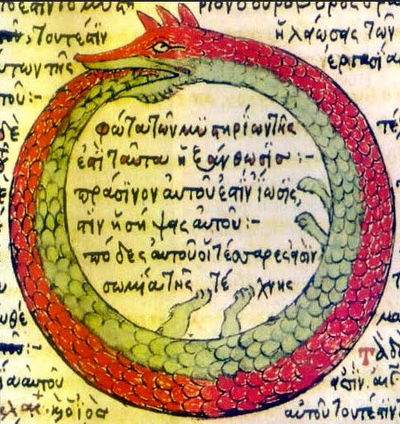
Ouroboros

Ouroboros

Is Erwin Schr dinger s wave function which did in the atomic and subatomic world an operation altogether similar to the one performed by Newton in the macroscopic world an objective reality or just a subjective knowledge? Physicists, philosophers and epistemologist have debated at length on this matter. In 1960, theoretical physicist Eugene Wigner has proposed that the observer s consciousness is the dividing line that triggers the collapse of the wave function[1], and this theory was later taken up and developed in recent years. The rules of quantum mechanics are correct but there is only one system which may be treated with quantum mechanics, namely the entire material world. There exist external observers which cannot be treated within quantum mechanics, namely human (and perhaps animal) minds, which perform measurements on the brain causing wave function collapse [2]. The English mathematical physicist and philosopher of science Roger Penrose developed the hypothesis called Orch-OR (Orchestrated objective reduction) according to which consciousness originates from processes within neurons, rather than from the connections between neurons (the conventional view). The mechanism is believed to be a quantum physical process called objective reduction which is orchestrated by the molecular structures of the microtubules of brain cells (which constitute the cytoskeleton of the cells themselves). Together with the physician Stuart Hameroff, Penrose has suggested a direct relationship between the quantum vibrations of microtubules and the formation of consciousness.

<Read More [by Fabio Marzocca]>

Next.

Previous.