Search Results: "otto"

19 November 2016

Keith Packard: AltOS-Lisp-2

Updates to Altos Lisp I wrote a few days ago about a tiny lisp interpreter I wrote for AltOS Really, it's almost "done" now, I just wanted to make a few improvements Incremental Collection I was on a walk on Wednesday when I figured out that I didn't need to do a full collection every time; a partial collection that only scanned the upper portion of memory would often find plenty of free space to keep working for a while. To recap, the heap is in two pieces; the ROM piece and the RAM piece. The ROM piece is generated during the build process and never changes afterwards (hence the name), so the only piece which is collected is the RAM piece. Collection works like:
chunk_low = heap base
new_top = heap base
For all of the heap
    Find the first 64 live objects above chunk_low
    Compact them all to new_top
    Rewrite references in the whole heap for them
    Set new_top above the new locations
    Set chunk_low above the old locations
top = new_top
The trick is to realize that there's really no need to start at the bottom of the heap; you can start anywhere you like and compact stuff, possibly leaving holes below that location in the heap. As the heap tends to have long-lived objects slowly sift down to the beginning, it's useful to compact objects higher than that, skipping the compaction process for the more stable area in memory. Each time the whole heap is scanned, the top location is recorded. After that, incremental collects happen starting at that location, and when that doesn't produce enough free space, a full collect is done. The collector now runs a bunch faster on average now. Binary Searches I stuck some linear searches in a few places in the code, the first was in the collector when looking to see where an object had moved to. As there are 64 entries, the search is reduced from 32 to 6 compares on average. The second place was in the frame objects, which hold the list of atom/value bindings for each lexical scope (including the global scope). These aren't terribly large, but a binary search is still a fine plan. I wanted to write down here the basic pattern I'm using for binary searches these days, which avoids some of the boundary conditions I've managed to generate in the past:
int find (needle)  
    int l = 0;
    int r = count - 1;
    while (l <= r)  
        int m = (l + r) >> 1;
        if (haystack[m] < needle)
            l = m + 1;
        else
            r = m - 1;
     
    return l;
 
With this version, the caller can then check to see if there's an exact match, and if not, then the returned value is the location in the array where the value should be inserted. If the needle is known to not be in the haystack, and if the haystack is large enough to accept the new value:
void insert(needle)  
    int l = find(needle);
    memmove(&haystack[l+1],
        &haystack[l],
        (num - l) * sizeof (haystack[0]));
    haystack[l] = needle;
 
Similarly, if the caller just wants to know if the value is in the array:
bool exists(needle)  
    int l = find(needle);
    return (l < count && haystack[l] == needle);
 
Call with Current Continuation Because the execution stack is managed on the heap, it's completely trivial to provide the scheme-like call with current continuation, which constructs an object which can be 'called' to transfer control to a saved location:
> (+ "hello " (call/cc (lambda (return) (setq boo return) (return "foo "))) "world")
"hello foo world"
> (boo "bar ")
"hello bar world"
> (boo "yikes ")
"hello yikes world"
One thing I'd done previously is dump the entire state of the interpreter on any error, and that included a full stack trace. I adopted that code for printing of these continuation objects:
boo
[
    expr:   (call/cc (lambda (return) (set (quote boo) return) (return "foo ")))
    state:  val
    values: (call/cc
             [recurse...]
             )
    sexprs: ()
    frame:   
]
[
    expr:   (+ "hello " (call/cc (lambda (return) (set (quote boo) return) (return "foo "))) "world")
    state:  formal
    values: (+
             "hello "
             )
    sexprs: ((call/cc (lambda (return) (set (quote boo) return) (return "foo ")))
             "world"
             )
    frame:   
]
The top stack frame is about to return from the call/cc spot with a value; supply a value to 'boo' and that's where you start. The next frame is in the middle of computing formals for the + s-expression. It's found the + function, and the "hello " string and has yet to get the value from call/cc or the value of the "world" string. Once the call/cc "returns", that value will get moved to the values list and the sexpr list will move forward one spot to compute the "world" value. Implementing this whole mechanism took only a few dozen lines of code as the existing stack contexts were already a continuation in effect. The hardest piece was figuring out that I needed to copy the entire stack each time the continuation was created or executed as it is effectively destroyed in the process of evaluation. I haven't implemented dynamic-wind yet; when I did that for nickle, it was a bit of a pain threading execution through the unwind paths. Re-using Frames I decided to try and re-use frames (those objects which hold atom/value bindings for each lexical scope). It wasn't that hard; the only trick was to mark frames which have been referenced from elsewhere as not-for-reuse and then avoid sticking those in the re-use queue. This reduced allocations even further so that for simple looping or tail-calling code, the allocator may never end up being called. How Big Is It? I've managed to squeeze the interpreter and all of the rest of the AltOS system into 25kB of Cortex-M0 code. That leaves space for the 4kB boot loader and 3kB of flash to save/restore the 3kB heap across resets. Adding builtins to control timers and GPIOs would make this a reasonable software load for an Arduino; offering a rather different programming model for those with a taste for adventure. Modern ARM-based Arduino boards have plenty of flash and ram for this. It might be interesting to get this running on the Arduino Zero; there's no real reason to replace the OS either; porting the lisp interpreter into the bare Arduino environment wouldn't take long.

17 November 2016

Jonathan Dowland: Docker lecture

This morning I gave a guest lecture to students at the EPSRC Centre for Doctoral Training in Cloud Computing for Big Data. The subject was a gentle introduction to Docker. This was the first guest lecture I've given for a couple of years so I thought I was a little rusty but I had a good time giving it and hopefully it went across OK. slides.pdf including speaker notes in boxes at the bottom of each slide; handouts.pdf (3 slides to a page with space for notes): demo steps.txt (the steps I followed for some of the demos). I mentioned a couple of things worth linking to here There was some discussion about alternatives to Docker, things which were briefly mentioned include

15 November 2016

Keith Packard: AltOS-Lisp

A Tiny Lisp for AltOS I took a bit of a diversion over the last week or so when I wondered how small a lisp interpreter I could write, and whether I could fit that into one of the processors that AltOS runs on. It turns out, you can write a tiny lisp interpreter that fits in about 25kB of ram with a 3kB heap for dynamic data. I decided to target our ChaosKey boards; they're tiny, and I've got a lot of them. That processor offers 28kB of usable flash space (after the 4kB boot loader) and 6kB of ram with the processor running at a steaming 48MHz. I'm not at all sure this is useful, but I always enjoy doing language implementations, and this one presented some 'interesting' challenges: Iterative Compacting Allocator I'm betting someone has built one of these before, but I couldn't find one, so I wrote my own. The basic strategy is to walk the heap to find a subset of the active objects which are allocated sequentially in memory with only unused storage between them. These objects are then compacted in-place, and then the heap is walked again to update all references to the moved objects. Then, the process is restarted to find another subset and move them. By looking for these subsets starting at the bottom of the heap, and working upwards towards the top, the whole heap can be compacted into a contiguous chunk at the bottom of memory. Allocation involves moving a pointer along at the top of active memory; when it gets to the top of the heap, collect and see if there's space now. As always, the hardest part was to make sure all active memory was tied down. The second hardest part was to make sure that all active pointers were updated after any allocation, in case a collect moved the underlying object. That was just bookkeeping, but did consume much of the development time. One additional trick was to terminate the recursion during heap walking by flagging active cons cell locations in a global bitmap and then walking that separately, iterating until that bitmap is empty. Nested lambdas form another recursion which should probably get the same approach, but I haven't done that yet. An unexpected "benefit" of the tiny heap is that the collector gets called a lot, so any referencing bugs will have a good chance of being uncovered in even a short program execution. ROM-able Lisp Instead of implementing all of the language in C, I wanted to be able to implement various pieces in Lisp itself. Because of the complex nature of the evaluation process, adding things like 'let' or even 'defun' turn out to be dramatically simpler in Lisp. However, I didn't want to consume bunches of precious RAM to hold these basic functions. What I did was to create two heaps, one in ROM and the other in RAM. References are be tagged as to which heap they're in. 16-bit Values Lisp programs use a pile of references. Using a full 32 bits for each one would mean having a lot less effective storage. So, instead, I use an offset from the base of the heap. The top bit of the offset is used to distinguish between the ROM heap and the RAM heap. I needed a place to store type information, so I settled on using the bottom two bits of the references. This allows for four direct type values. One of these values is used to indicate an indirect type, where the type is stored in the first byte of the object. The direct types are:
ValueType
0Cons cell
114-bit int
2String
3Other
With 2 tag bits, the allocator needs to work in 32-bit units as the references couldn't point to individual bytes. Finally, I wanted 0 to be nil, so I add four to the offsets within the heaps. The result is that the ROM and RAM heaps can each cover up to 32k - 4 bytes. Note that ints are not stored in the heap; instead they are immediate values stored in 14 bits, providing a range of -8192 to 8191. One can imagine wanting more range in ints at some point. Heap-based Evaluator A simple lisp implementation uses the fact that eval is re-entrant and do the operation on the C stack:
val eval(val exprs)  
    val vals;
    while (exprs)  
        vals = append(vals, eval(car(exprs)));
        exprs = exprs->cdr;
     
    return execute (car(vals), cdr(vals));
 
This makes things really simple and provides for a clean framework for implementing various bits of lisp, including control flow and macros. However, it rapidly consumes all of the available memory for a stack, while also requiring separate bookkeeping for the in-use memory in each frame. I replaced this design with one which keeps the lisp stack on the heap, and then performs eval with a state machine with all state stored in global variables so that the memory manager can reference them directly. Each eval operation is performed in a separate 'stack' context, which holds the entire eval state except for the current value, which lives in a separate global variable and is used to pass values out of one stack frame and into another. When the last stack context is finished, the evaluation terminates and the value is returned to the caller. There are nine states in the state machine, each of which is implemented in a separate function, making the state machine a simple matter of pulling the current state from the top of the stack and invoking the associated function:
while (ao_lisp_stack)  
    if (!(*evals[ao_lisp_stack->state])()   ao_lisp_exception)  
        ao_lisp_stack_clear();
        return AO_LISP_NIL;
     
 
return ao_lisp_v;
Because there's no C recursion involved, catching exceptions is a simple matter of one test at this level. Primitives like progn, while, cond and eval all take special magic in the state machine to handle; getting all of that working took several attempts before I found the simple loop shown above. Lexical Scoping The last time I did a lisp interpreter, I implemented dynamic scoping. Atoms were all global and had values associated directly with them. Evaluating a lambda started by saving all of the existing global values for the parameter atoms and then binding the new values. When finished, the previous values would be restored. This is almost correct, but provides surprising results for things like:
> (setq baz 1)
> (def foo (lambda (bar) (+ baz bar)))
> (def bletch (lambda (baz) (foo baz)))
> (bletch 2)
4
The value that foo gets for 'baz' is 2 instead of 1 under dynamic scoping, which most people find surprising. This time, I was determined to use lexical scoping, and it turned out to be surprisingly easy. The first trick was to separate the atoms from their 'value'; each atom can have a different value in different lexical scopes. So, each lexical scope gets a 'frame' object, those contain the value for each atom defined in that scope. There's a global scope which holds all of the globally defined values (like baz, foo and bletch above). Each frame points to its enclosing scope, so you can search upwards to find the right value. The second trick was to realize that the lexical scope of a lambda is the scope in which the lambda itself is evaluated, and that the evaluation of a lambda expression results in a 'function' object, which contains the lambda and its enclosing scope:
> (def foo (lambda (bar bletch)
       ((lambda (baz)
          (+ baz bar))
        bletch)))
> (foo 2 3)
5
In this case, the inner lambda in foo can 'see' the value of bar from the enclosing lambda. More subtly, even if the inner lambda were executed multiple times, it would see the same baz, and could even change it. This can be used to implement all kinds of craziness, including generators:
> (defun make-inc (add)
  ((lambda (base)
     (lambda ()
       (progn
     (setq base (+ base add))
     base)))
   0)
  )
> (setq plus2 (make-inc 2))
> (plus2)
2
> (plus2)
4
The current implementation of each frame is a simple array of atom/value pairs, with a reference to the parent frame to form the full scope. There are dramatically faster implementations of this same concept, but the goal here was small and simple. A Tiny Allocator Optimization With eval consuming heap space for stacks, frames and argument lists, the interpreter was spending a lot of time in the collector. As a simple optimization, I added some free lists for stack frames and cons cells. Stack frames are never referenced when they're finished, so they can always go on the free list. Cons cells used to construct argument lists for functions are usually free. Builtin functions have a bit which indicates whether they might hold on to a reference to the argument list. Interpreted lambdas can't get the list while nlambdas, lexprs and macros do. Each lambda execution creates a new frame, and while it would be possible to discover if that frame 'escapes' the lambda, I decided to not attempt to cache free ones yet. Save and Restore To make the lisp interpreter more useful in tiny computers, I added the ability to save and restore the entire heap to flash. This requires leaving enough space in the flash to preserve the heap, further constraining the amount of flash available for the application. Code All of this code is in the 'lisp' branch of my AltOS repository: AltOS The lisp interpreter is independent from the rest of AltOS and could be re-purposed for another embedded operating system. It runs fine on ChaosKey hardware, and also on the STM32F042 Nucleo-32 board There's also a test framework which runs on Linux, and is how I developed almost all of the code. That's in the src/test directory in the above repository, and is called 'ao_lisp_test'. Towers of Hanoi Here's an implementation of the classic recursive Towers of Hanoi game; it shows most of the current features of the language.
;
; Towers of Hanoi
;
; Copyright   2016 Keith Packard <keithp@keithp.com>
;
; This program is free software; you can redistribute it and/or modify
; it under the terms of the GNU General Public License as published by
; the Free Software Foundation, either version 2 of the License, or
; (at your option) any later version.
;
; This program is distributed in the hope that it will be useful, but
; WITHOUT ANY WARRANTY; without even the implied warranty of
; MERCHANTABILITY or FITNESS FOR A PARTICULAR PURPOSE.  See the GNU
; General Public License for more details.
;
; ANSI control sequences
(defun move-to (col row)
  (patom "\033[" row ";" col "H" nil)
  )
(defun clear ()
  (patom "\033[2J" nil)
  )
(defun display-string (x y str)
  (move-to x y)
  (patom str)
  )
; Here's the pieces to display
(setq stack '("*" "**" "***" "****" "*****" "******" "*******"))
(setq top (+ (length stack) 3))
;
; Here's all of the stacks of pieces
; This is generated when the program is run
;
(setq stacks nil)
; Display one stack, clearing any
; space above it
(defun display-stack (x y clear stack)
  (cond ((= 0 clear)
     (cond (stack (progn
            (display-string x y (car stack))
            (display-stack x (1+ y) 0 (cdr stack))
            )
              )
           )
     )
    (t (progn
         (display-string x y "          ")
         (display-stack x (1+ y) (1- clear) stack)
         )
       )
    )
  )
; This should probably be included in the rom image...
(defun length (list)
  (cond (list (1+ (length (cdr list))))
    (0)
    )
  )
; Position of the top of the stack on the screen
; Shorter stacks start further down the screen
(defun stack-pos (y stack)
  (- y (length stack))
  )
; Display all of the stacks, spaced 20 columns apart
(defun display-stacks (x y stacks)
  (cond (stacks (progn
          (display-stack x 0 (stack-pos y (car stacks)) (car stacks))
          (display-stacks (+ x 20) y (cdr stacks)))
        )
    )
  )
; Display all of the stacks, then move the cursor
; out of the way and flush the output
(defun display ()
  (display-stacks 0 top stacks)
  (move-to 1 21)
  (flush)
  )
; Reset stacks to the starting state, with
; all of the pieces in the first stack and the
; other two empty
(defun reset-stacks ()
  (setq stacks (list stack nil nil))
  (length stack)
  )
; more functions which could usefully
; be in the rom image
(defun min (a b)
  (cond ((< a b) a)
    (b)
    )
  )
(defun nth (list n)
  (cond ((= n 0) (car list))
    ((nth (cdr list) (1- n)))
    )
  )
; Replace a stack in the list of stacks
; with a new value
(defun replace (list pos member)
  (cond ((= pos 0) (cons member (cdr list)))
    ((cons (car list) (replace (cdr list) (1- pos) member)))
    )
  )
; Move a piece from the top of one stack
; to the top of another
(defun move-piece (from to)
  (let ((from-stack (nth stacks from))
    (to-stack (nth stacks to))
    (piece (car from-stack)))
    (setq from-stack (cdr from-stack))
    (setq to-stack (cons piece to-stack))
    (setq stacks (replace stacks from from-stack))
    (setq stacks (replace stacks to to-stack))
    (display)
    (delay 100)
    )
  )
; The implementation of the game
(defun _hanoi (n from to use)
  (cond ((= 1 n)
     (progn
      (move-piece from to)
      nil)
     )
    (t
     (progn
      (_hanoi (1- n) from use to)
      (_hanoi 1 from to use)
      (_hanoi (1- n) use to from)
      )
     )
    )
  )
; A pretty interface which
; resets the state of the game,
; clears the screen and runs
; the program
(defun hanoi ()
  (setq len (reset-stacks))
  (clear)
  (_hanoi len 0 1 2)
  )

12 November 2016

John Goerzen: Morning in the Skies

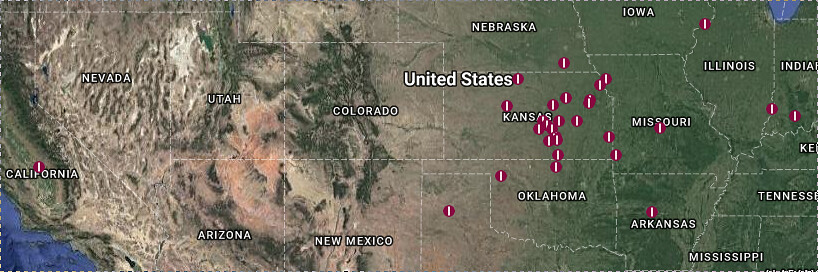
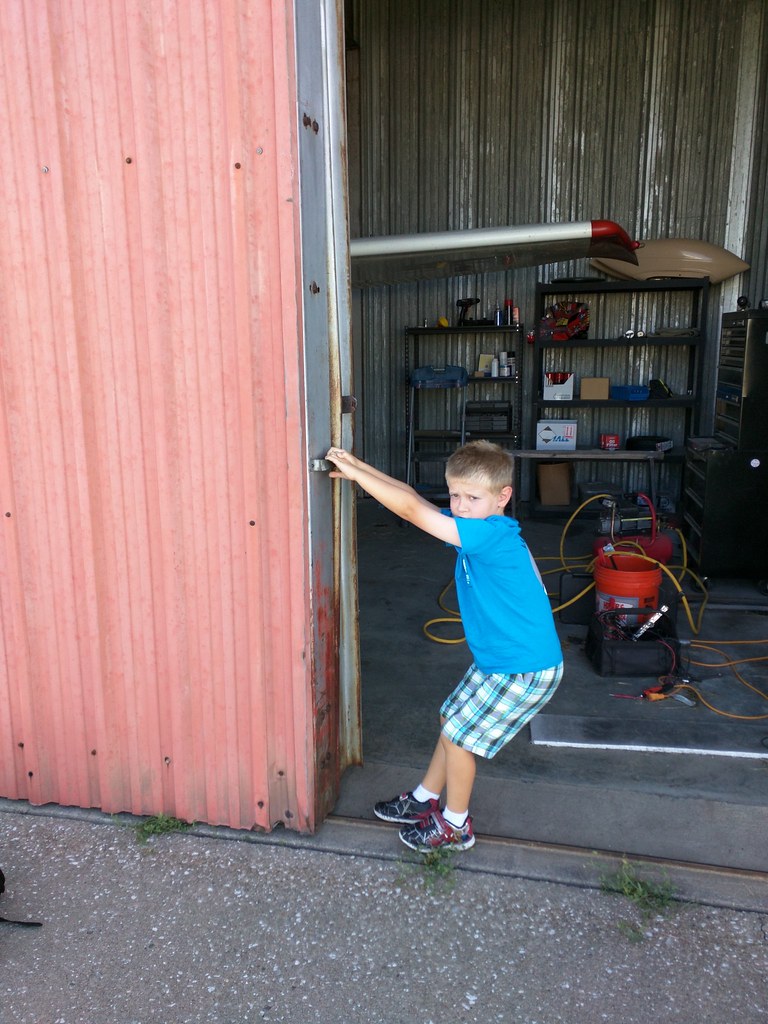
IMG_8515 This is morning. Time to fly. Two boys, happy to open the hangar door and get the plane ready. It s been a year since I passed the FAA exam and became a pilot. Memories like these are my favorite reminders why I did. It is such fun to see people s faces light up with the joy of flying a few thousand feet above ground, of the beauty and freedom and peace of the skies. I ve flown 14 different passengers in that time; almost every flight I ve taken has been with people, which I enjoy. I ve heard wow or beautiful so many times, and said it myself even more times. IMG_6083 I ve landed in two state parks, visited any number of wonderful small towns, seen historic sites and placid lakes, ascended magically over forests and plains. I ve landed at 31 airports in 10 states, flying over 13,000 miles. airports Not once have I encountered anyone other than friendly, kind, and outgoing. And why not? After all, we re working around magic flying carpet machines, right? IMG_7867_bw (That s my brother before a flight with me, by the way) Some weeks it is easy to be glum. This week has been that way for many, myself included. But then, whether you are in the air or on the ground, if you pay attention, you realize we still live in a beautiful world with many wonderful people. And, in fact, I got a reminder of that this week. Not long after the election, I got in a plane, pushed in the throttle, and started the takeoff roll down a runway in the midst of an Indiana forest. The skies were the best kind of clear blue, and pretty soon I lifted off and could see for miles. Off in the distance, I could see the last cottony remnants of the morning s fog, lying still in the valleys, surrounding the little farms and houses as if to give them a loving hug. Wow. Sometimes the flight is bumpy. Sometimes the weather doesn t cooperate, and it doesn t happen at all. Sometimes you can fly across four large states and it feels as smooth as glass the whole way. Whatever happens, at the end of the day, the magic flying carpet machine gets locked up again. We go home, rest our heads on our soft pillows, and if we so choose, remember the beauty we experienced that day. Really, this post is not about being a pilot. This post is a reminder to pay attention to all that is beautiful in this world. It surrounds us; the smell of pine trees in the forest, the delight in the faces of children, the gentle breeze in our hair, the kind word from a stranger, the very sunrise. I hope that more of us will pay attention to the moments of clear skies and wind at our back. Even at those moments when we pull the hangar door shut. IMG_20160716_093627

11 November 2016

Jonathan Dowland: Vinyl is killing Vinyl (but that's ok)

I started buying vinyl records about 16 years ago, but recently I've become a bit uncomfortable being identified as a "vinyl lover". The market is ascendant, with vinyl album sales growing for 8 consecutive years, at least in the UK. So why am I uncomfortable about it? A quick word about audio fidelity/quality here. I don't subscribe to the school of thought that audio on vinyl is inherently better than digital audio, far from it. I'm aware of its limitations. For recordings that I love, I try to seek out the best quality version available, which is almost always digital. Some believe that vinyl is immune to the "loudness war" brickwall mastering plaguing some modern releases, but for some of the worst offenders (Depeche Mode's Playing The Angel; Red Hot Chili Pepper's Californication) I haven't found the vinyl masterings to sound any different. 16 years ago Let's go back to why I started buying vinyl. Back when I started, the world was a very different place to what it is today. You could not buy most music in a digital form: it was 3 more years before the iTunes Store was opened, and it was Mac-only at first, and the music it sold was DRM-crippled for the first 5 or so years afterwards. The iPod had not been invented yet and there was no real market for personal music players. Minidiscs were still around, but Net-MD (the only sanctioned way to get digital music onto them from a computer) was terrible.
old-ish LPs old-ish LPs
Buying vinyl 16 years ago was a way to access music that was otherwise much harder to reach. There were still plenty of albums, originally recorded and released before CDs, which either had not been re-issued digitally at all, or had been done so early, and badly. Since vinyl was not fashionable, the second hand market was pretty cheap. I bought quite a lot of stuff for pennies at markets and car boot sales. Some music such as b-sides and 12" mixes and other mixes prepared especially for the format remains unavailable and uncollected on CD. (I'm a big fan of the B-side culture that existed prior to CDs. I might write more about that one day.) 10 years ago
modern-ish 7 inches modern-ish 7 inches
Fast forward to around 10 years ago. Ephemeral digital music is now much more common, the iPod and PMPs are well established. High-street music stores start to close down, including large chains like MOS, Our Price, and Virgin. Streaming hasn't particularly taken off yet, attempts to set up digital radio stations are fought by the large copyright owners. Vinyl is still not particularly fashionable, but it is still being produced, in particular for singles for up-and-coming bands in 7" format. You can buy a 7" single for between 1 and 4, getting the b-side with it. The b-side is often exclusive to the 7" release as an incentive to collectors. I was very prepared to punt 1-2 on a single from a group I was not particularly familiar with just to see what they were like. I discovered quite a lot of artists this way. One of the songs we played at our wedding was such an exclusive: a recording of the Zutons' covering Jackie Wilson's "Higher and Higher", originally broadcast once on Colin Murray's Evening Session radio show. Now
Vangelis - Blade Runner OST An indulgence
So, where are we now? Vinyl album sales are a huge growth market. They are very fashionable. Many purchasers are younger people who are new to the format; it's believed many don't have the means to play the music on the discs. Many (most?) albums are now issued as 12" vinyl in parallel with digital releases. These are usually exactly the same product (track listing, mixes, etc.) and usually priced at exactly twice that of the CD (with digital prices normally a fraction under that). The second hand market for 12" albums has inflated enormously. Gone are the bargains that could be had, a typical second hand LP is now priced quite close to the digital price for a popular/common album in most places. The popularity of vinyl has caused a huge inflation in the price of most 7" singles, which average somewhere between 8- 10 each, often without any b-side whatsoever. The good news is from my observations the 2nd hand market for 7" singles hasn't been affected quite as much. I guess they are not as desirable to buyers. The less said about Record Store Day, the better. So, that's all quite frustrating. But most of the reasons I used to buy vinyl have gone away anyway. Many of the rushed-to-market CD masterings have been reworked and reissued, correcting the earlier problems. B-side compilations are much more common so there are far fewer obscure tracks or mixes, and when the transfer has been done right, you're getting those previously-obscure tracks in a much higher quality. Several businesses exist to sell 2nd hand CDs for rock bottom prices, so it's still possible to get popular music very cheaply. The next thing to worry about is probably streaming services.

7 November 2016

Daniel Pocock: Quickstart SDR with gqrx, GNU Radio and the RTL-SDR dongle

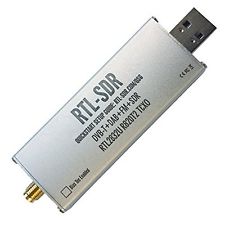
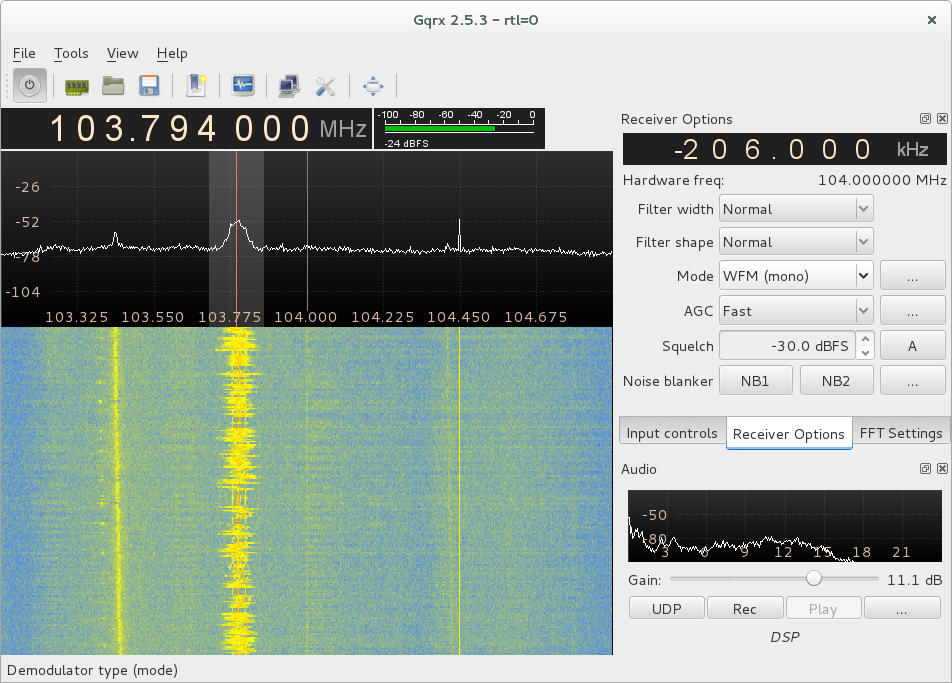
Software Defined Radio (SDR) provides many opportunities for both experimentation and solving real-world problems. It is not exactly a new technology but it has become significantly more accessible due to the increases in desktop computing power (for performing the DSP functions) and simultaneous reduction in the cost of SDR hardware. Thanks to the availability of a completely packaged gqrx and GNU Radio solution, you can now get up and running in less than half an hour and spending less than fifty dollars/pounds/euros. We provided a full demo of the Debian Hams gqrx solution at Mini DebConf Vienna (video) and hope to provide a similar demo at MiniDebConf Cambridge on the coming weekend of 12-13 November. gqrx is also available for Fedora users. Choosing hardware There are many different types of hardware, ranging from the low-cost RTL-SDR USB dongles to full duplex multi-transceiver systems. My recommendation is to start with an RTL-SDR dongle due to extremely low cost, this will give you an opportunity to reflect on the opportunities of this technology before putting money into one of the transceivers and their accessories. The RTL-SDR dongle also benefits from being a small self-contained solution that you can carry around and experiment with or demo just about anywhere. Important: Don't buy the cheapest generic RTL TV/radio receivers. It is absolutely essential to buy one of the units that has been explicitly promoted for SDR. These typically have a temperature compensated crystal oscillator (TCXO) which is absolutely essential for the reception of narrowband voice and digital signals. Without this, it is only possible to receive wideband broadcash FM radio and TV channels. For those who want to try it out with us at MiniDebConf Cambridge, Technofix has UK stock (online ordering), they are about 26. Getting gqrx up and running fast Note: to avoid the wrong kernel module being loaded automatically, it is recoemmended that you don't connect the RTL-SDR dongle before you install the packages. If you did already connect it, you may need to reboot or rmmod dvb_usb_rtl28xxu. If you are using a Debian jessie system, you can get all the necessary packages from jessie-backports. If you haven't already enabled backports, you can do so with a command like this:
$ sudo echo "deb http://ftp.ch.debian.org/debian jessie-backports main" >> /etc/apt/sources.list
Make sure your local index is updated and then install the necessary packages:
$ sudo apt-get update
$ sudo apt-get install -t jessie-backports gqrx-sdr rtl-sdr
Running it for the first time Once the packages are installed, connect the RTL-SDR dongle to the computer and then start the gqrx GUI from a terminal:
$ gqrx
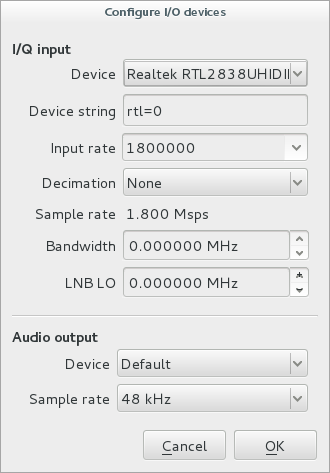
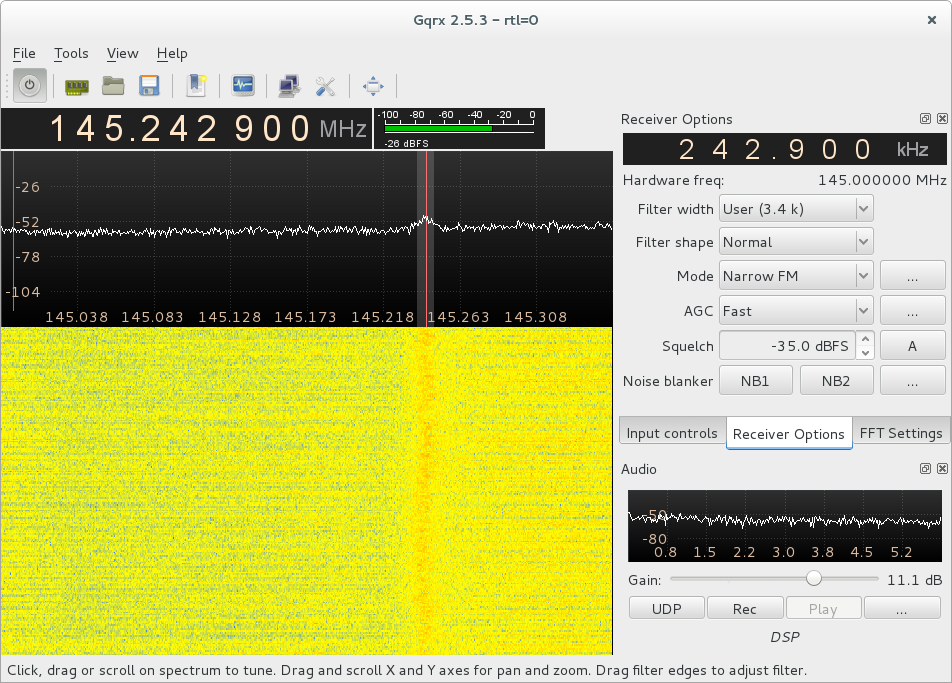
If the GUI fails to appear, look carefully at the error messages. It may be that the wrong kernel module has been loaded. The properties window appears, select the RTL-SDR dongle: Now the main screen will appear. Choose the wideband FM mode "WFM (mono)" and change the frequency to a value in the FM broadcast band such as 100MHz. Click the "Power on" button in the top left corner, just under the "File" menu, to start reception. Click in the middle of a strong signal to tune to that station. If you don't hear anything, check the squelch setting (it should be more negative than the signal strength value) and increase the Gain control at the bottom right hand side of the window. Looking for ham / amateur radio signals A popular band for hams is between 144 - 148 MHz (in some countries only a subset of this band is used). This is referred to as the two-meter band, as that is the wavelength at this frequency. Hams often use the narrowband FM mode in this band, especially with repeater stations. Change the "Mode" setting from "WFM" to "Narrow FM" and change the frequency to a value in the middle of the band. Look for signals in the radio spectrum and click on them to hear them. If you are not sure which part of the band to look in, search for the two-meter band plan for your country/region and look for the repeater output frequencies in the band plan.

23 October 2016

Vincent Sanders: Rabbit of Caerbannog

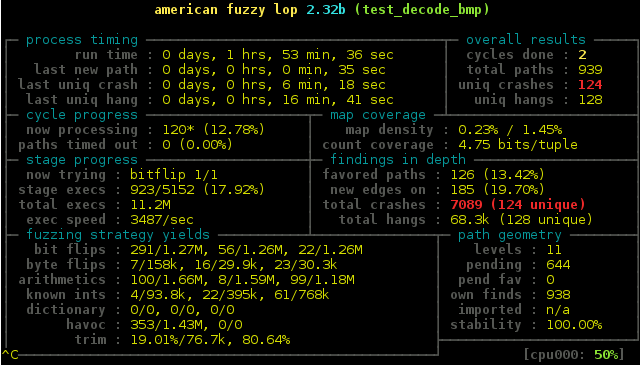
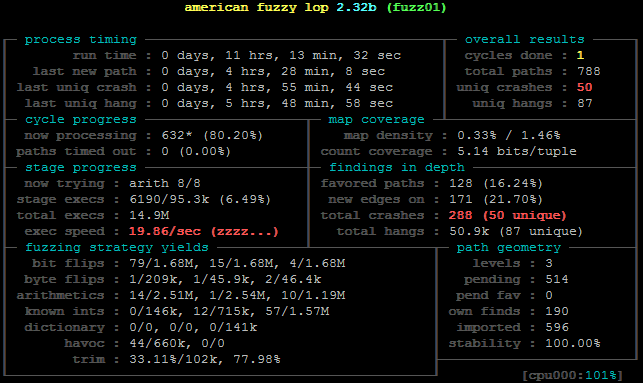
Subsequent to my previous use of American Fuzzy Lop (AFL) on the NetSurf bitmap image library I applied it to the gif library which, after fixing the test runner, failed to produce any crashes but did result in a better test corpus improving coverage above 90%

I then turned my attention to the SVG processing library. This was different to the bitmap libraries in that it required parsing a much lower density text format and performing operations on the resulting tree representation.

The test program for the SVG library needed some improvement but is very basic in operation. It takes the test SVG, parses it using libsvgtiny and then uses the parsed output to write out an imagemagick mvg file.

The libsvg processing uses the NetSurf DOM library which in turn uses an expat binding to parse the SVG XML text. To process this with AFL required instrumenting not only the XVG library but the DOM library. I did not initially understand this and my first run resulted in a "map coverage" indicating an issue. Helpfully the AFL docs do cover this so it was straightforward to rectify.

Once the test program was written and environment set up an AFL run was started and left to run. The next day I was somewhat alarmed to discover the fuzzer had made almost no progress and was running very slowly. I asked for help on the AFL mailing list and got a polite and helpful response, basically I needed to RTFM.

I must thank the members of the AFL mailing list for being so helpful and tolerating someone who ought to know better asking dumb questions.

After reading the fine manual I understood I needed to ensure all my test cases were as small as possible and further that the fuzzer needed a dictionary as a hint to the file format because the text file was of such low data density compared to binary formats.

Rabbit of Caerbannog. Death awaits you with pointy teeth
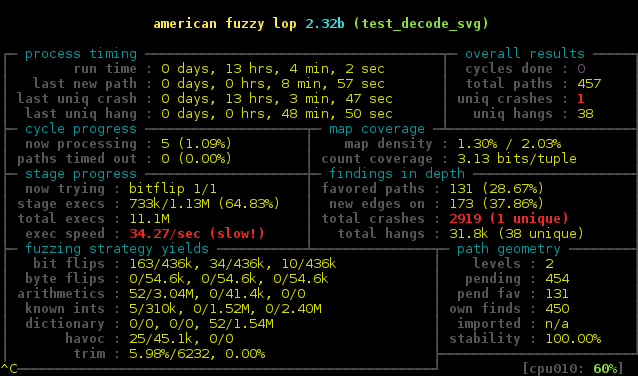
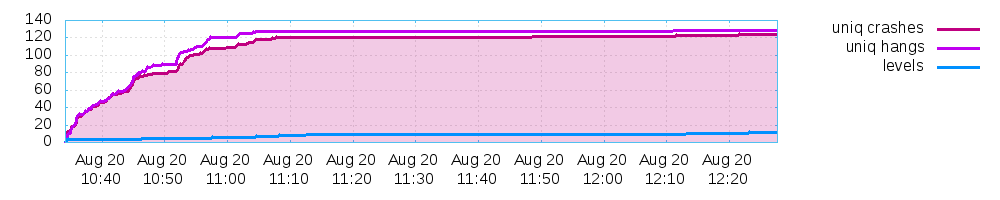
I crafted an SVG dictionary based on the XML one, ensured all the seed SVG files were as small as possible and tried again. The immediate result was thousands of crashes, nothing like being savaged by a rabbit to cause a surprise.

Not being in possession of the appropriate holy hand grenade I resorted instead to GDB and electric fence. Unlike the bitmap library crashes memory bounds issues simply did not feature in the crashes.Instead they mainly centered around actual logic errors when constructing and traversing the data structures.

For example Daniel Silverstone fixed an interesting bug where the XML parser binding would try and go "above" the root node in the tree if the source closed more tags than it opened which resulted in wild pointers and NULL references.

I found and squashed several others including dealing with SVG which has no valid root element and division by zero errors when things like colour gradients have no points.

I find it interesting that the type and texture of the crashes completely changed between the SVG and binary formats. Perhaps it is just the nature of the textural formats that causes this although it might be due to the techniques used to parse the formats.

Once all the immediately reproducible crashes were dealt with I performed a longer run. I used my monster system as previously described and ran the fuzzer for a whole week.

Summary stats
=============

Fuzzers alive : 10
Total run time : 68 days, 7 hours
Total execs : 9268 million
Cumulative speed : 15698 execs/sec
Pending paths : 0 faves, 2501 total
Pending per fuzzer : 0 faves, 250 total (on average)
Crashes found : 9 locally unique

After burning almost seventy days of processor time AFL found me another nine crashes and possibly more importantly a test corpus that generates over 90% coverage.

A useful tool that AFL provides is afl-cmin. This reduces the number of test files in a corpus to only those that are required to exercise all the code paths reached by the test set. In this case it reduced the number of files from 8242 to 2612

afl-cmin -i queue_all/ -o queue_cmin -- test_decode_svg @@ 1.0 /dev/null
corpus minimization tool for afl-fuzz by

[+] OK, 1447 tuples recorded.
[*] Obtaining traces for input files in 'queue_all/'...
Processing file 8242/8242...
[*] Sorting trace sets (this may take a while)...
[+] Found 23812 unique tuples across 8242 files.
[*] Finding best candidates for each tuple...
Processing file 8242/8242...
[*] Sorting candidate list (be patient)...
[*] Processing candidates and writing output files...
Processing tuple 23812/23812...
[+] Narrowed down to 2612 files, saved in 'queue_cmin'.

Additionally the actual information within the test files can be minimised with the afl-tmin tool. This must be run on each file individually and can take a relatively long time. Fortunately with GNU parallel one can run many of these jobs simultaneously which merely required another three days of CPU time to process. The resulting test corpus weighs in at a svelte 15 Megabytes or so against the 25 Megabytes before minimisation.

The result is yet another NetSurf library significantly improved by the use of AFL both from finding and squashing crashing bugs and from having a greatly improved test corpus to allow future library changes with a high confidence there will not be any regressions.

11 October 2016

Vincent Sanders: The pine stays green in winter... wisdom in hardship.

In December 2015 I saw the kickstarter for the Pine64. The project seemed to have a viable hardware design and after my experience with the hikey I decided it could not be a great deal worse.

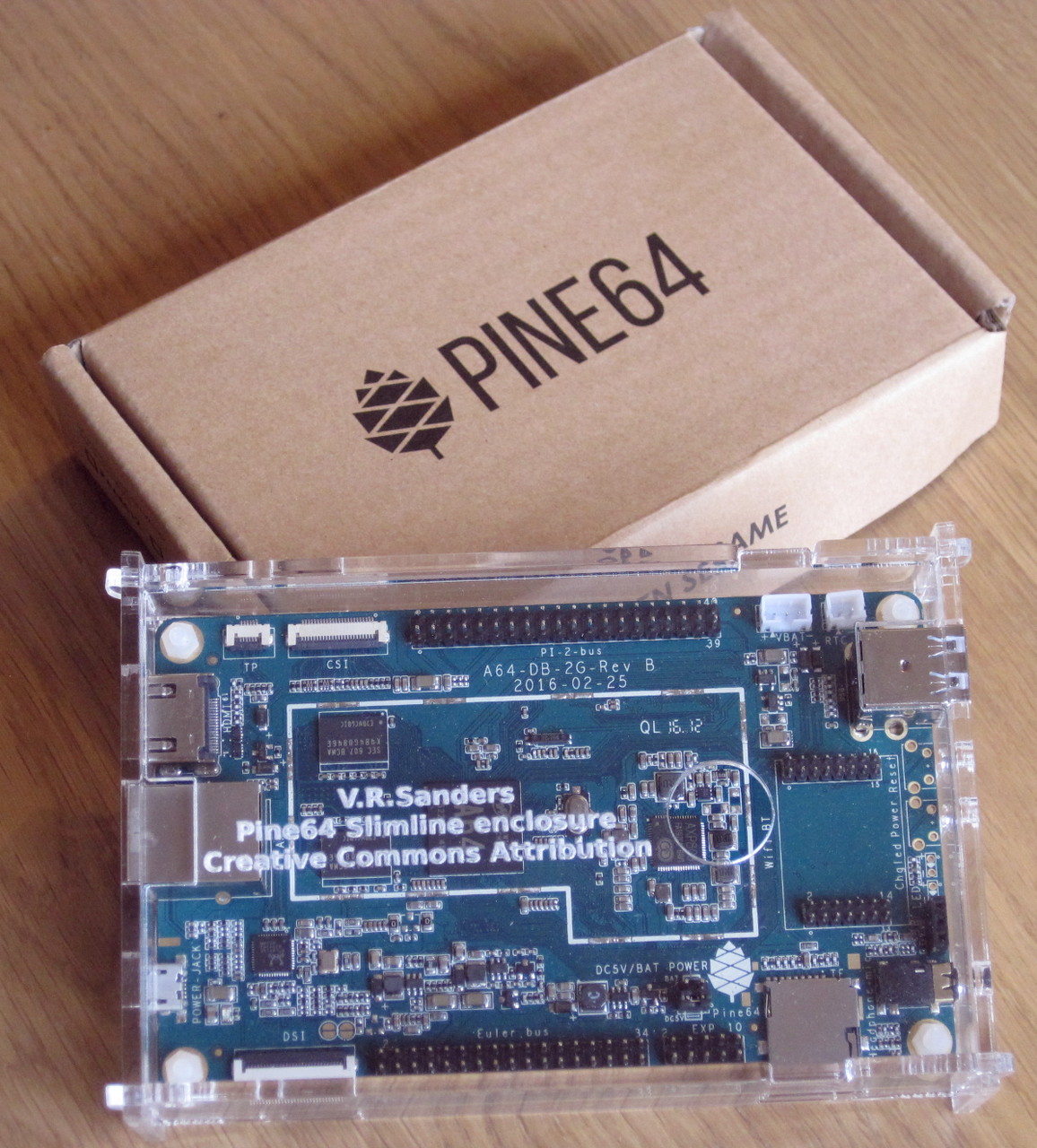
Pine64 board in my case design
The system I acquired comprises of:
Hardware based kickstarter projects are susceptible to several issues and the usual suspects occurred causing delays:
My personal view is that PINE 64 inc. handled it pretty well, much better than several other projects I have backed and as my Norman Douglas quotation suggests I think they have gained some wisdom from this.

I received my hardware at the beginning of April only a couple of months after their initial estimated shipping date which as these things go is not a huge delay. I understand some people who had slightly more complex orders were just receiving their orders in late June which is perhaps unfortunate but still well within kickstarter project norms.

As an aside: I fear that many people simply misunderstand the crowdfunding model for hardware projects and fail to understand that they are not buying a finished product, on the other side of the debate I think many projects need to learn expectation management much better than they do. Hyping the product to get interest is obviously the point of the crowdfunding platform, but over promising and under delivering always causes unhappy customers.

Pine64 board dimensions
Despite the delays in production and shipping the information available for the board was (and sadly remains) inadequate. As usual I wanted to case my board and there were no useful dimension drawings so I had to make my own from direct measurements together with a STL 3D model.

Also a mental sigh for "yet another poor form factor decision" so another special case size and design. After putting together a design and fabricating with the laser cutter I moved on to the software.

Once more this is where, once again, the story turns bleak. We find a very pretty website but no obvious link to the software (hint scroll to the bottom and find the "support" wiki link) once you find the wiki you will eventually discover that the provided software is either an Android 5.1.1 image (which failed to start on my board) or relies on some random guy from the forums who has put together his own OS images using a hacked up Allwinner Board Support Package (BSP) kernel.

Now please do not misunderstand me, I think the work by Simon Eisenmann (longsleep) to get a working kernel and Lenny Raposo to get viable OS images is outstanding and useful. I just feel that Allwinner and vendors like Pine64 Inc. should have provided something much, much better than they have. Even the efforts to get mainline support for this hardware are all completely volunteer community efforts and are are making slow progress as a result.

Assuming I wanted to run a useful OS on this hardware and not just use it as a modern work of art I installed a basic Debian arm64 using Lenny Raposo's pine64 pro site downloads. I was going to use the system for compiling and builds so used the "Debian Base" image to get a minimal setup. After generating unique ssh keys, renaming the default user and checking all the passwords and permissions I convinced myself the system was reasonably trustworthy.

The standard Debian Jessie OS runs as expected with few surprises. The main concern I have is that there are a number of unpackaged scripts installed (prefixed with pine64_) which perform several operations from reporting system health (using sysfs entries) to upgrading the kernel and bootloader.

While I understand these scripts have been provided for the novice users to reduce support burden, doing even more of the vendors job, I would much rather have had proper packages for these scripts, kernel and bootloader which apt could manage. This would have reduced image creation to a simple debootstrap giving much greater confidence in the images provenance.

The 3.10 based kernel is three years old at the time of writing and lacks a great number of features for the aarch64 ARM processors introduced since release. However I was pleasantly surprised at kvm apparently being available.

# dmesg grep -i kvm
[ 7.592896] kvm [1]: Using HYP init bounce page @b87c4000
[ 7.593361] kvm [1]: interrupt-controller@1c84000 IRQ25
[ 7.593778] kvm [1]: timer IRQ27
[ 7.593801] kvm [1]: Hyp mode initialized successfully

I installed the libvirt packages (and hence all their dependencies like qemu) and created a bridge ready for the virtual machines.

I needed access to storage for the host disc images and while I could have gone the route of using USB attached SATA as with the hikey I decided to try and use network attached storage instead. Initially I investigated iSCSI but it seems the Linux target (iSCSI uses initiator for client and target for server) support is either old, broken or unpackaged.

I turned to network block device (nbd) which is packaged and seems to have reasonable stability out of the box on modern distributions. This appeared to work well, indeed over the gigabit Ethernet interface I managed to get a sustained 40 megabytes a second read and write rate in basic testing. This is better performance than a USB 2.0 attached SSD on the hikey

I fired up the guest and perhaps I should have known better than to expect a 3.10 vendor kernel to cope. The immediate hard crashes despite tuning many variables convinced me that virtualisation was not viable with this kernel.

So abandoning that approach I attempted to run the CI workload directly on the system. To my dismay this also proved problematic. The processor has the bad habit of throttling due to thermal issues (despite a substantial heatsink) and because the storage is network attached throttling the CPU also massively impacts I/O.

The limitations meant that the workload caused the system to move between high performance and almost no progress on a roughly ten second cycle. This caused a simple NetSurf recompile CI job to take over fifteen minutes. For comparison the same task takes the armhf builder (CubieTruck) four minutes and a 64 bit x86 build which takes around a minute.

If the workload is tuned to a single core which does not trip thermal throttling the build took seven minutes. which is almost identical to the existing single core virtual machine instance running on the hikey.

In conclusion the Pine64 is an interesting bit of hardware with fatally flawed software offering. Without Simon and Lenny providing their builds to the community the device would be practically useless rather than just performing poorly. There appears to have been no progress whatsoever on the software offering from Pine64 in the six months since I received the device and no prospect of mainline Allwinner support for the SoC either.

Effectively I have spent around 50usd (40 for the board and 10 for the enclosure) on a failed experiment. Perhaps in the future the software will improve sufficiently for it to become useful but I do not hold out much hope that this will come from Pine64 themselves.

9 October 2016

Ben Armstrong: Annual Hike with Ryan: Salt Marsh Trail, 2016

Once again, Ryan Neily and I met last month for our annual hike. This year, to give our aging knees a break, we visited the Salt Marsh Trail for the first time. For an added level of challenge and to access the trail by public transit, we started with the Shearwater Flyer Trail and finished with the Heritage Trail. It was a perfect day both for hiking and photography: cool with cloud cover and a refreshing coastal breeze. The entire hike was over 25 km and took the better part of the day to complete. Good times, great conversations, and I look forward to visiting these beautiful trails again!
Salt Marsh trail hike, 2016. Click to start the slideshow.Salt Marsh trail hike, 2016. Click to start the slideshow.
We start here, on the Shearwater flyer trail.We start here, on the Shearwater flyer trail.
Couldn t ID this bush. The berries are spectacular! A pond to the side of the trail. Different angle for dramatic lighting effect. Rail bridge converted to foot bridge. Cranberries! Reviewing our progress. From the start Map of the Salt Marsh trail ahead. Off we go again! First glimpse through the trees. Appreciating the cloud cover today. Salt-marshy grasses. Never far from rocks in NS. Rocks all laid out in stripes. Lunch & selfie time. Ryan attacking his salad. Vantage point. A bit of causeway coast. Plenty of eel grass. Costal flora. We head for the bridge next. Impressed by the power of the flow beneath. Snapping more marsh shots. Ripples. Gulls, and if you squint, a copter. More ripples. Swift current along this channel. Until it broadens out and slows down. Nearly across. Heron! Sorry it s so tiny. Heron again, before I lost it. Ducks at the head of the Atlantic View trail where we rested and then turned back. Attempt at artsy. Nodding ladies tresses on the way back. Several of them. Sky darkening, but we still have time. A lonely wild rose. The last gasp of late summer. Back across the marshes. A short breather on the Heritage Trail.
Here s the Strava record of our hike:
Facebooktwittergoogle_plusredditpinterestlinkedinmail

Craig Sanders: Converting to a ZFS rootfs

My main desktop/server machine (running Debian sid) at home has been running XFS on mdadm raid-1 on a pair of SSDs for the last few years. A few days ago, one of the SSDs died. I ve been planning to switch to ZFS as the root filesystem for a while now, so instead of just replacing the failed drive, I took the opportunity to convert it. NOTE: at this point in time, ZFS On Linux does NOT support TRIM for either datasets or zvols on SSD. There s a patch almost ready (TRIM/Discard support from Nexenta #3656), so I m betting on that getting merged before it becomes an issue for me. Here s the procedure I came up with: 1. Buy new disks, shutdown machine, install new disks, reboot. The details of this stage are unimportant, and the only thing to note is that I m switching from mdadm RAID-1 with two SSDs to ZFS with two mirrored pairs (RAID-10) on four SSDs (Crucial MX300 275G at around $100 AUD each, they re hard to resist). Buying four 275G SSDs is slightly more expensive than buying two of the 525G models, but will perform a lot better. When installed in the machine, they ended up as /dev/sdp, /dev/sdq, /dev/sdr, and /dev/sds. I ll be using the symlinks in /dev/disk/by-id/ for the zpool, but for partition and setup, it s easiest to use the /dev/sd? device nodes. 2. Partition the disks identically with gpt partition tables, using gdisk and sgdisk. I need: ZFS On Linux uses partition type bf08 ( Solaris Reserved 1 ) natively, but doesn t seem to care what the partition types are for ZIL and L2ARC. I arbitrarily used bf08 ( Solaris Reserved 2 ) and bf09 ( Solaris Reserved 3 ) for easy identification. I ll set these up later, once I ve got the system booted I don t want to risk breaking my existing zpools by taking away their ZIL and L2ARC (and forgetting to zpool remove them, which I might possibly have done once) if I have to repartition. I used gdisk to interactively set up the partitions:
# gdisk -l /dev/sdp
GPT fdisk (gdisk) version 1.0.1
Partition table scan:
  MBR: protective
  BSD: not present
  APM: not present
  GPT: present
Found valid GPT with protective MBR; using GPT.
Disk /dev/sdp: 537234768 sectors, 256.2 GiB
Logical sector size: 512 bytes
Disk identifier (GUID): 4234FE49-FCF0-48AE-828B-3C52448E8CBD
Partition table holds up to 128 entries
First usable sector is 34, last usable sector is 537234734
Partitions will be aligned on 8-sector boundaries
Total free space is 6 sectors (3.0 KiB)
Number  Start (sector)    End (sector)  Size       Code  Name
   1              40            2047   1004.0 KiB  EF02  BIOS boot partition
   2            2048         2099199   1024.0 MiB  EF00  EFI System
   3         2099200         6293503   2.0 GiB     8300  Linux filesystem
   4         6293504        14682111   4.0 GiB     8200  Linux swap
   5        14682112       455084031   210.0 GiB   BF07  Solaris Reserved 1
   6       455084032       459278335   2.0 GiB     BF08  Solaris Reserved 2
   7       459278336       537234734   37.2 GiB    BF09  Solaris Reserved 3
I then cloned the partition table to the other three SSDs with this little script: clone-partitions.sh
#! /bin/bash
src='sdp'
targets=( 'sdq' 'sdr' 'sds' )
for tgt in "$ targets[@] "; do
  sgdisk --replicate="/dev/$tgt" /dev/"$src"
  sgdisk --randomize-guids "/dev/$tgt"
done
3. Create the mdadm for /boot, the zpool, and and the root filesystem. Most rootfs on ZFS guides that I ve seen say to call the pool rpool, then create a dataset called "$(hostname)-1" and then create a ROOT dataset under that. so on my machine, that would be rpool/ganesh-1/ROOT. Some reverse the order of hostname and the rootfs dataset, for rpool/ROOT/ganesh-1. There might be uses for this naming scheme in other environments but not in mine. And, to me, it looks ugly. So I ll use just $(hostname)/root for the rootfs. i.e. ganesh/root I wrote a script to automate it, figuring I d probably have to do it several times in order to optimise performance. Also, I wanted to document the procedure for future reference, and have scripts that would be trivial to modify for other machines. create.sh
#! /bin/bash
exec &> ./create.log
hn="$(hostname -s)"
base='ata-Crucial_CT275MX300SSD1_'
md='/dev/md0'
md_part=3
md_parts=( $(/bin/ls -1 /dev/disk/by-id/$ base *-part$ md_part ) )
zfs_part=5
# 4 disks, so use the top half and bottom half for the two mirrors.
zmirror1=( $(/bin/ls -1 /dev/disk/by-id/$ base *-part$ zfs_part    head -n 2) )
zmirror2=( $(/bin/ls -1 /dev/disk/by-id/$ base *-part$ zfs_part    tail -n 2) )
# create /boot raid array
mdadm "$md" --create \
    --bitmap=internal \
    --raid-devices=4 \
    --level 1 \
    --metadata=0.90 \
    "$ md_parts[@] "
mkfs.ext4 "$md"
# create zpool
zpool create -o ashift=12 "$hn" \
    mirror "$ zmirror1[@] " \
    mirror "$ zmirror2[@] "
# create zfs rootfs
zfs set compression=on "$hn"
zfs set atime=off "$hn"
zfs create "$hn/root"
zpool set bootfs="$hn/root"
# mount the new /boot under the zfs root
mount "$md" "/$hn/root/boot"
If you want or need other ZFS datasets (e.g. for /home, /var etc) then create them here in this script. Or you can do that later after you ve got the system up and running on ZFS. If you run mysql or postgresql, read the various tuning guides for how to get best performance for databases on ZFS (they both need their own datasets with particular recordsize and other settings). If you download Linux ISOs or anything with bit-torrent, avoid COW fragmentation by setting up a dataset to download into with recordsize=16K and configure your BT client to move the downloads to another directory on completion. I did this after I got my system booted on ZFS. For my db, I stoppped the postgres service, renamed /var/lib/postgresql to /var/lib/p, created the new datasets with:
zfs create -o recordsize=8K -o logbias=throughput -o mountpoint=/var/lib/postgresql \
  -o primarycache=metadata ganesh/postgres
zfs create -o recordsize=128k -o logbias=latency -o mountpoint=/var/lib/postgresql/9.6/main/pg_xlog \
  -o primarycache=metadata ganesh/pg-xlog
followed by rsync and then started postgres again. 4. rsync my current system to it. Logout all user sessions, shut down all services that write to the disk (postfix, postgresql, mysql, apache, asterisk, docker, etc). If you haven t booted into recovery/rescue/single-user mode, then you should be as close to it as possible everything non-esssential should be stopped. I chose not to boot to single-user in case I needed access to the web to look things up while I did all this (this machine is my internet gateway). Then:
hn="$(hostname -s)"
time rsync -avxHAXS -h -h --progress --stats --delete / /boot/ "/$hn/root/"
After the rsync, my 130GB of data from XFS was compressed to 91GB on ZFS with transparent lz4 compression. Run the rsync again if (as I did), you realise you forgot to shut down postfix (causing newly arrived mail to not be on the new setup) or something. You can do a (very quick & dirty) performance test now, by running zpool scrub "$hn". Then run watch zpool status "$hn". As there should be no errorss to correct, you should get scrub speeds approximating the combined sequential read speed of all vdevs in the pool. In my case, I got around 500-600M/s I was kind of expecting closer to 800M/s but that s good enough .the Crucial MX300s aren t the fastest drive available (but they re great for the price), and ZFS is optimised for reliability more than speed. The scrub took about 3 minutes to scan all 91GB. My HDD zpools get around 150 to 250M/s, depending on whether they have mirror or RAID-Z vdevs and on what kind of drives they have. For real benchmarking, use bonnie++ or fio. 5. Prepare the new rootfs for chroot, chroot into it, edit /etc/fstab and /etc/default/grub. This script bind mounts /proc, /sys, /dev, and /dev/pts before chrooting: chroot.sh
#! /bin/sh
hn="$(hostname -s)"
for i in proc sys dev dev/pts ; do
  mount -o bind "/$i" "/$ hn /root/$i"
done
chroot "/$ hn /root"
Change /etc/fstab (on the new zfs root to) have the zfs root and ext4 on raid-1 /boot:
/ganesh/root    /         zfs     defaults                                         0  0
/dev/md0        /boot     ext4    defaults,relatime,nodiratime,errors=remount-ro   0  2
I haven t bothered with setting up the swap at this point. That s trivial and I can do it after I ve got the system rebooted with its new ZFS rootfs (which reminds me, I still haven t done that :). add boot=zfs to the GRUB_CMDLINE_LINUX variable in /etc/default/grub. On my system, that s:
GRUB_CMDLINE_LINUX="iommu=noagp usbhid.quirks=0x1B1C:0x1B20:0x408 boot=zfs"
NOTE: If you end up needing to run rsync again as in step 4. above copy /etc/fstab and /etc/default/grub to the old root filesystem first. I suggest to /etc/fstab.zfs and /etc/default/grub.zfs 6. Install grub Here s where things get a little complicated. Running install-grub on /dev/sd[pqrs] is fine, we created the type ef02 partition for it to install itself into. But running update-grub to generate the new /boot/grub/grub.cfg will fail with an error like this:
/usr/sbin/grub-probe: error: failed to get canonical path of  /dev/ata-Crucial_CT275MX300SSD1_163313AADD8A-part5'.
IMO, that s a bug in grub-probe it should look in /dev/disk/by-id/ if it can t find what it s looking for in /dev/ I fixed that problem with this script: fix-ata-links.sh
#! /bin/sh
cd /dev
ln -s /dev/disk/by-id/ata-Crucial* .
After that, update-grub works fine. NOTE: you will have to add udev rules to create these symlinks, or run this script on every boot otherwise you ll get that error every time you run update-grub in future. 7. Prepare to reboot Unmount proc, sys, dev/pts, dev, the new raid /boot, and the new zfs filesystems. Set the mount point for the new rootfs to / umount-zfs-root.sh
#! /bin/sh
hn="$(hostname -s)"
md="/dev/md0"
for i in dev/pts dev sys proc ; do
  umount "/$ hn /root/$i"
done
umount "$md"
zfs umount "$ hn /root"
zfs umount "$ hn "
zfs set mountpoint=/ "$ hn /root"
zfs set canmount=off "$ hn "
8. Reboot Remember to configure the BIOS to boot from your new disks. The system should boot up with the new rootfs, no rescue disk required as in some other guides the rsync and chroot stuff has already been done. 9. Other notes 10. Useful references Reading these made it much easier to come up with my own method. Highly recommended. Converting to a ZFS rootfs is a post from: Errata

5 October 2016

Kees Cook: security things in Linux v4.8

Previously: v4.7. Here are a bunch of security things I m excited about in Linux v4.8: SLUB freelist ASLR Thomas Garnier continued his freelist randomization work by adding SLUB support. x86_64 KASLR text base offset physical/virtual decoupling On x86_64, to implement the KASLR text base offset, the physical memory location of the kernel was randomized, which resulted in the virtual address being offset as well. Due to how the kernel s -2GB addressing works (gcc s -mcmodel=kernel ), it wasn t possible to randomize the physical location beyond the 2GB limit, leaving any additional physical memory unused as a randomization target. In order to decouple the physical and virtual location of the kernel (to make physical address exposures less valuable to attackers), the physical location of the kernel needed to be randomized separately from the virtual location. This required a lot of work for handling very large addresses spanning terabytes of address space. Yinghai Lu, Baoquan He, and I landed a series of patches that ultimately did this (and in the process fixed some other bugs too). This expands the physical offset entropy to roughly $physical_memory_size_of_system / 2MB bits. x86_64 KASLR memory base offset Thomas Garnier rolled out KASLR to the kernel s various statically located memory ranges, randomizing their locations with CONFIG_RANDOMIZE_MEMORY. One of the more notable things randomized is the physical memory mapping, which is a known target for attacks. Also randomized is the vmalloc area, which makes attacks against targets vmalloced during boot (which tend to always end up in the same location on a given system) are now harder to locate. (The vmemmap region randomization accidentally missed the v4.8 window and will appear in v4.9.) x86_64 KASLR with hibernation Rafael Wysocki (with Thomas Garnier, Borislav Petkov, Yinghai Lu, Logan Gunthorpe, and myself) worked on a number of fixes to hibernation code that, even without KASLR, were coincidentally exposed by the earlier W^X fix. With that original problem fixed, then memory KASLR exposed more problems. I m very grateful everyone was able to help out fixing these, especially Rafael and Thomas. It s a hard place to debug. The bottom line, now, is that hibernation and KASLR are no longer mutually exclusive. gcc plugin infrastructure Emese Revfy ported the PaX/Grsecurity gcc plugin infrastructure to upstream. If you want to perform compiler-based magic on kernel builds, now it s much easier with CONFIG_GCC_PLUGINS! The plugins live in scripts/gcc-plugins/. Current plugins are a short example called Cyclic Complexity which just emits the complexity of functions as they re compiled, and Sanitizer Coverage which provides the same functionality as gcc s recent -fsanitize-coverage=trace-pc but back through gcc 4.5. Another notable detail about this work is that it was the first Linux kernel security work funded by Linux Foundation s Core Infrastructure Initiative. I m looking forward to more plugins! If you re on Debian or Ubuntu, the required gcc plugin headers are available via the gcc-$N-plugin-dev package (and similarly for all cross-compiler packages). hardened usercopy Along with work from Rik van Riel, Laura Abbott, Casey Schaufler, and many other folks doing testing on the KSPP mailing list, I ported part of PAX_USERCOPY (the basic runtime bounds checking) to upstream as CONFIG_HARDENED_USERCOPY. One of the interface boundaries between the kernel and user-space are the copy_to_user()/copy_from_user() family of functions. Frequently, the size of a copy is known at compile-time ( built-in constant ), so there s not much benefit in checking those sizes (hardened usercopy avoids these cases). In the case of dynamic sizes, hardened usercopy checks for 3 areas of memory: slab allocations, stack allocations, and kernel text. Direct kernel text copying is simply disallowed. Stack copying is allowed as long as it is entirely contained by the current stack memory range (and on x86, only if it does not include the saved stack frame and instruction pointers). For slab allocations (e.g. those allocated through kmem_cache_alloc() and the kmalloc()-family of functions), the copy size is compared against the size of the object being copied. For example, if copy_from_user() is writing to a structure that was allocated as size 64, but the copy gets tricked into trying to write 65 bytes, hardened usercopy will catch it and kill the process. For testing hardened usercopy, lkdtm gained several new tests: USERCOPY_HEAP_SIZE_TO, USERCOPY_HEAP_SIZE_FROM, USERCOPY_STACK_FRAME_TO,
USERCOPY_STACK_FRAME_FROM, USERCOPY_STACK_BEYOND, and USERCOPY_KERNEL. Additionally, USERCOPY_HEAP_FLAG_TO and USERCOPY_HEAP_FLAG_FROM were added to test what will be coming next for hardened usercopy: flagging slab memory as safe for copy to/from user-space , effectively whitelisting certainly slab caches, as done by PAX_USERCOPY. This further reduces the scope of what s allowed to be copied to/from, since most kernel memory is not intended to ever be exposed to user-space. Adding this logic will require some reorganization of usercopy code to add some new APIs, as PAX_USERCOPY s approach to handling special-cases is to add bounce-copies (copy from slab to stack, then copy to userspace) as needed, which is unlikely to be acceptable upstream. seccomp reordered after ptrace By its original design, seccomp filtering happened before ptrace so that seccomp-based ptracers (i.e. SECCOMP_RET_TRACE) could explicitly bypass seccomp filtering and force a desired syscall. Nothing actually used this feature, and as it turns out, it s not compatible with process launchers that install seccomp filters (e.g. systemd, lxc) since as long as the ptrace and fork syscalls are allowed (and fork is needed for any sensible container environment), a process could spawn a tracer to help bypass a filter by injecting syscalls. After Andy Lutomirski convinced me that ordering ptrace first does not change the attack surface of a running process (unless all syscalls are blacklisted, the entire ptrace attack surface will always be exposed), I rearranged things. Now there is no (expected) way to bypass seccomp filters, and containers with seccomp filters can allow ptrace again. That s it for v4.8! The merge window is open for v4.9

2016, Kees Cook. This work is licensed under a Creative Commons Attribution-ShareAlike 3.0 License.
Creative Commons License

3 October 2016

Kees Cook: security things in Linux v4.7

Previously: v4.6. Onward to security things I found interesting in Linux v4.7: KASLR text base offset for MIPS Matt Redfearn added text base address KASLR to MIPS, similar to what s available on x86 and arm64. As done with x86, MIPS attempts to gather entropy from various build-time, run-time, and CPU locations in an effort to find reasonable sources during early-boot. MIPS doesn t yet have anything as strong as x86 s RDRAND (though most have an instruction counter like x86 s RDTSC), but it does have the benefit of being able to use Device Tree (i.e. the /chosen/kaslr-seed property) like arm64 does. By my understanding, even without Device Tree, MIPS KASLR entropy should be as strong as pre-RDRAND x86 entropy, which is more than sufficient for what is, similar to x86, not a huge KASLR range anyway: default 8 bits (a span of 16MB with 64KB alignment), though CONFIG_RANDOMIZE_BASE_MAX_OFFSET can be tuned to the device s memory, giving a maximum of 11 bits on 32-bit, and 15 bits on EVA or 64-bit. SLAB freelist ASLR Thomas Garnier added CONFIG_SLAB_FREELIST_RANDOM to make slab allocation layouts less deterministic with a per-boot randomized freelist order. This raises the bar for successful kernel slab attacks. Attackers will need to either find additional bugs to help leak slab layout information or will need to perform more complex grooming during an attack. Thomas wrote a post describing the feature in more detail here: Randomizing the Linux kernel heap freelists. (SLAB is done in v4.7, and SLUB in v4.8.) eBPF JIT constant blinding Daniel Borkmann implemented constant blinding in the eBPF JIT subsystem. With strong kernel memory protections (CONFIG_DEBUG_RODATA) in place, and with the segregation of user-space memory execution from kernel (i.e SMEP, PXN, CONFIG_CPU_SW_DOMAIN_PAN), having a place where user-space can inject content into an executable area of kernel memory becomes very high-value to an attacker. The eBPF JIT was exactly such a thing: the use of BPF constants could result in the JIT producing instruction flows that could include attacker-controlled instructions (e.g. by directing execution into the middle of an instruction with a constant that would be interpreted as a native instruction). The eBPF JIT already uses a number of other defensive tricks (e.g. random starting position), but this added randomized blinding to any BPF constants, which makes building a malicious execution path in the eBPF JIT memory much more difficult (and helps block attempts at JIT spraying to bypass other protections). Elena Reshetova updated a 2012 proof-of-concept attack to succeed against modern kernels to help provide a working example of what needed fixing in the JIT. This serves as a thorough regression test for the protection. The cBPF JITs that exist in ARM, MIPS, PowerPC, and Sparc still need to be updated to eBPF, but when they do, they ll gain all these protections immediatley. Bottom line is that if you enable the (disabled-by-default) bpf_jit_enable sysctl, be sure to set the bpf_jit_harden sysctl to 2 (to perform blinding even for root). fix brk ASLR weakness on arm64 compat There have been a few ASLR fixes recently (e.g. ET_DYN, x86 32-bit unlimited stack), and while reviewing some suggested fixes to arm64 brk ASLR code from Jon Medhurst, I noticed that arm64 s brk ASLR entropy was slightly too low (less than 1 bit) for 64-bit and noticeably lower (by 2 bits) for 32-bit compat processes when compared to native 32-bit arm. I simplified the code by using literals for the entropy. Maybe we can add a sysctl some day to control brk ASLR entropy like was done for mmap ASLR entropy. LoadPin LSM LSM stacking is well-defined since v4.2, so I finally upstreamed a small LSM that implements a protection I wrote for Chrome OS several years back. On systems with a static root of trust that extends to the filesystem level (e.g. Chrome OS s coreboot+depthcharge boot firmware chaining to dm-verity, or a system booting from read-only media), it s redundant to sign kernel modules (you ve already got the modules on read-only media: they can t change). The kernel just needs to know they re all coming from the correct location. (And this solves loading known-good firmware too, since there is no convention for signed firmware in the kernel yet.) LoadPin requires that all modules, firmware, etc come from the same mount (and assumes that the first loaded file defines which mount is correct , hence load pinning ). That s it for v4.7. Prepare yourself for v4.8 next!

2016, Kees Cook. This work is licensed under a Creative Commons Attribution-ShareAlike 3.0 License.
Creative Commons License

30 September 2016

Bdale Garbee: Second Retirement

At the end of August 2012, I announced my Early Retirement from HP. Two years later, my friend and former boss Martin Fink successfully recruited me to return to what later became Hewlett Packard Enterprise, as an HPE Fellow working on open source strategy in his Office of the CTO. I'm proud of what I was was able to accomplish in the 25 months since then, but recent efforts to "simplify" HPE actually made things complicated for me. Between the announcement in late June that Martin intended to retire himself, and the two major spin-merger announcements involving Enterprise Services and Software... well... The bottom line is that today, 30 September 2016, is my last day at HPE. My plan is to "return to retirement" and work on some fun projects with my wife now that we are "empty nesters". I do intend to remain involved in the Free Software and open hardware worlds, but whether that might eventually involve further employment is something I'm going to try and avoid thinking about for a while... There is a rocket launch scheduled nearby this weekend, after all!

25 September 2016

Vincent Sanders: I'll huff, and I'll puff, and I'll blow your house in

Sometimes it really helps to have a different view on a problem and after my recent writings on my Public Suffix List (PSL) library I was fortunate to receive a suggestion from my friend Enrico Zini.

I had asked for suggestions on reducing the size of the library further and Enrico simply suggested Huffman coding. This was a technique I had learned about long ago in connection with data compression and the intervening years had made all the details fuzzy which explains why it had not immediately sprung to mind.

A small subset of the Public Suffix List as stored within libnspslHuffman coding named for David A. Huffman is an algorithm that enables a representation of data which is very efficient. In a normal array of characters every character takes the same eight bits to represent which is the best we can do when any of the 256 values possible is equally likely. If your data is not evenly distributed this is not the case for example if the data was english text then the value is fifteen times more likely to be that for e than k.

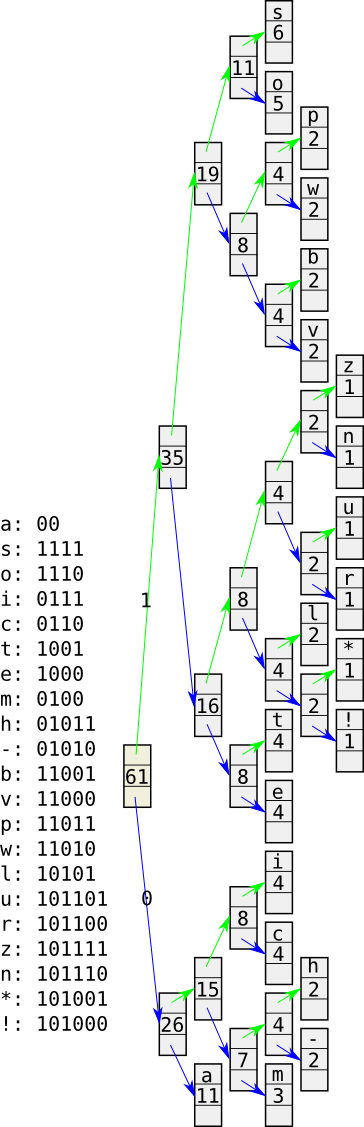
every step of huffman encoding tree build for the example string tableSo if we have some data with a non uniform distribution of probabilities we need a way the data be encoded with fewer bits for the common values and more bits for the rarer values. To be efficient we would need some way of having variable length representations without storing the length separately. The term for this data representation is a prefix code and there are several ways to generate them.

Such is the influence of Huffman on the area of prefix codes they are often called Huffman codes even if they were not created using his algorithm. One can dream of becoming immortalised like this, to join the ranks of those whose names are given to units or whole ideas in a field must be immensely rewarding, however given Huffman invented his algorithm and proved it to be optimal to answer a question on a term paper in his early twenties I fear I may already be a bit too late.

The algorithm itself is relatively straightforward. First a frequency analysis is performed, a fancy way of saying count how many of each character is in the input data. Next a binary tree is created by using a priority queue initialised with the nodes sorted by frequency.

The resulting huffman tree and the binary representation of the input symbols
The two least frequent items count is summed together and a node placed in the tree with the two original entries as child nodes. This step is repeated until a single node exists with a count value equal to the length of the input.

To encode data once simply walks the tree outputting a 0 for a left node or 1 for right node until reaching the original value. This generates a mapping of values to bit output, the input is then simply converted value by value to the bit output. To decode the data the data is used bit by bit to walk the tree to arrive at values.

If we perform this algorithm on the example string table *!asiabvcomcoopitamazonawsarsaves-the-whalescomputebasilicata we can reduce the 488 bits (61 * 8 bit characters) to 282 bits or 40% reduction. Obviously in a real application the huffman tree would need to be stored which would probably exceed this saving but for larger data sets it is probable this technique would yield excellent results on this kind of data.

Once I proved this to myself I implemented the encoder within the existing conversion program. Although my perl encoder is not very efficient it can process the entire PSL string table (around six thousand labels using 40KB or so) in less than a second, so unless the table grows massively an inelegant approach will suffice.

The resulting bits were packed into 32bit values to improve decode performance (most systems prefer to deal with larger memory fetches less frequently) and resulted in 18KB of output or 47% of the original size. This is a great improvement in size and means the statically linked test program is now 59KB and is actually smaller than the gzipped source data.

$ ls -alh test_nspsl
-rwxr-xr-x 1 vince vince 59K Sep 25 23:58 test_nspsl
$ ls -al public_suffix_list.dat.gz
-rw-r--r-- 1 vince vince 62K Sep 1 08:52 public_suffix_list.dat.gz

To be clear the statically linked program can determine if a domain is in the PSL with no additional heap allocations and includes the entire PSL ordered tree, the domain label string table and the huffman decode table to read it.

An unexpected side effect is that because the decode loop is small it sits in the processor cache. This appears to cause the string comparison function huffcasecmp() (which is not locale dependant because we know the data will be limited ASCII) performance to be close to using strcasecmp() indeed on ARM32 systems there is a very modest improvement in performance.

I think this is as much work as I am willing to put into this library but I am pleased to have achieved a result which is on par with the best of breed (libpsl still has a data representation 20KB smaller than libnspsl but requires additional libraries for additional functionality) and I got to (re)learn an important algorithm too.

20 September 2016

Vincent Sanders: If I see an ending, I can work backward.

Now while I am sure Arthur Miller was referring to writing a play when he said those words they have an oddly appropriate resonance for my topic.

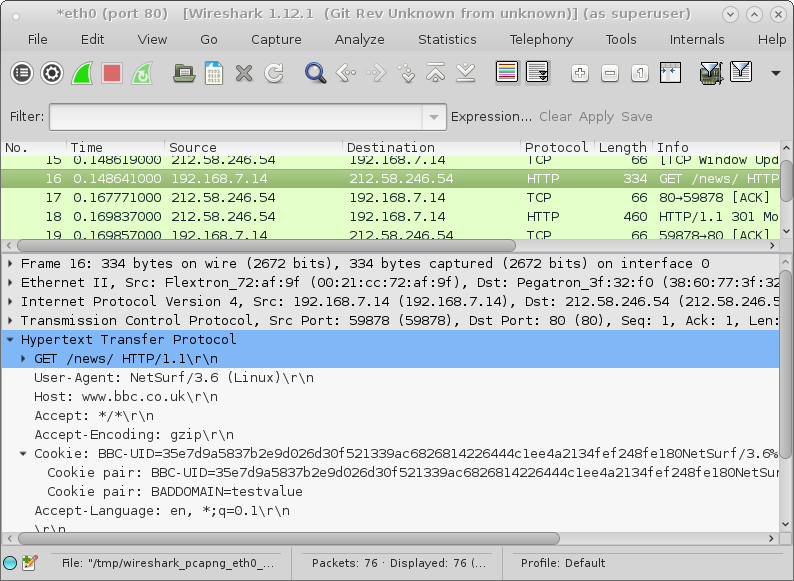
In the early nineties Lou Montulli applied the idea of magic cookies to HTTP to make the web stateful, I imagine he had no idea of the issues he was going to introduce for the future. Like most of the web technology it was a solution to an immediate problem which it has never been possible to subsequently improve.

Chocolate chip cookie are much tastier than HTTP cookiesThe HTTP cookie is simply a way for a website to identify a connecting browser session so that state can be kept between retrieving pages. Due to shortcomings in the design of cookies and implementation details in browsers this has lead to a selection of unwanted side effects. The specific issue that I am talking about here is the supercookie where the super prefix in this context has similar connotations as to when applied to the word villain.

Whenever the browser requests a resource (web page, image, etc.) the server may return a cookie along with the resource that your browser remembers. The cookie has a domain name associated with it and when your browser requests additional resources if the cookie domain matches the requested resources domain name the cookie is sent along with the request.

As an example the first time you visit a page on www.example.foo.invalid you might receive a cookie with the domain example.foo.invalid so next time you visit a page on www.example.foo.invalid your browser will send the cookie along. Indeed it will also send it along for any page on another.example.foo.invalid

A supercookies is simply one where instead of being limited to one sub-domain (example.foo.invalid) the cookie is set for a top level domain (foo.invalid) so visiting any such domain (I used the invalid name in my examples but one could substitute com or co.uk) your web browser gives out the cookie. Hackers would love to be able to set up such cookies and potentially control and hijack many sites at a time.

This problem was noted early on and browsers were not allowed to set cookie domains with fewer than two parts so example.invalid or example.com were allowed but invalid or com on their own were not. This works fine for top level domains like .com, .org and .mil but not for countries where the domain registrar had rules about second levels like the uk domain (uk domains must have a second level like .co.uk).

 NetSurf cookie manager showing a supercookieThere is no way to generate the correct set of top level domains with an algorithm so a database is required and is called the Public Suffix List (PSL). This database is a simple text formatted list with wildcard and inversion syntax and is at time of writing around 180Kb of text including comments which compresses down to 60Kb or so with deflate.

A few years ago with ICANN allowing the great expansion of top level domains the existing NetSurf supercookie handling was found to be wanting and I decided to implement a solution using the PSL. At this point in time the database was only 100Kb source or 40Kb compressed.

I started by looking at limited existing libraries. In fact only the regdom library was adequate but used 150Kb of heap to load the pre-processed list. This would have had the drawback of increasing NetSurf heap usage significantly (we still have users on 8Mb systems). Because of this and the need to run PHP script to generate the pre-processed input it was decided the library was not suitable.

Lacking other choices I came up with my own implementation which used a perl script to construct a tree of domains from the PSL in a static array with the label strings in a separate table. At the time my implementation added 70Kb of read only data which I thought reasonable and allowed for direct lookup of answers from the database.

This solution still required a pre-processing step to generate the C source code but perl is much more readily available, is a language already used by our tooling and we could always simply ship the generated file. As long as the generated file was updated at release time as we already do for our fallback SSL certificate root set this would be acceptable.

wireshark session shown NetSurf sending a co.uk supercookie to bbc.co.uk
I put the solution into NetSurf, was pleased no-one seemed to notice and moved on to other issues. Recently while fixing a completely unrelated issue in the display of session cookies in the management interface and I realised I had some test supercookies present in the display. After the initial "thats odd" I realised with horror there might be a deeper issue.

It quickly became evident the PSL generation was broken and had been for a long time, even worse somewhere along the line the "redundant" empty generated source file had been removed and the ancient fallback code path was all that had been used.

This issue had escalated somewhat from a trivial display problem. I took a moment to asses the situation a bit more broadly and came to the conclusion there were a number of interconnected causes, centered around the lack of automated testing, which could be solved by extracting the PSL handling into a "support" library.

NetSurf has several of these support libraries which could be used separately to the main browser project but are principally oriented towards it. These libraries are shipped and built in releases alongside the main browser codebase and mainly serve to make API more obvious and modular. In this case my main aim was to have the functionality segregated into a separate module which could be tested, updated and monitored directly by our CI system meaning the embarrassing failure I had found can never occur again.

Before creating my own library I did consider a library called libpsl had been created since I wrote my original implementation. Initially I was very interested in using this library given it managed a data representation within a mere 32Kb.

Unfortunately the library integrates a great deal of IDN and punycode handling which was not required in this use case. NetSurf already has to handle IDN and punycode translations and uses punycode encoded domain names internally only translating to unicode representations for display so duplicating this functionality using other libraries requires a great deal of resource above the raw data representation.

I put the library together based on the existing code generator Perl program and integrated the test set that comes along with the PSL. I was a little alarmed to discover that the PSL had almost doubled in size since the implementation was originally written and now the trivial test program of the library was weighing in at a hefty 120Kb.

This stemmed from two main causes:
  1. there were now many more domain label strings to be stored
  2. there now being many, many more nodes in the tree.
To address the first cause the length of the domain label strings was moved into the unused padding space within each tree node removing a byte from each domain label saving 6Kb. Next it occurred to me that while building the domain label string table that if the label to be added already existed as a substring within the table it could be elided.

The domain labels were sorted from longest to shortest and added in order searching for substring matches as the table was built this saved another 6Kb. I am sure there are ways to reduce this further I have missed (if you see them let me know!) but a 25% saving (47Kb to 35Kb) was a good start.

The second cause was a little harder to address. The structure representing nodes in the tree I started with was at first look reasonable.

struct pnode  
uint16_t label_index; /* index into string table of label */
uint16_t label_length; /* length of label */
uint16_t child_node_index; /* index of first child node */
uint16_t child_node_count; /* number of child nodes */
;

I examined the generated table and observed that the majority of nodes were leaf nodes (had no children) which makes sense given the type of data being represented. By allowing two types of node one for labels and a second for the child node information this would halve the node size in most cases and requiring only a modest change to the tree traversal code.

The only issue with this would be that a way to indicate a node has child information. It was realised that the domain labels can have a maximum length of 63 characters meaning their length can be represented in six bits so a uint16_t was excessive. The space was split into two uint8_t parts one for the length and one for a flag to indicate child data node followed.

union pnode  
struct
uint16_t index; /* index into string table of label */
uint8_t length; /* length of label */
uint8_t has_children; /* the next table entry is a child node */
label;
struct
uint16_t node_index; /* index of first child node */
uint16_t node_count; /* number of child nodes */
child;
;

static const union pnode pnodes[8580] =
/* root entry */
.label = 0, 0, 1 , .child = 2, 1553 ,
/* entries 2 to 1794 */
.label = 37, 2, 1 , .child = 1795, 6 ,

...

/* entries 8577 to 8578 */
.label = 31820, 6, 1 , .child = 8579, 1 ,
/* entry 8579 */
.label = 0, 1, 0 ,

;

This change reduced the node array size from 63Kb to 33Kb almost a 50% saving. I considered using bitfields to try and reduce the label length and has_children flag into a single byte but such packing will not reduce the length of a node below 32bits because it is unioned with the child structure.

A possibility of using the spare uint8_t derived by bitfield packing to store an additional label node in three other nodes was considered but added a great deal of complexity to node lookup and table construction for saving around 4Kb so was not incorporated.

With the changes incorporated the test program was a much more acceptable 75Kb reasonably close to the size of the compressed source but with the benefits of direct lookup. Integrating the libraries single API call into NetSurf was straightforward and resulted in correct operation when tested.

This episode just reminded me of the dangers of code that can fail silently. It exposed our users to a security problem that we thought had been addressed almost six years ago and squandered the limited resources of the project. Hopefully a lesson we will not have to learn again any time soon. If there is a positive to take away it is that the new implementation is more space efficient, automatically built and importantly tested

4 September 2016

Steinar H. Gunderson: Multitrack audio in Nageru 1.4.0

Even though the Chess Olympiad takes some attention right now, development on Nageru (my live video mixer) has continued steadily throughout since the 1.3.0 release. I wanted to take a little time to talk about the upcoming 1.4.0 release, and why things are as they are; writing down things often make them a bit clearer. Every major release of Nageru has had a specific primary focus: 1.0.0 was about just getting everything to work, 1.1.0 was about NVIDIA support for more oomph, 1.2.0 was about stabilization and polish (and added support for Blackmagic's PCI cards as a nice little bonus), and 1.3.0 was about x264 integration. For 1.4.0, I wanted to work on multitrack audio and mixing. Audio has always been a clear focus for Nageru, and for good reason; video is 90% about audio, and it's sorely neglected in most amateur productions (not to mention that processing tools are nearly non-existant in most free or cheap software video mixers). Right from the get-go, it's had a chain with proper leveling, compressors and most importantly visual monitoring, so that you know when things are not as they should be. However, it was also written with an assumption that there would be a single audio input source (one of the cameras), and that's going to change. Single-input is less of a showstopper than one'd think at first; you can work around it by buying a mixer, plug everything into that and then feed that signal into the computer. However, there are a few downsides: If you want camera audio, you'll need to pull more cable from each camera (or have SDI de-embedders). Your mixer is likely to require an extra power supply, and that means yet more cable (any decent USB video card can power over USB, so why shouldn't your audio?). You'll need to buy and transport yet another device. And so on. (If you already have a PA mixer, of course you can use it, but just reusing the PA mix as a stream mix rarely gives the best results, and mixing on an aux bus gives very little flexibility.) So for 1.4.0, I wanted something to get essentially the processing equivalent of a mid-range mixer. But even though my education is in DSP, my experience with mixers is rather limited, so I did the only reasonable thing and went over to a friend who's also an (award-winning) audio engineer. (It turns out that everything on a mixer is the way it is for a pretty good reason, tuned through 50+ years of collective audio experience. If you just try to make up something on your own without understanding what's going on, you have a 0.001% chance of stumbling upon some genius new way of doing things by accident, and a significantly larger chance than that of messing things up.) After some back and forth, we figured out a reasonable set of basic tools that would be useful in the right hands, and not too confusing for a beginner. So let's have a look at the new controls you get: Nageru expanded audio control view There's one set of these controls for each bus. (This is the expanded view; there's also a compact view that has only the meters and the fader, which is what you'll typically want to use during the run itself the expanded view is for setup and tweaking.) A bus in Nageru is a pair of channels (left/right), sourced from a video capture or ALSA card. The channel mapping is flexible; my USB sound card has 18 channels, for instance, and you can use that to make several buses. Each bus has a name (here I named it very creatively Main , but in a real setting you might want something like Blue microphone or Speaker PC ), which is just for convenience; it doesn't mean much. The most important parts of the mix are given the most screen estate, so even though the way through the signal chain is left-to-right top-to-bottom, I'll go over it in the opposite direction. By far the most important part is the audio level, so the fader naturally is very prominent. (Note that the scale is nonlinear; you want more resolution in the most important area.) Changing a fader with the mouse or keyboard is possible, and probably most people will be doing that, but Nageru will also support USB faders. These usually speak MIDI, for historical reasons, and there are some UI challenges when they're all so different, but you can get really small ones if you want to get that tactile feel without blowing up your budget or getting a bigger backpack. Then there's the meter to the left of that. Nageru already has R128 level meters in the mastering section (not shown here, but generally unchanged from 1.3.0), and those are kept as-is, but for each bus, you don't want to know loudness; you want to know recording levels, so you want a peak meter, not a loudness meter. In particular, you don't want the bus to send clipped data to the master (which would happen if you set it too high); Nageru can handle this situation pretty well (unlike most digital mixers, it mixes in full 32-bit floating-point so there's no internal clipping, and there's a limiter on the master by default), but it's still not a good place to be in, so you can see that being marked in red in this example. The meter doubles as an input peak check during setup; if you turn off all the effects and set the fader to neutral, you can see if the input hits peak or not, and then adjust it down. (Also, you can see here that I only have audio in the left channel; I'd better check my connections, or perhaps just use mono, by setting the right channel on the bus mapping to the same input as the left one.) The compressor (now moved from the mastering section to each bus) should be well-known for those using 1.3.0, but in this view, it also has a reduction meter, so that you can see whether it kicks in or not. Most casual users would want to just leave the gain staging and compressor settings alone, but a skilled audio engineer will know how to adjust these to each speaker's antics (some speak at a pretty even volume and thus can get a bit of headroom, while some are much more variable and need tighter settings). Finally (or, well, first), there's the EQ section. The lo-cut is again well-known from 1.3.0 (the cutoff frequency is the same across all buses), but there's now also a simple three-band EQ per bus. Simply ask the speaker to talk normally for a bit, and tweak the controls until it sounds good. People have different voices and different ways of holding the microphone, and if you have a reasonable ear, you can use the EQ to your advantage to make them sound a little more even on the stream. Either that, or just put it in neutral, and the entire EQ code will be bypassed. The code is making pretty good progress; all the DSP stuff is done (save for some optimizations I want to do in zita-resampler, now that the discussion flow is started again), and in theory, one could use it already as-is. However, there's a fair amount of gnarly support code that still needs to be written: In particular, I need to do some refactoring to support ALSA hotplug (you don't want your entire stream to go down just because an USB soundcard dropped out for a split second), and similarly some serialization of saving/loading bus mappings. It's not exactly rocket science, but all the code still needs to be written, and there are a number of corner cases to think of. If you want to peek, the code is in the multichannel_audio branch, but beware; I rebase/squash it pretty frequently, so if you pull from it, expect frequent git breakage.
22 August 2016

Vincent Sanders: Down the rabbit hole

My descent began with a user reporting a bug and I fear I am still on my way down.

Like Alice I headed down the hole. https://commons.wikimedia.org/wiki/File:Rabbit_burrow_entrance.jpg
The bug was simple enough, a windows bitmap file caused NetSurf to crash. Pretty quickly this was tracked down to the libnsbmp library attempting to decode the file. As to why we have a heavily used library for bitmaps? I am afraid they are part of every icon file and many websites still have favicons using that format.

Some time with a hex editor and the file format specification soon showed that the image in question was malformed and had a bad offset header entry. So I was faced with two issues, firstly that the decoder crashed when presented with badly encoded data and secondly that it failed to deal with incorrect header data.

This is typical of bug reports from real users, the obvious issues have already been encountered by the developers and unit tests formed to prevent them, what remains is harder to produce. After a debugging session with Valgrind and electric fence I discovered the crash was actually caused by running off the front of an allocated block due to an incorrect bounds check. Fixing the bounds check was simple enough as was working round the bad header value and after adding a unit test for the issue I almost moved on.

Almost...

american fuzzy lop are almost as cute as cats https://commons.wikimedia.org/wiki/File:Rabbit_american_fuzzy_lop_buck_white.jpg
We already used the bitmap test suite of images to check the library decode which was giving us a good 75% or so line coverage (I long ago added coverage testing to our CI system) but I wondered if there was a test set that might increase the coverage and perhaps exercise some more of the bounds checking code. A bit of searching turned up the american fuzzy lop (AFL) projects synthetic corpora of bmp and ico images.

After checking with the AFL authors that the images were usable in our project I added them to our test corpus and discovered a whole heap of trouble. After fixing more bounds checks and signed issues I finally had a library I was pretty sure was solid with over 85% test coverage.

Then I had the idea of actually running AFL on the library. I had been avoiding this because my previous experimentation with other fuzzing utilities had been utter frustration and very poor return on investment of time. Following the quick start guide looked straightforward enough so I thought I would spend a short amount of time and maybe I would learn a useful tool.

I downloaded the AFL source and built it with a simple make which was an encouraging start. The library was compiled in debug mode with AFL instrumentation simply by changing the compiler and linker environment variables.

$ LD=afl-gcc CC=afl-gcc AFL_HARDEN=1 make VARIANT=debug test
afl-cc 2.32b by <lcamtuf@google.com>
COMPILE: src/libnsbmp.c
afl-cc 2.32b by <lcamtuf@google.com>
afl-as 2.32b by <lcamtuf@google.com>
[+] Instrumented 751 locations (64-bit, hardened mode, ratio 100%).
AR: build-x86_64-linux-gnu-x86_64-linux-gnu-debug-lib-static/libnsbmp.a
COMPILE: test/decode_bmp.c
afl-cc 2.32b by <lcamtuf@google.com>
afl-as 2.32b by <lcamtuf@google.com>
[+] Instrumented 52 locations (64-bit, hardened mode, ratio 100%).
LINK: build-x86_64-linux-gnu-x86_64-linux-gnu-debug-lib-static/test_decode_bmp
afl-cc 2.32b by <lcamtuf@google.com>
COMPILE: test/decode_ico.c
afl-cc 2.32b by <lcamtuf@google.com>
afl-as 2.32b by <lcamtuf@google.com>
[+] Instrumented 65 locations (64-bit, hardened mode, ratio 100%).
LINK: build-x86_64-linux-gnu-x86_64-linux-gnu-debug-lib-static/test_decode_ico
afl-cc 2.32b by <lcamtuf@google.com>
Test bitmap decode
Tests:606 Pass:606 Error:0
Test icon decode
Tests:392 Pass:392 Error:0
TEST: Testing complete

I stuffed the AFL build directory on the end of my PATH, created a directory for the output and ran afl-fuzz

afl-fuzz -i test/bmp -o findings_dir -- ./build-x86_64-linux-gnu-x86_64-linux-gnu-debug-lib-static/test_decode_bmp @@ /dev/null

The result was immediate and not a little worrying, within seconds there were crashes and lots of them! Over the next couple of hours I watched as the unique crash total climbed into the triple digits.

I was forced to abort the run at this point as, despite clear warnings in the AFL documentation of the demands of the tool, my laptop was clearly not cut out to do this kind of work and had become distressingly hot.

AFL has a visualisation tool so you can see what kind of progress it is making which produced a graph that showed just how fast it managed to produce crashes and how much the return plateaus after just a few cycles. Although it was finding a new unique crash every ten minutes or so when aborted.

I dove in to analyse the crashes and it immediately became obvious the main issue was caused when the test tool attempted allocations of absurdly large bitmaps. The browser itself uses a heuristic to determine the maximum image size based on used memory and several other values. I simply applied an upper bound of 48 megabytes per decoded image which fits easily within the fuzzers default heap limit of 50 megabytes.

The main source of "hangs" also came from large allocations so once the test was fixed afl-fuzz was re-run with a timeout parameter set to 100ms. This time after several minutes no crashes and only a single hang were found which came as a great relief, at which point my laptop had a hard shutdown due to thermal event!

Once the laptop cooled down I spooled up a more appropriate system to perform this kind of work a 24way 2.1GHz Xeon system. A Debian Jessie guest vm with 20 processors and 20 gigabytes of memory was created and the build replicated and instrumented.

AFL master node display
To fully utilise this system the next test run would utilise AFL in parallel mode. In this mode there is a single "master" running all the deterministic checks and many "secondary" instances performing random tweaks.

If I have one tiny annoyance with AFL, it is that breeding and feeding a herd of rabbits by hand is annoying and something I would like to see a convenience utility for.

The warren was left overnight with 19 instances and by morning had generated crashes again. This time though the crashes actually appeared to be real failures.

$ afl-whatsup sync_dir/
Summary stats
=============

Fuzzers alive : 19
Total run time : 5 days, 12 hours
Total execs : 214 million
Cumulative speed : 8317 execs/sec
Pending paths : 0 faves, 542 total
Pending per fuzzer : 0 faves, 28 total (on average)
Crashes found : 554 locally unique

All the crashing test cases are available and a simple file command immediately showed that all the crashing test files had one thing in common the height of the image was -2147483648 This seemingly odd number is actually meaningful to a programmer, it is the largest negative number which can be stored in a 32bit integer (INT32_MIN) I immediately examined the source code that processes the height in the image header.

if ((width <= 0)   (height == 0))          
return BMP_DATA_ERROR;
if (height < 0)
bmp->reversed = true;
height = -height;

The bug is where the height is made a positive number and results in height being set to 0 after the existing check for zero and results in a crash later in execution. A simple fix was applied and test case added removing the crash and any possible future failure due to this.

Another AFL run has been started and after a few hours has yet to find a crash or non false positive hang so it looks like if there are any more crashes to find they are much harder to uncover.

Main lessons learned are:
I will of course be debugging any new crashes that occur and perhaps turning my sights to all the projects other unit tested libraries. I will also be investigating the generation of our own custom test corpus from AFL to replace the demo set, this will hopefully increase our unit test coverage even further.

Overall this has been my first successful use of a fuzzing tool and a very positive experience. I would wholeheartedly recommend using AFL to find errors and perhaps even integrate as part of a CI system.

15 August 2016

Russ Allbery: Review: Winds of Fate

Review: Winds of Fate, by Mercedes Lackey
Series: Mage Winds #1
Publisher: DAW
Copyright: 1991
Printing: July 1992
ISBN: 0-88677-516-7
Format: Mass market
Pages: 460
As a kid working my way through nearly everything in the children's section of the library, I always loved book series, since it meant I could find a lot more of something I liked. But children's book series tended to be linear, with a well-defined order. When I moved into the adult SF section, I encountered a new type of series: one that moves backwards and forwards in time to fill in a broader story. I mention that here because Winds of Fate, although well into the linked series that make up Valdemar, was one of the first Valdemar books I read. (I think it was the first, but my memory is hazy.) Therefore, in my brain, this is where the story of Valdemar "begins": with Elspeth, a country that has other abilities but has forgotten about magic, a rich world full of various approaches to magic, and very pushy magic horses. Talia's story, and particularly Vanyel's, were always backstory, the events that laid the groundwork for Elspeth's story. (I didn't encounter Tarma and Kethry until somewhat later.) Read now in context, this is obviously not the case. The Mage Winds trilogy, of which this is the first book, are clearly sequels to the Arrows of the Queen trilogy. Valdemar was victorious in the first round of war with Ancar, but the Heralds have slowly (and with great difficulty) become aware of their weakness against magic and their surprising lack of it. Elspeth has grown into the role of heir, but she's also one of the few who find it easy to talk about and think about magic (perhaps due to her long association with Kerowyn, who came into Valdemar from the outside world in By the Sword). She therefore takes on the mission of finding an Adept who can return to Valdemar, solve the mystery of whatever is keeping magic out of the kingdom, and start training mages for the kingdom again. Meanwhile, we get the first viewpoint character from the Tayledras: the elf-inspired mages who work to cleanse the Pelagiris forests from magic left over from a long-ago war. They appeared briefly in Vanyel's story, since his aunt was friends with a farther-north tribe of them and Valdemar of the time had contact with mages. Darkwind and his people are far to the south, up against the rim of the Dhorisha crater. Something has gone horribly wrong with Heartstone of the k'Sheyna, his tribe: it cracked when being drained, killing most of the experienced mages including Darkwind's mother, and now it is subtly wrong, twisting and undermining the normal flow of magic inside their Vale. In the aftermath of that catastrophe, Darkwind has forsworn magic and become a scout, putting him sharply at odds with his father. And it's a matter of time before less savory magic users in the area realize how vulnerable k'Sheyna is. Up to this point in the Valdemar series, Lackey primarily did localized world-building to support the stories and characters she was writing about. Valdemar and its Heralds and Companions have been one of the few shared elements, and only rarely did the external magic-using world encounter them. Here, we get the first extended contact between the fairly naive Heralds and experienced mages who understand how they and their Companions fit into the broader system of magic. We also finally get the origin of the Dhorisha Plains and the Tayledras and Shin'a'in, and a much better sense of the broader history of this world. And Need, which started as Kethry's soul-bonded sword and then became Kerowyn's, joins the story in a much more active way. The world-building is a definite feature if you like this sort of thing. It doesn't withstand too much thinking about the typical sword and sorcery lack of technology, but for retroactive coherence constructed from originally scattered stories, it's pretty fun. (I suspect part of why I like the Valdemar world-building is that it feels a lot like large shared universe world-building in comics.) And Need is the high point of the story: she brings a much-needed cynical stubbornness to the cast and is my favorite character in this book. What is not a feature, unfortunately, is the characterization. Darkwind is okay but a largely unremarkable here, more another instance of the troubled but ethical Tayledras type than a clearly defined character. But Elspeth is just infuriating, repeatedly making decisions and taking hard positions that seem entirely unwarranted by the recorded events of the book. This is made worse by how frequently she's shown to be correct in ways that seem like authorial cheating. At times, it feels like she's the heroine by authorial fiat, not because she's doing a particularly good job. I can muster some sympathy for not wanting to follow the plan of the Companions when it became clear they were acting entirely out of character and actively intervening, but she expresses that with petulant, childish insistence rather than reasoned argument. And she suddenly decides Skif is in love with her and treating her like a fragile princess on the basis of absolutely no action that occurs on camera in this book so far as I can tell, and proceeds to treat him like dirt for large sections of the book. That Skif then lives down to this suddenly negative impression doesn't help. This book also has quite a lot of the U-shaped story arc in which everything gets worse and more horrific and more hopeless for the heroes over the course of the book until it turns into torture, and only then do they manage to claw their way back out. I've come to dislike this way of building tension. It's undeniably effective, but the parts of the story near the bottom of the U are difficult and painful reading. I prefer a bit more evenly-spread hurt/comfort storytelling in my popcorn fantasy reading. Winds of Fate is, sadly, not a very good book. Most of the characterization is intensely irritating, the writing is a bit uneven, and the middle section of the book is rather painful to read. For me, though, that's balanced by the world-building and the sense of broadened scope, by Need's abrasive decisiveness, and by some really entertaining reactions to the combination of Elspeth, Need, and her Companion walking naive into the broader world. I still have a fond spot in my heart for it, but I'm hoping the remaining books of the trilogy are better. Rating: 6 out of 10

6 August 2016

Mirco Bauer: Ethereum GPU Mining on Linux How-To

TL;DR Install/use Debian 8 or Ubuntu 16.0.4 then execute:
sudo apt-get install software-properties-common
sudo add-apt-repository ppa:ethereum/ethereum
sudo sed 's/jessie/vivid/' -i /etc/apt/sources.list.d/ethereum-ethereum-*.list
sudo apt-get update
sudo apt-get install ethereum ethminer
geth account new
# copy long character sequence within  , that is your <YOUR_WALLET_ADDRESS>
# if you lose the passphrase, you lose your coins!
sudo apt-get install linux-headers-amd64 build-essential
chmod +x NVIDIA-Linux-x86_64-367.35.run
sudo NVIDIA-Linux-x86_64-367.35.run
ethminer -G -F http://yolo.ethclassic.faith:9999/0x<YOUR_WALLET_ADDRESS> --farm-recheck 200
echo done
My Attention Span is > 60 seconds Ethereum is a crypto currency similar to Bitcoin as it is based on the blockchain technology. Ethereum is not yet another Bitcoin clone though, since it has an additional feature called Smart Contracts that makes it unique and very promising. I am not going into details how Ethereum works, you can get that into great detail on the Internet. This post is about Ethereum mining. Mining is how crypto coins are created. You need to spent computing time to get coins out. At the beginning CPU mining was sufficient, but as the Ethereum network difficulty has increased you need to use GPUs as they can calculate at a much higher hashrate than a general purpose CPU can do. About 2 months ago I bought a new gaming rig, with a Nvidia GTX 1070 so I can experience virtual-reality gaming with a HTC Vive at a great framerate. As it turns out modern graphics cards are very good at hashing so I gave it a spin. Initially I did this mining setup with Windows 10, as that is the operating system on my gaming rig. If you want to do Ethereum mining using your GPU, then you really want to use Linux. On Windows the GTX 1070 produced a hashrate of 6 MH/s (megahashes per second) while the same hardware does 25 MH/s on Linux. The hashrate multiplied by 4 by using Linux instead of Windows. Sounds good? Keep reading and follow this guide. You have to pick a Linux distro to use for mining. As I am a Debian developer, all my systems run Debian, which is what I am also using for this guide. The same procedure can be done for Ubuntu as it is similar enough. For other distros you have to substitute the steps yourself. So I assume you already have Debian 8 or Ubuntu 16.04 installed on your system.

Install Ethereum Software First we need the geth tool which is the main Ethereum "client". Ethereum is really a peer-to-peer network, that means each node is a server and client at the same time. A node that contains the complete blockchain history in a database is called a full node. For this guide you don't need to run a full node, as mining pools do this for you. We still need geth to create the private key of your Ethereum wallet. Somewhere we have to receive the coins we are mining ;) Add the Ethereum APT repository using these commands:
sudo apt-get install software-properties-common
sudo add-apt-repository ppa:ethereum/ethereum
sudo apt-get update
On Debian 8 (on Ubuntu you can skip this) you need to replace the repository name with this command:
sudo sed 's/jessie/vivid/' -i /etc/apt/sources.list.d/ethereum-ethereum-*.list
sudo apt-get update
Install ethereum, ethminer and geth:
sudo apt-get install ethereum ethminer geth

Create Ethereum Wallet A wallet is where coins are "stored". They are not really stored in the wallet because the wallet is just a private key that nobody has. The balance of that wallet is visible to everyone using the blockchain database. And this is what full nodes do, they contain and distribute the database to all other peers. So this this command to create your first private key for your wallet:
geth account new
Be aware, that this passphrase protects the private key of your wallet. Anyone who has access to that file and knows your passphrase will have full control over your coins. And also do not forget the passphrase, as if you do, you lost all your coins! The output of "geth account new" shows a long character/number sequence quoted in . This is your wallet address and you should write that number down, as if someone wants to send you money, then it is to that address. We will use that for the mining pool later.

Install (proprietary) nvidia driver For OpenCL to work with nvidia graphics cards, like my GTX 1070, you need to install this proprietary driver from nvidia. If you have an older card maybe the opensource drivers will work for you. For the nvidia pascal cards numbers 10xx you will need this driver package. After you have agreed the terms, download the NVIDIA-Linux-x86_64-367.35.run file. But before we can use that installer we need to install some dependencies that installer needs as it will have to compile a Linux kernel module for you. Install the dependencies using this command:
sudo apt-get install linux-headers-amd64 build-essential
Now we can make the installer executable and run it like this:
chmod +x NVIDIA-Linux-x86_64-367.35.run
sudo NVIDIA-Linux-x86_64-367.35.run
If that step completed without error, then we should be able to run the mining benchmark!
ethminer -M -G
The -M means "run benchmark" and the -G is for GPU mining. The first time you run it it will create a DAG file and that will takes a while. For me it took about 12 minutes on my GTX 1070. After that is should show a inner mean hashrate. If it says H/s that is hashes per second and KH is kilo (H/1000) and MH is megahashes per second (KH/1000). I had numbers around 25-30 MH/s, but for real mining you will see an average that is a balanced number and not a min/max range.

Pick Ethereum Network Now it gets serious, you need to decide 2 things. First which Ethereum network you want to mine for and the second is using which pool. Ethereum has 2 networks, one is called Ethereum One or Core, while the other is called Ethereum Classic. Ethereum has made a hardfork to undo the consequences of a software bug in the DAO. The DAO is a smart contract for a decentralized organization. Because of that bug, a blackhat could use that bug to obtain money from that DAO. The Ethereum developers made a poll and decided that the consequences will be undone. Not everyone agreed and the old network stayed alive and is now called Ethereum Classic short ETC. The hardfork kept its short name ETH. This is important to understand for mining, because the hashing difficulty has a huge difference between ETH and ETC. As of writing, the hashrate of ETC is at 20% compared to ETH. Thus you need less computing time to get ETC coins and more time to get ETH coins. Differently said, ETC mining is currently more profitable.

Pick a Pool Hmmmm, I want a swimming pool, thanks! Just kidding... You can mine without a pool, that is called solo mining, but you will get less reward. A mining pool are multiple computers that work on the same block to find a solution quicker than others. The pool has an aggregated hashrate that is higher than other solo miners. Each found block by anyone in this pool will be rewarded to everyone in the pool. The reward of 5 ether currently per block gets split in the same ratio of hashrate each member provides (minus the pool fee). So while you get less for a found block, you still have a steady lower income rate instead of higher with less chance of finding one (in time). Simply said: you have to find a new block faster than the others to receive the reward. If you want to mine Ethereum Classic (ETC) use one of the pools listed here (at the bottom of the page). If you want to mine Ethereum One / Core (ETH) use one of the pools listed here.

Run ethminer The instruction page of the pool website usually says how to start the miner program, but here is an example of the pool that I use (because pony!):
ethminer -G -F http://yolo.ethclassic.faith:9999/0x<YOUR_WALLET_ADDRESS> --farm-recheck 200

Profit If this guide was helpful for you, you can tip me at ethereum:0x9ec1220d2f2fadd3f0c96e3007daa827bc83fbd6 or simply run the ethminer using my wallet address for a day or two:
ethminer -G -F http://yolo.ethclassic.faith:9999/0x9ec1220d2f2fadd3f0c96e3007daa827bc83fbd6 --farm-recheck 200
Happy mining!

1 August 2016

Ben Armstrong: Retiring as a Debian developer

This is a repost and update of my retirement letter sent privately to Debian last month, July 10, 2016. At that time I received many notes of appreciation and good wishes which I treasure. Now, I d like to say goodbye to the broader Debian community and, as well, indicate which of the cleanup items have since been addressed in strikethrough style and with annotations. Also, I d like to stay in touch with many of you, so I have added some comments oriented towards those of you who are interested in doing that after the letter.
When in 1995, on a tip from a friend, I installed Debian on my 386 at work and was enthralled with the results, I could not have foreseen that two years later, friends I had made on channel #debian would nudge me to become a Debian developer. Nor when that happened did I have any idea that twenty years later, I d consider Debian to be like family, the greatest free software community in the world, and would still be promoting it and helping people with it whenever I could. Debian quietly, unexpectedly became a part of what defines me. My priorities in life have changed over that time, though. I have shifted my attention to things that are more important to me in life, such as my family, my health and well-being physically and spiritually, and bringing all I can to bear on the task of preserving our local wilderness areas and trails. In the latter area, I m now bringing all of what Debian has helped shaped me to be to the table, launching some ambitious projects I hope will bear fruit in the coming years, and make a measurable contribution to help us hang onto our precious natural preserves where I live. Unfortunately, as I ve poured more time and energy into these things, I ve increasingly not been giving my packages the care they need. Nor do I have any roles or goals now for any of the Debian projects I was previously involved in. So, after much careful deliberation, and as much as it pains me to say it, it s time to retire as a Debian developer. It has been a great privilege to work with you, and to meet many of you in New York at Debconf 10. I plan to be around online, and will continue to take an interest in Debian, lending a hand when I can. Thanks for all of the fun times, for all that I ve learned, and for the privilege to make awesome things with you. I ll treasure this forever. So much for the soppy bits.  Now, business. These things remain to clean up upon my departure, and I d appreciate help from QA, and anyone else who can lend a hand. My packages are effectively orphaned, but I haven t the time to do any of the cleanup myself, so please speak up if you can help.
  1. Debian Jr.
    • O: junior-doc. The junior-doc package has been awaiting an overhaul by whoever revives the project since I gave it up years ago. I m still listed as maintainer and that should be changed to Debian Junior Maintainers <debianjr-maintainers@lists.alioth.debian.org> if they want it. Otherwise, it is orphaned.
    • I should also be dropped from Uploaders from debian-junior, the metapackages source. Fixed in git.
  2. Tux Paint. This is a very special package that deserves to go to someone who will love it and care for it well. There are three source packages in all:
    • O: tuxpaint
    • O: tuxpaint-config
    • O: tuxpaint-stamps
  3. O: xletters. This is a cute little typing practice game and needs a new maintainer.
  4. XPilot is co-maintained by Phil Brooke <pjb@debian.org>, so he should replace me as Maintainer. Phil said he ll pick up xpilot-ng and will also look at xpilot-extra.
    • xpilot-ng
    • O: xpilot-extra (recently removed from testing due to my neglect, and not co-maintained by Phil; it s unclear if anyone really uses this anymore)
  5. GTypist is co-maintained by Daniel Leidert <dleidert@debian.org> and should replace me as Maintainer.
  6. My ruby packages. A group of packages that I brought into Debian as dependencies of taskwarrior-web, which I never completed. Maybe they ll be useful in and of themselves, and maybe not. In any case, they are maintained by pkg-ruby-extras-maintainers, but I m the sole developer in Uploaders and should be removed: Fixed in git.
    • ruby-blockenspiel
    • ruby-parseconfig
    • ruby-rack-flash3
    • ruby-simple-navigation
    • ruby-sinatra-simple-navigation
    • ruby-term-ansicolor
    • ruby-versionomy
  7. Debian Live stuff: I am listed in Uploaders for live-manual (fixed in git) and debian-installer-launcher (fixed in git) and need to be removed.
  8. O: eeepc-acpi-scripts. The defunct Debian EeePC project has just this one package. Recently, the mailing list was asked about its status, and it was recently NMU d. To my knowledge, nobody from the original team remains to take care of it, so it needs a new maintainer. I should be removed from Uploaders, and since the Debian Eee PC Team no longer exists, it should be removed as maintainer. It is effectively orphaned unless someone speaks up.
There are also some Alioth projects / lists that are defunct that I ll need to talk to the Alioth admins about cleaning up in the coming days. One of these is <debian-eeepc-devel@lists.alioth.debian.org> and since it is still listed as the maintainer of eeepc-acpi-scripts, that needs to be sorted out before the list can be closed. Thanks again, and see you around!
Ben

Stay in touch For those of you who would like to stay in touch, here are some ways to do that:
  • Follow my blog: http://syn.theti.ca
    If you already do that, great! If not, welcome to my blog! For the past couple of years you may have noticed a decrease in technical content and increase in local trails and conservation oriented posts. You can expect more of the latter.
  • Say hi to me on irc: SynrG (also SynrGy) on irc.oftc.net (irc.debian.org) or irc.freenode.net.
    I still intend to hang out and offer support when I can, just no longer as a developer. Channel #debian-offtopic on either network is a good place to catch up with me socially.
  • Follow me on Facebook: https://www.facebook.com/SynrG
    For better or worse, a lot of the trails and conservation folks hang out here, and many of you in the Debian community are already my Facebook friends.
  • Look for my Bluff Trail posts on their site: https://wrweo.ca
    Providing tech support to this organization is where much of my time and energy is going these days. I post here once in a while, but do most of my work behind the scenes as a volunteer and, newly this year, as a board member.
Facebooktwittergoogle_plusredditpinterestlinkedinmail

Next.

Previous.