Search Results: "nion"

7 June 2021

Russ Allbery: Review: Stoneskin

Review: Stoneskin, by K.B. Spangler
Series: Deep Witches #0
Publisher: A Girl and Her Fed Books
Copyright: September 2017
ASIN: B075PHK498
Format: Kindle
Pages: 226
Stoneskin is a prequel to the Deep Witches Trilogy, which is why I have it marked as book 0 of the series. Unlike most prequels, it was written and published before the series and there doesn't seem to be any reason not to read it first. Tembi Moon is an eight-year-old girl from the poor Marumaru area on the planet of Adhama. Humanity has spread to the stars and first terraformed the worlds and then bioformed themselves to live there. The differences are subtle, but Tembi's skin becomes thicker and less sensitive when damaged (either physically or emotionally) and she can close her ears against dust storms. One day, she wakes up in an unknown alley and finds herself on the world of Miha'ana, sixteen thousand light-years away, where she is rescued and brought home by a Witch named Matindi. In this science fiction future, nearly all interstellar travel is done through the Deep. The Deep is not like the typical hand-waved science fiction subspace, most notably in that it's alive. No one is entirely sure where it came from or what sort of creature it is. It sometimes manages to communicate in words, but abstract patterns with feelings attached are more common, and it only communicates with specific people. Those people are Witches, who are chosen by the Deep via some criteria no one understands. Witches can use the Deep to move themselves or anything else around the galaxy. All interstellar logistics rely on them. The basics of Tembi's story are not that unusual; she's been chosen by the Deep to be a Witch. What is remarkable is that she's young and she's poor, completely disconnected from the power structures of the galaxy. But, once chosen, her path as far as the rest of the galaxy is concerned is fixed: she will go to Lancaster to be trained as a Witch. Matindi is able to postpone this for a time by keeping an eye on her, but not forever. I bought this book because of the idea of the Deep, and that is indeed the best part of the book. There is a lot of mystery about its exact nature, most of which is not resolved in this book, but it mostly behaves like a giant and extremely strange dog, and it's awesome. Replacing the various pseudo-scientific explanations for faster than light travel with interactions with a dream-weird giant St. Bernard with too many paws that talks in swirls of colored bubbles and is very eager to please its friends is brilliant. This book covers a lot of years of Tembi's life and is, as advertised, a prelude to a story that is not resolved here. It's a coming of age story in which she does eventually end up at Lancaster, learns and chafes at the elaborate and very conservative structures humans have put in place to try to make interactions with the Deep predictable and reliable, and eventually gets drawn into the politics of war and the question of when people have a responsibility to intervene. Tembi, and the reader, also have many opportunities to get extremely upset at how the Deep is treated and how much entitlement the Witches have about their access and control, although how the Deep feels about it is left for a future book. Not all of this story is as good as the premise. There are some standard coming of age tropes that I'm not fond of, such as Tembi's predictable temporary falling out with the Deep (although the Deep's reaction is entertaining). It's also not at all a complete story, although that's clearly signaled by the subtitle. But as an introduction to the story universe and an extended bit of scene-setting, it accomplishes what it sets out to do. It's also satisfyingly thoughtful about the moral trade-offs around stability and the value of preserving institutions. I know which side I'm on within the universe, but I appreciated how much nuance and thoughtfulness Spangler puts into the contrary opinion. I'm hooked on the universe and want to learn more about the Deep, enough so that I've already bought the first book of the main trilogy. Followed by The Blackwing War. Rating: 7 out of 10

4 June 2021

Matthew Garrett: Mike Lindell's Cyber "Evidence"

Mike Lindell, notable for absolutely nothing relevant in this field, today filed a lawsuit against a couple of voting machine manufacturers in response to them suing him for defamation after he claimed that they were covering up hacks that had altered the course of the US election. Paragraph 104 of his suit asserts that he has evidence of at least 20 documented hacks, including the number of votes that were changed. The citation is just a link to a video called Absolute 9-0, which claims to present sufficient evidence that the US supreme court will come to a 9-0 decision that the election was tampered with.

The claim is that Lindell was provided with a set of files on the 9th of January, and gave these to some cyber experts to verify. These experts identified them as packet captures. The video contains scrolling hex, and we are told that this is the raw encrypted data from the files. In reality, the hex values correspond very clearly to printable ASCII, and appear to just be the Pennsylvania voter roll. They're not encrypted, and they're not packet captures (they contain no packet headers).

20 of these packet captures were then selected and analysed, giving us the tables contained within Exhibit 12. The alleged source IPs appear to correspond to the networks the tables claim, and the latitude and longitude presumably just come from a geoip lookup of some sort (although clearly those values are far too precise to be accurate). But if we look at the target IPs, we find something interesting. Most of them resolve to the website for the county that was the nominal target (eg, 198.108.253.104 is www.deltacountymi.org). So, we're supposed to believe that in many cases, the county voting infrastructure was hosted on the county website.

Unfortunately we're not given the destination port, but 198.108.253.104 isn't listening on anything other than 80 and 443. We're told that the packet data is encrypted, so presumably it's over HTTPS. So, uh, how did they decrypt this to figure out how many votes were switched? If Mike's hackers have broken TLS, they really don't need to be dealing with this.

We're also given some background information on how it's impossible to reconstruct packet captures after the fact (untrue), or that modifying them would change their hashes (true, but in the absence of known good hash values that tells us nothing), but it's pretty clear that nothing we're shown actually demonstrates what we're told it does.

In summary: yes, any supreme court decision on this would be 9-0, just not the way he's hoping for.

Update: It was pointed out that this data appears to be part of a larger dataset. This one is even more dubious - it somehow has MAC addresses for both the source and destination (which is impossible), and almost none of these addresses are in actual issued ranges.

comment count unavailable comments

29 May 2021

Shirish Agarwal: Planes, Pandemic and Medical Devices I

The Great Electric Airplane Race It took me quite sometime to write as have been depressed about things. Then a few days back saw Nova s The Great Electric Airplane Race. While it was fabulous and a pleasure to see and know that there are more than 200 odd startups who are in the race of making an electric airplane which works and has FAA certification. I was disappointed though that there no coverage of any University projects. From what little I know, almost all advanced materials which U.S. had made has been first researched in mostly Universities and when it is close to fruition then either spin-off as a startup or give to some commercial organization/venture to make it scalable and profitable. If they had, I am sure more people could be convinced to join sciences and engineering in college. I actually do want to come to this as part of both general medicine and vaccine development in U.S. but will come later. The idea that industry works alone should be discouraged, but that perhaps may require another article to articulate why I believe so.

Medical Device Ventilators in India Before the pandemic, probably most didn t know what a ventilator is and was, at least I didn t, although I probably used it during my somewhat brief hospital stay a couple of years ago. It entered into the Indian twitter lexicon more so in the second wave as the number of people who got infected became more and more and the ventilators which were serving them became less and less just due to sheer mismatch of numbers and requirements. Rich countries donated/gifted ventilators to India on which GOI put GST of 28%. Apparently, they are a luxury item, just like my hearing aid. Last week Delhi High Court passed a judgement that imposition of GST should not be on a gift like ventilators or oxygenators. The order can be found here. Even without reading the judgement the shout from the right was judicial activism while after reading it is a good judgement which touches on several points. The first, in itself, stating the dichotomy that if a commercial organization wanted to import a ventilator or an oxygenator the IGST payable is nil while for an individual it is 12%. The State (here State refers to State Government in this case Gujarat Govt.) did reduce the IGST for state from 12% to NIL IGST for federal states but that to till only 30.06.2021. No relief to individuals on that account. The Court also made use of Mr. Arvind Datar, as Amicus Curiae or friend of court. The petitioner, an 85-year-old gentleman who has put it up has put broad assertions under Article 21 (right to live) and the court in its wisdom also added Article 14 which enshrines equality of everyone before law. The Amicus Curiae, as his duty, guided the court into how the IGST law works and shared a brief history of the law and the changes happening before and after it. During his submissions, he also shared the Mega Exemption Notification no. 50/2017 under which several items are there which are exempted from putting IGST. The Amicus Curiae did note that such exemptions were also there before Mega Exemption Notification had come into play. However, DGFT (Directorate General of Foreign Trade) on 30-04-2021 issued notification No. 4/2015-2020 through which oxygenators had been exempted from Custom Duty/BCD (Basic Customs Duty. In another notification on no. 30/2021 dated 01.05.2021 it reduced IGST from 28% to 12% for personal use. If however the oxygenator was procured by a canalizing agency (bodies such as State Trading Corporation of India (STC) or/and Metals and Minerals Corporation (MMTC) and such are defined as canalising agents) then it will be fully exempted from paying any sort of IGST, albeit subject to certain conditions. What the conditions are were not shared in the open court. The Amicus Curiae further observed that it is contrary to practice where both BCD and IGST has been exempted for canalising agents and others, some IGST has to be paid for personal use. To share within the narrow boundaries of the topic, he shared entry no. 607A of General Exemption no.190 where duty and IGST in case of life-saving drugs are zero provided the life-saving drugs imported have been provided by zero cost from an overseas supplier for personal use. He further shared that the oxygen generator would fall in the same entry of 607A as it fulfills all the criteria as shared for life-saving medicines and devices. He also used the help of Drugs and Cosmetics Act 1940 which provides such a relief. The Amicus Curiae further noted that GOI amended its foreign trade policy (2015-2020) via notification no.4/2015-2020, dated 30.04.2021, issued by DGFT where Rakhi and life-saving drugs for personal use has been exempted from BCD till 30-07-2021. No reason not to give the same exemption to oxygenators which fulfill the same thing. The Amicus Curiae, further observes that there are exceptional circumstances provisions as adverted to in sub-section (2) of Section 25 of the Customs Act, whereby Covid-19 which is known and labelled as a pandemic where the distinctions between the two classes of individuals or agencies do not make any sense. While he did make the observation that exemption from duty is not a right, in the light of the pandemic and Article 14, it does not make sense to have distinctions between the two classes of importers. He further shared from Circular no. 9/2014-Customs, dated 19.08.2014 by CBEC (Central Board of Excise and Customs) which gave broad exemptions under Section 25 (2) of the same act in respect of goods and services imported for safety and rehabilitation of people suffering and effected by natural disasters and epidemics. He further submits that the impugned notification is irrational as there is no intelligible differentia rule applied or observed in classifying the import of oxygen concentrators into two categories. One, by the State and its agencies; and the other, by an individual for personal use by way of gift. So there was an absence of adequate determining principle . To bolster his argument, he shared the judgements of

a) Union of India vs. N.S. Rathnam & Sons, (2015) 10 SCC 681 (N.S. Ratnams and Sons Case) b) Shayara Bano vs. Union of India, (2017) 9 SCC 1 (Shayara Bano Case) The Amicus Curiae also rightly observed that the right to life also encompasses within it, the right to health. You cannot have one without the other and within that is the right to have affordable treatment. He further stated that the state does not only have a duty but a positive obligation is cast upon it to ensure that the citizen s health is secured. He again cited Navtej Singh Johars vs Union of India (Navtej Singh Johar Case) in defence of right to life. Mr. Datar also shared that unlike in normal circumstances, it is and should be enough to show distinct and noticeable burdensomeness which is directly attributable to the impugned/questionable tax. The gentleman cited Indian Express Newspapers (Bombay) Private Limited vs. Union of India, (1985) 1 SCC 641 (Indian Express case) 1985 which shared both about Article 19 (1) (a) and Article 21. Bloggers note At this juncture, I should point out which I am sharing the judgement and I would be sharing only the Amicus Curiae POV and then the judge s final observations. While I was reading it, I was stuck by the fact that the Amicus Curiae had cited 4 cases till now, 3 of them are pretty well known both in the legal fraternity and even among public at large. Another 3 which have been shared below which are also of great significance. Hence, felt the need to share the whole judgement. The Amicus Curiae further observed that this tax would have to be disproportionately will have to be paid by the old and the infirm, and they might find it difficult to pay the amounts needed to pay the customs duty/IGST as well as find the agent to pay in this pandemic. Blogger Note The situation with the elderly is something like this. Now there are a few things to note, only Central Govt. employees and pensioners get pensions which has been freezed since last year. The rest of the elderly population does not. The rate of interest has fallen to record lows from 5-6% in savings interest rate to 2% and on Fixed Deposits at 4.9% while the nominal inflation rate has up by 6% while CPI and real inflation rates are and would be much more. And this is when there is absolutely no demand in the economy. To add to all this, RBI shared a couple of months ago that fraud of 5 trillion rupees has been committed between 2015 and 2019 in banks. And this is different from the number of record NPA s that have been both in Public and Private Sector banks. To get out of this, the banks have squeezed their customers and are squeezing as well as asking GOI for bailouts. How much GOI is responsible for the frauds as well as NPA s would probably require its own space. And even now, RBI and banks have made heavy provisions as lockdowns are still a facet and are supposed to remain a facet till the end of the year or even next year (all depending upon when we get the vaccine). The Amicus Curiae further argued that the ventilators which are available locally are of bad quality. The result of all this has resulted in a huge amount of unsurmountable pressure on hospitals which they are unable to overcome. Therefore, the levy of IGST on oxygenators has direct impact on health of the citizen. So the examination of the law should not be by what intention it was but how it is affecting citizen rights now. For this he shared R.C.Cooper vs Union of India (another famous case R.C. Cooper vs Union of India) especially paragraph 49 and Federation of Hotel & Restaurant Association of India vs. Union of India, (1989) at paragraph 46 (Federation of Hotel Case) Mr. Datar further shared the Supreme Court order dated 18.12.2020, passed in Suo Moto Writ Petition(Civil) No.7/2020, to buttress the plea that the right to health includes the right to affordable treatment. Blogger s Note For those, who don t know Suo Moto is when the Court, whether Supreme Court or the High Courts take up a matter for public good. It could be in anything, law and order, Banking, Finance, Public Health etc. etc. This was the norm before 2014. The excesses of the executive were curtailed by both the Higher and the lower Judiciary. That is and was the reason that Judiciary is and was known as the third pillar of Indian democracy. A good characterization of Suo Moto can be found here. Before ending his submission, the learned Amicus Curiae also shared Jeeja Ghosh vs. Union of India, (2016) (Jeeja Ghosh Case, an outstanding case as it deals with people with disabilities and their rights and the observations made by the Division Bench of Hon ble Mr. Justice A. K. Sikri as well as Hon ble Mr. Justice R. K. Agrawal.) After Amicus Curiae completed his submissions, it was the turn of Mr. Sudhir Nandrajog, and he adopted the arguments and submissions made by the Amicus Curiae. The gentleman reiterated the facts of the case and how the impugned notification was violative of both Article 14 and 21 of the Indian Constitution. Blogger s Note The High Court s judgement which shows all the above arguments by the Amicus Curiae and the petitioner s lawyer also shared the State s view. It is only on page 24, where the Delhi High Court starts to share its own observations on the arguments of both sides. Judgement continued The first observation that the Court makes is that while the petitioner demonstrated that the impugned tax imposition would have a distinct and noticeable burdensomeness while the State did not state or share in any way how much of a loss it would incur if such a tax were let go and how much additional work would have to be done in order to receive this specific tax. It didn t need to do something which is down the wire or mathematically precise, but it didn t even care to show even theoretically how many people will be affected by the above. The counter-affidavit by the State is silent on the whole issue. The Court also contended that the State failed to prove how collecting IGST from the concerned individuals would help in fighting coronavirus in any substantial manner for the public at large. The High Court shared observations from the Navtej Singh Johar case where it is observed that the State has both negative and positive obligations to ensure that its citizens are able to enjoy the right to health. The High Court further made the point that no respectable person does like to be turned into a charity case. If the State contends that those who obey the law should pay the taxes then it is also obligatory on the state s part to lessen exactions such as taxes at the very least in times of war, famine, floods, epidemics and pandemics. Such an approach would lead a person to live a life of dignity which is part of Article 21 of the Constitution. Another point that was made by the State that only the GST council is able to make any changes as regards to exemptions rather than the State were found to be false as the State had made some exemptions without going to the GST council using its own powers under Section 25 of the Customs Act. The Court also points out that it does send a discriminatory pattern when somebody like petitioner has to pay the tax for personal use while those who are buying it for commercial use do not have to pay the tax. The Court agreed of the view of the Amicus Curiae, Mr. Datar that oxygenator should be taxed at NIL rate at IGST as it is part of life-saving drugs and oxygenator fits the bill as medical equipment as it is used in the treatment, mitigation and prevention of spread of Coronavirus. Mr. Datar also did show that oxygenator is placed at the same level as other life-saving drugs. The Court felt further emboldened as the observations by Supreme Court in State of Andhra Pradesh vs. Linde India Limited, 2020 ( State of Andhra Pradesh vs Linde Ltd.) The Court further shared many subsequent notifications from the State and various press releases by the State itself which does make the Court s point that oxygenators indeed are drugs as defined in the court case above. The State should have it as part of notification 190. This would preserve the start of the notification date from 03.05.2021 and the state would not have to issue a new notification. The Court further went to postulate that any persons similar to the petitioner could avail of the same, if they furnish a letter of undertaking to an officer designated by the State that the medical equipment would not be put to commercial use. Till the state does not do that, in the interim the importer could give the same undertaking to Joint Secretary, Customs or their nominee can hand over the same to custom officer. The Court also shared that it does not disagree with the State s arguments but the challenges which have arisen are in a unique time period/circumstances, so they are basing their judgement based on how the situation is. The Court also mentioned an order given by Supreme Court Diary No. 10669/2020 passed on 20.03.2020 where SC has taken pains to understand the issues faced by the citizens. The court also mentioned the Small Scale Industrial Manufactures Association Case (both of these cases I don t know) . So in conclusion, the Court holds the imposition of IGST on oxygenator which are imported by individuals as gifts from their relatives as unconstitutional. They also shared that any taxes taken by GOI in above scenario have to be returned. The relief to the state is they will not have to pay interest cost on the same. To check misuse of the same, the petitioner or people who are in similar circumstances would have to give a letter of undertaking to an officer designated by the State within 7 days of the state notifying the patient or anybody authorized by him/her to act on their behalf to share the letter of undertaking with the State. And till the State doesn t provide an officer, the above will continue. Hence, both the writ petition and the pending application are disposed off. The Registry is directed to release any money deposited by the petitioner along with any interest occurred on it (if any) . At the end they record appreciation of Mr. Arvind Datar, Mr. Zoheb Hossain, Mr. Sudhir Nandrajog as well as Mr. Siddharth Bambha. It is only due to their assistance that the court could reach the conclusion it did. For Delhi High Court RAJIV SHAKDHER, J. TALWANT SINGH, J. May 21, 2020 Blogger s Observations Now, after the verdict GOI does have few choices, either accept the verdict or appeal in the SC. A third choice is to make a committee and come to the same conclusions via the committee. GOI has done something similar in the past. If that happens and the same conclusions are reached as before, then the aggrieved may have no choice but to appear in the highest court of law. And this will put the aggrieved at a much more vulnerable place than before as SC court fees, lawyer fees etc. are quite high compared to High Courts. So, there is a possibility that the petitioner may not even approach unless and until some non-profit (NGO) does decide to fight and put it up as common cause or something similar. There is another judgement that I will share, probably tomorrow. Thankfully, that one is pretty short compared to this one. So it should be far more easier to read. FWIW, I did learn about the whole freeenode stuff and many channels who have shifted from freenode to libera. I will share my own experience of the same but that probably will take a day or two.
Zeeshan of IYC (India Youth Congress) along with Salman Khan s non-profit Being Human getting oxygenators
The above picture of Zeeshan. There have been a whole team of Indian Youth Congress workers (main opposition party to the ruling party) who have doing lot of relief effort. They have been buying Oxygenators from abroad with help of Being Human Foundation started by Salman Khan, an actor who works in A-grade movies in Bollywood.

27 May 2021

Michael Prokop: What to expect from Debian/bullseye #newinbullseye

Bullseye Banner, Copyright 2020 Juliette Taka Debian v11 with codename bullseye is supposed to be released as new stable release soon-ish (let s hope for June, 2021! :)). Similar to what we had with #newinbuster and previous releases, now it s time for #newinbullseye! I was the driving force at several of my customers to be well prepared for bullseye before its freeze, and since then we re on good track there overall. In my opinion, Debian s release team did (and still does) a great job I m very happy about how unblock requests (not only mine but also ones I kept an eye on) were handled so far. As usual with major upgrades, there are some things to be aware of, and hereby I m starting my public notes on bullseye that might be worth also for other folks. My focus is primarily on server systems and looking at things from a sysadmin perspective. Further readings Of course start with taking a look at the official Debian release notes, make sure to especially go through What s new in Debian 11 + Issues to be aware of for bullseye. Chris published notes on upgrading to Debian bullseye, and also anarcat published upgrade notes for bullseye. Package versions As a starting point, let s look at some selected packages and their versions in buster vs. bullseye as of 2021-05-27 (mainly having amd64 in mind):
Package buster/v10 bullseye/v11
ansible 2.7.7 2.10.8
apache 2.4.38 2.4.46
apt 1.8.2.2 2.2.3
bash 5.0 5.1
ceph 12.2.11 14.2.20
docker 18.09.1 20.10.5
dovecot 2.3.4 2.3.13
dpkg 1.19.7 1.20.9
emacs 26.1 27.1
gcc 8.3.0 10.2.1
git 2.20.1 2.30.2
golang 1.11 1.15
libc 2.28 2.31
linux kernel 4.19 5.10
llvm 7.0 11.0
lxc 3.0.3 4.0.6
mariadb 10.3.27 10.5.10
nginx 1.14.2 1.18.0
nodejs 10.24.0 12.21.0
openjdk 11.0.9.1 11.0.11+9 + 17~19
openssh 7.9p1 8.4p1
openssl 1.1.1d 1.1.1k
perl 5.28.1 5.32.1
php 7.3 7.4+76
postfix 3.4.14 3.5.6
postgres 11 13
puppet 5.5.10 5.5.22
python2 2.7.16 2.7.18
python3 3.7.3 3.9.2
qemu/kvm 3.1 5.2
ruby 2.5.1 2.7+2
rust 1.41.1 1.48.0
samba 4.9.5 4.13.5
systemd 241 247.3
unattended-upgrades 1.11.2 2.8
util-linux 2.33.1 2.36.1
vagrant 2.2.3 2.2.14
vim 8.1.0875 8.2.2434
zsh 5.7.1 5.8
Linux Kernel The bullseye release will ship a Linux kernel based on v5.10 (v5.10.28 as of 2021-05-27, with v5.10.38 pending in unstable/sid), whereas buster shipped kernel 4.19. As usual there are plenty of changes in the kernel area and this might warrant a separate blog entry, but to highlight some issues: One surprising change might be that the scrollback buffer (Shift + PageUp) is gone from the Linux console. Make sure to always use screen/tmux or handle output through a pager of your choice if you need all of it and you re in the console. The kernel provides BTF support (via CONFIG_DEBUG_INFO_BTF, see #973870), which means it s no longer necessary to install LLVM, Clang, etc (requiring >100MB of disk space), see Gregg s excellent blog post regarding the underlying rational. Sadly the libbpf-tools packaging didn t make it into bullseye (#978727), but if you want to use your own self-made Debian packages, my notes might be useful. With kernel version 5.4, SUBDIRS support was removed from kbuild, so if an out-of-tree kernel module (like a *-dkms package) fails to compile on bullseye, make sure to use a recent version of it which uses M= or KBUILD_EXTMOD= instead. Unprivileged user namespaces are enabled by default (see #898446 + #987777), so programs can create more restricted sandboxes without the need to run as root or via a setuid-root helper. If you prefer to keep this feature restricted (or tools like web browsers, WebKitGTK, Flatpak, don t work), use sysctl -w kernel.unprivileged_userns_clone=0 . The /boot/System.map file(s) no longer provide the actual data, you need to switch to the dbg package if you rely on that information:
% cat /boot/System.map-5.10.0-6-amd64 
ffffffffffffffff B The real System.map is in the linux-image-<version>-dbg package
Be aware though, that the *-dbg package requires ~5GB of additional disk space. Systemd systemd v247 made it into bullseye (updated from v241). Same as for the kernel this might warrant a separate blog entry, but to mention some highlights: Systemd in bullseye activates its persistent journal functionality by default (storing its files in /var/log/journal/, see #717388). systemd-timesyncd is no longer part of the systemd binary package itself, but available as standalone package. This allows usage of ntp, chrony, openntpd, without having systemd-timesyncd installed (which prevents race conditions like #889290, which was biting me more than once). journalctl gained new options:
--cursor-file=FILE      Show entries after cursor in FILE and update FILE
--facility=FACILITY...  Show entries with the specified facilities
--image=IMAGE           Operate on files in filesystem image
--namespace=NAMESPACE   Show journal data from specified namespace
--relinquish-var        Stop logging to disk, log to temporary file system
--smart-relinquish-var  Similar, but NOP if log directory is on root mount
systemctl gained new options:
clean UNIT...                       Clean runtime, cache, state, logs or configuration of unit
freeze PATTERN...                   Freeze execution of unit processes
thaw PATTERN...                     Resume execution of a frozen unit
log-level [LEVEL]                   Get/set logging threshold for manager
log-target [TARGET]                 Get/set logging target for manager
service-watchdogs [BOOL]            Get/set service watchdog state
--with-dependencies                 Show unit dependencies with 'status', 'cat', 'list-units', and 'list-unit-files'
 -T --show-transaction              When enqueuing a unit job, show full transaction
 --what=RESOURCES                   Which types of resources to remove
--boot-loader-menu=TIME             Boot into boot loader menu on next boot
--boot-loader-entry=NAME            Boot into a specific boot loader entry on next boot
--timestamp=FORMAT                  Change format of printed timestamps
If you use systemctl edit to adjust overrides, then you ll now also get the existing configuration file listed as comment, which I consider very helpful. The MACAddressPolicy behavior with systemd naming schema v241 changed for virtual devices (I plan to write about this in a separate blog post). There are plenty of new manual pages: systemd also gained new unit configurations related to security hardening: Another new unit configuration is SystemCallLog= , which supports listing the system calls to be logged. This is very useful for for auditing or temporarily when constructing system call filters. The cgroupv2 change is also documented in the release notes, but to explicitly mention it also here, quoting from /usr/share/doc/systemd/NEWS.Debian.gz:
systemd now defaults to the unified cgroup hierarchy (i.e. cgroupv2).
This change reflects the fact that cgroups2 support has matured
substantially in both systemd and in the kernel.
All major container tools nowadays should support cgroupv2.
If you run into problems with cgroupv2, you can switch back to the previous,
hybrid setup by adding systemd.unified_cgroup_hierarchy=false to the
kernel command line.
You can read more about the benefits of cgroupv2 at
https://www.kernel.org/doc/html/latest/admin-guide/cgroup-v2.html
Note that cgroup-tools (lssubsys + lscgroup etc) don t work in cgroup2/unified hierarchy yet (see #959022 for the details). Configuration management puppet s upstream doesn t provide packages for bullseye yet (see PA-3624 + MODULES-11060), and sadly neither v6 nor v7 made it into bullseye, so when using the packages from Debian you re still stuck with v5.5 (also see #950182). ansible is also available, and while it looked like that only version 2.9.16 would make it into bullseye (see #984557 + #986213), actually version 2.10.8 made it into bullseye. chef was removed from Debian and is not available with bullseye (due to trademark issues). Prometheus stack Prometheus server was updated from v2.7.1 to v2.24.1, and the prometheus service by default applies some systemd hardening now. Also all the usual exporters are still there, but bullseye also gained some new ones: Virtualization docker (v20.10.5), ganeti (v3.0.1), libvirt (v7.0.0), lxc (v4.0.6), openstack, qemu/kvm (v5.2), xen (v4.14.1), are all still around, though what s new and noteworthy is that podman version 3.0.1 (tool for managing OCI containers and pods) made it into bullseye. If you re using the docker packages from upstream, be aware that they still don t seem to understand Debian package version handling. The docker* packages will not be automatically considered for upgrade, as 5:20.10.6~3-0~debian-buster is considered newer than 5:20.10.6~3-0~debian-bullseye:
% apt-cache policy docker-ce
  docker-ce:
    Installed: 5:20.10.6~3-0~debian-buster
    Candidate: 5:20.10.6~3-0~debian-buster
    Version table:
   *** 5:20.10.6~3-0~debian-buster 100
          100 /var/lib/dpkg/status
       5:20.10.6~3-0~debian-bullseye 500
          500 https://download.docker.com/linux/debian bullseye/stable amd64 Packages
Vagrant is available in version 2.2.14, the package from upstream works perfectly fine on bullseye as well. If you re relying on VirtualBox, be aware that upstream doesn t provide packages for bullseye yet, but the package from Debian/unstable (v6.1.22 as of 2021-05-27) works fine on bullseye (VirtualBox isn t shipped with stable releases since quite some time due to lack of cooperation from upstream on security support for older releases, see #794466). If you rely on the virtualbox-guest-additions-iso and its shared folders support, you might be glad to hear that v6.1.22 made it into bullseye (see #988783), properly supporting more recent kernel versions like present in bullseye. debuginfod There s a new service debuginfod.debian.net (see debian-devel-announce and Debian Wiki), which makes the debugging experience way smoother. You no longer need to download the debugging Debian packages (*-dbgsym/*-dbg), but instead can fetch them on demand, by exporting the following variables (before invoking gdb or alike):
% export DEBUGINFOD_PROGRESS=1    # for optional download progress reporting
% export DEBUGINFOD_URLS="https://debuginfod.debian.net"
BTW: if you can t rely on debuginfod (for whatever reason), I d like to point your attention towards find-dbgsym-packages from the debian-goodies package. Vim Sadly Vim 8.2 once again makes another change for bad defaults (hello mouse behavior!). When incsearch is set, it also applies to :substitute. This makes it veeeeeeeeeery annoying when running something like :%s/\s\+$// to get rid of trailing whitespace characters, because if there are no matches it jumps to the beginning of the file and then back, sigh. To get the old behavior back, you can use this:
au CmdLineEnter : let s:incs = &incsearch   set noincsearch
au CmdLineLeave : let &incsearch = s:incs
rsync rsync was updated from v3.1.3 to v3.2.3. It provides various checksum enhancements (see option --checksum-choice). We got new capabilities (hardlink-specials, atimes, optional protect-args, stop-at, no crtimes) and the addition of zstd and lz4 compression algorithms. And we got new options: OpenSSH OpenSSH was updated from v7.9p1 to 8.4p1, so if you re interested in all the changes, check out the release notes between those version (8.0, 8.1, 8.2, 8.3 + 8.4). Let s highlight some notable new features: Misc unsorted

25 May 2021

Shirish Agarwal: Pandemic, Toolkit and India

Pandemic Situation in India. I don t know from where I should start. This is probably a good start. I actually would recommend Indiacable as they do attempt to share some things happening in India from day to day but still there is a lot thatt they just can t cover, nobody can cover. There were two reports which kind of shook me all inside. One which sadly came from the UK publication Independent, probably as no Indian publication would dare publish it. The other from Rural India. I have been privileged in many ways, including friends who have asked me if I need any financial help. But seeing reports like above, these people need more help, guidance and help than I. While I m never one to say give to Foundations. If some people do want to help people from Maharashtra, then moneylifefoundation could be a good place where they could donate. FWIW, they usually use the foundation to help savers and investors be safe and help in getting money when taken by companies with dubious intentions. That is their drive. Two articles show their bent. The first one is about the Algo scam which I have written previously about the same in this blog. Interestingly, when I talk about this scam, all Modi supporters are silent. The other one does give some idea as to why the Govt. is indifferent. That is going to a heavy cross for all relatives to bear. There has been a lot that has been happening. Now instead of being limited to cities, Covid has now gone hinterland in a big way. One could ask also Praveen as he probably knows what would be good for Kerala and surrounding areas. The biggest change, however, has been that India is now battling not just the pandemic but also Mucormycosis also known as black fungus and its deadlier cousin the white fungus. Mucormycosis came largely due to an ill-advise given that applying cow dung gives protection to Corona. And many applied it due to faith. And people who know science do know that in fact it has that bacteria. Sadly, those of us who are and were more interested in law, computer science etc. has now also have to keep on top of what is happening in the medical field. It isn t that I hate it, but it has a lot of costs. From what I could gather on various social media and elsewhere, a single injection of anti-fungal for the above costs INR 3k/- and that needs to be 5 times in a day and that course has to be for three weeks. So even the relatively wealthy people can and will become poor in no time. No wonder thousands of those went to UK, US, Dubai or wherever they could find safe-harbor from the pandemic with no plans of arriving back soon. There was also the whole bit about FBS or Fetal Bovin Serum. India ordered millions of blood serum products from abroad and continues to. This was quickly shut down as news on Social Media. Apparently, it is only the Indian cow which is worthy of reverence. All other cows and their children are fair game according to those in power. Of course, that discussion was quickly shut down as was the discussion about IGP (Indian Genome Project). People over the years had asked me why India never participated for the HGP (Human Gnome Project). I actually had no answer for that. Then in 2020, there was idea of IGP which was put up and then it was quickly shot down as the results could damage a political party s image. In fact, a note to people who want to join Indian civil services tells the reason exactly. While many countries in the world are hypocrites, including the U.S. none can take the place that India has made for itself in that field.

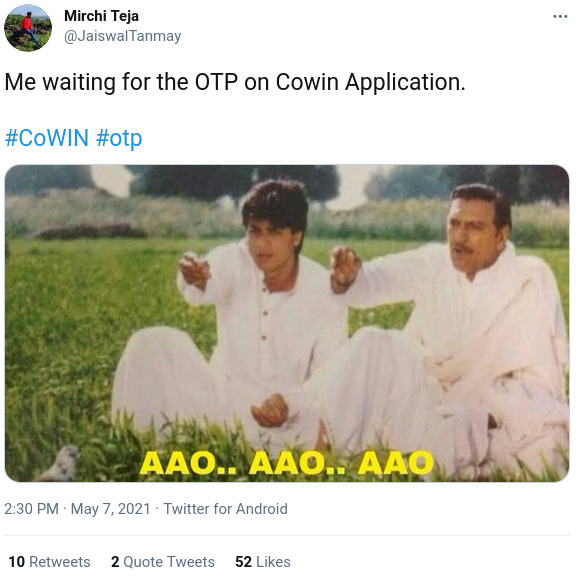
The Online experience The vaccination process has been made online and has led to severe heartburn and trouble for many including many memes. For e.g.

Daily work, get up, have a bath, see if you got a slot on the app, sleep.
People trying desperately to get a slot, taken from Hindi Movie Dilwale Dulhania Le Jaygenge.
Just to explain what is happening, one has to go to the website of cowin. Sharing a screenshot of the same.
Cowin app. sceeenshot
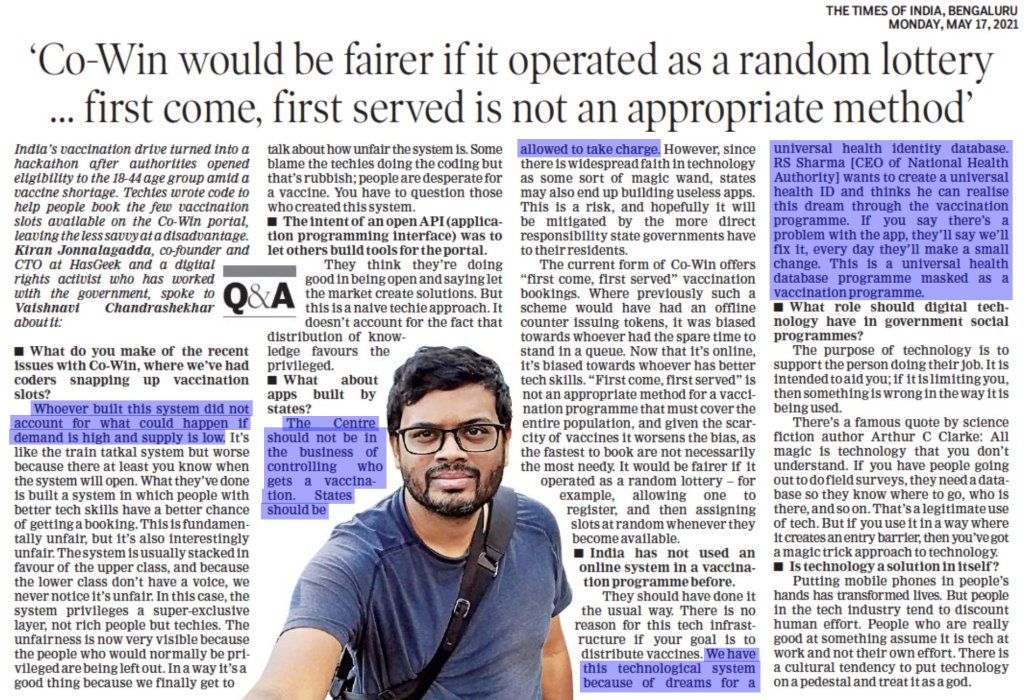
I have deliberately taken a screenshot of the cowin app. in U.P. which is one of the areas where the ruling party, BJP has. I haven t taken my state for the simple reason, even if a slot is open, it is of no use as there are no vaccines. As have been shared in India Cable as well as in many newspapers, it is the Central Govt. which holds the strings for the vaccines. Maharashtra did put up an international tender but to no effect. All vaccine manufacturers want only Central Govt. for purchases for multiple reasons. And GOI is saying it has no money even though recently it got loans as well as a dividend from RBI to the tune of 99k crore. For what all that money is, we have no clue. Coming back though, to the issue at hand. the cowin app. is made an open api. While normally, people like us should and are happy when an API is open, it has made those who understand how to use git, compile, etc. better than others. A copy of the public repo. of how you can do the same can be found on Github. Now, obviously, for people like me and many others it has ethical issues.

Kiran s Interview in Times of India (TOI) There isn t much to say apart from I haven t used it. I just didn t want to. It just is unethical. Hopefully, in the coming days GOI does something better. That is the only thing we are surviving on, hope.

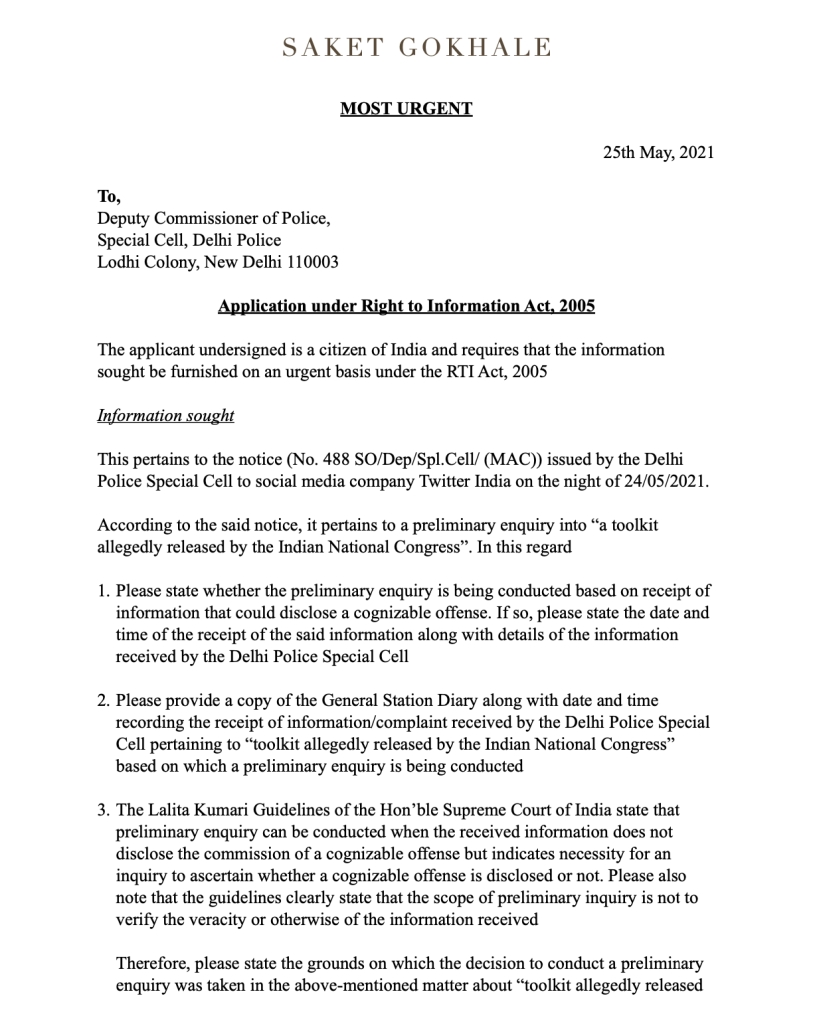
The Toolkit saga A few days before, GOI shared a toolkit apparently made by Congress to defame the party in power. That toolkit was shared before the press and Altnews did the investigation and promptly shredded the claims. Congress promptly made an FIR in Chhattisgarh where it is in power. The gentleman who made the claims Mr. Sambit Patra refused to appear against the police without evidence citing personal reasons and asking 1 week to appear before them. Apart from Altnews which did a great job, sadly many people didn t even know that there is something called WYSIWYG. I had to explain that so many Industries, whether it is politics, creative industries, legal, ad industries, medical transcription, and imaging all use this, and all the participants use the same version of the software. The reason being that in most Industries, there is a huge loss and issue of legal liabilities if something untoward happens. For e.g. if medical transcription is done in India is wrong (although his or her work will be checked by a superior in the West), but for whatever reason is not, and a wrong diagnosis is put (due to wrong color or something) then a patient could die and the firm who does that work could face heavy penalties which could be the death of them. There is another myth that Congress has unlimited wealth or huge wealth. I asked if that was the case, why didn t they shift to Mac. Of course, none have answers on this one. There is another reason why they didn t want to appear. The Rona Wilson investigation by Arsenal Experts also has made them cautious. Previously, they had a free run. Nowadays, software forensic tools are available to one and all. For e.g. Debian itself has a good variety of tools for the same. I remember Vipin s sharing few years back. For those who want to start, just install the apps. and try figuring out. Expertise on using the tools takes years though, as you use the tool day in night. Update 25/05/2021 Apparently because Twitter made and showcased few tweets as Manipulated Media , those in Govt. are and were dead against it. So they conducted a raid against Twitter India headquarters, knowing fully well that there would be nobody except security. The moment I read this, my mind went to the whole Fruit of the poisonous tree legal doctrine. Sadly though, India doesn t recognize it and in fact, still believes in the pre-colonial era that evidence however collected is good. A good explanation of the same can be found here. There are some exceptions to the rule, but they are done so fine that more often than not, they can t be used in the court of law in India. Although a good RTI was shared by Mr. Saket Gokhale on the same issue, which does raise some interesting points
Twitter India Raid, Saket Gokhale RTI 1
Saket Gokhale RTI query , Twitter India Raid 2
FWIW, Saket has been successful in getting his prayers heard either as answers to RTI queries or then following it up in the various High Courts of India. Of course, those who are in the ruling party ridicule him but are unable to find faults in his application of logic. And quite a few times, I have learned from his applications as well as nuances or whatever is there in law, a judgment or a guideline which he invokes in his prayer. For e.g. the Lalitha Kumari Guidelines which the gentleman has shared in his prayer can be found here. Hence now, it would be upto the Delhi Police Cell to prove their case in response to RTI. He has also trapped them as he has shared they can t give excuses/exemptions which they have tried before. As I had shared earlier, High Courts in India have woken up, whether it is Delhi, Mumbai, Aurangabad, Madhya Pradesh, Uttar Pradesh, Odisha or Kerala. Just today i.e. on 25th May 2021, Justices Bela Trivedi and Justice Kalra had asked how come all the hospitals don t have NOC from the Fire De[partment. They also questioned the ASG (Assistant Solicitor General) as how BU (Building Use Certificate) has been granted as almost all the 400 hospitals are in residential area. To which the ASG replies, it is the same state in almost 4000 schools as well as 6000 odd factories in Ahemdabad alone, leave the rest of the district and state alone. And this is when last year strict instuctions were passed. They chose to do nothing sadly. I will share a link on this when bar and bench gives me  The Hindu also shared the whole raid on twitter saga.

Conclusion In conclusion, I sincerely do not where we are headed. The only thing I know is that we cannot expect things to be better before year-end and maybe even after that. It all depends on the vaccines and their availability. After that ruralindia article, I had to see quite a few movies and whatnot just to get that out of my head. And this is apart from the 1600 odd teachers and workers who have died in the U.P. poll duty. Now, what a loss, not just to the family members of the victims, but a whole generation of school children who would not be able to get quality teaching and be deprived of education. What will be their future, God only knows. The only good Bollywood movie which I saw was Ramprasad ki Teravi . The movie was an accurate representation of most families in and around me. There was a movie called Sansar (1987) which showed the breakup of the joint family and into a nuclear family. This movie could very well have been a continuation of the same. Even Marathi movies which at one time were very progressive have gone back to the same boy, girl love story routine. Sameer, though released in late 2020, was able to see it only recently. Vakeel Saab was an ok copy of Pink . I loved Sameer as, unlike Salman Khan films, it showed pretty much an authentic human struggle of a person who goes to the Middle East without any qualifications and works as a laborer and the trials he goes through. Somehow, Malayalam movies have a knack for showing truth without much of budget. Most of the Indian web series didn t make an impact. I think many of them were just going through the motions, it seems as everybody is concerned with the well-being of their near and dear ones. There was also this (Trigger Warning: This story discusses organized campaigns glorifying and advocating sexual violence against Muslim women.) Hoping people somehow make it to the other side of the pandemic.

24 May 2021

Antoine Beaupr : Leaving Freenode

The freenode IRC network has been hijacked. TL;DR: move to libera.chat or OFTC.net, as did countless free software projects including Gentoo, CentOS, KDE, Wikipedia, FOSDEM, and more. Debian and the Tor project were already on OFTC and are not affected by this.

What is freenode and why should I care? freenode is the largest remaining IRC network. Before this incident, it had close to 80,000 users, which is small in terms of modern internet history -- even small social networks are larger by multiple orders of magnitude -- but is large in IRC history. The IRC network is also extensively used by the free software community, being the default IRC network on many programs, and used by hundreds if not thousands of free software projects. I have been using freenode since at least 2006. This matters if you care about IRC, the internet, open protocols, decentralisation, and, to a certain extent, federation as well. It also touches on who has the right on network resources: the people who "own" it (through money) or the people who make it work (through their labor). I am biased towards open protocols, the internet, federation, and worker power, and this might taint this analysis.

What happened? It's a long story, but basically:
  1. back in 2017, the former head of staff sold the freenode.net domain (and its related company) to Andrew Lee, "American entrepreneur, software developer and writer", and, rather weirdly, supposedly "crown prince of Korea" although that part is kind of complex (see House of Yi, Yi Won, and Yi Seok). It should be noted the Korean Empire hasn't existed for over a century at this point (even though its flag, also weirdly, remains)
  2. back then, this was only known to the public as this strange PIA and freenode joining forces gimmick. it was suspicious at first, but since the network kept running, no one paid much attention to it. opers of the network were similarly reassured that Lee would have no say in the management of the network
  3. this all changed recently when Lee asserted ownership of the freenode.net domain and started meddling in the operations of the network, according to this summary. this part is disputed, but it is corroborated by almost a dozen former staff which collectively resigned from the network in protest, after legal threats, when it was obvious freenode was lost.
  4. the departing freenode staff founded a new network, irc.libera.chat, based on the new ircd they were working on with OFTC, solanum
  5. meanwhile, bot armies started attacking all IRC networks: both libera and freenode, but also OFTC and unrelated networks like a small one I help operate. those attacks have mostly stopped as of this writing (2021-05-24 17:30UTC)
  6. on freenode, however, things are going for the worse: Lee has been accused of taking over a channel, in a grotesque abuse of power; then changing freenode policy to not only justify the abuse, but also remove rules against hateful speech, effectively allowing nazis on the network (update: the change was reverted, but not by Lee)
Update: even though the policy change was reverted, the actual conversations allowed on freenode have already degenerated into toxic garbage. There are also massive channel takeovers (presumably over 700), mostly on channels that were redirecting to libera, but also channels that were still live. Channels that were taken over include #fosdem, #wikipedia, #haskell... Instead of working on the network, the new "so-called freenode" staff is spending effort writing bots and patches to basically automate taking over channels. I run an IRC network and this bot is obviously not standard "services" stuff... This is just grotesque. At this point I agree with this HN comment:
We should stop implicitly legitimizing Andrew Lee's power grab by referring to his dominion as "Freenode". Freenode is a quarter-century-old community that has changed its name to libera.chat; the thing being referred to here as "Freenode" is something else that has illegitimately acquired control of Freenode's old servers and user database, causing enormous inconvenience to the real Freenode.
I don't agree with the suggested name there, let's instead call it "so called freenode" as suggested later in the thread.

What now? I recommend people and organisations move away from freenode as soon as possible. This is a major change: documentation needs to be fixed, and the migration needs to be coordinated. But I do not believe we can trust the new freenode "owners" to operate the network reliably and in good faith. It's also important to use the current momentum to build a critical mass elsewhere so that people don't end up on freenode again by default and find an even more toxic community than your typical run-of-the-mill free software project (which is already not a high bar to meet). Update: people are moving to libera in droves. It's now reaching 18,000 users, which is bigger than OFTC and getting close to the largest, traditionnal, IRC networks (EFnet, Undernet, IRCnet are in the 10-20k users range). so-called freenode is still larger, currently clocking 68,000 users, but that's a huge drop from the previous count which was 78,000 before the exodus began. We're even starting to see the effects of the migration on netsplit.de. Update 2: the isfreenodedeadyet.com site is updated more frequently than netsplit and shows tons more information. It shows 25k online users for libera and 61k for so-called freenode (down from ~78k), and the trend doesn't seem to be stopping for so-called freenode. There's also a list of 400+ channels that have moved out. Keep in mind that such migrations take effect over long periods of time.

Where do I move to? The first thing you should do is to figure out which tool to use for interactive user support. There are multiple alternatives, of course -- this is the internet after all -- but here is a short list of suggestions, in preferred priority order:
  1. irc.libera.chat
  2. irc.OFTC.net
  3. Matrix.org, which bridges with OFTC and (hopefully soon) with libera as well, modern IRC alternative
  4. XMPP/Jabber also still exists, if you're into that kind of stuff, but I don't think the "chat room" story is great there, at least not as good as Matrix
Basically, the decision tree is this:
  • if you want to stay on IRC:
    • if you are already on many OFTC channels and few freenode channels: move to OFTC
    • if you are more inclined to support the previous freenode staff: move to libera
    • if you care about matrix users (in the short term): move to OFTC
  • if you are ready to leave IRC:
    • if you want the latest and greatest: move to Matrix
    • if you like XML and already use XMPP: move to XMPP
Frankly, at this point, everyone should seriously consider moving to Matrix. The user story is great, the web is a first class user, it supports E2EE (although XMPP as well), and has a lot of momentum behind it. It even bridges with IRC well (which is not the case for XMPP) so if you're worried about problems like this happening again. (Indeed, I wouldn't be surprised if similar drama happens on OFTC or libera in the future. The history of IRC is full of such epic controversies, takeovers, sabotage, attacks, technical flamewars, and other silly things. I am not sure, but I suspect a federated model like Matrix might be more resilient to conflicts like this one.) Changing protocols might mean losing a bunch of users however: not everyone is ready to move to Matrix, for example. Graybeards like me have been using irssi for years, if not decades, and would take quite a bit of convincing to move elsewhere. I have mostly kept my channels on IRC, and moved either to OFTC or libera. In retrospect, I think I might have moved everything to OFTC if I would have thought about it more, because almost all of my channels are there. But I kind of expect a lot of the freenode community to move to libera, so I am keeping a socket open there anyways.

How do I move? The first thing you should do is to update documentation, websites, and source code to stop pointing at freenode altogether. This is what I did for feed2exec, for example. You need to let people know in the current channel as well, and possibly shutdown the channel on freenode. Since my channels are either small or empty, I took the radical approach of:
  • redirecting the channel to ##unavailable which is historically the way we show channels have moved to another network
  • make the channel invite-only (which effectively enforces the redirection)
  • kicking everyone out of the channel
  • kickban people who rejoin
  • set the topic to announce the change
In IRC speak, the following commands should do all this:
/msg ChanServ set #anarcat mlock +if ##unavailable
/msg ChanServ clear #anarcat users moving to irc.libera.chat
/msg ChanServ set #anarcat restricted on
/topic #anarcat this channel has moved to irc.libera.chat
If the channel is not registered, the following might work
/mode #anarcat +if ##unavailable
Then you can leave freenode altogether:
/disconnect Freenode unacceptable hijack, policy changes and takeovers. so long and thanks for all the fish.
Keep in mind that some people have been unable to setup such redirections, because the new freenode staff have taken over their channel, in which case you're out of luck... Some people have expressed concern about their private data hosted at freenode as well. If you care about this, you can always talk to NickServ and DROP your nick. Be warned, however, that this assumes good faith of the network operators, which, at this point, is kind of futile. I would assume any data you have registered on there (typically: your NickServ password and email address) to be compromised and leaked. If your password is used elsewhere (tsk, tsk), change it everywhere. Update: there's also another procedure, similar to the above, but with a different approach. Keep in mind that so-called freenode staff are actively hijacking channels for the mere act of mentioning libera in the channel topic, so thread carefully there.

Last words This is a sad time for IRC in general, and freenode in particular. It's a real shame that the previous freenode staff have been kicked out, and it's especially horrible that if the new policies of the network are basically making the network open to nazis. I wish things would have gone out differently: now we have yet another fork in the IRC history. While it's not the first time freenode changes name (it was called OPN before), now the old freenode is still around and this will bring much confusion to the world, especially since the new freenode staff is still claiming to support FOSS. I understand there are many sides to this story, and some people were deeply hurt by all this. But for me, it's completely unacceptable to keep pushing your staff so hard that they basically all (except one?) resign in protest. For me, that's leadership failure at the utmost, and a complete disgrace. And of course, I can't in good conscience support or join a network that allows hate speech. Regardless of the fate of whatever we'll call what's left of freenode, maybe it's time for this old IRC thing to die already. It's still a sad day in internet history, but then again, maybe IRC will never die...

13 May 2021

Shirish Agarwal: Population, Immigration, Vaccines and Mass-Surveilance.

The Population Issue and its many facets Another couple of weeks passed. A Lot of things happening, lots of anger and depression in folks due to handling in pandemic, but instead of blaming they are willing to blame everybody else including the population. Many of them want forced sterilization like what Sanjay Gandhi did during the Emergency (1975). I had to share So Long, My son . A very moving tale of two families of what happened to them during the one-child policy in China. I was so moved by it and couldn t believe that the Chinese censors allowed it to be produced, shot, edited, and then shared worldwide. It also won a couple of awards at the 69th Berlin Film Festival, silver bear for the best actor and the actress in that category. But more than the award, the theme, and the concept as well as the length of the movie which was astonishing. Over a 3 hr. something it paints a moving picture of love, loss, shame, relief, anger, and asking for forgiveness. All of which can be identified by any rational person with feelings worldwide.

Girl child What was also interesting though was what it couldn t or wasn t able to talk about and that is the Chinese leftover men. In fact, a similar situation exists here in India, only it has been suppressed. This has been more pronounced more in Asia than in other places. One big thing in this is human trafficking and mostly women trafficking. For the Chinese male, that was happening on a large scale from all neighboring countries including India. This has been shared in media and everybody knows about it and yet people are silent. But this is not limited to just the Chinese, even Indians have been doing it. Even yesteryear actress Rupa Ganguly was caught red-handed but then later let off after formal questioning as she is from the ruling party. So much for justice. What is and has been surprising at least for me is Rwanda which is in the top 10 of some of the best places in equal gender. It, along with other African countries have also been in news for putting quite a significant amount of percentage of GDP into public healthcare (between 20-10%), but that is a story for a bit later. People forget or want to forget that it was in Satara, a city in my own state where 220 girls changed their name from nakusha or unwanted to something else and that had become a piece of global news. One would think that after so many years, things would have changed, the only change that has happened is that now we have two ministries, The Ministry of Women and Child Development (MoWCD) and The Ministry of Health and Welfare (MoHFW). Sadly, in both cases, the ministries have been found wanting, Whether it was the high-profile Hathras case or even the routine cries of help which given by women on the twitter helpline. Sadly, neither of these ministries talks about POSH guidelines which came up after the 2012 gangrape case. For both these ministries, it should have been a pinned tweet. There is also the 1994 PCPNDT Act which although made in 1994, actually functioned in 2006, although what happens underground even today nobody knows  . On the global stage, about a decade ago, Stephen J. Dubner and Steven Levitt argued in their book Freakonomics how legalized abortion both made the coming population explosion as well as expected crime rates to be reduced. There was a huge pushback on the same from the conservatives and has become a matter of debate, perhaps something that the Conservatives wanted. Interestingly, it hasn t made them go back but go forward as can be seen from the Freakonomics site.

Climate Change Another topic that came up for discussion was repeatedly climate change, but when I share Shell s own 1998 Confidential report titled Greenhouse effect all become strangely silent. The silence here is of two parts, there probably is a large swathe of Indians who haven t read the report and there may be a minority who have read it and know what already has been shared with U.S. Congress. The Conservative s argument has been for it is jobs and a weak we need to research more . There was a partial debunk of it on the TBD podcast by Matt Farell and his brother Sean Farell as to how quickly the energy companies are taking to the coming change.

Health Budget Before going to Covid stories. I first wanted to talk about Health Budgets. From the last 7 years the Center s allocation for health has been between 0.34 to 0.8% per year. That amount barely covers the salaries to the staff, let alone any money for equipment or anything else. And here by allocation I mean, what is actually spent, not the one that is shared by GOI as part of budget proposal. In fact, an article on Wire gives a good breakdown of the numbers. Even those who are on the path of free markets describe India s health business model as a flawed one. See the Bloomberg Quint story on that. Now let me come to Rwanda. Why did I chose Rwanda, I could have chosen South Africa where I went for Debconf 2016, I chose because Rwanda s story is that much more inspiring. In many ways much more inspiring than that South Africa in many ways. Here is a country which for decades had one war or the other, culminating into the Rwanda Civil War which ended in 1994. And coincidentally, they gained independence on a similar timeline as South Africa ending Apartheid in 1994. What does the country do, when it gains its independence, it first puts most of its resources in the healthcare sector. The first few years at 20% of GDP, later than at 10% of GDP till everybody has universal medical coverage. Coming back to the Bloomberg article I shared, the story does not go into the depth of beyond-expiry date medicines, spurious medicines and whatnot. Sadly, most media in India does not cover the deaths happening in rural areas and this I am talking about normal times. Today what is happening in rural areas is just pure madness. For last couple of days have been talking with people who are and have been covering rural areas. In many of those communities, there is vaccine hesitancy and why, because there have been whatsapp forwards sharing that if you go to a hospital you will die and your kidney or some other part of the body will be taken by the doctor. This does two things, it scares people into not going and getting vaccinated, at the same time they are prejudiced against science. This is politics of the lowest kind. And they do it so that they will be forced to go to temples or babas and what not and ask for solutions. And whether they work or not is immaterial, they get fixed and property and money is seized. Sadly, there are not many Indian movies of North which have tried to show it except for oh my god but even here it doesn t go the distance. A much more honest approach was done in Trance . I have never understood how the South Indian movies are able to do a more honest job of story-telling than what is done in Bollywood even though they do in 1/10th the budget that is needed in Bollywood. Although, have to say with OTT, some baggage has been shed but with the whole film certification rearing its ugly head through MEITY orders, it seems two steps backward instead of forward. The idea being simply to infantilize the citizens even more. That is a whole different ball-game which probably will require its own space.

Vaccine issues One good news though is that Vaccination has started. But it has been a long story full of greed by none other than GOI (Government of India) or the ruling party BJP. Where should I start with. I probably should start with this excellent article done by Priyanka Pulla. It is interesting and fascinating to know how vaccines are made, at least one way which she shared. She also shared about the Cutter Incident which happened in the late 50 s. The response was on expected lines, character assassination of her and the newspaper they published but could not critique any of the points made by her. Not a single point that she didn t think about x or y. Interestingly enough, in January 2021 Bharati Biotech was supposed to be share phase 3 trial data but hasn t been put up in public domain till May 2021. In fact, there have been a few threads raised by both well-meaning Indians as well as others globally especially on twitter to which GOI/ICMR (Indian Council of Medical Research) is silent. Another interesting point to note is that Russia did say in its press release that it is possible that their vaccine may not be standard (read inactivation on their vaccines and another way is possible but would take time, again Brazil has objected, but India hasn t till date.) What also has been interesting is the homegrown B.1.617 lineage or known as double mutant . This was first discovered from my own state, Maharashtra and then transported around the world. There is also B.1.618 which was found in West Bengal and is same or supposed to be similar to the one found in South Africa. This one is known as Triple mutant . About B.1.618 we don t know much other than knowing that it is much more easily transferable, much more infectious. Most countries have banned flights from India and I cannot fault them anyway. Hell, when even our diplomats do not care for procedures to be followed during the pandemic then how a common man is supposed to do. Of course, now for next month, Mr. Modi was supposed to go and now will not attend the G7 meeting. Whether, it is because he would have to face the press (the only Prime Minister and the only Indian Prime Minister who never has faced free press.) or because the Indian delegation has been disinvited, we would never know.

A good article which shares lots of lows with how things have been done in India has been an article by Arundhati Roy. And while the article in itself is excellent and shares a bit of the bitter truth but is still incomplete as so much has been happening. The problem is that the issue manifests in so many ways, it is difficult to hold on. As Arundhati shared, should we just look at figures and numbers and hold on, or should we look at individual ones, for e.g. the one shared in Outlook India. Or the one shared by Dr. Dipshika Ghosh who works in Covid ICU in some hospital
Dr. Dipika Ghosh sharing an incident in Covid Ward

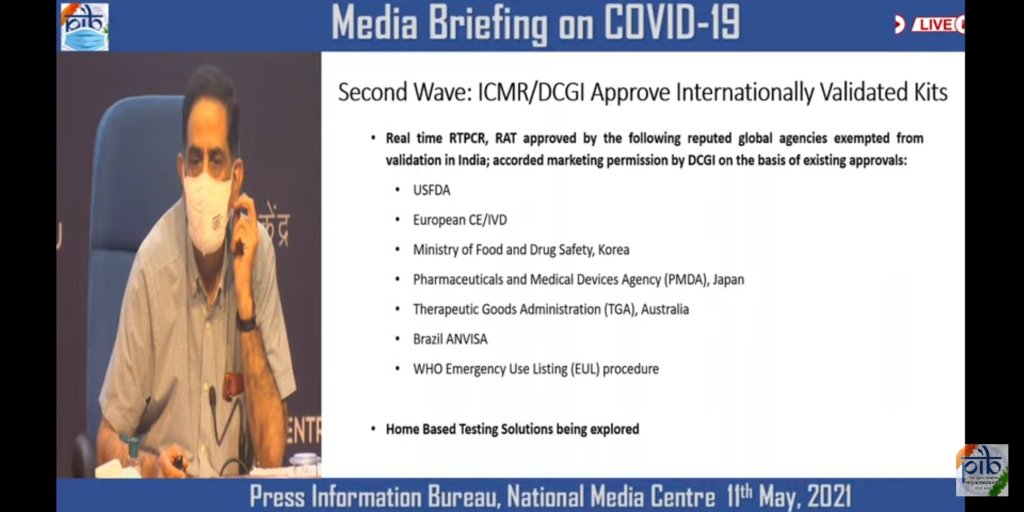
Interestingly as well, while in the vaccine issue, Brazil Anvisa doesn t know what they are doing or the regulator just isn t knowledgeable etc. (statements by various people in GOI, when it comes to testing kits, the same is an approver.)

ICMR/DGCI approving internationally validated kits, Press release.

Twitter In the midst of all this, one thing that many people have forgotten and seem to have forgotten that Twitter and other tools are used by only the elite. The reason why the whole thing has become serious now than in the first phase is because the elite of India have also fallen sick and dying which was not the case so much in the first phase. The population on Twitter is estimated to be around 30-34 million and people who are everyday around 20 odd million or so, which is what 2% of the Indian population which is estimated to be around 1.34 billion. The other 98% don t even know that there is something like twitter on which you can ask help. Twitter itself is exclusionary in many ways, with both the emoticons, the language and all sorts of things. There is a small subset who does use Twitter in regional languages, but they are too small to write anything about. The main language is English which does become a hindrance to lot of people.

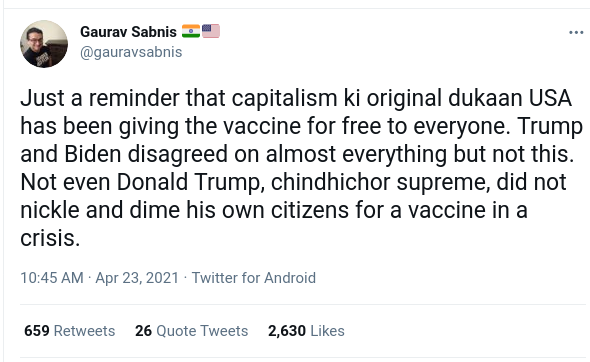
Censorship Censorship of Indians critical of Govt. mishandling has been non-stop. Even U.S. which usually doesn t interfere into India s internal politics was forced to make an exception. But of course, this has been on deaf ears. There is and was a good thread on Twitter by Gaurav Sabnis, a friend, fellow Puneite now settled in U.S. as a professor.
Gaurav on Trump-Biden on vaccination of their own citizens
Now just to surmise what has been happened in India and what has been happening in most of the countries around the world. Most of the countries have done centralization purchasing of the vaccine and then is distributed by the States, this is what we understand as co-operative federalism. While last year, GOI took a lot of money under the shady PM Cares fund for vaccine purchase, donations from well-meaning Indians as well as Industries and trade bodies. Then later, GOI said it would leave the states hanging and it is they who would have to buy vaccines from the manufacturers. This is again cheap politics. The idea behind it is simple, GOI knows that almost all the states are strapped for cash. This is not new news, this I have shared a couple of months back. The problem has been that for the last 6-8 months no GST meeting has taken place as shared by Punjab s Finance Minister Amarinder Singh. What will happen is that all the states will fight in-between themselves for the vaccine and most of them are now non-BJP Governments. The idea is let the states fight and somehow be on top. So, the pandemic, instead of being a public health issue has become something of on which politics has to played. The news on whatsapp by RW media is it s ok even if a million or two also die, as it is India is heavily populated. Although that argument vanishes for those who lose their dear and near ones. But that just isn t the issue, the issue goes much more deeper than that Oxygen:12%
Remedisivir:12%
Sanitiser:12%
Ventilator:12%
PPE:18%
Ambulances 28% Now all the products above are essential medical equipment and should be declared as essential medical equipment and should have price controls on which GST is levied. In times of pandemic, should the center be profiting on those. States want to let go and even want the center to let go so that some relief is there to the public, while at the same time make them as essential medical equipment with price controls. But GOI doesn t want to. Leaders of opposition parties wrote open letters but no effect. What is sad to me is how Ambulances are being taxed at 28%. Are they luxury items or sin goods ? This also reminds of the recent discovery shared by Mr. Pappu Yadav in Bihar. You can see the color of ambulances as shared by Mr. Yadav, and the same news being shared by India TV news showing other ambulances. Also, the weak argument being made of not having enough drivers. Ideally, you should have 2-3 people, both 9-1-1 and Chicago Fire show 2 people in ambulance but a few times they have also shown to be flipped over. European seems to have three people in ambulance, also they are also much more disciplined as drivers, at least an opinion shared by an American expat.
Pappu Yadav, President Jan Adhikar Party, Bihar May 11, 2021
What is also interesting to note is GOI plays this game of Health is State subject and health is Central subject depending on its convenience. Last year, when it invoked the Epidemic and DMA Act it was a Central subject, now when bodies are flowing down the Ganges and pyres being lit everywhere, it becomes a State subject. But when and where money is involved, it again becomes a Central subject. The States are also understanding it, but they are fighting on too many fronts.
Snippets from Karnataka High Court hearing today, 13th March 2021
One of the good things is most of the High Courts have woken up. Many of the people on the RW think that the Courts are doing Judicial activism . And while there may be an iota of truth in it, the bitter truth is that many judges or relatives or their helpers have diagnosed and some have even died due to Covid. In face of the inevitable, what can they do. They are hauling up local Governments to make sure they are accountable while at the same time making sure that they get access to medical facilities. And I as a citizen don t see any wrong in that even if they are doing it for selfish reasons. Because, even if justice is being done for selfish reasons, if it does improve medical delivery systems for the masses, it is cool. If it means that the poor and everybody else are able to get vaccinations, oxygen and whatever they need, it is cool. Of course, we are still seeing reports of patients spending in the region of INR 50k and more for each day spent in hospital. But as there are no price controls, judges cannot do anything unless they want to make an enemy of the medical lobby in the country. A good story on medicines and what happens in rural areas, see no further than Laakhon mein ek.
Allahabad High Court hauling Uttar Pradesh Govt. for lack of Oxygen is equal to genocide, May 11, 2021
The censorship is not just related to takedown requests on twitter but nowadays also any articles which are critical of the GOI s handling. I have been seeing many articles which have shared facts and have been critical of GOI being taken down. Previously, we used to see 404 errors happen 7-10 years down the line and that was reasonable. Now we see that happen, days weeks or months. India seems to be turning more into China and North Korea and become more anti-science day-by-day

Fake websites Before going into fake websites, let me start with a fake newspaper which was started by none other than the Gujarat CM Mr. Modi in 2005 .
Gujarat Satya Samachar 2005 launched by Mr. Modi.
And if this wasn t enough than on Feb 8, 2005, he had invoked Official Secrets Act
Mr. Modi invoking Official Secrets Act, Feb 8 2005 Gujarat Samachar
The headlines were In Modi s regime press freedom is in peril-Down with Modi s dictatorship. So this was a tried and tested technique. The above information was shared by Mr. Urvish Kothari, who incidentally also has his own youtube channel. Now cut to 2021, and we have a slew of fake websites being done by the same party. In fact, it seems they started this right from 2011. A good article on BBC itself tells the story. Hell, Disinfo.eu which basically combats disinformation in EU has a whole pdf chronicling how BJP has been doing it. Some of the sites it shared are

Times of New York
Manchester Times
Times of Los Angeles
Manhattan Post
Washington Herald
and many more. The idea being take any site name which sounds similar to a brand name recognized by Indians and make fool of them. Of course, those of who use whois and other such tools can easily know what is happening. Two more were added to the list yesterday, Daily Guardian and Australia Today. There are of course, many features which tell them apart from genuine websites. Most of these are on shared hosting rather than dedicated hosting, most of these are bought either from Godaddy and Bluehost. While Bluehost used to be a class act once upon a time, both the above will do anything as long as they get money. Don t care whether it s a fake website or true. Capitalism at its finest or worst depending upon how you look at it. But most of these details are lost on people who do not know web servers, at all and instead think see it is from an exotic site, a foreign site and it chooses to have same ideas as me. Those who are corrupt or see politics as a tool to win at any cost will not see it as evil. And as a gentleman Raghav shared with me, it is so easy to fool us. An example he shared which I had forgotten. Peter England which used to be an Irish brand was bought by Aditya Birla group way back in 2000. But even today, when you go for Peter England, the way the packaging is done, the way the prices are, more often than not, people believe they are buying the Irish brand. While sharing this, there is so much of Naom Chomsky which comes to my mind again and again

Caste Issues I had written about caste issues a few times on this blog. This again came to the fore as news came that a Hindu sect used forced labor from Dalit community to make a temple. This was also shared by the hill. In both, Mr. Joshi doesn t tell that if they were volunteers then why their passports have been taken forcibly, also I looked at both minimum wage prevailing in New Jersey as a state as well as wage given to those who are in the construction Industry. Even in minimum wage, they were giving $1 when the prevailing minimum wage for unskilled work is $12.00 and as Mr. Joshi shared that they are specialized artisans, then they should be paid between $23 $30 per hour. If this isn t exploitation, then I don t know what is. And this is not the first instance, the first instance was perhaps the case against Cisco which was done by John Doe. While I had been busy with other things, it seems Cisco had put up both a demurrer petition and a petition to strike which the Court stayed. This seemed to all over again a type of apartheid practice, only this time applied to caste. The good thing is that the court stayed the petition. Dr. Ambedkar s statement if Hindus migrate to other regions on earth, Indian caste would become a world problem given at Columbia University in 1916, seems to be proven right in today s time and sadly has aged well. But this is not just something which is there only in U.S. this is there in India even today, just couple of days back, a popular actress Munmun Dutta used a casteist slur and then later apologized giving the excuse that she didn t know Hindi. And this is patently false as she has been in the Bollywood industry for almost now 16-17 years. This again, was not an isolated incident. Seema Singh, a lecturer in IIT-Kharagpur abused students from SC, ST backgrounds and was later suspended. There is an SC/ST Atrocities Act but that has been diluted by this Govt. A bit on the background of Dr. Ambedkar can be found at a blog on Columbia website. As I have shared and asked before, how do we think, for what reason the Age of Englightenment or the Age of Reason happened. If I were a fat monk or a priest who was privileges, would I have let Age of Enlightenment happen. It broke religion or rather Church which was most powerful to not so powerful and that power was more distributed among all sort of thinkers, philosophers, tinkers, inventors and so on and so forth.

Situation going forward I believe things are going to be far more complex and deadly before they get better. I had to share another term called Comorbidities which fortunately or unfortunately has also become part of twitter lexicon. While I have shared what it means, it simply means when you have an existing ailment or condition and then Coronavirus attacks you. The Virus will weaken you. The Vaccine in the best case just stops the damage, but the damage already done can t be reversed. There are people who advise and people who are taking steroids but that again has its own side-effects. And this is now, when we are in summer. I am afraid for those who have recovered, what will happen to them during the Monsoons. We know that the Virus attacks most the lungs and their quality of life will be affected. Even the immune system may have issues. We also know about the inflammation. And the grant that has been given to University of Dundee also has signs of worry, both for people like me (obese) as well as those who have heart issues already. In other news, my city which has been under partial lockdown since a month, has been extended for another couple of weeks. There are rumors that the same may continue till the year-end even if it means economics goes out of the window.There is possibility that in the next few months something like 2 million odd Indians could die
The above is a conversation between Karan Thapar and an Oxford Mathematician Dr. Murad Banaji who has shared that the under-counting of cases in India is huge. Even BBC shared an article on the scope of under-counting. Of course, those on the RW call of the evidence including the deaths and obituaries in newspapers as a narrative . And when asked that when deaths used to be in the 20 s or 30 s which has jumped to 200-300 deaths and this is just the middle class and above. The poor don t have the money to get wood and that is the reason you are seeing the bodies in Ganges whether in Buxar Bihar or Gajipur, Uttar Pradesh. The sights and visuals makes for sorry reading
Pandit Ranjan Mishra son on his father s death due to unavailability of oxygen, Varanasi, Uttar Pradesh, 11th May 2021.
For those who don t know Pandit Ranjan Mishra was a renowned classical singer. More importantly, he was the first person to suggest Mr. Modi s name as a Prime Ministerial Candidate. If they couldn t fulfil his oxygen needs, then what can be expected for the normal public.

Conclusion Sadly, this time I have no humorous piece to share, I can however share a documentary which was shared on Feluda . I have shared about Feluda or Prodosh Chandra Mitter a few times on this blog. He has been the answer of James Bond from India. I have shared previously about The Golden Fortress . An amazing piece of art by Satyajit Ray. I watched that documentary two-three times. I thought, mistakenly that I am the only fool or fan of Feluda in Pune to find out that there are people who are even more than me. There were so many facets both about Feluda and master craftsman Satyajit Ray that I was unaware about. I was just simply amazed. I even shared few of the tidbits with mum as well, although now she has been truly hooked to Korean dramas. The only solace from all the surrounding madness. So, if you have nothing to do, you can look up his books, read them and then see the movies. And my first recommendation would be the Golden Fortress. The only thing I would say, do not have high hopes. The movie is beautiful. It starts slow and then picks up speed, just like a train. So, till later. Update The Mass surveillance part I could not do justice do hence removed it at the last moment. It actually needs its whole space, article. There is so much that the Govt. is doing under the guise of the pandemic that it is difficult to share it all in one article. As it is, the article is big

10 May 2021

Russell Coker: Echo Chambers vs Epistemic Bubbles

C Thi Nguyen wrote an interesting article about the difficulty of escaping from Echo Chambers and also mentions Epistemic Bubbles [1]. An Echo Chamber is a group of people who reinforce the same ideas and who often preemptively strike against opposing ideas (for example the right wing denigrating mainstream media to prevent their followers from straying from their approved message). An Epistemic Bubble is a group of people who just happen to not have contact with certain different ideas. When reading that article I wondered about what bubbles I and the people I associate with may be in. One obvious issue is that I have little communication with people who don t write in English and also little communication with people who are poor. So people who are poor and who can t write in English (which means significant portions of the population of India and Africa) are out of communication range for me. There are many situations that are claimed to be bubbles such as white people who are claimed to be innocent of racial issues because they only associate with other white people and men in the IT industry who are claimed to be innocent of sexism because they don t associate with women in the IT industry. But I think they are more of an echo chamber issue, if a white American doesn t access any of the variety of English language media produced by Afro Americans and realise that there s a racial problem it s because they don t want to see it and deliberately avoid looking at evidence. If a man in the IT industry doesn t access any of the media produced by women in tech and realise there are problems with sexism then it s because they don t want to see it. When is it OK to Reject a Group? The Ad Hominem Wikipedia page has a good analysis of different types of Ad Hominem arguments [2]. But the criteria for refuting a point in a debate are very different to the criteria used to determine which sources you should trust when learning about a topic. For example it s theoretically possible for someone to be good at computer science while also thinking the world is flat. In a debate about some aspect of computer programming it would be a fallacious Ad Hominem argument to say you think the Earth is flat therefore you can t program a computer . But if you do a Google search for information on computer programming and one of the results is from earthisflat.com then it would probably save time to skip reading that one. If only one person supports an idea then it s quite likely to be wrong. Good ideas tend to be supported by multiple people and for any good idea you will find a supporter who doesn t appear to have any ideas that are obviously wrong. One of the problems we have as a society now is determining the quality of data (ideas, claims about facts, opinions, communication/spam, etc). When humans have to do that it takes time and energy. Shortcuts can make things easier. Some shortcuts I use are that mainstream media articles are usually more reliable than social media posts (even posts by my friends) and that certain media outlets are untrustworthy (like Breitbart). The next step is that anyone who cites a bad site like Breitbart as factual (rather than just an indication of what some extremists believe) is unreliable. For most questions that you might search for on the Internet there is a virtually endless supply of answers, the challenge is not finding an answer but finding a correct answer. So eliminating answers that are unlikely to be correct is an important part of the search. If someone is citing references to support their argument and they can only cite fringe or extremist sites then I won t be convinced. Now someone could turn that argument around and claim that a site I reference such as the New York Times is wrong. If I find that my ideas were based on a claim that can only be found on the NYT then I will reconsider the issue. While I think that the NYT is generally accurate they are capable of making mistakes and if they are the sole source for claims that go against other claims then I will be hesitant to accept such claims. Newspapers often have exclusive articles based on their own research, but such articles always inspire investigation from other newspapers so other articles appear either supporting or questioning the claims in the exclusive. Saving Time When Interacting With Members of Echo Chambers Convincing a member of a cult or echo chamber of anything is not likely. When in discussions with them the focus should be on the audience and on avoiding wasting much time while also not giving them the impression that you agree with them. A common thing that members of echo chambers say is I don t have time to read about that when you ask if they have read a research paper or a news article. I don t have time to listen to people who can t or won t learn before speaking, there just isn t any value in that. Also if someone has a list of memes that takes more than 15 minutes to recite then they have obviously got time for reading things, just not reading outside their echo chamber. Conversations with members of echo chambers seem to be state free. They make a claim and you reject it, but regardless of the logical flaws you point out or the counter evidence you cite they make the same claim again the next time you speak to them. This seems to be evidence supporting the claim that evangelism is not about converting other people but alienating cult members from the wider society [3] (the original Quora text seems unavailable so I ve linked to a Reddit copy). Pointing out that they had made a claim previously and didn t address the issues you had with it seems effective, such discussions seem to be more about performance so you want to perform your part quickly and efficiently. Be aware of false claims about etiquette. It s generally regarded as polite not to disagree much with someone who invites you to your home or who has done some favour for you, but that is no reason for tolerating an unwanted lecture about their echo chamber. Anyone who tries to create a situation where it seems rude of you not to listen to them saying things that they know will offend you is being rude, much ruder than telling them you are sick of it. Look for specific claims that can be disproven easily. The claim that the Roman Salute is different from the Hitler Salute is one example that is easy to disprove. Then they have to deal with the issue of their echo chamber being wrong about something.

4 May 2021

Erich Schubert: Machine Learning Lecture Recordings

I have uploaded most of my Machine Learning lecture to YouTube. The slides are in English, but the audio is in German. Some very basic contents (e.g., a demo of standard k-means clustering) were left out from this advanced class, and instead only a link to recordings from an earlier class were given. In this class, I wanted to focus on the improved (accelerated) algorithms instead. These are not included here (yet). I believe there are some contents covered in this class you will find nowhere else (yet). The first unit is pretty long (I did not split it further yet). The later units are shorter recordings. ML F1: Principles in Machine Learning ML F2/F3: Correlation does not Imply Causation & Multiple Testing Problem ML F4: Overfitting beranpassung ML F5: Fluch der Dimensionalit t Curse of Dimensionality ML F6: Intrinsische Dimensionalit t Intrinsic Dimensionality ML F7: Distanzfunktionen und hnlichkeitsfunktionen ML L1: Einf hrung in die Klassifikation ML L2: Evaluation und Wahl von Klassifikatoren ML L3: Bayes-Klassifikatoren ML L4: N chste-Nachbarn Klassifikation ML L5: N chste Nachbarn und Kerndichtesch tzung ML L6: Lernen von Entscheidungsb umen ML L7: Splitkriterien bei Entscheidungsb umen ML L8: Ensembles und Meta-Learning: Random Forests und Gradient Boosting ML L9: Support Vector Machinen - Motivation ML L10: Affine Hyperebenen und Skalarprodukte Geometrie f r SVMs ML L11: Maximum Margin Hyperplane die breitest m gliche Stra e ML L12: Training Support Vector Machines ML L13: Non-linear SVM and the Kernel Trick ML L14: SVM Extensions and Conclusions ML L15: Motivation of Neural Networks ML L16: Threshold Logic Units ML L17: General Artificial Neural Networks ML L18: Learning Neural Networks with Backpropagation ML L19: Deep Neural Networks ML L20: Convolutional Neural Networks ML L21: Recurrent Neural Networks and LSTM ML L22: Conclusion Classification ML U1: Einleitung Clusteranalyse ML U2: Hierarchisches Clustering ML U3: Accelerating HAC mit Anderberg s Algorithmus ML U4: k-Means Clustering ML U5: Accelerating k-Means Clustering ML U6: Limitations of k-Means Clustering ML U7: Extensions of k-Means Clustering ML U8: Partitioning Around Medoids (k-Medoids) ML U9: Gaussian Mixture Modeling (EM Clustering) ML U10: Gaussian Mixture Modeling Demo ML U11: BIRCH and BETULA Clustering ML U12: Motivation Density-Based Clustering (DBSCAN) ML U13: Density-reachable and density-connected (DBSCAN Clustering) ML U14: DBSCAN Clustering ML U15: Parameterization of DBSCAN ML U16: Extensions and Variations of DBSCAN Clustering ML U17: OPTICS Clustering ML U18: Cluster Extraction from OPTICS Plots ML U19: Understanding the OPTICS Cluster Order ML U20: Spectral Clustering ML U21: Biclustering and Subspace Clustering ML U22: Further Clustering Approaches

3 May 2021

Russ Allbery: Review: The Voyage of the Dawn Treader

Review: The Voyage of the Dawn Treader, by C.S. Lewis
Illustrator: Pauline Baynes
Series: Chronicles of Narnia #3
Publisher: Collier Books
Copyright: 1952
Printing: 1978
ISBN: 0-02-044260-2
Format: Mass market
Pages: 216
There was a boy named Eustace Clarence Scrubb and he almost deserved it.
The Voyage of the Dawn Treader is the third Narnia book in original publication order (see my review of The Lion, the Witch and the Wardrobe for more about reading order). You could arguably start reading here; there are a lot of references to the previous books, but mostly as background material, and I don't think any of it is vital. If you wanted to sample a single Narnia book to see if you'd get along with the series, this is the one I'd recommend. Since I was a kid, The Voyage of the Dawn Treader has held the spot of my favorite of the series. I'm happy to report that it still holds up. Apart from one bit that didn't age well (more on that below), this is the book where the story and the world-building come together, in part because Lewis picks a plot shape that works with what he wants to write about. The younger two Pevensie children, Edmund and Lucy, are spending the summer with Uncle Harold and Aunt Alberta because their parents are in America. That means spending the summer with their cousin Eustace. C.S. Lewis had strong opinions about child-raising that crop up here and there in his books, and Harold and Alberta are his example of everything he dislikes: caricatured progressive, "scientific" parents who don't believe in fiction or mess or vices. Eustace therefore starts the book as a terror, a whiny bully who has only read boring practical books and is constantly scoffing at the Pevensies and making fun of their stories of Narnia. He is therefore entirely unprepared when the painting of a ship in the guest bedroom turns into a portal to the Narnia and dumps the three children into the middle of the ocean. Thankfully, they're in the middle of the ocean near the ship in the painting. That ship is the Dawn Treader, and onboard is Caspian from the previous book, now king of Narnia. He has (improbably) sorted things out in his kingdom and is now on a sea voyage to find seven honorable Telmarine lords who left Narnia while his uncle was usurping the throne. They're already days away from land, headed towards the Lone Islands and, beyond that, into uncharted seas. MAJOR SPOILERS BELOW. Obviously, Eustace gets a redemption arc, which is roughly the first half of this book. It's not a bad arc, but I am always happy when it's over. Lewis tries so hard to make Eustace insufferable that it becomes tedious. As an indoor kid who would not consider being dumped on a primitive sailing ship to be a grand adventure, I wanted to have more sympathy for him than the book would allow. The other problem with Eustace's initial character is that Lewis wants it to stem from "modern" parenting and not reading the right sort of books, but I don't buy it. I've known kids whose parents didn't believe in fiction, and they didn't act anything like this (and kids pick up a lot more via osmosis regardless of parenting than Lewis seems to realize). What Eustace acts like instead is an entitled, arrogant rich kid who is used to the world revolving around him, and it's fascinating to me how Lewis ignores class to focus on educational philosophy. The best part of Eustace's story is Reepicheep, which is just setup for Reepicheep becoming the best part of The Voyage of the Dawn Treader. Reepicheep, the leader of Narnia's talking mice, first appears in Prince Caspian, but there he's mostly played for laughs: the absurdly brave and dashing mouse who rushes into every fight he sees. In this book, he comes into his own as the courage and occasionally the moral conscience of the party. Caspian wants to explore and to find the lords of his past, the Pevensie kids want to have a sea adventure, and Eustace is in this book to have a redemption arc, but Reepicheep is the driving force at the heart of the voyage. He's going to Aslan's country beyond the sea, armed with a nursemaid's song about his destiny and a determination to be his best and most honorable self every step of the way, and nothing is going to stop him. Eustace, of course, takes an immediate dislike to a talking rodent. Reepicheep, in return, is the least interested of anyone on the ship in tolerating Eustace's obnoxious behavior and would be quite happy to duel him. But when Eustace is turned into a dragon, Reepicheep is the one who spends hours with him, telling him stories and ensuring he's not alone. It's beautifully handled, and my only complaint is that Lewis doesn't do enough with the Eustace and Reepicheep friendship (or indeed with Eustace at all) for the rest of the book. After Eustace's restoration and a few other relatively short incidents comes the second long section of the book and the part that didn't age well: the island of the Dufflepuds. It's a shame because the setup is wonderful: a cultivated island in the middle of nowhere with no one in sight, mysterious pounding sounds and voices, the fun of trying to figure out just what these invisible creatures could possibly be, and of course Lucy's foray into the second floor of a house, braving the lair of a magician to find and read one of the best books of magic in fantasy. Everything about how Lewis sets this scene is so well done. The kids are coming from an encounter with a sea serpent and a horrifically dangerous magic island and land on this scene of eerily normal domesticity. The most dangerous excursion is Lucy going upstairs in a brightly lit house with soft carpet in the middle of the day. And yet it's incredibly tense because Lewis knows exactly how to put you in Lucy's head, right down to having to stand with her back to an open door to read the book. And that book! The pages only turn forward, the spells are beautifully illustrated, and the sense of temptation is palpable. Lucy reading the eavesdropping spell is one of the more memorable bits in this series, at least for me, and makes a surprisingly subtle moral point about the practical reasons why invading other people's privacy is unwise and can just make you miserable. And then, when Lucy reads the visibility spell that was her goal, there's this exchange, which is pure C.S. Lewis:
"Oh Aslan," said she, "it was kind of you to come." "I have been here all the time," said he, "but you have just made me visible." "Aslan!" said Lucy almost a little reproachfully. "Don't make fun of me. As if anything I could do would make you visible!" "It did," said Aslan. "Did you think I wouldn't obey my own rules?"
I love the subtlety of what's happening here: the way that Lucy is much more powerful than she thinks she is, but only because Aslan decided to make the rules that way and chooses to follow his own rules, making himself vulnerable in a fascinating way. The best part is that Lewis never belabors points like this; the characters immediately move on to talk about other things, and no one feels obligated to explain. But, unfortunately, along with the explanation of the thumping and the magician, we learn that the Dufflepuds are (remarkably dim-witted) dwarfs, the magician is their guardian (put there by Aslan, no less!), he transformed them into rather absurd shapes that they hate, and all of this is played for laughs. Once you notice that these are sentient creatures being treated essentially like pets (and physically transformed against their will), the level of paternalistic colonialism going on here is very off-putting. It's even worse that the Dufflepuds are memorably funny (washing dishes before dinner to save time afterwards!) and are arguably too dim to manage on their own, because Lewis made the authorial choice to write them that way. The "white man's burden" feeling is very strong. And Lewis could have made other choices! Coriakin the magician is a fascinating and somewhat morally ambiguous character. We learn later in the book that he's a star and his presence on the island is a punishment of sorts, leading to one of my other favorite bits of theology in this book:
"My son," said Ramandu, "it is not for you, a son of Adam, to know what faults a star can commit."
Lewis could have kept most of the setup, kept the delightfully silly things the Dufflepuds believe, changed who was responsible for their transformation, and given Coriakin a less authoritarian role, and the story would have been so much stronger for it. After this, the story gets stranger and wilder, and it's in the last part that I think the true magic of this book lies. The entirety of The Voyage of the Dawn Treader is a progression from a relatively mundane sea voyage to something more awe-inspiring. The last few chapters are a tour de force of wonder: rejuvenating stars, sunbirds, the Witch's stone knife, undersea kingdoms, a sea of lilies, a wall of water, the cliffs of Aslan's country, and the literal end of the world. Lewis does it without much conflict, with sparse description in a very few pages, and with beautifully memorable touches like the quality of the light and the hush that falls over the ship. This is the part of Narnia that I point to and wonder why I don't see more emulation (although I should note that it is arguably an immram). Tolkien-style fantasy, with dwarfs and elves and magic rings and great battles, is everywhere, but I can't think of many examples of this sense of awe and discovery without great battles and detailed explanations. Or of characters like Reepicheep, who gets one of the best lines of the series:
"My own plans are made. While I can, I sail east in the Dawn Treader. When she fails me, I paddle east in my coracle. When she sinks, I shall swim east with my four paws. And when I can swim no longer, if I have not reached Aslan's country, or shot over the edge of the world in some vast cataract, I shall sink with my nose to the sunrise and Peepiceek shall be the head of the talking mice in Narnia."
The last section of The Voyage of the Dawn Treader is one of my favorite endings of any book precisely because it's so different than the typical ending of a novel. The final return to England is always a bit disappointing in this series, but it's very short and is preceded by so much wonder that I don't mind. Aslan does appear to the kids as a lamb at the very end of the world, making Lewis's intended Christian context a bit more obvious, but even that isn't belabored, just left there for those who recognize the symbolism to notice. I was curious during this re-read to understand why The Voyage of the Dawn Treader is so much better than the first two books in the series. I think it's primarily due to two things: pacing, and a story structure that's better aligned with what Lewis wants to write about. For pacing, both The Lion, the Witch and the Wardrobe and Prince Caspian have surprisingly long setups for short books. In The Voyage of the Dawn Treader, by contrast, it takes only 35 pages to get the kids in Narnia, introduce all the characters, tour the ship, learn why Caspian is off on a sea voyage, establish where this book fits in the Narnian timeline, and have the kids be captured by slavers. None of the Narnia books are exactly slow, but Dawn Treader is the first book of the series that feels like it knows exactly where it's going and isn't wasting time getting there. The other structural success of this book is that it's a semi-episodic adventure, which means Lewis can stop trying to write about battles and political changes whose details he's clearly not interested in and instead focus wholeheartedly on sense-of-wonder exploration. The island-hopping structure lets Lewis play with ideas and drop them before they wear out their welcome. And the lack of major historical events also means that Aslan doesn't have to come in to resolve everything and instead can play the role of guardian angel. I think The Voyage of the Dawn Treader has the most compelling portrayal of Aslan in the series. He doesn't make decisions for the kids or tell them directly what to do the way he did in the previous two books. Instead, he shows up whenever they're about to make a dreadful mistake and does just enough to get them to make a better decision. Some readers may find this takes too much of the tension out of the book, but I have always appreciated it. It lets nervous child readers enjoy the adventures while knowing that Aslan will keep anything too bad from happening. He plays the role of a protective but non-interfering parent in a genre that usually doesn't have parents because they would intervene to prevent adventures. I enjoyed this book just as much as I remembered enjoying it during my childhood re-reads. Still the best book of the series. This, as with both The Lion, the Witch and the Wardrobe and Prince Caspian, was originally intended to be the last book of the series. That, of course, turned out to not be the case, and The Voyage of the Dawn Treader is followed (in both chronological and original publication order) by The Silver Chair. Rating: 9 out of 10

28 April 2021

Antoine Beaupr : Building a status page service with Hugo

The Tor Project now has a status page which shows the state of our major services. You can check status.torprojet.org for news about major outages in Tor services, including v3 and v2 onion services, directory authorities, our website (torproject.org), and the check.torproject.org tool. The status page also displays outages related to Tor internal services, like our GitLab instance. This post documents why we launched status.torproject.org, how the service was built, and how it works.

Why a status page The first step in setting up a service page was to realize we needed one in the first place. I surveyed internal users at the end of 2020 to see what could be improved, and one of the suggestions that came up was to "document downtimes of one hour or longer" and generally improve communications around monitoring. The latter is still on the sysadmin roadmap, but a status page seemed like a good solution for the former. We already have two monitoring tools in the sysadmin team: Icinga (a fork of Nagios) and Prometheus, with Grafana dashboards. But those are hard to understand for users. Worse, they also tend to generate false positives, and don't clearly show users which issues are critical. In the end, a manually curated dashboard provides important usability benefits over an automated system, and all major organisations have one.

Picking the right tool It wasn't my first foray in status page design. In another life, I had setup a status page using a tool called Cachet. That was already a great improvement over the previous solutions, which were to use first a wiki and then a blog to post updates. But Cachet is a complex Laravel app, which also requires a web browser to update. It generally requires more maintenance than what we'd like, needing silly things like a SQL database and PHP web server. So when I found cstate, I was pretty excited. It's basically a theme for the Hugo static site generator, which means that it's a set of HTML, CSS, and a sprinkle of Javascript. And being based on Hugo means that the site is generated from a set of Markdown files and the result is just plain HTML that can be hosted on any web server on the planet.

Deployment At first, I wanted to deploy the site through GitLab CI, but at that time we didn't have GitLab pages set up. Even though we do have GitLab pages set up now, it's not (yet) integrated with our mirroring infrastructure. So, for now, the source is hosted and built in our legacy git and Jenkins services. It is nice to have the content hosted in a git repository: sysadmins can just edit Markdown in the git repository and push to deploy changes, no web browser required. And it's trivial to setup a local environment to preview changes:
hugo serve --baseUrl=http://localhost/
firefox https://localhost:1313/
Only the sysadmin team and gitolite administrators have access to the repository, at this stage, but that could be improved if necessary. Merge requests can also be issued on the GitLab repository and then pushed by authorized personnel later on, naturally.

Availability One of the concerns I have is that the site is hosted inside our normal mirror infrastructure. Naturally, if an outage occurs there, the site goes down. But I figured it's a bridge we'll cross when we get there. Because it's so easy to build the site from scratch, it's actually trivial to host a copy of the site on any GitLab server, thanks to the .gitlab-ci.yml file shipped (but not currently used) in the repository. If push comes to shove, we can just publish the site elsewhere and point DNS there. And, of course, if DNS fails us, then we're in trouble, but that's the situation anyway: we can always register a new domain name for the status page when we need to. It doesn't seem like a priority at the moment. Comments and feedback are welcome!
This article was first published on the Tor Project Blog.

22 April 2021

Shirish Agarwal: The Great Train Robbery

I had a twitter fight few days back with a gentleman and the article is a result of that fight. Sadly, I do not know the name of the gentleman as he goes via a psuedo name and then again I ve not taken permission from him to quote him in either way. So I will just state the observations I was able to make from the conversations we had. As people who read this blog regularly would know, I am and have been against Railway Privatization which is happening in India. And will be sharing some of the case studies from other countries as to how it panned out for them.

UK Railways
How Privatization Fails : Railways
The Above video is by a gentleman called Shaun who basically shared that privatization as far as UK is concerned is nothing but monopolies and while there are complex reasons for the same, the design of the Railways is such that it will always be a monopoly structure. At the most what you can do is have several monopolies but that is all that can happen. The idea of competition just cannot happen. Even the idea that subsidies will be less or/and trains will run on time is far from fact. Both of these facts have been checked and found to be truthful by fullfact.org. It is and argued that UK is small and perhaps it doesn t have the right conditions. It is probably true but still we do deserve to have a glance at the UK railway map.
UK railway map with operatorsUK railway map with operators
The above map is copyrighted to Map Marketing where you could see it today . As can be seen above most companies had their own specified areas. Now if you had looked at the facts then you would have seen that UK fares have been higher. In fact, an oldish article from Metro (a UK publication) shares the same. In fact, UK nationalized its railways effectively as many large rail operators were running in red. Even Scotland is set to nationalised back in March 2022. Remember this is a country which hasn t seen inflation go upwards of 5% in nearly a decade. The only outlier was 2011 where they indeed breached the 5% mark. So from this, what we see is Private Gains and Private Gains Public Losses perhaps seem fit. But then maybe we didn t use the right example. Perhaps Japan would be better. They have bullet trains while UK is still thinking about it. (HS2).

Japanese Railway Below is the map of Japanese Railway
Railway map of Japan with private ownership courtesy Wikimedia commons
Japan started privatizing its railway in 1987 and to date it has not been fully privatized. And on top of it, amount as much as 24 trillion of the long-term JNR debt was shouldered by the government at the expense of taxpayers of Japan while also reducing almost 1/4th of it employees. To add to it, while some parts of Japanese Railways did make profits, many of them made profits by doing large-scale non-railway business mostly real estate of land adjacent to railway stations. In many cases, it seems this went all the way up to 60% of the revenue. The most profitable has been the Shinkansen though. And while it has been profitable, it has not been without safety scandals over the years, the biggest in recent years was the 2005 Amagasaki derailment. What was interesting to me was the Aftermath, while the Wikipedia page doesn t share much, I had read at the time and probably could be found how a lot of ordinary people stood up to the companies in a country where it is a known fact that most companies are owned by the Yakuza. And this is a country where people are loyal to their corporation or company no matter what. It is a strange culture to west and also here in India where people change jobs on drop of hat, although nowadays we have record unemployment. So perhaps Japan too does not meet our standard as it doesn t do competition with each other but each is a set monopoly in those regions. Also how much subsidy is there or not is not really transparent.

U.S. Railways Last, but not the least I share the U.S. Railway map. This is provided by A Mr. Tom Alison on reddit on channel maporn. As the thread itself is archived and I do not know the gentleman concerned, nor have taken permission for the map, hence sharing the compressed version


U.S. Railway lines with the different owners
Now the U.S. Railways is and has always been peculiar as unlike the above two the U.S. has always been more of a freight network. Probably, much of it has to do that in the 1960 s when oil was cheap, the U.S. made zillions of roadways and romanticized the road trip and has been doing it ever since. Also the creation of low-cost airlines definitely didn t help the railways to have more passenger services, in fact the opposite. There are and have been smaller services and attempts of privatization in both New Zealand and Australia and both have been failures. Please see papers in that regard. My simple point is this, as can be seen above, there have been various attempts at privatization of railways and most of them have been a mixed bag. The only one which comes close to what we think as good is Japanese but that also used a lot of public debt which we don t know what will happen on next. Also for higher-speed train services like a bullet train or whatever, you need to direct, no hair pen bends. In fact, a good talk on the topic is the TBD podcast which while it talks about hyperloop, the same questions is and would be asked if were to do in India. Another thing to be kept in mind is that the Japanese have been exceptional builders and this is because they have been forced to. They live in a seismically active zone which made Fukushima disaster a reality but at the same time, their buildings are earthquake-resistant. Standard Disclaimer The above is a simplified version of things. I could have added in financial accounts but that again has no set pattern. For e.g. some Railways use accrual, some use cash and some use hybrid. I could have also shared in either the guage or electrification but all have slightly different standards, although uniguage is something that all Railways aspire for and electrification is again something that all Railways want although in many cases it just isn t economically feasible.

Indian Railways Indian Railways itself recently made the move from Cash to Accrual couple of years back. In-between for a couple of years, it was hybrid. The sad part is and was you can now never measure against past performance in the old way because it is so different. Hence, whether the Railways will be making a loss or a profit, we would come to know only much later. Also, most accountants don t know the new system well, so it is gonna take more time, how much unknown. Sadly, what GOI did a few years back is merge the Railway budget into the Union Budget. Of course, the excuse they gave is too many pressures of new trains, while the truth is, by doing this, they decreased transparency about the whole thing. For e.g. for the last few years, the only state which had significant work being done is in U.P. (Uttar Pradesh) and a bit in Goa, although that is has been protested time and again. I being from the neighborly state of Maharashtra , and have been there several times. Now it does feels all like a dream, going to Goa :(.

Covid news Now before I jump on the news, I should share the movie Virus (2019) which was made by the talented Aashiq Abu. Even though, am not a Malayalee, I still have enjoyed many of his movies simply because he is a terrific director and Malayalam movies, at least most of them have English subtitles and lot of original content.. Interestingly, unlike the first couple of times when I saw it a couple of years back. The first time I saw it, I couldn t sleep a wink for a week. Even the next time, it was heavy. I had shared the movie with mum, and even she couldn t see it in one go. It is and was that powerful Now maybe because we are headlong in the pandemic, and the madness is all around us. There are two terms that helped me though understand a great deal of what is happening in the movie, the first term was altered sensorium which has been defined here. The other is saturation or to be more precise oxygen saturation . This term has also entered the Indian twitter lexicon quite a bit as India has started running out of oxygen. Just today Delhi High Court did an emergency hearing on the subject late at night. Although there is much to share about the mismanagement of the center, the best piece on the subject has been by Miss Priya Ramani. Yup, the same lady who has won against M.J. Akbar and this is when Mr. Akbar had 100 lawyers for this specific case. It would be interesting to see what happens ahead. There are however few things even she forgot in her piece, For e.g. reverse migration i.e. from urban to rural migration started again. Two articles from different entities sharing a similar outlook.Sadly, the right have no empathy or feeling for either the poor or the sick. Even the labor minister Santosh Gangwar s statement that around 1.04 crores were the only people who walked back home. While there is not much data, however some work/research has been done on migration to cites that the number could be easily 10 times as much. And this was in the lockdown of last year. This year, again the same issue has re-surfaced and migrants learning lessons started leaving cities. And I m ashamed to say I think they are doing the right thing. Most State Governments have not learned lessons nor have they done any work to earn the trust of migrants. This is true of almost all state Governments. Last year, just before the lockdown was announced, me and my friend spent almost 30k getting a cab all the way from Chennai to Pune, how much we paid for the cab, how much we bribed the various people just so we could cross the state borders to return home to our anxious families. Thankfully, unlike the migrants, we were better off although we did make a loss. I probably wouldn t be alive if I were in their situation as many didn t. That number is still in the air undocumented deaths  Vaccine issues Currently, though the issue has been the Vaccine and the pricing of the same. A good article to get a summation of the issues outlined has been shared on Economist. Another article that goes to the heart of the issue is at scroll. To buttress the argument, the SII chairman had shared this few weeks back
Adar Poonawala talking to Vishnu Som on Left, right center, 7th April 2021.
So, a licensee manufacturer wants to make super-profits during the pandemic. And now, as shared above they can very easily do it. Even the quotes given to nearby countries is smaller than the quotes given to Indian states

Prices of AstraZeneca among various states and countries.
The situation around beds, vaccines, oxygen, anything is so dire that people could go to any lengths to save their loved ones. Even if they know if a certain medicine doesn t work. For e.g. Remdesivir, 5 WHO trials have concluded that it doesn t increase mortality. Heck, even AIIMS chief said the same. But both doctors and relatives desperation to cling on hope has made Remdesivir as a black market drug with unoffical prices hovering anywhere between INR 14k/- to INR30k/- per vial. One of the executives of a top firm was also arrested in Gujarat. In Maharashtra, the opposition M.P. came to the rescue of the officials of Bruick pharms in Mumbai. Sadly, this strange affliction to the party in the center is also there in my extended family. At one end, they will heap praise on Mr. Modi, at the same time they can t get wait to get fast out of India. Many of them have settled in horrors of horror Dubai, as it is the best place to do business, get international schools for the young ones at decent prices, cheaper or maybe a tad more than what they paid in Delhi or elsewhere. Being an Agarwal or a Gupta makes it easier to compartmentalize both things. Ease of doing business, 5 days flat to get a business registered, up and running. And the paranoia is still there. They won t talk on the phone about him because they are afraid they may say something which comes back to bite them. As far as their decision to migrate, can t really blame them. If I were 20-25 yeas younger and my mum were in a better shape than she is, we probably would have migrated as well, although would have preferred Europe than anywhere else.

Internet Freedom and Aarogya Setu App.


Internet Freedom had shared the chilling effects of the Aarogya Setu App. This had also been shared by FSCI in the past, and recently had their handle being banned on Twitter. This was also apparent in a legal bail order which the high court judge gave. While I won t go into the merits and demerits of the bail order, it is astounding for the judge to say that the accused, even though he would be on bail install an app. so he can be surveilled. And this is a high court judge, such a sad state of affairs. We seem to be putting up new lows every day when it comes to judicial jurisprudence. One interesting aspect of the whole case was shared by Aishwarya Iyer. She shared a story that she and her team worked on quint which raises questions on the quality of the work done by Delhi Police. This is of course, up to Delhi Police to ascertain the truth of the matter because unless and until they are able to tie in the PMO s office in for a leak or POTUS s office it hardly seems possible. For e.g. the dates when two heads of state can meet each other would be decided by the secretaries of the two. Once the date is known, it would be shared with the press while at the same time some sort of security apparatus would kick in place. It is incumbent, especially on the host to take as much care as he can of the guest. We all remember that World War 1 (the war to end all wars) started due to the murder of Archduke Ferdinand.

As nobody wants that, the best way is to make sure that a political murder doesn t happen on your watch. Now while I won t comment on what it would be, it would be safe to assume that it would be z+ security along with higher readiness. Especially if it as somebody as important as POTUS. Now, it would be quite a reach for Delhi Police to connect the two dates. They either will have to get creative with the dates or some other way. Otherwise, with practically no knowledge in the public domain, they can t work in limbo. In either case, I do hope the case comes up for hearing soon and we see what the Delhi Police says and contends in the High Court about the same. At the very least, it would be irritating for them to talk of the dates unless they can contend some mass conspiracy which involves the PMO (and would bring into question the constant vetting done by the Intelligence dept. of all those who work in PMO). And this whole case is to kind of shelter to the Delhi riots which happened in which majorly the Muslims died but their deaths lay unaccounted till date

Conclusion In Conclusion, I would like to share a bit of humor because right now the atmosphere is humorless, both with authoritarian tendencies of the Central Govt. and the mass mismanagement of public health which they now have left to the state to do as they fit. The peice I am sharing is from arre, one of my goto sites whenever I feel low.

19 April 2021

Ritesh Raj Sarraf: Catching Up Your Sources

I ve mostly had the preference of controlling my data rather than depend on someone else. That s one reason why I still believe email to be my most reliable medium for data storage, one that is not plagued/locked by a single entity. If I had the resources, I d prefer all digital data to be broken down to its simplest form for storage, like email format, and empower the user with it i.e. their data. Yes, there are free services that are indirectly forced upon common users, and many of us get attracted to it. Many of us do not think that the information, which is shared for the free service in return, is of much importance. Which may be fair, depending on the individual, given that they get certain services without paying any direct dime.
New age communication So first, we had email and usenet. As I mentioned above, email was designed with fine intentions. Intentions that make it stand even today, independently. But not everything, back then, was that great either. For example, instant messaging was very closed and centralised then too. Things like: ICQ, MSN, Yahoo Messenger; all were centralized. I wonder if people still have access to their ICQ logs. Not much has chagned in the current day either. We now have domination by: Facebook Messenger, Google Whatever the new marketing term they introdcue, WhatsApp, Telegram, Signal etc. To my knowledge, they are all centralized. Over all this time, I m yet to see a product come up with good (business) intentions, to really empower the end user. In this information age, the most invaluable data is user activity. That s one data everyone is after. If you decline to share that bit of free data in exchange for the free services, mind you, that that free service like Facebook, Google, Instagram, WhatsApp, Truecaller, Twitter; none of it would come to you at all. Try it out. So the reality is that while you may not be valuating the data you offer in exchange correctly, there s a lot that is reaped from it. But still, I think each user has (and should have) the freedom to opt in for these tech giants and give them their personal bit, for free services in return. That is a decent barter deal. And it is a choice that one if free to choose

Retaining my data I m fond of keeping an archive folder in my mailbox. A folder that holds significant events in the form of an email usually, if documented. Over the years, I chose to resort to the email format because I felt it was more reliable in the longer term than any other formats. The next best would be plain text. In my lifetime, I have learnt a lot from the internet; so it is natural that my preference has been with it. Mailing Lists, IRCs, HOWTOs, Guides, Blog posts; all have helped. And over the years, I ve come across hundreds of such content that I d always like to preserve. Now there are multiple ways to preserving data. Like, for example, big tech giants. In most usual cases, your data for your lifetime, should be fine with a tech giant. In some odd scenarios, you may be unlucky if you relied on a service provider that went bankrupt. But seriously, I think users should be fine if they host their data with Microsoft, Google etc; as long as they abide by their policies. There s also the catch of alignment. As the user, you should ensure to align (and transition) with the product offerings of your service provider. Otherwise, what may look constant and always reliable, will vanish in the blink of an eye. I guess Google Plus would be a good example. There was some Google Feed service too. Maybe Google Photos in the near decade future, just like Google Picasa in the previous (or current) decade.

History what is On the topic of retaining information, lets take a small drift. I still admire our ancestors. I don t know what went in their mind when they were documenting events in the form of scriptures, carvings, temples, churches, mosques etc; but one things for sure, they were able to leave a fine means of communication. They are all gone but a large number of those events are evident through the creations that they left. Some of those events have been strong enough that further rulers/invaders have had tough times trying to wipe it out from history. Remember, history is usually not the truth, but the statement to be believed by the teller. And the teller is usually the survivor, or the winner you may call. But still, the information retention techniques were better. I haven t visited, but admire whosoever built the Kailasa Temple, Ellora, without which, we d be made to believe what not by all invaders and rulers of the region. But the majestic standing of the temple, is a fine example of the history and the events that have occured in the past.
Ellora Temple -  The majectic carving believed to be carved out of a single stone
Ellora Temple - The majectic carving believed to be carved out of a single stone
Dominance has the power to rewrite history and unfortunately that s true and it has done its part. It is just that in a mere human s defined lifetime, it is not possible to witness the transtion from current to history, and say that I was there then and I m here now, and this is not the reality. And if not dominance, there s always the other bit, hearsay. With it, you can always put anything up for dispute. Because there s no way one can go back in time and produce a fine evidence. There s also a part about religion. Religion can be highly sentimental. And religion can be a solid way to get an agenda going. For example, in India - a country which today consitutionally is a secular country, there have been multiple attempts to discard the belief, that never ever did the thing called Ramayana exist. That the Rama Setu, nicely reworded as Adam s Bridge by who so ever, is a mere result of science. Now Rama, or Hanumana, or Ravana, or Valmiki, aren t going to come over and prove that that is true or false. So such subjects serve as a solid base to get an agenda going. And probably we ve even succeeded in proving and believing that there was never an event like Ramayana or the Mahabharata. Nor was there ever any empire other than the Moghul or the British Empire. But yes, whosoever made the Ellora Temple or the many many more of such creations, did a fine job of making a dent for the future, to know of what the history possibly could also be.

Enough of the drift So, in my opinion, having events documented is important. It d be nice to have skills documented too so that it can be passed over generations but that s a debatable topic. But events, I believe should be documented. And documented in the best possible ways so that its existence is not diminished. A documentation in the form of certain carvings on a rock is far more better than links and posts shared on Facebook, Twitter, Reddit etc. For one, these are all corporate entities with vested interests and can pretext excuse in the name of compliance and conformance. So, for the helpless state and generation I am in, I felt email was the best possible independent form of data retention in today s age. If I really had the resources, I d not rely on digital age. This age has no guarantee of retaining and recording information in any reliable manner. Instead, it is just mostly junk, which is manipulative and changeable, conditionally.

Email and RSS So for my communication, I like to prefer emails over any other means. That doesn t mean I don t use the current trends. I do. But this blog is mostly about penning my desires. And desire be to have communication over email format. Such is the case that for information useful over the internet, I crave to have it formatted in email for archival. RSS feeds is my most common mode of keeping track of information I care about. Not all that I care for is available in RSS feeds but hey such is life. And adaptability is okay. But my preference is still RSS. So I use RSS feeds through a fine software called feed2imap. A software that fits my bill fairly well. feed2imap is:
  • An rss feed news aggregator
  • Pulls and extracts news feeds in the form of an email
  • Can push the converted email over pop/imap
  • Can convert all image content to email mime attachment
In a gist, it makes the online content available to me offline in the most admired email format In my mail box, in today s day, my preferred email client is Evolution. It does a good job of dealing with such emails (rss feed items). An image example of accessing the rrs feed item through it is below
RSS News Item through Evolution
The good part is that my actual data is always independent of such MUAs. Tomorrow, as technology - trends - economics evolve, something new would come as a replacement but my data would still be mine.

17 April 2021

Chris Lamb: Tour d'Orwell: Wallington

Previously in George Orwell travel posts: Sutton Courtenay, Marrakesh, Hampstead, Paris, Southwold & The River Orwell. Wallington is a small village in Hertfordshire, approximately fifty miles north of London and twenty-five miles from the outskirts of Cambridge. George Orwell lived at No. 2 Kits Lane, better known as 'The Stores', on a mostly-permanent basis from 1936 to 1940, but he would continue to journey up from London on occasional weekends until 1947. His first reference to The Stores can be found in early 1936, where Orwell wrote from Lancashire during research for The Road to Wigan Pier to lament that he would very much like "to do some work again impossible, of course, in the [current] surroundings":
I am arranging to take a cottage at Wallington near Baldock in Herts, rather a pig in a poke because I have never seen it, but I am trusting the friends who have chosen it for me, and it is very cheap, only 7s. 6d. a week [ 20 in 2021].
For those not steeped in English colloquialisms, "a pig in a poke" is an item bought without seeing it in advance. In fact, one general insight that may be drawn from reading Orwell's extant correspondence is just how much he relied on a close network of friends, belying the lazy and hagiographical picture of an independent and solitary figure. (Still, even Orwell cultivated this image at times, such as in a patently autobiographical essay he wrote in 1946. But note the off-hand reference to varicose veins here, for they would shortly re-appear as a symbol of Winston's repressed humanity in Nineteen Eighty-Four.) Nevertheless, the porcine reference in Orwell's idiom is particularly apt, given that he wrote the bulk of Animal Farm at The Stores his 1945 novella, of course, portraying a revolution betrayed by allegorical pigs. Orwell even drew inspiration for his 'fairy story' from Wallington itself, principally by naming the novel's farm 'Manor Farm', just as it is in the village. But the allusion to the purchase of goods is just as appropriate, as Orwell returned The Stores to its former status as the village shop, even going so far as to drill peepholes in a door to keep an Orwellian eye on the jars of sweets. (Unfortunately, we cannot complete a tidy circle of references, as whilst it is certainly Napoleon Animal Farm's substitute for Stalin who is quoted as describing Britain as "a nation of shopkeepers", it was actually the maraisard Bertrand Bar re who first used the phrase). "It isn't what you might call luxurious", he wrote in typical British understatement, but Orwell did warmly emote on his animals. He kept hens in Wallington (perhaps even inspiring the opening line of Animal Farm: "Mr Jones, of the Manor Farm, had locked the hen-houses for the night, but was too drunk to remember to shut the pop-holes.") and a photograph even survives of Orwell feeding his pet goat, Muriel. Orwell's goat was the eponymous inspiration for the white goat in Animal Farm, a decidedly under-analysed character who, to me, serves to represent an intelligentsia that is highly perceptive of the declining political climate but, seemingly content with merely observing it, does not offer any meaningful opposition. Muriel's aesthetic of resistance, particularly in her reporting on the changes made to the Seven Commandments of the farm, thus rehearses the well-meaning (yet functionally ineffective) affinity for 'fact checking' which proliferates today. But I digress. There is a tendency to "read Orwell backwards", so I must point out that Orwell wrote several other works whilst at The Stores as well. This includes his Homage to Catalonia, his aforementioned The Road to Wigan Pier, not to mention countless indispensable reviews and essays as well. Indeed, another result of focusing exclusively on Orwell's last works is that we only encounter his ideas in their highly-refined forms, whilst in reality, it often took many years for concepts to fully mature we first see, for instance, the now-infamous idea of "2 + 2 = 5" in an essay written in 1939. This is important to understand for two reasons. Although the ostentatiously austere Barnhill might have housed the physical labour of its writing, it is refreshing to reflect that the philosophical heavy-lifting of Nineteen Eighty-Four may have been performed in a relatively undistinguished North Hertfordshire village. But perhaps more importantly, it emphasises that Orwell was just a man, and that any of us is fully capable of equally significant insight, with to quote Christopher Hitchens "little except a battered typewriter and a certain resilience."
The red commemorative plaque not only limits Orwell's tenure to the time he was permanently in the village, it omits all reference to his first wife, Eileen O'Shaughnessy, whom he married in the village church in 1936.
Wallington's Manor Farm, the inspiration for the farm in Animal Farm. The lower sign enjoins the public to inform the police "if you see anyone on the [church] roof acting suspiciously". Non-UK-residents may be surprised to learn about the systematic theft of lead.

11 April 2021

Vishal Gupta: Sikkim 101 for Backpackers

Host to Kanchenjunga, the world s third-highest mountain peak and the endangered Red Panda, Sikkim is a state in northeastern India. Nestled between Nepal, Tibet (China), Bhutan and West Bengal (India), the state offers a smorgasbord of cultures and cuisines. That said, it s hardly surprising that the old spice route meanders through western Sikkim, connecting Lhasa with the ports of Bengal. Although the latter could also be attributed to cardamom (kali elaichi), a perennial herb native to Sikkim, which the state is the second-largest producer of, globally. Lastly, having been to and lived in India, all my life, I can confidently say Sikkim is one of the cleanest & safest regions in India, making it ideal for first-time backpackers.

Brief History
  • 17th century: The Kingdom of Sikkim is founded by the Namgyal dynasty and ruled by Buddhist priest-kings known as the Chogyal.
  • 1890: Sikkim becomes a princely state of British India.
  • 1947: Sikkim continues its protectorate status with the Union of India, post-Indian-independence.
  • 1973: Anti-royalist riots take place in front of the Chogyal's palace, by Nepalis seeking greater representation.
  • 1975: Referendum leads to the deposition of the monarchy and Sikkim joins India as its 22nd state.
Languages
  • Official: English, Nepali, Sikkimese/Bhotia and Lepcha
  • Though Hindi and Nepali share the same script (Devanagari), they are not mutually intelligible. Yet, most people in Sikkim can understand and speak Hindi.
Ethnicity
  • Nepalis: Migrated in large numbers (from Nepal) and soon became the dominant community
  • Bhutias: People of Tibetan origin. Major inhabitants in Northern Sikkim.
  • Lepchas: Original inhabitants of Sikkim

Food
  • Tibetan/Nepali dishes (mostly consumed during winter)
    • Thukpa: Noodle soup, rich in spices and vegetables. Usually contains some form of meat. Common variations: Thenthuk and Gyathuk
    • Momos: Steamed or fried dumplings, usually with a meat filling.
    • Saadheko: Spicy marinated chicken salad.
    • Gundruk Soup: A soup made from Gundruk, a fermented leafy green vegetable.
    • Sinki : A fermented radish tap-root product, traditionally consumed as a base for soup and as a pickle. Eerily similar to Kimchi.
  • While pork and beef are pretty common, finding vegetarian dishes is equally easy.
  • Staple: Dal-Bhat with Subzi. Rice is a lot more common than wheat (rice) possibly due to greater carb content and proximity to West Bengal, India s largest producer of Rice.
  • Good places to eat in Gangtok
    • Hamro Bhansa Ghar, Nimtho (Nepali)
    • Taste of Tibet
    • Dragon Wok (Chinese & Japanese)

Buddhism in Sikkim
  • Bayul Demojong (Sikkim), is the most sacred Land in the Himalayas as per the belief of the Northern Buddhists and various religious texts.
  • Sikkim was blessed by Guru Padmasambhava, the great Buddhist saint who visited Sikkim in the 8th century and consecrated the land.
  • However, Buddhism is said to have reached Sikkim only in the 17th century with the arrival of three Tibetan monks viz. Rigdzin Goedki Demthruchen, Mon Kathok Sonam Gyaltshen & Rigdzin Legden Je at Yuksom. Together, they established a Buddhist monastery.
  • In 1642 they crowned Phuntsog Namgyal as the first monarch of Sikkim and gave him the title of Chogyal, or Dharma Raja.
  • The faith became popular through its royal patronage and soon many villages had their own monastery.
  • Today Sikkim has over 200 monasteries.

Major monasteries
  • Rumtek Monastery, 20Km from Gangtok
  • Lingdum/Ranka Monastery, 17Km from Gangtok
  • Phodong Monastery, 28Km from Gangtok
  • Ralang Monastery, 10Km from Ravangla
  • Tsuklakhang Monastery, Royal Palace, Gangtok
  • Enchey Monastery, Gangtok
  • Tashiding Monastery, 35Km from Ravangla


Reaching Sikkim
  • Gangtok, being the capital, is easiest to reach amongst other regions, by public transport and shared cabs.
  • By Air:
    • Pakyong (PYG) :
      • Nearest airport from Gangtok (about 1 hour away)
      • Tabletop airport
      • Reserved cabs cost around INR 1200.
      • As of Apr 2021, the only flights to PYG are from IGI (Delhi) and CCU (Kolkata).
    • Bagdogra (IXB) :
      • About 20 minutes from Siliguri and 4 hours from Gangtok.
      • Larger airport with flights to most major Indian cities.
      • Reserved cabs cost about INR 3000. Shared cabs cost about INR 350.
  • By Train:
    • New Jalpaiguri (NJP) :
      • About 20 minutes from Siliguri and 4 hours from Gangtok.
      • Reserved cabs cost about INR 3000. Shared cabs from INR 350.
  • By Road:
    • NH10 connects Siliguri to Gangtok
    • If you can t find buses plying to Gangtok directly, reach Siliguri and then take a cab to Gangtok.
  • Sikkim Nationalised Transport Div. also runs hourly buses between Siliguri and Gangtok and daily buses on other common routes. They re cheaper than shared cabs.
  • Wizzride also operates shared cabs between Siliguri/Bagdogra/NJP, Gangtok and Darjeeling. They cost about the same as shared cabs but pack in half as many people in luxury cars (Innova, Xylo, etc.) and are hence more comfortable.

Gangtok
  • Time needed: 1D/1N
  • Places to visit:
    • Hanuman Tok
    • Ganesh Tok
    • Tashi View Point [6,800ft]
    • MG Marg
    • Sikkim Zoo
    • Gangtok Ropeway
    • Enchey Monastery
    • Tsuklakhang Palace & Monastery
  • Hostels: Tagalong Backpackers (would strongly recommend), Zostel Gangtok
  • Places to chill: Travel Cafe, Caf Live & Loud and Gangtok Groove
  • Places to shop: Lal Market and MG Marg

Getting Around
  • Taxis operate on a reserved or shared basis. In case of the latter, you can pool with other commuters your taxis will pick up and drop en-route.
  • Naturally shared taxis only operate on popular routes. The easiest way to get around Gangtok is to catch a shared cab from MG Marg.
  • Reserved taxis for Gangtok sightseeing cost around INR 1000-1500, depending upon the spots you d like to see
  • Key taxi/bus stands :
    • Deorali stand: For Darjeeling, Siliguri, Kalimpong
    • Vajra stand: For North & East Sikkim (Tsomgo Lake & Nathula)
    • Rumtek taxi: For Ravangla, Pelling, Namchi, Geyzing, Jorethang and Singtam.
Exploring Gangtok on an MTB

North Sikkim
  • The easiest & most economical way to explore North Sikkim is the 3D/2N package offered by shared-cab drivers.
  • This includes food, permits, cab rides and accommodation (1N in Lachen and 1N in Lachung)
  • The accommodation on both nights are at homestays with bare necessities, so keep your hopes low.
  • In the spirit of sustainable tourism, you ll be asked to discard single-use plastic bottles, so please carry a bottle that you can refill along the way.
  • Zero Point and Gurdongmer Lake are snow-capped throughout the year
3D/2N Shared-cab Package Itinerary
  • Day 1
    • Gangtok (10am) - Chungthang - Lachung (stay)
  • Day 2
    • Pre-lunch : Lachung (6am) - Yumthang Valley [12,139ft] - Zero Point - Lachung [15,300ft]
    • Post-lunch : Lachung - Chungthang - Lachen (stay)
  • Day 3
    • Pre-lunch : Lachen (5am) - Kala Patthar - Gurdongmer Lake [16,910ft] - Lachen
    • Post-lunch : Lachen - Chungthang - Gangtok (7pm)
  • This itinerary is idealistic and depends on the level of snowfall.
  • Some drivers might switch up Day 2 and 3 itineraries by visiting Lachen and then Lachung, depending upon the weather.
  • Areas beyond Lachen & Lachung are heavily militarized since the Indo-China border is only a few miles away.

East Sikkim

Zuluk and Silk Route
  • Time needed: 2D/1N
  • Zuluk [9,400ft] is a small hamlet with an excellent view of the eastern Himalayan range including the Kanchenjunga.
  • Was once a transit point to the historic Silk Route from Tibet (Lhasa) to India (West Bengal).
  • The drive from Gangtok to Zuluk takes at least four hours. Hence, it makes sense to spend the night at a homestay and space out your trip to Zuluk

Tsomgo Lake and Nathula
  • Time Needed : 1D
  • A Protected Area Permit is required to visit these places, due to their proximity to the Chinese border
  • Tsomgo/Chhangu Lake [12,313ft]
    • Glacial lake, 40 km from Gangtok.
    • Remains frozen during the winter season.
    • You can also ride on the back of a Yak for INR 300
  • Baba Mandir
    • An old temple dedicated to Baba Harbhajan Singh, a Sepoy in the 23rd Regiment, who died in 1962 near the Nathu La during Indo China war.
  • Nathula Pass [14,450ft]
    • Located on the Indo-Tibetan border crossing of the Old Silk Route, it is one of the three open trading posts between India and China.
    • Plays a key role in the Sino-Indian Trade and also serves as an official Border Personnel Meeting(BPM) Point.
    • May get cordoned off by the Indian Army in event of heavy snowfall or for other security reasons.


West Sikkim
  • Time needed: 3N/1N
  • Hostels at Pelling : Mochilerro Ostillo

Itinerary

Day 1: Gangtok - Ravangla - Pelling
  • Leave Gangtok early, for Ravangla through the Temi Tea Estate route.
  • Spend some time at the tea garden and then visit Buddha Park at Ravangla
  • Head to Pelling from Ravangla

Day 2: Pelling sightseeing
  • Hire a cab and visit Skywalk, Pemayangtse Monastery, Rabdentse Ruins, Kecheopalri Lake, Kanchenjunga Falls.

Day 3: Pelling - Gangtok/Siliguri
  • Wake up early to catch a glimpse of Kanchenjunga at the Pelling Helipad around sunrise
  • Head back to Gangtok on a shared-cab
  • You could take a bus/taxi back to Siliguri if Pelling is your last stop.

Darjeeling
  • In my opinion, Darjeeling is lovely for a two-day detour on your way back to Bagdogra/Siliguri and not any longer (unless you re a Bengali couple on a honeymoon)
  • Once a part of Sikkim, Darjeeling was ceded to the East India Company after a series of wars, with Sikkim briefly receiving a grant from EIC for gifting Darjeeling to the latter
  • Post-independence, Darjeeling was merged with the state of West Bengal.

Itinerary

Day 1 :
  • Take a cab from Gangtok to Darjeeling (shared-cabs cost INR 300 per seat)
  • Reach Darjeeling by noon and check in to your Hostel. I stayed at Hideout.
  • Spend the evening visiting either a monastery (or the Batasia Loop), Nehru Road and Mall Road.
  • Grab dinner at Glenary whilst listening to live music.

Day 2:
  • Wake up early to catch the sunrise and a glimpse of Kanchenjunga at Tiger Hill. Since Tiger Hill is 10km from Darjeeling and requires a permit, book your taxi in advance.
  • Alternatively, if you don t want to get up at 4am or shell out INR1500 on the cab to Tiger Hill, walk to the Kanchenjunga View Point down Mall Road
  • Next, queue up outside Keventers for breakfast with a view in a century-old cafe
  • Get a cab at Gandhi Road and visit a tea garden (Happy Valley is the closest) and the Ropeway. I was lucky to meet 6 other backpackers at my hostel and we ended up pooling the cab at INR 200 per person, with INR 1400 being on the expensive side, but you could bargain.
  • Get lunch, buy some tea at Golden Tips, pack your bags and hop on a shared-cab back to Siliguri. It took us about 4hrs to reach Siliguri, with an hour to spare before my train.
  • If you ve still got time on your hands, then check out the Peace Pagoda and the Darjeeling Himalayan Railway (Toy Train). At INR 1500, I found the latter to be too expensive and skipped it.


Tips and hacks
  • Download offline maps, especially when you re exploring Northern Sikkim.
  • Food and booze are the cheapest in Gangtok. Stash up before heading to other regions.
  • Keep your Aadhar/Passport handy since you need permits to travel to North & East Sikkim.
  • In rural areas and some cafes, you may get to try Rhododendron Wine, made from Rhododendron arboreum a.k.a Gurans. Its production is a little hush-hush since the flower is considered holy and is also the National Flower of Nepal.
  • If you don t want to invest in a new jacket, boots or a pair of gloves, you can always rent them at nominal rates from your hotel or little stores around tourist sites.
  • Check the weather of a region before heading there. Low visibility and precipitation can quite literally dampen your experience.
  • Keep your itinerary flexible to accommodate for rest and impromptu plans.
  • Shops and restaurants close by 8pm in Sikkim and Darjeeling. Plan for the same.

Carry
  • a couple of extra pairs of socks (woollen, if possible)
  • a pair of slippers to wear indoors
  • a reusable water bottle
  • an umbrella
  • a power bank
  • a couple of tablets of Diamox. Helps deal with altitude sickness
  • extra clothes and wet bags since you may not get a chance to wash/dry your clothes
  • a few passport size photographs

Shared-cab hacks
  • Intercity rides can be exhausting. If you can afford it, pay for an additional seat.
  • Call shotgun on the drives beyond Lachen and Lachung. The views are breathtaking.
  • Return cabs tend to be cheaper (WB cabs travelling from SK and vice-versa)

Cost
  • My median daily expenditure (back when I went to Sikkim in early March 2021) was INR 1350.
  • This includes stay (bunk bed), food, wine and transit (shared cabs)
  • In my defence, I splurged on food, wine and extra seats in shared cabs, but if you re on a budget, you could easily get by on INR 1 - 1.2k per day.
  • For a 9-day trip, I ended up shelling out nearly INR 15k, including 2AC trains to & from Kolkata
  • Note : Summer (March to May) and Autumn (October to December) are peak seasons, and thereby more expensive to travel around.

Souvenirs and things you should buy

Buddhist souvenirs :
  • Colourful Prayer Flags (great for tying on bikes or behind car windshields)
  • Miniature Prayer/Mani Wheels
  • Lucky Charms, Pendants and Key Chains
  • Cham Dance masks and robes
  • Singing Bowls
  • Common symbols: Om mani padme hum, Ashtamangala, Zodiac signs

Handicrafts & Handlooms
  • Tibetan Yak Wool shawls, scarfs and carpets
  • Sikkimese Ceramic cups
  • Thangka Paintings

Edibles
  • Darjeeling Tea (usually brewed and not boiled)
  • Wine (Arucha Peach & Rhododendron)
  • Dalle Khursani (Chilli) Paste and Pickle

Header Icon made by Freepik from www.flaticon.com is licensed by CC 3.0 BY

4 April 2021

Russ Allbery: Review: Prince Caspian

Review: Prince Caspian, by C.S. Lewis
Illustrator: Pauline Baynes
Series: Chronicles of Narnia #2
Publisher: Collier Books
Copyright: 1951
Printing: 1979
ISBN: 0-02-044240-8
Format: Mass market
Pages: 216
Prince Caspian is the second book of the Chronicles of Narnia in the original publication order (the fourth in the new publication order) and a direct sequel to The Lion, the Witch and the Wardrobe. As much as I would like to say you could start here if you wanted less of Lewis's exploration of secondary-world Christianity and more children's adventure, I'm not sure it would be a good reading experience. Prince Caspian rests heavily on the events of The Lion, the Witch and the Wardrobe. If you haven't already, you may also want to read my review of that book for some introductory material about my past relationship with the series and why I follow the original publication order. Prince Caspian always feels like the real beginning of a re-read. Re-reading The Lion, the Witch and the Wardrobe is okay but a bit of a chore: it's very random, the business with Edmund drags on, and it's very concerned with hitting the mandatory theological notes. Prince Caspian is more similar to the following books and feels like Narnia proper. That said, I have always found the ending of Prince Caspian oddly forgettable. This re-read helped me see why: one of the worst bits of the series is in the middle of this book, and then the dramatic shape of the ending is very strange. MAJOR SPOILERS BELOW for both this book and The Lion, the Witch and the Wardrobe. Prince Caspian opens with the Pevensie kids heading to school by rail at the end of the summer holidays. They're saying their goodbyes to each other at a train station when they are first pulled and then dumped into the middle of a wood. After a bit of exploration and the discovery of a seashore, they find an overgrown and partly ruined castle. They have, of course, been pulled back into Narnia, and the castle is Cair Paravel, their great capital when they ruled as kings and queens. The twist is that it's over a thousand years later, long enough that Cair Paravel is now on an island and has been abandoned to the forest. They discover parts of how that happened when they rescue a dwarf named Trumpkin from two soldiers who are trying to drown him near the supposedly haunted woods. Most of the books in this series have good hooks, but Prince Caspian has one of the best. I adored everything about the start of this book as a kid: the initial delight at being by the sea when they were on their way to boarding school, the realization that getting food was not going to be easy, the abandoned castle, the dawning understanding of where they are, the treasure room, and the extended story about Prince Caspian, his discovery of the Old Narnia, and his flight from his usurper uncle. It becomes clear from Trumpkin's story that the children were pulled back into Narnia by Susan's horn (the best artifact in these books), but Caspian's forces were expecting the great kings and queens of legend from Narnia's Golden Age. Trumpkin is delightfully nonplussed at four school-age kids who are determined to join up with Prince Caspian and help. That's the first half of Prince Caspian, and it's a solid magical adventure story with lots of potential. The ending, alas, doesn't entirely work. And between that, we get the business with Aslan and Lucy in the woods, or as I thought of it even as a kid, the bit where Aslan is awful to everyone for no reason. For those who have forgotten, or who don't care about spoilers, the kids plus Trumpkin are trying to make their way to Aslan's How (formerly the Stone Table) where Prince Caspian and his forces were gathered, when they hit an unexpected deep gorge. Lucy sees Aslan and thinks he's calling for them to go up the gorge, but none of the other kids or Trumpkin can see him and only Edmund believes her. They go down instead, which almost gets them killed by archers. Then, that night, Lucy wakes up and finds Aslan again, who tells her to wake the others and follow him, but warns she may have to follow him alone if she can't convince the others to go along. She wakes them up (which does not go over well), Aslan continues to be invisible to everyone else despite being right there, Susan is particularly upset at Lucy, and everything is awful. But this time they do follow her (with lots of grumbling and over Susan's objections). This, of course, is the right decision: Aslan leads them to a hidden path that takes them over the river they're trying to cross, and becomes visible to everyone when they reach the other side. This is a mess. It made me angry as a kid, and it still makes me angry now. No one has ever had trouble seeing Aslan before, so the kids are rightfully skeptical. By intentionally deceiving them, Aslan puts the other kids in an awful position: they either have to believe Lucy is telling the truth and Aslan is being weirdly malicious, or Lucy is mistaken even though she's certain. It not only leads directly to conflict among the kids, it makes Lucy (the one who does all the right things all along) utterly miserable. It's just cruel and mean, for no purpose. It seems clear to me that this is C.S. Lewis trying to make a theological point about faith, and in a way that makes it even worse because I think he's making a different point than he intended to make. Why is religious faith necessary; why doesn't God simply make himself apparent to everyone and remove the doubt? This is one of the major problems in Christian apologetics, Lewis chooses to raise it here, and the answer he gives is that God only shows himself to his special favorites and hides from everyone else as a test. It's clearly not even a question of intention to have faith; Edmund has way more faith here than Lucy does (since Lucy doesn't need it) and still doesn't get to see Aslan properly until everyone else does. Pah. The worst part of this is that it's effectively the last we see of Susan. Prince Caspian is otherwise the book in which Susan comes into her own. The sibling relationship between the kids is great here in general, but Susan is particularly good. She is the one who takes bold action to rescue Trumpkin, risking herself by firing an arrow into the helmet of one of the soldiers despite being the most cautious of the kids. (And then gets a little defensive about her shot because she doesn't want anyone to think she would miss that badly at short range, a detail I just love.) I identified so much with her not wanting to beat Trumpkin at an archery contest because she felt bad for him (but then doing it anyway). She is, in short, awesome. I was fine with her being the most grumpy and frustrated with the argument over picking a direction. They're all kids, and sometimes one gets grumpy and frustrated and awful to the people around you. Once everyone sees Aslan again, Susan offers a truly excellent apology to Lucy, so it seemed like Lewis was setting up a redemption arc for her the way that he did for Edmund in The Lion, the Witch and the Wardrobe (although I maintain that nearly all of this mess was Aslan's fault). But then we never see Susan's conversation with Aslan, Peter later says he and Susan are now too old to return to Narnia, and that's it for Susan. Argh. I'll have more to say about this later (and it's not an original opinion), but the way Lewis treats Susan is the worst part of this series, and it adds insult to injury that it happens immediately after she has a chance to shine. The rest of the book suffers from the same problem that The Lion, the Witch and the Wardrobe did, namely that Aslan fixes everything in a somewhat surreal wild party and it's unclear why the kids needed to be there. (This is the book where Bacchus and Silenus show up, there is a staggering quantity of wine for a children's book, and Aslan turns a bunch of obnoxious school kids into pigs.) The kids do have more of a role to play this time: Peter and Edmund help save Caspian, and there's a (somewhat poorly motivated) duel that sends up the ending. But other than the brief battle in the How, the battle is won by Aslan waking the trees, and it's not clear why he didn't do that earlier. The ending is, at best, rushed and not worthy of its excellent setup. I was also disappointed that the "wait, why are you all kids?" moment was hand-waved away by Narnia giving the kids magical gravitas. Lewis never felt in control of either The Lion, the Witch and the Wardrobe or Prince Caspian. In both cases, he had a great hook and some ideas of what he wanted to hit along the way, but the endings are more sense of wonder and random Aslan set pieces than anything that follows naturally from the setup. This is part of why I'm not commenting too much on the sour notes, such as the red dwarves being the good and loyal ones but the black dwarves being suspicious and only out for themselves. If I thought bits like that were deliberate, I'd complain more, but instead it feels like Lewis threw random things he liked about children's books and animal stories into the book and gave it a good stir, and some of his subconscious prejudices fell into the story along the way. That said, resolving your civil war children's book by gathering all the people who hate talking animals (but who have lived in Narnia for generations) and exiling them through a magical gateway to a conveniently uninhabited country is certainly a choice, particularly when you wrote the book only two years after the Partition of India. Good lord. Prince Caspian is a much better book than The Lion, the Witch and the Wardrobe for the first half, and then it mostly falls apart. The first half is so good, though. I want to read the book that this could have become, but I'm not sure anyone else writes quite like Lewis at his best. Followed by The Voyage of the Dawn Treader, which is my absolute favorite of the series. Rating: 7 out of 10

31 March 2021

Gunnar Wolf: And what does the FSF have, anyway?

Following up with my previous post, it seems the FSF s board is taking good care of undermining the FSF itself. Over few days, it has: Now Many people have pointed to the fact that the FSF has been a sort of a moral leader pushing free software awareness But if they lose their moral statre, what s in there? What power do they bear? Why do we care? And the answer, at least one of them, is simple and strong. The General Public License (GPL), both in its v2 and v3 revisions, read:
Each version is given a distinguishing version number.  If the
Program specifies that a certain numbered version of the GNU General
Public License "or any later version" applies to it, you have the
option of following the terms and conditions either of that numbered
version or of any later version published by the Free Software
Foundation.  If the Program does not specify a version number of the
GNU General Public License, you may choose any version ever published
by the Free Software Foundation.
Years ago there was a huge argument on why Linux was licensed as GPLv2 only, without the option to relicense under GPLv3. Of course, by then, Linux had had thousands of authors, and they would all have to agree to change license so it would have been impossible even if it were wanted. But yes, some people decried several terms of GPLv3 not being aligned with their views of freedom. Well, so if the FSF board manages to have it their way, and get everybody mark them as irrelevant, they will still be the stewards of the GPL. Thousands of projects are licensed under the GPL v2 or v3 or later . Will we continue to trust the FSF s stewardship, if it just becomes a board of big egos, with no respect of what happens in the free software ecosystem? My suggestion is, for all project copyright holders that are in a position to do so, to drop the or-later terms and stick to a single, known GPL version.

29 March 2021

Jamie McClelland: The problem with Richard Stallman is not about free speech

Free speech and censorship are critically important issues. And, using them to defend Richard Stallman's return to the Free Software Foundation (FSF) board is just plain wrong. Richard Stallman resigned from the Board in 2019 after he sent an email in defense of Marvin Minsky (Minsky is accused of raping one of Jeffreys Epstein's victims). Stallman's fateful email, however, is just one piece of the reason for why he should not be on the board. The full story is about his history of abuse toward women and is extensive. On March 21st, 2021, Stallman announced he is back on the board. There are profound reasons why any movement interested in equitable and open participation would want to publicly distance themselves from Stallman. However, the long form defenses of Stallman, including a note from Nadine Strossen, the former executive director of the ACLU, quoted in this defense, persist. Many of the arguments defending Richard Stallman (including the one from Strossen) are grounded in a belief that Stallman is being punished for his unpopular political views, which deserve to be defended on the grounds of freedom of expression. That's wrong. Stallman should be kicked off the board because he has a long history of abusing his position to hit on women, which, when combined with his public opinions on under-age sex and his defense of Minsky, send a strong signal that the FSF does not care about the participation of women. Being on a board of directors is a privilege, not a right. Being removed from a board is not a punnishment. And being criticized and removed from a board because your behavior and public statements are an obstacle to building an inclusive and equitable movement is what every board should strive to do. If we are going to make this an issue about free expression, it should be about all the political expression lost to the free software movement because Stallman's unequal behavior toward women excluded an enormous number of talented individuals.

Russ Allbery: Review: JavaScript: The Definitive Guide

Review: JavaScript: The Definitive Guide, by David Flanagan
Publisher: O'Reilly
Copyright: May 2020
ISBN: 1-4919-5202-4
Format: Trade paperback
Pages: 665
JavaScript: The Definitive Guide has been frequently revised for new versions of JavaScript and therefore has multiple editions. This review is of the seventh edition, first published in May of 2020. Reviews of programming language books are challenging since people learn languages in different ways. A short calibration for my preferences may therefore be useful. I'm both an experienced programmer in multiple languages (C, Perl, Python, and some Java and Ruby professionally; Rust, some PHP, and a few minor languages as a hobby) and I specialized in software theory in college. I therefore like to learn languages comparatively and am comfortable with a lot of up-front syntax and discussion of the unique properties of the language. Introductory programs and practical exercises doesn't matter as much to me; I'm happy to hold the syntax in my head until enough of the language has been introduced to write simple programs. For me, this book is excellent. It's one of the best language manuals that I've read, and that requires some work because JavaScript is a sprawling mess with odd corners, deprecated features, and alternate implementations of core constructs. Flanagan takes the syntax-first, comprehensive approach that I prefer, working methodically through the language (defining your own functions aren't introduced until chapter eight) and discussing all of the quirks as he goes. I felt like I thoroughly understood each portion of the language before moving on. And this book is tight. Some comprehensive language introductions sprawl, but the benefit of seven editions of iteration is a book that has been honed to the most direct and effective explanation of each concept. The section on type conversions with operators, for example, was so good that I was able to immediately understand the unintuitive result of [1] + 2 (the string '12'), despite this being one of the most confusing parts of the language. The sections on JavaScript's prototype-based object type system and its three concurrency models (callbacks, promises, and async/await) were equally good. I came away feeling like I not only understood promises and callback chains but had a feel for how the same code would look when written in the different systems. The drawback in this approach is that if you instead want a language reference that only tells you the parts of the language that you should use and leaves out the legacy weirdness and obscure corners for later (or never), this may not be the book for you. Flanagan labels the obsolete constructs, but he's meticulous about explaining the entire language, including such things as new Boolean or var variables that no one should use. This is what I wanted; I prefer to have a thorough grounding in language primitives so that it doesn't surprise me. But it can be a lot to juggle and prune in your head. JavaScript is a language used in some very different domains. The approach Flanagan takes to that is to spend as long as possible on the core language that's usable both in the browser and on the server (while marking the pieces, such as the module system, that are markedly different between Node and browsers). He then puts two monster chapters at the back of the book that cover JavaScript in web browsers and JavaScript as implemented by Node. Both are more of overviews than orientations, since a comprehensive manual for either is probably as long again as this book, but they were more than adequate for my purposes. (I bogged down a bit in the web browser chapter, in part because I didn't have an immediate use for most of the material.) Flanagan wisely defers to MDN as the reference manual for the JavaScript APIs available in web browsers. I thought Flanagan also hit the right balance of explanation to examples, and did a good job controlling the length of the examples. Most of the code excerpts are short and to the point. The longer ones have a high level of explanatory power per line, since Flanagan uses them to pull together multiple concepts and show how they interact. I was particularly impressed with the example that closes the chapter on web browsers, which uses <canvas>, ImageData, generators, promises, web workers, and other areas of the language Flanagan previously explained to implement a Mandelbrot set explorer in eleven pages of code. I think that's the longest example in the book, and it's well worth it. This sort of introduction will always have limitations. Flanagan provides a brief orientation to the ecosystem surrounding JavaScript in the last chapter, but most JavaScript programmers will be working with packaging tools and frameworks that could themselves be the topic of another book and that he doesn't have room to cover. JavaScript, even more than most languages, is commonly used via a heavy layer of supporting libraries and abstractions, so you will probably not be able to tackle a practical JavaScript project using solely the material in this book. But if you're the sort of programmer who wants to start with a solid syntactical and conceptual understanding of the language core before starting on more applied topics, I've rarely seen it done better than this book. If you want a quick-start guide that will get you writing code quickly and is opinionated about what parts of the language you should learn, this may not be the book for you. But if you're comfortable with comprehensive detail in your language guides, this was exactly what I was looking for. Recommended. Rating: 9 out of 10

28 March 2021

Norbert Preining: RMS, Debian, and the world

Too much has been written, a war of support letters is going on, Debian is heading head first like Lemmings into the same war. And then, there is this by the first female President of the American Civil Liberties Union (ACLU): Civil Rights Activist Nadine Strossen s Response To #CancelStallman:
I find it so odd that the strong zeal for revenge and punishment if someone says anything that is perceived to be sexist or racist or discriminatory comes from liberals and progressives. There are so many violations [in cases like Stallman s] of such fundamental principles to which progressives and liberals cling in general as to what is justice, what is fairness, what is due process.
One is proportionality: that the punishment should be proportional to the offense. Another one is restorative justice: that rather than retribution and punishment, we should seek to have the person constructively come to understand, repent, and make amends for an infraction. Liberals generally believe society to be too punitive, too harsh, not forgiving enough. They are certainly against the death penalty and other harsh punishments even for the most violent, the mass murderers. Progressives are right now advocating for the release of criminals, even murderers. To then have exactly the opposite attitude towards something that certainly is not committing physical violence against somebody, I don t understand the double standard!
Another cardinal principle is we shouldn t have any guilt by association. [To hold culpable] these board members who were affiliated with him and ostensibly didn t do enough to punish him for things that he said which by the way were completely separate from the Free Software Foundation is multiplying the problems of unwarranted punishment. It extends the punishment where the argument for responsibility and culpability becomes thinner and thinner to the vanishing point. That is also going to have an enormous adverse impact on the freedom of association, which is an important right protected in the U.S. by the First Amendment.
The Supreme Court has upheld freedom of association in cases involving organizations that were at the time highly controversial. It started with NAACP (National Association for the Advancement of Colored People) during the civil rights movement in the 1950s and 60s, but we have a case that s going to the Supreme Court right now regarding Black Lives Matter. The Supreme Court says even if one member of the group does commit a crime in both of those cases physical violence and assault that is not a justification for punishing other members of the group unless they specifically intended to participate in the particular punishable conduct.
Now, let s assume for the sake of argument, Stallman had an attitude that was objectively described as discriminatory on the basis on race and gender (and by the way I have seen nothing to indicate that), that he s an unrepentant misogynist, who really believes women are inferior. We are not going to correct those ideas, to enlighten him towards rejecting them and deciding to treat women as equals through a punitive approach! The only approach that could possibly work is an educational one! Engaging in speech, dialogue, discussion and leading him to re-examine his own ideas.
Even if I strongly disagree with a position or an idea, an expression of an idea, advocacy of an idea, and even if the vast majority of the public disagrees with the idea and finds it offensive, that is not a justification for suppressing the idea. And it s not a justification for taking away the equal rights of the person who espouses that idea including the right to continue holding a tenured position or other prominent position for which that person is qualified.
But a number of the ideas for which Richard Stallman has been attacked and punished are ideas that I as a feminist advocate of human rights find completely correct and positive from the perspective of women s equality and dignity! So for example, when he talks about the misuse and over use and flawed use of the term sexual assault, I completely agree with that critique! People are indiscriminantly using that term or synonyms to describe everything from the most appaulling violent abuse of helpless vulnerable victims (such as a rape of a minor) to any conduct or expression in the realm of gender or sexuality that they find unpleasant or disagreeable.
So we see the term sexual assault and sexual harrassment used for example, when a guy asks a woman out on a date and she doesn t find that an appealing invitation. Maybe he used poor judgement in asking her out, maybe he didn t, but in any case that is NOT sexual assault or harassment. To call it that is to really demean the huge horror and violence and predation that does exist when you are talking about violent sexual assault. People use the term sexual assault/ sexual harassment to refer to any comment about gender or sexuality issues that they disagree with or a joke that might not be in the best taste, again is that to be commended? No! But to condemn it and equate it with a violent sexual assault again is really denying and demeaning the actual suffering that people who are victims of sexual assault endure. It trivializes the serious infractions that are committed by people like Jeffrey Epstein and Harvey Weinstein. So that is one point that he made that I think is very important that I strongly agree with.
Secondly and relatedly, [Richard Stallman] never said that he endorse child pornography, which by definition the United States Supreme Court has defined it multiple times is the sexual exploitation of an actual minor. Coerced, forced, sexual activity by that minor, with that minor that happens to be filmed or photographed. That is the definition of child pornography. He never defends that! What the point he makes, a very important one, which the U.S. Supreme Court has also made, is mainly that we overuse and distort the term child pornography to refer to any depiction of any minor in any context that is even vaguely sexual.
So some people have not only denounced as child pornography but prosecuted and jailed loving devoted parents who committed the crime of taking a nude or semi-nude picture of their own child in a bathtub or their own child in a bathing suit. Again it is the hysteria that has totally refused to draw an absolutely critical distinction between actual violence and abuse, which is criminal and should be criminal, to any potentially sexual depiction of a minor. And I say potentially because I think if you look at a picture a parent has taken of a child in a bathtub and you see that as sexual, then I d say there s something in your perspective that might be questioned or challenged! But don t foist that upon the parent who is lovingly documenting their beloved child s life and activities without seeing anything sexual in that image.
This is a decision that involves line drawing. We tend to have this hysteria where once we hear terms like pedophilia of course you are going to condemn anything that could possibly have that label. Of course you would. But societies around the world throughout history various cultures and various religions and moral positions have disagreed about at what age do you respect the autonomy and individuality and freedom of choice of a young person around sexuality. And the U.S. Supreme Court held that in a case involving minors right to choose to have an abortion.
By the way, [contraception and abortion] is a realm of sexuality where liberals and progressives and feminists have been saying, Yes! If you re old enough to have sex. You should have the right to contraception and access to it. You should have the right to have an abortion. You shouldn t have to consult with your parents and have their permission or a judge s permission because you re sufficiently mature. And the Supreme Court sided in accord of that position. The U.S. Supreme Court said constitutional rights do not magically mature and spring into being only when someone happens to attain the state defined age of majority.
In other words the constitution doesn t prevent anyone from exercising rights, including Rights and sexual freedoms, freedom of choice and autonomy at a certain age! And so you can t have it both ways. You can t say well we re strongly in favor of minors having the right to decide what to do with their own bodies, to have an abortion what is in some people s minds murder but we re not going to trust them to decide to have sex with somewhat older than they are.
And I say somewhat older than they are because that s something where the law has also been subject to change. On all issues of when you obtain the age of majority, states differ on that widely and they choose different ages for different activities. When you re old enough to drive, to have sex with someone around your age, to have sex with someone much older than you. There is no magic objective answer to these questions. I think people need to take seriously the importance of sexual freedom and autonomy and that certainly includes women, feminists. They have to take seriously the question of respecting a young person s autonomy in that area.
There have been famous cases of 18 year olds who have gone to prison because they had consensual sex with their girlfriends who were a couple of years younger. A lot of people would not consider that pedophilia and yet under some strict laws and some absolute definitions it is. Romeo and Juliet laws make an exception to pedophilia laws when there is only a relatively small age difference. But what is relatively small? So to me, especially when he says he is re-examining his position, Stallman is just thinking through the very serious debate of how to be protective and respectful of young people. He is not being disrespectful, much less wishing harm upon young people, which seems to be what his detractors think he s doing.
Unfortunately, I don t think the Anti-Harassment Team of Debian and others of the usual group of warriors will ever read less understand what is written there. So sad.

Next.

Previous.