Search Results: "nic"

14 December 2025

Evgeni Golov: Home Assistant, Govee Lights Local, VLANs, Oh my!

We recently bought some Govee Glide Hexa Light Panels, because they have a local LAN API that is well integrated into Home Assistant. Or so we thought. Our network is not that complicated, but there is a dedicated VLAN for IOT devices. Home Assistant runs in a container (with network=host) on a box in the basement, and that box has a NIC in the IOT VLAN so it can reach devices there easily. So far, this has never been a problem. Enter the Govee LAN API. Or maybe its Python implementation. Not exactly sure who's to blame here. The API involves sending JSON over multicast, which the Govee device will answer to.
No devices found on the network
After turning logging for homeassistant.components.govee_light_local to 11, erm debug, we see:
DEBUG (MainThread) [homeassistant.components.govee_light_local.config_flow] Starting discovery with IP 192.168.42.2
DEBUG (MainThread) [homeassistant.components.govee_light_local.config_flow] No devices found with IP 192.168.42.2
That's not the IP address in the IOT VLAN! Turns out the integration recently got support for multiple NICs, but Home Assistant doesn't just use all the interfaces it sees by default. You need to go to Settings Network Network adapter and deselect "Autoconfigure", which will allow your to select individual interfaces. Once you've done that, you'll see Starting discovery with IP messages for all selected interfaces and adding of Govee Lights Local will work.

13 December 2025

Junichi Uekawa: I was wondering if there was some debian thread and noticed maybe something is broken in my mail setup.

I was wondering if there was some debian thread and noticed maybe something is broken in my mail setup. The amount of emails I am receiving seems to be very small.

8 December 2025

Hellen Chemtai: Debian Images Testing with OpenQA Outreachy Internship

Hello there . I am a software developer and tester. Some of my interests include bash scripting , website full-stack development and also open source software contribution. Outreachy is dedicated to the open source community. The OpenQA community in itself had the right project I wanted to contribute to. It was a really great match for my interests and skills. The project is Debian Images testing with OpenQA. The contribution period was very intense. It was a learning phase at first. I made adjustments to my computer to ensure it would handle the tasks. I also had many trials , failures and problem solving to do. There was a lot of questions asked. My mentors were really helpful. What worked for me in the end was:
  1. Communicating in the social network with fellow contributors and helping out whenever they got stuck.
  2. Writing the small steps I made during the contribution period, from dual booting to all errors encountered and the ways I solved them in a google docs application.
  3. The small steps I made and the word application were then added to the list of contributions I made.
  4. I also wrote and edited the main application in small phases and was detailed on my experiences
  5. Last but not least I did work on my first task. It was speech testing and capturing all audio. I got a lot help from the mentors through out the process.

Every week is a learning phase to me. I encounter newer issues , lets say my latest issue was connecting the Virtual Machine to a newer Wi-Fi network. It took a whole day to get a solution but I eventually solved it. I regularly share my issues and write the solutions so that it would be helpful to anyone in the future. By the end of the internship period, I hope to have contributed to the Debian OpenQA Open Source community.This is by working on the tasks and working with the Opensuse broader community on any issues. I want to build a network with my mentors: Philip, Tassia, Roland and other mentors in the community in order to create future opportunities for contributions, mentoring and just general communication.

7 December 2025

Vincent Bernat: Compressing embedded files in Go

Go s embed feature lets you bundle static assets into an executable, but it stores them uncompressed. This wastes space: a web interface with documentation can bloat your binary by dozens of megabytes. A proposition to optionally enable compression was declined because it is difficult to handle all use cases. One solution? Put all the assets into a ZIP archive!

Code The Go standard library includes a module to read and write ZIP archives. It contains a function that turns a ZIP archive into an io/fs.FS structure that can replace embed.FS in most contexts.1
package embed
import (
  "archive/zip"
  "bytes"
  _ "embed"
  "fmt"
  "io/fs"
  "sync"
)
//go:embed data/embed.zip
var embeddedZip []byte
var dataOnce = sync.OnceValue(func() *zip.Reader  
  r, err := zip.NewReader(bytes.NewReader(embeddedZip), int64(len(embeddedZip)))
  if err != nil  
    panic(fmt.Sprintf("cannot read embedded archive: %s", err))
   
  return r
 )
func Data() fs.FS  
  return dataOnce()
 
We can build the embed.zip archive with a rule in a Makefile. We specify the files to embed as dependencies to ensure changes are detected.
common/embed/data/embed.zip: console/data/frontend console/data/docs
common/embed/data/embed.zip: orchestrator/clickhouse/data/protocols.csv 
common/embed/data/embed.zip: orchestrator/clickhouse/data/icmp.csv
common/embed/data/embed.zip: orchestrator/clickhouse/data/asns.csv
common/embed/data/embed.zip:
    mkdir -p common/embed/data && zip --quiet --recurse-paths --filesync $@ $^
The automatic variable $@ is the rule target, while $^ expands to all the dependencies, modified or not.

Space gain Akvorado, a flow collector written in Go, embeds several static assets:
  • CSV files to translate port numbers, protocols or AS numbers, and
  • HTML, CSS, JS, and image files for the web interface, and
  • the documentation.
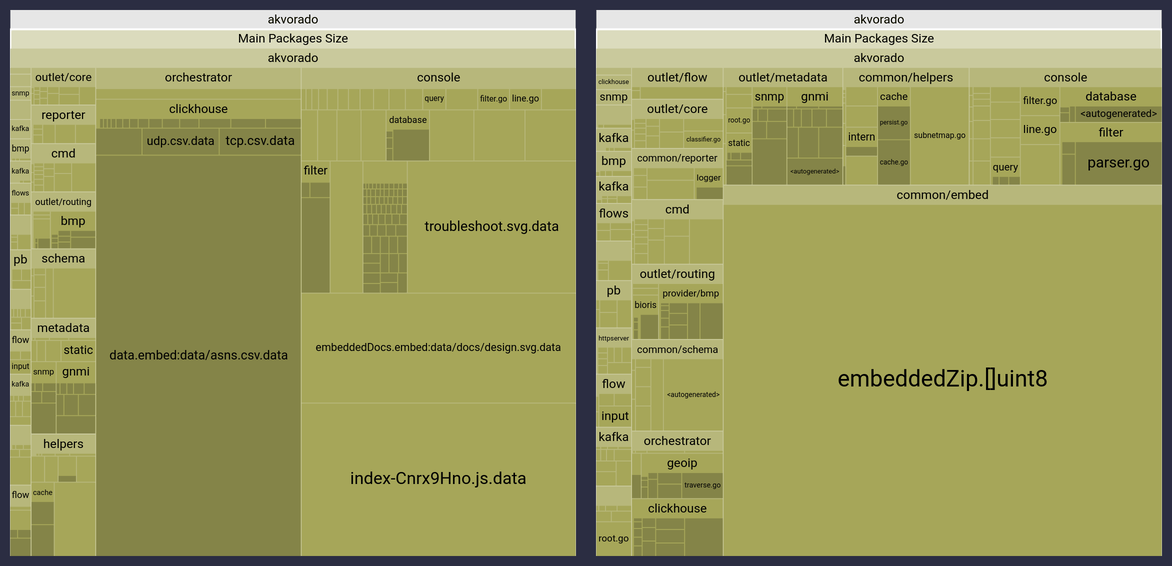
Breakdown of space used by each package before and after introducing embed.zip. It is displayed as a treemap and we can see many embedded files replaced by a bigger one.
Breakdown of the space used by each component before (left) and after (right) the introduction of embed.zip.
Embedding these assets into a ZIP archive reduced the size of the Akvorado executable by more than 4 MiB:
$ unzip -p common/embed/data/embed.zip   wc -c   numfmt --to=iec
7.3M
$ ll common/embed/data/embed.zip
-rw-r--r-- 1 bernat users 2.9M Dec  7 17:17 common/embed/data/embed.zip

Performance loss Reading from a compressed archive is not as fast as reading a flat file. A simple benchmark shows it is more than 4 slower. It also allocates some memory.2
goos: linux
goarch: amd64
pkg: akvorado/common/embed
cpu: AMD Ryzen 5 5600X 6-Core Processor
BenchmarkData/compressed-12     2262   526553 ns/op   610 B/op   10 allocs/op
BenchmarkData/uncompressed-12   9482   123175 ns/op     0 B/op    0 allocs/op
Each access to an asset requires a decompression step, as seen in this flame graph:
🖼 Flame graph when reading data from embed.zip compared to reading data directly
CPU flame graph comparing the time spent on CPU when reading data from embed.zip (left) versus reading data directly (right). Because the Go testing framework executes the benchmark for uncompressed data 4 times more often, it uses the same horizontal space as the benchmark for compressed data. The graph is interactive.
While a ZIP archive has an index to quickly find the requested file, seeking inside a compressed file is currently not possible.3 Therefore, the files from a compressed archive do not implement the io.ReaderAt or io.Seeker interfaces, unlike directly embedded files. This prevents some features, like serving partial files or detecting MIME types when serving files over HTTP.
For Akvorado, this is an acceptable compromise to save a few mebibytes from an executable of almost 100 MiB. Next week, I will continue this futile adventure by explaining how I prevented Go from disabling dead code elimination!

  1. You can safely read multiple files concurrently. However, it does not implement ReadDir() and ReadFile() methods.
  2. You could keep frequently accessed assets in memory. This reduces CPU usage and trades cached memory for resident memory.
  3. SOZip is a profile that enables fast random access in a compressed file. However, Go s archive/zip module does not support it.

6 December 2025

Taavi V n nen: How to import a new Wikipedia language edition (in hard mode)

I created the latest Wikipedia language edition, the Toki Pona Wikipedia, last month. Unlike most other wikis which start their lives in the Wikimedia Incubator before the full wiki is created, in this case the community had been using a completely external MediaWiki site to build the wiki before it was approved as a "proper" Wikipedia wiki,1 and now that external wiki needed to be imported to the newly created Wikimedia-hosted wiki. (As far as I'm aware, the last and previously only time an external wiki has been imported to a Wikimedia project was in 2013 when Wikitravel was forked as Wikivoyage.) Creating a Wikimedia wiki these days is actually pretty straightforward, at least when compared to what it used to be like a couple of years ago. Today the process mostly involves using a script to generate two configuration changes, one to add the basic configuration for a wiki to operate and an another to add the wiki to the list of all wikis that exist, and then running a script to create the wiki database in between of deploying those two configuration changes. And then you wait half an hour while the script to tell all Wikidata client wikis about the new wiki runs on one wiki at a time. The primary technical challenge in importing a third-party wiki is that there's no SUL making sure that a single username maps to the same account on both wikis. This means that the usual strategy of using the functionality I wrote in CentralAuth to manually create local accounts can't be used as is, and so we needed to come up with a new way of matching everyone's contributions to their existing Wikimedia accounts. (Side note: While the user-facing interface tries to present a single "global" user account that can be used on all public Wikimedia wikis, in reality the account management layer in CentralAuth is mostly just a glue layer to link together individual "local" accounts on each wiki that the user has ever visited. These local accounts have independent user ID numbers for example I am user #35938993 on the English Wikipedia but #4 on the new Toki Pona Wikipedia and are what most of MediaWiki code interacts with except for a few features specifically designed with cross-wiki usage in mind. This distinction is also still very much present and visible in the various administrative and anti-abuse workflows.) The approach we ended up choosing was to re-write the dump file before importing, so that a hypothetical account called $Name would be turned $Name~wikipesija.org after the import.2 We also created empty user accounts that would take ownership of the edits to be imported so that we could use the standard account management tools on them later on. MediaWiki supports importing contributions without a local account to attribute them to, but it doesn't seem to be possible to convert an imported actor3 to a regular user later on which we wanted to keep as a possibility, even with the minor downside of creating a few hundred users that'll likely never get touched again later. We also made specific decisions to add the username suffix to everyone, not to just those names that'd conflicted with existing SUL accounts, and to deal with renaming users that wanted their contributions linked to an existing SUL account only after the import. This both reduced complexity and thus risk from the import phase, which already had much more unknowns compared to the rest of the process, but also were much better options ethically as well: suffixing all names meant we would not imply that those people chose to be Wikimedians with those specific usernames (when in reality it was us choosing to import those edits to the Wikimedia universe), and doing renames using the standard MediaWiki account management tooling meant that it produced the normal public log entries that all other MediaWiki administrative actions create. With all of the edits imported, the only major thing remaining was doing those merges I mentioned earlier to attribute imported edits to people's existing SUL accounts. Thankfully, the local account -based system makes it actually pretty simple. Usually CentralAuth prevents renaming individual local accounts that are attached to a global account, but that check can be bypassed with a maintenance script or a privileged enough account. Renaming the user automatically detached it from the previous global account, after which an another maintenance script could be used to attach the user to the correct global account.

  1. That external site was a fork of a fork of the original Toki Pona Wikipedia that was closed in 2005. And because cool URIs don't change, we made the the URLs that the old Wikipedia was using work again. Try it: https://art-tokipona.wikipedia.org.
  2. wikipesija.org was the domain where the old third-party wiki was hosted on, and ~ was used as a separator character in usernames during the SUL finalization in the early 2010s so using it here felt appropriate as well.
  3. An actor is a MediaWiki term and a database table referring to anything that can do edits or logged actions. Usually an actor is a user account or an IP address, but an imported user name in a specific format can also be represented as an actor.

3 December 2025

Reproducible Builds: Reproducible Builds in November 2025

Welcome to the report for November 2025 from the Reproducible Builds project! These monthly reports outline what we ve been up to over the past month, highlighting items of news from elsewhere in the increasingly-important area of software supply-chain security. As always, if you are interested in contributing to the Reproducible Builds project, please see the Contribute page on our website. In this report:

  1. 10 years of Reproducible Build at SeaGL
  2. Distribution work
  3. Tool development
  4. Website updates
  5. Miscellaneous news
  6. Software Supply Chain Security of Web3
  7. Upstream patches

10 years of Reproducible Builds at SeaGL 2025 On Friday 8th November, Chris Lamb gave a talk called 10 years of Reproducible Builds at SeaGL in Seattle, WA. Founded in 2013, SeaGL is a free, grassroots technical summit dedicated to spreading awareness and knowledge about free source software, hardware and culture. Chris talk:
[ ] introduces the concept of reproducible builds, its technical underpinnings and its potentially transformative impact on software security and transparency. It is aimed at developers, security professionals and policy-makers who are concerned with enhancing trust and accountability in our software. It also provides a history of the Reproducible Builds project, which is approximately ten years old. How are we getting on? What have we got left to do? Aren t all the builds reproducible now?

Distribution work In Debian this month, Jochen Sprickerhof created a merge request to replace the use of reprotest in Debian s Salsa Continuous Integration (CI) pipeline with debrebuild. Jochen cites the advantages as being threefold: firstly, that only one extra build needed ; it uses the same sbuild and ccache tooling as the normal build ; and works for any Debian release . The merge request was merged by Emmanuel Arias and is now active. kpcyrd posted to our mailing list announcing the initial release of repro-threshold, which implements an APT transport that defines a threshold of at least X of my N trusted rebuilders need to confirm they reproduced the binary before installing Debian packages. Configuration can be done through a config file, or through a curses-like user interface. Holger then merged two commits by Jochen Sprickerhof in order to address a fakeroot-related reproducibility issue in the debian-installer, and J rg Jaspert deployed a patch by Ivo De Decker for a bug originally filed by Holger in February 2025 related to some Debian packages not being archived on snapshot.debian.org. Elsewhere, Roland Clobus performed some analysis on the live Debian trixie images, which he determined were not reproducible. However, in a follow-up post, Roland happily reports that the issues have been handled. In addition, 145 reviews of Debian packages were added, 12 were updated and 15 were removed this month adding to our knowledge about identified issues. Lastly, Jochen Sprickerhof filed a bug announcing their intention to binary NMU a very large number of the R programming language after a reproducibility-related toolchain bug was fixed.
Bernhard M. Wiedemann posted another openSUSE monthly update for their work there.
Julien Malka and Arnout Engelen launched the new hash collection server for NixOS. Aside from improved reporting to help focus reproducible builds efforts within NixOS, it collects build hashes as individually-signed attestations from independent builders, laying the groundwork for further tooling.

Tool development diffoscope version 307 was uploaded to Debian unstable (as well as version 309). These changes included further attempts to automatically attempt to deploy to PyPI by liaising with the PyPI developers/maintainers (with this experimental feature). [ ][ ][ ] In addition, reprotest versions 0.7.31 and 0.7.32 were uploaded to Debian unstable by Holger Levsen, who also made the following changes:
  • Do not vary the architecture personality if the kernel is not varied. (Thanks to Ra l Cumplido). [ ]
  • Drop the debian/watch file, as Lintian now flags this as error for native Debian packages. [ ][ ]
  • Bump Standards-Version to 4.7.2, with no changes needed. [ ]
  • Drop the Rules-Requires-Root header as it is no longer required.. [ ]
In addition, however, Vagrant Cascadian fixed a build failure by removing some extra whitespace from an older changelog entry. [ ]

Website updates Once again, there were a number of improvements made to our website this month including:

Miscellaneous news

Software Supply Chain Security of Web3 Via our mailing list, Martin Monperrus let us know about their recently-published page on the Software Supply Chain Security of Web3. The abstract of their paper is as follows:
Web3 applications, built on blockchain technology, manage billions of dollars in digital assets through decentralized applications (dApps) and smart contracts. These systems rely on complex, software supply chains that introduce significant security vulnerabilities. This paper examines the software supply chain security challenges unique to the Web3 ecosystem, where traditional Web2 software supply chain problems intersect with the immutable and high-stakes nature of blockchain technology. We analyze the threat landscape and propose mitigation strategies to strengthen the security posture of Web3 systems.
Their paper lists reproducible builds as one of the mitigating strategies. A PDF of the full text is available to download.

Upstream patches The Reproducible Builds project detects, dissects and attempts to fix as many currently-unreproducible packages as possible. We endeavour to send all of our patches upstream where appropriate. This month, we wrote a large number of such patches, including:

Finally, if you are interested in contributing to the Reproducible Builds project, please visit our Contribute page on our website. However, you can get in touch with us via:

2 December 2025

Birger Schacht: Status update, November 2025

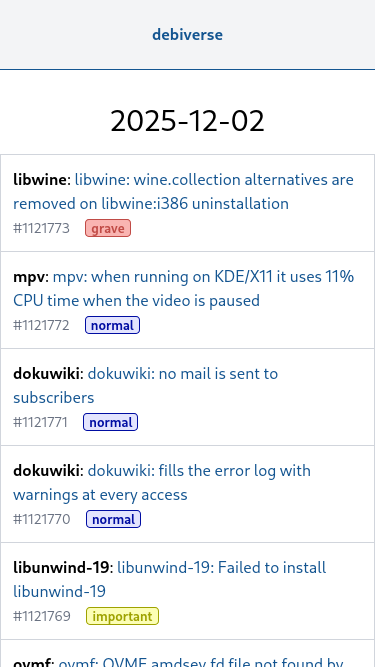
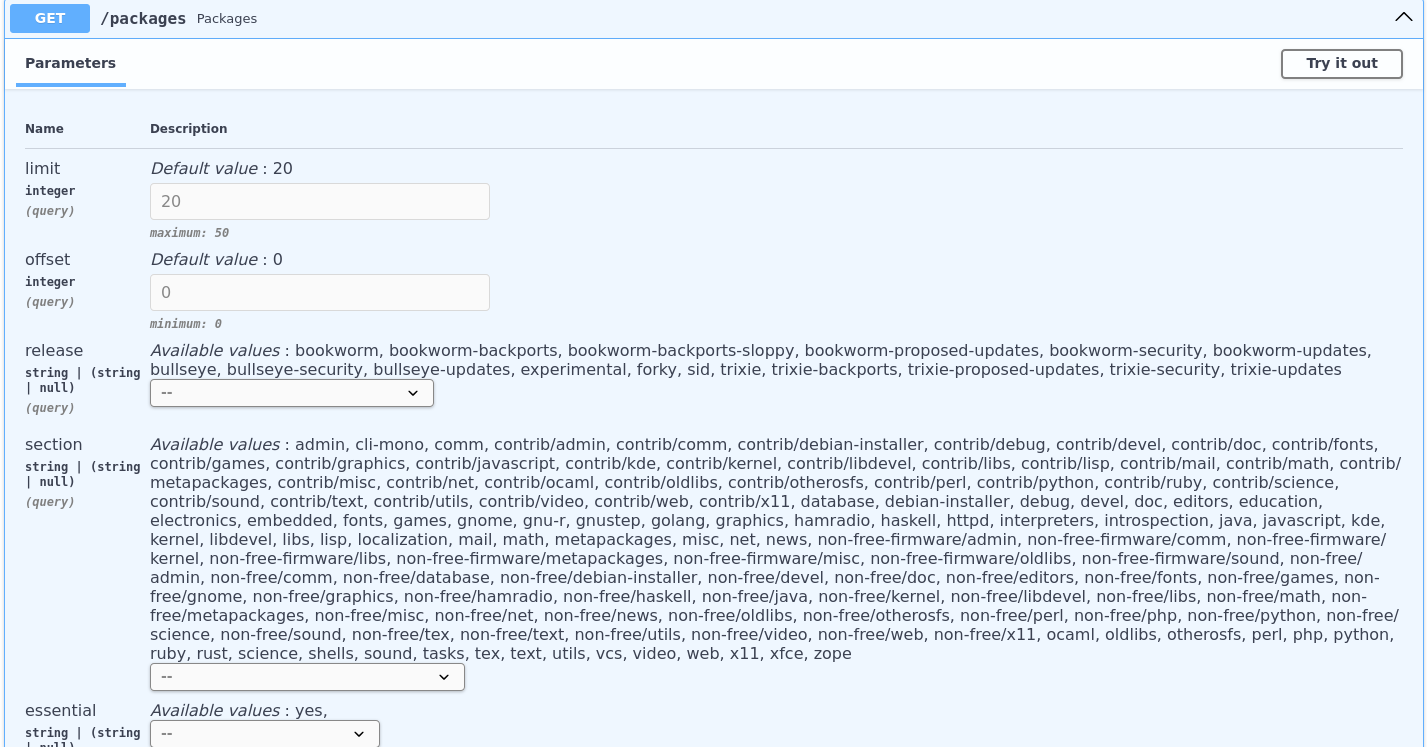
I started this month with a week of vacation which was followed by a small planned surgery and two weeks of sick leave. Nonetheless, I packaged and uploaded new releases of a couple of packages: Besides that I reactivated I project I started in summer 2024: debiverse.org. The idea of that was to have interfaces to Debian bugs and packages that are usable on mobile devices (I know, ludicrous!). Back then I started with Flask and Sqlalchemy, but that soon got out of hand. I now switched the whole stack to FastAPI and SQLModel which makes it a lot easier to manage. And the upside is that it comes with an API and OpenAPI docs. For the rendered HTML pages I use Jinja2 with Tailwind as CSS framework. I am currently using udd-mirror as database backend, which works pretty good (for this single user project). It would be nice to have some of the data in a faster index, like Typesense or Meilisearch. This way it would be possible to have faceted search or more performant full text search. But I haven t found any software that could provide this that is packaged in Debian.
Screenshot of the debiverse bug report list Screenshot of the debiverse swagger API

1 December 2025

Junichi Uekawa: It's already December.

It's already December. I haven't figure out why suspend resume no longer works on my workstation.

30 November 2025

Utkarsh Gupta: FOSS Activites in November 2025

Here s my monthly but brief update about the activities I ve done in the FOSS world.

Debian
Whilst I didn t get a chance to do much, here are still a few things that I worked on:
  • Did a few sessions with the new DFSG team to help kickstart things, et al.
  • Assited a few folks in getting their patches submitted via Salsa.
  • Mentoring for newcomers.
  • Moderation of -project mailing list.

Ubuntu
I joined Canonical to work on Ubuntu full-time back in February 2021. Whilst I can t give a full, detailed list of things I did, here s a quick TL;DR of what I did:
  • Successfully released Resolute Snapshot 1!
    • This one was particularly interesting as it was done without the ISO tracker and cdimage access.
    • There are some wrinkles that need ironing out for the next snapshot.
  • Resolute Raccoon is now fully and formally open.
  • Assisted a bunch of folks with my Archive Admin and Release team hats to:
    • review NEW packages for Ubuntu Studio.
    • remove old binaries that are stalling transition and/or migration.
    • LTS requalification of Ubuntu flavours.
    • bootstrapping dotnet-10 packages.
    • removal of openjdk-19 from Jammy, which sparked some interesting discussions.

Debian (E)LTS
This month I have worked 22 hours on Debian Long Term Support (LTS) and on its sister Extended LTS project and did the following things:
  • wordpress: There were multiple vulnerabilities reported in Wordpress, leading to Sent Data & Cross-site Scripting.
    • [bookworm]: Roberto rightly pointed out that the upload to bookworm hadn t gone through last month, so I re-uploaded wordpress/6.1.9+dfsg1-0+deb12u1 to bookworm-security.
    • This is now released as DSA 6075-1.
  • ruby-rack: There were multiple vulnerabilities reported in Rack, leading to DoS (memory exhaustion) and proxy bypass.
    • [ELTS]: Last month I had backported fixes for CVE-2025-46727 & CVE-2025-32441 to buster and stretch but the other backports were being a bit tricky due to really old versions.
    • I spent a bit more time but there s a lot to demystify. Gonna take a bit of break from this one and come back to this after doing other updates. Might even consider sending a RFH to the list.
  • libwebsockets: Multiple issues were reported in LWS causing denial of service and stack-based buffer overflow.
  • mako: It was found that Mako, a Python template library, was vulnerable to a denial of service attack via crafted regular expressions.
    • [LTS]: For bullseye, these were fixed via 1.1.3+ds1-2+deb11u1. And released as DLA 4393-1.
    • Backporting tests was an interesting exercise as I had to make them compatible with the bullseye version. :)
  • ceph: Affected by CVE-2024-47866, using the argument x-amz-copy-source to put an object and specifying an empty string as its content leads to the RGW daemon crashing, resulting in a DoS attack.
    • [LTS]: Whilst the patch is straightforward, backports are a bit tricky. I ve prepared the update but would like to reach out to zigo, the maintainer, to make sure nothing regresses.
    • [ELTS]: Same as LTS, I d like to get a quick review and upload to LTS first before I start staging uploads for ELTS.
  • [LTS] Attended the monthly LTS meeting on IRC. Summary here.
    • It was also followed by a 50-minute post-meeting technical discussion/question session.
  • [E/LTS] Monitored discussions on mailing lists, IRC, and all the documentation updates. Thanks, Sylvain, for a great documentation summary.

Until next time.
:wq for today.

Otto Kek l inen: DEP-18: A proposal for Git-based collaboration in Debian

Featured image of post DEP-18: A proposal for Git-based collaboration in DebianI am a huge fan of Git, as I have witnessed how it has made software development so much more productive compared to the pre-2010s era. I wish all Debian source code were in Git to reap the full benefits. Git is not perfect, as it requires significant effort to learn properly, and the ecosystem is complex with even more things to learn ranging from cryptographic signatures and commit hooks to Git-assisted code review best practices, forge websites, and CI systems. Sure, there is still room to optimize its use, but Git certainly has proven itself and is now the industry standard. Thus, some readers might be surprised to learn that Debian development in 2025 is not actually based on Git. In Debian, the version control is done by the Debian archive itself. Each commit is a new upload to the archive, and the commit message is the debian/changelog entry. The commit log is available at snapshots.debian.org. In practice, most Debian Developers (people who have the credentials to upload to the Debian archive) do use Git and host their packaging source code on salsa.debian.org the GitLab instance of Debian. This is, however, based on each DD s personal preferences. The Debian project does not have any policy requiring that packages be hosted on salsa.debian.org or be in version control at all.

Is collaborative software development possible without git and version control software? Debian, however, has some peculiarities that may be surprising to people who have grown accustomed to GitHub, GitLab or various company-internal code review systems. In Debian:
  • The source code of the next upload is not public but resides only on the developer s laptop.
  • Code contributions are plain patch files, based on the latest revision released in the Debian archive (where the unstable area is equivalent to the main development branch).
  • These patches are submitted by email to a bug tracker that does no validation or testing whatsoever.
  • Developers applying these patches typically have elaborate Mutt or Emacs setups to facilitate fetching patches from email.
  • There is no public staging area, no concept of rebasing patches or withdrawing a patch and replacing it with a better version.
  • The submitter won t see any progress information until a notification email arrives after a new version has been uploaded to the Debian archive.
This system has served Debian for three decades. It is not broken, but using the package archive just feels well, archaic. There is a more efficient way, and indeed the majority of Debian packages have a metadata field Vcs-Git that advertises which version control repository the maintainer uses. However, newcomers to Debian are surprised to notice that not all packages are hosted on salsa.debian.org but at various random places with their own account and code submission systems, and there is nothing enforcing or even warning if the code there is out of sync with what was uploaded to Debian. Any Debian Developer can at any time upload a new package with whatever changes, bypassing the Git repository, even when the package advertised a Git repository. All PGP signed commits, Git tags and other information in the Git repository are just extras currently, as the Debian archive does not enforce or validate anything about them. This also makes contributing to multiple packages in parallel hard. One can t just go on salsa.debian.org and fork a bunch of repositories and submit Merge Requests. Currently, the only reliable way is to download source packages from Debian unstable, develop patches on top of them, and send the final version as a plain patch file by email to the Debian bug tracker. To my knowledge, no system exists to facilitate working with the patches in the bug tracker, such as rebasing patches 6 months later to detect if they or equivalent changes were applied or if sending refreshed versions is needed. To newcomers in Debian, it is even more surprising that there are packages that are on salsa.debian.org but have the Merge Requests feature disabled. This is often because the maintainer does not want to receive notification emails about new Merge Requests, but rather just emails from bugs.debian.org. This may sound arrogant, but keep in mind that these developers put in the effort to set up their Mutt/Emacs workflow for the existing Debian process, and extending it to work with GitLab notifications is not trivial. There are also purists who want to do everything via the command-line (without having to open a browser, run JavaScript and maintain a live Internet connection), and tools like glab are not convenient enough for the full workflow.

Inefficient ways of working prevent Debian from flourishing I would claim, based on my personal experiences from the past 10+ years as a Debian Developer, that the lack of high-quality and productive tooling is seriously harming Debian. The current methods of collaboration are cumbersome for aspiring contributors to learn and suboptimal to use for both new and seasoned contributors. There are no exit interviews for contributors who left Debian, no comprehensive data on reasons to contribute or stop contributing, nor are there any metrics tracking how many people tried but failed to contribute to Debian. Some data points to support my concerns do exist:
  • The contributor database shows that the number of contributors is growing slower than Debian s popularity.
  • Most packages are maintained by one person working alone (just pick any package at random and look at the upload history).

Debian should embrace git, but decision-making is slow Debian is all about community and collaboration. One would assume that Debian prioritized above all making collaboration tools and processes simpler, faster and less error-prone, as it would help both current and future package maintainers. Yet, it isn t so, due to some reasons unique to Debian. There is no single company or entity running Debian, and it has managed to operate as a pure meritocracy and do-cracy for over 30 years. This is impressive and admirable. Unfortunately, some of the infrastructure and technical processes are also nearly 30 years old and very difficult to change for the same reason: the nature of Debian s distributed decision-making process. As a software developer and manager with 25+ years of experience, I strongly feel that developing software collaboratively using Git is a major step forward that Debian needs to take, in one form or another, and I hope to see other DDs voice their support if they agree.

Debian Enhancement Proposal 18 Following how consensus is achieved in Debian, I started drafting DEP-18 in 2024, and it is currently awaiting enough thumbs up at https://salsa.debian.org/dep-team/deps/-/merge_requests/21 to get into CANDIDATE status next. In summary, the DEP-18 proposes that everyone keen on collaborating should:
  1. Maintain Debian packaging sources in Git on Salsa.
  2. Use Merge Requests to show your work and to get reviews.
  3. Run Salsa CI before upload.
The principles above are not novel. According to stats at e.g. trends.debian.net, and UDD, ~93% of all Debian source packages are already hosted on salsa.debian.org. As of June 1st, 2025, only 1640 source packages remain that are not hosted on Salsa. The purpose of DEP-18 is to state in writing what Debian is currently doing for most packages, and thus express what among others new contributors should be learning and doing, so basic collaboration is smooth and free from structural obstacles. Most packages are also already allowing Merge Requests and using Salsa CI, but there hasn t been any written recommendation anywhere in Debian to do so. The Debian Policy (v.4.7.2) does not even mention the word Salsa a single time. The current process documentation on how to do non-maintainer uploads or salvaging packages are all based on uploading packages to the archive, without any consideration of using git-based collaboration such as posting a Merge Request first. Personally I feel posting a Merge Request would be a better approach, as it would invite collaborators to discuss and provide code reviews. If there are no responses, the submitter can proceed to merge, but compared to direct uploads to the Debian archive, the Merge Request practice at least tries to offer a time and place for discussions and reviews to happen. It could very well be that in the future somebody comes up with a new packaging format that makes upstream source package management easier, or a monorepo with all packages, or some other future structures or processes. Having a DEP to state how to do things now does not prevent people from experimenting and innovating if they intentionally want to do that. The DEP is merely an expression of the minimal common denominators in the packaging workflow that maintainers and contributors should follow, unless they know better.

Transparency and collaboration Among the DEP-18 recommendations is:
The recommended first step in contributing to a package is to use the built-in Fork feature on Salsa. This serves two purposes. Primarily, it allows any contributor to publish their Git branches and submit them as Merge Requests. Additionally, the mere existence of a list of Forks enables contributors to discover each other, and in rare cases when the original package is not accepting improvements, collaboration could arise among the contributors and potentially lead to permanent forks in the general meaning. Forking is a fundamental part of the dynamics in open source that helps drive quality and agreement. The ability to fork ultimately serves as the last line of defense of users rights. Git supports this by making both temporary and permanent forks easy to create and maintain.
Further, it states:
Debian packaging work should be reasonably transparent and public to allow contributors to participate. A maintainer should push their pending changes to Salsa at regular intervals, so that a potential contributor can discover if a particular change has already been made or a bug has been fixed in version control, and thus avoid duplicate work. Debian maintainers should make reasonable efforts to publish planned changes as Merge Requests on Salsa and solicit feedback and reviews. While pushing changes directly on the main Git branch is the fastest workflow, second only to uploading all changes directly to Debian repositories, it is not an inclusive way to develop software. Even packages that are maintained by a single maintainer should at least occasionally publish Merge Requests to allow new contributors to step up and participate.
I think these are key aspects leading to transparency and true open source collaboration. Even though this talks about Salsa which is based on GitLab the concepts are universal and will work also on other forges, like Forgejo or GitHub. The point is that sharing work-in-progress on a real-time platform, with CI and other supporting features, empowers and motivates people to iterate on code collaboratively. As an example of an anti-pattern, Oracle MySQL publishes the source code for all their releases and is license-compliant, but as they don t publish their Git commits in real-time, it does not feel like a real open source project. Non-Oracle employees are not motivated to participate as second-class developers who are kept in the dark. Debian should embrace git and sharing work in real-time, embodying a true open source spirit.

Recommend, not force Note that the Debian Enhancement Proposals are not binding. Only the Debian Policy and Technical Committee decisions carry that weight. The nature of collaboration is voluntary anyway, so the DEP does not need to force anything on people who don t want to use salsa.debian.org. The DEP-18 is also not a guide for package maintainers. I have my own views and have written detailed guides in blog articles if you want to read more on, for example, how to do code reviews efficiently. Within DEP-18, there is plenty of room to work in many different ways, and it does not try to force one single workflow. The goal here is to simply have agreed-upon minimal common denominators among those who are keen to collaborate using salsa.debian.org, not to dictate a complete code submission workflow. Once we reach this, there will hopefully be less friction in the most basic and recurring collaboration tasks, giving DDs more energy to improve other processes or just invest in having more and newer packages for Debian users to enjoy.

Next steps In addition to lengthy online discussions on mailing lists and DEP reviews, I also presented on this topic at DebConf 2025 in Brest, France. Unfortunately the recording is not yet up on Peertube. The feedback has been overwhelmingly positive. However, there are a few loud and very negative voices that cannot be ignored. Maintaining a Linux distribution at the scale and complexity of Debian requires extraordinary talent and dedication, and people doing this kind of work often have strong views, most of the time for good reasons. We do not want to alienate existing key contributors with new processes, so maximum consensus is desirable. We also need more data on what the 1000+ current Debian Developers view as a good process to avoid being skewed by a loud minority. If you are a current or aspiring Debian Developer, please add a thumbs up if you think I should continue with this effort (or a thumbs down if not) on the Merge Request that would make DEP-18 have candidate status. There is also technical work to do. Increased Git use will obviously lead to growing adoption of the new tag2upload feature, which will need to get full git-buildpackage support so it can integrate into salsa.debian.org without turning off Debian packaging security features. The git-buildpackage tool itself also needs various improvements, such as making contributing to multiple different packages with various levels of diligence in debian/gbp.conf maintenance less error-prone. Eventually, if it starts looking like all Debian packages might get hosted on salsa.debian.org, I would also start building a review.debian.org website to facilitate code review aspects that are unique to Debian, such as tracking Merge Requests across GitLab projects in ways GitLab can t do, highlighting which submissions need review most urgently, feeding code reviews and approvals into the contributors.debian.org database for better attribution, and so forth. Details on this vision will be in a later blog post, so subscribe to updates!

29 November 2025

Freexian Collaborators: Monthly report about Debian Long Term Support, October 2025 (by Roberto C. S nchez)

The Debian LTS Team, funded by Freexian s Debian LTS offering, is pleased to report its activities for October.

Activity summary During the month of October, 21 contributors have been paid to work on Debian LTS (links to individual contributor reports are located below). The team released 37 DLAs fixing 893 CVEs. The team has continued in its usual rhythm, preparing and uploading security updates targeting LTS and ELTS, as well as helping with updates to oldstable, stable, testing, and unstable. Additionally, the team received several contributions of LTS uploads from Debian Developers outside the standing LTS Team. Notable security updates:
  • https-everywhere, prepared by Markus Koschany, deals with a problem created by ownership of the https-rulesets.org domain passing to a malware operator
  • openjdk-17 and openjdk-11, prepared by Emilio Pozuelo Monfort, fixes XML external entity and certificate validation vulnerabilities
  • intel-microcode, prepared by Tobias Frost, fixes a variety of privilege escalation and denial of service vulnerabilities
Notable non-security updates:
  • distro-info-data, prepared by Stefano Rivera, updates information concerning current and upcoming Debian and Ubuntu releases
Contributions from outside the LTS Team:
  • Lukas M rdian, a Debian Developer, provided an update of log4cxx
  • Andrew Ruthven, one of the request-tracker4 maintainers, provided an update of request-tracker4
  • Christoph Goehre, co-maintainer of thunderbird, provided an update of thunderbird
Beyond the typical LTS updates, the team also helped the Debian community more broadly:
  • Guilhem Moulin prepared oldstable/stable updates of libxml2, and an unstable update of libxml2.9
  • Bastien Roucari s prepared oldstable/stable updates of imagemagick
  • Daniel Leidert prepared an oldstable update of python-authlib, oldstable update of libcommons-lang-java and stable update of libcommons-lang3-java
  • Utkarsh Gupta prepared oldstable/stable/testing/unstable updates of ruby-rack
The LTS Team is grateful for the opportunity to contribute to making LTS a high quality for sponsors and users. We are also particularly grateful for the collaboration from others outside the time; their contributions are important to the success of the LTS effort.

Individual Debian LTS contributor reports

Thanks to our sponsors Sponsors that joined recently are in bold.

27 November 2025

Russ Allbery: Review: A Matter of Execution

Review: A Matter of Execution, by Nicholas & Olivia Atwater
Series: Tales of the Iron Rose #0
Publisher: Starwatch Press
Copyright: 2024
ISBN: 1-998257-08-8
Format: Kindle
Pages: 131
A Matter of Execution is the introductory novella that kicked off the Tales of the Iron Rose series. It is steampunk fantasy with airships. I previously read and reviewed the subsequent novel, Echoes of the Imperium. As noted in that review, I read the novel first. That was a mistake; this is a much better place to start. A Matter of Execution was clearly intended as the introduction of all of these characters. More importantly, I think reading the novella first would have given me enough affinity with the characters to not mind the worst part of Echoes of the Imperium: the extremely slow first half that seemed filled with the protagonist's impostor syndrome. A Matter of Execution opens, fittingly, with Captain William Blair, a goblin, former Imperial soldier, Oathbreaker, and series first-person protagonist being carted to his execution. He is not alone; in the same prison wagon is an arrogant (and racist) man named Strahl, the killer of one of the rulers of Lyonesse. Strahl is rather contemptuous of Blair's claim to be a captain, given that he's both a goblin and an Oathbreaker. Strahl quickly revises that opinion when Blair's crew, somewhat predictably given that he is the series protagonist, creates a daring escape for both of them. The heat of action gives both a chance to gain some respect for the other, which explains why Blair is not only willing to invite Strahl to join his crew, but to go back for Strahl's companion. Breaking out Strahl's companion will be a more difficult, and surprising, problem. Nicholas Atwater is a role-playing game GM, something that you will learn in the "about the author" section at the end of this novella but probably will have guessed by then. Even more than Echoes of the Imperium, this novella feels like a (good) write-up of an RPG adventure. A wildly varied cast of characters come together and form a party with a well-defined objective that has some surrounding mysteries and surprises. Each of those characters get their individual moments to show off their specific skills. Readers with a certain gaming background will know exactly where to insert the Borderlands-style title card with a slightly demented description of each character. This is not a complaint. You may be able to see the bones of the setup adventure for a long-running campaign, but I like this style of character introduction and the story moves right along. There are a ton of varied characters, some interesting villains and maybe-villains, a rather satisfying heist setup, and some good chemistry and a bit of banter. This is not a deep story it's clearly an introductory episode for both the characters and the world background but it's a fun way to spend a few hours. I think the best part of this series is the world-building. If you have read my review of Echoes of the Imperium, you have unfortunately been mildly spoiled for the revelation in this novella. I don't think it hurt the story that much; you will be able to predict what obvious gaps in the novel backstory the novella is going to fill in, but it's just as enjoyable to see how that happens. But the Atwaters aren't going to drop any of the big world-building bombs in the introductory novella, of course. Instead, you get a gradual introduction to the nature of magic in this world, some of the political setup of the recent war, and a quick introduction to the capabilities of Strahl's mysterious companion. If you've not yet read this series, I recommend starting here. It's a quick investment to see if you'll be interested. The novel is heavier and slower, and the pacing of the first half isn't great, but the world-building is even better. If you've already read the novel, this is still worth reading as long as you enjoyed it. You'll have a few moments of "oh, that's how that happened," and it's a fun and fast-moving way to spend a bit more time with the characters. Followed by Echoes of the Imperium. The back matter of the novella says that The Winds of Fortune is supposedly forthcoming. Rating: 7 out of 10

25 November 2025

Russell Coker: EDID and my 8K TV

I previously blogged about buying a refurbished Hisense 65u80g 8K TV with the aim of making it a large monitor [1] and about searching for a suitable video card for 8k [2]. After writing the second post I bought an Intel Arc B580 which also did a maximum of 4096*2160 resolution. This post covers many attempts to try and get the TV to work correctly and it doesn t have good answers. The best answer might be to not buy Hisense devices but I still lack data. Attempts to Force 8K I posted on Lemmy again about this [3] and got a single response, which is OK as it was a good response. They didn t give me the answer on a silver platter but pointed me in the right direction of EDID [4]. I installed the Debian packages read-edid, wxedid, and edid-decode. The command get-edid > out.edid saves the binary form of the edid to a file. The command wxedid out.edid allows graphical analysis of the EDID data. The command edid-decode out.edid dumps a plain text representation of the output, the command edid-decode out.edid grep VIC cut -d: -f2 sort -n shows an ordered list of video modes, in my case the highest resolution is 4096 2160 which is the highest that Linux had allowed me to set with two different video cards and a selection of different cables (both HDMI and DisplayPort).
xrandr --newmode 7680x4320 1042.63  7680 7984 7760 7824  4320 4353 4323 4328
xrandr --addmode HDMI-3 7680x4320
xrandr --output HDMI-3 --mode 7680x4320
I ran the above commands and got the below error:
xrandr: Configure crtc 0 failed
At this time I don t know how much of this is due to the video card and how much is due to the TV. The parameters for xrandr came from a LLM because I couldn t find any Google results on what 8K parameters to use. As an aside if you have a working 8K TV or monitor connected to a computer please publish the EDID data, xrandr, and everything else you can think of. I found a Github repository for EDID data [5] but that didn t have an entry for my TV and didn t appear to have any other entry for an 8K device I could use. Resolution for Web Browsing I installed a browser on the TV, Chrome and Firefox aren t available for a TV and the Play Store program tells you that (but without providing a reason) when you search for them. I tried the site CodeShack What is my Screen Resolution [6] which said that my laptop is 2460*1353 while the laptop display is actually 2560*1440. So apparently I have 100 pixels used for the KDE panel at the left of the screen and 87 pixels used by the Chrome tabs and URL bar which seems about right. My Note 9 phone reports 384*661 out of it s 2960*1440 display so it seems that Chrome on my phone is running web sites at 4/15 of the native resolution and about 16% of the height of the screen is used by the system notification bar, the back/home/tasklist buttons (I choose buttons instead of swipe for navigation in system settings), and the URL bar when I have Screen zoom in system settings at 1/4. When I changed Screen zoom to 0/4 the claimed resolution changed to 411*717 (2/7 of the native resolution). Font size changes didn t change the claimed resolution. The claimed Browser Viewport Size by CodeShack is 1280*720 which is 1/6 of the real horizontal resolution and slightly more than 1/6 of the vertical resolution, it claims that the Pixel Density is 2* and a screen resolution of 970*540 which means to imply that the browser is only working at 1920*1080 resolution! Netflix When I view Netflix shows using the Netflix app running on the TV is reports 4K which doesn t happen on Linux PCs (as they restrict 4K content to platforms with DRM) and in the Device setting it reports Device Model as Hisense_SmartTV 8K FFM so the Netflix app knows all about 4K content and knows the text string 8K . YouTube When I view a YouTube video that s described as being 8K I don t get a request for paying for YouTube Premium which is apparently what happens nowadays when you try to play actual 8K video. I turn on State for Nerds and one line has Viewport / Frames 1920 1080*2.00 and another has Current / Optimal Res 3840 2160@60 / 3840 2160@60 so it seems that the YouTube app is seeing the screen as 4K but choosing to only display FullHD even when I have Quality set to 2160p60 HDR . It declares the network speed to be over 100mbit most of the time and the lowest it gets is 60mbit while 50mbit is allegedly what s required for 8K. I installed a few Android apps to report hardware capabilities and they reported the screen resolution to be 1920*1080. Have I Been Ripped Off? It looks like I might have been ripped off by this. I can t get any app other than Netflix to display 4K content. My PC will only connect to it at 4K. Android apps (including YouTube) regard it as 1920*1080. The AI Upscaling isn t really that great and in most ways it seems at best equivalent to a 4K TV and less than a 4K TV that runs Android apps with an actual 4K display buffer. Next Steps The next things I plan to do are to continue attempts to get the TV to do what it s claimed to be capable of, either an Android app that can display 8K content or a HDMI input of 8K content will do. Running a VNC client on the TV would be an acceptable way of getting an 8K display from a Linux PC. I need to get a somewhat portable device that can give 8K signal output. Maybe a mini PC with a powerful GPU or maybe one of those ARM boards that s designed to drive an 8K sign. Then I can hunt for stores that have 8K TVs on display. It would be nice if someone made a USB device that does 8K video output NOT a USB-C DisplayPort alternative mode that uses the video hardware on the laptop. Then I could take a laptop to any place that has an 8K display to show and connect my laptop to it. The one thing I haven t done yet is testing 8K MP4 files on a USB stick. That s mainly due to a lack of content and the fact that none of the phone cameras I have access to can do 8K video. I will try displaying 8K PNG and JPEG files from a USB stick. Most people would give up about now. But I am determined to solve this and buying another large TV isn t out of the question.

Freexian Collaborators: How we implemented a dark mode in Debusine (by Enrico Zini)

Having learnt that Bootstrap supports color modes, we decided to implement an option for users to enable dark mode in Debusine. By default, the color mode is selected depending on the user browser preferences. If explicitly selected, we use a cookie to store the theme selection so that a user can choose different color modes in different browsers. The work is in merge request !2401 and minimizes JavaScript dependencies like we do in other parts of debusine.

A view to select the theme First is a simple view to configure the selected theme and store it in a cookie. If auto is selected, then the cookie is deleted to delegate theme selection to JavaScript:
class ThemeSelectionView(View):
    """Select and save the current theme."""

    def post(
        self, request: HttpRequest, *args: Any, **kwargs: Any  # noqa: U100
    ) -> HttpResponse:
        """Set the selected theme."""
        value = request.POST.get("theme", "auto")
        next_url = request.POST.get("next", None)
        if next_url is None:
            next_url = reverse("homepage:homepage")
        response = HttpResponseRedirect(next_url)
        if value == "auto":
            response.delete_cookie("theme")
        else:
            response.set_cookie(
                "theme", value, httponly=False, max_age=dt.timedelta(days=3650)
            )
        return response
The main base view of Debusine reads the value from the cookie and makes it available to the templates:
      def get_context_data(self, **kwargs: Any) -> dict[str, Any]:
          ctx = super().get_context_data(**kwargs)
          ctx["theme"] = self.request.COOKIES.get("theme", None)
          # ...
          return ctx
The base template will use this value to set data-bs-theme on the main <html> element, and that s all that is needed to select the color mode in Bootstrap:
<html lang="en" % if theme %  data-bs-theme="  theme  " % endif % >
The view uses HTTP POST as it changes state, so theme selection happens in a form:
<form id="footer-theme" class="col-auto" method="post"
      action=" % url "theme-selection" % ">
     % csrf_token % 
    <input type="hidden" name="next" value="  request.get_full_path  ">
    Theme:
    <button type="submit" name="theme" value="dark">dark</button>
     
    <button type="submit" name="theme" value="light">light</button>
     
    <button type="submit" name="theme" value="auto">auto</button>
</form>
Since we added the theme selection buttons in the footer, we use CSS to render the buttons in the same way as the rest of the footer links. Bootstrap has a set of CSS variables that can be used to easily in sync with the site theme, and they are especially useful now that the theme is configurable:
footer button  
    background: none;
    border: none;
    margin: 0;
    padding: 0;
    color: var(--bs-link-color);
 

Theme autoselection Bootstrap would support theme autoselection via browser preferences, but that requires rebuilding its Sass sources. Alternatively, one can use JavaScript:
 % if not theme % 
    <script blocking="render">
    (function()  
        let theme = window.matchMedia('(prefers-color-scheme: dark)').matches ? 'dark' : 'light';
        let [html] = document.getElementsByTagName("html");
        html.setAttribute("data-bs-theme", theme);
     )();
    </script>
 % endif % 
This reads the color scheme preferences and sets the data-bs-theme attribute on <html>. The script is provided inline as it needs to use blocking="render" to avoid flashing a light background at the beginning of page load until the attribute is set. Given that this is a render-blocking snippet, as an extra optimization it is not added to the page if a theme has been set.

Bootstrap CSS fixes We were making use of the bootstrap btn-light class in navbars to highlight elements on hover, and that doesn t work well with theme selection. Lacking a button class that does the right thing across themes, we came up with a new CSS class that uses variables to define a button with hover highlight that works preserving the underlying color:
:root[data-bs-theme=light]  
    --debusine-hover-layer: rgb(0 0 0 / 20%);
    --debusine-hover-color-multiplier: 0.8;
    --debusine-disabled-color-multiplier: 1.5;
 
:root[data-bs-theme=dark]  
    --debusine-hover-layer: rgb(255 255 255 / 20%);
    --debusine-hover-color-multiplier: 1.2;
    --debusine-disabled-color-multiplier: 0.5;
 

/* Button that preserves the underlying color scheme */
.btn-debusine  
  --bs-btn-hover-color: rgb(from var(--bs-btn-color) calc(r * var(--debusine-hover-color-multiplier)) calc(g * var(--debusine-hover-color-multiplier)) calc(b * var(--debusine-hover-color-multiplier)));
  --bs-btn-hover-bg: var(--debusine-hover-layer);
  --bs-btn-disabled-color: rgb(from var(--bs-btn-color) calc(r * var(--debusine-disabled-color-multiplier)) calc(g * var(--debusine-disabled-color-multiplier)) calc(b * var(--debusine-disabled-color-multiplier)));
  --bs-btn-disabled-bg: var(--bs-btn-bg);
  --bs-btn-disabled-border-color: var(--bs-btn-border-color);
 

Dark mode! This was a nice integration exercise with many little tricks, like how to read color scheme preferences from the browser, render form buttons as links, use bootstrap variables, prevent a flashing background, handle cookies in Django. And Debusine now has a dark mode!

21 November 2025

Daniel Kahn Gillmor: Transferring Signal on Android

Transferring a Signal account between two Android devices I spent far too much time recently trying to get a Signal Private Messenger account to transfer from one device to another. What I eventually found worked was a very finicky path to enable functioning "Wi-Fi Direct", which I go into below. I also offer some troubleshooting and recovery-from-failure guidance. All of this blogpost uses "original device" to refer to the Android pocket supercomputer that already has Signal installed and set up, and "new device" to mean the Android device that doesn't yet have Signal on it.

Why Transfer? Signal Private Messenger is designed with the expectation that the user has a "primary device", which is either an iPhone or an Android pocket supercomputer. If you have an existing Signal account, and try to change your primary device by backing up and restoring from backup, it looks to me like Signal will cause your long-term identity keys to be changed. This in turn causes your peers to see a message like "Your safety number with Alice has changed." These warning messages are the same messages that they would get if an adversary were to take over your account. So it's a good idea to minimize them when there isn't an account takeover false alarms train people to ignore real alarms. You can avoid "safety number changed" warnings by using signal's "account transfer" process during setup, at least if you're transferring between two Android devices. However, my experience was that the transfer between two Android devices was very difficult to get to happen at all. I ran into many errors trying to do this, until I finally found a path that worked.

Dealing with Failure After each failed attempt at a transfer, my original device's Signal installation would need to be re-registered. Having set a PIN meant that i could re-register the device without needing to receive a text message or phone call. Set a PIN before you transfer! Also, after a failure, you need to re-link any "linked device" (i.e. any Signal Desktop or iPad installation). If any message came in during the aborted transfer, the linked device won't get a copy of that message. Finally, after a failed transfer, i recommend completely uninstalling Signal from the new device, and starting over with a fresh install on the new device.

Permissions My understanding is that Signal on Android uses Wi-Fi Direct to accomplish the transfer. But to use Wi-Fi Direct, Signal needs to have the right permissions. On each device:
  • Entirely stop the Signal app
  • Go to Settings Apps Signal Permissions
  • Ensure that the following permissions are all enabled whenever the app is running:
  • Location
  • Nearby Devices
  • Network

Preparing for Wi-Fi Direct The transfer process depends on "Wi-Fi Direct", which is a bit of a disaster on its own. I found that if i couldn't get Wi-Fi Direct to work between the two devices, then the Signal transfer was guaranteed to fail. So, for clearer debugging, i first tried to establish a Wi-Fi Direct link on Android, without Signal being involved at all. Setting up a Wi-Fi Direct connection directly failed, multiple times, until i found the following combination of steps, to be done on each device:
  • Turn off Bluetooth
  • Ensure Wi-Fi is enabled
  • Disconnect from any Wi-Fi network you are connected to (go to the "Internet" or "Wi-Fi" settings page, long-press on the currently connected network, and choose "Disconnect"). If your device knows how to connect to multiple local Wi-Fi networks, disconnct from each of them in turn until you are in a stable state where Wi-Fi is enabled, but no network is connected.
  • Close to the bottom of the "Inteernet" or "Wi-Fi" settings page, choose "Network Preferences" and then "Wi-Fi Direct"
  • if there are any entries listed under "Remembered groups", tap them and choose to "Forget this group"
  • If there are Peer devices that say "Invited", tap them and choose to "Cancel invitation"
I found that this configuration is the most likely to enable a successful Wi-Fi Direct connection, where clicking "invite" on one device would pop up an alert on the other asking to accept the connection, and result in a "Connected" state between the two devices.

Actually Transferring Start with both devices fully powered up and physically close to one another (on the same desk should be fine). On the new device:
  • Reboot the device, and log into the profile you want to use
  • Enable Internet access via Wi-Fi.
  • Remove any old version of Signal.
  • Install Signal, but DO NOT OPEN IT!
  • Set up the permissions for the Signal app as described above
  • Open Signal, and choose "restore or transfer" -- you still need to be connected to the network at this point.
  • The new device should display a QR code.
On the original device:
  • Reboot the device, and log into the profile that has the Signal account you're looking to transfer
  • Enable Internet access via Wi-Fi, using the same network that the old device is using.
  • Make sure the permissions for Signal are set up as described above
  • Open Signal, and tap the camera button
  • Point the camera at the new device's QR code
Now tap the "continue" choices on both devices until they both display a message that they are searching for each other. You might see the location indicator (a green dot) turn on during this process. If you see an immediate warning of failure on either device, you probably don't have the permissions set up right. You might see an alert (a "toast") on one of the devices that the other one is trying to connect. You should click OK on that alert. In my experience, both devices are likely to get stuck "searching" for each other. Wait for both devices to show Signal's warning that the search has timed out. At this point, leave Signal open on both devices, and go through all the steps described above to prepare for Wi-Fi Direct. Your Internet access will be disabled. Now, tap "Try again" in Signal on both devices, pressing the buttons within a few seconds of each other. You should see another alert that one device is trying to connect to the other. Press OK there. At this point, the transfer should start happening! The old device will indicate what percentag has been transferred, and the new device will indicate how many messages hav been transferred. When this is all done, re-connect to Wi-Fi on the new device.

Temporal gap for Linked Devices Note that during this process, if new messages are arriving, they will be queuing up for you. When you reconnect to wi-fi, the queued messages will flow to your new device. But the process of transferring automatically unlinks any linked devices. So if you want to keep your instance of Signal Desktop with as short a gap as possible, you should re-link that installation promptly after the transfer completes.

Clean-up After all this is done successfully, you probably want to go into the Permissions settings and turn off the Location and Nearby Devices permissions for Signal on both devices. I recommend also going into Wi-Fi Direct and removing any connected devices and forgetting any existing connections.

Conclusion This is an abysmally clunky user experience, and I'm glad I don't have to do it often. It would have been much simpler to make a backup and restore from it, but I didn't want to freak out my contacts with a safety number change. By contrast, when i wanted extend a DeltaChat account across two devices, the transfer was prompt and entirely painless -- i just had to make sure the devices were on the same network, and then scanned a QR code from one to the other. And there was no temporal gap for any other deviees. And i could use Delta on both devices simultaneously until i was convinced that it would work on the new device -- Delta doesn't have the concept of a primary account. I wish Signal made it that easy! Until it's that easy, i hope the processes described here are useful to someone.

19 November 2025

Dirk Eddelbuettel: digest 0.6.39 on CRAN: Micro Update

Release 0.6.39 of the digest package arrived at CRAN today and has also been uploaded to Debian. digest creates hash digests of arbitrary R objects. It can use a number different hashing algorithms (md5, sha-1, sha-256, sha-512, crc32, xxhash32, xxhash64, murmur32, spookyhash, blake3,crc32c, xxh3_64 and xxh3_128), and enables easy comparison of (potentially large and nested) R language objects as it relies on the native serialization in R. It is a mature and widely-used package (with 86.8 million downloads just on the partial cloud mirrors of CRAN which keep logs) as many tasks may involve caching of objects for which it provides convenient general-purpose hash key generation to quickly identify the various objects. As noted last week in the 0.6.38 release note, hours after it was admitted to CRAN, I heard from the ever-so-tireless Brian Ripley about an SAN issue on arm64 only (and apparently non-reproducible elsewhere). He kindly provided a fix; it needed a cast. Checking this on amd64 against our Rocker-based ASAN and UBSAN containers (where is remains impossible to replicate, this issue is apparently known for some arm64 issues) another micro-issue (of a missing final argument NULL missing in one .Call()) was detected. Both issues were fixed the same day, and constitute the only change here. I merely waited a week to avoid a mechanical nag triggered when release happen within a week. My CRANberries provides a summary of changes to the previous version. For questions or comments use the issue tracker off the GitHub repo. For documentation (including the changelog) see the documentation site. If you like this or other open-source work I do, you can now sponsor me at GitHub.

This post by Dirk Eddelbuettel originated on his Thinking inside the box blog. Please report excessive re-aggregation in third-party for-profit settings.

18 November 2025

Daniel Kahn Gillmor: App Store Oligopoly

A Call for Public Discussion about App Store Oligopoly Over on the ACLU's Free Future blog, I just published an article titled Your Smartphone, Their Rules: How App Stores Enable Corporate-Government Censorship. Free Software users and developers likely already understand the reasons why it matters who controls what tools you have access to. Hopefully this post can help clarify, even to people typically used to common non-free tooling, that there are real world risks to consolidated, proprietary control over computing and communication tools. Big shout out to the projects out there doing good work in the "pocket supercomputer" space, providing an escape valve for many users and a counter-example to centralized corporate control, including F-Droid, GrapheneOS, and phosh. The screws are tightening on user freedom, in the very place where most computing is happening today. The smartphone is already far too similar to an ankle monitor than it should be. Please, publish your own suggestions on creative forms of mutual technical liberation. These are communications tools, so no person can fix the problems alone. I would love to see a flourishing of non-Android, non-iOS systems in people's pockets, but i also know with the market the way it is, that is a long haul. Until that happens, we should also try to keep Android open, check out keepandroidopen.org for more suggestions.

17 November 2025

Valhalla's Things: Historically Inaccurate Hemd

Posted on November 17, 2025
Tags: madeof:atoms, craft:sewing
A woman wearing a white shirt with a tall, thick collar with lines of blue embroidery, closed in the front with small buttons; the sleeves are wide and billowing, gathered at the cuffs with more blue embroidery. She's keeping her hands at the waist so that the shirt, which reaches to mid thigh, doesn't look like a shapeless tent from the neck down. After cartridge pleating and honeycombing, I was still somewhat in the mood for that kind of fabric manipulation, and directing my internet searches in that vague direction, and I stumbled on this: https://katafalk.wordpress.com/2012/06/26/patternmaking-for-the-kampfrau-hemd-chemise/ Now, do I want to ever make myself a 16th century German costume, especially a kampfrau one? No! I m from lake Como! Those are the enemies who come down the Alps pillaging and bringing the Black Death with them! Although I have to admit that at times during my day job I have found the idea of leaving everything to go march with the J germonsters attractive. You know, the exciting prospective of long days of march spent knitting sturdy socks, punctuated by the excitement of settling down in camp and having a chance of doing lots of laundry. Or something. Sometimes being a programmer will make you think odd things. Anyway, going back to the topic, no, I didn t need an historically accurate hemd. But I did need a couple more shirts for daily wear, I did want to try my hand at smocking, and this looked nice, and I was intrigued by the way the shaping of the neck and shoulder worked, and wondered how comfortable it would be. And so, it had to be done. I didn t have any suitable linen, but I did have quite a bit of cotton voile, and since I wasn t aiming at historical accuracy it looked like a good option for something where a lot of fabric had to go in a small space. At first I considered making it with a bit less fabric than the one in the blog, but then the voile was quite thin, so I kept the original measurement as is, only adapting the sleeve / sides seams to my size. The same woman, from the back. This time the arms are out, so that the big sleeves show better, but the body does look like a tent. With the pieces being rectangles the width of the fabric, I was able to have at least one side of selvedge on all seams, and took advantage of it by finishing the seams by simply folding the allowances to one sides so that the selvedge was on top, and hemstitching them down as I would have done with a folded edge when felling. Also, at first I wanted to make the smocking in white on white, but then I thought about a few hanks of electric blue floss I had in my stash, and decided to just go with it. The initial seams were quickly made, then I started the smocking at the neck, and at that time the project went on hold while I got ready to go to DebConf. Then I came back and took some time to get back into a sewing mood, but finally the smocking on the next was finished, and I could go on with the main sewing, which, as I expected, went decently fast for a handsewing project. detail of the smocking in progress on the collar, showing the lines of basting thread I used as a reference, and the two in progress zig-zag lines being worked from each side. While doing the diagonal smocking on the collar I counted the stitches to make each side the same length, which didn t completely work because the gathers weren t that regular to start with, and started each line from the two front opening going towards the center back, leaving a triangle with a different size right in the middle. I think overall it worked well enough. Then there were a few more interruptions, but at last it was ready! just as the weather turned cold-ish and puffy shirts were no longer in season, but it will be there for me next spring. I did manage to wear it a few times and I have to say that the neck shaping is quite comfortable indeed: it doesn t pull in odd ways like the classical historically accurate pirate shirt sometimes does, and the heavy gathering at the neck makes it feel padded and soft. The same shirt belted (which looks nicer); one hand is held out to show that the cuff is a bit too wide and falls down over the hand. I m not as happy with the cuffs: the way I did them with just honeycombing means that they don t need a closure, and after washing and a bit of steaming they lie nicely, but then they tend to relax in a wider shape. The next time I think I ll leave a slit in the sleeves, possibly make a different type of smocking (depending on whether I have enough fabric) and then line them like the neck so that they are stable. Because, yes, I think that there will be another time: I have a few more project before that, and I want to spend maybe another year working from my stash, but then I think I ll buy some soft linen and make at least another one, maybe with white-on-white smocking so that it will be easier to match with different garments.



Rodrigo Siqueira: XDC 2025

It has been a long time since I published any update in this space. Since this was a year of colossal changes for me, maybe it is also time for me to make something different with this blog and publish something just for a change why not start talking about XDC 2025? This year, I attended XDC 2025 in Vienna as an Igalia developer. I was thrilled to see some faces from people I worked with in the past and people I m working with now. I had a chance to hang out with some folks I worked with at AMD (Harry, Alex, Leo, Christian, Shashank, and Pierre), many Igalians ( an, Job, Ricardo, Paulo, Tvrtko, and many others), and finally some developers from Valve. In particular, I met T mur in person for the first time, even though we have been talking for months about GPU recovery. Speaking of GPU recovery, we held a workshop on this topic together. The workshop was packed with developers from different companies, which was nice because it added different angles on this topic. We began our discussion by focusing on the topic of job resubmission. Christian began sharing a brief history of how the AMDGPU driver started handling resubmission and the associated issues. After learning from erstwhile experience, amdgpu ended up adopting the following approach:
  1. When a job cause a hang, call driver specific handler.
  2. Stop the scheduler.
  3. Copy all jobs from the ring buffer, minus the job that caused the issue, to a temporary ring.
  4. Reset the ring buffer.
  5. Copy back the other jobs to the ring buffer.
  6. Resume the scheduler.
Below, you can see one crucial series associated with amdgpu recovery implementation: The next topic was a discussion around the replacement of drm_sched_resubmit_jobs() since this function became deprecated. Just a few drivers still use this function, and they need a replacement for that. Some ideas were floating around to extract part of the specific implementation from some drivers into a generic function. The next day, Philipp Stanner continued to discuss this topic in his workshop, DRM GPU Scheduler. Another crucial topic discussed was improving GPU reset debuggability to narrow down which operations cause the hang (keep in mind that GPU recovery is a medicine, not the cure to the problem). Intel developers shared their strategy for dealing with this by obtaining hints from userspace, which helped them provide a better set of information to append to the devcoredump. AMD could adopt this alongside dumping the IB data into the devcoredump (I am already investigating this). Finally, we discussed strategies to avoid hang issues regressions. In summary, we have two lines of defense: Lighting talk This year, as always, XDC was super cool, packed with many engaging presentations which I highly recommend everyone check out. If you are interested, check the schedule and the presentation recordings available on the X.Org Foundation Youtube page. Anyway, I hope this blog post marks the inauguration of a new era for this site, where I will start posting more content ranging from updates to tutorials. See you soon.

16 November 2025

Russ Allbery: Cumulative haul

I haven't posted a book haul in forever, so lots of stuff stacked up, including a new translation of Bambi that I really should get around to reading. Nicholas & Olivia Atwater A Matter of Execution (sff)
Nicholas & Olivia Atwater Echoes of the Imperium (sff)
Travis Baldree Brigands & Breadknives (sff)
Elizabeth Bear The Folded Sky (sff)
Melissa Caruso The Last Hour Between Worlds (sff)
Melissa Caruso The Last Soul Among Wolves (sff)
Haley Cass Forever and a Day (romance)
C.L. Clark Ambessa: Chosen of the Wolf (sff)
C.L. Clark Fate's Bane (sff)
C.L. Clark The Sovereign (sff)
August Clarke Metal from Heaven (sff)
Erin Elkin A Little Vice (sff)
Audrey Faye Alpha (sff)
Emanuele Galletto, et al. Fabula Ultima: Core Rulebook (rpg)
Emanuele Galletto, et al. Fabula Ultima: Atlas High Fantasy (rpg)
Emanuele Galletto, et al. Fabula Ultima: Atlas Techno Fantasy (rpg)
Alix E. Harrow The Everlasting (sff)
Alix E. Harrow Starling House (sff)
Antonia Hodgson The Raven Scholar (sff)
Bel Kaufman Up the Down Staircase (mainstream)
Guy Gavriel Kay All the Seas of the World (sff)
N.K. Jemisin & Jamal Campbell Far Sector (graphic novel)
Mary Robinette Kowal The Martian Conspiracy (sff)
Matthew Kressel Space Trucker Jess (sff)
Mark Lawrence The Book That Held Her Heart (sff)
Yoon Ha Lee Moonstorm (sff)
Michael Lewis (ed.) Who Is Government? (non-fiction)
Aidan Moher Fight, Magic, Items (non-fiction)
Saleha Mohsin Paper Soldiers (non-fiction)
Ada Palmer Inventing the Renaissance (non-fiction)
Suzanne Palmer Driving the Deep (sff)
Suzanne Palmer The Scavenger Door (sff)
Suzanne Palmer Ghostdrift (sff)
Terry Pratchett Where's My Cow (graphic novel)
Felix Salten & Jack Zipes (trans.) The Original Bambi (classic)
L.M. Sagas Cascade Failure (sff)
Jenny Schwartz The House That Walked Between Worlds (sff)
Jenny Schwartz House in Hiding (sff)
Jenny Schwartz The House That Fought (sff)
N.D. Stevenson Scarlet Morning (sff)
Rory Stewart Politics on the Edge (non-fiction)
Emily Tesh The Incandescent (sff)
Brian K. Vaughan & Fiona Staples Saga #1 (graphic novel)
Scott Warren The Dragon's Banker (sff)
Sarah Wynn-Williams Careless People (non-fiction) As usual, I have already read and reviewed a whole bunch of these. More than I had expected, actually, given that I've not had a great reading year this year so far. I am, finally, almost caught up with reviews, with just one book read and not yet reviewed. And hopefully I'll have lots of time to read for the last month and a half of the year.

Next.

Previous.