Search Results: "mats"

7 May 2013

Timo Jyrinki: Qt 5 in Debian and Ubuntu, patches upstreaming

PackagesI quite like the current status of Qt 5 in Debian and Ubuntu (the links are to the qtbase packages, there are ca. 15 other modules as well). Despite Qt 5 being bleeding edge and Ubuntu having had the need to use it before even the first stable release came out in December, the co-operation with Debian has gone well. Debian is now having the first Qt 5 uploads done to experimental and later on to unstable. My work contributed to pkg-kde git on the modules has been welcomed, and even though more work has been done there by others, there haven't been drastic changes that would cause too big transition problems on the Ubuntu side. It has of course helped to ask others what they want, like the whole usage of qtchooser. Now with Qt 5.0.2 I've been able to mostly re-sync all newer changes / fixes to my packaging from Debian to Ubuntu and vice versa.

There will remain some delta, as pkg-kde plans to ask for a complete transition to qtchooser so that all Qt using packages would declare the Qt version either by QT_SELECT environment variable (preferable) or a package dependency (qt5-default or qt4-default). As a temporary change related to that, Debian will have a debhelper modification that defaults QT_SELECT to qt4 for the duration of the transition. Meanwhile, Ubuntu already shipped the 13.04 release with Qt 5, and a shortcut was taken there instead to prevent any Qt 4 package breakage. However, after the transition period in Debian is over, that small delta can again be removed.

I will also need to continue pushing any useful packaging I do to Debian. I pushed qtimageformats and qtdoc last week, but I know I'm still behind with some "possibly interesting" git snapshot modules like qtsensors and qtpim.

PatchesMore delta exists in the form of multiple patches related to the recent Ubuntu Touch efforts. I do not think they are of immediate interest to Debian let's start packaging Qt 5 apps to Debian first. However, about all of those patches have already been upstreamed to be part of Qt 5.1 or Qt 5.2, or will be later on. Some already were for 5.0.2.

A couple of months ago Ubuntu did have some patches hanging around with no clear author information. This was a result of the heated preparation for the Ubuntu Touch launches, and the fact that patches flew (too) quickly in place into various PPA:s. I started hunting down the authors, and the situation turned out to be better than I thought. About half of the patches were already upstreamed, and work on properly upstreaming the other ones was swiftly started after my initial contact. Proper DEP3 fields do help understanding the overall situation. There are now 10 Canonical individuals in the upstream group of contributors, and in the last week's sprint it turned out more people will be joining them to upstream their future patches.

Nowadays about all the requests I get for including patches from developers are stuff that was already upstreamed, like the XEmbed support in qtbase. This is how it should be.

One big patch still being Ubuntu only is the Unity appmenu support. There was a temporary solution for 13.04 that forward-ported the Qt 4 way of doing it. This will be however removed from the first 13.10 ('saucy') upload, as it's not upstreamable (the old way of supporting Unity appmenus was deliberately dropped from Qt 5). A re-implementation via QPA plugin support is on its way, but it may be that the development version users will be without appmenu support for some duration. Another big patch is related to qtwebkit's device pixel ratio, which will need to be fixed. Apart from these two areas of work that need to be followed through, patches situation is quite nice as mentioned.
ConclusionFree software will do world domination, and I'm happy to be part of it.

5 May 2013

Michael Banck: 5 May 2013

Debian 7.0 "wheezy" has been released this weekend!

Quite a few new Debichem packages are now available in a stable Debian release for the first time:

24 March 2013

Petter Reinholdtsen: Typesetting a short story using docbook for PDF, HTML and EPUB

A few days ago, during a discussion in EFN about interesting books to read about copyright and the data retention directive, a suggestion to read the 1968 short story Kod mus by Tore ge Bringsv rd came up. The text was only available in old paper books, and thus not easily available for current and future generations. Some of the people participating in the discussion contacted the author, and reported back 2013-03-19 that the author was OK with releasing the short story using a Creative Commons license. The text was quickly scanned and OCR-ed, and we were ready to start on the editing and typesetting. As I already had some experience formatting text in my project to provide a Norwegian version of the Free Culture book by Lawrence Lessig, I chipped in and set up a DocBook processing framework to generate PDF, HTML and EPUB version of the short story. The tools to transform DocBook to different formats are already in my Linux distribution of choice, Debian, so all I had to do was to use the dblatex, dbtoepub and xmlto tools to do the conversion. After a few days, we decided to replace dblatex with xsltproc/fop (aka docbook-xsl), to get the copyright information to show up in the PDF and to get a nicer <variablelist> typesetting, but that is just a minor technical detail. There were a few challenges, of course. We want to typeset the short story to look like the original, and that require fairly good control over the layout. The original short story have three parts/scenes separated by a single horizontally centred star (*), and the paragraphs do not contain only flowing text, but dialogs and text that started on a new line in the middle of the paragraph. I initially solved the first challenge by using a paragraph with a single star in it, ie <para>*</para>, but it made sure a placeholder indicated where the scene shifted. This did not look too good without the centring. The next approach was to create a new preprocessor directive <?newscene?>, mapping to "<hr/>" for HTML and "<fo:block text-align="center"><fo:leader leader-pattern="rule" rule-thickness="0.5pt"/></fo:block>" for FO/PDF output (did not try to implement this in dblatex, as we had switched at this time). The HTML XSL file looked like this:
<?xml version='1.0'?> 
<xsl:stylesheet xmlns:xsl="http://www.w3.org/1999/XSL/Transform" version='1.0'>
  <xsl:template match="processing-instruction('newscene')">
    <hr/>
  </xsl:template>
</xsl:stylesheet> 
And the FO/PDF XSL file looked like this:
<?xml version='1.0'?> 
<xsl:stylesheet xmlns:xsl="http://www.w3.org/1999/XSL/Transform" version='1.0'>
  <xsl:template match="processing-instruction('newscene')">
    <fo:block text-align="center">
      <fo:leader leader-pattern="rule" rule-thickness="0.5pt"/>
    </fo:block>
  </xsl:template>
</xsl:stylesheet> 
Finally, I came across the <bridgehead> tag, which seem to be a good fit for the task at hand, and I replaced <?newscene?> with <bridgehead>*</bridgehead>. It isn't centred, but we can fix it with some XSL rule if the current visual layout isn't enough. I did not find a good DocBook compliant way to solve the linebreak/paragraph challenge, so I ended up creating a new processor directive <?linebreak?>, mapping to <br/> in HTML, and <fo:block/> in FO/PDF. I suspect there are better ways to do this, and welcome ideas and patches on github. The HTML XSL file now look like this:
<?xml version='1.0'?> 
<xsl:stylesheet xmlns:xsl="http://www.w3.org/1999/XSL/Transform" version='1.0'>
  <xsl:template match="processing-instruction('linebreak)">
    <br/>
  </xsl:template>
</xsl:stylesheet> 
And the FO/PDF XSL file looked like this:
<?xml version='1.0'?> 
<xsl:stylesheet xmlns:xsl="http://www.w3.org/1999/XSL/Transform" version='1.0'
  xmlns:fo="http://www.w3.org/1999/XSL/Format">
  <xsl:template match="processing-instruction('linebreak)">
    <fo:block/>
  </xsl:template>
</xsl:stylesheet> 
One unsolved challenge is our wish to expose different ISBN numbers per publication format, while keeping all of them in some conditional structure in the DocBook source. No idea how to do this, so we ended up listing all the ISBN numbers next to their format in the colophon page. If you want to check out the finished result, check out the source repository at github (future/new/official repository). We expect it to be ready and announced in a few days.

23 March 2013

Dirk Eddelbuettel: Rcpp 0.10.3

A new relase 0.10.3 of Rcpp is now on CRAN and in Debian. This is the fourth release in the 0.10.* series, and further extends and solidifies the excellent Rcpp attributes. A few other bugs were fixed as well, and support for wide character strings has been added. We once again tested this fairly rigorously by checking against 86 of the 100 CRAN packages depending on Rcpp. All of these passed. So we do not expect any issues with dependent packages, but one never knows. The complete NEWS entry for 0.10.3 is below; more details are in the ChangeLog file in the package and on the Rcpp Changelog page.
Changes in Rcpp version 0.10.3 (2013-03-23)
  • Changes in R code:
    • Prevent build failures on Windowsn when Rcpp is installed in a library path with spaces (transform paths in the same manner that R does before passing them to the build system).
  • Changes in Rcpp attributes:
    • Rcpp modules can now be used with sourceCpp
    • Standalone roxygen chunks (e.g. to document a class) are now transposed into RcppExports.R
    • Added Rcpp::plugins attribute for binding directly to inline plugins. Plugins can be registered using the new registerPlugin function.
    • Added built-in cpp11 plugin for specifying the use of C++11 in a translation unit
    • Merge existing values of build related environment variables for sourceCpp
    • Add global package include file to RcppExports.cpp if it exists
    • Stop with an error if the file name passed to sourceCpp has spaces in it
    • Return invisibly from void functions
    • Ensure that line comments invalidate block comments when parsing for attributes
    • Eliminated spurious empty hello world function definition in Rcpp.package.skeleton
  • Changes in Rcpp API:
    • The very central use of R API R_PreserveObject and R_ReleaseObject has been replaced by a new system based on the functions Rcpp_PreserveObject, Rcpp_ReleaseObject and Rcpp_ReplaceObject which shows better performance and is implemented using a generic vector treated as a stack instead of a pairlist in the R implementation. However, as this preserve / release code is still a little rough at the edges, a new #define is used (in config.h) to disable it for now.
    • Platform-dependent code in Timer.cpp now recognises a few more BSD variants thanks to contributed defined() test suggestions
    • Support for wide character strings has been added throughout the API. In particular String, CharacterVector, wrap and as are aware of wide character strings
Thanks to CRANberries, you can also look at a diff to the previous release 0.10.2. As always, even fuller details are on the Rcpp Changelog page and the Rcpp page which also leads to the downloads, the browseable doxygen docs and zip files of doxygen output for the standard formats. A local directory has source and documentation too. Questions, comments etc should go to the rcpp-devel mailing list off the R-Forge page

10 March 2013

Axel Beckert: Rendering Markdown, Asciidoc and Friends automatically while Editing

Partially because of Markdown being Github s markup format of choice, I enjoy writing documents in simple markup formats more and more. There s though one common annoyance with these formats compared to writing plain HTML The Annoyance They need to be rendered (i.e. more or less compiled) before you can view your outpourings rendered, e.g. in the web browser. So the workflow usually is:
  1. Saving the current file in your favourite editor
  2. Switch to terminal with commandline
  3. Cursor up, Enter
  4. Switch to your favourite web browser
  5. Hit the reload button
Using a Specialized Editor with Live Preview One choice would be to use a specific editor with live rendering. The one I know in Debian (from Wheezy on) is ReText (Debian package retext). It supports Markdown and reStructuredText. But as with most simple GUI editors, I miss there many of the advanced editing commands possible with Emacs. Using Emacs Markdown Mode Then there is the Markdown Mode for Emacs (part of Debian s emacs-goodies-el package), where you can get a preview by pressing C-c C-c p. But for some reason this takes several seconds, opens a new buffer and window with the rendered HTML code and then starts (hardcoded) Firefox (which is not my preferred web browser). And if you do that a second time without closing Firefox first, it won t just reload the file but will open a new tab. You might think that just hitting reload should suffice. But no, the new tab has a different file name, so reload doesn t help. Additionally it may not use my preferred Markdown implementation. Meh. Well, I probably could fix all those issues with Markdown Mode, it s only Emacs Lisp. Heck, the called command is even configurable. But fixing at least four issues to fix one workflow annoyance? Maybe some other time, but not as long there are other nice choices Using inotifywait to Render on Write So everytime you save the currently edited file, you immediately want to rerender the same HTML file from it. This can be easily automated by using Linux inotify kernel subsystem which notices changes to the filesystem, and reports those to applications which ask for it. One such tool is inotifywait which can either output all or just specific events, or just exit if the first requested event occurs. With the latter it s easy to write a while loop on the commandline which regenerates a file after every write access. I use either Pandoc or Asciidoc for that since both generate full HTML pages including header and footer, but you can use that also with Markdown to render just the HTML body. Most browsers render it correctly anyway:
while inotifywait -q -e modify index.md; do pandoc -s -f markdown -t html -o index.html index.md; done
while inotifywait -q -e modify index.txt; do asciidoc index.txt; done
while inotifywait -q -e modify index.md; do markdown index.md > index.html; done
This solution is even editor- and build-system-agnostic (But not operating-system-agnostic.) inotifywait is part of inotify-tools, a useful set of commandline tools to interface with inotify. They re packaged in Debian as inotify-tools, too. Using mdpress for Markdown plus Impress.js based Slides The ruby-written mdpress is a special case of the previous case. It s a commandline tool to convert Markdown into Impress.js based slide shows and it has an option named --automatic which causes it to keep running and automatically update the presentation as soon as changes are made to the Markdown file. mdpress is not yet in Debian, but there s an ITP for it and Impress.js itself recently entered Debian as libjs-impress. Nevertheless, two dependencies (highlight.js, ITP ed, ruby-launchy, ITP ed) are still missing in Debian.

4 March 2013

Lucas Nussbaum: Debian is (still) changing

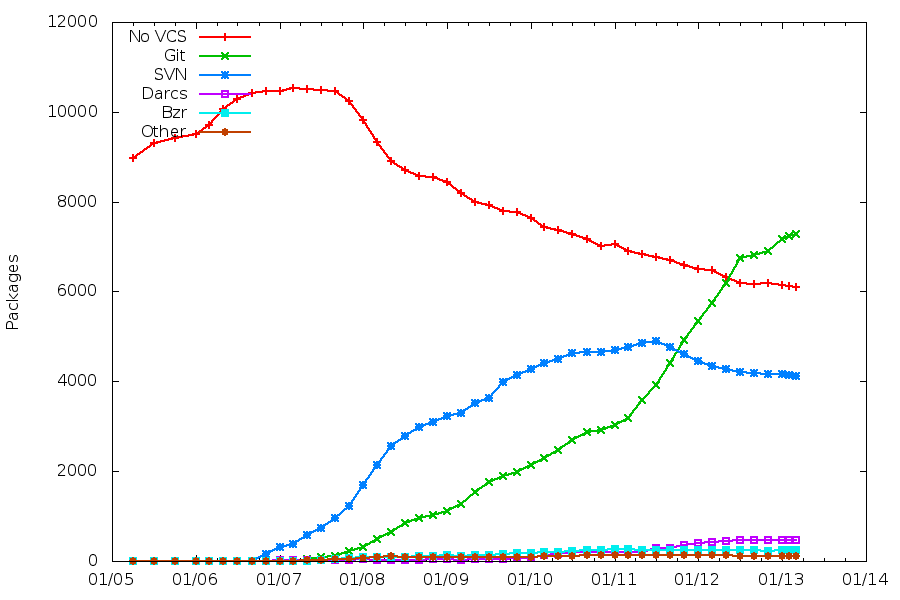
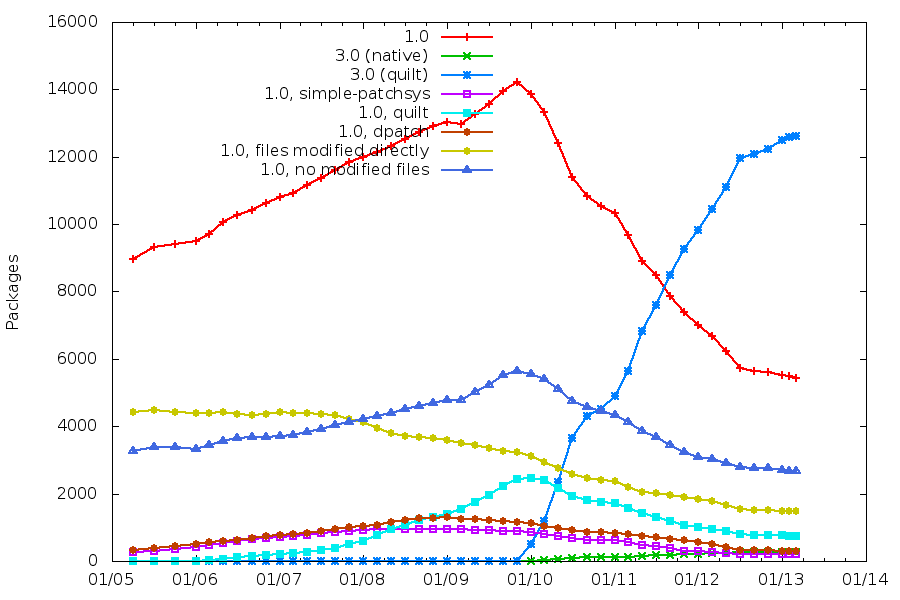
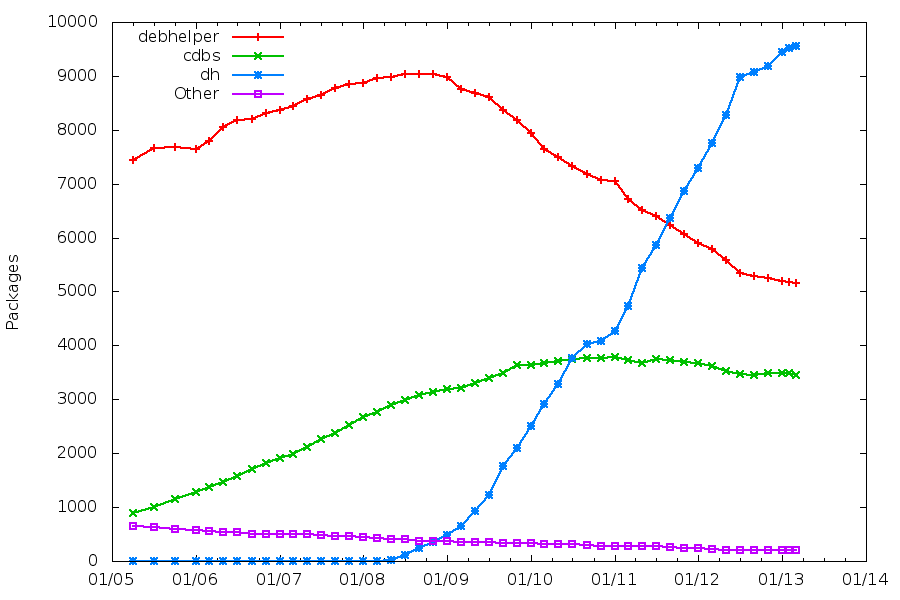
(Looking for those graphs online, I realized that I never properly published them, besides that old post) I ve been playing with snapshot.d.o, which is a fantastic resource if you want to look at Debian from an historical perspective (well, since 2005 at least). Team maintenance comaint
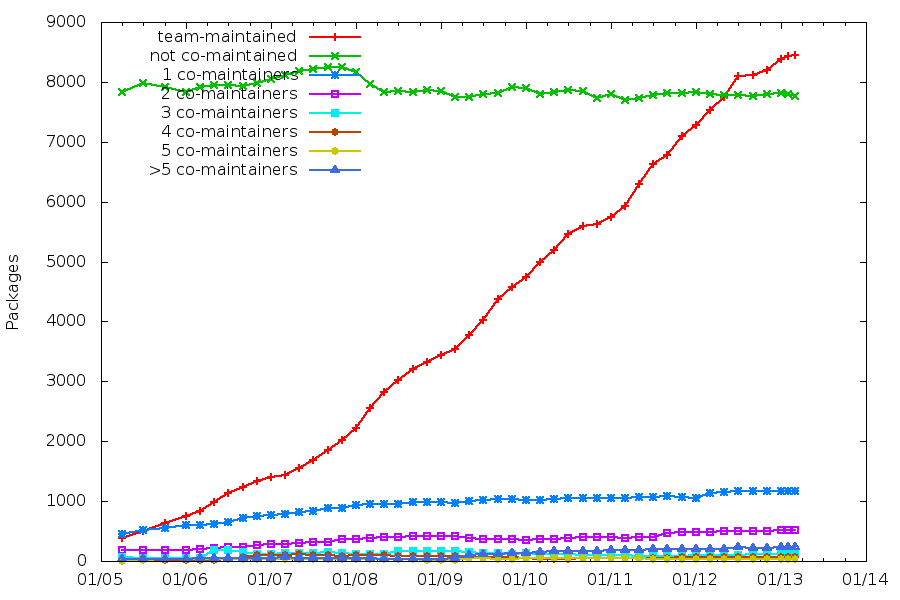
We now have more team-maintained packages than packages maintained by someone alone. Interestingly, the small, ad-hoc group of developers model does not really take off. Maintenance using a VCS vcs A large majority of our packages are maintained in a VCS repository, with Git being the clear winner now. Possible goal for Jessie: standardize on a Git workflow, since every team tends to design its own? Packaging helpers helpers Again, we have a clear winner here, with dh. It s interesting to note that, while dh was designed as a CDBS killer, it kind-of fails in that role. Possible goal for Jessie: deprecate at least pure-debhelper packaging? Patch systems and packaging formats formats-patches Again, clear winner with 3.0 (quilt). The (dirty) scripts that generate those graphs are available in Git (but you need to connect to stabile to execute them, and it s rather time consuming hours/days).
14 February 2013

Russell Coker: Conversion of Video Files

To convert video files between formats I use Makefiles, this means I can run make -j2 on my dual-core server to get both cores going at once. avconv uses 8 threads for it s computation and I ve seen it take up to 190% CPU time for brief periods of time, but overall it seems to average a lot less, if nothing else then running two copies at once allows one to calculate while the other is waiting for disk IO. Here is a basic Makefile to generate a subdirectory full of mp4 files from a directory full of flv files. I used to use this to convert my Youtube music archive for my Android devices until I installed MX Player which can play every type of video file you can imagine [1]. I ll probably encounter some situation where this script becomes necessary again so I keep it around. It s also a very simple example of how to run a batch conversion of video files. MP4S:=$(shell for n in *.flv ; do echo $$n sed -e s/^/mp4\\// -e s/flv$$/mp4/ ; done)

all: $(MP4S)

mp4/%.mp4: %.flv
avconv -i $< -strict experimental -b $$(~/bin/video-encoding-rate $<) $@ > /dev/null Here is a more complex Makefile. I use it on my directory of big videos (more than 1280*720 resolution) and scales them down for my favorite Android devices (Samsung Galaxy S3, Samsung Galaxy S, and Sony Ericsson Xperia X10). My Galaxy S3 can t play a FullHD version of Gangnam Style without going slow so I need to do this even for the fastest phones. This makefile generates three subdirectories of mp4 files for the three devices. S3MP4S:=$(shell for n in *.mp4 ; do echo $$n sed -e s/^/s3\\// -e s/.mp4$$/-s3.mp4/ -e s/.flv$$/-s3.mp4/; done)
XPERIAMP4S:=$(shell for n in *.mp4 ; do echo $$n sed -e s/^/xperiax10\\// -e s/.mp4$$/-xperiax10.mp4/ -e s/.flv$$/-xperiax10.mp4/; done)
SMP4S:=$(shell for n in *.mp4 ; do echo $$n sed -e s/^/galaxys\\// -e s/.mp4$$/-galaxys.mp4/ -e s/.flv$$/-galaxys.mp4/; done)

all: $(S3MP4S) $(XPERIAMP4S) $(SMP4S)

s3/%-s3.mp4: %.mp4
avconv -i $< -strict experimental -s $(shell ~/bin/video-scale-resolution 1280 720 $<) $@ > /dev/null

galaxys/%-galaxys.mp4: %.mp4
echo avconv -i $< -strict experimental -s $(shell ~/bin/video-scale-resolution 800 480 $<) $@ > /dev/null

xperiax10/%-xperiax10.mp4: %.mp4
echo avconv -i $< -strict experimental -s $(shell ~/bin/video-scale-resolution 854 480 $<) $@ > /dev/null The following script is used by the above Makefile to determine the resolution to use. Some Youtube videos have unusual combinations of width and height (Linkin Park seems to like doing this) so I scale them down so it fits the phone in one dimension and the other dimension is scaled appropriately. This requires a script from the Mplayer package and expects it to be in the location that it s used in the Debian package, for distributions other than Debian a minor change will be required. #!/bin/bash
set -e
OUT_VIDEO_WIDTH=$1
OUT_VIDEO_HEIGHT=$2

eval $(/usr/share/mplayer/midentify.sh $3)
XMULT=$(echo $ID_VIDEO_WIDTH*100/$OUT_VIDEO_WIDTH bc)
YMULT=$(echo $ID_VIDEO_HEIGHT*100/$OUT_VIDEO_HEIGHT bc)
if [ $XMULT -gt $YMULT ]; then
NEWX=$OUT_VIDEO_WIDTH
NEWY=$(echo $OUT_VIDEO_WIDTH*$ID_VIDEO_HEIGHT/$ID_VIDEO_WIDTH/2*2 bc)
else
NEWX=$(echo $OUT_VIDEO_HEIGHT*$ID_VIDEO_WIDTH/$ID_VIDEO_HEIGHT/2*2 bc)
NEWY=$OUT_VIDEO_HEIGHT
fi
echo $ NEWX x$ NEWY Note that I can t preserve TAB characters in a blog post. So those Makefiles won t work until you replace strings of 8 spaces with a TAB character.

Robert Collins: Time to revise the subunit protocol

Subunit is seven and a half years old now Conrad Parker and I first sketched it up at a CodeCon camping and coding, a brilliant combination in mid 2005.
revno: 1
committer: Robert Collins <robertc@robertcollins.net>
timestamp: Sat 2005-08-27 15:01:20 +1000
message:  design up a protocol with kfish
It has proved remarkably resilient as a protocol the basic nature hasn t changed at all, even though we ve added tags, timestamps, support for attachments of arbitrary size. However a growing number of irritations have been building up with it. I think it is time to design another iteration of the protocol, one that will retain the positive qualities of the current protocol, while helping it become suitable for the next 7 years. Ideally we can keep compatibility and make it possible for a single stream to be represented in any format. Existing design The existing design is a mostly human readable line orientated protocol that can be sniffed out from the regular output of make or other build systems. Binary attachments are done using HTTP chunking, and the parser has to maintain state about the current test, tags, timing data and test progression [a simple stack of progress counters]. How to arrange subunit output is undefined, how to select tests to run is undefined. This makes writing a parser quite easy, and the tagging and timestamp facility allow multiplexing streams from two or more concurrent test runs into one with good fidelity but also requires that state be buffered until the end of a test, as two tests cannot be executing at once. Dealing with debuggers The initial protocol was intended to support dropping into a debugger just pass each line read through to stdout, and connect stdin to the test process, and voila, you have a working debugger connection. This works, but the current line based parsers make using it tedious the line buffered nature of it makes feedback on what has been typed fiddly, and stdout tends to be buffered, leading to an inability to see print statements and the like. All in-principle fixable, right ? When running two or more test processes, which test process should stdin be connected to? What if two or more drop into a debugger at once? What is being typed to which process is more luck than anything else. We ve added some idioms in testrepository that control test execution by a similar but different format one test per line to list tests, and have runners permit listing and selecting by a list. This works well, but the inconsistency with subunit itself is a little annoying you need two parsers, and two output formats. Good points The current protocol is extremely easy to implement for emitters, and the arbitrary attachments and tagging features have worked extremely well. There is a comprehensive Python parser which maps everything into Python unittest API calls (an extended version of the standard, with good backwards compatibility). Pain points The debugging support was a total failure, and the way the parser depraminates it s toys when a test process corrupts an outcome line is extremely frustrating. (other tests execute but the parser sees them as non-subunit chatter and passes the lines on through stdout). Dealing with concurrency The original design didn t cater for concurrency. There are three concurrency issues the corruption issue (see below for more detail) and multiplexing. Consider two levels of nested concurrency: A supervisor process such as testrepository starts 2 (or more but 2 is sufficient to reason about the issue) subsidiary worker processes (I1 and I2), each of which starts 2 subsidiary processes of their own (W1, W2, W3, W4). Each of the 4 leaf processes is outputting subunit which gets multiplexed in the 2 intermediary processes, and then again in the supervisor. Why would there be two layers? A concrete example is using testrepository to coordinate test runs on multiple machines at once, with each machine running a local testrepository to broker tests amongst the local CPUs. This could be done with 4 separate ssh sessions and no intermediaries, but that only removes a fraction of the issues. What issues? Well, consider some stdout chatter that W1 outputs. That will get passed to I1 and from there to the supervisor and captured. But there is nothing marking the chatter as belonging to W1: there is no way to tell where it came from. If W1 happened to fail, and there was a diagnostic message printed, we ve lost information. Or at best muddled it all up. Secondly, buffering imagine that a test on W1 hangs. I1 will know that W1 is running a test, but has no way to tell the supervisor (and thus the user) that this is the case, without writing to stdout [and causing a *lot* of noise if that happens a lot]. We could have I1 write to stdout only if W1 s test is taking more than 5 seconds or something but this is a workaround for a limitation of the protocol. Adding to the confusion, the clock on W1 and W3 may be very skewed, so timestamps for everything have to be carefully synchronised by the multiplexer. Thirdly, scheduling if W1/W2 are on a faster machine than W3/W4 then a partition of equal-timed tests onto each machine will lead one idle before the other finishes. It would be nice to be able to pass tests to run to the faster machine when it goes idle, rather than having to start a new runner each time. Lastly, what to do when W1 and W2 both wait for user input on stdin (e.g. passphrases, debugger input, $other). Naively connecting stdin to all processes doesn t work well. A GUI supervisor could connect a separate fd to each of I1 and I2, but that doesn t help when it is W1 and W2 reading from stdin. So additional requirement over baseline subunit:
  1. make it possible for stdout and stderr output to be captured from W1 and routed through I1 to the supervisor without losing its origin. It might be chatter from a noisy test, or it might be build output. Either way, the user probably will benefit if we can capture it and show it to them later when they review the test run. The supervisor should probably show it immediately as well the protocol doesn t need to care about that, just make it possible.
  2. make it possible to pass information about tests that have not completed through one subunit stream while they are still incomplete.
  3. make it possible (but optional) to pass tests to run to a running process that accepts subunit.
  4. make it possible to route stdin to a specific currently process like W1. This and point 3 suggest that we need a bidirectional protocol rather than the solely unidirectional protocol we have today. I don t know of a reliable portable way to tell when some process is seeking such input, so that will be up to the user I think. (e.g. printing (pdb) to stdout might be a sufficiently good indicator.)
Dealing with corruption Consider the following subunit fragment:
test: foo
starting serversuccess:foo
This is a classic example of corruption: the test foo started a server and helpfully wrote to stdout explaining that it did that, but missed the newline. As a result the success message for the test wasn t printed on a line of its own, and the subunit parser will believe that foo never completed. Every subsequent test is then ignored. This is usually easy to identify and fix, but its a head-scratcher when it happens. Another way it can happen is when a build tool like make runs tests in parallel, and they output subunit onto the same stdout file handle. A third way is when a build tool like make runs two separate test scripts serially, and the first one starts a test but errors hard and doesn t finish it. That looks like:
test: foo
test: bar
success: bar
One way that this sort of corruption can be mitigated is to put subunit on it s own file descriptor, but this has several caveats: it is harder to tunnel through things like ssh and it doesn t solve the failing test script case. I think it is unreasonable to require a protocol where arbitrary interleaving of bytes between different test runner streams will work so the make -j2 case can be ignored at the wire level though we should create a simple way to safely mux the output from such tests when the execute. The root of the issue is that a dropped update leaves bad state in the parser and it never recovers. So some way to recover, or less state to carry in the parser, would neatly solve things. I favour reducing parser state as that should shift stateful complexity onto end nodes / complex processors, rather than being carried by every node in the transmission path. Dependencies Various suggestions have been made JSON, Protobufs, etc A key design goal of the first subunit was a low barrier to entry. We keep that by being backward compatible, but being easy to work with for the new revision is also a worthy goal. High level proposal A packetised length prefixed binary protocol, with each packet containing a small signature, length, routing code, a binary timestamp in UTC, a set of UTF8 tags (active only, no negative tags), a content tag one of (estimate + number, stdin, stdout, stderr, test- + test id), test status (one of exists/inprogress/xfail/xsuccess/success/fail/skip), an attachment name, mime type, a last-block marker and a block of bytes. The content tags: Test status values are pretty ordinary. Exists is used to indicate a test that can be run when listing tests, and inprogress is used to report a test that has started but not necessarily completed. Attachment names must be unique per routing code + testid. So how does this line up? Interleaving and recovery We could dispense with interleaving and say the streams are wholly binary, or we can say that packets can start either after a \n or directly after another packet. If we say that binary-only is the approach to take, it would be possible to write a filter that would apply the newline heuristic (or even look for packet headers at every byte offset. I think mandating adjacent to a packet or after \n is a small concession to make and will avoid tools like testrepository forcing users to always configure a heuristic filter. Non-subunit content can be wrapped in subunit for forwarding (the I1 in W1->I1->Supervisor chain would do the wrapping). This won t eliminate corruption but it will localise it and permit the stream to recover: the test that was corrupted will show up as incomplete, or with incomplete attachment data. listing Test listing would emit many small non-timestamped packets. It may be useful to have a wrapper packet for bulk amounts of fine grained data like listing is, or for multiplexers with many input streams that will often have multiple data packets available to write at once. Selecting tests to run Same as for listing while passing regexes down to the test runner to select groups of tests is a valid use case, thats not something subunit needs to worry about : if the selection is not the result of the supervisor selecting by test id, then it is known at the start of the test run and can just be a command line parameter to the backend : subunit is relevant for passing instructions to a runner mid-execution. Because the supervisor cannot just hand out some tests and wait for the thing it ran to report that it can accept incremental tests on stdin, supervisor processes will need to be informed about that out of band. Debugging Debugging is straight forward . The parser can read the first 4 or so bytes of a packet one at a time to determine if it is a packet or a line of stdout/stderr, and then either read to end of line, or the binary length of the packet. So, we combine a few things; non-subunit output should be wrapped and presented to the user. Subunit that is being multiplexed and forwarded should prepend a routing code to the packet (e.g. I1 would append 1 or 2 to select which of W1/W2 the content came from, and then forward the packet. S would append 1 or 2 to indicate I1/I2 the routing code is a path through the tree of forwarding processes). The UI the user is using needs to supply some means to switch where stdin is attached. And stdin input should be routed via stdin packets. When there is no routing code left, the packet should be entirely unwrapped and presented as raw bytes to the process in question. Multiplexing Very straight forward unwrap the outer layer of the packet, add or adjust the routing code, serialise a header + adjusted length + rest of packet as-is. No buffering is needed, so the supervisor can show in-progress tests (and how long they have been running for). Parsing / representation in Python or other languages The parser should be very simple to write. Once parsed, this will be fundamentally different to the existing Python TestCase->TestResult API that is in used today. However it should be easy to write two adapters: old-style <-> this new-style. old-style -> new-style is useful for running existing tests suites and generating subunit, because thats way the subunit generation is transparent. new-style->old-style is useful for using existing test reporting facilities (such as junitxml or html TestResult objects) with subunit streams. Importantly though, a new TestResult style that supports the features of this protocol would enable some useful features for regular Python test suites: The API might be something like:
class StreamingResult(object):
    def startTestRun(self):
        pass
    def stopTestRun(self):
        pass
    def estimate(self, count, route_code=None):
        pass
    def stdin(self, bytes, route_code=None):
        pass
    def stdout(self, bytes, route_code=None):
        pass
    def test(self, test_id, status, attachment_name=None, attachment_mime=None, attachment_eof=None, attachment_bytes=None):
        pass
This would support just-in-time debugging by wiring up pdb to the stdin/stdout handlers of the result object, rather than actual stdin/stdout of the process a simple matter once written. Alternatively, the test runner could replace sys.stdin/stdout etc with thunk file-like objects, which might be a good idea anyway to capture spurious output happening during a test run. That would permit pdb to Just Work (even if the test process is internally running concurrent tests.. until it has two pdb objects running concurrently :) Generation new streams Should be very easy in anything except shell. For shell, we can have a command line tool that when invoked outputs a subunit stream for one instruction. E.g. test foo completed + some attachments or test foo starting .

8 February 2013

Philipp Kern: Mozilla's direction

Am I the only one who's disappointed with the route Mozilla's taking and left wondering what the direction is? First they killed off the development of Thunderbird because, as we all know, people mainly use webmail these days. Then they presented us their view that the big Certificate Authorities are too big to fail, as CAs gravely violated our trust (c.f. Trustwave and their MitM authority). And "now" they're also blocking the introduction of new formats into their browser because they cannot be the one who innovates. Instead Microsoft and Apple obviously need to take the lead in introducing a format into their browsers because otherwise it wouldn't be useful. Even though it's safe to say that Chrome and Firefox make up for more than half of the desktop browser market share. It might be that Chrome's nibbling from Firefox's, still IE seems to be in decline and Safari is rather a further mention than something many people would care strongly about.

There were of course some valid reasons for not supporting WebP yet. But most of them got fixed in the meantime and all we hear is the referal to proprietary vendors who need to move first. If I'd want to depend on such vendors I'd go with proprietary operating systems. (Having to deal with hardware products of proprietary vendors at $dayjob is enough.) So what's up Mozilla? The solution is to ignore your users and tag bugs with patches wontfix?

The only real advantage of Firefox over Chromium these days is the vast amount of plugins and extensions (e.g. Pentadactyl, for which there is no real equivalent available). Another sad fact is that you need to pull Firefox from a 3rd party repository (even though packages are coming from the 2nd party) to get a current version onto your Debian system to work with the web. But then it's not Mozilla who's to blame here. Maybe we should've introduced one Iceweasel version that's allowed to have reverse-dependencies and one that cannot.

(This post might contain hyberboles, which should be considered as such.)

5 February 2013

Wouter Verhelst: Video at FOSDEM 2013

For the second year in a row, I've led the team that organized video at FOSDEM. This year, most things went pretty smoothly; more so than last year. We definitely learned from some of our mistakes, and although I can't say that everything went better than it did last year, after having done a first look at things I can certainly say that overall, the result is better now than it was last year. Our setup was very similar to what it was last year. However, there were some key differences: Unfortunately, that didn't mean all was well. The internal server would transcode the DV stream into WebM, which was then sent on to the Flumotion platform where it was going to be transcoded to Ogg Theora, before being streamed in both formats. Due to an issue which we could not track down (possibly something incorrect in my configuration), the transcoding into Ogg Theora did not work smoothly, and even had the unwanted effect of disrupting the WebM streaming. Since this made it difficult to debug without disrupting service, eventually we decided to give up on Ogg Theora and only provide WebM streams; I considered that to be a better solution than no streaming at all. In addition, apparently in the year since FOSDEM 2012, libav and gstreamer have changed significantly enough that the scripts that I used then had to be somewhat revisited in order to be able to transcode the existing recordings into WebM ready for video.fosdem.org. Oh well, I had to add in normalisation anyway; only it would've been nice if I didn't have to revisit it from scratch. Meh. At any rate, our streams seem to have been very popular. Some statistics:
Saturday

Sunday

Served traffic by country (over the whole weekend)
Served sessions by country (over the whole weekend)
As you can see from these graphs, watching the streams from Belgium seems to be happening fairly often; I suspect much of that is people at the conference watching a stream in a different room. Additionally, we peaked at 212 viewers, which is slightly more than the peak of 206 that we had last year. The final conclusion we can take home from these statistics is that the most popular talk on Saturday (at least according to people watching the streams) was the eudev one in the cross-distro room (with 68 viewers); on sunday, the talks in Janson were all fairly equally popular. The peak of 102 viewers was reached around 15:45. Overall, I'm quite happy with the result. Yesterday, Thomas Eug ne of NamurLUG (who used to do video for several years before I took over last year) helped me do the first review. What's left now is to do some transcoding and uploading; this will happen over the next few days and weeks.

24 January 2013

Hideki Yamane: net-snmp package

Current net-snmp package maintainers are busy, so now I'm trying to update it. One of maintainers Jochen Friedrich kindly checked my experimental package (thank!), and point MIB files should be removed to upload to Debian out (at least).

Anyway, current changelog is here (a little bit long). If you want to try it, get dsc file and build it.


net-snmp (5.7.2~dfsg-1~0.1) UNRELEASED; urgency=low
* Non-maintainer upload.
* New upstream version 5.7.2 (Closes: #557348, #631063, #684388, #599929,
#673197, #581185, #558356, #568550, #514842, #445608, #557186, #411858,
#428824, #611837)
* debian/control
- set "Standards-Version: 3.9.4"
- set "Build-Depends: debhelper (>= 9)" to enable hardening
- set "Build-Depends: automake", instead of automake1.9
- drop "Build-Depends: python-central", use dh_python2 by default, instead
- remove duplicational "Priority:" and "Section:" fields
- make it "Multi-Arch" enable
- add description for non-free snmp-mibs-downloader for users' convinience
(Closes: #561124)
- add "Build-Depends: libmysqld-dev" to support MySQL
- add "Build-Depends: dh-autoreconf"
- use python-all (2.6.6-3~) instead of python-all-dev (>= 2.5.4-1~), python
(>=2.3.5-7) for Build-Depends
- add "Build-Depends: python2.7-dev"
- s/libsnmp-python/python-netsnmp/ as Python Policy compliant (Closes: #661899)
* debian/compat
- set 9
* debian/*.install
- split into *.manpages
* debian/fixman: drop it.
* debian/*.manpages (Closes: #505149)
- remove unnecessary"snmp" from tail of all man pages
* debian/libsnmp-base.install
- move /usr/share/mibs to /usr/share/snmp/mibs (probably, previous setting
was just wrong...)
- install all mibs/*.txt
* debian/libsnmp-dev.install
- change from "usr/lib/*" to "usr/lib/*/*" to deal with Multi-Arch
* debian/libsnmp30.install
- change from "usr/lib/*.so" to "usr/lib/*/*.so" to deal with Multi-Arch
* debian/snmp.dirs: remove it since unnecessary
* debian/snmpd.dirs: remove lintian overrides direcotry, add /etc/snmp
* debian/libsnmp-dev.dirs: add it
* debian/libsnmp-perl.examples: add it since dh_installexamples target in
previous debian/rules doesn't work correctly.
* debian/patches
- remove all *.README files
- add fix_typo_in_snmpd.conf.patch (Closes: #603593)
Thanks to Slavko <linux@slavino.sk>
- add fix_logging_option.patch (Closes: #616437)
- add fix_snmpcheck_perl_path.patch to provide snmpcheck (Closes: #44373)
- add net-snmp-config_multi-arch.patch to enable Multi-Arch
- add fix_regular_expression.patch enable to build under Multi-Arch
- add to snmptranslate.1.patch fix lintian "hyphen-used-as-minus-sign"
warnings
- add fix_spelling_error.patch to fix typo
- adjust and refresh 03_makefiles.patch
- drop 25_duplicate_iftable.patch and 44_nlist_kvm.patch since it cannot be
applied to current code.
- drop 32_mnttab_path.patch since it was merged to upstream as
configure.d/config_os_misc4
- drop 56_manpage.patch since most of patches are merged, and others are
unnecessary because upstream files are disappeared.
- refresh 61_vacm_missing_dependency_check.patch
- drop 63_fix_shell.patch since it was merged to upstream
- reapplied 64_missing_lib.patch since upstream source has been changed.
- drop 65_CVE-2012-2141.patch since it was merged to upstream
- drop 66_formatstrings.patch since almost merged to upstream, some of
code are changed in upstream and become unnecessary.
- move 08_defaultconfig.patch to debian/snmptrapd.conf
* debian/rules
- enable hardening
(TODO: building perl module would be failed without -pie)
- specify LDFLAGS to enable hardening
- add "--with autotools-dev,autoreconf"
- export DEB_BUILD_MAINT_OPTIONS to enable hardening
- drop "dh --with python-central" (Closes: #616913)
- drop "include /usr/share/python/python.mk"
- remove "$(PYVERS:%=debian/python-install-stamp-%)"
- move exist python targets under override_dh_install
- remove unnecessary .PHONY lines
- enable tests by removing no instructions with dh_auto_test line
- set DEB_HOST_MULTIARCH to enable Multi-Arch
- enable install snmpcheck
- don't specify to copy files but install them by using .install file
(mostly)
- enable mysql support
- enable AES support (Closes: #447705)
- don't make symlink for /usr/share/doc/libsnmp-perl since other are okay
but it has examples files.
- snmpd doc files link to libsnmp (Closes: #453124)
- adjust dh_strip for dbg package.
- adjust dh_clean target
- remove override_dh_auto_build since LD_RUN_PATH is clearly specified
during building perl modules
- add mibII/mta_sendmail to build modules (Closes: #641608)
* debian/clean
- most listed files are cared by autotools-dev, so removed.
* debian/snmp.conf: fix typo (Closes: #623499, #647468)
* debian/snmpd.init
- force remove pid files (Closes: #528104)

-- Hideki Yamane <henrich@debian.org> Wed, 18 Jul 2012 13:39:41 +0900

And if I can put it to Debian, then I hope someone will maintain it...

22 January 2013

Jon Dowland: HD audio and more archiving

Having obtained a respectable set of headphones last year, I started pondering about high definition music. Could I hear the difference between a track mixed at CD quality, 16 bit samples / 44.1kHz sample rate, and the same track mixed at a higher bit or sample rate? A number of artists have made HD audio releases available in a variety of formats, most of which are now obsolete (see: SACD, DVD-Audio) and/or hard to demux to something more modern. However some artists have made digital HD audio releases. The last two Nine Inch Nails records were released in HD and are more readily available.
These releases also had nice per-track embedded art These releases also had nice per-track embedded art
"Ghosts - " had a standard-quality digital release but a high quality Blu-Ray release was also available, commercially. All versions were Creative Commons licensed, so people have legimitely demuxed the Blu Ray release and made it available in other formats. One was uploaded to archive.org, although it sadly lacks precise lineage information: "The Slip" was released in HD audio digitally. However, I noticed that nobody had uploaded the HD release to archive.org, and having developed an interest in archiving, I did: I tried performing some listening tests on my desktop computer, which has an M-Audio "Audiophile" 24/96 PCI sound card. However, in non-blind tests, I failed to distinguish the SD and HD versions of these songs. A friend suggested that despite the card's quoted rates, the signal-to-noise ratio was such that you wouldn't get high enough fidelity to play 24/96 properly. I can only take their word for it My preferred music player can only decode 24/44.1 but I recently learned that my phone, an Apple iPhone, can decode up to 24 bit, 48kHz. I decided to downsample the above two releases in order to try further listening tests on my phone. I uploaded both to archive.org: So far in non-blind tests I have not noticed a particular difference. Whether it's my equipment, my ears, these particular tracks or whether HD audio being audibly better than CD quality is a myth, I am not sure yet. I'm planning to do some proper ABX testing of various lossy codecs and bitrates prior to a major CD ripping exercise, so I may try proper ABX testing of HD audio at the same time. (I'm collecting together past and future log posts about archiving under the tag 'archiving').

21 January 2013

Petter Reinholdtsen: First prototype ready making hardware easier to use in Debian

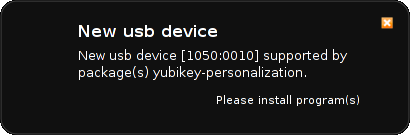
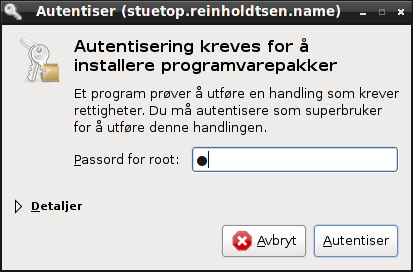
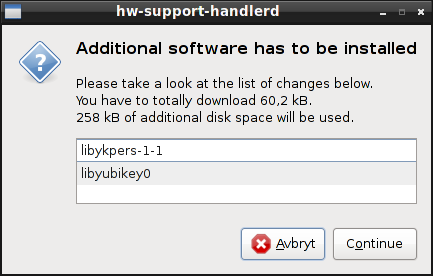
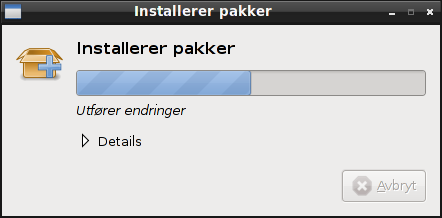
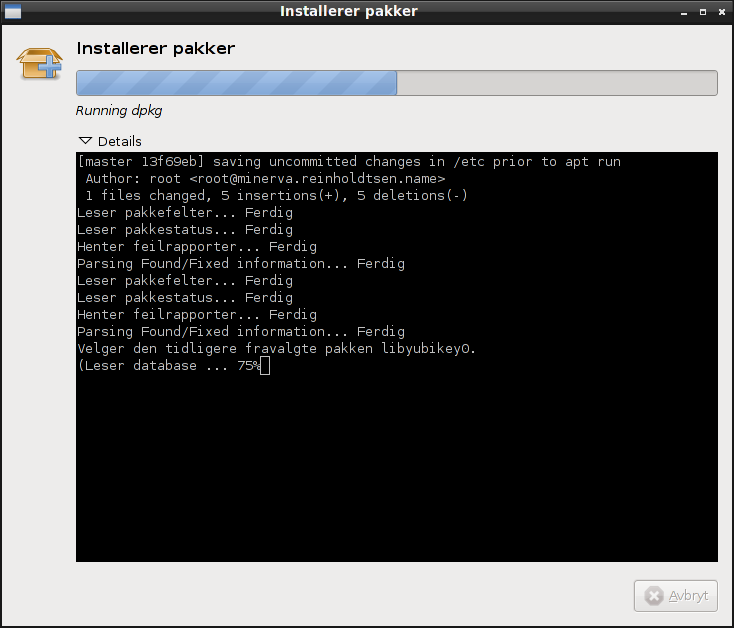
Early this month I set out to try to improve the Debian support for pluggable hardware devices. Now my prototype is working, and it is ready for a larger audience. To test it, fetch the source from the Debian Edu subversion repository, build and install the package. You might have to log out and in again activate the autostart script. The design is simple: I still need to come up with a better name for the system. Here are some screen shots showing the prototype in action. First the notification, then the password request, and finally the request to approve all the dependencies. Sorry for the Norwegian Bokm l GUI.


The prototype still need to be improved with longer timeouts, but is already useful. The database of hardware to package mappings also need more work. It is currently compatible with the Ubuntu way of storing such information in the package control file, but could be changed to use other formats instead or in addition to the current method. I've dropped the use of discover for this mapping, as the modalias approach is more flexible and easier to use on Linux as long as the Linux kernel expose its modalias strings directly. Update 2013-01-21 16:50: Due to popular demand, here is the command required to check out and build the source: Use 'svn checkout svn://svn.debian.org/debian-edu/trunk/src/hw-support-handler/; cd hw-support-handler; debuild'. If you lack debuild, install the devscripts package. Update 2013-01-23 12:00: The project is now renamed to Isenkram and the source moved from the Debian Edu subversion repository to a Debian collab-maint git repository. See build instructions for details.

27 December 2012

Jamie McClelland: Live video streaming using vp8enc and webm on Debian

The vp8 video codec and webm container format (which are alternates for theora/ogg and h264/flv) are getting lots of attention, especially as more web browsers are supporting html5 - which includes a new video tag that plays video directly in a web page, rather than requiring a plugin. With Google fully behind these new formats (and converting YouTube videos) and even skype using vp8, it seems as though it could supplant h264/flash as the default video codec and container. After years under the boot of the proprietary flash video, this change could usher in a lot of exciting developments. While the shift in formats is also significant for on-demand video, I'm focusing on live streaming in this blog. There are a lot of tools needed to successfully stream a live video. Enough of them support vp8 and webm to create a live video stream, however, not all of the right versions of these tools have landed in Debian. Without any patches or changes, if you try to send a live video stream to icecast using vp8 encoding and webm, you'll get something like this:
0 jamie@animal:~$ gst-launch v4l2src ! video/x-raw,width=320,height=240 ! vp8enc ! webmmux ! shout2send ip=icecast.server port=8000 password=secret mount=/test.webm
WARNING: erroneous pipeline: could not link webmmux0 to shout2send0
1 jamie@animal:~$
I've documented the steps for patching/upgrading gstreamer and icecast2 so you can get a live video stream using vp8 encoding and the webmc container that originates on a Debian wheezy machine using gstreamer and streams to a Debian squeeze server running icecast2. On the workstation, you'll need libshout3 version 2.3.0 or higher, which is at the moment available in experimental and installable without bringing in any dependencies. In addition, you will need to bring in gstreamer1.0 from sid and you will need to rebuild gstreamer1.0-plugins-good after libshout-dev has been installed from experimental. So, begin by adding experimental and sid to your sources list by creating the files /etc/apt/sources.list.d/experimental.list and /etc/apt/sources/lists.d/sid.list with the respective contents:
deb http://mirror.cc.columbia.edu/debian experimental main
and
deb http://mirror.cc.columbia.edu/debian sid main 
deb-src http://mirror.cc.columbia.edu/debian sid main
In order to avoid upgrading your entire machine to sid (experimental packages won't upgrade by default), you'll also need to add the file /etc/apt/preferences.d/sid:
Package: *
Pin: release n=sid
Pin-Priority: 200
Then update and install:
apt-get update
apt-get install -t experimental libshout3
apt-get install gir1.2-clutter-gst-1.0 gir1.2-gst-plugins-base-1.0 gir1.2-gstreamer-1.0 gstreamer0.10-ffmpeg  gstreamer1.0-libav:amd64 gstreamer1.0-plugins-bad:amd64 gstreamer1.0-plugins-base:amd64 gstreamer1.0-plugins-base-apps gstreamer1.0-plugins-good:amd64 gstreamer1.0-pulseaudio:amd64 gstreamer1.0-tools gstreamer1.0-x:amd64 libclutter-gst-1.0-0:amd64 libgstreamer-plugins-bad1.0-0:amd64 libgstreamer-plugins-base1.0-0:amd64 libgstreamer-plugins-base1.0 libgstreamer1.0-0:amd64 libgstreamer1.0
Fortunately, the version of gstreamer1.0-plugins-good in sid includes a fix for a bug patched on November 31, 2012 that allows the use of the webm container. However, for it to work properly gstreamer1.0-plugins-good has to be built against libshout version 2.3.0 or higher (which is in experimental, not sid). Therefore, you have install libshout-dev from experimental and then rebuild gstreamer1.0-plugins-good.
sudo apt-get build-dep gstreamer1.0-plugins-good
sudo apt-get -t experimental install libshout-dev
apt-get source gstreamer1.0-plugins-good
cd gst-plugins-good1.0-1.0.4
dch -v 1.0.4-1+webmmux
fakeroot debian/rules binary
sudo dpkg -i ../gstreamer1.0-plugins-good_1.0.4-1+webmmux_amd64.deb
Now if you try the command, things should work on the client side. When streaming to an icecast2 server running squeeze, I don't get any errors, however, when opening the streaming page via the icecast URL, there is a play button, which can be clicked, but no picture is shown. That's because the version of Icecast2 in squeeze doesn't support either vp8 or webm. On the server side, you will need icecast2 version 2.4beta or higher. This version hasn't landed anywhere in Debian as of this writing. However, you can build it from source by following these steps (the patches I'm removing have all been applied to the new upstream version).
apt-get source icecast2
wget http://downloads.xiph.org/releases/icecast/icecast-2.4-beta.tar.gz
tar -xzvf icecast-2.4-beta.tar.gz
cp -r icecast2-2.3.2/debian icecast-2.3.99.0/
cd icecast-2.3.99.0/
rm debian/patches/ 1001_autotools_avoid_debian-subdir.patch,1002_add_missing_xspf_file,1003_fix_memory_leak.patch,series 
dch -v 2.3.99.0-1
fakeroot debian/rules binary
When you install it, be sure to replace the icecast2.xml configuration file and update it with your server-specific customizations. Hopefully this version of icecast2 will make it to experimental soon. And now... you can successfully stream via:
gst-launch-1.0 v4l2src ! video/x-raw,width=320,height=240 ! vp8enc ! webmmux !  shout2send ip=icecast.server port=8000 password=secret mount=/test.webm
If you want full audio and video, here's a more complete pipeline: gst-launch-1.0 v4l2src ! queue ! video/x-raw,width=320,height=240 ! tee name=tscreen ! queue ! autovideosink tscreen. ! queue ! videorate ! video/x-raw,framerate=25/2 ! queue ! vp8enc ! queue ! webmmux name=mux pulsesrc ! queue ! audioconvert ! vorbisenc ! queue ! queue ! mux. mux. ! queue ! shout2send ip=hobo port=8000 mount=jamie.webm password=secret Unfortunately, since I'm not sure how to deal with the python2.7 vs python3 dependecies, my elegant mobi python script that creates this pipeline for you using python-gtk as been reduced to a crude bash script. Another item on the todo list is opus audio encoding. gstreamer doesn't seem able to use opus in the webm container (although it seems to work with ogg). In the course of this research I found directions for getting gstreamer-1.0 installed on debian independent of packages installed on the system. If you follow the directions above, these steps should not be necessary. I'm including in case you need the latest sources for another reason. Extra steps I needed were:

21 December 2012

Dirk Eddelbuettel: Rcpp 0.10.2

Relase 0.10.2 of Rcpp provides the second update to the 0.10.* series, and has arrived on CRAN and in Debian. It brings another great set of enhancements and extensions, building on the recent 0.10.0 and 0.10.1 releases. The new Rcpp attributes were rewritten to not require Rcpp modules (as we encountered on issue with exceptions on Windows when built this way), code was reorganized to significantly accelerate compilation and a couple of new things such as more Rcpp sugar goodies, a new timer class, and a new string class were added. See below for full details. We also tested this fairly rigorously by checking about two thirds of the over 90 CRAN packages depending on Rcpp (and the remainder required even more package installs which we did not do as this was already taking about 12 total cpu hours to test). We are quite confident that no changes are required (besides one in our own RcppClassic package which we will update. The complete NEWS entry for 0.10.2 is below; more details are in the ChangeLog file in the package and on the Rcpp Changelog page.
Changes in Rcpp version 0.10.2 (2012-12-21)
  • Changes in Rcpp API:
    • Source and header files were reorganized and consolidated so that compile time are now significantly lower
    • Added additional check in Rstreambuf deletetion
    • Added support for clang++ when using libc++, and for anc icpc in std=c++11 mode, thanks to a patch by Yan Zhou
    • New class Rcpp::String to facilitate working with a single element of a character vector
    • New utility class sugar::IndexHash inspired from Simon Urbanek's fastmatch package
    • Implementation of the equality operator between two Rcomplex
    • RNGScope now has an internal counter that enables it to be safely used multiple times in the same stack frame.
    • New class Rcpp::Timer for benchmarking
  • Changes in Rcpp sugar:
    • More efficient version of match based on IndexHash
    • More efficient version of unique base on IndexHash
    • More efficient version of in base on IndexHash
    • More efficient version of duplicated base on IndexHash
    • More efficient version of self_match base on IndexHash
    • New function collapse that implements paste(., collapse= "" )
  • Changes in Rcpp attributes:
    • Use code generation rather than modules to implement sourceCpp and compileAttributes (eliminates problem with exceptions not being able to cross shared library boundaries on Windows)
    • Exported functions now automatically establish an RNGScope
    • Functions exported by sourceCpp now directly reference the external function pointer rather than rely on dynlib lookup
    • On Windows, Rtools is automatically added to the PATH during sourceCpp compilations
    • Diagnostics are printed to the console if sourceCpp fails and C++ development tools are not installed
    • A warning is printed if when compileAttributes detects Rcpp::depends attributes in source files that are not matched by Depends/LinkingTo entries in the package DESCRIPTION
Thanks to CRANberries, you can also look at a diff to the previous release 0.10.1. As always, even fuller details are on the Rcpp Changelog page and the Rcpp page which also leads to the downloads, the browseable doxygen docs and zip files of doxygen output for the standard formats. A local directory has source and documentation too. Questions, comments etc should go to the rcpp-devel mailing list off the R-Forge page

1 December 2012

Rapha&#235;l Hertzog: My Free Software Activities in November 2012

This is my monthly summary of my free software related activities. If you re among the people who made a donation to support my work (692.20 , thanks everybody!), then you can learn how I spent your money. Otherwise it s just an interesting status update on my various projects. Misc packaging I updated the publican package (a tool for publishing material authored in DocBook XML) with version 3.0, a major new upstream version. As with any important update, it had its share of problems and I created two patches that I sent upstream. I uploaded the package to experimental since we re in freeze. The Debian Administrator s Handbook Since the translation teams have been working for a few months, I wanted to put the result of their work online. I did it and I blogged about it on debian-handbook.info. By the way, we have a Polish translation that just started. This took quite some time because many translators were not well versed with Docbook XML and its structure. So I fixed their mistakes and asked the Weblate developer (Michal Cihar) to implement new checks to avoid those basic XML mistakes. I also added a couple of build scripts to the git repository to make it easier to rebuild translations in multiple formats. I used this opportunity to file a couple of bugs I encountered with Publican (concerning ePub output mainly, and custom brands). I also blogged about our plans to update the book for Wheezy. Roland started to work on it but I did not have the time yet. Debian France The officers (president, treasurer, secretary) have just changed and we had to organize the transition. As the new president, I got administrator access on our Gandi virtual machine (france.debian.net) as well as access to our bank account. I got also got a bunch of administrative papers retracing the history of the association. Carl Chenet (the former president) gave them to me during the mini-debconf that was organized in Paris. Indeed, Sylvestre Ledru and Mehdi Dogguy organized our second mini-debconf Paris and they did it very well. It was a great success with over 100 attendants each of the 2 days it lasted (November 24-25th). Carl managed a merchandising booth that was well stuffed (Luca Capello also brought goodies of Debian.ch) I gave small lightning talk to present the ideas behind my Librement project (it s about funding free software developers). BTW I have not been very good at it, it was only my second lightning talk and I have been a bit too verbose. The talk did not fit in my 5 minutes time slot ;-) Back from the mini-debconf, I have been trying to delegate some projects (like get a real website, improve the work-flow of members management, update our server which was still running Lenny). Julien Cristau was willing to upgrade the server did not exactly knew how to upgrade the kernel (it s a bit special since Gandi manages the kernel on the Xen hypervisor side). So I took care of this part and also did some cleanup (adding a backup with its associated remote disk, tweaking the email configuration). And Julien completed the upgrade on November 30th. Alexandre Delano volunteered to have a try at the website and Emmanuel Bouthenot has been looking a bit to see if there was something better than Galette to handle our members. It looks like we ll stay with Galette but have to take care of upgrading it to a newer version. I also processed the first membership applications and organized a vote to extend the board of administrators (since we have two vacant seats). On Monday, we should be back to 9 administrators. Librement Except for the talk during the mini-debconf, I did not do much on this project. That said I got an answer from the Autorit de Contr le Prudentiel saying that I might be eligible for the exemption case (see discussion of last month) and that I should fill out a form to get a confirmation. I also contacted Tunz.com who might be able to provide the services I need (their E-money manager product in particular). They have the required accreditation as a banking/credit institution and are willing to partner with enterprises who setup platforms where you must manage flows of money between several parties. I m now waiting for details such as the cost of their various services. I expect to have much more to show next month I m working with two developers to implement the first building blocks of all this. Thanks See you next month for a new summary of my activities.

No comment Liked this article? Click here. My blog is Flattr-enabled.

28 November 2012

Dirk Eddelbuettel: Rcpp 0.10.1

A the new Rcpp release 0.10.1 arrived this morning on CRAN (as already has Windows binaries) and in Debian. This is a follow-up to the recent 0.10.0 release which extends the exciting new Rcpp-attributes and Rcpp-sugar work further, and as in a number of other areas as detailed below in the NEWS sections. This release brings an change to some of the binary interfaces. If you have packages using Rcpp, you will most likely have to reinstall them from source. Some change were made to const correctness as well as other aspects, and it seems that we have temporarily broken the excellent RcppEigen and RcppOctave packages. We are looking into this, and are sorry about the bug. The complete NEWS entry for 0.10.1 is below; more details are in the ChangeLog file in the package and on the Rcpp Changelog page.
Changes in Rcpp version 0.10.1 (2012-11-26)
  • Changes in Rcpp sugar:
    • New functions: setdiff, union_, intersect setequal, in, min, max, range, match, table, duplicated
    • New function: clamp which combines pmin and pmax, e.g. clamp( a, x, b) is the same as pmax( b, pmin(x, a) )
    • New function: self_match which implements something similar to match( x, unique( x ) )
  • Changes in Rcpp API:
    • The Vector template class (hence NumericVector ...) get the is_na and the get_na static methods.
    • New helper class no_init that can be used to create a vector without initializing its data, e.g. : IntegerVector out = no_init(n) ;
    • New exception constructor requiring only a message; stop function to throw an exception
    • DataFrame gains a nrows method
  • Changes in Rcpp attributes:
    • Ability to embed R code chunks (via specially formatted block comments) in C++ source files.
    • Allow specification of argument defaults for exported functions.
    • New scheme for more flexible mixing of generated and user composed C++ headers.
    • Print warning if no export attributes are found in source file.
    • Updated vignette with additional documentation on exposing C++ interfaces from packages and signaling errors.
  • Changes in Rcpp modules:
    • Enclose .External invocations in BEGIN_RCPP/END_RCPP
  • Changes in R code :
    • New function areMacrosDefined
    • Additions to Rcpp.package.skeleton:
      • attributes parameter to generate a version of rcpp_hello_world that uses Rcpp::export.
      • cpp_files parameter to provide a list of C++ files to include the in the src directory of the package.
  • Miscellaneous changes:
    • New example 'pi simulation' using R and C++ via Rcpp attributes
Thanks to CRANberries, you can also look at a diff to the previous release 0.10.0. As always, even fuller details are on the Rcpp Changelog page and the Rcpp page which also leads to the downloads, the browseable doxygen docs and zip files of doxygen output for the standard formats. A local directory has source and documentation too. Questions, comments etc should go to the rcpp-devel mailing list off the R-Forge page

26 November 2012

Russell Coker: Links November 2012

Julian Treasure gave an informative TED talk about The 4 Ways Sound Affects US [1]. Among other things he claims that open plan offices reduce productivity by 66%! He suggests that people who work in such offices wear headphones and play bird-songs. Naked Capitalism has an interesting interview between John Cusack and Jonathan Turley about how the US government policy of killing US citizens without trial demonstrates the failure of their political system [2]. Washington s blog has an interesting article on the economy in Iceland [3]. Allowing the insolvent banks to go bankrupt was the best thing that they have ever done for their economy. Clay Shirky wrote an insightful article about the social environment of mailing lists and ways to limit flame-wars [4]. ZRep is an interesting program that mirrors ZFS filesystems via regular snapshots and send/recv operations [5]. It seems that it could offer similar benefits to DRBD but at the file level and with greater reliability. James Lockyer gave a movingTEDx talk about his work in providing a legal defence for the wrongly convicted [6]. This has included overturning convictions after as much as half a century in which the falsely accused had already served a life sentence. Nathan Myers wrote an epic polemic about US government policy since 9-11 [7]. It s good to see that some Americans realise it s wrong. There is an insightful TED blog post about TED Fellow Salvatore Iaconesi who has brain cancer [8]. Apparently he had some problems with medical records in proprietary formats which made it difficult to get experts to properly assess his condition. Open document standards can be a matter of life and death and should be mandated by federal law. Paul Wayper wrote an interesting and amusing post about Emotional Computing which compares the strategies of Apple, MS, and the FOSS community among other things [9]. Kevin Allocca of Youtube gave an insightful TED talk about why videos go viral [10]. Jason Fried gave an interesting TED talk Why Work Doesn t Happen at Work [11]. His main issues are distraction and wasted time in meetings. He gives some good ideas for how to improve productivity. But they can also be used for sabotage. If someone doesn t like their employer then they could call for meetings, incite managers to call meetings, and book meetings so that they don t follow each other and thus waste more of the day (EG meetings at 1PM and 3PM instead of having the second meeting when the first finishes). Shyam Sankar gave an interesting TED talk about human computer cooperation [12]. He describes the success of human-computer partnerships in winning chess tournaments, protein folding, and other computational challenges. It seems that the limit for many types of computation will be the ability to get people and computers to work together efficiently. Cory Doctorow wrote an interesting and amusing article for Locus Magazine about some of the failings of modern sci-fi movies [13]. He is mainly concerned with pointless movies that get the science and technology aspects wrong and the way that the blockbuster budget process drives the development of such movies. Of course there are many other things wrong with sci-fi movies such as the fact that most of them are totally implausible (EG aliens who look like humans). The TED blog has an interesting interview with Catarina Mota about hacker spaces and open hardware [14]. Sociological Images has an interesting article about sporting behaviour [15]. They link to a very funny youtube video of a US high school football team who make the other team believe that they aren t playing until they win [16] Related posts:
  1. Links April 2012 Karen Tse gave an interesting TED talk about how to...
  2. Links March 2012 Washington s Blog has an informative summary of recent articles about...
  3. Links November 2011 Forbes has an interesting article about crowd-sourcing by criminals and...

18 November 2012

Michal &#268;iha&#345;: Roadmap for Weblate 1.4

As Weblate 1.3 is out, it's time to think about features for next release. My current plan is to go more into two areas. First is improving support for machine translations. I have some ideas how to integrate these in interesting ways, I just hope my (poor) Javascript knowledge will not prevent me doing it that way. The second area is improving testsuite. Right now it really does not cover much and I'd like to cover at least basic functionality with different file formats. I'll see how much I will be able to cover, but at least I will try to cover as much as possible :-).

Filed under: English Weblate 0 comments Flattr this!

15 November 2012

Axel Beckert: Tools to handle archives conveniently

TL;DR: There s a summary at the end of the article. Today I wanted to see why a dependency in a .deb-package from an external APT repository changed so that it became uninstallable. While dpkg-deb --info foobar.deb easily shows the control information, the changelog is in the filesystem part of the package. I could extract that one dpkg-deb, too, but I d have to extract either to some temporary directory or pipe it into tar which then can extract a single file from the archive and sent it to STDOUT:
dpkg-deb --fsys-tarfile foobar.deb   tar xOf - ./usr/share/doc/foobar/changelog.Debian.gz   zless
But that s tedious to type. The following command is clearly less to type and way easier to remember:
acat foobar.deb ./usr/share/doc/foobar/changelog.Debian.gz   zless
acat stands for archive cat is part of the atool suite of commands:
als
lists files in an archive.
$ als foobar.tgz
drwxr-xr-x abe/abe           0 2012-11-15 00:19 foobar/
-rw-r--r-- abe/abe          13 2012-11-15 00:20 foobar/bar
-rw-r--r-- abe/abe          13 2012-11-15 00:20 foobar/foo
acat
extracts files in an archive to standard out.
$ acat foobar.tgz foobar/foo foobar/bar
foobar/bar
bar contents
foobar/foo
foo contents
adiff
generates a diff between two archives using diff(1).
$ als quux.zip
Archive:  quux.zip
  Length      Date    Time    Name
---------  ---------- -----   ----
        0  2012-11-15 00:23   quux/
       16  2012-11-15 00:22   quux/foo
       13  2012-11-15 00:20   quux/bar
---------                     -------
       29                     3 files
$ adiff foobar.tgz quux.zip
diff -ru Unpack-3594/foobar/foo Unpack-7862/quux/foo
--- Unpack-3594/foobar/foo      2012-11-15 00:20:46.000000000 +0100
+++ Unpack-7862/quux/foo        2012-11-15 00:22:56.000000000 +0100
@@ -1 +1 @@
-foo contents
+foobar contents
arepack
repacks archives to a different format. It does this by first extracting all files of the old archive into a temporary directory, then packing all files extracted to that directory to the new archive. Use the --each (-e) option in combination with --format (-F) to repack multiple archives using a single invocation of atool. Note that arepack will not remove the old archive.
$ arepack foobar.tgz foobar.txz
foobar.tgz: extracted to  Unpack-7121/foobar'
foobar.txz: grew 36 bytes
apack
creates archives (or compresses files). If no file arguments are specified, filenames to add are read from standard in.
aunpack
extracts files from an archive. Often one wants to extract all files in an archive to a single subdirectory. However, some archives contain multiple files in their root directories. The aunpack program overcomes this problem by first extracting files to a unique (temporary) directory, and then moving its contents back if possible. This also prevents local files from being overwritten by mistake.
(atool subcommand descriptions from the atool man page which is licensed under GPLv3+. Examples by me.) I though miss the existence of an agrep subcommand. Guess why? atool supports a wealth of archive types: tar (gzip-, bzip-, bzip2-, compress-/Z-, lzip-, lzop-, xz-, and 7zip-compressed), zip, jar/war, rar, lha/lzh, 7zip, alzip/alz, ace, ar, arj, arc, rpm, deb, cab, gzip, bzip, bzip2, compress/Z, lzip, lzop, xz, rzip, lrzip and cpio. (Not all subcommands support all archive types.) Similar Utilities There are some utilities which cover parts of what atool does, too: Tools from the mtools package Yes, they come from the handle MS-DOS floppy disks tool package, don t ask me why. :-)
uz
gunzips and extracts a gzip d tar d archives
Advantage over aunpack: Less to type. :-)
Disadvantage compared to aunpack: Supports only one archive format.
lz
gunzips and shows a listing of a gzip d tar d archive
Advantage over als: One character less to type. :-)
Disadvantage compared to als: Supports only one archive format.
unp unp extracts one or more files given as arguments on the command line.
$ unp -s
Known archive formats and tools:
7z:           p7zip or p7zip-full
ace:          unace
ar,deb:       binutils
arj:          arj
bz2:          bzip2
cab:          cabextract
chm:          libchm-bin or archmage
cpio,afio:    cpio or afio
dat:          tnef
dms:          xdms
exe:          maybe orange or unzip or unrar or unarj or lha 
gz:           gzip
hqx:          macutils
lha,lzh:      lha
lz:           lzip
lzma:         xz-utils or lzma
lzo:          lzop
lzx:          unlzx
mbox:         formail and mpack
pmd:          ppmd
rar:          rar or unrar or unrar-free
rpm:          rpm2cpio and cpio
sea,sea.bin:  macutils
shar:         sharutils
tar:          tar
tar.bz2,tbz2: tar with bzip2
tar.lzip:     tar with lzip
tar.lzop,tzo: tar with lzop
tar.xz,txz:   tar with xz-utils
tar.z:        tar with compress
tgz,tar.gz:   tar with gzip
uu:           sharutils
xz:           xz-utils
zip,cbz,cbr,jar,war,ear,xpi,adf: unzip
zoo:          zoo
So it s very similar to aunpack, just a shorter command and it supports some more exotic archive formats which atool doesn t support. Also part of the unp package is ucat which does more or less the same as acat, just with unp as backend. dtrx From the man page of dtrx:
In addition to providing one command to extract many different archive types, dtrx also aids the user by extracting contents consistently. By default, everything will be written to a dedicated directory that s named after the archive. dtrx will also change the permissions to ensure that the owner can read and write all those files. Supported archive formats: tar, zip (including self-extracting .exe files), cpio, rpm, deb, gem, 7z, cab, rar, and InstallShield. It can also decompress files compressed with gzip, bzip2, lzma, or compress.
dtrx -l lists the contents of an archive, i.e. works like als or lz. dtrx has two features not present in the other tools mentioned so far: Unfortunately you can t mix those two features. But you can use the following tool for that purpose: deepfind deepfind is a command from the package strigi-utils and recursively lists files in archives, including archives in archives. I ve already written a detailed blog-posting about deepfind and its friend deepgrep. tardiff tardiff was written to check what changed in source code tarballs from one release to another. By default it just lists the differences in the file lists, not in the files contents and hence works different than adiff. Summary atool and friends are probably the first choice when it comes to DWIM archive handling, also because they have an easy to remember subcommand scheme. uz and lz and the shortest way to extract or list the contents of a .tar.gz file. But nothing more. And you have to install mtools even if you don t have a floppy drive. unp comes in handy for exotic archive formats atool doesn t support. And it s way easier to remember and type than aunpack. dtrx is neat if you want to extract archives in archives or if you want to extract metadata from some package files with just a few keystrokes. For listing all files in recursive archives, use deepfind.

Next.

Previous.