
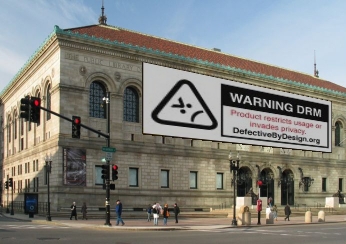
On Saturday February 9th, at 13:00, I'm going to be joining free
software and anti-DRM activists to
protest the use of DRM by the Boston
Public Library on parts of its electronic collection.
Those of us protesting are unhappy because the
BPL has launched
a new
service powered by a company called
OverDrive. The system gives BPL
patrons access to books, music, and movies online -- but only if they use
a Microsoft DRM system.
There are lots of problems with the introduction of this system: it bars
access to users of GNU/Linux and MacOS and creates a dependence on a
single technology vendor for access. These are important issues,
certainly. The
worst problem, however, is much more fundamental.
By adopting a DRM system for library content, the BPL is giving
OverDrive, copyright holders, and Microsoft the ability to decide what,
when, and how its patrons can and cannot read, listen, and watch these
parts of the BPL collection. They are giving these companies veto
power over the BPL's
own ability to access this data -- both now and in
the future. Cryptographically, BPL is quite literally handing over the
keys to their collection. In the process, they are not only providing a
disservice to their patrons. They are providing a disservice to
themselves.
The
first-sale doctrine says that libraries can do essentially
whatever they like with copies of books they purchase short of
duplication, modification, or performance. Of course, copyright holders
would prefer to charge a toll every time someone checks out a book.
Public libraries were possible in spite of this desire because they
were able to exploit power over the possession and control of their
books in the interests of their patrons. With DRM, libraries will
reduced to powerlessness.
Of course, times have changed. As media and the ways we interact with it
is increasingly digital, libraries have changed and will need to change
more. But if public libraries are to succeed at their fundamental
mission of spreading knowledge and serving communities, this change
can't be at the expense of patrons' ability to control their own
technology and libraries' ability to control their own collections.
I've supported my academic library,
MIT Libraries, as they
took a
risk and stood up to DRM when other institutions did not. And
they
won.
BPL is the largest municipal library in the US and the third largest US
library overall. It is the first library to be supported publicly, to be
open to the public in the US, and to allow patrons to take home books to
read and use them. BPL has an opportunity now to continue this history
of leadership, of access, and of patron empowerment.
If BPL stands up against DRM and in favor of its patrons' freedom and
its own control of its technical destiny and collection, it may set an
important precedent. If you're in or near Boston, please
join me in
Copley Square on Saturday to help make this happen. If you're not
near Boston, please help put pressure on similar efforts in your own
communities.
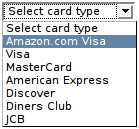 When I'm feeling generous, I imagine this is so that the credit card
companies can give an extra reminder that they only accept certain
credit cards -- not being able to select a card type in an "essential"
input field constrained to multiple choices is a pretty strong reminder.
When I'm feeling less generous, I suspect it might be so that the
companies can subtly remind us that they have their own brand credit
cards that we might like to acquire.
 Yesterday witnessed the most important step forward for the
 Both
