Search Results: "js"

1 April 2022

Paul Wise: FLOSS Activities March 2022

Focus This month I didn't have any particular focus. I just worked on issues in my info bubble.

Changes

Issues

Review
  • Spam: reported 3 Debian bug reports and 53 Debian mailing list posts
  • Debian wiki: RecentChanges for the month
  • Debian BTS usertags: changes for the month
  • Debian screenshots:

Administration
  • Debian servers: investigate wiki mail delivery issue, restart backup director
  • Debian wiki: unblock IP addresses, approve accounts

Communication
  • Forward python-plac test failure issue upstream
  • Participate in Debian Project Leader election discussions
  • Respond to queries from Debian users and contributors on the mailing lists and IRC

Sponsors The oci-python-sdk and plac work was sponsored. All other work was done on a volunteer basis.

7 March 2022

Ayoyimika Ajibade: Progress Report!! Modifying Expectations...

Wait! Just like yesterday when I was accepted as an Outreachy intern and the first half of the internship is finished . How time flies when you are having a good time As part of the requirements for the final application during the contribution period for the Outreachy internship, I needed to provide a timeline to achieve our goal on my outreachy task which is transitioning of dependencies in node16 and webpack5. Having consulted my mentors who implied that the packages depending on webpack and nodejs combined are so numerous that its impossible to finish all within a space of three months but we have steps to guide us through the entire process to achieve most of our goals which are As of this writing(though a little late ) we have successfully rebuilt all reverse dependencies of webpack5 and split them equally each for I and my co-intern for all Javascript modules as ruby packages also depend on webpack which is a total of 44 packages. Filed a bug report on Debian bug tracking system for failing packages, also the original maintainer or uploader of the package to the Debian archive mostly Debian developers also get a mail in references to the package bug report. Sometimes the uploader who also receives the bug report decides to help out to fix the package and forward the patch upstream if need be. We have also filed an issue to upstream repo mostly via github where some respond and create PR to solve those errors and others are plain aversive to the whole idea. PR from the upstream developer is cherry-picked and a patch is created by us to incorporate the code into our own working repository. some package upstream maintainer rejects such issues or doesn't respond, we take it upon ourselves to fix the package. The total number of packages that are successfully updated and ready to be merged is 10 packages while 12 packages remain on my own end to be updated. One of the most challenging packages to update so far was prop-type as its runs its large test suite using jest of a lower version 19.0.2 compared to that of Debian OS which is version 27.5.1 updating and migrating its API's and methods to use the Debian updated version is so challenging after several googling, testing out the solution from StackOverflow, trials, and errors, reading documentations we eventually made progress with the help of my mentor, co-intern and the whole community member. It's so crazy that when I got it working I said to myself. phew it's not rocket science why can I figure it out sooner than expected I initially proposed that I would be halfway done with the project by now, I guess the reason am not able to achieve some of our goals which are finishing up with the packages for webpack and moving to transition some of the nodejs packages at all is DEBUGGING. Yes DEBUGGING! where you never can predict what the solution is. is the problem coming from Debian? or dependencies of the package you are working on, upstream bug, or dependencies of dependencies of the package you are working on, so many questions to answer. You can't easily find a solution to a bug as it takes time to try out so many guesses more of an educated guess, or even try out all the solutions from stack overflow and still no viable progress. Obviously, you cannot really know about something to set up a plan for unless you get right into it. One way of doing this, if I have to start again is the truly understand how the javascript package work under the hood, how its handles different interaction between packages, some of its dos and don't of transpiling, bundling, testing, e.t.c I guess my unrealistic goals need to be modified because some drawback that was not envisaged popped up and I underestimated the complexity of the tasks, which will be reducing the number of packages to update in transitioning of nodejs from what I planned My major focus for the second half of the internship is to fix bugs and errors I discover, file bug reports for future bugs to seek help from co-maintainer or developers, file issues upstream and close those whose bugs are already resolved for the remaining 12 packages, and ultimately successfully uploading all reverse dependencies. Also diving into transitioning of nodejs16. Thanks for stopping by

4 March 2022

Abiola Ajadi: Outreachy-And it s a wrap!

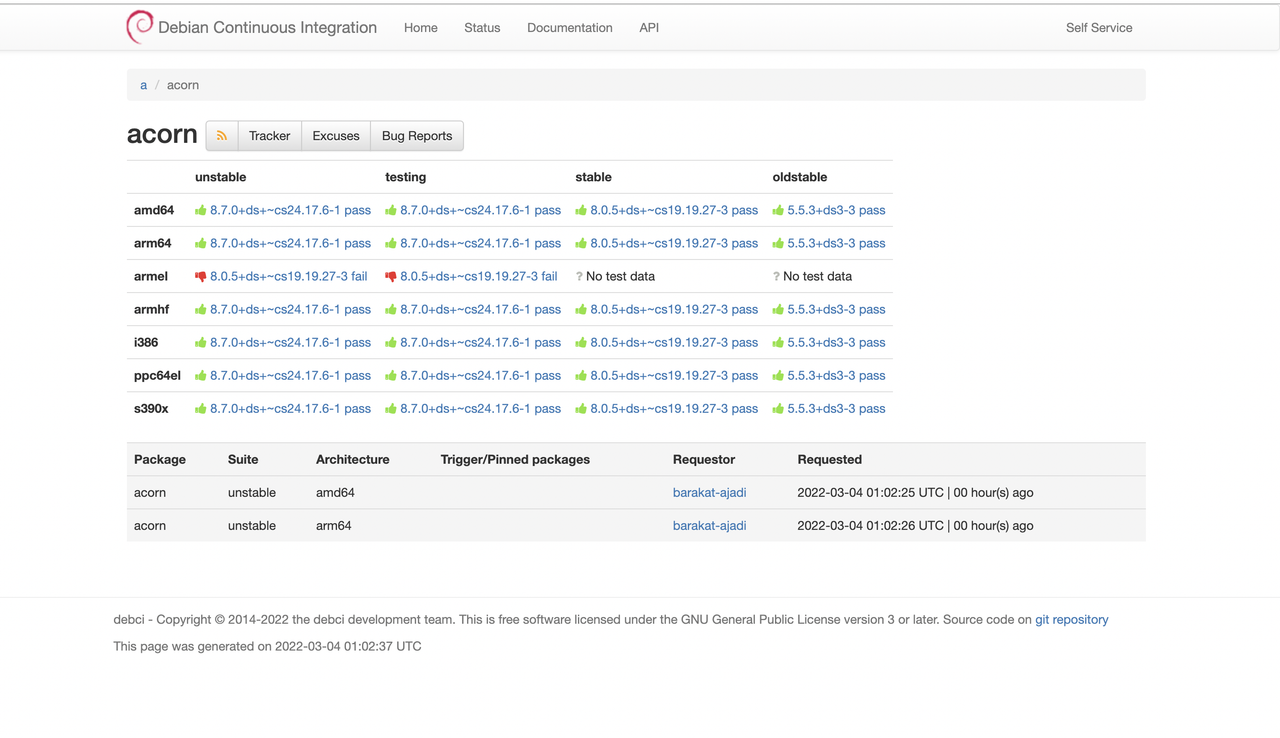
Outreachy Wrap-up Project Improve Debian Continuous Integration UX
Project Link: https://www.outreachy.org/outreachy-december-2021-internship-round/communities/debian/#improve-debian-continuous-integration-ux
Code Repository: https://salsa.debian.org/ci-team/debci
Mentors: Antonio Terceiro, Paul Gevers and Pavit Kaur

About the project Debci exist to make sure packages work currently after an update, How it does this is by testing all of the packages that have tests written in them to make sure it works and nothing is broken This project entails making improvements to the platform to make it easier to use and maintain.

Deliverables of the project:
  • Package landing page displaying pending jobs
  • web frontend: centralize job listings in a single template
  • self-service: request test form forgets values when validation fails
  • Improvement to status

Work done

Package landing page displaying pending jobs Previously, Jobs that were pending were not displayed on the package page. Working on this added a feature to display pending jobs on package landing. Working on this task made it known that the same block of codes was repeated in different files which led to the next task Screenshot-2022-03-04-at-02-03-06.png Merge request
web frontend: centralize job listings in a single template Jobs are listed in various landings such as status packages, Status alerts, status failing, History, and so on. The same Code was repeated in these pages to list the jobs, I worked on refactoring it and created a single template for job listing so it can be used anywhere it s needed. I also wrote a test for the feature I added.
Merge request
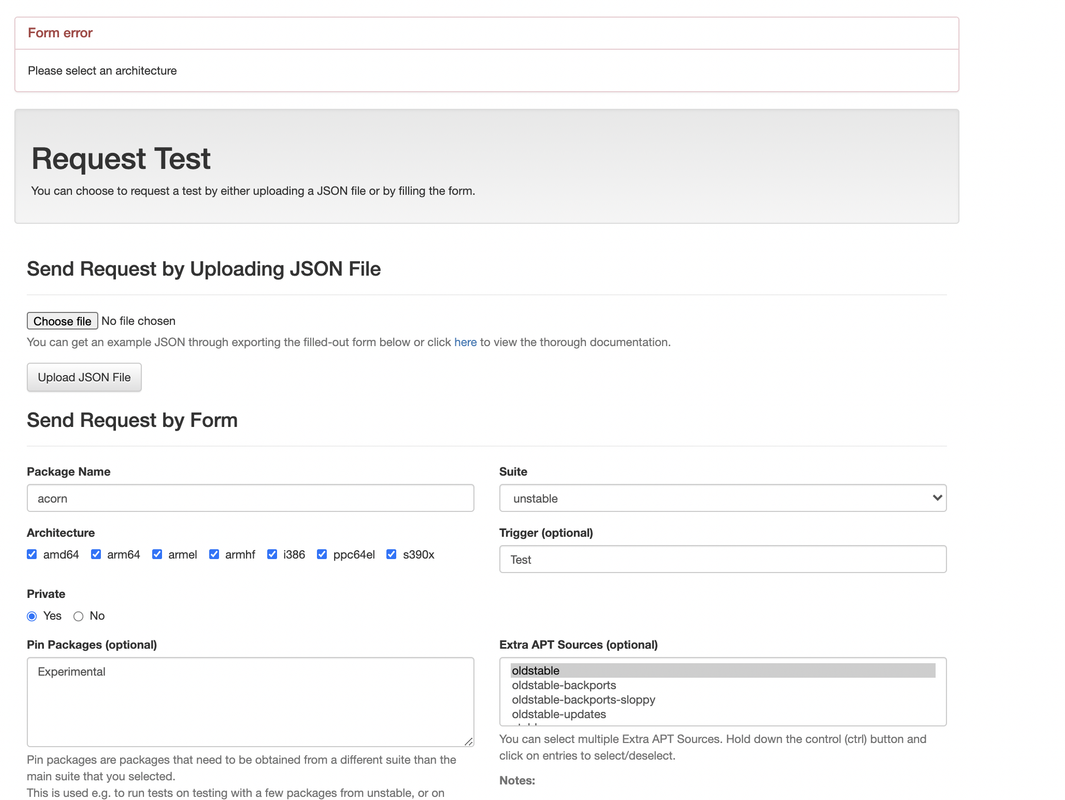
self service: request test form forgets values when validation fails When one tries to request for a test and it fails with an error, originally the form does not remember the values that were typed in the package name, suite field et. c. This fix ensures the form remembers the values inputted even when it throws an error. Image of request test page N/B: The form checks all architecture on the load of the page
merge request
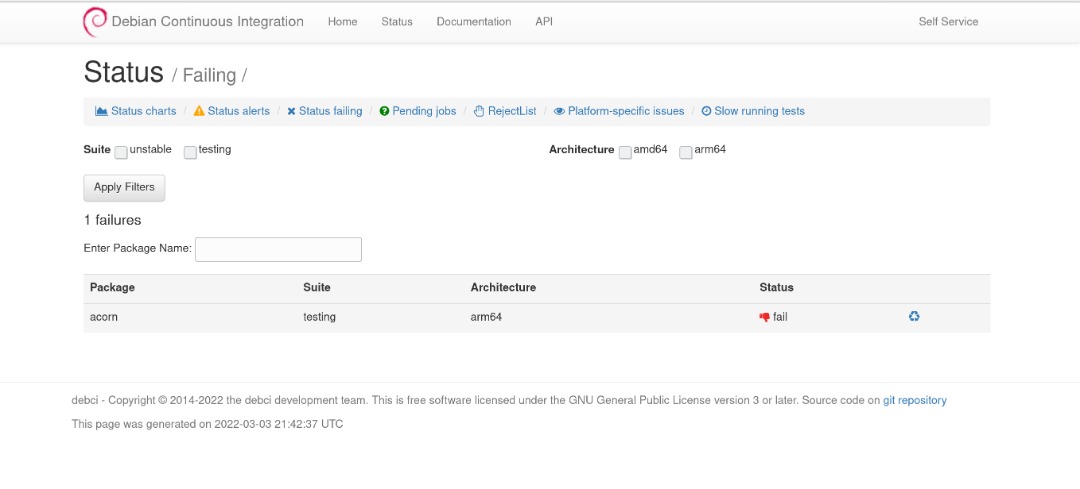
Improvement to status Originally the Status pages were rendered as static HTML pages but I converted these pages to be generated dynamically, I wrote endpoints for each page. Since most of the status pages have a list of jobs I modified it to use the template I created for job-listing. Previously, the status pages had a mechanism to filter such as All, Latest 50 et.c which wasn t paginated. I removed this mechanism added a filter by architecture and suites to these pages and also add pagination. Last but not the least, I wrote tests for these implementations carried out on the status page. Image of Status failing page merge request:
first task
second task

Major take-aways I learnt a lot during my internship but most importantly I learnt how to:
  • write Tests in Ruby and how writing tests is an important aspect of software development
  • maintain good coding practice, Paying attending to commit messages, Indentation et.c are good areas I developed in writing code.
  • make contributions in Ruby Programming Language.

Acknowledgement I can not end this without saying thank you to my mentors Antonio Terceiro, Paul Gevers, and Pavit Kaur for their constant support and guidance throughout the entire duration of this Internship. It has been a pleasure Interacting and learning from everyone.

Review Outreachy has helped me feel more confident about open-source, especially during the application phase. I had to reach out to the community I was interested in and ask questions on how to get started. The informal chats week was awesome I was able to build my network and have interesting conversations with amazing individuals in open-source. To round up, Always ask questions and do not be afraid of making a mistake, as one of the outreachy blog post topics says Everyone struggles!, but never give up!

1 March 2022

Paul Wise: FLOSS Activities February 2022

Focus This month I didn't have any particular focus. I just worked on issues in my info bubble.

Changes

Issues

Review

Administration
  • Debian BTS: fix usertags for some users, unarchive/reopen/triage bugs for reintroduced packages: horae dh-haskell shutter logging-tree openstreetmap-carto gnome-commander
  • Debian servers: restore wiki data from backup, restarted bacula director for TLS cert update
  • Debian wiki: restore wiki account from backup, approve accounts

Communication
  • Respond to queries from Debian users and contributors on the mailing lists and IRC

Sponsors The purple-discord, gensim, DiskANN, SPTAG, wsproto work was sponsored by my employer. All other work was done on a volunteer basis.

18 February 2022

Dirk Eddelbuettel: RcppSimdJson 0.1.7 on CRAN: Maintenance

The RcppSimdJson package was updated to release 0.1.7 today. CRAN had sent a note overnight that it triggered LENGTH_1 error (where boolean comparisons happen with longer vectors). That may be debatable in the two cases flagged if one looks at the commit but life being too short to debate this so we just fixed it. The email came in at 04:50h-ish when I was sound asleep, but four hours later the fixed version was on CRAN thanks to the automated processing: RcppSimdJson wraps the fantastic and genuinely impressive simdjson library by Daniel Lemire and collaborators. Via very clever algorithmic engineering to obtain largely branch-free code, coupled with modern C++ and newer compiler instructions, it results in parsing gigabytes of JSON parsed per second which is quite mindboggling. The best-case performance is faster than CPU speed as use of parallel SIMD instructions and careful branch avoidance can lead to less than one cpu cycle per byte parsed; see the video of the talk by Daniel Lemire at QCon (also voted best talk). The very short NEWS entry for this release follows.

Changes in version 0.1.7 (2022-02-18)
  • Two URLs were updated in 'README.md', and Travis artifacts and badges have been removed (Dirk).
  • One unit test file was updated to not trigger a 'LENGTH_1' warning (Dirk closing #76).

Courtesy of my CRANberries, there is also a diffstat report for this release. For questions, suggestions, or issues please use the issue tracker at the GitHub repo. If you like this or other open-source work I do, you can now sponsor me at GitHub.

This post by Dirk Eddelbuettel originated on his Thinking inside the box blog. Please report excessive re-aggregation in third-party for-profit settings.

5 February 2022

Reproducible Builds: Reproducible Builds in January 2022

Welcome to the January 2022 report from the Reproducible Builds project. In our reports, we try outline the most important things that have been happening in the past month. As ever, if you are interested in contributing to the project, please visit our Contribute page on our website.
An interesting blog post was published by Paragon Initiative Enterprises about Gossamer, a proposal for securing the PHP software supply-chain. Utilising code-signing and third-party attestations, Gossamer aims to mitigate the risks within the notorious PHP world via publishing attestations to a transparency log. Their post, titled Solving Open Source Supply Chain Security for the PHP Ecosystem goes into some detail regarding the design, scope and implementation of the system.
This month, the Linux Foundation announced SupplyChainSecurityCon, a conference focused on exploring the security threats affecting the software supply chain, sharing best practices and mitigation tactics. The conference is part of the Linux Foundation s Open Source Summit North America and will take place June 21st 24th 2022, both virtually and in Austin, Texas.

Debian There was a significant progress made in the Debian Linux distribution this month, including:

Other distributions kpcyrd reported on Twitter about the release of version 0.2.0 of pacman-bintrans, an experiment with binary transparency for the Arch Linux package manager, pacman. This new version is now able to query rebuilderd to check if a package was independently reproduced.
In the world of openSUSE, however, Bernhard M. Wiedemann posted his monthly reproducible builds status report.

diffoscope diffoscope is our in-depth and content-aware diff utility. Not only can it locate and diagnose reproducibility issues, it can provide human-readable diffs from many kinds of binary formats. This month, Chris Lamb prepared and uploaded versions 199, 200, 201 and 202 to Debian unstable (that were later backported to Debian bullseye-backports by Mattia Rizzolo), as well as made the following changes to the code itself:
  • New features:
    • First attempt at incremental output support with a timeout. Now passing, for example, --timeout=60 will mean that diffoscope will not recurse into any sub-archives after 60 seconds total execution time has elapsed. Note that this is not a fixed/strict timeout due to implementation issues. [ ][ ]
    • Support both variants of odt2txt, including the one provided by the unoconv package. [ ]
  • Bug fixes:
    • Do not return with a UNIX exit code of 0 if we encounter with a file whose human-readable metadata matches literal file contents. [ ]
    • Don t fail if comparing a nonexistent file with a .pyc file (and add test). [ ][ ]
    • If the debian.deb822 module raises any exception on import, re-raise it as an ImportError. This should fix diffoscope on some Fedora systems. [ ]
    • Even if a Sphinx .inv inventory file is labelled The remainder of this file is compressed using zlib, it might not actually be. In this case, don t traceback and simply return the original content. [ ]
  • Documentation:
    • Improve documentation for the new --timeout option due to a few misconceptions. [ ]
    • Drop reference in the manual page claiming the ability to compare non-existent files on the command-line. (This has not been possible since version 32 which was released in September 2015). [ ]
    • Update X has been modified after NT_GNU_BUILD_ID has been applied messages to, for example, not duplicating the full filename in the diffoscope output. [ ]
  • Codebase improvements:
    • Tidy some control flow. [ ]
    • Correct a recompile typo. [ ]
In addition, Alyssa Ross fixed the comparison of CBFS names that contain spaces [ ], Sergei Trofimovich fixed whitespace for compatibility with version 21.12 of the Black source code reformatter [ ] and Zbigniew J drzejewski-Szmek fixed JSON detection with a new version of file [ ].

Testing framework The Reproducible Builds project runs a significant testing framework at tests.reproducible-builds.org, to check packages and other artifacts for reproducibility. This month, the following changes were made:
  • Fr d ric Pierret (fepitre):
    • Add Debian bookworm to package set creation. [ ]
  • Holger Levsen:
    • Install the po4a package where appropriate, as it is needed for the Reproducible Builds website job [ ]. In addition, also run the i18n.sh and contributors.sh scripts [ ].
    • Correct some grammar in Debian live image build output. [ ]
    • Shell monitor improvements:
      • Only show the offline node section if there are offline nodes. [ ]
      • Colorise offline nodes. [ ]
      • Shrink screen usage. [ ][ ][ ]
    • Node health check improvements:
      • Detect if live package builds encounter incomplete snapshots. [ ][ ][ ]
      • Detect if a host is running with today s date (when it should be set artificially in the future). [ ]
    • Use the devscripts package from bullseye-backports on Debian nodes. [ ]
    • Use the Munin monitoring package bullseye-backports on Debian nodes too. [ ]
    • Update New Year handling, needed to be able to detect real and fake dates. [ ][ ]
    • Improve the error message of the script that powercycles the arm64 architecture nodes hosted by Codethink. [ ]
  • Mattia Rizzolo:
    • Use the new --timeout option added in diffoscope version 202. [ ]
  • Roland Clobus:
    • Update the build scripts now that the hooks for live builds are now maintained upstream in the live-build repository. [ ]
    • Show info lines in Jenkins when reproducible hooks have been active. [ ]
    • Use unique folders for the artifacts from each live Debian version. [ ]
  • Vagrant Cascadian:
    • Switch the Debian armhf architecture nodes to use new proxy. [ ]
    • Misc. node maintenance. [ ].

Upstream patches The Reproducible Builds project attempts to fix as many currently-unreproducible packages as possible. In January, we wrote a large number of such patches, including:

And finally If you are interested in contributing to the Reproducible Builds project, please visit our Contribute page on our website. However, you can get in touch with us via:

30 January 2022

Russell Coker: Links Jan 2022

Washington Post has an interesting article on how gender neutral language is developing in different countries [1]. pimaker has an interesting blog post about how they wrote a RISCV CPU emulator to boot a Linux kernel in a pixel shader in the VR Chat platform [2]. ZD has an interesting article about the new Solo Bumblebee platform for writing EBPF programs to run inside the Linux kernel [3]. EBPF is an interesting platform and it s good to have new tools to help people develop for it. Big Think has an interesting article about augmented reality suggesting that it could be worse than social media for driving disputes [4]. Some people would want tags of racial status on all people they see. Vice has an insightful article making the case for 8 hours of work per week [5]. The Guardian has an insightful article about how our attention is being stolen by modern technology [6]. Interesting article about the Ilobleed rootkit that targets the HP ILO server management system [7], it s apparently designed for persistent attacks as it bypasses the firmware upgrade process and updates only the version number so anyone who thinks that a firmware update will fix it is horribly mislead. Nick Bostrom wrote an insightful and disturbing article for Aeon titles None of Our Technologies has Managed to Destroy Humanity Yet [8] about the existential risk of new technologies and how they might be mitigated, much of which involves authoritarian governments unlike any we have seen before. As a counterpoint the novel A Deepness in the Sky claims that universal surveillance would be as damaging to the future of a society as planet-buster bombs. Euronews has an informative article about eco-fascism [9]. The idea that the solution to ecological problems is to have less people in the world and particularly less non-white people is a gateway from green politics to fascism. The developer of the colors and faker npm libraries (for NodeJS) recently uploaded corrupted versions of those libraries as a protest against companies that use them without paying him [10]. This is the wrong way to approach the issue, but it does demonstrate a serious problem with systems like NPM that allow automatic updates. It gives a better result to just use software packaged by a distribution which has QA checks applied including on security updates. VentureBeat has an interesting article on the way that AI is taking over jobs [11]. Lots of white collar jobs can be replaced by machine learning systems, we need to plan for the ways this will change the economy. The Atlantic has an interesting article about tapeworms that infect some ants [12]. The tapeworms make the ants live longer and produce pheromones to make the other ants serve them. This increases the chance that the ants will be eaten by birds which is the next stage in the tapeworm lifecycle.

29 January 2022

Sylvestre Ledru: An update on rust/coreutils

TLDR: we are making progress on the Rust implementation of the GNU coreutils. Well, it is an understatement to say my previous blog post interested many people. Many articles, blog posts and some podcasts talked about it! As we pushed coreutils 0.0.12 a few days ago and getting closer to the 10 000 stars on github, it is now time to give an update! This has brought a lot of new contributors to this project. Instead of 30 to 60 patches per month, we jumped to 400 to 472 patches every month. Similarly, we saw an increase in the number of contributors (20 to 50 per month from 3 to 8). Two new maintainers (Michael Debertol & Terts Diepraam) stepped in and have been doing a much better job than myself as reviewers now! As a silly metric, according to github, we had 5 561 clones of the repository over the last 2 weeks! The new contributors focused on: Closing the gap with GNU As far as I know, we are only missing stty (change and print terminal line settings) as a program. Thanks to some heroes, basenc, pr, chcon and runcon have been implemented. For example, for the two last programs, Koutheir Attouchi wrote new crates to manage SELinux properly. This crate has been used for some other utilities like cp, ls or id. Leveraging the GNU testsuite to test this implementation Because the GNU testsuite is excellent, we now have a proper CI using it to run the tests. It is pretty long on the Github action CI (almost two hours to run it) but it is an amazing improvement to the way we work. It was a joint work from a bunch of folks (James Robson, Roy Ivy III, etc). To achieve this, we also made it easier to run the GNU testsuite locally with the Rust implementation but also to ignore some tests or adjust some error messages (see build-gnu.sh and run-gnu-test.sh). Following a suggestion of Brian G, a colleague at Mozilla (he did the same for some Firefox major change), we are now collecting the history of fail/pass/error into a separate repository and generating a daily graph showing the evolution of regression. Evolution over time At this date, we have, with GNU/Coreutils 9.0:
Total 611 tests
Pass 214
Skip 84
Fail 298
Error 15
We are now automatically identifying new passing tests and regressions in the CI. For example:
Warning: Congrats! The gnu test tests/chmod/c-option is now passing!
<br />Warning: Congrats! The gnu test tests/chmod/silent is now passing!
<br />Warning: Congrats! The gnu test tests/chmod/umask-x is now passing!
<br />Error: GNU test failed: tests/du/long-from-unreadable. tests/du/long-from-unreadable is passing on 'master'. Maybe you have to rebase?
[...]
<br />Warning: Changes from master: PASS +4 / FAIL +0 / ERROR -4 / SKIP +0
This is also beneficial to GNU as, by implementing some options, Michael Debertol noticed some incorrect behaviors (with sort and cat) or an uninitialized variable (with chmod). Documentations Every day, we are generating the user documentation and of the internal coreutils. User documentation: https://uutils.github.io/coreutils-docs/user/ Example: ls or cp The internal documentation can be seen on: https://uutils.github.io/coreutils-docs/dev/uucore/
For example, the backup style is documented here: https://uutils.github.io/coreutils-docs/dev/uucore/backup_control/index.html More? Besides my work on Debian/Ubuntu, I have also noticed that more and more operating systems are starting to look at this: In parallel, https://github.com/uutils/findutils/, a rust dropped-in replacement for find, is getting more attention lately! Here, the graph showing the evolution of the program using the BFS testsuite (much better than GNU's). Evolution over time - BFS testsuite What is next?
  1. stty needs to be implemented
  2. Improve the GNU compatibility on key programs and reduce the gap
  3. Investigate how to reduce the size of the binaries
  4. Allow Debian and Ubuntu to switch by default without tricky manipulation
How to help? I have been maintaining a list of good first bugs for new comers in the repo! Don't hesitate to contribute, it is much easier than it seems and a terrific way to learn Rust!
26 January 2022

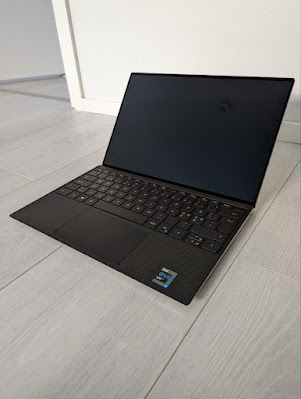
Timo Jyrinki: Unboxing Dell XPS 13 - openSUSE Tumbleweed alongside preinstalled Ubuntu

A look at the 2021 model of Dell XPS 13 - available with Linux pre-installed
I received a new laptop for work - a Dell XPS 13. Dell has been long famous for offering certain models with pre-installed Linux as a supported option, and opting for those is nice for moving some euros/dollars from certain PC desktop OS monopoly towards Linux desktop engineering costs. Notably Lenovo also offers Ubuntu and Fedora options on many models these days (like Carbon X1 and P15 Gen 2).
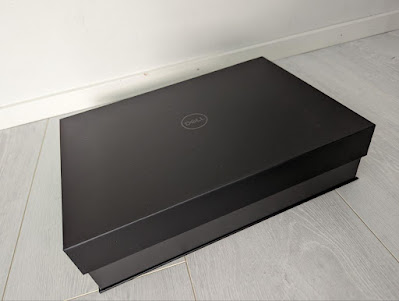
black box

opened box

accessories and a leaflet about Linux support

laptop lifted from the box, closed

laptop with lid open

Ubuntu running

openSUSE runnin
Obviously a smooth, ready-to-rock Ubuntu installation is nice for most people already, but I need openSUSE, so after checking everything is fine with Ubuntu, I continued to install openSUSE Tumbleweed as a dual boot option. As I m a funny little tinkerer, I obviously went with some special things. I wanted:
  • Ubuntu to remain as the reference supported OS on a small(ish) partition, useful to compare to if trying out new development versions of software on openSUSE and finding oddities.
  • openSUSE as the OS consuming most of the space.
  • LUKS encryption for openSUSE without LVM.
  • ext4 s new fancy fast_commit feature in use during filesystem creation.
  • As a result of all that, I ended up juggling back and forth installation screens a couple of times (even more than shown below, and also because I forgot I wanted to use encryption the first time around).
First boots to pre-installed Ubuntu and installation of openSUSE Tumbleweed as the dual-boot option:
(if the embedded video is not shown, use a direct link)
Some notes from the openSUSE installation:
  • openSUSE installer s partition editor apparently does not support resizing or automatically installing side-by-side another Linux distribution, so I did part of the setup completely on my own.
  • Installation package download hanged a couple of times, only passed when I entered a mirror manually. On my TW I ve also noticed download problems recently, there might be a problem with some mirror I need to escalate.
  • The installer doesn t very clearly show encryption status of the target installation - it took me a couple of attempts before I even noticed the small encrypted column and icon (well, very small, see below), which also did not spell out the device mapper name but only the main partition name. In the end it was going to do the right thing right away and use my pre-created encrypted target partition as I wanted, but it could be a better UX. Then again I was doing my very own tweaks anyway.
  • Let s not go to the details why I m so old-fashioned and use ext4 :)
  • openSUSE s installer does not work fine with HiDPI screen. Funnily the tty consoles seem to be fine and with a big font.
  • At the end of the video I install the two GNOME extensions I can t live without, Dash to Dock and Sound Input & Output Device Chooser.

21 January 2022

Reproducible Builds (diffoscope): diffoscope 201 released

The diffoscope maintainers are pleased to announce the release of diffoscope version 201. This version includes the following changes:
[ Chris Lamb ]
* If the debian.deb822 module raises any exception on import, re-raise it as
  an ImportError instead. This should fix diffoscope on some Fedora systems.
  Thanks to Mattia Rizzolo for suggesting this particular solution.
  (Closes: reproducible-builds/diffoscope#300)
[ Zbigniew J drzejewski-Szmek ]
* Fix json detection with file-5.41-3.fc36.x86_64.
You find out more by visiting the project homepage.

20 January 2022

Caleb Adepitan: I'm Thinking About You Right Now!

Just in case you stumbled on this incidentally and you wonder Who in the seven fat worlds is this mysterious...? Ha! That was what I was thinking about you you were thinking about me. You gerrit!? I heard you listening to my thoughts; I listened to yours too. I wonder if you heard me too. I will like to talk, today, about what it is I do at Debian as an Outreachy Intern under the JavaScript team. I woke up this morning and decided to bore you with so much details. I must have woken up glorified!

A Broader View My sole role at Debian alongside my teammate, aided by our mentors, is to facilitate the Node.js 16 and Webpack 5 Transitioning. What exactly does that mean? Node.js 16, as of the time of this writing, is the active LTS release from the Node.js developers while Webpack 5 is also the current release from the Webpack developers. At Debian we have to work towards supporting these packages. Debian as an OS comes with a package manager coined Advanced Package Tool or simply APT on which command-line programs specific to Debian and it's many-flavored distributions, apt, apt-get, apt-cache are based. This means before the conception of yarn and npm, the typical JavaScript developer's package managers, apt has been. Debian unlike yarn and npm, ideally, only supports one version of a software at any point in time and on edge cases may have to support an extra one as noted in this chat between my mentor and a member. To provide support for Webpack 5 and Node.js 16 which as regards to Debian are currently in experimental and only can be migrated to unstable after our transitioning, we have to test, reverse build, report and fix bugs till a certain level of compatibility has been attained with dependent packages currently in unstable. Webpack and Node.js have their respective dependencies, but there are certain software and packages also dependent on Webpack and/or Node.js, these are termed as reverse-dependencies. We have to test and build these reverse-dependencies, report and fix bugs and incompatibilities with the new versions of Webpack and Node.js. For reverse-dependent packages not yet supporting Webpack 5 and/or Node.js 16, we'll open an issue in form of a feature-request in upstream repository asking for Webpack 5 and/or Node.js 16 support. Ideally, Debian manages a repository of all supported packages on a GitLab managed Git based VCS. For JavaScript packages maintained by the JS Team, the home of those packages sits at https://salsa.debian.org/js-team/. Supported packages are pulled from upstream repository, mostly GitHub, using some certian packaging tools provided by Debian. The pulled source cannot be directly modified else it will break build. So there exists a dedicated folder named debian where certain cofiguration files, scripts and rules to convey to the debian package builder live at. In some cases, source code needs to be modified; these are done via patching which means the modifications won't live in the source but in a dedicated patch file inside the debian/patches/ folder. The modifications are diffed line by line with the original source (just as with git) and the result is output in a file managed by debian utility tool, Quilt. The contents of the debian folder are instructions on how to build the source into binaries or an installable archive .deb (like Java's .jar or Android's .apk).

Understanding Debian Software Release Cycle There are quite some interesting things about the software release cycle at Debian to get familiar with. Listed here are some release repositories alongside their codenames as of Debian 11:
  1. Unstable (Sid)
  2. Testing (Bookworm)
  3. Stable (Bullseye)
  4. Old stable (Buster)
  5. Old old stable (Stretch)
Ha! Isn't it ironic that unstable is the only one with a stable codename? Some of these, if not all, have codenames subject to change after every new release and/or migration. Only unstable which is referred to as Sid never changes. The current stable release which is Debian 11 is codenamed Bullseye. The next stable release which will be Debian 12 will be codenamed Bookworm because the current testing repository will be migrated to stable and released as Debian 12. The previous stable release which was Debian 10, now old stable, was codenamed Buster. To better understand Debian releases you may take a look at this wiki that completely defines them. Basically, as explained by one of my mentors remixed in my own words, experimental software are migrated to unstable after (as I said earlier) they have attained a certain level of compatibility with dependent software. They remain in unstable for a long period of time undergoing testing, autopkgtest tests, regression tests, etc. At this point bugs are reported and fixed to a satisfactory level. The unstable repository is then migrated to testing where release-critical bugs are reported and fixed to a satisfactory level where one can comfortably say testing is almost stable , and voila (!), testing is released as a Debian stable version. This happens roughly every two years. Some months before a new stable release, a soft freeze is turned on such that no new versions or transitions should be uploaded to unstable. Only fixes will be uploaded at this point. In like 4-6 weeks before the release, a hard freeze is turned on that completely disallows uploading to unstable, not even fixes. In due time, testing becomes the new stable release and freeze is lifted.

References
  1. Packaging pre-requisites
  2. Working with chroots
  3. Sbuild (clean builds)
  4. Updating a Debian Package by Abraham Raji

14 January 2022

Dirk Eddelbuettel: Rcpp 1.0.8: Updated, Strict Headers

rcpp logo The Rcpp team is thrilled to share the news of the newest release 1.0.8 of Rcpp which hit CRAN today, and has already been uploaded to Debian as well. Windows and macOS builds should appear at CRAN in the next few days. This release continues with the six-months cycle started with release 1.0.5 in July 2020. As a reminder, interim dev or rc releases will alwasys be available in the Rcpp drat repo; this cycle there were once again seven (!!) times two as we also tested the modified header (more below). These rolling release tend to work just as well, and are also fully tested against all reverse-dependencies. Rcpp has become the most popular way of enhancing R with C or C++ code. Right now, around 2478 packages on CRAN depend on Rcpp for making analytical code go faster and further, along with 242 in BioConductor. This release finally brings a change we have worked on quite a bit over the last few months. The idea of enforcing the setting of STRICT_R_HEADERS was prososed years ago in 2016 and again in 2018. But making such a chance against a widely-deployed code base has repurcussions, and we were not ready then. Last April, this was revisited in issue #1158. Over the course of numerous lengthy runs of tests of a changed Rcpp package against (essentially) all reverse-dependencies (i.e. packages which use Rcpp) we identified ninetyfour packages in total which needed a change. We provided either a patch we emailed, or a GitHub pull request, to all ninetyfour. And we are happy to say that eighty cases were resolved via a new CRAN upload, with a seven more having merged the pull request but not yet uploaded. Hence, we could make the case to CRAN (who were always CC ed on the monthly nag emails we sent to maintainers of packages needing a change) that an upload was warranted. And after a brief period for their checks and inspection, our January 11 release of Rcpp 1.0.8 arrived on CRAN on January 13. So with that, a big and heartfelt Thank You! to all eighty maintainers for updating their packages to permit this change at the Rcpp end, to CRAN for the extra checking, and to everybody else who I bugged with the numerous emails and updated to the seemingly never-ending issue #1158. We all got this done, and that is a Good Thing (TM). Other than the aforementioned change which will not automatically set STRICT_R_HEADERS (unless opted out which one can), a number of nice pull request by a number of contributors are included in this release: The full list of details follows.

Changes in Rcpp release version 1.0.8 (2022-01-11)
  • Changes in Rcpp API:
    • STRICT_R_HEADERS is now enabled by default, see extensive discussion in #1158 closing #898.
    • A new #define allows default setting of finalizer calls for external pointers (I aki in #1180 closing #1108).
    • Rcpp:::CxxFlags() now quotes the include path generated, (Kevin in #1189 closing #1188).
    • New header files Rcpp/Light, Rcpp/Lighter, Rcpp/Lightest and default Rcpp/Rcpp for fine-grained access to features (and compilation time) (Dirk #1191 addressing #1168).
  • Changes in Rcpp Attributes:
    • A new option signature allows customization of function signatures (Travers Ching in #1184 and #1187 fixing #1182)
  • Changes in Rcpp Documentation:
    • The Rcpp FAQ has a new entry on how not to grow a vector (Dirk in #1167).
    • Some long-spurious calls to RNGSope have been removed from examples (Dirk in #1173 closing #1172).
    • DOI reference in the bibtex files have been updated per JSS request (Dirk in #1186).
  • Changes in Rcpp Deployment:
    • Some continuous integration components have been updated (Dirk in #1174, #1181, and #1190).

Thanks to my CRANberries, you can also look at a diff to the previous release. Questions, comments etc should go to the rcpp-devel mailing list off the R-Forge page. Bugs reports are welcome at the GitHub issue tracker as well (where one can also search among open or closed issues); questions are also welcome under rcpp tag at StackOverflow which also allows searching among the (currently) 2822 previous questions. If you like this or other open-source work I do, you can sponsor me at GitHub.

This post by Dirk Eddelbuettel originated on his Thinking inside the box blog. Please report excessive re-aggregation in third-party for-profit settings.

8 January 2022

Ayoyimika Ajibade: Nodejs 16 and Webpack 5 transition in Debian

What is Debian ? Debian is also known as Debian GNU/Linux is a free open-source operating system (OS) based currently on the Linux kernel or the FreeBSD kernel, developed by the community-supported Debian Project; although efforts are in place to provide Debian for other kernels, primarily for the Hurd.

Fun fact about Debian
  • Debian was the first Linux distribution to include a package management system for easy installation and removal of software. It was also the first Linux distribution that could be upgraded without requiring reinstallation.
  • To protect your system against Trojan horses and other malevolent software, Debian's servers verify that uploaded packages come from their registered Debian maintainers.
  • Debian comes with over 59000 packages; as of this writing (precompiled software that is bundled up in a nice format for easy installation on your machine), a package manager (APT), and other utilities that make it possible to manage thousands of packages on thousands of computers as easily as installing a single application. All of it is FREE!
  • Debian is also the basis for many other distributions, most notably Ubuntu

What is Webpack ? Webpack is a static module bundler for modern JavaScript applications. When webpack processes your application, it internally builds a dependency graph from one or more entry points and then combines every module your project needs into one or more bundles, which are static assets to serve your content from

What is nodejs ? Node.js is an open-source, cross-platform built on Chrome's JavaScript runtime for easily building fast and scalable network applications and also developing server-side applications, Here javascript code is no longer limited to the traditional method of running on the web browser

What does Transitioning mean in Debian? Transitioning is a concept in Debian about maintaining only one version of a library like webpack, nodejs. There is a bottleneck as other libraries and applications may not support the version we have in Debian. So we have to port that software which For example, node-mini-css-extract-plugin, node-mermaid and so many packages uses webpack. In buster we had webpack4 and in bullseye, we want to update it to webpack5. node-mini-css-extract-plugin already supports webpack5, but others like node-mermaid don't support it yet. So either we wait or we help those projects to update their webpack version. Check out this chat between my mentor and a community member on transitioning of rails6

Getting Started with Creating or Updating packages in Debian To be able to create or maintain packages suitable for uploading to Debian you must be in a sid/unstable environment or distribution. See recommended instructions on how to setup Debian Sid via this link See link on how to debianize a new package See link for brief steps on how to update a package to its new upstream version. For more detailed content on the whys and hows of updating a package to its new upstream version visit here Note In updating to the new upstream version we have to watch out for breaking changes caused by both minor updates or major updates. As per https://semver.org major updates(e.g If the current version is 2.3.4, then 3.0 is a major update) of libraries with versions greater than 1.0 and minor updates(e.g If the current version is 0.10 then 0.11 is a minor update) of libraries with versions less than 1.0 can have breaking changes

The overall flow of webpack5 and nodejs16 transitioning in Debian After grasping the fundamental process and flow on how to update a package, you are well on your way to transitioning . Transitioning in webpack or nodejs involves building and testing of dependencies or packages that depend on webpack or nodejs respectively called reverse-dependencies, these reverse dependencies are tested and built with the new updated version usually uploaded to the experimental distribution if reverse dependencies are built and tested successfully both reverse dependencies and dependency in this case nodejs or webpack are then uploaded to the unstable/sid distribution for further processing

The major guidelines to follow while transitioning are
  • Find a list of reverse dependencies to fix
  • See if new upstream versions of reverse dependencies are available that supports the transitioning version
  • See if new upstream of reverse dependencies are available that supports the transitioning version works
  • Report bugs found while rebuilding and testing reverse dependencies in Debian
  • Forward bugs found while rebuilding and testing reverse dependencies upstream
  • Fix or update packages and forward patches upstream
After a successful transitioning phase users of the Debian OS have access to the latest and also oldest installation of these packages via apt based on their preferences, which implies having the benefit of more features, bug fixes, updated security patches from those packages, all these are possible due to the community of amazing people

7 January 2022

Ayoyimika Ajibade: Everyone Struggles

Starting anything new always has in it an element of uncertainty, doubt, fears, and struggle to forge ahead, this has been my current situation as an outreachy intern working on the transition of nodejs16 and webpack5 which is about updating all packages that depend on nodejs14 and webpack4 to work well with the updated version of nodejs16 and webpack5 in the Debian operations system. Juicy right! As a software developer struggling to grasp both basic and advanced knowledge of a concept can seem daunting, much like learning anything new, you can be overwhelmed when you are surrounded and know there is a whole lot of other new concept, tools, process, languages you have to learn that are linked to what you are currently learning, as you are struggling to grasp the fundamental idea of what you are currently learning. imbued in any struggle to get a solution to the problem is where innovation and inventions lie in, and our learning becomes improved as we dive into fact-finding, getting your hypothesis after a series of tests and ultimately proffering a solution Some of my struggles as I intern with Debian has been lack of skill of the shell scripting language as that is one of the core languages to understand so as to navigate your way around maintaining packages for Debian, also funny enough having just an intermediate knowledge of the javascript programming language as arguably having a basic knowledge of javascript is necessary to building and testing javascript packages in Debian as I know only the basic of javascript since my core language is Python, that I struggle with. The good thing is that the more I keep at it the faster the chance of the struggles reducing Now to the fun part! having a community of developers who have been through the struggling phase is divine, as they make your learning experience much easier, my mentors and other community member have made learning to package modules for Debian much easier as all hands are on deck to always help out with our challenges. I remember it felt so wonderful when my first contribution got merged and I became more encouraged to update more packages. These helped me a lot in the contribution stage for Debian as I better familiar with how the system worked. I m super grateful to my mentors and co-intern as they are always there to assist me.

How I Navigate my way through my struggles I guess the first thing about any challenge is to be aware of it and admit your limitations of particular knowledge, then you move on to creatively seek solutions by asking for help from those who know the way. Voila! Now comes the part where you have to take up their solutions, ideas, opinions and make it work for your particular case scenario that is a skill set that all Software developers must-have. Going through documentation has immensely helped solve my problems much faster and build new knowledge, as I get the fundamental idea of why and how things work. I also try to break each concept down into steps, achieve my goals for each step, then build all solutions in each step together, surfing the internet to find solutions also has a huge benefit.

Vocabulary terms Used in Debian
  1. uscan => a tool to identify and download upstream source code from the repository, also compressing it into the required format.
  2. apt => a package manager to manage packages in Debian, similar to pip in python, npm in javascript.
  3. stretch/buster/bullseye/bookworm/sid => old old stable Debian9 - The codename for the release before the previous stable release (stretch). old stable Debian10 - The previous stable release (Buster). stable Debian11 - The current stable release (Bullseye). testing Debian12 - The next-generation stable release (Bookworm). unstable - The unstable development release (Sid) where new or updated packages are introduced. To understand more on debian release cycle
  4. reverse-rebuild => is building all modules that depend on a package in Debian while building the main package.
  5. lintian => A helper tool used to check for inconsistencies and errors in a Debian Package based on Debian standards.
  6. pkg-js-tools => A collection of tools to aid packaging Node modules in Debian.
  7. dpkg-buildpackage => A command to build upstream code in an unclean chroot or environment.
  8. quilt => A patch creation and management automation script. quilt helps manage a series of patches that a Debian package maintainer needs to be applied to upstream source when building the package.
  9. autopkgtest => a script used to test an installed binary package using the source package's tests
  10. RFS => (Request For Sponsorship) Working in the Debian ecosystem includes two roles either as a Debian Maintainer with restricted rights and privileges like uploading to the Debian archive or as a Debian Developer with all rights and privileges such as uploading to the Debian archive, as a new contributor or a Debian maintainer (with few rights and privileges) in Debian you can RFS so that your pull request (PR) can be merged to the Debian archive by a Debian Developer, much like your contribution has been accepted
There are so many terms and tools you have to get accustomed to, but they are easy to understand and use, as enough and frequently updated wiki documentation are available to guide you through, plus a whole lot of community members you can ask questions from. strength and growth come only through continuous effort and struggle. Napoleon Hill

5 January 2022

Reproducible Builds: Reproducible Builds in December 2021

Welcome to the December 2021 report from the Reproducible Builds project! In these reports, we try and summarise what we have been up to over the past month, as well as what else has been occurring in the world of software supply-chain security. As a quick recap of what reproducible builds is trying to address, whilst anyone may inspect the source code of free software for malicious flaws, almost all software is distributed to end users as pre-compiled binaries. The motivation behind the reproducible builds effort is to ensure no flaws have been introduced during this compilation process by promising identical results are always generated from a given source, thus allowing multiple third-parties to come to a consensus on whether a build was compromised. As always, if you would like to contribute to the project, please get in touch with us directly or visit the Contribute page on our website.
Early in December, Julien Voisin blogged about setting up a rebuilderd instance in order to reproduce Tails images. Working on previous work from 2018, Julien has now set up a public-facing instance which is providing build attestations. As Julien dryly notes in his post, Currently, this isn t really super-useful to anyone, except maybe some Tails developers who want to check that the release manager didn t backdoor the released image. Naturally, we would contend sincerely that this is indeed useful.
The secure/anonymous Tor browser now supports reproducible source releases. According to the project s changelog, version 0.4.7.3-alpha of Tor can now build reproducible tarballs via the make dist-reprod command. This issue was tracked via Tor issue #26299.
Fabian Keil posted a question to our mailing list this month asking how they might analyse differences in images produced with the FreeBSD and ElectroBSD s mkimg and makefs commands:
After rebasing ElectroBSD from FreeBSD stable/11 to stable/12
I recently noticed that the "memstick" images are unfortunately
still not 100% reproducible.
Fabian s original post generated a short back-and-forth with Chris Lamb regarding how diffoscope might be able to support the particular format of images generated by this command set.

diffoscope diffoscope is our in-depth and content-aware diff utility. Not only can it locate and diagnose reproducibility issues, it can provide human-readable diffs from many kinds of binary formats. This month, Chris Lamb prepared and uploading versions 195, 196, 197 and 198 to Debian, as well as made the following changes:
  • Support showing Ordering differences only within .dsc field values. [ ]
  • Add support for XMLb files. [ ]
  • Also add, for example, /usr/lib/x86_64-linux-gnu to our local binary search path. [ ]
  • Support OCaml versions 4.11, 4.12 and 4.13. [ ]
  • Drop some unnecessary has_same_content_as logging calls. [ ]
  • Replace token variable with an anonymously-named variable instead to remove extra lines. [ ]
  • Don t use the runtime platform s native endianness when unpacking .pyc files. This fixes test failures on big-endian machines. [ ]
Mattia Rizzolo also made a number of changes to diffoscope this month as well, such as:
  • Also recognize GnuCash files as XML. [ ]
  • Support the pgpdump PGP packet visualiser version 0.34. [ ]
  • Ignore the new Lintian tag binary-with-bad-dynamic-table. [ ]
  • Fix the Enhances field in debian/control. [ ]
Finally, Brent Spillner fixed the version detection for Black uncompromising code formatter [ ], Jelle van der Waa added an external tool reference for Arch Linux [ ] and Roland Clobus added support for reporting when the GNU_BUILD_ID field has been modified [ ]. Thank you for your contributions!

Distribution work In Debian this month, 70 reviews of packages were added, 27 were updated and 41 were removed, adding to our database of knowledge about specific issues. A number of issue types were created as well, including: strip-nondeterminism version 1.13.0-1 was uploaded to Debian unstable by Holger Levsen. It included contributions already covered in previous months as well as new ones from Mattia Rizzolo, particularly that the dh_strip_nondeterminism Debian integration interface uses the new get_non_binnmu_date_epoch() utility when available: this is important to ensure that strip-nondeterminism does not break some kinds of binNMUs.
In the world of openSUSE, however, Bernhard M. Wiedemann posted his monthly reproducible builds status report.
In NixOS, work towards the longer-term goal of making the graphical installation image reproducible is ongoing. For example, Artturin made the gnome-desktop package reproducible.

Upstream patches The Reproducible Builds project attempts to fix as many currently-unreproducible packages as possible. In December, we wrote a large number of such patches, including:

Testing framework The Reproducible Builds project runs a significant testing framework at tests.reproducible-builds.org, to check packages and other artifacts for reproducibility. This month, the following changes were made:
  • Holger Levsen:
    • Run the Debian scheduler less often. [ ]
    • Fix the name of the Debian testing suite name. [ ]
    • Detect builds that are rescheduling due to problems with the diffoscope container. [ ]
    • No longer special-case particular machines having a different /boot partition size. [ ]
    • Automatically fix failed apt-daily and apt-daily-upgrade services [ ], failed e2scrub_all.service & user@ systemd units [ ][ ] as well as generic build failures [ ].
    • Simplify a script to powercycle arm64 architecture nodes hosted at/by codethink.co.uk. [ ]
    • Detect if the udd-mirror.debian.net service is down. [ ]
    • Various miscellaneous node maintenance. [ ][ ]
  • Roland Clobus (Debian live image generation):
    • If the latest snapshot is not complete yet, try to use the previous snapshot instead. [ ]
    • Minor: whitespace correction + comment correction. [ ]
    • Use unique folders and reports for each Debian version. [ ]
    • Turn off debugging. [ ]
    • Add a better error description for incorrect/missing arguments. [ ]
    • Report non-reproducible issues in Debian sid images. [ ]
Lastly, Mattia Rizzolo updated the automatic logfile parsing rules in a number of ways (eg. to ignore a warning about the Python setuptools deprecation) [ ][ ] and Vagrant Cascadian adjusted the config for the Squid caching proxy on a node. [ ]

If you are interested in contributing to the Reproducible Builds project, please visit our Contribute page on our website. However, you can get in touch with us via:

4 January 2022

Jonathan McDowell: Upgrading from a CC2531 to a CC2538 Zigbee coordinator

Previously I setup a CC2531 as a Zigbee coordinator for my home automation. This has turned out to be a good move, with the 4 gang wireless switch being particularly useful. However the range of the CC2531 is fairly poor; it has a simple PCB antenna. It s also a very basic device. I set about trying to improve the range and scalability and settled upon a CC2538 + CC2592 device, which feature an MMCX antenna connector. This device also has the advantage that it s ARM based, which I m hopeful means I might be able to build some firmware myself using a standard GCC toolchain. For now I fetched the JetHome firmware from https://github.com/jethome-ru/zigbee-firmware/tree/master/ti/coordinator/cc2538_cc2592 (JH_2538_2592_ZNP_UART_20211222.hex) - while it s possible to do USB directly with the CC2538 my board doesn t have those bits so going the external USB UART route is easier. The device had some existing firmware on it, so I needed to erase this to force a drop into the boot loader. That means soldering up the JTAG pins and hooking it up to my Bus Pirate for OpenOCD goodness.
OpenOCD config
source [find interface/buspirate.cfg]
buspirate_port /dev/ttyUSB1
buspirate_mode normal
buspirate_vreg 1
buspirate_pullup 0
transport select jtag
source [find target/cc2538.cfg]
Steps to erase
$ telnet localhost 4444
Trying ::1...
Trying 127.0.0.1...
Connected to localhost.
Escape character is '^]'.
Open On-Chip Debugger
> mww 0x400D300C 0x7F800
> mww 0x400D3008 0x0205
> shutdown
shutdown command invoked
Connection closed by foreign host.
At that point I can switch to the UART connection (on PA0 + PA1) and flash using cc2538-bsl:
$ git clone https://github.com/JelmerT/cc2538-bsl.git
$ cc2538-bsl/cc2538-bsl.py -p /dev/ttyUSB1 -e -w -v ~/JH_2538_2592_ZNP_UART_20211222.hex
Opening port /dev/ttyUSB1, baud 500000
Reading data from /home/noodles/JH_2538_2592_ZNP_UART_20211222.hex
Firmware file: Intel Hex
Connecting to target...
CC2538 PG2.0: 512KB Flash, 32KB SRAM, CCFG at 0x0027FFD4
Primary IEEE Address: 00:12:4B:00:22:22:22:22
    Performing mass erase
Erasing 524288 bytes starting at address 0x00200000
    Erase done
Writing 524256 bytes starting at address 0x00200000
Write 232 bytes at 0x0027FEF88
    Write done
Verifying by comparing CRC32 calculations.
    Verified (match: 0x74f2b0a1)
I then wanted to migrate from the old device to the new without having to repair everything. So I shut down Home Assistant and backed up the CC2531 network information using zigpy-znp (which is already installed for Home Assistant):
python3 -m zigpy_znp.tools.network_backup /dev/zigbee > cc2531-network.json
I copied the backup to cc2538-network.json and modified the coordinator_ieee to be the new device s MAC address (rather than end up with 2 devices claiming the same MAC if/when I reuse the CC2531) and did:
python3 -m zigpy_znp.tools.network_restore --input cc2538-network.json /dev/ttyUSB1
The old CC2531 needed unplugged first, otherwise I got an RuntimeError: Network formation refused, RF environment is likely too noisy. Temporarily unscrew the antenna or shield the coordinator with metal until a network is formed. error. After that I updated my udev rules to map the CC2538 to /dev/zigbee and restarted Home Assistant. To my surprise it came up and detected the existing devices without any extra effort on my part. However that resulted in 2 coordinators being shown in the visualisation, with the old one turning up as unk_manufacturer. Fixing that involved editing /etc/homeassistant/.storage/core.device_registry and removing the entry which had the old MAC address, removing the device entry in /etc/homeassistant/.storage/zha.storage for the old MAC and then finally firing up sqlite to modify the Zigbee database:
$ sqlite3 /etc/homeassistant/zigbee.db
SQLite version 3.34.1 2021-01-20 14:10:07
Enter ".help" for usage hints.
sqlite> DELETE FROM devices_v6 WHERE ieee = '00:12:4b:00:11:11:11:11';
sqlite> DELETE FROM endpoints_v6 WHERE ieee = '00:12:4b:00:11:11:11:11';
sqlite> DELETE FROM in_clusters_v6 WHERE ieee = '00:12:4b:00:11:11:11:11';
sqlite> DELETE FROM neighbors_v6 WHERE ieee = '00:12:4b:00:11:11:11:11' OR device_ieee = '00:12:4b:00:11:11:11:11';
sqlite> DELETE FROM node_descriptors_v6 WHERE ieee = '00:12:4b:00:11:11:11:11';
sqlite> DELETE FROM out_clusters_v6 WHERE ieee = '00:12:4b:00:11:11:11:11';
sqlite> .quit
So far it all seems a bit happier than with the CC2531; I ve been able to pair a light bulb that was previously detected but would not integrate, which suggests the range is improved. (This post another in the set of things I should write down so I can just grep my own website when I forget what I did to do foo .)

1 January 2022

Utkarsh Gupta: FOSS Activites in December 2021

Here s my (twenty-seventh) monthly but brief update about the activities I ve done in the F/L/OSS world.

Debian
This was my 36th month of actively contributing to Debian. I became a DM in late March 2019 and a DD on Christmas 19! \o/ Just churning through the backlog again this month. Ugh. Anyway, I did the following stuff in Debian:

Uploads and bug fixes:
  • ruby2.7 (2.7.5-1) - New upstream version fixing 3 new CVEs.

Other $things:
  • Mentoring for newcomers.
  • Moderation of -project mailing list.

Ubuntu
This was my 11th month of actively contributing to Ubuntu. Now that I ve joined Canonical to work on Ubuntu full-time, there s a bunch of things I do! \o/ I mostly worked on different things, I guess. I was too lazy to maintain a list of things I worked on so there s no concrete list atm. Maybe I ll get back to this section later or will start to list stuff from next year onward, as I was doing before. :D

Debian (E)LTS
Debian Long Term Support (LTS) is a project to extend the lifetime of all Debian stable releases to (at least) 5 years. Debian LTS is not handled by the Debian security team, but by a separate group of volunteers and companies interested in making it a success. And Debian Extended LTS (ELTS) is its sister project, extending support to the Jessie release (+2 years after LTS support). This was my twenty-seventh month as a Debian LTS and eighteenth month as a Debian ELTS paid contributor.
I was assigned 40.00 hours for LTS and 60.00 hours for ELTS and worked on the following things:
(since I had a 3-week vacation, I wanted to wrap things up that were pending and so I worked for 20h more for LTS, which I ll compensate the next month!)

LTS CVE Fixes and Announcements:

ELTS CVE Fixes and Announcements:
  • Issued ELA 525-2, fixing CVE-2021-43527, for nss.
    For Debian 8 jessie, these problems have been fixed in version 2:3.26-1+debu8u15.
  • Issued ELA 530-1, for systemd.
    For Debian 8 jessie, these problems have been fixed in version 215-17+deb8u14.
  • Issued ELA 531-1, fixing CVE-2021-41817 and CVE-2021-41819, for ruby2.1.
    For Debian 8 jessie, these problems have been fixed in version 2.1.5-2+deb8u13.
  • Issued ELA 533-1, fixing CVE-2018-12020, for python-gnupg.
    For Debian 8 jessie, these problems have been fixed in version 0.3.6-1+deb8u2.
  • Issued ELA 536-1, fixing CVE-2021-43818, for lxml.
    For Debian 8 jessie, these problems have been fixed in version Prior to version 4.6.5, the HTML Cleaner in lxml.html lets certain.
  • Started working on src:samba for CVE-2020-25717 to CVE-2020-25722 and CVE-2021-23192 for jessie and stretch, both.
    The version difference b/w the suites are a bit too much for the patch(es) to be easily backported. I ve talked to Anton to work something out. \o/
  • Found the problem w/ libjdom1-java. Will have to roll the regression upload.
    I ve prepared the patch but needs some testing to be finally rolled out. Same for stretch.

Other (E)LTS Work:
  • Front-desk duty from 29-11 to 05-12 and 20-12 to 26-12 for both LTS and ELTS.
  • Triaged ffmpeg, git, gpac, inetutils, mc, modsecurity-crs, node-object-path, php-pear, systemd-cron, node-tar, ruby2.3, gst-plugins-bad0.10, npm, nltk, request-tracker4, ros-ros-comm, mediawiki, ruby2.1, ckeditor, ntfs-3g, tiff, wordpress, and jsoup, udisks2, libgit2, python3.5, python3.4, and openssh.
  • Mark CVE-2021-38171/ffmpeg as postponed for stretch.
  • Mark CVE-2021-40330/git as no-dsa for stretch and jessie.
  • Mark CVE-2020-19481/gpac as ignored for stretch.
  • Mark CVE-2021-40491/inetutils as no-dsa for stretch.
  • Mark CVE-2021-36370/mc as no-dsa for stretch and jessie.
  • Mark CVE-2021-35368/modsecurity-crs as no-dsa for stretch.
  • Mark CVE-2021-23434/node-object-path as end-of-life for stretch.
  • Mark CVE-2021-32610/php-pear as no-dsa for stretch.
  • Mark CVE-2017-9525/systemd-cron as no-dsa for stretch.
  • Mark CVE-2021-37701/node-tar as end-of-life for stretch.
  • Mark CVE-2021-37712/node-tar as end-of-life in stretch.
  • Mark CVE-2021-39201/wordpress as not-affected for jessie.
  • Mark CVE-2020-19143/tiff as not-affected for stretch and jessie.
  • Mark CVE-2021-38562/request-tracker4 as no-dsa for stretch.
  • Mark CVE-2021-37146/ros-ros-comm as no-dsa for stretch.
  • Mark CVE-2021-28965/ruby2.1 as ignored for jessie.
  • Mark CVE-2021-37714/jsoup as ignored for jessie.
  • Mark CVE-2021-41617/openssh as no-dsa for jessie.
  • Auto EOL ed ardour, nltk, request-tracker4, python-scrapy, webkit2gtk, and linux for jessie.
  • Attended monthly Debian LTS meeting.
  • Answered questions (& discussions) on IRC (#debian-lts and #debian-elts).
  • General and other discussions on LTS private and public mailing list.

Debian LTS Survey I ve spent 5 hours on the LTS survey on the following bits:
  • Went through the old content on the previous survey.
  • Reviewed the new content - still more work to do.
  • Discussed the survey bits in the team meeting.
  • Partly reviewing the questions of the survey.
  • Walking through the instance to find the doability of the tasks discussed in the meeting.
  • Segregating and staging questions. More work to do here.

Until next time.
:wq for today.

31 December 2021

Junichi Uekawa: Plot something like github graph from my local repos.

Plot something like github graph from my local repos. Github is nice but only shows what I have published on github. I wanted to see how much activiity I had from my coding. My personal repositories have more commits in 2021 than 2019, or 2020. 2019 activities were mostly C++. 2020 activities were mostly on golang and js. 2021 activities showing signs of rust.

20 December 2021

Dirk Eddelbuettel: RcppSMC 0.2.6 on CRAN: Compiler Update

A new maintenance RcppSMC release 0.2.6 arrived at CRAN yesterday. It chiefly updates the code to comply with g++-11 which default to C++17 which brings us std::data(). And if one is not careful, as we weren t in three files, this can clash with other uses of data as I tweeted a good week ago. Otherwise some JSS URLs now sport the preferred shorter doi form. RcppSMC provides Rcpp-based bindings to R for the Sequential Monte Carlo Template Classes (SMCTC) by Adam Johansen described in his JSS article. Sequential Monte Carlo is also referred to as Particle Filter in some contexts. The package features the Google Summer of Code work by Leah South in 2017, and by Ilya Zarubin in 2021. This release is summarized below.

Changes in RcppSMC version 0.2.6 (2021-12-17)
  • Updated URLs to JSS for the new DOI scheme upon their request
  • Adjusted three source files for C++17 compilation under g++-11

Courtesy of my CRANberries, there is a diffstat report for this release. More information is on the RcppSMC page. Issues and bugreports should go to the GitHub issue tracker. If you like this or other open-source work I do, you can now sponsor me at GitHub.

This post by Dirk Eddelbuettel originated on his Thinking inside the box blog. Please report excessive re-aggregation in third-party for-profit settings.

16 December 2021

Dirk Eddelbuettel: RProtoBuf 0.4.18: Multiple Updates

A new release 0.4.18 of RProtoBuf arrived on CRAN earlier today. RProtoBuf provides R with bindings for the Google Protocol Buffers ( ProtoBuf ) data encoding and serialization library used and released by Google, and deployed very widely in numerous projects as a language and operating-system agnostic protocol. This release, the first since March of last year, contains two contributed pull requests improving or extending the package, some internal maintance updating the CI setup as well as retiring an old-yet-unused stub interface for RPC, as well as an update for UCRT builds on Windows. The following section from the NEWS.Rd file has more details.

Changes in RProtoBuf version 0.4.18 (2021-12-15)
  • Support string_view in FindMethodByName() (Adam Cozzette in #72).
  • CI use was updated first at Travis, later at GitHub and now uses r-ci (Dirk in #74 and (parts of) #76).
  • The (to the best of our knowledge) unused minimal RPC mechanism has been removed, retiring one method and one class as well as the import of the RCurl package (Dirk in #76).
  • The toJSON() method supports two (upstream) formatting toggles (Vitali Spinu in #79 with minor edit by Dirk).
  • Windows UCRT builds are now supported (Jeroen in #81, Dirk and Tomas Kalibera in #82).

Thanks to my CRANberries, there is a diff to the previous release. The RProtoBuf page has copies of the (older) package vignette, the quick overview vignette, and the pre-print of our JSS paper. Questions, comments etc should go to the GitHub issue tracker off the GitHub repo. If you like this or other open-source work I do, you can now sponsor me at GitHub.

This post by Dirk Eddelbuettel originated on his Thinking inside the box blog. Please report excessive re-aggregation in third-party for-profit settings.

Next.

Previous.