Search Results: "jr"

25 August 2010

MJ Ray: Audio Processing Tips for ffmpeg

I did some sound file mangling earlier this week. I ve been using the Bambuser app for Symbian recently to capture some recordings. If you tell their site your User-Agent is a mobile browser, it ll work OK with free software icky but better than many video services today. Even when I was recording audio only, the site left me with flash video (flv) files which contained both audio (mp3) and video streams. Step one was to remove the blank video and convert to mp3: ffmpeg -i videofile -acodec copy -vn part1.mp3 Mobile service isn t great in rural Somerset around Weston-super-Mare, so some recordings were split into several parts. Step two is to combine them with cat part1.mp3 part2.mp3 >whole.mp3 That s OK, but it leaves some painful squawking at the join, where the player hits the header information of part2. If you re unlucky, it ll crash some players. So step three is to remove it: ffmpeg -i whole.mp3 -acodec copy whole-clean.mp3. Often I transcode to ogg vorbis at the same time with ffmpeg -i whole.mp3 whole-clean.ogg but it depends what I m doing with the recording. Are there any other handy ffmpeg tricks I could use here?

24 August 2010

Lucas Nussbaum: RVM: seriously?

There s some hype in the Ruby community about RVM (Ruby Version Manager). It s a tool that allows to switch between Ruby versions on the same system (much like what the alternatives system provides for Java on Debian, except that RVM does it either system-wide or per-user). However, when you look at it, RVM looks quite scary. The recommended installation instruction is:
bash < <( curl http://rvm.beginrescueend.com/releases/rvm-install-head ).
That script doesn t use set -e, and actually does a git clone behind the scenes. Without first checking that git is installed. But if you don t have git installed, it s not a problem: there s another script later on the page that downloads and compiles it for you. After installing RVM itself, you need to install rubies (different ruby implementations). Use rvm install ree,1.9.2-head,jruby. That will automatically download and build the various versions in your homedir. It s interesting to note the the compilation messages were probably too scary, and are not displayed. But how does it handle the switch between different versions ? First, you need to add some magic to your .bashrc:
[[ -s "$HOME/.rvm/scripts/rvm" ]] && . "$HOME/.rvm/scripts/rvm"
or, for a system-wide install of rvm:
[[ -s "/usr/local/rvm/scripts/rvm" ]] && . "/usr/local/rvm/scripts/rvm"
And then, you can select your ruby implementation using rvm --default 1.9.2, for example. That works by redefining $PATH:
# echo $PATH
/usr/local/rvm/gems/ruby-1.9.2-p0/bin:/usr/local/rvm/gems/ruby-1.9.2-p0@global/bin:/usr/local/rvm/rubies/ruby-1.9.2-p0/bin:/usr/local/bin:/usr/local/bin:/usr/local/sbin:/usr/sbin:/usr/bin:/sbin:/bin:/usr/bin/X11
Of course, that s quite fragile: if you are in one of the cases where bash doesn t read .bashrc, or if you happen to be using dash, you lose. Looking at the code of RVM itself, it is also very fragile: it s pure bash, without any error handling. During my test (in a chroot), I often got error messages about missing commands that were apparently ignored. The installer insists on using colors, and spews lots of error messages if executed without a controlling tty. There are also some interesting code snippets like perl -e 'sleep 0.5'. So, where do we go from here? Well, obviously, with my Debian hat, I m not going to advocate a solution that makes everything possible to avoid the distribution s packaging system, and I don t see RVM being packaged in Debian anytime soon.
In Debian, we already provide co-installability of Ruby 1.8 and 1.9.2, and users are free to choose which one to use on a per-script basis, by running them with version-suffixed ruby executables. The ruby executable itself still points to 1.8, as it s clearly too early to make 1.9.2 the default. Many Ruby libraries are provided for both 1.8 and 1.9.2, and we plan to discuss changes in the packaging system to be able to make it easier to provide packages for both versions. There s also recent work on packaging JRuby, but it s quite hard as it requires removing all the non-free or undistributable parts, and packaging them separately.

MJ Ray: Library Cuts

Another day, another story about #ukgov cuts and today it s the turn of libraries. When I turned on the TV at breakfast, they were discussing BBC: A novel idea: Take a look inside the library pub. There s also a discussion on the terrible BBC speak your branes site. People have quickly pointed out that the library pub is quite small (a few hundred books) and couldn t run without the support of the council library service (according to FranksCasket and msarahwickham), so it s not an obvious cost-cutter. I guess the most endangered are the mobile libraries, as the books could be delivered on request by parcel or courier services without skilled staff. North Somerset has already consulted on cutting the number of stops (the results will be published by 06 Sep 2010) so that might be happen anyway. The reply which made me smile the most was Have a better plan: put a pub in the library which, of course, the visionaries in Norwich have already done. Well, a cafe-bar in the same building as the Millennium Library, at least. Not quite Real Ale, but it s a start. Personally, I feel library IT should be in line for cuts before library branches (I really don t enjoy using the local council library catalogue and the Windows-based PC kiosk control system feels like an expensive nasty experience to me), but it s all connected. More flexible library IT like Koha, with its web-based user interfaces, common hardware and possibility of distributed cooperative support, could probably support microbranches better than some of the legacy systems.

23 August 2010

MJ Ray: Reasons to use cat unnecessarily

Recently, I read on planet debian another rant along the lines of why oh why do people use cat when they could just redirect from a file? but not that this is a new complaint from expert users. I ve got one big reason for using cat on the command-line: it s far too easy to type gpg >encryptedfile when you mean gpg <encryptedfile and almost no systems have noclobber switched on by default any more, even on shells that support such an option. So you end up losing a valuable data file and having to recover it from backups I ve seen it happen too often. Because the pipe symbol is nowhere near anything destructive, cat encryptedfile gpg seems far less likely to end in tears, so I try not to criticise someone for doing that. That doesn t completely excuse using it in a script file, though, especially if it s used lots. Is there another way I ve forgotten that would reduce the risk of a destructive typo in the redirection?

20 August 2010

MJ Ray: Respond to the European Consultation on Library RFID

As you may remember, our co-op is working on various RFID (radio tags instead of barcodes, basically) extensions for Koha. One of the main ethical concerns about RFID is privacy if done wrong, it could become quite easy to see what books from which libraries someone has in their bag, without their consent and without physical contact. If borrower cards themselves become RFID-enabled, you might even obtain their personal data pretty easily, although I m not aware of any libraries in practice who put any personal data onto the borrower card tags yet. On 12 May 2009, the European Commission Recommended privacy and data protection in all RFID applications. That was followed by EU Mandate M436 for the European Standards Organisations (ESO) to develop standards to support that recommandation. Phase 1 started last March and has delivered a document RFID-DTR07044v006-draft (PDF). Phase 2 will build on that to produce formal standards for signage, privacy impact assessments and so on. EDItEUR are replying to that draft on behalf of the library sector and have sent me their draft response RFID_LibrarySectorCommentsDTR-07044-1 as a PDF. It s worth opening those two side-by-side to read through. If you can help improve the combined response, please send feedback to the email address in the Library Sector PDF by 6 September. If you d like to make your own response, you have until 15 September to reply to the ESO PDF using their template. By the way, does the ESO PDF look jaggy to anyone else? It looks like ghostscript can t anti-alias the text.

19 August 2010

MJ Ray: Welcome Back

I m back. Where have I been? I was in Portishead, Plymouth and Taunton in Co-operatives Fortnight back in late June/early July. I seemed to spend July flat out with work trying to catch up again, then I fell ill just as I caught up (soon after cycling a 40-mile round trip to Portishead, but that wasn t the cause) and spent the rest catching up again. The last two weeks, I ve been busy travelling around internationally (some work, some sight-seeing), then catching up again. Of course, this has meant that other members of our co-op have been helping my clients more than usual, so haven t written here either. But now I m back on schedule again, clearing the backlog and writing a few things here. I ve quite a stack of things to write here. I ll pace myself and I ve some news to post first. This week is getting back into Koha again. It s good to be back on track.

27 June 2010

MJ Ray: Doing Business the Co-operatives 2010 Way


Co-operatives 2010
On Friday, I was at this event in Plymouth. The basics of it are pretty well covered by John Atherton s blog post. I led one of open surgeries on use of Social Media, which I m going to try to summarise and expand into an interactive briefing note on the website of our co-op. If you ve hints and tips, or questions you feel I should cover, please leave me a comment here. Other than that, I was trying to help support the event (as I m one of the steering group for co-sponsors Co-operatives SW), so I was carrying some kit around and videoed the Question Time. That and some other clips should find their way online next week, along with some other thoughts triggered by the presentations. It was a pretty interesting and productive day, worth the ticket price in my opinion. Happily, we launched the new Co-operatives SW website from a train at 9am Friday because of some unforeseen events and it seems to be working fairly smoothly. Please be gentle with it. I like the Members News section, but then I would, wouldn t I?

26 June 2010

John Goerzen: Perfect use for broken technology: Give it to a 3-year-old

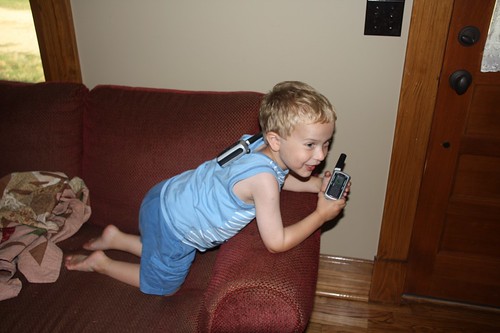
I last wrote about Jacob s new computer back in April. He has had fun with it, but is still a little young to appreciate it a whole lot. It s a fun thing, but not yet a favorite. Yesterday, though, I introduced Jacob to several bits of technology that really got him excited. We have a pair of FRS radios. These are low-power Family Radio Service devices, with a maximum practical range of maybe a mile, and are about as cheap a radio as you can buy that still has any sort of practical use. Anyhow, the receive circuit on one broke. I ordered a pair of TriSquare digital radios to replace them, which are incompatible. So, I have two radios, one with a broken receive circuit. What to do? GIVE THEM TO JACOB! I explained that one radio is the talking radio (the broken one) and the other is the listening radio. Then I demonstrated how I could use the talking radio and he could hear me on the listening radio. That was great fun. I encouraged him to go to the kitchen and see if he could still hear me in the next room. Cackles of laughter gave me the answer. Then he discovered the call button would make the other radio sound like a telephone, which was all the more exciting. He and I took turns with the talking and listening radios. Then I used the belt clip and attached the listening radio to the back of his shirt. I pointed out to him that this was sort of like a loudspeaker. Anything he said into the talking radio while holding town the transmit button would sound louder because it would also come out the radio on his back. Much cackling followed, and he ran around the house yelling MEOW! at the top of his lungs into the radio, then saying, Dad, did you hear THAT? It was VERY loud! He has spent hours listening to himself, listening to me, and generally enjoying life with radios. IMG_4218.JPG Jacob s second discovery was a cassette tape player. Awhile back, Terah rescued an old cassette tape player that was being thrown out, and bought a few 15-cent tapes for Jacob at a thrift store. The idea is that we can just let him play, and not care if he smashes it to bits. He enjoys it, but like the computer, didn t really get excited about it. Until yesterday, when we had this conversation: Me: Jacob, would you like to record your own voice on a tape? Jacob: (excited) Sure! Me: OK, bring me your tape recorder. Jacob: (exasperated) Dad, it s not a tape RECORDER. It s a tape PLAYER. Me: Jacob, it is a tape player, but it s also a tape recorder too. Jacob: (paused for about 5 seconds, then ) Ooooo! That is silly! (scampers off to find it) He found it, and I helped him put some tape over the write-protect tab on a cassette he had. Then he recorded his voice. He eventually figured out the stop, rewind, play, and record buttons with my help. But he s still confused: while he s recording, why doesn t he hear anything? Our first recording had me asking him some questions, and then telling him to press the stop button when he was done. He listened to it dozens of times, and each time my recorded voice asked a question, he answered it a little before his recorded voice did. And each time my recorded voice told him to press the stop button, he would say, I don t want to while his recorded voice asked is this it? He pretty well understands what the radios are about, but doesn t really get the tape recorder yet. Nevertheless, it has just become a far more exciting device in his eyes. Terah has been rolling her eyes at me today as I ve been trying to think up what other broken or old bits of technology we might have that Jacob would enjoy. My latest plan involves adapting his broken old batte
ry-operated fan into some sort of lego-related car. I think he d have fun working on it with me too. All this reminds me of things I did as a kid. My dad worked with a semi-retired man (Herb Miller) that loved to build weird contraptions. One of my favorites was a ball shooter made out of an old vacuum cleaner with a cardboard tube attached to the output spot. I also remember building a motorized car out of an erector set that sort of bent the rules at a school science class project. The idea was to launch a vehicle down a ramp and person whose vehicle went the farthest got a prize. There were no rules against using batteries and a scavenged motor to get that extra little edge over gravity. My car was the only one to manage to crash into the wall on the far side of the gymnasium. The science teacher, in a bit of fast thinking perhaps, announced my car the winner of the electric division. For some reason, I seem to be poised to encourage this sort of thinking in Jacob

22 June 2010

MJ Ray: Budget 2010: take 2 (IT, Co-ops and Community edition)

I ve been watching the June budget and pondering its effects on me, our co-op, co-ops in general and the wider community.
IT Taxes
I just want to flag this one up as a special interest: the telephone tax is killed off before it starts. Yippee! But now we get to wait and see how the government will support private investment to get universal provision of fast broadband. I ve no problem with tax relief for the video games industry being scrapped - why should any type of software get special treatment?
VAT up 2.5% to 20% from 4 January 2011
This seems bad for everyone. It s a bit less bad for our co-op because we have some international suppliers, whose sales tax rates won t change, but we buy a lot from the UK too and it hurts all our workers.
Personal Taxes
The basic income tax allowance rise of 1,000 is welcome, as is restoring the pension-earnings links. More widely, the freezes in various things, increase in Capital Gains Tax and drop in cider tax all seem broadly good ideas. The housing benefit 400 maximum is a bit mixed - how bad it is may depend how lenders react when borrowers get into difficulty.
Business Taxes
At a time when a VAT increase is called unavoidable , it stinks a bit to cut corporation tax, extend the 10% capital gains tax allowance and raise the employers National Insurance threshold. Of course, our co-op pays none of those, so it also hurts us by giving our competitors an advantage.
Business Incentives
George Osborne said he wants to tackle regional economic differences, but the big change in this budget is bad for all existing businesses outside London, the South-East and East: National Insurance exemptions for new businesses. Once again, existing co-ops take it in the neck from another government obsessed with capitalism and employment instead of businesses and work. Meanwhile, increasing the Enterprise Finance Guarantee props up debt-laden business and a new Growth Capital Fund encourages capitalist businesses, while both appear useless to good co-ops at first glance. I don t mind being ignored, but could we please elect a government which doesn t actively hinder co-ops? Where s the fabled commitment to fairness ? Promises around the Green Investment Bank and Green Deal sound good, but are in the future.
Council Tax
Council Tax will be frozen for a year. I wonder if that applies to parish councils, because our village planned a cut after a one-year project-based increase last year. The Budget Document has pretty much no detail.
So, how was it for you? Have I missed some friendly changes?

11 June 2010

MJ Ray: Koha in Book Industry Communication

Our co-op has joined Book Industry Communication as an associate member, mainly in order to voice experiences of the Koha community and ourselves about RFID tag standardisation and related sustainable development. I want us to give the Free and Open Source Software library world and our charity and academic clients more input in developing this big change to libraries. Even so, it wasn t an easy decision to join. I still believe that RFID standards development would be better done in an open forum, but there doesn t seem to be a perfect choice and I don t think we can create one. BIC already has cross-sector support and seems much more open than the so-called RFID Alliance . Pragmatism was enough, this time, and so far BIC seems friendly and welcoming. I see that a larger service provider co-operative, OCLC (UK), is also a member, so hopefully that means it s safe for co-ops. I think most of the readers of this will be free software developers, koha users and/or members of other co-ops. So, I ask you, what do you think of this move? Leave me a comment on our blog or email me if you prefer to keep it private.

4 June 2010

MJ Ray: Talks: RMS Kosovo, MJR Plymouth

RMS will be visiting Kosovo today to speak at the national library. There is no entrance fee, however the number of seats is limited to 250, so please register by writing to register@flossk.org. Less illustriously, MJR will be visiting Plymouth to run a social media surgery as part of Doing business the co-operative way on Friday 25 June (tickets 25 or 75 email now). I ve a few good ideas for what to cover if people are interested but don t have specific questions (and I ll post a few of them here later), but what tip would you give to a new social media user?

1 June 2010

MJ Ray: Hello Oslo, This is Emacs Calling

The Eurovision Song Contest has been and gone with a better-than-usual winner and much of the snarkiness was on microblog sites like identi.ca this year. Search for #ESC, #eurovision or incomprehensibly-to-me #eurovison (no second i is it spelt like that in some language, or can thousands not spell?). Anyway, enough of the title, on with the message I ve been irritated by my linphone SIP internet phone (Skype without lock-in, with standards) taking up my screen space for a while. I ve been meaning to upgrade to one of the recent versions that includes the linphonecsh shell and write some client that only displays windows when it s needed, but I ve been writing programs for work so much that I ve not even found time to write blog posts recently, much less fun code, so that s not happened. So I m quite happy to find linphone.el for my GNU Emacs text editor and find it mostly works. I changed one line at the end to (define-key global-map [menu-bar tools linphone] '("Linphone" . linphone)) to put it on the tools menu, but other than that, it just worked. Well, the Mute doesn t, but that s probably my phone headset being a different ALSA device. I don t care: I use the hardware mute button. In previous times, I would have added the link to the venerable EmacsWiki too, but it has the evil bad wrong Google reCaptcha on the edit page to stop disabled users, so screw it. Google s reCaptcha seems to be spreading again, obstructing more people when accessing more websites. Is there a reason for that? The re in reCaptcha stands for replace with real anti-spam, please! Anyway, now I m controlling phone calls from Emacs. Whatever next? Voice recognition, M-x doctor and a speech synth?

11 May 2010

MJ Ray: TravelWatch SouthWest General Meeting

Weeks ago, I was at a TravelWatchSW meeting in Taunton for Cooperatives-SW. The Chair s theme for the meeting was the journey was going so well, but is there trouble ahead? contemplating cuts due to the debt crisis and possible change of government. Lots of good people were present, so it was quite an illuminating meeting. First, we listened to Dr Gabriel Scally, Director of Public Health for the South West NHS, as he spoke on fat, exercise and transport He s a keen cyclist, so I asked for suggestions of how to get better parking at health centres and hospitals. Sadly, he had no easy answer. One tip: Primary Care Trusts control most money, so they re probably the best ones to persuade. The second keynote address was First Great Western s Projects and Planning Director Matthew Golton. He spoke about railway development, unsurprisingly. Rail is vital for co-operatives in the South West, as it s a greener way to travel the 250 miles length of this peninsula and avoids our poor congested roads. The big news is that class 150s (Sprinters) will replace the Exeter area 142s (Pacers/Railbuses) and there will be grade-seperated junctions at Reading by 2016 to reduce congestion between the various routes that converge at that point. There s bad news on the Intercity Express Programme and HST2 being delayed until after the election, but the original High Speed Train fleet should continue as reliably as ever. After lunch, there were a series of Just a minute comments on topics including: west country commuter services, staffing, Taunton nhs parking, axminster peak times, a TransWilts meeting. Finally before the reports and forum came the third and final keynote from Mike Lambden, head of corporate affairs for National Express Group. He outlined their plans including longer coaches, but asked for better coach stations. One strange mistake had been increasing the leg room on some coaches so much that they got complaints from shorter passengers that they couldn t reach the footrest any more oops! The forum was a scary discussion of rail under-provision planned in our region. Even if we only continue to grow rail use at the last decade s rates, overcrowding will increase. The forum ended with applause for all the hard work done by TWSW and the next meetings will be 9 October 2010 in Taunton, 5 March 2011, 1 October 2011.

10 May 2010

Romain Beauxis: Ubuntu, the firm and its employees

This post is not meant to be offensive in any way. I would just like to write down things that came to my mind recently. It all started when I was considering applying for the right to upload the package I maintain into Ubuntu. Looking at the procedure, I realized that this needs to be present during an IRC meeting at a given date online. This stopped me immediately. I am working most of my day-time and, given the time zone I am living now, this was not an option. But, since I had registered to the corresponding mailing list, I started receiving mails of other applicants that where trying to arrange things with their work and private life to be able to participate. Now, today, I stumbled upon these notes of Mark's presentation in Bruxelles, relayed by a friend that is not either working for Ubuntu. Reading it gave me a strong taste of management-oriented presentation, with all this sort of "yeah we want our product in every box next year" propaganda. Not like Steve Ballmer, fortunately, but not far perhaps. So, yeah, there is something that makes me uncomfortable with Ubuntu. I am really happy by its success and I will continue to recommend it to friends around me. However, I wonder if, in a way, Ubuntu is not a model of commercial company where a minimal core of developers are actually payed, while a second layer of developers are fan-boys that are willing to participate as if there were employees but without being actually payed, and a third layer being the open-source developers whose work is actually what makes 90% of the core of the OS. A very good illustration is at the end of the note from Mark's presentation. It reads:
Somebody asks about advertising Ubuntu, looks like there are no plans for the moment to actually advertise Ubuntu across traditional media. Mark uses the Ubuntu Manual as an example of how Ubuntu gets advertised and will reach the mainstream, Mark points out myself and the room applauds the Ubuntu Manual Project! Woohoo!
Now, guess what:
About Us We are a group of individuals trying to promote the use of Ubuntu and its variants. This is a private web site that is not connected in any official or financial way with Ubuntu, Canonical PL or Ubuntu.com. Official Ubuntu guides and downloads are freely available at www.ubuntu.com. Ubuntu is a registered trademark of Canonical PL
Source: http://ubuntumanual.org/about-us

5 May 2010

MJ Ray: General Election 2010

You may have noticed that the UK votes in a General Election tomorrow. It looks like the closest for at least 18 years and maybe more. Happily, all the major parties are saying nice things about cooperatives, but I wonder how much of that will translate into policies that are practical for co-ops like mine. Our national body Cooperatives UK has gathered the commitments from 18 manifestos and summarised them in a PDF. The first 7 pages deal with the five biggest English parties. One striking thing is how many gaps there are in the Labour, LibDem and UKIP policies, while it s not really clear to me that the Conservatives or LibDems really understand cooperatives. The Conservatives seem to suggest council-controlled co-ops (which wouldn t normally be co-ops if they lack autonomy), while the LibDems mention employee trusts more often than worker co-ops. I m sulking at Labour after several recent schemes that subsidised private competitors and excluded worker co-ops and I don t believe Labour can win in Weston-super-Mare. That would leave the Greens, who probably can t win but do seem to get it, except that there s no Green candidate where I live because he stood aside and recommended the LibDems (as I understand it). Drat. So, only a few hours to go before the start of the ballot and I m still an undecided voter.

4 May 2010

MJ Ray: Day Against DRM, 4 May 2010

Today is the Day Against DRM, working against Digital Restrictions Management or Technological Protection Measures (TPM). I ve two tips to help with our public disservice British Broadcasting Corporation which has consistently failed to act in the public interest and reject DRM:
  1. If you want to link to a BBC radio show like Global Business, you can often get mp3 and avoid Flash-forcing DRM-wannabe iPlayer (and cool toys like get_iplayer) by using BBC Mobile s Podcasts Index.
  2. Satellite TV broadcasts can be captured as MP2 by MythTV or even 50-quid black box home entertainment devices. The DRM-free file can be played back on a computer with mplayer -demuxer +mpegts filename.dvr or re-encoded for other devices with mencoder.
What DRM-avoiding tips would you give?

26 April 2010

Obey Arthur Liu: Welcome to our 2010 Debian Google Summer of Code students!

I d like to extend a warm welcome to our selected students for the 2010 Debian Google Summer of Code! They should pop up on Debian Planet soon and you re welcome to come talk to them on #debian-soc on irc.debian.org Aptitude Qt by Piotr Galiszewski, mentored by Sune Vuorela Qt GUI for aptitude. Currently, KDE users need to use Aptitude via the console interface, or install the newly developed GTK frontend, which does not fit well into KDE desktop. Making Qt frontend to Aptitude would solve this problem and bring an advanced and fully Debian-compliant graphical package manager to KDE. Content-aware Config Files Upgrading by Krzysztof Tyszecki, mentored by Dominique Dumont When a package deliver configuration files, the problem of merging user data with new configuration instructions will arise during package upgrades on users systems. Sometimes merging can be done with 3 way merge, but this process does not insure that the resulting file is correct or even legal. This project intends to create standards, tools an heuristics to make the scary config file conflict resolution debconf prompt a thing of the past. Debbugs Bug Reporting and Manipulation API by David Wendt Jr., mentored by Bastian Venthur Currently debbugs supports a SOAP interface for querying Debian s Bug Tracking System. Unfortunately this operation is read-only. This project would create an API for debbugs which supports sending and manipulating bug reports, without having to resort to email. This project does not intend to replace email as mean to manipulate the BTS but rather to enhance the BTS to allow other means of bug creation and manipulation. Debian High Performance Computing on Clouds by Dominique Belhachemi, mentored by Steffen Moeller The project paves a way to combine the demands in high performance computing with the dynamics of compute clouds with Debian. Combining the Eucalyptus cloud computing infrastructure with the TORQUE resource manager and preparing the components for dynamically added and removed instances provides the user with a attractive high performance computing environment. Such a system allows users to share resources with large compute centers with minimal changes in their workflow and scripts. Debian-Installer on Neo FreeRunner and Handheld Devices by Thibaut Girka, mentored by Gaudenz Steinlin This project aims to improve the installation experience of Debian on handheld devices by replacing ad-hoc install scripts by a full-blown and adapted Debian-Installer. The Neo FreeRunner is used as it is the most convenient and open device from a development standpoint, but other devices will also be explored. Hurd port and de-Linux-ization of Debian-Installer by J r mie Koenig, mentored by Samuel Thibault The primary means of distributing the Hurd is through Debian GNU/Hurd. However, the installation CDs presently use an ancient, non-native installer. The goal of this project is to port the missing parts of Debian-Installer to Hurd. To achieve this, all problematic Linux-specific code in Debian-Installer will be replaced by less or non-kernel dependent code, paving the way for better support of other non-Linux ports of Debian. Multi-Arch support in APT by David Kalnischkies, mentored by Michael Vogt Hardware like 64bit processors are perfectly able to execute 32bit opcode but until now this potentiality is disregard as the infrastructure tools like dpkg and APT are not able to install and/or solve dependencies across multiple architectures. The project therefore focuses on enabling APT to work out good solutions in a MultiArch aware environments without the need of hacky and partly working biarch packages currently in use. Package Repository Analysis and Migration Automation by Ricardo O Donell, mentored by Neil Williams Emdebian uses a filter to select packages from the main Debian repositories that are considered useful to embedded devices, excluding the majority of packages. The results of processing the filter are automated but maintaining the filter list is manual. This project seeks to automate certain elements of the filtering process to cope with specific conditions. This project will also generalize to more elaborate and intelligent algorithms to improve the transitions of the main Debian archives. Smart Upload Server for FTP Master by Petr Jasek, mentored by Joerg Jaspert Making packages upload smarter, more interactive and painless for uploaders by switching from anonymous FTP and Cron jobs to a robust protocol and modern package checking and processing daemon. This daemon would test early and report early, saving developers time. More details coming soon on http://wiki.debian.org/gsoc Congratulations everyone and have a fruitful summer!

23 April 2010

Jonathan McDowell: Out, damn'd PGP v3

Nearly a year ago people starting worrying about the complexity of SHA-1 being reduced and the potential availability of viable attacks against things such as PGP keys that used SHA-1. Many people (myself included) generated a new key, or updated preferences on keys that were otherwise strong enough. There were worries about what this might mean for Debian. We were getting ahead of ourselves a bit though. Firstly there haven't been any public viable attacks that I'm aware of (though of course this doesn't mean we shouldn't continue to migrate away), but secondly there's a much easier method of attack. PGP v3 keys. To quote RFC4880:

V3 keys are deprecated. They contain three weaknesses. First, it is relatively easy to construct a V3 key that has the same Key ID as any other key because the Key ID is simply the low 64 bits of the public modulus. Secondly, because the fingerprint of a V3 key hashes the key material, but not its length, there is an increased opportunity for fingerprint collisions. Third, there are weaknesses in the MD5 hash algorithm that make developers prefer other algorithms. See below for a fuller discussion of Key IDs and fingerprints.
At the time of writing Debian has 21 remaining v3 keys. This is a significant improvement over a year ago, when we had 200, but it's still 21 more than I'd like. I've been chasing people since last May (starting with those who had v3 + v4 keys, all of whom now only have a v4 key) and we're down to the stragglers. So it's time to name and shame, in the hope of kicking them into action. The following keys are what's left (doesn't match the currently active keyring because we've had a few replacements since the last promote):

0x0D2156BD3D97C149 Michael Stone <mstone>
0x225FD911CD269B31 Carlos Barros <cbf>
0x31E73F14E298966D James R. Van Zandt <jrv>
0x366CD3FEEBC11B01 Chris Waters <xtifr>
0x37A73FE355E8BC4D Frederic Lepied <lepied>
0x3E973117DCC528E9 Ardo van Rangelrooij <ardo>
0x5C7A46637953F711 Rich Sahlender <rsahlen>
0x5D6560F85F30F005 Craig Brozefsky <craig>
0x6B0E322836129171 Jim Westveer <jwest>
0x723724B4A5B6DD31 Christian Meder <meder>
0x7629B22ED71DAABD Adrian Bridgett <bridgett>
0x8FFC405EFD5A67CD Adam Di Carlo <aph>
0xB0D269DE17F3D4D1 Matthew Vernon <matthew>
0xBC151FC8D2A913A1 Peter S Galbraith <psg>
0xC1A0A171C2DCD3B1 Jim Mintha <jmintha>
0xC3168EBA23F5ADDB Ian Jackson <iwj>
0xCE951B1160D74C7D Patrick Cole <ltd>
0xE82A8B0D57137FE5 Paul Seelig <pseelig>
0xF20E242CE77AC835 Brian White <bcwhite>
0xFBAA570C3087194D Alan Bain <afrb2>
0xFFD1B4AC7C19FD19 David Engel <david>

Of these keys only 2 voted in the recent DPL election. 8 have failed to make any response to my mails (3 since last August). Only 9 have uploaded a package since August 2008. And 10 were already known to the MIA database. Some of them have stated they'll sort out a new key, but not yet done so.

If you are one of these people, please either get a new key sorted and signed and reply to the mails I've sent you, or reply and say you no longer wish to be involved in Debian. And if you know any of these people, encourage them to get a new key sorted and offer to sign it for them.

19 April 2010

MJ Ray: Samsung N150 Netbook and Ubuntu Netbook Remix

That was a pretty good weekend. I set up someone s new Samsung N150 netbook with Ubuntu Netbook Remix. If you like Windows, you might want to skip this long paragraph: the N150 came with Microsoft Windows 7 Starter. When I realised what that was, I thought it was some sort of joke. It s more like an advert for Windows than a proper operating system. They even removed the option to replace the branded backdrop image, which gives you an idea of the pettiness of that distribution. I read that Win7 Starter used to have a 3 simultaneous application limit but an update removed it because of the sheer volume of complaints and rumblings about court cases to get money back. Microsoft justify all the limits with the argument that it s optimised for low-power netbooks, but the N150 goes like stink compared to my own (7-year-old) work laptop and how much power is saved by loading the Windows logo backdrop instead of a nice picture anyway? What did that make me want to do? Well this:
Windows 7 Sins But I d read that Samsung view nuking Win7 Starter from orbit as voiding the warranty and I couldn t see anything to confirm or reject that in the paperwork, so I made it dual-boot with Ubuntu netbook remix. If it ever has to go back to the shop, I ll hide the boot menu. I had enough trouble installing it that I did contemplate get.debian.net with some of the Debian Eee PC things, but I wasn t sure what I needed and I didn t have that much time. There were two big gotchas when installing:
  1. When you switch between Ubuntu and Windows, it won t boot the first time. Second and subsequent boots are fine, but the first one just reboots immediately. I suspect this would be the same for all GNU/Linux distributions.
  2. I didn t realise that the current ndisgtk (or the underlying ndiswrapper?) couldn t use Win7 drivers. Once I downloaded some XP drivers, it worked. There are some native drivers for the rtl8192 but I didn t have time to go compiling on it yet.
After figuring those out, Ubuntu seems to work fine. Better than the Windows. I got particularly appreciative comments about the large clickable spaces on the launcher that netbook remix uses (which is what I d expect from Fitts s Law). Debian probably has a similar launcher, but I don t know what it s called yet. It looks like some Gnome window or file manager and I m a GNUstep throwback. Setting up the mobile phone for internet access was also a breeze. It s a later model than my old k608i, so it supports PANU, so after the Bluetooth pairing, it appeared in the networking menu on the top panel bar and it just worked. On Sunday, I cycled to Clevedon (7 miles away as the crow flies, but 12 by bike because of a missing river crossing). Pretty good weekend.

15 April 2010

MJ Ray: Debian Project Leader Election Campaign Round-up

I ve been AWOL for most of the debian project leader election campaigns this year, but I still want to vote, so I ve been dredging the emails on the last day. Maybe someone still has to vote and reads this, or maybe it ll help someone to interpret the result. What I ve done this year is to make a quick tally of platform points and campaign answers that I liked and disliked for each candidate, then total them up to get an order. If anyone gets a negative (more dislikes than likes), then I ll rank them below NOTA. Platforms: Margarita Manterola, Stefano Zacchiroli, Wouter Verhelst, Charles Plessy. Some of the questions: Make of that what you will. It surprised me which way the scores came out, but there was one answer with such a massive problem (in my opinion) that I ranked its giver equal with the next candidate down anyway. If you re a debian developer (DD), have you voted yet?

Next.

Previous.