Search Results: "joey"

17 February 2012

Joey Hess: addicted to $

One of the weird historical accidents of programming languages is that so many of them use $ for important things. The reason is just that out of the available punctuation, nearly all of it has a mathmatical or other predefined use that makes sense to retain in a programming language context, while $ (and also @ and #) do not. Still, $ annoys me, it's so asymetric that we use it all over our code, and never a or to be seen. The one language that manages to use $ nicely, IMHO, is Haskell. Recently I noticed that it has an actual visual mnemonic in its use of $. And it's used for something I've not seen in other languages. The visual mnemonic of $ is that it looks like an opening parenthesis, with the related closing parenthesis on a line below it.
(something (that
    (lisp folks
        (are (very (familiar with)))
    )
))
And this is also the problem that $ solves:
something $ that $
    haskell folks $
        are $ very $ familiar with
This is a trivial feature.. but oh so useful. The implementation in Haskell of $ is simply:
f $ x = f x
infixr 0 $
Just function application, but at a different precedence than usual. I am now very addicted to my $. Out of 15 thousand lines of code, only 87 contain )), while 10% use $.

3 February 2012

Joey Hess: more on ghc filename encodings

My last post missed an important thing about GHC 7.4's handling of encodings for FileName. It can in fact be safe to use FilePath to write a command like rm. This is because GHC internally uses a special encoding for FilePath data, that is documented to allow "arbitrary undecodable bytes to be round-tripped through it". (It seems to do this by encoding the undecodable bytes as very high unicode code points.) So, when presented with a filename that cannot be decoded using utf-8 (or whatever the system encoding is), it still handles it, and using the resulting FilePath will in fact operate on the right file. Whew! Moral of the story is that if you're going to be using GHC 7.4 to read or write filenames from a pipe, or a file, you need to arrange for the Handle you're reading or writing to use this special encoding too. I use this to set up my Handles:
import System.IO
import GHC.IO.Encoding
import GHC.IO.Handle
fileEncoding :: Handle -> IO ()
fileEncoding h = hSetEncoding h =<< getFileSystemEncoding
Even if you're only going to write a FilePath to stdout, you need to do this. Otherwise, your program will crash on some filenames! This doesn't seem quite right to me, but I hesitate to file a bug report. (And this is not a new problem in GHC anyway.) If I did, it would have this testcase:
# touch "me "
# LANG=C ghc
Prelude> :m System.Directory
Prelude System.Directory> mapM_ putStrLn =<< getDirectoryContents "."
me*** Exception: <stdout>: hPutChar: invalid argument (invalid character)
Since git-annex reads lots of filenames from git commands and other places, I had to deal with this extensively. Unfortunatly I have not found a way to read Text from a Handle using the fileSystemEncoding. So I'm stuck with slow Strings. But, it does seem to work now.
PS: I found a bug in GHC 7.4 today where one of those famous Haskell immutable values seems to get well, mutated. Specifically a [FilePath] that is non-empty at the top of a function ends up empty at the bottom. Unless IO is done involving it at the top. Really. Hope to develop a test case soon. Happily, the code that triggered it did so while working around a bug in GHC that is fixed in 7.4. Language bugs.. gotta love em.

2 February 2012

Joey Hess: unicode ate my homework

I've just spent several days trying to adapt git-annex to changes in ghc 7.4's handling of unicode in filenames. And by spent, I mean, time withdrawn from the bank, and frittered away. In kindergarten, the top of the classrom wall was encircled by the aA bB cC of the alphabet. I'll bet they still put that up on the walls. And all the kids who grow up to become involved with computers learn that was a lie. The alphabet doesn't stop at zZ. It wouldn't all fit on a wall anymore. So we're in a transition period, where we've all learnt deeply the alphabet, but the reality is much more complicated. And the collision between that intuitive sense of the world and the real world makes things more complicated still. And so, until we get much farther along in this transition period, you have to be very lucky indeed to not have wasted time dealing with that complexity, or at least having encountered Mojibake. Most of the pain centers around programming languages, and libraries, which are all at different stages of the transition from ascii and other legacy encodings to unicode. My most recent pain is because the haskell GHC compiler is moving along in the transition, getting closer to the end. Or at least finishing the second 80% and moving into the third 80%. (This is not a quick transition..) The change involves filename encodings, a situation that, at least on unix systems, is a vast mess of its own. Any filename, anywhere, can be in any encoding, and there's no way to know what's the right one, if you dislike guessing. Haskell folk like strongly typed stuff, so this ambiguity about what type of data is contained in a FilePath type was surely anathama. So GHC is changing to always use UTF-8 for operations on FilePath. (Or whatever the system encoding is set to, but let's just assume it's UTF-8.) Which is great and all, unless you need to write a Haskell program that can deal with arbitrary files. Let's say you want to delete a file. Just a simple rm. Now there are two problems:
  1. The input filename is assumed to be in the system encoding aka unicode. What if it cannot be validly interpreted in that encoding? Probably your rm throws an exception.
  2. Once the FilePath is loaded, it's been decoded to unicode characters. In order to call unlink, these have to be re-encoded to get a filename. Will that be the same bytes as the input filename and the filename on disk? Possibly not, and then the rm will delete the wrong thing, or fail.
But haskell people are smart, so they thought of this problem, and provided a separate type that can deal with it. RawFilePath hearks back to kindergarten; the filename is simply a series of bytes with no encoding. Which means it cannot be converted to a FilePath without encountering the above problems. But does let you write a safe rm in ghc 7.4. So I set out to make something more complicated than a rm, that still needs to deal with arbitrary filename encodings. And I soon saw it would be problimatic. Because the things ghc can do with RawFilePaths are limited. It can't even split the directory from the filename. We often do need to manipulate filenames in such ways, even if we don't know their encoding, when we're doing something more complicated than rm. If you use a library that does anything useful with FilePath, it's not available for RawFilePath. If you used standard haskell stuff like readFile and writeFile, it's not available for RawFilePath either. Enjoy your low-level POSIX interface! So, I went lowlevel, and wrote my own RawFilePath versions of pretty much all of System.FilePath, and System.Directory, and parts of MissingH and other libraries. (And noticed that I can understand all this Haskell code.. yay!) And I got it close enough to working that, I'm sure, if I wanted to chase type errors for a week, I could get git-annex, with ghc 7.4, to fully work on any encoding of filenames. But, now I'm left wondering what to do, because all this work is regressive; it's swimming against the tide of the transition. GHC's change is certainly the right change to make for most programs, that are not like rm. And so most programs and libraries won't use RawFilePath. This risks leaving a program that does a fish out of water. At this point, I'm inclined to make git-annex support only unicode (or the system encoding). That's easy. And maybe have a branch that uses RawFilePath, in a hackish and type-unsafe way, with no guarantees of correctness, for those who really need it.
Previously: unicode eye chart wanted on a bumper sticker abc boxes unpacking boxes

26 January 2012

Joey Hess: announcing github-backup

Partly as a followup to a Github survey, and partly because I had a free evening and the need to write more haskell code, any haskell code, I present to you, github-backup. github-backup is a simple tool you run in a git repository you cloned from Github. It backs up everything Github knows about the repository, including other forks, issues, comments, milestones, pull requests, and watchers. This is all stored in the repository, as regular files, on a "github" branch. Available in Cabal now, in Debian maybe if someone packages haskell-github.

21 January 2012

Joey Hess: olduse.net 1982

Hard to believe I've consumed all of 1981's Usenet posts now on olduse.net, and it's been running for 7 months already.
Last night, there was a "very long" post, describing nearly every node on usenet in 1982. There had been a warning about this post the day before, since it would take many sites half an hour to download at 300 baud. It was handily formatted as a shell script, which created per-node files. So, I ran this code nobody has run since 1982. It worked. I got files. I tossed them on the olduse.net wiki, and used some ikiwiki code TOVA contracted me to write just a few months ago, to make clickable links on my usenet map. usenet map The map data was contributed in another post a while back. By 1982, usenet is getting nearly impossible to map with 1982 technology of ascii art. I enjoyed throwing graphviz, git, wikis, and the web at it. So, we have a collaboration across time, me and "Mark" and a lot of people who described their usenet nodes and piles of technology that make creating a mashup easy. Awesome!
I blog about stuff I find on the olduse.net blog. It's an open blog; Koldfront also blogs there, and we welcome other bloggers. Some of the highlights for me have included: As the space shuttle program is winding down, reading the excitement about the first shuttle flights, and the play-by-play coverage of a launch, posted to net.columbia by a high school student borrowing his dad's account. (A usegroup name that's hard to read without remembering its fate). The announcements of the Motorola M68k, the IBM PC, and the CD-ROM. world ipv6 launch Reading the TCP-IP digest, and Postel's plans for launching IPv4 soon, while the world IPv6 launch is being planned now. (The nay-sayers are especially fun to read. Including the guy who was concerned about the address space size, in 1981!) Learning that nethack ascention tales have a history streching back 30 years, to rogue, and that the stories back then had much the same flavor as they do today. Various celebrity sightings. Dennis Ritchie teaching C and Unix. Bill Joy talking vi. RMS talking .. nuclear politics? The general development of usenet. B-news being rolled out, groups proliferating, many first inklings of what will be major problems and developments in 5 or 10 years. A shift in tone is already apparent, by now usenet is not only about announcements, there are already some flames. oldusenet in a period terminal Still 9 years to go!

16 January 2012

Rapha&#235;l Hertzog: Review of my Debian related goals for 2011

Last year I shared my Debian related goals for 2011 . I tend to put more goals than what I can reasonably complete alone and this year was no exception. Let s have a look.
  1. Translate my Debian book into English: PARTLY DONE
    It took more time than expected to prepare and to run the fundraising campaign but it has been successful and the translation is happening right now.
  2. Finish multiarch support in dpkg: DONE BUT NOT ENTIRELY MERGED YET
    Yes, multiarch support was already in the pipe last year in January. I completed the development between January and April (it was sponsored by Linaro) and since then it has mostly been waiting on Guillem to review it, tweak it, and integrate it.
  3. Make deb files use XZ compression by default: TRIED BUT ABANDONED
    After discussing the issue with Colin Watson and Joey Hess during debconf, I came to the conclusion that it was not really desirable at this point. The objections were that debian-installer was not ready for it and that it adds a new dependency on xz for debootstrap to work on non-Debian systems. I believe that the debian-installer side is no longer a problem since unxz is built in busybox-udeb (since version 1:1.19.3-2). For the other side, there s not much to do except ensuring that xz is portable to all the other OS we care about. DAK has been updated too (see #556407).
  4. Be more reactive to review/merge dpkg patches: PARTLY DONE
    I don t think we had any patch that received zero input. We still have a backlog of patches, and the situation is far from ideal but the situation improved.
  5. Implement the rolling distribution proposed as part of the CUT project and try to improve the release process: NOT DONE
    We had a BoF during debconf, we discussed it at length on debian-devel, but in the end we did nothing out of it. Except Josselin Mouette who wrote a proof of concept for his idea. For me testing is already what people are expecting from a rolling distribution. It s just a matter of documenting how to effectively use testing, and of some marketing by defining rolling as alias to testing.
  6. Work more regularly on the developers-reference: PARTLY DONE
    I did contribute some new material to the document but not as much as I could have hoped. On the other hand, I have been rather reactive to ensure that sane patches got merged. We need more people writing new parts and updating the existing content.
  7. Write a 10-lesson course called Smart Package Management : NOT DONE
  8. Create an information product (most likely an ebook or an online training) and sell it on my blog: NOT DONE
    This was supposed to happen after the translation of the Debian Administrator s Handbook. Since the translation is not yet over, I did not start to work on this yet.
  9. By the end of the year, have at least 1/3 of my time funded by donations and/or earnings of my information products: NOT REACHED
    My target was rather aggressive with 700 each month, and given that I did not manage to complete any information product, I m already very pleased to have achieved a mean amount of 204 of donations each month (min: 91 , max: 364 ). It s more than two times better than in 2010. Thank you! Note that those figures do not take into account the revenues of the fundraising of the Debian Administrator s Handbook since they will be used for its translation.
That makes quite a lot of red (for things that I did not achieve) on the other hand I completed projects that I did not foresee and did not plan. For instance improving dpkg-buildflags and then merging Kees Cook work on hardened build flags was an important step for Debian. This was waiting for so long already

2 comments Liked this article? Click here. My blog is Flattr-enabled.

Joey Hess: version numbers

Today I released two entirely different pieces of software with the identical version number 3.20120115. Debian developers also will be soon noticing a piece of software I released with the version number 9.20120115. I expect to move more of my software to this version number scheme over time, unless I find something badly wrong with it. It reflects how I think about versions for my software; there's a kind of continual "now" that development progresses through, in which individual releases have little discrete meaning and at the same time, there can also be significant discontinuities, that require the user to do something to deal with (such as a new debhelper compat version, or a new git-annex repository format). Those two things are really all that I need a version number for my software to communicate. I can do without the rest of the things that version numbers are used for: There is so much software, with so many version numbers that any signal encoded in such version numbers is swamped in the noise. Even on projects that I develop a version number like 2.88 is meaningless to me. All I care about is, how long ago was that version? Has there been a major change breaking compatibility since that version? "2.88" doesn't answer these questions well; "3.20111111" does. It is a little wordy to have the full year in there, and it can be annoying to remember to set the version to the right date on release day (TODO: automate). This is balanced with the version not being so wordy as to include the time of day, which means I might have to do a 3.20120115.1 if I goof up. These minor problems are worth it to instantly know how old a version is when a user pastes it into a bug report. And that is probably all I will ever have to say about version numbers. :)

13 January 2012

Rapha&#235;l Hertzog: People Behind Debian: Steve McIntyre, debian-cd maintainer, former Debian Project Leader

Steve McIntyre has been contributing to Debian since 1996, 2 years before I joined! But I quickly stumbled upon Steve: in 1999, he was struggling with getting his debian-cd script to produce 2 ISO images (it was the first time that Debian did no longer fit on a single CD), I helped him by rewriting debian-cd with a robust system to split packages on as many ISO images as required. I remember those times very well because Steve was very supportive of my efforts and it was a real pleasure to get this done. His friendly nature probably also explains why he got elected Debian Project Leader twice! Anyway, enough history, check out his interview to learn more about the great work he s doing nowadays. My questions are in bold, the rest is by Steve. Raphael: Who are you? Steve: I m a professional software engineer, 37, living in Cambridge (England) with my new wife Jo. I studied for the EIST degree at the University of Cambridge, then (like many people here, it seems) I just forgot to go home again afterwards and settled here. I spent more of my study time playing with Linux than working on my degree, so I guess I m lucky that it worked and I found a career in that area! Raphael: How did you start contributing to Debian? Steve: During my time in college, I started hacking on software in my free time, using Slackware as my first Linux distribution from the middle of 1994. After encountering more and more problems with Slackware, I was encouraged by a number of friends to make the jump over to Debian and in October 1996 I did. The installation process back then was much harder than anything people see today, but after a long weekend I finally had my Debian system up and running. I was already one of the main upstream developers for the Mikmod music player at that time, so that very same weekend I applied to be a DD so I could maintain it in Debian too. Back then, the NM process was much simpler: I just mailed a key to Bruce and he set me up with an account almost immediately! I then found that Joey Hess had beaten me to it and already packaged Mikmod. Grrr! :-) Raphael: What s your biggest achievement within Debian? Steve: Without a doubt, my proudest achievement within Debian is being elected Project Leader for 2 years by the other developers. It s a great feeling to have earned the trust of your friends and peers, and also a great responsibility to go and help Debian where needed: talking to the press about Debian, assisting wherever problems crop up, etc. The DPL job is certainly a lot of hard work, and I have nothing but respect for anybody who volunteers for it.
It s a great feeling to have earned the trust of your friends and peers.
Elsewhere, I ve been leading the Debian CD team for years too, both doing most of the maintenance of the debian-cd package and producing and testing the regular installation CDs and DVDs that we ship to the world. Again, this is a time-consuming job but it needs doing and it s worthwhile. Raphael: You re currently employed by ARM. What are you working on and are they supportive of your Debian involvement? Steve: The situation within ARM is very interesting; I m employed in PDSW (Processor Division, SoftWare), a new group founded just a couple of years back to help improve the state of software on ARM. Most of the people in the group are working on Free Software at this stage (e.g. toolchains, browsers, Linux kernel), which is lovely. Some of the engineers have also been seconded into a new non-profit company Linaro, which is a collaboration between ARM and a number of other companies investing in core Linux software and tools for ARM-based CPUs. I m one of the ARM engineers in Linaro, and I m a Technical Architect in the Office of the CTO. My role includes looking at future projects for Linaro to help with (e.g. ARM servers), but for the last few months I ve been concentrating on the new armhf architecture in Debian, Ubuntu and elsewhere. armhf is a new architecture in Debian and Ubuntu terms, but it s not strictly a new type of hardware. Instead, it s a new ABI. We have two reasons for doing this work:
  1. It targets the latest version of 32-bit ARM CPUs (v7) and makes better use of the hardware, for better performance. Compare targetting i686 instead of i386, for example. We ll still support the older armel port for the foreseeable future for users with older hardware that can t run armhf.
  2. More importantly: we are standardising on the ABI / compiler options / hardware support for future users.
In the past, there has been a huge amount of specialisation (aka fragmentation) in the ARM Linux environment, and that worked OK for specialised devices that only ever ran the software shipped with them. ARM CPUs are now becoming more and more mainstream, so people will expect to be able to install generic software on their machines. That gives a requirement for a standard base platform, and armhf (arm-linux-gnueabihf in GNU triplet terms) is that standard that we are pushing in the community. Debian, Ubuntu, Fedora, Suse and others are all going to use this, making compatibility possible. I ve been working with a small team of people to make armhf happen, helping where needed: putting together build machines; patching Debian packages directly; discussing and fixing toolchain issues with Ubuntu folks; agreeing ABI specifications with people from Fedora; advising people from other distros bootstrapping their new ARM ports. ARM and Linaro are very supportive of this work, and it s been lovely being sponsored to work directly on Free Software like this. It s work that will directly benefit ARM and its partners (of course!), but it s also helping out more generally too: Debian QA work, cross-build support, bootstrapping efforts, multi-arch. More and more of the ARM market is driven by Free Software, and companies are acknowledging that. I should probably also mention that we re hiring ! :-) Raphael: What are your plans for Debian Wheezy? Steve: There are three main tracks here. Obviously, I m interested in seeing armhf release with Wheezy. We ve just been added to Testing last weekend, so that s going well. We ve got over 90% of the archive built now, and we re mopping up the remaining issues. I m the primary maintainer of cdrkit at this point, but I d prefer to have it go away. Xorriso and the associated software in libisoburn is almost capable of replacing all the aging cdrtools-derived software that we have in Debian, The only missing feature that I m aware of is creating the HFS hybrid filesystems that we use for installations on Mac systems. I ve been talking with the upstream folks about this for some time already, and I m hoping we can finish this soon enough that we can get it into Wheezy. Finally, I ve got the ever-growing wishlist of things for debian-cd. We ve got the beginnings of an automated test suite that Mart n Ferrari has written, but it needs integrating and improving. I want to help get regular weekly/daily/release debian-live builds running on the main CD build machine. There s work needed if we want to make good installation media for the new multi-arch world, too. The Emdebian people are asking for help making CD images The list goes on :-) Raphael: The ARM community seems to be very interested in multi-arch. Can you explain why? Steve: There are a number of reasons for ARM people to be interested in multi-arch; two really stand out for me:
This is potentially the killer app for multi-arch: simply install the libraries for the target architecture [ ], install a simple cross-gcc package [ ] and you re all set.
Raphael: What s the biggest problem of Debian? Steve: For me, Debian s biggest problem has been the same for a long time: we are forever short of enough people to do the work that we re trying to do. That might sound like a weird thing to claim when Debian is one of the largest Free Software projects on the planet, but it s more a statement of just how huge our goals are. Many of the largest things in Debian are developed or controlled by very small teams working very hard, and there s always a risk of losing people due to burnout in those situations.
We are forever short of enough people to do the work that we re trying to do.
Some of the tasks that should be easy given our large membership (e.g. large-scale packaging transitions) can often instead take a very long time. We are fortunate to have more people wanting to join in Debian s work all the time, but we also need to be careful to keep on promoting what we re doing and recruiting new contributors, encouraging them to get more and more involved in core work. Debian gets ever bigger in terms of the size and the number of packages we distribute; we re not currently matching that growth rate elsewhere. Raphael: What motivates you to continue to contribute year after year? Steve: This one is much easier to answer! The thing that first attracted me to Debian was the fact that I could help to develop it, help to decide how things could and should be done within it. Instead of being forced to accept what some corporation decided I could do with my computer, I could change the software to suit my needs and preferences. Alongside that, I could get involved with a strong community of similar people all over the world, all with their own strong opinions about how software should work. I joined in and found it was great fun and very rewarding. That hasn t changed for me in the intervening years, and that s why I m still around. I work on Debian because it helps me to get the OS that I want to use. It seems that lots of people around the world find it useful too, and that s awesome. :-) Raphael: Do you believe that Stefano Zacchiroli will be the first DPL who managed to stay 3 consecutive years on the seat? Would you like him to candidate again? Steve: To be honest, I would be very surprised if Zack stood again for DPL this year. He told me himself that he wasn t planning on it, and I can understand that decision. He s been an awesome DPL in my opinion, and I m glad that he took the job. But: it is also a very difficult and time-consuming task that would be enough to wear down anybody. If Zack does decide to stand again, I would support him 100%. But I know that we also have lots of other good people in Debian who would be ready to take up the challenge next. Raphael: Is there someone in Debian that you admire for their contributions? Steve: There are lots of people I admire in Debian, so many so that I almost don t want to list individuals here for fear of missing people out. But :-) Bdale Garbee has been an inspiration to many of us, for many years. He s technically excellent, a great friend to many of us, an endless source of sage advice and (last but not least) he has some wonderful stories to tell about his experiences over the years. On top of that, he s just cool. :-) Christian Perrier is another exceptional developer, in my eyes he s great at co-ordinating people in translations, working tirelessly to make this very important part of Debian work better and better with every release. He s also a really nice guy and we all love him. I also have to mention Joey Hess here, whether he likes it or not. *grin* He s been responsible for so many good things in Debian over the years, even if he did steal my first package Finally, the teams of people who make sure that Debian is always working: the security team and DSA. The rest of us can choose to take time off from Debian to go and do other things, but these people need to cover things every day. That s a major responsibility, and I salute them for taking on that challenge.
Thank you to Steve for the time spent answering my questions. I hope you enjoyed reading his answers as I did. Note that you can find older interviews on http://wiki.debian.org/PeopleBehindDebian.

Subscribe to my newsletter to get my monthly summary of the Debian/Ubuntu news and to not miss further interviews. You can also follow along on Identi.ca, Google+, Twitter and Facebook.

One comment Liked this article? Click here. My blog is Flattr-enabled.

2 January 2012

Maximilian Attems: CPhT visit automn 2011

On my new particle physics blog (yupie to ikiwiki, thanks joey) posted some recollection of a fine, productive and busy Paris research visit to the Ecole Polytechnique. The feed agregegator for particle physics blogs got relaunched too that automn. In case you are interested in particle physics this should keep any reader updated on the Higgs hunt, black holes searches, fundamental interactions and much more.

1 January 2012

Joey Hess: a resolution that stuck

Last year, my new year's resolution was to write in my journal every day. That actually stuck, I wrote 262 journal entries in 2011. While I've been keeping a journal intermittently since 1998, last year I doubled the number of entries in it. And wrote a novel's worth of entries -- 53 thousand words! Most of it is of course banal and mundane stuff. Not good compared with Lars, who does something with his journal where he goes into some detail about code he's working on, and other work. The excerpts I've seen are quite nice. But after I've written code, written a commit message, documentation, perhaps bug reports etc, I often can't find much to say about it in my journal, beyond the bare bones that I worked on $foo today or faced a particularly hard bug. I also worry that the journal, and my reluctance to repeat myself, often tips the balance away from me blogging, if I write down something in the journal first.
Here's my journal for today:
Compare what jokes are funny now with those in 1982. The 1982 ones from net.jokes on olduse.net seem juvenile. Now compare what Unix joke man pages are funny now with those I'm reading from 1982. They seem basically the same. What would Biella make of this? Liw noticed ikiwiki OOM on pell. Tracked down to a perl markdown bug with long lines. Had quite enough of perl markdown; ikiwiki will be moving to a different engine. Added discount support to it today, still needs Debian package tho. [censored] Really gorgeous sunset, with a high wind, moon, puffy low, fast moving clouds. Enjoyed it ecstaticly. It's going to get cold soon. Very rainy early, but then got intermittently sunny; power is holding out ok. Was going to roast a chicken today, but got distracted and had a large lunch besides. Need to find some quick food for supper. I need to start a new book, should it be the River Cottage book about meat that I stole from Anna, or some SF? Blogged about journaling, and put this journal entry in it, so also journaled about blogging. Wrote it somewhat self-conciously.

The benefits for me have ranged from being able to go back and work out dates of events, to forwarding the odd excerpts to others. The best thing though is certianly having a regular time of introspection, to look back over my the day. If you've not got a new year's resolution yet, I recommend this one. (Learning Haskell would be another good one, if you haven't yet.) Just write something, anything, down in your journal every day.

31 December 2011

Joey Hess: solar year

I've been at the cabin, on solar power, for a year now. I have a year of data! Everything went pretty well until last month. There was an April rainy spell where power felt slightly tight. Then over the summer, plenty of power, no need to conserve. The last month though had what seemed like weeks of continual grey clouds, where I never saw the sun.
high noon today
Of course, even on a sunny day in winter, it does not get far above the hills, and the peak production window is only a few hours. This bad combination had my battery power dipping below the 10 volts that I consider low, down to 9, and even to 8 volts. I use kerosine lamps in the winter. (I prefer the light anway.) I've also started unplugging my Thecus server at night to conserve power, meaning no internet late or early. For four or so nights, I had no power to run even my laptop after sunset. On one notable day, there was no power even in the daytime. Even when it turned sunny again, I found that the batteries would seem to charge to 12 volts during the day, but then precipitously drop to 10 and 9 volts at night. I think the problem was not damaged batteries, but that these Nicads charge most efficiently above 12 volts (14 volts is best), and there was never enough power saved up to get them full enough that they could charge really efficiently. So, I reluctantly spent three days away this week, to let the batteries soak up sun and recover. It seems to have worked; they've been holding a 12 volt charge overnight again.

27 December 2011

Joey Hess: a Github survey

The great thing about git and other distributed version control systems is that once you clone (or fork) a repository, you have all the data. You don't have to trust that Github will preserve it; everyone who develops the project is a backup. Github carries this principle quite far amoung the features they provide. But not all the way. Today I have surveyed their features, and where the data for each is stored. The two that really stand out are the issues and notes not being stored in git. This means that, if a project uses github, it gets locked into github to a degree. The records of bugs and features, all the planning, and communication, is locked away in a database where it cannot be cloned, where every developer is not a backup. Github's intent here is not to control this data to lock you in (to the extent they want to lock you in, they do that by providing a proprietary UI that people rave about); it was probably only expedient to use some sort of database, rather than git, when implementing these features. They should automatically produce git repository branches containing a project's issues, and notes, based on the contents of their database. (For notes, git notes is the obviously right storage location.) Along with ensuring every developer checkout is a backup, this would allow accessing that data while offline, which is one of the reasons we use distributed version control. The lack of a global list of projects is problimatic in a more global sense. It means that we can't make a backup of all the (public) repositories in Github (assuming that we had the bandwidth and storage to do it). I recently backed up all the repositories on Berlios.de, when it looked to be shutting down; this was only possible because they allowed enumerating them all. People at The Internet Archive say that their archival coverage of free software is actually quite bad. We trust our version control systems to save our free software data, but while this works individually, it will result in data loss globally over time. I'd encourage Github to help the Internet Archive improve their collections by donating periodic snapshots of their public git repositories to the Archive. You're located in the same city, 5 miles apart; they have lots of hard drives (though less right now during the shortage than usual); this should be pretty easy to do.
Full disclosure: Github has bought me dinner and seemed like stand-up guys to me.

9 December 2011

Christian Perrier: 10 years being Debian Developer - part 5: being a newbie DD...and working on l10n

I left you 2.5 months ago with the last question asked by my applicaiton manager, Martin Michlmayr : "Please tell me about about yourself and what you intend to do for Debian". Interesting question to revisit now, indeed. Here is what I answered: About myself first. I'm a 40 year old project manager and system administrator working in French National Aerospace Research Center. My best definition of my skills in computing is "Know more or less about a Lot of Things and be a Specialist of Nothing"...:-). I'm definitely not a programmer, nor a real system administrator, nor a RDBMS administrator, nor a personal workstation designer, though I do all of these daily. I think I'm perfect for finding the good person for having a defined job done. Besides this, I'm a genealogist for several years now. This is what finally decided me to apply for becoming a package maintainer : there are some quite good free genealogy software for Unix, though for various reasons they are not used very widely, even Unix geeks (my main software for genealogy still runs on Another Operatin System and is evertythig but free).I think that I can bring something here to the Free Software World, by helping some of these good programs in getting into the best Linux distribution I know.... For me, this is a mean for giving back to the free software movement what I gives to me since I discovered Linux 6-7 years ago. My very first intention as soon as I get my way into the Debian Developers Heaven is adopting the Geneweb package currently maintained by Brent Flugham. I'm in close contact with the author (who happens to be french, which helps) as well as a daily user of it. The current package which is in the distribution is already my work for a great part. I gave it to Brent, the current maintainer and we both agreed that it would be better for me to apply to becoming anofficial maintainer. I also contributed to the package for lifelines, another genealogy software. The last version of the package is also 80% my work, acknowledged by Javier, the official maintainer. Concerning that package, I do not have "plans" for adopting it (we didn't discussed of this with Javier, and I'm not sure I could bring him that much things). I came to Linux thanks to a great friend of mine, Ren Cougnenc. Ren opened my eyes to the free software world when I still thought that it was only a variant of free beers. I got really involved into Linux when I forced me to remove any other Operating System from my computer at work and tried to do my daily job with Linux. I have now succeeded at ONERA in getting free software to be accepted as a credible alternative for important projects. At this time, especially for server and network-related projects. I absolutely cannot tell why and how I came to be a Debian user. I simply don't remember. But I know why I am still a Debian user : this is a distribution which is controlled by only one organisation--->its users. And I want to be part of it. Finally, I did not mention above the somewhat "political" nature of my personal involvment into free software. Except for the physical appearence, I think I mimic RMS on several points (though he probably speaks better french than I try to speak english....which does not help for expressing complex ideas like the ones above!). As anyone can see, I was already very verbose when writing, sorry for this. Funnily Martin summed this up in one paragraph when he posted his AM report about my application. From what I see, also, my English didn't improve that much since then. It seems this is a desperatecause, I'm afraid. Anyway, all this was apparently OK for Martin and, on July 21st 2001, he wrote and posted his AM report and, on July 30th 2001, I got a mail by James Troup: An account has been created for you on developer-accessible machines with username 'bubulle'. bubulle@debian.org was born. Now I can more easily destro^W contribute to my favourite Linux distro. Indeed, I don't remember that much about the 2001-2003 years. I was probably not that active in Debian. Mostly, I was maintaining geneweb, for which I polished the package to have it reach a quite decent state, with elaborated debconf configuration. Indeed, at that time, I was still also deeply involved in genealogy research and still contributing to several mutual help groups for this. This is about the time where I did setup my web site (including pages to keep the link with our US family, which we visited in 2002). I think that the major turn in my Debian activities happened around september 2002 when Denis Barbier contacted me to add support in geneweb for a new feature he introduced in Debian : po-debconf. At that time, I knew nearly nothing about localization and internationalization. Denis was definitely one of the "leaders" in this effort in Debian. During these years, he did a tremendous job setting up tools and infrastructure to make the translation work easier. One of his achievements was "po-debconf", this set of tools and scripts that allows translation debconf "templates", the questions asked to users when configuring packages. All this lead me to discover an entire new world : the world of translating software. As often when I discover something I like, I jumped into it very deeply. Indeed, in early January 2003, I did my very first contributions to debian-l10n-french and began working on systematic translation of debconf templates. Guess what was the goal : 100%, of course! Have ALL packages that have debconf templates...translated to French. We reached that goal.....on June 2nd 2008 in unstable (indeed "virtually" : all packages were either 100% translated...or had a bug report with a complete translation) and on December 21st 2010 for testing. Squeeze was indeed the first Debian release with full 100% for French. Something to learn with localization work: it's never finished and you have to be patient. So, back in 2003, we were starting this effort. Indeed, debian-l10n-french was, at that time, an incredibly busy list and the translation rate was very high: I still remember spending my summer holidays translating 2-3 packages debconf templates every day for two weeks. Meanwhile, my packaging activities were low: only geneweb and lifelines, that was all. Something suddenly changed this and it has been the other "big turn" in my Debian life. After summer 2003, I suddenly started coming on some strange packages that were needing translation: they were popping up daily in lists with funny names like "languagechooser", "countrychooser", "choose-mirror", etc. I knew nothing about them and started "translating" their strings too, and sending bug reports after a decent review on debian-l10n-french. Then, Denis Barbier mailed me and explained me that these things were belonging to a new shiny project named Debian Installer and meant to replace the good old boot-floppies. Denis explained me that it would maybe be more efficient to work directly in the "D-I" team and "commit" my work instead of sending bug reports. Commit? What's that? You mean this wizard tool that only Real Power Developers use, named "CVS"? But this is an incredibly complicated tool, Denis. Do you really want me, the nerd DD, to play with it? Oh, and in this D-I development, I see people who are close to be semi-gods. Names I read in mailing lists and always impress me with their Knowledge and Cleverness: Martin Michlmayr (my AM, doh), Tollef Fog Heen, Petter Reinholdtsen and so many others and, doh, this impressive person named "Joey Hess" who seems to be so clever and knowledgeable, and able to write things I have no clue about. Joey Hess, really? But this guy has been in Debian forever. Me, really? Work with the Elite of Debian? Doh, doh, doh. Anyway, in about two months time, I switched from the clueless guy status to the status of "the guy who nags people about l10n in D-I", along with another fellow named Denny "seppy" Stampfer". And then we started helping Joey to release well localized D-I alphas and betas at the end of 2003 (the release rate at the time was incredible: Sarge installer beta1 in November 2003, beta2 in January 2004). I really remember spending my 2003 Christmas holidays hunting for....100% completion of languages we were supporting, and helping new translators to work on D-I translation. Yes, 8 years ago, I was already doing all this..:-)...painting the world in red. All this leads up to the year 2004. Certainly the most important year in my Debian life because it has been....the year of my first DebConf. But you'll learn about this....in another post (hopefully not in 2.5 months).

4 December 2011

Joerg Jaspert: BSP Hildesheim

Right, so I am at the BSP in Hildesheim. Arrived somewhere Friday, leave in a few hours, and in the meantime I managed to break all our 3 archives at least once. Yay. But heck, I also managed to get them back to work (with help from the FTPTeam too), so it was a good thing. We are back on one code revision for security, backports and main archive. Security also changed to the newer style of handling the buildd repositories and is now also using daks own method of writing packages files instead of using apt-ftparchive. And while I was at it I also created 3 new sections, got a SHA256SUMS file in addition to the MD5SUMS for the debian-installer images (thanks Joeyh for the quick reaction), enabled DM uploads for backports and implemented various other smaller fixes and cleanups.

23 November 2011

Joey Hess: roundtrip latency from a cabin with dialup in 2011

alt="imagine an xkcd-style infographic here" 0 seconds 0.5 seconds 5 seconds 10 seconds 20 seconds 2 minutes 5 minutes 10 minutes 22 minutes 30 minutes 32 minutes 70 minutes 180 minutes 300 minutes

22 November 2011

Rapha&#235;l Hertzog: People behind Debian: Stefano Zacchiroli, Debian Project Leader

picture by Tiago Bortoletto Vaz, CC BY-NC-SA 2.0


It s been one year since the first People behind Debian interview. For this special occasion, I wanted a special guest and I m happy that our Debian Project Leader (DPL) Stefano Zacchiroli accepted my invitation. He has a difficult role in the community, but he s doing a really great job of it. He s a great mediator in difficult situations, but he s also opinionated and can push a discussion towards a conclusion. Read on to learn how he became a Debian developer and later DPL, what he s excited about in the next Debian release, and much more. Raphael: Who are you? Stefano: I m Stefano Zacchiroli, but I prefer to be called Zack, both on the Internet and in real life. I m 32, Italian, emigrated to France about 4 years ago. I live in Paris, and I find it to be one of the most gorgeous and exciting cities in the world. As my day job I m a Computer Science researcher and teacher at University Paris Diderot and IRILL. In my copious free time I contribute to Debian, and I m firmly convinced that doing so is an effective way to help the cause of Free Software. Besides, I find it to be a lot of fun! Raphael: How did you start contributing to Debian? Stefano: Flash back to 1999, when I was a 2nd year student in Computer Science at the University of Bologna. Back then in Italy it was uncommon for young geeks to get exposed to Free Software: Internet was way less pervasive than today and most computer magazines didn t pay much attention to GNU/Linux. Luckily for me, the professor in charge of the student lab was a Free Software enthusiast and all students machines there were running Debian. Not only that, but there was also a student program that allowed volunteers to become sysadmins after having shown their skills and convinced the director they were trustworthy. Becoming one of those volunteer Debian admins quickly became one of my top objectives for the year, and that is were I ve learned using Debian. The year after that, I got in touch with a research group that was to become the happy bunch of hackers with whom I would have done both my master and PhD theses. They were designing a new proof assistant. Most of the development was in OCaml and happened on Debian. OCaml was available in Debian, but many of the libraries we needed were not. So I approached the Debian OCaml Team offering to help. Before I realize what was going on I was (co-)maintainer of tens of OCaml-related packages. At some point I got told I think you should apply as a Debian Developer . So I did and in a couple of months I went through the New Member (NM) process, that was back then in its infancy. I still remember my happiness while reading the account created mail, the day after my 22nd birthday. I know the NM process went through some bad publicity in the past, but I m happy to see that nowadays the process can be as swift as it has been for me 10 years ago. Raphael: It s your second year as Debian Project Leader (DPL). Are you feeling more productive in the role? Do you fear to burn out? Stefano: I m feeling way more productive, no doubts. The task of the Debian Project Leader is not necessarily difficult, but it is a complex and scarcely documented one. It is also profoundly different from any other task that Debian people usually work on, so that experience doesn t help much in getting started. Before becoming effective as DPL one needs to get to know many people and mechanisms he is not familiar with. More importantly, one needs to set up a personal work-flow that allows to keep up with day-to-day DPL tasks (which are aplenty) as well as with urgencies (that tend to pop-up in the leader@debian.org INBOX at the least convenient time). Finally, one also needs to do proper traffic shaping and always retain enough motivation bandwidth to keep the Project informed about what is going on in DPL-land. Finding the right balance among all these ingredients can take some time. Once one is past it, everything goes way more smoothly. The above is why I m constantly encouraging people interested in running for DPL in the future to reach out to me and work on some tasks of the current DPL s TODO list. I swear it is not just a cheap attempt at slavery!. It is rather an attempt at DPL mentoring that could be beneficial: both to give future candidates more awareness of the task, and to reduce the potential downtime when handing over from one DPL to the next. Regarding burn out, I don t feel prone to its risk these days. If I look back, I can say that my contributions as DPL have been pretty constant in volume over time; my enthusiasm for the task, if anything, is on the rise. The effectiveness of my contributions as DPL are, on the other hand, not mine to judge. Raphael: If you had to single out two achievements where you were involved as DPL, what would they be? Stefano: I d go for the following two, in no particular order: OK, let me cheat and add a third one I m also proud of having been able to report to the Project my whereabouts as DPL, thoroughly and periodically, since the very beginning is first term. People annoyed by my reporting logorrhea now have all my sympathies. Raphael: Among the possible new features of Debian Wheezy, which one gets you excited most? Stefano: It s multi-arch, no doubt. Even though it is not a directly user visible change, it s a very far reaching one. It is also one of those changes that make me feel that moment of truth of coders, when you realize you are finally doing the right thing and ditching piles of ugly hacks.
It s multi-arch [ ] you realize you are finally doing the right thing and ditching piles of ugly hacks.
Raphael: If you were not DPL and could spend all your time on Debian, what project would you do? Stefano: I would sit down and do software development for Debian. It s impressive how many important and beneficial changes for Debian could be delivered by specific software improvements in various parts of our infrastructure. We tend to attract many packagers, but not so many people willing to maintain Debian infrastructure softwares like dak, britney, debbugs, the PTS, etc. Their maintenance burden then falls on the shoulders of the respective teams which are generally very busy with other important tasks. As a project, we seem to be more appealing to packagers than to software developers. That is a pity given the amount of exciting coding tasks that are everywhere in Debian. Part of the reason we are not appealing to developers is that we are not particularly good at collecting coding tasks in a place where interested developers could easily pick them up. It also takes quite a bit of inside knowledge to spot infrastructure bugs and understand how to fix them. I long for some spare hacking time to check if I m still good enough of a coder to hunt down longstanding bugs in our infrastructure, which have ended up being my pet peeves. I d also love to dive again into RCBW. It s less committing than package maintenance, more diverse and challenging, and also an immensely useful activity to get Debian releases done. Raphael: Martin Michlmayr is worried that there is so few paid opportunities around Debian. Do you agree with his sentiment, and if yes do you have ideas on how to improve this situation? Stefano: The idealistic me wishes Debian to be a community made only of volunteers that devote their free time to the Project. Oh, and that me also wishes Debian to be competitive with similar projects, no matter how many full-time employees others have! That is coherent with a view of society where everyone has a day job, but also engages in volunteering activities ensuring that public interest is pursued by people motivated by interests other than profit. But I do realize that for Free Software to succeed companies, employees, and salaries should all have a role. I admire projects that strike a good balance between volunteer and paid work. The Linux kernel is emblematic in that respect: many developers are paid by companies that have a commercial or strategic interest in Linux. Nevertheless volunteers contributions are aplenty and the Linux community gives a convincing impression that choices are driven by the community itself (or by its benevolent dictator) without money-driven impositions.
I do realize that for Free Software to succeed companies, employees, and salaries should all have a role.
Such an ecosystem does not exist around Debian. We do have a partner program that allows for it to happen, but we have very few partners with an interest in doing distribution development work. Like Martin, I m worried by this state of affairs, because it de facto means we lag behind in terms of available people power. In a community of volunteers, that might frustrate people and that is not good. To improve over the status quo the first step is to federate together small and medium companies that have a strategic interest in Debian and listen to their needs. I m already in touch with representatives of such companies that, in many cases, already employ Debian Developers to do some distribution work in Debian. We will be soon sending out a call to reach out to more such companies, but since we are discussing this, why waiting? If some of our readers here are representative of such companies, I encourage them to get in touch with me about this. Raphael: You know that the fundraising campaign for the Debian Administrator s Handbook is on good track but the liberation of the book is not yet assured. What do you think of this project? Stefano: I m happy about the project, to the point that I ve accepted writing a testimonial for it :-) . I m sad about the scarce availability of up to date and high quality (DFSG-)Free books about Debian and I welcome any initiative that might help closing that gap.
I m sad about the scarce availability of up to date and high quality (DFSG-)Free books about Debian.
Free Culture is a great offspring of Free Software and I m convinced we need to stand up against double standards in the two camps. Letting aside software-specific licensing details, the basic freedoms to be defended are the same. They are those freedoms that ensure that a reader is in full control of his book, pretty much as they ensure that a computer user is in full control of the software that runs on it. I m therefore proud that Debian has long resolved that the Debian Free Software Guidelines (DFSG) apply not only to software but also to books and other pieces of documentation. But the status quo implies that not only we have very few up to date, high quality books about Debian. It also implies that, at present, we have no such book that we can distribute in the Debian archive, showing off the Free Software (and Free Culture!) values we stand for.
Crowdfunding is considered to be a good mate for Free Culture, where the services model that applies to Free Software is more difficult to exploit. I so wish any luck to yours and Roland s initiative. A different matter is whether Debian, as a project, should endorse the initiative and actively campaign for it. As you know, I think it should not. While we do advertise general project donations, we don t do mission-specific fundraising campaign for Debian itself. Coherently with that, I don t think we should relay crowdfunding campaigns for 3rd parties, even when the result would be beneficial to Debian. Raphael: Is there someone in Debian that you admire for their contributions? Stefano: There are two classes of people that I particularly admire in Debian:
Thank you to Zack for the time spent answering my questions. I hope you enjoyed reading his answers as I did.

Subscribe to my newsletter to get my monthly summary of the Debian/Ubuntu news and to not miss further interviews. You can also follow along on Identi.ca, Google+, Twitter and Facebook .

7 comments Liked this article? Click here. My blog is Flattr-enabled.

7 November 2011

Wouter Verhelst: git-annex awesomeness

So a few days ago, there was this:
21:24 < wouter> hum.
21:24 < wouter> Anyone know of a tool to manage scanned documents?
21:25 < wouter> the idea being that I can tell this tool "here's a bunch of newly-scanned documents", and it will upload them to a server
21:25 < wouter> and it should allow me to easily find a specific file later on
21:25 < wouter> and I'd also like version control there
21:26 < wouter> and I do _not_ want to download the entire repository of scanned documents on my laptop (that's why I have a server)
21:26 < wouter> and perhaps I'd also like a pony to go with that.
21:29 < wouter> oh, yes, and I do _not_ want a webbrowser as the primary interface (that might be okay to look things up, but not to store stuff)
The answer, as it turned out, was git-annex: a tool to manage files with git, without checking them into git. What, I hear you say? Yes, that sounds a little weird, doesn't it? Perhaps it's easiest to explain with a little example.
$ git annex add 2011-11-07-belgacom.pdf
$ ls -l 2011-11-07-belgacom.pdf
lrwxrwxrwx 1 wouter wouter 191 nov  7 14:46 2011-11-07-belgacom.pdf ->
../.git/annex/objects/xx/3F/SHA256-s1537334--c44e1a057e247bfe7c196ac146c8a0ca32096c0b10df6c18fd3f1c2e99ecddbf/SHA256-s1537334--c44e1a057e247bfe7c196ac146c8a0ca32096c0b10df6c18fd3f1c2e99ecddbf
The file is now known to git-annex, and I can have it do all kinds of useful things with it now:
$ git annex drop 2011-11-07-belgacom.pdf
drop 2011-11-07-belgacom.pdf (unsafe)
  Could only verify the existence of 0 out of 1 necessary copies
  No other repository is known to contain the file.
  (Use --force to override this check, or adjust annex.numcopies.)
failed
git-annex: drop: 1 failed
Oops, we hadn't copied it to anywhere else yet. We don't want to lose our data!
$ git annex move --to server 2011-11-07-belgacom.pdf
move 2011-11-07-belgacom.pdf (checking server...) (to server...)
SHA256-s1537334--c44e1a057e247bfe7c196ac146c8a0ca32096c0b10df6c18fd3f1c2e99ecddbf
     1537334 100%    9.22MB/s    0:00:00 (xfer#1, to-check=0/1)
sent 30 bytes  received 1537668 bytes  1025132.00 bytes/sec
total size is 1537334  speedup is 1.00
ok
$
What just happened? git-annex copied the file to a git remote called "server", and then dropped it from my local copy. It's no longer here! The symlink in my local directory is now a dead link; I can not open it anymore. But, no worries! If we ever need it again, it's just a single command away.
$ git annex get 2011-11-07-belgacom.pdf
get 2011-11-07-belgacom.pdf (from server...) 
SHA256-s1537334--c44e1a057e247bfe7c196ac146c8a0ca32096c0b10df6c18fd3f1c2e99ecddbf
     1537334 100%    9.58MB/s    0:00:00 (xfer#1, to-check=0/1)
sent 30 bytes  received 1537668 bytes  3075396.00 bytes/sec
total size is 1537334  speedup is 1.00
ok
This allows me to save space on my local laptop while not having to care where the files are -- they're just there. And it gets more awesome if you know that git-annex can store multiple copies of each file (so you have automatic distributed backups, as with regular git), where you can enforce the minimum number of copies. Also, git-annex supports multiple backends -- you can store your data in Amazon S3, or on an encrypted USB drive, or whatever, and have git-annex manage it transparently for you. I said this already on IRC, but: Joey, I owe you beer.

3 November 2011

Joey Hess: the Engelbart demo

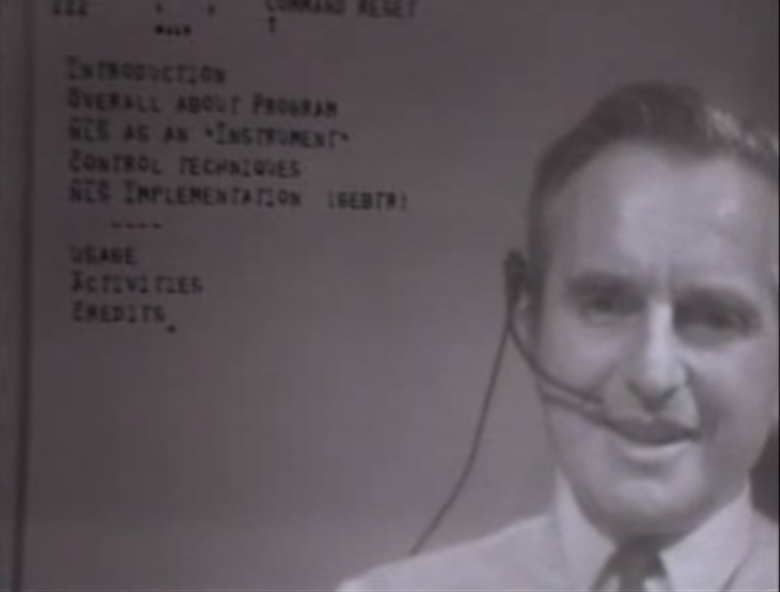
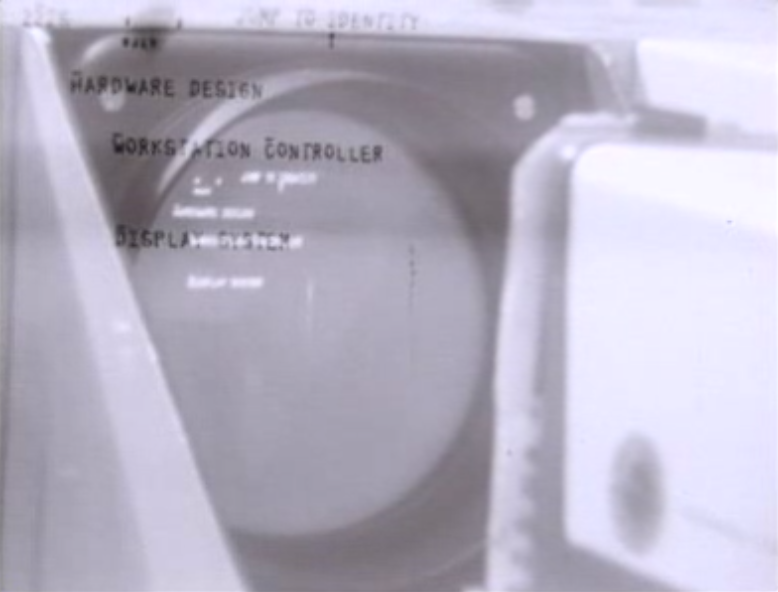
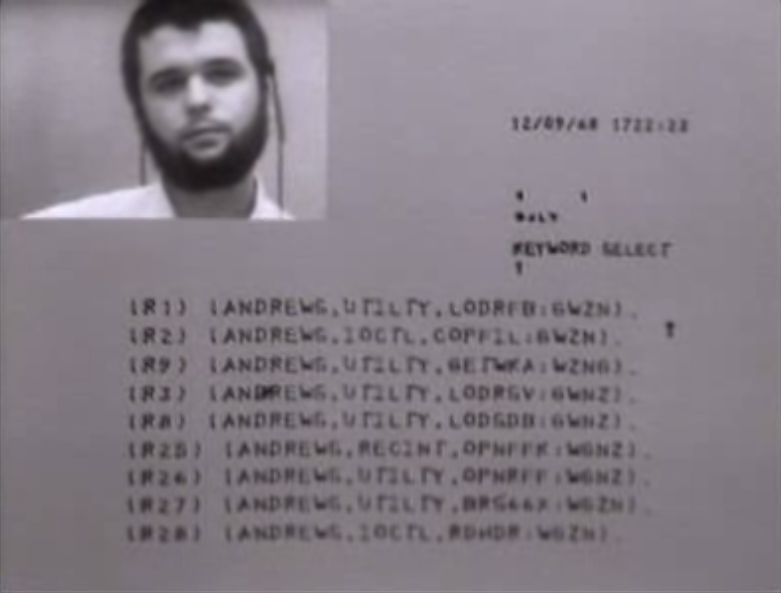
Just watched the whole Douglas Engelbart demo from 1968. Somehow I'd only heard of this as the first demo of the computer mouse, and only seen a brief clip on youtube. All three 30-minute reels of the film are available online, and well worth a watch in full. The mouse is the least of it, the demo includes an outlining text editor, model-view-controller, hypertext, wiki, domain specific programming languages, a precurser to email, bug tracking, version control(?), a chorded keyboard. (Ok, that last one didn't really take off.) Probably a dozen other things I've forgotten. All in a single interface, and all before I was born. Just like any tech demo, there are fumbles and mistakes, which is reassuring to anyone who has tried to give a tech demo. There's also the awesome crazy hack shown here. They could only afford these tiny, round CRTs, so they pointed a television camera at it, and the camera image was piped to their television console. (So add KVM switch to the list of firsts!) The demo was done in San Fransisco, with the computer system remote in Palo Alto, so in this image you see the text on the CRT overlaid with the video from the camera. Engelbart points out that the delay this added to the system acts as a short-term memory that filtered out flicker in the original display (and made the mouse have a mouse trail). To me it gives the whole demo a unique quality, as if it were underwater. Despite the piping around of audio and video signals, and the multiuser system, the glaring thing missing from the demo that we have these days is networking. Although there is this amusing bit at the end where they compile a regular expression and then apply it, in order to search for documents containing certain terms, and end up with a hyperlinked list of 10 results, ordered by relevance. Yes, think Google.

29 October 2011

Joey Hess: two random thoughts about bugs

First thought is this: A bug's likelyhood of ever being fixed decays with time, starting when I first read it. If I have to read it a second time, the bug has already become more complex, since something prevented me from just fixing it the first time. If more information has to be added to the bug, that makes it yet more complex. If there is an argument in the bug about whether it is a bug, or how to fix it, just revisiting the bug at a later date can become more expensive than it's worth. Much of what is involved in filing good and effective bug reports are obvious corollaries of this. It also follows that it's best to either fix, or at least plan how to fix a bug immediatly upon reading it. Second thought is about "wontfix". A bug submitter and the developer responsible for the bug see this state in very different ways, but the name hides what it really means, which is that there is a meta-bug affecting either the bug submitter, the developer, or both. Once you realize this, wontfix bugs, from either side, become a bit personally insulting. They also quickly decay to uselessness (see first thought), and then just lurk there wasting the developer's time in various ways. Bug tracking systems should not provide a "wontfix" state; if they want to track meta-bugs they should provide a way to reassign such a bug to some other party who can actually resolve such a meta-bug.

Charles Plessy: Everything in Git

Saturday started well, reading two stimulating articles on Planet_Debian. One about GitTogether2011, and the other about the use of Git in the Baserock company. I like a lot the idea of using Git beyond source code management. This article is itself distributed via a network of Git repositories. For the Debian package I develop and that are maintained with Git, I started some time ago to store their build logs in a branch that I called meta. Since sbuild can filter some variable chains in its logs, the command git diff --word-diff=color became a nice tool to inspect the difference between two package builds. Here is for instance the update I made this morning for bedtools: we can see that -D_FORTIFY_SOURCE=2 is not passed anymore, and that consequently the -Wunused-result warnings disappeared. Another advantages of storing build logs is simply to make available information that was not previously: buildd.debian.org contains the build logs for every architecture except the one used by the package maintainer, often one of the most popular architectures, because the uploads combine source and binary packages. This problem will be solved when our archive will automatically rebuild the binary packages uploaded with the source packages, but it will not be entirely solved as it is still possible to upload binary packages alone. In the meta branch of my Git repositories, the logs are kept side-to-side for every architecture. I am unsure if that the best layout, but for the moment I am uncomfortable with having too many parallel branches. I am starting to automate the work with the logs, for instance with that small script to gather them from buildd.debian.org.
#!/bin/bash
BASEURL=buildd.debian.org:/srv/buildd.debian.org/db
PACKAGE=$1
shift
for version in "$*"
do
  scp $BASEURL/$ PACKAGE:0:1 /$PACKAGE/$ version /* .
  for arch in $(ls *bz2   sed 's/_.*//g')
    do bzcat $ arch *bz2 > $ arch .log
    rm $ arch _*_log.bz2;
  done
done
exit

Next.

Previous.