Search Results: "gabriel"

13 April 2009

Biella Coleman: USER GENERATED CONTENT 3.0: From Threat to Opportunity

5.8%

12 April 2009

Biella Coleman: The the book we should be celebrating

I agree. This is the book that really engages with the craft of writing.

Biella Coleman: Memefactory, the video

I have found myself, at least on a few occasions, talking to a person whose relationship to the Internets is much thinner than my own, trying to explain the nature of certain Internet memes. I find this a pretty tough task to pull off as I tend to make memes sound really infantile (and perhaps that is just what they are). To explain this world to the uninitiated, I either: 1) very quickly give up and move onto some other less obscure 2) go into semi-professorial lecture mode and give a mini-low down on memes, some of the early examples, a small theory of self-referential irony, 4chan, rickrolls, encyclopedia dramatic etc etc and then show a bunch of memes as really you can t do it justice without the audio visul component. Now, I can just point people to the Meme Factory to three youngish guys from Brooklyn who put together a **fantastic show**** a few weeks ago on, yes, Internet Memes. It was a dazzling ride into the (sometimes very obnoxious) territory that is memeology, addressing and displaying both the happy-cheery-cute side of memes as well as its darker side. The video they have on their site documents their presentation and the word is out that they will soon craft something more like a stand-alone video-essay about Internet memes. As we wait for this next step in their project, this video is an amusing watch (though the interesting stuff starts about 3 minutes in).

Biella Coleman: Too cute to handle

Possibly the cutest pictures and story of the decade?!

11 April 2009

Biella Coleman: Help Me Find This


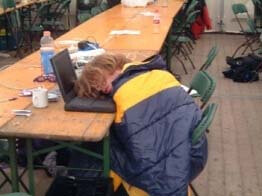
Help Me Find This, originally uploaded by the biella.
A long while back, I wrote a blog entry about debconf4, which became fodder for a section in my dissertation, and which will be published as a stand alone article this summer or fall in Anthropological Quarterly. I am including a number of images, most of which are mine or taken from the Debconf Gallery but I have a few images of unknown source/origin and it would be great to help me find it. The first is the photo pictured above, which I uploaded to my flickr page. Someone sent it to me a long time ago and all I know that it is from one of the Dutch Hacker Conferences, possibly HIP. Does anyone know where I can find a copy on the web? Seen it before? Are the kid pictured in the photo? Think you are the kid pictured in the photo? Sort of look like the kid pictured in the photo? Know of a service where you can upload a photo on a page and it will locate other copies?? Know of another similarly awesome photo? The second picture is of two Debian developers Gustavo and Jonas dancing at Debconf. I can t seem to locate it in the gallery and I am not sure who took it but I would love to find out to get permission to use it in the piece. Finally: do you have any pictures (in the gallery on not) that capture the joy of conferencing that you would not mind published either in this article or my book? If yes, feel free to send any along!

10 April 2009

Eddy Petrișor: Is Romania part of the European Union?

This is a really slim and really incomplete description of the events turning really bad for Romania and severely bad for Moldavian civilians.
Are we living in a parallel world? What interests would Romania have to ever consider that it would be involved in this? Moldavia is the poorest country in Europe, has huge problems with justice, corruption, criminal activity, social security, border security (Transdnistria) and other issues which Romania does NOT want to import since we're already in a bad position by ourselves!


WHAT THE HELL IS EU DOING? Romania is a member of the EU and it seems all the attacks against Romania are not addressed in any way by the EU, on the contrary, EU members either assist passively, look the other way or even allow us to understand that indeed they think Romania is involved.

9 April 2009

Biella Coleman: From Open Source Software to Open Culture: Three Misunderstandings

A few weeks ago, I jotted down some thoughts about (false) expectations made on FLOSS/F/OSS, something that I wish I had more time to write about (teaching and other things seem to take most of my time these days). But before this year turned into the next one, I wanted to pass on a few additional (and similar though they enter into different territory) thoughts by O Reilly editor, Andy Oram: From Open Source Software to Open Culture: Three Misunderstandings

3 April 2009

Biella Coleman: Digital Economies and the Politics of Circulation

Expand your perspectives in IP (if you are in NYC at least)

2 April 2009

Biella Coleman: Rocket Fuel where it should not be

Blast your infant to the sky with rocket fuel.

30 March 2009

Biella Coleman: Pure Data: FM Sprint in NYC and Berlin

FLOSS Manuals is proud to announce a three day book sprint for the Pure
Data FLOSS Manual. This sprint will take place simultaneously in New
York City and Berlin from Saturday 4 April to Monday 6 April. The Pure Data FLOSS Manual: http://en.flossmanuals.net/puredata There are possibilities to participate in person by coming to one of the
locations below, or remotely via the IRC interface built into the FLOSS
Manuals editing interface. Video conferencing may take place between the
venues as well. To participate, create a login at the PD FLOSS Manuals page: http://en.flossmanuals.net/bin/login/TWiki/WebHome?origurl=/bin/view/PureData/Introduction&skin=floss2 Discussion may also take place in the Pure Data mailing list: http://lists.puredata.info/listinfo/pd-list If you are in New York or Berlin, please join us at these locations! NEW YORK CITY * Contact: Hans-Christoph Steiner: hans@eds.org 718 360 4872 * Location (bring ID, you ll need to sign in): ITP/NYU Conference Room
721 Broadway, 4th Floor
NY, NY, USA
email me or call in case you can get past security: 718 360 4872 * Schedule:
Saturday: noon-midnight
Sunday: 10am-midnight
Monday: 9am-5:30pm (if we go later, we ll be in a different room) BERLIN * Contacts Derek Holzer: derek@umatic.nl +49 176 2812 5845
Adam Hyde: adam@flossmanuals.net +49 15 2230 54563 NK
ElsenStr. 52 (2.Hof)
Berlin, Germany
+49 176 20626386
http://www.myspace.com/enka52 * Schedule:
Saturday: noon-late
Sunday: noon-late
Monday: noon-late
SOME BASIC GUIDELINES: * This manual should address the widest possible user-base. Therefore,
objects which are cross-platform and in Pd Extended should have priority
over other solutions.
* Tone should be neutral and informative. Remember that humor doesn t
always translate well! ;-)
* Our readers are assumed to have little to no background in either
computer programming or digital signal processing, which much of the
existing documentation takes for granted. That s why this manual is
necessary! Please keep this in mind when explaining things.
* Please use existing the Audio Tutorials, Installing and Getting
Started chapters as a style guide.
* Keep the chapters small and self-contained. Ideally, chapters from
this manual could even be remixed into other FLOSS Manuals.
* Explain any jargon or technical terminology in-line the first time you
use it, and direct the reader to appropriate other chapters/manuals when
necessary.
* Please enter any new technical terms in the Glossary (we need to agree
on global format for glossary terms!).
* Screenshots:
Resolution? (Adam and I will work on this on Monday)
Please upload any complex patches, and make sure to label screenshot
with appropriate filename (see Audio Tutorials for examples)
Please keep explanatory text in the manual rather than only in the
screenshot, so that it can be text-searched by readers.
Please use anti-aliased fonts!
* All the chapters are moderated by Derek Holzer & Adam Hyde. Your
contributions will only be visible in the editing section until they
meet these guidelines, and after that they can be published to the main
page. Please let us know when your chapter(s) are ready for publishing
and we ll look them over. EXISTING CHAPTERS WHICH NEED HELP: # DataflowTutorials this section needs a lot of help in terms of style and content!!!!!
Tone is very informal, which doesn t help convey the information.
give titles to screenshots so that readers can tell which patches
match which images (some do this, some don t )
Math : examples/discussion of [expr]???
Order of connecting and [trigger] : explain the patches in-line,
rather than only in comments in screenshots (so that text is searchable,
copy/pasteable..)
Luka s screencaps are very aliased, to the point where you can t read
the ~ in the object names. Should they be redone at new resolution or
with antialiasing?
Possible janitors: Derek Holzer, Adam Hyde # PureGlossary format of object names = [italics in square brackets], must be
formatted correctly
format of glossary words in general text: we don t have one yet. Bold
on first use in chapter maybe? Needs formatting all through text. # ListofObjects incomplete, please add more libs
maybe more discussion of externals needed as well
formatting of object names? # PureLinks always welcome MORE CHAPTERS/SECTIONS TO DO (+ suggestions?): * GEM (in order of importance)(Derek can provide example patches for
much of this)
Basic VJ mixer (2 x
[gemhead]-[pix_film]-[alpha]-[colorRGB]-[pix_texture]-[rectangle] with
an alpha-crossfader)(+ platform specific codec info)
Live camera input (same as VJ mixer but with [pix_video], with
platform specific info on USB/firewire inputs what works & what doesn t)
VJ effects (using the various pix objects)
Basic 3D (that actually does something interesting, rather than just
show a sphere or a cube)
Basic movement tracking w/ [pix_blob]
GEM/video optimization/troubleshooting tips (see Troubleshooting
section of existing Pd FLOSS Manual) * MIDI tutorial
hardware:keyboards, sliders, etc,
objects: all MIDI objects
routing: input + output to/from devices or other programs * Patching strategies
Reusable abstractions ($0 etc)
GoP + other GUI creation strategies
Preset saving systems (Frank?) * Audiofile manipulation (Derek can provide examples, possibly also work
with www.pd-tutorial.com with permission?)
sfread, readsf, sfplay, etc
tables + tabplay, tabread, etc
oneshot playback without/with pitch shifting
looping without/with pitchshifting
granulation without/with pitchshifting
Extended objects ([xplay~], [xgroove~] are these stable? In my
experience, no ) * Realtime audio effects tutorial
delays: single tap, multitap, pitch-shifting, tuned comb filter, etc
filters: [hip~], [lop~], [bp~], [moog~], IEM lib filters
[vcf~]/[bp],[hp],[lp], difference between audio signal and message
controlled, building with ggee objects [bandpass],[llowpass],[highpass]
or [biquad~] (resources for coefficients?) * Sensor tutorial (HC?)
[hid]/[hidin]/[pduino]
simple circuit diagrams + photos (voltage divider examples:
potentiometer, photoresistor, etc)(hacked gamepads) * Networked data
netsend/netreceive
OSC
flash server
shell
python externals
others? * PDP/PiDiP
configuration info for OSX (+ poor performance disclaimer!)
basic VJ
networked streaming etc * Procedural Audio tutorial? (Andy?) * RJDJ tutorial? (Frank and the gang?)

28 March 2009

Biella Coleman: Circuits-FlowCharts-Biblegrams

After telling my friend about a talk on flow charts, brains, and psychology I attended today, my friend pointed me to his amazing art-a-gram of relationships as well as this even more out of this world biblegram. Damn.

24 March 2009

Biella Coleman: Memefactory

Memefactory! :
What do you get when you combine a lecture, vaudeville and Double Dare? Memefactory! Three gentlemen with five computers and three projectors take the audience on a fast-paced, whirlwind tour of every major Internet meme, famous piece of Internet media and YouTube footage imaginable. The modus is not depth, but breadth, and constant audience participation is required. Over the course of the evening, the audience will produce an entry for every internet phenomenon possible, including but not limited to: LOLCats, Bouncing GIFs, Me Singing [blank], Reaction Videos, Folk Covers of Hip Hop Classics, FAILs, Redubbed music videos, and more. Some will become famous like Boxxy, most will drink beers and a brave few will be nude.

22 March 2009

Biella Coleman: You don t need to choose one over the other.

So, one of th raging debates in medical science over the last two decades concerns the importance of genetics vs environmental factors for diseases: Are diseases genetically based or due to environmental factors, such as pesticides and toxins? This debate is one that might soon change its course (and collapse) due to the fascinating field of epigenetics, which blows this binary to pieces, by examining how lifestyle and environment can alter the expression of genes. Nova has a fascinating video about epigenetics, which is definitely worth watching.

19 March 2009

Biella Coleman: MIT approves open access

The more stuff like this happens, the harder it will be to pass this stuff.

18 March 2009

Biella Coleman: Hyperparenting: The Ethnography

I have a long list (it exists only in my head unfortunately) of various ethnographic projects I would like to conduct. I might start the real list soon but in the meantime, I will just through the half-baked ideas here and perhaps it will inspire others to take it on. I am currently reading a fantastic book, The Case Against Perfection, and am on a section on hyperparenting and well, while I think at a common sense level we know what psychological havoc such controlled parenting can cause, I think an ethnography of some of the practices and institutions of hyperparenting would, nonetheless, make for a fascinating read. If anyone knows of anything that even resembles this, do drop me a line. Update: Not exactly an ethnography but certainly fun to read.

Biella Coleman: FLOSS Manuals in Cambdrige, MA March 21-22nd

I recently got to spend some time hanging with part of the FLOSS manual crew and they basically are as busy as ever holding sprints across the US and Europe to write documentation and manuals for Free Software. They are holding a mini sprint in Cambridge, MA and along with the FSF will be writing a manual on the command line in about two days. If the idea of writing documentation makes you feel warm and happy inside, then this is the even for you. They are always looking for volunteers and I assure you, the experience will be well worth your time, effort, and participation.

Biella Coleman: Expectations

Expectations: A little over a week ago I participated in a camp/event/conference/ that threw together 12 different networked based-groups/phenomenon/organizations. They got to do what many often can t do: spend some time working face-to-face as well as thinking about about questions of un(organizational) growth/ungrowth. Some of us spent some time learning about the nature of networked coordinations and organizations from these groups. There is a lot I could write about but, in part because I was in Amsterdam for a week, I am now playing serious catch up, but there are a few things that really struck me both of which relate to expectations, which I thought worth jotting down. Generally present were the following types of groups: open source projects (such as Blender), tech-oriented activist projects (Dyne), non-tech oriented projects (such as Free Dimensional), artistic-tech projects (such as GOTO10), artistic projects (Upgrade), academic-activist (Edu Factory) and others which are harder to classify (such as Gender Changes, and FLOSS Manuals). One thing that came out during the plenary sessions, which is when we got together as a large group to debate and discuss, is that technically oriented open source projects are at times singled out for not being inclusive. That is, people pointed out that most projects expect you to contribute technically in order to participate (and don t necessarily offer people the training/capacity so you can participate). I have heard a version of this many many and many times before and find it to be a curious (and generally unproductive) accusation, though I understand why the confusions arises. I say confusion because most of these projects are not overtly set up to be inclusive/technically pedagogical, and this is perhaps the key point they don t purport to be though many folks think this is part of their overall message/mission. Because these free software projects are open source, this, for some, somehow automatically translates into the political projects of inclusivity (that is, training folks so that they can become part of this world). And yet some other projects, such as Edu Factory and GoTo10, which are run as tight-knit of collectives, are rarely accused of not being inclusive. Why should this be? I raise this mostly because I find it interesting, pointing to the way certain terms or phrases (Freedom, Openness) combined with the visibility of FLOSS projects, automatically generate other expectations and meanings even if they don t actually exist. I also raise it because I think it is an unfair expectation to have of these communities only in so far as most of them are full of folks busy hacking up technology and this in and of itself, as I have written about before is worthwhile politically. And yet If one wants to make them more inclusive, then one can go ahead and bring into being such a project for most of them are quite open to various initiatives to enlarge the scope of participation. These projects can be internal to projects or external to them. That is, self-initiative goes a long way in this world, and has helped changed the terrain of participation and inclusivity and I am sure will continue to do so. Which brings me to my second point about expectations. Many people complain that open source is not easy to use. While this was entirely, 1000% true prior to 1998, every passing day makes this statement harder to stand by. I imagine in another 10 years, there will be many many programs that are as usable for the novice user as proprietary software. They had to play serious catch-up and I think have done a decent job. In some regards, all that was and is needed is time because time has already shown that usability has improved leaps and bounds. And yet there is still something odd about the accusations, which my friend tulpje but in the following way One would never accuse the Zapatistas for not having their military might/shit together like the US army, so why accuse open source for not being the mightiest software our there?) While I actually think that free software has already and will continue to give proprietary firms a run for their money in a way that a rag-tag guerrilla army can t do with a national army, it is nonetheless important to couch one s responses and accusations in terms of the constraints and realities of these projects. That said, I still think such expectations reflect important hopes and desires. They show us just how profoundly free software/open source has, simply by virtue of its existence, inspired many to follow suite politically, turning to FLOSS as a beacon of possibility.

Next.

Previous.