Search Results: "eric"

15 July 2022

Steve Kemp: So we come to Lisp

Recently I've been working with simple/trivial scripting languages, and I guess I finally reached a point where I thought "Lisp? Why not". One of the reasons for recent experimentation was thinking about the kind of minimalism that makes implementing a language less work - being able to actually use the language to write itself. FORTH is my recurring example, because implementing it mostly means writing a virtual machine which consists of memory ("cells") along with a pair of stacks, and some primitives for operating upon them. Once you have that groundwork in place you can layer the higher-level constructs (such as "for", "if", etc). Lisp allows a similar approach, albeit with slightly fewer low-level details required, and far less tortuous thinking. Lisp always feels higher-level to me anyway, given the explicit data-types ("list", "string", "number", etc). Here's something that works in my toy lisp:
;; Define a function,  fact , to calculate factorials (recursively).
(define fact (lambda (n)
  (if (<= n 1)
    1
      (* n (fact (- n 1))))))
;; Invoke the factorial function, using apply
(apply (list 1 2 3 4 5 6 7 8 9 10)
  (lambda (x)
    (print "%s! => %s" x (fact x))))
The core language doesn't have helpful functions to filter lists, or build up lists by applying a specified function to each member of a list, but adding them is trivial using the standard car, cdr, and simple recursion. That means you end up writing lots of small functions like this:
(define zero? (lambda (n) (if (= n 0) #t #f)))
(define even? (lambda (n) (if (zero? (% n 2)) #t #f)))
(define odd?  (lambda (n) (! (even? n))))
(define sq    (lambda (x) (* x x)))
Once you have them you can use them in a way that feels simple and natural:
(print "Even numbers from 0-10: %s"
  (filter (nat 11) (lambda (x) (even? x))))
(print "Squared numbers from 0-10: %s"
  (map (nat 11) (lambda (x) (sq x))))
This all feels very sexy and simple, because the implementations of map, apply, filter are all written using the lisp - and they're easy to write. Lisp takes things further than some other "basic" languages because of the (infamous) support for Macros. But even without them writing new useful functions is pretty simple. Where things struggle? I guess I don't actually have a history of using lisp to actually solve problems - although it's great for configuring my editor.. Anyway I guess the journey continues. Having looked at the obvious "minimal core" languages I need to go further afield: I'll make an attempt to look at some of the esoteric programming languages, and see if any of those are fun to experiment with.

13 July 2022

Reproducible Builds: Reproducible Builds in June 2022

Welcome to the June 2022 report from the Reproducible Builds project. In these reports, we outline the most important things that we have been up to over the past month. As a quick recap, whilst anyone may inspect the source code of free software for malicious flaws, almost all software is distributed to end users as pre-compiled binaries.

Save the date! Despite several delays, we are pleased to announce dates for our in-person summit this year: November 1st 2022 November 3rd 2022
The event will happen in/around Venice (Italy), and we intend to pick a venue reachable via the train station and an international airport. However, the precise venue will depend on the number of attendees. Please see the announcement mail from Mattia Rizzolo, and do keep an eye on the mailing list for further announcements as it will hopefully include registration instructions.

News David Wheeler filed an issue against the Rust programming language to report that builds are not reproducible because full path to the source code is in the panic and debug strings . Luckily, as one of the responses mentions: the --remap-path-prefix solves this problem and has been used to great effect in build systems that rely on reproducibility (Bazel, Nix) to work at all and that there are efforts to teach cargo about it here .
The Python Security team announced that:
The ctx hosted project on PyPI was taken over via user account compromise and replaced with a malicious project which contained runtime code which collected the content of os.environ.items() when instantiating Ctx objects. The captured environment variables were sent as a base64 encoded query parameter to a Heroku application [ ]
As their announcement later goes onto state, version-pinning using hash-checking mode can prevent this attack, although this does depend on specific installations using this mode, rather than a prevention that can be applied systematically.
Developer vanitasvitae published an interesting and entertaining blog post detailing the blow-by-blow steps of debugging a reproducibility issue in PGPainless, a library which aims to make using OpenPGP in Java projects as simple as possible . Whilst their in-depth research into the internals of the .jar may have been unnecessary given that diffoscope would have identified the, it must be said that there is something to be said with occasionally delving into seemingly low-level details, as well describing any debugging process. Indeed, as vanitasvitae writes:
Yes, this would have spared me from 3h of debugging But I probably would also not have gone onto this little dive into the JAR/ZIP format, so in the end I m not mad.

Kees Cook published a short and practical blog post detailing how he uses reproducibility properties to aid work to replace one-element arrays in the Linux kernel. Kees approach is based on the principle that if a (small) proposed change is considered equivalent by the compiler, then the generated output will be identical but only if no other arbitrary or unrelated changes are introduced. Kees mentions the fantastic diffoscope tool, as well as various kernel-specific build options (eg. KBUILD_BUILD_TIMESTAMP) in order to prepare my build with the known to disrupt code layout options disabled .
Stefano Zacchiroli gave a presentation at GDR S curit Informatique based in part on a paper co-written with Chris Lamb titled Increasing the Integrity of Software Supply Chains. (Tweet)

Debian In Debian in this month, 28 reviews of Debian packages were added, 35 were updated and 27 were removed this month adding to our knowledge about identified issues. Two issue types were added: nondeterministic_checksum_generated_by_coq and nondetermistic_js_output_from_webpack. After Holger Levsen found hundreds of packages in the bookworm distribution that lack .buildinfo files, he uploaded 404 source packages to the archive (with no meaningful source changes). Currently bookworm now shows only 8 packages without .buildinfo files, and those 8 are fixed in unstable and should migrate shortly. By contrast, Debian unstable will always have packages without .buildinfo files, as this is how they come through the NEW queue. However, as these packages were not built on the official build servers (ie. they were uploaded by the maintainer) they will never migrate to Debian testing. In the future, therefore, testing should never have packages without .buildinfo files again. Roland Clobus posted yet another in-depth status report about his progress making the Debian Live images build reproducibly to our mailing list. In this update, Roland mentions that all major desktops build reproducibly with bullseye, bookworm and sid but also goes on to outline the progress made with automated testing of the generated images using openQA.

GNU Guix Vagrant Cascadian made a significant number of contributions to GNU Guix: Elsewhere in GNU Guix, Ludovic Court s published a paper in the journal The Art, Science, and Engineering of Programming called Building a Secure Software Supply Chain with GNU Guix:
This paper focuses on one research question: how can [Guix]((https://www.gnu.org/software/guix/) and similar systems allow users to securely update their software? [ ] Our main contribution is a model and tool to authenticate new Git revisions. We further show how, building on Git semantics, we build protections against downgrade attacks and related threats. We explain implementation choices. This work has been deployed in production two years ago, giving us insight on its actual use at scale every day. The Git checkout authentication at its core is applicable beyond the specific use case of Guix, and we think it could benefit to developer teams that use Git.
A full PDF of the text is available.

openSUSE In the world of openSUSE, SUSE announced at SUSECon that they are preparing to meet SLSA level 4. (SLSA (Supply chain Levels for Software Artifacts) is a new industry-led standardisation effort that aims to protect the integrity of the software supply chain.) However, at the time of writing, timestamps within RPM archives are not normalised, so bit-for-bit identical reproducible builds are not possible. Some in-toto provenance files published for SUSE s SLE-15-SP4 as one result of the SLSA level 4 effort. Old binaries are not rebuilt, so only new builds (e.g. maintenance updates) have this metadata added. Lastly, Bernhard M. Wiedemann posted his usual monthly openSUSE reproducible builds status report.

diffoscope diffoscope is our in-depth and content-aware diff utility. Not only can it locate and diagnose reproducibility issues, it can provide human-readable diffs from many kinds of binary formats. This month, Chris Lamb prepared and uploaded versions 215, 216 and 217 to Debian unstable. Chris Lamb also made the following changes:
  • New features:
    • Print profile output if we were called with --profile and we were killed via a TERM signal. This should help in situations where diffoscope is terminated due to some sort of timeout. [ ]
    • Support both PyPDF 1.x and 2.x. [ ]
  • Bug fixes:
    • Also catch IndexError exceptions (in addition to ValueError) when parsing .pyc files. (#1012258)
    • Correct the logic for supporting different versions of the argcomplete module. [ ]
  • Output improvements:
    • Don t leak the (likely-temporary) pathname when comparing PDF documents. [ ]
  • Logging improvements:
    • Update test fixtures for GNU readelf 2.38 (now in Debian unstable). [ ][ ]
    • Be more specific about the minimum required version of readelf (ie. binutils), as it appears that this patch level version change resulted in a change of output, not the minor version. [ ]
    • Use our @skip_unless_tool_is_at_least decorator (NB. at_least) over @skip_if_tool_version_is (NB. is) to fix tests under Debian stable. [ ]
    • Emit a warning if/when we are handling a UNIX TERM signal. [ ]
  • Codebase improvements:
    • Clarify in what situations the main finally block gets called with respect to TERM signal handling. [ ]
    • Clarify control flow in the diffoscope.profiling module. [ ]
    • Correctly package the scripts/ directory. [ ]
In addition, Edward Betts updated a broken link to the RSS on the diffoscope homepage and Vagrant Cascadian updated the diffoscope package in GNU Guix [ ][ ][ ].

Upstream patches The Reproducible Builds project detects, dissects and attempts to fix as many currently-unreproducible packages as possible. We endeavour to send all of our patches upstream where appropriate. This month, we wrote a large number of such patches, including:

Testing framework The Reproducible Builds project runs a significant testing framework at tests.reproducible-builds.org, to check packages and other artifacts for reproducibility. This month, the following changes were made:
  • Holger Levsen:
    • Add a package set for packages that use the R programming language [ ] as well as one for Rust [ ].
    • Improve package set matching for Python [ ] and font-related [ ] packages.
    • Install the lz4, lzop and xz-utils packages on all nodes in order to detect running kernels. [ ]
    • Improve the cleanup mechanisms when testing the reproducibility of Debian Live images. [ ][ ]
    • In the automated node health checks, deprioritise the generic kernel warning . [ ]
  • Roland Clobus (Debian Live image reproducibility):
    • Add various maintenance jobs to the Jenkins view. [ ]
    • Cleanup old workspaces after 24 hours. [ ]
    • Cleanup temporary workspace and resulting directories. [ ]
    • Implement a number of fixes and improvements around publishing files. [ ][ ][ ]
    • Don t attempt to preserve the file timestamps when copying artifacts. [ ]
And finally, node maintenance was also performed by Mattia Rizzolo [ ].

Mailing list and website On our mailing list this month: Lastly, Chris Lamb updated the main Reproducible Builds website and documentation in a number of small ways, but primarily published an interview with Hans-Christoph Steiner of the F-Droid project. Chris Lamb also added a Coffeescript example for parsing and using the SOURCE_DATE_EPOCH environment variable [ ]. In addition, Sebastian Crane very-helpfully updated the screenshot of salsa.debian.org s request access button on the How to join the Salsa group. [ ]

Contact If you are interested in contributing to the Reproducible Builds project, please visit our Contribute page on our website. However, you can get in touch with us via:

6 July 2022

Russ Allbery: Review: A Master of Djinn

Review: A Master of Djinn, by P. Dj l Clark
Series: Dead Djinn Universe #1
Publisher: Tordotcom
Copyright: 2021
ISBN: 1-250-26767-6
Format: Kindle
Pages: 391
A Master of Djinn is the first novel in the Dead Djinn Universe, but (as you might guess from the series title) is a direct sequel to the novelette "A Dead Djinn in Cairo". The novelette is not as good as the novel, but I recommend reading it first for the character introductions and some plot elements that carry over. Reading The Haunting of Tram Car 015 first is entirely optional. In 1912 in a mansion in Giza, a secret society of (mostly) British men is meeting. The Hermetic Brotherhood of Al-Jahiz is devoted to unlocking the mysteries of the Soudanese mystic al-Jahiz. In our world, these men would likely be colonialist plunderers. In this world, they still aspire to that role, but they're playing catch-up. Al-Jahiz bored into the Kaf, releasing djinn and magic into the world and making Egypt a world power in its own right. Now, its cities are full of clockwork marvels, djinn walk the streets as citizens, and British rule has been ejected from India and Africa by local magic. This group of still-rich romantics and crackpots hopes to discover the knowledge lost when al-Jahiz disappeared. They have not had much success. This will not save their lives. Fatma el-Sha'arawi is a special investigator for the Ministry of Alchemy, Enchantments, and Supernatural Entities. Her job is sorting out the problems caused by this new magic, such as a couple of young thieves with a bottle full of sleeping djinn whose angry reaction to being unexpectedly woken has very little to do with wishes. She is one of the few female investigators in a ministry that is slowly modernizing with the rest of society (Egyptian women just got the vote). She's also the one called to investigate the murder of a secret society of British men and a couple of Cairenes by a black-robed man in a golden mask. The black-robed man claims to be al-Jahiz returned, and proves to be terrifyingly adept at manipulating crowds and sparking popular dissent. Fatma and the Ministry's first attempt to handle him is a poorly-judged confrontation stymied by hostile crowds, the man's duplicating bodyguard, and his own fighting ability. From there, it's a race between Fatma's pursuit of linear clues and the black-robed man's efforts to destabilize society. This, like the previous short stories, is a police procedural, but it has considerably more room to breathe at novel length. That serves it well, since as with "A Dead Djinn in Cairo" the procedural part is a linear, reactive vehicle for plot exposition. I was more invested in Fatma's relationships with the supporting characters. Since the previous story, she's struck up a romance with Siti, a highly competent follower of the old Egyptian gods (Hathor in particular) and my favorite character in the book. She's also been assigned a new partner, Hadia, a new graduate and another female agent. The slow defeat of Fatma's irritation at not being allowed to work alone by Hadia's cheerful competence and persistence (and willingness to do paperwork) adds a lot to the characterization. The setting felt a bit less atmospheric than The Haunting of Tram Car 015, but we get more details of international politics, and they're a delight. Clark takes obvious (and warranted) glee in showing how the reintroduction of magic has shifted the balance of power away from the colonial empires. Cairo is a bustling steampunk metropolis and capital of a world power, welcoming envoys from West African kingdoms alongside the (still racist and obnoxious but now much less powerful) British and other Europeans. European countries were forced to search their own mythology for possible sources of magic power, which leads to the hilarious scene of the German Kaiser carrying a sleepy goblin on his shoulder to monitor his diplomacy. The magic of the story was less successful for me, although still enjoyable. The angels from "A Dead Djinn in Cairo" make another appearance and again felt like the freshest bit of world-building, but we don't find out much more about them. I liked the djinn and their widely-varied types and magic, but apart from them and a few glimpses of Egypt's older gods, that was the extent of the underlying structure. There is a significant magical artifact, but the characters are essentially handed an instruction manual, use it according to its instructions, and it then does what it was documented to do. It was a bit unsatisfying. I'm the type of fantasy reader who always wants to read the sourcebook for the magic system, but this is not that sort of a book. Instead, it's the kind of book where the investigator steadily follows a linear trail of clues and leads until they reach the final confrontation. Here, the confrontation felt remarkably like cut scenes from a Japanese RPG: sudden vast changes in scale, clockwork constructs, massive monsters, villains standing on mobile platforms, and surprise combat reversals. I could almost hear the fight music and see the dialog boxes pop up. This isn't exactly a complaint I love Japanese RPGs but it did add to the feeling that the plot was on rails and didn't require many decisions from the protagonist. Clark also relies on an overused plot cliche in the climactic battle, which was a minor disappointment. A Master of Djinn won the Nebula for best 2021 novel, I suspect largely on the basis of its setting and refreshingly non-European magical system. I don't entirely agree; the writing is still a bit clunky, with unnecessary sentences and stock phrases showing up here and there, and I think it suffers from the typical deficiencies of SFF writers writing mysteries or police procedurals without the plot sophistication normally found in that genre. But this is good stuff for a first novel, with fun supporting characters (loved the librarian) and some great world-building. I would happily read more in this universe. Rating: 7 out of 10

5 July 2022

Alberto Garc a: Running the Steam Deck s OS in a virtual machine using QEMU

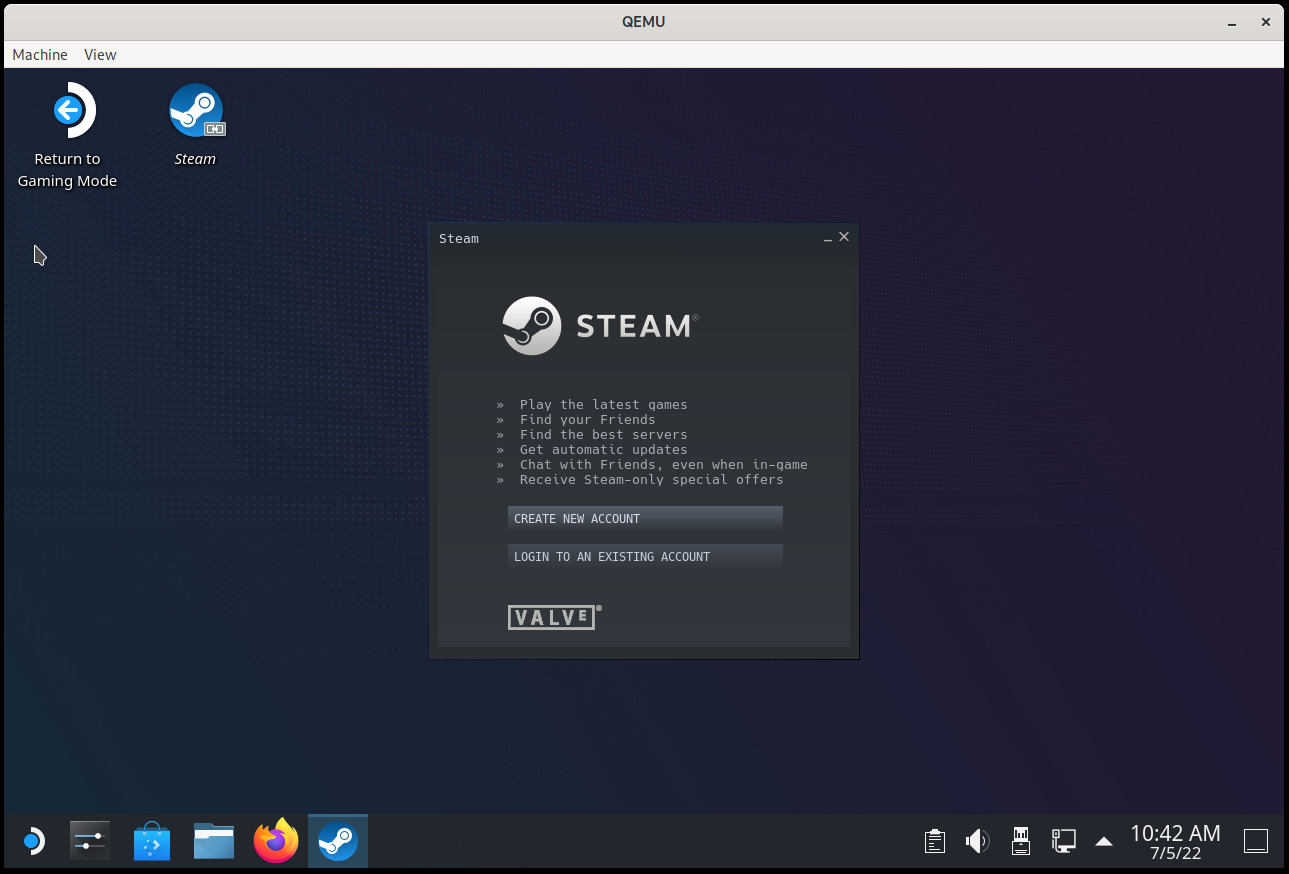
SteamOS desktop Introduction The Steam Deck is a handheld gaming computer that runs a Linux-based operating system called SteamOS. The machine comes with SteamOS 3 (code name holo ), which is in turn based on Arch Linux. Although there is no SteamOS 3 installer for a generic PC (yet), it is very easy to install on a virtual machine using QEMU. This post explains how to do it. The goal of this VM is not to play games (you can already install Steam on your computer after all) but to use SteamOS in desktop mode. The Gamescope mode (the console-like interface you normally see when you use the machine) requires additional development to make it work with QEMU and will not work with these instructions. A SteamOS VM can be useful for debugging, development, and generally playing and tinkering with the OS without risking breaking the Steam Deck. Running the SteamOS desktop in a virtual machine only requires QEMU and the OVMF UEFI firmware and should work in any relatively recent distribution. In this post I m using QEMU directly, but you can also use virt-manager or some other tool if you prefer, we re emulating a standard x86_64 machine here. General concepts SteamOS is a single-user operating system and it uses an A/B partition scheme, which means that there are two sets of partitions and two copies of the operating system. The root filesystem is read-only and system updates happen on the partition set that is not active. This allows for safer updates, among other things. There is one single /home partition, shared by both partition sets. It contains the games, user files, and anything that the user wants to install there. Although the user can trivially become root, make the root filesystem read-write and install or change anything (the pacman package manager is available), this is not recommended because A simple way for the user to install additional software that survives OS updates and doesn t touch the root filesystem is Flatpak. It comes preinstalled with the OS and is integrated with the KDE Discover app. Preparing all necessary files The first thing that we need is the installer. For that we have to download the Steam Deck recovery image from here: https://store.steampowered.com/steamos/download/?ver=steamdeck&snr= Once the file has been downloaded, we can uncompress it and we ll get a raw disk image called steamdeck-recovery-4.img (the number may vary). Note that the recovery image is already SteamOS (just not the most up-to-date version). If you simply want to have a quick look you can play a bit with it and skip the installation step. In this case I recommend that you extend the image before using it, for example with truncate -s 64G steamdeck-recovery-4.img or, better, create a qcow2 overlay file and leave the original raw image unmodified: qemu-img create -f qcow2 -F raw -b steamdeck-recovery-4.img steamdeck-recovery-extended.qcow2 64G But here we want to perform the actual installation, so we need a destination image. Let s create one: $ qemu-img create -f qcow2 steamos.qcow2 64G Installing SteamOS Now that we have all files we can start the virtual machine:
$ qemu-system-x86_64 -enable-kvm -smp cores=4 -m 8G \
    -device usb-ehci -device usb-tablet \
    -device intel-hda -device hda-duplex \
    -device VGA,xres=1280,yres=800 \
    -drive if=pflash,format=raw,readonly=on,file=/usr/share/ovmf/OVMF.fd \
    -drive if=virtio,file=steamdeck-recovery-4.img,driver=raw \
    -device nvme,drive=drive0,serial=badbeef \
    -drive if=none,id=drive0,file=steamos.qcow2
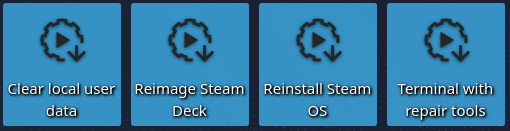
Note that we re emulating an NVMe drive for steamos.qcow2 because that s what the installer script expects. This is not strictly necessary but it makes things a bit easier. If you don t want to do that you ll have to edit ~/tools/repair_device.sh and change DISK and DISK_SUFFIX. SteamOS installer shortcuts Once the system has booted we ll see a KDE Plasma session with a few tools on the desktop. If we select Reimage Steam Deck and click Proceed on the confirmation dialog then SteamOS will be installed on the destination drive. This process should not take a long time. Now, once the operation finishes a new confirmation dialog will ask if we want to reboot the Steam Deck, but here we have to choose Cancel . We cannot use the new image yet because it would try to boot into the Gamescope session, which won t work, so we need to change the default desktop session. SteamOS comes with a helper script that allows us to enter a chroot after automatically mounting all SteamOS partitions, so let s open a Konsole and make the Plasma session the default one in both partition sets:
$ sudo steamos-chroot --disk /dev/nvme0n1 --partset A
# steamos-readonly disable
# echo '[Autologin]' > /etc/sddm.conf.d/zz-steamos-autologin.conf
# echo 'Session=plasma.desktop' >> /etc/sddm.conf.d/zz-steamos-autologin.conf
# steamos-readonly enable
# exit
$ sudo steamos-chroot --disk /dev/nvme0n1 --partset B
# steamos-readonly disable
# echo '[Autologin]' > /etc/sddm.conf.d/zz-steamos-autologin.conf
# echo 'Session=plasma.desktop' >> /etc/sddm.conf.d/zz-steamos-autologin.conf
# steamos-readonly enable
# exit
After this we can shut down the virtual machine. Our new SteamOS drive is ready to be used. We can discard the recovery image now if we want. Booting SteamOS and first steps To boot SteamOS we can use a QEMU line similar to the one used during the installation. This time we re not emulating an NVMe drive because it s no longer necessary.
$ cp /usr/share/OVMF/OVMF_VARS.fd .
$ qemu-system-x86_64 -enable-kvm -smp cores=4 -m 8G \
   -device usb-ehci -device usb-tablet \
   -device intel-hda -device hda-duplex \
   -device VGA,xres=1280,yres=800 \
   -drive if=pflash,format=raw,readonly=on,file=/usr/share/ovmf/OVMF.fd \
   -drive if=pflash,format=raw,file=OVMF_VARS.fd \
   -drive if=virtio,file=steamos.qcow2 \
   -device virtio-net-pci,netdev=net0 \
   -netdev user,id=net0,hostfwd=tcp::2222-:22
(the last two lines redirect tcp port 2222 to port 22 of the guest to be able to SSH into the VM. If you don t want to do that you can omit them) If everything went fine, you should see KDE Plasma again, this time with a desktop icon to launch Steam and another one to Return to Gaming Mode (which we should not use because it won t work). See the screenshot that opens this post. Congratulations, you re running SteamOS now. Here are some things that you probably want to do: Updating the OS to the latest version The Steam Deck recovery image doesn t install the most recent version of SteamOS, so now we should probably do a software update. Note: if the last step fails after reaching 100% with a post-install handler error then go to Connections in the system settings, rename Wired Connection 1 to something else (anything, the name doesn t matter), click Apply and run steamos-update again. This works around a bug in the update process. Recent images fix this and this workaround is not necessary with them. As we did with the recovery image, before rebooting we should ensure that the new update boots into the Plasma session, otherwise it won t work:
$ sudo steamos-chroot --partset other
# steamos-readonly disable
# echo '[Autologin]' > /etc/sddm.conf.d/zz-steamos-autologin.conf
# echo 'Session=plasma.desktop' >> /etc/sddm.conf.d/zz-steamos-autologin.conf
# steamos-readonly enable
# exit
After this we can restart the system. If everything went fine we should be running the latest SteamOS release. Enjoy! Reporting bugs SteamOS is under active development. If you find problems or want to request improvements please go to the SteamOS community tracker. Edit 06 Jul 2022: Small fixes, mention how to install the OS without using NVMe.

2 July 2022

Fran ois Marier: Remote logging of Turris Omnia log messages using syslog-ng and rsyslog

As part of debugging an upstream connection problem I've been seeing recently, I wanted to be able to monitor the logs from my Turris Omnia router. Here's how I configured it to send its logs to a server I already had on the local network.

Server setup The first thing I did was to open up my server's rsyslog (Debian's default syslog server) to remote connections since it's going to be the destination host for the router's log messages. I added the following to /etc/rsyslog.d/router.conf:
module(load="imtcp")
input(type="imtcp" port="514")
if $fromhost-ip == '192.168.1.1' then  
    if $syslogseverity <= 5 then  
        action(type="omfile" file="/var/log/router.log")
     
    stop
 
This is using the latest rsyslog configuration method: a handy scripting language called RainerScript. Severity level 5 maps to "notice" which consists of unusual non-error conditions, and 192.168.1.1 is of course the IP address of the router on the LAN side. With this, I'm directing all router log messages to a separate file, filtering out anything less important than severity 5. In order for rsyslog to pick up this new configuration file, I restarted it:
systemctl restart rsyslog.service
and checked that it was running correctly (e.g. no syntax errors in the new config file) using:
systemctl status rsyslog.service
Since I added a new log file, I also setup log rotation for it by putting the following in /etc/logrotate.d/router:
/var/log/router.log
 
    rotate 4
    weekly
    missingok
    notifempty
    compress
    delaycompress
    sharedscripts
    postrotate
        /usr/lib/rsyslog/rsyslog-rotate
    endscript
 
In addition, since I use logcheck to monitor my server logs and email me errors, I had to add /var/log/router.log to /etc/logcheck/logcheck.logfiles. Finally I opened the rsyslog port to the router in my server's firewall by adding the following to /etc/network/iptables.up.rules:
# Allow logs from the router
-A INPUT -s 192.168.1.1 -p tcp --dport 514 -j ACCEPT
and ran iptables-apply. With all of this in place, it was time to get the router to send messages.

Router setup As suggested on the Turris forum, I ssh'ed into my router and added this in /etc/syslog-ng.d/remote.conf:
destination d_loghost  
        network("192.168.1.200" time-zone("America/Vancouver"));
 ;
source dns  
        file("/var/log/resolver");
 ;
log  
        source(src);
        source(net);
        source(kernel);
        source(dns);
        destination(d_loghost);
 ;
Setting the timezone to the same as my server was needed because the router messages were otherwise sent with UTC timestamps. To ensure that the destination host always gets the same IP address (192.168.1.200), I went to the advanced DHCP configuration page and added a static lease for the server's MAC address so that it always gets assigned 192.168.1.200. If that wasn't already the server's IP address, you'll have to restart it for this to take effect. Finally, I restarted the syslog-ng daemon on the router to pick up the new config file:
/etc/init.d/syslog-ng restart

Testing In order to test this configuration, I opened three terminal windows:
  1. tail -f /var/log/syslog on the server
  2. tail -f /var/log/router.log on the server
  3. tail -f /var/log/messages on the router
I immediately started to see messages from the router in the third window and some of these, not all because of my severity-5 filter, were flowing to the second window as well. Also important is that none of the messages make it to the first window, otherwise log messages from the router would be mixed in with the server's own logs. That's the purpose of the stop command in /etc/rsyslog.d/router.conf. To force a log messages to be emitted by the router, simply ssh into it and issue the following command:
logger Test
It should show up in the second and third windows immediately if you've got everything setup correctly

28 June 2022

Dima Kogan: vnlog 1.33 released

This is a minor release to the vnlog toolkit that adds a few convenience options to the vnl-filter tool. The new options are

vnl-filter -l
Prints out the existing columns, and exits. I've been low-level wanting this for years, but never acutely-enough to actually write it. Today I finally did it.

vnl-filter --sub-abs
Defines an absolute-value abs() function in the default awk mode. I've been low-level wanting this for years as well. Previously I'd use --perl just to get abs(), or I'd explicitly define it: = sub 'abs(x) return x>0?x:-x; '=. Typing all that out was becoming tiresome, and now I don't need to anymore.

vnl-filter --begin ... and vnl-filter --end ...
Theses add BEGIN and END clauses. They're useful to, for instance, use a perl module in BEGIN, or to print out some final output in END. Previously you'd add these inside the --eval block, but that was awkward because BEGIN and END would then appear inside the while(<>) loop. And there was no clear was to do it in the normal -p mode (no --eval). Clearly these are all minor, since the toolkit is now mature. It does everything I want it to, that doesn't require lots of work to implement. The big missing features that I want would patch the underlying GNU coreutils instead of vnlog:
  • The sort tool can select different sorting modes, but join works only with alphanumeric sorting. join should have similarly selectable sorting modes. In the vnlog wrappe I can currently do something like vnl-join --vnl-sort n. This would pre-sort the input alphanumerically, and then post-sort it numerically. That is slow for big datasets. If join could handle numerically-sorted data directly, neither the pre- or post-sorts would be needed
  • When joining on a numerical field, join should be able to do some sort of interpolation when given fields that don't match exactly.
Both of these probably wouldn't take a ton of work to implement, and I'll look into it someday.

27 June 2022

Russ Allbery: Review: Light from Uncommon Stars

Review: Light from Uncommon Stars, by Ryka Aoki
Publisher: Tor
Copyright: 2021
ISBN: 1-250-78907-9
Format: Kindle
Pages: 371
Katrina Nguyen is an young abused transgender woman. As the story opens, she's preparing to run away from home. Her escape bag is packed with meds, clothes, her papers, and her violin. The note she is leaving for her parents says that she's going to San Francisco, a plausible lie. Her actual destination is Los Angeles, specifically the San Gabriel Valley, where a man she met at a queer youth conference said he'd give her a place to sleep. Shizuka Satomi is the Queen of Hell, the legendary uncompromising violin teacher responsible for six previous superstars, at least within the limited world of classical music. She's wealthy, abrasive, demanding, and intimidating, and unbeknownst to the rest of the world she has made a literal bargain with Hell. She has to deliver seven souls, seven violin players who want something badly enough that they'll bargain with Hell to get it. Six have already been delivered in spectacular fashion, but she's running out of time to deliver the seventh before her own soul is forfeit. Tamiko Grohl, an up-and-coming violinist from her native Los Angeles, will hopefully be the seventh. Lan Tran is a refugee and matriarch of a family who runs Starrgate Donut. She and her family didn't flee another unstable or inhospitable country. They fled the collapsing Galactic Empire, securing their travel authorization by promising to set up a tourism attraction. Meanwhile, she's careful to give cops free donuts and to keep their advanced technology carefully concealed. The opening of this book is unlikely to be a surprise in general shape. Most readers would expect Katrina to end up as Satomi's student rather than Tamiko, and indeed she does, although not before Katrina has a very difficult time. Near the start of the novel, I thought "oh, this is going to be hurt/comfort without a romantic relationship," and it is. But it then goes beyond that start into a multifaceted story about complexity, resilience, and how people support each other. It is also a fantastic look at the nuance and intricacies of being or supporting a transgender person, vividly illustrated by a story full of characters the reader cares about and without the academic abstruseness that often gets in the way. The problems with gender-blindness, the limitations of honoring someone's gender without understanding how other people do not, the trickiness of privilege, gender policing as a distraction and alienation from the rest of one's life, the complications of real human bodies and dysmorphia, the importance of listening to another person rather than one's assumptions about how that person feels it's all in here, flowing naturally from the story, specific to the characters involved, and never belabored. I cannot express how well-handled this is. It was a delight to read. The other wonderful thing Aoki does is set Satomi up as the almost supernaturally competent teacher who in a sense "rescues" Katrina, and then invert the trope, showing the limits of Satomi's expertise, the places where she desperately needs human connection for herself, and her struggle to understand Katrina well enough to teach her at the level Satomi expects of herself. Teaching is not one thing to everyone; it's about listening, and Katrina is nothing like Satomi's other students. This novel is full of people thinking they finally understand each other and realizing there is still more depth that they had missed, and then talking through the gap like adults. As you can tell from any summary of this book, it's an odd genre mash-up. The fantasy part is a classic "magician sells her soul to Hell" story; there are a few twists, but it largely follows genre expectations. The science fiction part involving Lan is unfortunately weaker and feels more like a random assortment of borrowed Star Trek tropes than coherent world-building. Genre readers should not come to this story expecting a well-thought-out science fiction universe or a serious attempt to reconcile metaphysics between the fantasy and science fiction backgrounds. It's a quirky assortment of parts that don't normally go together, defy easy classification, and are often unexplained. I suspect this was intentional on Aoki's part given how deeply this book is about the experience of being transgender. Of the three primary viewpoint characters, I thought Lan's perspective was the weakest, and not just because of her somewhat generic SF background. Aoki uses her as a way to talk about the refugee experience, describing her as a woman who brings her family out of danger to build a new life. This mostly works, but Lan has vastly more power and capabilities than a refugee would normally have. Rather than the typical Asian refugee experience in the San Gabriel valley, Lan is more akin to a US multimillionaire who for some reason fled to Vietnam (relative to those around her, Lan is arguably even more wealthy than that). This is also a refugee experience, but it is an incredibly privileged one in a way that partly undermines the role that she plays in the story. Another false note bothered me more: I thought Tamiko was treated horribly in this story. She plays a quite minor role, sidelined early in the novel and appearing only briefly near the climax, and she's portrayed quite negatively, but she's clearly hurting as deeply as the protagonists of this novel. Aoki gives her a moment of redemption, but Tamiko gets nothing from it. Unlike every other injured and abused character in this story, no one is there for Tamiko and no one ever attempts to understand her. I found that profoundly sad. She's not an admirable character, but neither is Satomi at the start of the book. At least a gesture at a future for Tamiko would have been appreciated. Those two complaints aside, though, I could not put this book down. I was able to predict the broad outline of the plot, but the specifics were so good and so true to characters. Both the primary and supporting cast are unique, unpredictable, and memorable. Light from Uncommon Stars has a complex relationship with genre. It is squarely in the speculative fiction genre; the plot would not work without the fantasy and (more arguably) the science fiction elements. Music is magical in a way that goes beyond what can be attributed to metaphor and subjectivity. But it's also primarily character story deeply rooted in the specific location of the San Gabriel valley east of Los Angeles, full of vivid descriptions (particularly of food) and day-to-day life. As with the fantasy and science fiction elements, Aoki does not try to meld the genre elements into a coherent whole. She lets them sit side by side and be awkward and charming and uneven and chaotic. If you're the sort of SF reader who likes building a coherent theory of world-building rules, you may have to turn that desire off to fully enjoy this book. I thought this book was great. It's not flawless, but like its characters it's not trying to be flawless. In places it is deeply insightful and heartbreakingly emotional; in others, it's a glorious mess. It's full of cooking and food, YouTube fame, the disappointments of replicators, video game music, meet-cutes over donuts, found family, and classical music drama. I wish we'd gotten way more about the violin repair shop and a bit less warmed-over Star Trek, but I also loved it exactly the way it was. Definitely the best of the 2022 Hugo nominees that I've read so far. Content warning for child abuse, rape, self-harm, and somewhat explicit sex work. The start of the book is rather heavy and horrific, although the author advertises fairly clearly (and accurately) that things will get better. Rating: 9 out of 10

17 June 2022

Antoine Beaupr : Matrix notes

I have some concerns about Matrix (the protocol, not the movie that came out recently, although I do have concerns about that as well). I've been watching the project for a long time, and it seems more a promising alternative to many protocols like IRC, XMPP, and Signal. This review may sound a bit negative, because it focuses on those concerns. I am the operator of an IRC network and people keep asking me to bridge it with Matrix. I have myself considered just giving up on IRC and converting to Matrix. This space is a living document exploring my research of that problem space. The TL;DR: is that no, I'm not setting up a bridge just yet, and I'm still on IRC. This article was written over the course of the last three months, but I have been watching the Matrix project for years (my logs seem to say 2016 at least). The article is rather long. It will likely take you half an hour to read, so copy this over to your ebook reader, your tablet, or dead trees, and lean back and relax as I show you around the Matrix. Or, alternatively, just jump to a section that interest you, most likely the conclusion.

Introduction to Matrix Matrix is an "open standard for interoperable, decentralised, real-time communication over IP. It can be used to power Instant Messaging, VoIP/WebRTC signalling, Internet of Things communication - or anywhere you need a standard HTTP API for publishing and subscribing to data whilst tracking the conversation history". It's also (when compared with XMPP) "an eventually consistent global JSON database with an HTTP API and pubsub semantics - whilst XMPP can be thought of as a message passing protocol." According to their FAQ, the project started in 2014, has about 20,000 servers, and millions of users. Matrix works over HTTPS but over a special port: 8448.

Security and privacy I have some concerns about the security promises of Matrix. It's advertised as a "secure" with "E2E [end-to-end] encryption", but how does it actually work?

Data retention defaults One of my main concerns with Matrix is data retention, which is a key part of security in a threat model where (for example) an hostile state actor wants to surveil your communications and can seize your devices. On IRC, servers don't actually keep messages all that long: they pass them along to other servers and clients as fast as they can, only keep them in memory, and move on to the next message. There are no concerns about data retention on messages (and their metadata) other than the network layer. (I'm ignoring the issues with user registration, which is a separate, if valid, concern.) Obviously, an hostile server could log everything passing through it, but IRC federations are normally tightly controlled. So, if you trust your IRC operators, you should be fairly safe. Obviously, clients can (and often do, even if OTR is configured!) log all messages, but this is generally not the default. Irssi, for example, does not log by default. IRC bouncers are more likely to log to disk, of course, to be able to do what they do. Compare this to Matrix: when you send a message to a Matrix homeserver, that server first stores it in its internal SQL database. Then it will transmit that message to all clients connected to that server and room, and to all other servers that have clients connected to that room. Those remote servers, in turn, will keep a copy of that message and all its metadata in their own database, by default forever. On encrypted rooms those messages are encrypted, but not their metadata. There is a mechanism to expire entries in Synapse, but it is not enabled by default. So one should generally assume that a message sent on Matrix is never expired.

GDPR in the federation But even if that setting was enabled by default, how do you control it? This is a fundamental problem of the federation: if any user is allowed to join a room (which is the default), those user's servers will log all content and metadata from that room. That includes private, one-on-one conversations, since those are essentially rooms as well. In the context of the GDPR, this is really tricky: who is the responsible party (known as the "data controller") here? It's basically any yahoo who fires up a home server and joins a room. In a federated network, one has to wonder whether GDPR enforcement is even possible at all. But in Matrix in particular, if you want to enforce your right to be forgotten in a given room, you would have to:
  1. enumerate all the users that ever joined the room while you were there
  2. discover all their home servers
  3. start a GDPR procedure against all those servers
I recognize this is a hard problem to solve while still keeping an open ecosystem. But I believe that Matrix should have much stricter defaults towards data retention than right now. Message expiry should be enforced by default, for example. (Note that there are also redaction policies that could be used to implement part of the GDPR automatically, see the privacy policy discussion below on that.) Also keep in mind that, in the brave new peer-to-peer world that Matrix is heading towards, the boundary between server and client is likely to be fuzzier, which would make applying the GDPR even more difficult. Update: this comment links to this post (in german) which apparently studied the question and concluded that Matrix is not GDPR-compliant. In fact, maybe Synapse should be designed so that there's no configurable flag to turn off data retention. A bit like how most system loggers in UNIX (e.g. syslog) come with a log retention system that typically rotate logs after a few weeks or month. Historically, this was designed to keep hard drives from filling up, but it also has the added benefit of limiting the amount of personal information kept on disk in this modern day. (Arguably, syslog doesn't rotate logs on its own, but, say, Debian GNU/Linux, as an installed system, does have log retention policies well defined for installed packages, and those can be discussed. And "no expiry" is definitely a bug.

Matrix.org privacy policy When I first looked at Matrix, five years ago, Element.io was called Riot.im and had a rather dubious privacy policy:
We currently use cookies to support our use of Google Analytics on the Website and Service. Google Analytics collects information about how you use the Website and Service. [...] This helps us to provide you with a good experience when you browse our Website and use our Service and also allows us to improve our Website and our Service.
When I asked Matrix people about why they were using Google Analytics, they explained this was for development purposes and they were aiming for velocity at the time, not privacy (paraphrasing here). They also included a "free to snitch" clause:
If we are or believe that we are under a duty to disclose or share your personal data, we will do so in order to comply with any legal obligation, the instructions or requests of a governmental authority or regulator, including those outside of the UK.
Those are really broad terms, above and beyond what is typically expected legally. Like the current retention policies, such user tracking and ... "liberal" collaboration practices with the state set a bad precedent for other home servers. Thankfully, since the above policy was published (2017), the GDPR was "implemented" (2018) and it seems like both the Element.io privacy policy and the Matrix.org privacy policy have been somewhat improved since. Notable points of the new privacy policies:
  • 2.3.1.1: the "federation" section actually outlines that "Federated homeservers and Matrix clients which respect the Matrix protocol are expected to honour these controls and redaction/erasure requests, but other federated homeservers are outside of the span of control of Element, and we cannot guarantee how this data will be processed"
  • 2.6: users under the age of 16 should not use the matrix.org service
  • 2.10: Upcloud, Mythic Beast, Amazon, and CloudFlare possibly have access to your data (it's nice to at least mention this in the privacy policy: many providers don't even bother admitting to this kind of delegation)
  • Element 2.2.1: mentions many more third parties (Twilio, Stripe, Quaderno, LinkedIn, Twitter, Google, Outplay, PipeDrive, HubSpot, Posthog, Sentry, and Matomo (phew!) used when you are paying Matrix.org for hosting
I'm not super happy with all the trackers they have on the Element platform, but then again you don't have to use that service. Your favorite homeserver (assuming you are not on Matrix.org) probably has their own Element deployment, hopefully without all that garbage. Overall, this is all a huge improvement over the previous privacy policy, so hats off to the Matrix people for figuring out a reasonable policy in such a tricky context. I particularly like this bit:
We will forget your copy of your data upon your request. We will also forward your request to be forgotten onto federated homeservers. However - these homeservers are outside our span of control, so we cannot guarantee they will forget your data.
It's great they implemented those mechanisms and, after all, if there's an hostile party in there, nothing can prevent them from using screenshots to just exfiltrate your data away from the client side anyways, even with services typically seen as more secure, like Signal. As an aside, I also appreciate that Matrix.org has a fairly decent code of conduct, based on the TODO CoC which checks all the boxes in the geekfeminism wiki.

Metadata handling Overall, privacy protections in Matrix mostly concern message contents, not metadata. In other words, who's talking with who, when and from where is not well protected. Compared to a tool like Signal, which goes through great lengths to anonymize that data with features like private contact discovery, disappearing messages, sealed senders, and private groups, Matrix is definitely behind. (Note: there is an issue open about message lifetimes in Element since 2020, but it's not at even at the MSC stage yet.) This is a known issue (opened in 2019) in Synapse, but this is not just an implementation issue, it's a flaw in the protocol itself. Home servers keep join/leave of all rooms, which gives clear text information about who is talking to. Synapse logs may also contain privately identifiable information that home server admins might not be aware of in the first place. Those log rotation policies are separate from the server-level retention policy, which may be confusing for a novice sysadmin. Combine this with the federation: even if you trust your home server to do the right thing, the second you join a public room with third-party home servers, those ideas kind of get thrown out because those servers can do whatever they want with that information. Again, a problem that is hard to solve in any federation. To be fair, IRC doesn't have a great story here either: any client knows not only who's talking to who in a room, but also typically their client IP address. Servers can (and often do) obfuscate this, but often that obfuscation is trivial to reverse. Some servers do provide "cloaks" (sometimes automatically), but that's kind of a "slap-on" solution that actually moves the problem elsewhere: now the server knows a little more about the user. Overall, I would worry much more about a Matrix home server seizure than a IRC or Signal server seizure. Signal does get subpoenas, and they can only give out a tiny bit of information about their users: their phone number, and their registration, and last connection date. Matrix carries a lot more information in its database.

Amplification attacks on URL previews I (still!) run an Icecast server and sometimes share links to it on IRC which, obviously, also ends up on (more than one!) Matrix home servers because some people connect to IRC using Matrix. This, in turn, means that Matrix will connect to that URL to generate a link preview. I feel this outlines a security issue, especially because those sockets would be kept open seemingly forever. I tried to warn the Matrix security team but somehow, I don't think this issue was taken very seriously. Here's the disclosure timeline:
  • January 18: contacted Matrix security
  • January 19: response: already reported as a bug
  • January 20: response: can't reproduce
  • January 31: timeout added, considered solved
  • January 31: I respond that I believe the security issue is underestimated, ask for clearance to disclose
  • February 1: response: asking for two weeks delay after the next release (1.53.0) including another patch, presumably in two weeks' time
  • February 22: Matrix 1.53.0 released
  • April 14: I notice the release, ask for clearance again
  • April 14: response: referred to the public disclosure
There are a couple of problems here:
  1. the bug was publicly disclosed in September 2020, and not considered a security issue until I notified them, and even then, I had to insist
  2. no clear disclosure policy timeline was proposed or seems established in the project (there is a security disclosure policy but it doesn't include any predefined timeline)
  3. I wasn't informed of the disclosure
  4. the actual solution is a size limit (10MB, already implemented), a time limit (30 seconds, implemented in PR 11784), and a content type allow list (HTML, "media" or JSON, implemented in PR 11936), and I'm not sure it's adequate
  5. (pure vanity:) I did not make it to their Hall of fame
I'm not sure those solutions are adequate because they all seem to assume a single home server will pull that one URL for a little while then stop. But in a federated network, many (possibly thousands) home servers may be connected in a single room at once. If an attacker drops a link into such a room, all those servers would connect to that link all at once. This is an amplification attack: a small amount of traffic will generate a lot more traffic to a single target. It doesn't matter there are size or time limits: the amplification is what matters here. It should also be noted that clients that generate link previews have more amplification because they are more numerous than servers. And of course, the default Matrix client (Element) does generate link previews as well. That said, this is possibly not a problem specific to Matrix: any federated service that generates link previews may suffer from this. I'm honestly not sure what the solution is here. Maybe moderation? Maybe link previews are just evil? All I know is there was this weird bug in my Icecast server and I tried to ring the bell about it, and it feels it was swept under the rug. Somehow I feel this is bound to blow up again in the future, even with the current mitigation.

Moderation In Matrix like elsewhere, Moderation is a hard problem. There is a detailed moderation guide and much of this problem space is actively worked on in Matrix right now. A fundamental problem with moderating a federated space is that a user banned from a room can rejoin the room from another server. This is why spam is such a problem in Email, and why IRC networks have stopped federating ages ago (see the IRC history for that fascinating story).

The mjolnir bot The mjolnir moderation bot is designed to help with some of those things. It can kick and ban users, redact all of a user's message (as opposed to one by one), all of this across multiple rooms. It can also subscribe to a federated block list published by matrix.org to block known abusers (users or servers). Bans are pretty flexible and can operate at the user, room, or server level. Matrix people suggest making the bot admin of your channels, because you can't take back admin from a user once given.

The command-line tool There's also a new command line tool designed to do things like:
  • System notify users (all users/users from a list, specific user)
  • delete sessions/devices not seen for X days
  • purge the remote media cache
  • select rooms with various criteria (external/local/empty/created by/encrypted/cleartext)
  • purge history of theses rooms
  • shutdown rooms
This tool and Mjolnir are based on the admin API built into Synapse.

Rate limiting Synapse has pretty good built-in rate-limiting which blocks repeated login, registration, joining, or messaging attempts. It may also end up throttling servers on the federation based on those settings.

Fundamental federation problems Because users joining a room may come from another server, room moderators are at the mercy of the registration and moderation policies of those servers. Matrix is like IRC's +R mode ("only registered users can join") by default, except that anyone can register their own homeserver, which makes this limited. Server admins can block IP addresses and home servers, but those tools are not easily available to room admins. There is an API (m.room.server_acl in /devtools) but it is not reliable (thanks Austin Huang for the clarification). Matrix has the concept of guest accounts, but it is not used very much, and virtually no client or homeserver supports it. This contrasts with the way IRC works: by default, anyone can join an IRC network even without authentication. Some channels require registration, but in general you are free to join and look around (until you get blocked, of course). I have seen anecdotal evidence (CW: Twitter, nitter link) that "moderating bridges is hell", and I can imagine why. Moderation is already hard enough on one federation, when you bridge a room with another network, you inherit all the problems from that network but without the entire abuse control tools from the original network's API...

Room admins Matrix, in particular, has the problem that room administrators (which have the power to redact messages, ban users, and promote other users) are bound to their Matrix ID which is, in turn, bound to their home servers. This implies that a home server administrators could (1) impersonate a given user and (2) use that to hijack the room. So in practice, the home server is the trust anchor for rooms, not the user themselves. That said, if server B administrator hijack user joe on server B, they will hijack that room on that specific server. This will not (necessarily) affect users on the other servers, as servers could refuse parts of the updates or ban the compromised account (or server). It does seem like a major flaw that room credentials are bound to Matrix identifiers, as opposed to the E2E encryption credentials. In an encrypted room even with fully verified members, a compromised or hostile home server can still take over the room by impersonating an admin. That admin (or even a newly minted user) can then send events or listen on the conversations. This is even more frustrating when you consider that Matrix events are actually signed and therefore have some authentication attached to them, acting like some sort of Merkle tree (as it contains a link to previous events). That signature, however, is made from the homeserver PKI keys, not the client's E2E keys, which makes E2E feel like it has been "bolted on" later.

Availability While Matrix has a strong advantage over Signal in that it's decentralized (so anyone can run their own homeserver,), I couldn't find an easy way to run a "multi-primary" setup, or even a "redundant" setup (even if with a single primary backend), short of going full-on "replicate PostgreSQL and Redis data", which is not typically for the faint of heart.

How this works in IRC On IRC, it's quite easy to setup redundant nodes. All you need is:
  1. a new machine (with it's own public address with an open port)
  2. a shared secret (or certificate) between that machine and an existing one on the network
  3. a connect block on both servers
That's it: the node will join the network and people can connect to it as usual and share the same user/namespace as the rest of the network. The servers take care of synchronizing state: you do not need to worry about replicating a database server. (Now, experienced IRC people will know there's a catch here: IRC doesn't have authentication built in, and relies on "services" which are basically bots that authenticate users (I'm simplifying, don't nitpick). If that service goes down, the network still works, but then people can't authenticate, and they can start doing nasty things like steal people's identity if they get knocked offline. But still: basic functionality still works: you can talk in rooms and with users that are on the reachable network.)

User identities Matrix is more complicated. Each "home server" has its own identity namespace: a specific user (say @anarcat:matrix.org) is bound to that specific home server. If that server goes down, that user is completely disconnected. They could register a new account elsewhere and reconnect, but then they basically lose all their configuration: contacts, joined channels are all lost. (Also notice how the Matrix IDs don't look like a typical user address like an email in XMPP. They at least did their homework and got the allocation for the scheme.)

Rooms Users talk to each other in "rooms", even in one-to-one communications. (Rooms are also used for other things like "spaces", they're basically used for everything, think "everything is a file" kind of tool.) For rooms, home servers act more like IRC nodes in that they keep a local state of the chat room and synchronize it with other servers. Users can keep talking inside a room if the server that originally hosts the room goes down. Rooms can have a local, server-specific "alias" so that, say, #room:matrix.org is also visible as #room:example.com on the example.com home server. Both addresses refer to the same room underlying room. (Finding this in the Element settings is not obvious though, because that "alias" are actually called a "local address" there. So to create such an alias (in Element), you need to go in the room settings' "General" section, "Show more" in "Local address", then add the alias name (e.g. foo), and then that room will be available on your example.com homeserver as #foo:example.com.) So a room doesn't belong to a server, it belongs to the federation, and anyone can join the room from any serer (if the room is public, or if invited otherwise). You can create a room on server A and when a user from server B joins, the room will be replicated on server B as well. If server A fails, server B will keep relaying traffic to connected users and servers. A room is therefore not fundamentally addressed with the above alias, instead ,it has a internal Matrix ID, which basically a random string. It has a server name attached to it, but that was made just to avoid collisions. That can get a little confusing. For example, the #fractal:gnome.org room is an alias on the gnome.org server, but the room ID is !hwiGbsdSTZIwSRfybq:matrix.org. That's because the room was created on matrix.org, but the preferred branding is gnome.org now. As an aside, rooms, by default, live forever, even after the last user quits. There's an admin API to delete rooms and a tombstone event to redirect to another one, but neither have a GUI yet. The latter is part of MSC1501 ("Room version upgrades") which allows a room admin to close a room, with a message and a pointer to another room.

Spaces Discovering rooms can be tricky: there is a per-server room directory, but Matrix.org people are trying to deprecate it in favor of "Spaces". Room directories were ripe for abuse: anyone can create a room, so anyone can show up in there. It's possible to restrict who can add aliases, but anyways directories were seen as too limited. In contrast, a "Space" is basically a room that's an index of other rooms (including other spaces), so existing moderation and administration mechanism that work in rooms can (somewhat) work in spaces as well. This enables a room directory that works across federation, regardless on which server they were originally created. New users can be added to a space or room automatically in Synapse. (Existing users can be told about the space with a server notice.) This gives admins a way to pre-populate a list of rooms on a server, which is useful to build clusters of related home servers, providing some sort of redundancy, at the room -- not user -- level.

Home servers So while you can workaround a home server going down at the room level, there's no such thing at the home server level, for user identities. So if you want those identities to be stable in the long term, you need to think about high availability. One limitation is that the domain name (e.g. matrix.example.com) must never change in the future, as renaming home servers is not supported. The documentation used to say you could "run a hot spare" but that has been removed. Last I heard, it was not possible to run a high-availability setup where multiple, separate locations could replace each other automatically. You can have high performance setups where the load gets distributed among workers, but those are based on a shared database (Redis and PostgreSQL) backend. So my guess is it would be possible to create a "warm" spare server of a matrix home server with regular PostgreSQL replication, but that is not documented in the Synapse manual. This sort of setup would also not be useful to deal with networking issues or denial of service attacks, as you will not be able to spread the load over multiple network locations easily. Redis and PostgreSQL heroes are welcome to provide their multi-primary solution in the comments. In the meantime, I'll just point out this is a solution that's handled somewhat more gracefully in IRC, by having the possibility of delegating the authentication layer.

Delegations If you do not want to run a Matrix server yourself, it's possible to delegate the entire thing to another server. There's a server discovery API which uses the .well-known pattern (or SRV records, but that's "not recommended" and a bit confusing) to delegate that service to another server. Be warned that the server still needs to be explicitly configured for your domain. You can't just put:
  "m.server": "matrix.org:443"  
... on https://example.com/.well-known/matrix/server and start using @you:example.com as a Matrix ID. That's because Matrix doesn't support "virtual hosting" and you'd still be connecting to rooms and people with your matrix.org identity, not example.com as you would normally expect. This is also why you cannot rename your home server. The server discovery API is what allows servers to find each other. Clients, on the other hand, use the client-server discovery API: this is what allows a given client to find your home server when you type your Matrix ID on login.

Performance The high availability discussion brushed over the performance of Matrix itself, but let's now dig into that.

Horizontal scalability There were serious scalability issues of the main Matrix server, Synapse, in the past. So the Matrix team has been working hard to improve its design. Since Synapse 1.22 the home server can horizontally scale to multiple workers (see this blog post for details) which can make it easier to scale large servers.

Other implementations There are other promising home servers implementations from a performance standpoint (dendrite, Golang, entered beta in late 2020; conduit, Rust, beta; others), but none of those are feature-complete so there's a trade-off to be made there. Synapse is also adding a lot of feature fast, so it's an open question whether the others will ever catch up. (I have heard that Dendrite might actually surpass Synapse in features within a few years, which would put Synapse in a more "LTS" situation.)

Latency Matrix can feel slow sometimes. For example, joining the "Matrix HQ" room in Element (from matrix.debian.social) takes a few minutes and then fails. That is because the home server has to sync the entire room state when you join the room. There was promising work on this announced in the lengthy 2021 retrospective, and some of that work landed (partial sync) in the 1.53 release already. Other improvements coming include sliding sync, lazy loading over federation, and fast room joins. So that's actually something that could be fixed in the fairly short term. But in general, communication in Matrix doesn't feel as "snappy" as on IRC or even Signal. It's hard to quantify this without instrumenting a full latency test bed (for example the tools I used in the terminal emulators latency tests), but even just typing in a web browser feels slower than typing in a xterm or Emacs for me. Even in conversations, I "feel" people don't immediately respond as fast. In fact, this could be an interesting double-blind experiment to make: have people guess whether they are talking to a person on Matrix, XMPP, or IRC, for example. My theory would be that people could notice that Matrix users are slower, if only because of the TCP round-trip time each message has to take.

Transport Some courageous person actually made some tests of various messaging platforms on a congested network. His evaluation was basically:
  • Briar: uses Tor, so unusable except locally
  • Matrix: "struggled to send and receive messages", joining a room takes forever as it has to sync all history, "took 20-30 seconds for my messages to be sent and another 20 seconds for further responses"
  • XMPP: "worked in real-time, full encryption, with nearly zero lag"
So that was interesting. I suspect IRC would have also fared better, but that's just a feeling. Other improvements to the transport layer include support for websocket and the CoAP proxy work from 2019 (targeting 100bps links), but both seem stalled at the time of writing. The Matrix people have also announced the pinecone p2p overlay network which aims at solving large, internet-scale routing problems. See also this talk at FOSDEM 2022.

Usability

Onboarding and workflow The workflow for joining a room, when you use Element web, is not great:
  1. click on a link in a web browser
  2. land on (say) https://matrix.to/#/#matrix-dev:matrix.org
  3. offers "Element", yeah that's sounds great, let's click "Continue"
  4. land on https://app.element.io/#/room%2F%23matrix-dev%3Amatrix.org and then you need to register, aaargh
As you might have guessed by now, there is a specification to solve this, but web browsers need to adopt it as well, so that's far from actually being solved. At least browsers generally know about the matrix: scheme, it's just not exactly clear what they should do with it, especially when the handler is just another web page (e.g. Element web). In general, when compared with tools like Signal or WhatsApp, Matrix doesn't fare so well in terms of user discovery. I probably have some of my normal contacts that have a Matrix account as well, but there's really no way to know. It's kind of creepy when Signal tells you "this person is on Signal!" but it's also pretty cool that it works, and they actually implemented it pretty well. Registration is also less obvious: in Signal, the app confirms your phone number automatically. It's friction-less and quick. In Matrix, you need to learn about home servers, pick one, register (with a password! aargh!), and then setup encryption keys (not default), etc. It's a lot more friction. And look, I understand: giving away your phone number is a huge trade-off. I don't like it either. But it solves a real problem and makes encryption accessible to a ton more people. Matrix does have "identity servers" that can serve that purpose, but I don't feel confident sharing my phone number there. It doesn't help that the identity servers don't have private contact discovery: giving them your phone number is a more serious security compromise than with Signal. There's a catch-22 here too: because no one feels like giving away their phone numbers, no one does, and everyone assumes that stuff doesn't work anyways. Like it or not, Signal forcing people to divulge their phone number actually gives them critical mass that means actually a lot of my relatives are on Signal and I don't have to install crap like WhatsApp to talk with them.

5 minute clients evaluation Throughout all my tests I evaluated a handful of Matrix clients, mostly from Flathub because almost none of them are packaged in Debian. Right now I'm using Element, the flagship client from Matrix.org, in a web browser window, with the PopUp Window extension. This makes it look almost like a native app, and opens links in my main browser window (instead of a new tab in that separate window), which is nice. But I'm tired of buying memory to feed my web browser, so this indirection has to stop. Furthermore, I'm often getting completely logged off from Element, which means re-logging in, recovering my security keys, and reconfiguring my settings. That is extremely annoying. Coming from Irssi, Element is really "GUI-y" (pronounced "gooey"). Lots of clickety happening. To mark conversations as read, in particular, I need to click-click-click on all the tabs that have some activity. There's no "jump to latest message" or "mark all as read" functionality as far as I could tell. In Irssi the former is built-in (alt-a) and I made a custom /READ command for the latter:
/ALIAS READ script exec \$_->activity(0) for Irssi::windows
And yes, that's a Perl script in my IRC client. I am not aware of any Matrix client that does stuff like that, except maybe Weechat, if we can call it a Matrix client, or Irssi itself, now that it has a Matrix plugin (!). As for other clients, I have looked through the Matrix Client Matrix (confusing right?) to try to figure out which one to try, and, even after selecting Linux as a filter, the chart is just too wide to figure out anything. So I tried those, kind of randomly:
  • Fractal
  • Mirage
  • Nheko
  • Quaternion
Unfortunately, I lost my notes on those, I don't actually remember which one did what. I still have a session open with Mirage, so I guess that means it's the one I preferred, but I remember they were also all very GUI-y. Maybe I need to look at weechat-matrix or gomuks. At least Weechat is scriptable so I could continue playing the power-user. Right now my strategy with messaging (and that includes microblogging like Twitter or Mastodon) is that everything goes through my IRC client, so Weechat could actually fit well in there. Going with gomuks, on the other hand, would mean running it in parallel with Irssi or ... ditching IRC, which is a leap I'm not quite ready to take just yet. Oh, and basically none of those clients (except Nheko and Element) support VoIP, which is still kind of a second-class citizen in Matrix. It does not support large multimedia rooms, for example: Jitsi was used for FOSDEM instead of the native videoconferencing system.

Bots This falls a little aside the "usability" section, but I didn't know where to put this... There's a few Matrix bots out there, and you are likely going to be able to replace your existing bots with Matrix bots. It's true that IRC has a long and impressive history with lots of various bots doing various things, but given how young Matrix is, there's still a good variety:
  • maubot: generic bot with tons of usual plugins like sed, dice, karma, xkcd, echo, rss, reminder, translate, react, exec, gitlab/github webhook receivers, weather, etc
  • opsdroid: framework to implement "chat ops" in Matrix, connects with Matrix, GitHub, GitLab, Shell commands, Slack, etc
  • matrix-nio: another framework, used to build lots more bots like:
    • hemppa: generic bot with various functionality like weather, RSS feeds, calendars, cron jobs, OpenStreetmaps lookups, URL title snarfing, wolfram alpha, astronomy pic of the day, Mastodon bridge, room bridging, oh dear
    • devops: ping, curl, etc
    • podbot: play podcast episodes from AntennaPod
    • cody: Python, Ruby, Javascript REPL
    • eno: generic bot, "personal assistant"
  • mjolnir: moderation bot
  • hookshot: bridge with GitLab/GitHub
  • matrix-monitor-bot: latency monitor
One thing I haven't found an equivalent for is Debian's MeetBot. There's an archive bot but it doesn't have topics or a meeting chair, or HTML logs.

Working on Matrix As a developer, I find Matrix kind of intimidating. The specification is huge. The official specification itself looks somewhat digestable: it's only 6 APIs so that looks, at first, kind of reasonable. But whenever you start asking complicated questions about Matrix, you quickly fall into the Matrix Spec Change specification (which, yes, is a separate specification). And there are literally hundreds of MSCs flying around. It's hard to tell what's been adopted and what hasn't, and even harder to figure out if your specific client has implemented it. (One trendy answer to this problem is to "rewrite it in rust": Matrix are working on implementing a lot of those specifications in a matrix-rust-sdk that's designed to take the implementation details away from users.) Just taking the latest weekly Matrix report, you find that three new MSCs proposed, just last week! There's even a graph that shows the number of MSCs is progressing steadily, at 600+ proposals total, with the majority (300+) "new". I would guess the "merged" ones are at about 150. That's a lot of text which includes stuff like 3D worlds which, frankly, I don't think you should be working on when you have such important security and usability problems. (The internet as a whole, arguably, doesn't fare much better. RFC600 is a really obscure discussion about "INTERFACING AN ILLINOIS PLASMA TERMINAL TO THE ARPANET". Maybe that's how many MSCs will end up as well, left forgotten in the pits of history.) And that's the thing: maybe the Matrix people have a different objective than I have. They want to connect everything to everything, and make Matrix a generic transport for all sorts of applications, including virtual reality, collaborative editors, and so on. I just want secure, simple messaging. Possibly with good file transfers, and video calls. That it works with existing stuff is good, and it should be federated to remove the "Signal point of failure". So I'm a bit worried with the direction all those MSCs are taking, especially when you consider that clients other than Element are still struggling to keep up with basic features like end-to-end encryption or room discovery, never mind voice or spaces...

Conclusion Overall, Matrix is somehow in the space XMPP was a few years ago. It has a ton of features, pretty good clients, and a large community. It seems to have gained some of the momentum that XMPP has lost. It may have the most potential to replace Signal if something bad would happen to it (like, I don't know, getting banned or going nuts with cryptocurrency)... But it's really not there yet, and I don't see Matrix trying to get there either, which is a bit worrisome.

Looking back at history I'm also worried that we are repeating the errors of the past. The history of federated services is really fascinating:. IRC, FTP, HTTP, and SMTP were all created in the early days of the internet, and are all still around (except, arguably, FTP, which was removed from major browsers recently). All of them had to face serious challenges in growing their federation. IRC had numerous conflicts and forks, both at the technical level but also at the political level. The history of IRC is really something that anyone working on a federated system should study in detail, because they are bound to make the same mistakes if they are not familiar with it. The "short" version is:
  • 1988: Finnish researcher publishes first IRC source code
  • 1989: 40 servers worldwide, mostly universities
  • 1990: EFnet ("eris-free network") fork which blocks the "open relay", named Eris - followers of Eris form the A-net, which promptly dissolves itself, with only EFnet remaining
  • 1992: Undernet fork, which offered authentication ("services"), routing improvements and timestamp-based channel synchronisation
  • 1994: DALnet fork, from Undernet, again on a technical disagreement
  • 1995: Freenode founded
  • 1996: IRCnet forks from EFnet, following a flame war of historical proportion, splitting the network between Europe and the Americas
  • 1997: Quakenet founded
  • 1999: (XMPP founded)
  • 2001: 6 million users, OFTC founded
  • 2002: DALnet peaks at 136,000 users
  • 2003: IRC as a whole peaks at 10 million users, EFnet peaks at 141,000 users
  • 2004: (Facebook founded), Undernet peaks at 159,000 users
  • 2005: Quakenet peaks at 242,000 users, IRCnet peaks at 136,000 (Youtube founded)
  • 2006: (Twitter founded)
  • 2009: (WhatsApp, Pinterest founded)
  • 2010: (TextSecure AKA Signal, Instagram founded)
  • 2011: (Snapchat founded)
  • ~2013: Freenode peaks at ~100,000 users
  • 2016: IRCv3 standardisation effort started (TikTok founded)
  • 2021: Freenode self-destructs, Libera chat founded
  • 2022: Libera peaks at 50,000 users, OFTC peaks at 30,000 users
(The numbers were taken from the Wikipedia page and Netsplit.de. Note that I also include other networks launch in parenthesis for context.) Pretty dramatic, don't you think? Eventually, somehow, IRC became irrelevant for most people: few people are even aware of it now. With less than a million users active, it's smaller than Mastodon, XMPP, or Matrix at this point.1 If I were to venture a guess, I'd say that infighting, lack of a standardization body, and a somewhat annoying protocol meant the network could not grow. It's also possible that the decentralised yet centralised structure of IRC networks limited their reliability and growth. But large social media companies have also taken over the space: observe how IRC numbers peak around the time the wave of large social media companies emerge, especially Facebook (2.9B users!!) and Twitter (400M users).

Where the federated services are in history Right now, Matrix, and Mastodon (and email!) are at the "pre-EFnet" stage: anyone can join the federation. Mastodon has started working on a global block list of fascist servers which is interesting, but it's still an open federation. Right now, Matrix is totally open, but matrix.org publishes a (federated) block list of hostile servers (#matrix-org-coc-bl:matrix.org, yes, of course it's a room). Interestingly, Email is also in that stage, where there are block lists of spammers, and it's a race between those blockers and spammers. Large email providers, obviously, are getting closer to the EFnet stage: you could consider they only accept email from themselves or between themselves. It's getting increasingly hard to deliver mail to Outlook and Gmail for example, partly because of bias against small providers, but also because they are including more and more machine-learning tools to sort through email and those systems are, fundamentally, unknowable. It's not quite the same as splitting the federation the way EFnet did, but the effect is similar. HTTP has somehow managed to live in a parallel universe, as it's technically still completely federated: anyone can start a web server if they have a public IP address and anyone can connect to it. The catch, of course, is how you find the darn thing. Which is how Google became one of the most powerful corporations on earth, and how they became the gatekeepers of human knowledge online. I have only briefly mentioned XMPP here, and my XMPP fans will undoubtedly comment on that, but I think it's somewhere in the middle of all of this. It was co-opted by Facebook and Google, and both corporations have abandoned it to its fate. I remember fondly the days where I could do instant messaging with my contacts who had a Gmail account. Those days are gone, and I don't talk to anyone over Jabber anymore, unfortunately. And this is a threat that Matrix still has to face. It's also the threat Email is currently facing. On the one hand corporations like Facebook want to completely destroy it and have mostly succeeded: many people just have an email account to register on things and talk to their friends over Instagram or (lately) TikTok (which, I know, is not Facebook, but they started that fire). On the other hand, you have corporations like Microsoft and Google who are still using and providing email services because, frankly, you still do need email for stuff, just like fax is still around but they are more and more isolated in their own silo. At this point, it's only a matter of time they reach critical mass and just decide that the risk of allowing external mail coming in is not worth the cost. They'll simply flip the switch and work on an allow-list principle. Then we'll have closed the loop and email will be dead, just like IRC is "dead" now. I wonder which path Matrix will take. Could it liberate us from these vicious cycles? Update: this generated some discussions on lobste.rs.

  1. According to Wikipedia, there are currently about 500 distinct IRC networks operating, on about 1,000 servers, serving over 250,000 users. In contrast, Mastodon seems to be around 5 million users, Matrix.org claimed at FOSDEM 2021 to have about 28 million globally visible accounts, and Signal lays claim to over 40 million souls. XMPP claims to have "millions" of users on the xmpp.org homepage but the FAQ says they don't actually know. On the proprietary silo side of the fence, this page says
    • Facebook: 2.9 billion users
    • WhatsApp: 2B
    • Instagram: 1.4B
    • TikTok: 1B
    • Snapchat: 500M
    • Pinterest: 480M
    • Twitter: 397M
    Notable omission from that list: Youtube, with its mind-boggling 2.6 billion users... Those are not the kind of numbers you just "need to convince a brother or sister" to grow the network...

10 June 2022

Iustin Pop: Still alive, 2022 version

Still alive, despite the blog being silent for more than a year. Nothing bad happened, but there was always something more important (or interesting) to do than write a post. And I did say many, many times - Oh, I should write a post about this thing I just did or learned about , but I never followed up. And I was close to forgetting entirely about blogging (ahem, it s a bit much calling it blogging ), until someone I follow posted something along the lines I have this half-written post for many months that I can t finish, here s some pictures instead . And from that followed an interesting discussion, and the similarity between why I didn t blog recently were very interesting, despite different countries, continents/etc. So yes, I don t know what happened - beside the chaos that even the end of Covid caused in our lives, and the psychological impact of the Ukraine invasion, but all this is relatively recent - that I couldn t muster the energy to write posts again. I even had a half-written post in late June last year, never finished. Sigh. I won t even bring up open-source work, since I haven t done that either. Life. Sometimes things just happen. But yes, I did get many Garmin badges in the last 12 months Oh, and Top Gun: Maverick is awesome. A movie, but an awesome movie. See you!

3 June 2022

Reproducible Builds (diffoscope): diffoscope 215 released

The diffoscope maintainers are pleased to announce the release of diffoscope version 215. This version includes the following changes:
[ Chris Lamb ]
* Bug fixes:
  - Also catch IndexError (in addition to ValueError) when parsing .pyc
    files. (Closes: #1012258)
  - Strip "sticky" etc. from "x.deb: sticky Debian binary package [ ]".
    Thanks to David Pr vot for the report. (Closes: #1011635)
  - Correctly package diffoscope's scripts/ directory, fixing the extraction
    of vmlinuz kernel images. (Closes: reproducible-builds/diffoscope#305)
  - Correct the logic for supporting different versions of argcomplete in
    debian/rules.
* New features:
  - Support both PyPDF 1.x and 2.x.
* Codebase improvements:
  - Don't call re.compile and then call .sub on the result; just call
    re.sub directly.
  - Clarify the logic around the difference between --usage and --help.
* Testsuite improvements:
  - Integrate test coverage with GitLab's concept of artifacts.
  - Re-enable Gnumeric tests as its now available again.
  - Test --help and --usage, and additionally test that --help includes
    the programmatically-generated file format list as well.
[ Holger Levsen ]
* Bump Standards Version field in debian/control to 4.6.1.
You find out more by visiting the project homepage.

16 May 2022

Matthew Garrett: Can we fix bearer tokens?

Last month I wrote about how bearer tokens are just awful, and a week later Github announced that someone had managed to exfiltrate bearer tokens from Heroku that gave them access to, well, a lot of Github repositories. This has inevitably resulted in a whole bunch of discussion about a number of things, but people seem to be largely ignoring the fundamental issue that maybe we just shouldn't have magical blobs that grant you access to basically everything even if you've copied them from a legitimate holder to Honest John's Totally Legitimate API Consumer.

To make it clearer what the problem is here, let's use an analogy. You have a safety deposit box. To gain access to it, you simply need to be able to open it with a key you were given. Anyone who turns up with the key can open the box and do whatever they want with the contents. Unfortunately, the key is extremely easy to copy - anyone who is able to get hold of your keyring for a moment is in a position to duplicate it, and then they have access to the box. Wouldn't it be better if something could be done to ensure that whoever showed up with a working key was someone who was actually authorised to have that key?

To achieve that we need some way to verify the identity of the person holding the key. In the physical world we have a range of ways to achieve this, from simply checking whether someone has a piece of ID that associates them with the safety deposit box all the way up to invasive biometric measurements that supposedly verify that they're definitely the same person. But computers don't have passports or fingerprints, so we need another way to identify them.

When you open a browser and try to connect to your bank, the bank's website provides a TLS certificate that lets your browser know that you're talking to your bank instead of someone pretending to be your bank. The spec allows this to be a bi-directional transaction - you can also prove your identity to the remote website. This is referred to as "mutual TLS", or mTLS, and a successful mTLS transaction ends up with both ends knowing who they're talking to, as long as they have a reason to trust the certificate they were presented with.

That's actually a pretty big constraint! We have a reasonable model for the server - it's something that's issued by a trusted third party and it's tied to the DNS name for the server in question. Clients don't tend to have stable DNS identity, and that makes the entire thing sort of awkward. But, thankfully, maybe we don't need to? We don't need the client to be able to prove its identity to arbitrary third party sites here - we just need the client to be able to prove it's a legitimate holder of whichever bearer token it's presenting to that site. And that's a much easier problem.

Here's the simple solution - clients generate a TLS cert. This can be self-signed, because all we want to do here is be able to verify whether the machine talking to us is the same one that had a token issued to it. The client contacts a service that's going to give it a bearer token. The service requests mTLS auth without being picky about the certificate that's presented. The service embeds a hash of that certificate in the token before handing it back to the client. Whenever the client presents that token to any other service, the service ensures that the mTLS cert the client presented matches the hash in the bearer token. Copy the token without copying the mTLS certificate and the token gets rejected. Hurrah hurrah hats for everyone.

Well except for the obvious problem that if you're in a position to exfiltrate the bearer tokens you can probably just steal the client certificates and keys as well, and now you can pretend to be the original client and this is not adding much additional security. Fortunately pretty much everything we care about has the ability to store the private half of an asymmetric key in hardware (TPMs on Linux and Windows systems, the Secure Enclave on Macs and iPhones, either a piece of magical hardware or Trustzone on Android) in a way that avoids anyone being able to just steal the key.

How do we know that the key is actually in hardware? Here's the fun bit - it doesn't matter. If you're issuing a bearer token to a system then you're already asserting that the system is trusted. If the system is lying to you about whether or not the key it's presenting is hardware-backed then you've already lost. If it lied and the system is later compromised then sure all your apes get stolen, but maybe don't run systems that lie and avoid that situation as a result?

Anyway. This is covered in RFC 8705 so why aren't we all doing this already? From the client side, the largest generic issue is that TPMs are astonishingly slow in comparison to doing a TLS handshake on the CPU. RSA signing operations on TPMs can take around half a second, which doesn't sound too bad, except your browser is probably establishing multiple TLS connections to subdomains on the site it's connecting to and performance is going to tank. Fixing this involves doing whatever's necessary to convince the browser to pipe everything over a single TLS connection, and that's just not really where the web is right at the moment. Using EC keys instead helps a lot (~0.1 seconds per signature on modern TPMs), but it's still going to be a bottleneck.

The other problem, of course, is that ecosystem support for hardware-backed certificates is just awful. Windows lets you stick them into the standard platform certificate store, but the docs for this are hidden in a random PDF in a Github repo. Macs require you to do some weird bridging between the Secure Enclave API and the keychain API. Linux? Well, the standard answer is to do PKCS#11, and I have literally never met anybody who likes PKCS#11 and I have spent a bunch of time in standards meetings with the sort of people you might expect to like PKCS#11 and even they don't like it. It turns out that loading a bunch of random C bullshit that has strong feelings about function pointers into your security critical process is not necessarily something that is going to improve your quality of life, so instead you should use something like this and just have enough C to bridge to a language that isn't secretly plotting to kill your pets the moment you turn your back.

And, uh, obviously none of this matters at all unless people actually support it. Github has no support at all for validating the identity of whoever holds a bearer token. Most issuers of bearer tokens have no support for embedding holder identity into the token. This is not good! As of last week, all three of the big cloud providers support virtualised TPMs in their VMs - we should be running CI on systems that can do that, and tying any issued tokens to the VMs that are supposed to be making use of them.

So sure this isn't trivial. But it's also not impossible, and making this stuff work would improve the security of, well, everything. We literally have the technology to prevent attacks like Github suffered. What do we have to do to get people to actually start working on implementing that?

comment count unavailable comments

10 May 2022

Russell Coker: Elon and Free Speech

Elon Musk has made the news for spending billions to buy a share of Twitter for the alleged purpose of providing free speech. The problem with this claim is that having any company controlling a large portion of the world s communication is inherently bad for free speech. The same applies for Facebook, but that s not a hot news item at the moment. If Elon wanted to provide free speech he would want to have decentralised messaging systems so that someone who breaks rules on one platform could find another with different rules. Among other things free speech ideally permits people to debate issues with residents of another country on issues related to different laws. If advocates for the Russian government get kicked off Twitter as part of the American sanctions against Russia then American citizens can t debate the issue with Russian citizens via Twitter. Mastodon is one example of a federated competitor to Twitter [1]. With a federated messaging system each host could make independent decisions about interpretation of sanctions. Someone who used a Mastodon instance based in the US could get a second account in another country if they wanted to communicate with people in countries that are sanctioned by the US. The problem with Mastodon at the moment is lack of use. It s got a good set of features and support for different platforms, there are apps for Android and iPhone as well as lots of other software using the API. But if the people you want to communicate with aren t on it then it s less useful. Elon could solve that problem by creating a Tesla Mastodon server and give a free account to everyone who buys a new Tesla, which is the sort of thing that a lot of Tesla buyers would like. It s quite likely that other companies selling prestige products would follow that example. Everyone has seen evidence of people sharing photos on social media with someone else s expensive car, a Mastodon account on ferrari.com or mercedes.com would be proof of buying the cars in question. The number of people who buy expensive cars new is a very small portion of the world population, but it s a group of people who are more influential than average and others would join Mastodon servers to follow them. The next thing that Elon could do to kill Twitter would be to have all his companies (which have something more than a dozen verified Twitter accounts) use Mastodon accounts for their primary PR releases and then send the same content to Twitter with a 48 hour delay. That would force journalists and people who want to discuss those companies on social media to follow the Mastodon accounts. Again this wouldn t be a significant number of people, but they would be influential people. Getting journalists to use a communications system increases it s importance. The question is whether Elon is lacking the vision necessary to plan a Mastodon deployment or whether he just wants to allow horrible people to run wild on Twitter. The Verge has an interesting article from 2019 about Gab using Mastodon [2]. The fact that over the last 2.5 years I didn t even hear of Gab using Mastodon suggests that the fears of some people significantly exceeded the problem. I m sure that some Gab users managed to harass some Mastodon users, but generally they were apparently banned quickly. As an aside the Mastodon server I use doesn t appear to ban Gab, a search for Gab on it gave me a user posting about being pureblood at the top of the list. Gab claims to have 4 million accounts and has an estimated 100,000 active users. If 5.5% of Tesla owners became active users on a hypothetical Tesla server that would be the largest Mastodon server. Elon could demonstrate his commitment to free speech by refusing to ban Gab in any way. The Wikipedia page about Gab [3] has a long list of horrible people and activities associated with it. Is that the free speech to associate with Tesla? Polestar makes some nice electric cars that appear quite luxurious [4] and doesn t get negative PR from the behaviour of it s owner, that s something Elon might want to consider. Is this really about bragging rights? Buying a controlling interest in a company that has a partial monopoly on Internet communication is something to boast about. Could users of commercial social media be considered serfs who serve their billionaire overlord?

Melissa Wen: Multiple syncobjs support for V3D(V) (Part 2)

In the previous post, I described how we enable multiple syncobjs capabilities in the V3D kernel driver. Now I will tell you what was changed on the userspace side, where we reworked the V3DV sync mechanisms to use Vulkan multiple wait and signal semaphores directly. This change represents greater adherence to the Vulkan submission framework. I was not used to Vulkan concepts and the V3DV driver. Fortunately, I counted on the guidance of the Igalia s Graphics team, mainly Iago Toral (thanks!), to understand the Vulkan Graphics Pipeline, sync scopes, and submission order. Therefore, we changed the original V3DV implementation for vkQueueSubmit and all related functions to allow direct mapping of multiple semaphores from V3DV to the V3D-kernel interface. Disclaimer: Here s a brief and probably inaccurate background, which we ll go into more detail later on. In Vulkan, GPU work submissions are described as command buffers. These command buffers, with GPU jobs, are grouped in a command buffer submission batch, specified by vkSubmitInfo, and submitted to a queue for execution. vkQueueSubmit is the command called to submit command buffers to a queue. Besides command buffers, vkSubmitInfo also specifies semaphores to wait before starting the batch execution and semaphores to signal when all command buffers in the batch are complete. Moreover, a fence in vkQueueSubmit can be signaled when all command buffer batches have completed execution. From this sequence, we can see some implicit ordering guarantees. Submission order defines the start order of execution between command buffers, in other words, it is determined by the order in which pSubmits appear in VkQueueSubmit and pCommandBuffers appear in VkSubmitInfo. However, we don t have any completion guarantees for jobs submitted to different GPU queue, which means they may overlap and complete out of order. Of course, jobs submitted to the same GPU engine follow start and finish order. A fence is ordered after all semaphores signal operations for signal operation order. In addition to implicit sync, we also have some explicit sync resources, such as semaphores, fences, and events. Considering these implicit and explicit sync mechanisms, we rework the V3DV implementation of queue submissions to better use multiple syncobjs capabilities from the kernel. In this merge request, you can find this work: v3dv: add support to multiple wait and signal semaphores. In this blog post, we run through each scope of change of this merge request for a V3D driver-guided description of the multisync support implementation.

Groundwork and basic code clean-up: As the original V3D-kernel interface allowed only one semaphore, V3DV resorted to booleans to translate multiple semaphores into one. Consequently, if a command buffer batch had at least one semaphore, it needed to wait on all jobs submitted complete before starting its execution. So, instead of just boolean, we created and changed structs that store semaphores information to accept the actual list of wait semaphores.

Expose multisync kernel interface to the driver: In the two commits below, we basically updated the DRM V3D interface from that one defined in the kernel and verified if the multisync capability is available for use.

Handle multiple semaphores for all GPU job types: At this point, we were only changing the submission design to consider multiple wait semaphores. Before supporting multisync, V3DV was waiting for the last job submitted to be signaled when at least one wait semaphore was defined, even when serialization wasn t required. V3DV handle GPU jobs according to the GPU queue in which they are submitted:
  • Control List (CL) for binning and rendering
  • Texture Formatting Unit (TFU)
  • Compute Shader Dispatch (CSD)
Therefore, we changed their submission setup to do jobs submitted to any GPU queues able to handle more than one wait semaphores. These commits created all mechanisms to set arrays of wait and signal semaphores for GPU job submissions:
  • Checking the conditions to define the wait_stage.
  • Wrapping them in a multisync extension.
  • According to the kernel interface (described in the previous blog post), configure the generic extension as a multisync extension.
Finally, we extended the ability of GPU jobs to handle multiple signal semaphores, but at this point, no GPU job is actually in charge of signaling them. With this in place, we could rework part of the code that tracks CPU and GPU job completions by verifying the GPU status and threads spawned by Event jobs.

Rework the QueueWaitIdle mechanism to track the syncobj of the last job submitted in each queue: As we had only single in/out syncobj interfaces for semaphores, we used a single last_job_sync to synchronize job dependencies of the previous submission. Although the DRM scheduler guarantees the order of starting to execute a job in the same queue in the kernel space, the order of completion isn t predictable. On the other hand, we still needed to use syncobjs to follow job completion since we have event threads on the CPU side. Therefore, a more accurate implementation requires last_job syncobjs to track when each engine (CL, TFU, and CSD) is idle. We also needed to keep the driver working on previous versions of v3d kernel-driver with single semaphores, then we kept tracking ANY last_job_sync to preserve the previous implementation.

Rework synchronization and submission design to let the jobs handle wait and signal semaphores: With multiple semaphores support, the conditions for waiting and signaling semaphores changed accordingly to the particularities of each GPU job (CL, CSD, TFU) and CPU job restrictions (Events, CSD indirect, etc.). In this sense, we redesigned V3DV semaphores handling and job submissions for command buffer batches in vkQueueSubmit. We scrutinized possible scenarios for submitting command buffer batches to change the original implementation carefully. It resulted in three commits more: We keep track of whether we have submitted a job to each GPU queue (CSD, TFU, CL) and a CPU job for each command buffer. We use syncobjs to track the last job submitted to each GPU queue and a flag that indicates if this represents the beginning of a command buffer. The first GPU job submitted to a GPU queue in a command buffer should wait on wait semaphores. The first CPU job submitted in a command buffer should call v3dv_QueueWaitIdle() to do the waiting and ignore semaphores (because it is waiting for everything). If the job is not the first but has the serialize flag set, it should wait on the completion of all last job submitted to any GPU queue before running. In practice, it means using syncobjs to track the last job submitted by queue and add these syncobjs as job dependencies of this serialized job. If this job is the last job of a command buffer batch, it may be used to signal semaphores if this command buffer batch has only one type of GPU job (because we have guarantees of execution ordering). Otherwise, we emit a no-op job just to signal semaphores. It waits on the completion of all last jobs submitted to any GPU queue and then signal semaphores. Note: We changed this approach to correctly deal with ordering changes caused by event threads at some point. Whenever we have an event job in the command buffer, we cannot use the last job in the last command buffer assumption. We have to wait all event threads complete to signal After submitting all command buffers, we emit a no-op job to wait on all last jobs by queue completion and signal fence. Note: at some point, we changed this approach to correct deal with ordering changes caused by event threads, as mentioned before.

Final considerations With many changes and many rounds of reviews, the patchset was merged. After more validations and code review, we polished and fixed the implementation together with external contributions: Also, multisync capabilities enabled us to add new features to V3DV and switch the driver to the common synchronization and submission framework:
  • v3dv: expose support for semaphore imports
    This was waiting for multisync support in the v3d kernel, which is already available. Exposing this feature however enabled a few more CTS tests that exposed pre-existing bugs in the user-space driver so we fix those here before exposing the feature.
  • v3dv: Switch to the common submit framework
    This should give you emulated timeline semaphores for free and kernel-assisted sharable timeline semaphores for cheap once you have the kernel interface wired in.
We used a set of games to ensure no performance regression in the new implementation. For this, we used GFXReconstruct to capture Vulkan API calls when playing those games. Then, we compared results with and without multisync caps in the kernelspace and also enabling multisync on v3dv. We didn t observe any compromise in performance, but improvements when replaying scenes of vkQuake game.

Melissa Wen: Multiple syncobjs support for V3D(V) (Part 1)

As you may already know, we at Igalia have been working on several improvements to the 3D rendering drivers of Broadcom Videocore GPU, found in Raspberry Pi 4 devices. One of our recent works focused on improving V3D(V) drivers adherence to Vulkan submission and synchronization framework. We had to cross various layers from the Linux Graphics stack to add support for multiple syncobjs to V3D(V), from the Linux/DRM kernel to the Vulkan driver. We have delivered bug fixes, a generic gate to extend job submission interfaces, and a more direct sync mapping of the Vulkan framework. These changes did not impact the performance of the tested games and brought greater precision to the synchronization mechanisms. Ultimately, support for multiple syncobjs opened the door to new features and other improvements to the V3DV submission framework.

DRM Syncobjs But, first, what are DRM sync objs?
* DRM synchronization objects (syncobj, see struct &drm_syncobj) provide a
* container for a synchronization primitive which can be used by userspace
* to explicitly synchronize GPU commands, can be shared between userspace
* processes, and can be shared between different DRM drivers.
* Their primary use-case is to implement Vulkan fences and semaphores.
[...]
* At it's core, a syncobj is simply a wrapper around a pointer to a struct
* &dma_fence which may be NULL.
And Jason Ekstrand well-summarized dma_fence features in a talk at the Linux Plumbers Conference 2021:
A struct that represents a (potentially future) event:
  • Has a boolean signaled state
  • Has a bunch of useful utility helpers/concepts, such as refcount, callback wait mechanisms, etc.
Provides two guarantees:
  • One-shot: once signaled, it will be signaled forever
  • Finite-time: once exposed, is guaranteed signal in a reasonable amount of time

What does multiple semaphores support mean for Raspberry Pi 4 GPU drivers? For our main purpose, the multiple syncobjs support means that V3DV can submit jobs with more than one wait and signal semaphore. In the kernel space, wait semaphores become explicit job dependencies to wait on before executing the job. Signal semaphores (or post dependencies), in turn, work as fences to be signaled when the job completes its execution, unlocking following jobs that depend on its completion. The multisync support development comprised of many decision-making points and steps summarized as follow:
  • added to the v3d kernel-driver capabilities to handle multiple syncobj;
  • exposed multisync capabilities to the userspace through a generic extension; and
  • reworked synchronization mechanisms of the V3DV driver to benefit from this feature
  • enabled simulator to work with multiple semaphores
  • tested on Vulkan games to verify the correctness and possible performance enhancements.
We decided to refactor parts of the V3D(V) submission design in kernel-space and userspace during this development. We improved job scheduling on V3D-kernel and the V3DV job submission design. We also delivered more accurate synchronizing mechanisms and further updates in the Broadcom Vulkan driver running on Raspberry Pi 4. Therefore, we summarize here changes in the kernel space, describing the previous state of the driver, taking decisions, side improvements, and fixes.

From single to multiple binary in/out syncobjs: Initially, V3D was very limited in the numbers of syncobjs per job submission. V3D job interfaces (CL, CSD, and TFU) only supported one syncobj (in_sync) to be added as an execution dependency and one syncobj (out_sync) to be signaled when a submission completes. Except for CL submission, which accepts two in_syncs: one for binner and another for render job, it didn t change the limited options. Meanwhile in the userspace, the V3DV driver followed alternative paths to meet Vulkan s synchronization and submission framework. It needed to handle multiple wait and signal semaphores, but the V3D kernel-driver interface only accepts one in_sync and one out_sync. In short, V3DV had to fit multiple semaphores into one when submitting every GPU job.

Generic ioctl extension The first decision was how to extend the V3D interface to accept multiple in and out syncobjs. We could extend each ioctl with two entries of syncobj arrays and two entries for their counters. We could create new ioctls with multiple in/out syncobj. But after examining other drivers solutions to extend their submission s interface, we decided to extend V3D ioctls (v3d_cl_submit_ioctl, v3d_csd_submit_ioctl, v3d_tfu_submit_ioctl) by a generic ioctl extension. I found a curious commit message when I was examining how other developers handled the issue in the past:
Author: Chris Wilson <chris@chris-wilson.co.uk>
Date:   Fri Mar 22 09:23:22 2019 +0000
    drm/i915: Introduce the i915_user_extension_method
    
    An idea for extending uABI inspired by Vulkan's extension chains.
    Instead of expanding the data struct for each ioctl every time we need
    to add a new feature, define an extension chain instead. As we add
    optional interfaces to control the ioctl, we define a new extension
    struct that can be linked into the ioctl data only when required by the
    user. The key advantage being able to ignore large control structs for
    optional interfaces/extensions, while being able to process them in a
    consistent manner.
    
    In comparison to other extensible ioctls, the key difference is the
    use of a linked chain of extension structs vs an array of tagged
    pointers. For example,
    
    struct drm_amdgpu_cs_chunk  
    	__u32		chunk_id;
        __u32		length_dw;
        __u64		chunk_data;
     ;
[...]
So, inspired by amdgpu_cs_chunk and i915_user_extension, we opted to extend the V3D interface through a generic interface. After applying some suggestions from Iago Toral (Igalia) and Daniel Vetter, we reached the following struct:
struct drm_v3d_extension  
	__u64 next;
	__u32 id;
#define DRM_V3D_EXT_ID_MULTI_SYNC		0x01
	__u32 flags; /* mbz */
 ;
This generic extension has an id to identify the feature/extension we are adding to an ioctl (that maps the related struct type), a pointer to the next extension, and flags (if needed). Whenever we need to extend the V3D interface again for another specific feature, we subclass this generic extension into the specific one instead of extending ioctls indefinitely.

Multisync extension For the multiple syncobjs extension, we define a multi_sync extension struct that subclasses the generic extension struct. It has arrays of in and out syncobjs, the respective number of elements in each of them, and a wait_stage value used in CL submissions to determine which job needs to wait for syncobjs before running.
struct drm_v3d_multi_sync  
	struct drm_v3d_extension base;
	/* Array of wait and signal semaphores */
	__u64 in_syncs;
	__u64 out_syncs;
	/* Number of entries */
	__u32 in_sync_count;
	__u32 out_sync_count;
	/* set the stage (v3d_queue) to sync */
	__u32 wait_stage;
	__u32 pad; /* mbz */
 ;
And if a multisync extension is defined, the V3D driver ignores the previous interface of single in/out syncobjs. Once we had the interface to support multiple in/out syncobjs, v3d kernel-driver needed to handle it. As V3D uses the DRM scheduler for job executions, changing from single syncobj to multiples is quite straightforward. V3D copies from userspace the in syncobjs and uses drm_syncobj_find_fence()+ drm_sched_job_add_dependency() to add all in_syncs (wait semaphores) as job dependencies, i.e. syncobjs to be checked by the scheduler before running the job. On CL submissions, we have the bin and render jobs, so V3D follows the value of wait_stage to determine which job depends on those in_syncs to start its execution. When V3D defines the last job in a submission, it replaces dma_fence of out_syncs with the done_fence from this last job. It uses drm_syncobj_find() + drm_syncobj_replace_fence() to do that. Therefore, when a job completes its execution and signals done_fence, all out_syncs are signaled too.

Other improvements to v3d kernel driver This work also made possible some improvements in the original implementation. Following Iago s suggestions, we refactored the job s initialization code to allocate memory and initialize a job in one go. With this, we started to clean up resources more cohesively, clearly distinguishing cleanups in case of failure from job completion. We also fixed the resource cleanup when a job is aborted before the DRM scheduler arms it - at that point, drm_sched_job_arm() had recently been introduced to job initialization. Finally, we prepared the semaphore interface to implement timeline syncobjs in the future.

Going Up The patchset that adds multiple syncobjs support and improvements to V3D is available here and comprises four patches:
  • drm/v3d: decouple adding job dependencies steps from job init
  • drm/v3d: alloc and init job in one shot
  • drm/v3d: add generic ioctl extension
  • drm/v3d: add multiple syncobjs support
After extending the V3D kernel interface to accept multiple syncobjs, we worked on V3DV to benefit from V3D multisync capabilities. In the next post, I will describe a little of this work.

5 May 2022

Reproducible Builds: Reproducible Builds in April 2022

Welcome to the April 2022 report from the Reproducible Builds project! In these reports, we try to summarise the most important things that we have been up to over the past month. If you are interested in contributing to the project, please take a few moments to visit our Contribute page on our website.

News Cory Doctorow published an interesting article this month about the possibility of Undetectable backdoors for machine learning models. Given that machine learning models can provide unpredictably incorrect results, Doctorow recounts that there exists another category of adversarial examples that comprise a gimmicked machine-learning input that, to the human eye, seems totally normal but which causes the ML system to misfire dramatically that permit the possibility of planting undetectable back doors into any machine learning system at training time .
Chris Lamb published two supporter spotlights on our blog: the first about Amateur Radio Digital Communications (ARDC) and the second about the Google Open Source Security Team (GOSST).
Piergiorgio Ladisa, Henrik Plate, Matias Martinez and Olivier Barais published a new academic paper titled A Taxonomy of Attacks on Open-Source Software Supply Chains (PDF):
This work proposes a general taxonomy for attacks on open-source supply chains, independent of specific programming languages or ecosystems, and covering all supply chain stages from code contributions to package distribution. Taking the form of an attack tree, it covers 107 unique vectors, linked to 94 real-world incidents, and mapped to 33 mitigating safeguards.

Elsewhere in academia, Ly Vu Duc published his PhD thesis. Titled Towards Understanding and Securing the OSS Supply Chain (PDF), Duc s abstract reads as follows:
This dissertation starts from the first link in the software supply chain, developers . Since many developers do not update their vulnerable software libraries, thus exposing the user of their code to security risks. To understand how they choose, manage and update the libraries, packages, and other Open-Source Software (OSS) that become the building blocks of companies completed products consumed by end-users, twenty-five semi-structured interviews were conducted with developers of both large and small-medium enterprises in nine countries. All interviews were transcribed, coded, and analyzed according to applied thematic analysis

Upstream news Filippo Valsorda published an informative blog post recently called How Go Mitigates Supply Chain Attacks outlining the high-level features of the Go ecosystem that helps prevent various supply-chain attacks.
There was new/further activity on a pull request filed against openssl by Sebastian Andrzej Siewior in order to prevent saved CFLAGS (which may contain the -fdebug-prefix-map=<PATH> flag that is used to strip an arbitrary the build path from the debug info if this information remains recorded then the binary is no longer reproducible if the build directory changes.

Events The Linux Foundation s SupplyChainSecurityCon, will take place June 21st 24th 2022, both virtually and in Austin, Texas. Long-time Reproducible Builds and openSUSE contributor Bernhard M. Wiedemann learned that he had his talk accepted, and will speak on Reproducible Builds: Unexpected Benefits and Problems on June 21st.
There will be an in-person Debian Reunion in Hamburg, Germany later this year, taking place from 23 30 May. Although this is a Debian event, there will be some folks from the broader Reproducible Builds community and, of course, everyone is welcome. Please see the event page on the Debian wiki for more information. 41 people have registered so far, and there s approx 10 on-site beds still left.
The minutes and logs from our April 2022 IRC meeting have been published. In case you missed this one, our next IRC meeting will take place on May 31st at 15:00 UTC on #reproducible-builds on the OFTC network.

Debian Roland Clobus wrote another in-depth status update about the status of live Debian images, summarising the current situation that all major desktops build reproducibly with bullseye, bookworm and sid, including the Cinnamon desktop on bookworm and sid, but at a small functionality cost: 14 words will be incorrectly abbreviated . This work incorporated:
  • Reporting an issue about unnecessarily modified timestamps in the daily Debian installer images. [ ]
  • Reporting a bug against the debian-installer: in order to use a suitable kernel version. (#1006800)
  • Reporting a bug in: texlive-binaries regarding the unreproducible content of .fmt files. (#1009196)
  • Adding hacks to make the Cinnamon desktop image reproducible in bookworm and sid. [ ]
  • Added a script to rebuild a live-build ISO image from a given timestamp. [
  • etc.
On our mailing list, Venkata Pyla started a thread on the Debian debconf cache is non-reproducible issue while creating system images and Vagrant Cascadian posted an excellent summary of the reproducibility status of core package sets in Debian and solicited for similar information from other distributions.
Lastly, 122 reviews of Debian packages were added, 44 were updated and 193 were removed this month adding to our extensive knowledge about identified issues. A number of issue types have been updated as well, including timestamps_generated_by_hevea, randomness_in_ocaml_preprocessed_files, build_path_captured_in_emacs_el_file, golang_compiler_captures_build_path_in_binary and build_path_captured_in_assembly_objects,

Other distributions Happy birthday to GNU Guix, which recently turned 10 years old! People have been sharing their stories, in which reproducible builds and bootstrappable builds are a recurring theme as a feature important to its users and developers. The experiences are available on the GNU Guix blog as well as a post on fossandcrafts.org
In openSUSE, Bernhard M. Wiedemann posted his usual monthly reproducible builds status report.

Upstream patches The Reproducible Builds project detects, dissects and attempts to fix as many currently-unreproducible packages as possible. We endeavour to send all of our patches upstream where appropriate. This month, we wrote a large number of such patches, including:

diffoscope diffoscope is our in-depth and content-aware diff utility. Not only can it locate and diagnose reproducibility issues, it can provide human-readable diffs from many kinds of binary formats. This month, Chris Lamb prepared and uploaded versions 210 and 211 to Debian unstable, as well as noticed that some Python .pyc files are reported as data, so we should support .pyc as a fallback filename extension [ ]. In addition, Mattia Rizzolo disabled the Gnumeric tests in Debian as the package is not currently available [ ] and dropped mplayer from Build-Depends too [ ]. In addition, Mattia fixed an issue to ensure that the PATH environment variable is properly modified for all actions, not just when running the comparator. [ ]

Testing framework The Reproducible Builds project runs a significant testing framework at tests.reproducible-builds.org, to check packages and other artifacts for reproducibility. This month, the following changes were made:
  • Daniel Golle:
    • Prefer a different solution to avoid building all OpenWrt packages; skip packages from optional community feeds. [ ]
  • Holger Levsen:
    • Detect Python deprecation warnings in the node health check. [ ]
    • Detect failure to build the Debian Installer. [ ]
  • Mattia Rizzolo:
    • Install disorderfs for building OpenWrt packages. [ ]
  • Paul Spooren (OpenWrt-related changes):
    • Don t build all packages whilst the core packages are not yet reproducible. [ ]
    • Add a missing RUN directive to node_cleanup. [ ]
    • Be less verbose during a toolchain build. [ ]
    • Use disorderfs for rebuilds and update the documentation to match. [ ][ ][ ]
  • Roland Clobus:
    • Publish the last reproducible Debian ISO image. [ ]
    • Use the rebuild.sh script from the live-build package. [ ]
Lastly, node maintenance was also performed by Holger Levsen [ ][ ].
If you are interested in contributing to the Reproducible Builds project, please visit our Contribute page on our website. However, you can get in touch with us via:

28 April 2022

Reproducible Builds (diffoscope): diffoscope 211 released

The diffoscope maintainers are pleased to announce the release of diffoscope version 211. This version includes the following changes:
[ Mattia Rizzolo ]
* Drop mplayer from the Build-Depends, it was add likely by accident and it's
  not needed.
* Disable gnumeric tests in Debian because it's not currently available.
You find out more by visiting the project homepage.

27 April 2022

Antoine Beaupr : building Debian packages under qemu with sbuild

I've been using sbuild for a while to build my Debian packages, mainly because it's what is used by the Debian autobuilders, but also because it's pretty powerful and efficient. Configuring it just right, however, can be a challenge. In my quick Debian development guide, I had a few pointers on how to configure sbuild with the normal schroot setup, but today I finished a qemu based configuration.

Why I want to use qemu mainly because it provides better isolation than a chroot. I sponsor packages sometimes and while I typically audit the source code before building, it still feels like the extra protection shouldn't hurt. I also like the idea of unifying my existing virtual machine setup with my build setup. My current VM is kind of all over the place: libvirt, vagrant, GNOME Boxes, etc?). I've been slowly converging over libvirt however, and most solutions I use right now rely on qemu under the hood, certainly not chroots... I could also have decided to go with containers like LXC, LXD, Docker (with conbuilder, whalebuilder, docker-buildpackage), systemd-nspawn (with debspawn), unshare (with schroot --chroot-mode=unshare), or whatever: I didn't feel those offer the level of isolation that is provided by qemu. The main downside of this approach is that it is (obviously) slower than native builds. But on modern hardware, that cost should be minimal.

How Basically, you need this:
sudo mkdir -p /srv/sbuild/qemu/
sudo apt install sbuild-qemu
sudo sbuild-qemu-create -o /srv/sbuild/qemu/unstable.img unstable https://deb.debian.org/debian
Then to make this used by default, add this to ~/.sbuildrc:
# run autopkgtest inside the schroot
$run_autopkgtest = 1;
# tell sbuild to use autopkgtest as a chroot
$chroot_mode = 'autopkgtest';
# tell autopkgtest to use qemu
$autopkgtest_virt_server = 'qemu';
# tell autopkgtest-virt-qemu the path to the image
# use --debug there to show what autopkgtest is doing
$autopkgtest_virt_server_options = [ '--', '/srv/sbuild/qemu/%r-%a.img' ];
# tell plain autopkgtest to use qemu, and the right image
$autopkgtest_opts = [ '--', 'qemu', '/srv/sbuild/qemu/%r-%a.img' ];
# no need to cleanup the chroot after build, we run in a completely clean VM
$purge_build_deps = 'never';
# no need for sudo
$autopkgtest_root_args = '';
Note that the above will use the default autopkgtest (1GB, one core) and qemu (128MB, one core) configuration, which might be a little low on resources. You probably want to be explicit about this, with something like this:
# extra parameters to pass to qemu
# --enable-kvm is not necessary, detected on the fly by autopkgtest
my @_qemu_options = ['--ram-size=4096', '--cpus=2'];
# tell autopkgtest-virt-qemu the path to the image
# use --debug there to show what autopkgtest is doing
$autopkgtest_virt_server_options = [ @_qemu_options, '--', '/srv/sbuild/qemu/%r-%a.img' ];
$autopkgtest_opts = [ '--', 'qemu', @qemu_options, '/srv/sbuild/qemu/%r-%a.img'];
This configuration will:
  1. create a virtual machine image in /srv/sbuild/qemu for unstable
  2. tell sbuild to use that image to create a temporary VM to build the packages
  3. tell sbuild to run autopkgtest (which should really be default)
  4. tell autopkgtest to use qemu for builds and for tests
Note that the VM created by sbuild-qemu-create have an unlocked root account with an empty password.

Other useful tasks
  • enter the VM to make test, changes will be discarded (thanks Nick Brown for the sbuild-qemu-boot tip!):
     sbuild-qemu-boot /srv/sbuild/qemu/unstable-amd64.img
    
    That program is shipped only with bookworm and later, an equivalent command is:
     qemu-system-x86_64 -snapshot -enable-kvm -object rng-random,filename=/dev/urandom,id=rng0 -device virtio-rng-pci,rng=rng0,id=rng-device0 -m 2048 -nographic /srv/sbuild/qemu/unstable-amd64.img
    
    The key argument here is -snapshot.
  • enter the VM to make permanent changes, which will not be discarded:
     sudo sbuild-qemu-boot --readwrite /srv/sbuild/qemu/unstable-amd64.img
    
    Equivalent command:
     sudo qemu-system-x86_64 -enable-kvm -object rng-random,filename=/dev/urandom,id=rng0 -device virtio-rng-pci,rng=rng0,id=rng-device0 -m 2048 -nographic /srv/sbuild/qemu/unstable-amd64.img
    
  • update the VM (thanks lavamind):
     sudo sbuild-qemu-update /srv/sbuild/qemu/unstable-amd64.img
    
  • build in a specific VM regardless of the suite specified in the changelog (e.g. UNRELEASED, bookworm-backports, bookworm-security, etc):
     sbuild --autopkgtest-virt-server-opts="-- qemu /var/lib/sbuild/qemu/bookworm-amd64.img"
    
    Note that you'd also need to pass --autopkgtest-opts if you want autopkgtest to run in the correct VM as well:
     sbuild --autopkgtest-opts="-- qemu /var/lib/sbuild/qemu/unstable.img" --autopkgtest-virt-server-opts="-- qemu /var/lib/sbuild/qemu/bookworm-amd64.img"
    
    You might also need parameters like --ram-size if you customized it above.
And yes, this is all quite complicated and could be streamlined a little, but that's what you get when you have years of legacy and just want to get stuff done. It seems to me autopkgtest-virt-qemu should have a magic flag starts a shell for you, but it doesn't look like that's a thing. When that program starts, it just says ok and sits there. Maybe because the authors consider the above to be simple enough (see also bug #911977 for a discussion of this problem).

Live access to a running test When autopkgtest starts a VM, it uses this funky qemu commandline:
qemu-system-x86_64 -m 4096 -smp 2 -nographic -net nic,model=virtio -net user,hostfwd=tcp:127.0.0.1:10022-:22 -object rng-random,filename=/dev/urandom,id=rng0 -device virtio-rng-pci,rng=rng0,id=rng-device0 -monitor unix:/tmp/autopkgtest-qemu.w1mlh54b/monitor,server,nowait -serial unix:/tmp/autopkgtest-qemu.w1mlh54b/ttyS0,server,nowait -serial unix:/tmp/autopkgtest-qemu.w1mlh54b/ttyS1,server,nowait -virtfs local,id=autopkgtest,path=/tmp/autopkgtest-qemu.w1mlh54b/shared,security_model=none,mount_tag=autopkgtest -drive index=0,file=/tmp/autopkgtest-qemu.w1mlh54b/overlay.img,cache=unsafe,if=virtio,discard=unmap,format=qcow2 -enable-kvm -cpu kvm64,+vmx,+lahf_lm
... which is a typical qemu commandline, I'm sorry to say. That gives us a VM with those settings (paths are relative to a temporary directory, /tmp/autopkgtest-qemu.w1mlh54b/ in the above example):
  • the shared/ directory is, well, shared with the VM
  • port 10022 is forward to the VM's port 22, presumably for SSH, but not SSH server is started by default
  • the ttyS1 and ttyS2 UNIX sockets are mapped to the first two serial ports (use nc -U to talk with those)
  • the monitor UNIX socket is a qemu control socket (see the QEMU monitor documentation, also nc -U)
In other words, it's possible to access the VM with:
nc -U /tmp/autopkgtest-qemu.w1mlh54b/ttyS2
The nc socket interface is ... not great, but it works well enough. And you can probably fire up an SSHd to get a better shell if you feel like it.

Nitty-gritty details no one cares about

Fixing hang in sbuild cleanup I'm having a hard time making heads or tails of this, but please bear with me. In sbuild + schroot, there's this notion that we don't really need to cleanup after ourselves inside the schroot, as the schroot will just be delted anyways. This behavior seems to be handled by the internal "Session Purged" parameter. At least in lib/Sbuild/Build.pm, we can see this:
my $is_cloned_session = (defined ($session->get('Session Purged')) &&
             $session->get('Session Purged') == 1) ? 1 : 0;
[...]
if ($is_cloned_session)  
$self->log("Not cleaning session: cloned chroot in use\n");
  else  
if ($purge_build_deps)  
    # Removing dependencies
    $resolver->uninstall_deps();
  else  
    $self->log("Not removing build depends: as requested\n");
 
 
The schroot builder defines that parameter as:
    $self->set('Session Purged', $info-> 'Session Purged' );
... which is ... a little confusing to me. $info is:
my $info = $self->get('Chroots')->get_info($schroot_session);
... so I presume that depends on whether the schroot was correctly cleaned up? I stopped digging there... ChrootUnshare.pm is way more explicit:
$self->set('Session Purged', 1);
I wonder if we should do something like this with the autopkgtest backend. I guess people might technically use it with something else than qemu, but qemu is the typical use case of the autopkgtest backend, in my experience. Or at least certainly with things that cleanup after themselves. Right? For some reason, before I added this line to my configuration:
$purge_build_deps = 'never';
... the "Cleanup" step would just completely hang. It was quite bizarre.

Disgression on the diversity of VM-like things There are a lot of different virtualization solutions one can use (e.g. Xen, KVM, Docker or Virtualbox). I have also found libguestfs to be useful to operate on virtual images in various ways. Libvirt and Vagrant are also useful wrappers on top of the above systems. There are particularly a lot of different tools which use Docker, Virtual machines or some sort of isolation stronger than chroot to build packages. Here are some of the alternatives I am aware of: Take, for example, Whalebuilder, which uses Docker to build packages instead of pbuilder or sbuild. Docker provides more isolation than a simple chroot: in whalebuilder, packages are built without network access and inside a virtualized environment. Keep in mind there are limitations to Docker's security and that pbuilder and sbuild do build under a different user which will limit the security issues with building untrusted packages. On the upside, some of things are being fixed: whalebuilder is now an official Debian package (whalebuilder) and has added the feature of passing custom arguments to dpkg-buildpackage. None of those solutions (except the autopkgtest/qemu backend) are implemented as a sbuild plugin, which would greatly reduce their complexity. I was previously using Qemu directly to run virtual machines, and had to create VMs by hand with various tools. This didn't work so well so I switched to using Vagrant as a de-facto standard to build development environment machines, but I'm returning to Qemu because it uses a similar backend as KVM and can be used to host longer-running virtual machines through libvirt. The great thing now is that autopkgtest has good support for qemu and sbuild has bridged the gap and can use it as a build backend. I originally had found those bugs in that setup, but all of them are now fixed:
  • #911977: sbuild: how do we correctly guess the VM name in autopkgtest?
  • #911979: sbuild: fails on chown in autopkgtest-qemu backend
  • #911963: autopkgtest qemu build fails with proxy_cmd: parameter not set
  • #911981: autopkgtest: qemu server warns about missing CPU features
So we have unification! It's possible to run your virtual machines and Debian builds using a single VM image backend storage, which is no small feat, in my humble opinion. See the sbuild-qemu blog post for the annoucement Now I just need to figure out how to merge Vagrant, GNOME Boxes, and libvirt together, which should be a matter of placing images in the right place... right? See also hosting.

pbuilder vs sbuild I was previously using pbuilder and switched in 2017 to sbuild. AskUbuntu.com has a good comparative between pbuilder and sbuild that shows they are pretty similar. The big advantage of sbuild is that it is the tool in use on the buildds and it's written in Perl instead of shell. My concerns about switching were POLA (I'm used to pbuilder), the fact that pbuilder runs as a separate user (works with sbuild as well now, if the _apt user is present), and setting up COW semantics in sbuild (can't just plug cowbuilder there, need to configure overlayfs or aufs, which was non-trivial in Debian jessie). Ubuntu folks, again, have more documentation there. Debian also has extensive documentation, especially about how to configure overlays. I was ultimately convinced by stapelberg's post on the topic which shows how much simpler sbuild really is...

Who Thanks lavamind for the introduction to the sbuild-qemu package.

23 April 2022

Andrej Shadura: To England by train (part 2)

My attempt to travel to the UK by train last year didn t go quite as well as I expected. As I mentioned in that blog post, the NightJet to Brussels was cancelled, forcing me to fly instead. This disappointed me so much that I actually unpublished the blog post minutes after it was originally put online. The timing was nearly perfect: I type make publish and I get an email from BB saying they don t know if my train is going to run. Of course it didn t, as Deutsche Bahn workers went ahead with their strike. The blog post sat in the drafts for more than half a year until yesterday, when I finally updated and published it. The reason I have finally published it is that I m going to the UK by train once again. Now, unless railways decide to hold a strike again, fully by train both ways. Very expensive, especially compared to the price of Ryanair flights to my destination. Unfortunately, even though Eurostar added more daily services, they re still not cheap, especially on a shorter notice. This seems to apply to the BB s NightJet even more: I tried many routes between Vienna and London, and the cheapest still seemed to be the connection through Brussels. While researching the prices of the tickets, it seems all booking systems decided to stop co-operating. The Trainline refused to let me look up any trains at all, even with all tracking and advertisement allowed, SNCF kepts showing me overly generic errors (Sorry, an error has occurred.), while the GWR booking system kept crashing with a 500 Internal Server Error for about two hours.
Error messages at the websites of Trainline, GWR and SNCFTrainline, GWR and SNCF kept crashing
Eventually, having spent a lot of time and money, I ve booked my trains to, within and back from England. This time, Cambridge is among the destinations.
The map of the train route from Bratislava to Cambridge through Brussels and London The complete route
Date Station Arrival Departure Train
26.4 Bratislava hl.st. 18:37 REX 2529
Wien Hbf 19:44 20:13 NJ 40490
27.4 Bruxelles-Midi 9:54 15:56 EST 9145
London St Pancras 17:01 17:43 ThamesLink
Cambridge 18:43
I m not sure about it yet, but I may end up taking an earlier train from Bratislava just to ensure there s enough time for the change in Vienna; similarly, I m not sure how much time I will be spending at St Pancras, so I may take one of the later trains. P.S. The maps in this and other posts were created using uMap; the map data come from OpenStreetMap. The train route visualisation was generated with help of signal.eu.org.

17 April 2022

Russ Allbery: First 2022 haul post

I haven't posted one of these in a while. Here's the (mostly new) stuff that's come out that caught my interest in the past few months. Some of these I've already read and reviewed. Tom Burgis Kleptopia (non-fiction)
Angela Chen Ace (non-fiction)
P. Dj l Clark A Dead Djinn in Cairo (sff)
P. Dj l Clark The Haunting of Tram Car 015 (sff)
P. Dj l Clark A Master of Djinn (sff)
Brittney C. Cooper Eloquent Rage (non-fiction)
Madeleine Dore I Didn't Do the Thing Today (non-fiction)
Saad Z. Hossain The Gurkha and the Lord of Tuesday (sff)
George F. Kennan Memoirs, 1925-1950 (non-fiction)
Kiese Laymon How to Slowly Kill Yourself and Others in America (non-fiction)
Adam Minter Secondhand (non-fiction)
Amanda Oliver Overdue (non-fiction)
Laurie Penny Sexual Revolution (non-fiction)
Scott A. Snook Friendly Fire (non-fiction)
Adrian Tchaikovsky Elder Race (sff)
Adrian Tchaikovsky Shards of Earth (sff)
Tor.com (ed.) Some of the Best of Tor.com: 2021 (sff anthology)
Charlie Warzel & Anne Helen Petersen Out of Office (non-fiction)
Robert Wears Still Not Safe (non-fiction)
Max Weber The Vocation Lectures (non-fiction) Lots and lots of non-fiction in this mix. Maybe a tiny bit better than normal at not buying tons of books that I don't have time to read, although my reading (and particularly my reviewing) rate has been a bit slow lately.

8 April 2022

Dirk Eddelbuettel: RcppEigen 0.3.3.9.2 on CRAN: Maintenance

A new release 0.3.3.9.2 of RcppEigen arrived on CRAN today (and already went to Debian). Eigen is a C++ template library for linear algebra: matrices, vectors, numerical solvers, and related algorithms. This update was (as it happens) requested by CRAN as R aims to bring the Fortran / C interface to best practices. We call dgesdd twice in one example and use a character argument, and the-powers-that-be now prefer better control over that character argument. So we did. Another change, kindly contributed by Mikael Jagan, switches row and column indices for R_xlen_t allowing for greater range. Plus some more small tweaks mostly to CI, see the NEWS entry below for full details. And again as we said for the previous three releases:
One additional and recent change was the accomodation of a recent CRAN Policy change to not allow gcc or clang to mess with diagnostic messages. A word of caution: this may make your compilation of packages using RcppEigen very noisy so consider adding -Wno-ignored-attributes to the compiler flags added in your ~/.R/Makevars.
We still find this requirement rather annoying. Eigen is only usable if you set, say,
-Wno-deprecated-declarations -Wno-parentheses -Wno-ignored-attributes -Wno-unused-function
asoptions in~/.R/Makevars . But CRAN makes the rules. Maybe if a few of us gently and politely nudge them they may relent one day. One can only hope. The complete NEWS file entry follows.

Changes in RcppEigen version 0.3.3.9.2 (2022-04-05)
  • Added test coverage in continuous integration
  • Added new tests to increase test coverage
  • Small improvement to the RcppEigen.package.skeleton() code
  • Small updates and edits to README.md and inst/CITATION
  • Use R_xlen_t for vector rows and columns (by Mikael Jagan)
  • Support USE_FC_LEN_T by adding FCONE to two dgesdd calls

Courtesy of CRANberries, there is also a diffstat report for the most recent release. If you like this or other open-source work I do, you can sponsor me at GitHub.

This post by Dirk Eddelbuettel originated on his Thinking inside the box blog. Please report excessive re-aggregation in third-party for-profit settings.

Next.

Previous.