Search Results: "John Goerzen"

6 August 2010

Steve McIntyre: DebConf in New York

Nearly at the end of the week already - time flies! As always, it's been a great event. The orga folks have done a wonderful job, and New York is a cool place. Well, rather more of a hot place at the moment with the weather... :-) The highlight for me, as always, has been meeting up with people during the conference. Old friends like Lars, Joey, Marga, Bdale (and many more than I can mention here!). And finally getting to say hi to people whom I feel I know well from their blogs via Planet, and their Debian work that I benefit from every day. It was great to see John Goerzen at the baseball on Wednesday night and thank him in person for his offlineimap development. Even if I didn't recognise him directly, but via the photos of his two sons that he's been posting over the last few years *grin*

John Goerzen: Really Dark Blue

As we were walking home tonight, Jacob started singing, over and over:
Really dark blue,
really dark blue,
really dark blue
The tune changed a bit, but the words didn t. Terah and I wondered what was really dark blue, until finally we heard:
Really dark blue,
really dark blue,
really dark blue sky. Really dark blue
Then a little while later, we heard:
Really dark blue,
really dark blue,
really dark blue with morning stars.
It was such a cute moment that it s hard to convey it in words. I even got an audio recording of it on my phone, which I ll perhaps post someday. Update 21:05: For Jacob s usual bedtime song tonight, I offered to sing the really dark blue song for him. When I sang really dark blue with morning stars, he said, no, that s not it. It s MOONLIT stars. So I guess my 3-year-old just corrected my blog post. I see a career in copy editing in his future

2 August 2010

John Goerzen: The Best Place of Ever

Jacob and Oliver have enjoyed our recent train trip, and our stay, from Kansas to New York City for Debconf. All told, that s a 40-hour trip, including the layover in Chicago. When we got on the train, in the middle of the night as usual, Jacob couldn t stop chattering about how great , fun , and exciting it is. He told us about all the lots of great things on the train, the fact that we were on a night train , and generally couldn t stop chattering. For an hour. At 3:30AM. This was a typical sight from Jacob: IMG_4284 It wasn t as relaxing as usual for Terah and me. Oliver is at the grabbing everything in sight stage. Which worked fine when Jacob was at the age, but with Jacob also along it was a bit more difficult to manage. I suspect that our next trip, when Oliver is a few months older, will go easier. A highlight for both boys, as usual, is the dining car. Oliver loves anything related to eating solid food it s still novel to him and Jacob loves anything relating to trains. What could go wrong? (Parents will probably identify the capability for two hyper-excited young boys to have plenty of things go wrong at a table in a restaurant here fortunately we didn t have anything go terribly wrong.) Oliver turned out to find the things outside the window to require intense concentration intense enough to stick out his tongue while he worked it all out. IMG_4296 And Jacob, of course, wanted to get the wrapper off his straw by himself. Which he can do, but takes a minute. IMG_4305 They also enjoyed the lounge car. IMG_4292 We were in a sleeper room on both trains. That was nice, and when we needed to go explore , we could. Jacob s favorite part of the trip was when I folded down the upper bunk during the day for him to play. I pointed out that it was like a train treehouse. His face sure lit up. He loved that he had his own window up there to look out of. He climbed up the ladder, and after awhile of playing, said, Dad, would you like to play with me up here? Of course I would it always makes me happy when he asks if I want to play with him. As I was playing with him, I asked him if he was having fun in his train treehouse. He gave me a sweet smile, and said, Dad, this is the best place of ever! IMG_4321 In Chicago, Jacob and I went outside and walked around. He enjoyed walking across the bridges over the canal by Union Station. I checked some work email when we got back, tried but failed to reach some local hams with my handheld, and then we got on the train for New York. The boys loved it too, and Jacob was very ready to be in New York when we got there. We got out at Penn Station which was, I think, pretty much what my mind had imagined of an underground station robbed of its former glory (especially having been in that part of Chicago Union Station). We found the connection to the 2 train uptown, bought some MetroCards for the subway, and got on. Jacob was very interested in the subway. He sat very, very still I thought he was scared but on asking him some questions, realized that he was just very interested and engrossed in it all. I had been trying out my HF antenna for my amateur radio setup a few days ago, and by some coincidence, kept making contact with people that grew up in New York. A guy from Fargo, ND a native of Brooklyn told me to make sure to get pretzels from a hot sauce vendor, Pastrami on rye or corned beef on rye from a Jewish deli (because they have the best meat), pizza from guys wearing red and white shirts, and don t be afraid of rats on the subway tracks, and that our boys will love to feed leftover bits of pretzels to pigeons and squirrels. He got so excited about NYC that he went on and on, saying, Man, you re making me hungry now. During times I m not at sessions at Debconf, we ve found some time to do some things as a family. We went to Grand Central Terminal, just to see it it is indeed still Grand. I knew there was a Jewish deli there, so I thought hey try out his advice. It was closed, and when I realized it was Saturday, I realized why. Oops. We hopped on another train to Brooklyn and checked out the New York Transit Museum, which is great and has a lot of exhibits about the history of the city s subway and bus systems. It s housed in a former subway station, and they have a lot of old subway cars down there dating back to 1905 most of which are open to go inside of. It s been nice to meet people at Debconf that I have only known via email or IRC. The organizers of this conference have done a fabulous job. I have every expectation that this will turn out to be the best conference I ve been to in at least 12 years this is my first Debconf. It doesn t skimp on the technical details, people are friendly, and there is a sense of common purpose. But just as important, while there is a set schedule, there is an easy way to add other ad-hoc sessions to the conference schedule. People can get together a group interested in a topic, and schedule an event about it for the next day very easily. I m quite impressed by that, and am looking forward to the virtualization discussion that grew out of a question to the mailing list. It was also neat to meet people that sort of knew our family from my blog posts. I had no idea that there were all that many people that actually read these things ;-) The Debconf kick-off was great. As I was walking across the campus of Columbia towards it, it was a nice temperature, with some light rain, and I heard bagpipes in the distance. Beautiful. And when I left after the evening sessions, I still heard bagpipes. So I went to check it out, and ran into Gabriella Coleman, one of the Debconf organizers and the person that gave the talk I just left on the way, with the same idea. The Columbia campus is beautiful and historic, and it is an excellent venue for the conference. New York is a great city and I m sure we ll be back. It is great to walk out of the hotel in the morning, buy a fresh peach or two from the street vendor 20 feet away, and then go buy a roll or two ($0.75 each) from the bakery down the street. I have been so missing rolls like that since we got back from Germany in March. These weren t quite like the German bakeries, but the closest I ve had to it. It is interesting to note how differently people from different places look at things. Terah has told several people how we live 6 miles from a town with 500 people in it, and people that stop to think about it realize how different it is from New York. It was a surprise to me to hear that some New Yorkers think of Columbia as country . It is beautifully landscaped, and feels different than the rest of the city. The numbers I ve seen suggest that a typical fall weekday has more people on the Columbia campus than in the entire county where we live. And that county is twice the size of New York City. That s not to say that there s anything wrong with New Yorkers thinking of it as country, any more than there is of me thinking of a town with 15,000 people as a pretty big town. It s a different perspective, and I enjoy different perspectives which is another thing I like about Debconf. There are so many people from all over the world there that different perspectives are inevitable.

24 July 2010

John Goerzen: Daniel Schorr

For many years now, I ve admired Daniel Schorr s reporting on NPR. I could instantly recognize his voice, and perhaps to the irritation of Terah, whenever I heard him on the radio, I d turn it up and ask that we be quiet for a couple minutes so I could listen. The thing about Dan is that he was a reporter for 60 years. He reported from Moscow for CBS, from the Netherlands, Berlin, Washington. He interviewed Kruschev, got on Nixon s enemies list a fact he famously discovered as he was reading the list for the first time live on the air and was fired from several jobs for insisting on sticking to his standards over the objections of more profit-driven executives. The reason I listened to him was that he had a perspective nobody else does. There d be some contemporary story, and inevitably he d relate it to something Eisenhower said, or a G7 meeting in the Reagan years, or something Kruschev or Gorbachev mentioned. And not only was it accurate, it was incisive and enlightening. Some things well worth reading:

22 July 2010

John Goerzen: Once, We Were Makers

I saw an article on Wired today: The Lost Tribes of RadioShack. It is well worth the read even if you re not into electronics. A key quote:
[H]is shop is a lone outpost; in a single generation, the American who built, repaired, and tinkered with technology has evolved into an entirely new species: the American who prefers to slip that technology out of his pocket and show off its killer apps. Once, we were makers. Now most of us are users.
I remember as a kid eagerly awaiting each year s new RadioShack catalog. I d read them pretty much cover to cover for fun. And who wouldn t? The catalogs had fun things like radios, telephone gadgets, calculators, tape recorders, electronic lab kits , books, components, LEDs I loved the catalogs and loved the store. My parents bought me a electronic kit (if memory serves 20 years later, it s the deluxe 160-project electronic kit from page 156 of the 1988 catalog, though it may have been purchased a different year). I had endless fun with that thing. It had resistors, diode, capacitors, oscillator, speaker, LED, relay, etc plenty to make a bunch of kid-friendly projects. Just looking at the catalog makes me excited even today. On the next page from the kit I had is a $5 crystal radio kit which needs no power source Solderless. With earphone, instructions, theory. On page 28 there was a revolving red light, and some microcassette recorders on p. 36 (I had one of those for awhile). I had enthusiasm for building and figuring out things for a long time. My dad let me take apart an old lawn mower for fun once I m sure he knew ahead of time it would never be back together. One of his friends from work built homemade contraptions out of things like an old vacuum cleaner (attach a cardboard tube to the exhaust and you get a great tennis ball shooter). And there was always all sorts of fun junk to discover up in the barn. I eventually shifted to a different sort of making things : programming. It has kept me busy for quite a number of years. But the Wired article has a point. RadioShack is struggling. Many people have no interest in making or fixing things anymore. The best-selling smartphone in the world comes sealed in a metal case where not even the battery can be replaced, the software is dictated by a company in California, and good luck trying to program for it without signing your life away first. A far cry from the first computer I used, a TRS-80 Color Computer II, bought, yes, at RadioShack. Turn it on, and in a few seconds you get a BASIC prompt. Can t really use it without programming. Being able to read its manual was an early motivation for me to work at learning to read. It is sad that so many devices can t be worked on anymore, and that so many people don t care. It is difficult for me to give Jacob (and later, Oliver) the sort of experience I had as a child. Companies would love to sell us $50 DVD sets, $300 educational game systems, $40 educational games, and any number of $30 plastic toys (some of which we have and the boys enjoy). I d rather give him a $10 bag of resistors, capacitors, wire, battery holders, LEDs, and a book, and see what he can come up with (when he s a bit older, of course). And, in fact, he and I built his first computer together. We installed the ultimate in operating systems for tinkering: Linux. This all brings me back to RadioShack. I ve been working on ham radio lately, with an eye to that being a project for Jacob (age 3.5), Oliver (just turned 1), and me to enjoy in the future. I needed some cable, and had been told by many people to visit the RadioShack in Derby, KS. It s like the one mentioned in the Wired article: huge, selling everything from washing machines to bulk cable, except this one specializes in amateur radio. I asked Jacob if he would like to come with me to a radio store. Dad, I would LOVE that! He brought his little semi-broken walkie-talkies with him to use during the hour drive there. At one point, he was concerned that a radio store is like a library and he might have to leave them on a shelf. I assured him he could keep them. We got to the RadioShack and he loved it. He couldn t even really contain his excitement. He ran back and forth along the bright green stripe running down the middle of the carpet. He excitedly watched them measure out 60ft of RG-8 coax for me. He pushed buttons on the demo clothes dryer, looked at all the antennas, and just had a great time. And he s been interested in my radio, too. When I was talking to somebody on it the other day, he said, I think he is at the radio store. He is having fun there. Right now, everybody I talk to on the radio is at the radio store to him. Jacob loves the fact that the backlight on my FT-857D can change colors, and often comes into the office just so I can put it into setup mode and let him spin the big wheel to change the colors. He enjoys opening boxes of components, and came out to help (and run around) while I suspended a dipole from some trees last Friday. I had told Jacob when we got to the store that This radio store is called RadioShack. He obviously took that to heart, because now if he hears me talking about a radio store , he will say, Dad, actually it is radio SHACK. So I say thank you to the Derby RadioShack for keeping the magic of making things with your dad alive for another generation.

17 July 2010

John Goerzen: KD0MJT

Wow tonight was thrilling. It s hard to explain why, but it s pretty exciting to have a radio setup that is all wrong in so many ways work well enough for me to sit in my kitchen in Kansas and talk to someone in Indianapolis using only two-way HF radios. I recently passed my technician and general amateur radio exams. I ve been talking to some very nice people locally on the 2m band, which permits local (say, 100-200mi radius) communication. It s been fun, but Kansas is sparsely populated enough that sometimes there just isn t any activity. At all. Earlier this week, my Yaesu FT-857D and two antennas arrived. I tried it first on VHF, and had a nice chat with Kent (KB0RWI) a few miles away. But tonight was the big experiment. I bought a 20m dipole antenna. This is basically a 30-foot-long wire, connected to a balun and a coax feed line in the middle. You re supposed to put it at least 30 feet off the ground, and away from trees, houses, etc. You re supposed to have a nice RF ground for your transmitter, power supply, antenna tuner, and all that stuff. You re not supposed to just run the coax under that (until today, annoying) small hole in the seal under the kitchen storm door. You re supposed to have to have the correct connectors on your coax, instead of soldering an RG-8 PL-259 onto some RG-8X because you re new at this and didn t realize that you need to buy an adapter. And, I m really pretty sure that you re not supposed to have an aggressive outdoor cat complete with a full set of claws and teeth attack the coax RG-8X cable as it s being pulled through the grass. Fail to do any of these things, and the thing might not work well, or might not work at all, or for people that use old equipment, might burn out your radio or something. So anyway I got out the ladder today, and I got the antenna maybe 10-15 feet in the air. I have three trees in a row with the perfect separation to hang each end and the center balun from. So while Jacob went around playing with water and trying out the ladder on occasion (with my help), I used some string to hang the antenna. In the trees, not far from them. Near the house. Not 30ft off the ground. I strung the feed line into the house, set up all my equipment on our kitchen table, flipped the switch. And nothing. Just the occasional familiar whine while tuning. I tried the 20m band, then the 40m, then even 15, 12, and 10. No activity anywhere. So what was wrong? I improvised some grounding extracted the ground conductor from an old strip of AC house wiring, shoved it into the ground, and grounded the tuner and transmitter. No difference. I unplugged the coax, and tested it with my multimeter. It tested out OK. I plugged it back in and wiggled the connector. Turns out the connector isn t in great shape, but it had been working. I tried transmitting. The tuner made a whole bunch of alarming-sounding clicking noises (sounded like a symphony of relays), indicated SWR over 3, and the ammeter on my power supply went a bit nuts. Later I realized that I just wasn t giving the tuner enough time to tune up; with a few more seconds, it tuned up just fine on every frequency. (So yes, it was supposed to do that.) And, it turns out, that all I needed to do was wait a little while longer to hear some signals. Pretty soon I was finding stuff all over the 40m band. I heard a discussion from Chicago, another from Oklahoma City, some apparent broadcasters from Africa. I decided I would try and transmit. I was hearing one side of a discussion very clearly and decided I would wait for an opportunity to try to contact that person. I heard his callsign, K9RM. I looked it up, and realized he was near Indianapolis, where I had lived for awhile. Eventually he invited a station trying to get in to participate. And: KD0MJT (I announced my callsign, as a request to join the conversation) He said he only made out the 0, but eventually we were talking quite well. It was a brief conversation, but interesting; the person he was talking to was in Portland, and couldn t hear me (and I could barely hear him, but not loud enough to make out). That with no phone lines, no Internet provider needed, etc. And with a rig that is far from being at peak efficiency. I had no idea what to expect tonight and was surprised that just tossing an antenna up in a tree let me talk to someone in Indiana. That s 650 miles away. I wonder what I ll be able to do once I get things done the right way. This hobby is going to be fun. Many thanks to Mike_W for equipment suggestions, Kent and Dan from Newton ARC for encouragement and coming out to the house to test things, Kent for being my first ham radio contact ever (on 2m while I was using an old 1981 radio), Chuck (K9RM) for taking a few minutes to be my first HF contact, and my dad for helping plan out exterior wall penetration methods that will eliminate this coax under the kitchen door and lack of grounding business. Jacob, by the way, still loves his radios and is starting to take an interest in mine. It wouldn t shock me at all of he s one of these kids that gets his technician license in the 2nd grade or something. I think he and I can do this together for a long time.

10 July 2010

John Goerzen: Radios

Those of you that follow me on twitter or identi.ca know that I ve been working on my amateur radio license. This started a few weeks ago when Jacob got excited about radios, and must have infected me too. I ve been studying and learning a bit. I had called a local ham (amateur radio operator) I know from church. He gave me one of his apparently newer radios, a 1981 2m Icom IC-22U 10W unit. That was great and got me all the more interested. Then last Friday, a couple of local hams came over to check out that radio and see what repeaters I could hit with it. They discovered a handheld 5W unit could hit at least one local repeater, and this 10W unit could too. One of them also had an HF rig in his pickup, and it was fun to stand out in the driveway and listen to conversations in Michigan and Utah. That evening erased any doubt in my mind about whether or not I would become a ham and it s a bit hard to believe it was only a week ago. I had been studying for the Technician-class amateur radio license, the lowest of three levels of licensing. One of the guys that came over Friday gave me a book to study for the General license, the intermediate level. It warned me to allow a month to prepare, and here I was planning to take the exams Tuesday. I picked it up Sunday, so really got 2 days of studying in. Tuesday I drove to Independence, KS, about 2.5 hours away for the exams. I went so far primarily because the Wichita exams weren t going to be offered until mid-August and I didn t want to wait that long. I found a fun group of people in Independence. I hadn t expected to have fun taking exams, but really, I did. We visited before the exams, and they wanted to know where I was from, of course. When it was time to take the exams, I guess I sort of surprised them by already having my FRN (FCC registration number) and photo copies of my IDs with me. One of them said, You re going to have no trouble with this, are you? I took the Technician exam, checked my work carefully, and turned it in to be graded. They checked it twice and had two people looking over it before they announced I passed with all 35 questions correct. I should note at this point that I was the only person taking the exams that night. Anyhow, on to the General exam. Same drill. It was harder, of course, and I turned it in to be graded. One of them looked at the test, looked at me, put on a grave face and said, Uh oh, not one right. I knew he was joking and they announced I passed THAT one with 100% correct as well. I hadn t expected that, and neither had they. That was what I planned to do, but they said that nobody had ever walked in, taken two tests, and had a score like that and pretty much insisted I try taking the Amateur Extra exam as well. I said I haven t studied for it at all and really doubt I could pass, but eventually went ahead and took that one too. I didn t pass, but I don t think they d have wanted to let me leave without trying. After the paperwork was done, they invited me to hang around and chat with their group that was meeting next door for a bit. I did, and drove home. Then was the frustrating part of the week: waiting for my license. I can t transmit until the FCC issues my license, even though I had passed the exam. My handheld radio arrived later in the week, and of course I still couldn t do much with it. Finally the FCC posted my license late yesterday so I was able to talk to people. It s been fun and I look forward to doing more. I was able to talk to people 55 miles away while driving, and with suitable equipment at home should be able to do much more than that. Several of the people I talked to were offering me tips. I ve never seen a group of people so eager to help out someone new. It s an amazing community and I think Jacob and Oliver will enjoy it one day too.

26 June 2010

John Goerzen: Perfect use for broken technology: Give it to a 3-year-old

I last wrote about Jacob s new computer back in April. He has had fun with it, but is still a little young to appreciate it a whole lot. It s a fun thing, but not yet a favorite. Yesterday, though, I introduced Jacob to several bits of technology that really got him excited. We have a pair of FRS radios. These are low-power Family Radio Service devices, with a maximum practical range of maybe a mile, and are about as cheap a radio as you can buy that still has any sort of practical use. Anyhow, the receive circuit on one broke. I ordered a pair of TriSquare digital radios to replace them, which are incompatible. So, I have two radios, one with a broken receive circuit. What to do? GIVE THEM TO JACOB! I explained that one radio is the talking radio (the broken one) and the other is the listening radio. Then I demonstrated how I could use the talking radio and he could hear me on the listening radio. That was great fun. I encouraged him to go to the kitchen and see if he could still hear me in the next room. Cackles of laughter gave me the answer. Then he discovered the call button would make the other radio sound like a telephone, which was all the more exciting. He and I took turns with the talking and listening radios. Then I used the belt clip and attached the listening radio to the back of his shirt. I pointed out to him that this was sort of like a loudspeaker. Anything he said into the talking radio while holding town the transmit button would sound louder because it would also come out the radio on his back. Much cackling followed, and he ran around the house yelling MEOW! at the top of his lungs into the radio, then saying, Dad, did you hear THAT? It was VERY loud! He has spent hours listening to himself, listening to me, and generally enjoying life with radios. IMG_4218.JPG Jacob s second discovery was a cassette tape player. Awhile back, Terah rescued an old cassette tape player that was being thrown out, and bought a few 15-cent tapes for Jacob at a thrift store. The idea is that we can just let him play, and not care if he smashes it to bits. He enjoys it, but like the computer, didn t really get excited about it. Until yesterday, when we had this conversation: Me: Jacob, would you like to record your own voice on a tape? Jacob: (excited) Sure! Me: OK, bring me your tape recorder. Jacob: (exasperated) Dad, it s not a tape RECORDER. It s a tape PLAYER. Me: Jacob, it is a tape player, but it s also a tape recorder too. Jacob: (paused for about 5 seconds, then ) Ooooo! That is silly! (scampers off to find it) He found it, and I helped him put some tape over the write-protect tab on a cassette he had. Then he recorded his voice. He eventually figured out the stop, rewind, play, and record buttons with my help. But he s still confused: while he s recording, why doesn t he hear anything? Our first recording had me asking him some questions, and then telling him to press the stop button when he was done. He listened to it dozens of times, and each time my recorded voice asked a question, he answered it a little before his recorded voice did. And each time my recorded voice told him to press the stop button, he would say, I don t want to while his recorded voice asked is this it? He pretty well understands what the radios are about, but doesn t really get the tape recorder yet. Nevertheless, it has just become a far more exciting device in his eyes. Terah has been rolling her eyes at me today as I ve been trying to think up what other broken or old bits of technology we might have that Jacob would enjoy. My latest plan involves adapting his broken old batte
ry-operated fan into some sort of lego-related car. I think he d have fun working on it with me too. All this reminds me of things I did as a kid. My dad worked with a semi-retired man (Herb Miller) that loved to build weird contraptions. One of my favorites was a ball shooter made out of an old vacuum cleaner with a cardboard tube attached to the output spot. I also remember building a motorized car out of an erector set that sort of bent the rules at a school science class project. The idea was to launch a vehicle down a ramp and person whose vehicle went the farthest got a prize. There were no rules against using batteries and a scavenged motor to get that extra little edge over gravity. My car was the only one to manage to crash into the wall on the far side of the gymnasium. The science teacher, in a bit of fast thinking perhaps, announced my car the winner of the electric division. For some reason, I seem to be poised to encourage this sort of thinking in Jacob

23 June 2010

John Goerzen: Thyroid Surgery & The Boys

Terah has been having thyroid troubles for some time now (you can read about it on her blog). Today was the day for it to be removed. This procedure is somewhat delicate. Running through each half of the thyroid are nerves that control the vocal chords. Also embedded in each half are tiny parathyroids, which regulate the body s calcium levels. Losing either of these things in one half of the thyroid is no big deal, but losing either of them entirely can be serious. For this reason, the general plan was for Terah to have half of her thyroid out, unless it was obvious in surgery that it would be a health risk to leave the other half in, or that it was obvious that the removal of the first half had successfully preserved the nerves and parathyroids. Jacob and Oliver spent the night with my parents last night an event that Jacob was incredibly excited about. I came home last night to find him running in circles in the kitchen. I had this conversation with him: Me: Jacob, are you excited about something? Jacob: Yes! Me: What are you excited about? Jacob: I don t know. (He usually says this when he doesn t want to say, but I figured it was his pending overnight stay) .. a minute later .. Jacob: I am excited about something blue. Me: [genuinely confused] Hmmm . I don t know what blue thing you might be excited about. Can you tell me? Jacob: A blue house! Me: Oh, is it grandma and grandpa s blue house? Jacob: YEAH! Now you ve got it! I m so excited! He was still running in circles the whole time. So Jacob and Oliver left, and Terah and I worked on the house. This morning, we arrived at the hospital at 6:15 to check in. At usual, the staff there was incredibly friendly and helpful. And two of them made connections: one of the intake nurses had taught at the college where my dad works, and another nurse knows his cousin. Living where we do, we were not surprised by this. (You sort of wonder how many connections you ll make at a place like this.) The surgery area is right next to the ER, and people waiting for people in surgery normally wait there. Having got my fill of the TV playing infomercials for the morning in the 5 minutes we sat there, I arranged to wait in the cafeteria (which is large and quiet in the middle of the morning) and they just called my cell phone when Terah was done. I was with Terah for as long as possible, then ate breakfast in the cafeteria, walked over to the doctor s office next door for my weekly allergy shots, and then waited with my Kindle in the cafeteria. They called, and a little while later the surgeon explained how the surgery went: far easier than they had expected. He was confident the left side surgery went well, and so took out the whole thing and was confident the right side removal also went well. I went to wait in Terah s room for her to exit recovery, and our pastor and his daughter showed up to wait too. When she arrived, she was very tired but said a few words before going to sleep. Our pastor gave the two of us a minute before coming in, and read a selection from Psalm 139 before leaving. I then mostly waited with my Kindle some more until she woke up. I brought back some lunch from the cafeteria, and eventually Terah woke up. We chatted just a bit (it was mostly me talking). I went to pick up the boys, and brought them to the hospital. They were glad to see her. But then, the dilemma: I had promised Jacob that we would eat in the hospital restaurant , but it was only 4 and they didn t start serving supper until 5. Jacob somehow remembered that we went exploring in the hospital when Oliver was born 11 months ago, and had been talking about doing this already. So off we went: Jacob sometimes helping me push Oliver s stroller, sometimes running on ahead, enjoying himself and spelling out letters on big signs on the walls. We got a whole bunch of smiles and compliments. Oliver was laughing, and Jacob was happy and well-behaved. We went towards the cafeteria at 4:30 and I got Jacob some of their free lemonade. He was complaining about not eating, and I remembered that he noticed a nurse walking out of there with an ice cream cone while we were exploring. Obviously the soft-serve machine was already up, so I got him and me ice cream cones. I m sure he ll be talking about the hospital ice cream for days. Anyhow, it took him about half an hour to eat it, so it was perfect timing for supper. We ate, went back to see Terah, and then headed out. I do believe that these may be the only two boys I know of that actually think of a hospital as a fun place to go. It wouldn t surprise me at all if Jacob asks to go back there. Both boys fell asleep on the way home. Jacob, unfortunately, had a rather significant accident, possibly due to the large amounts of free lemonade he insisted on drinking. And it was hot outside. So I carried Jacob in, and he sort of groggily looked at me. I suggested he take a nap on the rug in the kitchen (his room is upstairs) while I bring Oliver in. He sort of collapsed onto the rug and was back asleep a few seconds later. I got Oliver in, and brought down new shorts and an overnight pullup for Jacob. Put them on, had him use the toilet, and got him in bed. By that time, Oliver was awake and hungry. So I got him fed, and neither one of them quite went to sleep easily but they did. I watered the flowers and garden, did a load of laundry, etc. Jacob had been worried about the surgery, though had trouble verbalizing it. I think he s better about it now, though some of his trouble falling asleep tonight was probably still worry about that. Hopefully he ll be better once Terah is back home, which should hopefully be tomorrow.

14 June 2010

John Goerzen: Camping with 2 Boys

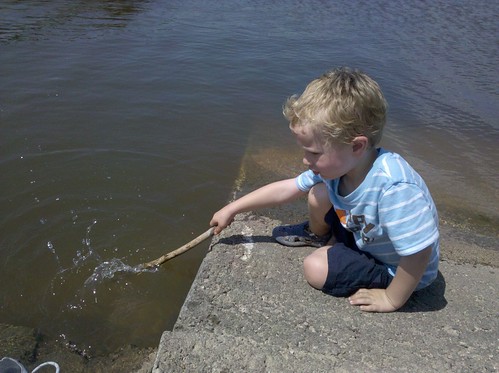
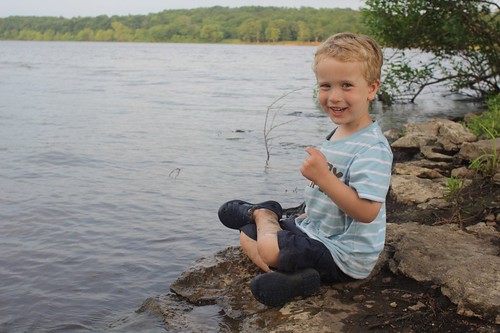
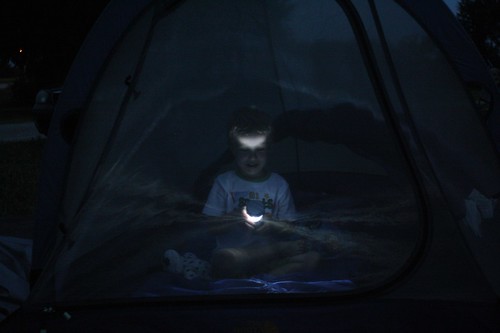
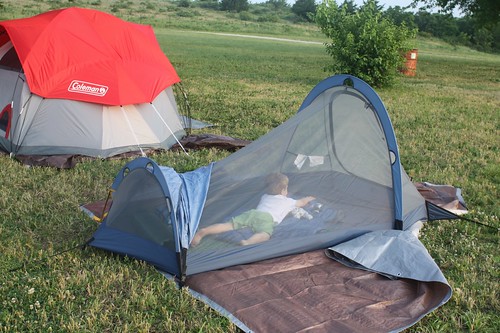
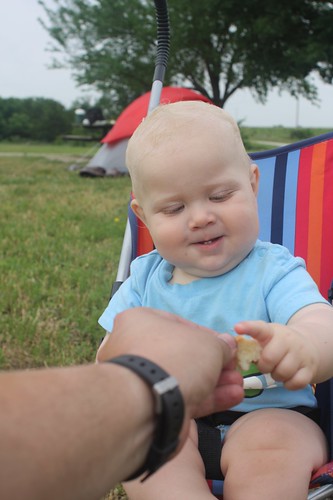
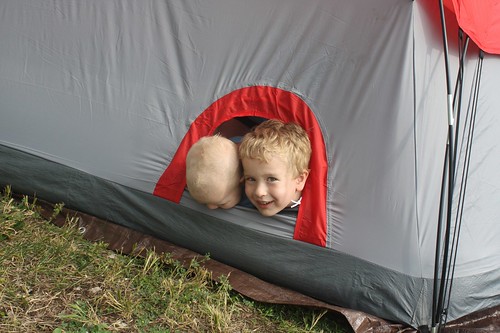
Friday I took the day off for us to go camping. Due to the birth of Oliver, our last time camping was in 2008. Back then, Terah had asked me what I wanted for father s day, and I suggested camping. Except when she was pregnant last year (and then Oliver was little), we have sort of had a standing plan to go camping twice a year: around father s day and my birthday. She says that s way more camping in a year than anyone needs. Anyhow, Jacob doesn t remember the last time we went camping; he was not quite 2 at the time. I explained that we would sleep in tents, and he d get one just his size. He laughed at that. Then I explained that he would get a bag to sleep in, and he thought that was hilarious. He kept talking about tents and even more so about sleeping bags until he actually got to be in one. It seems like each time we go camping, we wind up somewhere else. We ve camped at Kanoplis Lake and Marion Park and Lake in the past few years. But this time we went to Cedar Valley Reservoir near Garnett, KS. It was a nice place to be, with some wilderness camping areas far from any RV hookups (though right next to a gravel driveway where we could park). Almost as soon as we got out of the car, Jacob found a partially-burned stick left in a fire ring. So of course his hands were black pretty quick. He kept track of that stick the whole time we were there, and used it for everything he could think of. His favorite use, though, was at the lake to splash water: 2010-06-11 15.20.21.jpg The lake really was his favorite feature. He loved to throw rocks and sticks in it with me, to splash himself, and to stick his feet in. Oh, and to splash me. IMG_4057.JPG The pier was also a great thing for him he at first thought it was a boat, then really wanted to go. I made him hold my hand the whole time, and he liked walking on it. But he was frustrated that he couldn t reach the water. Somehow, Jacob acted as if he could sit in the hot sun for hours, just making small splashes with a stick. I, on the other hand, felt the 90-degree heat strongly, and eventually we found a shady spot to play in the lake. Oliver enjoyed crawling around on a blanket or on the grass. Though Terah put a stop to that after she noticed that he came across a pile of fish heads and was about to reach for one and put it in his mouth. We cooked over a campfire Friday night and Saturday morning. It took me a lot longer to start a fire than normal. Part of the problem was that there had been a lot of rain in the area, and it was humid, so there was little kindling to be found. Plenty of larger pieces of wood, so once the fire got going, it burned nicely. We cooked brats, brought along some homemade bread, had grilled foil-wrapped potatoes, and had stir-fry vegetables. Oliver got to eat with us too, of course: IMG_4022.JPG Terah is a big believer in smores, so after supper we made some smores Jacob predictably got sticky from the marshmallows and chocolate. Jacob started asking when I d set up the tent almost as soon as he found his stick. All afternoon he kept asking. Finally we got it set up, and of course he was so excited that he played inside it for an hour before he fell asleep. Terah had bought a $4 lantern at Walmart to give to him to use in his tent. I told him that there would be a surprise lantern in his tent for him to use. And he loved his lantern. It could turn on, off, and flash red. At one point he asked me, Dad, do you have a surprise lantern too? No, I will just use my flashlight. He looked a bit sad about that. For about 5 seconds. Then he turned on his lantern again. Here he is with it, still playing happily about 2 hours after his bedtime: IMG_4100.JPG And in the morning, of course he was still wanting that, but also wanted to play with his digital camera (a kid s version that also has a simple game or two on it). Without leaving the tent, of course. IMG_4105.JPG Oliver was getting hungry while we worked on breakfast, so I gave him some bread to munch on. IMG_4119.JPG We used our cast iron skillet to fry some bacon for breakfast. Then Terah made some pancakes in the skillet (with the bacon grease). Greasiest and best pancakes ever. After that, we had some fried and scrambled eggs. After that, we had more smores (I wasn t kidding about Terah being a big believer in them.) Jacob decided that he wanted to play in the other tent. He enjoyed playing with Terah, Oliver, and the air mattress (that Terah appreciated as much as I thought it took up too much space in the car). There s a little window on the back that can open to a screen or open completely. Jacob and Oliver enjoyed looking out of it while open. Or rather, Jacob enjoyed that, while Oliver enjoyed licking it. IMG_4161.JPG I had my Droid with me to keep an eye on the weather. The forecast for several days had called for a 20% chance of storms on Saturday. I checked Saturday morning at 7, and it still called for 20% chance of storms after 1PM. We decided we d pack up our tents after breakfast so we could stay as long as we liked or leave on short notice if we preferred. Clouds seemed to be building, though, so I checked the forecast again at maybe 9. Now it called for 60% chance of thunderstorms and heavy rain before 1PM. Guess I shouldn t have been surprised; it is Kansas after all. As I had the first tent about 90% put away, it started to rain. We rushed to get the rest of the stuff in the car, and by the time we did, it was raining heavily. We had planned to spend at least part of the afternoon there, but decided we d look for another place to stop on the way home. We stopped first at Garnett s North Lake, as the rain had let up for awhile. We spotted a fishing pier that Jacob wanted to walk on, but the bridge out to it was underwater, so we passed on that. While Terah fed Oliver in a shelter, Jacob and I played on some swings. Then we walked down to that lake. Jacob carefully came to an abrupt stop and looked both ways at each disused road between us and the lake, saying OK when it was clear to go. The rain picked up again, so we started heading towards home. It got quite heavy, with thunder and everything, which Jacob didn t care for at all. Both boys went to sleep, though. We stopped at Marion Reservoir on the way home. Jacob hadn t been able to play in the lake at Garnett (the place we stopped had a bank that was too steep) and so we played there. He waded into the water at the swimming area, and predictably enjoyed yes throwing rocks into the lake. When we got home, I set out the wet tent and tarps (it s not good to store that stuff wet) to dry there hadn t been rain at home yet. Camping s a lot of work, but it was a good family activity. I m looking forward to our next time, and hope we can choose a weekend a little less hot and damp.
7 June 2010

John Goerzen: Boys

Yesterday afternoon, it was nice outside. Terah, Jacob, Oliver, and I went outside. I had my camera to take photos while Jacob and Oliver mostly played. We did try to pose them a bit, but the overall plan was to just take some photos of them doing their own thing. So I wound up taking 824 photos. Hurray for digital cameras. We narrowed that down to a few of our favorites, which you can view as a slideshow. I ll highlight few of those below. IMG_3926.JPG
Jacob walking down the drive way, gazing at all the beans coming up off in the distance IMG_3910.JPG
Hmm, Oliver, let me see too IMG_3823.JPG
Running is fun! IMG_3818.JPG
Peek-a-boo IMG_3802.JPG
Goerzen s Law of Child Photography: If you attempt to get them to pose, a minimum of one boy will have a weird expression at any given time. IMG_3763.JPG
Also, chances are good that a cat will sneak in and also do something. IMG_3710.JPG
My imagined conversation for this one: Here Oliver, this is how you use a piece of bark. Quiet, I m trying to eat this grass. IMG_3718.JPG
Oliver decides that grass stuck on his teeth isn t fun IMG_3684.JPG
No explanation for this one. IMG_3644.JPG
Classic brothers. Jacob is using a piece of bark to mess around in some dirt, while Oliver quietly learns how to do it. He never said it, but I can easily imagine him saying, Here Oliver, here s what you do with bark: you dig up dirt like this! It s funny! IMG_3619.JPG
BONZAI!!! IMG_3580.JPG
Guess I better watch where I point that camera IMG_3477.JPG
Here kitty get ready for some more petting *thwack* Strangely the cat seemed to love it. Our other cat avoids Oliver. IMG_3404.JPG
Jacob deriving a great deal of joy from telling us that his shirt says big SPIDER . He came up with that joke himself and thought it was hilarious. IMG_3366.JPG
This is one of a few photos of Jacob wearing a suit that I once wore. IMG_3292.JPG
It s hard to stand still when the hammock has a great train whistle on it. IMG_3241.JPG
I have no idea what he s planning here. But really, I think I should be afraid. IMG_3191.JPG
It s a fridge door. Yay?

4 June 2010

John Goerzen: Hardware/Machine Reporting Tools

We have a tool at work, Kaseya, for our Windows machines. It handles updates, but also can report back information gathered from them: OS version, patches installed, time since last checkin, last user logged in, user most frequently logged in, plus details about hardware: RAM, disk size, serial number, etc. I m looking for a tool that can do this on Linux as well. Of course, we could roll our own; all the above is readily cleaned from standard commands plus examining /proc and /sys. But before we roll our own, we want to be sure there s nothing else out there worth using. Down the road, we might also like it to grow in another direction: centralized configuration, storing links between machines and people in a database, and generating DNS, DHCP, etc. configurations out of it. Whether that would be the same tool as this is another question. There are, of course, expensive and overkilling well-known commercial packages to do this. We re after something simple that gets the job done. Any ideas?

25 May 2010

John Goerzen: Free-Range Kids: A Parental Rant

There s a lot of unreasonable panic out there these days. Parents that don t want to let their kids even walk to the mailbox because of an irrational fear of abduction. (Children are more likely to die falling out of bed than be abducted, and before anyone panics, that s also exceptionally rare.) A woman that let her 11-year-old travel unaccompanied on the NYC subway he d been riding all his life unleashed a huge controversy. And there s also this maddening tendency for some parents to be so worried about wounding their children s self-esteem that they never want to say they ve done something wrong, and be so positive to them. Recent studies, as well as common sense, suggest that both attitudes are rather harmful. Terah and I are believers in letting children have cheap mistakes . If I see Jacob running through the kitchen about to trip over a toy he left out, I probably won t say anything. Him crashing to the floor after running on it won t even hurt him enough that he ll cry, but it will probably be far more effective at teaching safety than 20 days worth of me saying no running in the kitchen. Of course, we ll provide comfort for him when he s sad and be there to support him, but also give him more and more freedom to succeed or fail as he grows. This starts even younger. When he first started feeding himself, he got into this habit of throwing food on the floor. We had some natural consequences as a result. If his supper landed on the floor, then he would be all done eating. (Note: Jacob was always on the heavy side at that age anyway.) He couldn t reach his supper on the floor, and we weren t going to keep bending over to pick it up for him. Fixed that problem pretty quickly at least until he learned that he could wait until he was pretty full before throwing his food down on the floor (at which point we added a brief time-out). Or how about our reaction when he has mistakes. When he breaks something, whether accidentally or on purpose, we don t give him some sort of affirmation like Oh, that s OK, we can fix it or good try; you ll do better next time. It is NOT OK to rip the pull-up flaps out of a book or to stomp on those peas you dropped on the floor, and there will be predictable and reasonable consequences for doing so. As a result, when he does a good job, it ll mean more. He, at 3, has started sounding out letters, knows his alphabet, and can count to about 15 in English and about 3 in German. And those are things we give him a good job about. Two of the best things we can do for our children are: 1) be honest about their successes and failures; and 2) give them room to succeed and room to fail, so they can learn from both while the consequences mean a skinned knee or broken toy instead of a broken rib or foreclosure on a mortgage. The Free Range Kids FAQ makes excellent reading, and discusses how many of today s parents grew up enjoying this kind of freedom, and for various reasons are too scared to allow their children that today. Rather sad, really, especially given that today s world is safer.

21 May 2010

John Goerzen: Bicycling in Rain and Mud

I recently posted here about bicycling in the mud and rain, and got some good suggestions (and also on the icebike mailing list). I eventually decided to replace my current bike (Trek 7.3FX) with a Specialized Tricross Sport Triple. As I mentioned in the bike store, it seems odd to spend this kind of money on a bike only to ride it through mud and sand. Another customer overheard and said, It sure does but don t worry, it ll be fine! But on the other hand, I figure that it is probably realistic for me to ride it around 3600 miles (5793 km) per year. At that rate, it will pay for itself in reduced car costs in about a year. I picked it up last Friday, and on Saturday moved my accessories (headlight mount, tail light, water bottle cage, etc.) to it. The Bontrager Back Rack I from the 7.3FX did not fit well, so I ordered the Specialized Tricross Rack Set, which did fit well (I m not using the front rack though). This has been a wet week. I rode Thursday when it had stopped raining about 20 minutes before I left in the morning, and we got more rain in the afternoon. Although both the Tricross and the 7.3FX have 700 32C tires, even the factory tires on the Tricross performed far better in mud than the 7.3FX ever did and I can still go much more wide if I feel it necessary. Actually, somewhat to my surprise, I didn t really have a problem with kicking up mud; my enemy turned out to be kicking up sand. It didn t really damage anything, and I had to try not to cringe as I saw the sand hitting the chain, etc. I rinse it off when I get to my destination, and clean/lubricate the chain frequently in these conditions. I haven t yet been on the bike during an active rain, but from what I ve done so far, I think it will be fine. So at this point, there s very little that will prevent me from riding.

19 May 2010

John Goerzen: Time to learn a new language

I have something of an informal goal of learning a new programming language every few years. It s not so much a goal as it is something of a discomfort. There are so many programming languages out there, with so many niches and approaches to problems, that I get uncomfortable with my lack of knowledge of some of them after awhile. This tends to happen every few years. The last major language I learned was Haskell, which I started working with in 2004. I still enjoy Haskell and don t see anything displacing it as my primary day-to-day workhorse. Yet there are some languages that I d like to learn. I have an interest in cross-platform languages; one of my few annoyances with Haskell is that it can t (at least with production quality) be compiled into something like Java bytecode or something else that isn t architecture-dependent. I have long had a soft spot for functional languages. I haven t had such a soft spot for static type checking, but Haskell s type inference changed that for me. Also I have an interest in writing Android apps, which means some sort of Java tie-in would be needed. Here are my current candidates: Of some particular interest to me is that Haskell has interpreters for Scheme, Lua, and JavaScript as well as code generators for some of these languages (though not generic Haskell-to-foo compilers). Languages not in the running because I already know them include: OCaml, POSIX shell, Python, Perl, Java, C, C++, Pascal, BASIC, Common Lisp, Prolog, SQL. Languages I have no interest in learning right now include Ruby (not different enough from what I already know plus bad experiences with it), any assembly, anything steeped in the Microsoft monoculture (C#, VB, etc.), or anything that is hard to work with outside of an Emacs or vim environment. (If your language requires or strongly encourages me to use your IDE or proprietary compiler, I m not interested that means you, flash.) Brief Reivews of Languages I Have Used To give you a bit of an idea of where I m coming from:

13 May 2010

John Goerzen: Bicycling Update

I ve been bicycling to work for awhile now. It s become pretty much routine for dry days. I can reliably ride the 10 miles to work in less than an hour, even with heavy winds. My biggest enemy right now: rain. My first few miles are on gravel and sand roads, which aren t maintained to the highest of standards. When it rains, there will be mud. I ride a Trek 7.3FX, which I bought with the idea of just riding when it s dry. It works quite well for that. But its slick tires don t work so well in mud. Plus our mud is sticky, and the tires pick it up, then deposit it on the frame that goes around the wheel and the brake arm. So I have a mess to clean up. My current dilemma is: do I buy a second bike for use when it s wet, or there s a chance of rain? My 7.3FX can t use tires that are very wide, and a different bike of course could. There would be expense involved, obviously, but I would really like to be able to ride more often than I can now. Winter was pretty damp here and I didn t get to ride much at all over the winter months. Or, would different tires plus fenders do the trick on the 7.3FX? (I m thinking not.) If I do get a different bike, then the question would be whether to sell the 7.3FX. I really like that bike, and imagine it would be faster on the 7 miles or so of paved roads that I ride every day. Perhaps I d keep it as a fair weather or long-distance bike. I plan to visit the bike shop tonight and see what my options are.

29 April 2010

John Goerzen: Some More Gopher Data

Yesterday, I invited you to download a piece of Internet history. Today I have unearthed a bit more data to add to it. There is a new torrent with 1.5GB more data (3GB uncompressed). This includes the FTP site from boombox.micro.umn.edu/pub/gopher, which was a large collection of Gopher client and server software. Also included was ftp.unicom.com/pub/gn-tools, the old GN server, and wiretap.area.com. This last site was mirrorable via FTP, and included the UMN Gopherd .cap and .Links files, so it can be served up via PyGopherd. The full contents are available in my post to the Gopher mailing list. Incidentally, thank you to everyone that has helped seed, download, store, host, and otherwise preserve the 2007 archive. It is much appreciated. I have contacted several institutions recommended to me in comments or emails to try to arrange a stable long-term home for the data. Enjoy.

28 April 2010

John Goerzen: Download A Piece of Internet History

Back in the early 1990s, before there was a World Wide Web, there was the Internet Gopher. It was a distributed information system in the same sense as the web, but didn t use hypertext and was text-based. Gopher was popular back then, as it made it easy to hop from one server to the next in a way that FTP didn t. Gopher has hung on over the years, and is still clinging to life in a way. Back in 2007, I was disturbed at the number of old famous Gopher servers that had disappeared off the Internet without a trace. Some of these used to be known by most users of the Internet in the early 90s. To my knowledge, no archive of this data existed. Nobody like archive.org had ever attempted to save Gopherspace. So I decided I would. I wrote Gopherbot, a spidering archiver for Gopherspace. I ran it in June 2007, and saved off all the documents and sites it could find. That saved 40GB of data, or about 780,000 documents. Since that time, more servers have died. To my knowledge, this is the only comprehensive archive there is of what Gopherspace was like. (Another person is working on a new 2010 archive run, which I m guessing will find some new documents but turn up fewer overall than 2007 did.) When this was done, I compressed the archive with tar and bzip2 and split it out to 4 DVDs and mailed copies to a few people in the Gopher community. Recently, we ve noted that hard disk failures have hobbled a few actually maintained Gopher sites, so I read this archive back in and posted it on BitTorrent. If you d like to own a piece of Internet history, download the torrent file and go to town (and please stick around to seed if you can). This is 15GB compressed, and also includes a rare video interview with two of the founders of Gopher. There are some plans to potentially host this archive publicly in the manner of archive.org; we ll have to wait and see if anything comes of it. Finally, I have tried to find a place willing to be a permanent host of this data, and to date have struck out. If anybody knows of such a place, please get in touch. I regret that so many Gopher sites disappeared before 2007, but life is what it is, and this is the best snapshot of the old Gopherspace that I m aware of and would like to make sure that this piece of history is preserved.

20 April 2010

John Goerzen: Moral obligations of Free Software authors?

I ve got a bit of a problem. I enjoy writing software. I often write software to solve some sort of problem that I ve had. Usually virtually any code I write winds up in my git repositories, on the theory that it might be useful to someone else. Some of the code that I think might really be useful to people gets even better treatment. OfflineIMAP, for instance, has a very comprehensive manpage, heavily commented example config file, wiki, mailing list, public bug tracker, etc. Most of these I did the majority of the work to create, but OfflineIMAP does occasionally receive code and documentation contributions from others. Now here s my dilemma. For my purposes, OfflineIMAP is, well, finished. It does everything I ever wanted it to do, and does it better than I ever expected it would. There are some people that would like it to do other things; for instance, optimize performance for IMAP folders with 100,000 messages in them, do UTF-8 folder name translation, and retry a sync if a connection is lost rather than crash (OfflineIMAP was designed to crash gracefully and be automated, so this has never bothered me.) None of these are features that I care about, and I don t have much time to devote to OfflineIMAP these days. It is not an interesting problem to me anymore as, well, I ve solved it already. Yet I ll be honest and say I feel guilty about the bug reports that are stacking up in the OfflineIMAP bug tracking system. OfflineIMAP is used by people that have an expectation for improvement. My efforts to hand over maintainership of OfflineIMAP have failed (the people have gone AWOL shortly after agreeing to maintain it). This problem is even more acute for hpodder, my command-line podcatcher. hpodder works great and is simple. But I no longer listen to podcasts. At all. (I blame my Kindle for that.) Therefore I no longer even use hpodder. Again, I feel guilty for not working on it; for instance, when language changes broke its UTF-8 support, I haven t gone in to fix it. Neither has anybody else, for that matter. This leads me to a dilemma. If I do nothing with my code but toss it on git.complete.org, few people will benefit from it. Most people need documentation, packages for their distribution, etc. git repos don t tend to show up highly in search engines. So, although technically I ve shared things with the world by putting them there, practically speaking I haven t done people many favors. On the other hand, if I go the whole responsible maintainer route, writing documentation, wiki, mailing list, Debian packages, etc., then I have the problem of, well, actual users who want actual support. I feel bad if I m not in a position to give it to them. Many people seem to have the expectation that software is never finished and will continue to be improved. (Ah, if only my name were Knuth I might stand a chance to evade that one. But only a chance, given all the TeX spinoffs.) This expectation, in turn, reduces my enthusiasm for publishing my code online as Free Software. Because now I can t just toss it up there and say help yourselves . Now I get angry emails about all the bug reports piling up. On the other hand, I also get occasional small contributions via my PayPal tip jar , which are awesome and motivating. Despite my grumbling, I do continue to maintain OfflineIMAP, primarily as a patch reviewer these days. I take an aggressive stance on quality, and when I get patches that add features without documentation, I usually write documentation for them before committing them. If I have evidence that a patch hurts quality, I yank it (as I had to do with IDLE support, which was a great feature, but the patch caused all sorts of stability problems due to its requirement of imaplib2.py). For that reason, I suspect, forks haven t taken off. So what s a person that writes niche software to do? OfflineIMAP isn t at the level of popularity of something like Gnome, or even debhelper, and never will be; its userbase consists of people that think that IMAP support in $MUA isn t good enough. hpodder is the somewhat small domain of console-loving podcast listeners. What are your suggestions? Should I abolish the bug trackers and just go for simple? Is there something more I could be doing to make the community feel more empowered? Is simple posting on git.complete.org not as bad as I thought?

11 April 2010

John Goerzen: Final comments on our trip to Europe

I wrote a lot about our trip to Europe here, and I had a few more comments to share. I had a great time there. It was fun to stay with people, and it was also fun to explore cities on our own. I am eager to be able to go back. Communication
I ll admit I wasn t sure how I d do there. I speak only a little German, and no Czech at all. I have never been in a situation in which I don t speak the dominant language, and this is probably typical for Americans. (I m not going to count the few exceptions of eating at small Mexican restaurants in the USA where the staff speaks little English, as it s not really the same experience to be in that situation for an hour or two.) I was most apprehensive about our time in Berlin and Prague. In those cities, we didn t know anyone. And, although I speak a little German, I speak no Czech at all. In the end, though, it all worked out fine. I never saw anyone get frustrated with us for our lack of language knowledge, and we also never got rattled. With patience and a bit of ingenuity, we figured things out in every different situation. I feel a sense of accomplishment from that, and I think it s left me more ready to travel in the future. And, I d also have to say, that was one of the most interesting lessons of the trip: how two people that don t share a common language can still communicate. It might be slow, but it s also rewarding and easier than I might ever have thought. I remember particularly buying a couple of fragile carved wood souvenirs at the Zeidler Holzkunst (wood art) shop in the Altes Rathaus in Leipzig (Seiffener Volkskunsterzeugnisse was on the window). The shopkeeper spoke no English. We were interested in some rather fragile items, and I wanted to ask her if she could pack it in a box. I didn t know the German words for pack or box . So after a couple seconds thought, I realized I knew how to tell her, in German, that we re from America. And then I asked, Can you? (in German) and gestured for a square box, figuring maybe she d put it together that we d need to pack it well to take it home with us. Success. She quickly produced a box, and asked if that s what we wanted. A few minutes later, a bit of pointing towards the glass case communicated what we wanted to buy. It took a little longer than it would have from someone that spoke English, but this was more rewarding in the end. The train station in Prague was another challenge. It didn t have nearly as much English signage as other train stations we d been in. We did a little wondering around, and some educated guesses, and a brief English conversation in a bank, we eventually found an ATM, a place to change the big bills for smaller ones, and a Metro ticket shop that was open. Clothes Many Americans, and American travel books, suggest not wearing jeans and tennis shoes in Europe. Many commented that people dressed more formally in Europe. That advice appeared to be rather wrong, especially in L beck, where it appeared that many people dressed less formally than in the USA. As we went south and east, we saw fewer jeans, but still they were rather common. Our biggest blunder here was probably the shoes that we brought for Terah. She brought some shoes that looked nice, but weren t very good for walking. She wound up with some painful blisters on her feet, and wished she had just brought her regular tennis shoes. Luggage and Packing We try to travel light when we can. All of our luggage for the entire trip fit into two carryon-size suitcases, though we sometimes separated some items out into a backpack for ease of use in airports/airplanes. This worked out about right. We did laundry once in Germany so we didn t have to pack enough clothes for the entire trip. As far as electronics go, we brought along an international GSM phone from onesimcard.com, my Droid (which could use Wifi but not GSM), Terah s iPod Touch, a GPS, my digital camera, and a laptop. That also was about right. We used the Droid to call back to Indiana to check on the boys, using SIP over WiFi for free calling via Google Voice. The laptop is a small one, so didn t add a lot of weight or bulk. It was nice to have to check out maps and Facebook. The GPS was somewhat less useful than I had anticipated. I had pre-loaded it with street-level maps of most of Europe, and also put on it points in Berlin that had been suggested to us. The transit maps were really more useful most places, especially when combined with a detailed street-level map. In Berlin, though, the detail on the street-level map from our hotel was somewhat lacking, so the GPS came in handy. It was also nice to quickly be able to see where the nearest S-Bahn and U-Bahn stops were, then cross-referencing with our transit map to figure out how to get where we wanted to go. One night in Leipzig, after a concert at the Gewandhaus, we made a couple of wrong turns on our way to a tram stop. The GPS would have saved us 15 minutes of walking had we brought it along, but we figured it out with our street map and it wasn t really a problem. Rick Steves is a big advocate of money belts when traveling. These are a belt with a zippered pouch, and are worn under your pants (though over your shirt, if it s tucked in). The idea is that it s hard to pickpocket. He suggests having a days worth of cash in a front pocket, and passports and larger bills in the money belt. We brought one but never used it. I kept small cash in my pocket, and we kept passports and my wallet (with larger bills) in Terah s purse, which was on a strap around her neck, zippered shut, and held under her arm. We had no problems. I tend not to keep my wallet in my back pocket even when traveling in the USA. Also, the hotels we stayed in had safes, and the residences were of course plenty safe, so we had no problem leaving valuables there. I brought only a single lens for my Digital Rebel XTi, a 28mm fixed lens that is small and light. That was just fine, and I was happy to have a fixed lens for photography in dark churches. Also, I wouldn t have wanted to carry around a bulky zoom lens all over. We sometimes took the camera with us, and sometimes not. In Berlin in particular, we just left it in the hotel room. I figured (correctly) that there would be plenty of photos on Flickr of the sites we were visiting, and we could just enjoy the time a little better if we weren t worrying about a camera too. But I was glad to have it along. Transportation The transportation systems in the cities we visited felt more, well, balanced than they often are in the USA. It s not that there weren t busy car-filled avenues, but more that there were also quiet shopping streets where cars were banned. Cars often seemed to be more of an option than a necessity, and not always the best option at that. Public transportation was common, as were pedestrian routes and bicycle lanes. The only American city I ve visited that felt even close to this approach was Portland, OR. I wish we adopted it more often here. I also admire the German intercity rail service, operated by Deutsche Bahn. You can get all over the country pretty quickly. The trains we rode on were quiet, smooth, and timely. I wish we had that kind of service in more parts of the USA.

Next.

Previous.