Search Results: "Dirk Eddelbuettel"

22 February 2023

Dirk Eddelbuettel: RcppArmadillo 0.12.0.1.0 on CRAN: New Upstream, New Features

armadillo image Armadillo is a powerful and expressive C++ template library for linear algebra and scientific computing. It aims towards a good balance between speed and ease of use, has a syntax deliberately close to Matlab, and is useful for algorithm development directly in C++, or quick conversion of research code into production environments. RcppArmadillo integrates this library with the R environment and language and is widely used by (currently) 1042 other packages on CRAN, downloaded 28.1 million times (per the partial logs from the cloud mirrors of CRAN), and the CSDA paper (preprint / vignette) by Conrad and myself has been cited 513 times according to Google Scholar. This release brings a new upstream release 12.0.1. We found a small regression with the 12.0.0 release when we tested prior to a CRAN upload. Conrad very promptly fixed this with a literal one liner and made it 12.0.1 which we wrapped up as 0.12.0.1.0. Subsequent testing revealed no issues for us, and CRAN autoprocessed it as I tweeted earlier. This is actually quite impressive given the over 1000 CRAN packages using it all of which got tested again by CRAN. All this is testament to the rigour, as well as the well-oiled process at the repository. Our thanks go to the tireless maintainers! The releases actually has a rather nice set of changes (detailed below) to which we added one robustification thanks to Kevin. The full set of changes follows. We include the previous changeset as we may have skipped the usual blog post here.

Changes in RcppArmadillo version 0.12.0.1.0 (2023-02-20)
  • Upgraded to Armadillo release 12.0.1 (Cortisol Profusion)
    • faster fft() and ifft() via optional use of FFTW3
    • faster min() and max()
    • faster index_min() and index_max()
    • added .col_as_mat() and .row_as_mat() which return matrix representation of cube column and cube row
    • added csv_opts::strict option to loading CSV files to interpret missing values as NaN
    • added check_for_zeros option to form 4 of sparse matrix batch constructors
    • inv() and inv_sympd() with options inv_opts::no_ugly or inv_opts::allow_approx now use a scaled threshold similar to pinv()
    • set_cout_stream() and set_cerr_stream() are now no-ops; instead use the options ARMA_WARN_LEVEL, or ARMA_COUT_STREAM, or ARMA_CERR_STREAM
    • fix regression (mis-compilation) in shift() function (reported by us in #409)
  • The include directory order is now more robust (Kevin Ushey in #407 addressing #406)

Changes in RcppArmadillo version 0.11.4.4.0 (2023-02-09)
  • Upgraded to Armadillo release 11.4.4 (Ship of Theseus)
    • extended pow() with various forms of element-wise power operations
    • added find_nan() to find indices of NaN elements
    • faster handling of compound expressions by sum()
  • The package no longer sets a compilation standard, or progagates on in the generated packages as R ensures C++11 on all non-ancient versions
  • The CITATION file was updated to the current format

Courtesy of my CRANberries, there is a diffstat report relative to previous release. More detailed information is on the RcppArmadillo page. Questions, comments etc should go to the rcpp-devel mailing list off the R-Forge page. If you like this or other open-source work I do, you can sponsor me at GitHub.

This post by Dirk Eddelbuettel originated on his Thinking inside the box blog. Please report excessive re-aggregation in third-party for-profit settings.
2 February 2023

Dirk Eddelbuettel: RInside 0.2.18 on CRAN: Maintenance

A new release 0.2.18 of RInside arrived on CRAN and in Debian today. This is the first release in ten months since the 0.2.17 release. RInside provides a set of convenience classes which facilitate embedding of R inside of C++ applications and programs, using the classes and functions provided by Rcpp. This release brings a contributed change to how the internal REPL is called: Dominick found the current form more reliable when embedding R on Windows. We also updated a few other things around the package. The list of changes since the last release:

Changes in RInside version 0.2.18 (2023-02-01)
  • The random number initialization was updated as in R.
  • The main REPL is now running via 'run_Rmainloop()'.
  • Small routine update to package and continuous integration.

My CRANberries also provides a short report with changes from the previous release. More information is on the RInside page. Questions, comments etc should go to the rcpp-devel mailing list off the Rcpp R-Forge page, or to issues tickets at the GitHub repo. If you like this or other open-source work I do, you can now sponsor me at GitHub.

This post by Dirk Eddelbuettel originated on his Thinking inside the box blog. Please report excessive re-aggregation in third-party for-profit settings.

31 January 2023

Dirk Eddelbuettel: #39: Faster Feedback Systems A Continuous Integration Example

Welcome to the 39th post in the relatively randomly recurring rants, or R4 for short. Today s post picks up where the previous post #38: Faster Feedback Systems started. As we argued in #38, the need for fast feedback loops is fairly universal and widespread. Fairly shortly after we posted #38, useR! 2022 happened and one presentation had the key line
Waiting 1-24 minutes for a build to finish can be a massive time suck.
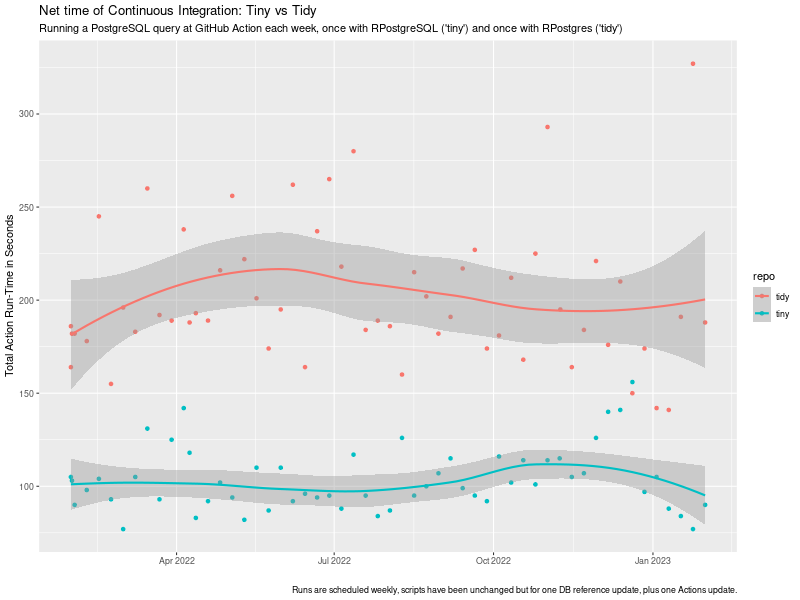
which we would like to come back to today. Furthermore, the unimitable @b0rk had a fabulous tweet just weeks later stating the same point debugging strategy: shorten your feedback loop as a key in a successful debugging strategy. So in sum: shorter is better. Nobody likes to wait. And shorter i.e. faster is a key and recurrent theme in the R4 series. Today we have a fairly nice illustration of two aspects we have stressed before: The combined effects can be staggering as we show below. The example is motivated by a truly surprising (we are being generous here) comment we received as an aside when discussing the eternal topic of whether R users do, or do not, have a choice when picking packages, or approaches, or verses. To our surprise, we were told that packages are not substitutable . Which is both demonstrably false (see below) and astonishing as it came from an academic. I.e. someone trained and paid to abstract superfluous detail away and recognise and compare core features of items under investigation. Truly stunning. But I digress. CRAN by now has many packages, slowly moving in on 20,000 in total, and is a unique success we commented-on time and time before. By now many packages shadow or duplicate each other, reinvent one another, or revise/review. One example is the pair of packages accessing PostgreSQL databases. There are several, but two are key. The older one is RPostgreSQL which has been around since Sameer Kumar Prayaga wrote it as a Google Summer of Code student in 2008 under my mentorship. The package has now been maintained well (if quietly) for many years by Tomoaki Nishiyama. The other entrant is more recent, though not new, and is RPostgres by Kirill M ller and others. We will for the remainder of this post refer to these two as the tiny and the tidy version as either can been as being a representative of a certain verse . The aforementioned comment on non-substitutability struck us as eminently silly, so we set out to prove just how absurd it really is. So about a year ago we set up pair of GitHub repos with minimal code in a pair we called lim-tiny and lim-tidy. Our conjecture was (and is!) that less is more just as post #34 titled Less Is More argued with respect to package dependencies. Each of the repos just does one thing: a query to a (freely accessible but remote) PostgreSQL database. The tiny version just retrieves a data frame using only the dependencies needed for RPostgreSQL namely DBI and nothing else. The tidy version retrieves a tibble and has access to everything else that comes when installing RPostgres: DBI, dplyr, and magrittr plus of course their respective dependencies. We were able to let the code run in (very default) GitHub Actions on a weekly schedule without intervention apart from one change to the SQL query when the remote server (providing public bioinformatics data) changed its schema slighly, plus one update to the action yaml code version. No other changes. We measure the time a standard continuous integration run takes in total using the default GitHub Action setup in the tidy case (which relies on RSPM/PPM binaries, caching, , and does not rebuild from source each time), and our own r-ci script (introduced in #32 for CI with R. It switched to using r2u during the course of this experiment but already had access to binaries via c2d4u so it is always binaries-based (see e.g. #37 or #13 for more). The chart shows the evolution of these run-times over the course of the year with one weekly run each.
tiny vs tidy ci timing impact chart tiny vs tidy ci timing impact chart
This study reveals a few things: The key point there is that while the net-time to fire off a single PostgreSQL is likely (near-)identical, the net cost of continuous integration is not. In this setup, it is about twice the run-time simply because Less Is More which (in this setup) comes out to about being twice as fast. And that is a valid (and concrete, and verifiable) illustration of the overall implicit cost of adding dependencies to creating and using development, test, or run-time environments. Faster feedback loops make for faster builds and faster debugging. Consider using fewer dependencies, and/or using binaries as provided by r2u.

This post by Dirk Eddelbuettel originated on his Thinking inside the box blog. Please report excessive re-aggregation in third-party for-profit settings.

29 January 2023

Dirk Eddelbuettel: RcppTOML 0.2.2 on CRAN: Now with macOS-on-Intel Builds

Just days after a build-fix release (for aarch64) and still only a few weeks after the 0.2.0 release of RcppTOML and its switch to toml++, we have another bugfix release 0.2.2 on CRAN also bringing release 3.3.0 of toml++ (even if we had large chunks of 3.3.0 already incorporated). TOML is a file format that is most suitable for configurations, as it is meant to be edited by humans but read by computers. It emphasizes strong readability for humans while at the same time supporting strong typing as well as immediate and clear error reports. On small typos you get parse errors, rather than silently corrupted garbage. Much preferable to any and all of XML, JSON or YAML though sadly these may be too ubiquitous now. TOML is frequently being used with the projects such as the Hugo static blog compiler, or the Cargo system of Crates (aka packages ) for the Rust language. The package was building fine on Intel-based macOS provided the versions were recent enough. CRAN, however, aims for the broadest possibly reach of binaries and builds on a fairly ancient macOS 10.13 with clang version 10. This confused toml++ into (wrongly) concluding it could not build when it in fact can. After a hint from Simon that Apple in their infinite wisdom redefines clang version ids, this has been reflected in version 3.3.0 of toml++ by Mark so we should now build everywhere. Big thanks to everybody for the help. The short summary of changes follows.

Changes in version 0.2.2 (2023-01-29)
  • New toml++ version 3.3.0 with fix to permit compilation on ancient macOS systems as used by CRAN for the Intel-based builds.

Courtesy of my CRANberries, there is a diffstat report for this release. More information is on the RcppTOML page page. Please use the GitHub issue tracker for issues and bugreports. If you like this or other open-source work I do, you can sponsor me at GitHub.

This post by Dirk Eddelbuettel originated on his Thinking inside the box blog. Please report excessive re-aggregation in third-party for-profit settings.

26 January 2023

Dirk Eddelbuettel: RcppTOML 0.2.1 on CRAN: Small Build Fix for Some Arches

Two weeks after the release of RcppTOML 0.2.0 and the switch to toml++, we have a quick bugfix release 0.2.1. TOML is a file format that is most suitable for configurations, as it is meant to be edited by humans but read by computers. It emphasizes strong readability for humans while at the same time supporting strong typing as well as immediate and clear error reports. On small typos you get parse errors, rather than silently corrupted garbage. Much preferable to any and all of XML, JSON or YAML though sadly these may be too ubiquitous now. TOML is frequently being used with the projects such as the Hugo static blog compiler, or the Cargo system of Crates (aka packages ) for the Rust language. Some architectures, aarch64 included, got confused over float16 which is of course a tiny two-byte type nobody should need. After consulting with Mark we concluded to (at least for now) simply override this excluding the use of float16 . The short summary of changes follows.

Changes in version 0.2.1 (2023-01-25)
  • Explicitly set -DTOML_ENABLE_FLOAT16=0 to permit compilation on some architectures stumbling of the type.

Courtesy of my CRANberries, there is a diffstat report for this release. More information is on the RcppTOML page page. Please use the GitHub issue tracker for issues and bugreports. If you like this or other open-source work I do, you can sponsor me at GitHub.

This post by Dirk Eddelbuettel originated on his Thinking inside the box blog. Please report excessive re-aggregation in third-party for-profit settings.

22 January 2023

Dirk Eddelbuettel: Rcpp 1.0.10 on CRAN: Regular Update

rcpp logo The Rcpp team is thrilled to announce the newest release 1.0.10 of the Rcpp package which is hitting CRAN now and will go to Debian shortly. Windows and macOS builds should appear at CRAN in the next few days, as will builds in different Linux distribution and of course at r2u. The release was prepared a few days ago, but given the widespread use at CRAN it took a few days to be processed. As always, our sincere thanks to the CRAN maintainers Uwe Ligges and Kurt Hornik. This release continues with the six-months cycle started with release 1.0.5 in July 2020. As a reminder, we do of course make interim snapshot dev or rc releases available via the Rcpp drat repo and strongly encourage their use and testing I run my systems with these versions which tend to work just as well, and are also fully tested against all reverse-dependencies. Rcpp has become the most popular way of enhancing R with C or C++ code. Right now, around 2623 packages on CRAN depend on Rcpp for making analytical code go faster and further, along with 252 in BioConductor. On CRAN, 13.7% of all packages depend (directly) on CRAN, and 58.7% of all compiled packages do. From the cloud mirror of CRAN (which is but a subset of all CRAN downloads), Rcpp has been downloaded 67.1 million times. This release is incremental as usual, preserving existing capabilities faithfully while smoothing our corners and / or extending slightly. Of particular note is the now fully-enabled use of the unwind protection making some operations a little faster by default; special thanks to I aki for spearheading this. Kevin and I also polished a few other bugs off as detailed below. The full list of details follows.

Changes in Rcpp release version 1.0.10 (2023-01-12)
  • Changes in Rcpp API:
    • Unwind protection is enabled by default (I aki in #1225). It can be disabled by defining RCPP_NO_UNWIND_PROTECT before including Rcpp.h. RCPP_USE_UNWIND_PROTECT is not checked anymore and has no effect. The associated plugin unwindProtect is therefore deprecated and will be removed in a future release.
    • The 'finalize' method for Rcpp Modules is now eagerly materialized, fixing an issue where errors can occur when Module finalizers are run (Kevin in #1231 closing #1230).
    • Zero-row data.frame objects can receive push_back or push_front (Dirk in #1233 fixing #1232).
    • One remaining sprintf has been replaced by snprintf (Dirk and Kevin in #1236 and #1237).
    • Several conversion warnings found by clang++ have been addressed (Dirk in #1240 and #1241).
  • Changes in Rcpp Attributes:
    • The C++20, C++2b (experimental) and C++23 standards now have plugin support like the other C++ standards (Dirk in #1228).
    • The source path for attributes received one more protection from spaces (Dirk in #1235 addressing #1234).
  • Changes in Rcpp Deployment:
    • Several GitHub Actions have been updated.

Thanks to my CRANberries, you can also look at a diff to the previous release. Questions, comments etc should go to the rcpp-devel mailing list off the R-Forge page. Bugs reports are welcome at the GitHub issue tracker as well (where one can also search among open or closed issues); questions are also welcome under rcpp tag at StackOverflow which also allows searching among the (currently) 2932 previous questions. If you like this or other open-source work I do, you can sponsor me at GitHub.

This post by Dirk Eddelbuettel originated on his Thinking inside the box blog. Please report excessive re-aggregation in third-party for-profit settings.

Dirk Eddelbuettel: BH 1.81.0-1 oon CRAN: New Upstream, New Library, sprintf Change

Boost Boost is a very large and comprehensive set of (peer-reviewed) libraries for the C++ programming language, containing well over one hundred individual libraries. The BH package provides a sizeable subset of header-only libraries for (easier, no linking required) use by R. It is fairly widely used: the (partial) CRAN mirror logs (aggregated from the cloud mirrors) show over 32.6 million package downloads. Version 1.81.0 of Boost was released in December following the regular Boost release schedule of April, August and December releases. As the commits and changelog show, we packaged it almost immediately and started testing following our annual update cycle which strives to balance being close enough to upstream and not stressing CRAN and the user base too much. The reverse depends check revealed about a handful of packages requiring changes or adjustments which is a pretty good outcome given the over three hundred direct reverse dependencies. So we opened issue #88 to coordinate the issue over the winter break during which CRAN also closes (just as we did before), and also send a wider PSA tweet as a heads-up. Our sincere thanks to the two packages that already updated, and the four that likely will soon. Our thanks also to CRAN for reviewing the package impact over the last few days since I uploaded the package earlier this week. There are a number of changes I have to make each time in BH, and it is worth mentioning them. Because CRAN cares about backwards compatibility and the ability to be used on minimal or older systems, we still adjust the filenames of a few files to fit a jurassic constraints of just over a 100 characters per filepath present in some long-outdated versions of tar. Not a big deal. We also, and that is more controversial, silence a number of #pragma diagnostic messages for g++ and clang++ because CRAN insists on it. I have no choice in that matter. Next, and hopefully this time only, we also found and replaced a few remaining sprintf uses and replaced them with snprintf. Many of the Boost libraries did that, so I hope by the next upgrade for Boost 1.84.0 next winter this will be fully taken care of. Lastly, and also only this time, we silenced a warning about Boost switching to C++14 in the next release 1.82.0 in April. This may matter for a number of packages having a hard-wired selection of C++11 as their C++ language standard. Luckily our compilers are good enough for C++14 so worst case I will have to nudge a few packages next December. This release adds one new library for url processing which struck us as potentially quite useful. The more detailed NEWS log follows.

Changes in version 1.81.0-1 (2023-01-17)
  • Upgrade to Boost 1.81.0 (#87)
  • Added url (new in 1.81.0)
  • Converted remaining sprintf to snprintf (#90 fixing #89)
  • Comment-out gcc warning messages in three files

Via my CRANberries, there is a diffstat report relative to the previous release. Comments and suggestions about BH are welcome via the issue tracker at the GitHub repo. If you like this or other open-source work I do, you can now sponsor me at GitHub.

This post by Dirk Eddelbuettel originated on his Thinking inside the box blog. Please report excessive re-aggregation in third-party for-profit settings.

21 January 2023

Dirk Eddelbuettel: RcppSimdJson 0.1.9 on CRAN: New Upstream

The RcppSimdJson package was just updated to release 0.1.9. RcppSimdJson wraps the fantastic and genuinely impressive simdjson library by Daniel Lemire and collaborators. Via very clever algorithmic engineering to obtain largely branch-free code, coupled with modern C++ and newer compiler instructions, it results in parsing gigabytes of JSON parsed per second which is quite mindboggling. The best-case performance is faster than CPU speed as use of parallel SIMD instructions and careful branch avoidance can lead to less than one cpu cycle per byte parsed; see the video of the talk by Daniel Lemire at QCon. This release updates the underlying simdjson library to version 3.0.1, settles on C++17 as the language standard, exports a worker function for direct C(++) access, and polishes a few small things around the package and tests. The NEWS entry for this release follows.

Changes in version 0.1.9 (2023-01-21)
  • The internal function deseralize_json is now exported at the C++ level as well as in R (Dirk in #81 closing #80).
  • simdjson was upgraded to version 3.0.1 (Dirk in #83).
  • The package now defaults to C++17 compilation; configure has been retired (Dirk closing #82).
  • The three main R access functions now use a more compact argument check via stopifnot (Dirk).

Courtesy of my CRANberries, there is also a diffstat report for this release. For questions, suggestions, or issues please use the issue tracker at the GitHub repo. If you like this or other open-source work I do, you can now sponsor me at GitHub.

This post by Dirk Eddelbuettel originated on his Thinking inside the box blog. Please report excessive re-aggregation in third-party for-profit settings.

Dirk Eddelbuettel: RcppFastFloat 0.0.4 on CRAN: New Upstream

A new release of RcppFastFloat arrived on CRAN yesterday. The package wraps fast_float, another nice library by Daniel Lemire. For details, see the arXiv paper showing that one can convert character representations of numbers into floating point at rates at or exceeding one gigabyte per second. This release updates the underlying fast_float library version. Special thanks to Daniel Lemire for quickly accomodating a parsing use case we had encode as a test, namely with various whitespace codes. The default in fast_float, as in C++17, is to be more narrow but we enable the wider use case via two #define statements.

Changes in version 0.0.4 (2023-01-20)
  • Update to fast_float 3.9.0
  • Set two #define re-establish prior behaviour with respect to whitespace removal prior to parsing for as.double2()
  • Small update to continuous integration actions

Courtesy of my CRANberries, there is also a diffstat report for this release. If you like this or other open-source work I do, you can now sponsor me at GitHub.

This post by Dirk Eddelbuettel originated on his Thinking inside the box blog. Please report excessive re-aggregation in third-party for-profit settings.

16 January 2023

Dirk Eddelbuettel: RcppArmadillo 0.11.4.3.1 on CRAN: Updates

armadillo image Armadillo is a powerful and expressive C++ template library for linear algebra and scientific computing. It aims towards a good balance between speed and ease of use, has a syntax deliberately close to Matlab, and is useful for algorithm development directly in C++, or quick conversion of research code into production environments. RcppArmadillo integrates this library with the R environment and language and is widely used by (currently) 1034 packages other packages on CRAN, downloaded 27.6 million times (per the partial logs from the cloud mirrors of CRAN), and the CSDA paper (preprint / vignette) by Conrad and myself has been cited 509 times according to Google Scholar. This release brings another upstream bugfix interation 11.4.3, released in accordance with the aimed-for monthly release cadence. We had hoped to move away from suppressing deprecation warnings in this release, and had prepared over two dozen patch sets all well as pull requests as documented in issue #391. However, it turns out that we both missed with one or two needed set of changes as well as two other sets of changes triggering deprecation warnings. So we expanded issue #391, and added issue #402 and prepared another eleven pull requests and patches today. With that we can hopefully remove the suppression of these warnings by an expected late of late April. The full set of changes (since the last CRAN release 0.11.4.2.1) follows.

Changes in RcppArmadillo version 0.11.4.3.1 (2023-01-14)
  • The #define ARMA_IGNORE_DEPRECATED_MARKER remains active to suppress the (upstream) deprecation warnings, see #391 and #402 for details.

Changes in RcppArmadillo version 0.11.4.3.0 (2022-12-28) (GitHub Only)
  • Upgraded to Armadillo release 11.4.3 (Ship of Theseus)
    • fix corner case in pinv() when processing symmetric matrices
  • Protect the undefine of NDEBUG behind additional opt-in define

Courtesy of my CRANberries, there is a diffstat report relative to previous release. More detailed information is on the RcppArmadillo page. Questions, comments etc should go to the rcpp-devel mailing list off the R-Forge page. If you like this or other open-source work I do, you can sponsor me at GitHub.

This post by Dirk Eddelbuettel originated on his Thinking inside the box blog. Please report excessive re-aggregation in third-party for-profit settings.

14 January 2023

Dirk Eddelbuettel: RApiDatetime 0.0.8 on CRAN: Maintenance

A new release of our RApiDatetime package is now on CRAN. RApiDatetime provides a number of entry points for C-level functions of the R API for Date and Datetime calculations. The functions asPOSIXlt and asPOSIXct convert between long and compact datetime representation, formatPOSIXlt and Rstrptime convert to and from character strings, and POSIXlt2D and D2POSIXlt convert between Date and POSIXlt datetime. Lastly, asDatePOSIXct converts to a date type. All these functions are rather useful, but were not previously exported by R for C-level use by other packages. Which this package aims to change. This release accomodates a CRAN request (as one does) to change (one single) instance of sprintf() to snprintf(). No more, no less.

Changes in RApiDatetime version 0.0.8 (2023-01-14)
  • Update one use of sprint to snprintf
  • Minor edits to DESCRIPTION

Courtesy of my CRANberries, there is are comparisons to the previous release. More information is on the rapidatetime page. For questions or comments please use the issue tracker off the GitHub repo.

This post by Dirk Eddelbuettel originated on his Thinking inside the box blog. Please report excessive re-aggregation in third-party for-profit settings.

13 January 2023

Dirk Eddelbuettel: RcppGSL 0.3.13 on CRAN: Mandated Update

A new release 0.3.13 of RcppGSL is now on CRAN. The RcppGSL package provides an interface from R to the GNU GSL by relying on the Rcpp package. This release contains one change (made at the request of a CRAN email in light of possible future changes for C standard C17 and then C23) and removes a compiler-check from configure.ac. It is both a fair point as our src/Makevars does not actually set a compiler yet also a little marginal? The NEWS entry follows:

Changes in version 0.3.13 (2023-01-12)
  • Remove 'AC_PROG_CC' from 'configure.ac' per CRAN wish

Courtesy of CRANberries, a summary of changes in the most recent release is also available. More information is on the RcppGSL page. Questions, comments etc should go to the issue tickets at the GitHub repo. If you like this or other open-source work I do, you can now sponsor me at GitHub.

This post by Dirk Eddelbuettel originated on his Thinking inside the box blog. Please report excessive re-aggregation in third-party for-profit settings.

12 January 2023

Dirk Eddelbuettel: RDieHarder 0.2.5 on CRAN: Mandated Update

An new version 0.2.5 of the random-number generator tester RDieHarder (based on the DieHarder suite developed / maintained by Robert Brown with contributions by David Bauer and myself along with other contributors) is now on CRAN. This release contains one change (made at the request of a CRAN email in light of possible future changes for C standard C17 and then C23) and removes a compiler-check from configure.ac. It is both a fair point as our src/Makevars does not actually set a compiler yet also a little marginal? Thanks to CRANberries, you can also look at the most recent diff. If you like this or other open-source work I do, you can now sponsor me at GitHub.

This post by Dirk Eddelbuettel originated on his Thinking inside the box blog. Please report excessive re-aggregation in third-party for-profit settings.

Dirk Eddelbuettel: linl 0.0.5 on CRAN: Extended Background Support

A new release of our linl package for writing LaTeX letters with (R)markdown is now on CRAN. linl makes it easy to write letters in markdown, with some extra bells and whistles thanks to some cleverness chiefly by Aaron. This version add extended header and footer placement support thanks to an included copy of wallpaper.sty as added in a nice PR by I aki. As the previous release was well over three years ago, we also enhanced continuous integration in the process. The repository README.md shows some screenshots of input and output files. The NEWS entry follows:

Changes in linl version 0.0.5 (2023-01-11)
  • Several updates to continuous integration and testing
  • Enhanced placment functionality for images in header and footer via wallpaper.sty and new x and y offset variable (I aki Ucar in #30)

Courtesy of CRANberries, there is a comparison to the previous release. More information is on the linl page. For questions or comments use the issue tracker off the GitHub repo. If you like this or other open-source work I do, you can now sponsor me at GitHub.

This post by Dirk Eddelbuettel originated on his Thinking inside the box blog. Please report excessive re-aggregation in third-party for-profit settings.

11 January 2023

Dirk Eddelbuettel: qlcal 0.0.4 on CRAN: Extended and Updated

The fourth release of the still new-ish qlcal package arrivied at CRAN just now. qlcal is based on the calendaring subset of QuantLib. It is provided (for the R package) as a set of included files, so the package is self-contained and does not depend on an external QuantLib library (which can be demanding to build). qlcal covers over sixty country / market calendars and can compute holiday lists, its complement (i.e. business day lists) and much more. This release generalizes the advanceDate() function (similar to what advanceUnits() already had), and updates several calendars along with the upcoming QuantLib 1.29 release. This includes updates for the UK and Australia related to changes in the monarchy, an update for South Africa and the additional of 2023 holidays for China.

Changes in version 0.0.4 (2023-01-11)
  • The advanceDate function can now selects a business day convention, a time unit and an end-of-month convention
  • Calendars routines for Australia, China, South Africa, UK, US have been updated to current versions from QuantLib 1.29.

Courtesy of my CRANberries, there is a diffstat report for this release. See the project page and package documentation for more details, and more examples. If you like this or other open-source work I do, you can now sponsor me at GitHub.

This post by Dirk Eddelbuettel originated on his Thinking inside the box blog. Please report excessive re-aggregation in third-party for-profit settings.

10 January 2023

Dirk Eddelbuettel: RcppTOML 0.2.0: TOML 1.0.0 rewrite with toml++

A few years since the last release in late 2020, the RcppTOML package is now back with a new and shiny CRAN release 0.2.0. It is now based on the wonderful toml++ C++17 library by Mark Gillard and gets us (at long last!) full TOML v1.0.0 compliance for use with R. TOML is a file format that is most suitable for configurations, as it is meant to be edited by humans but read by computers. It emphasizes strong readability for humans while at the same time supporting strong typing as well as immediate and clear error reports. On small typos you get parse errors, rather than silently corrupted garbage. Much preferable to any and all of XML, JSON or YAML though sadly these may be too ubiquitous now. TOML is frequently being used with the projects such as the Hugo static blog compiler, or the Cargo system of Crates (aka packages ) for the Rust language. This package is a rewrite of the internals interfacing the library, and updates the package to using toml++ and C++17. The R interface is unchanged, and a full run of reverse dependencies passed. This involved finding one sole test failure which turned to have been driven by a non-conforming TOML input file which Jianfeng Li kindly fixed at the source making his (extensive) set of tests in package configr pass too. The actual rewrite was mostly done in a one-off repo RcppTomlPlusPlus which can now be considered frozen. The short summary of changes follows.

Changes in version 0.2.0 (2023-01-10)
  • Rewritten in C++17 using toml++ for TOML v1.0.0 compliance
  • Unchanged interface from R, unchanged (and expanded tests)
  • Several small continuous integration upgrades since last release

Courtesy of my CRANberries, there is a diffstat report for this release. More information is on the RcppTOML page page. Please use the GitHub issue tracker for issues and bugreports. If you like this or other open-source work I do, you can sponsor me at GitHub.

This post by Dirk Eddelbuettel originated on his Thinking inside the box blog. Please report excessive re-aggregation in third-party for-profit settings.

8 January 2023

Dirk Eddelbuettel: spdl 0.0.4 on CRAN: Adding Stopwatch

Another quick update to the still new-ish package spdl is now om CRAN, and in Debian. The key focus of spdl is a offering the same interface from both R and C++ for logging by relying on spdlog via my RcppSpdlog package. This release add support for the stopwatch() facility. One can now instantiate such an object, and referencing it in a log message shows the elapsed time. No more, no less, and it works the same way in R and C++. The short NEWS entry follows.

Changes in spdl version 0.0.4 (2023-01-08)
  • Add support for stopwatch

Courtesy of my CRANberries, there is also a diffstat report. More detailed information is on the spdl page. If you like this or other open-source work I do, you can sponsor me at GitHub.

This post by Dirk Eddelbuettel originated on his Thinking inside the box blog. Please report excessive re-aggregation in third-party for-profit settings.

Dirk Eddelbuettel: RVowpalWabbit 0.0.18: Maintenance

A new maintenance release, now at version 0.0.18, of the RVowpalWabbit package arrived on CRAN. It improves several sprintf() calls by changing them to snprintf() (though there is a remaining one creeping in from a linked-to library). As noted before, there is a newer package rvw based on the excellent GSoC 2018 and beyond work by Ivan Pavlov (mentored by James and myself) so if you are into VowpalWabbit from R go check it out. CRANberries provides a summary of changes to the previous version. More information is on the RVowpalWabbit page. Issues and bugreports should go to the GitHub issue tracker. If you like this or other open-source work I do, you can now sponsor me at GitHub.

This post by Dirk Eddelbuettel originated on his Thinking inside the box blog. Please report excessive re-aggregation in third-party for-profit settings.

7 January 2023

Dirk Eddelbuettel: RcppSpdlog 0.0.12 on CRAN: Added Stopwatch

Version 0.0.12 of RcppSpdlog is now on CRAN and in Debian. RcppSpdlog bundles spdlog, a wonderful header-only C++ logging library with all the bells and whistles you would want that was written by Gabi Melman, and also includes fmt by Victor Zverovich. This release adds support for the stopwatch object, a simple container around a std::chrono object. It makes (simple) time measurements of routines and code segments trivially easy. Instantiate a stopwatch object, and formatting it in a logging string displays elapsed time. And given that the whole mojo of RcppSpdlog (and its sibbling package spdl) is to make use easy in both R and C++ we can do this nicely and consistently in both languages. The vignette has an added section with a concrete example. The NEWS entry for this release follows.

Changes in RcppSpdlog version 0.0.12 (2023-01-07)
  • Addeed support for 'stopwatch' object allowing for simple timing (from both C++ and R) via the logging framework.
  • The spdlog logging pattern is documented via a reference.

Courtesy of my CRANberries, there is also a diffstat report. More detailed information is on the RcppSpdlog page, or the package documention site. If you like this or other open-source work I do, you can sponsor me at GitHub.

This post by Dirk Eddelbuettel originated on his Thinking inside the box blog. Please report excessive re-aggregation in third-party for-profit settings.

21 December 2022

Dirk Eddelbuettel: RcppDE 0.1.7 on CRAN: Several Updates

The first fresh release of our RcppDE package in over four years (!!) is now on CRAN. RcppDE is a port of DEoptim, a popular package for derivative-free optimisation using differential evolution optimization, from plain C to C++. By using RcppArmadillo the code becomes a lot shorter and more legible. Our other main contribution is to leverage some of the excellence we get for free from using Rcpp, in particular the ability to optimise user-supplied compiled objective functions which can make things a lot faster than repeatedly evaluating interpreted objective functions as DEoptim does (and which, in fairness, most other optimisers do too). The gains can be quite substantial. This release brings two helpful patches from Max Coulter who spotted two distinct areas for improvement, based on how DEoptim how changed in recent years. I updated a number of aspects of continuous integration since the last release, and also streamlined and simplified the C++ interface (and in doing so also squashed a bug or two). Courtesy of my CRANberries, there is also a diffstat report. More detailed information is on the RcppDE page, or the repository. If you like this or other open-source work I do, you can sponsor me at GitHub.

This post by Dirk Eddelbuettel originated on his Thinking inside the box blog. Please report excessive re-aggregation in third-party for-profit settings.

Next.

Previous.