Search Results: "Benjamin Mako Hill"

16 April 2007

Benjamin Mako Hill: Undiscipline

I think it's good exercise to write on ruled or graph paper but to attempt to ignore the lines on the paper completely.

Benjamin Mako Hill: Undiscipline

I think it's good exercise to write on ruled or graph paper but to attempt to ignore the lines on the paper completely.

10 April 2007

Benjamin Mako Hill: Undiscipline

I think it's good exercise to write on ruled or graph paper but to attempt to ignore the lines on the paper completely.

8 April 2007

Benjamin Mako Hill: Etch Release Party

Bostonian and Cantabrigian Debianistas should waste no time in celebrating Etch's release. Join a group of us celebrating the release tonight (April 8) at Grendel's Den in Harvard Square. Things you should know:
  • We'll meet up at 21:00.
  • Directions are online.
  • Food is either half-price or $1 with a drink.
Call me if you're lost in the neighborhood or have questions. I hope to see a few of you there. New faces are, of course, welcome.

2 April 2007

Benjamin Mako Hill: Victory!

Last November, I used a Venn diagram to complain about (and explain) the fact that there while there were several RFID blocking wallets for sale, they were all made of leather. Many people, who like me prefered to eschew leather wallets, left comments, blogged, and emailed me in strong agreement. Mike Aiello, the proprietor of DFIRWEAR, found my blog. He emailed me not longer after my post to tell me that he had started looking into vegan materials to make a wallet that would fit my needs! Today, a vegan RFID-blocking wallet made it onto his site and is now available to be ordered! It's very exciting to see that what started out as a mild and humorous expression of dissatisfaction could quickly culminate in the creation of a new product. Mika and I each just ordered one. If you care about your privacy, you should too!

31 March 2007

Benjamin Mako Hill: Progress

There is cool semi-recent news on the Free Cultural Works Definition front. The board of directors of the Wikimedia Foundation passed a resolution stating that all projects (including Wikipedia, Wikimedia Commons, and Wikibooks):
...are expected to host only content which is under a Free Content License, or which is otherwise free as recognized by the Definition of Free Cultural Works.
There is still room for several exceptions but this must be minimal and the use of such works, "with limited exception, should be to illustrate historically significant events, to include identifying protected works such as logos, or to complement (within narrow limits) articles about copyrighted contemporary works." For WMF and it's member projects, this was a useful step because it documents and strengthens an important position in favor of explicit goals that I feel is important to successful freedom movements. But it's not a major change for them. The resolution merely codifies what has already become accepted practice within Wikimedia projects. But this is a major change -- and a major victory -- for freedomdefined.org and the definition. Wikimedia projects, including Wikipedia, are the single most visible and important centers for the production and dissemination of free culture today. They're also the most successful and a model many want to emulate. Explicit buy in from WMF is a major victory indeed.
29 March 2007

Benjamin Mako Hill: Dollar Books

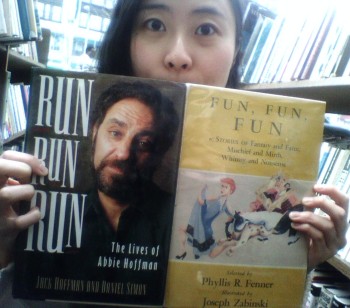
One of my favorite weekend activities is spending a Saturday afternoon going through the dollar book carts outside many New York and Boston area used book stores. It's not only because the books are cheap -- although I like that. The dollar book section is the great equalizer of bookstores. A neglected Dickens or Shakespeare can rub out against a discarded Mary-Cate and Ashley teeny-bopper quasi-romance novel. In the best cases, random shelving creates perfect (if unintuitive and ironic) pairs like Run Run Run about Abbie Hoffman and Fun Fun Fun about other youngsters -- a pair I found adjacent in a dollar book section last week.
/copyrighteous/images/run_fun_run.jpg
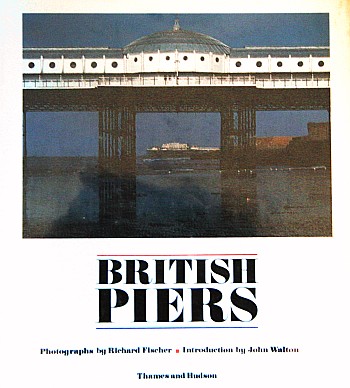
But you also get to meet books you will never meet in the bookstore sections you normally frequent. The dollar book section at the Strand has introduced me to a whole class of books with intriguing non-fiction sounding titles that I had pulled excitedly off the shelf only to find out that they were, in fact, novels. There are also the books with titles so good you suspect the book will be downhill from that point. The Complete Idiot's Guide To Being a Model (not, as one might expect, Becoming a model) and this guide to the British pierage are great examples.
/copyrighteous/images/british_piers.jpg

28 March 2007

Benjamin Mako Hill: Places I Have Almost Been

Yesterday, I passed by an offramp to Onset. Due to objections of others in the car, I wasn't able to visit. I did, however, snap this picture.
/copyrighteous/images/offramp_to_onset-small.jpg

20 March 2007

Benjamin Mako Hill: PHLanthropy

Last week, I had planned to travel from Boston to Tampa with a connection in Philadelphia. I landed in Philadelphia without a problem but an ice storm descended on the airport and, after five hours of our flight's departure time being pushed back, the entire airport was closed and all flights for that day were canceled. When I arrived back at PHL the next day, two hours before the scheduled departure of my flight home -- my trip to Tampa was, by this point, called off entirely -- the airport was in chaos. Flights were still being canceled, airport information displays were inaccurate or switched off entirely and stranded travelers were everywhere. US Airways had deactivated the automatic ticket machines and there were thousands of people in scores of lines hoping for new tickets and assistance. But unlike the day before, we all knew that planes were theoretically going to be leaving and that, stuck outside, we were not going to be on them. People wanted boarding passes and they wanted them desperately. But the lines were not moving and nobody -- or almost nobody -- was going anywhere. Meanwhile, the four teams of TSA workers at the security station were standing idly talking to themselves like attendants at a light night gas station. The only people inside the terminal were those that had slept there or flown in that morning. After finding the end of a line, I asked someone what their line was for. Nobody knew, but each hoped it lead to someone who would assist with their particular problem. Usually they merely wanted to check in. Several people I asked had been waiting in line for five hours that morning only to find out that their line was, in fact, not a line at all but merely a mass of people leading nowhere or simply dissolving into other lines. Nobody knew what else to do so, I, like everyone else, queued up and hoped for the best. An impeccably dressed and obviously wealthy woman asked what I was in line was for. I told her that I didn't know but, like everyone else, hoped it would lead to a boarding pass. She wanted the same thing. She asked if there was a separate queue for first class and I pointed out that it seemed unlikely, in the chaos, that first class was getting special treatment. I pointed out that I also had a first class ticket -- it was the only seat available when the harried agent rebooked me the day before and I had not paid extra for this, but I did not tell her this. She nodded to me in camaraderie. She stood pensively next to me for five minutes and then fumbled for her wallet and ticket. She asked me if I would hold her place in line and I agreed. Five minutes later she reappeared with a boarding pass in her hand. Surprised, I asked her how she had obtained it. She stated, quietly so as not be overhead by the other would-be passengers but matter of factly, that she'd found a baggage handler and flashed a twenty dollar bill and her itinerary. She mentioned that the man she had paid had left but that, "any of them will do it." Sure enough, I was in the terminal less than ten minutes, and twenty dollars, later. Despite growing up partially in the third world, I've only personally bribed a person once before -- also in the United States. Like my previous experience, I didn't feel good about buying my way out of what seems to have, in fact, devolved into a racket. I have spent a lot of time reflecting on the situation and my action in the last several days. Everyone, or nearly everyone, outside the Philadelphia airport terminal had twenty dollars and most of them would have happily paid it to escape their predicament. The reason that most people did not pay off baggage workers is not because they found it prohibitively distasteful, although certainly some of them would have, but because most of us, and I include myself, would have spent the whole day frustrated, desperate, and standing line after line without even considering a bribe as an option. While we know it on some intellectual, reflective level, the vast majority of us do not, in practice, imagine that we can use money as a way to manipulate people into special treatment. As a result, even in situations like that morning in Philadelphia, I simply don't even think of the twenty in my wallet as a way to solve my problem. It's true that wealthy people, like the woman in line behind me, get what they want because they can pay lots of money for products and services. But it is not quite this simple. Some wealthy, powerful people get what they want in part because they think to use money in ways that the rest of us do not. Perhaps this is because this type of spending is frequently not an option for most of us or, we tell ourselves, perhaps even truthfully, because we find it distasteful and immoral. The difference between being inside or outside the terminal last Saturday was not about having or not having money. It was, in fact, about having a particular relationship to money and, through money, to other people. It was not about the value conferred by money but about a set of values that can result from having it in abundance.

19 March 2007

Benjamin Mako Hill: Spellign

While everyone seems to be excited about OpenMoko, there's a smaller, less proficient group of typers who seems excited about the OpenMako project. Ari Pollack even painted a picture of what that frightening, Mako Hellish, world might look like.

15 March 2007

Benjamin Mako Hill: Never Too Late!

I've always thought it was a little silly that airports use their public announcement systems to give advice on how, and how not, passengers should pack their luggage. Presumably, travelers arrive airports with their bags packed. Last time I was at Boston's Logan Airport, I noticed that they were repeatedly playing these announcements in the baggage claim.

14 March 2007

Benjamin Mako Hill: UPS, I Did It Again

I think it's interesting that we pronounce some acronyms/initialisms but spell out others -- I've ever reflected on this before. For example, I think it's funny that we choose not to pronounce the initialism for Uninterruptible Power Supplies the way we pronounce the name of the reason we need them.

13 March 2007

Benjamin Mako Hill: Free Culture at FSF Members Meeting

While I've been making an effort in the recent past to cut down on talks -- so that I can focus on getting work done that will give me something to talk about in the future -- I'm thrilled to be giving a presentation at the upcoming Free Software Foundation Members Meeting in Cambridge, Massachusetts. While normally the members meetings are reserved for talks by the FSF board and staff, I've been invited to give a talk on my work around movement and definition building for free culture as part of a short members forum at the end of the day. I'll also be running a mini RockBox install party over lunch. You need to RSVP for the meeting by this coming Friday (2007/3/17) and, in order to do so, you need to be an FSF member. Fortunately, joining is easy to do. I won't lie and suggest that my talk could possibly be worth the membership price. Luckily, I don't have to lie to suggest that rest of the things that the FSF does are more than worth supporting with membership dues.

10 March 2007

Benjamin Mako Hill: What's Wrong With My iPod?

Last November I wrote about an iPod liberation party we held in Cambridge. As I mentioned then, it was a huge success. Mika just got around to polishing up a short documentary video she made from footage at the event and a few interviews afterward. The documentary is called, What's Wrong With My iPod? and it acts as an introduction to DRM on iPods and what we can do about it. The video introduces the concept of DRM, the dangers it brings, and describes the role it plays on the iPod. The second half is about iRony, our iPod liberation party, and RockBox. Please pass the video links around to your friends -- especially those who might not be up to speed on DRM. If it inspires you, think about running your own iPod Liberation Party (instructions here). You can view it on blip.tv (only MP4 until their converter catches up), on YouTube, or you can just download the OGG theora file (also in high quality).

1 March 2007

Benjamin Mako Hill: The Revolution Will Be Colorful

I forgot to mention the coolest thing about the last Ubucon in my summary. I heard that my friend Sean Moss-Pultz (the person who started the OpenMoko project) would be in New York the week of Ubucon so I managed to contact him and get him to drop by on his way to the airport so we could have lunch. To my surprise, he had one of the early versions of the free-phone for me (I wasn't expecting one for several weeks). I had brought my OLPC XO so, for the first time ever (as far as we know) we managed to get the two coolest, and most important, technology platform projects in the world together. While the XO and OpenMoko share a commitment to freedom, the similarities between the projects are, in fact, also skin deep. If we all work hard, we can look forward to a future that is free. Apparently, it's also white with bright trim.
/copyrighteous/images/xo_plus_openmoko-03-boot.jpg
/copyrighteous/images/xo_plus_openmoko-01.jpg
Apologies for the pictures taken from my current inferior, both ethically and technically, mobile phone.

Benjamin Mako Hill: Ubucon NYC

I had a great time at Ubucon a couple of weeks ago. I ended up running two sessions. After an initial opening, I opened the conference with a talk on how folks can participate in Ubuntu. The talk was roughly based on Andreas Lloyd's absolutely wonderful Contribute To Ubuntu page in the Ubuntu wiki. His page was, in turn, based on my own Participate In Ubuntu page. The talk tried to provide a solution to the common question of, "I love Ubuntu and want to give back! How can I?" -- when I was answering info@ubuntu.com (for my sins), I would get this question several times each day. The talk was a relatively straight forward walk through the different teams and group working in Ubuntu along with examples of their projects and fun anecdotes from my experience in the community along the way. I worked in a bit of talking about different community governance structures and issues and the membership process. Trying to cram an overview of the community and its different subsections into an hour is a pretty sobering experience. There's a lot going on and I barely had a chance to give a poor description of the most visible things going on. In the afternoon, I reminded folks (and myself) that I know a little of this tech stuff too by walking folks through a quick introduction to building and modifying Debian or Ubuntu packages. It was a quick variant on the "Debian Packaging for Sysadmins" talks that I've given in the past. Of course, the best part was getting to hang out with some folks I know from the community and to meet a bunch of new people. It was a blast and I'm definitely looking forward to the next one.

24 February 2007

Benjamin Mako Hill: Fit For an Emperor

I found this box outside my apartment labeled, "The Emperor Clothes." Fortunately, the contents were exactly what I was expecting.    Surely clothing fit for an emperor. That is of course, if you are fit enough to appreciate them.

22 February 2007

Benjamin Mako Hill: Notorious in Libraries

My Overprice Tags projects from a few days back has been getting a bunch of attention. Perhaps most interesting, the MIT libraries -- whose journals we defaced augmented in the project -- have been unbelievably positive about the project! They've written up a very positive description of the event on their website and published an interview with me as well!

21 February 2007

Benjamin Mako Hill: Trademark Violation and Greater Evils

Biella Coleman recently mentioned counterfeit drugs in a blog post:
A pirated movie carries little consequence, except for that the movie industry may lose some cash flow. A fake Rolex purchased on the bustling streets of NYC saves you a lot of money (and robs you of a warranty). But counterfeit drugs, the consequences and stakes are at a whole other, more serious, order of things.
Biella's intentions in drawing the analogy are harmless -- people really do lose their lives because of fake drugs while rock-off movies and Rolexes are relatively harmless. However, her aside reminds me of the much less harmless, fair, and honest analogies drawn by Pat Choate in Hot Property who used examples like counterfeit drugs and dishonestly labeled aircraft parts to support a high protectionist position on IP. Because of the arguments made by people like Choate, I believe that there is a subtle danger in the type of analogy that Biella draws that I think we should try to guard against in the future. The danger lies in the fact that these comparisons tend to conflate at least two very different kinds of illegal activity. Trademark violations are illegal. So it selling drugs without approval from regulatory bodies. So is manslaughter and murder -- both terms used in the Times article Biella links to to describe the actions of drug counterfeiters. Laws in most countries already prohibit all of these things and offer increasingly harsh punishments for each action. In fact, selling unlicensed drugs and killing people is much more illegal than violating trademark and making knockoffs. And it should be. When someone commit IP violations in the process of committing much worse crimes, we should focus on highlighting, condemning, and punishing the much worse crime, not the IP violation which in comparison is almost inconsequential. The punishment for counterfeiting drugs may only be a slap on the wrist and that's probably an appropriate punishment for the counterfeiting component of the crime. The other worse crimes that the counterfeiter is also committing should be punished much more harshly. If, as the Dr. Reggi quoted in the Times article complains, "counterfeiting a medicine can be [only] a misdemeanor," we need stronger laws against selling unregulated drugs -- not stronger IP laws. If we confuse and compare bootleg movies and knock-off Rolexes with fake malaria or AIDS drugs, we're likely to come to the opposite conclusion. Our reactions to such situations should be, "People are killing people with fake drugs! We need stronger laws against killing people in these ways." They should not be "People are killing people with fake drugs! Interesting to note that they are also violating trademark laws like other counterfeiters." The former reaction will frame the discussion in a way that lets us treat the bad components of the crime more harshly and will not help IP high protectionists argue for stronger IP through a disingenuous process of guilt by association.
20 February 2007

Benjamin Mako Hill: Overprice Tags

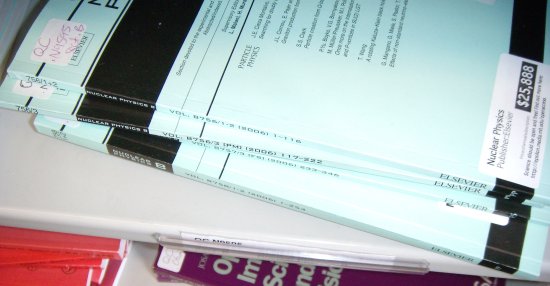
Last Thursday (February 15, 2007) was declared National Day of Action for Open Access. To help raise awareness of the movement for open access in scholarly publications at MIT, I got together with a number of other MIT students and placed price tags -- we called them overprice tags -- onto the 100 journals that MIT subscribes to at a cost of more than $5,000 USD per annum.
/copyrighteous/images/overpricetagged_journal.jpg
The project, inspired by a similar project called Seeing Red carried out by a Brown librarian a few years back, was a huge success. You can find information about the project, motivation and experience, see pictures, and find out how you might run a similar event at your institution on the Overprice Tags homepage.

Next.

Previous.