Search Results: "ag"

16 November 2006

Peter Van Eynde: on blobs

I notice that the binary blob discussion is again on lwns front page. Recently I got a new portable from work and this gave me some new insight. In short: binary-only drivers are so bad people will buy other hardware.
The machine (a Lenovo Z61m) uses a X1400 ATI chip, so I have to use the ATI binary-only driver. Well. I'm trying to use it.
The amount of grief I'm getting from it would convince even billg himself that opensource drivers are mandatory in an opensource system. Strange errors pop up and you're just lost, googling only gives you forums where other poor users are trying to make it all work. Due to the dynamic nature of xorg and kernel development the driver will never 'catch up' and problems will keep popping up. And there is little I can do except complain to the responsible person and urge him to buy the Intel only portable next time.
If this keeps on Intel will just sweep the Linux hacker's market, and with it the heart and minds of a lot of people. My next machine will be an Intel, the first one in years, because I cannot get an AMD with a open graphics card, and I think I won't be alone in this.

Mario Iseli: Microsoft and Novell - Support for opensource projects?

Right now I sit in my office and read the magazine “InfoWeek”. This is a magazine for IT professionals and IT companies, almost everbody in Switzerland who works as a sysadmin or programmer read it. Generally I really like this magazine, because you find stories about almost everything, opensource, closedsource, new technologies, routers, databases etc. Sometimes there are also good tutorials about how to exchange something in a company with an opensource pendant. Today I found this bad article, the title is “Microsoft unterst tzt Linux” (means in english something like “MS supports Linux”). There’s a picture with Steve Ballmer and Ron Hovsepian shaking their hands. Hmmm, for me the title is just completely wrong. Because this would mean “Linux ==Novell” and nothing more. There’s written that they got a lot of money from Microsoft which is dedicated for opensource projects. Now a question to everyone: Did someone of you got money from Microsoft/Novell for your free software project? I think not really, otherwise I would be very confused. Dear reporters of IT magazines: Linux is a free operating kernel and not “a desktop system developed by Novell”. And by buying money _FOR_ Linux you would have to give this money to the community or whatever because opensource products in general are not developed by companies as Microsoft. Sorry in a way for this article, I hope that the !Free-Software-People reading my blog will learn anything, I really hate this “Linux == Novell product”, because Novell is in my eyes a very proprietary company which destroys parts of the community. :-(

David Welton: Random Rants

Edge Eft breaks ldap At work, we decided to test upgrading to Ubuntu's Edgy Eft on a spare machine. CRUNCH... that didn't go so well. The bug is here: https://launchpad.net/distros/ubuntu/+source/libnss-ldap/+bug/51315 Also, it's no longer possible to boot with init=/bin/bash, you have to use init=/bin/dash. Single user mode brings up so much stuff that it's not really viable as a rescue mode, IMO. require_gem ? What is the deal with having a separate command to require gem-installed packages in Ruby. Perhaps there is a logical reason for it, but it's ugly looking to me. Rubyforge is down...again Ruby's popular these days, isn't there someone who could invest a bit of money in setting up a system that stays up? Harumph!

Benjamin Mako Hill: Dare to DReaM?

I went to a talk today by Sun scientist Susan Landau on Sun's DReaM/Open Media Commons DRM system that I've mentioned in the past. Landau used a variant of these slides to do a rough overview of the Sun system and the problems that it is trying to solve. Halfway through her talk, Landau showed a slide titled, "Users Matter: Creative Commons." Elaborating, Landau mentioned that she had been talking to a number of people -- both at CC and outside -- about the possibility of using DReaM to enforce the terms of CC licenses. I interrupted Landau to point out that CC licenses had an anti-DRM clause that, as far I knew, would make her system unusable on CC content. The CC anti-DRM clause, plus the resistance of the CC and iCommons community to accept parallel distribution language, are why it's impossible to play CC-licensed works on an unmodified PlayStation or XBox (these systems only play signed disks) -- even if you include an unencumbered copy alongside! Landau reassured me that I must be mistaken and that she had talked about DReaM in depth with CC leadership, lawyers, and technical advisory board members and she was sure her system was at least possible. Puzzled, I shut up. For most of the rest of her talk, Landau talked about fair use and how a DRM system might go about respecting it. In his qualified endorsement of the DRM system, Lessig mentioned that DReaM, "would be implemented to allow individuals to assert 'fair use,' and unlock DRM'd content, with a tag to trace misuse." At the time, I had a hard time imagining how fair use could be built into such a system -- separating fair from unfair use is remarkably resistant to technical solutions. Even bright light cases like verbatim copies every page of the Encyclopedia Britannica might be fair use if I were to make them into a paper m ch bust of Johann Gutenburg or use them to wallpaper a gallery wall. Landau's acknowledged the trickiness around fair use and suggested a compromise:
By default, works might be encumbered in the ways and to the degrees that the copyright holder wish. However, users could petition for an unencumbered "fair use copy" by identifying themselves and then checking some boxes and explaining (briefly) why they think their use for the work qualifies as fair. Once they've done this, the system would present the user with an unencumbered, watermarked, and fully traceable piece of media.
Conceivably, requests would be subject to some sort of review (at the very least to prevent automated requests) and non-fair uses of watermarked goods would be strictly tracked. If a "fair use" copy is found in the wild, the watermark would be traced and the originator would be held liable. Of course, anonymous fair use becomes impossible but, as Simson Garfinkel pointed out at Landau's talk, users may have a right to anonymous speech and to fair use but not to anonymous fair use. "Fair" enough. It is perhaps important to point out that DReaM does not currently implement this "fair use" system and that, one can only assume, the vast majority of DReaM users (e.g., Hollywood movie studios and their ilk) would have no little interest in giving their users a blanket ability to make "fair use copies" and would in most cases choose not to enable such an option. But let's return to the issue of DRM enforcement of CC license terms. While I was initially quite confused by the idea of DRM enforcement of CC license terms, it made much more sense when I looked at the CC anti-DRM clause itself:
You may not distribute, publicly display, publicly perform, or publicly digitally perform the Work with any technological measures that control access or use of the Work in a manner inconsistent with the terms of this License Agreement.
The emphasis (mine) points to the crux of the issue. The CC anti-DRM clause only blocks technological measures that overstep the boundaries set in the rest of the licensee. For the free licenses, that's a wide boundary that leaves little room for DRM. But as I've pointed out before, CC is a lot more than just free licenses. Landau mentioned that her group was primarily interested in using the DReaM system to enforce attribution and non-derivative work clauses in CC licenses -- a wise choice as non-commercial use is hard enough for humans to discern. As a result, the DReaM system might be used to make it impossible to remove attribution from CC works or might block modification to works marked as "ND." The catch that led me to believe that CC license blocked all DRM was the fact that I didn't think it would be possible for a DRM system to respect fair use. After all, each CC license includes an explicit affirmation that, "nothing in this license is intended to reduce, limit, or restrict any rights arising from fair use." The question that the possibility of a CC DRM scheme like DReaM hangs on is: to what degree does Landau's suggestion live up to the fair use legal bargain? Landau pointed out that a number of lawyers including Pam Samuelson and CC's technical advisory board and legal staff have been generally positive about her fair use permission-asking compromise. Honestly and on CC's own terms, it's hard to see why they wouldn't be. The loss of anonymous fair use was only ever a right we enjoyed by a fortunate accident. Watermarks are only there to "keep honest people honest." If you are not doing anything wrong, what do you have to hide? But DReaM enforcement of CC licenses is a bad thing and the bad taste that it inevitably leaves in many commoners mouths is not hard to explain:
  • Many commoners are not comfortable with the idea of DRM because it shifts power over users' computing devices away from the users and makes computers obey the will of a copyright holder. That's true of DReaM just as much as as it is of Apple iTunes or Microsoft DRM.
  • Many commoners are not completely comfortable with all CC licenses, so the idea of technical protection measures enforcing these terms, even those allowing for fair use lines and in line with the will of the author, is seen as dangerous.
To solve the first issue, CC needs a more strongly worded anti-DRM clause -- ideally one tied to a parallel distribution clause. To solve the second, we will ultimately need a new banner under which only truly free cultural works will reside. Susan Landau doesn't have it easy but she does seem to have the genuine best interest of consumers and users at heart. That's more than I can say about the vast majority of people in the DRM business. She's trying to walk a fine line and she's almost certainly being abused and heckled by folks in the industry who call her "communist" and by folks like me who feel that she's sacrificing essential principles in an attempt to compromise. The one thing we all agree on is that the ground she's treading is mine field. Yet while I sympathize with her, I must speak out against both her and DReaM. A DRM compromise at this stage would be insanity. This is a fight we have to win.

Benjamin Mako Hill: Ignorance is Bliss

A banker at my hippy bank had never heard of Google. I had to spell the name out and explain it to her! I've never imagined one could feel so happy about their choice of financial institution.

Zak B. Elep: Ubuntu-PH Release Party for 6.10 (Edgy Eft)


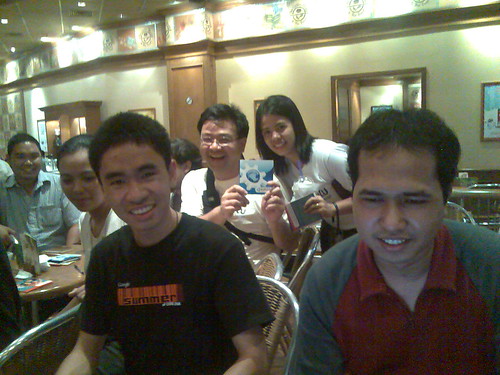
Last night I called Ubunteros nearby Manila for the Edgy Eft (belated) release party at the Coffee Bean and Tea Leaf at Greenbelt 3. Little did I know that there will be a lot of folks coming from the just-concluded FOSS@work workshop joining in the fun, thanks to Yolynne Medina and Eric Pareja. Diane Gonzales and I got to the venue first, then followed by the FOSS@Work folks. Dominique Cimafranca, Migs Paraz, Ranulf Goss, Jopes Gallardo, and Joel Bryan Juliano were there too, and all in all we were easily the noisiest group in the coffee shop, seemingly occupying the entirety of the place. I originally planned to move the group to have dinner somewhere, but along the way everybody seemed to forgot dinner and we quite engaged in talking to everyone else. It was terrific. The 2 boxes of Edgy ,K,Ed Ubuntu CDs I brought were easily given away to everyone; we even had them exchanged and autographed (naks!) reminiscent of what Ealden and I did last February when Mark came here. As a finale, we had a group photo of everyone with their CDs; Dominique remarks that in his informal’ study, more and more women prefer Ubuntu (and I sure do think he’ll be blogging more about this soon. ;) Needless to say, the above photo doesn’t do great justice to what happened last night; it came from my elric which I didn’t get use much as a camera since I too was happily chatting away. That said, I expect RJ Ian will be posting his photos from his brand-spanking-new Kodak camera to the Ubuntu-PH site once he gets back to Mindanao with Yolynne and company. I also think the FOSS@Work folks also have their own photosite or wiki to post more photos, which we’ll be seeing sooner. Jerome Gotangco and Ealden Esca an, the guys whom we all owe Ubuntu-PH to, were unfortunately unable to attend last night, as Jerome was off to Cebu to participate in the ICT congress there, while Ealden was quite busy at work. Hopefully they (as well as last night’s attendees!) can attend the next Release Party for 7.04 (aka Feisty Fawn,) and hopefully it will be just as fun, and be more meaningful if more Ubuntu-PH folks get involved in its development! Update: Yolynne and RJ just posted pics fresh from their arrival to home. Expect more pics later, nicely tagged too…

Jeff Licquia: What Do We Want From Microsoft?

Jason Matusow of Microsoft wants to know:
That said, the real voice of the community is…well…from those of you I don’t know. I have to tell you that the issues with getting this covenant right are incredibly complex and there are real concerns on all sides. Our design goal is to get language in place that allows individual developers to keep developing.
(This is in response to the recent patent deal between Microsoft and Novell, and the poor reception it’s getting from the free software community.) Unfortunately, he got GrokLaw-ed, and his comment system isn’t taking the heat well. So, here’s my feedback; hopefully, he’s paying attention to views outside his comments. The big problem, if you ask me, is the distinction between “commercial” and “non-commercial” that Matusow (and everyone else I hear from Microsoft) is making. In our world, that distinction is a lot less important than the distinction between “proprietary” and “open”. For us, “commercial” is just another way software can be used, and restrictions on commercial use are like restrictions on use by women, or by people in Illinois, or by people who have ever picked their nose in public. Why are businessmen any less deserving of our software as a class than housewives, or Haitians, or other free software developers? Matusow claims not to be interested in any of this:
We are not interested in providing carte blanche clearance on patents to any commercial activity - that is a separate discussion to be had on a per-instance basis. As you comment, please keep in mind that we are talking about individuals, not .orgs, not .com, not non-profits, not…well, not anyone other than individual non-commercial coders.
Dialogue often means meeting the other person where they’re at, not where you want them to be. They would, presumably, not take us seriously if we insisted on a blanket patent license as a condition for any kind of conversation. Fair enough; but then why should we taken them seriously when they insist on us turning our backs on one of our bedrock principles? But does the conversation have to be either-or? I’m betting that Matusow’s blog post is evidence that it doesn’t. People at his level are not the types to waste time on wild goose chases. And is it all that strange to think there might be value in the conversation? There’s a mighty thin line between “proprietary” and “commercial”, so thin even we get them confused sometimes. Does Microsoft really care all that much about for-profit use and improvement of free and open tech? If so, they’re prominent members of a small and shrinking club. If not, then it seems to me that we have a lot of common ground for discussion.

15 November 2006

Russell Coker: economics of a computer store (why they don't stoc...


In some mailing list discussions recently some people demonstrated a lack of knowledge of the economics of a shop. Having run a shop for a few years (an Internet Cafe) I have some practical knowledge of this. I will focus on small businesses in this article, but the same economic principles apply to large corporations too.

When running a shop the main problem you have is in managing stock. There are two ways of getting stock, one is to have wholesalers give it to you for a period in which you can try to sell it and you pay for it when it's sold, this is probably quite rare (I don't know of an example of it being done - and probably no retailer wants to talk about it in case they lose it). Often retailers consider themselves to be privileged if they are permitted to pay for hardware one month after they receive it! The more common way of getting stock is simply to buy it and hope you can sell it in a reasonable period of time (often the wholesaler will offer to buy the stock back at a 10% discount if you can't sell it).

To buy stock you need money, this can come from money that has accrued in the business account (if things are going really well) or from a mortgage taken out by the business owner if things aren't going so well. For small businesses things usually don't go so well so the money used to buy stock is borrowed at an interest rate of about 7% or 8% (I'm using numbers based on the current economic conditions in Australia, different numbers apply to different countries and different times but the same principles apply). The ideal situation is when there is money in the company bank account to cover the purchase of all stock, this means that the cost of owning stock is that you miss out on the 5.5% interest that the money will get in a term deposit.

Almost all stock has a use-by date of some form. Some items have a very short expiry (EG milk used to make hot chocolate in an Internet cafe, some have a moderate expiry date (computer systems become almost unsellable in about 18 months and lose value steadily month after month), but in the computer industry nothing has a long expiry date.

Let's assume for the sake of discussion that you want to run a small computer store that is open to passing trade (this means that you must have stock for an immediate sale). Let's assume that all items of computer hardware lose half their value over the period of 20 months at a steady rate of 2.5% of the original price per month (I think that most computer hardware loses value faster than that, but it's just an assumption to illustrate the point).

The next major issue is the profit margin on each sale. If you can make a 20% profit on a sale then an item that has lost 10% of it's value while gathering dust in your store will still be profitable. However the profit margins on computer sales are very small due to having a small number of major manufacturers (Intel, AMD, nVidia, ATI, Seagate, and WD) that have almost cartel positions in their markets and there being little to differentiate the stores apart from price. I have been told that 3% profit is typical for retail computer hardware sales by the small companies nowadays! Now if the stock will lose 2.5% of it's value per month, you pay 0.5% interest per month and you make a 3% profit then if an item remains in stock for a month then you lose money. So on average (by value) you need to have stock spending significantly less than a month in your store. Cheap items such as low-quality cases and PSUs can stay in stock for a while. More expensive items such as new CPUs and the motherboards to house them must be moved quickly.

What's the first thing that you do to reduce stock? You can keep stocks low, but there is a limit to how low you can go without losing sales. The next thing to do is to not stock items that customers won't often buy or items where there is a similar item that you can stock as a substitute. The classic example of this is hard drives, a customer will want a certain capacity for a certain price - if their preferred brand is not in stock they will almost always take a different brand if it has the same capacity at the same price. Stores often advertise prices on multiple brands of hard drive in each capacity, but often only try to keep one brand in stock.

Of course this is a problem for the more fussy buyer. If you want to buy two identical parts from the same store on different days you might discover that they don't have the stock on the second day and that they instead offer you something equivalent. Not only do retailers have issues with managing their investment in stock but wholesalers have the same problem. So if a retailer runs out of WD drives and discovers that their preferred wholesaler has also run out of WD drives then they just buy a different brand - most customers don't care anyway.

There are some companies I deal with that have a business model based on services. One of them sells hardware to customers at cost, but charges them for the time spend assembling them, transporting them, etc. The potential for a 3% profit on the hardware isn't worth persuing, they prefer to just charge for work and also save themselves the sales effort. Another company I know operates almost exclusively on the basis of ordering parts when customers request them (but still make a small profit margin on the sales), this means that the customer can be invoiced as soon as the hardware arrives. The down-side to this is that wholesalers have the same stock issues and they sometimes have excessive delays before the wholesaler can deliver the hardware.

Dell is the real winner out of this. As they operate by mail-order they don't need to have the stock immediately available, they have a few days to deliver it which gets them time to arrange the supply. They can also have a central warehouse per region which reduces the stock requirements again. A 3% profit on items that rapidly decrease in value makes it almost impossible to sustain a small business. But an organization such as Dell can sustain a successful business at that level.

Of course the down-side for the end-user is that Dell doesn't want to have too many models as that just makes it more complex for the sales channel. Also they have deals with major suppliers which presumably give them deep discounts in exchange for not selling rival products (this is why some brands of parts are conspicuously absent from Dell systems).

10 years ago there used to be a small computer store in every shopping area. Now in Australia there are a few large stores (which often only have a small section devoted to computers) and mail-order. There seems to be much less choice in computer hardware than there was, but it is much cheaper.


PS I've attached a picture of day 39 of the beard.

Steve Kemp: I could kill, but I don t care about it

I’ve significantly updated the code behind the Debian Administration website over the past few days. Now: I still need to decide whether to open up the inter-user messaging system, and implement a few more tweaks and fixups. But these are pretty trivial to do, it is more a matter of deciding whether they are appropriate things than actually writing the code. All of this work combined with travelling a fair amount recently has left me behind on several fronts though. I’m going to dedicate tomorrow to catching up on the biggest outstanding issues, but I’m not sure how far I’ll get. Being behind on things actually makes me feel pretty good, I’m no longer on as many critic paths as I was a few months ago, so whilst getting behind is frustrating and annoying it doesn’t affect quite so many people/projects/packages/things. Either way better to be happy and behind than the reverse .. ObXen: The xen-hosting setup managed to reach an uptime of 100 days. I’m obviously not geeky enough; powers of ten remain much more significant to me than powers of two! Actually I take that back: I can recite powers of two to rediculous degrees and disassemble x86 and z80 hex dumps into opcodes with a fair degree of accuracy .. About time I got more practised at patching binaries; although its hard to find GNU/Linux software which requires serial numbers ;)

Per Olofsson: What's the deal with hermeneutics?

Dear Lazyweb,

Today I had a philosophy class and we discussed hermeneutics. But I didn't understand a thing. Not that I ever understand much of what my philosophy teacher says, but I just don't get hermeneutics.

Yes, I've looked it up on Wikipedia, and I've read about it in a book. But I still don't understand. The language used to describe hermeneutics is complicated and weird, and just doesn't make any sense to me.

What I've grasped so far is this: Hermeneutics is a methodology and/or epistemology used in the humanities and, to some extent, the social sciences. Hermeneutics is about interpreting texts. A text can be a literary text or something else (like a film, painting, or perhaps even reality). When you read a text, you need to read it several times and perform "close reading" of the parts. A text consists of the parts and the whole, and somehow they relate to each other, and you need to understand the parts to understand the whole and vice versa (I have no idea what this means). Hermeneutics is also some kind of way of describing reality (epistemology) which differs from the natural science in that it seeks to understand things rather than explain them. In the natural sciences, or the logical positivist tradition, knowledge is sought by explaining cause and effect (at least that's what my teacher says). Proponents of hermeneutics argue that this method does not apply to the humanities. Hermeneutics also employ something called the "hermeneutic circle", which means that you understand a text better the more you read it.

But I don't understand this method. What's so special about reading a text several times? What's the deal with close reading, why is it that good? What kind of knowledge is gained by this method? How does it differ from simply reading a text any number of times and then write an essay about what you think and feel about it? The parts I understand about hermeneutics are only trivialities. Also, there seems to be some kind of rules when you read the text. Like, you need to observe the characters one time, and the plot the second time, etc. Who decided that? Why is it necessary to follow these particular rules, if they exist?

Most importantly, exactly why is hermeneutics a scientific method? To me it looks merely as a practice of reading texts and writing essays about them. These essays are of course subjective; they don't generate any objective knowledge in the natural scientific sense. I'm not saying that it's wrong to write about literature, I just don't understand why a certain method of doing it is considered more scientific than any arbitrary method. In the natural sciences, there are criteria of intersubjectivity, independent testability, verifiability, falsifiability, etc. I see nothing of the like in hermeneutics; I don't know any of its scientific criteria. Apparently you need to refer to specific parts of the text in order to justify your statements (opinions? theories?), but it is a rather vague criterion, and I don't understand the rationale for it.

Another thing is the epistemological side of it. Somehow, hermeneutics is a general theory of knowledge. How that could be I don't know. Why would, for example, a close reading of a text give us the answer to questions like the distance to a particular star or human effect on global warming? Maybe that's not what hermeneutics is intended for. But if it is claimed to be a general theory of knowledge, it should be able to answer those questions in some way.

Maybe all this is just me being stupid or zealous. Or maybe I'm not thinking clearly -- I'm suspecting that I've not been thinking clearly lately. Perhaps I'm refusing to understand out of mere distaste or frustration. My classmates suggested something in the line of that. Perhaps it's because I've read physicist Alan Sokal's brilliant satirical article "Transgressing the Boundaries: Toward a Transformative Hermeneutics of Quantum Gravity", and I am now allergic to the language used by academics in the humanities.

If someone could enlighten me on these issues, that would be much appreciated.

Biella Coleman: Stuck on the technology of yesterday

So I am in Alberta, Canada but I decided not to get a local phone number mostly because I have a VOIP phone that works fine and it lets me call Puerto Rico for free, and allows my sister call me for free too. But not having an Alberta 780 area code can be quite problematic at times and the latest chapter in the confusion has come from trying to get the IBM warranty folks to accept that you can call from Alberta with a non Alberta area code and realze that even if they accept that, the computer is the one wearing the pants and thus making the decision…So even if you convince them that new technologies make this possible, the transaction is still sabotaged because in the end, they rely on computer to get the actual service repair person to call you and the computer relies, and can only rely on the area code., who can only see that an area code 773= USA, so then it gets a US rep to contact you back after the initial phone call. Here is an IRC transcript discussing the confusion, which I think is pretty amusing: m: they are so confused
m: the guys says “what province are you in?” I say “Alberta”
m: and then he gets my number and he says “You aren’t in Alberta, sir”
m: and I say “Yes I am, my phone number is a US phone number, but I assure you, I am in Edmonton, Alberta right now”
m: and he says “Are you a canadian citizen?”
m: and I say ‘no, do I need to be, in order to be in Alberta?” and he says “The problem is, you are actually in the US right now”
m: I AM NOT IN THE USA
biella: heh
m: so I had to say “You realize that cell phones and voip technology allow you to roam outside of the USA and still use the same phone number?!”
b: and then what?
m: well he said I needed a canada number or their system would send it to the states
m: regardless if thats where my address is
m: their computer is too smart
micah anyways
biella: or not smart enough Well, we are now using my office number so hopefully all will be OK.

Jonathan McDowell: MPEG2 straight to the brane

I received a Freecom DVB-T stick last week (early wedding present). I've not actually played with DVB-T before, so I wasn't sure how much of a hassle it would be. My first act was to plug it into my laptop, with the aim of finding out the USB ID and thus which driver I'd need to compile up (I have a tendancy to build my own kernels with only drivers I think I'm likely to need). I did so and was greeted with:
dvb-usb: found a 'WideView WT-220U PenType Receiver (Typhoon/Freecom)' in cold state, will try to load a firmware
dvb-usb: did not find the firmware file. (dvb-usb-wt220u-02.fw) Please see linux/Documentation/dvb/ for more details on firmware-problems. (-2)
usbcore: registered new driver dvb_usb_dtt200u
Interesting, think I. I'm more organised than I thought and have already compiled up all the various v4l bits I thought I might end up using. So I go looking for the firmware file, find a copy, dump it in /usr/lib/hotplug/firmware/. Replug the device. And get:
dvb-usb: found a 'WideView WT-220U PenType Receiver (Typhoon/Freecom)' in cold state, will try to load a firmware
dvb-usb: downloading firmware from file 'dvb-usb-wt220u-02.fw'
usb 1-4: USB disconnect, address 15
dvb-usb: generic DVB-USB module successfully deinitialized and disconnected.
usb 1-4: new high speed USB device using ehci_hcd and address 16
usb 1-4: configuration #1 chosen from 1 choice
dvb-usb: found a 'WideView WT-220U PenType Receiver (Typhoon/Freecom)' in warm state.
dvb-usb: will use the device's hardware PID filter (table count: 15).
DVB: registering new adapter (WideView WT-220U PenType Receiver (Typhoon/Freecom)).
DVB: registering frontend 0 (WideView USB DVB-T)...
Rockin'. Now I need to tune it. I find Adam's DVB page which has the initial tuning file for the Tacolneston transmitter in Norfolk. I type scan uk-Tacolneston. It fails to find anything. I wonder if I'm using the wrong transmitter. I decide the supplied antenna is probably to blame and go to see about sorting out the one in the attic. I try again. I get a channels.conf containing 91 channels. Wooo. Copy this into ~/.mplayer/ and fire up mplayer dvb://. And have Freeview on my laptop. Nice. Unfortunately this requires me to have the loft aerial plugged into my laptop, which isn't very portable. Paddy tell me this will get better when the analogue transmitters get turned off and the digital power ramped up, so I look forward to that. Until then it should still prove useful to have a portable DVB-T stick - I intend to see if I can pick up BBC HD next time I'm staying in London, and check if Freeview coverage has made it to my parents' yet. Writing this all down makes it seem quite convoluted, but actually the process was a lot smoother than I expected; plug in stick, copy firmware, replug stick, scan for channels, watch tv. The issue that took most time to sort was the aerial. It's really quite cool to think about how easily you can get yourself an MPEG2 stream of TV to play with.

Erich Schubert: Eclipse just doesn't work

Eclipse just doesn't work right for me. I'm so pissed by this crap... I've been following this tutorial (whoever had the idea to use screenshots for the actual code parts... ever heard of copy'n'paste?). At one point you need to add a class. A new class. Derived from Object. So I chose the menu option in Eclipse to, well, add a new class. After pressing "Next" in the wizard, eclipse froze, using 100% CPU. After killing and restarting eclipse, it had only created an empty file. But since I have to type in the data from the Tutorial anyway, ok. Next step in the tutorial: edit the faces-config.xml file with the faces-config editor. Sounds easy. I click on the file, open with, faces-config editor. Boom. First some content type error message is displayed, but the details actually list a NullPointerException:
java.lang.NullPointerException
    at org.eclipse.wst.sse.ui.StructuredTextEditor.update(StructuredTextEditor.java:3047)
    at org.eclipse.jst.jsf.facesconfig.ui.FacesConfigEditor.addPages(FacesConfigEditor.java:396)
    at org.eclipse.ui.forms.editor.FormEditor.createPages(FormEditor.java:142)
    at org.eclipse.ui.part.MultiPageEditorPart.createPartControl(MultiPageEditorPart.java:276)
    [... 40 more lines of backtrace ...]
Error handling in Java sucks, too. Usually you just get a 50 lines+ stack trace. [Update: deinstalling XML buddy resolved the last problem, and I could add a second class without another crash]

Erich Schubert: CDBS is NMU-friendly

Steinar H. Gunderson even threatens kittens because of it, and Steve McIntyre ranted against using CDBS for packaging, claiming that it's much harder to fix bugs in packages that use CDBS. I have to disagree. More than once I've given up on fixing a bug in a package because I couldn't decrypt the huge makefiles used for building the package. For private packages I often switch over packages to CDBS then, so I don't have to fiddle around with a build system noone except the original maintainer understands. And every now and then I fix a bug in Debian, but don't upload it because I replaced the "magic" build system with CDBS magic... While CDBS does a lot of "black magic" to build packages, it usually does quite a good job. If it doesn't, it maybe even is a bug in CDBS, that happens. debian/rules files that use CDBS are usually quite easy to read, even easier than traditional debhelper template-based scripts. And that is why I think that CDBS is a good thing: it does a good job at separating package-specific and package-independendant build scripting. Maybe all we need is more documentation on how to properly fix common issues in CDBS, starting with misplaced or misnamed files etc. CDBS has a lot of hooks, but it's not obvious which hooks to use for which fixes. (Note that sometimes the fix should maybe be done in the upstream makefile instead.) On the long run, Debian could use a more unified way of packaging. Debhelper has already unified package building a lot, and CDBS maybe goes one step too far, but ideally we would all be able to understand each others debian/rules.

MJ Ray: Notes on Affero GPL

Debian, Free Software and licences: Affero GPL added.

Erich Schubert: Third party software

Ubuntu has been attracting "newbie" users, and also has drawn users away from Debian. Some people are annoyed by Ubuntu because of this - I am not. Ubuntu users have been happily collecting third-party repositories to get the latest glitz like beryl. Trevi o compiled a huge list of them, and made it easy to install (DON'T USE THIS!). Everybody concerned with security must go mad with just the throught of collecting thrid party repositories for the fun of it. To most of us, it's bad if we have to use any third party repositories... However, Johan Kiviniemi reacted in an interesting way. His highly experimental repository - setup for some 5 users or so, on his home DSL line - was included in this stupid "every repository I could find" list. Noticing this increase in users, he found out about this madness - and made a package to replace the default wallpapers (and disable wallpaper changing) with this scary warning message. Sounds like a good plan to me, however many users were pissed by being warned that they've done something stupid... So: thank you, Ubuntu community, for helping teaching new users that they shouldn't just blindly install software from the internet. :-) and for keeping these users away from Debian.

Norbert Tretkowski: Broken yaird backport

People keep asking me why installing kernel-images from backports.org fails, and what's the workaround. The reason why installing the packages fails is a broken yaird backport. Because nobody seems interested in fixing it, I just removed yaird from the backports.org archive. Use initramfs-tools instead, it works fine.

Holger Levsen: Solaris GPLed?

I am amused to imagine what J rg Schilling thinks about this :-) More seriously and less rumor, thanks and kudos to Sun for freeing Java! But Sun is hardly important for my well being, this is a job for the sun:

And on a not related note, the sun rises so low now, that it shines onto the desktop in my room. Yay to the nice effects of winter! Not that there are that many, but there are some :)

Uwe Hermann: Google sponsors the LinuxBIOS project [Update]

Mainboard As announced yesterday, Google has sponsored some work on the LinuxBIOS project, a Free Software (GPL) BIOS/firmware implementation for various architectures (x86, PowerPC, Alpha, and others). LinuxBIOS currently supports more than 100 different mainboards from various vendors. A list of supported chipsets, CPUs, and Super I/O chips is also available, so you can easily estimate how hard it will be to add support for a new mainboard. Most of the mainboards currently supported are high-end server-type mainboards (e.g. from Tyan) and embedded boards. There are not too many cheap, mainstream motherboards supported, yet, but that is about to change soonish. I've been contributing for a while now to the LinuxBIOS project in various areas (e.g. adding support for a bunch of Super I/O chips, which are required if you want to get LinuxBIOS debug output over the serial port). But one of my personal main goals for the project is to support a reasonably high number of cheap, standard desktop mainboards, and I'll concentrate my efforts in this area in the future. Any help from further developers with experience in the hardware, embedded, or low-level firmware area is very appreciated! If you're interested, checkout the website and say hi on the mailling list. But I digress. The Google funding was used to create an automated, distributed test infrastructure, which will help...
...to significantly improve the project's Quality Assurance process by creating a completely automated and distributed testing environment. Every single commit results in BIOS images being built for all mainboards, and tested on real hardware located all over the world. So whenever you want to download a LinuxBIOS image, you can now know that it works on a reference machine before flashing it to your system. A per-revision overview is available, as are test results for specific revisions, and you can even get detailed reports that include extensive logs for each motherboard. Developers can also use the build and test system without checking their code into the LinuxBIOS repository. The automatic build client has an option to submit BIOS images to the test system manually; you can see an overview of manually triggered builds. Anyone with a spare board supported by LinuxBIOS is welcome to put it into the automated test system, thus helping the LinuxBIOS project increase their quality on your hardware.
LinuxBIOS QA 1
LinuxBIOS QA 2
This is a great thing, and something which not many projects out there can claim to have. Automated test-suites in the software development "scene" are used seldomly enough (which is bad), but in the low-level hardware/embedded area you're usually stuck... (See also Golem and Heise if you speak German) Update 2006-11-15: Ok, the site is slashdotted right now. Maybe you can try archive.org or the Google cache...

Alexander Sack: mozilla security updates available for testing

Thanks to Mike Hommey we have another set of security updates for
our mozilla apps in sarge. The versions are: mozilla-firefox 1.0.4-2sarge13
mozilla-thunderbird 1.0.2-2.sarge1.0.8d.1
mozilla 1.7.8-1sarge8 Please use my security archive to get the preview packages and
test them as extensively as possible. If you encounter any NEW problems, please let us know at pkg-mozilla-maintainers@lists.alioth.debian.org. Thanks for your support.

Next.

Previous.