Search Results: "ag"

19 November 2006

Ross Burton: Sound Juicer "Wish I Could Stop You From Talking" 2.16.2

Sound Juicer "Wish I Could Stop You From Talking" 2.16.2 is out. Tarballs are available on burtonini.com, or from the GNOME FTP servers. Loads of fixes!

Todd Troxell: De-Scheming MIT

I am amazed by MIT's decision to move it's EECS curriculum away from scheme, doubly so at the fact that they're swapping it for Python. It has been part of their definition, at least in my mind. It makes sense to me, but I suppose I have some bias. I see it as a move from a language with deeper cognitive benefits to a language with stronger pragmatic benefits-- a move towards actually building things. Of course, it's just a language, and the same course could be taught with either one.

Jonathan McDowell: What's the point of the BCS?

I read El Reg's article about the BCS complaining about the lack of IT skills. And found myself wondering once again what purpose the BCS actually serve. I mean, it's a great idea, a professional organisation that serves the needs of IT professionals. Except, what exactly are our needs? And what exactly does the BCS do? No one I know has been able to explain the point of them, and that include a few people who've been members. All their blurb sounds much more tailored to IT management than people who actually hack on stuff. What am I missing?

18 November 2006

Adam Rosi-Kessel: Crash at Roslindale Medical Center

I live almost across from the Greater Roslindale Dental and Medical Center. I noticed this on a short walk this morning, viewing the Medical Center basement from the east looking west on Washington Street. I took these photos with my cell phone (I apologize for my thumb in the bottom image — it’s not the most ergonomic design for snapshots). Click on either image for slightly larger versions: I overheard someone say that an 87 year old man driving a car just flew into the building (not an easy feat considering the design of the intersection — no street actually points in this direction). He apparently at least survived the crash and was taken to the hospital. It’s hard to avoid thinking that this is an eminently predictable and avoidable problem. There are a lot of people out there who shouldn’t be driving. The state should revoke their licenses. The state should also provide a workable alternative for them to get around.

Evan Prodromou: 27 Brumaire CCXV

Amita June got her 12-month vaccinations two days ago. She had to get four shots -- two in each chubby little thigh. She's really building up a phobia about going to the doctor's office, screaming her head off each time we go in. Maj thinks it's a bad memory from the time she was sick and Maj took her to the nurse for an emergency checkup, which required getting her temperature taken... from the wrong direction. After her 12-month appointment (earlier last week), Maj bought her the book about Caillou going to visit the doctor, and a little doctor's bag that she waddles around the apartment clutching. We did some practice "shots" with the syringe from the toy doctor's bag, and played with the stethoscope and such. I think it helped a little bit, but still... 4 shots in one day is too much for anybody. Chuck Norris doesn't get 4 shots in one day without a few tears. The worst part, I think, is that the vaccinations give her a little bit of a fever, and she's supposed to get some chicken-pox spots next week sometime. She's been a bit irritable -- easy to understand -- which has made everyone in the house a little tense. When the baby's mad, we're alllllll mad. She's not sleeping well? We're not sleeping well, then. Anyways, hopefully this passes soon. tags:

Web server twiddling for dummies Two fun things I did on my server today. First, I finally got around to installing mod_redir_to_servname, which turns out to be rockingly simple and useful. Thanks to Simon Richter for the good insight. The other thing I did was set up awstats for each of the domains hosted on the server. Much more fantastic than my grungy old Webalizer configuration, that's for sure. Even if it doesn't give me everything I want, it's pretty darn good. tags:

PmWiki upgrade Another thing I did today was move the SonaUiki to my main server, and upgrade it from PmWiki 1.0 to version 2.1. That's something I've been waiting to do for a while -- the site has been really carpet-bombed by spammers, and I haven't been able to add any anti-spam extensions since the version was so old. The upgrade process was pretty painless, and the site is now cookin' with gas. I'd like to go back and update some of the PmWiki Cookbook extensions I wrote a few years ago, like the 404-caching extension and the Dublin Core metadata one. PmWiki's a neato piece of software -- well-crafted, compact, easy to extend and use. If someone bothered to configure Wikiwyg to work with it, I'd give it a serious thumbs-up. tags:

Video interview in The Deal I forgot to mention that there's an interview with me in the The Deal Blogs, the blog network for The Deal magazine. It's a pretty tough crowd at The Deal, so I'm pretty glad I came out looking as good as I did. We'll see how the print article looks, but for now I think I'm pretty OK. tags:

Enrico Zini: pbuilder-tips

pbuilder tips Many thanks to Arnaud Fontaine for providing me with the solutions to all pbuilder problems I had during the last years. This is what happens to me: someone reports a bug in debtags, and it turns out that the bug needs fixing in libwibble. I start by fixing libwibble, then I need to recompile libtagcoll2-dev, then use it to recompile libept-dev, which I can finally use to rebuild debtags. A normal pbuilder setup would only take dependencies from apt sources, so I need to create an APT source with the packages I just built and feed it to pbuilder. Now, thanks to Arnaud's suggestion, I have the easy way to create the APT repository:
$ cat update-aptsource
#!/bin/sh
cd /var/cache/pbuilder/result
dpkg-scanpackages . /dev/null   gzip -9 > Packages.gz
echo "Running pbuilder update..."
su -c "pbuilder update"
Since pbuilder works in a chroot environment, the easiest way of making it access the repository is via http. First I put the new repository online:
ln -s /var/cache/pbuilder/result /var/www/debian
Then I add it to /etc/pbuilderrc:
OTHERMIRROR="deb http://localhost/debian/ ./"
Then I tell pbuilder to update the configuration inside the chroots:
pbuilder update --override-config
And finally I can build my stack of packages. This is probably not rocket science for many DDs. What I'm really appreciating here is using the minimum amount of pbuilder customization and of lines of code of extra infrastructure to maintain. Now, at every compile round, I just need to run that update-aptsource script to inject into the system the dependencies that I have just built. Update: Josh Triplett sent the configuration options to avoid using an HTTP server and use pbuilder's bind-mount facility:
OTHERMIRROR="deb file:/var/cache/pbuilder/result/ ./"
BINDMOUNTS="/var/cache/pbuilder/result/"

Benjamin Mako Hill: Once Again...

Overheard on my flight back from San Francisco last week... over the PA system:
Once again, we are keeping our PAs to an absolute minimum on this flight.
Perhaps not an absolute minimum.

Martin F. Krafft: Online in the skies

I am sitting on Singapore Airlines flight SQ 25 from Frankfurt to Singapore and have wireless connectivity, reasonable for SSH usage. The service provider ConnexionByBoeing is phasing out of business, and in a move to appease the passengers, made the service free of charge in October, throughout the end of the year. This is definitely a first for me, to be able to "surf" several thousand metres above the ground. And while it certainly makes the next twelve hours seem like a lot less [*], I do wonder whether I'd even want broadband on every (long-distance) flight. Flying has always been relaxation to me, time off to read or watch movies I'd otherwise never see, to sleep, dream, stare at clouds, talk, think, be, drift. With the Internet available, work could creep into this time for those who lack control over their use of time. While I tend to disagree that I fall into this group, my dear friend Hanspeter seems to think otherwise. And isn't it great how in such situations, denial does nothing but reconfirm the position of the proponents? It's like smoking, which I do on the occasion. Tell someone that you're "only an occasional smoker" and you'll likely earn an expression of pity and averseness as your peer marks you down as a smoke addict.
[*]

Singapore Airlines is making this a very enjoyable experience. Asian hospitality really amazes and captures me every time. I only wish I had more time than a few days in Singapore.

We're flying in a Boeing 747-400, either very new or completely redone. The in-flight entertainment spans 80 on-demands movies, 90 TV shows, about 200 audio CDs, and several documentaries and live news channels. Add the Internet and those long hours are history.

Riku Voipio: cdbs: empathic maybe

I tried to ask our cats if they felt threatened by CDBS. They didn't seem really worried.

I'm not sure if it is entirely fair to blame CDBS for complex packaging issues. If CDBS was not available, more maintainers would just cook up their own spaghetti packaging scripts. The balance needs to be somewhere between "everyone reinventing the wheel" and "frameworks that are harder to use than the raw stuff". Currently I would recommend only using CDBS for simple packages.

Ross Burton: Contacts 0.2

Although I'm announcing Contacts 0.2, I hardly did any of the work on it. Brace yourself, Chris and Thomas have been very busy. Updated packages are already in Debian. Have fun!

Andreas Metzler: anti RFID wallet

Mako asks for a RFID-proof, vegan wallet. This is what I have been using for a couple of years:
cigarette case I started using it since my maestro/credit/whatever cards broke frequently, being RFID proof is just a nice side effect. The obvious downside is that I need to carry change separately in my pocket, but I wouldn't want a wallet big enough to carry the huge Euro coinage anyway.

Daniel Baumann: Debian NEW queue

As you may know, initial uploads of new packages in Debian need to go through the NEW queue for several reasons. As you may not know, I do store all my own packages I did, do and will do, as well as all the packages I did and do sponsor on my homepage for archive reasons. Currently, there are a few packages of mine waiting in NEW to be reviewed by one of the ftp-master team member. As some of them maybe are of generic interests, I do list them here for your convenience, so you can get them already now while they are waiting in NEW. These are, in alphabetic order:

Benjamin Mako Hill: Small Subgroup of a Small Subgroup

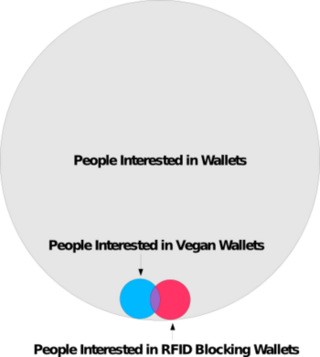
With the new Charlie Card coming out, it seemed like it was about time to obtain an RFID blocking wallet. I liked the idea of buying a nice off-the-shelf wallet but the only pre-made RFID-proof wallet I've found is made of leather. I'd like to buy a vegan wallet. Here is the Venn diagram describing my problem:
/copyrighteous/images/vegan-wallets.png
If you know a wallet for those of us in the purple zone, leave a comment or let me know. Otherwise, I suppose I'm going to have to make my own.

Sven Mueller: CBDS and kittens

Steinar H. Gunderson wrote about CDBS once again, and I couldn’t agree more. CDBS introduces a lot of complexity for non-trivial packages, and it especially is basically undocumented. So what is CDBS’s value? For non-trivial packages, it is hard to use, since you basically need to decipher the CDBS code. For trivial packages however, it doesn’t add much value over dh_make. That’s actually sad: I like the general idea behind CDBS, but it is implemented badly IMHO. What it should do, if implemented right is to automate anything you want done on an easy package while providing and documenting (which includes consistently named hooks and options) all the interfaces needed to maintain non-trivial packages. Ideally, this would even include packages which need multiple build runs (like providing two differently configured versions of the same binary in two packages). But as said: It would need consistent names and proper documentation, and CDBS fails both currently. I however hope this improves in the future. Don’t ask me to work on this however, since personally, I’m quite happy using debhelper on my packages, since it is removing complexity (not typing work or lines of code) from debian/rules while keeping it obvious from that file what is done during a build. I would really like to see the reasoning from Erich on why he thinks CDBS is NMU-friendly, since I don’t get why he thinks so from his blog post.

Joerg Jaspert: DebConf7 Call for Papers, take two

Watching the DebConf7 systems and looking at proposals people enter for DebConf7, one thing comes to mind (with now 129 created accounts and 9 submitted papers): People are submitting only proposals for talks like we had in the past. But the new system we use makes it way easier for us to have much more in our database and so in our schedule. So dont hesitate to submit other types of events that can or should happen at DebConf7 too. Like - currently we have the Keysigning Party, the Welcome Talk and also the Formal Dinner as seperate entries in our database. Other things I can think of are a cheese&wine party or a soccer game. Or everything else that fits in a schedule. Advantage - we can add it to the schedule so people can find it more easily, also probably reserving rooms for it. And you wont forget about it. And - this system allows feedback to talks (and speakers), so during DebConf7 all attendees can rate events. But only those in the database. Just one thing - if you submit such an event please use the “Submission notes” field to state that it is not for the main track, so our review committee doesn’t judge your submission.

17 November 2006

David Welton: Padova Hacking Society

I couldn't think of a better name, so that's what I came up with for a "cross-platform" group including a variety of people who are knowledgeable in different fields. Thanks to Matteo, we had our first meeting yesterday for (what else, being in Italy), pizza and beer. I continue to be very impressed by the amount of technical talent here in Padova. It is a university town, but it's only got about 200,000 people. At our dinner yesterday, we had guys from OFBiz, Mono, FreeBSD, and various other open source projects, as well as people expert in C, Perl, Python, Ruby, Java, Erlang, and counting myself, Tcl. Furthermore, the guys from the nascent startup seesaw.it were there as well. It was a lot of fun to meet up with people to talk tech in person. Even the level of diversity lead to some heated debate at times, I think I much preferred it to a monothematic event. With age, I tend to get less excited about things, and realize that it's all fascinating and worth knowing, and just wishing I had more time to soak up knowledge in the many fields that interest me. Hopefully, we'll be able to repeat the event sometime soon.

Joachim Breitner: Linux Gaming Tournament

To promote Linux with the students I held a gaming tournament tonight. The sixteen participants played two rounds of four-player-tetrinet-games, as well a single elimination bracket of Frozen Bubble. It was very chaotic, but in the end we had two winners: Elridge Nikki Gordon (tetrinet) and Beteab Gebreyesus (Frozen Bubble), and they got winner certificates (the names of course not printed but hand written). Unfortunately, we did not manage to pull through the Tuxracer competition, but it was still fun. For them at least, for me it was only stress. But the good kind of stress.

MJ Ray: Want a Pint? Give us your prints!

As if the underhand registration of children wasn't bad enough, this NO2ID newsletter describes another way to encourage people to submit to scanning:
"The scheme which is backed by the Home Office was first trialled in Yeovil but plans are afoot to expand the system to Coventry, Hull, Sheffield, Leeds, Gwent, Nottingham, Taunton and possibly Swindon. Drinkers must have their thumbprints scanned and supply their name, address and date of birth to enrol onto the system before they are allowed to enter licensed premises taking part in the scheme." "If you are in any of the towns affected, especially Yeovil, and are willing to do something then send an e-mail to phil@no2id.net (please put "pub fingerprinting" in the Subject).Don't get depressed, don't give in and get a home-brew kit - get angry and do something!" "PS. If anyone knows a pub that would like to take NO2ID beer mats, Newcastle NO2ID has created some with our logo on the front and key counter-arguments on the back, ideal for starting the discussions of the scheme that we need."
Not even our beer is safe from the ID State!

Evan Prodromou: 25 Brumaire CCXV

Interesting Techcrunch article about aboutus.org, the wiki about every domain on the Internet. It was started by Ray King, an extremely nice guy that we've met at a couple of Wiki events, and it seems to be doing really well. I guess he just closed an initial round of investments, which is great. There was an article about Aboutus in the Portland Business Journal. Although I don't think it's a "potential Google" (!), as the reporter does (gotta love the home town crowd), Aboutus is a neat idea and it's a good group of people, too. tags:

Puck Quebecois Speaking of things that are rocking, I just got an invite to Le Puck Quebecois. It's the Montreal tournament of the Hocky Association of the Arts, a group of artists and musicians nationwide who love to play hockey against each other. The organizer is Jeff Waye of Ninjatune, who combines in one person an unhealthy obsession with music with an unhealthy addiction to hockey. It should be a really fun amateur hockey tournament. All proceeds go to charity, of course. tags:

Not only but also Next week, 30 Brumaire, (or 22 November for those of you who need some math help) there's a meeting of MSLUG, the Montreal Scheme/Lisp Users Group. I have get to get out to an MSLUG meeting, but I think this one will be my first. It's admirable that the group has pulled off so many meetings in the last 3 years. tags:

Lenny So, at the bottom of this release message, we get the name of the post-etch Debian release: Lenny. Is Debian now using codenames from The Simpsons? I think Lenny Leonard is as nice as the next guy, but we're still going through the minor characters in Toy Story. I've scoured the Toy Story credits and Toy Story 2 credits, and "Lenny" is the name of the little binoculars character, which gets about 12 seconds of screen time, if I remember correctly. Man, we're really scraping the bottom of the barrel on this naming convention. tags:

Hey Doc! Don Marti's intro to OpenID for Doc Searls is cracking me up. I'd mentioned in my articles for LinuxWorld last week that I'd written an OpenID extension for MediaWiki, and I guess now Doc wants to know how to use it. tags:

Evan Prodromou: 26 Brumaire CCXV

I've been pretty interested in making Web sites WebSoftwareFriendly for a while, so I'm pretty psyched to see that Yahoo and Microsoft have embraced the Google Sitemaps format. They've started a site for the format, http://www.sitemaps.org/ , which lists out the protocol, which seems to be unmodified from the original Google version. Sitemaps have been a necessary part of Web sites for years. Netscape -- back when it was a browser -- had an RDF-based sitemap format that had a brief flare of popularity just before Netscape went into its weird late-90s spiral. Then RDF people got really abstract and academic, and decided that sitemaps weren't what RDF was all about, and RDF sitemaps were forgotten. So sitemaps went off the air, and we've had to wait for a standard on the idea until today. Yahoo lets you submit sitemaps today, as does Google; Microsoft Live supposedly will support it sometime in 2007. One thing that's interesting is a new "ping" protocol, for when the site is updated. I'm not sure how well it works or if it's even implemented, but it's interesting to see it working. I think the weak part of this whole thing is that site owners have to submit sitemaps to each search engine; it would be nice if there were some sort of discovery, like an HTML <link> element, so that other types of Web software besides the big search engines would benefit. tags:

Knowing when to hold 'em From O'Reilly's wrapup of the Web 2.0 Summit, I got a good link to some other Evan's Knowing When to Hold Em. It's a little discourse on the growth of Web 2.0 sites after they've been acquired. Evan Williams, the author and the guy who sold Blogger to Google, knows whereof he speaks. He has some graphs that show traffic for various Web 2.0 sites sloping precipitously upwards after their sale to some big company. The implication being, I guess, that the sites would have been more valuable to sell later. He also points out that few of the sites have benefited visibly from being acquired. I'm not sure the argument makes sense. Traffic is a cost centre as well as a potential source of revenue for companies. Keeping servers up, running, and cogent is hard work. Most small Web sites have been throwing labor and cash into their sites for a while, and the ability to keep such a site going into the Alexa top 100 is beyond most small companies. Paying for a lot of servers, developers, designers, sysadmins and bandwidth for another couple of years may make the site bigger and more desirable for acquisition, but it's a big risk to take. My favourite part of the discussion is that my friend Kevin Fox shows up at the end with some good points about when and how to invest. tags:

Free Software Java I've been programming in Java off and on since the first beta versions of the VM and JDK in 1995. The language has always had a certain cachet with the Open Source set -- the free-as-in-beer tools, good documentation, and cross-platform compatibility made it an Open Enough system, roughly equivalent to proprietary C compilers shipped with every Unix variant. Its release was roughly synchronous with the growth of the Web, and Java applet support in Netscape made the first round of rich client applications conceivable, if not exactly elegant. And then Java grew onto the Web server; and into other parts of the network; and then all of a sudden everything had to be Java. The system grew from this nifty little tool to The Enterprise Solution For Your Enterprise. Serious people worked on Java. I worked on Java when I needed to be serious. Java stopped being fun. Early efforts at getting Open Source Java VMs and development kits working were pretty successful, but they just couldn't catch up with the rapid pace of development on Sun's core product. But inclusion of the language in the Gnu Compiler Collection, the great JBoss J2EE system, the growth of Apache's Jakarta project, and the growing Java Community Process made Java less and less a regular product, built in a silo behind a corporate firewall, and more of an Open-Source-y project. So I guess it was inevitable that Sun would either Open Source its codebase, or end up irrelevant. They probably squeezed just about all they could out of it without going Free, so that's pretty impressive. I think Free Software advocates are supposed to be grateful about this; my main reaction is: why did you put everyone through all this crap for so long? You've wasted 12 years that could have gone into making Java really incredible. We'll see what happens. My main interface with the JVM for the last year or so has been through scripting languages like Rhino JavaScript engine (very fun) and Pnuts. Who's got time for Java programming any more? tags:

Next.

Previous.