Search Results: "sto"

29 April 2017

John Goerzen: Is there any way to truly secure Docker container contents?

There is much to like about Docker. Much has been written about it, and about how secure the containerization is. This post isn t about that. This is about keeping what s inside each container secure. I believe we have a fundamental problem here. Earlier this month, a study on security vulnerabilities on Docker Hub came out, and the picture isn t pretty. One key finding:
Over 80% of the :latest versions of official images contained at least on high severity vulnerability!
And it s not the only one raising questions. Let s dive in and see how we got here. It s hard to be secure, but Debian makes it easier Let s say you want to run a PHP application like WordPress under Apache. Here are the things you need to keep secure: On Debian (and most of its best-known derivatives), we are extremely lucky to have a wonderful security support system. If you run a Debian system, the combination of unattended-updates, needrestart, debsecan, and debian-security-support will help one keep a Debian system secure and verify it is. When the latest OpenSSL bug comes out, generally speaking by the time I wake up, unattended-updates has already patched it, needrestart has already restarted any server that uses it, and I m protected. Debian s security team generally backports fixes rather than just say here s the new version , making it very safe to automatically apply patches. As long as I use what s in Debian stable, all layers mentioned above will be protected using this scheme. This picture is much nicer than what we see in Docker. Problems We have a lot of problems in the Docker ecosystem:
  1. No built-in way to know when a base needs to be updated, or to automatically update it
  2. Diverse and complicated vendor security picture
  3. No way to detect when intermediate libraries need to be updated
  4. Complicated final application security picture
Let s look at them individually. Problem #1: No built-in way to know when a base needs to be updated, or to automatically update it First of all, there is nothing in Docker like unattended-updates. Although a few people have suggested ways to run unattended-updates inside containers, there are many reasons that approach doesn t work well. The standard advice is to update/rebuild containers. So how do you know when to do that? It is not all that obvious. Theoretically, official OS base images will be updated when needed, and then other Docker hub images will detect the base update and be rebuilt. So, if a bug in a base image is found, and if the vendors work properly, and if you are somehow watching, then you could be protected. There is work in this area; tools such as watchtower help here. But this can lead to a false sense of security, because: Problem #2: Diverse and complicated vendor security picture Different images can use different operating system bases. Consider just these official images, and the bases they use: (tracking latest tag on each) And how about a few unofficial images? The good news is that Debian jessie seems to be pretty popular here. The bad news is that you see everything from Oracle Linux, to Ubuntu, to Debian testing, to Debian oldstable in just this list. Go a little further, and you ll see Alpine Linux, CentOS, and many more represented. Here s the question: what do you know about the security practices of each of these organizations? How well updated are their base images? Even if it s Debian, how well updated is, for instance, the oldstable or the testing image? The attack surface here is a lot larger than if you were just using a single OS. But wait, it gets worse: Problem #3: No way to detect when intermediate libraries need to be updated Let s say your Docker image is using a base that is updated immediately when a security problem is found. Let s further assume that your software package (WordPress, MySQL, whatever) is also being updated. What about the intermediate dependencies? Let s look at the build process for nginx. The Dockerfile for it begins with Debian:stretch-slim. But then it does a natural thing: it runs an apt-get install, pulling in packages from both Debian and an nginx repo. I ran the docker build across this. Of course, the apt-get command brings in not just the specified packages, but also their dependencies. Here are the ones nginx brought in: fontconfig-config fonts-dejavu-core gettext-base libbsd0 libexpat1 libfontconfig1 libfreetype6 libgd3 libgeoip1 libicu57 libjbig0 libjpeg62-turbo libpng16-16 libssl1.1 libtiff5 libwebp6 libx11-6 libx11-data libxau6 libxcb1 libxdmcp6 libxml2 libxpm4 libxslt1.1 nginx nginx-module-geoip nginx-module-image-filter nginx-module-njs nginx-module-xslt ucf Now, what is going to trigger a rebuild if there s a security fix to libssl1.1 or libicu57? (Both of these have a history of security holes.) The answer, for the vast majority of Docker images, seems to be: nothing automatic. Problem #4: Complicated final application security picture And that brings us to the last problem: Let s say you want to run an application in Docker. exim, PostgreSQL, Drupal, or maybe something more obscure. Who is watching for security holes in it? If you re using Debian packages, the Debian security team is. If you re using a Docker image, well, maybe it s the random person that contributed it, maybe it s the vendor, maybe it s Docker, maybe it s nobody. You have to take this burden on yourself, to validate the security support picture for each image you use. Conclusion All this adds up to a lot of work, which is not taken care of for you by default in Docker. It is no surprise that many Docker images are insecure, given this picture. The unfortunate reality is that many Docker containers are running with known vulnerabilities that have known fixes, but just aren t, and that s sad. I wonder if there are any practices people are using that can mitigate this better than what the current best-practice recommendations seem to be?

Russ Allbery: Review: Neverness

Review: Neverness, by David Zindell
Publisher: Bantam Spectra
Copyright: May 1988
Printing: July 1989
ISBN: 0-553-27903-3
Format: Mass market
Pages: 552
Mallory Ringess is a Pilot, one of the people who can guide a lightship through interstellar space from inside the dark cocoon and biotech interface that allows visualization of the mathematics of interstellar travel. At the start of the book, he's young, arrogant, impulsive, and has a deeply unhealthy relationship with Leopold Soli, the Lord Pilot and supposedly his uncle by marriage (although they share a remarkable physical resemblance). An encounter with his uncle in a bar provokes a rash promise, and Ringess finds himself promising to attempt to map the Solid State Entity in search of the Elder Eddas, a secret of life from the mythical Ieldra that might lead to mankind's immortality. The opening of Neverness is Ringess's initial voyage and brash search, in which he proves to be a capable mathematician who can navigate a region of space twisted and deformed by becoming part of a transcendent machine intelligence. The knowledge he comes away with, though, is scarcely more coherent than the hints Soli relates at the start of the story: the secret of mankind is somehow hidden in its deepest past. That, in turn, provokes a deeply bizarre trip into the ice surrounding his home city of Neverness to attempt to steal biological material from people who have recreated themselves as Neanderthals. Beyond that point, I would say that things get even weirder, but weird still implies some emotional connection with the story. I think a more accurate description is that the book gets more incoherently mystical, more hopelessly pretentious, and more depressingly enthralled by childish drama. It's the sort of thing that one writes if one is convinced that the Oedipal complex is the height of subtle characterization. I loathed this book. I started loathing this book partway through Ringess's trip through the Solid State Entity, when Zindell's prose reached for transcendent complexity, tripped over its own shoelaces, and fell headlong into overwrought babbling. I continued reading every page because there's a perverse pleasure in hate-reading a book one dislikes this intensely, and because I wanted to write a review on the firm foundation of having endured the entire experience. The paperback edition I have has a pull quote from Orson Scott Card on the cover, which includes the phrase "excellent hard science fiction." I'm not sure what book Card read, because if this is hard science fiction, Lord of the Rings is paranormal romance. Even putting aside the idea that one travels through interstellar space by proving mathematical theorems in artificially dilated time (I don't think Zindell really understands what a proof is or why you write one), there's the whole business with stopping time with one's mind, reading other people's minds, and remembering one's own DNA. The technology, such as it is, makes considerably less sense than Star Wars. The hard SF requirement to keep technology consistent with extrapolated science is nowhere to be found here. The back-cover quote from the St. Louis Post-Dispatch is a bit more on-target: "Reminiscent of Gene Wolfe's New Sun novels... really comes to life among the intrigues of Neverness." This is indeed reminiscent of Gene Wolfe, in that it wouldn't surprise me at all if Zindell fell in love with the sense of antiquity, strangeness, and hints of understood technology that Wolfe successfully creates and attempted to emulate Wolfe in his first novel. Sadly, Zindell isn't Wolfe. Almost no one is, which is why attempting to emulate the extremely difficult feat Wolfe pulls off in the Book of the New Sun in your first novel is not a good idea. The results aren't pretty. There is something to be said for resplendent descriptions, rich with detail and ornamental prose. That something is "please use sparingly and with an eye to the emotional swings of the novel." Wolfe does not try to write most of a novel that way, which is what makes those moments of description so effective. Wolfe is also much better at making his mysteries and allusions subtle and unobtrusive, rather than having the first-person protagonist beat the reader over the head with them for pages at a time. This is a case where showing is probably better than telling. Let me quote a bit of description from the start of the book:
She shimmers, my city, she shimmers. She is said to be the most beautiful of all the cities of the Civilized Worlds, more beautiful even than Parpallaix or the cathedral cities of Vesper. To the west, pushing into the green sea like a huge, jewel-studded sleeve of city, the fragile obsidian cloisters and hospices of the Farsider's Quarter gleamed like black glass mirrors. Straight ahead as we skated, I saw the frothy churn of the Sound and their whitecaps of breakers crashing against the cliffs of North Beach and above the entire city, veined with purple and glazed with snow and ice, Waaskel and Attakel rose up like vast pyramids against the sky. Beneath the half-ring of extinct volcanoes (Urkel, I should mention, is the southernmost peak, and though less magnificent than the others, it has a conical symmetry that some find pleasing) the towers and spires of the Academy scattered the dazzling false winter light so that the whole of the Old City sparkled.
That's less than half of that paragraph, and the entire book is written like that, even in the middle of conversations. Endless, constant words piled on words about absolutely everything, whether important or not, whether emotionally significant or not. And much of it isn't even description, but philosophical ponderings that are desperately trying to seem profound. Here's another bit:
Although I knew I had never seen her before, I felt as if I had known her all my life. I was instantly in love with her, not, of course, as one loves another human being, but as a wanderer might love a new ocean or a gorgeous snowy peak he has glimpsed for the first time. I was practically struck dumb by her calmness and her beauty, so I said the first stupid thing which came to mind. "Welcome to Neverness," I told her.
Now, I should be fair: some people like this kind of description, or at least have more tolerance for it than I do. But that brings me to the second problem: there isn't a single truly likable character in this entire novel. Ringess, the person telling us this whole story, is a spoiled man-child, the sort of deeply immature and insecure person who attempts to compensate through bluster, impetuousness, and refusing to ever admit that he made a mistake or needed to learn something. He spends a good portion of the book, particularly the deeply bizarre and off-putting sections with the fake Neanderthals, attempting to act out some sort of stereotyped toxic masculinity and wallowing in negative emotions. Soli is an arrogant, abusive asshole from start to finish. Katherine, Ringess's love interest, is a seer who has had her eyes removed to see the future (I cannot express how disturbing I found Zindell's descriptions of this), has bizarre and weirdly sexualized reactions to the future she never explains, and leaves off the ends of all of her sentences, which might be be the most pointlessly irritating dialogue quirk I've seen in a novel. And Ringess's mother is a man-hating feminist from a separatist culture who turns into a master manipulator (I'm starting to see why Card liked this book). I at least really wanted to like Bardo, Ringess's closest friend, who has a sort of crude loyalty and unwillingness to get pulled too deep into the philosophical quicksand lurking underneath everything in this novel. Alas, Zindell insists on constantly describing Bardo's odious eating, belching, and sexual habits every time he's on the page, thus reducing him to the disgusting buffoon who gets drunk a lot and has irritating verbal ticks. About the only person I could stand by the end of the book was Justine, who at least seems vaguely sensible (and who leaves the person who abuses her), but she's too much of a non-entity to carry sustained interest. (There is potential here for a deeply scathing and vicious retelling of this story from Justine's point of view, focusing on the ways she was belittled, abused, and ignored, but I think Zindell was entirely unaware of why that would be so effective.) Oh, and there's lots of gore and horrific injury and lovingly-described torture, because of course there is. And that brings me back to the second half of that St. Louis Post-Dispatch review quote: "... really comes to life among the intrigues of Neverness." I would love to know what was hiding behind the ellipses in this pull quote, because this half-sentence is not wrong. Insofar as Neverness has any real appeal, it's in the intrigues of the city of Neverness and in the political structure that rules it. What this quote omits is that these intrigues start around page 317, more than halfway through the novel. That's about the point where faux-Wolfe starts mixing with late-career Frank Herbert and we get poet-assassins, some revelations about the leader of the Pilot culture, and some more concrete explanations of what this mess of a book is about. Unfortunately, you have to read through the huge and essentially meaningless Neanderthal scenes to get there, scenes that have essentially nothing to do with the interesting content of this book. (Everything that motivates them turns out to be completely irrelevant to the plot and useless for the characters.) The last 40% of the book is almost passable, and characters I cared about might have even made it enjoyable. Still, a couple of remaining problems detract heavily, chief among them the lack of connection of the great revelation of the story to, well, anything in the story. We learn at the very start of the novel that the stars of the Vild are mysteriously exploding, and much of the novel is driven by uncovering an explanation and solution. The characters do find an explanation, but not through any investigation. Ringess is simply told what is happening, in a wad of exposition, as a reward for something else entirely. It's weirdly disconnected from and irrelevant to everything else in the story. (There are some faint connections to the odd technological rules that the Pilot society lives under, but Zindell doesn't even draw attention to those.) The political intrigue in Neverness is similar: it appears out of nowhere more than halfway through the book, with no dramatic foundation for the motives of the person who has been keeping most of the secrets. And the final climax of the political machinations involves a bunch of mystical nonsense masquerading as science, and more of the Neanderthal bullshit that ruins the first half of the book. This is a thoroughly bad book: poorly plotted, poorly written, clotted and pretentious in style, and full of sociopaths and emotionally stunted children. I read the whole thing because I'm immensely stubborn and make poor life choices, but I was saying the eight deadly words ("I don't care what happens to these people") by a hundred pages in. Don't emulate my bad decisions. (Somehow, this novel was shortlisted for the Arthur C. Clarke award in 1990. What on earth could they possibly have been thinking?) Neverness is a stand-alone novel, but the ending sets up a subsequent trilogy that I have no intention of reading. Followed by The Broken God. Rating: 2 out of 10

28 April 2017

Russ Allbery: Review: Small Gods

Review: Small Gods, by Terry Pratchett
Series: Discworld #13
Publisher: Harper
Copyright: February 1994
Printing: March 2008
ISBN: 0-06-109217-7
Format: Mass market
Pages: 357
Small Gods is the thirteenth Discworld novel, but it features new characters and is unrelated to any of the previous books. Some reading order guides show it as following Pyramids in an "ancient civilizations" track, but its only relationship with that book is some minor thematic similarities. You could start here with Discworld if you wanted to. Brutha is a novice in the hierarchy of the church of the Great God Om, and his elders are convinced he'll probably die a novice. He's just not particularly bright, you see. But he is very obedient, and he doesn't mind doing hard work, and there's nothing exactly wrong with him, except that he looks at people with startling intensity when they're talking to him. Almost as if he's listening. All that seems about to change, however, when the Great God Om himself approaches Brutha and starts talking to him. Not that Brutha is at all convinced at first that this is happening, particularly given that Om appears in the form of a small, battered, one-eyed tortoise who was dropped into the church garden by an eagle attempting to break his shell. Small Gods is, as you might have guessed, a parody of religion, at least large, organized religion with fixed hierarchies, organizations called the Quisition that like to torture people, and terrifyingly devout deacons who are certain of themselves in ways that no human ever should be. It's also an interesting bit of Discworld metaphysics: gods gain power from worship (a very old idea in fantasy), and when they don't get enough worship, they end up much diminished and even adrift in the desert. Or trapped in the form of a small tortoise. One might wonder how Om ended up in his present condition given the vast and extremely authoritarian church devoted to his worship, but that's the heart of Pratchett's rather pointed parody: large religious organizations end up being about themselves, rather than about the god they supposedly worship, to such an extent that they don't provide any worship at all. Brutha is not thinking of things like this. Once he's finally convinced that Om is who he claims to be, he provides worship and belief of a very practical but wholehearted and unshakable sort, just as he does everything else in life. That makes him the eighth prophet of Om as prophecy foretold, but it's far from clear how that will be of any practical use. Or how Om will come back into power. And meanwhile, Brutha has come to the attention of Vorbis, the head of the Exquisitors, who does not know about the tortoise (and wouldn't believe if he did), but who has a use for Brutha's other talent: his eidetic memory. In typical Pratchett fashion, the story expands to include a variety of other memorable characters from the neighboring city of Ephebe, a country full of gods and philosophers. Vorbis's aims here are unclear at the start of the book, but Vorbis being who he is, they can't be good. Brutha is drawn along in his wake. Meanwhile, Om is constantly watching for an opportunity to regain his lost power and worshipful following, and also to avoid being eaten. Despite the humorous components, Small Gods is rather serious about religion and about its villain. It's also a touch repetitive; Om's lack of power and constant fretting about it, Brutha's earnest but naive loyalty, and Vorbis's malevolent determination are repeatedly stressed and get a little old. Some bits in Ephebe are quite fun, but the action is a bit disjointed, partly because the protagonist is rarely the motive force in the plot. There are also some extended scenes of trudging through the desert that I thought dragged a bit. But Pratchett hits some powerful notes in his critique of religion, and there are a few bits with Death at the end of the book that I thought were among the better pieces of Discworld philosophy. And when Brutha gets a chance to use his one talent of memory, I greatly enjoyed the resulting scenes. He hits just the right combination of modesty, capability, and earnestness. I know a lot of Pratchett readers really like Small Gods. I'm not one of those; I thought it was about average for the Discworld series (at least among the books I've read so far). But average for Discworld is still pretty good, and its new setting makes it a plausible place to start (or to take a break from the other Discworld plot threads). Followed, in publication order, by Lords and Ladies. I don't believe it has a direct plot sequel. Rating: 7 out of 10

Joachim Breitner: ghc-proofs rules more now

A few weeks ago I blogged about an experiment of mine, where I proved equalities of Haskell programs by (ab)using the GHC simplifier. For more details, please see that post, or the video of my talk at the Z rich Haskell User Group, but one reason why this approach has any chance of being useful is the compiler s support for rewrite rules. Rewrite rules are program equations that the programmer specifies in the source file, and which the compiler then applies, from left to right, whenever some intermediate code matches the left-hand side of the equation. One such rule, for example, is
 -# RULES "foldr/nil" forall k z. foldr k z [] = z #- 
taken right out of the standard library. In my blog post I went through the algebraic laws that a small library of mine, successors, should fulfill, and sure enough, once I got to more interesting proofs, they would not go through just like that. At that point I had to add additional rules to the file I was editing, which helped the compiler to finish the proofs. Some of these rules were simple like
 -# RULES "mapFB/id" forall c. mapFB c (\x -> x) = c #- 
 -# RULES "foldr/nil" forall k n. GHC.Base.foldr k n [] = n #- 
 -# RULES "foldr/undo" forall xs. GHC.Base.foldr (:) [] xs = xs #- 
and some are more intricate like
 -# RULES "foldr/mapFB" forall c f g n1 n2 xs.
    GHC.Base.foldr (mapFB c f) n1 (GHC.Base.foldr (mapFB (:) g) n2 xs)
    = GHC.Base.foldr (mapFB c (f.g)) (GHC.Base.foldr (mapFB c f) n1 n2) xs
    #- 
But there is something fishy going on here: The foldr/nil rule is identical to a rule in the standard library! I should not have to add to my file that as I am proving things. So I knew that the GHC plugin, which I wrote to do these proofs, was doing something wrong, but I did not investigate for a while. I returned to this problem recetly, and with the efficient and quick help of Simon Peyton Jones, I learned what I was doing wrong.1 After fixing it, I could remove all the simple rules from the files with my proofs. And to my surprise, I could remove the intricate rule as well! So with this bug fixed, ghc-proofs is able to prove all the Functor, Applicative and Monad rules of the Succs functor without any additional rewrite rules, as you can see in the example file! (I still have to strategically place seqs in a few places.) That s great, isn t it! Yeah, sure. But having to introduce the rules at that point provided a very good narrative in my talk, so when I will give a similar talk next week in Pairs (actually, twice, first at the university and then at the Paris Haskell meetup, I will have to come up with a different example that calls for additional rewrite rules. In related news: Since the last blog post, ghc-proofs learned to interpret proof specifications like
applicative_law4 :: Succs (a -> b) -> a -> Proof
applicative_law4 u y = u <*> pure y
                   === pure ($ y) <*> u
where it previously only understood
applicative_law4 = (\ u (y::a) -> u <*> (pure y :: Succs a))
               === (\ u (y::a) -> pure ($ y) <*> u)
I am not sur if this should be uploaded to Hackage, but I invite you to play around with the GitHub version of ghc-proofs.

  1. In short: I did not initialize the simplifier with the right InScopeSet, so RULES about functions defined in the current module were not always applied, and I did not feed the eps_rules to the simplifier, which contains all the rules found in imported packages, such as base.

27 April 2017

Yves-Alexis Perez: Debian, grsecurity and passing the baton

Since the question popped here and there, I'll post a short blog post about the issue right now so there's a reference somewhere. As you may know, Brad Spengler (spender) and the Pax Team recently announced that the grsecurity test patches won't be released publicly anymore. The stable patches were already restricted to enterprise, paying customers, this is now also the case for the test patches. Obviously that means the end of the current situation in Debian since I used those test patches for the linux-grsec packages, but I'm not exactly sure what comes next and I need to think a bit about this before doing anything. The passing the baton post mention a handover to the community (though the FAQ mention it needs to stop using the term grsecurity ) so maybe there's some coordination possible with other users like Gentoo Hardened and Alpine, but it's not clear what would be possible with the tools we have. I'm actually quite busy right now so I don't have much time to think about all this, but expect a new blog post when things have settled a bit and I've made up my mind.

Russ Allbery: Review: Necessity

Review: Necessity, by Jo Walton
Series: Thessaly #3
Publisher: Tor
Copyright: July 2016
ISBN: 0-7653-7902-3
Format: Hardcover
Pages: 331
Athena's experiment with a city (now civilization) modeled after Plato's Republic continues, but in a form that she would not have anticipated, and in a place rather far removed from its origins. But despite new awareness of the place and role of gods, a rather dramatic relocation, and unanticipated science-fiction complications, it continues in much the same style as in The Just City: thoughtful, questioning debate, a legal and social system that works surprisingly well, and a surprising lack of drama. At least, that is, until the displaced cities are contacted by the mainstream of humanity, and Athena goes unexpectedly missing. The latter event turns out to have much more to do with the story than the former, and I regret that. Analyzing mainline human civilization and negotiating the parameters of a very odd first contact would have, at least in my opinion, lined up a bit better with the strengths of this series. Instead, the focus is primarily on metaphysics, and the key climactic moment in those metaphysics is rather mushy and incoherent compared to the sharp-edged analysis Walton's civilization is normally capable of. Not particularly unexpected, as metaphysics of this sort are notoriously tricky to approach via dialectical logic, but it was a bit of a letdown. Much of this book deals with Athena's disappearance and its consequences (including the title), and it wasn't bad, but it wanders a bit into philosophical musings on the nature of gods. Necessity is a rather odd book, and I think anyone who started here would be baffled, but it does make a surprising amount of sense in the context of the series. Skipping ahead to here seems like a truly bad idea, but reading the entire series (relatively closely together) does show a coherent philosophical, moral, and social arc. The Just City opens with Apollo confronted by the idea of individual significance: what does it mean to treat other people as one's equals in an ethical sense, even if they aren't on measures of raw power? The Thessaly series holds to that theme throughout and follows its implications. Many of the bizarre things that happen in this series seem like matter-of-fact outcomes once you're engrossed in the premises and circumstances at the time. Necessity adds a surprising amount of more typical science fiction trappings, but they turn out to be ancillary to the story. What matters is considered action, trying to be your best self, and the earnest efforts of a society to put those principles first. And that's the strength of the whole series, including Necessity: I like these people, I like how they think, and I enjoy spending time with them, almost no matter what they're doing. As with the previous books, we get interwoven chapters from different viewpoints, this time from three primary characters plus some important "guest" chapters. As with the previous books, the viewpoint characters are different again, mostly a generation younger, and I had to overcome my initial disappointment at not hearing the same voices. But Walton is excellent at characterization. I really like this earnest, thoughtful, oddly-structured society that always teeters on the edge of being hopelessly naive and trusting but is self-aware enough to never fall in. By the end of the book, I liked this round of characters nearly as much as I liked the previous rounds (although I've still never liked a character in these books as well as I liked Simmea). I think one incomplete but important way to sum up the entire Thessaly series is that it's a trilogy of philosophical society-building on top of the premise of a universal love for and earnest, probing, thoughtful analysis of philosophy. Walton's initial cheat is to use an deus ex machina to jumpstart such a society from a complex human world that would be unlikely to provide enough time or space for it to build its own separate culture and tradition. I think the science-fiction trick is required to make this work real-world societies that try this end up having to spend so much of their energy fighting intrusion from the outside and diffusion into the surrounding culture that they don't have the same room to avoid conformity and test and argue against their own visions. Necessity is not at all the conclusion of that experiment I would expect, but it won me over, and I think it worked, even if a few bits of it felt indulgent. Most importantly for that overall project, this series is generational, and Necessity shows how it would feel to grow up deep inside it, seeing evolution on top of a base structure that is ubiquitous and ignored. Even the generation in The Philosopher Kings wasn't far enough removed to support that; Necessity is, and in a way this book shows how distinctly different and even alien human culture can become when it has space to evolve on top of different premises. I enjoyed the moments of small surprise, where characters didn't react the way that I'd expect for reasons now buried generations-deep in their philosophical foundations. This book will not win you over if you didn't already like the series, and I suspect it will lose a few people who read the previous two books. The plot structure is a little strange, the metaphysics are a touch strained, and the ending is, well, not quite the payoff that I was hoping for, although it's thematically appropriate and grew on me after a few days of thinking it over. But I got more Socrates, finally, who is as delightful as always and sorely needed to add some irreverence and contrariness to the the mix. And I got to read more about practical, thoughtful people who are trying hard to do their best, to be their best selves, and to analyze and understand the world. There's something calming, delightful, and beautifully optimistic about their approach, and I'm rather sad to not have more of it to read. Rating: 7 out of 10

26 April 2017

Sven Hoexter: Chrome 58 ignores commonName in certificates

People using Chrome might have already noticed that some internal certificates created without a SubjectAlternativeName extension fail to verify. Finally the Google Chrome team stepped forward, and after only 17 years of having SubjectAlternativeName as the place for FQDNs to verify as valid for a certificate, they started to ignore the commonName. See also https://www.chromestatus.com/feature/4981025180483584. Currently Debian/stretch still has Chromium 57 but Chromium 58 is already in unstable. So some more people might notice this change soon. I hope that everyone who maintains some broken internal scripting to maintain internal CAs now re-reads the OpenSSL Cookbook to finally fix this stuff. In general I recommend to base your internal CA scripting on easy-rsa to avoid making every mistake in certificate management on your own.

Russ Allbery: Review: Zero Bugs and Program Faster

Review: Zero Bugs and Program Faster, by Kate Thompson
Publisher: Kate Thompson
Copyright: 2015
Printing: December 2016
ISBN: 0-9961933-0-8
Format: Trade paperback
Pages: 169
Zero Bugs and Program Faster is another book I read for the engineering book club at work. Unlike a lot of the previous entries, I'd never heard about it before getting it for the book club and had no idea what to expect. What I got was a lavishly-illustrated book full of quirky stories and unusual turns of presentation on the general subject of avoiding bugs in code. Unfortunately, it's not a very deep examination of the topic. All that an experienced programmer is likely to get out of this book is the creative storytelling and the occasionally memorable illustration. I knew that this may not be a book aimed at me when I read the first paragraph:
If two books in a bookstore teach the same thing, I take the shorter one. Why waste time reading a 500-page book if I can learn the same in 100 pages? In this book, I kept things clear and brief, so you can ingest the information quickly.
It's a nice thought, but there are usually reasons why the 500-page book has 400 more pages, and those are the things I was missing here. Thompson skims over the top of every topic. There's a bit here on compiler warnings, a bit on testing, a bit on pair programming, and a bit on code review, but they're all in extremely short chapters, usually with some space taken up with an unusual twist of framing. This doesn't leave time to dive deep into any topic. You won't be bored by this book, but most of what you'll earn is "this concept exists." And if you've been programming for a while, you probably know that already. I learned during the work discussion that this was originally a blog and the chapters are repurposed from blog posts. I probably should have guessed at that, since that's exactly what the book feels like. It's a rare chapter that's longer than a couple of pages, including the room for the illustrations. The illustrations, I must say, are the best part of the book. There are a ton of them, sometimes just serving the purpose of stock photography to illustrate a point (usually with a slightly witty caption), sometimes a line drawing to illustrate some point about code, sometimes an illustrated mnemonic for the point of that chapter. The book isn't available in a Kindle edition precisely because including the illustrations properly is difficult to do (per its Amazon page). As short as this book is, only about two-thirds of it is chapters about programming. The rest is code examples (not that the chapters themselves were light on code examples). Thompson introduces these with:
One of the best ways to improve your programming is to look at examples of code written by others. On the next pages you will find some code I like. You don't need to read all of it: take the parts you like, and skip the parts you don't. I like it all.
I agree with this sentiment: reading other people's code is quite valuable. But it's also very easy to do, given a world full of free software and GitHub repositories. When reading a book, I'm looking for additional insight from the author. If the code examples are beautiful enough to warrant printing here, there presumably is some reason why. But Thompson rarely does more than hint at the reason for inclusion. There is some commentary on the code examples, but it's mostly just a discussion of their origin. I wanted to know why Thompson found each piece of code beautiful, as difficult as that may be to describe. Without that commentary, it's just an eclectic collection of code fragments, some from real systems and some from various bits of stunt programming (obfuscation contests, joke languages, and the like). The work book club discussion showed that I wasn't the only person disappointed by this book, but some people did like it for its unique voice. I don't recommend it, but if it sounds at all interesting, you may want to look over the corresponding web site to get a feel for the style and see if this is something you might enjoy more than I did. Rating: 5 out of 10

22 April 2017

Manuel A. Fernandez Montecelo: Debian GNU/Linux port for RISC-V 64-bit (riscv64)

This is a post describing my involvement with the Debian GNU/Linux port for RISC-V (unofficial and not endorsed by Debian at the moment) and announcing the availability of the repository (still very much WIP) with packages built for this architecture. If not interested in the story but you want to check the repository, just jump to the bottom. Roots A while ago, mostly during 2014, I was involved in the Debian port for OpenRISC (or1k) about which I posted (by coincidence) exactly 2 years ago. The two of us working on the port stopped in August or September of that year, after knowing that the copyright of the code to add support for this architecture in GCC would not be assigned to the FSF, so it would never be added to GCC upstream unless the original authors changed their mind (which they didn't) or there was a clean-room reimplementation (which didn't happen so far). But a few other key things contributed to the decision to stop working on that port, which bear direct relationship to this story. One thing that particularly influenced me to stop working on it was a sense of lack of purpose, all things considered, for the OpenRISC port that we were working on. For example, these chips are sometimes used as part of bigger devices by Samsung to control or wake up other chips; but it was not clear whether there would ever be devices with OpenRISC as the main chip, specially in devices powerful enough to run Linux or similar kernels, and Debian on top. One can use FPGAs to synthesise OpenRISC or1k, but these are slow, and expensive when using lots of memory. Without prospects of having hardware easily available to users, there's not much point in having a whole Debian port ready to run on hardware that never comes to be. Yeah, sure, it's fun to create such a port, but it's tons of work to maintain and keep it up to-date forever, and with close to zero users it's very unrewarding. Another thing that contributed to decide to stop is that, at least in my opinion, 32-bit was not future-proof enough for general purpose computing, specially for new devices and ports starting to take off on that time and age. There was some incipient work to create another OpenRISC design for 64-bits, but it was still in an early phase. My secret hope and ultimate goal was to be able to run as much a free-ish computer as possible as my main system. Still today many people are buying and using 32-bit devices, like small boards; but very few use it as their main computer or servers for demanding workloads or complex services. So for me, even if feasible if one is very austere and dedicated, OpenRISC or1k failed that test. And lastly, another thing happened at the time... Enter RISC-V In August 2014, at the point when we were fully acknowledging the problem of upstreaming (or rather, lack thereof) the support for OpenRISC in GCC, RISC-V was announced to the world, bringing along papers with suggestive titles such as Instruction Sets Should Be Free: The Case For RISC-V (pdf) and articles like RISC-V: An Open Standard for SoCs - The case for an open ISA in EE Times. RISC-V (as the previous RISC-n marks) had been designed (or rather, was being designed, because it was and is an as yet unfinished standard) by people from UC Berkeley, including David Patterson, the pioneer of RISC computer designs and co-author of the seminal book Computer Architecture: A Quantitative Approach . Other very capable people are also also leading the project, doing the design and legwork to make it happen see the list of contributors. But, apart from throwing names, the project has many other merits. Similarly to OpenRISC, RISC-V is an open instruction set architecture (ISA), but with the advantage of being designed in more recent times (thus avoiding some mistakes and optimising for problems discovered more recently, as technology evolves); with more resources; with support for instruction widths of 32, 64 and even 128 bits; with a clean set of standard but optional extensions (atomics, float, double, quad, vector, ...); and with reserved space to add new extensions in ordered and compatible ways. In the view of some people in the OpenRISC community, this unexpected development in a way made irrelevant the ongoing update of OpenRISC for 64-bits, and from what I know and for better or worse, all efforts on that front stopped. Also interestingly (if nothing else, for my purposes of running as much a free system as possible), was that the people behind RISC-V had strong intentions to make it useful to create modern hardware, and were pushing heavily towards it from the beginning. And together with this announcement or soonly after, it came the promise of free-ish hardware in the form of the lowRISC project. Although still today it seems to be a long way from actually shipping hardware, at least there was some prospect of getting it some day. On top of all that, about the freedom aspect, both the Berkeley and lowRISC teams engaged since very early on with the free hardware community, including attending and presenting at OpenRISC events; and lowRISC intended to have as much free hardware as possible in their planned SoC. Starting to work on the Debian port, this time for RISC-V So in late 2014 I slowly started to prepare the Debian port, switching on and off. The Userland spec was frozen in 2014 just before the announcement, the Privilege one is still not frozen today, so there was no need to rush. There were plans to upstream the support in the toolchain for RISC-V (GNU binutils, glibc and GCC; Linux and other useful software like Qemu) in 2015, but sadly these did not materialise until late 2016 and 2017. One of the main reasons for the delay was due to the slowness to sort out the copyright assignment of the code to the FSF (again). Still today, only binutils and GCC are upstreamed, and Linux and glibc depend on the Privilege spec being finished, so it will take a while. After the experience with OpenRISC and the support in GCC, I didn't want to invest too much time, lest it all became another dead-end due to lack of upstreaming so I was just cross-compiling here and there, testing Qemu (which still today is very limited for this architecture, e.g. no network support and very limited character and block devices) and trying to find and report bugs in the implementations, and send patches (although I did not contribute much in the end). Incompatible changes in the toolchain In terms of compiling packages and building-up a repository, things were complicate, and less mature and stable than the OpenRISC ones were even back in 2014. In theory, with the Userland spec being frozen, regular programs (below the Operating System level) compiled at any time could have run today; but in practice what happened is that there were several rounds of profound or, at least, disrupting changes in the toolchain before and while being upstreamed, which made the binary packages that I had built to not work at all (changes in dynamic loader, registers where arguments are stored when jumping functions, etc.). These major breakages happened several times already, and kind of unexpectedly at least for the people not heavily involved in the implementation. When the different pieces are upstreamed it is expected that these breakages won't happen; but still there's at least the fundamental bit of glibc, which will probably change things once again in incompatible ways before or while being upstreamed. Outside Debian but within the FOSS / Linux world, the main project that I know of is that some people from Fedora also started a port in mid 2016 and did great advances, but from what I know they put the project in the freezer in late 2016 until all such problems are resolved they don't want to spend time rebootstrapping again and again. What happened recently on the Debian front In early 2016 I created the page for RISC-V in the Debian wiki, expecting that things were at last fully stable and the important bits of the toolchain upstreamed during that year I was too optimistic. Some other people (including Debian folks) have been contributing for a while, in the wiki, mailing lists and IRC channels, and in the RISC-V project mailing lists you will see their names everywhere. However, due to the combination of lack of hardware, software not upstreamed and shortcomings of emulators (chiefly Qemu) make contributions hard and very tedious, nothing much happened recently visible to the outside world in terms of software. The private repository-in-the-making In late 2015 and beginning of 2016, having some free time in my hands and expecting that all things would coalesce quickly, I started to build a repository of binary packages in a more systematic way, with most of the basic software that one can expect in a basic Debian system (including things common to all Linux systems, and also specific Debian software like dpkg or apt, and even aptitude!). After that I also built many others outside the basic system (more than 1000 source packages and 2000 or 3000 arch-dependent binary packages in total), specially popular libraries (e.g. boost, gtk+ version 2 and 3), interpreters (several versions of lua, perl and python, also version 2 and 3) and in general packages that are needed to build many other packages (like doxygen). Unfortunately, some of these most interesting packages do not compile cleanly (more because of obscure or silly errors than proper porting), so they are not included at the moment. I intentionally avoided trying to compile thousands of packages in the archive which would be of nobody's use at this point; but many more could be compiled without much effort. About the how, initially I started cross-compiling and using rebootstrap, which was of great help in the beginning. Some of the packages that I cross-compiled had bugs that I did not know how to debug without a live and native (within emulators) system, so I tried to switch to natively built packages very early on. For that I needed many packages built natively (like doxygen or cmake) which would be unnecessary if I remained cross-compiling the host tools would be used in that case. But this also forced me to eat my own dog food, which even if much slower and tedious, it was on the whole a more instructive experience; and above all, it helped to test and make sure that the the tools and the whole stack was working well enough to build hundreds of packages. Why the repository-in-the-making was private Until now I did not attempt to make the repository available on-line, for several reasons. First because it would be kind of useless to publish files that were not working or would soon not work, due to the incompatible changes in the toolchain, rendering many or most of the packages built useless. And because, for many months now, I expected that things would stabilise and to have something stable really soon now but this didn't happen yet. Second because of lack of resources and time since mid 2016, and because I got some packages only compiled thanks to (mostly small and unimportant, but undocumented and unsaved) hacks, often working around temporary bugs and thus not worth sending upstream; but I couldn't share the binaries without sharing the full source and fulfill licenses like the GNU GPL. I did a new round of clean rebuilds in the last few weeks, just finished, the result is close to 1000 arch-dependent packages. And third, because of lack of demand. This changed in the last few weeks, when other people started to ask me to share the results even if incomplete or not working properly (I had one request in the past, but couldn't oblige in time at the time). Finally, the work so far: repository now on-line So finally, with the great help from Kurt Keville from MIT, and Bytemark sponsoring a machine where most of the packages were built, here we have the repository: The lines for /etc/apt/sources.list are:
 deb [ arch=riscv64 signed-by=/usr/share/keyrings/debian-keyring.gpg ] http://riscv.mit.edu/debian unstable main
 deb-src [ signed-by=/usr/share/keyrings/debian-keyring.gpg ] http://riscv.mit.edu/debian unstable main
The repository is signed with my key as Debian Developer, contained in the file /usr/share/keyrings/debian-keyring.gpg, which is part of the package debian-keyring (available from Debian and derivatives). WARNING!! This repository, though, is very much WIP, incomplete (some package dependencies cannot be fulfilled, and it's only a small percentage of the Debian archive, not trying to be comprehensive at the moment) and probably does not work at all in your system at this point, for the following reasons: The combination of all these shortcomings is specially unfortunate, because without glibc provided it will be difficult that you can get the binaries to run at all; but there are some packages that are arch-dependent but not too tied to libc or the dynamic loader will not be affected. At least you can try one the few static packages present in Debian, like the one in the package bash-static. When one removes moving parts like the dynamic loader and libc, since the basic machine instructions are stable for several years now, it should work, but I wouldn't discard some dark magic that prevents even static binaries from working. Still, I hope that the respository in its current state is useful to some people, at least for those who requested it. If one has the environment set-up, it's easy to unpack the contents of the .deb files and try out the software (which often is not trivial or very slow to compile, or needs lots of dependencies to be built first first). ... and finally, even if not useful at all for most people at the moment, by doing this I also hope that efforts like this spark your interest to contribute to free software, free hardware, or both! :-)

21 April 2017

Rhonda D'Vine: Home

A fair amount of things happened since I last blogged something else than music. First of all we did actually hold a Debian Diversity meeting. It was quite nice, less people around than hoped for, and I account that to some extend to the trolls and haters that defaced the titanpad page for the agenda and destroyed the doodle entry for settling on a date for the meeting. They even tried to troll my blog with comments, and while I did approve controversial responses in the past, those went over the line of being acceptable and didn't carry any relevant content. One response that I didn't approve but kept in my mailbox is even giving me strength to carry on. There is one sentence in it that speaks to me: Think you can stop us? You can't you stupid b*tch. You have ruined the Debian community for us. The rest of the message is of no further relevance, but even though I can't take credit for being responsible for that, I'm glad to be a perceived part of ruining the Debian community for intolerant and hateful people. A lot of other things happened since too. Mostly locally here in Vienna, several queer empowering groups were founding around me, some of them existed already, some formed with the help of myself. We now have several great regular meetings for non-binary people, for queer polyamory people about which we gave an interview, a queer playfight (I might explain that concept another time), a polyamory discussion group, two bi-/pansexual groups, a queer-feminist choir, and there will be an European Lesbian* Conference in October where I help with the organization and on June 21st I'll finally receive the keys to my flat in Que[e]rbau Seestadt. I'm sooo looking forward to it. It will be part of the Let me come Home experience that I'm currently in. Another part of that experience is that I started changing my name (and gender marker) officially. I had my first appointment in the corresponding bureau, and I hope that it won't last too long because I have to get my papers in time for booking my flight to Montreal, and somewhen along the process my current passport won't contain correct data anymore. So for the people who have it in their signing policy to see government IDs this might be your chance to finally sign my key then. I plan to do a diversity BoF at debconf where we can speak more directly on where we want to head with the project. I hope I'll find the time to do an IRC meeting beforehand. I'm just uncertain how to coordinate that one to make it accessible for interested parties while keeping the destructive trolls out. I'm open for ideas here.

/personal permanent link Comments: 3 Flattr this

Dirk Eddelbuettel: Rblpapi 0.3.6

Time for a new release of Rblpapi -- version 0.3.6 is now on CRAN. Rblpapi provides a direct interface between R and the Bloomberg Terminal via the C++ API provided by Bloomberg Labs (but note that a valid Bloomberg license and installation is required). This is the seventh release since the package first appeared on CRAN last year. This release brings a very nice new function lookupSecurity() contributed by Kevin Jin as well as a number of small fixes and enhancements. Details below:

Changes in Rblpapi version 0.3.6 (2017-04-20)
  • bdh can now store in double preventing overflow (Whit and John in #205 closing #163)
  • bdp documentation has another ovveride example
  • A new function lookupSecurity can search for securities, optionally filtered by yellow key (Kevin Jin and Dirk in #216 and #217 closing #215)
  • Added file init.c with calls to R_registerRoutines() and R_useDynamicSymbols(); also use .registration=TRUE in useDynLib in NAMESPACE (Dirk in #220)
  • getBars and getTicks can now return data.table objects (Dirk in #221)
  • bds has improved internal protect logic via Rcpp::Shield (Dirk in #222)

Courtesy of CRANberries, there is also a diffstat report for the this release. As always, more detailed information is on the Rblpapi page. Questions, comments etc should go to the issue tickets system at the GitHub repo.

This post by Dirk Eddelbuettel originated on his Thinking inside the box blog. Please report excessive re-aggregation in third-party for-profit settings.

20 April 2017

Dirk Eddelbuettel: RcppQuantuccia 0.0.1

New package! And, as it happens, a effectively a subset or variant of one my oldest packages, RQuantLib. Fairly recently, Peter Caspers started to put together a header-only subset of QuantLib. He called this Quantuccia, and, upon me asking, said that it stands for "little sister" of QuantLib. Very nice. One design goal is to keep Quantuccia header-only. This makes distribution and deployment much easier. In the fifteen years that we have worked with QuantLib by providing the R bindings via RQuantLib, it has always been a concern to provide current QuantLib libraries on all required operating systems. Many people helped over the years but it is still an issue, and e.g. right now we have no Windows package as there is no library build it against. Enter RcppQuantuccia. It only depends on R, Rcpp (for seamless R and C++ integrations) and BH bringing Boost headers. This will make it much easier to have Windows and macOS binaries. So what can it do right now? We started with calendaring, and you can compute date pertaining to different (ISDA and other) business day conventions, and compute holiday schedules. Here is one example computing inter alia under the NYSE holiday schedule common for US equity and futures markets:
R> library(RcppQuantuccia)
R> fromD <- as.Date("2017-01-01")
R> toD <- as.Date("2017-12-31")
R> getHolidays(fromD, toD)        # default calender ie TARGET
[1] "2017-04-14" "2017-04-17" "2017-05-01" "2017-12-25" "2017-12-26"
R> setCalendar("UnitedStates")
R> getHolidays(fromD, toD)        # US aka US::Settlement
[1] "2017-01-02" "2017-01-16" "2017-02-20" "2017-05-29" "2017-07-04" "2017-09-04"
[7] "2017-10-09" "2017-11-10" "2017-11-23" "2017-12-25"
R> setCalendar("UnitedStates::NYSE")
R> getHolidays(fromD, toD)        # US New York Stock Exchange
[1] "2017-01-02" "2017-01-16" "2017-02-20" "2017-04-14" "2017-05-29" "2017-07-04"
[7] "2017-09-04" "2017-11-23" "2017-12-25"
R>
The GitHub repo already has a few more calendars, and more are expected. Help is of course welcome for both this, and for porting over actual quantitative finance calculations. More information is on the RcppQuantuccia page. Issues and bugreports should go to the GitHub issue tracker.

This post by Dirk Eddelbuettel originated on his Thinking inside the box blog. Please report excessive re-aggregation in third-party for-profit settings.

19 April 2017

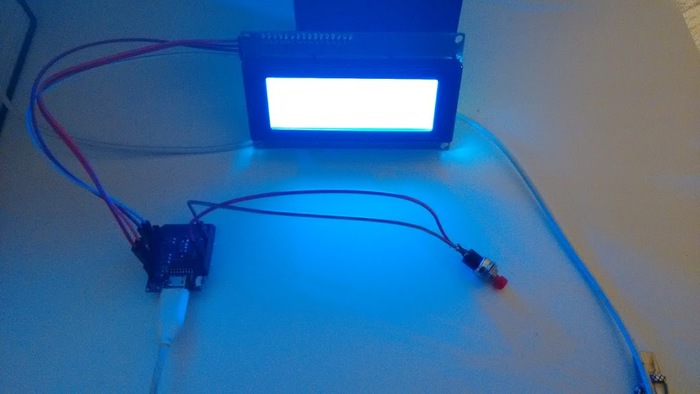
Steve Kemp: 3d-Printing is cool

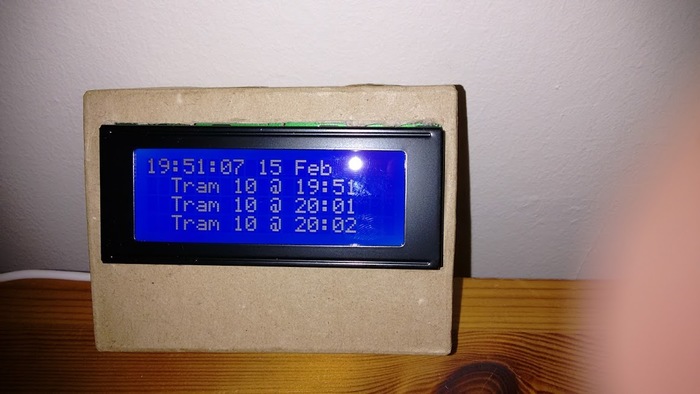
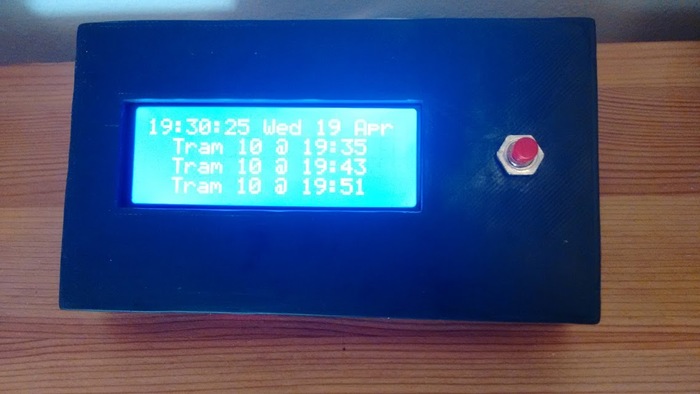
I've heard about 3d-printing a lot in the past, although the hype seems to have mostly died down. My view has always been "That seems cool", coupled with "Everybody says making the models is very hard", and "the process itself is fiddly & time-consuming". I've been sporadically working on a project for a few months now which displays tram-departure times, this is part of my drive to "hardware" things with Arduino/ESP8266 devices . Most visitors to our flat have commented on it, at least once, and over time it has become gradually more and more user-friendly. Initially it was just a toy-project for myself, so everything was hard-coded in the source but over time that changed - which I mentioned here, (specifically the Access-point setup): I've now wired up an input-button to the device too, experimenting with the different ways that a single button can carry out multiple actions: Anyway the software is neat, and I can't think of anything obvious to change. So lets move onto the real topic of this post: 3D Printing. I randomly remembered that I'd heard about an online site holding 3D-models, and on a whim I searched for "4x20 LCD". That lead me to this design, which is exactly what I was looking for. Just like open-source software we're now living in a world where you can get open-source hardware! How cool is that? I had to trust the dimensions of the model, and obviously I was going to mount my new button into the box, rather than the knob shown. But having a model was great. I could download it, for free, and I could view it online at viewstl.com. But with a model obtained the next step was getting it printed. I found a bunch of commercial companies, here in Europe, who would print a model, and ship it to me, but when I uploaded the model they priced it at 90+. Too much. I'd almost lost interest when I stumbled across a site which provides a gateway into a series of individual/companies who will print things for you, on-demand: 3dhubs. Once again I uploaded my model, and this time I was able to select a guy in the same city as me. He printed my model for 1/3-1/4 of the price of the companies I'd found, and sent me fun pictures of the object while it was in the process of being printed. To recap I started like this:
Then I boxed it in cardboard which looked better than nothing, but still not terribly great:
Now I've found an online case-design for free, got it printed cheaply by a volunteer (feels like the wrong word, after-all I did pay him), and I have something which look significantly more professional:
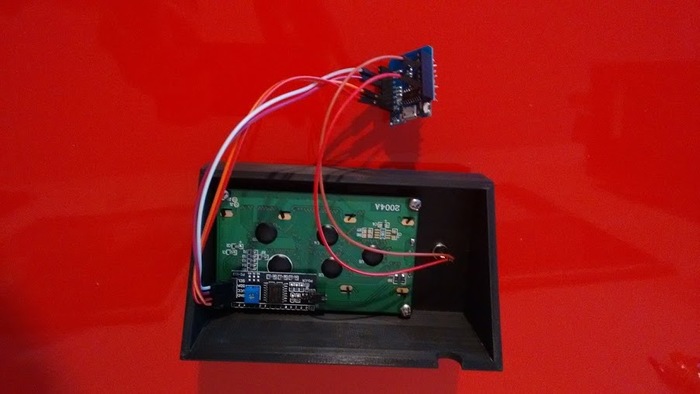
Inside it looks as neat as you would expect:
Of course the case still cost 5 times as much as the actual hardware involved (button: 0.05, processor-board 2.00 and LCD I2C display 3.00). But I've gone from being somebody who had zero experience with hardware-based projects 4 months ago, to somebody who has built a project which is functional and "pretty". The internet really is a glorious thing. Using it for learning, and coding is good, using it for building actual physical parts too? That's something I never could have predicted a few years ago and I can see myself doing it more in the future. Sure the case is a little rough around the edges, but I suspect it is now only a matter of time until I learn how to design my own models. An obvious extension is to add a status-LED above the switch, for example. How hard can it be to add a new hole to a model? (Hell I could just drill it!)

Antoine Beaupr : The rise of Linux-based networking hardware

Linux usage in networking hardware has been on the rise for some time. During the latest Netdev conference held in Montreal this April, people talked seriously about Linux running on high end, "top of rack" (TOR) networking equipment. Those devices have long been the realm of proprietary hardware and software companies like Cisco or Juniper, but Linux seems to be making some significant headway into the domain. According to Shrijeet Mukherjee, VP of Engineering at Cumulus Networks: "we are seeing a 28% adoption rate in the Fortune 50" companies. As someone who has worked in system administration and networking for over a decade, I was surprised by this: switches have always been black boxes of proprietary hardware that we barely get a shell into. But as more and more TOR hardware gets Linux support, some of that work trickles down outside of that niche. Are we really seeing the rise of Linux in high-end networking hardware?

Linux as the standard interface During his keynote at Netdev, Jesse Brandeburg explained that traffic is exploding on the Internet: "From 2006 to 2016 the compound annual growth rate was 78% of network traffic. So the network traffic is growing like crazy. In 2010 to 2023, it's going to grow by a thousand times." He also mentioned Intel was working on devices that could do up to 400 Gbps. In his talk, he argued that Linux has a critical place in the modern world by repeating the mantra that "everything is on the network, and the network runs Linux", but does it really? Through Android, Linux has become the most popular end-user device operating system and is also dominant on the server but what about the actual fabric of the network: the routers and switches that interconnect all those machines? Mukherjee, in his own keynote, argued that even though Linux has achieved dominance in the server and virtualization markets, there is a "discontinuity [...] at the boundary where the host and the network meet" and argued "that the host without the network will not survive". In other words, proprietary hardware and software in the network threaten free software in the server. Even though some manufacturers are already providing a "Linux interface" in their hardware, it is often only some sort of compatibility shell which might be compared with the Ubuntu compatibility layer in Windows: it's not a real Linux. Mukherjee pushed this idea further by saying that those companies are limiting themselves by not using the full Linux stack. He presented Linux as the "top vehicle for innovation" that provides a featureful network stack, citing VXLAN, eBPF, and Quagga as prime features used on switches. Mukherjee also praised the diversity of the user-space Linux ecosystem as something that commercial alternatives can't rival; he compared the faster Linux development to the commercial sector where similar top features stay in the beta stage for up to 3 years. Because of its dominance in the server market, consumers are expecting a Linux-like interface on their networking gear now, which means Linux could be the standard interface all providers strive toward. As a Debian developer, I can't help but smile at the thought; if there's one thing we have not been able to do among Linux distributions, it's pretty much standardize user space in a consistent interface. POSIX is old and incomplete, the FHS is showing its age, and most distributions have abandoned LSB. Yet, the idea is certainly enticing: there is a base set of tools and applications, especially for the Linux kernel, that are standardized: iproute2, ethtool, and iptables are generally consistent across distributions, even though each distribution has its own way of using them. Yet Linux is not dominant, why? Mukherjee identified the problem as "packaging issues" and listed a set of features he would like Linux to improve:
  • Standardization of the ethtool interface. The idea is to make ethtool a de-facto standard to manage switches and ports. Mukherjee gave the example that data centers spend more money on cables than any other hardware and explained that making it easier to identify cables is therefore a key functionality. Getting consistent interface naming was also a key problem identified by numerous participants at the conference. While systemd tried to fix this with the predictable network interface names specification, the interface names are not necessarily predictable across virtual machines or on special hardware; in fact, this was the topic of the first talk of the conference. ethtool also needs to support interfaces that run faster than 1 Gbps, something that still has limited support in Linux at the moment.
  • Scaling of the Linux bridge. Through the rise of "software defined networking", we are likely to see multi-switch virtual environments that need to scale to hundreds of interfaces and devices easily. This is something the Linux bridge was never designed to do and it's showing scalability issues. During the conference, there was hope that the new XDP and eBPF developments could help, but also concerns this would create yet another bridge layer inside the kernel.
Cumulus's goal seems to be to establish Linux as the industry standard for this new era of networking and it is not alone. Through its Open Compute project, Facebook is sharing open designs of data center products and, while we have yet to see commercial off-the-shelf (COTS) 24 and 48-port gigabit switches trickle down to the consumer market, the company is definitely deploying new hardware based on those specifications in its own data centers, and those devices are often based on Linux.

The Linux switch implementation So how exactly do switches work in Linux? The Linux kernel manipulates switches with three different operation structures: switchdev_ops, which we previously covered, ethtool_ops, and netdev_ops. Certain switches, however, also need distributed switch architecture (DSA) features to be properly handled. DSA is a more obscure part of the network stack that allows Linux to represent hardware switches or chains of switches using regular Linux tools like bridge, ifconfig, and so on. While switchdev is a new layer, DSA has been in the kernel since 2.6.28 in 2008. Originally developed to support Marvell switches, DSA is now a generic layer deployed in WiFi access points, set-top boxes, on-board flight entertainment systems, trains, and other industrial equipment. Switches that have an Ethernet controller need DSA, whereas the kernel can support switches without Ethernet controllers directly with switchdev drivers. The first years of DSA's development consisted only of basic maintenance but, in the last three years, DSA has seen a resurgence of contributions, as part of Linux networking push to support hardware offloading and network switches. Between 2014 and 2015, DSA added support for Broadcom hardware, wake on LAN, and hardware port bridging, among other features. DSA's development was parallel to swconfig, written by the OpenWrt project to support the small office and home office (SOHO) routers that the project is targeting. The main difference between swconfig and DSA is that DSA-supported switches show one network interface per port, whereas swconfig-configured switches show up as a single port, which limits the amount of information that can be extracted from the switch. For example, you cannot have per-port traffic statistics with swconfig. That limitation is what led to the creation of the switchdev framework, when swconfig was proposed (then refused) for inclusion in mainline. Another goal of switchdev was to support bridge hardware offloading and network interface card (NIC) virtualization. Also, whereas swconfig uses virtual LAN (VLAN) tagging to address ports, DSA enables the use of device-specific tagging headers to address different ports, which enables DSA to have better control over the switches. This allows, for example, DSA to do internet group management protocol (IGMP) snooping or implement the spanning tree protocol, whereas swconfig doesn't have those features. Some switches are actually connected to the host CPU through an Ethernet interface instead of regular PCI-Express interface, and DSA supports this as well. One advantage that remains in the swconfig approach is that it treats the internal switch as a simple external switch, and addresses ports with standard VLAN tags. This is something DSA could do, as well, but no one has bothered implementing this just yet. For now, DSA drivers use device-specific tagging mechanisms that limit the number of supported devices. Other areas of future improvement for DSA are better multi-chip support, IGMP snooping, and bonding, as well as firewall, NAT, and TC offloading.

Where is the freedom? Given all those technical improvements, you might rightfully wonder if your own wireless router or data center switch runs Linux. In recent years, we have seen more and more networking devices shipped with Linux and sometimes even OpenWrt (e.g. in the case of the Turris Omnia, which we previously covered), and especially on SOHO routers, but it sometimes means a crippled operating system that only offers you a proprietary web interface. But at least those efforts make it easier to deploy free operating systems on those devices. Based on my experience running OpenWrt on wireless routers to build the Montreal mesh network, deploying Linux on routers and switches has always been a manual process. The Ubiquiti hardware being used in the mesh network comes with an OpenWrt derivative, but it includes proprietary drivers and a proprietary web interface. To use the mesh networking protocol that was chosen, it was necessary to deploy custom OpenWrt images by hand. For years, it was a continuous struggle for OpenWrt developers to liberate generation after generation of proprietary hardware with companies like Cisco locking down the venerable WRT platform in 2006 and the US Federal Communications Commission (FCC) rules that forced TP-Link to block free software on its routers, a change that was later reverted. Most hardware providers are obviously not dedicated to software freedom: deploying Linux on their hardware is for them an economic, not political choice. As you might expect, a "Linux router" these days often means a closed device and operating system, using Linux as the only free component. I had the privilege of doing some reverse engineering on the SmartRG SR603n VDSL modem, which also doubles as a WiFi router and VoIP phone adapter. I was able to get a shell on that machine, and what I found was a custom operating system built on top of the Linux kernel. I wrote a detailed report about this two years ago and the situation then was pretty grim. Another experience I had was working over a decade in data centers, which tells an even worse story: most switches and routers there are not running free software at all. We have deployed HP ProCurve switches that provide free (as in beer) software updates and have struggled for years to find free (as in speech) software alternatives for those. We built our own routers using COTS server hardware, at a significant performance cost over the dedicated application-specific integrated circuits (ASICs) built into commercial routers, which do not offer us the trust and flexibility we were looking for. But Linux is definitely making some headway, and has been for a while. When we covered switchdev in February 2016, it was just getting started, but now vendors like Mellanox, Broadcom, Cumulus, and Intel are writing and shipping code using the framework. Cumulus, in particular, is developing a Debian-based distribution (Cumulus Linux) that it deploys for clients on targeted hardware. Most of the hardware in that list, however, is not actually open in the more radical sense: they are devices that can run free software but are not generally open-source hardware. There are some exceptions, but they sit at the higher end of the spectrum: most organizations probably don't need a 100 Gbps ports, let alone the 128 ports in the Backpack switch that Cumulus is shipping. How much this translates to actual freedom for the end-user is therefore questionable. While I have seen encouraging progress on the high end of the hardware spectrum at Netdev, I'm not sure this will translate into immediate wins in the data center or even for home users in the short term. In the long term, however, we will hopefully see some progress in Linux's rise in general-purpose networking hardware following its dominance in general-purpose computing.
The author would like to thank the Netdev organizers for travel assistance. Also, thanks to Andrew Lunn for a technical review of this article. Note: this article first appeared in the Linux Weekly News.

18 April 2017

Steinar H. Gunderson: Chinese HDMI-to-SDI converters

I often need to convert signals from HDMI to SDI (and occasionally back). This requires a box of some sort, and eBay obliges; there's a bunch of different sellers of the same devices, selling them around $20 25. They don't seem to have a brand name, but they are invariably sold as 3G-SDI converters (meaning they should go up to 1080p60) and look like this: There are also corresponding SDI-to-HDMI converters that look pretty much the same except they convert the other way. (They're easy to confuse, but that's not a problem unique tothem.) I've used them for a while now, and there are pros and cons. They seem reliable enough, and they're 1/4th the price of e.g. Blackmagic's Micro converters, which is a real bargain. However, there are also some issues: The last issue is by far the worst, but it only affects 3G-SDI resolutions. 720p60, 1080p30 and 1080i60 all work fine. And to be fair, not even Blackmagic's own converters actually send 352M correctly most of the time I wish there were a way I could publish this somewhere people would actually read it before buying these things, but without a name, it's hard for people to find it. They're great value for money, and I wouldn't hesitate to recommend them for almost all use but then, there's that almost. :-)

Norbert Preining: Gaming: Firewatch

A nice little game, Firewatch, puts you into a fire watch tower in Wyoming, with only a walkie-talkie connecting him to his supervisor Delilah. A so called first person mystery adventure with very nice graphics and great atmosphere.
Starting with your trip to the watch tower, the game sends the player into a series of missions , during which more and more clues about a mystery disappearance are revealed. The game development is rather straight forward, one has hardly any choices, and it is practically impossible to miss something or fail in some way.
The big plus of the game is the great atmosphere, the funny dialogues with Delilah, the story that pulls you into the game, and the development of the character(s). The tower, the cave, all the places one visits are delicately designed with lots of personality, making this a very human like game.
What is weak is the finish. During the game I was always thinking about whether I should tell Delilah everything, or keep some things secret. But in the end nothing matters, all ends with a simple escape in the helicopter and without any tying up the loose ends. Somehow a pity for such a beautiful game to leave the player somehow unsatisfied at the end.
But although the finish wasn t that good, I still enjoyed it more than I expected. Due to the simple flow it wont keep you busy for many hours, but as a short break a few evenings (for me), it was a nice break from all the riddle games I love so much.


17 April 2017

Sylvain Beucler: Practical basics of reproducible builds 3

On my quest to generate reproducible standalone binaries for GNU FreeDink, I met new friends but currently lie defeated by an unexpected enemy... Episode 1: Episode 2:
First, the random build differences when using -Wl,--no-insert-timestamp were explained.
peanalysis shows random build dates:
$ reprotest 'i686-w64-mingw32.static-gcc hello.c -I /opt/mxe/usr/i686-w64-mingw32.static/include -I/opt/mxe/usr/i686-w64-mingw32.static/include/SDL2 -L/opt/mxe/usr/i686-w64-mingw32.static/lib -lmingw32 -Dmain=SDL_main -lSDL2main -lSDL2 -lSDL2main -Wl,--no-insert-timestamp -luser32 -lgdi32 -lwinmm -limm32 -lole32 -loleaut32 -lshell32 -lversion -o hello && chmod 700 hello && analysePE.py hello   tee /tmp/hello.log-$(date +%s); sleep 1' 'hello'
$ diff -au /tmp/hello.log-1*
--- /tmp/hello.log-1490950327   2017-03-31 10:52:07.788616930 +0200
+++ /tmp/hello.log-1523203509   2017-03-31 10:52:09.064633539 +0200
@@ -18,7 +18,7 @@
 found PE header (size: 20)
     machine: i386
     number of sections: 17
-    timedatestamp: -1198218512 (Tue Jan 12 05:31:28 1932)
+    timedatestamp: 632430928 (Tue Jan 16 09:15:28 1990)
     pointer to symbol table: 4593152 (0x461600)
     number of symbols: 11581 (0x2d3d)
     size of optional header: 224
@@ -47,7 +47,7 @@
     Win32VersionValue: 0
     size of image (memory): 4640768
     size of headers (offset to first section raw data): 1536
-    checksum (for drivers): 4927867
+    checksum (for drivers): 4922616
     subsystem: 3
         win32 console binary
     DllCharacteristics: 0
Stephen Kitt mentioned 2 simple patches (1 2) fixing uninitialized memory in binutils. These patches fix the variation and were submitted to MXE (pull request).
Next was playing with compiler support for SOURCE_DATE_EPOCH (which e.g. sets __DATE__ macros).
The FreeDink DFArc frontend historically displays a build date in the About box:
    "Build Date: %s\n", ..., __TDATE__
sadly support is only landing upstream in GCC 7 :/
I had to remove that date.
Now comes the challenging parts. All my tests with reprotest checked. I started writing a reproducible build environment based on Docker (git browse).
At first I could not run reprotest in the container, so I reworked it with SSH support, and reprotest validated determinism.
(I also generate a reproducible .zip archive, more on that later.) So far so good, but were the release identical when running reprotest successively on the different environments?
(reminder: this is a .exe build that is insensitive to varying path, hence consistent in a full reprotest)
$ sha256sum *.zip
189d0ca5240374896c6ecc6dfcca00905ae60797ab48abce2162fa36568e7cf1  freedink-109.0-bin-buildsh.zip
e182406b4f4d7c3a4d239eee126134ba5c0304bbaa4af3de15fd4f8bda5634a9  freedink-109.0-bin-docker.zip
e182406b4f4d7c3a4d239eee126134ba5c0304bbaa4af3de15fd4f8bda5634a9  freedink-109.0-bin-reprotest-docker.zip
37007f6ee043d9479d8c48ea0a861ae1d79fb234cd05920a25bb3db704828ece  freedink-109.0-bin-reprotest-null.zip
Ouch! Even though both the Docker and my host are running Stretch, there are differences.
For the two host builds (direct and reprotest), there is a subtle but simple difference: HOME.
HOME is invariably non-existant in reprotest, while my normal compilation environment has an existing home (duh!). This caused a subtle bug when cross-compiling with mingw and wine-binfmt:
  checking whether we are cross compiling... no
  checking whether we are cross compiling... yes
The respective binaries were very different notably due to a different config.h.
This can be fixed by specifying --build in addition to --host when calling ./configure. I suggested reprotest have one of the tests with a valid HOME (#860428).
Now comes the big one, after the fix I still got:
$ sha256sum *.zip
3545270ef6eaa997640cb62d66dc610a328ce0e7d412f24c8f18fdc7445907fd  freedink-109.0-bin-buildsh.zip
cc50ec1a38598d143650bdff66904438f0f5c1d3e2bea0219b749be2dcd2c3eb  freedink-109.0-bin-docker.zip
3545270ef6eaa997640cb62d66dc610a328ce0e7d412f24c8f18fdc7445907fd  freedink-109.0-bin-reprotest-chroot.zip
cc50ec1a38598d143650bdff66904438f0f5c1d3e2bea0219b749be2dcd2c3eb  freedink-109.0-bin-reprotest-docker.zip
3545270ef6eaa997640cb62d66dc610a328ce0e7d412f24c8f18fdc7445907fd  freedink-109.0-bin-reprotest-null.zip
There is consistency on my host, and consistency within docker, but both are different.
Moreover, all the .o files were identical, so something must have gone wrong when compiling the libs, that is MXE. After many checks it appears that libstdc++.a is different.
Just overwriting it gets me a consistent FreeDink release on all environments.
Still, when rebuilding it (make gcc), libstdc++.a always has the same environment-dependent checksum.
45f8c5d50a68aa9919ee3602a4e3f5b2bd0333bc8d781d7852b2b6121c8ba27b  /opt/mxe/usr/lib/gcc/i686-w64-mingw32.static/5.4.0/libstdc++.a  # host
6870b84f8e17aec4b5cf23cfe9c2e87e40d9cf59772a92707152361b6ebc1eb4  /opt/mxe/usr/lib/gcc/i686-w64-mingw32.static/5.4.0/libstdc++.a  # docker
The 2 libraries are much different, there's barely any blue in hexcompare. At that time, I realized that the Docker "official" Debian are not really official, as Joey explains.
Could it be that Docker maliciously tampered with the compiler as Ken Thompson warned in 1984?? Well before jumping to conclusion let's mix & match.
$ sudo env -i /usr/sbin/chroot chroot-docker/
$ exec bash -l
$ cd /opt/mxe
$ touch src/gcc.mk
$ sha256sum /opt/mxe/usr/lib/gcc/i686-w64-mingw32.static/5.4.0/libstdc++.a 
6870b84f8e17aec4b5cf23cfe9c2e87e40d9cf59772a92707152361b6ebc1eb4  /opt/mxe/usr/lib/gcc/i686-w64-mingw32.static/5.4.0/libstdc++.a
$ make gcc
[build]     gcc                    i686-w64-mingw32.static
[done]      gcc                    i686-w64-mingw32.static                                 2709464 KiB    7m2.039s
$ sha256sum /opt/mxe/usr/lib/gcc/i686-w64-mingw32.static/5.4.0/libstdc++.a 
45f8c5d50a68aa9919ee3602a4e3f5b2bd0333bc8d781d7852b2b6121c8ba27b  /opt/mxe/usr/lib/gcc/i686-w64-mingw32.static/5.4.0/libstdc++.a
# consistent with host builds
$ sudo tar -C chroot -c .   docker import - chroot-debootstrap
$ docker run -ti chroot-debootstrap /bin/bash
$ sha256sum /opt/mxe/usr/lib/gcc/i686-w64-mingw32.static/5.4.0/libstdc++.a
45f8c5d50a68aa9919ee3602a4e3f5b2bd0333bc8d781d7852b2b6121c8ba27b  /opt/mxe/usr/lib/gcc/i686-w64-mingw32.static/5.4.0/libstdc++.a
$ touch src/gcc.mk
$ make gcc
[build]     gcc                    i686-w64-mingw32.static
[done]      gcc                    i686-w64-mingw32.static                                 2709412 KiB    7m6.608s
$ sha256sum /opt/mxe/usr/lib/gcc/i686-w64-mingw32.static/5.4.0/libstdc++.a
6870b84f8e17aec4b5cf23cfe9c2e87e40d9cf59772a92707152361b6ebc1eb4  /opt/mxe/usr/lib/gcc/i686-w64-mingw32.static/5.4.0/libstdc++.a
# consistent with docker builds
So, AFAICS when building with: then depending on whether running in a container or not we get a consistent but different libstdc++.a. This kind of issue is not detected with a simple reprotest build, as it only tests variations within a fixed build environment.
This is quite worrisome, I intend to use a container to control my build environment, but I can't guarantee that the container technology will be exactly the same 5 years from now. All my setup is simple and available for inspection at https://git.savannah.gnu.org/cgit/freedink.git/tree/autobuild/freedink-w32-snapshot/. I'd very much welcome enlightenment :)

Ross Gammon: My March 2017 Activities

March was a busy month, so this monthly report is a little late. I worked two weekends, and I was planning my Easter holiday, so there wasn t a lot of spare time. Debian
  • Updated Dominate to the latest version and uploaded to experimental (due to the Debian Stretch release freeze).
  • Uploaded the latest version of abcmidi (also to experimental).
  • Pinged the bugs for reverse dependencies of pygoocanvas and goocanvas with a view to getting them removed from the archive during the Buster cycle.
  • Asked for help on the Ubuntu Studio developers and users mailing lists to test the coming Ubuntu Studio 17.04 release ISO, because I would be away on holiday for most of it.
Ubuntu
  • Worked on ubuntustudio-controls, reverting it back to an earlier revision that Len said was working fine. Unfortunately, when I built and installed it from my ppa, it crashed. Eventually found my mistake with the bzr reversion, fixed it and prepared an upload ready for sponsorship. Submitted a Freeze Exception bug in the hope that the Release Team would accept it even though we had missed the Final Beta.
  • Put a new power supply in an old computer that was kaput, and got it working again. Set up Ubuntu Server 16.04 on it so that I could get a bit more experience with running a server. It won t last very long, because it is a 32 bit machine, and Ubuntu will probably drop support for that architecture eventually. I used two small spare drives to set up RAID 1 & LVM (so that I can add more space to it later). I set up some Samba shares, so that my wife will be able to get at them from her Windows machine. For music streaming, I set up Emby Server. I wold be great to see this packaged for Debian. I uploaded all of my photos and music for Emby to serve around the home (and remotely as well). Set up Obnam to back up the server to an external USB stick (temporarily until I set up something remote). Set LetsEncrypt with the wonderful Certbot program.
  • Did the Release Notes for Ubuntu Studio 17.04 Final Beta. As I was in Brussels for two days, I was not able to do any ISO testing myself.
Other
  • Measured up the new model railway layout and documented it in xtrkcad.
  • Started learning Ansible some more by setting up ssh on all my machines so that I could access them with Ansible and manipulate them using a playbook.
  • Went to the Open Source Days conference just down the road in Copenhagen. Saw some good presentations. Of interest for my previous work in the Debian GIS Team, was a presentation from the Danish Municipalities on how they run projects using Open Source. I noted how their use of Proj 4 and OSGeo. I was also pleased to see a presentation from Ximin Luo on Reproducible Builds, and introduced myself briefly after his talk (during the break).
  • Started looking at creating a Django website to store and publish my One Name Study sources (indexes). Started by creating a library to list some of my recently read Journals. I will eventually need to import all the others I have listed in a cvs spreadsheet that was originally exported from the commercial (Windows only) Custodian software.
Plan status from last month & update for next month Debian For the Debian Stretch release:
  • Keep an eye on the Release Critical bugs list, and see if I can help fix any. In Progress
Generally:
  • Package all the latest upstream versions of my Debian packages, and upload them to Experimental to keep them out of the way of the Stretch release. In Progress
  • Begin working again on all the new stuff I want packaged in Debian.
Ubuntu
  • Start working on an Ubuntu Studio package tracker website so that we can keep an eye on the status of the packages we are interested in. Started
  • Start testing & bug triaging Ubuntu Studio packages. In progress
  • Test Len s work on ubuntustudio-controls Done
  • Do the Ubuntu Studio Zesty 17.04 Final Beta release. Done
  • Sort out the Blueprints for the coming Ubuntu Studio 17.10 release cycle.
Other
  • Give JMRI a good try out and look at what it would take to package it. In progress
  • Also look at OpenPLC for simulating the relay logic of real railway interlockings (i.e. a little bit of the day job at home involving free software fun!). In progress

Russell Coker: More KVM Modules Configuration

Last year I blogged about blacklisting a video driver so that KVM virtual machines didn t go into graphics mode [1]. Now I ve been working on some other things to make virtual machines run better. I use the same initramfs for the physical hardware as for the virtual machines. So I need to remove modules that are needed for booting the physical hardware from the VMs as well as other modules that get dragged in by systemd and other things. One significant saving from this is that I use BTRFS for the physical machine and the BTRFS driver takes 1M of RAM! The first thing I did to reduce the number of modules was to edit /etc/initramfs-tools/initramfs.conf and change MODULES=most to MODULES=dep . This significantly reduced the number of modules loaded and also stopped the initramfs from probing for a non-existant floppy drive which added about 20 seconds to the boot. Note that this will result in your initramfs not supporting different hardware. So if you plan to take a hard drive out of your desktop PC and install it in another PC this could be bad for you, but for servers it s OK as that sort of upgrade is uncommon for servers and only done with some planning (such as creating an initramfs just for the migration). I put the following rmmod commands in /etc/rc.local to remove modules that are automatically loaded:
rmmod btrfs
rmmod evdev
rmmod lrw
rmmod glue_helper
rmmod ablk_helper
rmmod aes_x86_64
rmmod ecb
rmmod xor
rmmod raid6_pq
rmmod cryptd
rmmod gf128mul
rmmod ata_generic
rmmod ata_piix
rmmod i2c_piix4
rmmod libata
rmmod scsi_mod In /etc/modprobe.d/blacklist.conf I have the following lines to stop drivers being loaded. The first line is to stop the video mode being set and the rest are just to save space. One thing that inspired me to do this is that the parallel port driver gave a kernel error when it loaded and tried to access non-existant hardware.
blacklist bochs_drm
blacklist joydev
blacklist ppdev
blacklist sg
blacklist psmouse
blacklist pcspkr
blacklist sr_mod
blacklist acpi_cpufreq
blacklist cdrom
blacklist tpm
blacklist tpm_tis
blacklist floppy
blacklist parport_pc
blacklist serio_raw
blacklist button On the physical machine I have the following in /etc/modprobe.d/blacklist.conf. Most of this is to prevent loading of filesystem drivers when making an initramfs. I do this because I know there s never going to be any need for CDs, parallel devices, graphics, or strange block devices in a server room. I wouldn t do any of this for a desktop workstation or laptop.
blacklist ppdev
blacklist parport_pc
blacklist cdrom
blacklist sr_mod
blacklist nouveau blacklist ufs
blacklist qnx4
blacklist hfsplus
blacklist hfs
blacklist minix
blacklist ntfs
blacklist jfs
blacklist xfs

16 April 2017

Shirish Agarwal: single person cult-based political parties

Summer heat

Summer heat

I would like to start with sharing is the mercury has been shot in recent times to record temperatures. For instance, Pune has been recording temperatures between 41 and 43 degrees consistently. The result of that has been a massive reduction in volunteer activity on my part as well as some reduction in work activity. The body wants and needs to conserve energy. Even my mobile phone s lithium-ion battery becomes too hot and I have to turn it off in the crucial time from 12 17:00 hrs after which the weather cools down a bit. I am curious to know if I m the only one or there are others like me. I have seen quite a few construction, re-construction and renovation projects taking quite a hit by this incredible heat wave. If it isn t climate change then I don t know what is. And this is not limited to Pune but the whole of Western Maharashtra, Gujarat, Madhya Pradesh and quite a few parts of North India too. In Pune we are expecting it to hit 45 degrees pretty soon. And I don t see this ending anytime soon, at least till July when the rains comes and we have some relief from this weather. Balasaheb Thackeray, Founder Shiv Sena Balasaheb Thakre/Thackeray founded the Shiv Sena in/around 1966. While he was cartoonist by trade, most of his cartoons were anti-migrant in nature. The target was the urban, unemployed Marathi youth based mostly in Mumbai and the suburbs. The Shiv Sena vandalized properties run by South Indian businessman, Gujaratis. The Shiv Sena and Balasaheb Thackeray were also responsible in part due to the massive closure of cloth mills in South Mumbai. While the workers struggled to make ends meet, some whose wife and children died, fell into prostitution, drugs or whatever they could to make ends meet while the party and more important Mr. Balasahab Thackeray prospered. In spite of the many threats, there are and were many South Indians who prospered inspite of Shiv Sena s threats. Gujaratis on the other hand went back to Gujarat and now Surat rivals Mumbai. Another decade or so and Surat and not Mumbai would be the financial capital of India, the way Gujaratis are working towards it. Then in the 90 s people from U.P. and Bihar came in search of livelihood, again the same rhetoric and even attacks were done against people from U.P. and Bihar. The only thing that was missing for all these people is a domicile certificate which you can get only after living 15 years in Mumbai. The only thing that they and other political parties have been successful is murdering journalists. I m sad to report that Maharashtra, my home state has a very bad report card in preventing such murders. And it s both the State and the Centre who have to share the blame equally. Come to 2017 and Shiv Sena doesn t have a leg to stand on. Balasaheb Thackeray is no more, his son didn t inherit Balasaheb s fiery character and the nephew has now another outfit called Maha Navnirman Sena. Also, all those who were one-time outsiders are now residents of Mumbai (with the domicile certificate) and hence registered voters. There is another angle to it as well, Marathas for far too long thought that people they will elect from their community will do something from their community just like auto rickshaw drivers thought that educated unemployed youth from their community would be better than the agents who rip them off whenever they have some work in the local R.T.O. (Road Transport Office) . Similar to auto rickshaw drivers, the Marathas realized that none of the leaders whom they elected would ever do the work. This is why when last year there were huge Maratha rallies all over the state (peaceful demonstrations all around though). I just shared Pune as am most concerned with my city although similar rallies were held in Mumbai (Khargar), Nagpur, Solapur among other places that I know of. But as shown on youtube there was no central leadership (a.k.a. leaders) and still they were the most disciplined lot. While the Marathas may say one thing, in part they are also culprits of their own past. My interactions with few Marathas was that they are still smitten by what happened in the second and the third Anglo-Maratha War . It is sad because I do see them adding lot of value provided they keep a cool head as I have seen some do. Business or service is the game only for cooler heads. Things came to a head though about couple of weeks back when Mr. Ravindra Gaikwad, a Shiv Sena M.P. assaulted some elderly Air India Staff. While things have cooled down since then, it only belittles both the person and the party. If anything, Air India can be accused of being to gentleman like in the whole case. The only crime of its own making is it has been looted since the beginning by Indian MP s and their relatives with over-staffing and old age of the planes and being over-priced in an extremely price sensitive market. It doesn t have any low-cost options but all of that is another story altogether. Converse to this, the current Prime Minister, Mr. Narendra Modi and Malcolm Turnbull enjoyed the ride of the Delhi Metro. In Politics as well as in life, symbolism scores big. That showed where Mr. Modi s priorities lie and where Mr. Gaikwad s. In the end, the writing seems to be on the wall for not just the Shiv Sena but I would say all single-personality based parties. They need to widen both their political scope and activities and have prominent personalities with strong leadership taking the country along rather than being petty-minded.
Filed under: Miscellenous Tagged: #17th century, #Air India, #anti-migrant policy, #Indian Summer, #Maratha, #Maratha History, #Me Maratha, #Me Maratha rallies, #planet-debian

Next.

Previous.