Search Results: "rra"

24 November 2005

Paul van Tilburg: Broken HDDs

So, what’s with all the broken laptop hard disks?! I have two laptops running almost all day (one as a cheap simple server with built-in UPS) and one as workstation. But in the last, say, 2 years I had to replace the 2.5” (laptop) hard disk drives 4 times! Since laptop HDDs cost a lot more per megabyte than normal 3.5” drives, this was becoming an expensive issue for me. So, I geared up S.M.A.R.T on both machines and did some investigating. The major issue seems to be the load/unload system that is integrated into more and more of these drives nowadays. The heads will automatically be retracted (parked) after some idle time to decrease the risk of shock damage and reduce power consumption. However, this seems to be a bad combination with Linux. I have not done any research into the specific implementation of the journaled file systems that I use (ext3, XFS), but it can something to do with it. It seems the heads of almost all laptop disks I encounter are continuously unloaded and loaded instead of around 5 times per hour. It seems a hard disk drive is made to allow for 300.000 load/unload cycles, after that the mechanism wears of so that inaccurate moving can occur and the platters can be damaged because of a small miss. Now, my drives had 650.000, 1.2000.000 and 900.000 before bad sectors and completely erratic behaviour start to occur, but this was within a year. My most recent broken drive had about 3 load cycles per minute, this means 180 per hour. With things going bad at 600.000, the disk thus had a lifetime of 3333 hours (138 days). This is ridiculously short. So I’ve turned APM of all my drives off (hdparm -B254). Better a small risk of bad sectors when dropping my laptop than having to replace my disk within the year. Also note that my brand new Western Digital disk has spent 14.000 of its load cycles within the first 15 hours that I was busy with installing Debian and recovering backups! If someone has more information about this, please let me know.

23 November 2005

Antti-Juhani Kaijanaho: ID6

As I start to write this, it's the last minute of my country's 87th birthday (the Finnish Independence Day). It got me thinking about nation-states and independence and whatnot. And I came to a threefold conclusion: First, there is some value in independence. Getting rid of the status of a Grand Duchy in personal union with Russia was certainly a good step for Finland, in light of the rough road the Russians themselves have since travelled. For the same reason, the two wars Finland fought against the USSR were quite worthwhile. Similarly, if Finland were to be threatened by a neighbour again, armed defense would certainly be justifiable. Second, there is no intrinsic value in independence. If a humanly life (including freedom and local government) can be guaranteed even if there is no Finnish state in itself, I see no reason to hold on to the old-fashioned concept of a nation state. Third, I am in favour, as a long-term goal, of a world government. Of course, a single government becomes a single point of failure in case of a coup, for example, but if the global state is arranged properly, the danger of a successful coup is minimal. On the other hand, a world government is in far better position to institute necessary policies to combat the global problems of poverty, climate change and other such issues than the current system of competing and cooperating nation-states. In the current system, the big issues are easily put aside in name of local opportunism. Finland is by no means immune to that problem. The great crises of the 20th Century were its devastating wars. Fortunately, we have overcome them to a sufficient degree. The great crisis of the 21st Century is not terrorism - though it is a symptom. The great crisis is caused by the limits of growth, and we are already feeling quite concretely the nearness of those limits. If something is not done, our current civilization will crash spectacularly. The human race will probably survive - but do we really want to live through another Dark Age? Long Live the Earth!

22 November 2005

Wouter Verhelst: Wanted: an NBD dissector for Ethereal

I could probably write it myself, given time, but I'm guessing it's going to cost me a lot more time understanding the Ethereal API than it is going to cost someone else undestanding the NBD protocol. Which is really simple. So, here's a short description of the protocol; now if someone could write me an Ethereal dissector, I'd be very happy. And if you need it, just ask for more information.
"Negotiation" phase:
  • Connection is opened by the client
  • The server sends out the literal string NBDMAGIC to the client (which is the "INIT_PASSWD" in the code and in error messages), followed by the the 'cliserv_magic', 0x00420281861253LL. The NBDMAGIC is there to identify a server; the cliserv_magic may be updated when the protocol changes incompatibly.
  • The server sends the size of the device as a 64 bit unsigned integer.
  • The server sends 128 bytes of zeroes (discarded by the client currently; these are reserved for further use)
(whether or not the above are all in one packet is something I don't know and don't really care about; they're all done using different write calls, so can technically be in different packets)
After that, the client is expected to be happy with the connection (if it isn't, it'll just drop the connection without explanation).
Main data pushing phase:
(I just made that name up, give it a reasonable name please ;-)
  • Clients sends a struct nbd_request to the server (which is defined in <linux/nbd.h>. The fields in that struct are:
    magic (32bit unsigned int)
    must be NBD_REQUEST_MAGIC aka 0x25609513 (again defined in <linux/nbd.h>); if it isn't, the server disconnects (this should really be handled better, but at the moment it isn't; and changing the protocol to do this might be less than trivial). It is possible that previous versions of the protocol used 0x12560953 instead (the header file mentions that as something not to be used, but I don't know where it comes from).
    type (32 bit unsigned int)
    is NBD_CMD_READ aka 0 (to read data), NBD_CMD_WRITE (to write data) aka 1, or NBD_CMD_DISC aka 2 (to request a clean disconnect).
    handle (char array of eight bytes)
    used to uniquely identify a request; this is later sent back in the reply, and can be used to associate a reply with a request.
    from (64 bit unsigned int)
    the offset in the export where the read or the write should start.
    len (32 bit unsigned int)
    the length of the requested read or write.
  • If struct nbd_request.type==NBD_CMD_WRITE, the client will then send struct nbd_request.len bytes to the server, containing the data it wants to see written.
  • Server sends a struct nbd_reply to the client:
    magic (32 bit unsigned int)
    functions similar to struct nbd_request.magic, only its value is supposed to be 0x67446698. Analoguous to struct nbd_request.magic, there's a value, possibly from a previous version of the protocol, which says 0x96744668 instead.
    error (32 bit unsigned integer)
    is zero, unless an error occurred
    handle (char array of eight bytes)
    the exact same value that was received in struct nbd_request.handle
  • If struct nbd_request.type==NBD_CMD_READ, the server will then send struct nbd_request.len bytes to the client, containing the data it read.
As you can see, a very simple protocol really... now if only somebody could write me a dissector—having to dissect it by hand isn't very funny, really.

Clint Adams: GUI music players

First, I should point out that I hate GUIs. Then I should point out that I don't want to play music with a GUI music player. I'm including ncurses-type things like cplay in the GUI category. They've always made my skin crawl. So, why am I testing out GUI music players? It's because I didn't didn't realize that I misread the Audioscrobbler spec. Now that we've established that I don't know what I'm talking about, let's move on. Yesterday, I followed the suggestion of some KDE people and tried amaroK. I was pleasantly surprised. It was pretty, it was functional, the UI didn't piss me off, and it kept showing me a picture of Mako for some reason I still can't figure out. Here's where it fell down: it wanted me to select tracks based on album/artist info in the file tags; the musicbrainz lookup function is not as useful as tp_tagger; when I tried to play tracks off of a slow networked filesystem, it skipped a bit, then it shoved its head up its ass and ate itself. It managed to finish the track before it disabled its frontal lobe, but it didn't send the data to last.fm. So, amaroK was a lot better than I expected, but unacceptable. People seem to like Quod Libet. Joey and Erinn. So when I tried it today, I didn't expect it to be awful. Here's what it has over amaroK: it doesn't fall over and die when trying to deal with files on a slow networked filesystem. It just skips. You may be thinking that this could be easily solved with proper buffering. I'd think that too, if it didn't skip when playing files on the local hard drive. You may be wondering why I'm trying to play music on an old 486. I'm not. This is a Pentium 4 2.8GHz under almost no load. This is ridiculous. Compared to amaroK, this thing is ugly as sin, and incredibly awkward. That includes the metadata editor that people keep raving about for some reason. Furthermore, when I rearrange songs in the Play Queue, it occasionally ignores me and plays the track that used to be at the top of the list. Rhythmbox also has problems with skipping, so I guess that gstreamer is the devil. I'm not filing bugs because I don't intend to ever use these programs again.

Sam Hocevar: Suspicious Activity? Indeed

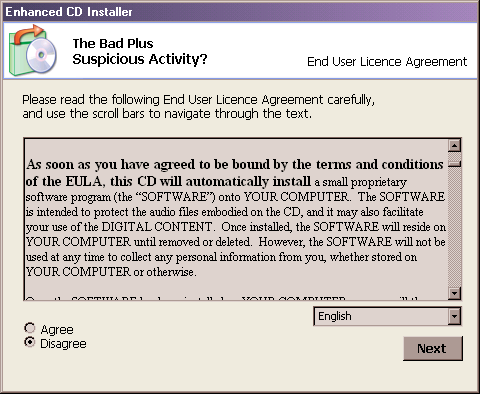
The Bad Plus I spent the whole weekend looking for a DRM-encumbered Sony CD so that I could check for myself whether my code was really being redistributed without permission. I eventually found one: Suspicious Activity?, by The Bad Plus. A rather enjoyable post-modern jazz album. I am rather lucky, it could have been C line Dion. As expected, installing the CD s custom player also installed a stealth aries.sys driver along with a few other interesting files such as $sys$DRMServer.exe, all hidden in a $sys$filesystem directory. I rapidly got rid of this cruft and started studying the really important file, ECDPlayerControl.ocx. It is the file Sebastian Porst and Matti Nikki found to be containing parts of mpglib, LAME, faad2, VLC... Suspicious Installer? Evidence that the DRMS code comes from VLC There are of course obvious similarities between some functions and structures of ECDPlayerControl.ocx and the ones in VLC s source. However, given how precise the implementation of a cryptographic protocol needs to be, the possibility that two separate implementations show many similarities must not be dismissed. The data structures and constant tables especially are likely to be identical. I think however that I found strong enough evidence that this is not the case here. The original drms.c was written by Jon on 01/05/04. I then hacked on that file on 01/18/04 and reorganised it, also replacing the reverse-engineered MD5 and AES functions with clean implementations, then Jon added DRMSv2 support on 05/05/04 and I reorganised the code again on 05/08/04. Some of these changes were specific to VLC (not in that they made the code unusable outside of VLC, but rather that they made it possible to use an external MD5 hash provider, for instance), so they were the bits I was looking for in ECDPlayerControl.ocx. For instance, Jon s original code had the following instruction:
p_acei[ 4 ] = 0x5476212A;
Since all bytes of this long word are comprised between 0x20 and 0x7f, it was later rewritten like this:
char p_secret1[] = "Tv!*";
This change makes the code more human-readable because many other secrets in the Apple DRMS protocol are ASCII strings. Also, I know how to look for binaries that use the string "Tv!*", but it takes me some more time to think of a way to find binaries that use 0x5476212A. And the Sony rootkit uses the following (only relevant lines shown):
 .text:100883B8   mov   cl, byte ptr ds:xxxxx+4 ; 0
 .text:100883C2   mov   eax, dword ptr ds:xxxxx ; "Tv!*"
 .text:100883C8   mov   [esp+70h+yyyyy], eax
 .text:100883DC   mov   [esp+7Ch+zzzzz], cl
The use of xxxxx+4 shows that ECDPlayerControl.ocx uses a string instead of a 32 bits integer to store the secret, disregarding the fact that the 5th character of the string (a null char) is never used. Another example: in this commit I reorganised the DoExtShuffle() function, merging FourthPass() and FifthPass() and discarding a structure allocated on the stack. What is important here is that DoExtShuffle() was built by a complex combination of choices, the main purpose of which being to reduce the size of the C functions:
 static void DoExtShuffle( uint32_t * p_bordel )
  
     uint32_t i_ret;
     i_ret = FirstPass( p_bordel );
     SecondPass( p_bordel, i_ret );
     ThirdPass( p_bordel );
     FourthPass( p_bordel );
  
Note how i_ret is not reused and could be merged into the p_bordel array, or maybe SecondPass() merged into FirstPass(). This choice is definitely a legacy of how the code evolved. And the Sony equivalent: a perfect match.
 .text:10089F3C xxxxx:
 .text:10089F3C   mov   ecx, esi
 .text:10089F3E   call  yyyyy
 .text:10089F43   push  eax
 .text:10089F44   mov   eax, esi
 .text:10089F46   call  zzzzz
 .text:10089F4B   add   esp, 4
 .text:10089F4E   call  ttttt
 .text:10089F53   call  uuuuu
After having studied the Sony code for a while, I have of course gathered dozens of such examples. But I also discovered a few new things. Where does the DRMS code come from? The code undoubtedly comes originally from VLC, but it has traveled a lot. I would be surpried if it came directly from VLC, as no other part of VLC is included with the rootkit. And although there are parts of FAAC in the Sony code and FAAC includes VLC s drms.c, the version currently in the FAAC CVS is horribly outdated. Sebastian Porst also noticed a few obvious differences between the Sony code and the version of drms.c present in VLC. The most obvious being this one:
 if( p_shuffle->i_version == 0x01000300 )
  
     DoExtShuffle( p_bordel );
  
Which became:
 .text:10089F2E   cmp   eax, 1000300h
 .text:10089F33   jz    short DoExtShuffle
 .text:10089F35   cmp   eax, 1000400h
 .text:10089F3A   jnz   short skip
 .text:10089F3C DoExtShuffle:
 .text:10089F3C   ...
 .text:10089F58 skip:
 .text:10089F58   ...
That 0x01000400 is a version check for 4th generation iPods firmwares. I also discovered at least 40 KB of new lookup tables that seem to be used for more buffer shuffling. At first I thought it was simply F4I s DRM implementation, but the shuffling calls are nested with iPod hardware information retrieval from our DRMS code, so they re really part of drms.c. Sony distributing a DRMSv3 descrambler? The only explanation I can think of is that someone took the VLC code, added support for an upcoming Apple DRMS format version and redistributed the software without letting the VLC authors know, probably violating the GPL (I only say that because I have not found the software yet, but I feel pretty safe in saying it). Since it is based on GPL software, I was already entitled to ask Sony for the source code of ECDPlayerControl.ocx. But as the copyright holder of a significant part of the software they counterfeited, maybe I have a greater chance of being heard. Not that it would be difficult to reverse-engineer it yet another time, but it would be awesome if the next opensource iTunes Music Store file player was contributed by Sony!
20 November 2005

Matthew Palmer: The Fun Never Stops With Ruby

Well, there's nothing like posting a really rubbish program to your blog to find out the right way to do it. Firstly, Philipp Kern has come up with another, even shorter version than his version I posted in the update to my original Ruby post, this time blowing me away with the strangeness of explicit casts in Ruby. Apparently, casting an input stream to an array produces an array with one-line-per-element, as in this example:
 STDIN.to_a.sort_by rand .each l puts l 
As Philipp warns, however: "Ruby is full of fun and power; one must watch out that the scripts remain readable". For a fairly toy example, this solution is still fairly readable, however I can see hair growing on this thing if your program grows large. Next, Pierre-Charles David showed his qualifications for becoming a co-author of the next edition of the Pickaxe (AKA "Programming Ruby: The Pragmatic Programmers' Guide"), with his example and explanation. He's kindly given permission for me to reproduce his e-mail in it's entireity, since it's too good to chop up:
Here is the shortest and most readable version of your "randomize stdin" script I can think of:
  #!/usr/bin/env ruby
  print ARGF.readlines.sort_by   rand  
 
ARGF is a special variable representing either stdin or, in the case where file names are passed on the command line, the content of these files (think of Perl's <>). ARGF behaves like an IO object (although I think it is not one). In particular, it responds to the #readlines method which splits the receiver's content into lines and returns an array. In other words,
  lines = ARGF.readlines
 
is the idiomatic way of doing
  lines = []
  while line = gets() do
    lines << line
  end
 
in your example. The next part (sort_by) uses a new form of the sort method, which I think is not documented in the Pickaxe. It implements the Schwartzian transform technique. In essence, a random number is associated to each element of the array, which are then sorted based on this index. As a general style remark, note that although Ruby supports "while" and "for x in y" loops, they are rarely used, in favor of iterators and/or higher order methods. For example, to gather all the input lines in an array without using readlines, one might write
  lines = Array.new
  ARGF.each_line    l  lines << l  
 
or
  lines = ARGF.inject([])    lines, l  lines << l  
 
Hope it helps, and welcome to Ruby!
Pierre, your explanation definitely helped, and I hope it helps others too. The third person to help me out is Decklin Foster, through a post in his blog. What particularly caught me about his solution was the neat demonstration of another feature of Ruby which I think I will really learn to love: the ability to dynamically add methods to an existing class. "Aiee!" I hear all the purists scream -- and I can see the potential for severe misuse, too. But, since every good idea seems to get deeply perverted, we may as well have some real useful features to pervert while we're at it. Decklin has the clever idea of adding methods to the Array class that shuffle the elements of the array in a random fashion. His code is beautiful in it's simplicity:
 class Array
    def swap!(a, b)
        self[a], self[b] = self[b], self[a]
        self
    end
    def shuffle!
        each_index do  i 
            j = i + rand(length - i)
            swap!(i, j)
        end
        self
    end
 end
He then goes on to rewrite my bumbling example in probably the most comprehensible manner I've yet seen:
 STDIN.readlines.shuffle!.each    line  puts line  
Decklin writes, "Now that is cool.". I couldn't have put it better myself. My thanks to Philipp, Pierre-Charles, and Decklin, for helping me along the Ruby path. So, two new Ruby Rules for me to live by: Hmm, is it possible that Ruby is nothing more than Functional Programming by Stealth? Aiee!

Radu Spineanu: Boring everything

Honestly... It's saturday night and if you don't want to go to a noisy club you really can't do anything interesting after 2 in the morning.

Well, throw a party ? Sure, but where ? Where i live the walls are so thin i can hear my upstairs lady neighbour do about everything(EVERYTHING...). In the dorms ? Somebody always calls the police about the noise.

All the places in this town are either caffes or clubs, and i am really bored of clubs.

I wonder what other people do when they have a free night, reserved for fun.

In other news, we are probably going to get a new IBM server for work (don't know exactly the model yet) and i have to decide on using either vservers or xen. I've only worked with vservers but heard great things about xen. Maybe we can finally bring ftp.timisoara.roedu.net back online, hurray...

18 November 2005

Christoph Berg: Hacking DDPO

Over the last few weeks, I've implemented some new features in DDPO. The system, originally written by Igor Genibel, is a mix of Python, Perl, and PHP generated from WML, so it's quite interesting to see how these languages interact. The main new features are the ability to add arbitrary packages to the list displayed, and an automatic listing of all NMUs and sponsored uploads in the new "uploads" section. (Thanks to Ryan Murray, Joerg Jaspert, and Joey Schulze for helping fix the projectb for that!) I won't repeat the details here, read the d-d-a posting for that. Another nice thing is the link to Ian Lynagh's popcon graphs which I had mostly ignored so far. Have a look at my DDPO page to see the new features - feedback welcome!

16 November 2005

Horms: Back from Korea

I made it back from Korea in once piece (several weeks ago), however, sadly, my camera did not. Well, its in once piece, but one not working piece. I took it back to the shop for repair under warranty, they called to tell me it was fixed. But alas when I went to pick it up, it was still not working - though in a slightly different way. I think its an electronics failure. I hope it gets fixed soon so I can take some new snaps. Fortunately Dave's attempts at taking photos were more successful than mine. As an added bonus, his trip with Soyong was around 2 weeks, whereas Chiz and I only dropped in for 2 days. You can read all about it on his blog [Oct] [Nov] which also has links to lots of awesome photos. In semi-related news, by brother sent me a copy of Lee Frost's "The Complete Guide to Night and Low-Light Photography". Mmm, wish I had my camera back...

Gunnar Wolf: ...So I did it

So it seems I cannot uphold my word - Well, yes, it was because of the trouble it would represent to the fine Moquegua guys - But anyway, I ended up accepting the invitation practically at the last minute, and went to Moquegua, Per , probably for my life's most tiresome journey.
Saturday, after lunch, we headed for the airport. I left Mexico at 17:30, and arrived five hours later in the Lima airport. Thanks to Antonio, Jos and Laura, who picked me up at 23:30 and arranged me a room in a hotel. I met the DebianPeru crowd, a very nice group, Sunday morning - We had breakfast, chatted for a while, and went for Lima's famous ceviche (assorted seafood cooked in cold in lemon. VERY good). At 3:45PM, I took the bus to Moquegua... For 17 long hours.
Got to Moquegua at ~8AM, went to the Jos Carlos Mari tegui University. I met the other guest speakers for breakfast, went with them to meet the Univerity Rector, hooked up some minutes to the net, went to a typical Moqueguan restaurant, gave my talk... Then hurried up to get the bus back to Lima. We got there five minutes before it left. I don't know why or how, but the bus back took 14 instead of 17 hours - I will not complain ;-)
Back in Lima, Carlos met me at the bus station, we went for breakfast, and hurried to the airport. I crossed the gate at 12PM, hurried by the airline personnel (and didn't manage to see Rudy/Stone_Head, who was on his way there)... Just to find the plane was delayed, although by little. Sat down for a while, hacked for a bit, and took the plane back home.
Summing it all up, I traveled roughly 40 hours, out of the 72 hours I was out of Mexico. Of course, you could add 1hr travelling to the airport and 1:30 back home... Anyway, 40/72 is quite close to 42/74 :)
I am tired. Plain tired. I am just waiting for Nadezhda to get home, as I want her to find me alive, and I'll crash down in bed.

Anthony Towns: Hacking dak

Who can resist a good rhyme? Or a bad one? So this round of dak hacking turned out to make the AJ Market scheme another notch more confusing – hence the delay in blogging, and the teaser in my last post. The issue leading to the confusion is that the major item on the list to start hacking on was SCC, which unlike the projects I’ve undertaken so far, is more than a day’s hacking. In fact, due to the need to give mirrors a chance to adapt to the new system between it being implemented and actually used, it’s actually more of a multi-week task. And doing it as a one-day-a-week project would extend that into a multi-month task afaics. I guess that’s still better than never, but obviously it’s worth looking into alternatives. Naturally, then, the first phase of a longer project like this is threefold. We’ll call it “the three P’s”. Planning My theory at this point was to come up with a plan for what to do, try figuring out how much work it’d take, and then see what sort of financial arrangements might be plausible – not involving me cutting a few weeks out of my life for spare change, but without making the whole thing an unleapable chasm from what the AJ Market’s currently managing either. I figured writing it up as a semi-formal proposal makes most sense:
Summary Implementation of the outstanding mirror split proposal for the Debian archive to allow new architectures, particularly amd64, to be included in the archive. Benefit In spite (or perhaps because) of its simplicity, this project has been languishing for over two years, and is not currently being worked on; so at present it’s not even possible to estimate when it would otherwise be completed. It is most notably preventing amd64 from being integrated into the normal Debian development environment, causing derived distributions to maintain amd64 specific patches themselves. In the longer term, reducing the constraints imposed on the archive size may allow the introduction of additional suites, such as backports or volatile, as well as additional architectures; though significant further discussion on this would be needed. Background Since at least mid-2003 the Debian archive has been closed to new architectures due to the already large amount of space and bandwidth required to become a Debian mirror. At present, the archive uses some 158GiB of disk, and about 1GiB per day; additional architectures are expected to require approximately an additional 10GiB each, and there are likely around half a dozen architectures that will be considered for addition once the moratorium on new architectures is rescinded (incl amd64, armeb, sh variants, kfreebsd and possibly partial architectures for arch variants such as s390x and ppc64). The primary work needed to fix this involves:
  • ensuring the mirror network operates correctly when a majority of mirrors are partial; this reduces the impact on bandwidth and storage capacity
  • optimising portions of the archive maintenance software, particularly apt-ftparchive; this reduces the load on the archive server
  • providing appropriate guidelines on the qualification criteria new architectures need to meet in order to be added to the archive; this provides a limit on future increases, allowing growth to be appropriately controlled
Actual work I expect there will be six phases to the project:
  1. cleanup of the archive as it stands, and establishing a clear categorisation of its contents to define what a partial mirror by architecture or suite should officially contain
  2. providing appropriate scripts to ensure mirror sites can easily comply with the previously defined expectations for partial mirroring
  3. devise an appropriate structure for the new mirror network, that can easily incorporate existing mirrors, and coexist with the existing structure
  4. provide information on the new structure to both mirror admins and users; assist with the transition, and resolve any problems found
  5. ensure the archive management software is appropriately optimised, and that archive inclusion criteria have been debated and established
  6. add new ports that have passed the qualification requirements to the archive
In theory, a couple of days for each of those sound plausible, so making that twelve days actual work (with a couple of week’s delay in between for mirrors to have some time to adapt to the new network). On the downside, twelve days at a day a week is over three months of real time, not counting the possibility of doing other things with the one day a week, or Christmas, or the aforementioned delay for mirrors. Yick. So much for planning. Preparation So the next “p” is preparation. In this case that’s finally getting around to fix dak CVS, which has been slightly broken since May. The extent of the actual breakage was just the loss of the ChangeLog history, aiui (or at least, that was the unrecovered breakage), but the result of that was months of uncommitted changes on both ftp-master and security (and reportedly from Ubuntu’s dak installation too). The changelog for the first set of commits (not counting buildd changes from ftp-master, security changes or Ubuntu changes that haven’t made it to ftp-master) looks like:
        * tiffani: new script to do patches to Packages, Sources and Contents
        files for quicker downloads.
        * ziyi: update to authenticate tiffani generated files
        * dak: new script to provide a single binary with less arbitrary names
        for access to dak functionality.
        * cindy: script implemented
        * saffron: cope with suites that don't have a Priority specified
        * heidi: use get_suite_id()
        * denise: don't hardcode stable and unstable, or limit udebs to unstable
        * denise: remove override munging for testing (now done by cindy)
        * helena: expanded help, added new, sort and age options, and fancy headers
        * jennifer: require description, add a reject for missing dsc file
        * jennifer: change lock file
        * kelly: propogation support
        * lisa: honour accepted lock, use mtime not ctime, add override type_id
        * madison: don't say "dep-retry"
        * melanie: bug fix in output (missing %)
        * natalie: cope with maintainer_override == None; add type_id for overrides
        * nina: use mtime, not ctime
        * katie.py: propogation bug fixes
        * logging.py: add debugging support, use   as the logfile separator
        * katie.conf: updated signing key (4F368D5D)
        * katie.conf: changed lockfile to dinstall.lock
        * katie.conf: added Lisa::AcceptedLockFile, Dir::Lock
        * katie.conf: added tiffani, cindy support
        * katie.conf: updated to match 3.0r6 release
        * katie.conf: updated to match sarge's release
        * apt.conf: update for sarge's release
        * apt.conf.stable: update for sarge's release
        * apt.conf: bump daily max Contents change to 25MB from 12MB
        * cron.daily: add accepted lock and invoke cindy  
        * cron.daily: add daily.lock
        * cron.daily: invoke tiffani
        * cron.daily: rebuild accepted buildd stuff
        * cron.daily: save rene-daily output on the web site
        * cron.daily: disable billie
        * cron.daily: add stats pr0n
        * cron.hourly: invoke helena
        * pseudo-packages.maintainers,.descriptions: miscellaneous updates
        * vars: add lockdir, add etch to copyoverrides
        * Makefile: add -Ipostgresql/server to CXXFLAGS
        * docs/: added README.quotes
        * docs/: added manpages for alicia, catherine, charisma, cindy, heidi,
        julia, katie, kelly, lisa, madison, melanie, natalie, rhona.
        * TODO: correct spelling of "conflicts"
Ugh. Still, that’s enough to start work. And the final “P”? Come on, be honest with yourself, you know what it’s going to be. Procrastination Okay, that’s not entirely fair; the irrelevant bit of work was actually on to TODO list before SCC (mostly because it was something that I could get done reasonably quickly) and in fact was this line of the above changelog:
        * dak: new script to provide a single binary with less arbitrary names
        for access to dak functionality.
All the various model/actress names have been getting more than a little confusing recently, with almost forty in the dak suite, and another two dozen or so in use elsewhere – and then there’s the fact that the whole hot babes thing is both a bit offensive, and getting a bit old. OTOH, you need something to rename them to. We ended up deciding on the “version control solution” and introducing a “dak” command that’d launch all the different little bits of functionality depending on arguments, in the same way cvs, svn, tla, bzr, darcs etc do. The implementation’s kinda neat: we have a list of commands (like “ls”) and their description (“Show which suites packages are in”), along with the python module and function they’re in (“madison”, “main()”). That let’s us not actually have to change any of the other scripts immediately, and lets “dak ls foo” work the same as “madison foo”. It also means that down the track we don’t need to have separate modules for each subcommand, and that we can rename modules and functions without affecting the user interface. Of course it also means that all the internal scripts haven’t changed to use the new names yet, leaving the new interface a bit underused, but hey, “dak ls” at least manages to be one character shorter than “madison”, so that’s a win! To be continued…

15 November 2005

Jordi Mallach: Not that Cambridge

As predicted, the morning was not productive at all. At one point I slightly became concious and saw sladen fetching his bike, opening the door and saying me "Back in two hours!". We didn't know anything about him until 24 hours later. As we started waking up, we tried to think of a plan for the day. The morning was gone, though. Clint took us to a restaurant two blocks away for breakfast, or actually brunch, because that was the only food in many hours. I ate some "pancakes" with banana in them, and barely could finish them; they are very filling. We went to the promenade for a last look at the Manhattan skyline and took some pictures while we tried to figure out what to do.


A last view over Manhattan Mako was developing a plan in secret, though, which involved micah and his car. Micah found out soon after. We went back to Clint's, expecting to find sladen somewhere, but we didn't. I packed my things, and when we really needed to go, we resolved to put his things in the entrance so he could find then and do whatever he wanted on his return. We went on the Metro to Union Square, where, hear this helix, I saw TONS of raperos doing their break-dance thing (ok, maybe not tons, but I did see them). And two blocks away, we arrived to the most incredible book store. Mako has blogged many times about buying very rare books at the Strand for ridiculous prices, but this was totally unexpected. The Strand is huge. On the outside, there's carts with hundreds of second-hand books, all for one dollar. Mako used to go there and browse the books to find interesting stuff. The Acetarium is full of them! Most of the dollar books are total crap though. A very high percent talk about god, religion, "our troops" and stuff like that. Mentally filtering what might be good and what is not is not easy when you haven't done it before. Mako started scanning the shelves as soon as we arrived, and every now and them he'd pick some totally stupid title. I was on my own shelf, missing many good stuff, while mika, Clint and mako did their own. Clint found quite a few titles, but mako didn't find anything good. I got lucky though, and found the precious book of the day: The Spanish Anarchists. The heroic years 1868-1936, by Murray Bookchin. Although old, it was in very good condition, and mako immediately asked if I was taking it. :) I won! The inside of the Strand was incredible too. Three very big floors packed with books, plus the half-priced "reviewer's copies" at the basement. I was totally overwhelmed by the amount of books I'd be interested in buying, and the limited weigh I should be carrying back, so I did my best not to look too carefully. For a few hours, I didn't have a too clear idea of what mako's plans were. At some point, micah phoned him and we rushed to the PATH, the train that goes to New Jersey. Apparently we were meeting micah at Newark, but I still didn't know why we had to go there. During our ride, I could see how pleasant New Jersey is to the human eye. Miles and miles of heavy industries. I'm pretty sure it's the ugliest place I've ever seen. What I couldn't see, and I'm still disappointed, is any of the viciously arrogant rats of the New York metro system. Mako had told me about how they look at you, like saying "if you come down here, you'll be left with 9 fingers", and the incredible number of them on the tracks. Unfortunately I couldn't see any. I blame Michael Bloomberg. At Newark, micah appeared in his car, and we all hopped into it. We apparently were going by car to Boston... including Clint. I was puzzled, as he had to work on Monday, but he'd said that he'd simply "come back". There was a problem though, mako had dilinger's keys, and he was going back to NYC from Boston, and we didn't have time to get to Boston before he left, so we had to find a way of leaving the keys in NYC so he could get into his appartment. Finally, mako resolved that Clint would be left in a cold street, in a rough area of NYC, and he would handle the keys problem. I still didn't understand what was going on. We headed North, and I quickly fell asleep on mika's nap. I'm getting old. When the car stopped again and I suddenly woke up, I looked ahead and... HORROR! We were at the door of a McDonads. WTF WAS GOING ON? So it seems that when you're on the road, there's no much other choice than shit food. After a quick discussion with mako about how badly those burgers taste, I quickly went back to sleep, until we were in Boston. It took a while to find a parking spot, because all of them "permit only". It's impossible to park if you come from somewhere else. I was finally at the Acetarium, a very cool flat in Cambridge, 15 minutes away from the MIT. It was 3:30 in the morning. The day after, we woke up pretty late, and as I opened my laptop and found a privmsg from sladen, he was was knocking at the door. This man has an incredible ability to disappear and reappear when he's most unexpected. Apparently he managed to grab his stuff in NYC, fetch the bus and arrive at 2 in Boston, meeting dilinger at the station, and mako as he went out to MIT. micah and I went to explore Boston, but never managed. We consumed a few hours when trying to ship some equipment to micah's colo, and then trying to find food. When we were ready to go, micah got a very badly timed call, which made him go back to the Acetarium: a server at work was dying or dead. At one point, it was late enough that going to Boston wasn't worth it, so we went to visit the Media Lab instead. On our way there, micah and I kept chatting about this and that, and found out how small the internet is. We both know a bunch of common people from uncommon places like Per , from our involvement in social projects in the net like Indymedia and Sindominio.net. The MIT is incredible, specially the Stata Center by Frank Gehry. We wandered around as we only got voice mail from mako, until an hour later we found we was like 20 metres away from us. He gave us a tour through the Media lab, and it was incredible. I had never seen something like that. Every lab was colourful and fun, and very cool developments were going on everywhere. I also saw the coolest mame box ever, with an arcade case and everything.


The Stata Center, right next to the Media Lab After the tour, micah and I headed back, while sladen stayed to have a look at one of mako's projects. When we got back to the flat, there were a few people already there for mika's sushi party, and I rolled my first sushi rolls, which was fun. A bunch of Debian people joined us, including zufus and gravity, and had a great chat with them. The party ended way too late and after too many beers. sladen used his secret disappearing abilities, and a few colleagues from mako crashed, so there was a bit of overbooking. Mako's solution was simple. mika, him and I could share their bed. I can't say I have slept too much, because mako would keep pulling the blanket and leave me out in the cold, and I was trying not to squish mika. But it went ok, although we discovered too late that mika was hot while I was cold, and we swapped our places too late. Today, we'll go find the Freedom Trail and walk a bit around it, meet gravity and zufus for lunch, and I will sadly have to go back to Cambridge, quickly pack and head to the airport to catch my plane. My hours in North America are expiring.

14 November 2005

Dirk Eddelbuettel: Billy and me

Went to see 'Billy and me' on Friday at the CSO. A celebration of Billy Holiday, directed by Terri Lyne Carrington and performed by five fine vocalists: Rita Coolidge, Niki Haris, Joan Osborne, Dianne Reeves and Rokia Traore. A little multimedia-ish with a few short readings, photos and film segments. This part didn't flow all that well as the 'acting MC', Rita Coolidge, completely bombed that part. On the other hand, the vocal performances were all outstanding. We went as we wanted to see Dianne Reeves another time after a truly breathtaking last concert a few years ago, and she did not disappoint. However, the others vocalists were very fine too, and I should check out some of their recordings. Musical arrangements, and performances, were really good. Some pieces were a little 'funked up', in particular I'll be seeing you in a world-music alike flavour with really nice horns (Rob Smith, tp and ts; Tineke Postma, ts and ss) and rhythm section (Paul Bollenback, g; Mitchel Forman, kb; James Genus, b; Munyungo Jacksone, pc) and everything driven by Terri Lyne Carrington at the drums. All in all a very nice concert.

10 November 2005

Andrew Pollock: [life] And it's not even summer yet!

My friend Kim, who's done the Brisbane → Melbourne → Brisbane thing (like I've done the Brisbane → Canberra → Brisbane → Canberra thing) is finding summer back in Brisbane a bit uncomfortable. When I moved back to Brisbane I did it around this time of year, and coming from Canberra's late spring (which actually behaves like a late spring) to Brisbane's eternal summer of a spring is a bit of a shock to the system. The humidity was the prime factor in me wanting to return to the blissful dry heat of Canberra's summer. Kim, I feel your pain, furthermore, I'll be in Brisbane this weekend to feel it in person.

Andrew Pollock: [code] Finding a specific instance of a given day in the month in PHP

When I took over organising the CLUG meetings, I managed to replace most of myself with a small shell script (I even have the t-shirt). Now that I'm leaving Canberra, Steve Walsh has kindly taken over the running of the script. So I've done a bit more work on the script, and added a public front end to it, and made an RSS feed (my very first). So until yesterday, to work out the fourth Thursday of the month, I'd been calling a Perl script that used Date::Manip, when I decided to investigate doing it with PHP natively. Tony gave me some initial code, but I ended up with this:
function nth_day($instance, $dow, $month, $year)

    
$first_dom = date("w", mktime(0, 0, 0, $month, 1, $year));
    
    if (
$first_dom <= $dow)
        
$first_instance = date("j", mktime(0, 0, 0, $month, 1 + ($dow - $first_dom), $year));
     else
        
$first_instance = date("j", mktime(0, 0, 0, $month, 8 - ($first_dom - $dow), $year));


$instance_we_want = $first_instance + (($instance-1) * 7);

    
$date = date("j", mktime(0, 0, 0, $month, $instance_we_want, $year));

    return
$date;

9 November 2005

Ian Murdock: No good deed goes unpunished

One of the big Debian stories of the week is that a company called Nexenta Systems has made a version of Ubuntu that’s based on OpenSolaris rather than the Linux kernel. Personally, I find the emergence of a Debian-based OpenSolaris distribution exciting, as it promises to vastly improve Solaris installation, packaging, and overall usability. Solaris is great technology with an incredible pedigree and some very compelling features (DTrace, in particular, sounds like a godsend, as I’m sure anyone who’s debugged kernel code via endless iterations of inserting printfs at strategic places would agree), not to mention that it’s now open source. However, when a Linux developer eager to have a look at all this neat new open source stuff boots up Solaris for the first time, it’s a bit of a throwback to an earlier time (not to mention the fact that apt-get is a hard habit to break..). And, so, I’m more than a little embarrassed at how certain members of the Debian community reacted to Nexenta’s work. The vitriol surprised even me, knowing as much as I know about how, uh, strongly the Debian community feels about certain issues. The issue in this case: Nexenta links GPL-licensed programs (including dpkg) with the Sun C library, which is licensed under the GPL-incompatible but still free software/open source CDDL license. Granted, Nexenta didn’t go about introducing themselves to the Debian community in the best way, and there may (may) be issues around whether or not what they are doing is permitted by the GPL, but couldn’t we at least engage them in a more constructive manner? In terms of the actual issue being discussed here, am I the only one who doesn’t get it? It seems to me the argument that linking a GPL application to a CDDL library and asserting that that somehow makes the library a derivative work of the application is, to say the least, a stretch—not to mention the fact that we’re talking about libc here, a library with a highly standard interface that’s been implemented any number of times and, heck, that’s even older than the GPL itself. It’s interpretations like this, folks, that give the GPL its reputation of being viral, and I know how much Richard Stallman hates that word. It’s one thing to ensure that actual derivative works of GPL code are themselves licensed under similar terms; it’s quite another to try to apply the same argument to code that clearly isn’t a derivative work in an attempt to spread free software at any cost. I’ve been a big GPL advocate for a long time, but that just strikes me as wrong.

Jose Carlos Garcia Sogo: Been back in Rascafria

Just one year later after our previous visit to Rascafria a friend of mine and I manged to go back. It was completely unprepared, as we decided to go just the day before, without any previous talking. This time we climb to the Pe alara Lake before going to have meal to Rascafria. And as previous year we enjoyed a lot, being joined in the evening by a friend of us. Her parents own a house there and we were out for a walk in the evening in the surroundings. Being in the mountains of the North of Madrid, it is placed in a really wonderful landscape.

7 November 2005

Simon Law: Jeff Bailey Love Day


Jeff Waugh escaped
Originally uploaded by magicfab.
Two Sundays ago, Jim and I walked down to Ubuntu Love Day. The Ubuntu Below Zero conference is being held at the Holiday Inn in Chinatown. That's the one with the fake Chinese tiles on the roof, which is sort of tacky. We found our way downstairs to the conference room and sat down. The previous night's revelries still had quite the effect, so I'm afraid I drifted in and out while listening to people speak. I thought I had rid myself of this habit, but apparently university has trained me to consider digital projectors as sleeping aids. I'll have to do something about this one day. I got to see some fairly interesting people: Mattias Klaus, whom I met earlier at Jeff Bailey's place; Fabio Di Nitto, who is incredibly jolly; Chris Peterman, who was with his classmates from Clarkson; Colin Watson, whom I thanked for working so hard on Debian; Jeff Waugh, who dressed up as an inmate; and plenty of others. Oh, I managed to meet Andrew Mitchell in person, but we failed to have a proper CHUG meeting while we were all in town. We broke for lunch, which was held in the hotel restaurant. A buffet, with some Chinese-style dishes, was being served. There, we had to negotiate with the unilingual (Cantonese) staff to find out what Jeff could eat. We had a special order of plain white rice brought for him and we were informed that it was safe for him to eat the stir-fried vegetables. I suggested to Jeff that he ought to keep a phrasebook on him whenever he travels. On each page, one per language, there should be a written description of what he can and cannot eat. Then, he just has to show this to waiters who don't speak English or French.

Stocking the buffet
Originally uploaded by magicfab.
For reference, the characters that mean "vegetarian" in Chinese are and . Most of the time, they mean "vegan", but there are some places where eggs and oysters are considered vegetarian. After lunch, Mark Shuttleworth gave Jeff a very nice birthday speech. He also gave Jeff a nice bottle of wine, which was very nice. And Matthias came up to give Jeff a bottle of fish-oil pills, which was very odd. Then, there were two Birds Of a Feather sessions, involving how to make an Ubuntu package and how to be an Ubuntu advocate. Being upstream to both these issues, I sat in the middle of the room and listened to both presentations at once. This was quite interesting, and slightly taxing. After this was done, we broke up once more. The plan for the evening was to meet for dinner in the hotel lobby. This transformed to meeting outside the front door. Jim, [info]wlach, and I showed up and were greeted by this mass of people. Since there were stragglers and I knew where dinner was to be held, Jeff took a group of nineteen people in the metro. I followed about ten minutes later with a group of eighteen. We met up on St-Denis, and by this time we had lost some of the more impatient, and more hungry, people. Eventually, a group of twenty-three were milling about outside Le Nil Bleu. Angie had made arrangements for us to be served a set meal, and they had agreed to seat twenty-five of us. I went inside to let the staff know that we had arrived. When 20:30 came around, we were let into the restaurant and seated. I think the kitchen was still preparing food, because we had to wait about an hour before being served. Unlike my previous experience there with Jeff, the food was quite good this time and the service was very attentive. We enjoyed ourselves very much, and Jeff seemed to be having a very excellent birthday dinner. Some of the guests were not so happy, because the food was a little spicy for their European palates. Since gratuities are not standardised around the world, we discovered that some people had not tipped. To cover the embarassment, Angie and I made sure that the wait-staff were adequately compensated for their efforts. I'll be sure to go back to this restaurant again, but with a more significant crowd to ensure good service. After eating, a group of us including Matthias and Tollef went up to B l K , which was just a little north on Mont-Royal. That's a really interesting bar with beautiful tiled floors and ostrich heads on the walls. We enjoyed the lovely music, had a very good conversation there, and laughed until we were all exhausted. Since the Canonical people had to be awake for the 09:00 keynote speech the next day, they left early. Jim and I bid goodnight to them before we staggered home.

6 November 2005

Andrew Pollock: [code] Canberra Perl Mongers meeting

The Canberra Perl Users Group is having one of its extremely irregular meetings next week. If you're in Canberra, or will be on November 2, let me know. The last one wasn't too bad. http://mail.pm.org/pipermail/canberra-pm/2005-October/000146.html

2 November 2005

Martin F. Krafft: Windows XP activation

I had to install Windows XP today. What a fucking pain! At least I had our university SP1 media and a "corporate" serial number, so theoretically, I would not have to activate it. Theoretically... It would not accept two serial numbers from our pool, only the third one worked. I typed these serial numbers two or three times, copying them from official Microsoft documents, but no success. Yeah, Microsoft, "Buy One For Three" is a great way to make more money than you deserve! When Windows finally installed, it surprised me with the notice that I would have 30 days to activate it. Somewhat startled, I clicked "Later", noted to ask our licence guru tomorrow, and continued. But after the inevitable reboot, I found Windows to refuse logins without activation. My 30 day period just went with a puff. Having grown suspicious, I started from scratch, with a sniffer on the line. And fact is... there's a whole lot of data transferred from microsoft.com to the machine, which I could not decipher, both during the install as well as after the first login... are they installing software on the new system that requires activation, even for corporate users? "Genuine Advantage" or some other euphemism for bullshitting customers? I have not found anything of that sort online, so I really doubt it, but the symptoms suggest so. I have sent the traffic capture to some friends for analysis... FWIW, I also called the help desk and asked them what this was all about. The dude there was hopelessly clueless and came up with the following explanation:
Well, you know, sometimes even a corporate installation decides it needs to be activated. Then you just have to activate it for there is no other way to use it.
Great. When I asked him what conditions make such an install so special as to warrant custom treatment, he shrugged. I will not go through the humiliating process of activating Windows over the phone. The Internet activation just times out for some reason unbeknown to me. Thank $DEITY for Linux^WDebian.

Next.

Previous.