Search Results: "nic"

13 June 2016

Scarlett Clark: Debian: KDE: Reproducible Builds week 3, Randa Platforms Equals Busy times!

Debian: I am a smidgen late on post due to travel, sorry! choqok:
https://bugs.debian.org/cgi-bin/bugreport.cgi?bug=825322
For this I was able to come up with a patch for kconfig_compiler to encode generated files to utf-8.
Review request is here:
https://git.reviewboard.kde.org/r/128102/
This has been approved and I will be pushing it as soon as I patch the qt5 frameworks version. kxmlgui:
WIP this has been a steep learning curve, according to the notes it was an easy embedded kernel version, that was not the case! After grueling hours of
trying to sort out randomness in debug output I finally narrowed it down to cases where QStringLiteral was used and there were non letter characters eg. ( <") These were causing debug symbols to generate with ( lambda() ) which caused unreproducible symbol/debug files. It is now a case of fixing all of these in the code to use QString::fromUtf8 seems to fix this. I am working on a mega patch for upstream and it should be ready early in the week.
This last week I spent a large portion making my through a mega patch for kxmlgui, when it was suggested to me to write a small qt app
to test QStringLiteral isolated and sure enough two build were byte for byte identical. So this means that QStringLiteral may not be the issue at all. With some
more assistance I am to expand my test app with several QStringLiterals of varying lengths, we have suspicion it is a padding issue, which complicates things. KDE:
On the KDE front, I have arrived safe and sound in Randa and aside from some major jetlag, reproducible builds, I have been quite busy with the KDE CI. I am reworking
my DSL to use friendly yaml files to generate jobs for all platforms ( linux, android, osx, windows, snappy, flatpak ) and can easily be extended later.
Major workpoints so far for Randa: TODO: Have a great day.

12 June 2016

Iustin Pop: Elsa Bike Trophy 2016 my first bike race!

Elsa Bike Trophy 2016 my first bike race! So today, after two months of intermittent training using Zwift and some actual outside rides, I did my first bike race. Not of 2016, not of 2000+, but like ever. Which is strange, as I learned biking very young, and I did like to bike. But as it turned out, even though I didn't like running as a child, I did participate in a number of running events over the years, but no biking ones. The event Elsa Bike Trophy is a mountain bike event cross-country, not downhill or anything crazy; it takes part in Estavayer-le-Lac, and has two courses - one 60Km with 1'791m altitude gain, and a smaller one of 30Km with 845m altitude gain. I went, of course, for the latter. 845m is more than I ever did in a single ride, so it was good enough for a first try. The web page says that this smaller course est nerveux, technique et ne laisse que peu de r pit . I choose to think that's a bit of an exaggeration, and that it will be relatively easy (as I'm not too skilled technically). The atmosphere there was like for the running races, with the exception of bike stuff being sold, and people on very noisy rollers. I'm glad for my trainer which sounds many decibels quieter The long race started at 12:00, and the shorter one at 12:20. While waiting for the start I had to concerns in mind: whether I'm able to do the whole course (endurance), and whether it will be too cold (the weather kept moving towards rain). I had a small concern about the state of the course, as it was not very nice weather recently, but a small one. And then, after one hour plus of waiting, go! Racing, with a bit of "swimming" At first thing went as expected. Starting on paved roads, moving towards the small town exit, a couple of 14% climbs, then more flat roads, then a nice and hard 18% short climb (I'll never again complain about < 10%!), then entering the woods. It became quickly apparent that the ground in the forest was in much worse state than I feared. Much worse as in a few orders of magnitude. In about 5 minutes after entering the tree cover, my reasonably clean, reasonably light bike became a muddy, heavy monster. And the pace that until then went quite OK became walking pace, as the first rider that didn't manage to keep going up because the wheel turned out of the track blocked the one behind him, which had to stop, and repeat until we were one line (or two, depending on how wide the trail was) of riders walking their bikes up. While on dry ground walking your bike up is no problem, or hiking through mud with good hiking shoes is also no problem, walking up with biking shoes is a pain. Your foot slides and you waste half of your energy "swimming" in the mud. Once the climb is over, you get on the bike, and of course the pedals and cleats are full of heavy mud, so it takes a while until you can actually clip in. Here the trail version of SPD was really useful, as I could pedal reasonably well without being clipped-in, just had to be careful and push too hard. Then maybe you exit the trail and get on paved road, but the wheels are so full of mud that you still are very slow (and accelerate very slowly), until the shed enough of the mud to become somewhat more "normal". After a bit of this "up through mud, flat and shedding mud", I came upon the first real downhill section. I would have been somewhat confident in dry ground, but I got scared and got off my bike. Better safe than sorry was the thing for now. And after this is was a repetition of the above: climb, sometimes (rarely) on the bike, most times pushing the bike, fast flat sections through muddy terrain where any mistake of controlling the bike can send the front wheel flying due to the mud being highly viscous, slow flat sections through very liquid mud where it definitely felt like swimming, or any dry sections. My biggest fear, uphill/endurance, was unfounded. The most gains I made were on the dry uphills, where I had enough stamina to overtake. On flat ground I mostly kept order (i.e. neither being overtaken nor overtaking), but on downhill sections, I lost lots of time, and was overtaken a lot. Still, it was a good run. And then, after about 20 kilometres out of the 30, I got tired enough of getting off the bike, on the bike, and also tired mentally and not being careful enough, that I stopped getting off the bike on downhills. And the feeling was awesome! It was actually much much easier to flow through the mud and rocks and roots on downhill, even when it was difficult (for me) like 40cm drops (estimated), than doing it on foot, where you slide without control and the bike can come crashing down on you. It was a liberating feel, like finally having overcome the mud. I was soo glad to have done a one-day training course with Swiss Alpine Adventure, as it really helped. Thanks Dave! Of course, people were still overtaking me, but I also overtook some people (who were on foot; he he, I wasn't the only one it seems). And being easier, I had some more energy so I was able to push a bit harder on the flats and dry uphill sections. And then the remaining distance started shrinking, and the last downhill was over, I entered through familiar roads the small town, a passer-by cries "one kilometre left", I push hard (I mean, hard as I could after all the effort), and I reach the finish. Oh, and my other concern, the rain? Yes it did rain somewhat, and I was glad for it (I keep overheating); there was a single moment I felt cold, when exiting a nice cosy forest into a field where the wind was very strong headwind, of course. Lessons learned I did learn a lot in this first event. Results So, how did I do after all? As soon as I reached the finish and recovered my items, among which the phone, I checked the datasport page: I was rank 59/68 in my category. Damn, I hoped (and thought) I would do better. Similar % in the overall ranking for this distance. That aside, it was mighty fun. So much fun I'd do it again tomorrow! I forgot the awesome atmosphere of such events, even in the back of the rankings. And then, after I reach drive home and open on my workstation the datasport page, I get very confused: the overall number of participants was different. And the I realised: not everybody finished the race when I first checked (d'oh)! Final ranking: 59 out of 84 in my category, and 247/364 in the overall 30km rankings. That makes it 70% and 67% respectively, which matches somewhat with my usual running results a few years back (but a bit worse). It is in any case better than what I thought originally, yay! Also, Strava activity for some more statistics (note that my Garmin says it was not 800+ meters of altitude ): I'd embed a Veloviewer nice 3D-map but I can't seem to get the embed option, hmm TODO: train more endurance, train more technique, train in more various conditions!

Mario Lang: A Raspberry Pi Zero in a Handy Tech Active Star 40 Braille Display

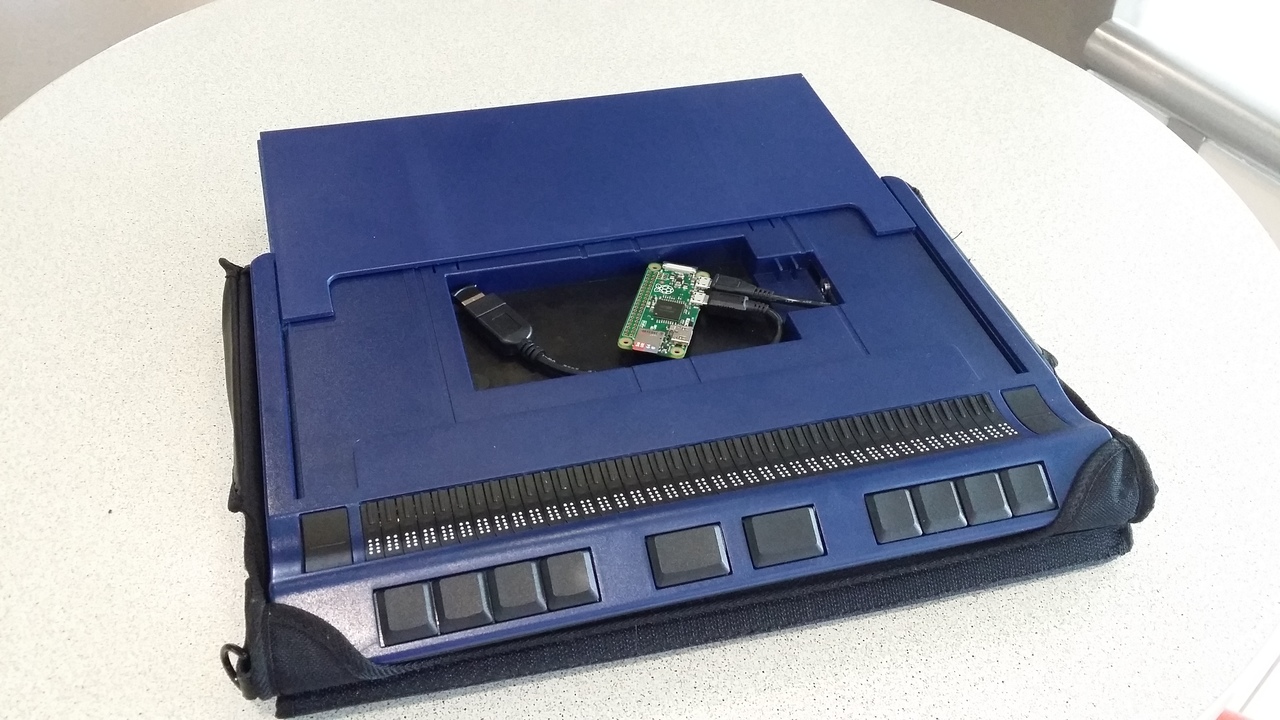
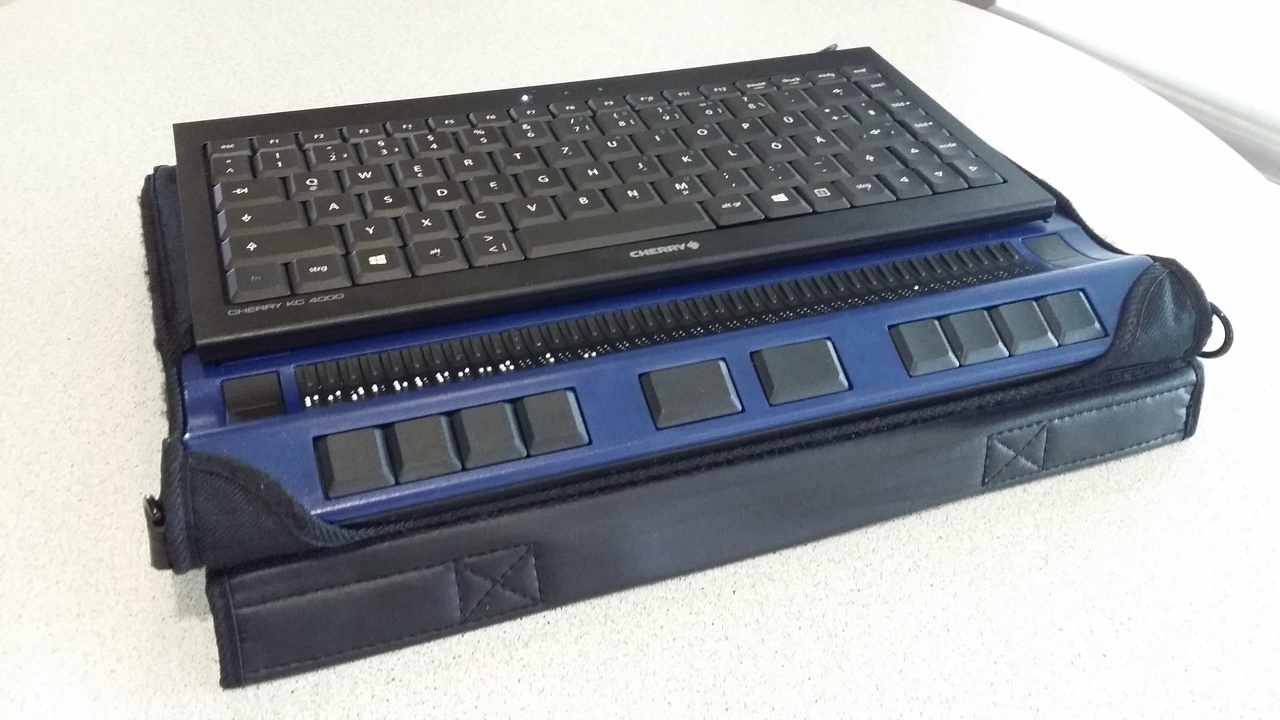
TL;DR: I put a $5 Raspberry Pi Zero, a Bluetooth USB dongle, and the required adapter cable into my new Handy Tech Active Star 40 braille display. An internal USB port provides the power. This has transformed my braille display into an ARM-based, monitorless, Linux laptop that has a keyboard and a braille display. It can be charged/powered via USB so it can also be run from a power bank or a solar charger, thus potentially being able to run for days, rather than just hours, without needing a standard wall-jack. [picture: a Raspberry Pi Zero embedded within an Active Star 40] [picture: a braille display with a keyboard on top and a Raspberry Pi Zero inside]
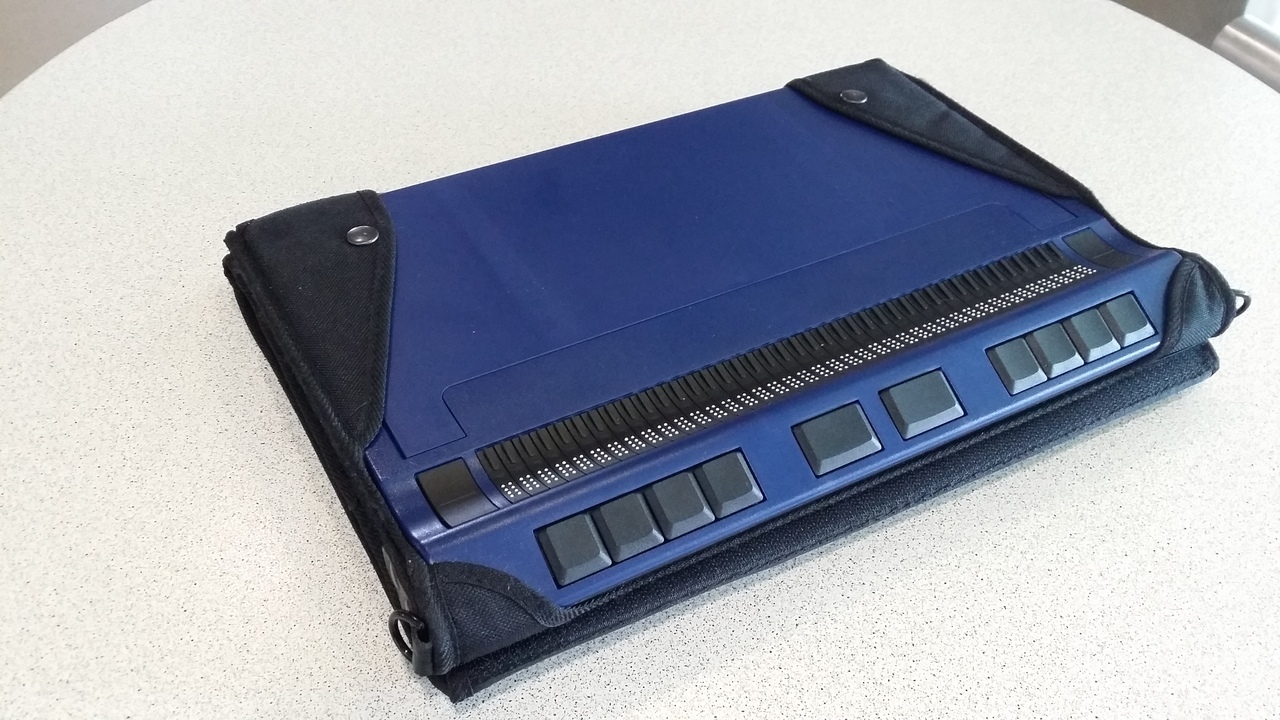
Some Background on Braille Display Form Factors Braille displays come in various sizes. There are models tailored for desktop use (with 60 cells or more), models tailored for portable use with a laptop (usually with 40 cells), and, nowadays, there are even models tailored for on-the-go use with a smartphone or similar (with something like 14 or 18 cells). Back in the old days, braille displays were rather massive. A 40-cell braille display was typically about the size of a 13" laptop. In modern times, manufacturers have managed to reduce the size of the internals such that a 40-cell display can be placed in front of a laptop or keyboard instead of placing the laptop on top of the braille display. While this is a nice achievement, I personally haven't found it to be very convenient because you now have to place two physically separate devices on your lap. It's OK if you have a real desk, but, at least in my opinion, if you try to use your laptop as its name suggests, it's actually inconvenient to use a small form factor, 40-cell display. For this reason, I've been waiting for a long-promised new model in the Handy Tech Star series. In 2002, they released the Handy Tech Braille Star 40, which is a 40-cell braille display with enough space to put a laptop directly on top of it. To accommodate larger laptop models, they even built in a little platform at the back that can be pulled out to effectively enlarge the top surface. Handy Tech has now released a new model, the Active Star 40, that has essentially the same layout but modernized internals. [picture: a plain Active Star 40] You can still pull out the little platform to increase the space that can be used to put something on top. [picture: an Active Star 40 with extended platform and a laptop on top] But, most conveniently, they've designed in an empty compartment, roughly the size of a modern smartphone, beneath the platform. The original idea was to actually put a smartphone inside, but this has turned out (at least to me) to not be very feasible. Fortunately, they thought about the need for electricity and added a Micro USB cable terminating within the newly created, empty compartment. My first idea was to put a conventional Raspberry Pi inside. When I received the braille display, however, we immediately noticed that a standard-sized rpi is roughly 3mm too high to fit into the empty compartment. Fortunately, though, a co-worker noticed that the Raspberry Pi Zero was available for order. The Raspberry Pi Zero is a lot thinner, and fits perfectly inside (actually, I think there's enough space for two, or even three, of them). So we ordered one, along with some accessories like a 64GB SDHC card, a Bluetooth dongle, and a Micro USB adapter cable. The hardware arrived a few days later, and was immediately bootstrapped with the assistance of very helpful friends. It works like a charm!

Technical Details The backside of the Handy Tech Active Star 40 features two USB host ports that can be used to connect devices such as a keyboard. A small form-factor, USB keyboard with a magnetic clip-on is included. When a USB keyboard is connected, and when the display is used via Bluetooth, the braille display firmware additionally offers the Bluetooth HID profile, and key press/release events received via the USB port are passed through to it. I use the Bluetooth dongle for all my communication needs. Most importantly, BRLTTY is used as a console screen reader. It talks to the braille display via Bluetooth (more precisely, via an RFCOMM channel). The keyboard connects through to Linux via the Bluetooth HID profile. Now, all that is left is network connectivity. To keep the energy consumption as low as possible, I decided to go for Bluetooth PAN. It appears that the tethering mode of my mobile phone works (albeit with a quirk), so I can actually access the internet as long as I have cell phone reception. Additionally, I configured a Bluetooth PAN access point on my desktop machines at home and at work, so I can easily (and somewhat more reliably) get IP connectivity for the rpi when I'm near one of these machines. I plan to configure a classic Raspberry Pi as a mobile Bluetooth access point. It would essentially function as a Bluetooth to ethernet adapter, and should allow me to have network connectivity in places where I don't want to use my phone.
BlueZ 5 and PAN It was a bit challenging to figure out how to actually configure Bluetooth PAN with BlueZ 5. I found the bt-pan python script (see below) to be the only way so far to configure PAN without a GUI. It handles both ends of a PAN network, configuring a server and a client. Once instructed to do so (via D-Bus) in client mode, BlueZ will create a new network device - bnep0 - once a connection to a server has been established. Typically, DHCP is used to assign IP addresses for these interfaces. In server mode, BlueZ needs to know the name of a bridge device to which it can add a slave device for each incoming client connection. Configuring an address for the bridge device, as well as running a DHCP server + IP Masquerading on the bridge, is usually all you need to do.
A Bluetooth PAN Access Point with Systemd I'm using systemd-networkd to configure the bridge device. /etc/systemd/network/pan.netdev:
[NetDev]
Name=pan
Kind=bridge
ForwardDelaySec=0
/etc/systemd/network/pan.network:
[Match]
Name=pan
[Network]
Address=0.0.0.0/24
DHCPServer=yes
IPMasquerade=yes
Now, BlueZ needs to be told to configure a NAP profile. To my surprise, there seems to be no way to do this with stock BlueZ 5.36 utilities. Please correct me if I'm wrong. Luckily, I found a very nice blog post, as well as an accommodating Python script that performs the required D-Bus calls. For convenience, I use a Systemd service to invoke the script and to ensure that its dependencies are met. /etc/systemd/system/pan.service:
[Unit]
Description=Bluetooth Personal Area Network
After=bluetooth.service systemd-networkd.service
Requires=systemd-networkd.service
PartOf=bluetooth.service
[Service]
Type=notify
ExecStart=/usr/local/sbin/pan
[Install]
WantedBy=bluetooth.target
/usr/local/sbin/pan:
#!/bin/sh
# Ugly hack to work around #787480
iptables -F
iptables -t nat -F
iptables -t mangle -F
iptables -t nat -A POSTROUTING -o eth0 -j MASQUERADE
exec /usr/local/sbin/bt-pan --systemd --debug server pan
This last file wouldn't be necessary if IPMasquerade= were supported in Debian right now (see #787480). After the obligatory systemctl daemon-reload and systemctl restart systemd-networkd, you can start your Bluetooth Personal Area Network with systemctl start pan.
Bluetooth PAN Client with Systemd Configuring the client is also quite easy to do with Systemd. /etc/systemd/network/pan-client.network:
[Match]
Name=bnep*
[Network]
DHCP=yes
/etc/systemd/system/pan@.service:
[Unit]
Description=Bluetooth Personal Area Network client
[Service]
Type=notify
ExecStart=/usr/local/sbin/bt-pan --debug --systemd client %I --wait
Now, after the usual configuration reloading, you should be able to connect to a specific Bluetooth access point with:
systemctl start pan@00:11:22:33:44:55
Pairing via the Command Line Of course, the server and client-side service configuration require a pre-existing pairing between the server and each of its clients. On the server, start bluetoothctl and issue the following commands:
power on
agent on
default-agent
scan on
scan off
pair XX:XX:XX:XX:XX:XX
trust XX:XX:XX:XX:XX:XX
Once you've set scan mode to on, wait a few seconds until you see the device you're looking for scroll by. Note its device address, and use it for the pair and (optional) trust commands. On the client, the sequence is essentially the same except that you don't need to issue the trust command. The server needs to trust a client in order to accept NAP profile connections from it without waiting for manual confirmation by the user. I'm actually not sure if this is the optimal sequence of commands. It might be enough to just pair the client with the server and issue the trust command on the server, but I haven't tried this yet.
Enabling Use of the Bluetooth HID Profile Essentially the same as above also needs to be done in order to use the Bluetooth HID profile of the Active Star 40 on Linux. However, instead of agent on, you need to issue the command agent KeyboardOnly. This explicitly tells bluetoothctl that you're specifically looking for a HID profile.
Configuring Bluetooth via the Command Line Feels Vague While I'm very happy that I actually managed to set all of this up, I must admit that the command-line interface to BlueZ feels a bit incomplete and confusing. I initially thought that agents were only for PIN code entry. Now that I've discovered that "agent KeyboardOnly" is used to enable the HID profile, I'm not sure anymore. I'm surprised that I needed to grab a script from a random git repository in order to be able to set up PAN. I remember, with earlier version of BlueZ, that there was a tool called pand that you could use to do all of this from the command-line. I don't seem to see anything like that for BlueZ 5 anymore. Maybe I'm missing something obvious?
Performance The data rate is roughly 120kB/s, which I consider acceptable for such a low power solution. The 1GHz ARM CPU actually feels sufficiently fast for a console/text-mode person like me. I'll rarely be using much more than ssh and emacs on it anyway.
Console fonts and screen dimensions The default dimensions of the framebuffer on the Raspberry Pi Zero are a bit unexpectedly strange. fbset reports that the screen dimension is 656x416 pixels (of course, no monitor connected). With a typical console font of 8x16, I got 82 columns and 26 lines. With a 40 cell braille display, the 82 columns are very inconvenient. Additionally, as a braille user, I would like to be able to view Unicode braille characters in addition to the normal charset on the console. Fortunately, Linux supports 512 glyphs, while most console fonts do only provide 256. console-setup can load and combine two 256-glyph fonts at once. So I added the following to /etc/default/console-setup to make the text console a lot more friendly to braille users:
SCREEN_WIDTH=80
SCREEN_HEIGHT=25
FONT="Lat15-Terminus16.psf.gz brl-16x8.psf"

Note

You need console-braille installed for brl-16x8.psf to be available.

Further Projects There's a 3.5mm audio jack inside the braille display as well. Unfortunately, there are no converters from Mini-HDMI to 3.5mm audio that I know of. It would be very nice to be able to use the sound card that is already built into the Raspberry Pi Zero, but, unfortunately, this doesn't seem possible at the moment. Alternatively, I'm looking at using a Micro USB OTG hub and an additional USB audio adapter to get sound from the Raspberry Pi Zero to the braille display's speakers. Unfortunately, the two USB audio adapters I've tried so far have run hot for some unknown reason. So I have to find some other chipset to see if the problem goes away. A little nuisance, currently, is that you need to manually power off the Raspberry, wait a few seconds, and then power down the braille display. Turning the braille display off cuts power delivery via the internal USB port. If this is accidentally done too soon then the Raspberry Pi Zero is shut down ungracefully (which is probably not the best way to do it). We're looking into connecting a small, buffering battery to the GPIO pins of the rpi, and into notifying the rpi when external power has dropped. A graceful, software-initiated shutdown can then be performed. You can think of it as being like a mini UPS for Micro USB.
The image If you are a happy owner of a Handy Tech Active Star 40 and would like to do something similar, I am happy to share my current (Raspbian Stretch based) image. In fact, if there is enough interest by other blind users, we might even consider putting a kit together that makes it as easy as possible for you to get started. Let me know if this could be of interest to you.
Thanks Thanks to Dave Mielke for reviewing the text of this posting. Thanks to Simon Kainz for making the photos for this article. And I owe a big thank you to my co-workers at Graz University of Technology who have helped me a lot to bootstrap really quickly into the rpi world.
P.S. My first tweet about this topic is just five days ago, and apart from the soundcard not working yet, I feel like the project is already almost complete! By the way, I am editing the final version of this blog posting from my newly created monitorless ARM-based Linux laptop via an ssh connection to my home machine.

11 June 2016

Shirish Agarwal: The road to debconf 2016, tourism and arts.

A longish blog post, please bear, a second part of the blog post would be published in few days from now. My fixed visa finally arrived, yeah:) But this story doesn t start here, it starts about a year back. While I have been contributing to Debian in my free time over the years, and sometimes paid time as well, I had never thought of going overseas as the experiences I knew from friends and relatives, it isn t easy to get all the permissions and paperwork done to say the least (bureaucracy @ work). But last year, when Debconf 15 was being launched, there are/were 2-3 friends of mine who are studying, doing their Ph.D. in some computer/web stuff, living in Germany currently that they goaded me to apply. The first few times I gave some standard excuses, but when they kept on for a while, just to shut them up I applied to the debconf team applying for food, accommodation and travel sponsorship. I didn t have high hopes as there obviously are many more talented peers around me who understand FOSS and Debian at a much more fundamental, philosophical as well as technical level than me. Much to my surprise though, about a month (and around two or three weeks just before the event was about to take place) I got the bursary/sponsorships for food, accommodation as well as travel. I was unsure that the remaining time was enough to get a visa hence declined that time around. That whole episode gave me the confidence that perhaps my application would be accepted if I applied again. Using my previous years understanding, decided to give it a shot again as this would also enable me to get a feel of visa bureaucracy as well as gain a bit of novice understanding about what factors go in choosing a flight and believe me the latter part proved to be pretty confusing. While the visa business seems easy, the form at least is easy and what they ask, it can be troublesome as far as visa-processing process is concerned. It took a better part of the month to get the visa which I needed. The in-between time is and can be a bit stressful as you have committed funds for travel i.e. the airline tickets and are in a limbo as you didn t know that if the visa is cancelled for some reason, your tickets would be refunded or not. A little history is needed and hopefully is helpful for anybody who s applying for a short-stay Visa in South Africa. Exactly, A month and day back I had applied for visa. The visa I had applied for is 17 days as the flights within my budget was for those days only. The visa I got was for 10 days only which was ending in the middle of the conference. I tried many avenues to get information and was told that I needed to write a correction letter telling/sharing the information about the correct time period and dates in BOLD with a heavier weight/point which is what I did and gave to VFS office without any further payment on my part. It took a bit more time than the first time around but the consulate co-operated. While I can understand the oversight as they probably get more visas requests along with special and urgent requests so such occurrences can happen. I am and was happy that there was a recourse rather than starting from scratch which probably would have made me more anxious due to the first experience . Apparently I was lucky that I had done with Qatar Airways as later came to know that there are other airways which don t refund money even after visa rejection . This information I got to know pretty late in the game otherwise I wouldn t have been much stressed. As had committed knew had to go the whole hog and whatever barriers are there, have overcome at least as far as the visa part/process is concerned. Now after few days, will probably start to worry about the actual travel, part nervousness, part excitement, nervousness as it will be an alien land, am obese so traveling economy on 787-8 and 777-300 ER will be tricky. The 787-8 will probably be a rough ride as it s a 9 hr. journey and the seat are a mere 18 , the cattle class as shared by one of our esteemed politicians. This blame has to do with Boeing 787 rather than anybody else. Hopefully, if there is a next time, would make better choices. Anyways,have selected an aisle seat so that will be able to walk every hr. or so to get the circulation in legs going as leg room in economy is not much from my domestic air travel experiences. If I do survive the travel, then will see South Africa and try to get some free time and explore South Africa and try to figure out how are they able to get one and half time tourists while we get around half figure for a whole year even though we are bigger (area-wise) to South Africa. I did find something positive for us as well, it s not all doldrums all around. Now, I had been thinking about if I know any South African music and movies. I had explored djembe while growing up in teens but other than that, not much. The only music I have heard is Harry Belafonte . So I hope to bring some Indian movies and music with me so that people if they have not explored Bollywood as well as Indian classical music could explore some of it, of course it will be pale imitation of what Sawai Gandharva Music Festival for instance gives. I also hope to hear and get some music and movies to learn more about South Africa.
Filed under: Miscellenous Tagged: #bollywood, #Debconf Germany 2015, #Debconf South Africa 2016, #Debconf15, #Debconf16, #djembe, #South-African consulate, music, tourism, visa

Paul Tagliamonte: It's all relative

As nearly anyone who's worked with me will attest to, I've long since touted nedbat's talk Pragmatic Unicode, or, How do I stop the pain? as one of the most foundational talks, and required watching for all programmers. The reason is because netbat hits on something bigger - something more fundamental than how to handle Unicode -- it's how to handle data which is relative. For those who want the TL;DR, the argument is as follows: Facts of Life:
  1. Computers work with Bytes. Bytes go in, Bytes go out.
  2. The world needs more than 256 symbols.
  3. You need both Bytes and Unicode
  4. You cannot infer the encoding of bytes.
  5. Declared encodings can be Wrong
Now, to fix it, the following protips:
  1. Unicode sandwich
  2. Know what you have
  3. TEST
Relative Data I've started to think more about why we do the things we do when we write code, and one thing that continues to be a source of morbid schadenfreude is watching code break by failing to handle Unicode right. It's hard! However, watching what breaks lets you gain a bit of insight into how the author thinks, and what assumptions they make. When you send someone Unicode, there are a lot of assumptions that have to be made. Your computer has to trust what you (yes, you!) entered into your web browser, your web browser has to pass that on over the network (most of the time without encoding information), to a server which reads that bytestream, and makes a wild guess at what it should be. That server might save it to a database, and interpolate it into an HTML template in a different encoding (called Mojibake), resulting in a bad time for everyone involved. Everything's awful, and the fact our computers can continue to display text to us is a goddamn miracle. Never forget that. When it comes down to it, when I see a byte sitting on a page, I don't know (and can't know!) if it's Windows-1252, UTF-8, Latin-1, or EBCDIC. What's a poem to me is terminal garbage to you. Over the years, hacks have evolved. We have magic numbers, and plain ole' hacks to just guess based on the content. Of course, like all good computer programs, this has lead to its fair share of hilarious bugs, and there's nothing stopping files from (validly!) being multiple things at the same time. Like many things, it's all in the eye of the beholder. Timezones Just like Unicode, this is a word that can put your friendly neighborhood programmer into a series of profanity laden tirades. Go find one in the wild, and ask them about what they think about timezone handling bugs they've seen. I'll wait. Go ahead. Rants are funny things. They're fun to watch. Hilarious to give. Sometimes just getting it all out can help. They can tell you a lot about the true nature of problems. It's funny to consider the isomorphic nature of Unicode rants and Timezone rants. I don't think this is an accident. U n i c o d e timezone Sandwich Ned's Unicode Sandwich applies -- As early as we can, in the lowest level we can (reading from the database, filesystem, wherever!), all datetimes must be timezone qualified with their correct timezone. Always. If you mean UTC, say it's in UTC. Treat any unqualified datetimes as "bytes". They're not to be trusted. Never, never, never trust 'em. Don't process any datetimes until you're sure they're in the right timezone. This lets the delicious inside of your datetime sandwich handle timezones with grace, and finally, as late as you can, turn it back into bytes (if at all!). Treat locations as tzdb entries, and qualify datetime objects into their absolute timezone (EST, EDT, PST, PDT) It's not until you want to show the datetime to the user again should you consider how to re-encode your datetime to bytes. You should think about what flavor of bytes, what encoding -- what timezone -- should I be encoding into? TEST Just like Unicode, testing that your code works with datetimes is important. Every time I think about how to go about doing this, I think about that one time that mjg59 couldn't book a flight starting Tuesday from AKL, landing in HNL on Monday night, because United couldn't book the last leg to SFO. Do you ever assume dates only go forward as time goes on? Remember timezones. Construct test data, make sure someone in New Zealand's +13:45 can correctly talk with their friends in Baker Island's -12:00, and that the events sort right. Just because it's Noon on New Years Eve in England doesn't mean it's not 1 AM the next year in New Zealand. Places a few miles apart may go on Daylight savings different days. Indian Standard Time is not even aligned on the hour to GMT (+05:30)! Test early, and test often. Memorize a few timezones, and challenge your assumptions when writing code that has to do with time. Don't use wall clocks to mean monotonic time. Remember there's a whole world out there, and we only deal with part of it. It's also worth remembering, as Andrew Pendleton pointed out to me, that it's possible that a datetime isn't even unique for a place, since you can never know if 2016-11-06 01:00:00 in America/New_York (in the tzdb) is the first one, or second one. Storing EST or EDT along with your datetime may help, though! Pitfalls Improper handling of timezones can lead to some interesting things, and failing to be explicit (or at least, very rigid) in what you expect will lead to an unholy class of bugs we've all come to hate. At best, you have confused users doing math, at worst, someone misses a critical event, or our security code fails. I recently found what I regard to be a pretty bad bug in apt (which David has prepared a fix for and is pending upload, yay! Thank you!), which boiled down to documentation and code expecting datetimes in a timezone, but accepting any timezone, and silently treating it as UTC. The solution is to hard-fail, which is an interesting choice to me (as a vocal fan of timezone aware code), but at the least it won't fail by misunderstanding what the server is trying to communicate, and I do understand and empathize with the situation the apt maintainers are in. Final Thoughts Overall, my main point is although most modern developers know how to deal with Unicode pain, I think there is a more general lesson to learn -- namely, you should always know what data you have, and always remember what it is. Understand assumptions as early as you can, and always store them with the data.

10 June 2016

Jaminy Prabaharan: Weekly Report for GSoC16-week 1 and week2

After introducing ourselves to the community, we start contributing to the open and free source software. Since this is the first week, I have went through theories which would help me in coding. Before coding it is always safer to refer to theories so that we don t need to spare time in debugging. The following were my week 1-4 plans:

These two weeks I have completed my first two tasks in the list.I have committed and pushed my works in GitHub.https://github.com/Jaminy/GSoC

Successfully logged into the email account using IMAP and examined each folders.Examined inbox to extract To , From and CC of the last message received.Trying to extract all message details to put in CSV file.


8 June 2016

Daniel Pocock: Working to pass GSoC

GSoC students have officially been coding since 23 May (about 2.5 weeks) and are almost half-way to the mid-summer evaluation (20 - 27 June). Students who haven't completed some meaningful work before that deadline don't receive payment and in such a large program, there is no possibility to give students extensions or let them try and catch up later. Every project and every student are different, some are still getting to know their environment while others have already done enough to pass the mid-summer evaluation. I'd like to share a few tips to help students ensure they don't inadvertently fail the mid-summer evaluation Kill electronic distractions As a developer of real-time communications projects, many people will find it ironic or hypocritical that this is at the top of my list. Switch off the mobile phone or put it in silent mode so it doesn't even vibrate. Research has suggested that physically turning it off and putting it out of sight has significant benefits. Disabling the voicemail service can be an effective way of making sure no time is lost listening to a bunch of messages later. Some people may grumble at first but if they respect you, they'll get into the habit of emailing you and waiting for you to respond when you are not working. Get out a piece of paper and make a list of all the desktop notifications on your computer, whether they are from incoming emails, social media, automatic updates, security alerts or whatever else. Then figure out how to disable them all one-by-one. Use email to schedule fixed times for meetings with mentors. Some teams/projects also have fixed daily or weekly times for IRC chat. For a development project like GSoC, it is not necessary or productive to be constantly on call for 3 straight months. Commit every day Habits are a powerful thing. Successful students have a habit of making at least one commit every day. The "C" in GSoC is for Code and commits are a good way to prove that coding is taking place. GSoC is not a job, it is like a freelance project. There is no safety-net for students who get sick or have an accident and mentors are not bosses, each student is expected to be their own boss. Although Google has started recommending students work full time, 40 hours per week, it is unlikely any mentors have any way to validate these hours. Mentors can look for a commit log, however, and simply won't be able to pass a student if there isn't code. There may be one day per week where a student writes a blog or investigates a particularly difficult bug and puts a detailed report in the bug tracker but by the time we reach the second or third week of GSoC, most students are making at least one commit in 3 days out of every 5. Consider working away from home/family/friends Can you work without anybody interrupting you for at least five or six hours every day? Do you feel pressure to help with housework, cooking, siblings or other relatives? Even if there is no pressure to do these things, do you find yourself wandering away from the computer to deal with them anyway? Do family, friends or housemates engage in social activities, games or other things in close proximity to where you work? All these things can make a difference between passing and failing. Maybe these things were tolerable during high school or university. GSoC, however, is a stepping stone into professional life and that means making a conscious decision to shut those things out and focus. Some students have the ability to manage these distractions well, but it is not for everybody. Think about how leading sports stars or musicians find a time and space to be "in the zone" when training or rehearsing, this is where great developers need to be too. Some students find the right space in a public library or campus computer lab. Some students have been working in hacker spaces or at empty desks in local IT companies. These environments can also provide great networking opportunities. Managing another summer job concurrently with GSoC It is no secret that some GSoC students have another job as well. Sometimes the mentor is aware of it, sometimes it has not been disclosed. The fact is, some students have passed GSoC while doing a summer job or internship concurrently but some have also failed badly in both GSoC and their summer job. Choosing one or the other is the best way to succeed, get the best results and maximize the quality of learning and community interaction. For students in this situation, now it is not too late to make the decision to withdraw from GSoC or the other job. If doing a summer job concurrently with GSoC is unavoidable, the chance of success can be greatly increased by doing the GSoC work in the mornings, before starting the other job. Some students have found that they actually finish more quickly and produce better work when GSoC is constrained to a period of 4 or 5 hours each morning and their other job is only in the afternoon. On the other hand, if a student doesn't have the motivation or energy to get up and work on GSoC before the other job then this is a strong sign that it is better to withdraw from GSoC now.

Gunnar Wolf: University degrees and sysadmin skills

I'll tune in to the post-based conversation being held on Planet Debian: Russell Coker wonders about what's needed to get university graduates with enough skills for a sysadmin job, to which Lucas Nussbaum responds with his viewpoints. They present a very contrasting view of what's needed for students And for a good reason, I'd say: Lucas is an academician; I don't know for sure about Russell, but he seems to be a down-to-the-earth, dirty-handed, proficient sysadmin working on the field. They both contact newcomers to their fields, and will notice different shortcomings. I tend to side with Lucas' view. That does not come as a surprise, as I've been working for over 15 years in an university, and in the last few years I started walking from a mostly-operative sysadmin in an academic setting towards becoming an academician that spends most of his time sysadmining. Subtle but important distinction. I teach at the BSc level at UNAM, and am a Masters student at IPN (respectively, Mexico's largest and second-largest universities). And yes, the lack of sysadmin abilities in both is surprising. But so is a good understanding of programming. And I'm sure that, were I to dig into several different fields, I'd feel the same: Student formation is very basic at each of those fields. But I see that as natural. Of course, if I were to judge people as geneticists as they graduate from Biology, or were I to judge them as topologists as they graduate from Mathematics, or any other discipline in which I'm not an expert, I'd surely not know where to start Given I have about 20 years of professional life on my shoulders, I'm quite skewed as to what is basic for a computing professional. And of course, there are severe holes in my formation, in areas I never used. I know next to nothing of electronics, my mathematical basis is quite flaky, and I'm a poor excuse when talking about artificial intelligence. Where am I going with this? An university degree (BSc in English, would amount to "licenciatura" in Spanish) is not for specialization. It is to have a sufficiently broad panorama of the field, and all of the needed tools to start digging deeper and specializing either by yourself, working on a given field and learning its details as you go, or going through a postgraduate program (Specialization, Masters, Doctorate). Even most of my colleagues at the Masters in Engineering in Security and Information Technology lack of a good formation in fields I consider essential. However, what does information security mean? Many among them are working on legal implications of several laws that touch our field. Many other are working on authenticity issues in images, audios and other such media. Many other are trying to come up with mathematical ways to cheapen the enormous burden of crypto operations (say, "shaving" CPU cycles off a very large exponentiation). Others are designing autonomous learning mechanisms to characterize malware. Were I as a computing professional to start talking about their research, I'd surely reveal I know nothing about it and get laughed at. That's because I haven't specialized in those fields. University education should give a broad universal basis to enter a professional field. It should not focus on teaching tools or specific procedures (although some should surely be presented as examples or case studies). Although I'd surely be happy if my university's graduates were to know everything about administering a Debian system, that would be wrong for a university to aim at; I'd criticize it the same way I currently criticize programs that mix together university formation and industry certification as if they were related.

Reproducible builds folks: Reproducible builds: week 58 in Stretch cycle

What happened in the Reproducible Builds effort between May 29th and June 4th 2016: Media coverage Ed Maste will present Reproducible Builds in FreeBSD at BDSCan 2016 in Ottawa, Canada on June 11th. GSoC and Outreachy updates Toolchain fixes Other upstream fixes Packages fixed The following 53 packages have become reproducible due to changes in their build-dependencies: angband blktrace code-saturne coinor-symphony device-tree-compiler mpich rtslib ruby-bcrypt ruby-bson-ext ruby-byebug ruby-cairo ruby-charlock-holmes ruby-curb ruby-dataobjects-sqlite3 ruby-escape-utils ruby-ferret ruby-ffi ruby-fusefs ruby-github-markdown ruby-god ruby-gsl ruby-hdfeos5 ruby-hiredis ruby-hitimes ruby-hpricot ruby-kgio ruby-lapack ruby-ldap ruby-libvirt ruby-libxml ruby-msgpack ruby-ncurses ruby-nfc ruby-nio4r ruby-nokogiri ruby-odbc ruby-oj ruby-ox ruby-raindrops ruby-rdiscount ruby-redcarpet ruby-redcloth ruby-rinku ruby-rjb ruby-rmagick ruby-rugged ruby-sdl ruby-serialport ruby-sqlite3 ruby-unicode ruby-yajl ruby-zoom thin The following packages have become reproducible after being fixed: Some uploads have addressed some reproducibility issues, but not all of them: Uploads with an unknown result because they fail to build: Patches submitted that have not made their way to the archive yet: Package reviews 45 reviews have been added, 25 have been updated and 25 have been removed in this week. 12 FTBFS bugs have been reported by Chris Lamb and Niko Tyni. diffoscope development strip-nondeterminism development Mattia uploaded strip-nondeterminism 0.018-1 which improved support for *.epub files. tests.reproducible-builds.org Misc. Last week we also learned about progress of reproducible builds in FreeBSD. Ed Maste announced a change to record the build timestamp during ports building, which is required for later reproduction. This week's edition was written by Reiner Herrman, Holger Levsen and Chris Lamb and reviewed by a bunch of Reproducible builds folks on IRC.

Jonathan Dowland: Some tools for working with Docker images

For developing complex, real-world Docker images, there are a number of tools that can make life easier. The first thing to realise is that the Dockerfile format is severely limited. At work, we have eventually outgrown it and it has been replaced with a structured YAML document that is processed into a Dockerfile by a tool called dogen. There are several advantages to this, but I'll point out two: firstly, having data about the image available in a structured format makes automatically deriving technical documentation very easy. Secondly, some of the quirks of Dockerfiles, such as the ADD command respecting the environment's umask, are worked around in the dogen tool. We have a large suite of integration tests that we run against images to make sure that we haven't introduced regressions during their development. The core of this is the Container Testing Framework, which makes use of the Behave system. Each command that is run in a Dockerfile generates a new docker image layer. In practice, this can mean a real-world image has a great number of layers underneath it. Docker-dot-com have resisted introducing layer squashing into their tools, but with both hard limits for layers in some of the storage backends, and performance issues for most of the rest, this is a very real issue. Marek Goldmann wrote a squashing tool that we use to control the number of intermediate layers that are introduced by our images. Finally, even with tools like dogen and ctf, we would like to be able to have more sophisticated tools than shell scripts for configuring images, both at image build time and container run time. We want to do this without introducing extra dependencies inside the images which will not otherwise be used for their operation. Ansible could be a solution for this, but there are practical issues with relying on it for runtime configuration in our situation. For that reason David Becvarik is designing and implementing Container Configuration Tool, or cct, a framework for performing configuration of containers written in Python.

7 June 2016

Matthew Garrett: Be wary of heroes

Inspiring change is difficult. Fighting the status quo typically means being able to communicate so effectively that powerful opponents can't win merely by outspending you. People need to read your work or hear you speak and leave with enough conviction that they in turn can convince others. You need charisma. You need to be smart. And you need to be able to tailor your message depending on the audience, even down to telling an individual exactly what they need to hear to take your side. Not many people have all these qualities, but those who do are powerful and you want them on your side.

But the skills that allow you to convince people that they shouldn't listen to a politician's arguments are the same skills that allow you to convince people that they shouldn't listen to someone you abused. The ability that allows you to argue that someone should change their mind about whether a given behaviour is of social benefit is the same ability that allows you to argue that someone should change their mind about whether they should sleep with you. The visibility that gives you the power to force people to take you seriously is the same visibility that makes people afraid to publicly criticise you.

We need these people, but we also need to be aware that their talents can be used to hurt as well as to help. We need to hold them to higher standards of scrutiny. We need to listen to stories about their behaviour, even if we don't want to believe them. And when there are reasons to believe those stories, we need to act on them. That means people need to feel safe in coming forward with their experiences, which means that nobody should have the power to damage them in reprisal. If you're not careful, allowing charismatic individuals to become the public face of your organisation gives them that power.

There's no reason to believe that someone is bad merely because they're charismatic, but this kind of role allows a charismatic abuser both a great deal of cover and a great deal of opportunity. Sometimes people are just too good to be true. Pretending otherwise doesn't benefit anybody but the abusers.

comment count unavailable comments

6 June 2016

Reproducible builds folks: Reprotest has a preliminary CLI and configuration file handling

Author: ceridwen This is the first draft of reprotest's interface, and I welcome comments on how to improve it. At the moment, reprotest's CLI takes two mandatory arguments, the build command to run and the build artifact file to test after running the build. If the build command or build artifact have spaces, they have to be passed as strings, e.g. "debuild -b -uc -us". For optional arguments, it has --variations, which accepts a list of possible build variations to test, one or more of 'captures_environment', 'domain_host', 'filesystem', 'home', 'kernel', 'locales', 'path', 'shell', 'time', 'timezone', 'umask', and 'user_group' (see variations for more information); --dont_vary, which makes reprotest not test any variations in the given list (the default is to run all variations); --source_root, which accepts a directory to run the build command in and defaults to the current working directory; and --verbose, which will eventually enable more detailed logging. To get help for the CLI, run reprotest -h or reprotest --help. The config file has one section, basics, and the same options as the CLI, except there's no dont_vary option, and there are build_command and artifact options. If build_command and/or artifact are set in the config file, reprotest can be run without passing those as command-line arguments. Command-line arguments always override config file options. Reprotest currently searches the working directory for the config file, but it will also eventually search the user's home directory. A sample config file is below.
[basics]
build_command = setup.py sdist
artifact = dist/reprotest-0.1.tar.gz
source_root = reprotest/
variations =
  captures_environment
  domain_host
  filesystem
  home
  host
  kernel
  locales
  path
  shell
  time
  timezone
  umask
  user_group
At the moment, the only build variations that reprotest actually tests are the environment variable variations: captures_environment, home, locales, and timezone. Over the next week, I plan to add the rest of the basic variations and accompanying tests. I also need to write tests for the CLI and the configuration file. After that, I intend to work on getting (s)chroot communication working, which will involve integrating autopkgtest code. Some of the variations require specific other packages to be installed: for instance, the locales variation currently requires the fr_CH.UTF-8 locale. Locales are a particular problem because I don't know of a way in Debian to specify that a given locale must be installed. For other packages, it's unclear to me whether I should specify them as depends or recommends: they aren't dependencies in a strict sense, but marking them as dependencies will make it easier to install a fully-functional reprotest. When reprotest runs with variations enabled that it can't test because it doesn't have the correct packages installed, I intend to have it print a warning but continue to run. tests.reproducible-builds.org also has different settings, such as different locales, for different architectures. I'm not clear on why this is. I'd prefer to avoid having to generate a giant list of variations based on architecture, but if necessary, I can do that. The prebuilder script contains variations specific to Linux, to Debian, and to pbuilder/cowbuilder. I'm not including Debian-specific variations until I get much more of the basic functionality implemented, and I'm not sure I'm going to include pbuilder-specific variations ever, because it's probably better for extensibility to other OSes, e.g. BSD, to add support for plugins or more complicated configurations. I implemented the variations by creating a function for each variation. Each function takes as input two build commands, two source trees, and two sets of environment variables and returns the same. At the moment, I'm using dictionaries for the environment variables, mutating them in-place and passing the references forward. I'm probably going to replace those at some point with an immutable mapping. While at the moment, reprotest only builds on the existing system, when I start extending it to other build environments, this will require double-dispatch, because the code that needs to be executed will depend on both the variation to be tested and the environment being built on. At the moment, I'm probably going to implement this with a dictionary with tuple keys of (build_environment, variation) or nested dictionaries. If it's necessary for code to depend on OS or architecture, too, this could end up becoming a triple or quadruple dispatch.

Norbert Preining: TeX Live 2016 released

After long months of testing and waiting for the DVD production, we have released TeX Live 2016 today! texlive2016 Detailed changes can be found here, the most important ones are: CTAN mirrors are working on getting the latest releases, but in a day or two all the servers should be updated. Thanks to all the developers, package writers, documentation writers, testers, and especially Karl Berry for his perfect organization. Now get the champagne and write some nice documents!

5 June 2016

Iustin Pop: Short trip to Opio en Provence

Short trip to Opio en Provence I had a short work-related trip this week to Opio en Provence. It was not a working trip, but rather a team event, which means almost a vacation! Getting there and back I dislike taking the plane for very short flights (and Z rich-Nice is indeed only around one hour), as that means you're spending 3 as much going to the airport, at the airport, waiting to take off, waiting to get off the plane, and then going from the airport to the actual destination. So I took the opportunity to drive there, since I've never driven that way, and on the map the route seemed reasonably interesting. Not that it's a shorter trip by any measure, but seemed more interesting. Leaving Z rich I went over San Bernardino pass, as I never did that before. On the north side, the pass is actually much less suited to traffic than the Gotthard pass (also on the north side), as you basically climb around 300m in a very short distance, with very sharp hairpins. There was still snow on the top, and the small lake had lots of slush/ice floating on it. As to the south side, it looked much more driveable, but I'm not sure as I made the mistake of re-joining the highway, so instead of driving reasonably nice on the empty pass road, I spent half an hour in a slow moving line. Lesson learned Entering Italy was the usual Como-Milan route, but as opposed to my other trips, this time it was around Milan on the west (A50) and then south on the A7 until it meets the A26 and then down to the coast. From here, along the E80 (Italian A10, French A8) until somewhere near Nice, and then exiting the highway system to get on the small local roads towards Opio. What I read in advance on the internet was that the coastal highway is very nice, and has better views of the sea than the actual seaside drive (which goes through towns and is much slower). I should know better than trust the internet , and I should read maps instead, which would have shown me the fact that the Alps are reaching to the sea in this region, so The road was OK, but it definitely didn't feel like a highway: maximum allowed speed was usually either 90km/h or 110km/h, and half the time you're in a short tunnel, so it's sun, tunnel/dark, sun, dark, and you're eyes get quite tired from this continuous switching. The few glimpses of the sea were nice, but the road required enough concentration (both due to traffic and the amount of curves) that one couldn't look left or right. So that was that a semi-failure; I expected a nice drive, but instead it was a challenge drive If I had even more time to spend, going back via the Rhone valley (Grenoble, Geneva, Z rich) would have been a more interesting alternative. France Going to France always feels strange for me. I learned (some) French way before German, so the French language feels much more familiar to me, even without never actually having used it on a day-to-day basis; so going to France feels like getting back to somewhere where I never lived. Somewhat similar with Italian due to the language closeness between Romanian and Italian, but not the same feeling as I didn't actually hear or learn Italian in the childhood. So I go to France, and I start partially understand what I hear, and I can somewhat talk/communicate. Very weird, while I still struggle with German in my daily life in Z rich. For example, I would hesitate before asking for directions in German, but not so in French, unrelated to my actual understanding of either language. The brain is funny The hotel We stayed at Club Med Opio-en-Provence, which was interesting. Much bigger than I thought from quick looks on the internet (this internet seems quite unreliable), but also better than I expected from a family-oriented, all-inclusive hotel. The biggest problem was the food - French P tisserie is one of my weaknesses, and I failed to resist. I mean, it was much better than I expected, and I indulged a bit too much. I'll have to pay that back on the bike or running :-P The other interesting part of the hotel was the wide range of activities. Again, this being a family hotel, I thought the organised activities would be pretty mild; but at least for our group, they weren't. The mountain bike ride included an easy single-trail section, but while easy it was single-trail and rocky, so complete beginners might have had a small surprise. Overall it was about 50 minutes, 13.5km, with 230m altitude gain, which again for sedentary people might be unusual. I probably spent during the ride one of the deserts I ate later that day ;-) The "hike" they organised for another sub-group was also interesting, involving going through old tunnels and something with broken water pipes that caused people to either get their feet wet or monkey-spidering along the walls. Fun! After the bike ride, on the same afternoon, while walking around the hotel, we found the Ecole de Trap ze volant open, which looked way to exciting not to try it. Try and fail to do things right, but nevertheless it was excellent and unexpected fun. I'll have to do that again some day when I'll be more fit! Plus that the hotel itself had a very nice location and olive garden, so short runs in the morning were very pleasant. Only one cookie though each Back home and then it was over; short, but quite good. The Provence area is nice, and I'd like to be back again someday, for a proper vacation longer and more relaxed. And do the trap ze thing again, properly this time.

Jamie McClelland: Signal and Mobile XMPP Update

First, many thanks to Planet Debian readers for your thoughtful and constructive feedback to my Signal and Mobile Instant Messaging blogs. I learned a lot. Particularly useful was the comment directing me to Daniel Gultsch's The State of Mobile in 2016 post. I had previously listed the outstanding technical challenges as: I am now fairly convined that both problems are well-solved on Android via the Conversations app and a well-tuned XMPP server (I had no idea how easy it was to install your own Prosody modulues -- the client state indicator module is only 22 lines of lua code!) I think the current technical challenges could be better summarized as: adding iOS (iPhone) support. Both end-to-end encryption and receiving messages consistently seem to be hurdles. However, it seems that Chris Ballinger and the Chat Secure team are well on their way toward solving the push issue and facing funder skittishness on the encryption front. Nonetheless, but seem to be progressing. With the obvious technical hurdles in progress, we have the luxury of talking about the less obvious ones - particularly the ones requiring trade-offs. In particular: Signal replaces your SMS client. It looks and feels like an SMS client and automatically sends un-encrypted messages to everyone your address book that is not on signal and sends encrypted messages to those that are on signal. The significance of this feature is hard to over-state. It differentiates tools by and for technically minded people and those designed for a mass audience. When I convince people to use Conversations, in contrast, I have to teach them to: For most people who don't (yet) have their friends XMPP addresses or for people who don't have any friends who use XMPP, it means that they will install it, send me a few messages and then never use it again. The price Signal pays for this convenience is steep: Signal seems to synchronize your entire address book to their servers so they can keep a map of cell phone numbers to signal users. It's not only creepy (I get a text message everytime someone in my address book joins Signal) but it's flies in the face of expectations for a privacy-minded application. How could we take advantage of this feature, without the privacy problems? What if... The main downside (which Signal faces as well) is that you have to contend with the complexities of sending SMS messages on top of the work needed to write a well-functioning XMPP client. As I mentioned in my Signal blog, there are no shortage of MMS bugs against Signal. Nobody wants that head-ache. Additinally, we would still lose one Signal feature: with Signal, when a user joins, everyone automatically sends them encrypted messages. With this proposed app, each user would have to manually add the XMPP address and have no way of knowing when one of their friends gets an XMPP address. Any other ideas?

3 June 2016

Gunnar Wolf: Stop it with those short PGP key IDs!

Debian is quite probably the project that most uses a OpenPGP implementation (that is, GnuPG, or gpg) for many of its internal operations, and that places most trust in it. PGP is also very widely used, of course, in many other projects and between individuals. It is regarded as a secure way to do all sorts of crypto (mainly, encrypting/decrypting private stuff, signing public stuff, certifying other people's identities). PGP's lineage traces back to Phil Zimmerman's program, first published in 1991 By far, not a newcomer PGP is secure, as it was 25 years ago. However, some uses of it might not be so. We went through several migrations related to algorithmic weaknesses (i.e. v3 keys using MD5; SHA1 is strongly discouraged, although not yet completely broken, and it should be avoided as well) or to computational complexity (as the migration away from keys smaller than 2048 bits, strongly prefering 4096 bits). But some vulnerabilities are human usage (that is, configuration-) related. Today, Enrico Zini gave us a heads-up in the #debian-keyring IRC channel, and started a thread in the debian-private mailing list; I understand the mail to a private list was partly meant to get our collective attention, and to allow for potentially security-relevant information to be shared. I won't go into details about what is, is not, should be or should not be private, but I'll post here only what's public information already. What are short and long key IDs? I'll start by quoting Enrico's mail:
there are currently at least 3 ways to refer to a gpg key: short key ID (last 8 hex digits of fingerprint), long key ID (last 16 hex digits) and full fingerprint. The short key ID used to be popular, and since 5 years it is known that it is computationally easy to generate a gnupg key with an arbitrary short key id. A mitigation to this is using "keyid-format long" in gpg.conf, and a better thing to do, especially in scripts, is to use the full fingerprint to refer to a key, or just ship the public key for verification and skip the key servers. Note that in case of keyid collision, gpg will download and import all the matching keys, and will use all the matching keys for verifying signatures.
So... What is this about? We humans are quite bad at recognizing and remembering randomly-generated strings with no inherent patterns in them. Every GPG key can be uniquely identified by its fingerprint, a 128-bit string, usually encoded as ten blocks of four hexadecimal characters (this allows for 160 bits; I guess there's space for a checksum in it). That is, my (full) key's signature is:
AB41 C1C6 8AFD 668C A045  EBF8 673A 03E4 C1DB 921F
However, it's quite hard to recognize such a long string, let alone memorize it! So, we often do what humans do: Given that strong cryptography implies a homogenous probability distribution, people compromised on using just a portion of the key the last portion. The short key ID. Mine is then the last two blocks (shown in boldface): C1DB921F. We can also use what's known as the long key ID, that's twice as long: 64 bits. However, while I can speak my short key ID on a single breath (and maybe even expect you to remember and note it down), try doing so with the long one (shown in italics above): 673A03E4C1DB921F. Nah. Too much for our little, analog brains. This short and almost-rememberable number has then 32 bits of entropy I have less than one in 4,000,000,000 chance of generating a new key with this same short key ID. Besides, key generation is a CPU-intensive operation, so it's quite unlikely we will have a collision, right? Well, wrong. Previous successful attacks on short key IDs Already five years ago, Asheesh Laroia migrated his 1024D key to a 4096R. And, as he describes in his always-entertaining fashion, he made his computer sweat until he was able to create a new key for which the short key ID collided with the old one. It might not seem like a big deal, as he did this non-maliciously, but this easily should have spelt game over for the usage of short key IDs. After all, being able to generate a collision is usually the end for cryptographic systems. Asheesh specifically mentioned in his posting how this could be abused. But we didn't listen. Short key IDs are just too convenient! Besides, they allow us to have fun, can be a means of expression! I know of at least two keys that would qualify as vanity: Obey Arthur Liu's 0x29C0FFEE (created in 2009) and Keith Packard's 0x00000011 (created in 2012). Then we got the Evil 32 project. They developed Scallion, started (AFAICT) in 2012. Scallion automates the search for a 32-bit collision using GPUs; they claim that it takes only four seconds to find a collision. So, they went through the strong set of the public PGP Web of Trust, and created a (32-bit-)colliding key for each of the existing keys. And what happened now? What happened today? We still don't really know, but it seems we found a first potentially malicious collision that is, the first "nonacademic" case. Enrico found two keys sharing the 9F6C6333 short ID, apparently belonging to the same person (as would be the case of Asheesh, mentioned above). After contacting Gustavo, though, he does not know about the second That is, it can be clearly regarded as an impersonation attempt. Besides, what gave away this attempt are the signatures it has: Both keys are signed by what appears to be the same three keys: B29B232A, F2C850CA and 789038F2. Those three keys are not (yet?) uploaded to the keyservers, though... But we can expect them to appear at any point in the future. We don't know who is behind this, or what his purpose is. We just know this looks very evil. Now, don't panic: Gustavo's key is safe. Same for his certifiers, Marga, Agust n and Maxy. It's just a 32-bit collision. So, in principle, the only parties that could be cheated to trust the attacker are humans, right? Nope. Enrico tested on the PGP pathfinder & key statistics service, a keyserver that finds trust paths between any two arbitrary keys in the strong set. Surprise: The pathfinder works on the short key IDs, even when supplied full fingerprints. So, it turns out I have three faked trust paths into our impostor. What next? There are several things this should urge us to do. And there are surely many other important recommendations. But this is a good set of points to start with. [update] I was pointed at Daniel Kahn Gillmor's 2013 blog post, OpenPGP Key IDs are not useful. Daniel argues, in short, that cutting a fingerprint in order to get a (32- or 64-bit) short key ID is the worst of all worlds, and we should rather target either always showing full fingerprints, or not showing it at all (and leaving all the crypto-checking bits to be done by the software, as comparing 160-bit strings is not natural for us humans). [update] This post was picked up by LWN.net. A very interesting discussion continues in their comments.

Simon D saulniers: Google Summer Of Code

I am part of the group of students working with the Debian organization. You can see my profile on the Debian wiki here.

Improving distributed and secure communication using free software This the title of my project for this summer. It sounds good, but what am I going to really do? Well, since I m a student at Universit du Qu bec Montr al, I have had the opportunity to meet with the company Savoir-Faire Linux in Montreal last year and that s when I found out about their exciting project: Ring.
Ring is one of the few projects which bring communication confidentiality and freedom in the hands of the users.

OpenDHT Ring is divided in multiple components as explained here: https://ring.cx/en/about/technical. The component I work on is called OpenDHT. This is the distributed hash table which enables Ring users to communicate in a decentralized network. I have already been working on this project for a year now, so you won t see me posting reports where I say I have to find my way around in this project. In fact, I have contributed to rewriting a major part of the code for better maintainability. In the begining of last summer, I was able to be part of a research association between Savoir-Faire Linux and Universit du Qu bec Montr al. We have been working on adding two major features to OpenDHT.

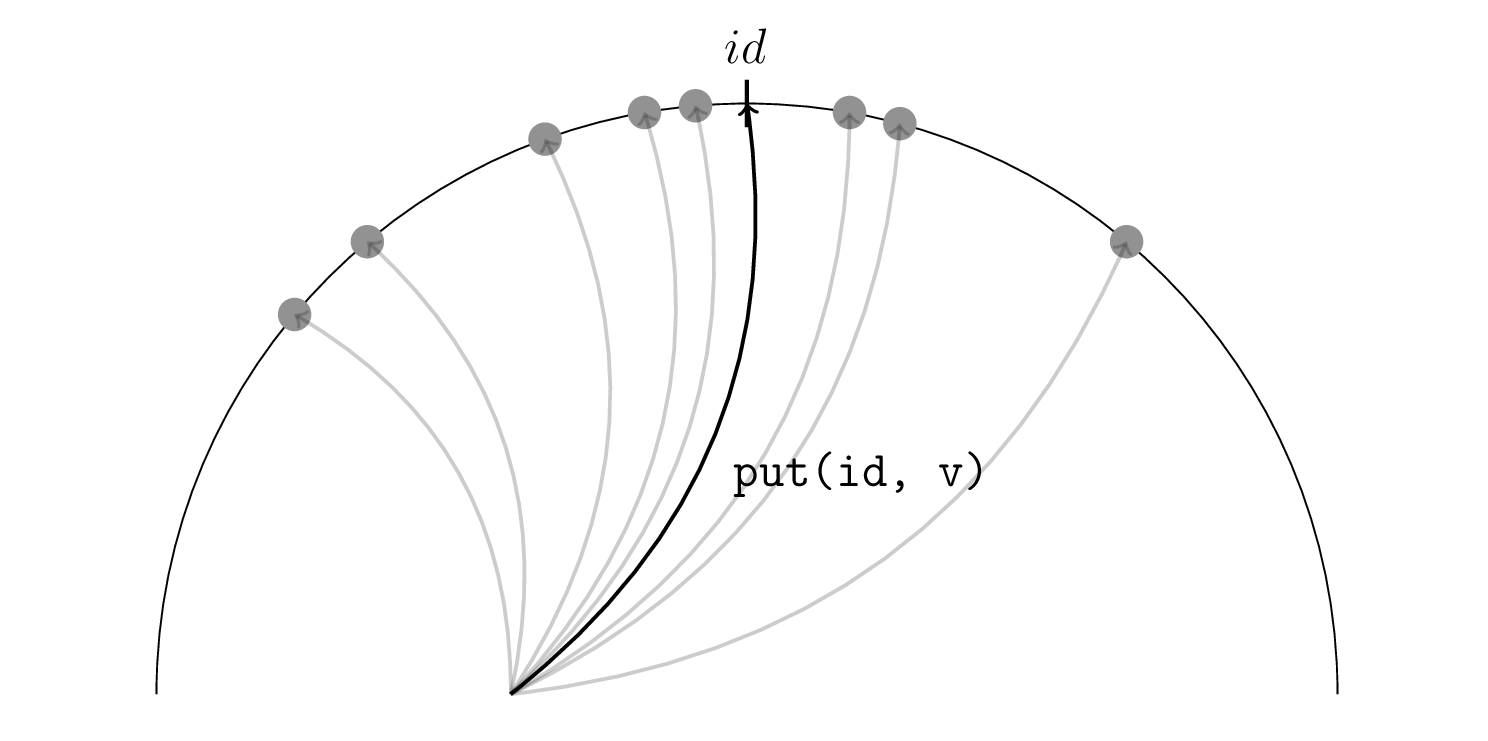
Short introduction to Distributed Hash Tables OpenDHT is based on the Kademlia design. If you know about DHTs, you are aware that they define the notion of distance using the XOR metric. This makes the tuple (H_n, xor) a metric space, where H_n is the space of identifier keys of length n. This way, you can find an identifier be the closest to a target hash than the rest of the nodes in the network.
In order to find some data that is associated with some hash h, you have to find the nodes in the network for which the distance between their hash identifier and the target hash h is minimized. The group of nodes which are the closest to the target hash (OpenDHT allows up to 8 nodes) will hold data for that hash.

Data persistence Let s say you ask a group of 8 nodes to hold some data for a hash and you want the data to hold the whole time until its expiration time as come. If the group of 8 nodes change because that for some reason those nodes leave or others just arrive and have an id that is closer to the target hash than the initial group of 8 nodes. The data would then not be found on the new group of 8 nodes. A first and simple solution was to count on the initial creator of the value to periodically announce the value to the group of 8 nodes. However, what if this node leaves? This is one of the main problem that I ve been working on solving since 2015. A first version of this was produced on September 2015. However, we experienced traffic issues and were forced to redesign the OpenDHT network requests engine. We are presently working on adding a Query feature that would enable filtering of data on remote nodes, hence substantially lowering the overall traffic produced by a response to a get request.

Indexation During the last year, I have also been working on the design of a solution for the use case of indexation. In a more technical way, this is the capability to find data by providing a map where its key is a string field and the mapped value is the value associated to that field, much like in a form. This could help find data for which you don t know the hash, but you have specific information about its content. In other words, this would be a search engine for OpenDHT. I have already created a working, but still in progress, version of this. You can find it on http://opendht.net, on the index branch. Now, Nicolas Reynaud (kaldoran) is contributing to this during the GSOC.

Roadmap As I explained on my page on the Debian Wiki, I am going to work on:
  1. Developing new functionalities in OpenDHT aiming at reducing overall generated traffic.
  2. Maintenance and optimization of the OpenDHT code in general.
  3. Optimizing data persistence solution over the distributed hash table.
  4. Merge (1) in the Ring daemon component in order to benefit from lower traffic in Ring.
  5. Make OpenDHT use TCP protocol instead of UDP. This is going to reduce code complexity and enhance robsutness of the DHT.
For further details, read my reports!

Reproducible builds folks: Reprotest repository exists and installs

Author: ceridwen I had family obligations for most of the past week, so I haven't had a chance to do more than get started on reprotest. The repository now contains a version of reprotest that can be installed with pip/setuptools (run python setup.py install in the repository directory or pip reprotest/ from its parent directory) or with debhelper (run debuild -b -uc -us in the repository, then install the resulting .deb). I've tested this works by installing into a virtualenv and onto my own system, but if anyone else wants to verify this, that would be great. At the moment, reprotest doesn't do anything, mind. I ended up importing significant amounts of code from autopkgtest into reprotest. While I may change my opinion as I read the code further, my first analysis is that much of the code responsible for processing command line arguments and config files (in lib/ and runner/) and building and communicating with the environments/virtual servers (in runner/, tools/, and virt-subproc/) can be adapted for reprotest. Once I have the chance to begin implementing functionality, I intend to discuss this in more detail.

2 June 2016

Kevin Avignon: Making a platformer in F# with MonoGame

Hey guys, Being myself a fan of functional programming and cross-platform development, I thought you might like a nice read on how to create your very first platformer game with F# & MonoGame. Making a platformer in F# with MonoGame For those not having any prior knowledge of F#, don t worry, I m going to do Continue reading Making a platformer in F# with MonoGame

Next.

Previous.