Search Results: "nate"

1 June 2014

Russ Allbery: Spring haul post

Sorry about the lack of posting recently. Work has been rather problematic, and also very distracting, and on my time away from work I've been relaxing rather than writing. Didn't even get reviews written while on vacation. I am still hoping to catch up on reviews, however. In the meantime, I have been reading some, and buying more books. Here's a new haul list. Elizabeth Bear Steles of the Sky (sff)
Katherine Boo Behind the Beautiful Forevers (non-fiction)
John Chu The Water That Falls on You from Nowhere (sff)
Lewis Dartnell The Knowledge (non-fiction)
David Lochbaum, et al. Fukushima (non-fiction)
Ben Goldacre Bad Pharma (non-fiction)
Mira Grant Parasite (sff)
Thomas Olde Heuvelt The Ink Readers of Doi Saket (sff)
Mary Robinette Kowal The Lady Astronaut of Mars (sff)
Madeline Miller The Song of Achilles (historical)
Edmund S. Morgan American Slavery, American Freedom (non-fiction)
Richard Rhodes The Making of the Atomic Bomb (non-fiction)
Lee Smolin The Trouble with Physics (non-fiction)
Charles Stross Equoid (sff)
Charles Stross Neptune's Brood (sff) This is a bit of a grab-bag, including a variety of non-fiction that I had recommended to me by various people. I also picked up the remaining Hugo nominees for best novel that won't be in the voter packet, and the short fiction from Tor.com that was nominated and was available for free from Amazon for the Kindle. I read The Knowledge while I was on vacation, and it's in my large backlog of pending reviews.

31 May 2014

Dirk Eddelbuettel: RcppGSL 0.2.1 and 0.2.2

A few days ago, version 0.2.1 of RcppGSL---our interface package between R and the GNU GSL using our Rcpp package for seamless R and C++ integration---appeared on CRAN making it the first release in some time. And it turned that this version tickled an obscure and long-dormant bug under clang which was found on OS X Mavericks---which Kevin Ushey consequently squashed. So this is now reflected in version 0.2.2 which just arrived on CRAN. Besides the bugfix, a few things were modernized to reflect capabilities of Rcpp 0.11.0 and later. The releases also contain a few changes that had accumulated since the previous release in 2012 such as an additional example using B-splines, and use of updated vignette build options provided by R. The NEWS file entries follows below:
Changes in version 0.2.2 (2014-05-31)
  • A subtle bug (tickled only by clang on some OS versions) in vector and matrix view initialization was corrected by Kevin Ushey
Changes in version 0.2.1 (2014-05-26)
  • Added new example based on B-splines example in GSL manual illustrating simple GSL use via Rcpp attributes
  • Vignette compilation has been reverted to using highlight since version 0.4.2 or greater can be used as a vignette engine (with R 3.0.* or later).
  • Vignette compilation is now being done by R CMD build as R 3.0.0 supports different vignette engines, so the vignette build process has been simplified. A convenience helper script has also been added for command-line builds.
  • Unit tests now use sourceCpp() instead of cxxfunction() from the inline package
  • The DESCRIPTION file now uses Suggests: Rcpp (instead of Depends: Rcpp) to permit building of the vignette
  • The package now takes advantage of the simplified build process available with Rcpp (>= 0.11.0)
  • Similar updates to the build process were made for the example package included with RcppGSL
And courtesy of CRANberries, a summaries of changes to release 0.2.0 and this week's release 0.2.1 are available. More information is on the RcppGSL page. Questions, comments etc should go to the rcpp-devel mailing list off the R-Forge page.

This post by Dirk Eddelbuettel originated on his Thinking inside the box blog. Please report excessive re-aggregation in third-party for-profit settings.

30 May 2014

Tiago Bortoletto Vaz: On losing contacts with old friends

In 2010 I decided to stop using my google account. In 2011 I decided to leave facebook, twitter and other $cool stuff. This was a hard decision. Not because email migration was annoying, nor because I liked to do social networking. It's hard because most of friends depend on either google or facebook to chat. Since I moved to another country, phone calls and presencial meetings have been substantially reduced. So we keep in contact by using IRC and XMPP. I have good friends who use IRC, mostly Debian people, which is great. I also have lots of friends and contacts not using IRC. In the past they used ICQ, then moved to MSN and now they are using google talk and facebook. I used to explain them that we could talk by using their google account and my Jabber account due to an open standard called XMPP. I enjoy having short conversations in random times, which sometimes takes hours and helps us to keep affectionately connected. It used to work so well. Now it seems to be gone. I've noticed that I can't connect anymore with contacts using google talk, probably because google has finally put into action their decision to abandon open standards for instant messaging. I'm not going to list here all the good things that happened in my life when I stopped using all this crap services. But I have to admit that it really hurts to see my contacts disappearing day by day, feeling like my friends are being devoured by these companies, with zero critical sense. You'll say that good friends won't disappear like that if they are good friends. I agree, but the convenience of having people from one-click distance in random hours a day makes a difference, mainly when physical distance is a blocker.

Don Armstrong: Dropbox Recursive Downloader

I'm working on some analyses for the Genetic Analysis Workshop #19, which has placed it's data on Dropbox. Unfortunately, Dropbox doesn't allow for people to download zip archives larger than 1GB, and the data was made available in an unpacked structure with more than a hundred files. Some searching indicated that no one had written a recursive downloader for Dropbox, so 30 minutes of hacking with WWW::Mechanize later, I wrote a simple recursive downloader for Dropbox. Two hours later, all of the files had downloaded.

28 May 2014

John Goerzen: Review: The Wheel of Time

Five years ago, I opened The Eye of the World, the first book in the Wheel of Time series, and read:
Lord of the Morning, he said, I have come for you.

On the island, the air shimmered and coalesced. The black-clad man stood staring at the fiery mountain rising out of the plain. His face twisted in rage and contempt. You cannot escape so easily, Dragon. It is not done between us. It will not be done until the end of time. Then he was gone, and the mountain and the island stood alone. Waiting.
And then, as often, Robert Jordan began books citing some of the prophecy he invented:
And it came to pass in those days, as it had come before and would come again, that the Dark lay heavy on the land and weighed down the hearts of men, and the green things failed, and hope died. And men cried out to the Creator, saying, O Light of the Heavens, Light of the World, let the Promised One be born of the mountain, according to the prophecies, as he was in ages past and will be in ages to come. Let the Prince of the Morning sing to the land that green things will grow and the valleys give forth lambs. Let the arm of the Lord of the Dawn shelter us from the Dark, and the great sword of justice defend us. Let the Dragon ride again on the winds of time. from Charal Drianaan to Calamon,
The Cycle of the Dragon.
Author unknown, the Fourth Age
And then, the grand opening to each of the books in the 11,000-page series, something like this:
The Wheel of Time turns, and Ages come and pass, leaving memories that become legend. Legend fades to myth, and even myth is long forgotten when the Age that gave it birth comes again. In one Age, called the Third Age by some, an Age yet to come, an Age long past, a wind rose in the Mountains of Mist. The wind was not the beginning. There are neither beginnings nor endings to the turning of the Wheel of Time. But it was a beginning. Born below the ever cloud-capped peaks that gave the mountains their name, the wind blew east, out across the Sand Hills, once the shore of a great ocean, before the Breaking of the World. Down it flailed into the Two Rivers, into the tangled forest called the Westwood, and beat at two men walking with a cart and horse down the rock-strewn track called the Quarry Road.
And yesterday, 11,000 pages later, I have completed the series. Really, how could I have put down a book with such a majestic beginning as that? It hinted at the epic that was to come, the amazing literature I was going to read. I didn t read it straight through; I enjoyed books like War and Peace along the way. But what a trip the Wheel of Time series was. The characters were so detailed, so deep, the setting so elaborate, the plots so grand and also so small everyone from servants to queens were well-represented in the books. Not every section was a page-turner; in fact, around the 4th or 5th book, the series started to plod for a thousand pages or two, reading more like a history book than a novel. Sometimes the prejudices and stereotypes of the characters, particularly the sexism that both the men and women displayed, were frustrating to read. I never quite figured out of this was brilliant writing (making the reader feel frustrated at the plodding pace of the book when it was describing characters being frustrated at the plodding pace of events), or if it could have been trimmed down by 2/3 in some places. But really, the number of brilliant endings, laugh-out-loud situations, and page-turning suspense that somehow managed to build over hundreds, and then even thousands of pages, outweighed the flaws.
Politics is a foggy mire full of snakes. - The Eye of the World
Ah. Furlan washed his hands in one direction, then rubbed them in the other. Ah. Forgive me, Master Andra, but Lady Alys is a fierce sounding woman. Only with those who displease her, Lan said blandly. Her bite is far worse than her bark. Ah. Ah. Ah. Your rooms are this way. . . - The Dragon Reborn
One of the marks of truly good writing is that I leave a book or series with a sense of sadness or nostalgia, leaving characters that seem almost like friends. I felt that after finishing the last book in the series, A Memory of Light. The ending was deep, and satisfying, but ultimately left me wanting even more even more than 11,000 pages, somehow.
Elienda and Briain woke from the dream. She might have been speaking of the weather rather than two deaths among women she knew. We all must wake eventually. - Knife of Dreams
I was often touched by the way the Aiel referred to each other. A desert people, their fond farewall was may you always find water and shade. A fitting metaphor for anyone s life, I think. And they referred to their spouse as shade of my heart. Jordan touched on quite a few themes of religion and philosophy. In that quote above, he has the Aiel referring to death as waking from a dream. An intriguing metaphor, isn t it? He even writes conflicts of philosophy, religion, and culture into the series. I was particularly impressed with his treatment of theodicy and the problem of evil (the argument and religious response relating to the presence of evil in the world in the face of a loving God.) It is the most impressive treatment I have seen in fiction, and does a better job of advancing the theodistic argument than many philosophers have, I suspect. It is hard to really go into that one here because of the length and potential for spoilers. I can, however, comment on his treatment of existential nihilism the theory that life and the universe is without meaning, and the sometimes-related comment that what does anything matter then anyway? Here are a couple of quotes:
In Maradon, I saw what had been done to men who followed me. I saw Light in them, Min. Defying the Dark One no matter the length of his shadow. We will live, that defiance said. We will love and we will hope. And I saw him trying so hard to destroy that. He knows that if he could break them, it would mean something. Something much more than Maradon. Breaking the spirit of men he thirsts for that. He struck far harder than he otherwise would have because he wanted to break my spirit. His voice grew softer and he opened his eyes, looking down at her. And so I stood against him. - Towers of Midnight
What if I think it s all meaningless? he demanded with the loud voice of a king. What if I don t want it to keep turning? We live our lives by the blood of others! And those others become forgotten. What good is it if everything we know will fade? Great deeds or great tragedies, neither means anything! They will become legends, then those legends will be forgotten, then it will all start over again!

Why? Rand thought with wonder. Because each time we live, we get to love again.

It felt relaxing to stare out at that distant light, so welcoming and noble. Storms will soon come, it seemed to say. But for now, I am here. I am here. - The Gathering Storm
I unfortunately can t put in in its proper context due to spoilers, but it is a pivotal turning point in the series, relating to the preservation of the world. By giving what we might normally call a characteristic or behavior evil an almost-human voice and character, it can be discussed in interesting ways.
We are always more afraid than we wish to be, but we can always be braver than we expect. Hold on to your heart, and the Aes Sedai cannot harm what is really you, your heart. They are not nearly so far above us as we believed. May you always find water and shade, Egwene. And always remember your heart. - Lord of Chaos
Eben is dead. Would you want to forget your pain if you lost that hulking giant of yours? Have your feelings for him cut away like some spoiled chunk of flesh in an otherwise good roast? - The Gathering Storm
These quotes are examples of characters in the series dealing with difficult situations. In one, a character is yelled at for offering to use her special powers to numb the pain of another person over a death. It brings up a question that those of us that have known pain might find interesting: would we really have wanted our pain erased? And suggests perhaps not. That there is a benefit to it. That we get through it by embracing it by embracing it while still being true to our heart.
He had four rules concerning action and information. Never make a plan without knowing as much as you can of the enemy. Never be afraid to change your plans when you receive new information. Never believe you know everything. And never wait to know everything. - Lord of Chaos
Sometimes the series treats us to logical thinkers, whether they are generals or innkeepers, and gives us little tidbits like this one.
Androl brushed off his hands, smiling. Children were so adaptable. Before them, centuries of tradition, terror and superstition could melt away like butter left too long in the sun. - Towers of Midnight
And sometimes, things to chew over. Isn t that an interesting comment on prejudice? Children aren t born prejudiced; we can see how easily they make friends with anyone. It is sad that we teach them to be, isn t it? Wheel of Time is a fine story, expertly woven. But it is not just a story. It is true, in the sense that it illuminates truths, just like Romeo and Juliet can. In it, I see lessons and echoes of the civil rights era, comments on what makes good leaders, characters wrestling with decisions without adequate data, people putting on a mask of emotions, sacrifice, and the overall theme of the entire series: the power of love and compassion. The inspiration of the series for me well, it is there, but it may take a few more days to figure it out. I think it has something to do with this: The wind rose high and free, to soar in an open sky with no clouds.

Joachim Breitner: Predicting the livetime of a Hackage package

The Debian Haskell Group has no proper policy about when to update a certain package to a new version from Hackage. So far, we upgrade when one of us personally needs something, when someone nudges us, if its required as a dependency or just when we feel like it. I was thinking about ways to improve that. One thing that we should definitely do is to upgrade to new versions that differ only in the forth version number, e.g. from 1.2.3.4 to 1.2.3.5 these are most likely bug fix uploads and have little risk of breaking things. (Unless they are only changes to the .cabal file, then they might not be an improvement for our users or us.) I plan to code that soon. But what else can we do? Ideally we d package versions that will be the newest version for a long time, and not versions that are going to be replaced the next day. Unfortunately, deciding that requires visionary powers. But maybe there is a correlation between the upload history and the lifetime of a new package? Maybe there are patterns, e.g. the first upload after a long time tends to be replaced fast, but the third package in a short succession has a high chance to live long? Can we predict the livetime of a freshly uploaded package? So after a bit of hacking I got this graphic:
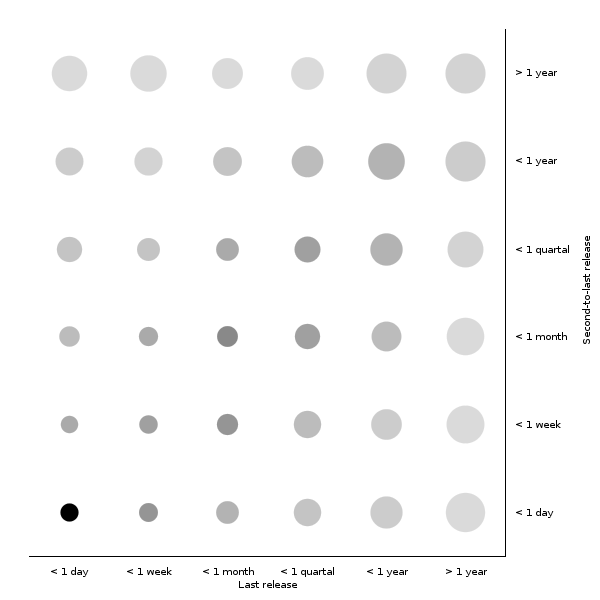
It needs a bit explanation: Both axis are time differences, the picture is one year by one year. For every release of which we know the lifetime (i.e. there has been an upload later), we draw its history on a vertical line. The horizontal position of the line corresponds to the lifetime of the release: A package that was superseded immediately later (which I sometimes do after spotting annoying typos) would appear on the far left, a package that is stable for one year on the far right. The history itself is a series of dots, representing the previous uploads of that package, with their distance from the lower edge indicating the time that has passed since then. So if a package had two updates half a year ago, and then no update for another half year, it would contribute two dots right above each other in the middle of the picture. Unfortunately, the picture does not yield any insight, besides that short-lived packages are more frequent than long-lived packages. So I tried another view:
I grouped uploads by the livetime of their two preceding uploads. For each such groups, the circle indicates the average livetime. The darkness indicates the absolute number in the sample. So we see a correlation between the packages livetime and the livetime of its predecessor, which is also not very surprising. We can state some hypothesis, like: A package replacing a very old package is likely to be long-lived if its pre-predecessor lived very long or very shortly, but less so if that lived for a few months. But I m not sure of the significance of these. I could have also taken into account which uploads are major and which are minor, by looking at the version number, but I didn t. What s the conclusion? Nothing much. I got some funny looking graphs. And there needs to be a way to render pictures like the first within the axes of a Chart diagram. I put the (somewhat hackish) code online feel free to play with it.

27 May 2014

Jon Dowland: 2012 In Review

2013 is nearly all finished up and so I thought I'd spend a little time writing up what was noteable in the last twelve months. When I did so I found an unfinished draft from the year before. It would be a shame for it to go to waste, so here it is. 2012 was an interesting year in many respects with personal highs and lows. Every year I see a lots of "round-up"-style blog posts on the web, titled things like "2012 in music", which attempt to summarize the highlights of the year in that particular context. Here's JWZ's effort, for example. Often they are prefixed with statements like "2012 was a strong year for music" or whatever. For me, 2012 was not a particularly great year. I discovered quite a lot of stuff that I love that was new to me, but not new in any other sense. In Music, there were a bunch of come-back albums that made the headlines. I picked up both of Orbital's Wonky and Brian Eno's Lux (debatably a comeback: his first ambient record since 1983, his first solo effort since 2005, but his fourth collaborative effort on Warp in the naughties). I've enjoyed them both, but I've already forgotten Wonky and I still haven't fully embraced Lux (and On Land has not been knocked from the top spot when I want to listen to ambience.) There was also Throbbing Gristle's (or X-TG) final effort, a semi/post-TG, partly posthumous double-album swan song effort which, even more than Lux, I still haven't fully digested. In all honesty I think it was eclipsed by the surprise one-off release of a live recording of a TG side project featuring Nik Void of Factory Floor: Carter Tutti Void's Transverse, which is excellent. Ostensibly a four-track release, there's a studio excerpt V4 studio (Slap 1) which is available from (at least) Amazon. There's also a much more obscure fifth "unreleased" track cruX which I managed to "buy" from one of the web shops for zero cost. The other big musical surprise for me last year was Beth Jeans Houghton and the Hooves of Destiny: Yours Truly, Cellophane Nose. I knew nothing of BJH, although it turns out I've heard some of her singles repeatedly on Radio 6, but her band's guitarist Ed Blazey and his partner lived in the flat below me briefly. In that time I managed to get to the pub with him just once, but he kindly gave me a copy of their album on 12" afterwards. It reminds me a bit of Goldfrapp circa "Seventh Tree": I really like it and I'm looking forward to whatever they do next. Reznor's How To Destroy Angels squeezed out An Omen EP which failed to set my world on fire as a coherent collection, despite a few strong songs individually. In movies, sadly once again I'd say most of the things I recall seeing would be "also rans". Prometheus was a disappointment, although I will probably rewatch it in 2D at least once. The final Batman was fun although not groundbreaking to me and it didn't surpass Ledger's efforts in The Dark Knight. Inception remains my favourite Nolan by a long shot. Looper is perhaps the stand-out, not least because it came from nowhere and I managed to avoid any hype. In games, I moaned about having moaning about too many games, most of which are much older than 2012. I started Borderlands 2 after enjoying Borderlands (disqualified on age grounds) but to this day haven't persued it much further. I mostly played the two similar meta-games: The Playstation Plus download free games in a fixed time period and the more sporadic but bountiful humble bundle whack-a-mole. More on these another time. In reading, as is typical I mostly read stuff that was not written in 2012. Of that which was, Charles Stross's The Apocalypse Codex was an improvement over The Fuller Memorandum which I did not enjoy much, but in general I'm finding I much prefer Stross's older work to his newer; David Byrne's How Music Works was my first (and currently last) Google Books ebook purchase, and I read it entirely on a Nexus 7. I thoroughly enjoyed the book but the experience has not made a convert of me away from paper. He leans heavily on his own experiences which is inevitable but fortunately they are wide and numerous. Iain Banks' Stonemouth was an enjoyable romp around a fictional Scottish town (one which, I am reliably informed, is incredibly realistical rendered). One of his "mainstream" novels, It avoided a particular plot pattern that I've grown to dread with Banks, much to my suprise (and pleasure). Finally, the stand-out pleasant surprise novel of the year was Pratchett and Baxter's The Long Earth. With a plot device not unlike Banks' Transition or Stross's Family Trade series, the pair managed to write a journey-book capturing the sense-of-wonder that these multiverse plots are good for. (Or perhaps I have a weakness for them). It's hard to find the lines between Baxter and Pratchett's writing, but the debatably-reincarnated Tibetan Monk-cum-Artificial Intelligence 'Lobsang' must surely be Pratchett's. Pratchett managed to squeeze out another non-Discworld novel (Dodger) as well as a long-overdue short story collection, although I haven't read either of them yet. On to 2013's write-up...

24 May 2014

Wouter Verhelst: kFreeBSD and ZFS

At one particular customer, increasing storage needs require that we add a large file server which should be as fast as possible. In that context, I'm currently evaluating using Debian GNU/kFreeBSD ("Debian," from now on) on ZFS. Not being hampered by a large degree of knowledge on the subject, here's a blog post with things I've learned so far. For context, the system on which we'll be installing will have 64 gigs of RAM, about two dozen SAS disks connected to a RAID controller of which I'm reasonably sure (though not 100% so) that it supports JBOD mode, and a PCIe-attached solid state storage device of several terabytes. If it turns out the RAID controller doesn't support JBOD mode, I'll probably create as many RAID0 devices as possible and hand those over to ZFS as "hard disks", instead; this wouldn't be an ideal solution, but I don't have much of a choice of hard disk attachment, unfortunately. That being said, the system on which I'm testing right now is the latest incantation of samba, an HP ProLiant ML115 server. A system with far more modest hardware specifications, it has 2G of RAM (which isn't really enough for ZFS), a single 160G SATA hard disk, and a dual-core AMD processor of about half a decade ago. And oh yes, no SSD. So for evaluating ZFS performance it's not ideal, but for evaluating Debian and ZFS features, it will do. Anyway, what I've found so far on samba: We'll see what else I learn.

23 May 2014

Steve Kemp: Using a cubox as a media platform.

Somebody recent got in touch offering to mail me a Cubox, in exchange for me experimenting with it and writing about it. In the past I've written book reviews in exchange for receiving free copies, and while I don't want to make a habit of it I don't see a problem providing I'm up-front and honest. So, what is the cubox-i? It's another one of those "small computers", roughly similar to the Raspberry Pi, but with slightly different hardware, and a really neat little case design, as the name suggests it just looks like a tiny two inch cube, only spoiled by the mass of cabling attached to the back. Me? I was cheeky and said I'd have no use for one, unless it was the fancy-model. The hardware comes in 4 different versions, which you can read about on the Cubox-i product page. Ignoring the smaller/cheaper models the fancy version is the CuBox-i4Pro, and this differentiates itself from the Rasberry Pi: I had two uses for this toy; the first was to be a random NAS-box hosting local backups, the second was to be a media-center. In the past I used a Rasberry PI as a media-box, but unfortunately performance was appalling, largely because of the low-spead of the USB WiFi dongle I bought. The video playback would stall at times, even though the hardware could display full HD-output, the network constraints seemed to be a limiting factor. In the end I abandoned it and these days use it sporadically for emulation, and little else. I've been meaning to do something more interesting with it, but never quite got round to it. By contrast the Cubox-i is wonderful at being a media-box. I've exported some shares of MP4/AVI files from my desktop host, via NFS, then downloaded a binary image of the geexbox (XBMC) distribution which I installed onto the MicroSD card via dd. The box boots in about seven seconds, was configured to use WiFi (via "Programs Settings"), and was streaming media in less than two minutes. There is a Debian disitribution available for download from the cubox-i wiki, but sadly it is an ancient snapshot of Jessie from December last year. It did install, but there was no WiFi out of the box. Gunnar Wolf wrote about bootstrapping an image from sources, rather than using a binary snapshot. He's kindly shared the resulting image he built, but again sadly no WiFi support, so for the moment I'm just enjoying the media-suport. In the future I need to decide what to do: I also need to look at running Pure Debian, for obvious reasons, but if I can't use WiFi the machine is no good to me. (The TV is in a different room to the office which contains our Linux hosts.) Either way I've not been excited about new hardware for a while, not since I bought a Logitech Squeezebox, and we're both enjoying watching media on the TV.
Emanuele Rocca: A (very) brief history of Australia

This post is mostly a sum-up of the Wikipedia page History of Australia, with some content taken from History of the British Empire. Both texts are available under the Creative Commons Attribution-ShareAlike License. I do not seem to be able to learn about a new topic without taking notes: in this case I have decided to publish my work, hoping that someone will find it useful. Some very important themes such as the Gold Rush and Australian History during the World Wars have been impudently ignored.
Indigenous Australians The ancestors of Indigenous Australians are believed to have arrived in Australia 40,000 to 60,000 years ago, and possibly as early as 70,000 years ago. By 1788, the population of Australia existed as 250 individual nations, many of which were in alliance with one another, and within each nation there existed several clans, from as few as five or six to as many as 30 or 40. Each nation had its own language and a few had multiple, thus over 250 languages existed, around 200 of which are now extinct. Permanent European settlers arrived at Sydney in 1788 and came to control most of the continent by end of the 19th century. Bastions of largely unaltered Aboriginal societies survived, particularly in Northern and Western Australia into the 20th century, until finally, a group of Pintupi people of the Gibson Desert became the last people to be contacted by outsider ways in 1984.
European explorers Terra Australis (Latin for South Land) is one of the names given to a hypothetical continent which appeared on European maps between the 15th and 18th centuries. Although the landmass was drawn onto maps, Terra Australis was not based on any actual surveying of such a landmass but rather based on the hypothesis that continents in the Northern Hemisphere should be balanced by land in the south. The first documented European landing in Australia was made in 1606 by a Dutch ship led by Willem Janszoon. Hence the ancient name "Nova Hollandia". The same year, a Spanish expedition had landed in the New Hebrides and, believing them to be the fabled southern continent, named the land: "Terra Austral del Espiritu Santo". Hence the current name "Australia". Although various proposals for colonisation were made, notably by Pierre Purry from 1717 to 1744, none was officially attempted. Indigenous Australians were less able to trade with Europeans than were the peoples of India, the East Indies, China, and Japan. The Dutch East India Company concluded that there was "no good to be done there". In 1769, Lieutenant James Cook tried to locate the supposed Southern Continent. This continent was not found, and Cook decided to survey the east coast of New Holland, the only major part of that continent that had not been charted by Dutch navigators. Cook charted and took possession of the east coast of New Holland. He noted the following in his journal:
"I can land no more upon this Eastern coast of New Holland, and
 on the Western side I can make no new discovery the honour of
 which belongs to the Dutch Navigators and as such they may lay
 Claim to it as their property, but the Eastern Coast from the
 Latitude of 38 South down to this place I am confident was never
 seen or viseted by any European before us and therefore by the
 same Rule belongs to great Brittan."
Colonisation The American Revolutionary War (1775-1783) saw Great Britain lose most of its North American colonies and consider establishing replacement territories. The British colony of New South Wales was established with the arrival of the First Fleet of 11 vessels in January 1788. It consisted of over a thousand settlers, including 778 convicts (192 women and 586 men). A few days after arrival at Botany Bay the fleet moved to the more suitable Port Jackson where a settlement was established at Sydney Cove on 26 January 1788. This date later became Australia's national day, Australia Day. Between 1788 and 1868, approximately 161,700 convicts (of whom 25,000 were women) were transported to the Australian colonies of New South Wales, Van Diemen's land and Western Australia. Early colonial administrations were anxious to address the gender imbalance in the population brought about by the importation of large numbers of convict men. In 1835, the British Colonial Office issued the Proclamation of Governor Bourke, implementing the legal doctrine of terra nullius upon which British settlement was based, reinforcing the notion that the land belonged to no one prior to the British Crown taking possession of it and quashing any likelihood of treaties with Aboriginal peoples, including that signed by John Batman. Its publication meant that from then, all people found occupying land without the authority of the government would be considered illegal trespassers. A group in Britain led by Edward Gibbon Wakefield sought to start a colony based on free settlement and political and religious freedoms, rather than convict labour. The South Australia Act [1834], passed by the British Government which established the colony reflected these desires and included a promise of representative government when the population reached 50,000 people. Significantly, the Letters Patent enabling the South Australia Act 1834 included a guarantee of the rights of 'any Aboriginal Natives' and their descendants to lands they 'now actually occupied or enjoyed'. In 1836, two ships of the South Australia Land Company left to establish the first settlement on Kangaroo Island. The foundation of South Australia is now generally commemorated as Governor John Hindmarsh's Proclamation of the new Province at Glenelg, on the mainland, on 28 December 1836. By 1851 the colony was experimenting with a partially elected council.
Development of Australian democracy Traditional Aboriginal society had been governed by councils of elders and a corporate decision making process, but the first European-style governments established after 1788 were autocratic and run by appointed governors. The reformist attorney general, John Plunkett, sought to apply Enlightenment principles to governance in the colony, pursuing the establishment of equality before the law. Plunkett twice charged the colonist perpetrators of the Myall Creek massacre of Aborigines with murder, resulting in a conviction and his landmark Church Act of 1836 disestablished the Church of England and established legal equality between Anglicans, Catholics, Presbyterians and later Methodists. In 1840, the Adelaide City Council and the Sydney City Council were established. Men who possessed 1,000 pounds worth of property were able to stand for election and wealthy landowners were permitted up to four votes each in elections. Australia's first parliamentary elections were conducted for the New South Wales Legislative Council in 1843, again with voting rights (for males only) tied to property ownership or financial capacity. Voter rights were extended further in New South Wales in 1850 and elections for legislative councils were held in the colonies of Victoria, South Australia and Tasmania. Women became eligible to vote for the Parliament of South Australia in 1895. This was the first legislation in the world permitting women also to stand for election to political office and, in 1897, Catherine Helen Spence became the first female political candidate for political office, unsuccessfully standing for election as a delegate to the Federal Convention on Australian Federation. Western Australia granted voting rights to women in 1899. Early federal parliamentary reform and judicial interpretation sought to limit Aboriginal voting in practice, a situation which endured until rights activists began campaigning in the 1940s.
Road to independence Despite suspicion from some sections of the colonial community (especially in smaller colonies) about the value of nationhood, improvements in inter-colonial transport and communication, including the linking of Perth to the south eastern cities by telegraph in 1877, helped break down inter-colonial rivalries. New South Wales Premier Henry Parkes addressed a rural audience in his 1889 Tenterfield Oration, stating that the time had come to form a national executive government:
"Australia [now has] a population of three and a half millions,
 and the American people numbered only between three and four
 millions when they formed the great commonwealth of the United
 States. The numbers were about the same, and surely what the
 Americans had done by war, the Australians could bring about in
 peace, without breaking the ties that held them to the mother
 country."
Though Parkes would not live to see it, his vision would be achieved within a little over a decade, and he is remembered as the "father of federation". The Commonwealth of Australia came into being when the Federal Constitution was proclaimed by the Governor-General, Lord Hopetoun, on 1 January 1901. Australia took part in WWI. The contributions of Australian and New Zealand troops during the 1915 Gallipoli Campaign against the Ottoman Empire had a great impact on the national consciousness at home, and marked a watershed in the transition of Australia and New Zealand from colonies to nations in their own right. The countries continue to commemorate this occasion on ANZAC Day. Australia achieved independent Sovereign Nation status after World War I, under the Statute of Westminster, which defined Dominions of the British empire in the following way:
"They are autonomous Communities within the British Empire, equal
 in status, in no way subordinate one to another in any aspect of
 their domestic or external affairs, though united by a common
 allegiance to the Crown, and freely associated as members of the
 British Commonwealth of Nations."
The parliaments of Canada, Australia, New Zealand, the Union of South Africa, the Irish Free State and Newfoundland (currently part of Canada) were now independent of British legislative control, they could nullify British laws and Britain could no longer pass laws for them without their consent. The Australia Act 1986 removed any remaining links between the British Parliament and the Australian states.

21 May 2014

Russell Coker: Why I Use BTRFS

I ve just had to do yet another backup/format/restore operation on my workstation due to a BTRFS corruption problem, but as usual I didn t lose any data. The BTRFS data integrity features work reasonably well even when the filesystem gets into a state where the kernel will only accept a read-only mount. Given that the BTRFS tag on my blog is mostly about problems with BTRFS I think it s time that I explain why I use it in spite of the problems before people start to worry about my sanity or competence. The first thing to note is that BTRFS is fairly resiliant toward errors when mounted in read-only mode. When mounting a filesystem read-write there are a number of ways in which things can break which are often due to kernel code not being able to handle corrupt metadata I don t know how much of this is inherent to the design of BTRFS and how much is simply missing features in filesystem error handling. Some of the errors that I have had weren t entirely the fault of BTRFS, I twice had to do a backup/format/restore of my workstation due to a faulty DIMM corrupting memory (that has the potential to mess up any filesystem), but I still didn t lose any data AFAIK. The next thing to note is that I don t use BTRFS when doing paid sysadmin work. ZFS is a solid and reliable filesystem and it is working really well for my clients while BTRFS has too many issues at the moment. As an aside I m not interested in any comments about the ZFS license situation from anyone who s not officially representing Oracle. I also don t use BTRFS on systems that I can t access easily. The servers I have running BTRFS are all within an hour s drive from home, while driving for an hour on account of a kernel or filesystem error is really annoying it s not as bad as dealing with a remote server where I have no direct access. Reasons to Use BTRFS The benefits of BTRFS right now are snapshots (which are good for a first-line backup) and the basic data integrity features. I ve found these features to work well in real use. According to the comparison of Filesystems Wikipedia page ZFS and BTRFS are the only general purpose filesystems (IE for disks not tapes, NVRAM, or a cluster) that support checksums for all data and compression. Given that ZFS license issues will never allow it to be included in the Linux kernel tree it seems clear that BTRFS is the next significant filesystem for Linux. More testing of BTRFS is a good thing, while there are a number of known problems that the developers are working on it seems that more testing is needed now to find corner cases. Also we need a lot of testing to find bugs related to interactions with other software. I ve recently filed bug reports against the Debian installer because it can t install to a BTRFS RAID-1 (fortunately BTRFS supports changing to RAID-1 after installation) and because it doesn t support formatting an existing BTRFS filesystem (the mkfs program needs a -f option in that case). I also sent in a patch for the magic database used by file(1) to provide more information on BTRFS filesystems (which is in Debian/testing but not Debian/Wheezy). These are the sorts of things you encounter when routinely using software that you don t necessarily notice in basic testing. As an aside the Debian installation process failed at the GRUB step when I manually balanced a filesystem to use RAID-1 while the Debian installation was in progress. I didn t file a bug report because the best advice is to not mess with filesystems while the installer is running. I ll do a lot more testing of this when the Debian installer supports a BTRFS RAID-1 installation. A final thing that we need to work on is developing sysadmin best practices and scripts for managing BTRFS filesystems. I ve done some work on scripts to create snapshots for online backups but there are issues of managing free space etc. But working out how to best manage a new filesystem is something that takes years because there are many corner cases you may only encounter after a system has been running for a long time. So I really wouldn t want to be in the situation of using a new filesystem on an important server without having practice running it on less important systems, I did that with ZFS and now have a hacky first install that I have to support for years.

19 May 2014

Russell Coker: My First Ingress Anomaly

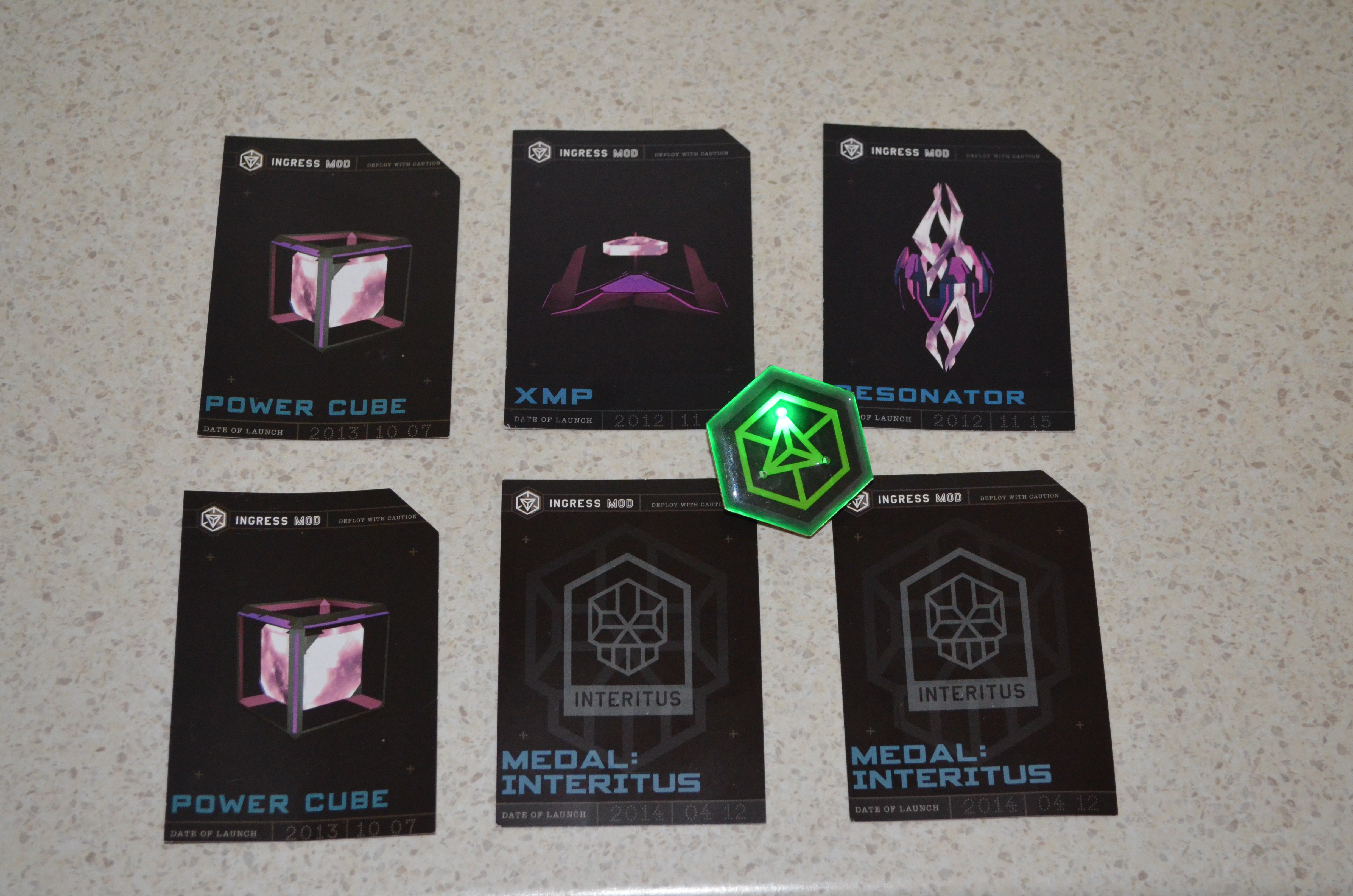
schwag from Ingress Anomaly Ingress is an Android phone game developed by Google where you have to go to various places to capture portals which are based on landmarks or places of note. There s a sci-fi back story which I haven t cared much about (my local library has a heap of good sci-fi books I don t have time to read). But if you are interested in low quality sci-fi you can start with the Youtube channel for Ingress [1]. But the best thing to do is to download the Ingress client program from the Google play store if you have an Android phone [2]. Periodically they have special events in the game called Anomalies , which usually involve many people competing to capture a small number of special portals. Usually a portal is fairly easy to capture so a high level player can easily capture a portal in at most a few minutes, but when there is a large group of players defending a portal by replacing the resonators as quickly as they are destroyed it becomes more challenging. I m not going to try to explain this properly as I presume that readers either already know or don t care. The Wikipedia page about Ingress has more information. On Saturday there was an Anomaly where the main city was Melbourne. My team (Enlightened) won the event in Australia but apparently the event in the US at the same time was won by the other team (Resistance). I had hoped that our event would be similar to some of the ones I ve seen on the Ingress Report (a fictional news service on youtube) in which actors from the sci-fi videos about Ingress attended. But unfortunately it seems that the actors stay in the US. Every player who was registered for the anomaly received a gift pack that contained three cards and a badge. The picture above shows the cards that my wife and I received along with one of our badges. The badges are green for Enlightened and blue for Resistance (the in-game colors) and have three flashing LEDs the photo has one of the LEDs lit up. The three cards have passcodes which can be redeemed for in-game items, the XMP, Power Cubes, and Resonators weren t that useful (10 not particularly rare items that I could get through 10 minutes of game playing). The Medal cards are for in-game badges showing the anomalies that we have played at, but they are bronze badges which again aren t much use as nothing less than silver will help in leveling up. Overall it was a good experience, we won, had a good after-party (with free snacks and one free drink per person), and the badges are nice. I recommend attending if there s an event in your area, and note that you don t need to be a high level player to attend, even L6 players were able to contribute.

13 May 2014

Jose Luis Rivas: angular-geocomplete's first version

So I was needing a resulting JSON array with possible solutions for a given address or city name and then angular-geocomplete was made. The great thing is that you can use it together with typeahead and now you have address/location autocomplete, just like the one on Google Maps. And yes, it does uses Google Maps's API. What's the advantage of this thing? You get coordinates together with all the names. Installable via bower as well with bower install angular-geocomplete. Any issue: to the GitHub tracker.

Dirk Eddelbuettel: Updated list of upcoming Rcpp talks and workshops

This is an updated version of an earlier post in March. A number of talks about Rcpp are scheduled over the next couple of months: So the month of June remains pretty open. If someone wants me to talk somewhere else, preferably on a Saturday, feel free to get in touch.

This post by Dirk Eddelbuettel originated on his Thinking inside the box blog. Please report excessive re-aggregation in third-party for-profit settings.

11 May 2014

Matthew Garrett: Oracle continue to circumvent EXPORT_SYMBOL_GPL()

Oracle won their appeal regarding whether APIs are copyrightable. There'll be ongoing argument about whether Google's use of those APIs is fair use or not, and perhaps an appeal to the Supreme Court, but that's the new status quo. This will doubtless result in arguments over whether Oracle's implementation of Linux APIs in Solaris 10 was a violation of copyright or not (and presumably Google are currently checking whether they own any code that Oracle reimplemented), but that's not what I'm going to talk about today.

Oracle own some code called DTrace (Wikipedia has a good overview here - what it actually does isn't especially relevant) that was originally written as part of Solaris. When Solaris was released under the CDDL, so was DTrace. The CDDL is a file-level copyleft license with some restrictions not present in the GPL - as a result, combining GPLed code with CDDLed code will (in the absence of additional permission grants) result in a work that is under an inconsistent license and cannot legally be distributed.

Oracle wanted to make DTrace available for Linux as part of their Unbreakable Linux product. Integrating it directly into the kernel would obviously cause legal issues, so instead they implemented it as a kernel module. The copyright status of kernel modules is somewhat unclear. The GPL covers derivative works, but the definition of derivative works is a function of copyright law and judges. Making use of explicitly exported API may not be sufficient to constitute a derivative work - on the other hand, it might. This is largely untested in court. Oracle appear to believe that they're legitimate, and so have added just enough in-kernel code (and GPLed) to support DTrace, while keeping the CDDLed core of DTrace separate.

The kernel actually has two levels of exposed (non-userspace) API - those exported via EXPORT_SYMBOL() and those exported via EXPORT_SYMBOL_GPL(). Symbols exported via EXPORT_SYMBOL_GPL() may only be used by modules that claim to be GPLed, with the kernel refusing to load them otherwise. There is no technical limitation on the use of symbols exported via EXPORT_SYMBOL().

(Aside: this should not be interpreted as meaning that modules that only use symbols exported via EXPORT_SYMBOL() will not be considered derivative works. Anything exported via EXPORT_SYMBOL_GPL() is considered by the author to be so fundamental to the kernel that using it would be impossible without creating a derivative work. Using something exported via EXPORT_SYMBOL() may result in the creation of a derivative work. Consult lawyers before attempting to release a non-GPLed Linux kernel module)

DTrace integrates very tightly with the host kernel, and one of the things it needs access to is a high-resolution timer that is guaranteed to monotonically increase. Linux provides one in the form of ktime_get(). Unfortunately for Oracle, ktime_get() is only exported via EXPORT_SYMBOL_GPL(). Attempting to call it directly from the DTrace module would fail.

Oracle work around this in their (GPLed) kernel abstraction code. A function called dtrace_gethrtimer() simply returns the value of ktime_get(). dtrace_gethrtimer() is exported via EXPORT_SYMBOL() and therefore can be called from the DTrace module.

So, in the face of a technical mechanism designed to enforce the author's beliefs about the copyright status of callers of this function, Oracle deliberately circumvent that technical mechanism by simply re-exporting the same function under a new name. It should be emphasised that calling an EXPORT_SYMBOL_GPL() function does not inherently cause the caller to become a derivative work of the kernel - it only represents the original author's opinion of whether it would. You'd still need a court case to find out for sure. But if it turns out that the use of ktime_get() does cause a work to become derivative, Oracle would find it fairly difficult to argue that their infringement was accidental.

Of course, as copyright holders of DTrace, Oracle could solve the problem by dual-licensing DTrace under the GPL as well as the CDDL. The fact that they haven't implies that they think there's enough value in keeping it under an incompatible license to risk losing a copyright infringement suit. This might be just the kind of recklessness that Oracle accused Google of back in their last case.

comment count unavailable comments

10 May 2014

DebConf team: DebConf15 organisation kicked off in Heidelberg (Posted by Martin Krafft)

The lobby of the youth hostel Heidelberg (by Richard Hartmann) The DC15 team met Saturday at the Heidelberg International Youth Hostel to kick off the organisation of DebConf15. While a handful of team members unfortunately had to excuse themselves, 18 people showed up, and the spirit level was high. Self-contained in beautiful surroundings The youth hostel Heidelberg from the outside view (by Richard Hartmann) The youth hostel is the expected venue for DebConf15, which is slated to take place in August 2015. It sleeps more than 400 people, and it features two large conference rooms. Several smaller rooms can be used for team meetings and impromptu birds-of-a-feather sessions. A panoramic view of the city of Heidelberg (by Michael Banck) The venue is located a little bit outside of Heidelberg s centre, right on the side of the Neckar river, north of the Heidelberg Zoo, west of a university campus, and south of a sports field. Fantastic, child-friendly DebConf venue The courtyard of the youth hostel, used for eating and socialising (by Richard Hartmann) The large cafeteria and the plentiful outside space usable for eating, working, chatting and playing make it a fantastic venue for DebConf. And far away from traffic, with a play area, space to run around, and the zoo next door, it s very suitable to families with children, too. Become part of the team! If you are interested in being part of the organisation of our conference, we welcome you on our mailing list and look forward to your contributions! There is also the #debconf15-germany IRC channel on irc.debian.org, and we have a list of DC15 sub-teams to give you an overview. Feel free to add yourself, or just help out and someone will add you. (Photos by Michael Banck and Richard Hartmann, used under the terms of the CC by-sa licence 3.0)

9 May 2014

Rhonda D'Vine: Rhonda's Free Hugging Guidelines

Recently I was wearing my Free Hugs shirt to different Free Software meetings, and I came up with the idea if we are advocating the Free in Software specificly, why not come up with Free Hugging Guidelines, too. So here they are, from now on considered to be named the RFHG.
  1. Free Redistribution Your hugs may not restrict any party from passing on the hugs they received from you.
  2. Source Code The hugs must be possible to be perceived and understandable in complete. You are not allowed to use any special techniques that can not be perceived.
  3. Derived Works Your hugs must be allowed to be modified, and must allow the modified forms of your hugs to be distributed under the same terms as they received them.
  4. Integrity of The Author's Source Code While you are allowed to pass on the hugs in modified form, you are not allowed to modify the DNA of the original person you received the hugs from. Genetic modification is out of the scope of the RFHG.
  5. No Discrimination Against Persons or Groups While we acknowledge that you might not feel willing to hug everyone, you must apply rules that do not distinquish by rules which would violate The Universal Declaration of Human Rights. Furthermore, you have the right to not hug a person if you are not in the mood for it. Please refrain from wearing any Free Hugs markers at those times though.
  6. No Discrimination Against Fields of Endeavor The hugs can not be restricted to be used in a specific field of endeavor. For example, you may not restrict the hugs from being passed on only in times of sorrow.
  7. Distribution of Hugs The rights attached to the hugs must apply to all to whom the hugs are redistributed without the need for execution of an additional license by those parties.
  8. Hugs Must Not Be Specific to Rhonda The rights attached to the hugs must not depend on the hugs being related to Rhonda. If the hugs are extracted from Rhonda and used or distributed without Rhonda nearby but otherwise within the terms of the hug's permissions, all parties to whom the hugs are distributed should have the same rights as those that are granted in conjunction with Rhonda.
  9. Hugs Must Not Contaminate Other People If you are contagious (e.g. got the flu, or worse) you have to apply appropriate counter measures to not transfer your illness with your hugs.
  10. Example Hugs This Group Hug modification and of course the Free Hugs Campaign are great examples of what we consider Free.
One last note: If you feel like it you don't have to wait until I wear my Free Hugs shirt again. I am fine with receiving (or giving) hugs like almost always. Surprise me. I at least know then that you read the RFHG. :) Like always, enjoy!

/personal permanent link Comments: 3 Flattr this

7 May 2014

Dirk Eddelbuettel: RcppEigen 0.3.2.1.2

A bug-fix release 0.3.2.1.2 is of RcppEigen is now on CRAN and in Debian. It contains a short upstream patch by Gaek Guennebaud for the UBSAN warnings that were flagged at CRAN (from a rather harmless cpu-id comparison). The NEWS entry follows.
Changes in RcppEigen version 0.3.2.1.2 (2014-05-05)
  • Applied upstream patch to not trigger g++ UBSAN warning on the cpu id comparison, with thanks to Gael Guennebaud for the patch
Courtesy of CRANberries, there are diffstat reports for the most recent release. Questions, comments etc about RcppEigen should go to the rcpp-devel mailing list off the R-Forge page.

This post by Dirk Eddelbuettel originated on his Thinking inside the box blog. Please report excessive re-aggregation in third-party for-profit settings.

6 May 2014

Michal Čihař: Weblate 1.9

Weblate 1.9 has been released today. It comes with lot of improvements and bug fixes and with experimental Zen mode for editing translations. Full list of changes for 1.9: You can find more information about Weblate on http://weblate.org, the code is hosted on Github. If you are curious how it looks, you can try it out on demo server. You can login there with demo account using demo password or register your own user. Ready to run appliances will be soon available in SUSE Studio Gallery. Weblate is also being used https://l10n.cihar.com/ as official translating service for phpMyAdmin, Gammu, Weblate itself and others. If you are free software project which would like to use Weblate, I'm happy to help you with set up or even host Weblate for you. Further development of Weblate would not be possible without people providing donations, thanks to everybody who have helped so far!

Filed under: English phpMyAdmin SUSE Weblate 0 comments Flattr this!

5 May 2014

Dirk Eddelbuettel: RcppArmadillo 0.4.300.0

A new release 4.300 of Armadillo, the templated C++ library for linear algebra, was released by Conrad a few days ago. As usual, this was rolled up in a new RcppArmadillo release 0.4.300.0 which is now on CRAN and in Debian. This release brings nice new upstream changes such as faster find() as well as corresponding functions to find elements which are either finite or non-finite, based on a suggestion we made. This may need an RcppArmadillo specific extension as R extends the IEEE logic to supported NA, NaN and Inf on floating point variables whereas standard C++ (and hence Armadillo) only supports the latter two. We hope to work on this shortly. Kevin also put in some code to make sure unsigned int vectors and matrices are converted correctly, and I updated the short configure script checking for complete LAPACK support to account for the R 3.0.3 or later case.
Changes in RcppArmadillo version 0.4.300.0 (2014-05-04)
  • Upgraded to Armadillo release Version 4.300 (Medieval Cornea Scraper)
    • faster find()
    • added find_finite() and find_nonfinite() for finding indices of finite and non-finite elements
    • expressions X=inv(A)*B*C and X=A.i()*B*C are automatically converted to X=solve(A,B*C)
  • Corrected conversion to unsigned int vectors and matrices
  • Configure script now checks for R version 3.0.3 or newer to enable complex divide-and-conquer SVD in case of R-supplied LAPACK
Courtesy of CRANberries, there is also a diffstat report for the most recent release As always, more detailed information is on the RcppArmadillo page. Questions, comments etc should go to the rcpp-devel mailing list off the R-Forge page.

This post by Dirk Eddelbuettel originated on his Thinking inside the box blog. Please report excessive re-aggregation in third-party for-profit settings.

Next.

Previous.