Search Results: "mak"

25 July 2017

Reproducible builds folks: Reproducible Builds: week 117 in Buster cycle

Here's what happened in the Reproducible Builds effort between Sunday July 16 and Saturday July 22 2017: Toolchain development Bernhard M. Wiedemann wrote a tool to automatically run through different sources of non-determinism, and report which of these caused irreproducibility. Dan Kegel's patches to fpm were merged. Bugs filed Patches submitted upstream: Patches filed in Debian: Reviews of unreproducible packages 73 package reviews have been added, 44 have been updated and 50 have been removed in this week, adding to our knowledge about identified issues. No issue types were updated. Weekly QA work During our reproducibility testing, FTBFS bugs have been detected and reported by: diffoscope development reprotest development Ximin also restarted the discussion with autopkgtest-devel about code reuse for reprotest. Santiago Torres began a series of patches to make reprotest more distro-agnostic, with the aim of making it usable on Arch Linux. Ximin reviewed these patches. Misc. This week's edition was written by Ximin Luo, Bernhard M. Wiedemann and Chris Lamb & reviewed by a bunch of Reproducible Builds folks on IRC & the mailing lists.

Satyam Zode: Maya - the OpenEBS Go Kit Project

The Kit project in Go is the common project containing all the standard libraries or packages used across all the Go projects in the organization. Motivation I attended GopherCon India 2017, there was a talk on Package Oriented Design In Go by William Kennedy. In that talk, William explained some really important and thoughtful design principles which We can apply in our day to day life, while writing Go. Hence, I wanted to apply these design philosophies to the Go projects in which I have been working on as a part of OpenEBS project. I learnt a good practice of having a Go Kit project at the organization level from William s talk. What is the Kit Project? The Kit project in Go is the common project containing all the standard libraries or packages used across all the Go projects in the organization. Packages in the Kit project should follow design philosophies. Need for a Kit project Sometimes, We write same Go packages again and again to do the same task at different levels in the different Go projects under the same organization. For example, we write custom logger package in the different Go projects. If the custom logger package is same across the organization and can be reused by simply importing it, then this custom logger package is the perfect fit for Kit project. You can sense how much time and cost it will save for us when we have a Kit project. How to convert existing projects to have kit Maya is the kit project in the progress. I will walk through our journey of creating a Kit project called maya for OpenEBS organization from existing Go projects. At OpenEBS, as a open source and growing Go project, We value Go principles and We try hard to leverage Go s offerings. Maya is the Kit project for the Application projects like maya-apiserver, maya-storage-bot etc. Maya contains all the kubernetes & nomad API s, common utilities etc. needed for development of maya-apiserver and maya-storage-bot. In the near future, we are trying to push our custom libraries to maya. So that, it will become a promising Go kit project for OpenEBS community. We have specifically followed the package oriented design principles in Go to create maya as a kit project. Project structure for the Maya as Kit project Example usage of maya kit project in maya-apiserver Maya-apiserver uses maya as a Kit project. Maya-apiserver exposes OpenEBS operations in form of REST APIs. This allows multiple clients e.g. volume related plugins to consume OpenEBS storage operations exposed by Maya API server. Conclusion Go Kit project should contain packages which are usable, purposeful and portable. Go Kit projects will improve the efficiency of the organization at both human and code level.

Gunnar Wolf: Getting ready for DebConf17 in Montreal!


(image shamelessly copied from Noodles' Emptiness) This year I will only make it to DebConf, not to DebCamp. But, still, I am very very happy and excited as the travel date looms nearer! I have ordered some of the delicacies for the Cheese and Wine party, signed up for the public bicycle system of Montreal, and done a fair share of work with the Content Team; finally today we sent out the announcement for the schedule of talks. Of course, there are several issues yet to fix, and a lot of things to do before traveling... But, no doubt about this: It will be an intense week! Oh, one more thing while we are at it: The schedule as it was published today does not really look like we have organized stuff into tracks But we have! This will be soon fixed, adding some color-coding to make tracks clearer on the schedule. This year, I pushed for the Content Team to recover the notion of tracks as an organizative measure, and as something that delivers value to DebConf as a whole. Several months ago, I created a Wiki page for the DebConf tracks, asking interested people to sign up for them. We currently have the following tracks registered:
Blends
Andreas Tille
Debian Science
Michael Banck
Cloud and containers
Luca Filipozzi
Embedded
Pending
Systems administration, automation and orchestation
Pending
Security
Gunnar Wolf
We have two tracks still needing a track coordinator. Do note that most of the tasks mentioned by the Wiki have already been carried out; what a track coordinator will now do is to serve as some sort of moderator, maybe a recurring talkmeister, ensuring continuity and probably providing for some commentary, giving some unity to its sessions. So, the responsibilities for a track coordinator right now are quite similar to what is expected for video team volunteers but to a set of contiguous sessions. If you are interested in being the track coordinator/moderator for Embedded or for Systems administration, automation and orchestation or even to share the job with any of the other, registered, coordinators, please speak up! Mail content@debconf.org and update the table in the Wiki page. See you very soon in Montreal!

24 July 2017

Jonathan Carter: Plans for DebCamp17

In a few days, I ll be attending DebCamp17 in Montr al, Canada. Here are a few things I plan to pay attention to:

23 July 2017

Gregor Herrmann: RC bugs 2017/08-29

long time no blog post. & the stretch release happened without many RC bug fixes from me; in practice, the auto-removals are faster & more convenient. what I nevertheless did in the last months was to fix RC bugs in pkg-perl packages (it still surprises me how fast rotting & constantly moving code is); prepare RC bug fixes for jessie (also for pkg-perl packages); & in the last weeks provide patches & carry out NMUs for perl packages as part of the ongoing perl 5.26 transition.

Norbert Preining: Gaming: Refunct

A lovely little game, Refunct, just crossed my Steam installation. A simple platformer developed with much love. The game play consists of reviving a lost area by stepping on towers, finding buttons, and making more towers appear through this. The simple game play idea is enriched with wonderful lightening due to the movement of the sun. I really enjoyed the changing of environment and mood that was created by this effect.
Although not terrible useful by now, one can also swim and dive and enjoy the world from below, which is just an added nice bonus.
The game is currently (till Monday night as far as I see) on sale on Steam for 149 Yen, i.e., slightly above a Euro/Dollar. Well worth the investment for about 1h of game play. Addition: The fastest run at the moment is at 2:46.57, that is under 3min! I managed barely under 25min. Incredible.

22 July 2017

Norbert Preining: Making fun of Trump thanks France

I mean, it is easy to make fun of Trump, he is just too stupid and incapable and uneducated. But what the French president Emmanuel Macron did on Bastille Day, in presence of the usual Trumpies, was just above the usual level of making fun of Trump. The French made Trump watch a French band playing a medley of Daft Punk. And as we know Trump seemed to be very unimpressed, most probably because he doesn t have a clue. I mean, normally you play these pathetic rubbish, look at the average US (or Chinese or North Korean) parades, and here we have the celebration of an event much older then anything the US can put on the table, and they are playing Daft Punk! France, thanks. You made my day actually not only one!

Niels Thykier: Improving bulk performance in debhelper

Since debhelper/10.3, there has been a number of performance related changes. The vast majority primarily improves bulk performance or only have visible effects at larger input sizes. Most visible cases are: For debhelper, this mostly involved: How to take advantage of these improvements in tools that use Dh_Lib: Credits: I would like to thank the following for reporting performance issues, regressions or/and providing patches. The list is in no particular order: Should I have missed your contribution, please do not hesitate to let me know.
Filed under: Debhelper, Debian

21 July 2017

Michal Čihař: Making Weblate more secure and robust

Having publicly running web application always brings challenges in terms of security and in generally in handling untrusted data. Security wise Weblate has been always quite good (mostly thanks to using Django which comes with built in protection against many vulnerabilities), but there were always things to improve in input validation or possible information leaks. When Weblate has joined HackerOne (see our first month experience with it), I was hoping to get some security driven core review, but apparently most people there are focused on black box testing. I can certainly understand that - it's easier to conduct and you need much less knowledge of the tested website to perform this. One big area where reports against Weblate came in was authentication. Originally we were mostly fully relying on default authentication pipeline coming with Python Social Auth, but that showed some possible security implications and we ended up with having heavily customized authentication pipeline to avoid several risks. Some patches were submitted back, some issues reported, but still we've diverged quite a lot in this area. Second area where scanning was apparently performed, but almost none reports came, was input validation. Thanks to excellent XSS protection in Django nothing was really found. On the other side this has triggered several internal server errors on our side. At this point I was really happy to have Rollbar configured to track all errors happening in the production. Thanks to having all such errors properly recorded and grouped it was really easy to go through them and fix them in our codebase. Most of the related fixes have landed in Weblate 2.14 and 2.15, but obviously this is ongoing effort to make Weblate better with every release.

Filed under: Debian English SUSE Weblate

20 July 2017

Norbert Preining: The poison of academia.edu

All those working in academics or research have surely heard about academia.edu. It started out as a service for academics, in their own words:
Academia.edu is a platform for academics to share research papers. The company s mission is to accelerate the world s research.
But as with most of these platforms, they need to get money, and since some months now academia.edu is pressing users to pay into a premium account at the incredible rate of 8.25USD per month. This is about he same you pay for Netflix, or some other streaming service. If you remain on the free side, what remains for you to do is SNS-like stuff, and uploading your papers so that academia.edu can make money from it. What I am really surprised that they can pull this of at a .edu domain. The registry requirements state
For Institutions Within the United States. To obtain an Internet name in the .edu domain, your institution must be a postsecondary institution that is institutionally accredited by an agency on the U.S. Department of Education s list of Nationally Recognized Accrediting Agencies (see recognized accrediting bodies).
Educause web site
Seeing what they are doing I think it is high time to request removal of the domain name. So let us see what they are offering for their paid service: On the other hand, the free service is consisting of SNS elements where you can follow other researchers, see when they upload/input an event, and that is it more or less. They have lured a considerable amount of academics into this service, gathered lots of papers, and now they are showing their real face money. In contrast to LinkedIn, which also offers paid tier, but keeps the free tier reasonably usable, academia.edu has broken its promise to accelerate the world s research and even worse, it is NOT a platform for academics to share research papers . They are collecting papers and sell access to them, like the publisher paywalls. I consider this kind of service highly poisonous for the academic environment and researchers.

Benjamin Mako Hill: Testing Our Theories About Eternal September

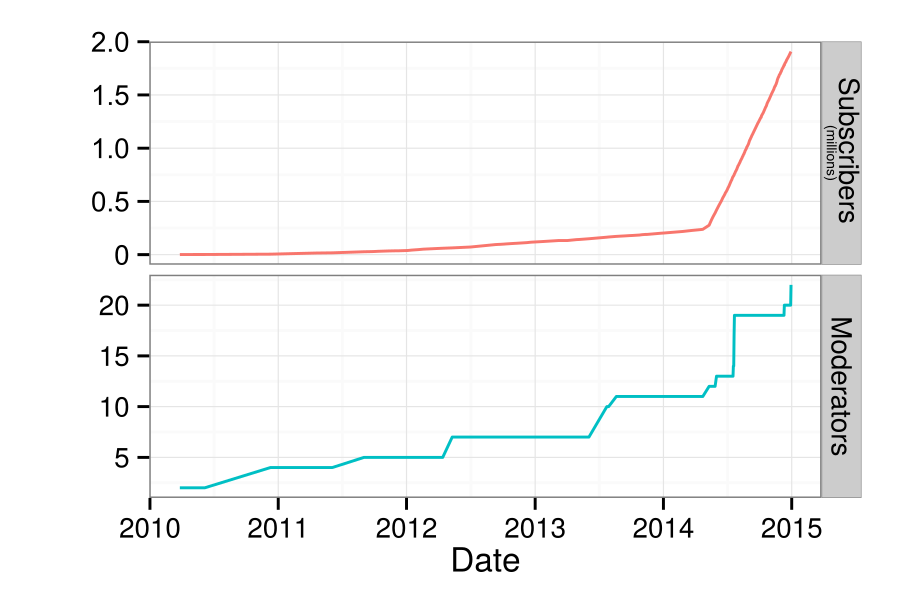
Graph of subscribers and moderators over time in /r/NoSleep. The image is taken from our 2016 CHI paper.
Last year at CHI 2016, my research group published a qualitative study examining the effects of a large influx of newcomers to the /r/nosleep online community in Reddit. Our study began with the observation that most research on sustained waves of newcomers focuses on the destructive effect of newcomers and frequently invokes Usenet s infamous Eternal September. Our qualitative study argued that the /r/nosleep community managed its surge of newcomers gracefully through strategic preparation by moderators, technological systems to reign in on norm violations, and a shared sense of protecting the community s immersive environment among participants. We are thrilled that, less a year after the publication of our study, Zhiyuan Jerry Lin and a group of researchers at Stanford have published a quantitative test of our study s findings! Lin analyzed 45 million comments and upvote patterns from 10 Reddit communities that a massive inundation of newcomers like the one we studied on /r/nosleep. Lin s group found that these communities retained their quality despite a slight dip in its initial growth period. Our team discussed doing a quantitative study like Lin s at some length and our paper ends with a lament that our findings merely reflected, propositions for testing in future work. Lin s study provides exactly such a test! Lin et al. s results suggest that our qualitative findings generalize and that sustained influx of newcomers need not doom a community to a descent into an Eternal September. Through strong moderation and the use of a voting system, the subreddits analyzed by Lin appear to retain their identities despite the surge of new users. There are always limits to research projects work quantitative and qualitative. We think the Lin s paper compliments ours beautifully, we are excited that Lin built on our work, and we re thrilled that our propositions seem to have held up! This blog post was written with Charlie Kiene. Our paper about /r/nosleep, written with Charlie Kiene and Andr s Monroy-Hern ndez, was published in the Proceedings of CHI 2016 and is released as open access. Lin s paper was published in the Proceedings of ICWSM 2017 and is also available online.

18 July 2017

Daniel Silverstone: Yay, finished my degree at last

A little while back, in June, I sat my last exam for what I hoped would be the last module in my degree. For seven years, I've been working on a degree with the Open University and have been taking advantage of the opportunity to have a somewhat self-directed course load by taking the 'Open' degree track. When asked why I bothered to do this, I guess my answer has been a little varied. In principle it's because I felt like I'd already done a year's worth of degree and didn't want it wasted, but it's also because I have been, in the dim and distant past, overlooked for jobs simply because I had no degree and thus was an easy "bin the CV". Fed up with this, I decided to commit to the Open University and thus began my journey toward 'qualification' in 2010. I started by transferring the level 1 credits from my stint at UCL back in 1998/1999 which were in a combination of basic programming in Java, some mathematics including things like RSA, and some psychology and AI courses which at the time were aiming at a degree called 'Computer Science with Cognitive Sciences'. Then I took level 2 courses, M263 (Building blocks of software), TA212 (The technology of music) and MS221 (Exploring mathematics). I really enjoyed the mathematics course and so... At level 3 I took MT365 (Graphs, networks and design), M362 (Developing concurrent distributed systems), TM351 (Data management and analysis - which I ended up hating), and finally finishing this June with TM355 (Communications technology). I received an email this evening telling me the module result for TM355 had been posted, and I logged in to find I had done well enough to be offered my degree. I could have claimed my degree 18+ months ago, but I persevered through another two courses in order to qualify for an honours degree which I have now been awarded. Since I don't particularly fancy any ceremonial awarding, I just went through the clicky clicky and accepted my qualification of 'Batchelor of Science (Honours) Open, Upper Second-class Honours (2.1)' which grants me the letters 'BSc (Hons) Open (Open)' which, knowing me, will likely never even make it onto my CV because I'm too lazy. It has been a significant effort, over the course of the past few years, to complete a degree without giving up too much of my personal commitments. In addition to earning the degree, I have worked, for six of the seven years it has taken, for Codethink doing interesting work in and around Linux systems and Trustable software. I have designed and built Git server software which is in use in some universities, and many companies, along with a good few of my F/LOSS colleagues. And I've still managed to find time to attend plays, watch films, read an average of 2 novel-length stories a week (some of which were even real books), and be a member of the Manchester Hackspace. Right now, I'm looking forward to a stress free couple of weeks, followed by an immense amount of fun at Debconf17 in Montr al!

Reproducible builds folks: Reproducible Builds: week 116 in Stretch cycle

Here's what happened in the Reproducible Builds effort between Sunday July 9 and Saturday July 15 2017: Packages reviewed and fixed, and bugs filed Reviews of unreproducible packages 13 package reviews have been added, 12 have been updated and 19 have been removed in this week, adding to our knowledge about identified issues. 2 issue types have been added: 3 issue types have been updated: Weekly QA work During our reproducibility testing, FTBFS bugs have been detected and reported by: diffoscope development Version 84 was uploaded to unstable by Mattia Rizzolo. It included contributions already reported from the previous weeks, as well as new ones: After the release, development continued in git with contributions from: strip-nondeterminism development Versions 0.036-1, 0.037-1 and 0.038-1 were uploaded to unstable by Chris Lamb. They included contributions from: reprotest development Development continued in git with contributions from: buildinfo.debian.net development tests.reproducible-builds.org Misc. This week's edition was written by Bernhard M. Wiedemann, Chris Lamb, Mattia Rizzolo, Vagrant Cascadian & reviewed by a bunch of Reproducible Builds folks on IRC & the mailing lists.

Matthew Garrett: Avoiding TPM PCR fragility using Secure Boot

In measured boot, each component of the boot process is "measured" (ie, hashed and that hash recorded) in a register in the Trusted Platform Module (TPM) build into the system. The TPM has several different registers (Platform Configuration Registers, or PCRs) which are typically used for different purposes - for instance, PCR0 contains measurements of various system firmware components, PCR2 contains any option ROMs, PCR4 contains information about the partition table and the bootloader. The allocation of these is defined by the PC Client working group of the Trusted Computing Group. However, once the boot loader takes over, we're outside the spec[1].

One important thing to note here is that the TPM doesn't actually have any ability to directly interfere with the boot process. If you try to boot modified code on a system, the TPM will contain different measurements but boot will still succeed. What the TPM can do is refuse to hand over secrets unless the measurements are correct. This allows for configurations where your disk encryption key can be stored in the TPM and then handed over automatically if the measurements are unaltered. If anybody interferes with your boot process then the measurements will be different, the TPM will refuse to hand over the key, your disk will remain encrypted and whoever's trying to compromise your machine will be sad.

The problem here is that a lot of things can affect the measurements. Upgrading your bootloader or kernel will do so. At that point if you reboot your disk fails to unlock and you become unhappy. To get around this your update system needs to notice that a new component is about to be installed, generate the new expected hashes and re-seal the secret to the TPM using the new hashes. If there are several different points in the update where this can happen, this can quite easily go wrong. And if it goes wrong, you're back to being unhappy.

Is there a way to improve this? Surprisingly, the answer is "yes" and the people to thank are Microsoft. Appendix A of a basically entirely unrelated spec defines a mechanism for storing the UEFI Secure Boot policy and used keys in PCR 7 of the TPM. The idea here is that you trust your OS vendor (since otherwise they could just backdoor your system anyway), so anything signed by your OS vendor is acceptable. If someone tries to boot something signed by a different vendor then PCR 7 will be different. If someone disables secure boot, PCR 7 will be different. If you upgrade your bootloader or kernel, PCR 7 will be the same. This simplifies things significantly.

I've put together a (not well-tested) patchset for Shim that adds support for including Shim's measurements in PCR 7. In conjunction with appropriate firmware, it should then be straightforward to seal secrets to PCR 7 and not worry about things breaking over system updates. This makes tying things like disk encryption keys to the TPM much more reasonable.

However, there's still one pretty major problem, which is that the initramfs (ie, the component responsible for setting up the disk encryption in the first place) isn't signed and isn't included in PCR 7[2]. An attacker can simply modify it to stash any TPM-backed secrets or mount the encrypted filesystem and then drop to a root prompt. This, uh, reduces the utility of the entire exercise.

The simplest solution to this that I've come up with depends on how Linux implements initramfs files. In its simplest form, an initramfs is just a cpio archive. In its slightly more complicated form, it's a compressed cpio archive. And in its peak form of evolution, it's a series of compressed cpio archives concatenated together. As the kernel reads each one in turn, it extracts it over the previous ones. That means that any files in the final archive will overwrite files of the same name in previous archives.

My proposal is to generate a small initramfs whose sole job is to get secrets from the TPM and stash them in the kernel keyring, and then measure an additional value into PCR 7 in order to ensure that the secrets can't be obtained again. Later disk encryption setup will then be able to set up dm-crypt using the secret already stored within the kernel. This small initramfs will be built into the signed kernel image, and the bootloader will be responsible for appending it to the end of any user-provided initramfs. This means that the TPM will only grant access to the secrets while trustworthy code is running - once the secret is in the kernel it will only be available for in-kernel use, and once PCR 7 has been modified the TPM won't give it to anyone else. A similar approach for some kernel command-line arguments (the kernel, module-init-tools and systemd all interpret the kernel command line left-to-right, with later arguments overriding earlier ones) would make it possible to ensure that certain kernel configuration options (such as the iommu) weren't overridable by an attacker.

There's obviously a few things that have to be done here (standardise how to embed such an initramfs in the kernel image, ensure that luks knows how to use the kernel keyring, teach all relevant bootloaders how to handle these images), but overall this should make it practical to use PCR 7 as a mechanism for supporting TPM-backed disk encryption secrets on Linux without introducing a hug support burden in the process.

[1] The patchset I've posted to add measured boot support to Grub use PCRs 8 and 9 to measure various components during the boot process, but other bootloaders may have different policies.

[2] This is because most Linux systems generate the initramfs locally rather than shipping it pre-built. It may also get rebuilt on various userspace updates, even if the kernel hasn't changed. Including it in PCR 7 would entirely break the fragility guarantees and defeat the point of all of this.

comment count unavailable comments

16 July 2017

Lior Kaplan: PDO_IBM: tracking changes publicly

As part of my work at Zend (now a RogueWave company), I maintain the various patch sets. One of those is the changes for PDO_IBM extension for PHP. After some patch exchange I decided it s would be easier to manage the whole process over a public git repository, and maybe gain some more review / feedback along the way. Info at https://github.com/kaplanlior/pecl-database-pdo_ibm/commits/zend-patches Another aspect of this, is having IBMi specific patches from YIPS (young i professionals) at http://www.youngiprofessionals.com/wiki/index.php/XMLService/PHP, which itself are patches on top of vanilla releases. Info at https://github.com/kaplanlior/pecl-database-pdo_ibm/commits/zend-patches-for-yips So keeping track over these changes as well is easier while using git s ability to rebase efficiently, so when a new release is done, I can adapt my patches quite easily. Make sure the changes can be back and forward ported between vanilla and IBMi versions of the extension.
Filed under: PHP

15 July 2017

Dirk Eddelbuettel: Rcpp 0.12.12: Rounding some corners

The twelveth update in the 0.12.* series of Rcpp landed on CRAN this morning, following two days of testing at CRAN preceded by five full reverse-depends checks we did (and which are always logged in this GitHub repo). The Debian package has been built and uploaded; Windows and macOS binaries should follow at CRAN as usual. This 0.12.12 release follows the 0.12.0 release from late July, the 0.12.1 release in September, the 0.12.2 release in November, the 0.12.3 release in January, the 0.12.4 release in March, the 0.12.5 release in May, the 0.12.6 release in July, the 0.12.7 release in September, the 0.12.8 release in November, the 0.12.9 release in January, the 0.12.10.release in March, and the 0.12.11.release in May making it the sixteenth release at the steady and predictable bi-montly release frequency. Rcpp has become the most popular way of enhancing GNU R with C or C++ code. As of today, 1097 packages (and hence 71 more since the last release in May) on CRAN depend on Rcpp for making analytical code go faster and further, along with another 91 in BioConductor. This releases contain a fairly large number of fairly small and focused pull requests most of which either correct some corner cases or improve other aspects. JJ tirelessly improved the package registration added in the previous release and following R 3.4.0. Kirill tidied up a number of small issues allowing us to run compilation in even more verbose modes---usually a good thing. Jeroen, Elias Pipping and Yo Gong all contributed as well, and we thank everybody for their contributions. All changes are listed below in some detail.

Changes in Rcpp version 0.12.12 (2017-07-13)
  • Changes in Rcpp API:
    • The tinyformat.h header now ends in a newline (#701).
    • Fixed rare protection error that occurred when fetching stack traces during the construction of an Rcpp exception (Kirill M ller in #706).
    • Compilation is now also possibly on Haiku-OS (Yo Gong in #708 addressing #707).
    • Dimension attributes are explicitly cast to int (Kirill M ller in #715).
    • Unused arguments are no longer declared (Kirill M ller in #716).
    • Visibility of exported functions is now supported via the R macro atttribute_visible (Jeroen Ooms in #720).
    • The no_init() constructor accepts R_xlen_t (Kirill M ller in #730).
    • Loop unrolling used R_xlen_t (Kirill M ller in #731).
    • Two unused-variables warnings are now avoided (Jeff Pollock in #732).
  • Changes in Rcpp Attributes:
    • Execute tools::package_native_routine_registration_skeleton within package rather than current working directory (JJ in #697).
    • The R portion no longer uses dir.exists to no require R 3.2.0 or newer (Elias Pipping in #698).
    • Fix native registration for exports with name attribute (JJ in #703 addressing #702).
    • Automatically register init functions for Rcpp Modules (JJ in #705 addressing #704).
    • Add Shield around parameters in Rcpp::interfaces (JJ in #713 addressing #712).
    • Replace dot (".") with underscore ("_") in package names when generating native routine registrations (JJ in #722 addressing #721).
    • Generate C++ native routines with underscore ("_") prefix to avoid exporting when standard exportPattern is used in NAMESPACE (JJ in #725 addressing #723).

Thanks to CRANberries, you can also look at a diff to the previous release. As always, even fuller details are on the Rcpp Changelog page and the Rcpp page which also leads to the downloads page, the browseable doxygen docs and zip files of doxygen output for the standard formats. A local directory has source and documentation too. Questions, comments etc should go to the rcpp-devel mailing list off the R-Forge page.

This post by Dirk Eddelbuettel originated on his Thinking inside the box blog. Please report excessive re-aggregation in third-party for-profit settings.

Vasudev Kamath: debcargo: Replacing subprocess crate with git2 crate

In my previous post I talked about using subprocess crate to extract beginning and ending year from git repository for generating debian/copyright file. In this post I'm going to talk on how I replaced subprocess with native git2 crate and achieved the same result in much cleaner and safer way. git2 is a native Rust crate which provides access to Git repository internals. git2 does not involve any unsafe invocation as it is built against libgit2-sys which is actually using Rust FFI to directly bind to underlying libgit library. Below is the new copyright_fromgit function with git2 crate.
fn copyright_fromgit(repo_url: &str) -> Result<String>  
   let tempdir = TempDir::new_in(".", "debcargo")?;
   let repo = Repository::clone(repo_url, tempdir.path())?;
   let mut revwalker = repo.revwalk()?;
   revwalker.push_head()?;
   // Get the latest and first commit id. This is bit ugly
   let latest_id = revwalker.next().unwrap()?;
   let first_id = revwalker.last().unwrap()?; // revwalker ends here is consumed by last
   let first_commit = repo.find_commit(first_id)?;
   let latest_commit = repo.find_commit(latest_id)?;
   let first_year =
       DateTime::<Utc>::from_utc(
               NaiveDateTime::from_timestamp(first_commit.time().seconds(), 0),
               Utc).year();
   let latest_year =
       DateTime::<Utc>::from_utc(
             NaiveDateTime::from_timestamp(latest_commit.time().seconds(), 0),
             Utc).year();
   let notice = match first_year.cmp(&latest_year)  
       Ordering::Equal => format!(" ", first_year),
       _ => format!(" - ,", first_year, latest_year),
    ;
   Ok(notice)
 
So here is what I'm doing
  1. Use git2::Repository::clone to clone the given URL. We are thus avoiding exec of git clone command.
  2. Get a revision walker object. git2::RevWalk implements Iterator trait and allows walking through the git history. This is what we are using to avoid exec of git log command.
  3. revwalker.push_head() is important because we want to tell revwalker from where we want to walk the history. In this case we are asking it to walk history from repository HEAD. Without this line next line will not work. (Learned it in hard way :-) ).
  4. Then we extract git2::Oid which is we can say similar to commit hash and can be used to lookup a particular commit. We take latest commit hash using RevWalk::next call and the first commit using Revwalk::last, note the order this is because Revwalk::last consumes the revwalker so doing it in reverse order will make borrow checker unhappy :-). This replaces exec of head -n1 command.
  5. Look up the git2::Commit objects using git2::Repository::find_commit
  6. Then convert the git2::Time to chrono::DateTime and take out the years.
After this change I found an obvious error which went unnoticed in previous version, that is if there was no repository key in Cargo.toml. When there was no repo URL git clone exec did not error out and our shell commands happily extracted year from the debcargo repository!. Well since I was testing code from debcargo repository It never failed, but when I executed from non-git repository folder git threw an error but that was git log and not git clone. This error was spotted right away because git2 threw me an error that I gave it empty URL. When it comes to performance I see that debcargo is faster compared to previous version. This makes sense because previously it was doing 5 fork and exec system calls and now that is avoided.

12 July 2017

Reproducible builds folks: Reproducible Builds: week 115 in Stretch cycle

Here's what happened in the Reproducible Builds effort between Sunday July 2 and Saturday July 8 2017: Reproducible work in other projects Ed Maste pointed to a thread on the LLVM developer mailing list about container iteration being the main source of non-determinism in LLVM, together with discussion on how to solve this. Ignoring build path issues, container iteration order was also the main issue with rustc, which was fixed by using a fixed-order hash map for certain compiler structures. (It was unclear from the thread whether LLVM's builds are truly path-independent or rather that they haven't done comparisons between builds run under different paths.) Bugs filed Patches submitted upstream: Reviews of unreproducible packages 52 package reviews have been added, 62 have been updated and 20 have been removed in this week, adding to our knowledge about identified issues. No issue types were updated or added this week. Weekly QA work During our reproducibility testing, FTBFS bugs have been detected and reported by: diffoscope development Development continued in git with contributions from: With these changes, we are able to generate a dynamically loaded HTML diff for GCC-6 that can be displayed in a normal web browser. For more details see this mailing list post. Misc. This week's edition was written by Ximin Luo, Bernhard M. Wiedemann and Chris Lamb & reviewed by a bunch of Reproducible Builds folks on IRC & the mailing lists.

11 July 2017

Andreas Bombe: PDP-8/e Replicated Overview

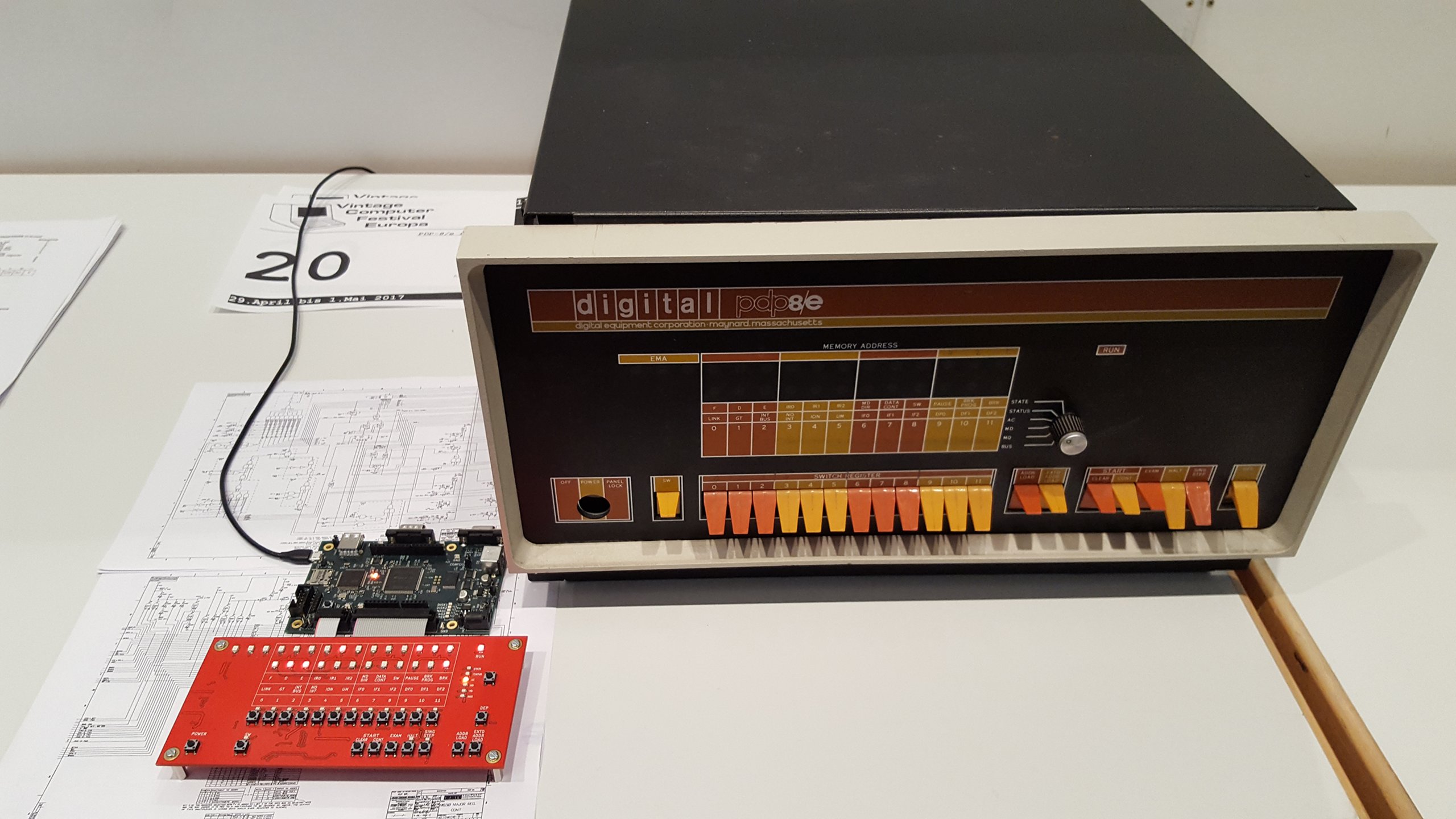
This is an overview of the hardware and internals of the PDP-8/e replica I m building.

The front panel board
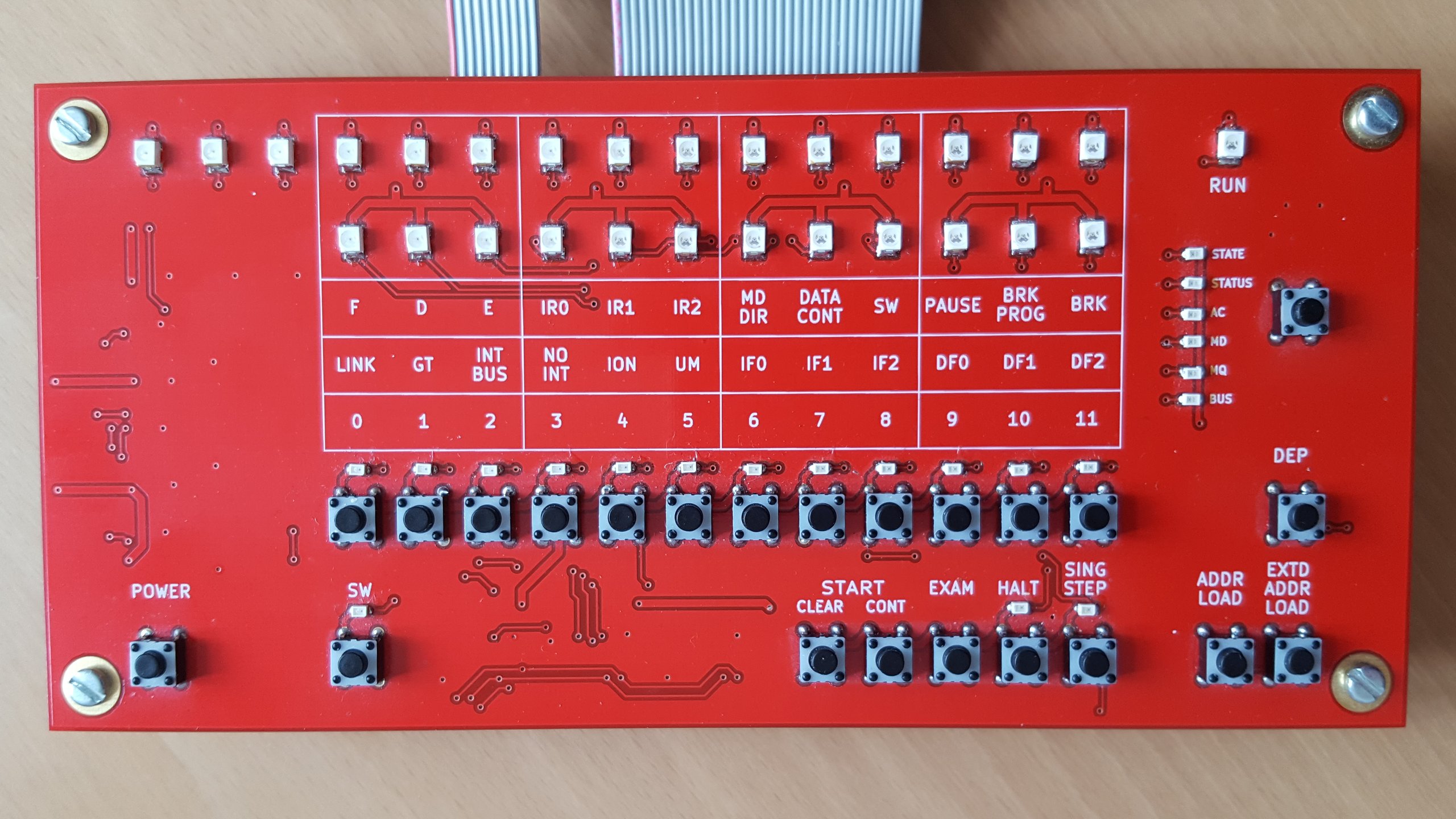
functional replica of the PDP-8/e front panel
If you know the original or remember the picture from the first post it is clear that this is a functional replica not aiming to be as pretty as those of the other projects I mentioned. I have reordered the switches into two rows to make the board more compact (which also means cheaper) without sacrificing usability. There s the two rows of display lights plus one run light the 8/e provides. The upper row is the address made up of 12 bits of memory address and 3 bits of extended memory address or field. Below are the 12 bits indicator which can show one data set out of six as selected by the user. All the switches of the original are implemented as more compact buttons1. While momentary switches are easily substituted by buttons, all buttons implementing two position switches toggle on/off with each press and they have a LED above that shows the current state. The six position rotary switch is implemented as a button cycling through all indicator displays together with six LEDs which show the active selection. Markings show the meaning of the indicator and switches as on the original, grouped in threes as the predominant numbering system for the PDPs was octal. The upper line shows the meaning for the state indicator, the middle for the status indicator and bit numbers for the rest. Note that on the PDP-8 and opposite to modern conventions, the most significant bit was numbered 0. I designed it as a pure front panel board without any PDP-8 simulation parts. The buttons and associated lights are controllable via SPI lines with a 3.3 V supply. The address and indicator lights have a separate common anode configuration with all cathodes individually available on a pin header without any resistors in the path, leaving voltage and current regulation up to the simulation board. This board is actually a few years old from a similar project where I emulated the PDP-8 in software on a microcontroller and the flexible design allowed me to reuse it unchanged.

The main board
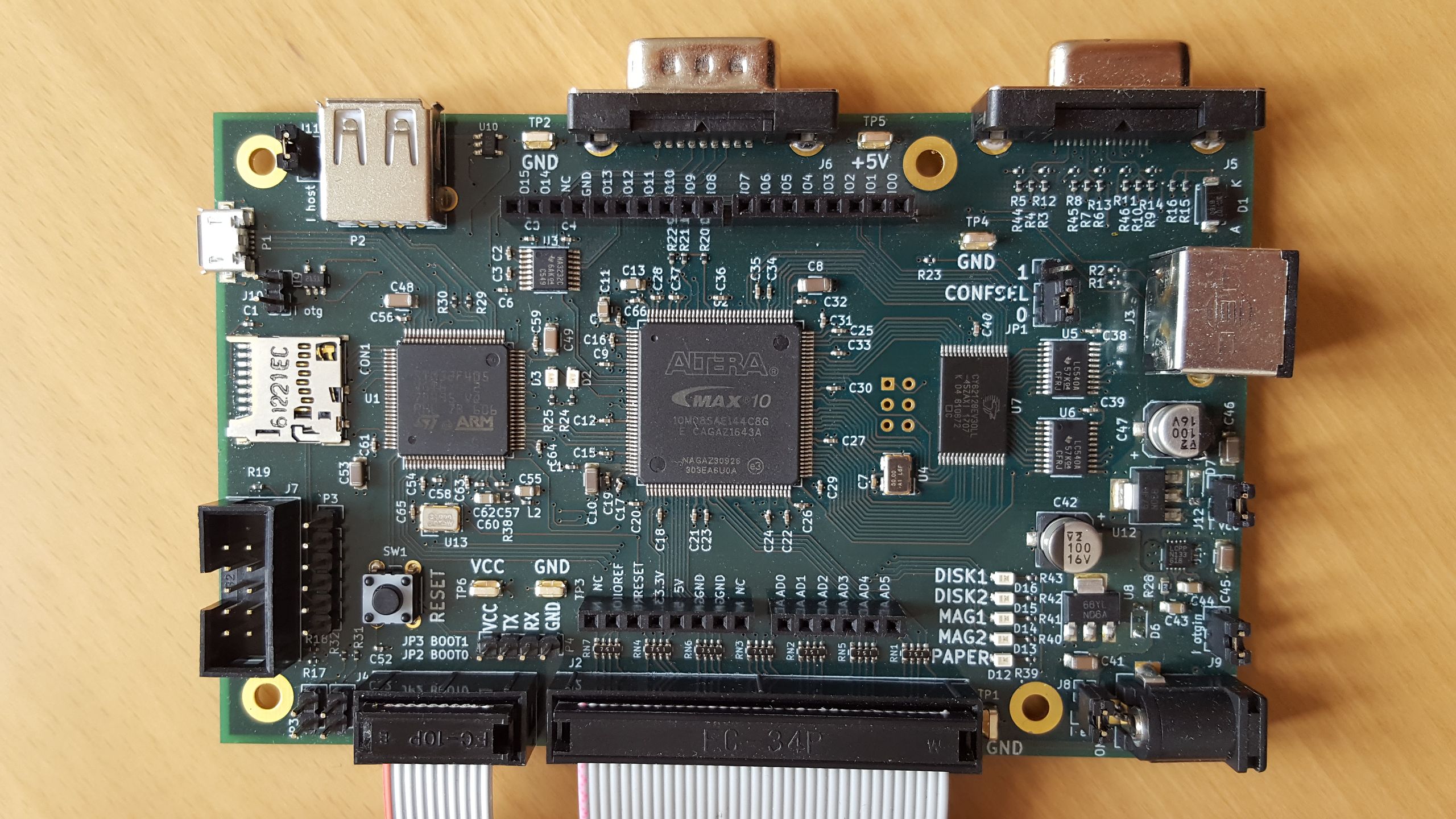
main board with CPU and peripherals of the replicated PDP-8/e
This is where the magic happens. You can see three big ICs on the board: On the left is the STM32F405 microcontroller (with ARM Cortex-M4 core), the bigger one in the middle is the Altera2 MAX 10 FPGA and finally to the right is the SRAM that is large enough to hold all the main memory of the 32 KW maximum expansion of the PDP-8/e. The two smaller chips to the right of that are just buffers that drive the front panel address LEDs, the small chip at the top left is a RS-232 level shifter. The idea behind this is that the PDP-8 and peripherals that are simple to directly implement, such as GPIO or a serial port, are fully on the FPGA. Other peripherals such as paper and magnetic tape and disks, which are after all not connected to real PDP-8 drives but disk images on a microSD, are implemented on the microcontroller interfacing with stub devices in the FPGA. Compared to implementing everything everything in the FPGA, the STM32F4 has the advantage of useful built in peripherals such as two host/device capable USB ports. 5 V tolerant I/O pins are very useful and simply not available in any FPGA. I have to admit that this board was a bit of a rush job in order to have something at all to show at the Vintage Computer Festival Europe 18.0. Given that it was my first time designing a board with a large microcontroller and the first time with an FPGA, it wasn t exactly my fastest progressing project either and I got basic functionality (front panel allows toggling in small programs and running them) working just in time. For various reasons the project hasn t progressed much since, so the following is still just plans, but plans for which the hardware was designed. Since the aim is to have a cycle accurate PDP-8/e implementation, digital I/O was always planned. Rather than defining my own header I have included Arduino R3 compatible headers (for 3.3 V compatible boards only) that have become a popular even outside the Arduino world for this purpose. The digital Arduino pins are connected directly to the FPGA and will be directly controllable by PDP-8 software. The downside of choosing the Arduino headers is that the original PDP-8 digital I/O interface is not a perfect match since it naturally has 12 lines whereas the Arduino has 15. The analog inputs are not connected to the FPGA, the documentation of the MAX10 s ADC in the EQFP package are not very encouraging. They are connected to the STM32 instead3. Another interface connected directly to the FPGA and that would be directly under PDP-8 control is a standard 9 pin RS-232 interface. RX, TX, CTS and RTS are connected and level-shifted between 3.3 V and RS-232 levels by a MAX3232. Besides the PDP-8, I also plan to implement a full video terminal on the board. The idea is that with a power supply, keyboard and monitor this board would form a complete system without the need of connecting another computer to act as a terminal. To that end, there is a VGA port attached to the FPGA with simple resistor network DACs for 9 bits color (RGB with 3 bits each). This is another spot where I left myself room to expand, for e.g. a VT220 you really only need one color in two brightness levels. Keyboards will be connected either via the PS/2 connector on the right or the USB-A host port at the top left. Last of the interface ports is the USB micro-AB port on the left, which for now I am using only for power supply. I mainly plan to use it to provide alternative or additional serial ports to the PDP-8 or to export the video terminal serial port for testing purposes. Other possible uses are access to the image files on the microSD and firmware updates. This has gotten rather long again, so I m stopping here and leave some implementation notes for another post.

  1. They are also much cheaper. Given the large number of switches, the savings are substantial. Additionaly the buttons are nicer to operate than long rows of tiny switches. [return]
  2. Or rather Intel now. At least Altera s web site, documentation and software have already been thoroughly rebranded, but the chips I got were produced prior to that. [return]
  3. That s not to say that the analog conversions on the STM32 are necessarily better than those of the MAX10 when you can t follow their guidelines, I have no comparisons. Certainly following the guidelines would have been prohibitive given how many pins usage they restrict. [return]

Next.

Previous.