
Search Results: "cas"

25 October 2015

Russ Allbery: Review: The Thrilling Adventures of Lovelace and Babbage

Review: The Thrilling Adventures of Lovelace and Babbage, by Sydney Padua
Publisher: Pantheon
Copyright: 2015
ISBN: 0-307-90827-5
Format: Hardcover
Pages: 317
I seem to be writing a lot of reviews lately where any reader can easily do their own research and see if this is something they'd like. This is another of those, but perhaps a bit more obscure. As Padua explains in the preface, the first Lovelace and Babbage strip was intended to be a one-off joke. A friend suggested that she draw a comic telling the (short and rather tragic) life of Ada Lovelace, widely considered the first computer programmer even though the computer for which she wrote programs was never built: Charles Babbage's Analytic Engine. Padua found the story of Babbage and Lovelace's collaboration fascinating but too grim, and so wrote an alternate ending involving a pocket universe in which Babbage and Lovelace lived on to fight crime! Or at least fought against street organs and poetry. Padua meant this as a joke. The Internet took it as a teaser. Quite to her surprise, she found herself writing occasional additional episodes and getting lost in fascinating research about Lovelace and Babbage. The result is all at 2dgoggles.com. This book is a curated collection of those comics, including much of their (extensive) footnotes and research notes, in a very attractive and well-constructed book form. The best review, therefore, would be to go read some of the comics yourself, easily accessible via the Comics tab on the web site, and see if this is the sort of thing you'd enjoy. There is some material in the book that isn't on the web site, but most of it is there (including one full story that didn't make it into the book). There are a few reasons to buy a collection like this of material that previously appeared on the Internet. One, of course, is out of gratitude to support the author, which is the main reason I bought it. If you want to do that, though, you probably already know you do. Another reason is for additional unpublished material, but that's not really the case here. But a third is that, despite all the technology of the web, books can sometimes provide a more elegant and beautiful presentation. And that's very much the case for The Thrilling Adventures of Lovelace and Babbage. The hardcover is a beautiful work of art. It has what you would expect from a hardcover graphic novel, of course: sturdy paper, lovely story headings in the form of Victorian-style posters, and very nice artwork beneath the dust jacket. (I've been so happy to see that in the last few hardcovers I've reviewed.) But, best of all, it presents the primary research notes on each page underneath comic panels. Those who have been reading Lovelace and Babbage as it appears on the web know Padua's copious research notes. But they're normally presented at the end of each complete part, and I found myself often not reading them in detail. This might not be the case for everyone, but at least for me this presentation works so much better. Historical notes are at the bottom of (nearly) every page, in context. This might sound like it would distract from and break up the flow of the story, but at least for me it does the opposite. The comics feel so much richer when intermixed with the actual history (which in some cases is surprisingly similar to what seemed to be wild, invented scenarios). The historical notes also have end notes, and quite substantial ones. I found that organization less successful (readers of my reviews will know I have a long-standing antipathy towards end notes for anything other than cross-references), but I have to admit I have no idea how Padua would have fit those on the same page as footnotes. They're also written well enough, and with sufficient detail, that I could usually read a chapter and then read all the end notes and mostly remember what they referred to. Padua also takes advantage of the format to play a few neat games with frame breaks: characters commenting on the notes, stabbing things into them, or otherwise affecting them. I have to admit to some mild frustration where this makes the notes unreadable, since they're nearly as fascinating as the comics, but the overall effect is still worth it. (And, of course, the full notes are available on the web if one wishes to look them up.) Rounding out the book version are a few of the best original source documents that Padua found, thankfully excerpted and well-edited to not outlive their welcome for those of us who don't like poring over Victorian letters. And, finally, some beautiful illustrations of the mechanisms of the Analytic Engine with supporting descriptions of how they were supposed to work. I'm not particularly mechanically inclined, nor that fascinated by steampunk, and I still found these diagrams impressive and fun to look at. Someone more interested in such things will be in for a treat. I've been thoroughly enjoying the (sadly infrequent) installments of Lovelace and Babbage for years now, and am utterly delighted by their hardcover appearance. If you already knew about Padua's work and have any interest in nice hardcovers of such things, I don't think you'll regret the purchase. If you haven't heard of her, or this series, before, some quick reading at the web site should quickly reveal whether this is something you'd enjoy. Rating: 9 out of 10

24 October 2015

Vincent Sanders: It takes courage to sit on a jury. How many of us want to decide the fate of another person's life or freedom?

I think Regina Brett has a point although having now experienced being a juror in a British crown court I have a much better understanding of both the process and effectiveness of the jury system.

The actual process of becoming a juror on a case is something I had not been aware of previously. You simply receive a letter telling you to be at the court on a specific date and that you are required to be available for at least ten days, possibly more. The only qualification to receive the letter is to be on the electoral roll and it is an invitation with few options to refuse without serious repercussions.

When you arrive at the court you are directed to the Jury lounge (practical hint: take a book) where you notice there are over forty people, which would seem odd until you realise there are three courtrooms and they each need a jury, even then there are an excess of people which is because of the selection process.

The process of jury selection is fairly simple, an usher for a court comes and calls fourteen names which forms the jury in waiting. The group is taken up to the court waiting room (this room gets terribly familiar over the forthcoming weeks) and then twelve names are called.

As each person is called they enter the jury box in order which persists for the entire trial (practical hint:remember your juror number). Before each person is sworn or affirmed there is the possibility they will be found unsuitable and will be replaced by one of the previously unselected jurors. Any unselected jurors are then sent back to the jury lounge and become available for forming another jury in waiting.

Anyone unselected at the end of the process has to remain available to return to the court to form a jury in waiting when a previous trial ends until they have exhausted their duty. There were a few of these unfortunate people who were kept in a state of limbo for several days and I am relieved this did not happen to me.

Being a juror, from a purely practical perspective, felt like working an office job for ten days. Duties consisting of attending a series of meetings with strange rules and the typically understated British approach to mentioning the result of breaking them.

I participated in two cases, both of which were (almost by definition) unpleasant happenings, these were a case of Grievous bodily harm and an offence under section 7 of the Sexual Offences Act 2003.

Both cases were challenging in their own ways the first because of the way the case was presented and the second because of its subject matter. One of the most important rules is "Do not discuss anything with anyone as it might be perjury" so going along with that I will not be discussing any details. Because I cannot be specific this post has become a little impersonal, you will have to forgive me as I found I had to remove a great deal of more content which was not appropriate.

An important thing to note is that the trials bore no resemblance to TV courtroom drama. The trials proceed in a professional manner with very little theatrics. The prosecution barrister commences outlining the case against the accused, calling witnesses and reading into evidence uncontested material. The defence then gets to present their case, again calling witnesses and placing documents into evidence.

One of the striking things about this process is that if the barristers do not call a witness or present evidence that would seem to be pertinent, the jury must not draw inference from that omission, which is especially bizarre when a central witness referred to by almost everyone involved with the case is not called.

Once the case is presented the jury is sequestered in a room and must come to a unanimous decision on each of the charges. This was, for me, the most challenging part of the whole process. Twelve people with unique views on the information presented have to attempt to discuss the evidence and not simply go with their first impressions based on their preconceptions.

The jury is allowed to ask for some evidence to be repeated and if deliberations take some time the jury may be instructed that a majority of 10 to 2 may be accepted. I imagine at some point the jury will run out of time to make a decision and something else will happen but I did not experience this.

Overall the experience was enlightening if not enjoyable, I understand the process a lot more and am happy to have discharged my duty and am equally glad the responsibility will not come around again for at least a few years.

22 October 2015

Pau Garcia i Quiles: FOSDEM Desktops DevRoom 2016

It is now official: KDE will be present again at FOSDEM in the 2016 edition, on the 30th and 31st of January, 2016. Talks will take place at the Desktops DevRoom, on Sunday the 31st, but not exclusively: in past years, there were Qt and KDE-related talks at the mobile devroom, lightning talks, distributions, open document editors and more. KDE will be sharing the room with other desktop environments, as usual: Gnome, Unity, Enlightenment, Razor, etc. Representatives from those communities will be helping me in managing and organizing the devroom: Christophe Fergeau, Michael Zanetti, Philippe Caseiro and J rome Leclanche. I would like to extend the invitation to any other free/open source desktop environment and/or related stuff. Check last year s schedule for an example. Closed-source shops (Microsoft, Apple, Oracle, etc) are ALSO invited, provided that you will talk about something related to open source. We will publish the Call for Talks for the Desktops DevRoom 2016 soon. Stay tuned. In the meanwhile, you can subscribe to the Desktops DevRoom mailing list to be informed of important and useful information, and talk about FOSDEM and specific issues of the Desktops DevRoom.

Russ Allbery: Review: What If?

Review: What If?, by Randall Munroe
Publisher: Houghton Mifflin Harcourt
Copyright: 2014
ISBN: 0-544-27299-4
Format: Hardcover
Pages: 295
This is another one of those reviews that's somewhat pointless to write, at least beyond telling people who for some strange reason aren't xkcd readers that this is a thing that exists in the world. What If? is a collection of essays from that feature on the xkcd web site and new essays in the same vein. (Over half are new to this collection.) If you've read them, you know what to expect; if you haven't, and have any liking at all for odd scientific facts or stick figures, you're in for a treat. So, short review: The subtitle is Serious Scientific Answers to Absurd Hypothetical Questions, and it's exactly what it says on the tin, except that "serious" includes a healthy dose of trademark xkcd humor. Go read what-if.xkcd.com for numerous samples of Munroe's essay style. If you like what you see, this is a whole book of that: a nice, high-quality hardcover (at least the edition I bought), featuring the same mix of text and cartoon commentary, and with new (and in some cases somewhat longer) material. You probably now have all the information necessary to make a purchasing decision. If you need more motivation, particularly to buy a physical copy, the inside of the dust jacket of the hardcover is a detailed, labeled map of the world after a drain in the Marianas Trench has emptied most of the oceans onto Mars. And the book inside the dust jacket is embossed with what happens after the dinosaur on the cover is lowered into, or at least towards, the Great Pit of Carkoon. This made me particularly happy, since too often hardcovers inside the dust jacket look just like every other hardcover except for the spine lettering. Very few of them have embossed Star Wars references. Personally, I think that's a great reason to buy the hardcover even if, like me, you've been following What If? on the web religiously since it started. But of course the real draw is the new material. There's enough of it that I won't try any sort of comprehensive list, but rest assured that it's of equal or better quality than the web-published essays we know and love. My favorite of the new pieces is the answer to the question "what would happen if you made a periodic table out of cube-shaped bricks, where each brick was made of the corresponding element?" As with so many What If? questions, it starts with killing everyone in the vicinity, and then things get weird. Another nice touch in this collection is what I'd call "rejected questions": questions that people submitted but that didn't inspire an essay. Most of these (I wish all) get a single cartoon of reaction to the question itself, which include some of the funniest (and most touching) panels in the book. Ebook formatting has gotten much better, so there's some hope that at least some platforms could do justice to this book with its embedded cartoons. Putting the footnotes properly at the bottom of each page (thank you!) might be a challenge, though. Writing mixed with art is one of the things I think benefits greatly from a physical copy, and the hardcover is a satisfying and beautiful artifact. (I see there's also an audio book, but I'm sure how well that could work; so much of the joy of What If? is the illustrations, and I'm dubious that one could adequately describe them.) Prior web readers will be relieved to know that the mouse-over text is preserved as italic captions under the cartoons, although sadly most cartoons are missing captions. (As I recall, that's also the case for the early web What If? essays, but later essays have mouse-over text for nearly every cartoon.) Anyway, this is a thing that exists. If you follow xkcd, you probably knew that already, given that the book was published last year and I only now got around to reading it. (My current backlog is... impressive.) If you were not previously aware of What If? or of xkcd itself, now you are, and I envy you the joy of discovery. A short bit of reading will tell you for certain whether this is something you want to purchase. If your relationship to physics is at all similar to mine, I suspect the answer will be yes. A small personal note: I just now realized how much the style of What If? resembles the mixed text and illustrations of One Two Three... Infinity. Given how foundational that book was to my love of obscure physics facts, my love of What If? is even less surprising. Rating: 10 out of 10

21 October 2015

DebConf team: DebConf15 dates are set, come and join us! (Posted by DebConf15 team)

At DebConf14 in Portland, Oregon, USA, next year s DebConf team presented their conference plans and announced the conference dates: DebConf15 will take place from 15 to 22 August 2015 in Heidelberg, Germany. On the Open Weekend on 15/16 August, we invite members of the public to participate in our wide offering of content and events, before we dive into the more technical part of the conference during following week. DebConf15 will also be preceeded by DebCamp, a time and place for teams to gather for intensive collaboration. A set of slides from a quick show-case during the DebConf14 closing ceremony provide a quick overview of what you can expect next year. For more in-depth information, we invite you to watch the video recording of the full session, in which the team provides detailed information on the preparations so far, location and transportation to the venue at Heidelberg, the different rooms and areas at the Youth Hostel (for accommodation, hacking, talks, and social activities), details about the infrastructure that are being worked on, and the plans around the conference schedule. We invite everyone to join us in organising this conference. There are different areas where your help could be very valuable, and we are always looking forward to your ideas. Have a look at our wiki page, join our IRC channels and subscribe to our mailing lists. We are also contacting potential sponsors from all around the globe. If you know any organisation that could be interested, please consider handing them our sponsorship brochure or contact the fundraising team with any leads. Let s work together, as every year, on making the best DebConf ever!

Russell Coker: LUV Server Upgrade to Jessie

On Sunday night I started the process of upgrading the LUV server to Debian/Jessie from Debian/Wheezy. My initial plan was to just upgrade Apache first but dependencies required upgrading systemd too. One problem I ve encountered in the past is that the Wheezy version of systemd will often hang on an upgrade to a newer version. Generally the solution to this is to run systemctl daemon-reexec from another terminal. The problem in this case was that not all the libraries needed for systemd had been installed, so systemd could re-exec itself but immediately aborted. The kernel really doesn t like it when process 1 aborts repeatedly and apparently immediately hanging is the result. At the time I didn t know this, all I knew was that my session died and the server stopped responding to pings immediately after I requested a reexec. The LUV server is hosted at VPAC for free. As their staff have actual work to do they couldn t spend a lot of time working on the LUV server. They told me that the screen was flickering and suspected a VGA cable. I got to the VPAC server room with the spare LUV server (LUV had been given 3 almost identical Sun servers from Barwon Water) at 16:30. By 17:30 I had fixed the core problem (boot with init=/bin/bash , mount the root filesystem rw, finish the upgrade of systemd and it s dependencies, and then reboot normally). That got it into a stage where the Xen server for Wikimedia Au was working but most LUV functionality wasn t working. By 23:00 on Monday I had the full list server functionality working for users, this is the main feature that users want when it s not near a meeting time. I can t remember whether it was Monday night or Tuesday morning when I got the Drupal site going (the main LUV web site). Last night at midnight I got the last of the Mailman administrative interface going, I admit I could have got it going a bit earlier by putting SE Linux in permissive mode, but I don t think that the members would have benefited from that (I ll upload a SE Linux policy package that gets Mailman working on Jessie soon). Now it s Wednesday and I m still fixing some cron jobs. Along the way I noticed some problems with excessive disk space use that I m fixing now and I ve also removed some Wikimedia related configuration files that were obsolete and would have prevented anyone from using a wikimedia.org.au address to subscribe to the LUV mailing lists. Now I believe that everything is working correctly and generally working better than before. Lessons Learned While Sunday night wasn t a bad time to start the upgrade it wasn t the best. If I had started the upgrade on Monday morning there would have been less down-time. Another possibility might be to do the upgrade while near the VPAC office during business hours, I could have started the upgrade while at a nearby cafe and then visited the server room immediately if something went wrong. Doing an upgrade on a day when there s no meeting within a week was a good choice. It wasn t really a conscious choice as I m usually doing other LUV work near the meeting day which precludes doing other LUV work that doesn t need to be done soon. But in future it would be best to consciously plan upgrades for a date when users aren t going to need the service much. While the Wheezy systemd bug is unlikely to ever be fixed there are work-arounds that shouldn t result in a broken server. At the moment it seems that the best option would be to kill -9 the systemctl processes that hang until the packages that systemd depends on are installed. The problem is that the upgrade hangs while the new systemctl tries to tell the old systemd to restart daemons. If we can get past that to the stage where the shared objects are installed then it should be ok. The Apache upgrade from 2.2.x to 2.4.x changed the operation of some access control directives and it took me some time to work out how to fix that. Doing a Google search on the differences between those would have led me to the Apache document about upgrading from 2.2 to 2.4 [1]. That wouldn t have prevented some down-time of the web sites but would have allowed me to prepare for it and to more quickly fix the problems when they became apparent. Also the rather confusing configuration of the LUV server (supporting many web sites that are no longer used) didn t help things. I think that removing cruft from an installation before an upgrade would be better than waiting until after things break. Next time I do an upgrade of such a server I ll write notes about it while I go. That will give a better blog post about it if it becomes newsworthy enough to be blogged about and also more opportunities to learn better ways of doing it. Sorry for the inconvenience.

Antoine Beaupr : Proprietary VDSL2 Linux routers adventures

I recently bought a wireless / phone adapter / VDSL modem from my Internet Service Provider (ISP) during my last outage. It generally works fine as a VDSL modem, but unfortunately, I can't seem to get used to configuring the device through their clickety web user interface... Furthermore, I am worried that I can't backup the config in a meaningful way, that is: if the device fails, I will probably not find the same model again and because they run a custom Linux distributions, the chances of the backup being possible to restore on another machine are basically zero. No way i will waste my time configuring this black box. So I started looking at running a distribution like OpenWRT on it.
(Unfortunately, I don't even dare hoping to run a decent operating system like Debian on those devices, if only because of the exotic chipsets that require all sorts of nasty hacks to run...)
The machine is a SmartRG SR630n (specs). I am linking to third party site, because the SmartRG site doesn't seem to know about their own product (!). I paid extra for this device to get one that would do both Wifi and VoIP, so i could replace two machines: my current Soekris net5501 router and a Cisco ATA 186 phone adapter that seems to mysteriously defy the challenges of time. (I don't remember when I got that thing, but it's at least from 2006.) Unfortunately, it seems that SmartRG are running a custom, proprietary Linux distribution. According to my ISP, init is a complete rewrite that reads an XML config file (and indeed it's the format of the backup files) and does the configuration through a shared memory scheme (!?). According to DSL reports, the device seems to be running a Broadcom 63168 SOC (system on a chip) that is unsupported in Linux. There are some efforts to write drivers for those from scratch, but they have been basically stalled for years now. Here are more details on the sucker: Now the next step would logically be to "simply" build a new image with OpenWRT and install it in place. Then I would need to figure out a way to load the binary blobs into the OpenWRT kernel and run all the ADSL utilities as well. It's basically impossible: the odds of the binary modules being compatible with another arbitrary release of the Linux kernel are near zero. Furthermore, the userland tool are most likely custom as well. And worse of all: it seems that Bell Canada deployed a custom "Lucent Stinger" DSLAM which requires a custom binary firmware in the modem. This could be why the SmartRG is so bizarre in the first place. As long as the other end is non-standard, we are all screwed. And those Stinger DSLAM will stick around for a long time, thanks to bell.
See this other good explanation of Stinger.
Which means this machine is now yet another closed box sitting on the internet without firmware upgrades, totally handicapped. I will probably end up selling it back for another machine that has OpenWRT support for their VDSL modems. But there are very few such machines, and with a lot of those, VDSL support is often marked as "spotty" or "in progress". Some machines are supported but are basically impossible to find. There's the Draytek modems are also interesting because, apparently, some models run OpenWRT out of the box too, which is a huge benefit. This is because they use the more open Lantiq SOC. Which are probably not going to support Stinger lines. Still, there are some very interesting projects out there... The Omnia is one I am definitely interested in right now. I really like their approach... But then they don't have a VDSL chipset in there (I asked for one, actually). And the connectors are only mini-PCIe, which makes it impossible to connect a VDSL PCI card into it. I could find a single VDSL2 PCI card online, and it could be supported, but only the annex B is available, not the annex A, and it seems the network is using "annex A" according to the ADSL stats i had in 2015-05-28-anarcat-back-again. With such a card, I could use my existing Soekris net5501 router, slam a DSL card into it, and just use the SmartRG as a dumb wifi router/phone adapter. Then it will remain to see how supported are those VDSL cards in FreeBSD (they provide Linux source code, so that's cool). And of course, all this assumes the card works with the "Stinger" mode, which is probably not the case anyways. Besides, I have VDSL2 here, not the lowly ADSL2+. By the way, Soekris keeps on pushing new interesting products out: their net6501, with 2 extra Gig-E cards could be a really interesting high-end switch, all working with free software tools. A friend has a SmartRG 505n modem, which looks quite similar, except without the ATA connectors. And those modems are the ones that Teksavvy recommends ("You may use a Cellpipe 7130 or Sagemcom F@ST 2864 in lieu of our SmartRG SR505N for our DSL 15/10, DSL 25 or DSL 50 services."). Furthermore, Teksavvy provides a firmware update for the 505n - again, no idea if it works with the 630n. Of course, the 505n doesn't run OpenWRT either. So, long story short, again I got screwed by my ISP: I thought i would get a pretty hackable device, "running Linux" that my ISP said over the phone. I got weeks of downtime, no refund, and while i got a better line (more reliable, higher bandwidth), my costs doubled. And I have yet another computing device to worry about: instead of simplifying and reducing waste, I actually just added crap on top of my already cluttered desk. Next time, maybe I'll tell you about how my ISP overbilled me, broke IPv6 and drops large packets to the floor. I haven't had a response from them in months now... hopefully they will either answer and fix all of this (doubtful) or I'll switch to some other provider, probably Teksavvy. Many thanks to the numerous people in the DSL reports Teksavvy forum that have amazing expertise. They are even building a map of Bell COs... Thanks also to Taggart for helping me figure out how the firmware images work and encouraging me to figure out how my machine works overall.
Note: all the information shared here is presented in the spirit of the fair use conditions of copyright law.

20 October 2015

Russ Allbery: Review: The Oathbound

Review: The Oathbound, by Mercedes Lackey
Series: Vows and Honor #1
Publisher: DAW
Copyright: July 1988
ISBN: 0-88677-414-4
Format: Mass market
Pages: 302
This book warrants a bit of explanation. Before Arrows of the Queen, before Valdemar (at least in terms of publication dates), came Tarma and Kethry short stories. I don't know if they were always intended to be set in the same world as Valdemar; if not, they were quickly included. But they came from another part of the world and a slightly different sub-genre. While the first two Valdemar trilogies were largely coming-of-age fantasy, Tarma and Kethry are itinerant sword-and-sorcery adventures featuring two women with a soul bond: the conventionally attractive, aristocratic mage Kethry, and the celibate, goddess-sworn swordswoman Tarma. Their first story was published, appropriately, in Marion Zimmer Bradley's Swords and Sorceress III. This is the first book about Tarma and Kethry. It's a fix-up novel: shorter stories, bridged and re-edited, and glued together with some additional material. And it does not contain the first Tarma and Kethry story. As mentioned in my earlier Valdemar reviews, this is a re-read, but it's been something like twenty years since I previously read the whole Valdemar corpus (as it was at the time; I'll probably re-read everything I have on hand, but it's grown considerably, and I may not chase down the rest of it). One of the things I'd forgotten is how oddly, from a novel reader's perspective, the Tarma and Kethry stories were collected. Knowing what I know now about publishing, I assume Swords and Sorceress III was still in print at the time The Oathbound was published, or the rights weren't available for some other reason, so their first story had to be omitted. Whatever the reason, The Oathbound starts with a jarring gap that's no less irritating in this re-read than it was originally. Also as is becoming typical for this series, I remembered a lot more world-building and character development than is actually present in at least this first book. In this case, I strongly suspect most of that characterization is in Oathbreakers, which I remember as being more of a coherent single story and less of a fix-up of puzzle and adventure stories with scant time for character growth. I'll be able to test my memory shortly. What we do get is Kethry's reconciliation of her past, a brief look at the Shin'a'in and the depth of Tarma and Kethry's mutual oath (unfortunately told more than shown), the introduction of Warrl (again, a relationship that will grow a great deal more depth later), and then some typical sword and sorcery episodes: a locked room mystery, a caravan guard adventure about which I'll have more to say later, and two rather unpleasant encounters with a demon. The material is bridged enough that it has a vague novel-like shape, but the bones of the underlying short stories are pretty obvious. One can tell this isn't really a novel even without the tell of a narrative recap in later chapters of events that you'd just read earlier in the same book. What we also get is rather a lot of rape, and one episode of seriously unpleasant "justice." A drawback of early Lackey is that her villains are pure evil. My not entirely trustworthy memory tells me that this moderates over time, but early stories tend to feature villains completely devoid of redeeming qualities. In this book alone one gets to choose between the rapist pedophile, the rapist lord, the rapist bandit, and the rapist demon who had been doing extensive research in Jack Chalker novels. You'll notice a theme. Most of the rape happens off camera, but I was still thoroughly sick of it by the end of the book. This was already a cliched motivation tactic when these stories were written. Worse, as with the end of Arrow's Flight, the protagonists don't seem to be above a bit of "turnabout is fair play." When you're dealing with rape as a primary plot motivation, that goes about as badly as you might expect. The final episode here involves a confrontation that Tarma and Kethry brought entirely on themselves through some rather despicable actions, and from which they should have taken a lesson about why civilized societies have criminal justice systems. Unfortunately, despite an ethical priest who is mostly played for mild amusement, no one in the book seems to have drawn that rather obvious conclusion. This, too, I recall as getting better as the series goes along and Lackey matures as a writer, but that only helps marginally with the early books. Some time after the publication of The Oathbound and Oathbreakers, something (presumably the rights situation) changed. Oathblood was published in 1998 and includes not only the first Tarma and Kethry story but also several of the short stories that make up this book, in (I assume) something closer to their original form. That makes The Oathbound somewhat pointless and entirely skippable. I re-read it first because that's how I first approached the series many years ago, and (to be honest) because I'd forgotten how much was reprinted in Oathblood. I'd advise a new reader to skip it entirely, start with the short stories in Oathblood, and then read Oathbreakers before reading the final novella. You'd miss the demon stories, but that's probably for the best. I'm complaining a lot about this book, but that's partly from familiarity. If you can stomach the rape and one stunningly unethical protagonist decision, the stories that make it up are solid and enjoyable, and the dynamic between Tarma and Kethry is always a lot of fun (and gets even better when Warrl is added to the mix). I think my favorite was the locked room mystery. It's significantly spoiled by knowing the ending, and it has little deeper significance, but it's a classic sort unembellished, unapologetic sword-and-sorcery tale that's hard to come by in books. But since it too is reprinted (in a better form) in Oathblood, there's no point in reading it here. Followed by Oathbreakers. Rating: 6 out of 10

Ritesh Raj Sarraf: Controlling ill behaving applications with Linux Cgroups

For some time, I have been wanting to read more on Linux Cgroups to explore possibilities of using it to control Ill behaving applications. At this time, while I'm stuck in travel, it has given me some time to look into it. In our Free Software world, most of the things are do-o-cracy, i.e. when your use case is not the common one, it is typically you who has to explore possible solutions. It could be Bugs, Feature Requests or as is in my case, performance issues. But that is not to assume that we do not have better quality software in Free Software world. Infact, in my opinion, some of the tools available are far much more better than the competition in terms of features, and to add a sweetener (or nutritional facts) to it is the fact that Free Software liberates the user. One of my favorite tool, for photo management, is Digikam. Digikam is a big project, very featureful, and has some functionalities that may not be available in the competition. But as is with most Free Software projects, Digikam is a tool which underneath consumes many more subprojects from the Free Software ecosystem. For anyone who has used Digikam, may know some of the bugs that surface on it. Not necessarily a bug in Digikam, but maybe in one of the underneath libraries/tools that it consumes (Exiv, libkface, marble, OpenCV, libPGF etc). But the bottom line is that the overall Digikam experience (and if I may say: the overall GNU/Linux experience) takes a hit. Digikam has pretty powerful features for annotation, tagging, facial recognition. These features, together with Digikam, make it a compelling product. But the problem is that many of these projects are independent. Thus tight integration is a challenge. And at times, bugs can be hard to find, root cause and fix. Let's take a real example here. If you were to use Digikam today (version 4.13.0) with annotation, tagging and facial recognition as some of the core features for your use case, you may run into frustrating overall experience. Not just that, the bugs would also effect your overall GNU/Linux experience. The facial recognition feature, if triggered, will eat up all your memory. Thus leading you to uncover Linux's long old memory bug. The tagging feature, if triggered, again will lead to frequent I/O. Thus again leading to a stalled Linux system because of blocked CPU cycled, for nothing. So one of the items on my TODO list was to explore Linux Cgroups, and see if it was cleanly possible to tame a process to a confinement, so that even if it was ill behaving (for whatever reasons), your machine does not take the beating. And now that the cgroups consumer dust has kinda settled down, systemd was my first obvious choice to look at. systemd provides a helper utility, systemd-run, for similar tasks. With systemd-run, you could apply all the resource controller logic to the given process, typically cpu, memory and blkio. And restrict it to a certain set. You can also define what user to run the service as.
rrs@learner:/var/tmp/Debian-Build/Result$ systemd-run -p BlockIOWeight=10 find /
Running as unit run-23805.service.
2015-10-20 / 21:37:44         
rrs@learner:/var/tmp/Debian-Build/Result$ systemctl status -l run-23805.service
  run-23805.service - /usr/bin/find /
   Loaded: loaded
  Drop-In: /run/systemd/system/run-23805.service.d
            50-BlockIOWeight.conf, 50-Description.conf, 50-ExecStart.conf
   Active: active (running) since Tue 2015-10-20 21:37:44 CEST; 6s ago
 Main PID: 23814 (find)
   Memory: 12.2M
      CPU: 502ms
   CGroup: /system.slice/run-23805.service
            23814 /usr/bin/find /
Oct 20 21:37:45 learner find[23814]: /proc/3/net/raw6
Oct 20 21:37:45 learner find[23814]: /proc/3/net/snmp
Oct 20 21:37:45 learner find[23814]: /proc/3/net/stat
Oct 20 21:37:45 learner find[23814]: /proc/3/net/stat/rt_cache
Oct 20 21:37:45 learner find[23814]: /proc/3/net/stat/arp_cache
Oct 20 21:37:45 learner find[23814]: /proc/3/net/stat/ndisc_cache
Oct 20 21:37:45 learner find[23814]: /proc/3/net/stat/ip_conntrack
Oct 20 21:37:45 learner find[23814]: /proc/3/net/stat/nf_conntrack
Oct 20 21:37:45 learner find[23814]: /proc/3/net/tcp6
Oct 20 21:37:45 learner find[23814]: /proc/3/net/udp6
2015-10-20 / 21:37:51         
But, out of the box, graphical applications do not work. I haven't looked, but it should be doable by giving it the correct environment details.
Underneath, systemd is using the same Linux Control Groups to limit resources for individual applications. So, in cases where you have a requirement and do not have systemd, or you directly want to make use of cgroups, it could be easily done with basic cgroups tools like cgroup-tools.
With cgroup-tools, I now have a simple cgroups hierarchy set for my current use case, i.e. Digikam
rrs@learner:/var/tmp/Debian-Build/Result$ ls /sys/fs/cgroup/memory/rrs_customCG/
cgroup.clone_children           memory.kmem.tcp.limit_in_bytes      memory.numa_stat
cgroup.event_control            memory.kmem.tcp.max_usage_in_bytes  memory.oom_control
cgroup.procs                    memory.kmem.tcp.usage_in_bytes      memory.pressure_level
digikam/                        memory.kmem.usage_in_bytes          memory.soft_limit_in_bytes
memory.failcnt                  memory.limit_in_bytes               memory.stat
memory.force_empty              memory.max_usage_in_bytes           memory.swappiness
memory.kmem.failcnt             memory.memsw.failcnt                memory.usage_in_bytes
memory.kmem.limit_in_bytes      memory.memsw.limit_in_bytes         memory.use_hierarchy
memory.kmem.max_usage_in_bytes  memory.memsw.max_usage_in_bytes     notify_on_release
memory.kmem.slabinfo            memory.memsw.usage_in_bytes         tasks
memory.kmem.tcp.failcnt         memory.move_charge_at_immigrate
2015-10-20 / 21:45:38         
rrs@learner:/var/tmp/Debian-Build/Result$ ls /sys/fs/cgroup/memory/rrs_customCG/digikam/
cgroup.clone_children           memory.kmem.tcp.max_usage_in_bytes  memory.oom_control
cgroup.event_control            memory.kmem.tcp.usage_in_bytes      memory.pressure_level
cgroup.procs                    memory.kmem.usage_in_bytes          memory.soft_limit_in_bytes
memory.failcnt                  memory.limit_in_bytes               memory.stat
memory.force_empty              memory.max_usage_in_bytes           memory.swappiness
memory.kmem.failcnt             memory.memsw.failcnt                memory.usage_in_bytes
memory.kmem.limit_in_bytes      memory.memsw.limit_in_bytes         memory.use_hierarchy
memory.kmem.max_usage_in_bytes  memory.memsw.max_usage_in_bytes     notify_on_release
memory.kmem.slabinfo            memory.memsw.usage_in_bytes         tasks
memory.kmem.tcp.failcnt         memory.move_charge_at_immigrate
memory.kmem.tcp.limit_in_bytes  memory.numa_stat
2015-10-20 / 21:45:53         
rrs@learner:/var/tmp/Debian-Build/Result$ cat /sys/fs/cgroup/cpu/rrs_customCG/cpu.shares 
1024
2015-10-20 / 21:48:44         
rrs@learner:/var/tmp/Debian-Build/Result$ cat /sys/fs/cgroup/cpu/rrs_customCG/digikam/cpu.shares 
512
2015-10-20 / 21:49:05         
rrs@learner:/var/tmp/Debian-Build/Result$ cat /sys/fs/cgroup/memory/rrs_customCG/memory.limit_in_bytes 
9223372036854771712
2015-10-20 / 22:20:14         
rrs@learner:/var/tmp/Debian-Build/Result$ cat /sys/fs/cgroup/memory/rrs_customCG/digikam/memory.limit_in_bytes 
2764369920
2015-10-20 / 22:20:27         
rrs@learner:/var/tmp/Debian-Build/Result$ cat /sys/fs/cgroup/blkio/rrs_customCG/blkio.weight
500
2015-10-20 / 21:51:43         
rrs@learner:/var/tmp/Debian-Build/Result$ cat /sys/fs/cgroup/blkio/rrs_customCG/digikam/blkio.weight
10
2015-10-20 / 21:51:50         
The base group, $USER_customCG needs super admin privileges. Which once set appropriately, allows the user to further self-define sub-groups. And users can then also define separate limits per sub-group.
With the resource limitations set in place, my overall experience on very recent hardware (Intel Haswell Core i7, 8 GiB RAM, 500 GB SSHD, 128 GB SSD) has improved considerably. It still is not perfect, but it definitely is a huge improvement over what I had to go through ealire: A stalled machine for hours.
top - 21:54:38 up 1 day,  6:46,  1 user,  load average: 7.22, 7.51, 7.37
Tasks: 299 total,   1 running, 298 sleeping,   0 stopped,   0 zombie
%Cpu0  :  7.1 us,  3.0 sy,  1.0 ni, 11.1 id, 77.8 wa,  0.0 hi,  0.0 si,  0.0 st
%Cpu1  :  6.0 us,  4.0 sy,  2.0 ni, 49.0 id, 39.0 wa,  0.0 hi,  0.0 si,  0.0 st
%Cpu2  :  5.0 us,  2.0 sy,  0.0 ni, 24.8 id, 68.3 wa,  0.0 hi,  0.0 si,  0.0 st
%Cpu3  :  5.9 us,  5.0 sy,  0.0 ni, 21.8 id, 67.3 wa,  0.0 hi,  0.0 si,  0.0 st
MiB Mem : 7908.926 total,   96.449 free, 4634.922 used, 3177.555 buff/cache
MiB Swap: 8579.996 total, 3454.746 free, 5125.250 used. 2753.324 avail Mem 
PID to signal/kill [default pid = 8879] 
  PID  PPID nTH USER        PR  NI S %CPU %MEM     TIME+ COMMAND                           UID 
 8879  8868  18 rrs         20   0 S  8.2 31.2  37:44.64 digikam                          1000 
10255  9960   4 rrs         39  19 S  1.0  0.8  19:47.73 tracker-miner-f                  1000 
10157  9960   7 rrs         20   0 S  0.5  3.0  32:29.76 gnome-shell                      1000 
    7     2   1 root        20   0 S  0.2        0:53.48 rcu_sched                           0 
  401     1   1 root        20   0 S  0.2  1.3   0:54.93 systemd-journal                     0 
10269  9937   4 rrs         20   0 S  0.2  0.4   2:34.50 gnome-terminal-                  1000 
15316     1  14 rrs         20   0 S  0.2  3.7  30:05.96 evolution                        1000 
23777     2   1 root        20   0 S  0.2        0:05.73 kworker/u16:0                       0 
23814     1   1 root        20   0 D  0.2  0.0   0:02.00 find                                0 
24049     2   1 root        20   0 S  0.2        0:01.29 kworker/u16:3                       0 
24052     2   1 root        20   0 S  0.2        0:02.94 kworker/u16:4                       0 
    1     0   1 root        20   0 S       0.1   0:18.24 systemd                             0 
The reporting tools may not be correct here. Because from what is being reported above, I should be having a machine stalled, and heavily paging, while the kernel scanning its list of processes to find the best process to kill. From this approach of jailing processes, the major side effect I can see is that the process (Digikam) is now starved of resources and will take much much much more time than what it would have been usually. But in the usual cases, it takes up all, and ends up starving (and getting killed) for consuming all available resources. So I guess it is better to be on a balanced resource diet. :-)

Categories:

Keywords:

Like:

17 October 2015

Sven Hoexter: TclCurl snapshot uploaded to unstable

While I was pondering if I should drop the tclcurl package and get it removed from Debian Christian Werner from Androwish (a Tcl/Tk port for Android) started to fix the open bugs. Thanks a lot Christian! I've now uploaded a new TclCurl package to unstable based on the code in the new upstream repository plus the patches from Christian. In case you're one of the few TclCurl users out there please try the new package. I'm still pondering if it's worth to keep the package. For the last five years or so I could get along with the Tcl http module just fine and thus no longer use TclCurl myself. In case someone would like to adopt it just write me a mail, I'd be happy to give it away.

Simon Richter: Key Transition

So, since several years I've had a second gpg key, 4096R/6AABE354. Several of you have already signed it, and I've been using it in Debian for some time already, but I've not announced it more widely yet, and I occasionally still get mail encrypted to the old key (which remains valid and usable, but it's 1024R). Of course, I've also made a formal transition statement:
-----BEGIN PGP SIGNED MESSAGE-----
Hash: SHA1
OpenPGP Key Transition Statement for Simon Richter
I have created a new OpenPGP key and will be transitioning away from
my old key.  The old key has not been compromised and will continue to
be valid for some time, but I prefer all future correspondence to be
encrypted to the new key, and will be making signatures with the new
key going forward.
I would like this new key to be re-integrated into the web of trust.
This message is signed by both keys to certify the transition.  My new
and old keys are signed by each other.  If you have signed my old key,
I would appreciate signatures on my new key as well, provided that
your signing policy permits that without re-authenticating me.
The old key, which I am transitioning away from, is:
pub   1024D/5706A4B4 2002-02-26
      Key fingerprint = 040E B5F7 84F1 4FBC CEAD  ADC6 18A0 CC8D 5706 A4B4
The new key, to which I am transitioning, is:
pub   4096R/6AABE354 2009-11-19
      Key fingerprint = 9C43 2534 95E4 DCA8 3794  5F5B EBF6 7A84 6AAB E354
The entire key may be downloaded from: http://www.simonrichter.eu/simon.asc
To fetch the full new key from a public key server using GnuPG, run:
  gpg --keyserver keys.gnupg.net --recv-key 6AABE354
If you already know my old key, you can now verify that the new key is
signed by the old one:
  gpg --check-sigs 6AABE354
If you are satisfied that you've got the right key, and the User IDs
match what you expect, I would appreciate it if you would sign my key:
  gpg --sign-key 6AABE354
You can upload your signatures to a public keyserver directly:
  gpg --keyserver keys.gnupg.net --send-key 6AABE354
Or email sr@simonrichter.eu (possibly encrypted) the output from:
  gpg --armor --export 6AABE354
If you'd like any further verification or have any questions about the
transition please contact me directly.
To verify the integrity of this statement:
  wget -q -O- http://www.simonrichter.eu/key-transition-2015-03-09.txt   gpg --verify
   Simon
-----BEGIN PGP SIGNATURE-----
Version: GnuPG v1
iQEcBAEBAgAGBQJU/bbEAAoJEH69OHuwmQgRWOIH/AogHxhhVO5Tp5FFGpBFwljf
NzKTPBExMhZ/8trAzYybOWFv3Bx4AGdWkYfDnxP6oxQJOXVq4KL6ZcPPuIZuZ6fZ
bu0XHdPMU89u0TymR/WJENRCOcydRBe/lZs+zdJbKQtEZ+on4uNXxHpUiZPi1xxM
ggSdVBKn2PlCBcYih40S9Oo/rM9uBmYcFavX7JMouBSzgX78cVoIcY6zPRmHoq4k
TkGKfvHeSu+wbzWRmDwu/PFHRA4TKNvR6oeO+Et1yk454zjrHMXineBILRvvMCIA
t54pV6n+XzOUmtXcKnkIGltK+ZaJSV6am0swtx84RaevVXrknIQE8NvlA4MNgguI
nAQBAQIABgUCVP23tAAKCRDSx966V9+/u3j4BACVHifAcO86jAc5dn+4OkFZFhV1
l3MKIolL+E7Q7Ox+vJunGJJuGnOnazUK+64yDGZ2JxNJ4QNWD1FOs/Ng2gm82Vin
ArBtyp1ZGWUa+349X+1qarUQF9qAaUXDZjFp5Hzh/o6KC4t3eECxcb41og3LUTQD
VuG2KWNXYBe5P5ak9Q==
=o61r
-----END PGP SIGNATURE-----

16 October 2015

Vincent Sanders: Raspberries are not the only fruit

I have worked with ARM based systems for longer than I care to admit to myself. From the Acorn Archimedes 305 in 1987 through to modern 64bit systems I have seen many many changes in the ARM community. One big change has been the rise of the inexpensive single board computer (SBC).

Arguably the Raspberry Pi (RPi) was responsible for starting this trend. Before RPi there were small development boards available, I was even involved in producing some of them, none of these really became a big thing and were principally vehicles for silicon vendors to showcase their SoC in an accessible way. When I say accessible I mean for silicon vendors who were previously used to charging many thousands of pounds for their development boards now only charging hundreds.

Raspberry Pi 2 B+ in my case
In my opinion the RPi was a complete disruption to the SBC market. In early 2012 a complete ARM computer system could now be purchased for $35 ( 25) which was substantially cheaper than the best contemporary competitor the Beaglebone $89 ( 60)

To be clear, the reason the RPi succeeded (millions sold, household name) was not on price alone but also the large amount of good supporting software and how easy it was made for teachers and makers to use.

There were several areas that the RPi managed to change perceived issues into opportunities for using what was already available or third parties to provide. There were also several issues raised about the original RPi:
Some of these have been addressed since release as the foundation now sells cases, hardware revisions with much more powerful processors, pre-configured storage, cameras and displays. The important thing to note here though is the RPi has made the bare SBC a much more widely accepted product where all the non critical parts are considered "extras" and a lot is forgiven because of the price.

With that acceptance there have been many, many new SBC coming to market with better peripherals and increasingly competitive pricing. These are technically not clones as none of them use the Broadcom processor of the RPi but they often share many features and possibly even a compatible expansion header.

Banana pi in my case with a 2.5inch drive bay
The Banana Pi was one of these copycats which I acquired for a similar price as an RPi in 2014. The main processor of this system was a 1Ghz dual core Allwinner A20 processor (a considerable advance on the 700MHz single core of the original RPi) coupled to a gigabyte of memory. Additionally the board benefited from having SATA and gigabit Ethernet MAC which made for a much more versatile system. Various third parties filled in the missing peripherals including my own attempt at a case.

I acquired a cubietruck for the NetSurf project to use as a build node in their CI system this is again based on the A20 but with more memory and somewhat better peripheral support but at a substantial cost over the Banana Pi.

The most recent addition to this form factor is the introduction by Xunlong Software of the Orange Pi PC. This little board is the same footprint as the RPi2 B+ design but with differing connector placement. The processor is a quad core 1.6GHz Allwinner H3 with a gigabyte of memory and has has Ethernet and USB but no SATA.

Pile of Orange Pi PC in my cases
The big news about this board though is the price, at $15 ( 10) it resets the price expectations just as the RPi did before it. I was initially sceptical of the quality of the product (or if it would arrive at all) but I have acquired five of these boards and every one of them came well packaged, boxed and in a static bag, just like the RPi does, and they all worked.

I created a case design based on my RPi slimline case so they would be protected when piled up with all the other boards. The use of a DC barrel jack instead of micro USB for power is better in that the connector is more robust and intended for higher current draws but does mean additional leads are needed. There are, however, two flies in the ointment, neither are showstoppers but make the board a little more difficult to use.

Orange Pi in my case with heatsinkOne is a simple necessity of a substantial heatsink on the H3 processor. Initially I used a small 20 x 20mm copper heatsink (around 800mm square surface area) but this was insufficient under full load. I did not want to have to use a fan so I milled some slots into copper round bar, then cut off sections and faced them on a lathe. The completed design had more than 2200 square mm surface area and cost around $2.5 ( 1.5) in material (and a couple of hours in the workshop but that was fun and I made something)

The second issue and arguably much more serious is that of software. Let me be honest, it is dreadful, I mean very bad indeed. The images provided from the Orange Pi website are some of the worst examples of "do something quick" I have experienced.

Fortunately a user on the forums named loboris decided to create scripts that generate a Debian (and Ubuntu and Fedora) distribution images that can be installed from SD card. He relies on a somewhat patched 3.4 kernel full of Allwinner vendor changes and the inevitable binary blobs for the Marli GPU but the result does work.

I have had a few units acting as distcc compiler slaves for two weeks now at 100% CPU loading and they are still running. The processor does not get overly warm with the heatsink installed and Debian behaves just fine. The main caveat being that it is definitely not going to work if you try and update the kernel through packaging.

My ARM build farm as a pile of SBC
The state of software support and Xunlong Software relying on a forum user to complete their product does tarnish an otherwise impressive and possibly market changing SBC.

Perhaps I expect too much for fifteen bucks? I guess when the cost of the case, heatsink, cables and memory storage card is similar to the rest of the computer there is simply no margin left for anything else.

In conclusion hopefully this brief overview has provided some insight into what is available in this market and that the Raspberry Pi is indeed not the only option.

I finish with an image is of my ARM build farm consisting of every SBC I mention here (including a couple of RPi)

Russ Allbery: Review: Ancillary Mercy

Review: Ancillary Mercy, by Ann Leckie
Series: Imperial Radch #3
Publisher: Orbit
Copyright: October 2015
ISBN: 0-316-24668-9
Format: Trade paperback
Pages: 330
This is the third book of the series that starts with Ancillary Justice. Please don't read it out of order. The three books form a rare thing in SF: a trilogy with a clear start and a clear ending. They're ideally read fairly close together so that you can remember the people involved. By the end of Ancillary Sword, Leckie had apparently resolved most of the plot in the Athoek system, although the Ghost Gate and broader imperial turmoil still lurked. I was expecting this novel to be another change of scene, and probably a broadening of the scope into the more sweeping events set off by earlier books. That's not what Ancillary Mercy is at all. Leckie caught me by surprise early, and the book kept not going in the direction I was expecting. And the result is brilliant. It's obviously difficult to talk about this in detail, since there's no way I'm going to spoil this or any of the previous books. This is some of the best SF I've ever read, and I want anyone who's not read the series yet to have the full experience. What I will say is that there was a lot of character growth left, including in some places that I thought would remain setting-mandated blind spots. Leckie tackles some very tricky themes, ones that are hard to do well because of how thoroughly the ground has already been explored, and still manages to find an original take and an even more original tone. And remains true to Breq's characterization throughout, including one critical scene that's masterful in its heart-breaking understatedness. Breq's flat affect is both very difficult and incredibly rewarding as a first-person protagonist. If I had to call out one thing that makes this series so special to me, it's the way that Leckie puts the reader in the middle of a restrained and very careful culture, centers the book on a character with a very unusual relationship to emotion, nearly completely avoids outward displays of feeling, treats emotions primarily as data to be weighed with other information, and yet provides just the right amount of subtle clues and external reflection to show just how central emotion is to everything that happens. This is an incredibly difficult balancing act, much harder than an openly emotional book (let alone the tough-guy cliches that military SF is normally full of), and it makes the occasional pay-offs so rewarding. I think some people might find Ancillary Mercy too understated, but I thought it was note-perfect throughout. And the ending was spectacular. For those who are less enamored of Breq and more interested in the plot, don't worry: we do get some resolution to most of the loose threads. There's clearly potential in this universe for more stories (and apparently more books coming!), but this trilogy comes to a definite end. If I had to quibble, I'd say that a few bits of the plot are too convenient: the resolution would have been impossible without one very critical mistake at the start of the second book, and there's at least one perfectly-timed accident. But Leckie's most critical plot resolution tool was properly hung on the wall in the last book and used perfectly. It's hard to manage a satisfying resolution to a twisty political conflict between very sharp antagonists; for me, at least, Leckie pulls it off. Looking back on the whole series, I find it striking how much more satisfying and believable Leckie's military culture is for her setting than those I normally read. I think we're too often given far-future military stories that are full of impulsive drama, high emotion, and physical feats. But in a world of starships and space stations, advanced computers, careful and systematized roles, and precise engineering, that's not realistic. While there is some physical violence required, problems in that world are more likely to look like operational computer problems than gladiatorial problems. That means the required tools are careful and fast analytical skills, quick iterative decision-making, and precise execution, not physical toughness and grit. In that world, adrenaline is at best useless and often your enemy. Leckie's world of tea sets and emotional control is partly driven by other world-building factors, but, particularly in this book, I was struck by how well-adapted it is to a military where calm decisions and efficient follow-through are far more important than adrenaline-driven courage. The emotion is absolutely there, but the catharsis doesn't come through bloody battles or feats of physicality. Again, so tricky to pull off, since it plays against the expectations we bring as readers to a war story, but I found it so much more satisfying when written well. I also love that this series is not about saving the world, at least in any direct sense. It is about justice, and ethics, and about standing up for what's right, but it's just as much about identity, about how to choose and define one's ethics, and how to make the most of the small number of decisions one gets to make. Everyone in this world is operating under sharp constraints: culture, ability, available alliances, physical limitations, and particularly the role into which they were cast. Huge things happen in this series, but not from the dramatic, order-overturning action of Chosen Ones. Rather, change is created by individuals who find small points of leverage and definition, and who make quiet, critical decisions to become better people than they were. I adore this series, and particularly this conclusion, beyond all rational measure. I'm sure that won't be universal, just as other readers weren't as enamored as I was of the direction Leckie went in Ancillary Sword. But this was a series conclusion that I was not expecting at all, that kept surprising me right up to the climax, and was exactly the conclusion that I wanted. If you liked the previous books, and particularly if you liked Ancillary Sword but thought Breq was a bit too much in control of the plot and a bit too able to make things go her way, I think you'll love Ancillary Mercy. This is simply the best SF series I've read in a long time. Rating: 10 out of 10

15 October 2015

Laura Arjona: Long summer story, Welcome team, and I am a Debian Developer now

Note: 2015/10/16: I need to add some links but I won t delay this more, posting now, will edit later. Summer ended long time ago, but believe me, I m still catching up with all the things that I began in June/July, all the things I left in August when I went holidays, and more things that appeared in August and September. This is a long overdue post, I hope you bear with me for waiting so long, and writing (now) so long too! June In June, I was 100% sure that I would not attend DebConf15 (well, I was 98% sure until then), and when the new Outreach Sponsorship grants were announced, I decided to write some mails to several Debian contributors, so they consider applying for the grant and attend DebConf (and maybe trigger some i18n/l10n meeting ). They kindly declined, and I understood their reasons, but also wondered what would have happened if the proposal would have come from somebody more official instead of a random contributor that they don t know. I also hoped that lots of other Debianites also write to newbies or not-yet-DD-contributors or non-packaging contributors to invite them to DebConf, and I hoped that they had better luck than me in convincing them :) July In July I usually work hard preparing the computer labs for next academic year at my workplace in the University, but I also have more free time in the long afternoons and evenings, since I don t sleep much, and there is not much to do outside with the summer hot. So I used that month to go on contributing to DebConf publicity and think a bit more about Debian and the other free software communities. I didn t put much time in advancing my selfhosting (no SSL yet in *.larjona.net! booooo!) but I decided to deep my toe in Sandstorm.io, and try to selfhost an instance ( http://lacaja.larjona.net ) and try Etherpad inside Sandstorm (since I failed in deploying Etherpad by myself in my jessie+nginx+postgres box). Sandstorm worked, and Etherpad was packaged in Sandstorm so it worked too; and I have my free-software-base pads now for writing and share. So I joined #sandstorm IRC channel since then, and there I learnt that Asheesh Laroia (who works in Sandstorm.io and is also a Debian Developer and was going to give a talk about Sandstorm.io in DebConf15) was offering mentorship for people wanting to learn Sandstorm packaging, and his proposal was to begin packaging Framadate. I also failed in selfhosting Dudle (prepared for Apache + FastCGI, couldn t make it work in my Nginx), so Asheesh s proposal looked suitable for me. We talked and decided to invest the rest of July and first days of August in learning to package Framadate. I learned a lot, but couldn t finish the task. I encountered many issues (setting my dev environment, and later trying to package), and we solved some of them but my time ran out. I posted my work in the list, and I hope that my feedback on the documentation and the issues I encountered helped Asheesh and the Sandstorm community. Framadate is packaged in Sandstorm.io now, Drew Fisher packaged it, not sure if my stuff was useful or not (it s been useful for me, for learning, at least). I ll talk more about Sandstorm.io in a future blog post updating on my selfhosting adventures. What I liked most was the kind of proposal of mentoring that Asheesh made. It was very detailed in every aspect: the task, the things you need to accomplish it, details about his availability for mentorship I try to be welcoming in the teams in which I participate, but the fact is that I fail in actually mentor, maybe because of not making specific proposals to people (until now, I was like Hi, newcomer! Go read this, this and this, and try for yourself any task you feel you like it, and come back if you have issues , la Debian ). This, plus the thoughts about my mails in June for diversity outreach in DebConf, made me feel the need of having a team where people willing to welcome newcomers share tricks and procedures, write together more specific proposals, and follow up the newcomers experiences in a regular way. I talked with Enrico Zini and we wrote down some notes for a Welcome Team in Debian; he said he would spread the word during DebCamp/DebConf and we would see what people thinks about it. August August came, and the day before going on holidays I was really tired: too much luggage to prepare, too many hours in front of the computer, and the usual stress of traveling; and I took the bad decision of signing some GPG keys of several Debianites that I met in July. I say bad decision because the lack of sleep showed its black magic and I accidentally deleted my secring.gpg file. I knew I had a backup but I didn t have too much time to invest and I didn t want to mess it with the backup too, and my laptop was going to stay at home, powered off, during the whole month, so I just went on holidays and left the GPG issue for later. The day after, meanwhile I was waiting in the airport for my boarding time, I received a mail accepting me as Debian Developer. Wow!! Really, I was not expecting that the process was already finished, I had interchanged several mails with my Application Manager (who happens to be the current DPL!) and I thought that his summer could be quite packed of Debian/DebConf work and my process could wait a bit. So it was a very happy news and very motivating after one month (July) full of free software work. On the other side, I was a bit scared: what type of Debian Developer are you, larjona, not capable to sign some GPG keys without breaking your setup?! but I answered myself well, I m the type of Debian Developer that has backups :) and then, with that mixed feelings of excitement and impostor syndrome, I took my plane and went on holidays, not expecting to touch any computer until the end of the month. August is probably the month in the year when I have more free time (holidays), but less time to dedicate to free software. I devote most of the month to visit family and stay with them, with no internet connection available or no free time to look at the mailbox or social networks or IRC But DebCamp and DebConf15 were happening during my holidays. And this DebConf15 was the first one in which I participated in the organization, and the first one in which I felt more than being a consumer of Debian videos . I could not follow the streamings, my only internet-capable device was my Android 2.x phone, but when I had wifi I fetched the mail, and during the nights, while everybody else was sleeping and I was laying on the terrace, below the sky full of stars, I could read batches of hundred of mails from debconf-discuss mailing list. And I could get some feeling from DebConf life, because I learned about the ad-hoc BoFs and discussions, the morning bike rides and swimming proposals, and the dancing classes, the i18m/l10n meeting, and many other things. I could answer some mail from time to time, and I also knew that a fellow Debianite from Madrid was going to bring me some stickers, maybe a t-shirt, and shake hands in my name to some persons. September and October September was about finishing reading all the mails and try to answer the pending ones, and preparing my computer to use my new Debian identity (and stop using larjona-guest). I still have some things to do, pending technical work, and some mails that I should have answered and I ve forgotten, for sure (if you sent me a mail that needs answer or would be fine that I answer (even if it was months ago!), please resend or ping me). I recovered my secring.gpg but and just now I added larjona@debian.org to the ID in my GPG key, but didn t signed the pending keys again (sorry dkg and holger! will catch up there soon). My subkeys expired and I m trying to find out how to proceed (they are in my FSFE SmartCard) :/ About the Debian teams, I ve resumed my work in publicity team (this year I ll try to be more involved, in Debian Project News in particular), partially in the website team, and recently I ve finished catching up with the Spanish translation of the website. I ve also joined the DebConf team again (for DebConf16, no matter I probably won t attend) and documented the Publicity task for DebConf, and I try to engage the mailing list and the IRC meetings. I finally could have time to watch some DebConf15 videos and Andreas Tille s talk ( Creating a more inviting environment for newcomers New experiences from MoM, SoB, Teammetrics ) helped me to step ahead in welcoming people with more useful stuff than Hi, newcomer! Go read this (general URLs), try for yourself whatever you like . I have made specific proposals for two people. In mid September I accepted an interview about Debian for a podcast with quite a lot audience (in Spanish), in which I explained the idea of the Welcome Team and offered myself as first-contact. Since then, two more people have contacted me and I have offered specific tasks I think are suitable for them. I also try to be more available in the IRC and offer some time spans for new contributors to DebConf to explain the git setup, the wiki, and all this stuff that looks more complicated than what it is. And I think that s all. My Debianite friend kindly brought me some stickers and a DebConf t-shirt, plus the organization t-shirt that the team gave me as present for my contributions in DebConf15. Neil McGovern kindly sent me a certificate of my new Debian Developer status (thanks!!), and it s posted in my wall at work. Here you are a photo! larjona_dd.JPG (Note: my wall is full of stickers and pieces of papers with things I need, things I like and things I use to explain my work (sometimes sarcastically/ironically ). Maybe some day I ll make a blog post about that!) I feel very proud and happy. Still, a lot of things to learn and work to do, but my intentions are: to keep on progressing (sometimes fast, sometimes slowly), never give up, and enjoy the multiple flowers I find in my way :) Thanks everybody! October and future Some other ideas/plans for the future (the ones I didn t say yet): Comments? If you want to comment you can use this pump.io thread.
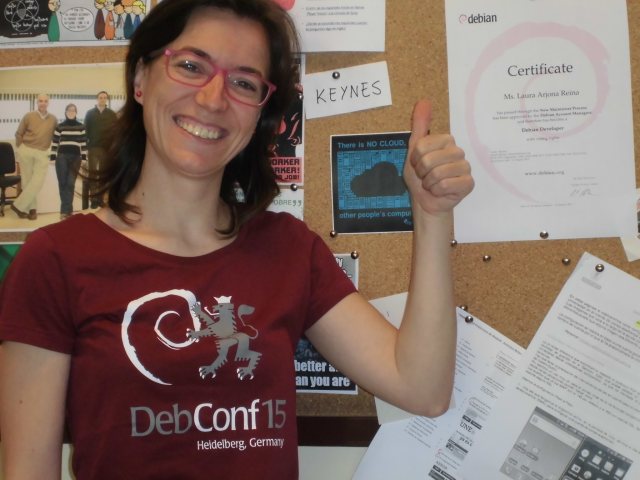
Filed under: My experiences and opinion, News Tagged: Communities, Contributing to libre software, Debian, Developer motivations, encryption, English, Free Software, gpg, libre software

Simon Richter: Restarting blogging

I haven't had a blog for a few years now (and I might at some point be tempted to import all the old content), but occasionally I just want to point at something cool, rant about technology, or talk about my projects in the hope that someone else gets inspired to point at, or rant about them. My current interests are

Charles Plessy: The slippery slope.

Step by step, one slips towards the bottom:
  1. One should be blunt with those who are wrong.
  2. One is blunt when one is right.
  3. When one thinks to be right, one is blunt.
  4. One is wrong and blunt.
Let's note anyway that one can slip to the bottom without being vulgar or insulting. In any large project like Debian, one can find people who know how to be very oppressive, while keeping a very correct communication style. Debian is a broad project, and it is easy to avoid them, unless one tries make contributions that can be related to keywords like committee , code , policy , delegation , etc. In that case, it is better to retrieve the good old thick skin from the cupboard where we stored it after our code of conduct was adopted...

14 October 2015

Russ Allbery: Review: Firebird

Review: Firebird, by Jack McDevitt
Series: Alex Benedict #6
Publisher: Ace
Copyright: November 2011
Printing: October 2012
ISBN: 1-937007-80-4
Format: Mass market
Pages: 357
Firebird is the sixth book in the Alex Benedict series about an antique hunter in the far future (albeit a far future that looks exactly like 1960s suburbia, but with spaceships). This is a very episodic series, though, and I don't think it would be hurt much by starting in the middle. There are references to earlier investigations, but they're fleeting, and I often didn't map them to remembered plots even though I've read the whole series to this point. The investigation in this book starts with the heir to an estate coming to Alex to sell some of the possessions of a physicist. Chase (Alex's assistant, and here, as in the last few books, the viewpoint character) doesn't even recognize the name, but Alex does: Christopher Robin disappeared forty-one years earlier, under circumstances that were never fully explained. He was also (and unusually for a physicist) interested in strange and marginal ideas: dark energy, new drive technology, parallel universes one could potentially cross into, and similar fringe concepts. The normal pattern of this series is that Alex will hear about some mystery, be unable to restrain his curiosity, and start poking around, usually turning up things that people would rather he didn't. It takes a while for that to happen here; instead, the story starts with Alex playing up popular interest in Robin's ideas in a rather mercenary attempt to increase the value of the estate. He stumbles into more mystery mostly by accident. Eventually he can't resist the allure of a revealed link between Christopher Robin and sightings of mysterious disappearing starships and the normal pattern kicks in, but he spends rather more of the book than normal being flippant and slightly unethical. I didn't much like the shift in tone. Alex is a lot harder to like this book, and not just for his business practices. His tone towards Chase also moves past the slightly superior smugness that's common to many books of this type (think Nero Wolfe) and well into condescending ass. Some of this may be intentional, as McDevitt uses this book to bring out a bit more of Alex and Chase's past and has some story reasons for making Alex less of a saint. But some of it feels accidental, or unnoticed, and it left a bad taste in my mouth. As with a lot of McDevitt, the actual mystery is slow, a bit scattered, and has a fair number of blind alleys. That property makes these books feel more like real investigations, but it works better when the characters are fully engaged in the investigation and are communicating a bit better than they are here. The plot also gets entangled in a subplot about a planet full of abandoned AIs, and while that was moderately interesting, it felt like an extended digression with dubious relevance to the main plot. McDevitt occasionally has trouble with plot focus, and I think I noticed more this time because the characters weren't as fun to spend time with. The end of Firebird was up to the usual standards of this series, albeit surprisingly traumatic. The rest of the book, though, felt markedly weaker. Alex decided to be obnoxious and play into his (previously mostly inaccurate) public perception as a money and glory hound. Chase seemed too flippant, uninterested, and a bit too much of a foil instead of a partner. And the plot felt like two different story ideas awkwardly smushed together. I think this was the weakest of the series to date. Hopefully the next book, which looks to be more of a direct sequel to this one, will improve. Followed by Coming Home. Rating: 6 out of 10

Rhonda D'Vine: Post DebConf15

There are some things that I didn't mention in my sort-of quickly written entry about DebConf15. So first things first. When I received the mail about the room allocation I was at first confused. I was put into a room with other ladies, which I didn't expect. Granted, two of the other three names were people that knew me since a while, but it still felt like a mistake might have happened. But after a while I realized what has happened: It wasn't a mistake, it was intentional, I was finally recognized as woman for the room allocation too, which made me extremely happy. I was just just concerned about the third person who would be in our room who doesn't know me yet and whether it would make them feel uncomfortable. In the end, that was no trouble at all. I felt so empowered and more accepted than ever in this community. And when finally being on-site there another thing happened with me. I started to use the women's restroom. Up to now I usually had the feeling of "it's fine for me to use the male one, and I don't want other women to feel uncomfortable", but somehow, with a skirt on, it in the end made me feeling uncomfortable. Additionally, there were only three times in total when I used the male toilet (and one was on the boat for the daytrip), and every single time of it I felt extremely uncomfortable with it, like others might think I'm just faking it. It at least in my mind doesn't help with accepting me as female when I go to the male restroom. And it's not a Good choice! as a woman did put it during the conference dinner when there was a longer queue infront of the male restroom. It's not so much of a choice over here. But I give her the doubt of not knowing how important these little steps became to me over time. Totally unrelated to the restroom question but interestingly featuring it a fair bit I was made aware of the Assigned Male cartoon. I instantly fell in love with it, and in case you want to enlighten yourself a bit more about how some things you might say or do get received by trans people, be very much invited to read it. Sophie is currently on European tour with her book, unfortunately Vienna/Austria doesn't seem to be part of europe in that respect so I hope someone will be able to visit one of her stations to pick up a book for me ... And then there was also a small inofficial Nail Polish BoF going on at DebConf. I left it on my fingers for the next two weeks, totally in love with it. Unfortunately the nail polish I got for myself after DebConf had a rather big brush so I wasn't able to work on it, I failed miserably. ... which brings me to the empowerment that DebConf meant for me this year, and the time since. Given that I left the nail polish on I even took the comfort in being myself to go to work in my skirt on a more regular basis. Also, a very nice friend did visit me and we went lipstick shopping. I loved the color she chose, even though in the meantime it isn't visible enough for me and I guess I'll get another one rather sooner than later. Also, about what I mentioned in my last blog post was that my name change within the Debian project was granted. A quick update on that is that also now my GPG key got replaced. I guess it's finally time for me to write a gpg transition statement, even though I don't follow those myself. I still prefer meeting up with people face-to-face for signing their new keys. But given that it's called a transition statement makes it more appealing to me on that grounds. :) And I got invited to a local podcast show. Actually I know the person who does the podcast since several years already, he's also part of the local free software community who attends various events, and he does a podcast since several years now called Biertaucher (named after cooling the beer in a fountain). It is held in German language, so if you don't understand German you might want to skip these links.

In the first episode that I joined in I talked about DebConf. Afterwards we were sitting together and talking about that they would like to have more social topics too, not just technical things. So we took that chance and talked in Biertaucher #221 about Polyamory, which was a quite interesting experience. The host intentionally asked questions coming from a quite ignorant point of view, but it went nice. We were three poly people sharing our views and insight how it works for us.
Then there was Biertaucher #223 where it was just me and one of the hosts. We didn't had much to talk about from the past week, so we agreed to talk about Transgender in the end. Granted, it's mostly my personal story, but I guess I got some important topics addressed in a useful way. And, after getting my name changed in Debian, I thought about what it might take to get my name changed officially, too (as if it could get more official than using it throughout my work environment, both payed and voluntary, but ...). I covered that in the podcast, but mostly it is either quite expensive or requires me to change my gender in the register of births, which require a lot of other hassles that include psychiatry. Or, settle for a so-called "gender neutral" name as first name, which both doesn't sound very convincing somehow ... Only time can tell I guess. Guess that's enough for now, if I forgot something I might come back to it. :) One last note: I consider the Debian project a very welcoming one, and that can only work for a fair amount of people if the tone is right. So yes, I wholeheartly agree with the Code of Conduct. And I'm very disappointed to see that there are still people in the project that are advocating for a freedom of expression, so to say. Respectful communication with each other is a must in a bigger community to make it work, not something that might be a nice to have, and calling someone names and ridiculing them for stating that is absolutely not acceptable. I encourage those people to watch How to Throughly Offend and Insult People in Open Source presentation (or at least read the slides) that Gina Likins gave earlier this year. It might give them an idea why it's important to communicate respectful with each other, and that includes banning degrading terms like "SJW" from your vocabulary because it actually speaks a lot more about your own attitude than about the one of the person you use it for.

/personal permanent link Comments: 8 Flattr this

Russ Allbery: Review: Magic's Price

Review: Magic's Price, by Mercedes Lackey
Series: Last Herald Mage #3
Publisher: DAW
Copyright: July 1990
ISBN: 0-88677-426-8
Format: Mass market
Pages: 351
Magic's Price is the conclusion of the Last Herald Mage trilogy (Lackey is from an era of fantasy in which trilogies stopped at three books), but those books are widely spaced and mostly stand alone. You might miss some context around Vanyel's personal life and the politics of the kingdom, but there's a lot of somewhat-awkward in-line summary, so you could read these books out of order if you wanted to. As with the previous two, this is a re-read of a book I've read several times before, but not for more than fifteen years. This is the book that finally introduces Stefan. On this re-read, that surprised me I thought of him as a large part of Vanyel's overall arc but he's only in the third book. He is, of course, key to the grand conclusion of Vanyel's story, beginning as the Bard who has the ability to blunt the pain of the badly-suffering king of Valdemar and then becoming more than that to Van. It's also a book about Vanyel trying desperately to hold things together as the country falls on hard times and far too much weight is put on his shoulders. And a book about a climactic fight against an arch-villain (awkwardly and retroactively inserted). And Vanyel coming to terms with his own foresight. It's a book about rather a lot of things, and therein lies a problem. I thought Magic's Promise had a better story than Magic's Pawn, but both had reasonably coherent stories and some internal flow. Magic's Price has three or four interwoven stories and some odd stops and starts. This is still early in Lackey's writing career (three years after her first novel), and I don't think she was entirely successful in what she was trying to do. The climaxes of the different stories don't quite line up and don't get enough separate attention, leaving a book that lacks clear dramatic shape, an engrossing build-up, or a satisfying climax. The biggest problem I had is that the main threat is not adequately supported. The story is building towards a rather drastic conclusion, one that has been foreshadowed from early in the series, but the threat that creates that conclusion comes out of nowhere. Lackey tries to tie it back to events from earlier in the series, and maybe it was planned all along, but there's little concrete support and no build-up. It feels like a retcon. And the key character in that threat receives almost no characterization whatsoever. I'm a bit grateful for that, since Lackey tends towards total evil in her villains, but to have the cause of all the drama in this story be a complete cipher takes a lot out of the story. (Also, I truly could have done without the rape.) The other irritation is that Vanyel spends quite a lot of the book being a jackass. This is another occasional problem with Lackey's books: her love stories, at least in her early books, involve a bit too much of people being stupid at each other. But I hadn't remembered just how much Van jerked Stef around and treated him miserably, straight to the end of the book. Love is a bit too ordained and imbued with magical powers in Valdemar, which is lucky for Vanyel: extensive plot support is required to explain why Stef didn't find someone else who was less of an ass. In the real world, when someone insists they have no emotional space for you, the correct reaction is "gotcha, have a nice life" and finding someone else to spend time with. This gets partly sorted out in the end, but I didn't find the reconciliation entirely believable, and certainly not fair to Stef. (And the age difference is just a little creepy, although thankfully Lackey doesn't put much focus on that.) On my first read of the Valdemar corpus, this was the book during which I started getting interested in the lore and politics of this universe. There's much more of that to come, thankfully, as I think it's my favorite part of the series. At this point in her writing career, Lackey is getting better at avoiding infodumps and making her magic system interesting. The politics is still a bit black and white, but the Tayledras are a lot of fun (and increasingly less like elves, even if that's the obvious initial inspiration), and the areas beyond Valdemar are developing some more coherence. The conclusion loses a lot from the lack of build-up and emotional support, but it still adds an interesting bit of magical history that will be important later. I wish I'd enjoyed Magic's Price more on re-read, but it was much spottier and more exasperating than I had remembered. That said, it certainly has its moments, particularly around the lore. This is the first book where one starts to realize just how powerful the Companions are, and just how much they're capable of that they're not showing. When I first read it, I loved it. Now, the flaws are too obvious, and Vanyel's behavior is too irritating, for me to unreservedly recommend it, but Magic's Price, and the whole trilogy, is important for building the lore of later books. When I get to Elspeth's part of the series, the politics and magical system will be developed at much greater length. Next, though, my favorite stories in this universe: Tarma and Kethry. Rating: 6 out of 10

13 October 2015

Bastian Venthur: Thanks!

Two months ago I asked for help porting python-debianbts, to Python3. Python-debianbts is a tiny little library that allows for querying Debian s bug tracking system. Since Debian s reportbug depends on it, the library is installed on ca 80% of the Debian installations. The main blocker back then was that python-debianbts depended on SOAPpy which was not available for Python3. So before we could port python-debianbts to Python3 we had to migrate from SOAPpy to pysimplesoap a daunting task given the beast that SOAP is. Fortunately, Gaetano Guerriero heard my call and helped a lot. First he migrated python-debianbts to pysimplesoap. Then, he ported python-debianbts to Python3 and now he is still busy fixing bugs and providing me with pull requests. I m very satisfied with the outcome. His pull requests are very high-quality and come usually with the appropriate unit tests included. While he is doing the major grunt work, I merely do some occasional nitpicking and uploading to Debian/unstable. Thank you very much Gaetano! If you ever come to Berlin, please drop me a note so I can invite you to a beer or two.

Next.

Previous.