Search Results: "az"

9 April 2010

David Welton: US Exports: "The Cloud"?

An Economist special report in last week's print edition talks about how the US will need focus more on savings and exports:

A special report on America's economy: Time to rebalance I've been thinking about that for a while too, especially after the dollar's recent weakness, although it has been strengthening some, lately, apparently due to the state of Greece's finances... I think that the computing industry is, in general, well poised to take advantage of that. For instance, what could be easier to export than computing power or "Software as a Service"? All it takes is a few minutes for someone in Europe to sign up to a US-based service with a credit card. For instance, compare Linode's prices and good service with most of their European competitors (gandi.net for instance, who are good people, and you have to love that they put "no bullshit" right on their front page). Not that they don't have good service in Europe, but it's very difficult to compete on price with the dollar being significantly cheaper. With the dollar where it is right now, gandi is almost, but not quite, competitive with Linode. If you don't include taxes. If the dollar weakens again, though, things could easily tilt far in Linode's favor. Besides a weak dollar, I think it will be important for companies in a position to do so in the US to focus on "the rest of the world". The US is a big, populous country where it's very easy to forget about far-off lands. Compare my home town of Eugene, Oregon to where I live in Padova. Google Maps says that it takes 7+ hours to drive to Vancouver, Canada (which, to tell the truth, isn't all that foreign in that they speak English with an accent much closer to mine than say, Alabama or Maine). Going south, Google says it's 15+ hours just to San Diego, although I think that's optimistic myself, given traffic in California. From Padova, I can be in France in 5 hours, according to Google, 3 hours to Switzerland, 4 to Innsbruck, in Austria, less than 3 hours to the capital of Slovenia, Ljubljana, and around 3 hours to Croatia, too. And if you wanted to throw in another country, the Republic of San Marino is also less than 3 hours away, according to Google's driving time estimates. You could probably live your entire life in a place like Eugene and never really deal much with foreigners, whereas here, nearby borders are both a historic and an ever-present fact. The outcome of this is that, to some degree, people in the US have traditionally focused their businesses "inwards" until they got to a certain size. Which is, of course, a natural thing to do when you have such a big, homogenous market to deal with before you even start thinking about foreign languages, different laws, exchange rates and all the hassle those things entail. However, if exchange rates hold steady or favor the US further, and internal spending remains weaker, it appears as if it may be sensible for companies to invest some time and energy to attract clients in "the rest of the world". "Cloud" (anyone got a better term? this one's awfully vague, but I want to encompass both "computing power" like Linode or Amazon's EC2, as well as "software as a service") companies likely will have a much easier time of things: for many services, it's easy to just keep running things in the US for a while, and worry about having physical or legal infrastructure abroad later. Your service might not be quite as snappy as it may be with a local server, but it'll do, if it performs a useful function. Compare that with a more traditional business where you might have to do something like open a factory abroad, or at the very least figure out the details of how to ship physical products abroad and sell them, and do so in a way that you're somewhat insured against the large array of things that could go wrong between sending your products on their merry way, and someone buying them in Oslo, Lisbon or Prague. Since this barrier to entry is lower, it makes more sense to climb over it earlier on. As an example, Linode recently did a deal to provide VPS services from a London data center, to make their service more attractive to European customers. However, they still don't appear have marketing materials translated into various languages, and presumably they don't have support staff capable of speaking languages like Chinese, German or Russian either (well, at least not in an official capacity). This isn't to pick on them; they may have considered those things and found them too much of an expense/distraction/hassle for the time being - they certainly know their business better than I do - and that they simply are content to make do with English. Other businesses, however, may decide that a local touch is important to attracting clients. What do you need to look at to make your service more attractive to people in other countries? In no particular order:

There's certainly no lack of work there, but on the other hand, it's possible to do almost all of it from wherever you happen to be located, rather than spending lots of money and time flying around to remote corners of the globe, as is still common practice in many industries.

8 April 2010

John Goerzen: Face to Face With Destruction

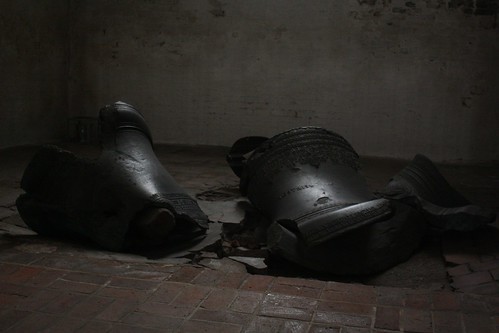
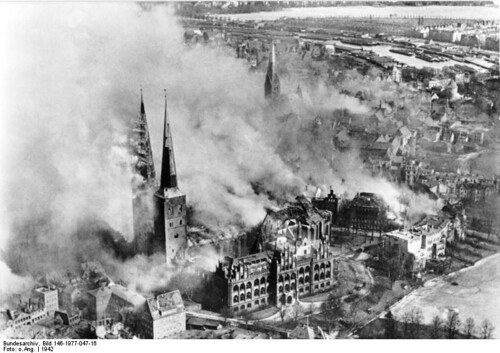
IMG_2641 Seeing these church bells in L beck wasn t easy for me. They melted and fell to the ground after an air raid in 1942, and have been left exactly as they fell. I wasn t alive in 1942, and even my parents hadn t yet been born. My grandfather was relocated by the American government because he refused to fight in the military for religious reasons. And yet, I still felt a sense of embarrassment, being an American standing there in Germany next to those bells. My country* did things like this. Why? Even if there s a war on, and whatever the other side may be doing, do we really have to bomb all their churches? Then, we went to the Dom (cathedral). It has a small gallery of photos of the destruction in 1942, and how it took 40 years to restore (though some original works are simply irreplaceable.) Burning L beck Cathedral after an air raid in 1942 I had just been walking through the beautiful Dom, and then saw pictures like that. It was very sad. I imagined the people in 1942, seeing the smoking remains of so many buildings that had been important to the town for centuries. Places where, no doubt, some of them worshiped, and their parents and grandparents had too. I imagined my sadness if a country bombed one of the churches that my ancestors helped start or build. I felt ashamed of what the democracy in which I live (and its allies) did to the Dom, to Marienkirche, and to the other churches and civilians there. Then, a few days ago, Wikileaks posted a video from an American helicopter in which our soldiers begged Come on, let us shoot! at people, most or all of which were completely unarmed. They killed a bunch of people. Then a van came to try to get the wounded to the hospital. Then the soldiers in helicopter killed those people, and wounded some children. Even if they thought their lives were in danger, I d expect to hear some quiet sadness at what they thought was a regrettable need to use force. Instead, you d hear them cheering whenever they killed someone, as if they had just won a round on some video game. They killed civilians, and considered it a fun experience and a mission accomplished. There was no sadness for knocking a man to the ground, leaving him writhing. Just jokes. There was no more care for human life here than there was 60 years ago. It saddens me that every year we celebrate our military on independence day celebrating its ability to kill, not its ability to feed. I wish that we could rather celebrate the times Americans have saved lives, whether in Berlin or in Port-au-Prince, or helped to topple dictatorships. Military power shouldn t be our first choice so often. L beck wasn t attacked for any strategic purpose; the British did it to destroy the morale of the enemy civil population , as the Americans did in Dresden or the Germans in London. In other words, those bells fell to the ground for no reason other than that they were German. People lost their lives for the same reason in Germany and in London. The British had no reason to believe that those civilians meant them any harm, that they were anything but caught between two strong powers. And the same held true in Iraq. When we went to Berlin, we walked through the replica of Checkpoint Charlie, with the big sign announcing that you are leaving the American sector. There is little positive to be said about the Cold War, but there is something the British and American military did of which I am not the least ashamed: the Berlin Airlift. Although I didn t see it, I feel a sense of the USA having been a force for good when I read about the Berlin Airlift Monument at Tempelhof, which has the names of the 70 British and American men that lost their lives in the airlift (due to accidents), above the inscription They gave their lives for the freedom of Berlin. That s the spirit I wish we d see more often in the world today: people giving their lives not just for their own security, but for strangers in need on a different continent. We Americans have been, compared to many countries in Europe, relatively sheltered from the ravages of war in our own midst. I wish that more of us would have the opportunity to gaze at fallen church bells, to wonder through a magnificent old church and then to see photos of it on fire, or to see a monument to our soldiers in a far away land. Perhaps then we could better learn from history, and see firsthand that some of our most positive contributions to the world have come in the form of coal and candy bars instead of incendiary devices. A small post script Many historic buildings or locations we saw in Germany had plaques on their exterior with a brief history, often in German and in English. I was interested to note that some (though not all) of these plaques had language such as destroyed by fire in 1942 , with no mention that the cause of the fire was a bombing. I was even more interested to note that same sort of description at several sites in Prague Castle, mentioning that the original building was lost in the fire of 1142. It was only on the third or fourth building in the Castle that we learned that the fire of 1142 was caused by a military siege of Prague Castle. * I know it was the British at L beck, but the Americans did similar things elsewhere. I also acknowledge that, at a macro level at least, the Berlin Airlift wasn t purely an altruistic act, as there were geopolitical factors in play. But I am speaking of the actions of the airmen here, who took on considerable risk to help others.

3 April 2010

Romain Beauxis: On mail servers and google spam filter..

The worst April's fool ever, on which I will not comment here, has forced me to quickly move the services on my previous machine. Among them was the email services, which I fear the most. Configuring again a postfix server, I realize again how arcane its configuration is. Email is probably, with nttp and unix, one of the oldest paradigm in modern computing, and you feel it. I understand that email used to be intrinsicly linked with unix account. But, come on, those were the days where you would login to a mainframe, way before personal computers. So, why do you need to know about all sort of server-wide files, like /etc/aliasee and /etc/mailname ? Why do you need to have to tweak the server-wide accounts and login system to create new mailboxes ? In 99% of the situations now, email accounts do not corresponds to anything on the server, so why keeping all sort of arcane stuff that make the configuration of a mail server so delicate ? On a side note, I would like to share 3 questions. First is this idea of using gmail as a spam filter service. You register your address, say joe@doe.com with your joe.doe@gmail.com and you tell your mail server to redirect all the mail to joe@doe.com to joe.doe@gmail.com. Then in gmail's interface, you ask gmail to redirect all mails to joe@mail.doe.com. Eventually, the mail at mail.joe.com is delivered to the local inbox. This allows to use gmail as a spam filter loop. However, I have no idea if this is something already known and if gmail administrators will like it. Lazy web, what do you think ? Second is the following parameters for postfix: reject_non_fqdn_recipient and reject_unknown_reverse_client_hostname. I wonder if I may loose some mail using them.. Any idea ? Third is that I wanted to configure the old server to relay anything on the new, and filter there. But, as much fuzz there is about open relay, I was not able to configure my postfix as an open relay.. Any idea on how to do it ?

Russell Coker: Too Stupid to be a Bishop

A Stupid Bisop breaks the Godwin Rule The Sydney Morning Herald reports that Catholic Bishop Anthony Fisher has just claimed that GODLESSNESS and secularism led to Nazism, Stalinism, mass murder and abortion [1]. This is a violation of the rule part of Godwin s Law. We might not expect clerics to have enough general knowledge of society to know this rule, but it does seem reasonable to expect them to have enough empathy to understand why inappropriate Hitler analogies will just offend people and don t advance their cause. But anyone in a position of leadership in a global organisation who is going to talk to the media should have enough intelligence to check historical references. The Wikipedia article about Positive Christianity is worth reading, it includes references to Christian based race-hate in Nazi Germany as well as modern references [2]. There is also an interesting Wikipedia page about the Religious aspects of Nazism [3], there seems to be room for a lot of debate on the matter of how religion fit in to the Nazi regime but it seems quite clear that it was not an atheist regime. The Wikipedia page about the Rechskonkordat (the agreement between the Nazi Germany and the Catholic Church) is also worth reading [4]. Also I m sure that the Chilean Dictator Augusto Pinochet wasn t the only Catholic despot. Community Services and Moral Authority Cardinal Pell was quoted in the same SMH article as saying we find no community services sponsored by the atheists , of course if he was to investigate who is contributing to the religious based community service organisations he would find plenty of atheists. I know I m not the only atheist who donates to The Salvation Army [5] on occasion. I wonder how many religious people would be happy to donate to an explicitly atheist organisation, I suspect that the prevalence of religious charities is due to the fact that a religious charity can get money from both religious people and atheists while a charity that advocated atheism in any way would be limited to atheist donors. If I was to establish a community service charity I would seriously consider adding some religious element to help with fund raising it s just a matter of doing what s necessary to achieve the main goal. Even if it wasn t for violating Godwin s law and a total lack of any knowledge of history Anthony would still have failed. We all know the position of the Catholic Church on the sexual abuse of children. The Catholic policies are implemented in the same way in every country and as far as we can tell have been done so for all time. I believe that makes them unqualified to offer moral advice of any kind. Criticising the Secular World Peter Craven has written an article for The Age criticising the secular world [6]. He makes the extraordinary claim the molesting clergy are like the brutal policemen and negligent doctors and corrupt politicians: they come with the territory because pennies have two sides . The difference of course is that police, doctors, and politicians tend to get punished for doing the wrong thing even when they do things that are far less serious. But the molesting clergy seem to be protected by all levels of the church hierarchy. Peter makes some claims about the secular world as if there is a Borg collective of atheists and claims that there is an incomprehension of Christian values . I believe that the attitudes of atheists and the secular justice system correspond quite well with what most Christians would regard as Christian values the problem is that the actions of the church leaders tend not to match that. It s All About Money I would like to know why Christians almost never change church and never cease donating. Religious organisations are much like corporations, they seek new members and new revenue sources. If a significant number of Catholics were to pledge to not donate any money to their church for a year after every child sex abuse scandal then Catholic policies might change. Also if Catholics were to start changing to Christian denominations that do the right thing in regard to moral issues then the Catholic church would either change or eventually become irrelevant. If you keep paying people who do bad things then you are supporting them! I suggest that any church member who cares about the moral issues of the day should vote with their checkbook. If their church fails to do the right thing then inside the donation envelope they should put a note saying due to the immoral actions of the church I will donate to other charities . I am not aware of any church that would expel members for such a protest, but I know that some smaller parishes have cash-flow problems and would rapidly escalate the issue through the management chain if even a few members were to protest in such a manner.

2 April 2010

Thomas Koch: Design document for a patch management system on a DVCS

Dear friends of Debian,

this is my first post to Planet Debian. - The planet with the most geeky registration procedure in the known universe!

I proposed an alternative to topgit some days ago on the vcs-pkg.org list. Martin asked (and encouraged) me to give a better explanation of the idea, which I'll hereby try. Sorry for not giving any drawings, but I'm totally incapable of anything graphical.

Hopefully, I'll manage to come to the Debian Miniconf in Berlin. Then we could discuss the idea further and maybe even start implementing it. (Somebody would need to help me with my first steps in Perl then...)

The following text is available on github. Please help me expand it!

Design document for a patch management system on a DVCS
Requirements The system to implement manages patchsets. A patchset is a set of patches with a tree-ish dependency graph between the patches. There's one distinct root of this dependency graph. Patches are managed as branches with each branch representing a patch. Modification of a patch is done by a commit to the respective branch. A branch representing a patch as part of a patchset is called patchbranch. The patch of a patchbranch is created as the diff between the root of the patchbranch and the head. The most important management methods are:
  • Export a patchset in different formats
    • quilt
    • a merged commit of all patches
    • a line of commits with each commit representing one patch
  • Update a patchset against an updated root.
  • Copy a patchset
  • Delete a patchset from direct visibility while preserving all history about it
  • Hide and unhide a patchset from direct visibility
Additional requirements:
  • The system should be implementable on top of GIT, Mercurial and eventually Bazaar.
  • The system must easily cope with multiple different and independent patchsets.
  • All information about a patchset must be encoded in one distinct branch. Publishing this one branch must be sufficient to allow somebody else to recreate the patchset with all of its patchbranches.
  • The system should not rely on the presence of hooks.
  • The system should not require the addition of management files in patch branches (like .topmsg and .topdeps in topgit)
  • The system must be easy to understand for a regular user of the underlying DVCS.
  • The implementation may allow a patchset to depend on another patchset(s).

implementation
patchset meta branch A patchset meta branch holds all informations about one patchset. First, it holds references to the top commits of all patch branches in the form of parent references of commits. Thus pushing the patchset meta branch automatically also pushes all commits of all patch branches. Secondly, the patchset meta branch contains meta informations about the patchset. These meta informations are:
  • The names of all patch branches together with the most recent commit identifier of a particular patch branch. Let's save this information in a file called branches.
  • A message for each patch branch that explains the patch. These messages can be saved in the file tree as msg/$ PATCH-BRANCH-NAME
  • References to the dependencies of the patch (other patches of the same patchset or the root of the patchset). This is also encoded in the file branches.
Since the patchset meta branch holds all this informations, it is possible, to delete all patch branches and recreate them from this informations. Although the commits of the patchset meta branches hold references to the patch branches, its file tree does not need to contain any files from the referenced patches. This may confuse the underlying DVCS, but the patch meta branch is not ment to be directly inspected.

The branches file A branches file for a fictive patchset could look like:
# patch branches without an explicit dependency depend on the root of the
# patchset tree
# A Root can be given as either a fix commit (seen here), a branch or a tag.
# A fixed commit or tag is useful to maintain a patchset against an older
# upstream version
ROOT: 6a8589de32d490806ab86432a3181370e65953ca
# A tag as a dependency
#ROOT: upstream/0.1.2
# A branch as a dependency
#ROOT: upstream
# A regular patch with it's name and last commit
BRANCH: debian/use-debian-jars-in-build-xml 4bab542c261ff1a1ae87151c3536f19ef02d7937
# two other regular patches
BRANCH: upstream-jira/HDFS-1234 a8e4af13106582ca1bfbbcaeb0537f73faf46d87
BRANCH: upstream-jira/MAP-REDUCE-007 e3426bcbcb2537478f851edcf6eb04b34f6c7106
# This patch depends on the above two patches
# The sha1 below the dependency patches references a merge commit of the two
# dependencies
BRANCH: upstream-jira/HDFS-008 517851aa829d77e09bc5e59985fed1b0aa339cc6
DEPENDENCIES:
  upstream-jira/HDFS-1234
  upstream-jira/MAP-REDUCE-007
    cc294f2e4773c4ff71efb83648a0e16835fca841
# A patch branch that belongs to the patch branch, but won't get exported (yet)
BRANCH: upstream-jira/HDFS-9999 74257905azgsa4689bc5e59985fed1b0aa339cc6
BRANCH-FLAGS: noexport


30 March 2010

MJ Ray: Enemies of Digital Economy Workers: the TUC

The Trade Union Congress s chief executive recently came out in the crazy position of sharing a platform with the British Phonographic Industry (and why are they still relevant? What is the market share of phonographs now?) and supporting the much-hated Digital Britain guilty-without-trial three strikes disconnect measures. Yes, you read that right: the TUC s chief exec wants digital economy workers to be arbitrarily disconnectable in response to allegations of file-sharing by large competitors. If I m being charitable, I think he was duped. That stupid article was in response to yet another set of filesharing-will-fankle-us scare figures which carefully only included the creative industries most impacted by piracy (see second paragraph of introduction). See pages 12 and 14 of the full report to note that businesses that don t depend on profit from copyright licensing were not even included! So, these are not the creative industries. They are the KEA and WIPO definitions of copyright industries. Of course they are hurt by copyright infringement and have little to lose from over-zealous copyright laws, but they are not the creative industries. I contacted the TUC to basically ask why they were so against digital economy workers in this way. I received an anonymous answer from TUC Information Services that was almost helpful:
The current policy of the TUC on this issue was decided at our annual congress last autumn. and directing me to Composite Motions 18 and 19 (PDF) and the verbatim report of the conference (PDF) pp. 107-9
Composite Motion 18 seems largely innocent. In fact, its call for social inclusion, a Universal Service Obligation and digital inclusion could be seen as an instruction to oppose non-judicial three-strikes, because allowing so-called Kangkaroo courts run by private-sector transnationals to decide who may use the internet is basically incompatible with inclusion and universal service. The NUJ-supported Composite Motion 19 is the dangerous one and I m alarmed that the claims around piracy are completely without evidence or justification in the verbatim report of the conference. Were references supplied, or does the TUC adopt positions based solely on reference-free argument? How does the TUC reconcile contradictory motions for inclusion and universal service and for exclusion through private courts? Their answer?
The TUC does not, as a rule, enter into correspondence with individual union members [...]
Oh great(!) You are in a maze of twisted union organisations and none of the ones which are screwing things up are accountable to you. Thankfully, I have happier Digital Britain news from another source which I should write about soon.

Norbert Tretkowski: MySQL distro meeting in Brussels

Last month I spent two days in Belgium, after I got invited to the MySQL distro meeting. It was a non-public meeting with some people from Sun Microsystems and MySQL maintainers from different Linux distributions. It took place directly after FOSDEM (which I unfortunately could not attend due to personal reasons) at the Sun Microsystems Belgium office in Brussels. It was great to meet with Mathias Gug from the Ubuntu Server team in person. He had some really good ideas on how we could reduce the differences between MySQL in Debian and Ubuntu in the future. As a consequence, Debian will soon switch from Subversion to Bazaar for maintenance of most MySQL packages.

However, we were not only talking about the MySQL Server itself, but also about MySQL Cluster, MySQL Proxy, the MySQL Connectors and the MySQL GUI Tools. Giuseppe Maxia has a more detailed blog entry about the event, including the whole list of participants and some pictures. I fully agree with him: The meeting was a success, we also had a lot of fun, and we should do that more often!

Thanks a lot to Sun Microsystems for sponsoring, and of course to Lenz Grimmer for organizing the event.

David Bremner: Distributed Issue Tracking with Git

I'm thinking about distributed issue tracking systems that play nice with git. I don't care about other version control systems anymore :). I also prefer command line interfaces, because as commentators on the blog have mentioned, I'm a Luddite (in the imprecise, slang sense). So far I have found a few projects, and tried to guess how much of a going concern they are. Git Specific VCS Agnostic Sortof VCS Agnostic

David Welton: Where Tcl and Tk Went Wrong

I've been pondering this subject for a while, and I think I'm finally ready to write about it.
Tcl was, for many years, my go-to language of choice. It's still near and dear to me in many ways, and I even worked on a portion of a book about it ( http://journal.dedasys.com/2009/09/15/tcl-and-the-tk-toolkit-2nd-edition ). However, examining what "went wrong" is quite interesting, if one attempts, as much as possible, a dispassionate, analytical approach that aims to gain knowledge, rather than assign blame or paper over real defects with a rose-colored vision of things. It has made me consider, and learn, about a variety of aspects of the software industry, such as economics and marketing, that I had not previously been interested in. Indeed, my thesis is that Tcl and Tk's problems primarily stem from economic and marketing (human) factors, rather than any serious defects with the technology itself. Before we go further, I want to say that Tcl is not "dying". It is still a very widely used language, with a lot of code in production, and, importantly, a healthy, diverse, and highly talented core team that is dedicated to maintaining and improving the code. That said, since its "heyday" in the late 90ies, it has not ... "thrived", I guess we can say. I would also like to state that "hindsight is 20-20" - it's easy to criticize after the fact, and not nearly so easy to do the right thing in the right moment. This was one reason why I was reticent to write this article. Let me repeat that I am writing it not out of malice or frustration (I went through a "frustrated" phase, but that's in the past), but because at this point I think it's a genuinely interesting "case history" of a the rise and gentle decline of a widely used software system, and that there is a lot to be learned. At the height of its popularity, Tcl was up there with Perl, which was the scripting language in those days. Perl, Tcl, and Python were often mentioned together. Ruby existed, but was virtually unknown outside of Japan. PHP was on the rise, but still hadn't really come into its own. Lua hadn't really carved out a niche for itself yet, either. Tcl is no longer one of the popular languages, these days, so to say it hasn't had problems is to bury one's head in the sand: it has fallen in terms of popularity. To examine what went wrong, we should probably start off with what went right: These features led to Tcl being widely used, from Cisco routers to advanced television graphics generation programs to the AOLserver web server, which was busy serving out large quantities of dynamic web pages when many of us were still fiddling around with comparatively slow and clunky CGI programs in Perl. Note also that there have been a lot of cool things to have gone into Tcl in the mean time. It has a lot of impressive features; many more than most people realize, and has had a lot of them for a while. Check out http://www.tcl.tk to learn more about the "good stuff". But that's not the point of this article... There was a healthy, active community of developers producing lots of interesting add-ons for the language, and working on the language itself. This culminated in its adoption by Sun Microsystems, which hired the language's creator, Dr. John Ousterhout, and a team of people, who added a lot of great features to the language. Quoting from Ousterhout's history of Tcl page:

The additional resources provided by Sun allowed us to make major improvements to Tcl and Tk. Scott Stanton and Ray Johnson ported Tcl and Tk to Windows and the Macintosh, so that Tcl became an outstanding cross-platform development environment; Windows quickly came to be the most common platform. Jacob Levy and Scott Stanton overhauled the I/O system and added socket support, so that Tcl could easily be used for a variety of network applications. Brian Lewis built a bytecode compiler for Tcl scripts, which provided speedups of as much as a factor of 10x. Jacob Levy implemented Safe-Tcl, a powerful security model that allows untrusted scripts to be evaluated safely. Jacob Levy and Laurent Demailly built a Tcl plugin, so that Tcl scripts can be evaluated in a Web browser, and we created Jacl and TclBlend, which allow Tcl and Java to work closely together. We added many other smaller improvements, such as dynamic loading, namespaces, time and date support, binary I/O, additional file manipulation commands, and an improved font mechanism. Unfortunately, after several years, Sun decided that they wanted to promote one and only one language. And that language was Java. So Ousterhout and many people from his team decamped to a startup that Ousterhout founded, called Scriptics, where the Tcl and Tk innovations continued:

In 1998, Scriptics made several patch releases for Tcl 8.0 to fix bugs and add small new features, such as a better support for the [incr Tcl] extension. In April 1999, Scriptics made its first major open source release, Tcl/Tk 8.1. This release added Unicode support (for internationalization), thread safety (for multi-threaded server applications), and an all-new regular expression package by Henry Spencer that included many new features as well as Unicode support.
However, as many a company based around open source was to find later, it's a tough space to be in. Scriptics changed its name to Ajuba, and was eventually sold (at a healthy profit, apparently, making it a relative dot com success story, all in all) to Interwoven, for the "B2B" technology that Ajuba had developed. Interwoven was not interested in Tcl, particularly, so, to create a system for the ongoing development and governance of the language, the "Tcl Core Team" was created. This was something of a blow to Tcl, but certainly not fatal: Perl, Python, Ruby, PHP, Lua have all had some paid corporate support, but it has by no means been constant, or included large teams. At the same time in the late 90ies, open source was really starting to take off in general. Programmers were making all kinds of progress, and had begun to make Linux into what is today the world's most widely used server platform, and laying the groundwork for the KDE and Gnome desktops. While these may still not be widely used, they are for the most part very polished systems, and leaps and bounds better than what passed for the 'Unix desktop' experience in the 90ies. One of the key bits of work that was added to Tk was to make it look pretty good on Microsoft Windows systems. This was in an time when the "enterprisey" folks were turning away from Unix in the form of AIX, Solaris, HPUX, et al. and taking up NT as the platform of choice, so it was in some ways sensible to make Tk work well there, and in any case as a cross platform GUI toolkit, it ought to work well there in any case. And, on the Unix side, Tk emulated the expensive, professional Motif look and feel that serious Unix programmers used. What could go wrong? As Gnome and KDE continued to mature, though, what would become one of Tk's major (in my opinion) marketing blunders took root. I have it on good authority, from someone who was there in the office, that the Scriptics guys working on Tcl and Tk viewed Gnome and KDE (and the Gtk and Qt toolkits) as not really worth their while. To be fair, since Tk has always been under a liberal BSD style license, the Qt toolkit has always been "off limits". Still, though, the attitude was that Tk was a standalone system, and since it ran on pretty much any Unix system, it didn't need to bother with Gnome or KDE. Gradually, though, as more and more people used Gnome and KDE exclusively on Linux, the Tk look and feel began to look more and more antiquated, a relic from the 1990ies when Motif (which has since pretty much disappeared) was king. Tk applications started to really stand out by not looking at all like the rest of the operating system. And, while Linux may not be responsible for a vast portion of the world's desktops, it is widely used by developers, who were turned off by the increasingly creaky look of the Tk applications they saw. Tk is and was actually a fairly flexible system, and it would have been possible to tweak the look and feel to make it look a bit better on Linux, without even doing any major work. Maybe not perfect, but certainly better looking. Nothing happened, though. Another problem was that Tk and Tcl made it so easy to create GUIs that anyone could, and did, despite, in many cases, a complete lack of design skills. You can't particularly blame the tools for how they're used, but there was certainly a cultural problem: if you read most of the early Tcl and Tk books, and even many of the modern ones, there are hundreds of pages dedicated to exactly how to use Tk, but few to none explaining even basic user interface concepts, or even admonitions to the user to seek out that knowledge prior to attempting a serious GUI program. The end result is that a lot of Tk programs, besides just looking "old fashioned" had fairly poor user interfaces because they were made by programmers who did not have a UI/design culture. Contrast that with Gnome and KDE, which have made a point of focusing on how to make a good GUI for their systems, complete with guidelines about how applications should behave. It may have taken them some time to get things right, but they have done a lot to try and instill a culture of creating high quality, well-integrated GUI's that are consistent with the system where they run. Lately, there has been a lot of work to update the Tk look and feel, and it has finally started to bear fruit. However, in terms of marketing, the damage has already been done: the image of "old, crufty Tk" has been firmly planted in countless developers' minds, and no amount of facts are going to displace it in the near future. Another problem Tcl faced, as it grew, was the tug-of-war between those wishing to see it small, light, and easy to distribute embedded within some other program, and those wishing it to become a "full-fledged" programming language, with lots of tools for solving every day programs. Unfortunately, that tug of war seems to have left it somewhere in the middle. Lua is probably more popular these days as an embedded language, because it is very small, and very fast, and doesn't have as much "baggage" as Tcl. Meaning, of course, that it doesn't do as much as Tcl either, but for a system where one merely wishes to embed a scripting language, without much 'extra stuff', Tcl's extra functionality is perhaps a burden rather than a bonus. On the other hand, while Perl was happily chugging along with their CPAN system for distributing code, giving users easy access to a huge array of add-on functionality, and Python was building up a "batteries included" distribution, that included a lot of very useful software straight out of the box. Tcl, on the other hand, chose to keep the core distribution smallish, and only lately has got some semblance of a packaging and distribution system, that is, however, run by ActiveState, and is (at least according to a cursory glance at the Tcl'ers wiki), not even fully open source. The lack of a good distribution mechanism, and, in the meantime, eschewing a larger, batteries-included main distribution left Tcl users with a language that, out of the box, did significantly less than the competition. Technically, a Python style "big" distribution would not have been all that difficult, so once again, I think this is a marketing problem: a failure of the Tcl Core Team to observe the "market", assess what users needed, and act on it in a timely manner. Somewhat related to the large Tcl vs small Tcl issue was one particular extension, or extensions to the language that was noticeably absent: a system for writing "object oriented" code. Tcl, at heart, will never be an OO language through and through, like Ruby or Smalltalk, but that doesn't mean that an OO system for it is not a useful way of organizing larger Tcl systems. Indeed, Tcl's syntax is flexible enough that it's possible to write an OO system in Tcl itself, or, optimizing for speed, utilizing the extensive C API in order to create new commands. Over the years, a number of such systems have arisen, the most well-known being "Incr Tcl" (a play on the incr command, which is akin to += 1 in languages like C). However, none of these extensions was ever included with the standard Tcl distribution or somehow "blessed" as the official OO system for Tcl. This meant that a newcomer to Tcl wishing to organize their code according to OO principles had to pick a system to use from several competing options. And of course, newcomers are the least able to judge a complex feature like that in a language, making it a doubly stressful choice. Furthermore, even experienced Tcl programmers who wanted to share their code could not utilize an OO system if they wanted their code to work with just standard Tcl. Also, if their code had a dependancy on some OO system, it would require the user to download not only the extension in question, but the OO system it was built on, which, naturally, might conflict with whatever OO system the user had already selected! As of Tcl 8.6, thanks to the work of Donal Fellows, Tcl is finally integrating the building blocks of an OO system in the core itself, but this effort is probably something like 10 years too late. Some other more or less minor things that have taken too long to get integrated in the Tcl or Tk distributions include the PNG format (still not there in a production release of Tcl), a readline-based command line (Tkcon is nice, but not a replacement for simply being able to type "tclsh" and get a nice, functional shell like Python, Ruby and most other languages have. This could easily lead to a bad first experience for someone trying out Tcl). Tcl also took too long to integrate a first-class hash type (accessed with the 'dict' command), which only appeared in 8.5. Its "arrays" aren't bad, but don't quite have the full power of a hash table as dict implements them. Once again, the code to do these things was/is out there, it has just been a matter of integrating it into Tcl and Tk, which has been a slow process. One actual technical problem that Tcl faces is the concept that all values must be representable as a string. This is more or less ok for things like lists, hash tables or numbers, but is problematic when the user wishes to represent a value that simply isn't a string. A basic example is a file handle, which at the C API level is a FILE*. How does Tcl get around this? It keeps an internal hash table with a Tcl-script accessible string, such as "file5" that points to a FILE * value that is used internally by file commands. This works pretty well, but there is a big "but": since you can compose a string like "file5" at any time, that must be able to access the actual file pointer, you can't do any sort of "garbage collection" to determine when to clean things up automatically. Other languages have explicit references to resources, so the program "knows" when a resource is no longer referenced by the rest of the program, and can clean it up. Therefore, the programmer must explicity free any resources referenced this way. This explanation is simplifying things somewhat, but it is something I view as a technical problem with Tcl. If you've been following along, you've noticed a lot of "these days" and "recently". That's because Tcl is still very actively developed, with a lot of new ideas going into it. However, if you look at the release dates, it seems that after Ajuba was sold off, and Ousterhout pretty much abandoned an active role in the language for good, placing it in the hands of the Tcl Core Team, there was a lull in the momentum, with Tcl 8.5 taking 5 years to be released. This is actually, in my opinion, an interesting phenomenon in languages: you risk hitting some kind of local maximum when your language is popular enough to have a lot of users who will be angry if things are changed or accidentally broken in the course of big upheavals. So you have to slow down, go carefully, and not rock the boat too much. On the other hand, there is an opportunity cost in that newer languages with less to lose can race ahead of you, adding all kinds of cool and handy new things, or simply fix and remove "broken" features. Erlang is another system that has, in my opinion, suffered from this problem to some degree, but this article is long enough already! Once again, though, not really a technical issue, but a problem with how the code was managed (and not an easy one to solve, at that). A Tcl failure that I was personally involved with was the web infrastructure. What went on to become Apache Rivet was one of the first open source Apache/Tcl projects, and was actually quite a nice system: it was significantly faster than PHP, and of course made use of Tcl, which at the time had a large library of existing code, and could be easily repurposed for projects outside the web (or the other way around: non-web code could be brought in to a web-based project). One thing I ought to have done differently with the Apache Rivet project was listen to the wise advice of Damon Courtney, my "partner in crime" on the project, who wanted to see Apache Rivet have a fairly "fat" distribution with lots of useful goodies. Rails and Django, these days, have shown that that's a sensible approach, rather than relying on lots of little extensions that the user has to go around and collect. The code was out there, I should have helped make Rivet do more "out of the box". A problem that is and it isn't: the syntax. Tcl's syntax is amazingly flexible. Since everything is a command, you can write new commands in Tcl itself - and that goes for control structures, too! For instance, Tcl has a "while" command, but no "do ... while". It's very easy to implement that in Tcl itself. You simply can't do that in most "everyday" languages. However, this comes at something of a "cost". The syntax, for your average programmer who doesn't want to go too far out of their comfort zone, is perhaps a little bit further afield from the C family of languages than they would prefer. Still though, a "human" problem, rather than a technical one. Perhaps, sadly, the message is that you'd better not "scare" people when introducing a new language, by showing people something that doesn't look at least a little bit familiar. Conclusions? First and foremost, that, gradually, Tcl and Tk continue to be improved. However, if one visits developer forums, there are also a lot of negatives associated with the Tcl and Tk "brands", and I am not sure if it will be possible to rectify that. So what can we learn from the rise and subsequent "stagnation" of Tcl?

29 March 2010

Russell Coker: Server Costs vs Virtual Server Costs

The Claim I have seen it claimed that renting a virtual server can be cheaper than paying for electricity on a server you own. So I m going to analyse this with electricity costs from Melbourne, Australia and the costs of running virtual servers in the US and Europe as these are the options available to me. The Costs According to my last bill I m paying 18.25 cents per kWh that s a domestic rate for electricity use and businesses pay different rates. For this post I m interested in SOHO and hobbyist use so business rates aren t relevant. I ll assume that a year has 365.25 days as I really doubt that people will change their server arrangements to save some money on a leap year. A device that draws 1W of power if left on for 365.25 days will take 365.25*24/1000 = 8.766kWh which will cost 8.766*0.1825 = $1.5997950. I ll round that off to $1.60 per Watt-year. I ve documented the power use of some systems that I own [1]. I ll use the idle power use because most small servers spend so much time idling that the time that they spend doing something useful doesn t affect the average power use. I think it s safe to assume that someone who really wants to save money on a small server isn t going to buy a new system so I ll look at the older and cheaper systems. The lowest power use there is a Cobalt Qube, a 450MHz AMD K6 is really small, but at 20W when idling means a cost of only $32 per annum. My Thinkpad T41p is a powerful little system, a 1.7GHz Pentium-M with 1.5G of RAM, a 100G IDE disk and a Gig-E port should be quite useful as a server which now that the screen is broken is a good use for it. That Thinkpad drew 23W at idle with the screen on last time I tested it which means an annual cost of $36.80 or something a little less if I leave the screen turned off. A 1.8GHz Celeron with 3 IDE disks drew 58W when idling (but with the disks still spinning), let s assume for the sake of discussion that a well configured system of that era would take 60W on average and cost $96 per annum. So my cost for electricity would vary from as little as $36.80 to as much as $96 per year depending on the specs of the system I choose. That s not considering the possibility of doing something crazy like ripping the IDE disk out of an old Thinkpad and using some spare USB flash devices for storage I ve been given enough USB flash devices to run a RAID array if I was really enthusiastic. For virtual server hosting the cheapest I could find was Xen Europe charges E5 for a virtual server with 128M of RAM, 10G of storage and 1TB of data transfer [2], that is $AU7.38. The next best was Quantact who charges $US15 for a virtual server with 256M of RAM [3], that is $AU16.41. Really for my own use if I was paying I might choose Linode [4] or Slicehost [5], they both charge $US20 ($AU21.89) for their cheapest virtual server which has 360M or 256M of RAM respectively. I ve done a lot of things with Linode and Slicehost and had some good experiences, Xen Europe got some good reviews last time I checked but I haven t used them. The Conclusion When comparing a Xen Europe virtual server at $88.56 per annum it might be slightly cheaper than running my old Celeron system but would be more expensive than buying electricity for my old Thinkpad. If I needed more than 128M of RAM (which seems likely) then the next cheapest option is a 256M XenEurope server for $14.76 per month which is $177.12 per annum which makes my old computers look very appealing. If I needed more than a Gig of RAM then my old Thinkpad would be a clear winner, also if I needed good disk IO capacity (something that always seems poor in virtual servers) then a local server would win. Virtual servers win when serious data transfer is needed. Even if you aren t based in a country like Australia where data transfer quotas are small (see my previous post about why Internet access in Australia sucks [6]) you will probably find that any home Internet connection you can reasonably afford doesn t allow the fast transfer of large quantities of data that you would desire from a server. So I conclude that apart from strange and unusual corner cases it is cheaper in terms of ongoing expenses to run a small server in your own home than to rent a virtual server. If you have to purchase a system to run as a server (let s say $200 for something cheap) and assume hardware depreciation expenses (maybe another $200 every two years) then you might be able to save money. But this also seems like a corner case as the vast majority of people who have the skills to run such servers also have plenty of old hardware, they replace their main desktop systems periodically and often receive gifts of old hardware. One final fact that is worth considering is that if your time has a monetary value and if you aren t going to learn anything useful by running your own local server then using a managed virtual server such as those provided by Linode (who have a really good management console) then you will probably save enough time to make it worth the expense.

John Goerzen: Trip part 6: Prague

Note: this post written on March 20-21 and posted after our return. IMG_2895
(two women looking into the crypt at St. George s Basilica) We ve had a good couple of days in Prague. The city definitely feels more, well, foreign than Germany and that is perhaps accentuated by the fact that I don t know any Czech at all, while I know some basic German. It s been slow going at times, and surprisingly easy at others. Despite my lack of knowledge of Czech, I d say communicating here has been roughly as easy as in Germany. That is perhaps partially due to the fact that, of the places where we ve needed to communicate, we are either making simple requests (buying bread at a bakery) or the people we re talking to know some basic English. (Or, in one case, a guard at a museum at the Prague Castle complex used German to ask me to check a bag at the coat check, mildly surprising me and confusing Terah when I started to comply with instructions she didn t understand, and didn t know how I did.) The very first time we had a situation where it was a bit difficult to communicate, in the bakery, I got into my difficult to communicate mode and accidentally slipped in a couple of German words. Oops. Terah was laughing at me later, and commented that the store owner might have also been laughing at me or perhaps at his employee that also accidentally slipped into basic German mode. On Friday, we visited Vy ehrad Castle, the one that nobody that visits Prague seems to know about. That is perhaps because the palace/castle part of the complex has been mostly destroyed (but we did know that before going there.) It is in a nice, quiet, and beautiful park, and has the beautiful and old Basilica of Saints Peter and Paul, as well as a large ornate cemetery. Then we visited two iconic Prague places: V clavsk n m st (Wenceslas Square) and Starom stsk n m st (Old Town Square). Both were beautiful. And, unfortunately, also packed with tourists and made-in-China plastic trinket shops. There I got my first clue that large tour groups tend to have a detrimental effect on any free site in Prague. They come in, the guides yell, they clog up things, and also generally miss the sites of true interest because buying tickets to them makes the price of the tour uncompetitive. On Saturday, we took the tram out to Pra sk hrad (Prague Castle) the one that everybody knows about. We got there at about 8:15, and although the grounds are open, most of the buildings weren t open until 9. As a result, we had 45 minutes almost to ourselves in the nearly-empty castle complex. We could walk around on the giant squares, take some photos, and generally enjoy a crisp and quiet morning. IMG_2771 At 9, it was still pretty empty and we went into the ticket offices to buy our tickets. By the time we got out a few minutes later, it was packed mostly due to the arrival of innumerable tour groups from all over Europe and, apparently, Japan. We went to the Star kr lovsk pal c (Old Royal Palace) first, since I knew from their website that it would close at noon due to a visit from Prince Charles. That was a beautiful building, and it s amazing to read about the features of it that are centuries old or even almost a thousand years old. The Vladislavsk s l (Vladislav Hall) and chapel particularly caught my eye. Underneath the palace is a museum, including some 1000-year-old jewelry and flooring, and some clothing that is several hundred years old recoverd from burial plots. IMG_2775
(Vladislav Hall) Next, we went to the iconic (and free) Katedr la svat ho V ta (St. Vitus Cathedral). Our audioguides fortunately allowed us to bypass the long line, and we could step inside at a side door. That was one of many times in Europe I stepped inside a building, and suddenly came to a stop with a wow . That building is every bit as much impressive as it is made out to be, even crowded as it was. IMG_2839 We also went to Bazilika Sv. Ji (St. George s Basilica), which one of the guides described as ancient . It was another wow moment, and it felt like the oldest church we were in yet. I think it probably was, actually; last rebuilt in 1142. IMG_2874 For lunch, we asked for a recommendation from our hotel. They suggested one place, which we walked to. It was a nice easy walk down some Prague side streets, but the restaurant and all the others along our walk were closed on Saturday. We eventually made our way back to the hotel and asked for a new recommendation, which was successful this time. Terah ordered some ribs, while I ordered a more traditional Czech goulash, which happened to be served in a bread bowl. A minute later, the waiter brought Terah a fork and knife. And he brought me a bowl of water with a slice of lemon, and announced wash for you. That was a surprise, and a bit puzzling one at that. Turns out that eating bread that had stew served in it is indeed a bit messy, and having some water to clean up with is indeed helpful. We met up with Anna from Leipzig and one of her Czech friends for dinner Saturday night. We found a nice local Czech place. I had ham with sauerkraut in a folded potato cake. It was excellent, and the total bill for Terah and me came to 235 Kc or about $12.50. We had a nice walk back to the hotel in the crisp, dark evening. Sunday morning we had breakfast at our hotel the only time we ate a meal at a hotel this whole trip then got on the tram, the metro, and the bus to the airport. Total cost for that trip for two: 52 Kc, or about $2.75. Far cheaper than a taxi. One weird thing happened to us in Prague. We were riding the tram towards downtown, and as we would be on it for several stops, Terah was sitting. I was standing as there wasn t an available seat for me. Terah and I were both looking out windows, until Terah was startled because her arm was wet. She looked around and it turned out a middle-aged woman had spit on her, and was glaring at her. We never did figure out why. About all we can think of is maybe someone else, such as a very old person, had gotten aboard but Terah hadn t noticed and therefore didn t offer to give up her seat. That was probably the only real rude gesture towards us on the entire trip. We ran the story by Anna s friend (the native Czech) and she was as surprised and baffled as we were. As I wrap this up, we re sitting at our gate in Prague waiting for our flight to Munich. In this airport, in an out of the way corner on the very lowest floor, I spotted only the second drinking fountain I ve seen in Europe this entire time and also perhaps the continent s most expensive cup of coffee. After we get to Munich, it s a flight to Chicago, another to Indianapolis, and finally a drive home Monday.

Roland Mas: FusionForge 5.0

Fourteen months after the renaming of the Free/Open Source code of GForge 4.x to the new FusionForge name, we're pleased to announce version 5.0. As mentioned in the release notes, this is still an incremental step over version 4.8 rather than a revolution, but the changes are important enough, and numerous enough, that we felt it justified to bump the major version number. Major improvements, beyond a host of bugfixes, include: FusionForge 5.0 now also includes new plugins that were previously only floating around (or completely private): These plugins, as well as a large part of the improvements in the trackers and the rewritten Mediawiki plugin, are a direct consequence of the upstreaming of work having been done in private instances of forges. We're happy to note that this goal of ours (to merge local patches into the central repository when it makes sense) seems to be working well. For the record, this 5.0 release includes work and plugins that were reintegrated from sources such as Alcatel-Lucent, Adullact and AdaCore. This release is also the first to have had the benefit of automated testing during the whole cycle. Coverage isn't 100 % yet, but the existing unit tests and functional tests help us be confident in the quality of the release. We'll keep adding more tests as time passes, of course. Looking back at the initial goals stated when the project started, we seem to be on the right track: We still need to work on the database schema and the cross-distro part, as well as cross-forge interoperability. The good news is that work is happening on these fronts already. And with almost 2500 commits, we truly seem to have accomplished at least one of the (implicit) goals: to bring development back to a healthy state. And we're far from being out of ideas for the future, so there's a lot of good stuff still cooking!

28 March 2010

Manoj Srivastava: Manoj: Customer obsession: Early days at a new Job

I have been at Amazon.com for a very short while (I have only gotten one paycheck from them so far), but long enough for first impressions to have settled. Dress is casual, Parking is limited. Cafeteria food is merely OK, and is not free. There is a very flat structure at Amazon. The front line work is done by one-or-two pizza teams size measure by the number of large pizzas that can feed the team. Individual experiences with the company largely depend on what team you happen to end up with. I think I lucked out here. I get to work on interesting and challenging problems, at scales I had not experienced before. There is an ownership culture. Every one including developers get to own what they produce. You are responsible for our product down to carrying pagers in rotation with others on your team, so that there is someone on call in case your product has a bug. RC (or customer impacting) bugs result in a conference call being invoked within 10-15 minutes, and all kinds of people and departments being folded in until the issue is resolved. Unlike others, I find the operations burden refreshing (I come from working as a federal government contractor). On call pages are often opportunities to learn thing, and I like the investigation of the current burning issue du jour. I also like the fact that I get to be my own support staff for the most part, though I have not yet installed Debian anywhere here. While it seems corny, customer obsession is a concept that pervades the company. I find ti refreshing. The mantra that it s all about the customer experience is actually true and enforced. Whenever a tie needs to be broken on how something should work the answer to this question is usually sufficient to break it. Most other places the management was responsible for, and worried about budgets for the department this does not seem to be the case for lower to middle management here. We don t get infinite resources, but work is planned based on user experience, customer needs, and technical requirements, not following the drum beat of bean counters. The focus is on the job to be done, not the hours punched in. I can choose to work from home if I wish, modulo meetings (which one could dial in to, at a pinch). But then, I have a 5 mile, 12 minute commute. I have, to my surprise, started coming in to work at 7:30 in the morning (I used to rarely get out of bed before 9:30 before), and I plan on getting a bike and seeing if I can ride my bike to work this summer. All in all, I like it here.

27 March 2010

John Goerzen: Trip part 4: Berlin

Note: this post was written on March 16 and posted after our return home. Also, I took no photos in Berlin, reasoning that I could leave my camera at the hotel so as to not worry about it, since I m sure there are enough photos of the Brandenburg Gate in the world already. Photos on this story only are from others. We ve had a good time in Berlin it s been adventurous to be out on our own in an unfamiliar city with an unfamiliar language, but has gone well. I feel that I m finally getting used to it a bit, and now tomorrow we move on to Leipzig. Stepping off the train at the Berlin Hauptbahnhof, and seeing all those people connecting to all those trains, I had a feeling of excitement: here is a grand train station that is actively used by so many people. I got a sense of what the beautiful and enormous Kansas City Union Station once felt like, I think; that station at its peak served almost the same number of people in a day at Berlin Hbf does.
(photo by eliotc) Stepping outside in the cold and snow to wait for our bus, I got the first sense that Berlin felt a bit more like an American city than did L beck: a beggar with a suspicious story was working the crowd with Speak English? (We saw many dressed similarly using the exact same tactic during our stay in Berlin.) Our bus ride to the hotel showed us some graffiti a fact of life in many cities in the USA too. Our hotel, the Circus, most definitely did not feel American. The staff was very friendly (I think I ve only seen that level of friendliness and helpfulness at one hotel in the USA: the Portland Doubletree). The room was small (which we expected) but very nice. There was a fresh flower waiting, and a whole printout of information with my name on it waiting in the room: info about the hotel, restaurant, and a multi-page history of this part of the city. They are very energy-conscious there. The hall lights automatically turn off, but you can touch your (apparently RFID-enabled) room card to any switch to turn them on for a few minutes. When in your room, you put your key card in a little holder that keeps it safe and enables the use of the lights. They don t put shampoo in the rooms, but have a selection free for the taking at the front desk: the rationale being that it generates waste when they have to replace it for people that don t need it replaced. They are very environmentally conscious with everything except the showerhead, which appears to use so much water that it would be illegal in the USA. Here s the obligatory surprising to an American comment about Germany: the complete lack of water drinking fountains. In the US, you can get a drink of water at any building of any size airports, train stations, museums, shopping centers, and also in many public places such as parks. I may have seen exactly one water fountain in the Hamburg airport, but that was it. It is odd given the general sense of environmentalism here that so much energy is being wasted on bottling water, not to mention the expense of having to pay for it all over the place. The bus ride to the hotel was interesting. I needed to buy two tickets from the bus driver. I didn t know the German word for ticket, so I just guessed and went with Zwei Ticket, bitte. Wohin? Rosenthaler Str. Then the price came up. I believe that was my first completely successful German-only conversation. (Most Germans hear a couple of words of mine and quickly switch at least partially to English, which probably gets things done a lot faster, and saves me embarrassment, but doesn t give me much chance to practice my German.) We ate dinner Monday night at the Hackesche H fe at Weihenstephaner, a Bavarian restaurant. It was a fun meal, and the tables were long and seated multiple parties. I tried out their special Bavarian beer, and of course had some Wienerschnitzel. I had noticed apple strudel on their website but not on their menu, so when it was time for dessert, I asked our waitress if they had apple strudel today. They did, and it was delicious. Tuesday began with a walk to the Pergamon Museum. From our hotel, this was a walk of about a mile. We had been introduced to excellent German bakeries during our time in L beck. So, since we hadn t had breakfast, when we spotted a bakery along the road, we went in. Terah got a croissant with chocolate on top, which turned out to also have chocolate inside. I found a couple of smaller rolls with various seeds and flavorings on top. All were excellent, and I believe we spent less than EUR 2 all together. We ate our breakfast of rolls as we walked towards the museum. It was a cold and somewhat windy morning, but it was also fun and exciting to be there. The Pergamon was quite the experience. The Pergamon Altar was the first large artifact we saw, and was particularly interesting given that I have recently read The Iliad and The Odyssey.
(photo by *hoodrat*) The Market Gate of Miletus was also impressive, but the true highlight has to be the Ishtar Gate and processional way. Wow. It was built in 575BC by King Nebuchadnezzar II, and importantly was built out of glazed tiles, so the original artwork, color and all, still survives. You can walk through the processional way and get the feeling of kings and armies proceeding there. Truly spectacular.
(photo by Rictor Norton & David Allen) After the Pergamon, we crossed a bridge to the east taking us off Museumsinsel (Museum Island). We walked down a quiet and somewhat forgotten back street and found a small restaurant for lunch. I had the Berlin Wurst , some excellent sausage with excellent and not-so-sour sauerkraut. Terah had some breakfast-type items with fruit. After that, we walked over to the famous Unter den Linden. It wasn t yet spring, so the scenery wasn t all that spectacular yet, but that and the light snow didn t stop the tourists, or the tacky tourist shops, which appear to be a universal global feature. ( Berlin flip-flops and t-shirts made in China, anyone?) The destination of all this walking was the Brandenburger Tor, the famous Berlin icon. The Brandenburg Gate was immense, and the sense of history of standing there was impressive.
(photo by Andrew Mason) We of course walked through the Brandenburg Gate on our way to the Bundestag, which we intended to tour. We didn t, though, due to the cold and very long line snaking out of the building. We then got on the train to Checkpoint Charlie. We saw the outdoor checkpoint still in the middle of the street. We intended to visit the museum Haus am Checkpoint Charlie, but was so packed that it was difficult to even get in the door. We stood in line to buy tickets for a few minutes, but made absolutely no progress; meanwhile, it appeared that an entire school group came in after us somehow and was also waiting to pay. So we decided to go see Schloss Charlottenburg instead.
(photo by Poom!) The Schloss (palace) was a baroque design, intended to impress visitors with the power and wealth of the owners. Only the old wing was open Tuesday, but we had about an hour and a half available to tour it: enough to see the whole thing, but not enough to linger and read all of the information. It was impressive and interesting. Particularly interesting was the chapel, which was this odd state/religion combination decorated both with sacred symbols as well as symbols of the king. After Charlottenburg, we had dinner at the Prussian Restaurant Marjellchen near the Savignyplatz S-bahn. We started with a smoked herring appetizer. Then I had the K nigsberg meatballs, and Terah had creamed ham. Both of us really enjoyed our meals, and Terah s reminded her of Verenike. Wednesday started with an early rise, then we went to Mauerpark to see a remnant of the Berlin Wall. I am glad to have seen it, and was a bit surprised with how small it was at that point compared to my expectations.
(photo by Eichental) Then we had a few minutes back in our hotel to munch on some rolls for breakfast; after that, it was off to the Hauptbahnhof for our train to Leipzig.

25 March 2010

Russell Coker: Bose vs Bauhn/Aldi Noise Canceling Headphones

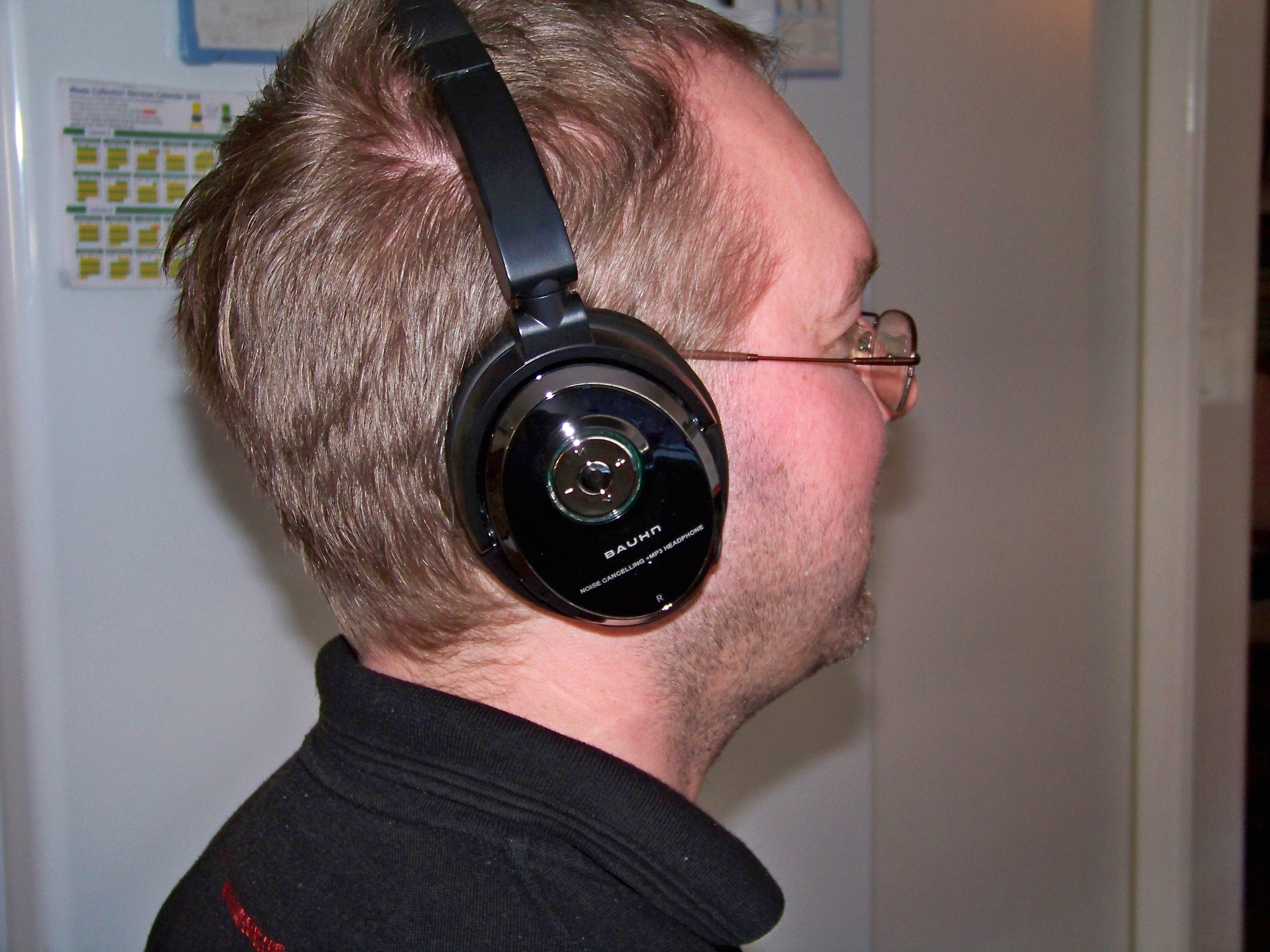
Me wearing Bauhn HeadphonesInside the case of Bauhn Noise Canceling Headphones showing the cable and connectorsOutside of the cases of Bauhn and Bose Headphones Overview The German supermarket chain Aldi has been running in Australia for 8 years now [1]. Their standard practice for a long time has been to offer regular special deals on a few items of consumer electronics every week, my chocolate fridge is one thing I bought from Aldi [2]. Today Aldi have started selling Noise Canceling Headphones [3]. These headphones are badged by Bauhn but that name is apparently applied to random products from cheap manufacturers, it may be an Aldi name that is applied to stuff that they sell. The headphones cost $69AU which is really cheap. But the deal will probably end in less than a week when stock runs out. Noise canceling headphones can be used in server rooms and other noisy environments. Every company that has a server room should buy a few sets. One of the features of noise-canceling is that it works best on low frequencies and on regular sounds it specifically doesn t block human voice well. In some noisy environments it will be easier to hear people talk if you wear such headphones! Noise canceling headphones are also very useful to people who are on the autism spectrum and other people who get more annoyed by noise pollution than average people. I have been wearing my Bose headphones on public transport and when walking around in the city, this not only stops traffic noise but it also helps to avoid people thinking that I want to talk to them. Features The first picture shows me wearing the Bauhn NC headphones, it s from the right to show the controls for the built-in MP3 player. I have not yet tested the MP3 functionality. It appears that as the controls are one power button, buttons for next/previous track, and for controlling the volume. This is fairly poor for MP3 functionality, ideally you would want to have a display to see a list of tracks, maybe have directories to store files, etc. I guess this could be a convenient feature on occasion, but you wouldn t buy the headphones for the MP3 functionality.
The next two pictures show a comparison of the Bauhn headset with the Bose QC-15 headset that I bought last year [4]. The cases of the Bauhn and Bose devices are almost exactly the same size and of a very similar shape, the Bose case is tapered and indented and also has a finer weave on the cloth covering it looks much nicer. Both devices come with an adapter for an airline socket and with a detachable cable. They also both have pouches attached to the inside of the case with velcro. But the Bauhn headphones come with an adapter for the 6.5mm TRS connector which could be convenient if you want to plug them in to a larger amplifier, the basic connector is 3.5mm in both cases. The Bauhn device uses a standard TRS connector at the headphone end while the Bose QC-15 use a special connector that matches the shape of the headset and which has a TRRS plug (to cater for the high/low volume switch), so it seems that a damaged Bauhn cable could be replaced cheaply while a replacement Bose cable would have to be purchased from Bose (presumably at great expense and delay). The Bauhn case also has a velcro attached pocket for storing business cards (or maybe a name tag or something). The supplied cable for the Bauhn is described as being 5 feet long which isn t quite long enough to reach a tower PC that is sitting on the floor. The Bose has a cable that is about a foot longer (maybe 6 feet total), but due to the non-standard connector you can t replace it. I presume that I could easily buy a 4 meter cable for the Bauhn headphones, but I could of course buy an extension cable to use with the Bose. Bose advertise the QC-15 headphones as having 35 hours of battery life from a single AAA battery. Aldi advertise the Bauhn headset as having 5 hours of battery life when NC is turned on and they use two AAA batteries. It s widely regarded that rechargeable batteries don t last as long as the batteries used for estimating the battery life (which presumably are the most expensive long-life batteries available). I ve found a single rechargeable AAA battery to last well over 5 hours in my Bose headphones, so it seems that battery life is considerably worse for the Bauhn device. One feature of the Bauhn device is that it can be used without any batteries for playing external music. The Bose headphones can t be used at all without a battery. So while the Bauhn will use the batteries faster it will at least be usable when the batteries run out. But if you are buying headphones for the purpose of avoiding noise then the Bose headphones are simply better. Comfort The Bose headphones have significantly deeper ear wells than the Bauhn about 23mm vs 18mm. If your ears stick out more than 18mm (as mine apparently do) then this is a good reason for choosing Bose. The Bose headphones are a tighter fit, the spring that pushes the ear-pieces together is stronger. But they have better padding so this doesn t cause me any discomfort. Also the Bose headphones have better passive noise reduction due to having a more snug fit around the ears. I ve worn my Bose headphones on a flight from the US to Australia with hardly a break and they were quite comfortable I would never want to do that with the Bauhn headphones. Noise Reduction I tested the Bose and Bauhn products against three noise scenarios, external music, an air-conditioner, and a car engine. The Bose headphones made good reductions of the noise from the external music (Numb by Linkin Park) and the air-conditioner. The Bauhn headphones did little to stop Linkin Park and was not very effective against the air-conditioner noise. I think that this is largely due to the lack of passive noise reduction, the air-conditioner in question makes little vibration noise and the sound of rushing air is generally immune to active noise cancellation. Both headphones were very effective when in a car with the engine idling. The engine noise of vehicles seems to fall in an ideal frequency range for active cancellation. Music Quality When listening to Youtube music played on my Thinkpad I could not notice any quality difference between the two sets of headphones. I did notice that the Bose headphones seemed to have a greater response in the higher frequency range, but that doesn t necessarily mean that one set is better than the other. Maybe if I was listening to FLAC0 encoded music that I had personally ripped from a CD then I would notice a difference. But for most people the Bauhn music quality should be good enough. Design Quality The Bose product is solidly designed, while the Bauhn product appears cheap in every way. Opening the battery compartment on the Bauhn headphones is difficult and if you do it wrong you could easily break the lid off, I expect that every set of Bauhn headphones that is used by children will be broken in a small amount of time but it should still be fully functional with a broken lid. The matt finish of the Bose headphones should hide minor scratches much better than the shiny Bauhn headphones. The Bauhn headphones also have lower quality plastic parts, it appears that the molds used were designed cheaply and without adequate care to prevent marking the final product. The design flaws that affect usage of the Bauhn product are the shallow ear wells, the poor fit of the cushions around the ears (which is probably mostly due to a weak spring pressing the ear cups to the wearer s head), and the battery compartment lid which is difficult to open and appears prone to breakage. The other flaws are all cosmetic. I wonder whether the Bauhn product was made by one of the big name manufacturers who deliberately reduced the quality to avoid competing with their more expensive products. It seems that the major flaws could have been corrected at design time with almost no increase in manufacturing costs. Recommendations If you can afford the Bose QuietComfort 15 Acoustic Noise Cancelling Headphones then they are really worth the extra expense, I have no regrets at all about spending about $320US (including tax) on my Bose QC-15. The Bauhn product is good for when you want something cheap, for example a set to be used in a server room, or for the use of children. I bought a Bauhn headset for a friend who is a pilot, he spent $1,100 on a noise-canceling headset for his plane but had never got around to buying one for recreational use I expect that he will allow his children to use his new Bauhn headphones, if they get broken it s only a $69 expense. The second cheapest NC headphones I ve seen on offer in Australia is Harvey Norman selling Phillips HN-110 Noise Canceling Headphones for $100AU [5]. Amazon sells Philips HN 110 Folding Noise-Canceling Headphones for $50US but doesn t seem to ship them outside the US (at least not to Australia). JB Hifi also has some NC headphones on sale in Australia [6], but they are more expensive at $219 for AKG and $319 for Sennheiser. Also the models they sell are on-ear which means that they will inherently have very little passive noise reduction and will also annoy anyone who doesn t like having their ears squashed. If I was buying NC headphones for my own use and didn t want to spend $300US then I would either buy the Philips HN 110 Folding Noise-Canceling Headphones from Amazon and get a friend in the US to post them to me or I would buy them from Harvey Norman. But the Bauhn product is good if you want cheap headphones to stop engine noise and give reasonable quality when playing music.

24 March 2010

John Goerzen: Review: Travel as a Political Act by Rick Steves

Rick Steves is known for writing books, and producing public TV shows, about travel to Europe. He encourages people to get out of their comfort zone, advocates staying in homes instead of hotels, and giving yourself permission to struggle to communicate in a land of unfamiliar language. That way, you get to experience not just the landmarks, but the culture and history. That was the approach we favored in our recent trip to Europe, and after being there (and seeing tour groups), I think Rick Steves is right on. On the plane to Europe, I read his Travel as a Political Act. This is not a guidebook, but more a book about the philosophy of travel. As usual with my book reviews, unless indicated otherwise, all quotes here come from the book. He starts out with this statement:
I ve taught people how to travel. I focus mostly on the logistics: finding the right hotel, avoiding long lines But that s not why we travel. We travel to have enlightening experiences, to meet inspirational people, to be stimulated, to learn, and to grow. Travel has taught me the fun in having my cultural furniture rearranged and my ethnocentric self-assuredness walloped.
I read this book mostly on the plane to Hamburg, or the week prior to leaving. I can credit Rick Steves directly for encouraging me to strike up a conversation with a random German on the bus from Hamburg to L beck, which I ll discuss here in a couple of days. Probably the biggest lament from Rick Steves is that the people that really ought to travel the ones that are so sure that their ways are correct and best are least likely to do so.
Make a decision that on any trip you take, you ll make a point to be open to new experiences, seek options that get you out of your comfort zone, and be a cultural chameleon trying on new ways of looking at things and striving to become a temporary local. My best vacations have been both fun and intensely educational Travel challenges truths that we were raised thinking were self-evident and God-given. Leaving home, we learn that other people find different truths to be self-evident. We realize that it just makes sense to give everyone a little wiggle room.
The book is set with an introductory encouragement to travel, followed by seven vignettes of different countries he s visited, and descriptions of how it s impacted him. He gave a lesson of the opening of the German Reichstag (parliament building), which he was present for in 1999. He was surrounded by teary-eyed Germans and a few tourists so preoccupied with trivialities forgotten camera batteries, needing a Coke, the lack of air-conditioning that they were missing out on this once-in-a-lifetime opportunity to celebrate a great moment with the German people. He comments that we can learn from other countries that no one country has a monopoly on good ideas, and it is plenty patriotic to insist what we adopt good ideas (such as drug policy) from other countries and adopt them for our own. Particularly touching to me was the description and photo of a memorial in El Salvador, very much looking like the American Vietnam memorial except that one remembering loved ones lost fighting the United States. How many Americans even know that we were involved in a damaging war in El Salvador? A large part of his book was, for me, preaching to the choir, as this comment illustrated:
In the European view, America is trapped in an inescapable cycle to feed its military-industrial complex: As we bulk up our military, we look for opportunities to make use of it. (When your only tool is a hammer, you treat every problem like a nail.) And then, when we employ our military unwisely, we create more enemies which makes us feel the need to grow our military even more. If an American diplomat complained to his European counterpart, America is doing all the heavly lifting when it comes to military, the European might respond, Well, you seem to be enjoying it. We re building roads and bridges instead.
That s a sentiment I ve agreed with for quite some time already, and as such, some parts of the book moved slowly for me though I imagine his target audience included people that had never seriously considered these arguments before. Then there were surprising facts:
by the end of World War I, an estimated half of all the men in France between the ages of 15 and 30 were casualties. When some Americans, frustrated at France s reluctance to follow us into a war, call the French surrender monkeys, I believe it shows their ignorance of history.
And again, I d agree with him on that point. The vignette on Iran was particularly interesting, as he described his experiences in person, they sounded far different than the picture we often get in the media. I have realized, incidentally, that I am terrible at writing book reviews. So rather than inflict more paragraphs upon you with this one, I ll summarize by saying that this is a touching, informative, and motivational book, which I highly recommend. I ll leave you with this quote:
Mark Twain wrote, Travel is fatal to prejudice, bigotry, and narrow-mindedness. These wise words can be a reallying cry for all travelers once comfortably back home. When courageous leaders in our community combat small-mindedness and ignorance travelers can stand with them in solidarity.
I didn t travel to make some sort of statement or as a political act. But I was enriched in many ways by travel of course the obvious ones of contemplating the history of a 900-year-old beautiful church, but also in seeing the different character of different cities, being with two families for a couple of days, and seeing different approaches to common problems. I am very glad I wasn t shut off from this behind a tinted window in a tour bus.

23 March 2010

Russ Allbery: Lintian 2.3.4

It's been nearly two months since the previous release, so lots had accumulated in the bug tracker. This release resolves a bunch of various false positives, fixes a few minor issues with the lintian.debian.org pages, and applies all the patches that were in the BTS that were ready to go in. It doesn't have any of the pending larger changes, since we wanted to get the smaller fixes out quickly. The current tentative plan is that the next release will be 2.4.0 and will include several large structural changes that various people have been working on, including the conversion of the manual to DocBook. All plans are, of course, pending finding enough time. It's amazing how effective Lintian can be given that it uses a bunch of guesswork and loose regexes to parse everything from init scripts to debian/rules files. We do have a bunch of accumulated wishlist bugs that aren't going to be fixed without writing better and more thorough parsing, particularly for shell scripts, but it boggles me just how far you can get with some dead-simple heuristics. Thanks very much to Adam D. Barratt and Raphael Geissert who have kept things going while I've been eaten by work, and particularly to Raphael for doing the last two releases and a ton of work with the security update.

22 March 2010

Russell Coker: Links March 2010

Blaise Aguera y Arcas gave an exciting demonstration of new augmented reality mapping software from Microsoft that combines video (including live video) with static mapping data and pictures [1]. This is a significant advance over current mapping systems such as Google Earth but it s not released yet either. It will be interesting to see whether Google or Microsoft gets this released first. The New York Review of Books has an insightful atricle by Garry Kasparov about human/computer chess [2]. It s surprising the degree to which a combination of human and computer chess playing can give a good result. Amateur human chess players plus regular PCs can beat grandmasters with computers or high-end computers with human help. It s apparently the quality of human-computer interaction that determines the quality of play. But the article contains a lot more, I recommend reading it. Daniel Kahneman gave an interesting TED talk about the difference between experiential and memory happyness [3]. As the concept of the moment is so short (about 3 seconds) apparently most people try to optimise their actions for the best memories of being happy. But to do so requires some different strategies. For example a two week vacation gives a memory that s not much different from a one week vacation. Therefore it seems that you would be better off staying in a five star hotel for a week than a four star hotel for two weeks, and eat dinner at a Michelin Star restaurant at least once per holiday even if it means eating at McDonalds on other occasions due to lack of funds. Temple Grandin gave an interesting TED talk The World Needs all Kinds of Minds [4] which mostly focussed on teaching children who are on the Autism spectrum. She is concerned that autistic children won t end up where they belong in Silicon Valley . Anupam Mishra gave an interesting TED talk about how the people of India s Golden desert built structures to harvest and store water [5]. Some of their ideas should be copied in Australia, due to mismanagement and stupidity Australians are failing to survive in much more hospitable places. Michael Tieman wrote an insightful and well researched article about the OSI s rejection of the IIPA s attacks on Open Source [6]. This is worth reading by anyone who wants to make a business or social case for free software. Mark Shuttleworth wrote an interesting post about the new visual style for Ubuntu and Canonical [7]. Apparently this includes the creation of a new font set which will be available for free use. Divorced Before Puberty an informative New York Times article by Nicholas Kristof about the links between treatment of women and terrorism [8]. The New York Times has an interesting article on Human Flesh Searches on the Internet in China [9]. It s basically crowds targetting people to find private information and harass them (similar to what some griefers are known for doing on the English-language part of the Internet). But they seem more interested in vigilante justice than lulz. The New York Times has an informative article about the Cult of Scientology (Co$) [10]. Among other interesting news it suggests that the number of cult victims in the US has dropped from 55,000 to 25,000 in the 2001-2008 time period. Senator Xenophon has called for an inquiry into the crimes committed by the cult and a review of it s tax-exempt status [11]. As always Xenu.net is the authoritative source for information on the Cult of Scientology AKA the Church of Scientology. The New York Times has an interesting article about formally studying the skills related to school teaching [12]. It largely focuses on Doug Lemov s Taxonomy of Effective Teaching describes 49 techniques that improve school results and some other related research. The article also mentions that increasing teacher salaries is not going to help much due to the large number of teachers, it s only professions that employ small numbers of people that can potentially have their overall skills improved by increasing salaries. Andy Wingo wrote an interesting article about Julius Caesar [13] based on the book The Assassination of Julius Caesar: A People s History of Ancient Rome by Michael Parenti. It seems that Caesar was more of a populist than a despot. Interesting article in The Register about the Large Hadron Collider (LHC) [14]. Apparently one 3.5TeV proton beam has as much energy as a British aircraft carrier running at 8 knots.

Christian Perrier: Amazing week in Khon Kaen for Thailand MiniDebconf

I'm now on my way back from The first miniDebCamp and miniDebconf that happened from March 13th to March 19th in Khon Kaen, Thailand. This even was organized locally by a team of very motivated Thai Debian enthusiasts and contributors, such as Theppitak Karoonboonyanan (*the* Thai DD), Neutron Soutmun, Kitt Tientanopajai, and all those whose name I'm not remembering as of now (I hope they won't mind). The even had kinda the structure of DebConfs, with a few days of "Debcamp" to begin. See the full schedule. We were hosted in Khon Kaen University (KKU), one one the most famous universities in Thailand, a small "town in town" in a city with a few hundred thousand inhabitants (dunno exactly). Lodging was done in a hotel located inside the university. Interestingly, the hotel was also hosting youg students participating to "Summer Camps" (apparently training systems to get good school results) gving to all this a very young atmosphere. The hacking lab and talks location was a 30-seat room in the university library, and meals were brought in there very efficiently, with the very specific way that Thai people have to transport each and every kind of meal (in small plastic bags closed by rubber). I arrived only in the 3rd day because I had commitments at home that made it impossible to me to come for the first day. During these days, people have been very busy hacking and participating to the Bug Squashing Party. During that BSP, about 50 bugs have been touched, without about 15 or so closed. Other non Thai attendees were Andrew Lee from TW, Paul Wise from AU, Daiki Ueno and Yukiharu Yabuki from JP. Organizers were expecting some attendees from neighbouring countries such as Laos, Vietnam or Cambodia. Unfortunately, none of them could come, including Anousak Soupavanh, leader of Lao free software localization efforts, who I was very impatient to meet. Transport difficulties, or visa problems, do not make things easy in that part of the world. On Wednesday we had a "DayTrip" as it is common for such event. We went abotu 50 km away from Khon Kaen, to visit a nice place, close to a dam lake, and climbed a hill surrounded by a big temple and a giant Buddha statue. Then we had a wonderful lunch in a fish restaurant in the very specific Thai way to share stuff: everything is on the table and you pick your food here and there, at you rconvenience. Of course, local advice before trying apparently innocent food is always worth it because the fire might be hidden anywhere (for instance in that soja plate which I tried and that set my mouth as a burning hell for 20 minutes). The journey ended by a visit of a great temple in Khon Kaen and, very noticeably by a dinner in a very popular barbecue restaurant in "all you can eat" style for...100Bath (so, about 2.5 euros). Maybe only vegetarian people had more trouble enjoying the meal as it was mostly made of various meat (and sea food). The talk days were very intense, at least in my opinion. Probably because I ended up giving four talks, some of them completely improvised (about IP-over-DNS, which I was using at the hotel and about which many wanted to learn a little bit more, and GPG keysigning processes). It turned out that the GPG talk was well received and, discussing with Paul later on, we agreed that such a talk, mostly meant to explain the DOs and DON'Ts For good GPG keys signing, could be a good idea even for Debconfs. There were also a few talks about local initiatives and efforts to develop (and not only promote) free software. We have no recordings of these talks as we were infortunately missing some video recording installation (maybe next time, Thep) just like the miniConf that was happening in Panama at about the same time was having. Due to local regulation on the university network, we had some limitations with Internet access (some firewalling that for instance was preventing SIP to work properly, which made a video-conference with a japanese user group fail, unfurtunately). The event ended in a round table discussion about ideas to organize something bigger in the future. The local community in Thailand has apparently the energy, maybe ressources and local support to be able to organize a slightly bigger event as first try (somethign like an Asian DebConf or something similar, targeting mostly Asian contributors and about 50-100 people. Thailand seems to be a good target to host such event, with many things being relatively inexpensive (and not only beer!). And they even think about possibly hosting a Debconf at some time in the future (actually, Martin Krafft should also be credited for bringing this idea). That isn't as crazy as it seems and, provided that potential organizers start involving themselves in the current Debconfs, everything seems to be possible. After all, if we look back to 2005, only one person (hello, Safir) was seriously thinking that Debconf could really happen in Bosnia and Herzegovina, right? After this week (followed by 2.5 days of sightseeing in Bangkok for me, plus a small meeting today with local Thai Linux corporate users and IT company owners), I feel like the mood in Asia about Debian development is high and full of potential. The miniconf last year in Taiwan was already a good success, by establishing a good connection between people.....we need to keep that alive and, hopefully, there will be other miniconfs in this part of the world. And, well, if I can be there, I'll be there.

Andrew McMillan: The cost of crap

For several years now we've been buying our groceries online. It's worked well, and for the last couple of christmases I remember Heather adding a six-pack into the pre-christmas order so she could pull it out and hand it off to the delivery guy. Fair enough too, because he was their front-line man. He was the guy who had to actually meet the customer, and even if only for two minutes face time, the impression he gave with his cheery "seeya mate" on the way out, and his always-happy smile, was that getting the groceries delivered was fun. Well that ongoing encouragement has gone now. His surly replacement who moans about having to carry the boxes up a flight of stairs does nothing to promote a repeat experience, and he brings into sharp focus the disadvantages of online grocery ordering: sometimes the wrong thing is substituted, or sent. Or the fruit doesn't travel quite so well as it does with the personal loving kindness we supply in our own padded wagon. Two visits from the new guy, and we're back to driving to the supermarket ourselves, patrolling the aisles once more in a cereal haze of consumer demand. Distress-purchasing done, and back to the car A.S.A.P. Carrying our own boxes up the stairs. I hate it, which is why I promoted the idea that we try this online grocery thing a few years ago, and it's worked just fine until this sullen bastard came along and destroyed the fun. I wonder how the company feels? Do they realise what this person is doing to their customers? Will they notice, and if they do, will they even be able to tell where the source of the problem is? In these days of increasing online experience, customer service is still important, if not more important than ever before.

Next.

Previous.