Search Results: "agi"

31 December 2012

Russell Coker: Modern Swap Use

A while ago I wrote a blog post debunking the idea that swap should be twice as large as RAM [1]. The issue of swap size has come up for discussion in a mailing list so it seems that it s worth another blog post. Swap Size In my previous post I suggested making swap space equal to RAM size for systems with less than 1G of RAM and half RAM size for systems with 2-4G of RAM with a maximum of 2G for any system. Generally it s better to have the kernel Oom handler kill a memory hungry process than to have the entire system go so slow that a hardware reset is needed. I wrote memlockd to lock the important system programs and the shared objects and data files they use into RAM to make it easier to recover from some bad paging situations [2], but even that won t always make it possible to login to a thrashing system in a reasonable amount of time. But it s not always good to reduce swap size. Sometimes if you don t have enough swap then performance sucks in situations where it would be OK if there was more swap. One factor in this regard is that pages mapped read-only from files are discarded when there is great memory pressure and no swap space to page-out the read-write pages. This can mean that you get thrashing among memory for executables and shared objects while there s lots of unused data pages in RAM that can t be paged out. One noteworthy corner case in this regard is Chromium which seems to take a lot of RAM if you have many tabs open for a long time. Another factor is that there is a reasonable amount of memory allocated which will almost never get used (EG all the X based workstations which have 6 gettys running on virtual consoles which will almost never be used). So a system which has a large amount of RAM relative to it s use (EG a single-user workstation with 8G of RAM) can still benefit from having a small amount of swap to allow larger caches. One workstation I run has 8G of RAM for a single user and typically has about 200M of the 1G swap space in use. It doesn t have enough swap to make much difference if really memory hungry programs are run, but having 4G of memory for cache instead of 3.8G might make a difference to system performance. So even systems which can run without using any swap can still be expected to give better performance if there is some swap space for programs that are very inactive. I have some systems with as much 4G of swap, but they are for corner cases where swap is allocated but there isn t a lot of paging going on. For example I have a workstation with 3G of RAM and 4G of swap for the benefit of Chromium. Hardware Developments Disk IO performance hasn t increased much when compared to increases in RAM size over the last ~15 years. A low-end 1988 era hard drive could sustain 512KB/s contiguous transfer rates and had random access times of about 28ms. A modern SATA disk will have contiguous transfer rates getting close to 200MB/s and random access times less than 4ms. So we are looking at about 400* the contiguous performance and about 10* the random access since 1988. In 1988 2MB was a lot of RAM for a PC, now no-one would buy a new PC with less than 4G so we are looking at something like 2000* the RAM size in the same period. When comparing with 1993 (when I first ran a Linux server 24*7) it was 4M of RAM, maybe 15ms random access, and maybe 1MB/s contiguous IO approximately double everything I had in 1988. But I ll use the numbers from 1988 because I m more certain of them even though I never ran an OS capable of proper memory management on the 1988 PC. In the most unrealistically ideal situation paging IO will be a factor of 5* more expensive now relatively than it was in 1988 (RAM size increase by a factor of 2000 divided by contiguous IO performance increase by a factor of 400). But in a more realistic situation (random IO) it will be 200* more expensive relatively than it was. In the early 90s a Linux system with swap use equal or greater than RAM could perform well (my recollection is that a system with 4M of RAM and 4M of active swap performed well and the same system with 8M of active swap was usable). But nowadays there s no chance of a system that has 4G of RAM and 4G of swap in active use being usable in any way unless you have some corner case of an application allocating RAM and not using it much. Note that 4G of RAM doesn t make a big system by today s standards, so it might be reasonable to compare 2M in 1988 to 8G or 16G today. But I think that assuming 4G of RAM for the purpose of comparison makes my point. Using Lots of Swap It is probably possible to have some background Chromium tabs using 4G of paged out RAM with good system performance. I ve had a system use 2G of swap for Chromium and perform well overall. There are surely many other ways that a user can launch processes that use a lot of memory and not use them actively. But this will probably require that the user know how the system works and alter their usage patterns. If you have a lot of swap in use and one application starts to run slowly you really don t want to flip to another application which would only make things worse. If you use tmpfs for /tmp then you need enough swap to store everything that is written to /tmp. There is no real upper limit to how much data that could be apart from the fact that applications and users generally don t want to write big data files that disappear on reboot. I generally only use a tmpfs for /tmp on servers. Programs that run on servers tend not to store a large amount of data in /tmp and that data is usually very temporary, unlike workstation users who store large video files in /tmp and leave them there until the next reboot. Are there any other common corner cases that allow using a lot of swap space without serious performance problems? My Swap Space Allocation When I setup Linux workstations for other people I generally use 1G of swap. For a system that often has multiple users (via the user-switch feature) I use 2G of swap if it only has 3G of RAM (I run many systems which are limited to 3G of RAM by their chipset). For systems that I personally use I generally allocate 4G of swap, this is to cater to excessive RAM use by Chromium and also because I test out random memory hungry programs and can t easily predict how much swap space will be needed a typical end-user desktop system is a lot more predictable than a workstation used for software development. For servers I generally allocate 512M of swap space. That s enough to page out things that aren t used and make space for cache memory. If that turns out to be inadequate then it s probably best to just let the watchdog daemon reboot the system.

29 December 2012

Russell Coker: Samsung Galaxy Camera a Quick Review

I recently had a chance to briefly play with the new Samsung Galaxy Camera [1]. The Galaxy Camera is an Android device with a 4.8 display (the same size as the Samsung Galaxy S3) that has a fairly capable camera (IE nothing like a typical phone camera). It runs Android 4.1 (Jelly Bean) and the camera has 21* zoom with a 16 megapixel sensor. Camera Features It seems that professional photographers are often annoyed when they see someone with a DSLR set in auto mode. It s widely regarded that auto mode is a waste of a good camera, although the better lenses used with DSLRs will usually give a better result than any compact camera even when it s in auto mode. The problem is that photography is quite complex, in an earlier post about digital cameras I summarised some of the technical issues related to cameras and even without any great detail it became a complex issue [2]. The Galaxy Camera has a reasonably friendly GUI for changing camera settings which even includes help on some of the terms, I expect that most people who use it will end up using most of the features which could make it a good training camera for someone who is going to move to a DSLR. A DSLR version of the Galaxy Camera could also be an interesting product. The camera also has modes such as Waterfall and Panorama , hopefully the settings for those would be exposed to the user so they could devise their own similar groups of settings. I ve seen the phone criticised for the lack of physical controls as the expert mode in software is inherently slower than manually turning dials on a DSLR. But it seems obvious to me that anyone who knows how to use the controls manually should be using a DSLR or bridge camera and anyone who doesn t already know how to do such things will be better suited by the software controls. It supports 120fps video at 720*480 resolution (with a file format stating that it s 30fps to give 1/4 speed) which could be useful. I used to have a LG Viewty smart-phone that did 120fps video but the resolution was too low to be useful. 720*480 is enough resolution to see some detail and has the potential for some interesting video, one use that I ve heard of is filming athletes to allow them to analyse their performance in slow motion. It also does 60fps video at 720p (1280*720) resolution. One down-side to the device is that the lens cover doesn t seem particularly sturdy. It s quite OK for a device that will be stored in a camera case but not so good for a device that will be used as a tablet. I didn t get to poke at the lens cover (people don t like it if you mess with their Christmas presents) but it s design is a couple of thin flaps that automatically retract when the camera is enabled which looks quite weak. I d like to see something solid which doesn t look like it will slide back if the device is treated as roughly as a phone. I think that the lack of a solid lens cover could be the one factor that prevents it from being used as a replacement for a smart phone. Apart from that a Galaxy Camera and a cheap GSM phone could perform all the functions of a high end phone such as the Galaxy S3 while also producing great pictures. It would probably make sense for retailers to bundle a cheap phone with a Galaxy Camera for this purpose. Tablet Features The device boasts WiFi Direct to allow multiple cameras and phones to talk to each other without a regular WiFi access point [3]. I didn t test this and I don t think it would be particularly useful to me, but it seems like a handy feature for less technical users. It can connect to the Internet via Wifi or 3G, supports automatic upload of pictures (it comes with Dropbox support by default like the Galaxy S3), and has a suite of photo and video editing software. I don t expect that any photo editing software that runs on an Android device would be much good (I think that you really need fine cursor control with a mouse and a high resolution screen), but it would probably be handy for sending out a first draft of photos. Most Android apps should just work, the exceptions being apps that rely on a camera that faces the user or full phone functionality. So the Galaxy Camera can do almost anything that an Android phone or tablet can do. Value The RRP for the Galaxy Camera is $599, that puts it in the same price range as a DSLR with a single lens. While that s not a bad price when compared to smart-phones (it s cheaper than the LTE version of the Galaxy S3 phone) it s still quite expensive for a camera that s not a DSLR. Fortunately Kogan is selling it for $469 and has free shipping at the moment [4]. This still makes it more expensive than some of Bridge Cameras which probably have significantly better optical features, but in terms of what the typical user can do with a camera the Galaxy Camera will probably give a much better result. The sensor in the Galaxy Camera is smaller than that in the Nokia 808 PureView [5] (1/2.3 vs 1/1.2 ) so the Nokia PureView should be able to take better pictures in some situations. Unfortunately the Nokia 808 doesn t run Android, I d probably own one if it did. Some of the reviews are rather harsh, the Verge has a harsh but fair review by Aaron Souppouris which makes a number of negative comparisons to cheaper cameras [6]. I really recommend reading Aaron s review as there s a lot of good information there. But I think that Aaron is missing some things, for example he criticises the inclusion of ebook software by saying that he wouldn t read a book on a camera. But the device is a small tablet computer which also has a compact camera included. I can easily imagine someone reading a book or playing Angry Birds on their camera/tablet while in transit to where they are will photograph something. I can also imagine a Galaxy Camera being a valuable tool for a journalist who wants to be able to write short articles and upload pictures and video when out of the office. Aaron concludes by suggesting that the Galaxy Camera is a $200 camera with $300 of editing features. I think of it as $200 in camera hardware with software that allows less skilled users to take full advantage of the hardware and the ability to do all the software/Internet things that you would do on a $450+ smart-phone. Would I Buy One? No. The Galaxy Camera is among other things a great toy, I d love to have one to play with but I can t spare $469 on one. Part of the reason for this is that my wife just bought a DSLR and is getting lessons from a professional photographer, so I really won t get better pictures from a Galaxy Camera. The DSLR on auto mode will allow me to take pictures that will usually be better than a Galaxy Camera can achieve (sometimes you just can t beat a good lens). For more demanding pictures my wife can tweak the DSLR. The 120fps video is a really nice feature, I don t know if my wife s DSLR can do that, but it s a toy feature not something I really need. I ve just bought a Galaxy S3 which is a great little tablet computer (most of the time it won t be used for phone calls). I don t need another 4.8 tablet so a significant part of the use of the Galaxy Camera doesn t apply to me. I recommend the Galaxy Camera to anyone who wants to take good photos but can t get a DSLR and lessons on how to use it properly. But if you would rather get a 35mm camera with interchangeable lenses that runs Android then it might be worth waiting. I expect that the Galaxy Camera will be a great success in the market (it s something you will love when you see it). That will drive the development of similar products, if Samsung doesn t release a 35mm Android camera soon then someone else will (for example Sony develops both high end cameras and Android phones). If my wife didn t have a DSLR then I d probably have bought a Galaxy Camera already. I will recommend it to my parents and many other people I know who want an OK camera and can benefit from a tablet, but don t know how to use a DSLR properly (or don t want to carry a bulky camera).

Steve Kemp: More polish for slaughter

A couple of days ago I made a new release of slaughter, to add a new primitive I was sorely missing:

if ( 1 != IdenticalContents( File1 => "/etc/foo" ,
                             File2 => "/etc/bar" ) )
 
   # do something because the file contents differ
 
This allows me to stop blindly over-writing files if they are identical already. As part of that work I figured I should be more "visible", so on that basis I've done two things: After sanity-checking my policies I'm confident I'm not leaking anything I wish to keep private - but there is some news being disclosed ;) Now that is done I think there shouldn't be any major slaughter-changes for the forseeable future; I'm managing about ten hosts with it now, and being perl it suits my needs. The transport system is flexible enough to suit most folk, and there are adequate facilities for making local additions without touching the core so if people do want to do new things they don't need me to make changes - hopefully. ObQuote: "Yippee-ki-yay" - Die Hard, the ultimate Christmas film.

John Goerzen: Milk, Cookies, and Delight

Sometimes an attic is all it takes to delight children. This afternoon, the boys and I made cookies. Jacob has been talking about setting out milk and cookies for Santa Claus for several days, and of course the fact that we had made cookies reminded him of this as I figured it would. So after the boys got into their pajamas and all ready for bed, we set out milk and cookies for Santa. The boys have always known that Santa is pretend, but love the stories and traditions anyhow. Never mind that Christmas was 3 days ago, and they ve already opened their presents. It s SANTA! It s magic! It doesn t matter! I asked Jacob, Would you like me to pretend to be Santa tonight? A big grin, then Oh yes, dad! Do it! So after I read them their bedtime story, sang them a song (Jacob chose a Latin hymn that s my boy!), and tucked them into bed, I pretended to be Santa. I went back downstairs. I drank the milk and ate the cookies. Then I went to my small future present stash, selected a few small items, and put them under the tree. I gave it a few minutes. Then I crept up to the attic. I snuck along the wood floors quietly, until I was above the boys room. Then I jumped. And I scraped a wood chair along the floor. And then I yelled out HO HO HO! Merry Christmas! I had a brief conversation with Rudolph, then made some sliding noises. I was silent for a few seconds, then made some more noise and said, Wow, Rudolph, Jacob and Oliver left some great milk and cookies! Let s go deliver the rest of our presents! And made some vague sleigh taking off from the roof of a house noises. I crept back down the stairs. I put my ear to the outside of the closed door to the boys bedroom. I heard Jacob excitedly jabbering, He said milk and cookies! He liked them! He really liked them! Ooo butterfly, he was here! (Butterfly is a stuffed, er, butterfly that he sleeps with.) I gave it a minute or two, then I went in. Jacob, did you hear something? Yes! What was it? Well, it was a loud thud! I sat straight up like this. [ he demonstrates ] Then I heard ho ho ho ! And milk and cookies ! And I was excited like this! [ more demonstrations ] What do you think happened? I don t know! Dad, what did you do? I told him. It only increased his delight. Did it sound like Santa s sleight landing? (annoyed) No, dad. It sounded like a crash. (brightening) And then Santa coming down the chimney with presents! Oh, it is so exciting! (We don t have a chimney) It was still magical, even though he knew exactly what happened. For his part, Oliver slept through it all. He will still discover the empty plate, empty cup, and slightly less empty area underneath the tree. And neither boy knows about the thank you note from Santa yet. I anticipate smiles in the morning!

28 December 2012

Guido G nther: GNOME Shell and On Screen Keyboard

Running Debian on the WeTab with GNOME Shell without an external keyboard works pretty nicely. The on screen keyboard - if enabled via the accessibility menu - folds out automatically in the shell itself within text input fields. To have this within GTK+3/GTK+2 applications you need libcaribou-gtk3-module and libcaribou-gtk-module installed. For other cases I stitched together a small extension that puts a keyboard "Button" prominently into the middle of the panel. Clicking/touching it will fold it out, clicking again will hide it again. You can fetch it from
git clone git://honk.sigxcpu.org/git/gnome-shell-oskb-extension.git ~/.local/share/gnome-shell/extensions/OnScreenKeyboardButton@sigxcpu.org
and activate it via
 gsettings set org.gnome.shell enabled-extensions "['OnScreenKeyboardButton@sigxcpu.org']"
OSK Button Screenshot For kinetic scrolling in Iceweasel I'm currently using Grab and Drag which is not yet packaged for Debian. Thanks to the Debian's GNOME packaging team gnome-shell 3.6 is already available in experimental. This blog is flattr enabled.

Hideki Yamane: How to associate with distribution


I know there is a reason why you rebuild/create your own packages.

  • Unfortunately, there's no official package that is necessary to provide service to your customers
  • distro package is not suitable for your purpose by default
    • maybe since its features
    • maybe since performance issue


However, I want to ask you one question.
Is it necessary that you'd maintain it in your private repository?
Because create custom package repository is a kind of "fork"


  • Of course, you can do folk. But if you don't want to be "upstream", every time you need to follow your upstream to fix bugs, vulnerabilities and introduce new features. Important: Merge cost would become larger and larger from the time you did folk.
  • It's best that if your system can be used "out of box", but you need to modify packages for some reason (as above).
    Then, what would you do? - minimize
    • minimize numbers of private package
      = reduce maintenance cost
    • minimize diff with distro package
      = minimize diff with upstream = reduce maintenance cost

If you could minimize diff with distro, you can update and introduce new attractive features from updated distro package easily (maybe you don't need to maintain your custom package since its feature is merged to upstream).

Yes, you can get Agility.


And, if you would put your package to Debian official repository, we Debian can give you below benefits

  • build daemon with many architectures
  • open bug tracking system
  • world wide mirror network
  • security vulnerabilities tracker
  • users

  1. We can provide build system, including non-x86 arch (none of you have thought arm* architecture become important, right?) You can deal with porting as daily job, no huge jump to support newer architectures. It also brings the view to build cleaner structures in your code.
    It is much work to setup such system, but you can use it without any trouble.
  2. You can get bug report/wishlist/patches from Debian BTS (without any pay for it! :-)
    It will help you to improve software packages, it cannot be sent to you if you would put packages to closed private repository.
  3. Package is mirrored to many repositories in world wide. Robust. You can get binary/source code immediately, anywhere. No need to backup your package source.
  4. Any CVE is tracked. You can analyze security status in your system easily (it means you don't need to pay much money to build such system)
  5. Debian has huge user base. It would work as good "showcase" test (of course, without any pay for it...)


Conclusion)

It's okay to create/modify package. It's FLOSS. As you like! :)

However, to maintain custom package, you need to pay its cost (someone should work for it. If it's in only your own repository, it means you should work, no one can help it).

To maintain packages in distro can reduce its cost, can get many benefit - Less cost, more benefit - why not? Let's get involved to distribution!

27 December 2012

Tanguy Ortolo: Tiling window managers

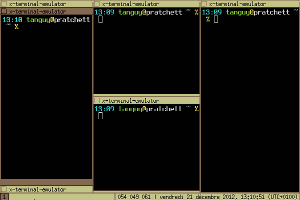
Floating and tiling window managers In the X Window System, the window manager is that piece of software that places your windows and allows you to move them, resize them, hide them, etc. If your windows have titles on top of them, with buttons to close them or reduce them, it is thanks to the window manager. There are two major types of window managers:
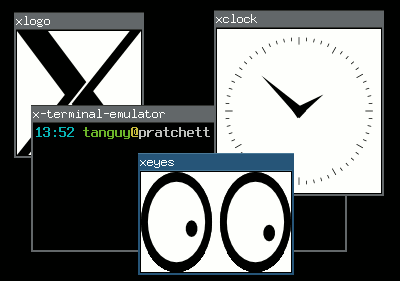
Floating window managers
They are the most usual window managers, that allow you to place an size your windows freely on the screen, in a way where they are independent of each other, possibly overlapping, just as you would be able to place sheets of paper on your desk.
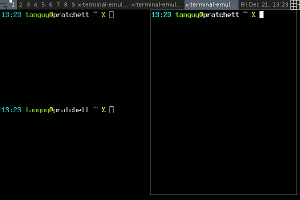
Tiling window managers
They are a more elitist type of window manager, that adjust the size and position of the windows so there is no overlapping and no space lost between windows, thus tiling the screen.
Four computer windows managed in floating mode

Floating window management

Four computer windows managed in tiling mode

Tiling window management

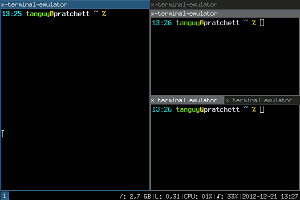
The frontier between these two types is not very tight, because some floating window managers have limited tiling features, and almost all the tiling window manager have floating modes for programs that are not adapted to tiling. For what it is worth, here is a report on my experience with three tiling window managers. Perhaps it may help people that are still hesitating to switch to tiling window management?Using tiling window managers Five years ago I switched to tiling window management, feeling that managing windows was the window manager's job (a quote from larswm). At that time, I started using wmii, then switched to awesome, and now I am trying i3.
Screenshot of the wmii window manager

wmii: three columns, first one stacked ()

Screenshot of the awesome window manager

awesome: fair layout

screenshot of the i3 window manager

i3: three containers, second one stacked, third one tabbed

For people in a hurry, here is a comparative table:
wmii awesome i3
Configuration Shell script Lua script config file
Scriptability any language, 9P-based Lua, API-based any language, socket-based
Layout simple, column-based automatic layout-based flexible, manual tiling-based
Multi-monitor sucks OK OK
Modern stuff XCB, Xft, notification area, dock windows XCB, Xft, notification area
Special features
  • tag-based workspace system
  • XDG convention to locate the config file
  • real framework for customization
  • powerful status bar
wmii wmii is a rather minimalist window manager which used to be part of the suckless project, but is now hosted at Google Code and seems to have lost all its documentation during the move (why is it that all the software I have seen hosted at Google Code or worst, at Launchpad, have almost not documentation, and never, ever a single screenshot?). It uses a column-based layout: you place windows in a number of columns, and for each column you can choose either vertical split, stacking or full column mode. This system is very simple to control flexible enough for most situations, but it does not allow for arbitrary tiling. It is fully scriptable in any language, in an interesting way: it exposes all its functions on a 9P virtual filesystem. In fact, wmii itself only implements window management functions, and all the user interaction logic takes place in a distinct script which calls that functions using that 9P filesystem. wmii comes with a default script, written in shell, which makes it a bit hard to extend, and slow if you start calling external programs such as grep, sed and co. You can script it in any language you like however, and there are some already made implementations in Ruby and Python IIRC. A special feature of wmii is that its workspaces are in fact tags, and that you can tag a window so that it will appear in several ones. While this is interesting, in practice I did not find much use for that feature. It is explicitly minimalist, and the developers used to impose themselves a limit on its numbers of lines of codes (not sure if this is still true with the switch to Google Code). While I was using it, it had no notification area, no support for Xft fonts and it sucked with multiple monitors, which is the reason I switched to awesome. awesome awesome is a very flexible window manager that provides advanced automatic layouts. It has become quite popular, and it has a very well documented wiki. It is not officially a tiling window manager but a framework window manager, and to emphasize on that it start in floating mode by default. I think most people use it in tiling mode however. It uses automatic layouts, that place your windows according to rules, for instance the fair layout, which tiles in columns and rows so that each window occupies a similar space. Thanks to that automation, this system is very easy to control and to get used to, and although it certainly does not allow arbitrary tiling, you can cycle between several available layouts which are suitable for most situations (most of them are entirely automatic, but some have parameters you can modify, such as the number and width of columns), and if you miss one, I think you can even code your own. It is fully scriptable using the Lua language. In fact, just as wmii, the user interaction logic is defined in the configuration file, which allows efficient customization. The Lua API is fully documented, and there is a series of useful libraries to extend the basic configuration in any way you like, which is why awesome calls itself a framework window manager . It is not designed to be minimalist, and it implements some modern stuff, such as using XCB rather than Xlib, a notification area, and specific support for dock or utility-type windows such as GIMP's tools. i3 i3 is a window manager inspired by wmii, although they do not have much in common in my opinion. for what I have seen, I think it would be closer the defunct Ion. It uses a layout based on manual splitting: as you open windows you can choose to split an existing window either vertically or horizontally, leading to arbitrarily complex layouts. In addition to that you can tab or stack windows in containers instead of splitting them. This system is very flexible but it requires more user intervention. In its standard mode of operation, i3 is simply configured in a regular way, which allows to customize the user interaction but not to script it in an arbitrary way. It offers an IPC system that can be used for that however, by the mean of a Unix socket, so it can actually be scripted in any language too if needed, although this possibility is probably not as popular and easy as with wmii and awesome. It implements modern features such as XCB, a notification area and a powerful status bar that uses the standard output of a dedicated program that is easy to replace by your own if you need.

25 December 2012

Russ Allbery: Review: A Paradise Built in Hell

Review: A Paradise Built in Hell, by Rebecca Solnit
Publisher: Penguin
Copyright: 2009
Printing: 2010
ISBN: 0-14-311807-2
Format: Trade paperback
Pages: 319
A Paradise Built in Hell is a book with an agenda. Solnit's goal is to convince the reader that nearly everything we're shown in movies and popular culture about human behavior during disasters is wrong. Not only is destructive mass panic unusual verging on nonexistent, spontaneous cooperation and acts of startling courage and resourcefulness are commonplace. The heroes that we hear about afterwards are more the norm than the exception. Disasters are far more likely to bring out the best in people than the worst. They break down barriers and form spontaneous human communities that survivors remember for a lifetime. Rather than natural disasters leading inevitably to an exacerbating human crisis in the absence of strong authority, Solnit argues that they are an amazing human opportunity, and that the most negative and destructive human behavior during crises is not from untrained victims but from the panic of the elites who are supposedly responsible for protecting the public. I think her analysis and presentation is both deeply appealing and deeply flawed. The flaws involve extrapolation and generalization beyond the applicability of her research, and I'll say more about that in a moment. But the appeal is still surprising and satisfying, and I think there's a lot of truth in this book despite its one-sided presentation. I like to tell people, half-jokingly, that I'm an anarchosyndicalist. It's my political alliegance of the heart: the political structure that I know would never work, but that matches the world I want to live in. (I suspect much of the belief in libertarianism is of this form.) Now I have a book to point people at when they ask what the appeal of anarchosyndicalism is. The sense of spontaneous community, of bonding, of reaching out to other people to do something necessary, together, that Solnit describes here in the aftermath of a disaster matches that vision of a world without imposed economic authority, where people spontaneously collaborate to solve problems. A Paradise Built in Hell is structured by disaster, providing a tour of major disasters and their aftermath interspersed with extended musings on what the human reactions mean and how disaster communities functioned. The major disasters discussed are the 1906 San Francisco earthquake, the Halifax explosion, the 1985 Mexico City earthquake, 9/11, and Hurricane Katrina. Solnit moves through them in chronological order, closing the book with Katrina, which had (at least for me) the most infuriating and uplifting mixes of community bonding and elite panic. But both of those factors are present from the beginning in the 1906 earthquake: spontaneous human organization that (from multiple first-hand accounts) transformed people's lives mixed with a military reaction and elite panic that possibly did more damage to the city than the earthquake did. Elite panic is the dark side of Solnit's celebration of human altruism and spontaneous community organization. The primary picture she paints is of ordinary people responding with great courage and creativity and finding, in their reaction, a transformative experience and a sense of purpose that often becomes the most powerful and positive experience of their life. But this is at odds with a deeply-entrenched elite belief in mass panic, in the necessity of keeping information from the public to suppress their reaction, and in the need to re-establish "order." And with that, Solnit is absolutely scathing, and with some justification. Along with detailed accounts of these major disasters, Solnit also gives the reader a tour of the research literature on disasters, research that has shown that the panic and chaos that is at the center of practically every disaster movie ever made is essentially a myth. Mass panic in disasters is not only rare, it's close to non-existent. As you might expect, the handling of Katrina by both the government and by neighboring white communities is the subject of the harshest attacks. The material on Katrina presented here is enough to make anyone want to throw out the current playbook on how we react to disasters (and lest one think Solnit is unfair, her research matches very closely with other research and journalism on Katrina that I've seen from a wide variety of sources). But Solnit shows that this is a pattern: the combination of our media-driven belief in how people will react to disasters combined with the elite need to re-establish control plays out in many major disasters, and almost always negatively. Even in 9/11, the official response in some cases hampered and undermined an already-effective unofficial response. This is very interesting and has concrete implications for public policy around disasters. But where Solnit moves onto thinner anarchosyndicalist ice is the story that she tells about disasters as dramatic upheavals of the established social order that could point to a revolution in how we interact with each other. Solnit is deeply inspired by human altruism during disasters, and her enthusiasm is somewhat contageous, but it was useful to read this book shortly after Bruce Schneier's Liars and Outliers. I think Solnit, in her understandable eagerness to find a way to extend disaster behavior to general life, does not understand the relationships between what Schneier terms moral, reputational, and institutional pressures. And that's the core of why we need to both enable spontaneous human response in disasters and have organized first responders and supporting infrastructure, and why disaster communities will break down when extended beyond the disaster. When I first mentioned A Paradise Built in Hell to my mother, her first reaction was dubiousness due to her memory of the 1977 New York City blackout. There was a disaster that resulted in widespread looting and destruction, rather than the positive reaction Solnit describes. Solnit does have a cogent argument for why looting is poorly analyzed (we don't, for example, distinguish between breaking into stores to get desperately needed supplies and doing so for personal gain) and should not be a priority in a life-threatening disaster. But it's not completely convincing; in some disasters, particularly ones like the 1977 power outage that were not particularly life-threatening, the looting has been the most destructive part of the disaster. Schneier provides what I think is the missing piece, both to this and to why the wonderful behavior during disasters doesn't last into everyday life. During a life-threatening disaster, moral pressures are massively increased. Nearly all of us have self-images and moral beliefs that provide very strong incentives to help others and collaborate in the face of life-threatening emergencies, incentives that override other motives and lead to the sort of behavior that Solnit celebrates. But moral pressures have inherent limitations. That moral reaction applies most strongly to small groups (such as bands of survivors), and will start to break down as larger society re-establishes itself. And disasters, like a power outage, that are not immediately life-threatening will not provoke the same intensification of moral pressures: we don't have strong moral beliefs and internal stories about staying quietly at home during power outages the way that we do for saving people from burning buildings or pulling them out of rubble. Once larger communities have reformed and that short-term emergency reaction has dissipated, the need for institutional pressures (police, law, and formal authority structures) will return. I wish Solnit had been able to read Schneier's book before writing hers. I think his analysis structure provides a healthy dose of realism and perspective to her desire for a self-organizing communal world, and might have blunted her enthusiastic but somewhat unrealistic hopes for finding some key to a revolution in human organization in the heart of disasters. But if A Paradise Built in Hell is unlikely to lead to a radical change in how we organize societies, it should at least provoke a radical rethinking of some of our unnecessary pessimism about our fellow humans. The evidence is substantial and compelling: crisis brings out the best in people, not the worst, and the ordinary people who happen to be around are capable of becoming some of the most amazing disaster response teams that we can imagine. This has numerous mundane implications for social policy. We should consider simple training for the general public, for example, to strengthen that reaction, should allow for it in legal structures and training of first responders (around looting, for instance), and should do everything we can to kill the destructive myth that people cannot be trusted in disasters or that mass panic will be as much of a threat as the disaster. But the best part of this book is that it provides a concrete, well-documented, and well-defended reason to let go of some of our cynicism and to extend a bit of trust to our fellow humans. There sadly aren't earth-shaking implications for everyday society, but there is a wealth of evidence that shows that we're better people in the crunch than we believe we are, or that we expect of others. And the more that we can embrace the dissolution of boundaries and social hierarchies in the middle of disasters, the more we are likely to be surprised by deep human connection and a sense of shared, focused purpose. Solnit is a bit long-winded with her agenda, but that bright hope has stuck with me. Recommended. Rating: 8 out of 10

23 December 2012

Russ Allbery: Review: Alpha and Omega

Review: Alpha and Omega, by Patricia Briggs
Series: Alpha and Omega #1
Publisher: Berkley
Copyright: 2007
ISBN: 1-101-41379-4
Format: Kindle
Pages: 112
Alpha and Omega is a novella set in Briggs's Mercy Thompson universe, an urban fantasy world that started with Moon Called. There's a limited edition hardcover version which is, at this point, ridiculously expensive, but it's available relatively inexpensively on the Kindle. (The page count in the sidebar may be high, since that's from the hardcover version; the Kindle version doesn't have page numbers.) It's the prequel novella to the novel Cry Wolf. You don't have to have read any of the Mercy Thompson novels to follow the story; it stands alone fairly well. I actually read Cry Wolf first, but (as I was warned) that proved to be a mistake, so I'm publishing my reviews in the "correct" reading order. Unusually for a niche novella leading into a regular series, Cry Wolf leans heavily on Alpha and Omega and works best if you've read it first. Anna is a werewolf, but not a very happy one. She's been a werewolf for three years, cutting herself off from everything before at the insistance of her pack, and she's at the bottom of the pecking order: abused, mistreated, and ordered about (although some of the abuse has gotten mildly better). That makes it startling that, when she sees a photograph in the paper of a missing teenager that she recognizes, she's willing to call the Marrok, the ruler of all wolves in North America, to report her pack's possible involvement. The Marrok sends his enforcer, Charles, to investigate. As soon as he arrives, he can tell that far more is wrong than anyone had realized. Anna's pack is completely dysfunctional, and Anna herself... well, that's the point of the story. Alpha and Omega has one of the more appealing qualities of novellas: a clear narrative drive that goes from point A to point B without many sidetracks or digressions. It's told in alternating tight third person perspectives, a traditional choice for this sort of story. Very little here will surprise an urban fantasy reader. It's the hurt/comfort story that one expects from the early going, but it's one that moves right along and hits most of the right notes. The biggest drawback for me was that I'm not horribly fond of Briggs's werewolf mythology. There are some parts that I like, such as Anna herself and the role that she discovers, but there's rather a lot of characters wrestling with their instinctive reactions or finding pack hierarchy enforced via means that appear to be magic. Given that the sort of absolute dominance hierarchy portrayed here is now considered dubious or refuted even in wild wolves, and given that I have a knee-jerk dislike of simplified, absolute structures, that part of Briggs's world-building makes my teeth itch. But, if you can get past that, and if you're not looking for any complex plotting (it is just a novella, after all), this isn't a bad way to spend an afternoon. It's comfort reading: things go roughly as you would expect them to go, and you can have the emotional satisfaction of seeing Anna's growth with very little risk. Followed by Cry Wolf. Rating: 7 out of 10

Ben Hutchings: What's in the Linux kernel for Debian 7.0 'wheezy', part 1

As you may know, Debian 7.0 (codename 'wheezy') includes Linux 3.2. I'm maintaining the 3.2.y stable series at kernel.org which will collect bug fixes and some new hardware support as nominated by kernel developers and distributors, following the usual stable kernel rules. The Debian package has some additional features not present in mainline Linux 3.2. Union filesystem Debian Live needs a union filesystem to allow writing files on top of the read-only live system image. To support this, we include Aufs developed by Junjiro R. Okajima. I hope that Linux will gain union mount or union filesystem support in time for the next release, but currently it doesn't take much work on our part to integrate. Security hardening Bufferbloat I backported two big pieces of the solution to bufferbloat:

22 December 2012

Bartosz Feński: Two full-time days to work on Debian

My current employer as a benefit offers two days of paid volunteer time every calendar year. In September I decided to devote this time for Debian project. It wasn t easy to convince HR and my manager (hi Gloria ;) ) that such activity can be considered as volunteering but I eventually did it! So last Thursday and Friday were days I could spent working on my packages and other stuff related to Debian ;) Let s talk about effects. 5 packages updated, 16 bugs closed, more than 50 lintian warnings/errors solved. Here goes changelogs from updated packages:
calcurse (3.1.2-1) unstable; urgency=low
* The Akamai Technologies paid volunteer days release.
* Package made from scratch (this was funny experience):
- uses new quilt source format
- uses new copyright format
- uses debhelper compatibility level 9 w/hardening options
- uses the newest Standards-Version
* New upstream version:
- supports UTF8 (Closes: #558671)
- hopefully fixes problem with accented characters (Closes: #466010) -- Bartosz Fenski <fenio> Thu, 20 Dec 2012 13:51:08 +0100 httpie (0.3.1-1) unstable; urgency=low * The Akamai Technologies paid volunteer days release.
* Includes manual page (Closes: #673067)
Courtesy of Khalid El Fathi <khalid>. Thanks!
* New upstream version. (Closes: #693810)
- handles binary transfers properly (Closes: #689974) -- Bartosz Fenski <fenio> Thu, 20 Dec 2012 14:27:59 +0100 skipfish (2.10b-1) unstable; urgency=low * The Akamai Technologies paid volunteer days release.
* New upstream version.
* Bumped Standards-Version (no changes needed).
* Various path fixes because of upstream changes.
* Added new libpcre3-dev build dependency.
* Totally rewritten copyright file to comply with new copyright standard. -- Bartosz Fenski <fenio> Thu, 20 Dec 2012 14:59:36 +010 ipcalc (0.41-3) unstable; urgency=low * The Akamai Technologies paid volunteer days release.
* ACK previous NMU, thanks Christopher!
* Documents some missing features in the manpage (Closes: #588143)
Thanks Tanguy Ortolo <tanguy>!
* Fixes other minor problems in manpage (Closes: #688148)
* Description now says it's tool IPv4 only (Closes: #628955)
* Fixes lack of </table> tag when printing supernets (Closes: #600251)
* The following changes are courtesy of Jari Aalto <jari.aalto>:
- Remove deprecated dpatch and upgrade to packaging format "3.0 quilt".
- Update to Standards-Version to 3.9.3 and debhelper to 9.
- Add build-arch and build-indep targets; use dh_prep in rules file.
- Patch 03: update with "quilt refresh" to make it apply cleanly.
Thanks to these changes (Closes: #670737) -- Bartosz Fenski <fenio> Fri, 21 Dec 2012 12:30:11 +0100 netw-ib-ox-ag (5.39.0-1) unstable; urgency=low * The Akamai Technologies paid volunteer days release.
* New upstream version.
* Uses Homepage header. (Closes: #615219, #615294, #615321, #615436, #645522)
* Bumped Standards-Version (no changes needed).
* Switch to dpkg-source 3.0 (quilt) format)
* Fixes FTBFS on s390x and sparc64 (Closes: #639493)
* Fixes 29 (sic!) lintian warnings/errors thus many small changes
in packaging scripts.
-- Bartosz Fenski <fenio> Fri, 21 Dec 2012 15:38:29 +0200
Despite this I did something else. I sent end of the world joke-mail to debian-mentors mailing list stating (ignore the fact that my own server marked me as spammer; fixed already ;P) that I m going to review and try to upload every package that will be send to me during end-of-the-world day.
That action was quite successful although no package has been uploaded yet. I reviewed 4 of them and two more are yet to come. So it looks that these two days sponsored by Akamai motivated me enough to spent few more days or even months and help other people to contribute to Debian. Thank you Akamai!

Russ Allbery: Review: Regenesis

Review: Regenesis, by C.J. Cherryh
Series: Cyteen #2
Publisher: DAW
Copyright: January 2009
ISBN: 0-7564-0592-0
Format: Mass market
Pages: 682
Regenesis is a direct sequel to Cyteen, picking up very shortly after the end of that book and featuring all of the same characters. It would be absolutely pointless to read this book without first reading Cyteen; all of the emotional resonance and world-building that make Regensis work are done there, and you will almost certainly know whether you want to read it after reading the first book. Besides, Cyteen is one of the best SF novels ever written and not the novel to skip. Because this is such a direct sequel, it's impossible to provide a good description of Regenesis without spoiling at least characters and general plot developments from Cyteen. So stop reading here if you've not yet read the previous book. I've had this book for a while, and re-read Cyteen in anticipation of reading it, but I've been nervous about it. One of the best parts of Cyteen is that Cherryh didn't belabor the ending, and I wasn't sure what part of the plot could be reasonably extended. Making me more nervous was the back-cover text that framed the novel as an investigation of who actually killed the first Ari, a question that was fairly firmly in the past by the end of Cyteen and that neither I nor the characters had much interest in answering. Cyteen was also a magical blend of sympathetic characters, taut tension, complex plotting, and wonderful catharsis, the sort of lightning in a bottle that can rarely be caught twice. I need not have worried. If someone had told me that Regenesis was another 700 pages of my favorite section of Cyteen, I would have been dubious. But that's exactly what it is. And the characters only care about Ari's murderer because it comes up, fairly late in the novel, as a clue in another problem. Ari, and Justin, are back in the safe laboratory environment of Reseune, safe now that politics are not trying to kill or control them. Yanni has taken over administration. There is a general truce, and even some deeper agreement. Everyone can take a breath and relax, albeit with the presence of Justin's father Jordan as an ongoing irritant and hostile factor. But broader Union politics are not as stable: there is an election in progress for the Defense councilor that may break the tenuous majority in favor of Reseune and the Science Directorate, Yanni is working out a compromise to gain more support by turning a terraforming project loose on a remote world, and Ari isn't sure she likes that Eversnow idea at all. Then, just as things seem to be turning Reseune's way, politics and interpersonal relationships abruptly deteriorate, tensions with Jordan sharply worsen, and there may be moles in Reseune's iron-clad security. Navigating the crisis while keeping her chosen family safe will once again tax all of Ari's abilities. The third section of Cyteen, where Ari finally has the tools to take fate into her own hands and starts playing everyone off against each other, is one of my favorite sections of any book. If it was yours as well, Regenesis is another 700 pages of exactly that. As an extension and revisiting, it does lose a bit of immediacy and surprise from the original, and Regenesis is much less concerned with the larger questions of azi society, the nature of thought and personality, loyalty and authority, and the best model for the development of human civilization. It's somewhat less far-thinking and more of a political thriller. But it's a political thriller that recaptures much of the drama and tension of Cyteen and is full of exceptionally smart and paranoid people thinking through all angles of a problem, working fast on their feet, and successfully navigating tricky and treacherous political landscapes. And, like Cyteen but unlike others of Cherryh's novels I've read, it's a novel about empowerment, about seizing control of one's surroundings and effectively using all of the capability and leverage at one's fingertips. That gives it a thrilling catharsis that's almost as good as Cyteen. It's also, like its predecessor, a surprisingly authoritarian novel. I think it's in that, more than anything else in these books, that one sees the impact of the azi. Regenesis makes it clear that the story is set, not in a typical society, but inside a sort of corporation, with an essentially hierarchical governance structure. There are other SF novels set within corporations (Solitaire comes to mind), but normally they follow peons or at best mid-level personnel or field agents, or otherwise take the viewpoint of the employees or the exploited. When they follow the corporate leaders, the focus usually isn't down inside the organization, but out into the world, with the corporation as silent resources on which the protagonist can draw. Regenesis is much more of a balance. It's about decisions of the future of humanity that characters feel they can make undemocratically (in part because they or their predecessors have effectively engineered the opinions of the democratic population), but it's also about how one manages a top-down organization. And, most vitally, how one secures it. Reseune is, as in the previous novel, a paranoid's suspicions come true; everyone is out to get everyone else, or at least might be, and the level of omnipresent security and threat forces a close parsing of alliances and motivations that elevates loyalty to the greatest virtue. In Cyteen, we had long enough with Ari to see the basic shape of her personality and her slight divergences from her predecessor, but her actions are mostly driven by necessity. Regenesis gives us more of a picture of what she's like when her actions aren't forced, and here I think Cherryh manages a masterpiece of subtle characterization. Ari has diverged substantially from her predecessor without necessarily realizing it, but in ways that are firmly grounded in the differences she found or created between her life and the first Ari's. Specifically, she has friends, confidents, and a community, which combined with past trauma has made her fiercely, powerfully protective, and it's that protective instinct that weaves the plot together. It's probably the most significant way in which so much of the events of Cyteen and Regenesis are driven by people's varying reactions to trauma. If you, like me, loved the last third of Cyteen, read this, because Regenesis is more of exactly that. Cherryh finds new politics, new challenges, and a new and original plot within the same world and with the same characters, but it has the same feel of maneuvering, analysis, and decisive action. You will, as with Cyteen have to be comfortable with pages of internal monologue from really smart people thinking through all sides of a problem. If you didn't like that in the previous book, avoid this one; if you loved it, here's the sequel you didn't know you were waiting for. Rating: 9 out of 10

21 December 2012

Petter Reinholdtsen: A word on bitcoin support in Debian

It has been a while since I wrote about bitcoin, the decentralised peer-to-peer based crypto-currency, and the reason is simply that I have been busy elsewhere. But two days ago, I started looking at the state of bitcoin in Debian again to try to recover my old bitcoin wallet. The package is now maintained by a team of people, and the grunt work had already been done by this team. We owe a huge thank you to all these team members. :) But I was sad to discover that the bitcoin client is missing in Wheezy. It is only available in Sid (and an outdated client from backports). The client had several RC bugs registered in BTS blocking it from entering testing. To try to help the team and improve the situation, I spent some time providing patches and triaging the bug reports. I also had a look at the bitcoin package available from Matt Corallo in a PPA for Ubuntu, and moved the useful pieces from that version into the Debian package. After checking with the main package maintainer Jonas Smedegaard on IRC, I pushed several patches into the collab-maint git repository to improve the package. It now contains fixes for the RC issues (not from me, but fixed by Scott Howard), build rules for a Qt GUI client package, konqueror support for the bitcoin: URI and bash completion setup. As I work on Debian Squeeze, I also created a patch to backport the latest version. Jonas is going to look at it and try to integrate it into the git repository before uploading a new version to unstable. I would very much like bitcoin to succeed, to get rid of the centralized control currently exercised in the monetary system. I find it completely unacceptable that the USA government is collecting transaction data for almost all international money transfers (most are done in USD and transaction logs shipped to the spooks), and that the major credit card companies can block legal money transactions to Wikileaks. But for bitcoin to succeed, more people need to use bitcoins, and more people need to accept bitcoins when they sell products and services. Improving the bitcoin support in Debian is a small step in the right direction, but not enough. Unfortunately the user experience when browsing the web and wanting to pay with bitcoin is still not very good. The bitcoin: URI is a step in the right direction, but need to work in most or every browser in use. Also the bitcoin-qt client is too heavy to fire up to do a quick transaction. I believe there are other clients available, but have not tested them. My experiment with bitcoins showed that at least some of my readers use bitcoin. I received 20.15 BTC so far on the address I provided in my blog two years ago, as can be seen on the blockexplorer service. Thank you everyone for your donation. The blockexplorer service demonstrates quite well that bitcoin is not quite anonymous and untracked. :) I wonder if the number of users have gone up since then. If you use bitcoin and want to show your support of my activity, please send Bitcoin donations to the same address as last time, 15oWEoG9dUPovwmUL9KWAnYRtNJEkP1u1b.

18 December 2012

Russ Allbery: Review: Liars and Outliers

Review: Liars and Outliers, by Bruce Schneier
Publisher: John Wiley
Copyright: 2012
ISBN: 1-118-14330-2
Format: Hardcover
Pages: 285
One of the perils of buying a book written by a blogger one reads regularly is that the book may be little more than a rehashing of their blog, with insufficient original material to warrant the time investment. Sometimes it's still nice to support them financially, but it may not make sense to read the book. I've been following Schneier's blog for years (as should anyone with an interest in security), including through the entire process of writing Liars and Outliers, and was a bit worried that might be the case here. Thankfully, I can reassure any other worried potential readers that is not the case. This is substantial new material establishing a firm framework for thinking about incentives and controls in any society or organization. Liars and Outliers talks about security mechanisms, but it's not, at its core, a book about security. Rather, it's a book about incentives, order, and how order is established. It's a comprehensive reductionist analysis of how societies create predictability and compliance to allow us to trust other people who we have never met before and will never meet again. It's a unique (at least in my experience) combination of anthropology, sociology, security analysis, and political science. Schneier cuts across fields in an idiosyncratic but illuminating way that reminded me of (on an entirely separate topic) Jane Jacobs. This is not a prescriptive book, nor is a collection of answers, solutions, or even deep analysis of particular problems. Rather, it's an attempt to construct a general framework for analyzing societal dilemmas: conflicts between individual desires and social good, how those conflicts are resolved, and how societies can weigh the scales and influence the statistical outcomes. The closest Schneier comes to telling the reader how to solve problems is a checklist, at the end of the book, for designing effective societal pressures. Its primary contribution is vocabulary and structure. It also passes one of my litmus tests for any book about human behavior: Schneier complicates, broadens, deepens, and expands understanding, and points out complex interactions and complex feedback in effects we're inclined to consider simple, rather than simplifying or eliminating human complexity. One point I found refreshing about this book is that Schneier is scrupulous in refusing to define either society or individuals as good or bad, to the point of carefully defining terminology used in all of the social dilemmas. Following societal rules is called compliance; not following those rules is called defection. In some cases, defection is morally correct (Schneier's most frequent example is in the civil rights struggles of the 1960s in the United States). In all cases, social pressures are tools, which can be used to encourage compliance with moral or immoral systems, and which are deployed by totalitarian dictatorships and utopian communes alike. Schneier explicitly puts out of scope for this book the questions of how societal goals should be determined, how they change, and whether any given societal rule or interest is moral or immoral. He focuses, rather, only on the mechanisms, with a primary goal of informing and deepening debates over how best to encourage behavior that societies want to encourage and discourage behavior societies want to discourage. He also emphasizes discourage, as opposed to eliminate. Early on, Schneier shows some of the results of game theory, as well as basic common sense, that indicate that no healthy society can totally eliminate defection. Not only would that stifle valuable and important reform, such as changes in civil rights, but the degree of pressure required is immense. Defectors are natural and will always exist, and are sometimes valuable and necessary. Rather, the goal of a society is to reduce defectors to a level where most people can ignore their existence most of the time, a state that leads to the level of risk and trust required to have a functioning and healthy society. The word society, similarly, is intentionally broad, and can refer to just about any collection of people, from a circle of friends to a corporation, institution, or country. However, as Schneier points out early in the book, small societies rarely need much in the way of formal pressure and appear almost magically self-governing. That's the first property that he disassembles, resulting in a general classification of societal pressures into four categories: moral, reputational, institutional, and security systems. The last is an odd category that's partly orthagonal to the other three. Moral pressure is internalized conscience: the normal tendency of nearly everyone to follow their own moral code, a code that's at least partly constructed and certainly heavily influenced by the surrounding society. Reputational pressure is, in a sense, externalized morality: it's the informal reactions of others around one to one's past actions. Included in reputational pressure is shunning of every kind, from cutting off a friendship to boycotts against corporations, but it also includes confrontation from another member of one's society, the more subtle effects of our individual desires to be liked and respected, and all the various aspects of "face", honor, and respect within a community. Small communities are frequently self-governing, in Schneier's model, because they're small enough that moral and reputational pressures are sufficient and no other pressures are required. We're so used to applying moral and reputational pressure to other humans almost unconsciously that we sometimes don't even notice its existence, leading to that "magical" self-governing property. But Schneier puts pressures in a sequence: pressures that work extremely well with small groups often don't scale. Moral pressure works best with small groups and reputational pressure with somewhat larger groups, but when societies scale beyond the limits of reputational pressure when, for example, one frequently interacts with people whose reputations are unknown to you and whose subsequent opinion of you will not be relevant institutional pressure is required to force compliance. Institutional pressure is the sort of pressure that we all tend to think of first when we look for ways to enforce rules: laws, policies, contracts, and other codes of behavior that carry with them formal punishments and some enforcement mechanism. But even in societies so large that institutional pressures are frequently required, such as whole countries, moral and reputational pressures still exist and are extremely important. One of Schneier's most interesting points is his analysis of how institutional pressures can paradoxically undermine reputational and moral pressures, resulting in more defection than if the institutional pressure hadn't existed. This is just the basic framework of Schneier's analysis, hopefully giving you a feel for the structure of the book. He goes much deeper into the complicated interactions between the various levels of pressure, and then dives into an extensive look at competing societal dilemmas: cases where there is more than one society in play simultaneously, possibly demanding contradictory actions. Liars and Outliers also includes a wonderful analysis of organizational entities within the same framework, including their much-different reactions to moral, reputational, and institutional pressures. One of the most cogent analyses of the difficulties of regulating both corporations and governmental institutions falls out of that analysis, once one looks at them in light of Schneier's basic framework. Pressures quickly become complex and multi-layered, and human reactions to pressures are frequently counter-intuitive. Schneier draws extensively on game theory to show that some counter-intuitive responses are actually emergent properties of logical analysis of the situation, but that others are more uniquely human and have little or nothing to do with a mathematical cost-benefit analysis. I haven't even mentioned his discussion of security systems, and how they can extend moral, reputational, and institutional pressures, as well as add a new type of pressure (making a defecting action impossible) that scales even better than institutional pressures. Liars and Outliers has all of the supporting infrastructure you would expect in a scholarly book: notes, extensive references, and a good index. I suspect it will end up being used as at least additional reading in college classes. The notes are, unfortunately, end notes, making the full context of the book much harder to read than was necessary, but at least Schneier does separate the notes from the references so that one doesn't chase notes for further explanation and find a simple citation. As with any book like this, one always wishes it could end in a simple prescription to fix everything, but of course it doesn't. But that's also a measure of a good scholarly work. Human and organizational motivations are complex and tricky, and any framework for analyzing them needs to be able to represent that complexity. Schneier here has constructed a very powerful one, one that I started using in discussions before I'd even finished the book. Perhaps the most valuable contribution of Liars and Outliers to public discussion is clear terminology and categories, which can be of great help in finding the core components of a problem. Liars and Outliers can be slow going, particularly early on when Schneier is still defining terms and setting up the background of his analysis. One can get a bit tired of the analysis matrices of societal dilemmas. But stick with it through the groundwork, since the analyses of competing societal dilemmas and of the impact of societal pressures on organizations are exceptional. Highly recommended, particularly for anyone who is designing or implementing societal pressures: managers, political activists, or anyone in a security-related field. Rating: 8 out of 10

17 December 2012

Jaldhar Vyas: Heads Up: Latest Dovecot Package Loses Features

Sometimes it's easy to forget that Debian's unstable branch is...unstable. Unfortunately today I have to remind you of that unpleasant fact. Dovecot 2.1.7-6 which I just uploaded has removed some features present in -5. The reason for this is that I am trying to get dovecot in shape for Wheezy. Unfortunately, as I have been severely pressed for time these past few months, the process did not take place in quite as orderly a fashion as I had hoped. My -5 packages were deemed by the release managers to have too drastic changes for this stage of the pre-Wheezy freeze and this is an attempt to make things more acceptable to them. Hopefully this version will pass into testing without incident and as soon as it does, I will prepare -7 which will put these features back. So if you need any of them, you are advised to skip -6 and stay at -5 until that happens. If you are following testing there is another possible problem you might encounter. When -1 of this version was uploaded, certain extra conf files were accidently omitted from the package. This is also true of -2 which is currently in testing. It was fixed in -3 but that version (or -4 or -5) never made it into testing so -6 is potentially the first time you might be dealing with the conf file fix. If you have manually made changes to files in /etc/dovecot/conf.d make sure you have backups because they may get overriden (as dpkg will be unaware at that point that they are conffiles.) This is a one time only packaging error and will not be a problem going forward but I apologize in advance for any inconvenience caused. And this is a good time to ask anyone interested in Dovecot on Debian (and Ubuntu etc.) to volunteer to help maintain it. It is getting more and more popular at a time when I can give it less and less attention. It is vital that an important package like this needs is team-maintained and it kind of is but so far other people who have expressed an interest in joining the team have been similarly strapped for time so we still need more recruits. All the code is publically accessible at git://git.debian.org/git/collab-maint/dovecot.git and I would be happy to sponsor any non-DD/DMs who need it.

13 December 2012

Patrick Matth i: otrs 3.1.12 in Debian experimental

Heyho, I have just uploaded otrs2 version 3.1.12+dfsg1-1 to Debian experimental yesterday! It includes many bugfixes, for a full list have a look at [0]. I also would welcome help for two important tasks:
#690306: Upgrade to Wheezy fails, if InnoDB is used in (some) tables
#695664: Embedded JavaScript code copies. As usual problematic with a package which is as big as otrs.. I also will backport otrs 3.1.x to Wheezy backports, if it is released. After this step, work on the 3.2.x packaging will begin. [0]: otrs changelog

12 December 2012

Vincent Sanders: What man's mind can create, man's character can control.

I have a project that required me to programmatically control power to several devices. I have done this before using a Velleman vm8090 board which is relatively easy to control. However they are relatively expensive.

I turned to ebay and found a similar module at a substantially reduced cost. Upon receipt however I discovered that instead of being a simple serial USB interface it presented USB HID and the Debian system I was running it on has loaded the hiddev driver for me but it did not implement any of the standard HID Usage Pages leaving me with no way to control the device.
I did the obligatory
sudo lsusb -d 12bf:ff03 -vvv

Bus 003 Device 019: ID 12bf:ff03  
Device Descriptor:
bLength 18
bDescriptorType 1
bcdUSB 1.10
bDeviceClass 0 (Defined at Interface level)
bDeviceSubClass 0
bDeviceProtocol 0
bMaxPacketSize0 8
idVendor 0x12bf
idProduct 0xff03
bcdDevice 1.00
iManufacturer 1 Matrix Multimedia Ltd.
iProduct 2 Flowcode USB HID
iSerial 0
bNumConfigurations 1
Configuration Descriptor:
bLength 9
bDescriptorType 2
wTotalLength 41
bNumInterfaces 1
bConfigurationValue 1
iConfiguration 0
bmAttributes 0x80
(Bus Powered)
MaxPower 50mA
Interface Descriptor:
bLength 9
bDescriptorType 4
bInterfaceNumber 0
bAlternateSetting 0
bNumEndpoints 2
bInterfaceClass 3 Human Interface Device
bInterfaceSubClass 0 No Subclass
bInterfaceProtocol 0 None
iInterface 0
HID Device Descriptor:
bLength 9
bDescriptorType 33
bcdHID 1.10
bCountryCode 0 Not supported
bNumDescriptors 1
bDescriptorType 34 Report
wDescriptorLength 54
Report Descriptors:
** UNAVAILABLE **
Endpoint Descriptor:
bLength 7
bDescriptorType 5
bEndpointAddress 0x81 EP 1 IN
bmAttributes 3
Transfer Type Interrupt
Synch Type None
Usage Type Data
wMaxPacketSize 0x0008 1x 8 bytes
bInterval 5
Endpoint Descriptor:
bLength 7
bDescriptorType 5
bEndpointAddress 0x01 EP 1 OUT
bmAttributes 3
Transfer Type Interrupt
Synch Type None
Usage Type Data
wMaxPacketSize 0x0008 1x 8 bytes
bInterval 5
Device Status: 0x0980
(Bus Powered)
This simply showed me what I already knew and surprised me that lsusb did not dump HID report descriptor items. Some searching revealed that teh device had to be unbound so lussb could access the descriptor.

Thus a simple
echo -n 3-1.1.4:1.0   sudo dd of=/sys/bus/usb/drivers/usbhid/unbind
resulted in lussb dumping the descriptor items:

Item(Global): Usage Page, data= [ 0xa0 0xff ] 65440
(null)
Item(Local ): Usage, data= [ 0x01 ] 1
(null)
Item(Main ): Collection, data= [ 0x01 ] 1
Application
Item(Local ): Usage, data= [ 0x02 ] 2
(null)
Item(Main ): Collection, data= [ 0x00 ] 0
Physical
Item(Global): Usage Page, data= [ 0xa1 0xff ] 65441
(null)
Item(Local ): Usage, data= [ 0x03 ] 3
(null)
Item(Local ): Usage, data= [ 0x04 ] 4
(null)
Item(Global): Logical Minimum, data= [ 0x00 ] 0
Item(Global): Logical Maximum, data= [ 0xff 0x00 ] 255
Item(Global): Physical Minimum, data= [ 0x00 ] 0
Item(Global): Physical Maximum, data= [ 0xff ] 255
Item(Global): Report Size, data= [ 0x08 ] 8
Item(Global): Report Count, data= [ 0x08 ] 8
Item(Main ): Input, data= [ 0x02 ] 2
Data Variable Absolute No_Wrap Linear
Preferred_State No_Null_Position Non_Volatile Bitfield
Item(Local ): Usage, data= [ 0x05 ] 5
(null)
Item(Local ): Usage, data= [ 0x06 ] 6
(null)
Item(Global): Logical Minimum, data= [ 0x00 ] 0
Item(Global): Logical Maximum, data= [ 0xff 0x00 ] 255
Item(Global): Physical Minimum, data= [ 0x00 ] 0
Item(Global): Physical Maximum, data= [ 0xff ] 255
Item(Global): Report Size, data= [ 0x08 ] 8
Item(Global): Report Count, data= [ 0x08 ] 8
Item(Main ): Output, data= [ 0x02 ] 2
Data Variable Absolute No_Wrap Linear
Preferred_State No_Null_Position Non_Volatile Bitfield
Item(Main ): End Collection, data=none

By consulting the device class definitions document I determined the device was using the "Vendor defined" Usage page (0xff00 to 0xffff) so I would definitely have to write a program to control the device.

Linux provides a really easy interface to deal with HID devices called hiddev (gosh, such adventurous naming) which I already had to unbind to get my descriptors decoded so I am fairly sure it works ;-)

The kernel documentation and header for hiddev provide the absolute basic mechanics of the interface but no example code or guidance. The obligatory web search turned up very little and even that had to be retrieved from the internet archive. So It seems I would be forced to work it through myself.

It seems the hiddev interface is orientated around HID devices generating reports which the program is expected to read. Numerous ioctl() are provided so the program can obtain the descriptor information necessary to control and process the received reports.

However in this case we need to be able to send reports to the device, all the descriptor information revealed was that there were eight (Item Report Count = 8) values with eight bits each (Item Report Size = 8) with logical and physical values representing the whole range of the octets.

Fortunately the seller provided a website with some control programs and even source. After some time rummaging through the Visual Basic program I finally found (in FrmMain.vb:2989) that the eight bytes were largely unused and the first was simply a bitmask of the eight relays coil status, set for energised clear for off. With bit 0 controlling relay labelled 1 through to bit 7 for relay 8.

To send a report to a HID device the hiddev interface uses the HIDIOCSREPORT ioctl where the report data is first set using HIDIOCSUSAGE .

The HIDIOCSUSAGE ioctl is passed a hiddev_usage_ref structure which must be initialised with information about the report descriptor identifier (constructed from the Usage Page and Usage as set by the items in the descriptor), the index of the item (named usage) we wish to set in the report (in this case the first which is 0) and the value we actually want to set.

After a great deal of debugging the final program is very short indeed but does the job, my main problem now is that if I switch too many (more than one) relays at once the whole device resets. The scope says the supply rails are behaving very badly when this happens, looks like I need to add a load of capacitance to the power well to stabilise it during the switching events.

Oh and add in the fact Relay 1 LED doest work unless you push on it and I do wonder about the wisdom of the economy in this case. Though yet again Linux makes the software side easy.

11 December 2012

Francesca Ciceri: Welcome Malatesta, Goodbye Kasbah!

Kasbah, my old laptop, is almost dead. It was my first laptop, an Asus X50C, which worked like a charm and was robust like a tank. But then the screen hinges broke. Time for a new one. So, ladies and gentlemen, I'm glad to present you malatesta. Malatesta is a Lenovo Thinkpad E335. Sadly, while kasbah worked with free drivers, malatesta requires proprietary drivers both for the video card and the wifi. Which sounds a bit ironic for a laptop named after a famous anarchist. The only two problems I encountered with it were related to the video card (00:01.0 VGA compatible controller: Advanced Micro Devices [AMD] nee ATI Device 9808) and the special keys. Malatesta worked well with the kernel of Squeeze, but freezed during the boot with Wheezy. Thankfully, I stumbled upon this blogpost by Blars Blarson suggesting to use the fglrx-driver with Sid. And that solved the problem. Another little odissey was the brightness of the monitor. With kernels < 3.2.0-4-amd64 the thinkpad_acpi didn't recognize my model and I was stuck with a brightness level probably visible from the outer space. Neither xrandr nor xbacklight could help, and I was seriously considering to use sunglasses to work (a slight unusual approach to the brightness problem, I know, but I suffer of migraines and couldn't bear an hyper-bright monitor), when the upgrade to Sid solved the problem. On the bright side (pun intended) this laptop was born without Windows. (Both malatesta and kasbah were shipped with FreeDOS). Now, if you're wondering about the names: my first namescheme was "references to songs by the Clash" (and kasbah is obviously for "Rock the Casbah", with a typo). But it wasn't really scalable. Since last year, I've decided to name my systems after famous anarchists. The server is named after one of my all time favourite anarchists, Buenaventura Durruti.
madamezou@durruti:~$ cat /etc/motd
%%%%%%%%%%%%%%%%%%%%%%%%%%%%%%%%%%%%%%%%%%%%%%%%%%%%%%%%%%%%%%%%%%%%%
Llevamos un mundo nuevo en nuestros corazones;
y ese mundo est  creciendo en este instante
                        Buenaventura Durruti
%%%%%%%%%%%%%%%%%%%%%%%%%%%%%%%%%%%%%%%%%%%%%%%%%%%%%%%%%%%%%%%%%%%%%
While the new laptop's name comes from Errico Malatesta.
madamezou@malatesta:~$ cat /etc/motd 
%%%%%%%%%%%%%%%%%%%%%%%%%%%%%%%%%%%%%%%%%%%%%%%%%%%%%%%%%%%%%%%%%%%%%
We anarchists do not want to emancipate the people;
We want the people to emancipate themselves.
            Errico Malatesta, L'Agitazione (18 June 1897)
%%%%%%%%%%%%%%%%%%%%%%%%%%%%%%%%%%%%%%%%%%%%%%%%%%%%%%%%%%%%%%%%%%%%%

8 December 2012

Eddy Petri&#537;or: Faulty logic - confusing correlation with causation

I want to start this post by saying two things:
  1. It is sad when a good person decides to commit suicide
  2. It is even sadder anyone writing on a subject like this MUST add this kind of disclaimers in the hope the message of the writing isn't distorted because we are unable to listen to each other without suspecting/blaming the other of pure evilness/lack of compassion.
Imagine you are working in an office with other colleagues and one of them makes a print screen of your desktop screen and then displays it full-screen on your computer. You struggle a little and get frustrated when nothing works, the colleagues laugh at your expense. Pretty childish, but no harm, right? You laugh it off.

Imagine a similar scenario, but your shoelaces are tied to the desk without your notice, and the colleagues tied your laces so you can't stand, so the risk of injury is null. You stumble a little when you want to leave the desk. Again, childish, funny, but no harm, right? Again, you laugh it off.

Imagine even a scenario where you are the target of a prank that doesn't injure you physically, but it happens in front of an audience of 100 people. You might feel ashamed, embarrassed, depending on the prank. But that would go away with time, with your laughs or by leaving that audience, right?

So now imagine you are just a person that unknowingly contributed to the success of a harmless prank in which somebody was duped into thinking they were talking to a very public figure about some unimportant and inconsequential stuff related to their job. You'd brush it off, wouldn't you? Most likely, you'd probably laugh at the prank and you wouldn't think the pranksters should be prosecuted or fired. Even if the famous public figure would be upset, taking into account the fact that the things discussed were inconsequential, you wouldn't worry about it. I wouldn't worry even if that famous person was my direct boss and I was the one talking about my boss.

At least, that's how I am thinking, but for some reason, many people don't think this way. And yes, I am talking about the recent sad news about the apparent suicide of a nurse who was involved in the care of the person called Kate Middleton.

I don't want to talk about names, or man-made titles, man-made concepts, or how some people forget that even the most influential people in the world are still a member of this same species that all of us are. I don't even want to talk about this particular sad situation, I just want to talk about the totally irrational reaction many people had to it.


Everybody knows that jokes are a matter of taste. What I might consider funny, some people would take offence at, but, generally speaking, there's an area of jokes that even kids would consider funny. Also, if we are honest to ourselves, a joke is not funnier or less funnier if from the total of people in the room instead of 2 people not liking it, 5 people don't. Not even if some of them are so offended by the joke they leave the room. The joke is equally funny or in poor taste with 2 or with 100 people in the room.

And there's the issue of confusing correlation with causation. If I tell somebody some good news about my aunt and the next day that somebody happens to had bought a car, it doesn't mean my good news made that person decide they want to buy a car. It could be, but it's not necessary, it could be a coincidence.

The same happens in the sad case of the nurse. She decided to take her life, as far as it seems. But that's the extent to which we know anything about the situation. We don't know if the suicide had anything to do with the prank or not. Just the fact that it happened the next day doesn't mean AT ALL the prank call is the cause of the suicide. It doesn't even mean that is "the straw that broke the camel's back", it might be totally unrelated. Or it might not. Taking into account the inconsequential and harmless nature of the call, it seems even less likely. Yet, I might be mistaken.

What I am sure of now is that jumping to the conclusion that the prank call had anything to do with the death, is wrong, as it is jumping to the opposing conclusion. I am also sure that in the absence of other information, the latter, the lack of connection, is more likely, because we know that such drastic sad decisions are not generally caused by trivial stuff.

Time proximity doesn't prove causation. Geographical proximity doesn't either. There needs to be a lot more into it than simple temporal sequence.


Which gets me to the second part of irrational reactions: terminating the show and twitter accounts of the two pranksters. What the hell? Talk about hypersensitivity and paranoid reactions! Are we this blind and willing to blame the least insignificant thing for the gravest consequences that we forget how we all make decisions and how to use our brains, as soon as some tragedy happens?

<iframe allowfullscreen="allowfullscreen" frameborder="0" height="315" src="http://www.youtube.com/embed/tbhsdlJ_MiQ" width="560"></iframe>
Australian Prime-minister Julia Gillard making fun of doomsday believers


Imagine some person who thinks the 21st of December 2012 will bring the end of the earth. Imagine that person taking as a serious declaration the obvious joke from the Australian prime-minister Julia Gillard, and would end their lives to avoid the mayhem, panic and violence they think would follow the 21st of December. I wonder, would as many people blame Julia Gillard for the suicide? I doubt it. And the irony is that for such an hypothetical case, there would be a stronger case for causation than what we now know about the previous case.


I still wonder, when will we learn to think a little more rationally than the people walking the Earth 100.000 years ago?

7 December 2012

Joachim Breitner: Calculating the internal rate of return with hledger

For more than ten years now, I am a regular and happy user of GnuCash, the free accountancy program. Especially the integrated online banking support for HBCI that allows me not only to fetch my transactions, but also to transfer money using a cryptographic makes it a great tool. Nevertheless, it has shortcomings, especially when it comes to reports. And for some reason I never felt the urge to hack on that C/Guile code (although I recently hacked a bit on the UI).
Joey Hess blog post about Simon Michael s hledger made me look at that command line based accountancy tool. It certainly won t replace Gnucash for me, but luckily ledger, of which hledger is a re-implementation, can read GnuCash s file format and convert it to a ledger file that hledger can read as well. So now I can do analysis on my financial data in Haskell what would you want more? One report that I was missing was the internal rate of investment of some account. This is the annual rate of a hypothetical fixed interest-bearing savings account that would, given the same deposits and payouts, result in the same final value. I now implemented this as the hledger-irr command and as you would expect you can find it on hackage. See the package description for documentation and example output. It is very fresh, hardly tested code, so don t base important decisions on it yet. Also, it needs work to work correctly with multiple currencies or things with varying prices, and I am not yet sure what to do there. Update: Simon asked me to elaborate the difference to hledger-interest by Peter Simons (on which my code was initial based, but eventually I rewrote everything but the option parsing code). The difference is that hledger-interest answers the question I have this investment with this yearly interest rate (which may even change), how large are the interest payments going to be. I imagine a usecase is that you have borrowed some money to a friend at a certain (surely amicable) rate and need to figure out what he owes you, even when you gave him the money mid year and he payed you some back shortly after easter. hledger-irr serves a different purpose: Here you already know your investment payments, gains and losses and you want to have a number describing how good your investment was. One usecase might be that, at the end of a live of paying into a pension fund, you ask yourself: Given all the feeds and commissions, was this a good idea or should I just have invested the money myself? Then the internal rate of investment tells you how lucrative an alternative fixed-rate investment would have had to been to match your pension fund investment. (Or course this is not the only aspect that you should look at when comparing investments, as it totally ignores risk and possible insurance elements of the investment.)

Next.

Previous.