Search Results: "ag"

17 December 2006

Russell Coker: comment-less blogs

Are comment-less blogs missing the spirit of blogging?

It seems to me that the most significant development about blogging is the idea that anyone can write. Prior to blogs news-papers were the only method of writing topical articles for a mass audience. To be able to write for a news-paper you had to be employed there or get a guest writing spot (not sure how you achieve this but examples are common).

Anyone can start a blog, if there is a community that you are part of which has a planet then it's not difficult to get your blog syndicated and have some reasonable readership. Even the most popular planets have less readers than most small papers, but that combined with the ease of forwarding articles gives a decent readership.

It seems to me that the major characteristic that separates a blog from an online newspaper is the low entry requirements, anyone can create one.

Every news-paper that is remotely worth reading has a letters column to publish feedback from readers. Of course it's heavily moderated and getting even 50% of your letters published is something to be proud of. But it does create a limited forum to discuss the articles that are published.

It seems to me that creating a blog and denying the readers the ability to comment on it is in some ways making the blog less open than a news-paper column. When such blogs are aggregated in a community planet feed it seems that they go against the community spirit. It also drives people to make one-line blog posts in response, which I regard as a bad thing.

The comments on my blog are generally of a high quality, I've had a few anonymous flame comments - but you have to learn to deal with a few flames if you are going to use the net, and people who are afraid to publish their real name to a flame don't deserve much attention. I've had one comment which might have been an attempt to advertise a product (so I deleted it just to be safe). But apart from that the comments are generally very good. I've learned quite a few useful things from blog comments, sometimes I mention having technical problems in blog posts and blog comments provide the solution. Other times they suggest topics for further writing.

There are facilities for moderated blog comments that some people use. If you have a really popular blog then it's probably a good idea to moderate the comments to avoid spam, but I'm not that popular yet and most people who blog will never be so popular. At this time blog moderation would be more trouble for me than it's worth.

In conclusion I believe that the web should be about interactive communication in all areas, it should provide a level playing field where the participation of all individuals is limited only by time and ability. Refusing comments on blogs is a small step away from that goal.

David Welton: In which Ruby kicks PHP's ass

At work, we're doing some coding to integrate our system with Ebay's system, which is kind of big and complex. Here's some PHP code to get a listed item, from eBay's developer site:
$verb = 'GetItem';
//Regulates versioning of the XML interface for the API
$compatabilityLevel = 433;
//get an array of strings containing the required headers
$headers = buildEbayHeaders($devID, $appID, $certID, $compatabilityLevel, $siteID, $verb);
///Build the request Xml string
$requestXmlBody = '<?xml version="1.0" encoding="utf-8" ?>';
$requestXmlBody .= '<GetItemRequest xmlns="urn:ebay:apis:eBLBaseComponents">';
$requestXmlBody .= "<RequesterCredentials><eBayAuthToken>$userToken</eBayAuthToken></RequesterCredentials>";
$requestXmlBody .= "<ItemID>$id</ItemID>";
$requestXmlBody .= '</GetItemRequest>';
$responseXml = sendHttpRequest($requestXmlBody, $serverUrl, $headers);
if(stristr($responseXml, 'HTTP 404')   $responseXml == '')  
    die('<P>Error sending request');
 
//Xml string is parsed and creates a DOM Document object
$responseDoc = domxml_open_mem($responseXml);
//get any error nodes
$errors = $responseDoc->get_elements_by_tagname('Errors');
//if there are rrror nodes
if(count($errors) > 0)
... and so on and so forth (it just gets more painful)... Compare with Cody Fauser's Ruby eBay API
ebay = Ebay::Api.new
begin
  response = ebay.get_item(:item_id => '110011765264')
rescue Ebay::RequestError => e
  e.errors.each do  error 
    puts error.long_message
  end
end
It's not even a contest. Best of all, most of the code that turns the XML interface into Ruby code is auto-generated. Very nice work!

Ben Armstrong: Xautomation: visually grepping for gui elements

In my first article about testing tuxpaint with xautomation, I mentioned that I wasn’t happy with hardwiring button positions. But before I could proceed, I discovered a bug in xautomation that prevented me from using visgrep to search for the “Yes” button in tuxpaint screenshots. Fortunately, the fix was straightforward enough after reading the libpng man page. At the same time, I also decided to borrow an idea from the example scripts in the xmacro package. Running the test script on the tester’s own display may be fine for developing the script, but it is nice to be able to run it on a virtual display after the kinks are worked out. For one thing, the test doesn’t get in the way of other things when you’re waiting for it to finish. For another, it is much easier to control the test environment. Xvfb is perfect for this. The resulting script requires tuxpaint, Xvfb, xautomation with the above patch applied, xbase-clients and Imagemagick.

Russell Coker: what defines a well operating planet?


At OSDC Mary Gardiner gave a talk titled The Planet Feed Reader: Better Living Through Gravity. During the course of the presentation she expressed the opinion that short dialog based blog entries are a sign of a well running planet.

Certainly if blog posts respond to each other then there is a community interaction, and if that is what you desire from a planet then it can be considered a good thing. Mary seemed focussed on planets for internal use rather than for people outside the community which makes the interaction more important.

However I believe that planets are not a direct substitute for mailing lists. On a mailing list you can reply to a message agreeing with it and expect that the same people who saw the original message will see your reply. Blogs however are each syndicated separately so a blog post in response to someone else's blog should be readable on it's own. A one line post saying "John is right" provides little value to people who don't know who John is, especially if you don't provide a link to John's post that you agree with.

On Planet Debian there have been a few contentious issues discussed where multiple people posted one-line blog entries. I believe that the effective way to communicate their opinions would either be to write a short essay (maybe 2-3 paragraphs) explaining their opinion and the reasons for it, or if they have no new insight to contribute then they should summarise the discussion.

I believe that a planet such as Planet Debian or Planet Linux Australia should not only be a forum for people who are in the community but also an introduction to the community for people who are outside. AOL posts don't help in this regard.

One final thing to note is that blogs already do have a feature for allowing "me too" responses, it's the blog comment facility...

PS Above is a picture of day 59 of the beard, it was taken on the 5th of December (I've been a little slack with beard pictures).

Andrew Pollock: [life] On departing the home of the Spanish Inquisition

I'm currently in (the really lovely) Philadelphia airport again, waiting for my connecting flight to San Francisco. I'm rapidly arriving at the conclusion that it is easier to enter the US once you've landed on US soil, than it is to depart from the country bound for the US. I had the most harrowing experience of my life this morning, trying to check in for my return flight. Due to the way various people's itineraries worked out, I ended up having to share a taxi from Badajoz to Madrid Airport at 12:30am. My flight didn't depart until something like 12:20pm, but the bus with the bulk of the people on it wasn't going to get me to the airport with less than 2 hours before departure, and I didn't want to risk missing my flight, especially given I'm feeling under the weather. So I got to the airport at about 4am, having had little sleep in the taxi. Terminal 1 has a real dearth of seating for people waiting to check in. I spent 4 hours trying to make myself as comfortable as possible on the hard floor, and didn't get a lot of sleep then either. For the record, check-ins (at least for US Airways) seem to open around 4 hours before the scheduled departure time. So I went to check in, and the way they were working it was there was a bunch of podiums out the front of what I would consider a conventional check-in counter. The people at these podiums then proceeded to give you your first Spanish Inquisition. I'd previously remarked to myself at how trivial it was to get into Spain... I was asked the purpose of my trip to Spain. I told the woman it was for a business meeting. She then asked where I'd spent my time I Spain. I told her Badajoz. She asked if I had a hotel receipt to show for it. I told her the accommodation was paid for my someone else. She then asked if I had any business cards to show for the business meeting. Sheesh, I thought. Luckily I still had all the copies of people's keys leftover from the keysigning we did, and some of them were in a business card format, so I pulled out a fistful of them and gave them to her. Oh, and she wanted to see a copy of my itinerary, and seemed satisfied that the flights were a reversal of what got me there in the first place. She wandered off with my passport, itinerary and the fistful of "business cards" and came back, seemingly satisfied that everything was in order. She stuck little blue stickers on my luggage and passport (the size of an Australian convenience-store price tag) and I was allowed to wait for the next check-in person. The rest of the checking-in process was fairly normal. I can appreciate the airline wanting to avoid having to deal with passengers being refused entry to the US, but I had a valid US visa in my passport, so that should make all of that a moot point. I don't know why I had to prove my trip's legitimacy to the airline. So I thought that was the end of it. Hardly. Terminal 1 of Madrid Airport seems to have heaps of gates, with a letter/number combination. Mine was in the B series, and I went through the security screening, and it became apparent that I had to go through another guard post looking thing to get from the A series to the B series. The signage looked like it said "Police". Anyway, the guy there had so-so English, and he initially was a little unhappy that I had an Australian passport and was flying to the US and not Australia. I pointed out the US visa, and he seemed less concerned. Then he asked me to say something in Spanish. I don't know if he was trying to be conversational, or I had to be able to speak some Spanish to get past or what the story was, but by this stage I was pretty tired, and this caught me totally off guard. I think I stammered out a Buenos d as or something. He then wanted to know how many hours it took to fly from Australia to Spain. I told him I had no idea, because I'd only flown from the US to Spain. He then begrudgingly gave me an exit stamp in my passport, and I was allowed on my way. I think the whole thing was made the more harrowing by the fact I was deadly tired, the Police guy didn't speak terribly fantastic English, and I wasn't expecting a second Spanish Inquisition (let alone the first). Oh, and closer to boarding time, they chucked everyone out of the lounge area closest to the gate, and rechecked everyone's passports and boarding passes. That was fair enough, and not unlike what happens in Sydney going to the US, but they don't even let you into the lounge area in the first place. That departure process was more what I would have expected an entry process to be like, and has put me off returning to Spain a little bit. The entry process was a joke. The guy barely looked at my passport long enough to give me the entry stamp. Fortunately I slept for the bulk of the flight from Madrid to Philly, and now I'm feeling a bit more human.

Clint Adams: Next week: why everyone should go to tech shows topless

Kathy Sierra writes about how conference T-shirt distributors are not trying to make their attendees look sexy enough, by providing tees that attempt to hide breasts. She doesn't mention underwear though, and this suffers from exactly the same problem. The free logo-branded boxers you get at these things are almost always poorly-made and ill-fitting. Why not provide Speedos or bikini bottoms or anything which will tightly-hug the pubic region and showcase one's junk? Does this guy want to hide his genitalia? No, he wants to strut, proud and trouserless, across the expo floor, knowing full well how much the conference organizers care about him. Bless his courage and rejection of societal norms.

Mario Iseli: New Debian Installation - positive and negative points

Hi :) Yesterday I did a new install of my notebook because I had LUKS and for a reason my laptop began to hang totally (with all installed kernels) after several seconds. This was also my first installation with compiz, I really like it even if it’s just eyecandy - it’s cool. _BUT_, then I installed the sun-java-* packages and also the netbeans package which is waiting in the NEW-queue, I can start it, but there’s no content inside the window? So i tested some other java programs and there exactly the same. Finally I found out that when you run compiz all java applications don’t have a content inside of the javax.swing.JFrame objects. :-) Iceweasel seems also not to work (I’m still searching why), because when invoking on the console I don’t get any line of output - just no reaction. But I can blog - thanks to “drivel” which is also a very nice program in my opinion. Yeah, enough talking bad now - in general I’m very happy and it’s a very good system (compared to other days with unstable :-) ), I think etch will become a really good distribution when I look at my notebook, it’s very simple to use, enough eyecandy, most hardware works out of the box. Special thanks for this to the GNOME-Team who did a really god job in the last months! Wish you a nice Sunday and have fun at work tomorrow (I have holidays :-P )

Aurelien Jarno: New ARM autobuilders

I am really upset by the way the ARM build daemons are managed. The packages are not uploaded regularly, with sometimes three days between two uploads. Well it should not be a problem, if packages that have failed to build due to some packages not uploaded fast enough (see for example python-gnome, or rkward) were requeued, but that’s actually not the case. Also last week, the build daemon named “cats” stopped to upload packages, despite it continued to build them. 11 days later, nothing has changed even after a mail to arm@buildd.debian.org. And I do not speak about build daemons building nothing. All of that resulted in ARM being the slowest architecture to build packages. It looks like the ARM build daemon maintainer does not know the excellent page made by Jeroen. As arm@buildd.debian.org is everything but responsive (well if you can assign a level of responsiveness to /dev/null), I have decided to act. I have installed QEMU on an 8-way Opteron machine, and created 8 emulated ARM machines, which 256MB of RAM and 10GB of disk for each, all running buildd + sbuild. Altogether those 8 emulated ARM machines should be faster than all the Debian ARM build daemons. I have setup a wanna-build database on my server. During the day it has built around 100 packages. Yes I agree that real machines would be better, but I don’t have a stack of fast ARM machines at home. Anyway when you see random segfaults on the build daemons, or strange failures (that happen for weeks) on the build daemon named “netwinder“, you may think to that again. Unfortunately the machine I use for that is only available for a few months, and I will have to stop the emulated machine then. I just hope that the situation with respect to the build daemons will improve, so that I can stop them even before.

Biella Coleman: Big News in Pharma Science

So one of the darling drugs for bipolar disorder (and I believe schizophrenia) has been Zyprexa.. Marked by the pharmaceutical company as a wonder drug, for being safe and effective, it has just come out that Eli Lilly, maker of the drug, hid and downlplayed the severity of side-effects. This is big because critics from survivors to academics and journalists and have been attacking pharmaceutical science for this very reason… This explicit revelation is thus pretty gynormous. I am frantically getting ready to go to PR, so that is I can say but more later…

Lucas Nussbaum: Back from the Debian QA meeting in Extremadura

I’ve spent the last few days in Badajoz for the Debian QA meeting in Extremadura. It was my first Debian event, and it was really nice to finally meet all those developers I only knew over the Internet until then. The organisation was very good in general, and C sar G mez really deserves kudos and some rest now :-) In addition to the usual mail processing, I worked on a few things: In general, I was pleasantly surprised by the fact that all DDs there were very friendly, welcoming, etc. Quite different from the picture of the Debian project one can easily get by looking at the mailing list. It was really nice to have so many interesting discussions with interesting people.

Erich Schubert: Spammers bypassing greylist filters?

A few weeks ago, some spammer sent out a spam wave abusing one of my domains (fortunately one I havn't been using much). I quickly reacted by rejecting all mail to this domain. However, I'm still seeing frequent mail delivery attempts. Apparently spammers have "discovered" the email address one of them invented, and are now spamming these addresses. Great... that's like... spammer masturbation? making up your own email addresses to spam to... And worse: apparently they're now trying to bypass greylisting. Looks like we've now hit the point where greylisting will lose much of it's effectiveness we all love it for. :-( thats really bad news. Here's an excerpt from my logs (addresses removed to protect the invented):
Dec 10 14:58:54 postfix/smtpd[25738]: NOQUEUE: reject: RCPT from unknown[89.129.198.153]: 550 <agricolaapocalyptic@mydomain.tld>: Recipient address rejected: Spammers invented this address, it does not exist.; from=<random@random.tld> to=<agricolaapocalyptic@mydomain.tld> proto=ESMTP helo=<mail.001sm.com>
Dec 10 15:00:25 postfix/smtpd[15969]: NOQUEUE: reject: RCPT from unknown[89.129.198.153]: 550 <agricolaapocalyptic@mydomain.tld>: Recipient address rejected: Spammers invented this address, it does not exist.; from=<random2@random2.tld> to=<agricolaapocalyptic@mydomain.tld> proto=ESMTP helo=<mx1.cnm.cn>
Dec 10 15:02:35 postfix/smtpd[15139]: NOQUEUE: reject: RCPT from unknown[89.129.198.153]: 550 <agricolaapocalyptic@mydomain.tld>: Recipient address rejected: Spammers invented this address, it does not exist.; from=<random3@random3.tld> to=<agricolaapocalyptic@mydomain.tld> proto=ESMTP helo=<mx2.fr.clara.net>
Dec 10 15:04:40 postfix/smtpd[10646]: NOQUEUE: reject: RCPT from unknown[89.129.198.153]: 550 <agricolaapocalyptic@mydomain.tld>: Recipient address rejected: Spammers invented this address, it does not exist.; from=<random4@random4.tld> to=<agricolaapocalyptic@mydomain.tld> proto=ESMTP helo=<mail.1-shops.com>
Dec 10 15:06:46 postfix/smtpd[20414]: NOQUEUE: reject: RCPT from unknown[89.129.198.153]: 550 <agricolaapocalyptic@mydomain.tld>: Recipient address rejected: Spammers invented this address, it does not exist.; from=<hisyn@0reality.com> to=<agricolaapocalyptic@mydomain.tld> proto=ESMTP helo=<aspmx2.googlemail.com>
Dec 10 15:09:48 postfix/smtpd[20608]: NOQUEUE: reject: RCPT from efi235.internetdsl.tpnet.pl[83.14.242.235]: 550 <agricolaapocalyptic@mydomain.tld>: Recipient address rejected: Spammers invented this address, it does not exist.; from=<random5@random5.tld> to=<agricolaapocalyptic@mydomain.tld> proto=ESMTP helo=<efi235.internetdsl.tpnet.pl>
Yes, that is one host retrying for 8 minutes (usually enough to bypass a greylist), another one a few minutes later, and a third one 5 days later (not included in the log); hosts that didn't make it past the RBL are not included. All in all I count 148 email delivery attemts to this address. And all on a random email in my domain that never existed, and is not a dictionary address like sales@domain.tld; but this probably means I won't be able to enable a catchall for this domain ever again or face loads of spam. OTOH, my spam filter can probably learn that "agricolaapocalyptic" is a sure indicator for spam and just discard all of it. P.S. this effect makes it more plausible that spammers are grabbing the Outlook address books of Windows users to use for spam; it's plausible the spam-address was auto-collected by outlook and then in turn collected by the next spammer. Maybe we really need to create random addresses until they give up on having sane databases sometime? Or at least blacklist our domains for their email collectors...

16 December 2006

Neil McGovern: It may be cold, but it's hotting up in here

aba recently announced the freeze of Debian Etch, which is great news. However, it now means that a lot of work is now important for the secure testing team. So, if you have time, please help us out and look through the list of vulnerable packages in the testing suite, and provide patches/upload fixes :) I'd like as many of these fixed as possible before we hand over to the stable security team.
I've also been actively recruiting recently. Luk has joined the team, and should also be helping to issue updates in the near future. Please come find me on IRC (Maulkin) if you want to help us produce a nice secure operating system :P

As this seems to be a post about testing security, I'll put a bit of a status update too:

Isaac Clerencia: Hacking on eBox again

Last months I’ve been busy with some projects at work, involving some Qt programming, dealing with Cisco JTAPI and other nuisances, which have prevented me from working in eBox. My work desktop is about a meter away from the now three full-time developer eBox team, so I’ve been closely following the development process and participating in some design meetings and at last, I’ve found some time to write nice stuff for it again. eBox lacked administration logging, that is, a log with every change made through the eBox administrative interface (quite useful to know when something was changed or who changed it), so I’ve added support for that in the eBox framework and have implemented the necessary stuff in two modules as an example. There is still a lot of work until every module reports every action to the module, but the core is already working:
As a nice side effect, now we can also show the changes that you are about to save or rollback:
FYI, a new eBox version (0.7.99, aka 0.8rc1) was released some days ago, you can give it a try. Check our downloads section. Obviously these changes won’t be included in 0.8, but in 0.9, which will also add a openvpn module, traffic shaping and other improvements.

Julien Blache: mbpeventd v0.9: audio support

mpbeventd v0.9 is out featuring audio support, based on code contributed by Romain BEAUXIS. Starting with this version, the initial backlight level setting is optional (see config file). I’m opening a DBus branch based on this version; the goal is to have graphical clients reacting to the events sent through DBus, and eventually integrate with standard tools (HAL and gnome-power-manager have been mentionned). If you have on opinion on that and want to help (ie, you are an mbpeventd user), feel free to contact me. If enough people are interested, I’ll move mbpeventd on Alioth.

Martin Michlmayr: Debian QA meeting in Extremadura

The last few days I attended a Debian QA meeting in Badajoz in the Spanish region of Extremadura. I worked on a number of QA tasks, like cleaning out bug reports for removed packages and tidying up some WNPP bugs. I also started another compilation run of the archive using GCC 4.2. In general, I worked on a number of TODO items I had, such as updating my Debian on Cobalt pages for etch, and responded to some email. My inbox is actually empty right now and there are few specific things I need to do, even though there's a lot in general, just like always. Tomorrow I'll head back to Madrid to meet up with some friends. Apparently we'll go bowling. On Monday I'll briefly visit the Universidad Rey Juan Carlos where I stayed for three months earlier this year before catching a flight to Austria where I'll spend New Year.

Adam Rosi-Kessel: Questionable Verizon EVDO Support

Once you’ve had a taste of EVDO (presently offered only by Verizon and Sprint), it’s hard to imagine not having it. Like cell service, you quickly forget what it was like not to be online always everywhere. (It’s a great example of our rising “baseline” standard of living). Recently, I switched to an embedded EVDO card on a new laptop (running Windows for reasons beyond the scope of this blog entry). It worked for a couple of days, and then I started getting mysterious “error 913” messages when trying to connect. After trying all the solutions that seemed obvious to me, I contacted Verizon Wireless Tech Support as suggested by the error message, which otherwise provided no information about error 913. Perhaps surprisingly, Verizon Wireless Tech Support didn’t really know what error 913 was either. After a few minutes, I was escalated to second level tech support. They had me reboot. Then they had me reinstall the card controller software. The second-level tech support person put me on hold to speak with whatever higher level tech support she had access to. Then they had me delete the EVDO connection from the dial-up networking control panel and re-create it. None of these things worked. So she said I should just return the laptop to the store and get a new one. It was perhaps the best example of the three “R’s” of Windows Tech Support I had ever experienced: reboot, reinstall, replace. This may perhaps be the only cost effective way of providing such support. I persisted, though, as I was pretty sure there wasn’t a hardware issue given that all the diagnostics were coming up without error. I would rather not return a perfectly good laptop just because we couldn’t figure it out. I was also suspicious because I had seen several instances of precisely this problem popping up in message boards, and the tech support person herself told me that she had recently been unable to solve the same problem with another customer. It just didn’t have the symptomology of broken hardware. After a few more minutes of speculating about why this might happen, the tech support person said she had an idea, and asked me to try to reconnect. Since then, it has worked perfectly. As I understand the problem, my account was enabled for unlimited “roaming” EVDO access, but did not actually have authorization for “non-roaming” (i.e., within the network) access. Thus the connection was rejected. There are several things wrong with this picture. Why didn’t the EVDO access manager software provide an error message that actually indicated that the connection was refused for lack of authorization? Why didn’t anyone at Verizon know what error 913 was? Shouldn’t Verizon have a checklist for such issues that includes “check to see if the subscriber is properly signed up”? (For that matter, why did my account spontaneously lose non-roaming access?) These are just a few questions that come to mind. I hate to beat on Verizon, since I’ve done it three times before, but it’s almost like they’re just asking for it. Maybe it’s time they rethink their organizational strategy.

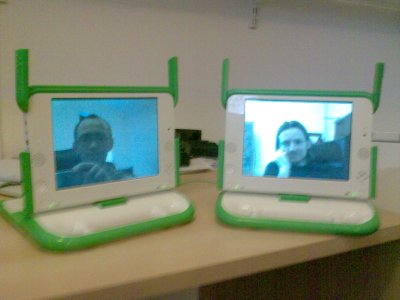
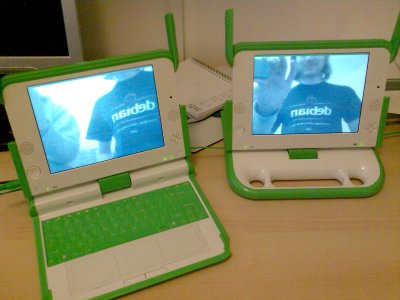
Robert McQueen: Telepathy and OLPC (part 2)

I’ve been away from the office for a couple of days, but when I got back to Cambridge, Daf and Sjoerd had some pretty cool stuff to show me: These screenshots are taken by using an environment variable to tell stream-engine just to create an xvimagesink for any call, but Daf’s writing a simple pygtk UI which handles embedding the output window into the UI properly and should make placing/receiving calls slightly less mystical. Even so, a graphical video call APP in ~150 lines of python… not too bad if you ask me. :)

Benjamin Mako Hill: Earning My Keep, Ensuring My Sleep

I managed to find the futon we sleep on for $20 (USD) in Harlem. When that mattress got a little compressed and hard, I managed to get my friend Shekhar to loan us his futon and frame for the year. I also found and dragged in a decent fold out bed in New York that we keep in our living room for guests. Last night, I managed to procure a very nice mattress pad for free. Some might call me the bed winner of the Acetarium household.

Ian Murdock: More on iAccessible2 and cross platform accessibility interfaces

Aaron Leventhal of IBM has more details on the relationship between iAccessible2 and the UNIX/Linux accessibility API (ATK/AT-SPI) as well as the motivations behind iAccessible2’s evolutionary approach:
[A]n evolutionary path was needed for applications which already had MSAA (IAccessible) support… [and] an API was needed that did not require separate accessibility implementations for each platform. […] The IAccessible2 interface itself collects important ATK features from other areas, as well some completely new methods and features… For the most part, features were added either to bring Windows capabilities up to the level of ATK/AT-SPI, or in order to support the features of ARIA (previously known of DHTML accessibility). […] [W]hat we’re doing is expanding MSAA while matching ATK/AT-SPI to a very helpful degree. […] [B]ecause IAccessible2 is backwards-compatible with MSAA, the current support of Windows screen readers and other assistive technologies can continue to work on applications that add IAccessible2 support. However, the newer IAccessible2 capabilities will also be exposed, and thus newer assistive technologies will be able to take advantage of them.
Peter Korn of Sun weighs in as well. (Via Andy Updegrove.)

Daniel Burrows: urlscan 0.5

If, like me, you use the mutt mailreader, you may at some point have tried out the urlview program to quickly jump to URLs in emails. urlview is a nice concept, but it has a few limitations, the worst of which is it doesn't decode quoted-printable emails (so, e.g., CGI urls containing equal signs get escaped and become useless).

With the increasing number of dynamic URLs and quoted-printable emails out there, this has rendered urlview more or less useless for me. A couple weekends ago, I got annoyed enough to do something: I wrote a quick-and-dirty Python replacement for urlview, called urlscan. I'm not proud of all the code, but thanks to Python's great standard library, it can decode just about anything you throw at it; it also extracts some context around each URL, so there's less guesswork involved in picking URLs.

I've uploaded urlscan to unstable (it just went in today), in the hopes that someone out there will find it useful. Enjoy. :-)

Next.

Previous.