Search Results: "spa"

21 March 2016

Lunar: Reproducible builds: week 47 in Stretch cycle

What happened in the reproducible builds effort between March 13th and March 19th 2016:

Toolchain fixes
  • Petter Reinholdtsen uploaded naturaldocs/1.51-1.1 which makes the output reproducible. Original patch by Chris Lamb.
  • Damyan Ivanov uploaded libpdf-api2-perl/2.025-2 which will make internal font ID reproducible.
  • Christian Hofstaedtler uploaded ruby2.3/2.3.0-5 which sets gzip embedded mtime field to fixed value for rdoc-generated compressed javascript data.

Packages fixed The following packages have become reproducible due to changes in their build dependencies: diction, doublecmd, ruby-hiredis, vdr-plugin-epgsearch. The following packages became reproducible after getting fixed: Some uploads fixed some reproducibility issues, but not all of them: Patches submitted which have not made their way to the archive yet:
  • #818128 on nethack by Reiner Herrmann: implement support for SOURCE_DATE_EPOCH, set LC_ALL to C, and ensure deterministic build order when running parallel builds.
  • #818111 on debian-keyring by Satyam Zode: fix the order of files in md5sums.
  • #818067 on ncurses by Niels Thykier: strip trailing whitespaces introduced when using dash as system shell.
  • #818230 on aircrack-ng by Reiner Herrmann: build assembly code as a separate .o file.
  • #818419 on mutt by Daniel Shahaf: use C locale when listing files to be put in README.Patches.
  • #818430 on ruby-coveralls by Dhole: ensure UTC is used as the timezone when generating the documentation.
  • #818686 on littlewizard by Reiner Herrmann: use the C locale in the script for iterating over the files.
  • #818704 on strigi by Reiner Herrmann: sort keys when traversing hashes in makecode.pl.

Package reviews 44 reviews have been removed, 40 added and 5 updated in the previous week. Chris Lamb has reported 16 FTBFS.

Russ Allbery: Term::ANSIColor 4.05

This Perl (core) module provides a variety of functions and tools for manipulating ANSI color and text style escape sequences. The primary change in this release is a few internal tweaks to reduce memory usage, which apparently had ballooned by 70% since Perl 5.14. Unfortunately, that also meant dropping support for non-ASCII characters in color aliases, which I think previously would have theoretically worked (not that it was ever documented or tested). I have mixed feelings, but since the memory usage was reported as a bug (and this is the sort of module that one might legitimately want to use in some space-constrainted situations as part of core), and no one ever mentioned non-ASCII color aliases, I decided to apply this patch. Yell at me if this broke something. I also cleaned up the metadata management following all the work that others helped me with for podlators. You can get the latest release from the Term::ANSIColor distribution page.

20 March 2016

Norbert Preining: Debian/TeX Live 2015.20160320-1 and biber 2.4-1

About one month has passed and here is the usual updated of TeX Live packages for Debian, this time also with an update to biber to accompany the updated version of biblatex. This will be (probably) the last upload before TeX Live 2015 gets frozen in preparation for 2016. After the freeze there will be some time of piece, and updates will got to experimental with the new binaries. Debian - TeX Live 2015 From the list of updated and new packages I want to mention that biblatex has been updated together with biber, and most biblatex styles should already by updated to work with the new biblatex, too. From the new packages one has in particular caught my attention: prooftrees. As I am writing a lot of proofs in my research, I am happy to see new package dealing with this, especially because this package is built on top of the excellent package forest (which in turn uses tikz), allowing for very compact proofs. Updated packages aastex, abntex2, academicons, acro, amsmath, animate, archaeologie, asciilist, babel, babel-french, babel-friulan, babel-russian, babel-spanish, beamertheme-metropolis, bibexport, biblatex, biblatex-apa, biblatex-bookinarticle, biblatex-caspervector, biblatex-chem, biblatex-fiwi, biblatex-gost, biblatex-manuscripts-philology, biblatex-nature, biblatex-philosophy, biblatex-phys, biblatex-publist, biblatex-realauthor, biblatex-science, bxjscls, cabin, caption, cbfonts-fd, celtic, chemmacros, computational-complexity, crimson, csplain, datetime2-english, diagbox, disser, droit-fr, dtk, dvips, ejpecp, emisa, factura, fibeamer, fithesis, forest, gost, hobby, hyperxmp, inconsolata, lualatex-math, mandi, mcf2graph, media9, nameauth, ocgx2, parades, pdftex, pkuthss, poetrytex, ptex, reledmac, roundrect, showhyphens, siunitx, spath3, splitindex, suftesi, tcolorbox, tetex, tex4ht, texinfo, texlive-scripts, thuthesis, titlesec, turabian-formatting, unicode-data, uptex, velthuis, venndiagram, xassoccnt, xint, xsavebox. New packages beamercolorthemeowl, bibletext, cochineal, formation-latex-ul, gobble, keyvaltable, lroundrect, luatex85, mathpartir, miama, multidef, parades, pgfornament, prooftrees, visualpstricks, visualtikz, xsavebox, ycbook. Enjoy.

19 March 2016

Petter Reinholdtsen: UsingQR - "Electronic" paper invoices using JSON and QR codes

Back in 2013 I proposed a way to make paper and PDF invoices easier to process electronically by adding a QR code with the key information about the invoice. I suggested using vCard field definition, to get some standard format for name and address, but any format would work. I did not do anything about the proposal, but hoped someone one day would make something like it. It would make it possible to efficiently send machine readable invoices directly between seller and buyer. This was the background when I came across a proposal and specification from the web based accounting and invoicing supplier Visma in Sweden called UsingQR. Their PDF invoices contain a QR code with the key information of the invoice in JSON format. This is the typical content of a QR code following the UsingQR specification (based on a real world example, some numbers replaced to get a more bogus entry). I've reformatted the JSON to make it easier to read. Normally this is all on one long line:
 
 "vh":500.00,
 "vm":0,
 "vl":0,
 "uqr":1,
 "tp":1,
 "nme":"Din Leverand r",
 "cc":"NO",
 "cid":"997912345 MVA",
 "iref":"12300001",
 "idt":"20151022",
 "ddt":"20151105",
 "due":2500.0000,
 "cur":"NOK",
 "pt":"BBAN",
 "acc":"17202612345",
 "bc":"BIENNOK1",
 "adr":"0313 OSLO"
 
The interpretation of the fields can be found in the format specification (revision 2 from june 2014). The format seem to have most of the information needed to handle accounting and payment of invoices, at least the fields I have needed so far here in Norway. Unfortunately, the site and document do not mention anything about the patent, trademark and copyright status of the format and the specification. Because of this, I asked the people behind it back in November to clarify. Ann-Christine Savlid (ann-christine.savlid (at) visma.com) replied that Visma had not applied for patent or trademark protection for this format, and that there were no copyright based usage limitations for the format. I urged her to make sure this was explicitly written on the web pages and in the specification, but unfortunately this has not happened yet. So I guess if there is submarine patents, hidden trademarks or a will to sue for copyright infringements, those starting to use the UsingQR format might be at risk, but if this happen there is some legal defense in the fact that the people behind the format claimed it was safe to do so. At least with patents, there is always a chance of getting sued... I also asked if they planned to maintain the format in an independent standard organization to give others more confidence that they would participate in the standardization process on equal terms with Visma, but they had no immediate plans for this. Their plan was to work with banks to try to get more users of the format, and evaluate the way forward if the format proved to be popular. I hope they conclude that using an open standard organisation like IETF is the correct place to maintain such specification. Update 2016-03-20: Via Twitter I became aware of some comments about this blog post that had several useful links and references to similar systems. In the Czech republic, the Czech Banking Association standard #26, with short name SPAYD, uses QR codes with payment information. More information is available from the Wikipedia page on Short Payment Descriptor. And in Germany, there is a system named BezahlCode, (specification v1.8 2013-12-05 available as PDF), which uses QR codes with URL-like formatting using "bank:" as the URI schema/protocol to provide the payment information. There is also the ZUGFeRD file format that perhaps could be transfered using QR codes, but I am not sure if it is done already. Last, in Bolivia there are reports that tax information since november 2014 need to be printed in QR format on invoices. I have not been able to track down a specification for this format, because of my limited language skill sets.

18 March 2016

Enrico Zini: Adjusting with Moore's Law

In my last post I used zxcvbn to check the strength of passwords, and it gave estimates in hundreds of centuries. However, there's Moore's law. If we assume that every 18 months the effective computing power will double...
#!/usr/bin/python3
import sys
years = int(sys.argv[1])
# How many 18 months intervals we spent
count = 0
# How many original-computation-time-months we compute each 18 months interval
step = 18
# How many original-computation-time-months we computed so far
total = 0
# How many original-computation-time-months we need
target = years * 12
# Iterate each 18 months interval
while True:
    count += 1
    total += step
    if total > target: break
    step *= 2
print(" :.2f  years needed".format(count / 12 * 18))
...then something that is now estimated in 152 centures is likely to take, well:
$ ./actual_years 15200
9.33 years needed
Update Fixed algorithm (thanks John MacGregor). Now the estimate is a little longer, but still:
$ ./actual_years 15200
21.00 years needed
ukasz Stelmach proposed an analytic solution:
There are two cars (remember phisics in primary school?). They both have the same speed V0. It is going to take "54.697 centuries" for car A to travel the desired distance at constant speed. Car B is accelerating, its speed is 2^(t/18m)*V0 (18 [m]onths). s = V0 * T (car A, T is 54.697 centuries) s = 2^(t/18)*V0 dt (car B, we're looking for t) It's been some time but as far as I can tell it is s = V0 * 2^(t/18) * 1/((1/18) * ln 2) 2^(t/18) * 1/((1/18) * ln 2) = 54.697 * 100 * 12 [months] 2^(t/18) = 2527.54 t = 18*log2(2527.54) t = 16.96 years (still reasonable strength).

17 March 2016

Enrico Zini: Enhanced xkcd password generator

gpw and xkcdpass have entered testing. How about putting them together?
#!/usr/bin/python3
import subprocess
import random
import re
re_spaces = re.compile(r"\s+")
def get_words(cmd):
    out = subprocess.check_output(cmd, universal_newlines=True)
    return (x for x in re_spaces.split(out) if x)
words = set()
words.update(get_words(["xkcdpass", "-c", "10"]))
for l in range(6, 9):
    words.update(get_words(["gpw", "10", str(l)]))
for i in range(7):
    print(" ".join(random.sample(words, 5)))
Let's check the results:
#!/usr/bin/python
from __future__ import print_function
from zxcvbn import password_strength
import sys
for line in sys.stdin:
    pw = line.strip()
    info = password_strength(pw)
    print(" pw :  crack_time_display   entropy ".format(pw=pw, **info))
$ xkcdpass -n 5 -c 7   ./checkpass
moribund fasten cologne enamor by-and-by: centuries 132.586
woolen leptonic pogrom roster Serra: centuries 127.145
shorthand Piman suctional elution unholy: centuries 119.809
Blackwell mauvish covey selenium finished: centuries 112.936
asthma bloat crenulate clean-cut cytoplasm: centuries 150.181
agreeable refined racism Captain Cyrenaic: centuries 104.28
Bothnia stagnant atomist these revise: centuries 97.91
$ gpw 7   ./checkpass
ncenspri: 11.0 days 33.903
orsterma: instant 19.54
entsssel: 14.0 hours 29.788
tempispi: instant 20.058
nidgersi: 14.0 hours 29.725
oligalin: 51.0 minutes 25.824
iseartio: 10.0 minutes 23.207
$ ./metapass   ./checkpass
herups icirop overdub oldster cingsape: centuries 147.265
mujahidin usufruct rition porky prignam: centuries 153.684
cannula irenics tableaux ntshed calcific: centuries 152.196
stopgap stale orthente Amazonia sharer: centuries 113.474
edudives mmingsso eremab prignam tableaux: centuries 147.354
tingei heroism Nathaniel cannula molasses: centuries 103.007
Torres blood lewdness prignam eremab: centuries 118.475
The strength, according to zxcvbn, seems only marginally better, and it's a wonderful way to grow a vocabulary of nonexisting words that can be dropped into cheap talk conversation to confuse the innocents.

16 March 2016

Enrico Zini: Postprocessing files saved by vim

Processing vim buffers through an external program on save, is a technique that is probably in use, and that I have not found documented anywhere, so here we go. Skip to the details for the entertaining example. I wanted to integrate egt with TaskWarrior so that every time I am editing an egt project file in vim, if I write a line in a certain way then a new taskwarrior task is created. Also, I have never written a vim plugin, and I don't want to dive into another rabbit hole just yet. Lynoure brought to my attention that taskwiki processes things when the file is saved, so I thought that I can probably get a long way by piping the file from vim into egt and reading it back before saving. I created a new egt annotate command that reads a project file, tweaks it, and then prints it out; I opened a project file in vim; I typed :%!egt annotate %:p --stdin and saw that it could be done. I find the result quite fun: I type 15 March: 18:00-21:00 in a log in egt, save the file, and it becomes 15 March: 18:00-21:00 3h. I do something in TaskWarrior, save the file in egt, and the lines that are TaskWarrior tasks update with the new task states. Details Here's a step by step example of how to hook into vim in this way. First thing, create a filter script that processes text files in some way. Let's call this /usr/local/bin/pyvimshell:
#!/usr/bin/python3
import sys
import subprocess
for line in sys.stdin:
    print(line.rstrip(), file=sys.stdout)
line = line.strip()
if line == "$":
    pass
elif line.startswith("$"):
    out = subprocess.check_output(["sh", "-c", line[1:].strip()], universal_newlines=True)
    sys.stdout.write(out)
    if not out.endswith("\n"):
        sys.stdout.write("\n")
    print("$ ", file=sys.stdout)
Then let's create a new filetype in ~/.vim/filetype.vim for our special magic text files:
if exists("did_load_filetypes")
  finish
endif
augroup filetypedetect
  au! BufNewFile,BufRead *.term setf SillyShell
augroup END
If you create a file example.term, open it in vim and type :set ft it should say SillyShell. Finally, the hook in ~/.vim/after/ftplugin/SillyShell.vim:
function! SillyShellRun()
    :%!/home/enrico/dev/egt/pyvimshell
    :$
endfunction
autocmd BufWritePre,FileWritePre <buffer> :silent call SillyShellRun()
Now you can create a file example.term, open it in vim, type $ ls, save it, and suddenly you have a terminal with infinite scrollback. For egt, I actually want to preserve my cursor position across saves, and egt also needs to know the path to the project file, so here is the egt version of the hook:
function! EgtAnnotate()
    let l:cur_pos = getpos(".")
    :%!egt annotate --stdin %:p
    call setpos(".", l:cur_pos)
endfunction
autocmd BufWritePre,FileWritePre <buffer> :silent call EgtAnnotate()
I find this adorably dangerous. Have fun.

15 March 2016

Joerg Jaspert: Removing checksums

And as just announced on d-d-a, I m trying to break all the tools dealing with the (Debian) archive. Or something like it. But its about time to get rid of MD5Sum checksums, and SHA1 can go with it directly. As it is only in experimental for now, we can test and see what still breaks. I hope it won t be too much, so we can get it over all the archive (minus the stable stuff, of course). For some reason, what I like most in this change is the following python code that ended up in our InRelease file generation tool:
import apt_pkg
# Note: suite.checksums being an array with possible values of md5sum, sha1, sha256
hashfuncs = dict(zip([x.upper().replace('UM', 'um') for x in suite.checksums],
                      [getattr(apt_pkg, "%s" % (x)) for x in [x.replace("sum", "") + "sum" for x in suite.checksums]]))
Though I m sure this can be done in much more readable ways, it s doing what we need, but heck, took me a while to get it. But probably the change to get rid of gzip will be much more challenging / hard to get through. Lets see, in the few minutes after my mail, I already got some notices about possible breakage here. Fortunately those indices and the release file stuff are nicely seperated settings, so if it turns out we only take the checksums drop for now into the other suites, thats doable.

Michal &#268;iha&#345;: Weekly phpMyAdmin contributions 2016-W10

Last week was quite equally split between refactoring and bug fixing. As we're getting closer to 4.6.0 release more people give feedback on it and some corner case issues are being discovered. However the biggest challenge was strange bug that was reported long time ago - it affected only Italian translation on Windows server. After lot of debugging, I've realized that trying to encode Cardinalit </td> to json (using json_encode) causes this problem. Obviously there have to be more conditions met as this string only doesn't cause it, however removing it or placing x between and < fixes the problem. In the end I've workarounded it in our code and hopefully I will get to create proper bugreport for php so that it can be fixed upstream as well. The refactoring was mostly focused on encoding conversion part which is now all embedded in the Encoding class. It was quite simplified and should also speed up pages a bit as it does the initialization only when needed not on every phpMyAdmin's page. Handled issues:

Filed under: English phpMyAdmin 0 comments

13 March 2016

Vincent Sanders: I changed my mind, Erase and rewind

My recent rack design turned out to simply not be practical. It did not hold all the SBC I needed it to and most troubling accessing connectors was impractical. I was forced to remove the enclosure from the rack and go back to piles of SBC on a shelf.

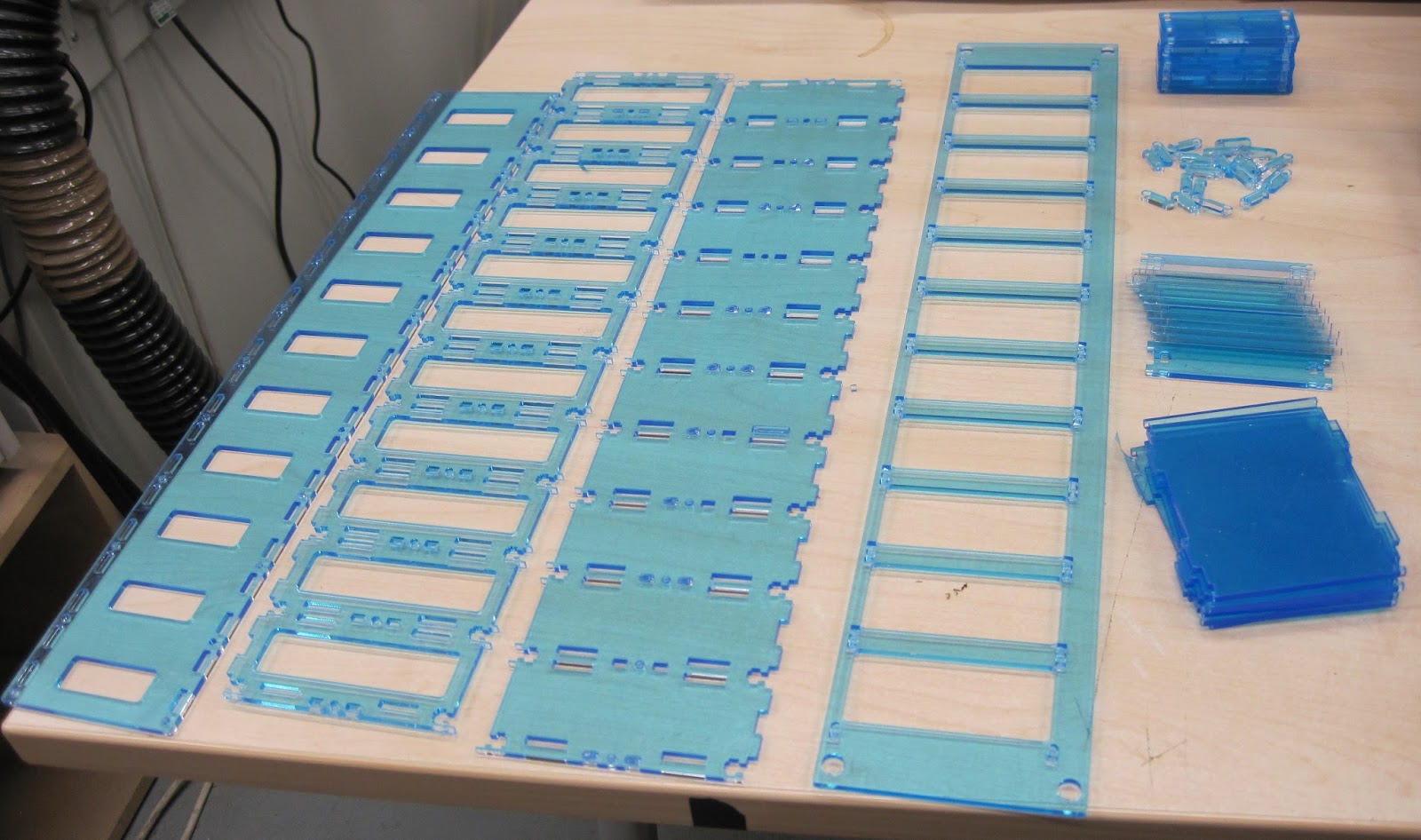
View of the acrylic being laser cut through the heavily tinted window
This sent me back to the beginning of the design process. The requirement for easy access to connectors had been compromised on in my first solution because I wanted a compact 1U size. This time I returned to my initial toast rack layout but retaining the SBC inside their clip cases.

By facing the connectors downwards and providing basic cable management the design should be much more practical.

My design process is to use the QCAD package to create layered 2D outlines which are then converted from DXF into toolpaths with Lasercut CAM software. The toolpaths are then uploaded to the laser cutter directly from the PC running Lasercut.

Assembled sub rack enclosureDespite the laser cutters being professional grade systems the Lasercut software is a continuous cause of issues for many users, it is the only closed source piece of software in the production process and it has a pretty poor user interface. On this occasion my main issue with it was my design was quite large at 700mm by 400mm which caused the software to crash repeatedly. I broke the design down into two halves and this allowed me to continue.

Once I defeated the software the design was laser cut from 3mm clear extruded acrylic. The assembled is secured with 72 off M3 nuts and bolts. The resulting construction is very strong and probably contains much more material than necessary.

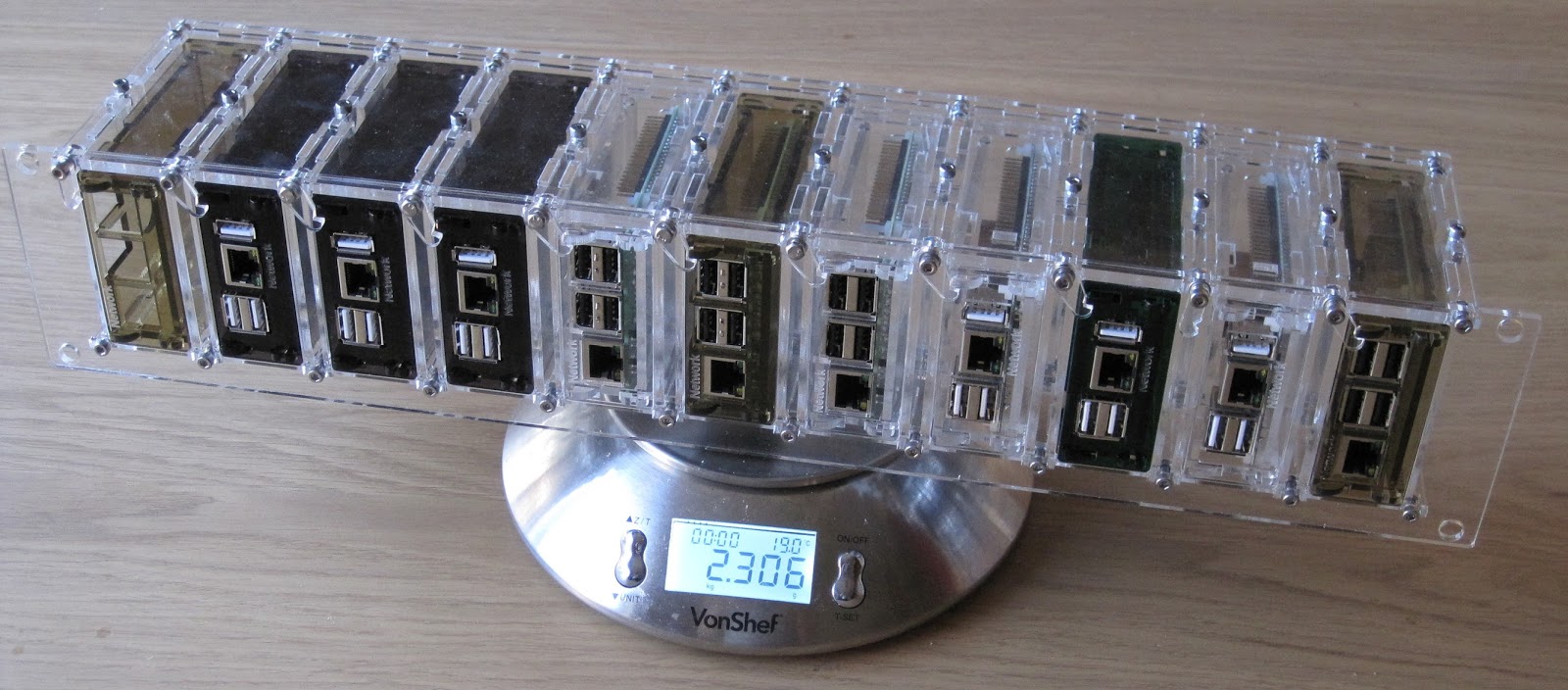
One interesting thing I discovered is that in going from a 1U enclosure holding 5 units to a 2U design holding 11 units I had increased the final weight from 320g to 980g and when all 11 SBC are installed that goes up to a whopping 2300g. Fortunately this is within the mechanical capabilities of the material but it is the heaviest thing I have ever constructed from 3mm acrylic.

bolted into the rack and operatingOnce installed in the rack with all SBC inserted and connected this finally actually works and provides a practical solution. The self is finally clear of SBC and has enough space for all the other systems I need to accommodate for various projects.

As usual the design files are all freely available though I really cannot see anyone else needing to replicate this.

Amaya Rodrigo:


,

. 3D

, , 3D ( , , , , , , , , , , , , ), .
, . , - - , , , . , .
1.
. . , . , . 104
: 8 (4967) 76-11-11, 8 (4967) 76-01-11

2. ,
. . , . , . 21/2
: +7 (4967) 37-72-72, +7 (916) 037-72-72, +7 (915) 037-72-72

3.
. . , , . 64
: 8 (915) 118-49-98, 8 (925) 545-72-58, 8 (495) 545-72-58

4. -3
. . , . , . 2
: 8 (4967) 35-11-22, 8 (916) 40-100-60, 8 (903) 193-02-07

</div></p>

Amaya Rodrigo:


,

. 3D

, , 3D ( , , , , , , , , , , , , ), .
, . , - - , , , . , .
1. ,
. . , . , . 26, 6
: 8 (49234) 2-69-58, 8 (900) 476-84-25

2.
. . , . , . 149 , 2-
: 8 (49234) 77-9-44, 8 (919) 000-79-44

3.
. . , , . 17
: +7 (49234) 77-5-77, +7 (904) 251-46-99

</div></p>

Amaya Rodrigo:


, , , , , .

, , , , , , , , , , , , , , , , , , .
, .
, , , .
, , - . , , . . , , , , , .
, . , , . , , , , .
:

. , , .
, , , . , , , , , , .
, , , .
</div></p>

Amaya Rodrigo:


. , , . - . .

, , , , , , , , , , , , .


. . . ( ), . .
.
- .
- .
. - .37/39.
. - . .6
18.01.2016
! 18.01.2016
09.10.2015

13.01.2015

11.03.2016
, , , , ?
11.03.2016
. " / . . - 1.6
11.03.2016
. 8 . . . . .
</div></p>

Amaya Rodrigo:


. , , . - . .

, , , , , , , , , , , , .


. . . ( ), . .
.
- .
- .
. - .37/39.
. - . .6
18.01.2016
! 18.01.2016
09.10.2015

13.01.2015

11.03.2016
, , , , ?
11.03.2016
. " / . . - 1.6
11.03.2016
. 8 . . . . .
</div></p>

12 March 2016

Daniel Pocock: Google Summer of Code opportunities for ham radio and SDR

I've started preparing some ideas for Google Summer of Code projects I'd be willing to help mentor this year and one of them is for ham radio, with a focus on software defined radio (SDR). Can you help? If you can help as a co-mentor or simply help refer students for this project please get in touch with me. Ander the terms of the program students are paid a $US 5,500 stipend by Google and source code is fully published under a genuine free software license . Details about the project and how students can apply Students applying for this project are invited to submit two applications, one under the GNU Radio project and another under the Debian Project. The aim of this project is to make ready-to-run solutions for ham radio enthusiasts. The typical use case is a ham who has a spare computer in his shack, he should be able to boot the computer from DVD or USB stick using the Debian Ham Radio Live Blend or the GNU Radio Live SDR and have a functional transceiver within a few minutes. A student may not be able to do everything required for this project in one summer. We are looking for a student who can make any incremental improvement to bring us closer to this goal. Here are some of the tasks that may be involved:
  • survey the existing GNU Radio samples for ham radio, many are listed on the HamRadio page of the GNU Radio wiki.
  • design user interface improvements for the samples to make them more intuitive to new users and traditional radio operators. Consider how they can interact with Hardware such as a VFO tuning knob, PTT microphone switch and even a morse key.
  • look through the other packages in the Debian Ham Radio metapackage list and consider how they could interact with GNU Radio. In particular, we are interested in the use of message bus solutions, such as ZeroMQ or D-Bus - for example, GNU Radio could send alerts on the bus when incoming signals exceed the squelch threshold. GNU Radio could also receive events over a message bus, for example, patching GPredict to send Doppler shift information.
  • developing and packaging libraries needed to process digital voice transmissions
  • look at how one or more of the samples can be deployed as a Debian package so users can just install the package and have a working radio
Prerequisites The following experience is highly desirable:
  • ham radio license
  • GNU/Linux skills (Debian or Ubuntu or another distribution like Fedora)
  • use of version control systems (Git)
  • C++ or Python or both
Mentor(s)
  • Daniel Pocock (VK3TQR/M0GLR/HB9FZT)
Application process To apply
  • please introduce yourself on both the GNU Radio mailing list and the Debian Hams mailing list
  • Fill in the formal application for both GNU Radio and Debian
  • Pick some items from the list above or feel free to suggest another piece of work relevant to this theme. Give us a detailed, week-by-week plan for completing the task over the summer.
  • find at least one other member of the GNU Radio or Debian community who is willing to be a co-mentor on the project. Please try communicating with us over IRC or email and give us examples of your existing work on Github or elsewhere.

Bits from Debian: Debian is looking for three interns in the Outreachy Program

Outreachy logo As part of its diversity outreach initiatives, Debian will be participating in the upcoming 12th round (May - August 2016) of Outreachy, an internship program open worldwide to women (cis and trans), trans men and genderqueer people, as well as nationals and residents of the United States of any gender who are Black/African American, Hispanic/Latin@, American Indian, Alaska Native, Native Hawaiian, or Pacific Islander. Thanks to the generosity of our donors, and specifically of our sponsor Intel who has given us funds specifically for one intern, Debian will be able to welcome three interns this round. Applications for the program are open until March 22nd, so don't wait up! Debian has a lot of interesting internship opportunities this year. More info about the program is available on the Debian specific program page, as well as on the official website. Feel free to contact the outreach team and mentors on our mailing list or IRC channel #debian-soc in irc.oftc.net If you want Debian to keep participating in such programs, and expand its outreach efforts, you can donate to one of the organizations supporting the Debian project, or volunteer some time by participating in discussions on our mailing list.

11 March 2016

Steinar H. Gunderson: Agon and the Candidates tournament

The situation where Agon (the designated organizer of the Chess World Championship, and also the Candidates tournament, the prequalifier to said WC) is trying to claim exclusive rights of the broadcasting of the moves (not just the video) is turning bizarre. First of all, they have readily acknowledged they have no basis in copyright to do so; chess moves, once played, are facts and cannot be limited. They try to jump through some hoops with a New York-specific doctrine (even though the Candidates, unlike the World Championship, is played in Moscow) about hot news , but their main weapon seems to be that they simply will throw out anyone from the hall who tries to report on the moves, and then try to give them only to those that promise not to give them on. This leads to the previously unheard-of situation where you need to register and accept their terms just to get to watch the games in your browser. You have to wonder what they will be doing about the World Championship, which is broadcast unencrypted on Norwegian television (previous editions also with no geoblock). Needless to say, this wasn't practically possible to hold together. All the big sites (like Chessdom, ChessBomb and Chess24) had coverage as if nothing had happened. Move sourcing is a bit of a murky business where nobody really wants to say where they get the moves from (although it's pretty clear that for many tournaments, the tournament organizers will simply come to one or more of the big players with an URL they can poll at will, containing the games in the standard PGN format), and this was no exception ChessBomb went to the unusual move of asking their viewers to download Tor and crowdsource the moves, while Chessdom and Chess24 appeared to do no such thing. In fact, unlike Chessdom and ChessBomb, Chess24 didn't seem to say a thing about the controversy, possibly because they now found themselves on the other side of the fence from Norway Chess 2015, where they themselves had exclusive rights to the PGN in a similar controversy although it would seem from a tweet that they were perfectly okay with people just re-broadcasting from their site if they paid for a (quite expensive) premium membership, and didn't come up with any similar legal acrobatics to try to scare other sites. However, their ToS were less clear on the issue, and they didn't respond to requests for clarification at the time, so I guess all of this just continues to be on some sort of gentleman's agreement among the bigger players. (ChessBomb also provides PGNs for premium members for the tournaments they serve, but they expressly prohibit rebroadcast. They claim that for the tournaments they host, which is a small minority, they provide free PGNs for all.) Agon, predictably, sent out angry letters where they threatened to sue the sites in question, although it's not clear at all to me what exactly they would sue for. Nobody seemed to care, except one entity TWIC, which normally has live PGNs from most tournaments, announced they would not be broadcasting from the Candidats tournament. This isn't that unexpected, as TWIC (which is pretty much a one-man project anyway) mainly is about archival, where they publish weekly dumps of all top-level games played that week. This didn't affect a lot of sites, though, as TWIC's live PGNs are often not what you'd want to base a top-caliber site on (they usually lack clock information, and moves are often delayed by half a minute or so). I run a hobby chess relay/analysis site myself (mainly focusing on the games of Magnus Carlsen), though, so I've used TWIC a fair bit in the past, and if I were to cover the Candidates tournament (I don't plan to do so, given Agon's behavior, although I plan to cover the World Championship itself), I might have been hit by this. So, that was the background. The strange part started when worldchess.com, Agon's broadcasting site, promptly went down during the first round of the Candidates tournament today Agon blamed DDoS, which I'm sure is true, but it's unclear exactly how strong the DDoS was, and if they did anything at all to deal with it other than to simply wait it out. But this lead to the crazy situation where the self-declared monopolist was the only big player not broadcasting the tournament in some form. And now, in the trully bizarre move, World Chess is publishing a detailed rebuttal of Agon's arguments, explaining how it is bad for chess, not juridically sound, and also morally wrong. Yes, you read that right; Agon's broadcast site is carrying an op-ed saying Agon is wrong. You at least have to give them credit for not trying to censor their columinst when he says something they don't agree with. Oh, and if you want those PGNs? I will, at least for the time being, be pushing them out live on http://pgn.sesse.net/. I have not gone into any agreement with Agon, and they're hosted in Norway, far from any New York-specific doctrines. So feel free to relay from them, although I would of course be happy to know if you do.

Matthew Garrett: I stayed in a hotel with Android lightswitches and it was just as bad as you'd imagine

I'm in London for Kubecon right now, and the hotel I'm staying at has decided that light switches are unfashionable and replaced them with a series of Android tablets.
A tablet displaying the text UK_bathroom isn't responding. Do you want to close it?
One was embedded in the wall, but the two next to the bed had convenient looking ethernet cables plugged into the wall. So.

I managed to borrow a couple of USB ethernet adapters, set up a transparent bridge (brctl addbr br0; brctl addif br0 enp0s20f0u1; brctl addif br0 enp0s20f0u2; ifconfig br0 up) and then stuck my laptop between the tablet and the wall. tcpdump -i br0 showed traffic, and wireshark revealed that it was Modbus over TCP. Modbus is a pretty trivial protocol, and notably has no authentication whatsoever. tcpdump showed that traffic was being sent to 172.16.207.14, and pymodbus let me start controlling my lights, turning the TV on and off and even making my curtains open and close. What fun!

And then I noticed something. My room number is 714. The IP address I was communicating with was 172.16.207.14. They wouldn't, would they?

I mean yes obviously they would.

It's basically as bad as it could be - once I'd figured out the gateway, I could access the control systems on every floor and query other rooms to figure out whether the lights were on or not, which strongly implies that I could control them as well. Jesus Molina talked about doing this kind of thing a couple of years ago, so it's not some kind of one-off - instead, hotels are happily deploying systems with no meaningful security, and the outcome of sending a constant stream of "Set room lights to full" and "Open curtain" commands at 3AM seems fairly predictable.

We're doomed.

(edited: this previously claimed I could only access systems on my own floor, but it turns out that each floor is a separate broadcast domain and I just needed to set a gateway to access the others)

(further edit: I'm deliberately not naming the hotel. They were receptive to my feedback and promised to do something about the issue.)

comment count unavailable comments

Rapha&#235;l Hertzog: Freexian s report about Debian Long Term Support, February 2016

A Debian LTS logoLike each month, here comes a report about the work of paid contributors to Debian LTS. Individual reports In February, 112.50 work hours have been dispatched among 11 paid contributors. Their reports are available: Evolution of the situation The number of sponsored hours continued to decrease a little bit. It s not worrisome yet but we should try to get back to a positive slope if we want to be able to do an outstanding job for wheezy LTS. On the positive side, TOSHIBA renewed their platinum sponsorship for another 6 months at least and we have some contacts for new sponsors, though they are far from being concluded yet. We are now in transition between squeeze LTS and wheezy LTS. The paid contributors are helping the security team by fixing packages that were fixed in squeeze already but that are still outstanding in wheezy. They are also taking generic measures to prepare wheezy LTS (for example to ensure all packages work with OpenJDK 7.x since support for 6.x will be dropped in the LTS period). Thanks to our sponsors New sponsors are in bold (none this month).

No comment Liked this article? Click here. My blog is Flattr-enabled.

Next.

Previous.