Search Results: "agi"

22 January 2013

Russ Allbery: Review: Fantasy & Science Fiction, March/April 2011

Review: Fantasy & Science Fiction, March/April 2011
Editor: Gordon van Gelder
Issue: Volume 120, No. 3 & 4
ISSN: 1095-8258
Pages: 258
Charles de Lint's book review column sticks with the sorts of things he normally reviews: urban and contemporary fantasy and young adult. Predictably, I didn't find that much of interest. But I was happy to see that not all the reviews were positive, and he talked some about how a few books didn't work. I do prefer seeing a mix of positive and negative (or at least critical) reviews. James Sallis's review column focuses entirely on Henry Kuttner and C.L. Moore (by way of reviewing a collection). I'm always happy to see this sort of review. But between that and de Lint's normal subject matter, this issue of F&SF was left without any current science fiction reviews, which was disappointing. Lucius Shepard's movie review column features stunning amounts of whining, even by Shepard's standards. The topic du jour is how indie films aren't indie enough, mixed with large amounts of cane-shaking and decrying of all popular art. I find it entertaining that the F&SF film review column regularly contains exactly the sort of analysis that one expects from literary gatekeepers who are reviewing science fiction and fantasy. Perhaps David Langford should consider adding an "As We See Others" feature to Ansible cataloging the things genre fiction fans say about popular movies. "Scatter My Ashes" by Albert E. Cowdrey: The protagonist of this story is an itinerant author who has been contracted to write a family history (for $100K, which I suspect is a bit of tongue-in-cheek wish fulfillment) and has promptly tumbled into bed with his employer. But he is somewhat serious about the writing as well, and is poking around in family archives and asking relatives about past details. There is a murder (maybe) in the family history, not to mention some supernatural connections. Those familiar with Cowdrey's writing will recognize the mix of historical drama, investigation, and the supernatural. Puzzles are, of course, untangled, not without a bit of physical danger. Experienced fantasy readers will probably guess at some of the explanation long before the protagonist does. Like most Cowdrey, it's reliably entertaining, but I found it a bit thin. (6) "A Pocketful of Faces" by Paul Di Filippo: Here's a bit of science fiction, and another mystery, this time following the basic model of a police procedural. The police in this case are enforcing laws around acceptable use of "faces" in a future world where one can clone someone's appearance from their DNA and then mount it on a programmable android. As you might expect from that setup, the possibilities are lurid, occasionally disgusting, and inclined to give the police nightmares. After some scene-setting, the story kicks in with the discovery of the face of a dead woman who, at least on the surface, no one should have any motive to clone. There were a few elements of the story that were a bit too disgusting for me, but the basic mystery plot was satisfying. I thought the ending was a let-down, however. Di Filippo tries to complicate the story and, I thought, went just a little too far, leaving motives and intent more confusing than illuminating. (6) "The Paper Menagerie" by Ken Liu: Back to fantasy, this time using a small bit of magic to illustrate the emotional conflicts and difficulties of allegiance for second-generation immigrants. Jack is the son of an American farther and a Chinese mother who was a mail-order bride. He's young at the start of the story and struggling with the embarassment and humiliation that he feels at his mother's history and the difficulties he has blending in with other kids, leading to the sort of breathtaking cruelty that comes so easily from teenagers who are too self-focused and haven't yet developed adult empathy. I found this very hard to read. The magic is beautiful, personal, and very badly damaged by the cruelty in ways that can never really be fixed. It's a sharp reminder of the importance of being open-hearted, but it's also a devastating reminder that the lesson is normally learned too late. Not the story to read if you're prone to worrying about how you might have hurt other people. (6) "The Evening and the Morning" by Sheila Finch: This long novella is about a third of the issue and is, for once, straight science fiction, a somewhat rare beast in F&SF these days. It's set in the far future, among humans who are members of the Guild of Xenolinguists and among aliens called the Venatixi, and it's about an expedition back to the long-abandoned planet of Earth. I had a lot of suspension of disbelief problems with the setup here. While Earth has mostly dropped out of memory, there's a startling lack of curiosity about its current condition among the humans. Finch plays some with transportation systems and leaves humanity largely dependent on other races to explain the failure to return to Earth, but I never quite bought it. It was necessary to set up the plot, which is an exploration story with touches of first contact set on an Earth that's become alien to the characters, but it seemed remarkably artificial to me. But, putting that aside, I did get pulled into the story. Its emotional focus is one of decline and senescence, a growing sense of futility, that's halted by exploration, mystery, and analysis. The question of what's happened on Earth is inherently interesting and engaging, and the slow movement of the story provides opportunities to build up to some eerie moments. The problem, continuing a theme for this issue, is the ending. Some of the reader's questions are answered, but most of the answers are old, well-worn paths in science fiction. The emotional arc of the story is decidedly unsatisfying, at least to me. I think I see what Finch was trying to do: there's an attempted undermining of the normal conclusion of this sort of investigation to make a broader point about how to stay engaged in the world. But it lacked triumph and catharsis for me, partly because the revelations that we get are too pedestrian for the build-up they received. It's still an interesting story, but I don't think it entirely worked. (6) "Night Gauntlet" by Walter C. DeBill, Jr., et al.: The full list of authors for this story (Walter C. DeBill, Jr., Richard Gavin, Robert M. Price, W.H. Pugmire, Jeffrey Thomas, and Don Webb) provides one with the first clue that it's gone off the rails. Collaborative storytelling, where each author tries to riff off the work of the previous author while spinning the story in a different direction, is something that I think works much better orally, particularly if you can watch facial expressions while the authors try to stump each other. In written form, it's a recipe for a poorly-told story. That's indeed what we get here. The setup is typical Cthulhu mythos stuff: a strange scientist obsessed with conspiracy theories goes insane, leaving behind an office with a map of linkages between apparently unrelated places. The characters in the story also start going insane for similar reasons, leading up to a typical confrontation with things man was not meant to know, or at least pay attention to. If you like that sort of thing, you may like this story better than I did, but I thought it was shallow and predictable. (3) "Happy Ending 2.0" by James Patrick Kelly: More fantasy, this time of the time travel variety. (I call it fantasy since there's no scientific explanation for the time travel and it plays a pure fantasy role in the story.) That's about as much as I can say without giving away the plot entirely (it's rather short). I can see what Kelly was going for, and I think he was largely successful, but I'm not sure how to react to it. The story felt like it reinforced some rather uncomfortable stereotypes about romantic relationships, and the so-called happy ending struck me as the sort of situation that was going to turn very nasty and very uncomfortable about five or ten pages past where Kelly ended the story. (5) "The Second Kalandar's Tale" by Francis Marion Soty: The main question I have about this story is one that I can't answer without doing more research than I feel like doing right now: how much of this is original to Soty and how much if it is straight from Burton's translation of One Thousand and One Nights. Burton is credited for the story, so I suspect quite a lot of this is from the original. Whether one would be better off just reading the original, or if Soty's retelling adds anything substantial, are good questions that I don't have the background to answer. Taken as a stand-alone story, it's not a bad one. It's a twisting magical adventure involving a djinn, a captive woman, some rather predictable fighting over the woman, and then a subsequent adventure involving physical transformation and a magical battle reminiscent of T.H. White. (Although I have quite likely reversed the order of inspiration if as much of this is straight from Burton as I suspect.) Gender roles, however, are kind of appalling, despite the presence of a stunningly powerful princess, due to the amount of self-sacrifice expected from every woman in the story. Personally, I don't think any of the men in the story are worth anywhere near the amount of loyalty and bravery that the women show. Still, it was reasonably entertaining throughout, in exactly the way that I would expect a One Thousand and One Nights tale to be. Whether there's any point in reading it instead of the original is a question I'll leave to others. (7) "Bodyguard" by Karl Bunker: This is probably the best science fiction of the issue. The first person protagonist is an explorer living with an alien race, partly in order to flee the post-singularity world of uploaded minds and apparent stagnation that Earth has become. It's a personal story that uses his analysis of alien mindsets (and his interaction with his assigned alien bodyguard) to flesh out his own desires, emotional background, and reactions to the world. There are some neat linguistic bits here that I quite enjoyed, although I wish they'd been developed at even more length. (The alien language is more realistic than it might sound; there are some human languages that construct sentences in a vaguely similar way.) It's a sad, elegiac story, but it grew on me. (7) "Botanical Exercises for Curious Girls" by Kali Wallace: One has to count this story as science fiction as well, although for me it had a fantasy tone because the scientific world seems to play by fantasy rules from the perspective of the protagonist. Unpacking that perspective is part of the enjoyment of the story. At the start, she seems to be a disabled girl who is being cared for by a strange succession of nurses who vary by the time of day, but as the story progresses, it becomes clear that something much stranger is going on. There are moments that capture a sense of wonder, reinforced by the persistantly curious and happy narrative voice, but both are undercut by a pervasive sense of danger and dread. This is a light story written about rather dark actions. My biggest complaint with the story is that it doesn't so much end as wander off into the sunset. It set up conflict within a claustrophobic frame, so I can understand the thematic intent of breaking free of that frame, but in the process I felt like the story walked away from all of the questions and structure that it created and ended in a place that felt less alive with potential than formless and oddly pointless. I think I wanted it to stay involved and engaged with the environment it had created. (6) "Ping" by Dixon Wragg: I probably should just skip this, since despite the table of contents billing and the full title introduction, it's not a story. It's a two-line joke. But it's such a bad two-line joke that I had to complain about it. I have no idea why F&SF bothered to reprint it. (1) "The Ifs of Time" by James Stoddard: This certainly fits with the Arabian Nights story in this issue. The timekeeper of a vast and rambling castle (think Gormenghast taken to the extreme) wanders into a story-telling session in a distant part of the castle. The reader gets to listen to four (fairly good) short stories about time, knowledge, and memory, told in four very different genres. All of this does relate to why the timekeeper is there, and the frame story is resolved by the end, but the embedded stories are the best part; each of them is interesting in a different way, and none of them outlast their welcome. This was probably the strongest story of this issue. (7) Rating: 6 out of 10

18 January 2013

Russell Coker: Phone Calls and Other Distractions

Harald Welte has written about the distraction of phone calls and how it impacts engineering work [1]. He asks why people feel that they are entitled to interrupt him given the cost to his work. Some years ago while working as a programmer I was discussing such things with a colleague who worked for the consulting part of the same company. He was really surprised when I told him that a phone call at the wrong time would cost me at least 30 minutes work and possibly an hour or more. His work was also quite technical and demanding but the difference between software development (where you need to think about a lot of program state to consider where the problem might be) and consulting (where you have to deal with a smaller number of configuration file options and sometimes getting debugging information to someone like me) is considerable. So the attitudes towards receiving calls also tends to be quite different. Computer work requires more concentration, thought, and knowledge of system state than many (most?) career choices. If someone finds that an unexpected phone call costs them no more than a few minutes work then it s quite reasonable of them to phone other people whenever they feel like it generally by default people think that everyone else is just like them. In terms of managing interruptions to my work, I generally encourage people to email me and that works reasonably well. So I don t have too many problems with distracting phone calls. I used Jabber for a while a few years ago but I didn t reinstall my Jabber server after it became corrupt because of the distraction. I believe that was due to using Jabber in the wrong way. I should have just started a Jabber client when I wasn t doing anything important and then killed it when I started doing some serious coding. Having a Jabber message interrupt me when I m watching a TED talk or reading blogs is no big deal. In fact I could tell everyone who has my phone number that if they see me on Jabber then they can just phone me if they wish while knowing that it won t distract me from anything serious. I wonder if I could configure a Jabber client to only receive messages when a program such as mplayer is running. I have configured my laptop and workstation to never alert me for new mail. If I m not concentrating then I ll be checking my email frequently and if I am concentrating I don t want a distraction. I have configured my phone to give one brief vibration when it gets mail and not make any sound, I will only notice that if I m not concentrating on anything. It s a standard Android feature to associate ring tones with phone numbers, it s a pity that the K9 MUA doesn t allow associating email addresses with notifications. There are some people who s email could usefully trigger an audible alert. There is an K9 feature request from 2009 to allow notifications only when the IMAP flag Flagged is set which would allow the mail server to determine which users are important, but there s no sign that it will be implemented soon. I ve started playing with Google+ recently due to Ingress team interaction being managed through it. Google+ seems quite poor in this regard, it defaults to making a ring tone for lots of different events. Turning that off is easy enough but getting notifications only about things that are important to me seems impossible. I would like to get an audible alert when someone makes a Google+ post with an Ingress code (because they expire quickly and because they only seem to be posted at times when I m not busy) but not get audible alerts about anything else. I m sure that most people who use Google+ would like to have different notifications for various types of event. But the Android client has options for whether there should be vibration and/or noise and for which events get the notifications. No options for different notifications for different events and for treating some community posts differently from others. It seems that the default settings for most programs suit people who never need to spend much time concentrating on a task. It also seems that most programs don t offer configuration options that suit the needs of people who do concentrate a lot but who also sometimes receive important phone calls and email. It s ironic that so many applications are designed in the least optimal way for the type of people who develop applications. The Google+ developers have an excuse as doing what I desire would be quite complex. But there are other programs which should deal with such things in a user friendly manner.

17 January 2013

Matthew Garrett: Experiences with depression

I've been lucky in life. I've known several people who've killed themselves, but I've been friendly with them rather than friends with them. Their deaths have saddened me, but haven't left giant gaping holes that I have trouble imagining filling. I've also been lucky in that I'm not especially predisposed towards depression, and even luckier that the one serious episode I had ended well. That luck means I'm not qualified to speak authoritatively on the topic, but this seems like a good time to share. Most of 2002 wasn't great for me. Many of my friends had graduated and moved away. My PhD, which was what I'd spent the past few years of my life working towards, was going horribly wrong. The girl I liked didn't like me. Lots of individual small things that didn't fundamentally matter, but which build up into overall feelings of isolation and failure at life. I was spending an increasing number of days not leaving bed and not talking to people. It wasn't that I couldn't have fun - socialising was still pleasurable, and I didn't actively avoid people, but it was always tempered with the knowledge that this was temporary and I'd be returning to the unhappiness afterwards. I couldn't see any sequence of events that would turn my life around and restore my happiness. This was how life was, and this was how life was going to be. I'd irrevocably fucked up, and this was my future. Looking back, what strikes me is how reasonable this seemed. I could point at specific things that were making me unhappy, and nobody could argue that it was unreasonable to be unhappy about them. There wasn't any point in speaking to people about it, because what would they be able to do except agree that I was justifiably unhappy? I thought about suicide. Not seriously, because overall life still seemed worthwhile, but I could conceive of a level of further unhappiness that would make it seem like the best choice. I don't think it would ever have occured to me to speak to someone about it first. It seemed like it would be the same argument - I'm justifiably unhappy, I already feel like I'm letting my friends down, what could they do other than tell me that my feelings are wrong or make me feel even more guilty? So, when I saw exhortions for people to speak to someone if they felt suicidal, it seemed like they were talking to people who hadn't thought this through as well as me. It felt like I'd thought this all through carefully and rationally and come to a completely logical decision. If changes in circumstances and further consideration made it seem like suicide was the better choice, that would be because it was the better choice. Maybe other people weren't thinking about this as logically as I was. Maybe they'd have their minds changed by speaking to a friend or a professional. I wouldn't. Of course, with hindsight I was rationalising the way I already felt rather than making entirely rational decisions. I could have rationalised myself to death even though there were (in my case) straightforward ways to make my life better. In any case, I've no idea how close I ever got to that point. Things were at their worst in August - by September I had a new job and new house, and things just got better from there. In the end, the friends I was convinced could do nothing for me ended up giving me the opportunity to find gainful employment and made sure I had somewhere to live. Without them, things might have been different. As it was, I spent less than nine months depressed and it was still the most hellish experience of my life. The thought of returning to that state is terrifying. I was lucky. I might not be again. There's no terribly good moral here. If I'd known more about depression beforehand, I might have been able to identify what was happening to me and seek professional help. Other than that, I didn't learn anything about how to avoid or deal with depression. The experience didn't make me a better person. I've no advice for people in the same situation. The only thing I gained from it all was the realisation that if I'd felt any worse and knew that this was what I faced for the rest of my life, death might not have been the worst choice I had. Depression is a huge social problem and we deal with it badly. We refuse to talk about it, and when we do talk about it we mostly limit ourselves to platitudes about how things will get better or placing the blame on depressed people for not wanting to talk to those around them. Sometimes it doesn't get better. Sometimes talking to those around you will make things worse. People need to be aware of what the effects of depression are and get better at identifying it in others, rather than assuming that they'll be able to ask for help themselves. Society as a whole needs to be better at ensuring that professional support is there for people who need it. And, unless we can make massive improvements in our understanding of the causes of depression and effective mechanisms for countering it, we need to accept that it will cost us friends. Let's redirect the anger we feel at their choice to avoid a lifetime of misery into anger at the society that still hasn't done everything it can to help them.

comment count unavailable comments

15 January 2013

Daniel Kahn Gillmor: in memory of Aaron Swartz

I was upset to learn about Aaron Swartz's death last week. I continue to be upset about his loss, and about our loss. He didn't just show promise of great things to come in the future -- he had already done more work for the public good than many of us will ever do. I'd only met him IRL a couple times, but (like many others) i had encountered him on the 'net in many places. He was a good person, someone i didn't need to always agree with to respect. I read Russ Allbery's posts about Aaron and "slacktivism" with much appreciation. I had been ambivalent about signing the whitehouse.gov petition asking for the removal of the prosecutor for overreach, because I generally distrust the effectiveness of online petitions (and offline petitions, for that matter). But Russ's analysis convinced me to go ahead and sign it. The petition is concrete, clear (despite wanting a grammatical proofread), and actionable. For people willing to go beyond petition signing to civil disobedience, The Aaron Swartz Memorial JSTOR Liberator is an option. It makes it straightforward to potentially violate the onerous JSTOR terms of service by re-publishing a public-domain article from JSTOR to archive.org, where it will be accessible to anyone directly. As someone who builds and maintains information/communications infrastructure, i have very mixed feelings about most online civil disobedience, since it often takes the form of a Distributed Denial of Service (DDoS) attack of some sort. DDoS attacks of public services are notoriously difficult to defend against without having huge resources to throw at the problem, so encouraging participation in a DDoS often feels a little bit like handing out cans of gasoline when you know that everyone is living in a house of straw. However, the JSTOR Liberator is not a DDoS at all -- it's simply a facilitation of people breaking the JSTOR Terms of Service (ToS), some of the same terms that Aaron was facing charges for violating. So it is a well-targeted way to demonstrate that the prosecutions were overreaching. I wanted to take issue with one of Russ' statements, though. In his second post about the situation, Russ wrote:
Social activism and political disobedience are important and often valuable things, but performing your social activism using other people's stuff is just rude. I think it can be a forgivable rudeness; people can get caught up in the moment and not realize what they're doing. But it's still rude, and it's still not the way to go about civil disobedience.
While i generally agree with Russ' thoughtful consideration of consent, I have to take issue with this elevation of some sort of hyper-extended property right over the moral agency that drives civil disobedience. To use someone else's property for the sake of a just cause without damaging the property or depriving the owner of its use is not "forgivable rudeness" -- it's forgivable, laudable even, because it is just. And the person using the property doesn't need to be "caught up in the moment and not realize what they're doing" for it to be acceptable. Civil disobedience often involves putting some level of inconvenience or discomfort on other people, including innocent people. It might be the friends and family of the activist who have to deal with the jail time; it might be the drivers stuck in a traffic jam caused by a demonstration; it might be the people forced to shop elsewhere because the store's doors are barricaded by protestors. All of these people could be troubled by the civil disobedience more than MIT's network users and admins were troubled by Aaron's protest, and that doesn't make the protests described worse or "not the way to go about civil disobedience." The trouble highlights a more significant injustice, and in its troubling way does what it can to help right it. Aaron was a troublemaker, and a good one. He will be missed. Tags: aaronsw

14 January 2013

Russell Coker: Promoting Enthusiasm

Rusty wrote an insightful post titled What Can I Do To Help? about reactions to new ideas [1]. He suggests that people make an effort to have a positive approach when someone talks about a new idea, it s quite common for people to point out reasons why the new idea might not work out which is discouraging for the person who had the idea. I think that is a really good point. I probably haven t done too well in that regard in the past and will try to do better in future. Code Written by Assholes Rusty previously wrote a post titled If you didn t run code written by assholes, your machine wouldn t boot which implies that we should just let assholes be assholes [2]. That doesn t go well with his What Can I Do To Help? post. Note that I m not accusing Rusty of hypocrisy here, giving advice to help people who want to get along well with others is not in contradiction with refraining from giving unsolicited advice and encouragement to difficult people who have expressed no interest in improving their behavior. A comment on the latter post by Doctor Whom says If I had seen this kind of talk when I was a teenager, I would have thought twice about picking up coding , presumably given the number of people who read Rusty s blog there are some teenagers who experienced some discouragement towards a career in computers (or a hobby in FOSS) from Rusty s post. I ve already written a response to the If you didn t run code written by assholes post, among other things I suggested that people who are minor assholes should be assisted to be less difficult and major assholes should be excluded [3]. In that post I was working on the assumption that for every significant task that needs to be completed (such as making a popular OS bootable) someone will do it, if the person working on it disappears then someone else will take over there is a community of programmers who will work on whatever needs to be done. The Importance of Individuals But in terms of new ideas it really comes down to individuals. Most projects which are significant and important now probably started out as one person or a small group who had an idea that seemed unlikely to succeed at the time. So while any big and successful project can have people replaced (which is among other things a requirement of long-term success) there are situations in which individuals with ideas matter. Another important factor is that even ideas which turn out to be impractical are still useful. Someone who has an impractical idea about a technical issue and investigates it fully will learn a lot and may end up working on the less radical ways of solving similar problems this is good for the individual and the community. Another Way of Promoting Enthusiasm In terms of promoting enthusiasm it seems that one thing that can be done by high profile people is to avoid writing posts like If you didn t run code written by assholes, your machine wouldn t boot . When people in positions of power and influence appear to have no interest in promoting good behavior it really discourages people who are vulnerable to the assholes which among other things means most members of minority groups. Obviously Rusty could t stamp out all asshole behavior, but if he announced a plan to try and make things better in that regard then it would help. It s difficult to be enthusiastic when faced with discrimination from a minority and disinterest from the majority. Of course with the way the Internet works I m sure someone will say what about the assholes who have great ideas, shouldn t we nurture their enthusiasm by letting them keep doing asshole things? . I think that for the major assholes this won t be a problem, for example anyone who s racist will be well aware that many people disagree strongly with them and thus won t be particularly discouraged when they meet more people who disagree. For the minor assholes (people who don t want to be assholes) it will be somewhat discouraging to be corrected, but that could be a learning experience for them that s worth more than support in implementing their latest technical idea. Update: Why Rusty is Important In response to a comment by private mail I ve added this section after publication. Firstly I think that the opinions of all members of the community matter as they all affect the social environment which determines what types of behavior are encouraged and discouraged. But Rusty is more important than most people. Firstly Rusty has a Wikipedia page [4], that alone is an objective criteria indicating his importance. But in terms of influencing people in the FOSS community the most important things are that he s a high profile Linux kernel programmer (which alone gives significant status and influence) and that he s the founder of the first Linux conference in Australia (which is now known as Linux.conf.au AKA LCA). When issues such as the anti-harassment policy for LCA are being discussed any opinion that Rusty offered would be taken very seriously. But so far he doesn t seem to be involved in any of the public discussions.

Ben Hutchings: What's in the Linux kernel for Debian 7.0 'wheezy', part 3

The Debian package of the Linux kernel has some additional features not present in mainline Linux 3.2. This continues from part 1 and part 2. Real-time scheduling The 'PREEMPT_RT' aka 'linux-rt' patchset provides true real-time scheduling under Linux. This can allow applications to respond to I/O with very low latency and jitter, although the results depend on application design and on the hardware and firmware used. Real-time scheduling is commonly used in industrial control, live audio/video applications, and high-frequency trading systems; it can also be useful for tightly-coupled cluster computing. However, most applications will run more slowly under these kernels, and may not be any more responsive. The Linux 3.2-rt stable series maintained by Steven Rostedt is used to build alternate kernels for amd64 and i386. You can install these using the metapackage linux-image-rt-amd64 or linux-image-rt-686-pae. Hyper-V guest drivers Like most VM hypervisors, Microsoft Hyper-V supports paravirtualised drivers which can provide much better performance than emulation of old hardware devices. Linux 3.2 had quite early versions of these drivers that were relegated to the 'staging' area, but we've updated them to the much improved versions found in Linux 3.4. I hoped we would also be able to package the userland daemon that supports management of Hyper-V guests, but this also needed many fixes and wasn't ready in time.

13 January 2013

Russ Allbery: afs-monitor 2.4

I love free software. Two more patches from users of my AFS monitoring scripts (primarily for Nagios) on the heels of the last release, so have another release. This one adds another ignore line to check_afs_bos for the output when there are long-running scheduled jobs, and adds an optional regex filter to check_afs_quotas to select the volumes whose quota one wants to check. Thanks to Georg Sluyterman and Christian Ospelkaus for the patches. You can get the latest version from the afs-monitor distribution page. As before, Debian packages have been uploaded to my personal repository. Also, a quick note about a previous journal entry: Philip Martin and Bernhard R. Link pointed me at the relevant part of the gpg source, which will only check signatures if all signatures use the same class and digest. I updated my previous entry. Thank you!

12 January 2013

Russ Allbery: Review: Asimov's, April/May 2011

Review: Asimov's Science Fiction, April/May 2011
Editor: Sheila Williams
Issue: Volume 35, No. 4 & 5
ISSN: 1065-2698
Pages: 192
Williams's editorial this issue is about the tendency of SF to take a rose-colored view of the world, which on the surface seems odd given the tendency of recent SF towards dystopia. But she makes a good point that the portrayal of the past is rose-colored, linking that into the current steampunk trend. She doesn't take the argument quite as far as I'd like, but I'm glad to see editorials raising points like this. I'm inclined to think that a lot of the rose-colored frame of the past is because few of us want to read about real historic conditions at any length, even for edification, because the stench and discomfort isn't fun to read about. Silverberg's column is another discussion of programmatic plot generators, which mostly makes the point that plot ideas are the easy part of writing. James Gunn contributes an extended biography of Isaac Asimov that probably won't be new to long-time genre readers but may fill in some details (although it politely sticks to mostly flattering material). Spinrad's book review column is one of his better ones; it looks at two novels by China Mi ville and two by Ian McDonald and explores differences in world-building. Spinrad predictably makes the case in favor of science fiction with rules and against the New Weird, but the discussion along the way was worth reading. "The Day the Wires Came Down" by Alexander Jablokov: Speaking of steampunk, here's an example. There is even an airship, although the primary technological focus is suspended street cars. Jablokov postulates a city-wide transportation network of suspended carriages called telpher cars, along with a city built around the telpher cables: stores on roofs, windows displaying merchandise to passing cars, and even a history of heated competition and dirty tricks between competing telpher networks. The story is set, as the title would indicate, on the last day of the network. It's being shut down for cost, with some hints that progress is destroying something precious. There is a plot here, revolving around some mysteries of the history of the telpher network and the roles of several people in that history. But the story is primarily a celebration of old technology. It's a rail fan's story recast with a steampunk technology, featuring the same mix of fascination with mechanics and a sense that the intricate details are falling out of common knowledge (and perhaps usefulness). As a story, it's a bit slow-moving, but I enjoyed the elegiac tone. (7) "An Empty House with Many Doors" by Michael Swanwick: This is a very short story, more of an emotional profile, involving a man's reaction to the death of his wife. Oh, and parallel universes. It's sort of the inverse of Niven's classic "All the Myriad Ways." Similar to Niven's story, I found the idea vaguely interesting but the conclusion and emotional reaction unbelievable and alien. (5) "The Homecoming" by Mike Resnick: Resnick tends to yank on the heart-strings rather sharply in his stories, so I knew roughly what to expect when a father comes home to find his son is visiting. A son who, rather against his father's wishes, has been significantly altered to be able to live with aliens. Throw in a mother with serious dementia, and you can probably predict what Resnick does with this. Still, most of the story is a two-sided conversation, and I thought he succeeded in doing justice to both sides, even though one of them was destined to lose. (6) "North Shore Friday" by Nick Mamatas: Illegal Greek immigrants, a family-run system for getting them married off before the INS catch them, government psi probes and eavesdropping on thoughts, joint projects between computer and religion departments, secret government experiments, and even ghosts... this story is a complex mess, with numerous thoughts stuck into small boxes and scattered through the surface story. It's one of those stories where figuring out what's going on, and even how to read the story in a sensible way, is much of the fun. If you find that fun, that is; if not, it will probably be frustrating. I wished there was a bit more plot, but there's something delightful about how much stuff Mamatas packs into it. (6) "Clockworks" by William Preston: This is a prequel to Preston's earlier "Helping Them Take the Old Man Down". Like that story, it's primarily a pulp adventure, but layered with another level of analysis and thoughtfulness that tries to embed the pulp adventure in our understanding of human behavior and the nature of the world, although this one stays a bit more pulp than its predecessor. As with Preston's other story, we don't get directly in the head of the Old Man (here, just called the man, but identifiable from clues in both stories as Doc Savage); instead, the protagonist is a former villain named Simon Lukic who the man hopes to have fixed by operating on his brain. The undercurrent that lies beneath a more typical pulp adventure is the question of whether Lukic is actually healed. I think there was a bit too much daring-do and human perfection, but it's a perfectly servicable pulp story with some depth. (6) "The Fnoor Hen" by Rudy Rucker: If you've read any of Rucker's work before, you probably know what to expect: a mind-boggling blizzard of mathematically-inspired technobabble that turns into vaguely coherent surrealism. (You can probably tell that I'm not much of a fan, although the clear good humor in these stories makes it hard to dislike them too much.) There's a mutated chicken and some sort of alternate mathematical space and then something that seems like magic... I'd be lying if I said that I followed this story. If you like Rucker, this seems like the sort of thing that you'd like. (4) "Smoke City" by Christopher Barzak: At the start of this story, I thought it was going to be an emotional parable about immigration. The progatonist lives two lives: one in our world, and one in the Smoke City of industry, a world of hard labor, pollution, and little reward, with families in both. But nearly all of the story is set within Smoke City, and the parable turns out to be a caustic indictment of industry and its exploitation of labor. I kind of wish Barzak hadn't used rape as a metaphor, but when the captains of industry show up, I can't argue with how deeply and accurately the story shoves in the knife. There isn't much subtlety here, but it's still one of the better stories in this issue. (7) "A Response from EST17" by Tom Purdom: I'm very happy to see Purdom's writing appearing regularly. His stories are always quiet and matter-of-fact, and at first seem to miss emotional zest, but they almost always grow on me. He lets the reader fill in their own emotional reactions to events, and there's always a lot going on. This story is a first-contact story, except that the "humans" here are not human at all. They're automated probes sent by two separate human civilizations, with different programming and different governance algorithms, and they quickly start competing negotiations. The aliens they've discovered similarly have factions, who start talking to the different probes in an elaborate dance of gathering information without giving too much away. The twist is that this pattern has replayed itself many times in the past, and information itself can be a weapon. I enjoyed this one from start to finish. (7) "The One That Got Away" by Esther M. Friesner: Friesner is best known, at least to me, for humorous fantasy, and this story is advertised as such from early on. The first-person protagonist is a prostitute in a seaside town. She's bemused to finally be invited over by a sailor who's been eyeing her all evening, but that sailor has something else in mind than normal business. For much of this story, the fantasy element is unclear; when it finally comes, it was an amusing twist. (7) "The Flow and Dream" by Jack Skillingstead: This is a mildly interesting variation on the old SF story of hibernating humans (on a generation ship or elsewhere) waking up to a transformed world. Here, it's not a ship, it's a planet, and the hiberation was to wait for terraforming rather than for transit. The twist comes from an excessively literal computer and the fun of putting together the pieces. Sadly, the story trails off at the end without much new to say. (5) "Becalmed" by Kristine Kathryn Rusch: "Becalmed" takes place immediately before "Becoming One with the Ghosts" and explains the incident that created the situation explored in that story. The first-person protagonist of "Becalmed" is a linguist, an expert in learning alien languages so that the Fleet can understand the civilizations that it runs across. But something went horribly wrong at their last stop, something that she's largely suppressed, and now she's confined to quarters and possibly in deep trouble. As is the ship; they're in foldspace, and they have been for days. "Becalmed" is structed like a mystery, centered around recovering the protagonist's memories. It's also a bit of a legal procedural; the ship is trying to determine what to do with her and to what degree she's responsible. But the heart of the story is a linguistic and cultural puzzle. This is another great SF story from Rusch, whose name on a cover will make me eager to start reading a new magazine. I love both angles on the universe she's built, but I think I like the Fleet even better than the divers. The Fleet captures some of the magic of the original Star Trek, but with much more mature characters, more believable situations, and a more sensible and nuanced version of the Prime Directive. Rusch writes substantial, interesting plots that hold my interest. I'd love to see more like this. (8) Rating: 7 out of 10

11 January 2013

Patrick Matth i: What an ugly (PHP) work..

We still have got some more or less webapplications which are not compatible with PHP higher than version 5.2.x, which is the only blocker for the last Lenny servers to upgrade them to Squeeze.. I do not think that I am alone with this ****** topic :) So the new masterplan is to deploy those applications on seperated Wheezy servers, with PHP 5.2.x running as FastCGI, so that most parts of the system are security supported . First; I didn t documented my steps and I am not 100% done (something like 99%) but I have done the following to have it as clean as possible : PHP 5.2.x is just not able to detect the new multiarch paths, it fails at most dir options. Since patching the whole build system would be *too* much work I decided to hack around this (ln -s /usr/lib/x86 ./foo.so /usr/lib/), then some adjustions to the build dependencies, disablieng some modules, like SSL and libdb (incompatible versions), disabling merged patches and refresh the suhosin hardening patch; I get an working PHP 5.2.17 package on Wheezy.
But this is too easy!
I want packages which I could co-install with the PHP 5.4 packages from Wheezy, 5.2 should only used withing vHosts where I have enabled them.. So I rewrote the whole packaging (*burg* IMHO at all) to use php52 instead of php5 as packaging namespace and also everything is put into /opt as prefix. Much painfull work, but yeah it works.. :)
Some packages, like php52-dev or php-pear are broken, but those were not my goal of this action. If someone is interested in those packages please send me an email.
Since PHP 5.2 is not supported any longer (and that this is at all a big hack) I will not publish the source and binaries at all.

10 January 2013

Petter Reinholdtsen: Moved the pymissile Debian packaging to collab-maint

As part of my investigation on how to improve the support in Debian for hardware dongles, I dug up my old Mark and Spencer USB Rocket Launcher and updated the Debian package pymissile to make sure udev will fix the device permissions when it is plugged in. I also added a "Modaliases" header to test it in the Debian archive and hopefully make the package be proposed by jockey in Ubuntu when a user plug in his rocket launcher. In the process I moved the source to a git repository under collab-maint, to make it easier for any DD to contribute. Upstream is not very active, but the software still work for me even after five years of relative silence. The new git repository is not listed in the uploaded package yet, because I want to test the other changes a bit more before I upload the new version. If you want to check out the new version with a .desktop file included, visit the gitweb view or use "git clone git://anonscm.debian.org/collab-maint/pymissile.git".

Russ Allbery: afs-monitor 2.3

Today was a travel day, coming back home from the holidays, so I'm rather stunned that I managed to do yet another software release. But there were a few minor bugs in afs-monitor that didn't take long to fix, and I talked myself into making a release rather than spending more time updating the coding style. afs-monitor is a package of check scripts for AFS servers. They're designed with Nagios in mind, but they should work with most monitoring systems that can call external checks in a similar way as Nagios. This is a bug fix release that fixes a relatively serious problem with check_afs_quotas. It has been there since the beginning, but was reported to me by three separate people in the past month; it's weird how those sorts of things come in spurts. It also teaches check_afs_bos about some standard bos output for a feature I don't use (scheduled jobs). You can get the latest version from the afs-monitor distribution page. New Debian packages (as nagios-plugins-afs) have been uploaded to my personal repository. (If anyone would find it useful to have those in Debian proper, drop me a note and I'll do that.)

9 January 2013

Michal Čihař: Updated phpMyAdmin packages

Finally, I've found some time to update phpMyAdmin packages in Debian to 3.5 series. For long it was not possible due to licensing reasons, but recently this issue was resolved upstream by using jqPlot instead of Highcharts. While packaging new version, I've also replaced all embedded libraries to use corresponding packages from Debian. I've done some testing and everything seems to work fine, but still this frightens me as some versions are slightly different than upstream. Anyway new version is available in experimental for now. Ubuntu users can get it from phpMyAdmin PPA.

Filed under: Debian English Phpmyadmin 9 comments Flattr this!

Dirk Eddelbuettel: Annoucing the Rcpp Gallery

Earlier this morning, JJ announced what we had been working on for the last few weeks: the Rcpp Gallery. Now, as our luck will have it, the Rcpp-devel list received his message but did not transmit it for an apparent mail system outage at WU Vienna: no sign at the Gmane archive of rcpp-devel or in the personal mailboxen of myself or anybody I spoke to. Hence, so far, and preceding this blog announcement, the only way word got out was via this earlier tweet of mine from about 12 hours ago. The Rcpp Gallery is really the brainchild of JJ. It builds on what he contributed over the last few months in not one but two implementations: Rcpp Attributes. These are described in a vignette of their own. They provide very powerful new functions like sourceCpp which allow the easiest-yet way to get compiled code into R---see for example these posts from my blog about simulating pi in essentially five lines of R or five lines of C++, or this post about using the GSL with ease from R. The Rcpp Gallery also builds on Yihui's excellent knitr package which gained the ability to process C++ code just like R code, as well as some Ruby / Jekyll magic to build a website on the github infrastructure. I helped a little on the side by (at long last) learning how to do prettier websites thanks to Boostrap and its theming extensions. So what does it do, and what is it for? Have a look around the Rcpp Gallery site. Each post is based on a single C++ (or Markdown) file which gets digested by knitr and Rcpp, with the actual output shown alongside the marked up code and explanatory text. Raw sources are available, just pass them into the sourceCpp() function from a current Rcpp release and you should have the same output. Our idea is to have this as a repository for useful code: from simple and introductory to fancy and featureful. We already seeded it with several dozen posts covered anything from lesser known but powerful STL idioms, to Rcpp sugar, to tieing in Armadillo or GSL, random number generation and of course benchmarking---as we do love performance. The entire content is in this github repository, and our page on how to contribute details how you can get involved. We are looking forward to what is to come. In many ways, we are only just getting started.

7 January 2013

Bartosz Feński: talk about packaging

Dear lazyweb. I remember that not so long ago someone on planet.debian.org shared info about he/she s talk about packaging Debian with link to both video of the talk and sources of presentation. Since I would like to prepare similar talk for some local Polish OpenSource conference I d be thankful if someone could remind me a link in comments. TIA.

Thomas Koch: searching a job: Debian, Java, Python, ...

I'm looking for a new position as a Software Developer in eastern Switzerland, southern Germany or remote. Please have a look at my CV if some of the following buzzwords sound interesting to you:

Java, Python, Debian packaging, Git, Gerrit, Eclipse, JUnit, Java QA tools, Hadoop, HBase, ZooKeeper, Lucene, REST, ATOM, HTTP, Guava, Guice, LaTeX, Emacs, OTRS, GnuPG, SSH, Web Crawling and Indexing, Big Data, Scrum, functional programming, web development (Apache Webserver, MySQL, PHP, HTML, CSS, Javascript), D, Scala, PostgreSQL, semantic technologies, XMPP

Raphaël Hertzog: My Free Software Activities in December 2012

This is my monthly summary of my free software related activities. If you re among the people who made a donation to support my work (836.78 , thanks everybody!), then you can learn how I spent your money. Otherwise it s just an interesting status update on my various projects. Debian Packaging I uploaded Zim 0.58, WordPress 3.5 (and I had to file a ticket about the availability of sources of minified javascript files again) and another security update for python-django (696535). Speaking of python-django, I forwarded one bug report of Anders Kaseorg concerning Django s bash completion (#695811). I also sponsored the upload of ledgersmb 1.3.25-1. Other Debian work I contributed some patches to improve debian-installer support in live-build. I also added a work-around for bug #652946 in live-installer and committed a fix for this same bug in a jessie branch of partman-target. I also prepared a bugfix for a counter-productive behavior of choose-mirror (#695261, it was not possible to override the codename of the release to install via preseed if you install from a CD with a full base system). I discovered an oddity in the Packages.diff/Index file for the architectures armhf and s390x, I reported it to ftpmasters in #696792. (All those issues were discovered while working for a customer) Debian France I spent quite some time on Debian France this month again. I started by setting up an internal gitolite to manage our accounting/administrative documents. Then I updated galette, the web application that we are using to manage our database of members. In the process, I filed two bugs that we discovered. I immediately tested Galette by registering 4 members that joined during the former mini-Debconf in Paris. We have plans to automate the membership renewal process so we have opened a Paypal account. This month we also cleared the last steps so that I and Sylvestre Ledru have full control on the Debian France bank account. I also registered the new officers at the Tribunal d instance de Sarreguemines . Salt bug reports During the last mini-debconf, I discovered Salt (thanks to Julien Cristau!) and since I had to switch some servers of mine, I took this opportunity to upgrade to wheezy and try out salt at the same time. It took much more time than expected but the result is pleasant. The configuration of all my servers is now well documented/specified in a central Git repository, and moving services is much easier than before. In the process, I filed quite some bugs (#2865, #2851, #2866 and #2875), most of them have been fixed in the 0.11.1 release that just happened. Thanks I wish you a happy new year and all the best for 2013! See you next month for a new summary of my activities.

4 comments Liked this article? Click here. My blog is Flattr-enabled.

5 January 2013

Ian Wienand: Position Independent Code and x86-64 libraries

A comment pointed out that the original article from 2008 made a few simplifications that were a bit misleading, so I have taken some time to update this. Thanks for the feedback. If you've ever tried to link non-position independent code into a shared library on x86-64, you should have seen a fairly cryptic error about invalid relocations and missing symbols. Hopefully this will clear it up a little. Let's start with a small program to illustrate.
int global = 100;
int function(int i)  
    return i + global;
 
Firstly, inspect the disassembley of this function:
$gcc -c function.c
$objdump --disassemble function.o
0000000000000000 <function>:
   0:   55                      push   %rbp
   1:   48 89 e5                mov    %rsp,%rbp
   4:   89 7d fc                mov    %edi,-0x4(%rbp)
   7:   8b 05 00 00 00 00       mov    0x0(%rip),%eax        # d <function+0xd>
   d:   03 45 fc                add    -0x4(%rbp),%eax
  10:   c9                      leaveq
  11:   c3                      retq
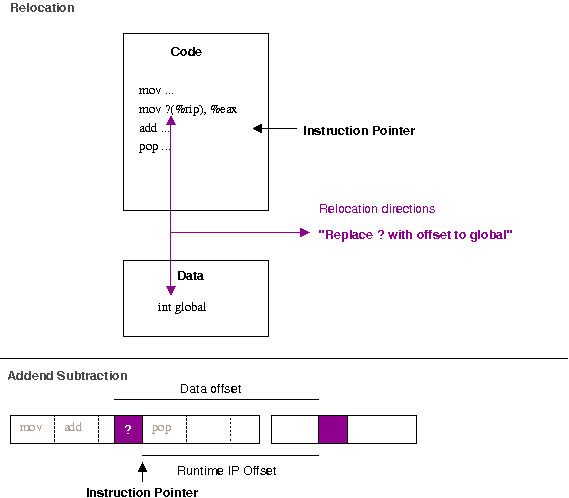
Lets just go through that for clarity: The IP relative move is really the trick here. We know from the code that it has to move the value of the global variable here. The zero value is simply a place holder - the compiler currently does not determine the required address (i.e. how far away from the instruction pointer the memory holding the global variable is). It leaves behind a relocation -- a note that says to the linker "you should determine the correct address of foo (global in our case), and then patch this bit of the code to point to that addresss". Relocations with addend The top portion of the image above gives some idea of how it works. We can examine relocations in binaries with the readelf tool.
$ readelf --relocs ./function.o
Relocation section '.rela.text' at offset 0x518 contains 1 entries:
  Offset          Info           Type           Sym. Value    Sym. Name + Addend
000000000009  000800000002 R_X86_64_PC32     0000000000000000 global + fffffffffffffffc
There are many different types of relocations for different situations; the exact rules for different relocation types are described in the ABI documentation for the architecture. The R_X86_64_PC32 relocation is defined as "the base of the section the symbol is within, plus the symbol value, plus the addend". The addend makes it look more tricky than it is; remember that when an instruction is executing the instruction pointer points to the next instruction to be executed. Therefore, to correctly find the data relative to the instruction pointer, we need to subtract the extra. This can be seen more clearly when layed out in a linear fashion (as in the bottom of the above diagram). If you try and build a shared object (dynamic library) with an object file with this type of relocation, you should get something like:
$ gcc -shared function.c
/usr/bin/ld: /tmp/ccQ2ttcT.o: relocation R_X86_64_32 against  a local symbol' can not be used when making a shared object; recompile with -fPIC
/tmp/ccQ2ttcT.o: could not read symbols: Bad value
collect2: ld returned 1 exit status
If you look back at the disassembly, we notice that the R_X86_64_32 relocation has left only 4-bytes (32-bits) of space left for the relocation entry (the zeros in 7: 8b 15 00 00 00 00). So why does this matter when you're creating a shared library? The first thing to remember is that in a shared library situation, we can not depend on the local value of global actually being the one we want. Consider the following example, where we override the value of global with a LD_PRELOAD library.
$ cat function.c
int global = 100;
int function(int i)  
    return i + global;
 
$ gcc -fPIC -shared -o libfunction.so function.c
$ cat preload.c
int global = 200;
$ gcc -shared preload.c -o libpreload.so
$ cat program.c
#include <stdio.h>
int function(int i);
int main(void)  
   printf("%d\n", function(10));
 
$ gcc -L. -lfunction program.c -o program
$ LD_LIBRARY_PATH=. ./program
110
$ LD_PRELOAD=libpreload.so LD_LIBRARY_PATH=. ./program
210
If the code in libfunction.so were to have a fixed offset into its own data section, it will not be able to be overridden at run-time by the value provided by libpreload.so. Additionally, there are only 4-bytes available to patch in for the address of global -- since a shared library could conceivably be loaded anywhere in the 64-bit (8-byte) address space we therefore need 8-bytes of space to cover ourselves for all possible addresses global might turn up at. The two basic possibilities for an object file are to be either linked into an executable or linked into a shared-library. In the executable case, the value of global will be in the exectuable's data section, which should definitely be reachable with a 32-bit offset of the current instruction-pointer. The instruction-pointer relative address can simply be patched in and the executable is finalised. But what about the shared-library case, where we know the value of global could essentially be anywhere within the 64-bit address space? It is possible to leave 8-bytes of space for the address of global, by telling gcc to use the large-code model. e.g.
$ gcc -c -mcmodel=large function.c
$ objdump --disassemble ./function.o
./function.o:     file format elf64-x86-64
Disassembly of section .text:
0000000000000000 <function>:
   0:  55                      push   %rbp
   1:  48 89 e5                mov    %rsp,%rbp
   4:  89 7d fc                mov    %edi,-0x4(%rbp)
   7:  48 b8 00 00 00 00 00    movabs $0x0,%rax
   e:  00 00 00
  11:  8b 10                   mov    (%rax),%edx
  13:  8b 45 fc                mov    -0x4(%rbp),%eax
  16:  01 d0                   add    %edx,%eax
  18:  5d                      pop    %rbp
  19:  c3                      retq
However, this creates a problem if you really want to share this code. By having to patch in an address of global directly, this means the run-time code above does not remain unchanged. Two separate processes therefore can't share this code -- they each need separate copies that are identical but for their own addresses of global patched into it. By enabling Position Independent Code (PIC, with the flag -fPIC) you can ensure the code remains share-able. PIC means that the output binary does not expect to be loaded at a particular base address, but is happy being put anywhere in memory (compare the output of readelf --segments on a binary such as /bin/ls to that of any shared library). This is obviously critical for implementing lazy-loading (i.e. only loaded when required) shared-libraries, where you may have many libraries loaded in essentially any order at any location. Of course, any problem in computer science can be solved with a layer of abstraction and that is essentially what is done when compiling with -fPIC. To examine this case, let's see what happens with PIC turned on.
$ gcc -fPIC -shared -c  function.c
$ objdump --disassemble ./function.o
./function.o:     file format elf64-x86-64
Disassembly of section .text:
0000000000000000 <function>:
   0:   55                      push   %rbp
   1:   48 89 e5                mov    %rsp,%rbp
   4:   89 7d fc                mov    %edi,-0x4(%rbp)
   7:   48 8b 05 00 00 00 00    mov    0x0(%rip),%rax        # e <function+0xe>
   e:   8b 00                   mov    (%rax),%eax
  10:   03 45 fc                add    -0x4(%rbp),%eax
  13:   c9                      leaveq
  14:   c3                      retq
It's almost the same! We setup the frame pointer with the first two instructions as before. We push the first argument into memory in the pre-allocated "red-zone" as before. Then, however, we do an IP relative load of an address into rax. Next we de-reference this into eax (e.g. eax = *rax in C) before adding the incoming argument to it and returning.
$ readelf --relocs ./function.o
Relocation section '.rela.text' at offset 0x550 contains 1 entries:
  Offset          Info           Type           Sym. Value    Sym. Name + Addend
00000000000a  000800000009 R_X86_64_GOTPCREL 0000000000000000 global + fffffffffffffffc
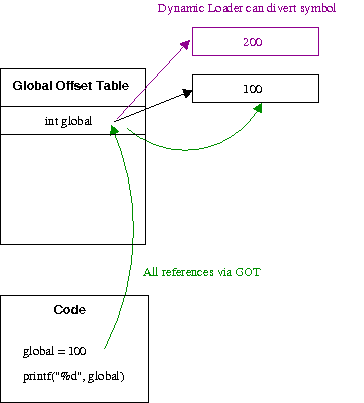
The magic here is again in the relocations. Notice this time we have a P_X86_64_GOTPCREL relocation. This says "replace the data at offset 0xa with the global offset table (GOT) entry of global. Global Offset Table operation with data variables As shown above, the GOT ensures the abstraction required so symbols can be diverted as expected. Each entry is essentially a pointer to the real data (hence the extra dereference in the code above). Since we can assume the GOT is at a fixed offset from the program code within plus or minus 2Gib, the code can use a 32-bit IP relative address to gain access to the table entries. So, taking a look a the final shared-library binary we see a final offset hard-coded
$ gcc -shared -fPIC -o libfunction.so function.c
$ objdump --disassemble ./libfunction.so
00000000000006b0 <function>:
 6b0:  55                      push   %rbp
 6b1:  48 89 e5                mov    %rsp,%rbp
 6b4:  89 7d fc                mov    %edi,-0x4(%rbp)
 6b7:  48 8b 05 8a 02 20 00    mov    0x20028a(%rip),%rax        # 200948 <_DYNAMIC+0x1d8>
 6be:  8b 10                   mov    (%rax),%edx
 6c0:  8b 45 fc                mov    -0x4(%rbp),%eax
 6c3:  01 d0                   add    %edx,%eax
 6c5:  5d                      pop    %rbp
 6c6:  c3                      retq
 6c7:  90                      nop
Every process who wants to share this code just needs to make sure they have their unique address of global at 0x20028a(%rip). Since each process has a separate address-space, this means they can all have different values for global but share the same code! Thus the default of the small-code model is sensible. It is exceedingly rare for an executable to need more than 4-byte offsets for a relative access to a variable in it's data region, so using a full 8-byte value would just be a waste of space. Although leaving 8-bytes would allow access to the variable anywhere in the 64-bit address space; when building a shared library, you really want to use -fPIC to ensure the library can actually be shared, which introduces a different relocation and access to data via the GOT. This should explain why gcc -shared function.c works on x86-32, but does not work on x86-64. Inspecting the code reveals why:
$ objdump --disassemble ./function.o
00000000 <function>:
   0:   55                      push   %ebp
   1:   89 e5                   mov    %esp,%ebp
   3:   a1 00 00 00 00          mov    0x0,%eax
   8:   03 45 08                add    0x8(%ebp),%eax
   b:   5d                      pop    %ebp
   c:   c3                      ret
$ readelf --relocs ./function.o
Relocation section '.rel.text' at offset 0x2ec contains 1 entries:
 Offset     Info    Type            Sym.Value  Sym. Name
00000004  00000701 R_386_32          00000000   global
We start out the same, with the first two instructions setting up the frame pointer. However, next we load a memory value into eax -- as we can see from the relocation information, the address of global. Next we add the incoming argument from the stack (0x8(%ebp)) to the value in this memory location; implicitly dereferencing it. But since we only have a 32-bit address-space, the 4-bytes allocated is enough to access any possible address. So while this can work, you're not creating position-independent code and hence not enabling code-sharing. The disadvantage of PIC code is that you require "bouncing" through the GOT, which requires more loads and reads to find an address than directly referencing it. However, if your program is at the point that this is becoming a performance issue you're probably not reading this blog! Hopefully, this helps clear up that possibly cryptic error message. Further searches around position-independent code, global-offset tables and code-sharing should also yield you more information if it remains unclear.

Russ Allbery: Automated Perl testing

I started several coding projects today, but none of them reached an announcable conclusion, so this seems like a good day to write up my current discoveries in automated Perl testing modules. This post isn't about test frameworks like Test::More and friends, or even about helper modules (although I do recommend Test::Warn if you want to test warning code in your modules). It's not about writing functionality tests. Rather, it's about various CPAN modules that can be used almost identically in just about every Perl module distribution (and in some other places, like Perl scripts inside a larger package written in another language). You can drop a small driver script into your t directory and (mostly) run make test with no further customization. If you want to see the driver scripts for all of the below that I'm currently using, see the t directory of the Term::ANSIColor distribution. They'll slowly make their way into my other modules, and probably, despite the name of the package, rra-c-util, since that's my equivalent of gnulib and I have tools to synchronize shared code from that package. The driver script generally tests whether the module is installed, skips the test if not, and otherwise dispatches to the "test everything" routine in the module. Test::MinimumVersion: This tests that you're not accidentally using a newer Perl feature than you were expecting. It's very handy if you want to support backward compatibility to a particular version of Perl. It knows about features as far back as 5.004_05. It won't be able to catch everything, but it will catch some of the most obvious things. Test::Perl::Critic: This is sort of the thousand-pound gorilla. Test::Perl::Critic runs all of your code through perlcritic and reports any errors. You will probably need to combine this with a perlcriticrc file in your distribution that you configure it to use, since otherwise the person running the tests may have customized perlcritic. If you let it run perltidy to check for formatting problems, you'll also want a perltidyrc. See the driver script mentioned above for how I set that up. I usually configure this test to only run for me (by checking an environment variable) since the results vary a lot depending on what version of perlcritic is installed, and it's likely new versions will cause the test to start failing. If you use this, expect to need to add ## no critic annotations to your code. Test::Pod: Checks for syntax errors in your POD documentation so that you won't have those embarassing POD ERRORS sections. Note that the latest version of podlators turns syntax errors into fatal errors, so soon you won't have to worry as much about this. But if you'd been using this module all along, you wouldn't have to worry about the fact that pod2man may start faliing due to syntax errors you never fixed! Test::Pod::Coverage: Only of interest to module distributions, not ramdom scripts, this checks that every sub provided by your module has POD documentation. It understands various subs that don't need to be documented (such as the ones you provide to implement a tied class) and lets you mark some subs as not requiring documentation. Test::Pod::Spelling: Checks your POD documentation for spelling mistakes with a spell checker. (Note that perlcritic, and hence Test::Perl::Critic, can also do this, but I use this module separately since I think the output is more readable.) You will almost certainly want to make this test maintainer-only, since spell checkers and spelling dictionaries vary a lot. But it prevents a lot of embarassment when you read your documentation on search.cpan.org and find that obvious spelling error you never saw before. Test::Strict: Checks all Perl code to ensure that it compiles, checks whether it has use strict, and optionally checks whether it has use warnings. This is great; I use this even with packages that just have a few Perl utility scripts in a package otherwise written in C, since I previously kept releasing packages with helper scripts with obvious syntax errors since I didn't run them much. Another place it's useful is if you have internal Debian packages that wrap up Perl utility scripts; just create a small test suite with this module and run it from override_dh_auto_check and you won't ever release a package with scripts that won't run. You can also do test suite coverage testing with this module (and Devel::Cover), but that you'll want to mark maintainer-only since it takes a while. Test::Synopsis: Checks the code in the SYNOPSIS section of any POD documentation to ensure that it compiles. No more syntax errors in your example code in the documentation! All of these modules are, of course, packaged for Debian (thanks largely to the wonderful Perl packaging team!), and otherwise available on CPAN. There are a variety of others, of course; these are just the main ones that I've found personally useful. One final whine, however: all this wonderful Perl testing infrastructure desperately needs a common module and a common interface for providing a list of files to check. Every one of these modules reinvents that wheel, and most of them do it a slightly different way than all the others. Most of them check in either blib or lib (or sometimes both). Most of them also add t. Most of them don't include Makefile.PL, but some of them do. Almost none of them look in examples. Some have a simple way to add more files or directories; some don't. Some can be run from the t directory and still find things, but most of them can't. And of course the syntax is different in every case! Most of the work in my driver scripts is finding the right way to add a few additional directories to the scope of the testing, and in one annoying case (Test::Synopsis), I actually had to use Perl::Critic::Utils (for lack of a better module) to build a list of files to check instead of using the build-in file list, since the build-in file list required all module code be in lib. A module to abstract out all of this and provide a common interface would be easy to write. Most of the work would involve talking to all the authors of all these different modules and asking them to use it. If someone in the Perl community felt like doing that, it would make life so much easier for everyone.

4 January 2013

Stefano Zacchiroli: bits from the DPL for December 2012

Happy new year, Debian! To celebrate, here are some freshly posted, bits from the DPL for December 2012.
Dear Project Members, happy new year! Here goes another report of DPL activities, this time for December 2012. This issue of the DPL-monthly is skinnier than usual: during the past month I've been struck by the catastrophe also known as "family holiday season", enjoying a solid 10 day break from computer-related activities. Talks Assets DPL helpers Collaboration with the outer world That's all for last year, enjoy the new one, which will soon see a new Debian release out of the door. And to make it happen sooner, let's go back fix RC bugs! Cheers.
PS the day-to-day activity log for December 2012 is available at the usual place master:/srv/leader/news/bits-from-the-DPL.txt.201212

3 January 2013

Hideki Yamane: Hello New year, Hello Planet

This is first post to Planet Debian...

Hi, let me introduce myself a bit... I'm a Debian Developer living in Japan. I'm not a geek, programmer... but love Debian and enjoy to participate this project :-) I want to share something interesting related to Debian.


Recently, also I'm curious about Debian cloud computing service - AmazonEC2, Rackspace, WindowsAzure, Google Compute Engine and so on.
Recent two big topic for me is

Especially Aeolus is huge software stack and need to package a lot of Ruby gems, so I've joined Pkg-ruby-extras-maintainers and started packaging some gems. I'm newbie for Ruby, so please help if there's something wrong with my packaging.

Next.

Previous.



