Search Results: "tb"

9 April 2012

Joey Hess: Stand by the grey stone when the thrush knocks

Today, map in hand, I explored the "long valley, narrower than the great dale in the South where the Gates of the river stood, and walled with lower spurs of the Mountain".
"The dangerous search on the western slopes for the secret door"
"It seemed as if darkness flowed out like a vapour from the hole in the mountain-side" "They spoke low and never called or sang, for danger brooded in every rock."
"It is almost dark so that its vastness can only be dimly guessed, but rising from the near side of the rocky floor there is a great glow. The glow of Smaug!"

Russell Coker: Guest/Link Post Spam

I ve been getting a lot of spam recently from people wanting to write guest posts or have their site included in a future links post. Guest Posts For guest posts the social convention for the planets which aggregate my blog seems to be that random guest posts are unacceptable. I could change my blog feed to have some posts excluded from the planet feeds but that s too much effort and I don t want random guest posts anyway. The only situations in which I will accept guest posts are when someone is writing what I might have written (IE they generally agree with me) or if they are a member of the free software community who doesn t have their own blog but has something relevant to say. Any applicant for a guest post who runs a business that is useless and/or evil IMHO (EG anything related to the TSA) is going to get rejected firmly. Any applicant who tells me that they can write on a wide variety of topics probably isn t capable of making me an offer that I would accept. Tell me that you can write about Linux programming or computer security and I ll be interested, but you have to provide links to your previous work. An application to write a guest post that starts with something like I liked your recent post at the above URL but I think you missed some important points, as I have some experience in that field I think I could write a guest post that would help educate your readers may be accepted. Probably the best thing to do however is to write comments on my blog, if you can write informative comments and offer to make a longer comment into a guest post then there s a good chance that I ll be interested. Generally though I will only offer the opportunity to write a guest post to someone who writes something really informative in private email or on a closed mailing list. If you can solve a technical problem about Linux that has me stumped then I will almost certainly be willing to accept a guest post about it! Links Posts There are many sites which consist of nothing but links to other sites. In the 90 s such sites were really useful but since the rise of Google their value has declined dramatically. As an aside when I ran an Internet Cafe in the 90 s I had every web browser start with the main page of my Hot Stuff list, the purpose of this was to increase the hit rate of my Squid cache by having most of the customers visit the same sites. Even back then I probably wouldn t have bothered if it wasn t for Squid hits. It must seem like an easy way to make money to create pages of links to articles with short summaries and then hope for advertising revenue, a domain sale, or the launch of some sort of profitable business once people start using the site. I wonder whether that ever works out for people. It doesn t seem like a good business model, doing something that requires little skill, which can be done by almost anyone, and which is done by many people. Maybe there are sweat-shops dedicated to this. Anyway my links posts are unlikely to ever link to any such links pages, I don t think that the people who read my blog want double indirection. I won t entirely rule out linking to a links page, but it would have to be of very high quality and related to something very technical about computers. Basically anyone who reads this should give up on the idea of submitting a links page to me, if it s good enough to make me break my policy of not linking to such things then I ll probably find it myself. Conclusion As a general rule if you want someone to publish your work then you need to look at what they are publishing and make sure that your work fits. With the recent requests for links and guest posts I ve been getting I have to wonder whether the people making the requests have even read my blog. That method of operating is unlikely to give any success at a blog that has any reasonable number of readers. I ll probably link to this from my about page or something. It might discourage some of the spammers. Related posts:
  1. Link Within Good Things about LinkWithin For the last 10 weeks I ve...
  2. Feedburner Item Link Clicks For a while I used the Item Link Clicks feature...
  3. Can you run SE Linux on a Xen Guest? I was asked Can you run SELinux on a XEN...

8 April 2012

Richard Hartmann: Richuck

Q: How much wood would a Richuck chuck if a Richuck could chuck wood? A: Quite a bit. The few times in the past when I was able to get my hands onto a tree or three, I thoroughly enjoyed turning them into firewood. It's good workout, you get fresh air, and you can actually see what you accomplished with your hands. Back then, I had access to a hatchet, a felling axe and a single wedge. Splitting anything larger than 20 or 30 cm in diameter was tedious work, though still enjoyable. Two weeks ago, I was presented with several cubic meters of spruce; log diameters ranging in between 10 and 50 cm, pre-cut to two meters in length. Plus, access to a chainsaw. Yay. After some research, I ordered two helicoidal splitting wedges (they turn themselves when driven into wood), a splitting axe and a splitting maul. The rest of the equipment handed to me is probably older than I am, but still working perfectly fine. You have to admire the simple yet efficient design of the cant hook. Something I could not find an English name for is the German Sapie, in itself loosely defined as "any tool you can use to pick up, turn, drag or otherwise move logs". There's a surprising variety of these tools, but then, moving wood around has been a necessity of life for millennia so people are bound to come up with good designs. Last weekend, the chainsaw wasn't running very smoothly or much at all, resulting in hours spent coaxing it to cut at least enough for some hacking (the wood, not the computer kind). Other than our chainsaw troubles, that weekend was very pleasant and I ended up splitting tons of logs. We had the chainsaw overhauled and resharpened during the week and picked it up again on Friday, planning to resume cutting early Saturday, a plan that was spoiled by torrential downpour and hail. In the afternoon, I started splitting some left-overs around the house and used a short break from the rain to head out into the woods to where the logs are piled. The place I chose for splitting is somewhat exposed and even though the mix of rain, sleet, snow, hail, and everything in between resumed soon enough turns out you simply stop caring at some point. While temperatures were around freezing, I ended up being drenched in sweat in no time at all. There is something primordial and deeply satisfying about simply working away at these logs, ending with piles and piles of firewood. Of course, using my favourite new toy, 4.6 kg of forged stainless steel fuck you, increased said satisfaction immensely. Between the two wedges and that maul, splitting any middle-European conifers is a breeze. Add in the splitting axe for slim trunks and splitting will take less than 60 seconds per cut, no matter how many branch knots or pockets of shock-absorbing partially decayed wood you encounter. If only I've had those tools a decade and a half ago... While I am feeling muscles I forgot I had, I am planning to pursue this new-found old hobby for at least the foreseeable future. Especially since I sourced more logs and a few trees, already.

Gregor Herrmann: RC bugs 2012/14

good news: it looks like more & more people are working on RC bugs & doing NMUs. here are my contributions from this week:

Ingo Juergensmann: Grub2 fails booting from second VG

I just got a new harddisk, because my old RAID of 3x 1 TB disks are getting filled and I'm running out of space. In the end I'll have replaced my old disks by 3x 4 TB disks. Currently the setup is as this:
Kategorie:

Russell Coker: Flash Storage Update

Last month I wrote about using USB flash storage devices for my firewall and Squid proxy [1]. 4 days ago it failed, the USB device used for the root filesystem stopped accepting write requests. The USB device which is used for /var/spool/squid is still going well after almost 5 months of intensive use while the USB device for the root filesystem failed after 24 days of light use. Both USB devices were of the same model and were obtained at the same time. Presumably one of them was just defective. I m now using an old 1G USB device for the root filesystem. When using it on less ancient systems with USB 2.0 there was an obvious speed difference between the 1GB and 4GB devices. But when run on USB 1.2 they can both support the maximum speed of the port so performance probably isn t any worse. Not that it really matters for the root filesystem, the server is supposed to run without a break for long periods of time so if boot time becomes a performance issue then whatever is causing the reboots will be a much bigger problem. It s annoying to have a device fail and the failure rate for USB flash devices running 24*7 is looking rather bad at the moment. But I m confident that things will run well from now on. Related posts:
  1. USB Flash Storage For some years I have had my Internet gateway/firewall system...
  2. flash for main storage I was in a discussion about flash on a closed...
  3. Flash Storage and Servers In the comments on my post about the Dell PowerEdge...

7 April 2012

Ritesh Raj Sarraf: Apport for Debian

apport just cleared the new queue and is now available in experimental. For those who do not know what apport is:

Debugging program crashes without any automated tools has been pretty time consuming and hard for both developers and users. Many program crashes remain unreported or unfixed because:

  • Many crashes are not easily reproducible.
  • End users do not know how to prepare a report that is really useful for developers, like building a package with debug symbols, operating gdb, etc.

  • A considerable part of bug triage is spent with collecting relevant information about the crash itself, package versions, hardware architecture, operating system version, etc.
  • There is no easy frontend which allow users to submit detailed problem reports.
  • Existing solutions like bug-buddy or krash are specific to a particular desktop environment, are nontrivial to adapt to the needs of a distribution developer, do not work for crashes of background servers (like a database or an email server), and do not integrate well with existing debug packages that a distribution might provide.

Apport is a system which

  • intercepts crashes right when they happen the first time,
  • gathers potentially useful information about the crash and the OS environment,
  • can be automatically invoked for unhandled exceptions in other programming languages (e. g. in Ubuntu this is done for Python),
  • can be automatically invoked for other problems that can be automatically detected (e. g. Ubuntu automatically detects and reports package installation/upgrade failures from update-manager),
  • presents a UI that informs the user about the crash and instructs them on how to proceed,
  • and is able to file non-crash bug reports about software, so that developers still get information about package versions, OS version etc.
At this moment, it is quite broken. The crashes are not intercepted by update-notifier on my box. With it now in experimental, my intent is to slowly integrate it well with all dependent tools for Debian. It won't be ready for the Wheezy release, but hopefully for the one after that.On the Ubuntu side, Canonical hosts a retracing service that takes user reported core dumps and generates a usable backtrace. For Debian, my plan is to have a chroot kind interface, where in the user could opt-in to download all debug packages to generate a valid backtrace. This could go as the debian backend for apport in the future. On the bug reporting side, afaik, we do not have a web interface to lodge bugs. To report bugs (minus the core dumps), we will want a backend to submit it over email. The current apport report gathering tool is pretty good (if compared to other tools like reportbug), so here the low hanging fruit would be to just take the report and feed in email to our BTS server. For the eyes:Apport on Debian

3 April 2012

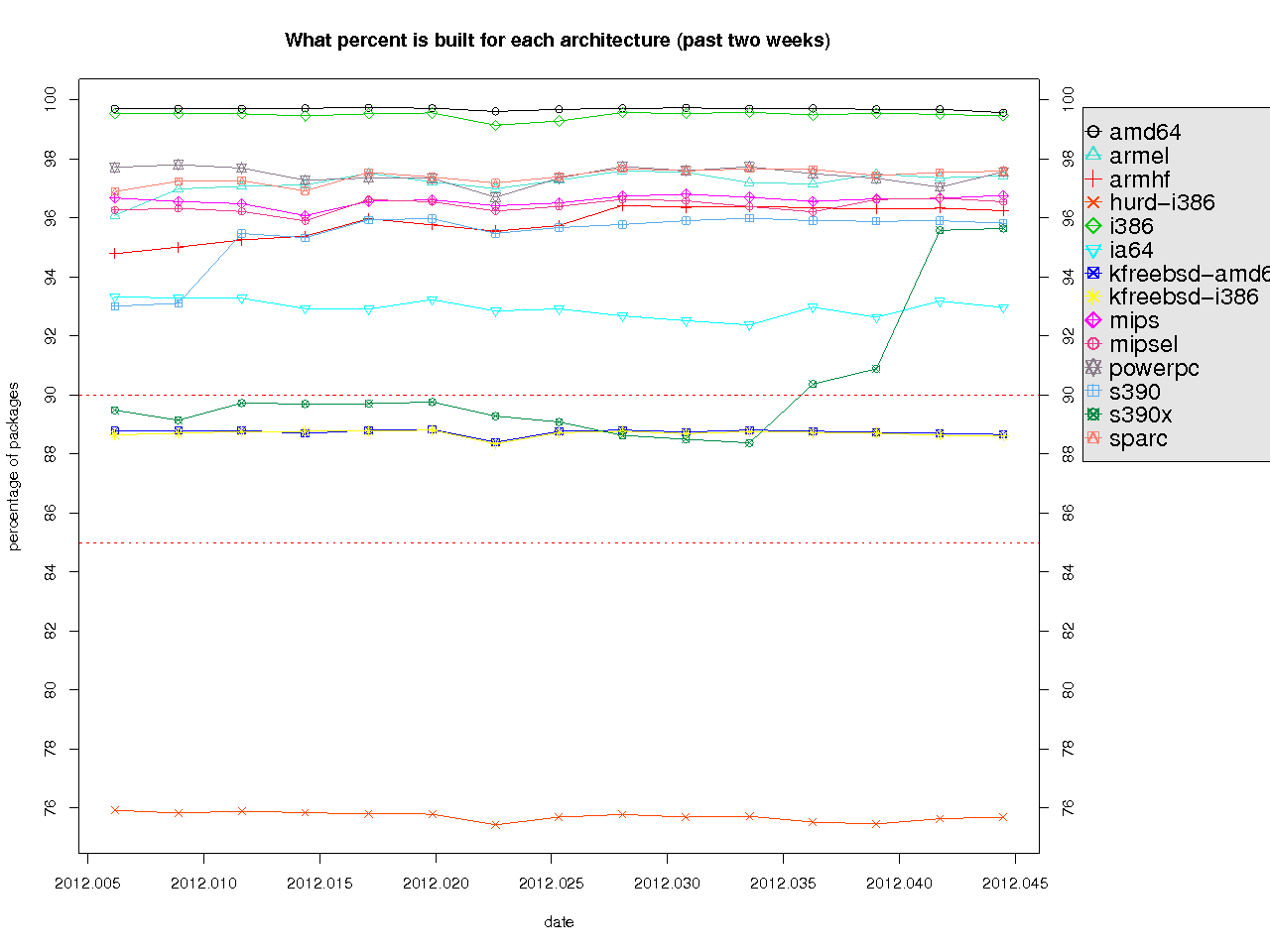
Philipp Kern: The state of Debian s390x

When we added s390x to the main archive, coming from Debian Ports, we were unlucky. A new glib release had assumptions that weren't true on 64bit big endian architectures and it entered the archive just a few days before we made the initial import. This weekend we finally got a new major release into Debian unstable that fixed these issues. So we're almost on par with s390 now. It all untangled quite nicely after glib-networking was able to complete its testsuite. Only one build-dependency loop between nautilus and tracker had to be broken manually.

So what's left? There's a bunch of usertagged bugs (with both general FTBFSes and arch-specific issues; kudos to Aur lien Jarno providing a lot of patches) and we still need to file some, like iceweasel segfaulting during its build. That's important because another bunch of packages needs it to build (well, mozjs and/or xulrunner, or some package that needs those).

1 April 2012

Gregor Herrmann: RC bugs 2012/13

due to some new incoming RC bugs, this week was more devoted to fixing bugs in "our" (= the Debian Perl Group's) packages. here's the list:

Russ Allbery: Review: Agile Project Management with Scrum

Review: Agile Project Management with Scrum, by Ken Schwaber
Publisher: Microsoft
Copyright: 2004
ISBN: 0-7356-1993-X
Format: Trade paperback
Pages: 153
Ken Schwaber is one of the two original developers of Scrum and one of the signatories to the Agile Manifesto. Agile Project Management with Scrum is an introduction to Scrum by him that feels aimed primarily at business people (project managers, executives, line managers) rather than at technical people. There's very little about agile software development in general; the emphasis is on business process, team organization, and how the Scrum process looks to the rest of the organization. After an introductory chapter laying out the basics of Scrum, the remainder of the book is primarily case studies. Schwaber presents some principle and then discuss an anonymized case study that illustrates the principle. Each major Scrum role (ScrumMaster, Product Owner, and Team Member) gets their own chapter, interspersed with chapters on planning, reporting, and scaling. Finally, there are some concluding appendices laying out the rules of Scrum in more detail, adding a brief (and very disappointing) discussion of fixed-term, fixed-price contracts, and providing some other supplemental information. This is only the second regular book that I've read about Scrum, but my reading has been a bit out of order. We've been using Scrum for various projects for about a year and a half, I've played both team member and product owner roles, and we've been thinking hard about how to integrate Scrum more into the way we do development. My impression of this book is that it's intended as more of an introduction for people who aren't yet comfortable with Scrum or who are still struggling to make the pieces fit together. I'm therefore possibly not the target audience. Much of this book is a rehash of things someone who has studied Scrum will already know. I'm of two minds about the case study presentation style of this book. On one hand, it does help to make the points Schwaber discusses more concrete, and it's difficult to talk about business process in any other way. They're also more interesting and engaging than Schwaber's straight rule descriptions. But I had difficulty digging into most of the ones here. They're very simple and a little shallow, and I had trouble applying many of them to practical situations I might be in. I would have liked somewhat more detailed stories with more analysis and possible alternatives within the situation, rather than simple illustrations of how Scrum solves the problem that Schwaber had just said it would solve. What I did like about this book is that it provides the background and theory of Scrum as empirical process control much more clearly than any material I'd previously read. Schwaber is good at explaining what empirical process control is and why it's a superior approach, and he gave me new vocabulary and basic concepts to use to talk about Scrum. I also liked the high-level look from a management perspective without getting into the details of story points and velocity estimation (Schwaber doesn't use them at all in this book, relying instead on traditional "days of work" estimates). Much of my previous experience with Scrum was tightly focused on its advantages for estimation and responsiveness to changes, and it's nice to see some of the other advantages of Scrum (developer job satisfaction, improved focus, incremental deployment) highlighted more. Another part of this book I appreciated was the discussion of sprint length. Schwaber doesn't go into the possible alternatives, largely assuming that a month is the best interval, but the discussion of the impact and implications of a month sprint length helped me see the advantages of longer sprints. (To date, we've been doing either one week or two week sprints.) I came away with the feeling that a hybrid model where longer sprints are used for business purposes and then subdivided into shorter sprints for developer coordination might be particularly effective, although that's not an idea that Schwaber presents. This is not a particularly compelling read, particularly if, like me, you're not a huge fan of genericized case studies. Schwaber's writing is clear, but wooden and occasionally awkward, and the book is often dry. But it talks about Scrum from a management angle instead of a developer angle, which is an additional perspective that I found valuable. Possibly worth taking a look if you want more detail about Scrum from a high-level management perspective, although I don't think you're missing a lot by not reading it. Rating: 6 out of 10

30 March 2012

Russell Coker: The Security Benefits of Automation

Some Random WTFs The Daily WTF is an educational and amusing site that recounts anecdotes about failed computer projects. One of their stories titled Remotely Incompetent concerns someone who breaks networking on a server and is then granted administrative access to someone else s server by the Data Center staff [1]! In one of the discussions about that I saw people make various claims about Data Center security, such as claiming that having their own locked room helps. My experience indicates that such things don t do much good, I have often been granted access to server rooms without appropriate checks. My experience is that security guards on site generally don t directly do any good. I once had a guard hold a door for me when I was removing a server from a DC without even bothering to ask for ID! On another occasion in the Netherlands I had a security guard who didn t speak English unlock the wrong server room for me, I used hand gestures to inform him that I needed access to the room with the big computers and he gave me the access I needed! It seems that the benefit of security guards is solely based on scaring people who don t have the confidence needed to bluff their way in. Preventing children from thieving is a good thing, On another occasion I showed ID and signed in for access to a DC owned by my employer and I used my security key to go through a locked door with a sign that promised many bad consequences if I failed to lock the door behind me. Then I discovered that the back door was wide open for the benefit of some electricians who were working in the building. Presumably the electricians who had no security training were expected to act as ad-hoc security guards if someone tried to enter through the back door presumably they would not have been good at it. When a company uses part of their own office for a server room then many of these problems disappear. But a common issue in such ad-hoc DCs is the lack of planning and procedures, I have lost count of the number of times I ve seen doors (and even windows) propped open to allow ventilation because there were too many servers for the air-conditioning to cope. The most ironic example of this is the company that had a walk-in safe (think of a small bank vault with concrete walls and thick solid steel door) used for storing servers but with it s door propped open to allow cooling. The advantage of a serious hosting company is that they will have procedures for cooling etc and will be very unlikely to do strange and silly things. Having a locked room in a DC makes some sense, but if security guards have the master keys and are allowed to use them then it might not do much good. The one time I locked my keys in such a room I had a guard let me in without verifying my ID or the claim that there were actually keys locked in the room. Presumably anyone could just claim to have forgotten their keys and get the door unlocked just like a cheap hotel. Locking a rack sounds like a good idea, but the racks I ve seen have had locks which are quite easy to pick. On the one occasion when I had to pick a lock on a rack (due to keys being too difficult to manage for the relevant people) the security guards didn t investigate, so either the security cameras were not supervised or they just didn t care about people picking locks in a shared server room. Also if you allow people to do things freely in a shared server room they could install devices to monitor network traffic. A locked cage in a server room should work well. In the one case where I worked for a company that used such a cage I found it to mostly work well apart from the few weeks when the lock was broken. One company that I worked for had scales before the door between a server room and the car-park to prevent people from stealing heavy servers. Of course that wouldn t stop people stealing hard drives full of data which is worth more than the servers! Also an over-weight colleague had to have the scales disabled for him (as they were based on absolute mass not unexpected changes in an individual s mass) which presumably means that any skinny employee could steal a 2RU server and still be below the mass threshold. How to Solve some of these Problems Computers are subject to all manner of security problems. But they tend not to do arbitrary things for no apparent reason and they will never give in to someone who is charming, attractive, or aggressive unlike humans. I have servers running on Hetzner, Linode, and the Rackspace Cloud. I am always concerned about possible security compromises. But I am not worried about someone climbing in a window of a server room or convincing a security guard to let them in through the door. All three of those hosting companies have the vast majority of interactions automated. I can change many aspects of the servers without involving ANY human interaction. Out of the three of those companies I have had some human interaction with Hetzner (who provide managed servers) when a hard drive needed to be replaced obviously replacing a disk in the wrong server would have been a significant system integrity issue even though everyone would be running RAID-1 and if Hetzner improperly disposed of the broken disk then there could be security issues but this is an unlikely mistake in the face of a rare occurrence. With Linode and the Rackspace Cloud (and the previous Slicehost hosting that was purchased by Rackspace) the most common interactions I have with employees of those companies are when my clients don t pay their bills on time and that s an administrative not a technical issue. When I do have to contact the support people about a technical issue it s usually something that s not immediately connected to the virtual server (EG a loss of routing to the DC). It seems most likely that there are a fairly small number of people who are allowed in the DCs for companies like Hetzner, Linode, and Rackspace. Those people would probably be recognised by the security guards and their work would be restricted to replacing failing hardware and not involve granting access requests. There are some unusual requests that they can process (EG one of my clients recently transferred a virtual server between business units) but even in those cases the administrative software controls who gets access. This is much better than just handing hardware access to what seems to be the correct physical server to a client. If you have software running a few computers and operating correctly then you can probably scale it up to run thousands of computers and have it still work correctly. But if you have a team of people controlling access requests and want to scale it up significantly then there are huge problems in hiring skilled people and training them correctly. There is a real risk of security flaws in such administrative software, if someone managed to exploit the automated management system for one of those three companies then they could probably gain access to the private data of any of their customers. But the risk of this seems a lot less than the risk of general incompetence among humans who perform routine and boring tasks which have the potential for great errors. Related posts:
  1. The Security Benefits of Being Unimportant A recent news item is the hacking of the Yahoo...
  2. Security Lessons from a Ferry On Saturday I traveled from Victoria to Tasmania via the...
  3. Public Security Cameras There is ongoing debate about the issue of security cameras,...

29 March 2012

Carl Chenet: Debian developer

I received the email yesterday and was like wow, I m in . I would like to thank: Sorry for the other readers who will find this post boring, but it means a lot to me :)

28 March 2012

Jordi Mallach: GNOME 3.4

The GNOME project released today GNOME 3.4, the second major update to the GNOME 3 platform. Congrats! I know there's lots of polish and improvements to some of the major rough edges in GNOME 3.2, but I think that of all changes in this release, Epiphany really stands out, as you can see in blog posts by Xan and Diego.

Work to bring GNOME 3.4 to Debian wheezy users has been underway for a few weeks already, and some bits and pieces have been hitting unstable since the tarballs were released a pair of days ago. We still need more base work to be done before some exciting components like GNOME Shell can hit our archive, and we want to fix as many FTBFS with GLib 2.32 bugs as possible before pushing it to unstable, but all in all, hopefully this time, shepherding a major GNOME release to Debian testing won't be as painful as it was not so long ago. However, we have already identified some fun bits involving clutter, cogl and mutter in our initial analysis, but nothing that hopefully can't be dealt with in a civilised way. As always, if you think you can help us, we're reachable at #debian-gnome at OFTC!

Andrew Pollock: [life/americania] Four days in New Orleans

Sarah's Mum had accrued too much annual leave and had to take some time off work, so Sarah did some (very mild) arm twisting and convinced her to come over for 3 weeks, and do a 5 day cruise to Mexico out of New Orleans. Unfortunately, my annual leave situation wasn't quite so abundant, and I had a lot going on at work, so regretfully I didn't join them on the cruise, and instead went to New Orleans for a four day weekend when they returned. From all reports, the cruise was very good. Zoe handled it well, although she did say "home" a lot. One of the two stops in Mexico was to check out some Mayan ruins, which looked awesome from the photos. The other stop involved a dolphin encounter. I was incredibly envious of all that they got to do, and would have loved to have gone with them, as I've never been on a cruise ship either. I can also report that no cats were lost during this bachelor stint. I had a night flight on the Wednesday evening to get there, which was scheduled to get in at around midnight, and I'd booked a motel room near the airport for that night, and we'd booked a vacation rental home for Thursday to Sunday nights. Unfortunately, my flight ended being delayed something like 2.5 hours, so I didn't get into New Orleans until around 2am. The house we rented did the trick nicely. It was a small "shotgun" duplex in what looked like a nice neighbourhood. It was advertised as being close to the street car line, but they were doing some work on the tracks, so the street car didn't seem to be running as far down the line as it usually did, so it ended up being a bit more of a trek to get to it. It was also extremely slow, and there was a marathon on the Sunday, which closed everything down for a long time, making it a generally pretty unreliable form the transport. We ended up renting a car for Saturday and Sunday, which was something of a saga in itself, as Enterprise didn't have any cars at the location we'd booked one, so after a couple of hours cooling our heels there (Zoe was incredibly well-behaved, all things considered), they shuttled us over to another location and we ended up with a minivan instead of a compact, which for the same price, allayed our concerns about being able to transport all of our luggage to the airport on Monday morning. We had a very early morning flight on Monday morning to come back, which got into SFO at around 9am, and I went directly to work from there. Thursday We all arrived at the house, separately. It ended up taking them 2 hours to disembark the ship when it came back into port, with Customs taking an eternity to process everyone. I think we went exploring the local area that afternoon, and took a street car into the city to check out Bourbon Street, having a Cajun dinner at Remoulade. Friday In the morning, we went to check out Lafayette Cemetery Number 2. Sarah took Zoe back to the house for a nap, and Sarah's Mum and I continued back to explore the French Quarter some more, walking down the length of Royal Street (which was vastly different from Bourbon Street, just one block over). We had lunch at the French Market. The cemetery was interesting, as pretty much all of the graves were these huge above ground tombs, that seemed to have multiple family members interred in them. Apparently the cemetery filled up quite quickly courtesy of a Yellow Fever outbreak. After lunch, Sarah's Mum and I continued wandering around the French Quarter. We went and took a look at the Mississippi River, and I had an encounter with a grifter who was so good at his job I couldn't bring myself to argue with him over the $20 he diddled me out of. We tried to get to the Civil War Museum, but it closed at 4pm. We looked at the Robert E. Lee Monument, which seemed to be draped in drunks, and then I think we rendezvoused with Sarah and Zoe back on Canal Street for dinner at The Court of Two Sisters (which apparently we were under-dressed for, as Sarah and her Mum said we were getting a lot of dirty looks from other patrons). Saturday On Saturday morning, we had the aforementioned car rental experience from hell, and by the time we had the car it was lunchtime, so Zoe napped in the car after lunch on the way out to Oak Alley Plantation, where we were introduced to the delightful beverage known as the mint julep, and took a tour of the house and wandered the grounds. Sunday On Sunday, Sarah and her Mum did a swamp tour, and Zoe and I went to the zoo. As I said earlier, there was a marathon that completely closed down Saint Charles Avenue, which is where the street cars run, so after walking down to where the street cars started operating (which ended up being most of the way down South Carrollton Avenue), the driver informed me that the street cars were queuing up at the corner of South Carrollton and Saint Charles, and I should get off her street car and get on the one at the front of the queue. I did this, but the driver of the front street car informed me that she wouldn't be leaving for an hour and half. At this point, I started considering a bus instead. Zoe and I went to check out the Mississippi River, which was quite close to where we were, and then I went back, and despite a street car having left (without any passengers) the driver of the current street car couldn't tell me when she'd be leaving, so I started walking down Saint Charles Avenue. Unfortunately, Zoe's going through a phase where she wants to be carried everywhere, so I was lugging her all over the place on my hip. Sarah didn't take a stroller with her, and instantly regretted it. Lesson learned. Eventually we managed to get onto a bus, which dropped us off at Audubon Park, which had Audubon Zoo at the other end of it. There was a playground near the Saint Charles Avenue end of the park, so Zoe had a bit of a play on that, and then we continued through the park to the zoo. Mercifully, the zoo had dodgy strollers for rent, and there was no way in the world I wasn't going to rent one of them, so that made getting around with Zoe a lot easier on my back. We had a really good time at the zoo. There was some sort of a music festival on in the parklands within the zoo grounds, and that included a jumping castle, which Zoe expressed a desire to have a go on. She had a fabulous time on it. I think she probably spent about 15 minutes in there, without any tears. I was very impressed. I took a brief video of some of her antics. It was getting close to Zoe's nap time, and she was getting tired, but fortunately Sarah and her Mum were able to pick us up from the zoo after their swamp tour and Zoe got to nap back at the house. Monday We had a very early start. Unfortunately, our flight (with United) was a couple of days after United and Continental officially merged, and despite having checked in online, we had to queue up with everyone else (for an extended period of time) to drop off our checked luggage. Then there was a 45 minute line for security screening. We pulled the "toddler going to melt down" card and jumped to the head of the line, but Sarah's Mum had to wait. The flight ended up being delayed because people were stuck in the security line. Overall impressions of New Orleans Fabulous architecture. There were so many gorgeous houses on Saint Charles Avenue and the surrounding area. I'd have loved to do an architecture tour. Crap (but cheap) public transport. $3 gets you a day pass. The street cars are cute, but slow and unpredictable. The drivers were remarkably unhelpful. The buses were okay. Great food. Zoe seemed to have a liking for the spicy stuff. I gave her some fresh alligator jerky, and after some initial coughing and spluttering at the spiciness of it, she came back for more. Post-Katrina recovery. We really only saw a very small part of the city, but there were still some houses with boarded up windows, and some vacant blocks where buildings had been demolished, but largely you'd not have been able to tell that large parts of the city had been underwater, from casual inspection. I really enjoyed the trip, even though it was brief, I feel like I got a good feel for the place. We were there just after Mardi Gras, and there were still beads everywhere. Draped all over fences. Over power lines. Trees on the parade route were absolutely covered in beads. I'd have loved to have been there for Mardi Gras. My friend Brandon, who is an excellent street photographer, took some great photos that capture some of it. Photos from Sarah's cruise and our time in New Orleans are here.

27 March 2012

Timo Jyrinki: On brands, marketing and technical details

I have a few thoughts based on the yet another round of debate where marketing clashes with free software advocation and technical details. Nothing new in the debate itself, but I'm adding a couple of insights.


Marketing is not highly respected by many technical people, and neither by the people wanting more advocating than the messing up with facts and feelings that the marketing does. I'm all for advocating free software, but it's currently not something you can use for marketing to win big markets. If we advance to a world where free software is as wanted as the green values today are, it can be used in marketing as well similar to all the ecological (according to the market department at least) products today, but alas the benefits of free software are not yet as universally known. Since it doesn't say much that touches the masses, advocating has a negative marketing effect since it takes space away from the potentially "hitting" marketing moves, in those cases where you target the big masses in the first place. "Open" this and that has some marketing power in it nowadays, but it's a mess of different meanings that probably doesn't advance libre software freedoms as such. Wikipedia has probably been the biggest contributor to advancing general knowledge of software and culture libre. Disclaimer: I'm not a proper marketing person, some more professional might have better insights in this area. If I'd be a proper marketing person, I'd decorate this blog post with fancy pictures so that more people would actually read it.

Some of the marketing can be done without sacrificing any of the advocation. The fabulous Fedora campaigns, graphics, slogans and materials are a great example of those and do an important job, even though Fedora isn't reaching the big masses with it (and Fedora isn't targeted for OEMs to ship to millions either). But they do hopefully reach a lot of level people on the grassroots level. I hope as a Debian Developer that more people valuing the freedoms of free software would help also Debian as a project to reach more of its advocation potential and developers from the more proprietary world. But I'm happy that at least some free software projects have nowadays true graphical and marketing talent. Even though not as widely known, freedoms of the software users including for example privacy aspects are a potential good marketing tool toward a portion of the developer pool.

Let's not forget that Android conquered the mobile market without using the brand power of Linux. The 30+ million people who know Linux a bit deeper than just "I've heard it" already run a Linux distribution like Ubuntu, but we need hotter brands than a project name of a kernel to reach the bigger masses. Call it Ubuntu, Fedora, or something, but no matter do what it needs to ship it to millions. AFAIK mostly Ubuntu and SUSE are shipping currently via desktop/notebook OEMs, and more Ubuntu than SUSE. Others aren't concentrating on the market, which is a very difficult one. Ubuntu is doing a lot more mass population advocating for free software than Android has ever done. Note for example the time any user tries to play a video for the first time in a non-free format - Ubuntu will tell the user about the problems related to those formats and asking a permission to install a free software player for those (or buy licensed codecs), and the Ubuntu Help texts describe a lot of details about restricted formats, DRM et cetera. Not to mention what happens if the person actually wanders into the community, discovering Debian, other free software projects, free software licenses and so on. Meanwhile Android users never notice anything being wrong while watching H.264 videos or watching DRM Flash videos. Granted, like Boot2Gecko debate shows, it may be a partially similar situation on shipping desktop Linux variants as well, in order to actually ship them via partners.

Anyway, the best example of brands is MeeGo. Even the LWN editor does not get into dissecting the meaning of MeeGo on Nokia N9, because "there has been no real agreement on that in the past", but just uses the brand name as is. That is the power of brands. Technical people debate that it's not really MeeGo, it's maemo GNU/Linux with a special permission from Linux Foundation to use the MeeGo brand name, and then counter-argument with that the MeeGo is an API and maemo matches the MeeGo 1.2 API which is actually just Qt 4.7 API. And actually, as proven by the LWN example, it's not even "technical people". For most of technical people Nokia N9 is MeeGo as well. Only the people who have actually worked on it plus the couple of other people migrated from maemo and MeeGo.com communities to Mer project understand the legacy, history and the complete difference between the Maemo Harmattan platform and what MeeGo.com was. Yet at the same time like all GNU/FreeDesktop.org/Linux distributions, they are 95% same code, just all the infrastructure and packaging and polishing and history is different.

For 99.9% of people who know what MeeGo is, MeeGo is the cool Nokia smartphone, one of its kind and not sold in some of the major western markets, and/or the colorful sweet characters of meego.com shown at one time on a couple of netbooks. That is the brand, and the technical details do not matter even to the technical people unless they actually get into working on the projects directly.

To most people, the Linux brand is a mess of a lot of things, while other brands have the possibility at least to have a more differentiating and unique appearance.

25 March 2012

Steve Kemp: So I have a new camera. Again.

Until recently I've had a Canon EOS 1000D, my starter-camera, and a Canon EOS 40D which is my real-camera. The 40D is older, but it probably counts as a "semi-pro" body, albeit an old mid-range one. From an image size point of view there isn't too much to tell them apart - both produce 10MP images. But from a hardware and ease of use sense the 40D has several key features which made it a compelling upgrade: Anyway both these cameras have been my friends for the past year or two, although I did buy a toy camera for those times when I didn't want to carry the DLSR around. I've made sure I only bought "posh" lens, including the fabulous and horrifically expensive 70-200 f/2.8 MK 2 lens (Just short of 2000) and I'd been wanting to use those on a full-frame camera. Now it is upgrade time once more and I've just bought the EOS 5D MK II - a full-frame camera which means I don't have to worry about crop-factors any more. So far I've only had it a couple of days but I'm in love. The output images are 21MP so I get far fewer to a (CF) card. But the detail is sublime. Future portraits and photos of people will be wonderful - although I hope they already are to a large degree! This upgrade was a hard choice. The 5D is a full-frame, but a little slow. (Faster than my 40D by a hairs-bredth) The alternative would have been a 7D which is fast, and wonderful, but still uses a cropped sensor. Given that I have fast lenses and don't do sports (often) the 5D seemed like the sanest approach. For my reference - my Canon serial numbers:
EOS 1000D1780312242
EOS 40D1230734041
EOS 5D MK II4131916951
ObQuote: "Courage is only required when facing that which you fear. " -Stargate: The Ark Of Truth

Gregor Herrmann: RC bugs 2012/12

thanks to lucas' last archive rebuild, this week offered some new & easy additional RC bugs :) here's the list:

24 March 2012

Dirk Eddelbuettel: Initial release 0.1.0 of package RcppSMC

Hm, I realized that I announced this on Google+ (via Rcpp) as well as on Twitter, on the r-packages list, wrote a new and simple web page for it, but had not put it on my blog. So here is some catching up. Sequential Monte Carlo / Particle Filter is a (to quote the Wikipedia page I just linked to) sophisticated model estimation technique based on simulation. They are related to both Kalman Filters, and Markov Chain Monte Carlo methods. Adam Johansen has a rather nice set of C++ classes documentated in his 2009 paper in the Journal of Statistical Software (JSS). I started to play with these classes and realized that, once again, this would make perfect sense in an R extension built with the Rcpp package by Romain and myself (and in JSS too). So I put a first prototype onto R-Forge and emailed Adam who, to my pleasant surprise, was quite interested. And a couple of emails, and commits later, we are happy to present a very first release 0.1.0. I wrote a few words on a RcppSMC page on my website where you can find a few more details. But in short, we already have example functions demonstrating the backend classes by reproducing examples from
Johansen (2009)
and his example 5.1 via pfLineartBS() for a linear bootstrap example;
Doucet, Briers and Senecal (2006)
and their (optimal) block-sampling particle filter for a linear Gaussian model (serving as an illustration as the setup does of course have an analytical solution) via the function blockpfGaussianOpt()
Gordon, Salmond and Smith (1993)
and their ubiqitous nonlinear state space model via the function pfNonlinBS().
And to illustrate just why Rcpp is so cool for this, here is a little animation of a callback from the C++ code when doing the filtering on Adam's example 5.1. By passing a simple plotting function, written in R, to the C++ code, we can get a plot updated on every iteration. Here I cheated a little and used our old plot function with fixed ranges, the package now uses a more general function: Example of RcppSMC callback to R plot when estimation example 5.1 from Johansen (2009) The animation is of course due to ImageMagick glueing one hundred files into a single animated gif. More information about RcppSMC is on its page, and we intend to add more examples and extensions over time.

23 March 2012

Michal Čihař: Roadmap for Weblate

There were no big updates from me on Weblate this week. I decided to settle down a bit and focus on bringing it close to 1.0 release. I plan to release 0.8 in one or two weeks, which should include all features. After it receives some testing and bug fixes, 0.9 will be released and if no major problems occur 1.0 will follow shortly. Right now most of the core for all features is prepared, just some user interface is missing for most of them. The 0.8 release will come with rewritten full text search (now is based on Whoosh), changes tracking (for possible review of changes made by others) and built in dictionary for frequently used terms. Along with these changes there are smaller ones as well like improvements to various consistency checks, cleaned up translate page or faster loading of translation services. Anyway if you feel something is done wrongly, it is now last chance to complain so that it is possible to do some bigger change for 1.0 release.

Filed under: English Weblate 0 comments Flattr this!

Russell Coker: Cheap NAS Devices Suck

There are some really good Network Attached Storage (NAS) devices on the market. NetApp is one company that is known for making good products [1]. The advantage of a NAS is that you have a device with NVRAM for write-back caching, a filesystem that supports all the necessary features for best performance (NetApp developed their own filesystem WAFL to provide the features they needed), and a set of quality hardware that has been tested and certified to work together. If you want a cheap NAS then you end up with something running Linux with GPL filesystems. This isn t a bad thing as such, but some of the best performance and data integrity features are available in ZFS (which isn t GPL) and BTRFS (which isn t ready for production use). Not to mention WAFL which has been providing ZFS/BTRFS type features for more than a decade. A cheap NAS will generally be sold without disks as this is the best way to keep costs down. Selling with disks either means selling lots of different variations (which means it can t be sold off the shelf) or selling packages that don t quite suit some customers (thus causing people to buy the device and replace the disks which means extra costs). This means that the vendors can t provide the guarantees about disk quality and suitability that NetApp can provide. One major problem with a NAS is that you typically can t get shell access. Commands such as rm -rf and cp -rl which are typically rather quick when performed locally can take ages when run over NFS. Also commands such as grep -R which can perform reasonably well over NFS will always perform better when run locally. Also tasks such as compiling big programs which require good disk speed as well as some CPU time can be run locally if you have a file server system that also has local accounts (IE a typical multi-user Unix server configuration), but a dedicated NAS will prevent that. I have never used a NetApp device due to my clients deciding (sometimes correctly and sometimes incorrectly IMHO) that they are too expensive. But when considering what my clients do the down-sides of lacking local code execution on a NetApp would be more than compensated in many cases by the significant performance and reliability advantages that they offer (see my post about the reliability issues in standard RAID implementations [2]). A server class system (with ECC RAM as a minimum criteria) running RAID-6 can be a fairly decent file server. That requires hardware RAID with NVRAM for the write-back cache for decent write performance, but when write performance isn t required software RAID does the job quite well. A Dell tower system will typically hold at least 4 disks which means 6TB of RAID-6 storage and is quite cheap it can be under $2000. also such a system can be easily expanded with extra Ethernet ports etc. NetApp doesn t sell products directly and doesn t list prices, but they do have some adverts for products being under $7500 . That s not really cheap but not THAT expensive when you consider the features. A hidden cost in running a NAS is having someone perform sysadmin work on it. For a relatively expensive device that offers significant features such as a NetApp Filer this expense probably isn t too great. But for a device that does what any PC running Linux can do it s noteworthy that more training or experimenting time is required. There are some special cases where small and cheap NAS appliances really make sense, such as the Apple Time Capsule for home network backups. But apart from that I don t think that cheap NAS appliances make sense. It seems that cheap NAS devices provide the biggest down-sides of expensive NAS devices (in terms of lacking local access and having a different administration interface to servers) while also having the biggest down-sides of PC servers (lacking the advanced features of WAFL and performance of a NetApp). Earlier today I started a process of reorganising some backups which included backups to a cheap NAS. I have been very unimpressed by the time taken to copy and rm files over NFS. I m sure that the job would have been completed hours ago if I had local root access to the NAS. Related posts:
  1. big and cheap USB flash devices It s often the case with technology that serious changes occur...
  2. Insider Threats and Small Storage Devices Danny Angus writes about the potential threat posed by small...
  3. Some RAID Issues I just read an interesting paper titled An Analysis of...

Next.

Previous.