Search Results: "reg"

27 September 2015

Lunar: Reproducible builds: week 22 in Stretch cycle

What happened in the reproducible builds effort this week: Toolchain fixes Packages fixed The following 22 packages became reproducible due to changes in their build dependencies: breathe, cdi-api, geronimo-jpa-2.0-spec, geronimo-validation-1.0-spec, gradle-propdeps-plugin, jansi, javaparser, libjsr311-api-java, mac-widgets, mockito, mojarra, pastescript, plexus-utils2, powerline, python-psutil, python-sfml, python-tldap, pythondialog, tox, trident, truffle, zookeeper. The following packages became reproducible after getting fixed: Some uploads fixed some reproducibility issues but not all of them: Patches submitted which have not made their way to the archive yet: diffoscope development The changes to make diffoscope run under Python 3, along with many small fixes, entered the archive with version 35 on September 21th. Another release was made the very next day fixed two encoding-related issues discovered when running diffoscope on more Debian packages. strip-nondeterminism development Version 0.12.0 now preserves file permissions on modified zip files and dh_strip_nondeterminism has been made compatible with older debhelper. disorderfs development Version 0.3.0 implemented a multi-user mode that was required to build Debian packages using disorderfs. It also added command line options to control the ordering of files in directory (either shuffled or reversed) and another to do arbitrary changes to the reported space used by files on disk. A couple days later, version 0.4.0 was released to support locks, flush, fsync, fsyncdir, read_buf, and write_buf. Almost all known issues have now been fixed. reproducible.debian.net disorderfs is now used during the second build. This makes file ordering issue very easy to identify as such. (h01ger) Work has been done on making the distributed build setup more reliable. (h01ger) Documentation update Matt Kraii fixed the example on how to fix issues related to dates in Sphinx. Recent Sphinx versions should also be compatible with SOURCE_DATE_EPOCH. Package reviews 53 reviews have been removed, 85 added and 13 updated this week. 46 packages failing to build from source has been identified by Chris Lamb, Chris West, and Niko Tyni. Chris Lamb was the lucky reporter of bug #800000 on vdr-plugin-prefermenu. Issues related to disorderfs are being tracked with a new issue.

25 September 2015

Dirk Eddelbuettel: RcppEigen 0.3.2.5.1

A bugfix release of RcppEigen is now on CRAN and in Debian. The NEWS file entry follows.
Changes in RcppEigen version 0.3.2.5.1 (2015-09-23)
  • Corrected use of kitten() thanks to Grant Brown (#21)
  • Applied upstream change to protect against undefined behaviour with null pointers
Courtesy of CRANberries, there is also a diffstat report for the most recent release.

This post by Dirk Eddelbuettel originated on his Thinking inside the box blog. Please report excessive re-aggregation in third-party for-profit settings.

23 September 2015

Daniel Pocock: The only way to ensure the VW scandal never happens again

The automotive industry has been in the spotlight after a massive scandal at Volkswagen, using code hidden in the engine management software to cheat emissions tests. What else is hidden in your new car's computer? Every technology we use in our lives is becoming more computerized, even light bulbs and toilet seats. In a large piece of equipment like a car, there are many opportunities for computerization. In most cases, consumers aren't even given a choice whether or not they want software in their car. It has long been known that such software is spying on the habits of the driver and this data is extracted from the car when it is serviced and uploaded to the car company. Car companies are building vast databases about the lifestyles, habits and employment activities of their customers. Computers aren't going away, so what can be done? Most people realize that computers aren't going to go away any time soon. That doesn't mean that people have to put up with these deceptions and intrusions on our lives. For years, many leading experts in the software engineering world have been promoting the benefits and principles of free software. What we mean by free is that users, regulators and other independent experts should have the freedom to see and modify the source code in the equipment that we depend on as part of modern life. In fact, experts generally agree that there is no means other than software freedom to counter the might of corporations like Volkswagen and their potential to misuse that power, as demonstrated in the emissions testing scandal. If Governments and regulators want to be taken seriously and protect society, isn't it time that they insisted that the car industry replaces all hidden code with free and open source software?

Russ Allbery: Review: Getting Back to Full Employment

Review: Getting Back to Full Employment, by Dean Baker & Jared Bernstein
Publisher: CEPR
Copyright: 2013
ISBN: 0-615-91836-0
Format: Kindle
Pages: 116
Getting Back to Full Employment is more of a policy paper than a book. The authors both work for economic think tanks; one of those, the Center for Economic and Policy research (co-founded by Baker), is the publisher of this book. It's also free on the Kindle, another sign that the purpose is more about educating and convincing the public than about selling a non-fiction analysis. I found out about this through Paul Krugman, and if you're a regular reader of Krugman's columns and blog, not much here will be a surprise. Baker and Bernstein are advocating what I would call conventional-liberal economic policy by US standards (which means that it's not really that liberal). The short version is that full employment is vital for improving the economic position of the average person, inflation is nowhere near as much of a risk as people claim, and the best economic action the US government can take at present is to aggressively pursue a full employment strategy without worrying excessively about inflation. If you're at all familiar with this debate, you probably already have an opinion about everything in that summary. I certainly do. If you follow economics at all, this debate has been raging ever since the 2008 financial crisis (and earlier versions of the debate were raging before then). Since I'm a regular Krugman reader, you probably know my opinion: the people who have been crying wolf about the dangers of inflation have been systematically wrong about everything for seven years solid, and it's amazing that anyone is still giving them the time of day. Baker and Bernstein make a similar argument at greater length, and with a more academic tone. The risk of any policy paper like this is that reactions will be almost entirely decided by one's pre-existing opinion about the political actions that each economic policy implies. If you (like me) have already decided that government intervention in the economy is useful to prevent concentration of wealth in the hands of a few and provide support for the most vulnerable, everything Baker and Bernstein say here is going to sound quite convincing. If you've already decided that government intervention in the economy almost always leads to tears, and that a large government with the ability to take economic action is far more dangerous than any of the effects of economic downturns and unemployment, it would surprise me if Baker and Bernstein will change your mind. In other words, I'm skeptical that policy papers like this accomplish much. That said, there are a lot of facts and data here, which at least help ground this ongoing argument in more specifics. The authors show you the math: the evidence for moderate inflation not leading to any serious impact for economies, the very strong correlations between low unemployment rates and rising median wages, the theoretical basis for lower bounds on unemployment rates and our extensive past history of assuming that lower bound is much higher than it actually is, and some pointed comparisons to countries like Germany that have taken many of the specific policy recommendations included here and have a far healthier labor market as a result. All the statistics, charts, and discussion of analysis techniques is fairly dry, but I think the data is compelling. Of course, I was already convinced by earlier reading. There are a few bits here that I hadn't seen before, or at least hadn't internalized. One is a subtle but very important statistical limitation: any uncertainty in measuring the inflation rate will lead to incorrect statistical findings that inflation slows growth. The explanation for this takes several pages and is somewhat technical: the short and somewhat inaccurate version is that growth is measured in inflation-adjusted GDP, so if you get inflation wrong, you magnify the correlation between GDP and inflation. An inaccurately-high measure of inflation rate simultaneously leads to underestimating GDP growth for that country; an inflation rate that's inaccurate on the low side leads to overestimating GDP growth. This is inherent in how this comparison is done, and it's hard to see how to avoid it. It's therefore worth taking any analysis of the growth impact from higher inflation with a grain of salt. (Please note here that we're talking about moderate inflation the typical rates between 1% and 8% that you see in developed economics.) Another bit that was new to me was the analysis of the connection between trade deficits and full employment. I typically dismiss any international trade analysis in macroeconomic policy for the US since international trade is a much smaller part of our economy than most people think it is, and because protectionism has been rightfully discarded as a policy approach. But Baker and Bernstein make an interesting argument here about the effects of a strong currency on increasing unemployment; even with the relatively small amount of trade, reducing the deficit would have a noticeable effect. (Increasing the volume of trade but not changing the balance would not.) The authors certainly don't recommend protectionism; they do recommend being willing to let the value of the dollar drop against other currencies as a good way to reduce the deficit, and to be aware that other central banks have intentional policies of propping up the dollar that we're largely ignoring. They also mention that this is a zero-sum game for the world economy as a whole, although I would have preferred a bit more emphasis on that. You can't get very far via beggar-thy-neighbor economic policy. But it's a good reminder that the obsession in some parts with not "devaluing the currency" is economic nonsense and directly hurts employment. The end of the book discusses a variety of sensible policy recommendations ranging from international currency policy to Germany's work-sharing program where the government subsidies reduction of worker hours the same way that we already subsidize unemployment. They all seemed reasonable to me, although, sadly, I have little faith that the dysfunctional US government will consider any of them seriously, particularly more direct approaches such as government taking on the role of employer of last resort. But they're fun to read about and imagine a US in which the government actually did sensible things like that. Getting Back to Full Employment is pretty dry, and it's hard to shake the feeling that writing things like this is basically pointless, so I'm not sure I can really recommend it. But if you like reading Krugman's columns and are interested in similar material from different people at a longer length, that's basically what this is. Rating: 6 out of 10

22 September 2015

Clint Adams: 404 No forwarding address for Ryan Hockert-Lotz in Fall River, MA

[As You Like It, Act III, Scene V] Hey Beautiful I thought of you on the Fourth of July; which does not, in and of itself, distinguish the day from any other since I met you. It was remarkable only in that it was justifiable, given our conversation about fireworks displays. Of course, I'm happy to take the flimsiest of displays as an excuse to mark you. I'm home alone right now, after watching The Bad Seed. Truth be told, the shadows keep spooking me. I can't seem to stop myself from imagining precocious blonde murderers in them. It's a manageable silliness, but made a little less so by the fact that I forgot to lock the door. Less troublesome than the night I spent after Ringu (the original Japanese version of The Ring). I finished watching it in the wee hours of the morning, and I wanted to go to sleep. I was in half a stupor, but the incessant inner critic in me kept imagining all the changes that could have been made to make the movie more truly unsettling until visions of Obake were swimming around me. Ordinarily I doubt I'd be bothered particularly by a 50's classic, but went back up to Boston this afternoon. 's at a conference in Finland, so I invited him down to visit while I have the apartment all to myself. It was strange to have a visitor actually in my home for whom I didn't have to play at being contented. At any rate, being around for three days essentially meant carrying on a three-day-long conversaiton, and the abrupt drop of sociability makes me feel my isolation a little more acutely. We watched The Way We Were together, and agreed that it should be remade with casting that actually works. I hadn't seen it before, and was surprised to find it unusually nuanced and substantial, yet still not good. It was nice to have someone around who would dissect it with me afterward. It's been a while since I actually discussed a film with someone. Partly out of my own fault; I don't always enjoy verbalizing my opinions of movies immediately after watching them if I've found them in the least bit moving. I guess I consider the aftertaste part of the experience. In this case, we both felt the film had missed its emotional mark so it wasn't so much of an issue. On the other hand, I don't find most movies moving. I find them frustratingly flawed, and by the time they end I'm raring to rant about their petty contradictions and failures of logic. I think it might give people the impression that I don't actually make any effort to tease out the messages filmmakers weave into their work. Or maybe I'm just making excuses for having uninteresting friends. Either way, it was pleasant to be in the company of someone eager to tolerate the convolutions of my thought process. On Wednesday night, I have a date to meet up with some former co-workers/friends that I've been passively avoiding for several years now. Every time I fail to carefully manage my visibility, people seem to come flooding back into my life. This time the culprit was a day spent logged into instant messaging without stringent privacy settings. I should feel lucky for that, I suppose. I'm not sure how I actually feel. One of the formers is a woman I was very close to, as far as most of the world her included could discern. The other is a Boston boy I admired for the touch of golden child in the air that hung about him. The main theme of his life was (and I suspect still is) getting to drinks with friends at one of his regular bars at the end of every evening. Which did not at all stop him from being productive, interested in the world, and bright. If he had been a girl I would have been hateful with envy. Instead he's always stood out in my memory as the only person I've had a bit of a crush on despite not finding him particularly intellectually stimulating. A month or so ago he sold his company to google. Now he spends a lot of time out of town giving lectures. I suspect I may be generally happy for him, and I'm not quite sure what to do with that. Thursday I'm leaving for a few days in Denver. I wish I hadn't scheduled it for a time when I could have been the sole occupant of my domicile, but other than that I'm looking forward to it. I've no idea what I'll do there, but at least that means I really am going someplace that wouldn't occur to me outside of a peculiar set of constraints. I think it would be advisable to work out the transportation system before I depart, though. I hope this letter finds you relatively satisfied, at a minimum. I don't actually need to tell you how much I miss talking to you, do I? You're wonderful. Affectionally, as always,

20 September 2015

Dirk Eddelbuettel: RcppArmadillo 0.5.600.2.0

armadillo image And yet another upstream Armadillo update -- version 5.600.2 was released yesterday by Conrad. So I pushed a new and matching RcppArmadillo release 0.5.600.2.0 to CRAN and to Debian. Armadillo is a powerful and expressive C++ template library for linear algebra aiming towards a good balance between speed and ease of use with a syntax deliberately close to a Matlab. This release contains small upstream improvements:
Changes in RcppArmadillo version 0.5.600.2.0 (2015-09-19)
  • Upgraded to Armadillo 5.600.2 ("Molotov Cocktail Deluxe")
    • expanded .each_col() and .each_row() to handle out-of-place operations
    • added .each_slice() for repeated matrix operations on each slice of a cube
    • faster handling of compound expressions by join_rows() and join_cols()
Courtesy of CRANberries, there is also a diffstat report for the most recent CRAN release. As always, more detailed information is on the RcppArmadillo page. Questions, comments etc should go to the rcpp-devel mailing list off the R-Forge page.

This post by Dirk Eddelbuettel originated on his Thinking inside the box blog. Please report excessive re-aggregation in third-party for-profit settings.

Dirk Eddelbuettel: RQuantLib 0.4.1

Right before heading off to last week's excellent EARL 2015 conference in London, a new minor release of RQuantLib was released onto CRAN and into Debian. The changes are detailed below.
Changes in RQuantLib version 0.4.1 (2015-09-11)
  • Changes in RQuantLib code:
    • A simple shiny application is now included in the directory shiny/DiscountCurve/ and accessible via the new demo function ShinyDiscountCurve.
    • The option surface plotting example in arrays.R now checks for rgl by using requireNamespace.
    • The files NAMESPACE and DESCRIPTION have been updated to reflect all the suggestions of R CMD check.
    • The Travis CI tests now use binary Debian packages for all package dependencies making the tests a little faster.
Courtesy of CRANberries, there is also a diffstat report for the this release. As always, more detailed information is on the RQuantLib page. Questions, comments etc should go to the rquantlib-devel mailing list off the R-Forge page. Issue tickets can be filed at the GitHub repo.

This post by Dirk Eddelbuettel originated on his Thinking inside the box blog. Please report excessive re-aggregation in third-party for-profit settings.

Michal Čihař: Weblate 2.4

Weblate 2.4 has been released today. It comes with extended support for various file formats, extended hook scripts, better keyboard shortcuts and dozen of bug fixes. Full list of changes for 2.4: If you are upgrading from older version, please follow our upgrading instructions. You can find more information about Weblate on http://weblate.org, the code is hosted on Github. If you are curious how it looks, you can try it out on demo server. You can login there with demo account using demo password or register your own user. Weblate is also being used https://hosted.weblate.org/ as official translating service for phpMyAdmin, Gammu, Weblate itself and other projects. If you are free software project which would like to use Weblate, I'm happy to help you with set up or even host Weblate for you. Further development of Weblate would not be possible without people providing donations, thanks to everybody who have helped so far! PS: The roadmap for next release is just being prepared, you can influence this by expressing support for individual issues either by comments or by providing bounty for them.

Filed under: English phpMyAdmin SUSE Weblate 0 comments

17 September 2015

Lunar: A key signing party keyserver as a Tor hidden service

Key signing parties are a pain and hopefully, one day, we will have better ways to authentication keys than reading hexadecimal strings out loud. The Zimmermann Sassaman key-signing protocol makes them much more bearable already by having only one single hexadecimal string read out loud. That string is the cryptographic hash of a document given to every participant listing all participants and their fingerprints. If everyone has the same hash, then we assume that everyone has the same document. Then, participants in turn will confirm that they fully recognize the fingerprint listed in the document. Alexander Wirt wrote a small key server dedicated to receive keys from the participants. There is also a script that will generate the document from the submitted keys and a ready-to-use keyring. The latter can be run automatically using inoticoming when a new key arrives. Finally, it would be nice if participants could confirm that their key has been properly added to the document, e.g. by making the list available on a web server. Setting all this up seemed like a good opportunity to play with Tor hidden services and systemd-nspawn. Here's the setup log with some comments. This was done on a small armhf device with Debian Jessie. Create a new hidden service Edit /etc/tor/torrc on the host to setup the hidden service:
HiddenServiceDir /var/lib/tor/ksp/
HiddenServicePort 80 10.0.0.2:80
HiddenServicePort 11371 10.0.0.2:11371
Run:
host# systemctl reload tor.service
Then, to learn the name of the newly created hidden service name:
host# cat /var/lib/tor/ksp/hostname
ksp123456789abcd.onion
Install the container debootstrap as always:
host# debootstrap --variant=minbase jessie /var/lib/container/ksp
Preliminary container configuration We do the following step simply using chroot as we are going to use the host network configuration for this stage. The container itself will not have access to the Internet.
host# chroot ksp
Let's set the hostname:
ksp-chroot# echo 'ksp' > /etc/hostname
Set up APT:
ksp-chroot# echo 'deb http://httpredir.debian.org/debian jessie main' > /etc/apt/sources.list
ksp-chroot# apt update
We need dbus to get systemd to work well:
ksp-chroot# apt-get install dbus
Make sure that we can resolve our own hostname:
ksp-chroot# apt-get install libnss-myhostname
ksp-chroot# sed -e '/^hosts:/s/files/myhostname \0/' -i /etc/nsswitch.conf
These are dependencies of the keyserver:
ksp-chroot# apt-get install --no-install-recommends libhttp-daemon-perl \
                liblog-loglite-perl libproc-reliable-perl
These ones are needed for the script generating the list:
ksp-chroot# apt-get install bzip2 inoticoming
And we will use the smallest HTTP server available:
ksp-chroot# apt-get install netcat-traditional micro-httpd
Finally, let's unconfigure all DNS resolvers:
ksp-chroot# echo > /etc/resolv.conf
And we are done with the chroot:
ksp-chroot# exit
Let's retrieve the ksp-tools repository now:
host# cd /var/lib/container/srv
host# git clone https://github.com/formorer/ksp-tools
Container setup We will now start the container with a shell to configure it:
host# systemd-nspawn -D ksp --network-veth
Let's ask systemd to configure the network for us:
ksp# systemctl enable systemd-networkd
Let's not forget to set a root password:
ksp# passwd
We add a dedicated user to run the keyserver and the list generation script:
ksp# adduser --system --group --disabled-password --disabled-login --home /var/lib/ksp ksp
Let's configure the keyserver:
ksp# cp /srv/ksp-tools/keyserver.conf /var/lib/ksp/keyserver.conf
Let's edit /var/lib/ksp/keyserver.conf:
homedir = /var/lib/ksp
Now create the GnuPG homedir for the keyserve:
ksp# mkdir /var/lib/ksp/keys
ksp# install -d -o ksp -g ksp -m 0700 /var/lib/ksp/keys/gpg
Copy the template list generator:
ksp# cp -r /srv/ksp-tools/example /var/lib/ksp/keys/ksp123456789abcd_onion
Create the key repository:
ksp# install -d -o ksp -g ksp -m 0700 /var/lib/ksp/keys/ksp123456789abcd_onion/keys
Create a directory accessible to the web server where the participant list will be generated:
ksp# mkdir -p /var/www
ksp# install -d -o ksp -g ksp -m 0755 /var/www/keys
Let's configure the list generation script by editing /var/lib/ksp/keys/ksp123456789abcd_onion/conf/vars:
KS=ksp123456789abcd.onion
export GNUPGHOME=/tmp/ksp-gpg
KSPFILE="/var/www/keys/ksp-event.txt"
Don't forget to adjust the header in /var/lib/ksp/keys/ksp123456789abcd_onion/conf/list-header. Now we create a unit file for the keyserver in /etc/systemd/system/keyserver.service:
[Unit]
Description=Key signing party keyserver
[Service]
Type=simple
Environment="KSP_HOMEDIR=/var/lib/ksp"
ExecStart=/srv/ksp-tools/bin/kspkeyserver.pl --nodaemonize
User=ksp
Group=ksp
PrivateTmp=yes
ProtectHome=yes
ProtectSystem=full
ReadOnlyDirectories=/
ReadWriteDirectories=-/var/lib/ksp
CapabilityBoundingSet=CAP_NET_BIND_SERVICE
[Install]
WantedBy=multi-user.target
Another unit for the list generator as /etc/systemd/system/ksp-list-generator.service:
[Unit]
Description=Key signing party list generator
[Service]
Type=simple
EnvironmentFile=/var/lib/ksp/keys/ksp123456789abcd_onion/conf/vars
ExecStart=/usr/bin/inoticoming --foreground /var/lib/ksp/keys/ksp123456789abcd_onion/keys --chdir /var/lib/ksp/keys/ksp123456789abcd_onion bin/generate-list \;
User=ksp
Group=ksp
PrivateTmp=yes
ProtectHome=yes
ProtectSystem=full
ReadOnlyDirectories=/
ReadWriteDirectories=/var/www/keys
CapabilityBoundingSet=
[Install]
WantedBy=multi-user.target
For the web server, we first configure a socket listening on port 80 in /etc/systemd/system/micro-httpd.socket:
[Unit]
Description=micro-httpd socket
[Socket]
ListenStream=80
Accept=yes
[Install]
WantedBy=sockets.target
And then the web server in /etc/systemd/system/micro-httpd@.service:
[Unit]
Description=micro-httpd server
[Service]
ExecStart=-/usr/sbin/micro-httpd /var/www/ksp
StandardInput=socket
PrivateTmp=yes
ProtectHome=yes
ProtectSystem=full
ReadOnlyDirectories=/
CapabilityBoundingSet=
Let's now ask systemd to start all of these at boot time:
ksp# systemctl daemon-reload
ksp# systemctl enable keyserver.service
ksp# systemctl enable ksp-list-generator.service
ksp# systemctl enable micro-httpd.socket
One way to kill the container is to type Control+] three times. Boot the container Let's get this party started!
host# systemd-nspawn -b -D /var/lib/container/ksp --network-veth
Hopefully, things should work now. Participants to the KSP should then be able to send their key with:
$ torsocks gpg --keyserver ksp123456789abcd.onion --send-key $KEYID
(Sadly, this is broken with GnuPG 2.1 at the moment.) The participant list should be available at http://ksp123456789abcd.onion/ksp-event.txt. Final steps We need to tell systemd to start the container started at boot time:
host# systemctl enable systemd-nspawn@ksp.service
But the default command-line will not use a dedicated network, so we need to override that part of the configuration. First create a directory:
host# mkdir /etc/systemd/system/systemd-nspawn@ksp.service.d
And edit /etc/systemd/system/systemd-nspawn@ksp.service.d/use-network-veth.conf:
[Service]
# The empty line because we want to override all previous ExecStart
# and not add an extra command
ExecStart=
ExecStart=/usr/bin/systemd-nspawn --quiet --keep-unit --boot --link-journal=try-guest --directory=/var/lib/container/%i --network-veth
Let's reload systemd and verify that our snippet is there:
host# systemctl daemon-reload
host# systemctl cat systemd-nspawn@ksp.service
All good? Let's start it:
host# systemctl start systemd-nspawn@ksp.service
One should also add a firewall to disallow any outgoing connections from the ve-ksp interface as an extra protection.

Julien Danjou: My interview in le Journal du Hacker

A few days ago, the French equivalent of Hacker News, called "Le Journal du Hacker", interviewed me about my work on OpenStack, my job at Red Hat and my self-published book The Hacker's Guide to Python. I've spent some time translating it into English so you can read it if you don't understand French! I hope you'll enjoy it.
Hi Julien, and thanks for participating in this interview for the Journal du Hacker. For our readers who don't know you, can you introduce you briefly?
You're welcome! My name is Julien, I'm 31 years old, and I live in Paris. I now have been developing free software for around fifteen years. I had the pleasure to work (among other things) on Debian, Emacs and awesome these last years, and more recently on OpenStack. Since a few months now, I work at Red Hat, as a Principal Software Engineer on OpenStack. I am in charge of doing upstream development for that cloud-computing platform, mainly around the Ceilometer, Aodh and Gnocchi projects.
Being myself a system architect, I follow your work in OpenStack since a while. It's uncommon to have the point of view of someone as implied as you are. Can you give us a summary of the state of the project, and then detail your activities in this project?
The OpenStack project has grown and changed a lot since I started 4 years ago. It started as a few projects providing the basics, like Nova (compute), Swift (object storage), Cinder (volume), Keystone (identity) or even Neutron (network) who are basis for a cloud-computing platform, and finally became composed of a lot more projects. For a while, the inclusion of projects was the subject of a strict review from the technical committee. But since a few months, the rules have been relaxed, and we see a lot more projects connected to cloud-computing joining us. As far as I'm concerned, I've started with a few others people the Ceilometer project in 2012, devoted to handling metrics of OpenStack platforms. Our goal is to be able to collect all the metrics and record them to analyze them later. We also have a module providing the ability to trigger actions on threshold crossing (alarm). The project grew in a monolithic way, and in a linear way for the number of contributors, during the first two years. I was the PTL (Project Technical Leader) for a year. This leader position asks for a lot of time for bureaucratic things and people management, so I decided to leave my spot in order to be able to spend more time solving the technical challenges that Ceilometer offered. I've started the Gnocchi project in 2014. The first stable version (1.0.0) was released a few months ago. It's a timeseries database offering a REST API and a strong ability to scale. It was a necessary development to solve the problems tied to the large amount of metrics created by a cloud-computing platform, where tens of thousands of virtual machines have to be metered as often as possible. This project works as a standalone deployment or with the rest of OpenStack. More recently, I've started Aodh, the result of moving out the code and features of Ceilometer related to threshold action triggering (alarming). That's the logical suite to what we started with Gnocchi. It means Ceilometer is to be split into independent modules that can work together with or without OpenStack. It seems to me that the features provided by Ceilometer, Aodh and Gnocchi can also be interesting for operators running more classical infrastructures. That's why I've pushed the projects into that direction, and also to have a more service-oriented architecture (SOA)
I'd like to stop for a moment on Ceilometer. I think that this solution was very expected, especially by the cloud-computing providers using OpenStack for billing resources sold to their customers. I remember reading a blog post where you were talking about the high-speed construction of this brick, and features that were not supposed to be there. Nowadays, with Gnocchi and Aodh, what is the quality of the brick Ceilometer and the programs it relies on?
Indeed, one of the first use-case for Ceilometer was tied to the ability to get metrics to feed a billing tool. That's now a reached goal since we have billing tools for OpenStack using Ceilometer, such as CloudKitty. However, other use-cases appeared rapidly, such as the ability to trigger alarms. This feature was necessary, for example, to implement the auto-scaling feature that Heat needed. At the time, for technical and political reasons, it was not possible to implement this feature in a new project, and the functionality ended up in Ceilometer, since it was using the metrics collected and stored by Ceilometer itself. Though, like I said, this feature is now in its own project, Aodh. The alarm feature is used since a few cycles in production, and the Aodh project brings new features on the table. It allows to trigger threshold actions and is one of the few solutions able to work at high scale with several thousands of alarms. It's impossible to make Nagios run with millions of instances to fetch metrics and triggers alarms. Ceilometer and Aodh can do that easily on a few tens of nodes automatically. On the other side, Ceilometer has been for a long time painted as slow and complicated to use, because its metrics storage system was by default using MongoDB. Clearly, the data structure model picked was not optimal for what the users were doing with the data. That's why I started Gnocchi last year, which is perfectly designed for this use case. It allows linear access time to metrics (O(1) complexity) and fast access time to the resources data via an index. Today, with 3 projects having their own perimeter of features defined and which can work together Ceilometer, Aodh and Gnocchi finally erased the biggest problems and defects of the initial project.
To end with OpenStack, one last question. You're a Python developer for a long time and a fervent user of software testing and test-driven development. Several of your blogs posts point how important their usage are. Can you tell us more about the usage of tests in OpenStack, and the test prerequisites to contribute to OpenStack?
I don't know any project that is as tested on every layer as OpenStack is. At the start of the project, there was a vague test coverage, made of a few unit tests. For each release, a bunch of new features were provided, and you had to keep your fingers crossed to have them working. That's already almost unacceptable. But the big issue was that there was also a lot of regressions, et things that were working were not anymore. It was often corner cases that developers forgot about that stopped working. Then the project decided to change its policy and started to refuse all patches new features or bug fix that would not implement a minimal set of unit tests, proving the patch would work. Quickly, regressions were history, and the number of bugs largely reduced months after months. Then came the functional tests, with the Tempest project, which runs a test battery on a complete OpenStack deployment. OpenStack now possesses a complete test infrastructure, with operators hired full-time to maintain them. The developers have to write the test, and the operators maintain an architecture based on Gerrit, Zuul, and Jenkins, which runs the test battery of each project for each patch sent. Indeed, for each version of a patch sent, a full OpenStack is deployed into a virtual machine, and a battery of thousands of unit and functional tests is run to check that no regressions are possible. To contribute to OpenStack, you need to know how to write a unit test the policy on functional tests is laxer. The tools used are standard Python tools, unittest for the framework and tox to run a virtual environment (venv) and run them. It's also possible to use DevStack to deploy an OpenStack platform on a virtual machine and run functional tests. However, since the project infrastructure also do that when a patch is submitted, it's not mandatory to do that yourself locally.
The tools and tests you write for OpenStack are written in Python, a language which is very popular today. You seem to like it more than you have to, since you wrote a book about it, The Hacker's Guide to Python, that I really enjoyed. Can you explain what brought you to Python, the main strong points you attribute to this language (quickly) and how you went from developer to author?
I stumbled upon Python by chance, around 2005. I don't remember how I hear about it, but I bought a first book to discover it and started toying with that language. At that time, I didn't find any project to contribute to or to start. My first project with Python was rebuildd for Debian in 2007, a bit later. I like Python for its simplicity, its object orientation rather clean, its easiness to be deployed and its rich open source ecosystem. Once you get the basics, it's very easy to evolve and to use it for anything, because the ecosystem makes it easy to find libraries to solve any kind of problem. I became an author by chance, writing blog posts from time to time about Python. I finally realized that after a few years studying Python internals (CPython), I learned a lot of things. While writing a post about the differences between method types in Python which is still one of the most read post on my blog I realized that a lot of things that seemed obvious to me where not for other developers. I wrote that initial post after thousands of hours spent doing code reviews on OpenStack. I, therefore, decided to note all the developers pain points and to write a book about that. A compilation of what years of experience taught me and taught to the other developers I decided to interview in the book.
I've been very interested by the publication of your book, for the subject itself, but also the process you chose. You self-published the book, which seems very relevant nowadays. Is that a choice from the start? Did you look for an editor? Can you tell use more about that?
I've been lucky to find out about others self-published authors, such as Nathan Barry who even wrote a book on that subject, called Authority. That's what convinced me it was possible and gave me hints for that project. I've started to write in August 2013, and I ran the firs interviews with other developers at that time. I started to write the table of contents and then filled the pages with what I knew and what I wanted to share. I manage to finish the book around January 2014. The proof-reading took more time than I expected, so the book was only released in March 2014. I wrote a complete report on that on my blog, where I explain the full process in detail, from writing to launching. I did not look for editors though I've been proposed some. The idea of self-publishing really convince me, so I decided to go on my own, and I have no regret. It's true that you have to wear two hats at the same time and handle a lot more things, but with a minimal audience and some help from the Internet, anything's possible! I've been reached by two editors since then, a Chinese and Korean one. I gave them rights to translate and publish the books in their countries, so you can buy the Chinese and Korean version of the first edition of the book out there. Seeing how successful it was, I decided to launch a second edition in Mai 2015, and it's likely that a third edition will be released in 2016.
Nowadays, you work for Red Hat, a company that represents the success of using Free Software as a commercial business model. This company fascinates a lot in our community. What can you say about your employer from your point of view?
It only has been a year since I joined Red Hat (when they bought eNovance), so my experience is quite recent. Though, Red Hat is really a special company on every level. It's hard to see from the outside how open it is, and how it works. It's really close to and it really looks like an open source project. For more details, you should read The Open Organization, a book wrote by Jim Whitehurst (CEO of Red Hat), which he just published. It describes perfectly how Red Hat works. To summarize, meritocracy and the lack of organization in silos is what makes Red Hat a strong organization and puts them as one of the most innovative company. In the end, I'm lucky enough to be autonomous for the project I work on with my team around OpenStack, and I can spend 100% working upstream and enhance the Python ecosystem.

Norbert Preining: Debian/TeX Live 2015.20150917-1

Usual regular update of the TeX Live packages. Now that Debian/unstable is back to full development speed thanks to the end of the bit gcc transition, probably this TeX Live update will be lost between the hundreds of others. Anyway a few interesting changes are still in there. Debian - TeX Live 2015 Most importantly the fix for unicode-math that was broken for a short time, and for the Japanese users it seems that the LaTeX3 packages have gained support for upTeX. Good to hear. Of course, these are not the only updates and newcomers, see the list below. Updated packages abc, acro, alegreya, animate, arabxetex, babel-bosnian, babel-french, babel-greek, babel-latin, babel-welsh, beamer-FUBerlin, bidi, bigfoot, blochsphere, bxjscls, chemformula, chemmacros, chet, classicthesis, crossrefware, csplain, ctable, ctanify, datetime2, datetime2-basque, detlev-cm, disser, doclicense, drm, dtxgen, dtxtut, dvips, ecclesiastic, eledmac, embrac, etex-pkg, etoc, factura, fbb, fithesis, font-change, fontname, glossaries, gothic, greek-fontenc, IEEEtran, l3build, l3experimental, l3kernel, l3packages, latexconfig, lettrine, luatexja, mathastext, mcf2graph, media9, metrix, mhequ, minted, moderntimeline, newtx, ocgx2, pagecolor, pdftex, pgf, pstricks, reledmac, resphilosophica, roboto, shdoc, siunitx, suftesi, tetex, tex4ht, texlive-scripts, tikz-bayesnet, translations, ucharcat, udesoftec, ulthese, unicode-math, ut-thesis, withargs, xint. New packages checklistings, cleanthesis, easyreview, fei, medstarbeamer, mfirstuc, nevelok, old-arrows, proofread, uassign, xebaposter. Enjoy.

15 September 2015

Russ Allbery: Review: Let's Pretend This Never Happened

Review: Let's Pretend This Never Happened, by Jenny Lawson
Publisher: Berkley
Copyright: 2012, 2013
Printing: March 2013
ISBN: 0-425-26101-8
Format: Trade paperback
Pages: 366
Let's Pretend This Never Happened, subtitled (A Mostly True Memoir), is the closest that I've ever found to the book form of a stand-up comedy routine. Lawson grew up in rural Texas with a taxidermist father, frequent contact with animals in various forms of distress, an undiagnosed anxiety disorder, and a talent for creatively freaking out about things that never occur to anyone else. But, more importantly, she has a talent for putting down on paper the random thoughts that go through her head so the rest of us can read them. Not to mention excellent comic timing and absolute mastery of the strangely relevant digression. It's always tricky to review comedy. I think tastes differ more wildly in this genre than any other. Things some people find hilarious others will find offensive or just boring. That may be particularly true of Lawson, who, similar to some of the best stand-up comics, specializes in taking off filters and saying all sorts of offensive things that people might think but not say. This kind of comedy is a knife's edge, since it can easily turn into punching down. Lawson avoids this (rather well, in my opinion) by making herself the punch line of most of the jokes. A pretty typical paragraph of the book, so that you know the sort of thing that you're in for:
The following is a series of actual events pulled form my journal that led me to believe that our home was possessed by demons and/or built over an Indian burial ground. (Also, please note that the first part of this chapter actually happens just before the previous chapter, and the last part of it happens just after it. This could be viewed as "clunky and awkward," but I prefer to think of it as "intellectually challenging and chronologically surreal. Like if Memento was a book. About dead dogs and vaginas and puppets made out of squirrel corpses." You can feel free to use that quote if you're reviewing this chapter, or if you're a student and your teacher asks you, "What was the author trying to say here?" That was it. That's what I was trying to say. That and "Use condoms if you're going to have sex, for God's sake. There are a lot of skanks out there." That's not really covered in this book, but it's still good advice.)
That has a little bit of everything this book had for me: Lawson's somewhat surreal worries, the extended digression, a rhythm that's quite compelling once you start reading it, random uncomfortable topics, and the occasional miss that I don't find funny (the last few sentences). It's all mixed together in a slightly breathless rush of narrative momentum. For more samples, Lawson's writing started as a blog and she's still actively blogging, so you can get a good advance sample by reading some of The Bloggess. Her tone there matches the book closely. What makes this book more than only comedy is that Lawson is very open about her struggles with mental illness (anxiety and depression). A lot of the humor comes from "this is the ridiculous nonsense that my brain throws out on a regular basis" and inviting you to laugh along with her, but the undertone is use of humor as a coping mechanism to deal with anxiety spirals. And alongside that coping mechanism is an open-hearted message of "you are not the only person to have completely irrational reactions to the world please laugh along with mine and feel better about yours." Due to that, the best comparison I can make to another book I've read is to Allie Brosh's Hyperbole and a Half. Brosh is more serious in places, more analytical, and a bit better at generalizing to experiences the reader can identify with. (And, of course, more graphical.) Lawson is more madcap, a bit more manic, and focused on absurd situations that don't normally happen to people. I loved this book from beginning to end, and it had me laughing out-loud in multiple places. Despite being a collection of disconnected stories, it has a rhythm and flow that kept me reading. Some books of this kind are best read in small segments with a break between, but I devoured Let's Pretend This Never Happened in large chunks (and had to be careful about reading it in public and laughing too loudly). Check first whether the sense of humor works for you, but if it does, highly recommended. Rating: 9 out of 10

14 September 2015

Lunar: Reproducible builds: week 20 in Stretch cycle

What happened in the reproducible builds effort this week: Media coverage Motherboard published an article on the project inspired by the talk at the Chaos Communication 15. Journalists sadly rarely pick their headlines. The sensationalist How Debian Is Trying to Shut Down the CIA got started a few rants here and there. One from OpenBSD developper Ted Unangst lead to a good email contact and some thorough comments. Toolchain fixes The modified version of gettext has been removed from the experimental toolchain. Fixing individual package seems a better approach for now. Chris Lamb sent two patches for abi-compliance-checker: one to drop the timestamp from generated HTML reports and another to make umask and timestamps deterministic in the abi tarball. Bugs submitted by Dhole lead to a discussion on the best way to adapt pod2man now that we have SOURCE_DATE_EPOCH specified. There is really a whole class of issues that are currently undiscovered waiting for tests running on a different date. This is likely to should happen soon. Chris Lamb uploaded a new version of debhelper in the reproducible repository, cherry-picking a fix for interactions between ddebs and udebs. Packages fixed The following packages became reproducible due to changes in their build dependencies: aspic, django-guardian, erlang-sqlite3, etcd, libnative-platform-java, mingw-ocaml, nose2, oar, obexftp, py3cairo, python-dugong, python-secretstorage, python-setuptools, qct, qdox, recutils, s3ql, wine. The following packages became reproducible after getting fixed: Some uploads fixed some reproducibility issues but not all of them: Patches submitted which have not made their way to the archive yet: reproducible.debian.net The configuration of all remote armhf and amd64 nodes in now finished. The remaining reproducibility tests running on the Jenkins host has been removed. armhf results and graphs are now visible in dashboard. We can now test the whole archive in 2-3 weeks using the current 12 amd64 jobs and 3 months using the current 6 armhf builders. We will be looking at improving the armhf sitation, maybe using more native systems or via arm64. (h01ger) The Jenkins UI is now more responsive since all jobs building packages have been moved to remote hosts. (h01ger) A new job has been added to collect information about build nodes to be included in the variation table. (h01ger) The currently scheduled page has been split for amd64 and armhf. They now give an overview (refreshed every minute, thanks to Chris Lamb) of the packages currently being tested. (h01ger) Several cleanup and bugfixes have been made, especially in the remote building and maintenance scripts. They should now be more robust against network problems. The automatic scheduler is now also run closer to when schroots and pbuilders are updated. (h01ger, mapreri) Package reviews 16 reviews have been removed, 54 added and 55 updated this week. Santiago Vila renamed lc_messages_randomness with the more descriptive different_pot_creation_date_in_gettext_mo_files. New issues added this week: timestamps_in_reports_generated_by_abi_compliance_checker, umask_and_timestamp_variation_in_tgz_generated_by_abi_compliance_checker, and timestamps_added_by_blast2. 23 new FTBFS bugs have been filled by Chris Lamb, and Niko Tyni. Misc. Red Hat developper Mike McLean had a talk at Flock 2015 about reproducible builds in Koji. Slides and video recording are available. Koji is the build infrastructure used by Fedora, Red Hat and other distributions. It already keeps track of the environment used for a given build, so the required changes for handling the environment are smaller than the ones in Debian. Fedora is still missing a team effort to fix non-determinism in the package builds, but it is great to see Fedora moving forward.

13 September 2015

Russ Allbery: Accumulated haul

I haven't posted one of these in a while, but now that I'm finally caught up with writing reviews (although not posting them yet), I've been feeling about reading again. And of course the backlog always grows. Let's see if I can figure out what I've picked up since the last post. Catherine Asaro The Phoenix Code (sff)
Annie Bellet Justice Calling (sff)
Annie Bellet Murder of Crows (sff)
Annie Bellet Pack of Lies (sff)
Zen Cho Sorcerer to the Crown (sff)
J.J. Gribble Steel Victory (sff)
Judith L. Herman Trauma and Recovery (non-fiction)
Janis Ian & Mike Resnick Stars: The Anthology (sff anthology)
Megg Jensen Hidden (sff)
T. Kingfisher Bryony and Roses (sff)
T. Kingfisher The Seventh Bride (sff)
Nancy Kress Crossfire (sff)
Edmond Lau The Effective Engineer (non-fiction)
Yoon Ha Lee The Fox's Tower and Other Tales (sff collection)
Lozzi Roma Rome and the Vatican (non-fiction)
Elizabeth Lynn The Dancers of Arun (sff)
Elizabeth Lynn The Northern Girl (sff)
Rhonda Mason Empress Game (sff)
Vonda N. McIntyre Starfarers (sff)
Linda Nagata Memory (sff)
Jody Lynn Nye Strong Arm Tactics (sff)
Cat Rambo Near + Far (sff)
Kristine Kathryn Rusch The Diving Bundle (sff collection)
Kristine Kathryn Rusch Recovering Apollo 8 (sff)
L. Shelby Serendipity's Tide (sff)
L. Shelby Treachery's Harbor (sff)
L. Shelby Fealty's Shore (sff)
K.B. Spangler Digital Divide (sff)
Judith Tarr Forgotten Suns (sff)
Greg van Eekhout California Bones (sff) Hm, that's quite a lot. Most of it is various ebooks I picked up from various places, including a Humble Bundle. I've been impulse-buying a lot of stuff based on James Nicoll's reviews. The travel guide was a gift from a friend from a vacation in Italy.

Gregor Herrmann: RC bugs 2015/31-37

during the last weeks, I spent time mostly with RC bug prevention but I at least managed to also fix a couple of actual RC bugs:
Russ Allbery: Review: The Sea Thy Mistress

Review: The Sea Thy Mistress, by Elizabeth Bear
Series: Edda of Burdens #3
Publisher: Tor
Copyright: February 2011
ISBN: 0-7653-1884-9
Format: Hardcover
Pages: 334
The Sea Thy Mistress is the third book in the Edda of Burdens series, but the second book (By the Mountain Bound) was a prequel to the first, telling the story of an earlier world and the betrayal that ended it. This one is a direct sequel to All the Windwracked Stars, a complex and idea-rich book that I read more than six years ago. A challenging property of Bear's fiction is that it's short on explanation and doesn't hold your hand. This makes it lean, sharp, and effective if you're fully invested in it and can keep the context in your head. It becomes very hard to understand if you've mostly forgotten the plot of an earlier book. (Once again, I bemoan the death of the previous book synopsis in series fiction.) The Sea Thy Mistress is all about aftermath, loss, despair, unhealed wounds, old grudges, and complicated personal histories, and it relies very heavily on the reader being invested enough in the characters to care about all of those things. I wish I'd read this entire series closer together so that I could retain more of the state. The start of this story was therefore somewhat frustrating, as I scrambled to rebuild my memory of the first book and piece together the large cast. Thankfully, most of the characters are easy to care about. Aethelred reliably brought a smile to my face, and the opening scene of him finding a baby on the sea shore is a great piece of writing. Selene is back; she was one of my favorite characters in the first book. And Bear pulls off something I didn't think she could: the Grey Wolf is also back, for the third book, and he actually won me over. I think he grew up a bit; there's at least less whining and angst, and more effective action. It probably also helped that less of the story was told from his perspective. The Sea Thy Mistress is primarily the story of Cathoair and his son, Cathmar, and their encounter with a truly nasty threat: a goddess who has way more knowledge of how their world works than they do, and is out to destroy it. This review will necessarily be sketchy on details; most of them would partly spoil All the Windwracked Stars. (I suppose I'm spoiling it a bit anyway just by listing characters who are still around.) Cathmar is... not too irritating. He's young and stupid, and the first half of the book is a bit painful as he plays into the hands of the plot with much less information than the reader has available. But I was okay with him by the end of the book. Cathoair is a more complicated matter. I suspect whether you like this book will depend mostly on whether you can find some sympathy for his personal angst and self-destructive behavior, or at least tolerate him long enough to get to the ending. Quite a lot of this book consists of people behaving stupidly and horribly while those who love them stand by helplessly, unable to figure out how to break the cycle. If that sounds frustrating, you have the right impression. I really struggled with the first two-thirds of the book and started regretting reading it. But there is a payoff: one that's uncomfortable, raw, perilous, and sad, but also beautiful and honest and effective. Muire's role in this book may be minor, but it's very memorable. Despite the difficulties of the early book, I was very glad to have read it for the payoff. I'm not sure whether to recommend this or not, but I think it's worth reading if you enjoyed All the Windwracked Stars. If you do read it, though, try to read the whole series in close proximity. You'll want to remember the details between books. I'm now somewhat tempted to go back and re-read the whole series to experience it in context. Rating: 6 out of 10

10 September 2015

Dirk Eddelbuettel: Rcpp 0.12.1: First boat load of fixes!

The first updated in the 0.12.* series of Rcpp is now on the CRAN network for GNU R this morning, and I will push a Debian package. This follows the 0.12.0 release from late July which started to some serious new features. Rcpp has become the most popular way of enhancing GNU R with C++ code. As of today, 461 packages on CRAN depend on Rcpp for making analyses go faster and further. This release once again features contributions from a number of new contributors, with Florian Plaza O ate and Dan Dillon joining the fray with several pull requests each. Kurt Hornik also helped with a fix for a bad interaction between very recent R (3.2.2) changes and Rcpp; another related one was also addressed. A big Thanks! to everybody helping with code, bug reports or documentation, See below for a detailed list of changes extracted from the NEWS file.
Changes in Rcpp version 0.12.1 (2015-09-10)
  • Changes in Rcpp API:
    • Correct use of WIN32 instead of _WIN32 to please Windows 10
    • Add an assignment operator to DimNameProxy (PR #339 by Florian)
    • Add vector and matrix accessors .at() with bounds checking (PR #342 by Florian)
    • Correct character vector conversion from single char (PR #344 by Florian fixing issue #343)
    • Correct on use of R_xlen_t back to size_t (PR #348 by Romain)
    • Correct subsetting code to allow for single assignment (PR #349 by Florian)
    • Enable subset assignment on left and righ-hand side (PR #353 by Qiang, fixing issue #345)
    • Refreshed to included tinyformat template library (PR #357 by Dirk, issue #356)
    • Add operator<<() for vectors and matrices (PR #361 by Dan fixing issue #239)
    • Make String and String_Proxy objects comparable (PR #366 and PR #372 by Dan, fixing issue #191)
    • Add a new class Nullable for objects which may be NULL (PR #368 by Dirk and Dan, fixing issue #363)
    • Correct creation and access of large matrices (PR #370 by Florian, fixing issue #369)
  • Changes in Rcpp Attributes:
    • Correctly reset directory in case of no-rebuilding but Windows code (PR #335 by Dirk)
  • Changes in Rcpp Modules:
    • We no longer define multiple Modules objects named World in the unit tests with was seen to have a bad effect with R 3.2.2 or later (PR #351 by Dirk fixing issue #350).
    • Applied patch by Kurt Hornik which improves how Rcpp loads Modules (PR #353 by Dirk)
  • Changes in Rcpp Documentation:
    • The Rcpp.bib file with bibliographic references was updated.
Thanks to CRANberries, you can also look at a diff to the previous release As always, even fuller details are on the Rcpp Changelog page and the Rcpp page which also leads to the downloads page, the browseable doxygen docs and zip files of doxygen output for the standard formats. A local directory has source and documentation too. Questions, comments etc should go to the rcpp-devel mailing list off the R-Forge page.

This post by Dirk Eddelbuettel originated on his Thinking inside the box blog. Please report excessive re-aggregation in third-party for-profit settings.

Antoine Beaupr : Switched to bootstrap theme

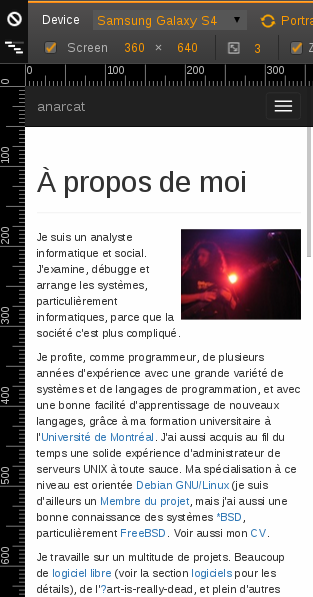
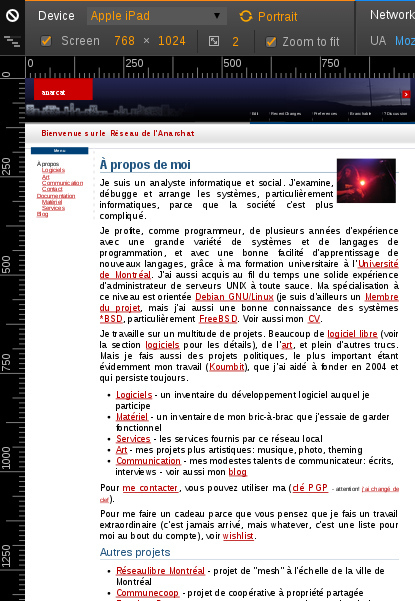
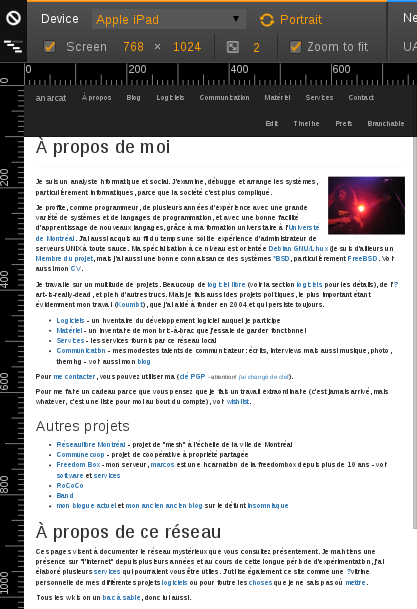
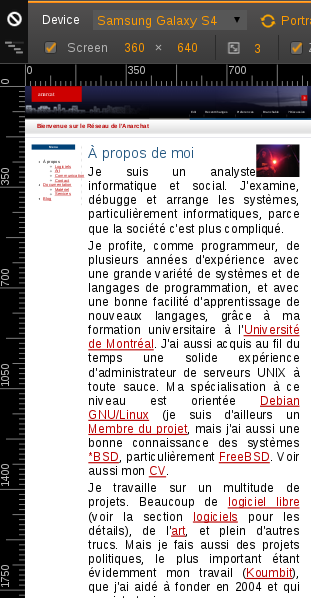
I finally gave up and drank the cool-aid of the Bootstrap theme. The main reason was that I noticed the site was basically unusable on any mobile device, including tablet computers like the iPad, which are unfortunately very, very common. Phones wouldn't render the site in a legible way either, unfortunately. The change is rather drastic, so I figured it was important to mention it here. I am not so satisfied pretty exctied with the result: the theme is very basic, if not absent. I actually like that purified form now, and it works across devices now much better. But I do feel I just made my blog look like everyone else that uses Bootstrap. We seem to enter an era where non-graphic designers (like me) are back to building web pages that all look the same, not very different, in a way, from the old days of plain HTML, like the default ikiwiki theme. I did some work to change the look at least minimally, but the top black navbar is really a killer giveaway this is a bootstrap theme. Bootstrap does a lot for the typography, at least when checking the presslabs checklist or the practical typography checklist, but I still had to change the main body width, which helped a lot I think. Anyways, the old Night City theme is still available for download and I could still flip it back on here if I need to.

What changed The new theme keeps the distractions away, but ironically, it's slower than the previous theme even though there are no images and basically no colors at all. On my tests, it now loads in about 3.42 seconds on the "Regular 2G (250Kbps)" simulation of Chromium with 72KB in 12 requests. Whereas my tests with the previous theme were taking 3.25 seconds with 43.5KB in 17 requests. This is due to the Bootstrap CSS, which takes a whopping 19KB itself, but especially because I now load JQuery, which takes a whopping 32.8KB! And that is probably gzip-compressed, as the original is more around 90KB. But at least the thing is readable on phones and tablets now. Compare:

Samsung S3, before Screenshot of a fake rendering on the Samsung Galaxy S3 in night city

Samsung S3, after Screenshot of a fake rendering on the Samsung Galaxy S3 in bootstrap I like this: much simpler, purer version on smaller devices. And we see what counts: the freaking text. Of course, on tablets, it doesn't fare as well: the top menu gets wrapped around...

Apple iPad, before Screenshot of a fake rendering on the iPad in night city

Apple iPad, after Screenshot of a fake rendering on the iPad in bootstrap Apparently, the fix would be for me to "customize the @grid-float-breakpoint variable" in LESS (which I thought was a pager, but seems to be a CSS preprocessor, graaah). Still, I think it's better that way, more readable, and less crufty.

How it was done After doing a thorough evaluation of all the Bootstrap ikiwiki themes I could find (there are more than 4 at least!), I figured I prefered the Jak Linux one. It seemed to be better implemented than the others, cleaner, and I liked the mean black border on top. Black is cool. Oh, and I liked the subtle footer as well. Subtle is cool. Unfortunately, that theme originally required a custom plugin to have a menu on top, which i thought was silly. So I patched it to make it work with the sidebar plugin, which turned out to be trivially simple: just dump the sidebar content, and make the sidebar page have explicit HTML tags in it that match Bootstrap's required classes. I also added the regular action links in the top navbar, but that does overload it quite a bit. I also did some code cleanups and various other small changes, all of which are available in my personnal git repo.

What doesn't work So of course, there are always problems. The first problem is the extra bandwidth usage. Not sure that can be fixed, other than switching to the upcoming Bootstrap 4, which is smaller than Bootstrap 3, bizarrely. The more annoying problems are weird alignment issues. If the screen gets two narrow without kicking some collapse rules in place (the iPad bug above), the navbar rows overflow and look ugly. Even more bizarre, in some cases the right navbar can just completely disappear, in fact, that's the only fix I could find: to assign the hidden-xs and hidden-sm classes to the navbar-right <UL> element. But then it just goes away, which is pretty darn stupid. Still - I assigned the classes to a few actions that seemed low priority, both in the theme and in the sidebar page. Similarly, the search form at the bottom of the page doesn't seem to want to fit in the footer properly. No idea why and I can't bother to figure that one out. I ended up merging this with the backlinks, tags and trails navigation items. Oh, and amazingly enough: comments are simply not rendered at all right now. Oops. I seemed to have picked the single bootstrap Ikiwiki theme that does *not* have comments rendering... Aaaargh. For now I just copy-pasted stuff from the [ramseydsilva][] theme and it looks pretty ugly, but at least it works. I ended up theming comments the same way i did for Night City, which looks pretty good, but is not in sync with the LESS stuff in Bootstrap. I also add to add back trails, backlinks and favicon... looks like the Jak theme wasn't made for a blog after all... but that's now fixed! :) Another improvement would be to change the font from the canonical Helvetica to something prettier, like suggested in Practical Typography, in the font recommendations section, or the presslabs checklist. So far I have settled on Mozilla's Fira font (which means, yes, one set of objects is actually loading from the CDN, sorry). Feedback welcome.

9 September 2015

Rhonda D'Vine: Sookee

It's time for some new music. And given that this artist was suggested to me at least twice by different people I guess I finally have to feature her. This time it's about Sookee, a rapper from Berlin with queer-feministic background. I guess if you listen and see the first song you might know why she was suggested to me, and also why I consider her an important artist to share. So without further delay, here are the songs: As you can see, Sookee isn't just some artist but transports a lot of messages. And even when you might not understand them because they are in German I hope you get the concept nevertheless. :) Enjoy!

/music permanent link Comments: 0 Flattr this

8 September 2015

Dirk Eddelbuettel: It was twenty years ago today...

sgt pepper Hm, wasn't there a catchy tune that started that way? Just kidding. But about twenty years ago today I sent this email about a new Debian package upload -- and that makes it (as best as I can tell) the earliest trace of me doing Debian work. It so happened that I did upload two packages in July of 1995 as well, but it was so early in the project that we did not have a mailing list archive for such things yet (!!). And I have a vague recollection that the two in July were an adoption---whereas the post referenced above announced efax as my first new package added to the distribution. And there were more to come ... Anyway, thanks for all the fish! Twenty years with Debian has been a great, great ride. I learned a lot from a lot of fantastic people, and I hope I helped a few people along the way with a package or two I still maintain. Debian remains a truly fabulous project which I hope will go strongly for another 20 (or even 22).

This post by Dirk Eddelbuettel originated on his Thinking inside the box blog. Please report excessive re-aggregation in third-party for-profit settings.

Next.

Previous.