Search Results: "nic"

2 July 2016

Jonathan Carter: So, that was DebCamp16!

Picture: Adrian Frith

University of Cape Town, host location to DebConf 16. Picture: Adrian Frith

What an amazingly quick week that was Our bid to host DebConf in Cape Town was accepted nearly 15 months ago. And before that, the bid itself was a big collective effort from our team. So it s almost surreal that the first half of the two weeks of DebCamp/DebConf is now over. Things have been going really well. The few problems we ve had so far were too small to even mention. It s a few degrees colder than it usually is this time of the year and there s already snow on the mountains, so Cape Town is currently quite chilly.
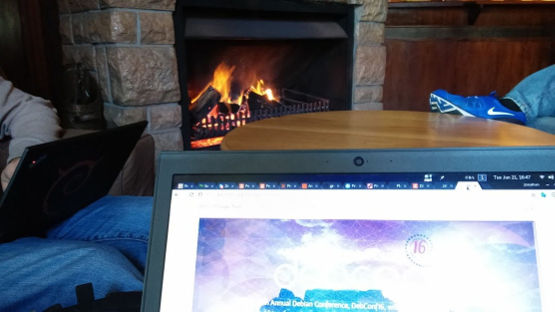
Hacking by the fire at the sports club

Gathering some heat by the fire at the sports club while catching up to the world the day before it all started.

All Kinds of Quality Time I really enjoyed working with the video team last year, but this year there was just 0 time for that. Working on the orga team means dealing with a constant torrent of small tasks, which is good in its own way because you get to deal with a wide variety of Debian people you might not usually get to interact with, but video team problems are more fun and interesting. Next year I hope to do a lot more video work again. If you re at DebConf over the next week, I can highly recommend that you get involved!
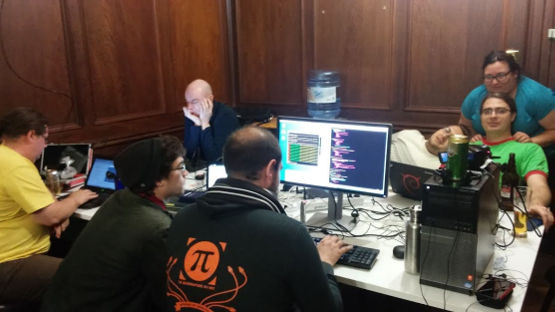
Video team hacking away at problems

Video team members hacking away at problems late at night during DebCamp

The first time I met Debian folk was early in 2004. I worked at the Shuttleworth Foundation as Open Source Technical Co-ordinator at the time, and Mark Shuttleworth had them over for one of the early Ubuntu sprints in Canonical s early days. I was so intimidated by them back then that I could hardly even manage to speak to them. I was already a big free software fan before working there, but little did I even dream to think that I would one day be involved in a project like Ubuntu or Debian. My manager back then encouraged me to go talk to them and get involved and become a Debian Developer and joked that I should become highvoltage@debian.org. I guess that was when the initial seeds got planted and since then I ve met many great people all over the world who have even became friends during UDS, DebConf, BTS and other hackfests where Debianites hang out. It gave me a really nice warm feeling to have all these amazing, talented and really friendly people from all over coming together in this little corner of the world to work together on projects that I think are really important.
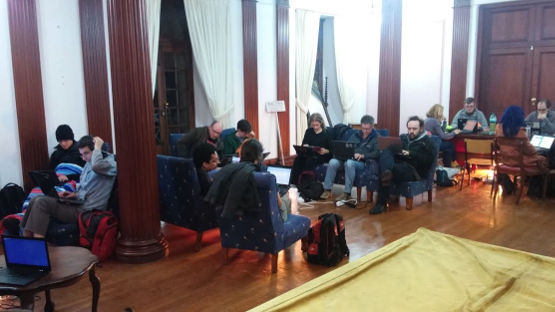
Finding a warm space to work in the Happy Feet hack lab

Finding a warm space to work in the Happy Feet hack lab

Oh the Chicken Back at DebConf12, someone (I don t remember the exact history) brought a rubber chicken to DebConf who was simply called Pollito ( chicken in Spanish). Since then the chicken has grown into somewhat of a mascot for DebConf. Back in 2012 I already imagined that if we would ever host a DebConf, I d make a little of picture book story about Pollito. Last year after DC15, when bringing Pollito over, I created a little story called Pollito s first trip to Africa . I was recovering from flu while putting that together and didn t spend much time on it, but it turned out to be somewhat of a hit. I was surprised to see it in the #debconf topic ever since I posted it :) We gave a tour of the campus on the first and second days and it was quite time consuming and there was no way we could do it every day for the rest of DebCamp, so on the 2nd day I smacked together a new rush job called Pollito s Guide to DC16 . The idea was that newcommers could use it as a visual guide and rely on others who have been there for a while if they get stuck. I wish I had the time to make it a lot nicer, but I think the general idea is good and next year we can have a much nicer one that might not be quite as Pollito focused.
Pollito's Guide to DC16

Pollito s Guide to DC16

Debian Maintainer After all these years, I finally sat down and applied to become a Debian Maintainer, and the application was successful (approved yesterday \o/). Now just for the wait until my key is uploaded to the keyring. I haven t yet had time to properly process this but I think once the DebConf dust settles and I had some time to recover, I will be ecstatic. Some actual DebCampy work Everywhere I go, I see people installing a bunch of GNOME extensions on their Debian GNOME desktops shortly after installation using http://extensions.gnome.org/ (I noticed this even at DebCamp!). A few months ago I thought that it s really about time someone package up some of the really popular ones. So I started to put together some basic packaging for AIMS Desktop around a month ago. During the last few days of DebCamp, things were going well enough with the organisational tasks that I had some time to do some actual packaging work and improve these so that they re ready for upload to the Debian archives. The little DebCamp time I had ended up being my very own little extension fest :) I worked on the following packages which are ready for upload: I worked on the following packages which still need minor work, might be able to get them in uploadable state by the end of DebConf: The actual packaging of GNOME extensions is actually pretty trivial. It s mostly source-only JavaScript with some CSS and translations and maybe some gsettings schemas and dialogs. Or at least, it would be pretty trivial, but many extensions are without licenses, contain embedded code (often JavaScript) from other projects, or have no usable form of upstream tarball, to name a few of the problems. So I ve been contacting the upstream authors of these packages where there have been problems, and for the most part they ve been friendly and pretty quick to address the problems. So that s it, for now. I couldn t possibly sum up the last week and everything that lead up to it in a single blog post. All I can really say is thank you for letting me be a part of this very special project!

Joey Hess: twenty years of free software -- part 6 moreutils

moreutils is a little love letter to the Unix Tools philosophy. It was interesting to try to find new tools as basic as cat and ls. With sponge and vidir and ifne and chronic and others, we managed to find several such tools. So, it was fun to work on moreutils, but it also ran into inherent problems with the Unix Tools philosophy. One is namespacing; there are only so many good short names for commands, and a command like parallel can easily collide with something else. And since Unix Tools have a bigger surface area than a pure function, my parallel is not going to be quite compatible with your parallel, even if they were developed with (erm) parallel intentions. Partly due to that problem, I have gotten pickier about adding new tools to moreutils as it's gotten older, and so there's a lot of suggested additions that I will probably never get to. And as my mention of pure functions suggests, I have kind of moved on from being a big fan of the Unix Tools philosophy. Unix tools are a decent approximation of pure functions for their time, but they are not really pure, and not typed at all, and not usefully namespaced, and this limits them. Next: twenty years of free software -- part 7 git-annex

1 July 2016

Joachim Breitner: When to reroll a six

This is a story about counter-intuitive probabilities and how a small bit of doubt turned out to be very justified. It begins with the game To Court the King (German: Um Krone und Kragen ). It is a nice game with dice and cards, where you start with a few dice, and use your dice rolls to buy additional cards, which give you extra dice or special powers to modify the dice that you rolled. You can actually roll your dice many times, but every time, you have to set aside at least one die, which you can no longer change or reroll, until eventually all dice have been set aside. A few years ago, I have played this game a lot, both online (on yucata.de) as well as in real life. It soon became apparent that it is almost always better to go for the cards that give you an extra die, instead of those that let you modify the dice. Intuitively, this is because every additional die allows you to re-roll your dice once more. I concluded that if I have a certain number of dice (say, n), and I want to have a sum as high as possible at the end, then it may make sense to reroll as many dice as possible, setting aside only those showing a 6 (because that is the best you can get) or, if there is no dice showing a 6, then a single die with the best score. Besides for small number of dice (2 or 3), where even a 4 or 5 is worth keeping, this seemed to be a simple, obvious and correct strategy to maximize the expected outcome of this simplified game. It is definitely simple and obvious. But some doubt that it was correct remained. Having one more die still in the game (i.e. not set aside) definitely improves your expected score, because you can reroll the dice more often. How large is this advantage? What if it ever exceeds 6 then it would make sense to reroll a 6. The thought was strange, but I could not dismiss it. So I did what one does these days if one has a question: I posed it on the mathematics site of StackExchange. That was January 2015, and nothing happened. I tried to answer it myself a month later, or at least work towards at an answer, and did that by brute force. Using a library for probabilistic calculations for Haskell I could write some code that simply calculated the various expected values of n dice for up to n = 9 (beyond that, my unoptimized code would take too long):
1:  3.50000 (+3.50000)
2:  8.23611 (+4.73611)
3: 13.42490 (+5.18879)
4: 18.84364 (+5.41874)
5: 24.43605 (+5.59241)
6: 30.15198 (+5.71592)
7: 35.95216 (+5.80018)
8: 41.80969 (+5.85753)
9: 47.70676 (+5.89707)
Note that this calculation, although printed as floating point numbers, is performed using fractions of unbounded integers, so there are no rounding issues that could skew the result. The result supported the hypothesis that there is no point in rolling a 6 again: The value of an additional die grows and approaches 6 from beyond, but judging from these number is never going to reach it. Then again nothing happened. Until 14 month later, when some Byron Schmuland came along, found this an interesting puzzle, and set out a 500 point bounty to whoever solved this problem. This attracted a bit attention, and a few not very successful attempts at solving this. Eventually it reached twitter, where Roman Cheplyaka linked to it. Coincidally a day later some joriki came along, and he had a very good idea: Why not make our life easier and think about dice with less sides, and look at 3 instead of 6. This way, and using a more efficient implementation (but still properly using rationals), he could do a similar calculation for up to 50 dice. And it was very lucky that he went to 50, and not just 25, because up to 27, the results were very much as expected, approaching value of +3 from below. But then it surpassed +3 and became +3.000000008463403. In other words: If you have roll 28 dice, and you have exactly two dice showing a 3, then it gives you better expected score if you set aside only one 3, and not both of them. The advantage is minuscule, but that does not matter it is there. From then on, the results behaved strangely. Between 28 and 34, the additional value was larger than 3. Then, from 35 on again lower than 2. It oscillated. Something similar could be observed when the game is played with coins. Eventually, joriki improved his code and applied enough tricks so that he could solve it also for the 6-sided die: The difference of the expected value of 198 dice and having 199 dice is larger than 6 (by 10 21...)! The optimizations that allowed him to calculate these numbers in a reasonable amount of time unfortunately was to assume that my original hypothesis (never rerolling a 6 is optimal), which held until n < 199. But this meant that for n > 199, the code did not yield correct results. What is the rationale of the story? Don t trust common sense when it comes to statistics; don t judge a sequence just from a few initial numbers; if you have an interesting question, post it online and wait for 16 months.

Elena 'valhalla' Grandi: Busy/idle status indicator

Busy/idle status indicator


About one year ago, during my first http://debconf15.debconf.org/, I've felt the need for some way to tell people whether I was busy on my laptop doing stuff that required concentration or just passing some time between talks etc. and available for interruptions, socialization or context switches.

One easily available method of course would have been to ping me on IRC (and then probably go on chatting on it while being in the same room, of course :) ), but I wanted to try something that allowed for less planning and worked even in places with less connectivity.

My first idea was a base laptop sticker with two statuses and then a removable one used to cover the wrong status and point to the correct one, and I still think it would be nice, but having it printed is probably going to be somewhat expensive, so I shelved the project for the time being.

Immagine/foto

Lately, however, I've been playing with hexagonal stickers https://terinjokes.github.io/StickerConstructorSpec/ and decided to design something on this topic, whith the result in the figure above, with the hacking sticker being my first choice, and the concentrating alternative probably useful while surrounded by people who may misunderstand the term hacking .

While idly looking around for sticker printing prices I realized that it didn't necessarly have to be a sticker and started to consider alternatives.

One format I'm trying is inspired by "do not disturb" door signs: I've used some laminating pouches I already had around which are slightly bigger than credit-card format (but credit-card size would also work of course ) and cut a notch so that they can be attached to the open lid of a laptop.

Immagine/fotoImmagine/foto

They seem to fit well on my laptop lid, and apart from a bad tendency to attract every bit of lint in a radius of a few meters the form factor looks good. I'll try to use them at the next conference to see if they actually work for their intended purpose.

SVG sources (and a PDF) are available on my website http://www.trueelena.org/computers/projects/busy_idle_indicator.html under the CC-BY-SA license.

30 June 2016

Chris Lamb: Free software activities in June 2016

Here is my monthly update covering a large part of what I have been doing in the free software world (previously):
Debian My work in the Reproducible Builds project was covered in our weekly reports. (#58, #59 & #60)
Debian LTS

This month I have been paid to work 18 hours on Debian Long Term Support (LTS). In that time I did the following:
  • "Frontdesk" duties, triaging CVEs, etc.
  • Extended the lts-cve-triage.py script to ignore packages that are not subject to Long Term Support.

  • Issued DLA 512-1 for mantis fixing an XSS vulnerability.
  • Issued DLA 513-1 for nspr correcting a buffer overflow in a sprintf utility.
  • Issued DLA 515-1 for libav patching a memory corruption issue.
  • Issued DLA 524-1 for squidguard fixing a reflected cross-site scripting vulnerability.
  • Issued DLA 525-1 for gimp correcting a use-after-free vulnerability in the channel and layer properties parsing process.

Uploads
  • redis (2:3.2.1-1) New upstream bugfix release, plus subsequent upload to the backports repository.
  • python-django (1.10~beta1-1) New upstream experimental release.
  • libfiu (0.94-5) Misc packaging updates.


RC bugs

I also filed 170 FTBFS bugs against a7xpg, acepack, android-platform-dalvik, android-platform-frameworks-base, android-platform-system-extras, android-platform-tools-base, apache-directory-api, aplpy, appstream-generator, arc-gui-clients, assertj-core, astroml, bamf, breathe, buildbot, cached-property, calf, celery-haystack, charmtimetracker, clapack, cmake, commons-javaflow, dataquay, dbi, django-celery, django-celery-transactions, django-classy-tags, django-compat, django-countries, django-floppyforms, django-hijack, django-localflavor, django-markupfield, django-model-utils, django-nose, django-pipeline, django-polymorphic, django-recurrence, django-sekizai, django-sitetree, django-stronghold, django-taggit, dune-functions, elementtidy, epic4-help, fcopulae, fextremes, fnonlinear, foreign, fort77, fregression, gap-alnuth, gcin, gdb-avr, ggcov, git-repair, glance, gnome-twitch, gnustep-gui, golang-github-audriusbutkevicius-go-nat-pmp, golang-github-gosimple-slug, gprbuild, grafana, grantlee5, graphite-api, guacamole-server, ido, jless, jodreports, jreen, kdeedu-data, kdewebdev, kwalify, libarray-refelem-perl, libdbusmenu, libdebian-package-html-perl, libdevice-modem-perl, libindicator, liblrdf, libmail-milter-perl, libopenraw, libvisca, linuxdcpp, lme4, marble, mgcv, mini-buildd, mu-cade, mvtnorm, nose, octave-epstk, onioncircuits, opencolorio, parsec47, phantomjs, php-guzzlehttp-ringphp, pjproject, pokerth, prayer, pyevolve, pyinfra, python-asdf, python-ceilometermiddleware, python-django-bootstrap-form, python-django-compressor, python-django-contact-form, python-django-debug-toolbar, python-django-extensions, python-django-feincms, python-django-formtools, python-django-jsonfield, python-django-mptt, python-django-openstack-auth, python-django-pyscss, python-django-registration, python-django-tagging, python-django-treebeard, python-geopandas, python-hdf5storage, python-hypothesis, python-jingo, python-libarchive-c, python-mhash, python-oauth2client, python-proliantutils, python-pytc, python-restless, python-tidylib, python-websockets, pyvows, qct, qgo, qmidinet, quodlibet, r-cran-gss, r-cran-runit, r-cran-sn, r-cran-stabledist, r-cran-xml, rgl, rglpk, rkt, rodbc, ruby-devise-two-factor, ruby-json-schema, ruby-puppet-syntax, ruby-rspec-puppet, ruby-state-machine, ruby-xmlparser, ryu, sbd, scanlogd, signond, slpvm, sogo, sphinx-argparse, squirrel3, sugar-jukebox-activity, sugar-log-activity, systemd, tiles, tkrplot, twill, ucommon, urca, v4l-utils, view3dscene, xqilla, youtube-dl & zope.interface.

FTP Team

As a Debian FTP assistant I ACCEPTed 186 packages: akonadi4, alljoyn-core-1509, alljoyn-core-1604, alljoyn-gateway-1504, alljoyn-services-1504, alljoyn-services-1509, alljoyn-thin-client-1504, alljoyn-thin-client-1509, alljoyn-thin-client-1604, apertium-arg, apertium-arg-cat, apertium-eo-fr, apertium-es-it, apertium-eu-en, apertium-hbs, apertium-hin, apertium-isl, apertium-kaz, apertium-spa, apertium-spa-arg, apertium-tat, apertium-urd, arc-theme, argus-clients, ariba, beast-mcmc, binwalk, bottleneck, colorfultabs, dh-runit, django-modeltranslation, dq, dublin-traceroute, duktape, edk2, emacs-pdf-tools, eris, erlang-p1-oauth2, erlang-p1-sqlite3, erlang-p1-xmlrpc, faba-icon-theme, firefox-branding-iceweasel, golang-1.6, golang-defaults, golang-github-aelsabbahy-gonetstat, golang-github-howeyc-gopass, golang-github-oleiade-reflections, golang-websocket, google-android-m2repository-installer, googler, goto-chg-el, gr-radar, growl-for-linux, guvcview, haskell-open-browser, ipe, labplot, libalt-alien-ffi-system-perl, libanyevent-fcgi-perl, libcds-savot-java, libclass-ehierarchy-perl, libconfig-properties-perl, libffi-checklib-perl, libffi-platypus-perl, libhtml-element-library-perl, liblwp-authen-oauth2-perl, libmediawiki-dumpfile-perl, libmessage-passing-zeromq-perl, libmoosex-types-portnumber-perl, libmpack, libnet-ip-xs-perl, libperl-osnames-perl, libpodofo, libprogress-any-perl, libqtpas, librdkafka, libreoffice, libretro-beetle-pce-fast, libretro-beetle-psx, libretro-beetle-vb, libretro-beetle-wswan, libretro-bsnes-mercury, libretro-mupen64plus, libservicelog, libtemplate-plugin-datetime-perl, libtext-metaphone-perl, libtins, libzmq-ffi-perl, licensecheck, link-grammar, linux, linux-signed, lua-busted, magics++, mkalias, moka-icon-theme, neutron-vpnaas, newlisp, node-absolute-path, node-ejs, node-errs, node-has-flag, node-lodash-compat, node-strip-ansi, numba, numix-icon-theme, nvidia-graphics-drivers, nvidia-graphics-drivers-legacy-304xx, nvidia-graphics-drivers-legacy-340xx, obs-studio, opencv, pacapt, pgbackrest, postgis, powermock, primer3, profile-sync-daemon, pyeapi, pypandoc, pyssim, python-cutadapt, python-cymruwhois, python-fisx, python-formencode, python-hkdf, python-model-mommy, python-nanomsg, python-offtrac, python-social-auth, python-twiggy, python-vagrant, python-watcherclient, python-xkcd, pywps, r-bioc-deseq2, r-bioc-dnacopy, r-bioc-ensembldb, r-bioc-geneplotter, r-cran-adegenet, r-cran-adephylo, r-cran-distory, r-cran-fields, r-cran-future, r-cran-globals, r-cran-htmlwidgets, r-cran-listenv, r-cran-mlbench, r-cran-mlmrev, r-cran-pheatmap, r-cran-pscbs, r-cran-r.cache, refind, relatorio, reprotest, ring, ros-ros-comm, ruby-acts-as-tree, ruby-chronic-duration, ruby-flot-rails, ruby-numerizer, ruby-u2f, selenium-firefoxdriver, simgrid, skiboot, smtpping, snap-confine, snapd, sniffles, sollya, spin, subuser, superlu, swauth, swift-plugin-s3, syncthing, systemd-bootchart, tdiary-theme, texttable, tidy-html5, toxiproxy, twinkle, vmtk, wait-for-it, watcher, wcslib & xapian-core.

Dirk Eddelbuettel: RMarkdown and Metropolis/Mtheme

Nick Tierney asked on Twitter about rmarkdown and metropolis about whether folks had used RMarkdown-driven LaTeX Beamer presentations. And the answer is a firm hell yeah. I have been using mtheme (and/or a local variant I called 'm2') as well as the newer (renamed) release mtheme for the last year or two for all my RMarkdown-based presentations as you can see from my presentations page. And earlier this year back I cleaned this up and wrote myself local Ubuntu packages which are here on Launchpad. I also have two GitHub repos for the underlying .deb package code: - the pkg-latex-metropolis package for the LaTeX part (which is also in TeXlive in an older version) - the pkg-fonts-fira for the underlying (free) font (and this sadly cannot build on launchpad as it needs a download step). To round things up, I now also created a public 'sample' repo on GitHub. It is complete for all but the custom per-presenteation header.tex that modifies colours, add local definitions etc as needed for each presentation. With that, Happy Canada Day (tomorrow, though) -- never felt better to be part of something Glorious and Free, and also free of Brexit, Drumpf and other nonsense.

29 June 2016

Gunnar Wolf: Batch of the Next Thing Co.'s C.H.I.P. computers on its way to DebConf!)

Hello world! I'm very happy to inform that the Next Thing Co. has shipped us a pack of 50 C.H.I.P. computers to be given away at DebConf! What is the C.H.I.P.? As their tagline says, it's the world's first US$9 computer. Further details:

https://nextthing.co/pages/chip
All in all, it's a nice small ARM single-board computer; I won't bore you on this mail with tons of specs; suffice to say they are probably the most open ARM system I've seen to date. So, I agreed with Richard, our contact at the company, I would distribute the machines among the DebConf speakers interested in one. Of course, not every DebConf speaker wants to fiddle with an adorable tiny piece of beautiful engineering, so I'm sure I'll have some spare computers to give out to other interested DebConf attendees. We are supposed to receive the C.H.I.P.s by Monday 4; if you want to track the package shipment, the DHL tracking number is 1209937606. Don't DDoS them too hard! So, please do mail me telling why do you want one, what your projects are with it. My conditions for this giveaway are: To sign up for yours, please mail gwolf+chip@gwolf.org - I will capture mail sent to that alias ONLY.

27 June 2016

Jonathan McDowell: Hire me!

It s rare to be in a position to be able to publicly announce you re looking for a new job, but as the opportunity is currently available to me I feel I should take advantage of it. That s especially true given the fact I ll be at DebConf 16 next week and hope to be able to talk to various people who might be hiring (and will, of course, be attending the job fair). I m coming to the end of my Masters in Legal Science and although it s been fascinating I ve made the decision that I want to return to the world of tech. I like building things too much it seems. There are various people I ve already reached out to, and more that are on my list to contact, but I figure making it more widely known that I m in the market can t hurt with finding the right fit. I m on LinkedIn and OpenHUB, which should give a bit more info on my previous experience and skill set. I know I m light on details here, so feel free to email me to talk about what I might be able to specifically bring to your organisation.

John Goerzen: I m switching from git-annex to Syncthing

I wrote recently about using git-annex for encrypted sync, but due to a number of issues with it, I ve opted to switch to Syncthing. I d been using git-annex with real but noncritical data. Among the first issues I noticed was occasional but persistent high CPU usage spikes, which once started, would persist apparently forever. I had an issue where git-annex tried to replace files I d removed from its repo with broken symlinks, but the real final straw was a number of issues with the gcrypt remote repos. git-remote-gcrypt appears to have a number of issues with possible race conditions on the remote, and at least one of them somehow caused encrypted data to appear in a packfile on a remote repo. Why there was data in a packfile there, I don t know, since git-annex is supposed to keep the data out of packfiles. Anyhow, git-annex is still an awesome tool with a lot of use cases, but I m concluding that live sync to an encrypted git remote isn t quite there yet enough for me. So I looked for alternatives. My main criteria were supporting live sync (via inotify or similar) and not requiring the files to be stored unencrypted on a remote system (my local systems all use LUKS). I found Syncthing met these requirements. Syncthing is pretty interesting in that, like git-annex, it doesn t require a centralized server at all. Rather, it forms basically a mesh between your devices. Its concept is somewhat similar to the proprietary Bittorrent Sync basically, all the nodes communicate about what files and chunks of files they have, and the changes that are made, and immediately propagate as much as possible. Unlike, say, Dropbox or Owncloud, Syncthing can actually support simultaneous downloads from multiple remotes for optimum performance when there are many changes. Combined with syncthing-inotify or syncthing-gtk, it has immediate detection of changes and therefore very quick propagation of them. Syncthing is particularly adept at figuring out ways for the nodes to communicate with each other. It begins by broadcasting on the local network, so known nearby nodes can be found directly. The Syncthing folks also run a discovery server (though you can use your own if you prefer) that lets nodes find each other on the Internet. Syncthing will attempt to use UPnP to configure firewalls to let it out, but if that fails, the last resort is a traffic relay server again, a number of volunteers host these online, but you can run your own if you prefer. Each node in Syncthing has an RSA keypair, and what amounts to part of the public key is used as a globally unique node ID. The initial link between nodes is accomplished by pasting the globally unique ID from one node into the add node screen on the other; the user of the first node then must accept the request, and from that point on, syncing can proceed. The data is all transmitted encrypted, of course, so interception will not cause data to be revealed. Really my only complaint about Syncthing so far is that, although it binds to localhost, the web GUI does not require authentication by default. There is an ITP open for Syncthing in Debian, but until then, their apt repo works fine. For syncthing-gtk, the trusty version of the webupd8 PPD works in Jessie (though be sure to pin it to a low priority if you don t want it replacing some unrelated Debian packages).

Paul Tagliamonte: Hello, Sense!

A while back, I saw a Kickstarter for one of the most well designed and pretty sleep trackers on the market. I fell in love with it, and it has stuck with me since. A few months ago, I finally got my hands on one and started to track my data. Naturally, I now want to store this new data with the rest of the data I have on myself in my own databases. I went in search of an API, but I found that the Sense API hasn't been published yet, and is being worked on by the team. Here's hoping it'll land soon! After some subdomain guessing, I hit on api.hello.is. So, naturally, I went to take a quick look at their Android app and network traffic, lo and behold, there was a pretty nicely designed API. This API is clearly an internal API, and as such, it's something that should not be considered stable. However, I'm OK with a fragile API, so I've published a quick and dirty API wrapper for the Sense API to my GitHub.. I've published it because I've found it useful, but I can't promise the world, (since I'm not a member of the Sense team at Hello!), so here are a few ground rules of this wrapper: This module is currently Python 3 only. If someone really needs Python 2 support, I'm open to minimally invasive patches to the codebase using six to support Python 2.7. Working with the API: First, let's go ahead and log in using python -m sense.
$ python -m sense
Sense OAuth Client ID: xxxxxxxx-xxxx-xxxx-xxxx-xxxxxxxxxxxx
Sense OAuth Client Secret: xxxxxxxx-xxxx-xxxx-xxxx-xxxxxxxxxxxx
Sense email: paultag@gmail.com
Sense password: 
Attempting to log into Sense's API
Success!
Attempting to query the Sense API
The humidity is **just right**.
The air quality is **just right**.
The light level is **just right**.
It's **pretty hot** in here.
The noise level is **just right**.
Success!
Now, let's see if we can pull up information on my Sense:
>>> from sense import Sense
>>> sense = Sense()
>>> sense.devices()
 'senses': [ 'id': 'xxxxxxxxxxxxxxxx', 'firmware_version': '11a1', 'last_updated': 1466991060000, 'state': 'NORMAL', 'wifi_info':  'rssi': 0, 'ssid': 'Pretty Fly for a WiFi (2.4 GhZ)', 'condition': 'GOOD', 'last_updated': 1462927722000 , 'color': 'BLACK' ], 'pills': [ 'id': 'xxxxxxxxxxxxxxxx', 'firmware_version': '2', 'last_updated': 1466990339000, 'battery_level': 87, 'color': 'BLUE', 'state': 'NORMAL' ] 
Neat! Pretty cool. Look, you can even see my WiFi AP! Let's try some more and pull some trends out.
>>> values = [x.get("value") for x in sense.room_sensors()["humidity"]][:10]
>>> min(values)
45.73904
>>> max(values)
45.985928
>>> 
I plan to keep maintaining it as long as it's needed, so I welcome co-maintainers, and I'd love to see what people build with it! So far, I'm using it to dump my room data into InfluxDB, pulling information on my room into Grafana. Hopefully more to come! Happy hacking!

26 June 2016

Steinar H. Gunderson: Nageru 1.3.0 released

I've just released version 1.3.0 of Nageru, my live software video mixer. Things have been a bit quiet on the Nageru front recently, for two reasons: First, I've been busy with moving (from Switzerland to Norway) and associated job change (from Google to MySQL/Oracle). Things are going well, but these kinds of changes tend to take, well, time and energy. Second, the highlight of Nageru 1.3.0 is encoding of H.264 streams meant for end users (using x264), not just the Quick Sync Video streams from earlier versions, which work more as a near-lossless intermediate format meant for transcoding to something else later. Like with most things video, hitting such features really hard (I've been doing literally weeks of continuous stream testing) tends to expose weaknesses in upstream software. In particular, I wanted x264 speed control, where the quality is tuned up and down live as the content dictates. This is mainly because the content I want to stream this summer (demoscene competitions) varies from the very simple to downright ridiculously complex (as you can see, YouTube just basically gives up and creates gray blocks). If you have only one static quality setting, you will have the choice between something that looks like crap for everything, and one that drops frames like crazy (or, if your encoding software isn't all that, like e.g. using ffmpeg(1) directly, just gets behind and all your clients' streams just stop) when the tricky stuff comes. There was an unofficial patch for speed control, but it was buggy, not suitable for today's hardware and not kept at all up to date with modern x264 versions. So to get speed control, I had to work that patch pretty heavily (including making it so that it could work in Nageru directly instead of requiring a patched x264) and then it exposed a bug in x264 proper that would cause corruption when changing between some presets, and I couldn't release 1.3.0 before that fix had at least hit git. Similarly, debugging this exposed an issue with how I did streaming with ffmpeg and the MP4 mux (which you need to be able to stream H.264 directly to HTML5 <video> without any funny and latency-inducing segmenting business); to know where keyframes started, I needed to flush the mux before each one, but this messes up interleaving, and if frames were ever dropped right in front of a keyframe (which they would on the most difficult content, even at speed control's fastest presets!), the duration field of the frame would be wrong, causing the timestamps to be wrong and even having pts < dts in some cases. (VLC has to deal with flushing in exactly the same way, and thus would have exactly the same issue, although VLC generally doesn't transcode variable-framerate content so well to begin with, so the heuristics would be more likely to work. Incidentally, I wrote the VLC code for this flushing back in the day, to be able to stream WebM for some Debconf.) I cannot take credit for the ffmpeg/libav fixes (that was all done by Martin Storsj ), but again, Nageru had to wait for the new API they introduce (that just signals to the application when a keyframe is about to begin, removing the need for flushing) to get into git mainline. Hopefully, both fixes will get into releases soon-ish and from there one make their way into stretch. Apart from that, there's a bunch of fixes as always. I'm still occasionally (about once every two weeks of streaming or so) hitting what I believe is a bug in NVIDIA's proprietary OpenGL drivers, but it's nearly impossible to debug without some serious help from them, and they haven't been responding to my inquiries. Every two weeks means that you could be hitting it in a weekend's worth of streaming, so it would be nice to get it fixed, but it also means it's really really hard to make a reproducible test case. :-) But the fact that this is currently the worst stability bug (and that you can work around it by using e.g. Intel's drivers) also shows that Nageru is pretty stable these days.

Iustin Pop: Random things of the week - brexit and the pretzel

Random things of the week In no particular order (mostly). Coming back from the US, it was easier dealing with the jet-lag this time; doing sports in the morning or at noon and eating light on the evening helps a lot. The big thing of the week, that has everybody talking, is of course brexit. My thoughts, as written before on a facebook comment: Direct democracy doesn't really work if it's done once in a blue moon. Wikipedia says there have been thirteen referendums in UK since 1975, but most of them (10) on devolution issues in individual countries, and only three were UK-wide referendums (quoting from the above page): the first on membership of the European Economic Community in 1975, the second on adopting the Alternative vote system in parliamentary elections in 2011, and the third one is the current one. Which means that a referendum is done every 13 years or so. At this frequency, people are not a) used to inform themselves on the actual issues, b) believing that your vote actually will change things, and most likely c) not taking the "direct-democracy" aspect seriously (thinking beyond the issue at hand and how will it play together with all the rest of the political decisions). The result is what we've seen, leave politicians already backpedalling on issues, and confusion that yes, leave votes actually counted. My prognosis for what's going to happen: We'll see what happens though. Reading comments on various websites still make me cringe at how small some people think: "independence" from the EU when the real issue is EU versus the other big blocks US, China, in the future India; and "versus" not necessarily in a conflict sense, but simply as negotiating power, economic treaties, etc. Back to more down-to-earth things: this week was quite a good week for me. Including commutes, my calendar turned out quite nice: Week calendar The downside was that most of those were short runs or bike sessions. My runs are now usually 6.5K, and I'll try to keep to that for a few weeks, in order to be sure that bone and ligaments have adjusted, and hopefully keep injuries away. On the bike front, the only significant thing was that I did as well the Zwift Canyon Ultimate Pretzel Mission, on the last day of the contest (today): 73.5Km in total, 3h:27m. I've done 60K rides on Zwift before, so the first 60K were OK, but the last ~5K were really hard. Legs felt like logs of wood, I was only pushing very weak output by the end although I did hydrate and fuel up during the ride. But, I was proud of the fact that on the last sprint (about 2K before the end of the ride), I had ~34s, compared to my all-time best of 29.2s. Was not bad after ~3h20m of riding and 1300 virtual meters of ascent. Strava also tells me I got 31 PRs on various segments, but that's because I rode on some parts of Watopia that I never rode before (mostly the reverse ones). Overall, stats for this week: ~160Km in total (virtual and real, biking and running), ~9 hours spent doing sports. Still much lower than the amount of time I was playing computer games, so it's a net win Have a nice start of the week everyone, and keep doing what moves you forward!

Paul Wise: DebCamp16 day 3

Review, approve chromium, gnome-terminal and radeontop screenshots. Disgusted to see the level of creativity GPL violators have. Words of encouragement on #debian-mentors. Pleased to see Tails reproducible builds funding by Mozilla. Point out build dates in versions leads to non-reproducible builds. Point out apt-file search to someone looking for a binary of kill. Review wiki RecentChanges. Alarmingly windy. Report important Debian bug #828215 against unattended-upgrades. Clean up some code in check-all-the-things and work on fixing Debian bug #826089. Wind glorious wind! Much clearer day, nice view of the mountain. More check-all-the-things code clean up and finish up fixing Debian bug #826089. Twinkling city lights and more wind. Final code polish during dinner/discussion. Wandering in the wind amongst the twinklies. Whitelisted one user in the wiki anti-spam system. Usual spam reporting.

25 June 2016

Paul Wise: DebCamp16 day 2

Review wiki RecentChanges since my bookmark. Usual spam reporting. Mention microG on #debian-mobile. Answer pkg-config question on #debian-mentors. Suggest using UUIDs in response to a debian-arm query. Reported Debian bug #828103 against needrestart. A giant yellow SOS crane between the balcony hacklab and a truly misty city. Locate the 2014 Debian & stuff podcast on archive.org. Poke the SPARC porters in response to a suggestion on debian-www. Mention systemctl daemon-reload wrt buildd service changes. Automate updating some extension lists from check-all-the-things. Reported wishlist Debian bug #828128 against debsources. Engage lizard mode! Wish for better display technology. Nice vegetarian food with nice folks and interesting discussions with interesting locals. Polish and release check-all-the-things. Close bugs I forgot to close in the changelog. Add link to debian-boot on Debootstrap wiki page. Notice first mockup of a theme for Debian stretch. Answer a question about package naming on #debian-mentors. Discuss the future of cross compilation on Debian. Notice a talk about FOSSology & update a wiki page. Mention AsteroidOS and MaruOS on the mobile wiki page. Contemplate how close to the FSDG Debian might be and approaches to improving that.

24 June 2016

Joey Hess: twenty years of free software -- part 5 pristine-tar

I've written retrospectively about pristine-tar before, when I stopped maintaining it. So, I'll quote part of that here:
[...] a little bit about the reason I wrote pristine-tar in the
first place. There were two reasons:
1. I was once in a talk where someone mentioned that Ubuntu had/was
   developing something that involved regenerating orig tarballs
   from version control.
   I asked the obvious question: How could that possibly be done
   technically? 
   The (slightly hung over) presenter did not have a satesfactory
   response, so my curiosity was piqued to find a way to do it.
   (I later heard that Ubuntu has been using pristine-tar..)
2. Sometimes code can be subversive. It can change people's perspective
   on a topic, nudging discourse in a different direction. It can even
   point out absurdities in the way things are done. I may or may not
   have accomplished the subversive part of my goals with pristine-tar.
Code can also escape its original intention. Many current uses of
pristine-tar fall into that category. So it seems likely that some
people will want it to continue to work even if it's met the two goals
above already.
For me, the best part of building pristine-tar was finding an answer to the question "How could that possibly be done technically?" It was also pretty cool to be able to use every tarball in Debian as the test suite for pristine-tar. I'm afraid I kind of left Debian in the lurch when I stopped maintaining pristine-tar. "Debian has probably hundreds, if not thousands of git repositories using pristine-tar. We all rely now on an unmaintained, orphaned, and buggy piece of software." -- Norbert Preining So I was relieved when it finally got a new maintainer just recently. Still, I don't expect I'll ever use pristine-tar again. It's the only software I've built in the past ten years that I can say that about. Next: twenty years of free software -- part 6 moreutils

Norbert Preining: Debian/TeX Live 2016.20160623-1

About one month has passed since we did release TeX Live 2016, and more than a month since the last Debian packages, so it is high time to ship out a new checkout of upstream. Nothing spectacular new here, just lots and lots of updates since the freeze. texlive2016-debian I am dedicating this release to those intelligent beings who voted against the stupid Brexit and for remaining in the EC! I am still optimist! New packages aucklandthesis, autobreak, cquthesis, getargs, hustthesis, ietfbibs, linop, markdown, olsak-misc, optidef, sanitize-umlaut, umbclegislation, wordcount, xcntperchap. Updated packages academicons, achemso, acmart, acro, animate, apa6, arabluatex, archaeologie, babel-hungarian, beamertheme-epyt, beebe, biblatex-abnt, biblatex-anonymous, biblatex-bookinother, biblatex-caspervector, biblatex-chicago, biblatex-manuscripts-philology, biblatex-morenames, biblatex-opcit-booktitle, biblatex-philosophy, biblatex-realauthor, biblatex-source-division, biblatex-subseries, bidi, bookcover, bxjscls, caption, chemformula, chemmacros, circuitikz, cloze, cochineal, context, csplain, cstex, datetime2, denisbdoc, dvipdfmx-def, epstopdf, erewhon, exsol, fbb, fibeamer, fithesis, fontawesome, fontspec, fonts-tlwg, geschichtsfrkl, getmap, glossaries, glossaries-extra, graphics, graphics-cfg, gregoriotex, gzt, he-she, hook-pre-commit-pkg, hyperref, ifluatex, keyvaltable, koma-script, l3build, latex, latex-bin, limap, lollipop, lshort-chinese, luaotfload, luatex85, luatex-def, luatexja, lua-visual-debug, marginnote, mcf2graph, media9, minted, mptopdf, msu-thesis, musixtex, navigator, nwejm, oberdiek, patchcmd, pdfcomment, pdftex-def, pdfx, pkuthss, platex, pstricks, ptex, ptex2pdf, ptex-base, ptex-ng, reledmac, repere, scheme-xml, sduthesis, showlabels, tableaux, tcolorbox, tex4ht, texinfo, texlive-scripts, tex-overview, textpos, tools, translations, tudscr, unicode-data, uplatex, uptex, xassoccnt, xcharter, xetex, xindy, yathesis, ycbook. Enjoy.


23 June 2016

Paul Wise: DebCamp16 day 0

Today is officially the first day of DebCamp 2016. The night wasn't as cold as I had feared. Woke at 5am for some reason. Noted the network still blocks port 6697 and 7000, worked around in IRC client configuration using 9999. Reply to network discussion to point that out. Minor changes to the empathy Debian RTC wiki page. Answer support@mentors.d.n bug email about shared company OpenPGP keys and suggest moving to individual keys. Review wiki RecentChanges. Comment on NetworkManager upstream bug #705545 that MAC address privacy is a complicated feature with many use cases. Warn another person that reporting Alioth to SpamCop does nothing and link to the unsubscription URL. Talk to Brown about IP address conflict sparc64 porters found with the setup of notker (sparc64 build machine). Filed Debian wishlist bug #827944 against at asking for support for using an editor to write at jobs. Woke up properly, discussed spam over breakfast. Notice Point Linux in the Distrowatch feed and invite them to the derivatives census. Point out reproducible builds in a discussion about source-only uploads. Commented that I encountered evolution upstream crash bug #680471 again. Reported gnome-shell upstream crash bug #767969. Joined the tour around the campus, enjoyed the view from the outdoor hacklab at the top of the hill. Confirmed that "Monkey Gland" from the pub menu is not in fact derived from monkeys in any way. Noted that Pollito did not eat chicken from the buffet. Beat head against VPN/SIP/WebRTC for a while but oncoming jetlag put me out of business for some hours. Pointed out the future Packages.gz removal in favour of Packages.xz to the popcon developers.

Jaminy Prabaharan: GSoC-Journey till Mid term

Hi readers,

Here comes my journey till the mid-term (June 21st) as a blog to share my experience.

I have previously worked on some social related projects such as smart guidance for blind and sensor based wireless controller . I have been selected as a speaker for FOSSASIA-16 (Asia s premier technological event)to talk on the project smart guidance for blind .FOSSASIA speakers. It was a great experience participating in the technological event in Singapore science centre.Got an opportunity to meet open source contributors from all over the world(even though it is an Asian event, participation was all over from the world). There were pre-meetups for FOSSASIA on the day before three-day event.I have attended the one organised by RedHat, Singapore.Discussed on many topics related to open source.

Three days of FOSSASIA event was a great experience.It was the second time as a speaker in an international conference.My talk was on the second day.Sharing is the best way to increase your knowledge. Talks and workshops were brainstorming.Learnt many new things and got the courage to contribute to the open source.Met Daniel Pocock in Debian exhibition table.Meeting awesome people can be the turning point of life.Had a discussion about the Debian projects and it motivated me for open source software.We have discussed about the Real Time Communication and was encouraged to apply for GSoC (Google Summer of Code). As per our discussion, prepared the project proposal on improving voice,video and chat communication with free software and submitted it for GSoC. I have been selected to contribute for Debian with stipend from Google.

This was my first application for GSoC and I have been selected to contribute for open source and free software. I would like to thank Google and Debian for giving this amazing experience.

Learning and coding have begun.Updated my laptop with Jessie, latest version of Debian.Get acquainted with the new platform.Got to learn many things about Real Time Communication.Learnt more about SIP, XMPP, peer-to-peer technology to work on my project.It s always better to be clear with theory before coding.When it comes to voice and video over IP, most people nowadays are quick to use Skype, Whatsapp, or Viber. My main goals of the project are helping people to avoid using proprietary communications tools like Skype, Viber and WhatsApp and simplifying the setup of free alternatives like Jitsi, Linphone, Ekiga, Tox (qtox), Mumble.Downloaded some of the already available open source VoIP to find the problems behind it and improve it further.Bootstrapping any business relevant network based on these free alternatives is still hard.

Would you like to list the senders, receivers and date of the messages in the inbox of your mail.Python has a library file IMAP which can be used to connect to an email account, examine every message in every folder and look at the To , From and CC headers of every email message in the folder.

Do you have phone numbers and other contact details in old emails? Would you like a quick way to data-mine your inbox to find them and help migrate them to your address book? Got the help from phonenumbers library for parsing, formatting, and validating international phone numbers.I would like to share how I imported this library file into my coding.Download the given library file and open the file in the terminal.Type

$ python setup.py install

to install the library file.Now you can call the functions by importing phonenumbers.

You can go through the code in my GitHub profile here.(Recently started committing my projects in GitHub)

Iain R. Learmonth joined my journey as a mentor.Helped in solving some issues in my coding through GitHub.

It was a wonderful journey till now.Will be working further to improve voice, video and chat communication with free software.Stay connected to know more about my further journey through GSoC.

download

Joey Hess: twenty years of free software -- part 4 ikiwiki-hosting

ikiwiki-hosting is a spin-off from ikiwiki. I wrote it to manage many ikiwiki instances for Branchable, and made it free software out of principle. While Branchable has not reached the point of providing much income, it's still running after 6 years. Ikiwiki-hosting makes it pretty easy to maintain it, and I host all of my websites there. A couple of other people have also found ikiwiki-hosting useful, which is not only nice, but led to some big improvements to it. Mostly though, releasing the software behind the business as free software caused us to avoid shortcuts and build things well. Next: twenty years of free software -- part 5 pristine-tar

22 June 2016

Paul Wise: DebCamp16 day -1

Landed late due to technical delays. Mountains! Mountains are everywhere! Beautiful sunny day with clear blue skies. Ran into Valessio as I was shown to my room. Wandered around the campus for a bunch of hours. Ate an all you can eat yum buffet lunch at the pub. Wandered down the hill and ended up on the train and wandering around a lake with lilies in a park. Arriving back at UCT we ran into a beer mission along with some wonderful arriving folks. The warm DebConf nervous centre was quite inviting and soon had plentiful beer, pizza and discussion.

Next.

Previous.