Search Results: "dom"

20 February 2011

Joey Hess: the fate of the orphans

(Non-Debian readers can stop reading now, I'm talking about so-called "orphaned packages" and not anything of real-world importance.) In 2008 I stopped maintaining non-native packages in Debian. At the time I maintained a fair amount of stuff. It's interesting to see what happened to it after I gave it up, partly because some of the results seem so random and partly because some of what has happened seems to point at weaknesses in Debian. First, the success stories. More than half of my packages are now being maintained by others: xaos, longrun, fbreader, liblinebreak, analog, xgalaga, znc, sysnews, metastore, bsdgames, uqm, oneko, kobodeluxe, archivemail, unclutter I still use much of this stuff, some only occasionally, and other daily, and am glad it's being kept alive. (It's surprising that someone still care about longrun.) I was unhappy to have to NMU procmeter3 just before the release of Debian 6.0 to fix a trivial to debug RC bug that almost got it removed from the release. I hope that was just a bump in its road. Also, splitvt is now maintained again after being orphaned a long time. I'm not sure if it makes sense to keep it in Debian, since screen can do the same thing, and it has a security history, but someone wants to, so that's fine. Two packages are left on life support. I'm surprised nobody wants to maintain grepmail, unless we're all using notmuch or mairix now? And dgen is the best Sega emulator I know of. Several games were not picked up by the games team, despite them showing some interest originally, and were removed: xtris, xjewel, xemeraldia, xbl Of those, xemeraldia in particular is a lot of fun, I'm surprised nobody cared to keep it. Also, the nestra Nintendo emulator was shipped with squeeze, but now is removed as it never got a maintainer. I don't know if there is a better NES emulator in Debian. The intercal programming language was removed. Surprising. Debian does at least still have clc-intercal for all our pressing Intercal needs. Finally, sparkline-php was removed today despite never having had any bugs, needing no maintenance, and being a suggests of ikiwiki, which is now more buggy (broken relationships, outdated docs) and less featureful in Debian.

18 February 2011

Russell Coker: Sony Ericsson Xperia X10i First Experience

I have just got a new Xperia X10i for my wife. It s with Virgin who use the Optus network. Optus apparently have better coverage than Three (who we have been using for 6.5 years) and Virgin offers the best deals they have good phones on low monthly rates and do nice things like selling most phones unlocked (the Xperia is one that comes unlocked).I chose the phone for use in system administration work. A large screen should be good for reading email and running a ssh client. Hopefully I will be able to use the phone s Wifi to provide mobile net access to a laptop for any problem that can t be solved on a tiny screen. My wife doesn t do much sysadmin work nowadays, but it ll save some effort if we can both use the same model of phone. Also according to Amobil.no the Xperia X10 is the second best phone for camera-phone functionality [1], and my wife would really like to take some good pictures with her phone (she loves the LG U990 Viewty that she has right now).ScreenOne major reason for choosing this phone is that it has the biggest and highest resolution of any phone that doesn t cost a huge amount of money. It does well in this regard, the screen is very good to look at. However it is apparently not particularly sensitive and we still have the protective cover on the screen which makes the swipe to unlock operation quite difficult. My wife generally likes to keep the protective plastic on such screens for a while to prevent damage, but she may take this off sooner than on other devices.Sony FoolishnessOne reason that this phone is cheaper than any other phone with similar specs is that it s made by Sony. Sony won t provide updates to Android 2.2 or better and they have their own stupid applications installed in an intrusive manner. The main screen of the phone has a large icon for the Sony Timescape program. If you choose a background image of a person s face then the Timescape logo is in the ideal location to obscure the person s eyes. Generally it s not desired to have the person in your phone background look like Zorro. Fortunately you can delete icons from the home screen, you just have to press and hold the icon until a trash-can appears at the bottom of the screen and then drag it to the trash.Phone BookThe core phone functionality is fairly important for a mobile phone. But it seems that every modern phone has some serious failings in this regard. The Xperia comes with a phone book that is reasonably good for managing contacts and partially coalesces multiple entries with the same name which is convenient as I somehow managed to import 3 copies of each entry in my wife s phone book. The down-side is that the multiple entries are still stored, so when it comes time to update someone s phone number my wife will have to separate the entries and then delete all but one of them, adding probably a minute of effort for each one. With 60 phone book entries that s probably an hour of wasted time during the course of her phone use.They really should do a time based analysis of phone use and optimise the UI for efficiently performing common tasks. I think that an ideal design would start off by asking the user to rate the importance of phone functionality, camera, facebook, twitter, etc and then give a UI that matches the important tasks. A device that has 384M of RAM, 1G of built-in Flash storage, and an 8G micro-SD card (which Virgin provided with the phone) should be able to offer a selection of UIs.CameraThe configuration for the camera allows some settings to be changed easily and others have to be changed through the advanced settings which requires one more button press and a few extra taps on the screen. One real stupidity is to have the phone light be in the advanced settings, so if the room happens to be a little darker than expected you suddenly need to go to a lot of extra effort to turn on the light.Finally it would be really good to be able to take a quick picture. I would like to be able to be able to press a combination of buttons and have it immediately take a picture regardless of what had been running before. Not press the main menu button, the camera icon (which I made a link from the home screen), wait a second for it to load, and then press the shutter button. Ideally I would like to press a combination of hardware buttons to have it immediately take a picture even when the screen is locked. I don t want to wait for the screen unlock process, sometimes the perfect shot is only available for a second.WifiIt doesn t support ad-hoc networks. This is really annoying for me as I don t own an access point and I don t plan to buy one just for a phone. My laptop (Thinkpad T61 with Intel Corporation PRO/Wireless 3945ABG [Golan]) doesn t seem to support running as an access point, and my EeePC 701 with an Atheros AR5001 has the same problem, here is the error message:# iwconfig wlan0 mode master essid x
Error for wireless request Set Mode (8B06) :
SET failed on device wlan0 ; Invalid argument.I have a cheap Realtec USB Wifi device that claims to support being an access point but just fails when I try it. So presumably it doesn t really support it but the driver is buggy.It seems that I may need to put a custom Android installation on it to get ad-hoc working.Also it s apparently necessary to root the Xperia to get Wifi tethering to work for providing net access to a laptop. So I guess I ll hacking it soon.Internet AccessThe Virgin web site couldn t help me set up the Internet access because I ported a phone number from another Telco. I had to use the phone number supplied by Virgin to login to their web site and the site then wanted to sent (probably SMS) the settings to my phone, but of course it couldn t SMS to that number as I ve got the Three number active. Presumably they were expecting that customers would setup Internet access before porting their old number.I phoned the Virgin tech support and used the settings they suggested, but it didn t work. Then I took the phone to a Virgin store and it started working after they rebooted it with no changes to settings. Just like Windows used to be. :(Email Access Default AppThe email setup defaults to port 143 IMAP access, so even when a mail server provides access on port 993 for IMAPS and on port 995 for POP3S probably most users will not use any encryption because their phone doesn t default to it. Also one annoying feature is that when I gave it the email address test@coker.com.au it decided to use test as the user-name for IMAP by default. It seems that a very large portion of the active email accounts nowadays are on systems that handle multiple domains and thus require the domain name in authentication, and a large portion of the remainder accept domain names even when they aren t required. Besides it s a lot easier to delete a domain name when it s not needed than to type it in when it is.The default hostname for sending and receiving mail is the domain name, if the MUA configuration program had checked the MX record it would have known that smtp.sws.net.au is a better default choice for the mail server. I ve now started the practice of creating a CNAME entry named m in every domain I run, so when someone is setting up a mobile phone they just have to add m. to the start of the default hostname to use for sending and receiving mail. By doing this I can probably save an average user at least 30 seconds of typing, which is particularly important if I happen to be talking them through the process!The MUA uses IMAP commands to load the text of the message without attachments and then loads attachments on demand, this will be handy for when people attach unreasonably large files. With IMAP caching and partial loads the core functionality seems OK, and some quick tests of standard but not commonly used IMAP functions such as noticing that mail has been deleted by another client seemed to work well. The performance of loading a new mailbox with 369 message was quite poor, I m not sure how much of this is due to the network connection and how much is due to the client implementation. This is a real concern for me as I typically have about 7,000 messages in my IMAP account and 3,000 unread messages most of which are in two folders.Another problem is the fact that there seems to be no way of searching in the list of messages, sorting/grouping by subject or sender, or showing unread messages. This makes the Xperia unsuitable for the task of reading mailing lists when on public transport. I would really like to be able to sort through a folder of mailing-list mail, delete messages that I don t need to keep and flag ones that need attention when I have the resources of a desktop system when I m on a tram or in other situations where a laptop can be inconvenient.One undeniable bug I discovered (as opposed to the missing features I listed) is that when a message has a line with a URL followed by many spaces it won t load correctly in the web browser, the spaces will be treated as part of the URL. I ve changed the default signature in my email to have a description followed by a URL to avoid triggering this bug. Presumably other Android phones are bug for bug compatible. :(Moxier MailThere is a complete set of email and calendaring applications preloaded from Moxier.com. The Moxier mail client uses company.com as an example domain name (they should use example.com does no-one read the RFCs?). It s nice that they verify the SSL certificate and display the details when it s not signed.Unfortunately Moxier doesn t support anything other than Exchange, and I can t delete it either as it s part of the base set of applications from Sony.SMSThe SMS application is supposedly conversation based. This doesn t seem like a benefit to me, it s a pity that there is no option to make it act more like every other SMS implementation I ve used over the last 12 years.BatteryThe battery is described as having a capacity of 1500mAh, for comparison a AA rechargeable batteries have capacities ranging from 1800mAh to 2800mAh. My first mobile phone had a rechargeable battery that took the same space as 4*AA batteries and the phone was designed to run on AA batteries if the main battery wasn t charged. I would like to have an Android phone that had a battery pack of similar size to at least 2*AA batteries, and 4*AA would be OK too.The Xperia battery was reported as being half discharged after playing with the phone for less than an hour. Basically when doing anything with the phone that is remotely intensive I need to have it plugged in. Unless of course I m using one of the star-chart applications LightsThere are two white leds in the gaps between the keys for Settings, Main-Menu, and Back on the front. They are quite bright and annoying to look into at night.SSHSSH was one of the reasons for getting an Android phone, but it was one of the last things I worked on because everything else was so much fun. I m currently using ConnectBot, it supports storing ssh host keys, generating a key-pair from random screen touches, locking and unlocking the key-pair (with a pass-phrase) and pasting the public key to an open window. All the basic functions just work although it s rather inconvenient to enter the CTRL keys.The next thing to investigate is a small and light Bluetooth keyboard. Using an external hardware keyboard will save me from the pain of entering CTRL keys (which is even worse than the pain of entering passwords that contain digits and mixed case). It will also allow me to type a lot faster and use the entire screen for the ssh session.Current Bug SummaryWifi doesn t do ad-hoc mode or tethering.MUA doesn t correctly handle URLs in messages if many spaces follow the URL and is also unsuitable for mailing list mail.Sometimes requires a reboot to make Internet access settings take affect.Camera light can t be easily turned on and off.This isn t too bad.ConclusionMost things do what I want. Once I get a MUA working with all my email, Wifi doing what I want, and a Bluetooth keyboard it ll be a fairly ideal mobile sysadmin terminal. I ll probably order one for myself this weekend.

17 February 2011

Steve McIntyre: Pledge for the Freedom Box Foundation

Thanks to Clint for the link; I've just gone and pledged to support the Freedom Box Foundation with some money.

Clint Adams: Forward the foundation

I don't know how I feel about this.

Raphaël Hertzog: People behind Debian: Maximilian Attems, member of the kernel team

Maximilian, along with the other members of the Debian kernel team, has the overwhelming job of maintaining the Linux kernel in Debian. It s one of the largest package and certainly one where dealing with bug reports is really difficult as most of them are hardware-specific, and thus difficult to reproduce. He s very enthusiastic and energetic, and does not fear criticizing when something doesn t please him. You ll see. My questions are in bold, the rest is by Maximilian. Who are you? My name is Maximilian Attems. I am a theoretical physicist in my last year of PhD at the Technical University of Vienna. My main research area is the early phase of a Quark-Gluon Plasma as produced in heavy ion collisions at the LHC at CERN. I am developing simulations that take weeks on the Vienna Scientific Cluster (in the TOP 500 list). The rest of the lab is much less fancy and boils down to straight intel boxes without any binary blobs or external drivers (although lately we add radeon graphics for decent free 3D). Mathematica and Maple are the rare exceptions to the many dev tools of Debian (LaTeX, editors, git, IDE s, Open MPI, ..) found at the institute, as those are unfortunately yet unmatched in Free Software for symbolic computations. The lab mostly runs a combination of Debian stable (testing starting from freeze) for desktops and oldstable/stable for servers. Debian is in use for more than 10 years. So people in the institute know some ups and downs of the project. Newcomers like my room neighbors are always surprised how functional a free Debian Desktop is. :) What s your biggest achievement within Debian? Building lots and lots of kernels together with an growing uptake of the officially released linux images. I joined the Debian kernel team shortly after Herbert Xu departed. I had been upstream Maintainer of the linux-2.6 janitor project for almost a year brewing hundreds of small cleanups with quilt in a tree named kjt for early linux-2.6. In Debian we had lots of fun in sorting out the troubles that the long 2.5 freeze had imposed: Meaning we were sitting on a huge diverging monolithic semi-good patchset. It was great fun to prepare 2.6.8 for Sarge with a huge team enthusiastic in shipping something real close to mainline (You have to imagine that back then you had no stable or longterm release nor any useful free tools like git. This involved passing patches around, hand editing them and seeing what the result does.) From the Sarge install reports a common pattern emerged that the current Debian early userspace was causing lots of boot failures. This motivated me to develop an alternative using the new upstream initramfs features. So I got involved in early userspace. Thanks to large and active development team initramfs-tools got a nice ecosystem. It still tries to be as generic and flexible as possible and thus gains many nice features. Also H. Peter Anvin (hpa) gave me the official co-maintenance of klibc. klibc saw uptake and good patches from Google in the last 2 years. I am proud that the early userspace is working out fairly well these days, meaning you can shuffle discs around and see your box boot. Later on we focused on 2.6.18 for Etch, which turned out to a be good release and picked up by several other distributions. Only very much later we would see such a sync again. With 2.6.26 for Lenny we got somehow unlucky as we just missed the new longterm release by one release. We also pushed for another update very late (during freeze) in the release cycle, which turned out to semi-work as too much things depend on linux-2.6. For Squeeze 2.6.32 got picked thanks to discussions at Portland Linux Plumbers and it turned out to be a good release picked up by many distributions and external patchsets. The long-term support is going very well. Greg KH is doing a great job in collecting various needed fixes for it. Somehow we had hoped that the Squeeze freeze would start sooner and that the freeze duration would be shorter, since we were ready for a release starting from the actual freeze on. The only real big bastard on the cool 2.6.32 sync is Red Hat. Red Hat Enterprise 6.0 is shipping the linux-2.6 2.6.32 in obfuscated form. They released their linux-2.6 as one big tarball clashing with the spirit of the GPL. One can only mildly guess from the changelog which patches get applied. This is in sharp contrast to any previous Red Hat release and has not yet generated the sharp and snide comments in press it deserves. Red Hat should really step back and not make such stupid management moves. Next to them even the semi-maintained Oracle Unbreakable 2.6.32 branch looks better: It is git fetchable. What are your plans and those of the kernel team for Debian Wheezy? Since 2.6.32 many of the used patches landed upstream or are on the way (speakup, Kbuild Debian specific targets, ..). The proper vfs based unionfs is something we d be looking forward. We haven t yet picked the next upstream release we will base Wheezy on, so currently we can happily jump to the most recent ones. There are plans for better interaction with Debian Installer thanks to generating our udebs properly in linux-2.6 source itself. Also we are looking forward to using git as tool of maintenance. We d hope that this will also allow for even better cross distribution collaboration. Concerning early userspace I plan to release an initramfs-tools with more generic userspace for the default case and finally also a klibc only for embedded or tuning cases. What do you like most in Debian? For one thing I do like the 2 year release cycle. It is not too long to have completely outdated software and on the other hand it gives enough time to really see huge progress from release to release. Also at my institute the software is is recent enough without too much admin overhead. For servers the three years support are a bit short, but on the manageable side. I do enjoy a lot the testing distribution. For my personal use it is very stable and thus I mainly run testing on my desktop and work boxes. (Occasionally mixing in things from sid for unbreaking transition or newer security fixes). Debian is independent and not a commercial entity. I think this is its main force and even more important these days. I enjoy using the Debian platform a lot at work thus in return this motivates me to contribute to Debian itself. I also like the fact that we strive for technical correctness. Is there some recurrent problem that hinders the progress of Debian? The New Maintainer process is a strange way to discourage people to contribute to Debian. It is particularly bureaucratic and a huge waste of time both for the applicant and his manager. It should be completely thrown overboard. One needs a more scalable approach for trust and credibility that also enhances the technical knowledge for coding and packaging of the applicant. NM is currently set in stone as any outside critics is automatically rejected. Young and energetic people are crucial for Debian and the long-term viability of the project, this is the reason why I d consider the New Maintainer process as Debian s biggest problem. Note from Rapha l Hertzog: I must say I do not share this point of view on the New Maintainer process, I have witnessed lots of improvements lately thanks to the addition of the Debian Maintainer status, and to the fact that a good history of contribution can easily subsume the annoying Tasks & Skills questionnaire. Another thing I miss is professional graphics input both for the desktop theme and the website. I know that effort has been done there lately and it is good to see movement there, but the end result is still lacking. Another trouble of Debian is its marketing capabilities. It should learn to better sell itself. It is the distribution users want to run and use not the rebranded copies of itself with lock-in sugar . Debian is about choice and it offers plenty of it: it is a great default Desktop. Linus Torvalds doesn t find Debian (and/or Ubuntu) a good platform to hack on the kernel. Do you know why and what can we do about this? The Fedora linux-2.6 receives contributions from several Red Hat employed upstream sub-Maintainers. Thus it typically carries huge patches which are not yet upstream. As a consequence eventual userland troubles get revealed quite quickly and are often seen there first. The cutting edge nature of Fedora rawhide is appealing for many developers. The usual Debian package division of library development files and the library itself is traditionally an entry barrier for dev on Debian. Debian got pretty easily usable these days, although we could and should again improve a lot more in this sector. Personally I think that Linus hasn t tried Debian for years. I have the feeling that the implication of the Debian Kernel team in LKML has been on the rise. Is that true and how do you explain this? Ben Hutchings is the Nr.1 contributor for 2.6.33. He also is top listed as author of patches on stable 2.6.32. Debian is not listed as organization as many send their linux-2.6 patches from their corporate or personal email address and thus it won t be attributed to Debian. There is currently no means to see how many patches get forwarded for the stable tree, but I certainly forwarded more then fifty patches. I was very happy when Greg KH personally thanked me in the 2.6.32.12 release. In the Squeeze kernel, the firmwares have been stripped and moved into separate packages in the non-free section. What should a user do to ensure his system keeps working? There is a debconf warning on linux-2.6 installation. It is quite clear that the free linux-2.6 can t depend on the firmware of the non-free archive (also there is no strict dependency there technically). On the terminal you d also see warnings by update-initramfs on the initramfs generation for drivers included in the initramfs. The debconf warning lists the filename(s) of the missing firmware(s). One can then apt-cache search for the firmware package name and install it via the non-free repository. The check runs against the current loaded modules. The match is not 100% accurate for special cases as the one where the device might be handled well by this driver without firmware, but is accurate enough to warrant the warning. The set of virtualization technologies that the official Debian kernel supports seems to change regularly. Which of the currently available options would you recommend to users who want to build on something that will last? KVM has been a smooth ride from day zero. It almost got included instantly upstream. The uptake it has is great as it sees both dev from Intel and AMD. Together with libvirt it s management is easy. Also the performance of virtio is very good. The linux containers are the thing we are looking forward for enhanced chroots in the Wheezy schedule. They are also manageable by libvirt. Xen being the bad outside boy has an incredible shrinking patchset, thus is fair to expect to see it for Wheezy and beyond. For many it may come a bit late, but for old hardware without relevant CPU it is there. Many tend to overstate the importance of the virtualization tech. I d be much more looking forward to the better Desktop support in newer linux-2.6. The Desktop is important for linux and something that is in heavy use. The much better graphics support of the radeon and nouveau drivers: The performance optimizations thanks to dcache scalability work and the neat automatic task-grouping for the CPU scheduler are very promising features for the usability of the linux desktop. Another nice to have feature is the online defrag of ext4 and its faster mkfs. Even cooler would be better scalability in ext4 (This side seems to have seen not enough effort lately). Is there someone in Debian that you admire for their contributions? Hans Peter Anvin and Ted Tso are a huge source of deep linux-2.6 knowledge and personal wisdom. I do enjoy all sorts of interactions with them. Christoph Hellwig with Matthew Wilcox and also William Irwin for setting up the Debian kernel Team. Several Debian leaders including the previous and the current one for their engagement, which very often happens behind the scene. The Debian Gnome Team work is great, also the interactions have always been always easy and a pleasure. Martin Michlmayr and previously Thiemo Seufer do an incredible job in porting Debian on funny and interesting ARM and MIPS boxes. Debian has a lot of upcoming potential on this area. I m looking forward to other young enthusiastic people in that area. Colin Watson is bridging Debian and Ubuntu, which is an immense task. Michael Prokop bases on Debian an excellent recovery boot CD: http://www.grml.org. I d be happy if any Debian Developer would work as carefully coding and working.
Thank you to Maximilian for the time spent answering my questions. I hope you enjoyed reading his answers as I did. Subscribe to my newsletter to get my monthly summary of the Debian/Ubuntu news and to not miss further interviews. You can also follow along on Identi.ca, Twitter and Facebook.

One comment Liked this article? Click here. My blog is Flattr-enabled.

David Welton: Random github idea: show pull requests on the network

Another day, another "which ^(&^%*&*^&()* version should I use?!" with github: https://github.com/gramos/easy-fckeditor/network Github is nice, but very, very often all the forks are the very model of a modern major paradox of choice. Which one should I use? Which one is best? Do the forks exist because 1) the original author stopped bothering? 2) because the forkers just wanted to be 'cool' and have their own fork? 3) because the forkers don't have a clue about open source and don't attempt to submit their patches back? Who the hell knows, in most cases. This is frustrating. I had a random idea that might help some: if the 'network' view were able to show you, at a glance, the amount of interaction between different forks: pull requests accepted and rejected. At least we'd get an idea of what sort of community is forming around the project, and also have an idea whether the forkers and/or the authors are good open source citizens or not. Of course, as my friend Salvatore says, "pull requests are not conversations", but it's better than nothing.

16 February 2011

Stefano Zacchiroli: in the news - Debian and the FreedomBox

Fellow geeks who have attended FOSDEM this year probably remember Eben Moglen's announcement about the creation of a foundation to support the development of FreedomBox-es. The FreedomBox foundation and its goals have been featured in a New York Times article appeared yesterday, together with a nice Debian mention which points to our wiki. Debian is also prominently present on the (ikiwiki-powered) website of the foundation. Yet another reason why I'm proud of being part of Debian.
(thanks to Faidon for the heads up)

15 February 2011

Michal Čihař: phpMyAdmin translation status

Another week is over and it's time to look again at state of translations for phpMyAdmin 3.4. There was quite a good progress in last week and hope it will continue this way. We now have eight translations at 100%: There are three which were close last week, but are still not at 100%: Was your language not listed? You can help it being better!

Filed under: English Phpmyadmin 0 comments Flattr this!

Pietro Abate: xen 4 on debian squeeze

It's time to upgrade my xen servers to squeeze. I've already put this off too long and now I've to task to go from etch to squeeze in one long step. In order to avoid problems I just did a first upgrade etch -> lenny and then to squeeze. However, since so much has changed in the meantime, and so much twicking of essential components is needed (such as Xen !), I guess I could have gone directly from etch to squeeze in one go, and fix everthing in the process... Anyway, to late for this kind of considerations.
 
The xen debian wiki is full of invaluable information. Kudos to the xen team for their hard work. To get you started on squeeze you need to install the xen hypervisor. Everything is provided by one package:
aptitude install xen-linux-system-2.6-xen-amd64
This will pull the latest linux kernel and xen-hypervisor to run on dom0 . By default the hypervisor is probably not going to be the default kernel. If you want to change this, you should edit the grub default values :
vi /etc/default/grub
to make sure that the default kernel on dom0 is the xen-hypervisor. This is tricky, because grub let you define a default w.r.t the list of available kernels. so if you install a new kernel, you have to change the default accordingly with the list of kernels in /boot/grub/grub.cfg. It would be nice if I could define the default kernel with a label instead of a number... ( ref #505517 ) Alternatively, as suggested in the wiki, you can just move the xen kernel out of the way ...
mv -i /etc/grub.d/10_linux /etc/grub.d/50_linux
When installing xen related tools, aptitude will also probably install by default rinse and xenwatch. The first one is to boostrap redhat machines and maybe you don't need it. The second one is a GUI and will pull in a lot of X-related dependencies. If we have similar needs, you can just remove what is not needed...
aptitude purge rinse rpm rpm-common
aptitude purge xenwatch
Something that is new, is the new schema for virtual devices. Now all vms will see /dev/xdva1 instead of /dev/sda1 as before. This needs to be changed in the domU as well as in the xen config files (/etc/xen/vm.cfg). One fantastic news is that xen 4 now uses pyGrub. It is not mandatory (so if you want, you can stick with the old configuration file). But if you use pygrub, on the domU you can install whatever kernel you want. Finally, your users will have complete freedom to pick and choose their kernels ! There was a small detail I didn't notice on the debian wiki, that is, if you try to use grub2 in squeeze, it will fail when probing the device#601974 . The workaround described in the wiki is to use xvd a,b,c,... as device names (and not xvd 1,2,3,... ) to make grub happy. Once you have changed then naming schema, grub will be able to see the disks and install the bootloader. Another solution is to install the os-prober from unstable / experimental. It seems a patch is on the works. On newly created images, you can also pass the --scsi parameter to xen-create-image to ignore this problem altogeher... I'm not sure if this will have other implications...
 
The console name is also changes from tty to xhv0 . To get back the console you should add this line in the inittab of all you VMs.
vc:2345:respawn:/sbin/getty 38400 hvc0
A last note is about the merge upstream of the xen patch !! \o/ yeiiii !!

14 February 2011

John Goerzen: How do you hire programmers and sysadmins? How should employers evaluate you?

Reading job listings for any sort of IT job is depressing. It s been quite some time since I ve had to do that, but how many times have you seen something like this: I could go on and on. As a job seeker, that sort of thing is fundamentally devaluing to someone who has strengths in being adaptable and quickly learning new tools, languages, or even entire environments. As an employer, it sends a message that you re not interested in more than a surface look at someone s strengths, and probably don t care to hire the best and the brightest. After all, would you turn away a rockstar programmer simply because he or she had been writing filesystem code in C the last 3 years instead of the latest whizbang Java web widget that will probably be obsolete in a year and unsupported in two? I am quite certain that there are plenty of managers that do. Even if you are a company large enough to have an entire team of people that do nothing but work on that whizbang app, don t you still want the best you can find, realizing that some of the best people to work on that app may not have even heard of it yet? (And that when the app goes obsolete in 5 years, you d rather not have to lay off a large team of single-skill people) Some of you may know that I work in IT at a manufacturing company. We have a small IT team here, about seven people, and are a heavy Debian shop. And we have a vacancy open up in our development/Linux admin group. I m the manager of that group, which is why I m thinking about this right now. We re too small for single-subject specialists to make sense, yet we re big enough to appreciate skill, experience, flexibility, and rigor. Consequently, when the occasion arises for me to look for new employees, I don t prepare a laundry list of things we use in-house and would like experience with. The list of almost-required things generally begins with Linux and ends with experienced , and has nothing else in between. In other words, I d like it if I don t have to explain to you what a symlink or a hardlink is, but I d be willing to do so if I think you d internalize it quickly. On the experienced side, it would be nice if you already have a well-developed sense of fear at running rm when you re root, or have designed a storage infrastructure for a network before, or are paranoid about security. But again, if people can pick up those traits on the job, we are usually still interested. If learning how to package up software for Debian, fix bugs in software you ve never seen in a language you ve never heard of, raise good questions about things you may not have lots of experience with, and write documentation for it all on a wiki sounds like fun, then that s probably the kind of person I want, even if you ve never used our particular tools before. If I were to judge based on the stuff I normally see in job postings, I guess you might conclude I m nuts. I don t think I am, but then again I m also the only person I know that formats his own resume in hand-crafted LaTeX. What do you all think? The next question is: how should one evaluate candidates given this sort of philosophy? I m not a fan of canned tests, or even whiteboard tests that tend to be some sort of canned topic that may test the applicant s specific knowledge base more than overall skill and flexibility. Similarly, as an applicant in years past, I ve struggled with how to present the I ve never used $LANGUAGE, but I know I could pick it up quickly and do it very well vibe. To certain people, that might sound like BS. To the more geeky managers, perhaps it sounds like what they want. We ve built a fairly diverse team on the back of this approach, and it s worked out well for us so far. I m interested to hear your thoughts. Oh, and if you d like to work for us, you should probably be sending me an email. No, I m not going to list the address here on this blog post. If you can t figure it out, I don t want to hear from you <grin>

13 February 2011

Evgeni Golov: Mustek PoweMust 1000 USB on Debian Squeeze

Some (long) time ago, I wrote an article how to setup a Mustek PowerMust 1000 USB on Debian Sarge. Since then Etch, Lenny and now Squeeze were released and the machine the UPS was attached to was replaced.Yesterday I have upgraded this machine from Lenny to Squeeze and of course nut has kicked me in the nuts, telling me it can t connect to the UPS.When I replaced the old machine, I had to connect the UPS via USB instead of serial, as the new machine has only one serial port and that one is needed for the serial console to my Sun Netra T1. On Lenny, I was using the megatec_usb driver which seems borked on Squeeze and is superseeded by the blazer_usb one. So here is my nut setup on Squeeze:nut.conf:
MODE=standalone
UPSD_OPTIONS=""
UPSMON_OPTIONS=""
ups.conf:
[powermust]
    driver = blazer_usb
    port = schrank
    vendorid = 0665
    productid = 5161
    desc = "Mustek PowerMust 1000"
Yes, port has to be set, but can be any random string.upsd.conf:
ACL all 0.0.0.0/0
ACL localhost 127.0.0.1/32
ACCEPT localhost
REJECT all
upsmon.conf:
RUN_AS_USER nut
MONITOR powermust@localhost 1 nut nut master
MINSUPPLIES 1
SHUTDOWNCMD "/sbin/shutdown -h +0"
POLLFREQ 5
POLLFREQALERT 5
HOSTSYNC 15
DEADTIME 15
POWERDOWNFLAG /etc/killpower
RBWARNTIME 43200
NOCOMMWARNTIME 300
FINALDELAY 5
upssched.conf:
CMDSCRIPT /upssched-cmd
I hope this helps someone ;)

Andrew Pollock: [life] Zoe at nine months

(The requisite "I have no time any more, it's 10 days late") It certainly feels like 3 months has passed since I last reflected on her development. It feels like forever. As usual, we've managed to do a fair bit in 3 months. She's doing very well. Growing nicely. Still around the 25th percentile for weight, but now up to the 50th percentile for height. We just had to upgrade her from an infant car seat to a "big kid" car seat, because she was maxing it out on height, not weight. She seems to have handled the transition okay, but we haven't done any long car trips since making the change. She's now sitting really well, and pulling herself up into a standing position. She's cruising around on furniture a bit (and sporting various bruises to show for it). She started crawling at six and a half months, and now there's no stopping her. She's into everything. No more teeth have appeared yet. Her top teeth have been looking like they want to do something for ages. I think, given a recent uptick in fussiness, their appearance may be imminent. On the food front, she's eating all sorts of things. We've got a few infant/toddler cookbooks, so we still are predominantly feeding her either a combination of pureed fruits and vegetables, or a few pureed dishes that I've prepared (mainly vegetable stews or risotto). She also enjoys bread, toast and has taken to Vegemite on toast, like a good little Aussie. The other night we ate out at our local Italian restaurant, and she had some garlic bread and some penne pasta with marinara sauce. She's definitely enjoying finger food. We went back to Australia for a couple of weeks recently, and she handled the flights extremely well, and had an absolute ball back in Australia. She'd just started sleeping through the night a few times before we left for the trip, and didn't sleep as well while we were in Australia, but got back into the swing of things in under a week of getting back to the US. She's so much fun at this age. She laughs, she plays. She gets so excited when I get home from work in the evenings. I love her and being a Dad so much. Zoe at 9 months

12 February 2011

Joerg Jaspert: Daily comic strips

I ve been using dailystrips since April 2006 to get a daily overview page of all the various daily web comics I (and a few friends) like to see. It makes it much simpler than having to browse dozens of various webpages, with all their useless webbugs integrated, to see stuff. That had some drawbacks: So about two or three weeks ago I took a look at dailystrips code to figure out where I need to stuff some lines in to get the additional information. Yuck. No. I don t like it. Not because it is perl, that alone would be fine. So, instead I went and did a little rewrite of it. In a simple and pure bash script. I duplicated the functionality of the daily mode (fetch images per day and put them into a daily subdirectory, create html files for them) and didn t bother with the fetch a random strip one as I never used that. Turned out at 276 lines of shell script that can even fetch alt/title and not break on funny characters in them, yay. Even better, as the search terms for the additional information is just a regex using bashs capability there run over the html file, one can have anything from it put as alt/title onto the final page. When I had that working I asked a colleague to provide a bit of CSS, so it also looks better now. An example output is available (note that the Previous/Archive links are not available there), and if you want you can take a look at the code too. There is no Debian package and I m not sure there should ever be one. If you want to get me patches feel free to mail me, be it for the CSS or the script, whatever.

Evgeni Golov: Privacy-over-IP does not exist

Did not exist.Will never exist.There was quite a lot of buzz about privacy with that new IPv6 thingy. Some say it is bad, as you will have a static address. Some say the privacy extensions will fix everything. I say: lemme rant ;)First of all, that was the internet, when I started using it back in 1999:
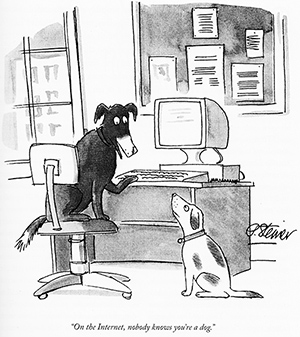
 [  New Yorker Magazine, March 1993] On the Internet nobody knows that you are a dog'
[ New Yorker Magazine, March 1993] On the Internet nobody knows that you are a dog And that s the internet today:
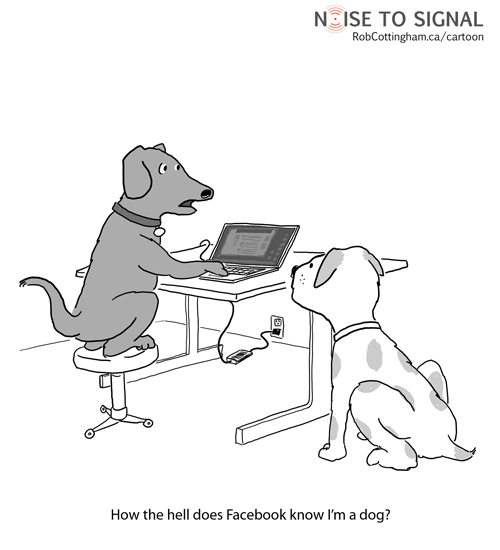
robcottingham.ca - How the hell does Facebook know I'm a dog?
[ robcottingham.ca] How the hell does Facebook know I m a dog?

Well, I d say that s not correct. Even in 1999 facebook could know you are a dog (if you ignore the fact, that there was no facebook in 1999), it s just noone really cared about it. But let s start from the beginning :)An IP-address is a 32-bit integer

An IP-address is technically a 32-bit integer, formatted into 4 8-bit parts (you can read more about IPv4 at Wikipedia), which makes a total of 4,294,967,296 possible IP-addresses. Your ISP has a range in this address-space it can give to its customers (you). My ISP (Unitymedia) owns about 300,000 IP-addresses (based on the RIPE database), which is about 0.007% of the whole address-space. If you look at the RIPE page, you see two common netname prefixes (DE-KNRW and DE-IESY-HFC) which match two regions of Germany where my ISP has its customers (Unitymedia is a merge of ish and iesy). What does that mean? It means one can map a Unitymedia customer into one of these regions, even if he would change his IP-address (Unitymedia uses DHCP with high lease-times, so this does not happen actually). It does not map the customer to a dog yet, but I bet real GeoIP databases can map them correctly to a city (I didn t try much, but this site suggests it works: http://www.ip-adress.com/?lc=en at least they map me correctly to Duesseldorf).Dynamic IP-addresses do not improve privacy

Given the above facts, even if Unitymedia would give me a new IP-address every X hours (many DSL-providers have X=24), it is still possible to map me into a set of about 150,000 users (here user means customer, there still may be multiple computers connected via the same line). I would even go further and say the set is much smaller, as I think I am not able to get every free IP-address from DE-KNRW-*, as these should be bound to cities/regions (GeoIP databases exist, you rememember?) and I do not move with my line.Routers and reverse DNS kill privacy

Currently, my IP-address is 62.143.232.104, which has a reverse DNS entry ip-62-143-232-104.unitymediagroup.de and does not say anything about me or my location, besides of the obvious Unitymedia customer . But look at the traceroute:

4  7111A-MX960-01-ae5.frankfurt.unity-media.net (80.81.192.181)
5  13NOC-MX960-01-ae8.kerpen.unity-media.net (80.69.107.26)
6  1411G-MX960-01-ae9.neuss.unity-media.net (80.69.107.2)
7  1411J-MX960-01-ae1.bilk.unity-media.net (80.69.107.70)
8  PH-1411J-uBR10k-06-Te-1-2-0.bilk.unity-media.net (80.69.102.106)
Frankfurt is about 250km from here, Kerpen about 60, Neuss about 10 and Bilk is a part of the city I live in, about 4km away from my home. I guess you get the idea :)Browsers kill privacy tooDo I have to say more than a link to https://panopticlick.eff.org/? My Chromium scores one in 1,400,000. How much IP-addresses did I have to hide in again?We are at the dog level now, dogs use BoneOS with FireBark, not Linux with Chromium :)IPv6 kills cute kittensOh, and privacy, because with IPv6, there are 2^128 IPv6-addresses out there, of which your provider will maybe own a /32 (2^96 addresses) and give you a /48 (2^80 addresses) or (more likely) /64 (2^64 addresses). Then you enable the great IPv6 privacy extensions (RFC4941) and happily hide in your own assigned subnet, still being a customer of your ISP, still living in the same city and using your old browser It s just about mapping subnets instead of individual IP-addresses then. And we can t get lower as the dog levelPeople can annoy meI did not write all this to teach you, you can do yourself with Wikipedia and RFCs. There is a person out there, who thinks using a random name, mail address and twitter account could fool me into thinking that s a new, yet unknown, person to me. Well, I am not stupid, sorry. When you comment on my blog, your IP-address is logged, when I approve the comment, I often look at the reverse DNS and the whois entry of that IP-address (sorry, I AM paranoid). I even might check my webserver logs (or Piwik) where did you come from (Google etc), writing accidentally in your comment does not help :) Also, if you are trying to fool me, don t use your own computer, running Windows 7 and Firefox which I installed. Oh, and probably do not use your home line which I used to login into my admin-area using my unique Chromium ;)Sorry Hanna Lena, the chicken has just eaten her own eggs And yes, one can track down a single person on this big thing called internet, IPv6 will not change this (in any direction).

Dominique Dumont: FOSDEM video of config-model talks are available

Hello The Cross-Distro video team was very fast this year: All videos of the cross-distro talks are available. Among them, you can find the 2 config-model related talks I gave: If you re interested in the subject of collaboration between distribution, you can also view Vincent Untz s talk: Example of cross-distro collaboration: Application Installer All the best.

11 February 2011

Julien Viard de Galbert: Triage X Bugs of the Week (TXBW12)

This report is 2 week late It was delayed by an important event, not the release of squeeze, but the birth of my first child: C lestine is born Monday the 31th of January. My wife and C lestine are both fine now but the firsts days were not that easy. I m starting to recover from the lack of sleep, but I m still very late on my debian tasks ;) So I guess I just drop Triaging for week 13, 14 and maybe 15 Now the bugs I triaged just before : The X Strike Force (still) needs you ! You can have a look at the X Strike Force Bug Closing Procedure and check XSF unstable bugs sorted by date.

Joachim Breitner: GNUnify started

Yesterday night I arrived in Pune for the GNUnify conference where I m a speaker. I should speak more often at such conferences, they really pamper the speakers: I was picked up with a car from the train station, brought to a posh restaurant where other speakers were already dining and afterwards accommodated in the guest house of the Symbiosis University, which means a spacious room with my own bathroom (with running hot water) and best of all: Internet connectivity after midnight! Tonight I was alone, the next night I ll be sharing it with another speaker.
Today we had breakfast at the conference venue and the first talks started. I attended a talk about Openmoko, but nothing new to me so far. I was happy to see Debian listed as one of the Distributions for the FreeRunner, given that I once co-initiated that port. Nevertheless it could not bring me to try using the FreeRunner again, reliability is just not good enough. I asked for the next best (in terms of freedom and geek-compatibility) phone, but there is no obvious good answer. The n700 seems to be a dead end, given that Nokia might ditch Meego. The Geeksphone sounds like a good candidate, but is out of stock. My Haskell talk will start in 30 minutes. I hope I ll reach my audience and haskell-cafe will see more Indian names soon... The talks are recorded. I guess I should have dressed better.

10 February 2011

Adrian von Bidder: Freedom

LWN Coverage of Eben Moglen's FOSDEM keynote. A very thoughtful article on freedom and how to get there. While we can, technically, build these free systems that Eben Moglen talks about, history has shown that we won't. People don't care until it's too late until the police is on their doorstep with an arrest warrant (if the regime cares about such details at all.) So it's up to the small minority of people who actually cares and is prepared to pay the price (in money or in being isolated by not being on Facebook or whatever) to create systems that are both Free and also appealing to the uneducated masses. People will move to Free systems only when they're much cheaper and also offer more value as perceived by them, in terms of features, or coolness or whatever. Bling. We're almost there in terms of software (Firefox managed to get noticeable market share, and people at least talk about OpenOffice / LibreOffice.) We're nowhere close in terms of networks and content, though. Wikipedia and Openstreetmap are the rare exceptions, but there's not much in terms of social networking, searching, messaging, collaboration platforms etc.: all firmly in corporate hands. I'm not sure that Moglen's Freedom Box idea will succeed either: so far, I can't see the must have element for people who don't care about these things that might change the game.

MJ Ray: OpenBiblio Principles

There s a lot of exciting activity going on around libraries at the moment. One of them is the OpenBiblio Principles, which are:

  1. When publishing bibliographic data make an explicit and robust license statement.
  2. Use a recognized waiver or license that is appropriate for data.
  3. If you want your data to be effectively used and added to by others it should be open as defined by the Open Definition (http://opendefinition.org) in particular non-commercial and other restrictive clauses should not be used.
  4. Where possible, explicitly place bibliographic data in the Public Domain via PDDL or CC0.
Happily, our co-op has decided to support these principles. I feel that the third one is particularly important: non-commercial clauses lock out many cooperatives and social enterprises from sharing and helping. If you ve got an idea for an app using open bibliographic data (you can enter the idea or a prototype app), you ve just about got time to enter the OpenBiblio Challenge before it closes on 17 February and win some money. Good luck!

9 February 2011

Steve Kemp: Random tools I would use - and pictures

So previously I talked about pictures. Having spent a while playing with some new lighting ideas I'll present three recent images:
Now that's out of the way lets talk software. There are two specific things I think would be useful to me right now:
Opportunistic "cron"
I've got a few jobs that don't take long to run, and I schedule for once a day when my systems are idle. It'd be nice to have some long-running daemon which could trigger these odd-jobs (which do things like update my list of mutt mailboxes) when the system has been idle for >30 minutes, or some similar criterion. Ideally I'd say "Run this job when the system is idle, but if the system is never idle run it once a day, or once an hour regardless".
Content-aware tracking software
I use rsync to archive images across a number of systems. Imagine I rename a few images locally, I have to re-rsync even though ideally all I need to do is rename the contents remotely. The issue is remembering what I've changed. So given:
~/Images/Stolen-Souls/2011.02/
~/Images/Stolen-Souls/2011.02/02-Borcsa
~/Images/Stolen-Souls/2011.02/02-Camilla
~/Images/Stolen-Souls/2011.02/06-Indigo
~/Images/Stolen-Souls/2011.02/07-Rosa
If I rename "06-Indigo" then it's trivial to ssh to the remote host and do the same job. But what if I rename a bunch of individual files? Ideally I'd be able to run something like:
~$ tool --snapshot ~/Images/
~$ mv Images/old.jpg Images/new.jpg
~$ tool --show-changes ~/Images
mv Images/old.jpg Images/new.jpg
I half believe git can do something like this, but it seems like you should be able to index the filename+SHA1+size to ~/.snapshot, then later do the same thing and output a list of "mv" commands.
Anyway; I'm drunk. I'm probably not making sense, and I need to sleep. Goodnight. ObQuote: "Hello Mr. Svenning how have you been?" - Mallrats

Next.

Previous.