Search Results: "az"

16 May 2010

Ingo Juergensmann: Slow Import with Digikam

I'm using Digikam to manage my pictures. There are currently more than 32000 pictures to handle. While Digikam 1.2 brought some great performance increases, but the import of new images is driving me crazy. I don't know since when the import ist that slow, but currently a 12 MP image needs 8 seconds to import when it is horizontal. When Digikam needs to rotate it during import because it is a vertically aligned image, then it needs approximately 20 seconds for each image to import.
Funny enough the larger NEF files are imported within a fraction of a second.
I don't know whether this is a Digikam issue or those of a related library or such, but it's really, really annoying when you shot a bunch of fotos and need hours to import them.

UPDATE:
Mark Purcell points at a libexiv2 bugreport: #579835

Russell Coker: Noise Canceling Headphones and People Talking

The Problem I was asked for advice on buying headphones to protect students who have medical conditions that make them sensitive to noise, such headphones would have to allow them to hear human voices. Due to the significant differences in hearing issues (including physical damage and sensory issues) it seems unlikely that getting identical headphones for all students will give an ideal result. The person who asked me the question didn t explain what type of students are being taught. If it s an adult education class then getting everyone the ideal headset wouldn t be particularly difficult. If however it s the special needs class in a high school then students would probably want the most shiny headphones rather than the ones that are a best match to their hearing issues. Also some combinations of hearing problems and ambient noise can t be addressed by such headsets. A friend who developed Noise Induced Hearing Loss from shooting tells me that he really can t stand brass instruments. But the high frequencies from such instruments tend not to be filtered well by noise canceling headphones, so any student who has such a problem would probably need hearing aids that filter out high frequencies I believe that such hearing aids are available but don t have any particular knowledge about them. Test Results I did a quick test on my Bose QC-15 noise canceling headphones [1] which cost me $320US including tax and my cheap Bauhn headphones from Aldi [2] which cost me $69AU (and which apparently could later be purchased on special for $35AU to clear stock). I found that when not playing music they seemed to perform about equally well in terms of allowing me to hear people speaking, although I admit that just having a conversation with the nearest people wasn t the most scientific test. When I was playing music I found that the Bose headset made it significantly more difficult to hear people speak than the Bauhn headset. This is an advantage for the Bose for it s intended use, and I expect that students who need a headset for medical reasons won t want to listen to music while studying so it s never a disadvantage. In both cases, if the headphones are used for just canceling unwanted noise the speaker shouldn t need to raise their voice significantly to be heard. In some situations the noise canceling headphones make it easier for someone with good hearing to hear what people are saying, for example a conversation in a car or plane could probably be held at a lower volume if all people involved were wearing suitable noise canceling headphones. If however the students have damaged hearing then I can t make any prediction as to whether the teacher could speak at a lower volume or whether they would be required to use a higher volume if the students wore such headphones. The Brookstone on-ear headphones that I tested [3] seem particularly noteworthy in this regard due to the way they canceled the melody of the store background music and just left the singing. If someone wants to buy headphones for people with physical damage to their ears then the Brookstone product is really worth investigating. If however the target market happens to be people on the Autism Spectrum then they may hate anything that presses on their ears (as I do) in which case the Brookstone product can t be considered. The Brookstone price of $150US (presumably $160 including tax) was also the best price I saw when shopping in the US but I presume that I could have found something with a similar quality and price to Bauhn in the US if I looked hard enough. Conclusion The big advantage of the Bose for this use is that it blocks a wider range of frequencies than some other noise canceling headsets. They all work really well on regular low frequency noise such as car engine noise (whether a car passenger or a pedestrian) but to stop certain higher frequencies such as those from air conditioning systems the Bose wins hands down. I guess this may depend on what noise is to be blocked, if a class was held in the same room every time and noise canceling headsets were purchased specifically for that class then it would probably make sense to ensure that the acoustic capabilities of the headsets match the unwanted background noise and the hearing issue that each student has. Here s an Amazon link: Bose QuietComfort 15 Acoustic Noise Cancelling Headphones I ve been reading about Sensory Processing Disorder. I m sure that some children are doing poorly in the default school system because they either have an undiagnosed case of SPD or who don t have enough symptoms to get a diagnosis. I think it would make a good experiment to try noise canceling headphones on some of the difficult children, I wouldn t expect a high success rate but if it worked in as little as 5% of cases and did no harm to the children who didn t benefit then it would be worth doing.

15 May 2010

Joey Hess: life update

Today I strapped a kayack on a car (badly) and gingerly drove it out to the country, stopping for Greek food enroute. Now at my yurt, where I hung out and played Agricola all afternoon with my sister. Working on some processing of the 19 applicants for DebConfNewbies sponsorship while amazing venison potstickers are started. Tomorrow morning three kayackers will go out early and float down the river, and maybe find where the underriver creek emerges. Good times! Backing up a bit, the past two months have been significant ones. First, I quit my job. Then I almost bought a lot of land, which would have been huge, especially without an income. But it fell through just before closing, and I've had to push the idea of getting some land in the country back off into the indefinite future, where it probably belongs. Instead, Anna and Mark have been amazing, letting me come out here very regularly to unwind. And I've been very wound up, since there's a secret project under development that I can't discuss yet. Hmm, maybe not being on Facebook anymore will mean more personal blogging. That would be good. Now to go help with the potstickers..

13 May 2010

Steve Kemp: Can you stand on your head?

I've been a little quieter than usual recently, having spent more time outdoors putting cute people in front of the camera. However that said I've still been doing some things. Most interestingly I've given away my first ever project. The collection of small scripts known as xen-tools (which was initially a sleazy hack to go with a small introduction to Xen article) has now got new developers, and a new home where development is continuing. This isn't the first time I've stopped working on something, but it is the first time I've explicitly "given away" a project. (Mostly on the basis that if I didn't care nobody else did either, or people cared but were too busy/unable to actually do soemthing useful.) I'll be following new updates with interest, even though these days I'm 100% Xen-free. No need to go into huge details about why, but I'm enjoying KVM. Having said that I recently got into a huge mess with a combination of LVM, KVM, and ext3. I've written up the details on ServerFault in the optimistic hope that somebody will report having experienced a similar problem. If you have seen something similar I'd love to hear from you. Otherwise I'm genuinely at a loss to understand what went wrong, and why things failed. I could suspect hardware issues, but that feels like a cop-out, albeit one that has a potential solution (Mad Hatter: All Change!) rather than my current answer and explaination "It broke. I don't know why. It might happen again. It might not. Trust me?". ObFilm: Alice In Wonderland (1951 version.)

10 May 2010

Stefano Zacchiroli: UDD - consolidating bazaar metadata for QA and data mining

Eclectic paper on the Ultimate Debian Database A few months ago, I've co-authored with Lucas a paper on UDD, which has just been presented at this year IEEE's Mining Software Repository conference, continuing my recent tradition of eclectic papers. The paper is titled The Ultimate Debian Database: Consolidating Bazaar Metadata for Quality Assurance and Data Mining and is available for download from my publications page. For Debian people already familiar with UDD there is probably not much to learn from it, as the main target of the paper is the community of scientists doing data mining on software repositories. For them, UDD offers a valuable entry point to Debian "facts", as data sources reflected in the database are easily joinable together and to some extent already validated by other UDD users (e.g. QA people). Nevertheless the first two sections of the paper are probably of more broad interest. There we have given our point of view on the so called Debian Data Hell: why it exists, how it's related to the nature of Debian and similar distros, etc. I've already noted in the past how that is also related to the culture of freedom that in Debian we value not only in our software, but also in our infrastructure and procedures. We should just get rid of a bit of inertia, and total world domination will then be just around the corner :-) I'm happy to conclude quoting the acknowledgments section of the paper: Acknowledgments
The authors would like to thank all UDD contributors, and in particular: Christian von Essen and Marc Brockschmidt (student and co-mentor in the Google Summer of Code which witnessed the first UDD implementation), Olivier Berger for his support and FLOSSmole contacts, Andreas Tille who contributed several gatherers, the Debian community at large, the "German cabal" and Debian System Administrators for their UDD hosting and support.

6 May 2010

Adrian von Bidder: Inglourious Basterds

Whew. Thank God I did download that one and not spend money on it. If you're trying to poke fun (or be satirical) at the Nazis, do it like Chaplin, or do it like Monty Python. Inglourious Basterds is just not funny and hasn't got enough substance to be satire. It's just fooling around by people with too big an ego and too much money. I'm extremely disappointed with Tarantino here; I liked his other movies and had expected quite a bit more here. I'm not surprised to see Brad Pitt in such a movie (he's not a bad actor, but I've always had the impression that he's not picky about the roles he's playing), and Uma Thurman gets bonus points for not appearing :-) It just occurs to me that as well as completely missing the mark with the plot here, Tarantino also utterly fails at assembling a gripping soundtrack. Coincidence? If we ignore all this, the film is at least well made, and most of the actors show a good performance (I particularly like Christoph Waltz being the complete asshole.) (On second thought: now, he didn't miss the mark with the plot, but with the way he's been filming it. Use the same plot but do it as a slapstick comedy, I think it could have been really funny. Use the same basic plot but take it seriously, it might have been a real thrilling war movie. Etc. So the plot is not to blame.)

Gunnar Wolf: 5000 Km

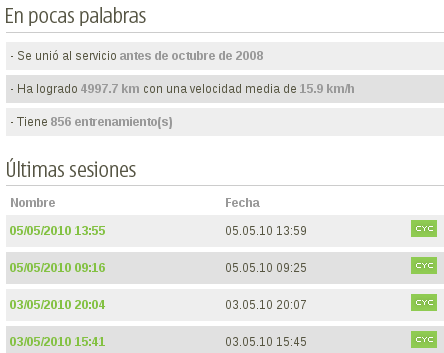
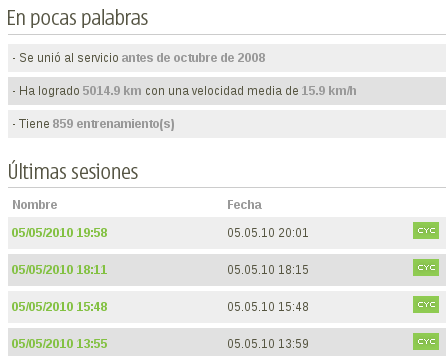
In an amazing but meaningless feat of synchronicity, Toxicore's post led me to check how much distance have I done while excercising I have mainly done this cycling, although some running also comes into play. Turns out I was just about to break the same mark he did. From my Nokia Sportstracker records: Before breaking the 5000 Km mark, yesterday at noon:
Yesterday excercise records, at noon After breaking the 5000 Km mark, yesterday at night:
Yesterday excercise records, at night So, following Bubulle's style... If I have done 5000 Km since January 2008, when do you think I should reach 5500? 6000? 7000? Infinity and beyond?

Andrew Pollock: [life] Crazy few days

Here's why: Zoe's birth Zoe Dianne Pollock was born at 12:30pm PDT, at Lucile Packard Children's Hospital, via Caesarean-section. Her birth weight was 2920 grams (6 lbs, 7 oz) and she's 49.5 centimetres (19.5 inches) long. As for why she was born 11 days early than her previously scheduled early arrival... Monday morning started off like any other normal Monday morning. I got up at 6am to go to the gym with Dan. I got home at around 8am. I asked Sarah if she'd felt any baby movement, and she said she hadn't. Even after some jiggling and a cold glass of orange juice, there was nothing. Not wanting a repeat performance of what happened last time, we wasted no time in heading to Labour and Delivery to get things checked out. When we were nearly at the hospital, Sarah felt some small movement, so that was a relief. When we got to the hospital, they performed a non-stress test as they have previously. They spent a good couple of hours with Sarah hooked up to the monitor, and then the on-call obstetrician asked us how we'd feel about just having the baby today. I asked if there was anything particularly concerning about the NST, and the OB said that she (the baby) was doing marvelously now, but was "less than marvelous" when we first came in. I haven't had a chance since to ask her if there was anything untoward observed during the delivery. Anyway, she (the on call OB) said that rather than have Sarah get stressed out for the following 11 days, she'd talked with our regular OB, and they felt that since she was at 37 weeks (and considered "full term") that it was okay to deliver at that point. At the end of the conversation, it was upgraded to a recommendation, rather than an option. So so much for an attempt at VBAC. We got to the hospital at around 9am, and I think they/we made the decision to deliver at about 10:30am. I had enough time to race home and grab the camera and race back again, and the next thing I knew we were all in the operating room, and Zoe was being delivered. It was amazing getting to see the "extraction". They dropped down the sheet that was blocking our view of the action right at the end, and I got to see (and photograph) Zoe's head and whole body being pulled out. She gave out a little cry, and Sarah and I totally lost it with relief. Things were a bit of a blur after that. I got to come over and meet Zoe while they were weighing her and measuring her, and then they bundled her up and let me take her back to Sarah's head-end on the operating table, so Sarah could get a look at her. Sarah handled this C-section better than last time. She didn't get any nausea, but she still got the itching and involuntary shivering, courtesy of the morphine. While they were still putting Sarah's insides back in, Zoe and I went to the nursery, where they put her under a heater for a little while to warm her up a bit. Then it was back to the recovery room to have a proper meeting with Sarah. Once Sarah was ready to move to the maternity ward, Zoe and I again returned to the nursery, where she got her first bath, had her umbilical cord trimmed some more, and her anti-theft device fitted to her umbilical cord clamp. Then it was off to the maternity ward. I think we were all in the maternity ward by 3pm. After a little while, we managed to get bumped to a private room, which was a lot better than the shared room (the other bed was vacant, but just having more space made a big difference), and that's where we've been ever since. I've stayed each night on the roll away bed, helping out with diaper (sorry Aussies, I've been here too long, and dealt with too many babies, I never think of them as "nappies" any more) changes, and burping and other miscellaneous tasks. Monday night was okay. Tuesday was a bit rough. Sarah didn't get any sleep on Monday night, and the anaesthesia totally wore off and she was in a fair bit of pain. She slept better on Tuesday night, and today, the breastfeeding has been going well, and the post-operative pain is well and truly under control. She's lost a bit of weight since delivery (as is to be expected). She was down to 5 lbs 14 oz (2664 grams) at last night's weigh-in, and at tonight's weigh-in she came in at 5 lbs 13 oz (2636 grams). So the weight loss is starting to plateau. We're already supplementing the breastfeeding with syringes of colostrum/milk that Sarah's pumped previously, so I hope the weight loss will have turned around by tomorrow night's weigh-in. The breastfeeding in general is going pretty well as of today. Mum and bub have both mastered the latch. I think it's just a matter of Sarah's milk coming in now. I've brought forward my 7 weeks paternity leave (an excellent benefit Google offers) to start as of Zoe's delivery. Sarah's Mum arrives on the 19th for 4 weeks, which will be great. We expect to be discharged from hospital on Friday. Luckily we were pretty much all ready for this happening a little bit earlier. We had our last baby classes on the weekend. The nursery is ready enough to bring a baby home to, so aside from Sarah's Mum being disappointed that Zoe's going to be a bit older when she first gets to see her, we're all good. The WiFi in the hospital is great. We've already Skyped with both grandmothers and they've had a chance to see Zoe. We've had a steady trickle of visitors, and the whole baby routine is making the time go pretty quickly.

5 May 2010

Ana Beatriz Guerrero Lopez: KDE 4.4.3 in unstable

Following Qt 4.6.2, uploaded a couple of weeks ago, KDE 4.4.3, has finally found its way to unstable in the last 48 hours.
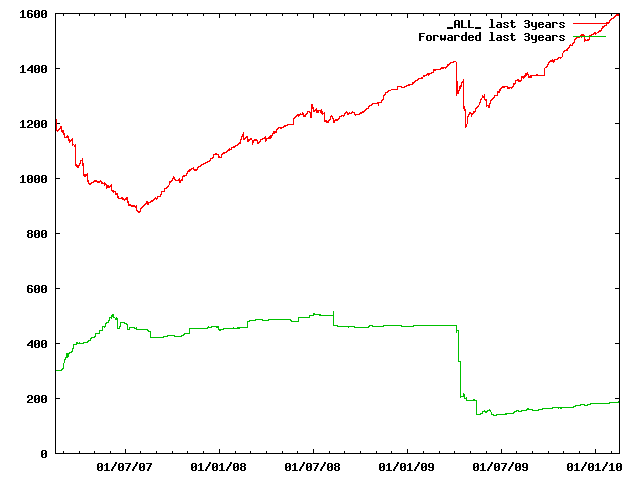
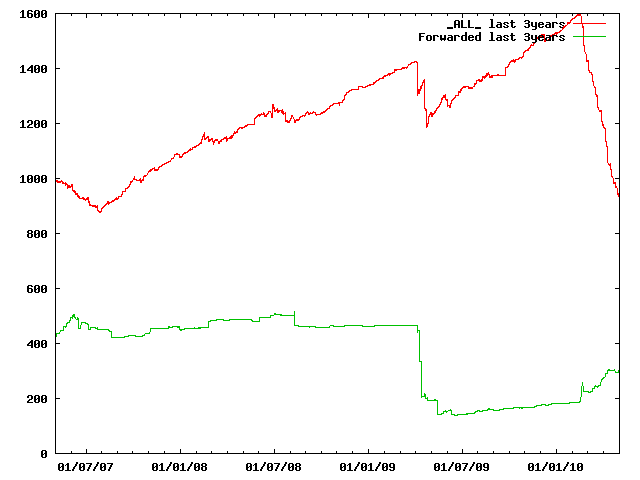
Given KDE 4.5.0 is not expected until August, it is likely the next point release, 4.4.4, will be the KDE version included in next Debian stable, Squeeze. What this means: go and update to 4.4.3, test, and when you find a bug, please, follow this instructions. If you are lazy to read it: report upstream bugs at the KDE Bugzilla and report the packaging/integration bugs in the Debian BTS. When in doubt, you have the Debian KDE mailing list, that is being successful so far in maintaining a good signal-noise ratio. I would like highlight the drop in the open bugs in the BTS experimented in the last 2-3 months, I published this graph in February: Number of bugs reported against KDE in Debian in the last 3 years - February 2010 And look at the situation now: Number of bugs reported against KDE in Debian in the last 3 years -May 2010 This is mainly due to the great work of Eckhart W rner. Also there is other people who contributed to it more modestly, a big thank you to all of you! As you can see in the second graph, there are less than 1000 bugs open now in the BTS, they are still too much and time has taught us it is very easy going over 1000 again, so we still welcome more volunteers looking at bugs. If you are not the bugsquasher type, you can write HTML and you do some IRC, we also need somebody to help us reorganize a bit the pkg-kde website. I will help you personally on this task, but it is good if you can lurk by IRC and you are not scared to share your doubts with the rest of the team there. Finally, I promise I will publish something about the status of KOffice pre-2.2 in Debian, but I still can not say whether it will be in Squeeze.

Bastian Venthur: Running Gnome Applets in KDE

Dear Lazyweb, does anyone know how to run gnome applets in KDE? I m talking about byzanz which is a software to record your desktop in an animated gif, ogg or Flash format. It provides a command line and a gnome applet, which apparently only works under Gnome. Is there a workaround to make gnome applets run under KDE as well?

4 May 2010

Kartik Mistry: lazy hosting for me

* After realize that I can book domain name with payment using Internet banking, I booked one. However, that hosting provider has crap schemes and I want: a. Debian
b. Shell access
c. Payment using Internet banking from India (sorry I has no Credit Card or intend to have one nearly). Lazy lazy web anyone? Size doesn t matter. I want ikiwiki and some static pages for random use.

3 May 2010

Lucas Nussbaum: But why isn t Debian using Launchpad?

Due to my work on Ultimate Debian Database, I m sometimes asked why Debian isn t using Launchpad. First, using Launchpad can mean two different things. The first possibility is using Canonical s instance of Launchpad. That would mean creating a Debian project on launchpad.net, and using Canonical s infrastructure. Well, that s clearly not a good idea. We (Debian) do not want to depend on Canonical to fix bugs or make enhancements that we require to improve Debian. For example, Canonical imposes the use of the Bazaar Version Control System in Launchpad: you simply can t use Git instead (git-bzr hacks don t count). We want to stay in control of our infrastructure, for obvious reasons. So the other possibility would be to setup our own instance of Launchpad, given that Launchpad is now Free Software. However, it is not clear if it is actually possible: I was told by a Launchpad developer that they didn t know of any external (outside Canonical) installation of Launchpad. Even if this was possible, it is not clear at all that the Ubuntu infrastructure is superior to the Debian infrastructure. The Debian infrastructure has many nice features that are missing in Launchpad, for example version-tracking in the Bug Tracking System, which allows to track (by parsing the changelog) the versions of a package where a bug has been fixed or not (example with iceweasel). So, when switching to Launchpad, we would have to reimplement quite a lot of needed features in in, with no clear benefit: the Debian infrastructure works fine, and is actively maintained. It s also interesting to note that while the Ubuntu infrastructure is centered on Launchpad, there are quite a lot of external services that are not integrated in Launchpad: the Ubuntu popularity contest, merges.u.c, patches.u.c, the various services on qa.ubuntuwire.org and qa.u.c, etc. With the Debian model, it is very easy to add a new service and get it integrated with the various dashboard (Debian Developer s Packages Overview, Packages Tracking System). Within Ubuntu, those external services are really second-class citizens. All in all, the infrastructures of the two projects reflect their organizations: bazaar model for Debian, with an emphasis on collaboration between the services, controlled by Canonical for Ubuntu.

1 May 2010

Sean Finney: Nouveau, Gallium3D, and Compiz on Debian

update: 20100503: It's been brought to my attention that there might have been a regression in one of the libraries, mesa, maybe, so that master might not be as reliable a reference point for this guide. so, just in case, here are the commit hashes that were used from the different projects: for the non-git-savvy: git checkout -b mybranch <hash> we now return to your regular broadcasting... A week or two ago I figured it was about time that I took the plung and tried out the latest nouveau drivers from experimental on my laptop. Unfortunately, it meant bidding adieu to compiz (apart from the bling it does actually provide some pretty damned useful features). I thought I'd give it a shot at least for a while on principal, since I've always had to think of the nvidia drivers as a necessary evil, and their lack of proper xrandr support is really, really annoying. Since then I haven't noticed any problems, apart from the following message after every suspend/resume:
[  931.213239] Uhhuh. NMI received for unknown reason 80 on CPU 0.
[  931.213240] You have some hardware problem, likely on the PCI bus.
[  931.213242] Dazed and confused, but trying to continue

No idea what's causing it, but otherwise the system is stable and functional. If anyone knows what can be done about this, I'd appreciate hearing from you. My graphics card, by the way:
01:00.0 VGA compatible controller: nVidia Corporation G72M [Quadro NVS 110M/GeForce Go 7300] (rev a1)

In the time since then, the nouveau driver has made its way into unstable, and a lot of distros (ubuntu, fedora, ...) are even using it as the default driver. So before going any further with the 3d/compiz stuff, I highly recommend that you get the packaged version working first. This will not only make sure that the basic driver works, but it will also make recovery/rollback a lot easier. Since it's all packaged in the standard repositories, it's not much harder than installing a few packages and editing a few files... so come on give it a try :) Getting the 2d driver working in Debian sid Really, this is so easy it's hardly worth writing up, but i'm running with the -v flag this morning... Make sure you don't have any reference to nvidia in /etc/modules or other places that might cause it to be automatically loaded. Then remove the proprietary glx bindings, which would otherwise interfere with the nouveau driver.
sudo apt-get remove nvidia-glx

Next, you'll need to install a kernel that includes updated drm support. Normally this would require a kernel >= 2.6.33.1, but the debian kernel maintainers have graciously backported this code to the 2.6.32-4 kernel package. note this isn't the default kernel version in testing/unstable at the time of writing so you have to explicitly install it along with the nouveau driver.
sudo apt-get install linux-image-2.6.32-4-amd64 xserver-xorg-video-nouveau

If you are already running this kernel and using the proprietary nvidia drivers, via module-assistant or otherwise, you /might/ need to uninstall them first. On my system I left them installed in the old kernel version but did not install them on the new kernel version. Required xorg configuration I don't believe that nouveau is picked by default if available at the time of writing, so you have to have the following in your xorg.conf:
sudo sh -c "cat > /etc/X11/xorg.conf" << EOF
Section "Device"
    Identifier     "nVidia Corporation G72M [Quadro NVS 110M/GeForce Go 7300]"
    Driver         "nouveau"
EndSection
EOF

This was all I needed to do, apart from rebooting into the new kernel. For those who don't want to venture outside the packaging system, this is about as far as you can go for the time being. Though really, if you're bothering to read this far along, you're probably more interested in what comes next :) Getting 3d working (without voiding your distro warranty) So I thought I'd give the 3d-accelerated gallium a go. Their wiki page certainly makes one think twice, but at this point I was seriously fiending to get my bling back (well, the compiz scale plugin, anyway) and figured it wouldn't hurt too much to try. Via google and trawling around in various forums I found a number of how-to documents for getting Gallium3d on debian/ubuntu systems, but most of them recommended doing things in a way that wasn't easily reversible and that could totally hose your system in a not-so-hypothetical worst-case scenario. It's pretty hard to roll back a make install done into /usr, for example, and subsequent package upgrades can leave your system even worse off as they will probably clobber half of what you just did, leaving the other half totally broken. And if you have a laptop which requires the gui for networking (i.e. network-manager), then fixing/rolling-back the changes is not entirely trivial, since you'd likely have to re-download the various drm/mesa/xorg packages. So enter the tried and true unix utility stow (apt-get install stow, of course). stow is a utility that lets you install software into arbitrary folders, and then manage the system-wide installation of the software via a farm of symlinks pointing at the installed location. It's probably more well known among the sysadmin crowd than the desktop user crowd, but it's incredibly useful for the task at hand as it will let us easily install multiple copies of different software in a way that's very easy to update and/or roll-back. RTFM stow(1) for more information. So, on to the juicy stuff... Install needed software, remove problematic packages, setup, etc At least on my system, I had to remove libdrm-dev to keep things from accidentally linking against it instead of the updated version that we install later on below. There's probably a way to override this with CFLAGS but I figure this is simpler.
sudo apt-get remove libdrm-dev
sudo apt-get install stow build-essential xorg-dev git-core libtool mesa-common-dev automake autoconf 
mkdir ~/nouveau

Compile a linux-2.6.34 RC kernel
cd ~/nouveau
git clone git://git.kernel.org/pub/scm/linux/kernel/git/torvalds/linux-2.6.git
cd linux-2.6
git remote add -f nouveau git://anongit.freedesktop.org/nouveau/linux-2.6
git checkout -b nouveau-master nouveau/master
make menuconfig

Enable device drivers -> staging drivers -> nouveau. Make any other changes you might want to make (I just took defaults for everything else).
make deb-pkg

The linux-firmware-free debian package ships some of the same stuff from the generated linux-firmware-image package. I decided to opt for the upstream firmware, though I'm not sure that this is necessary:
sudo apt-get remove linux-firmware-free
sudo dpkg -i ~/nouveau/linux-image*.deb ~/nouveau/linux-firmware-image*.deb
sudo update-grub

Install a copy of dri2proto
cd ~/nouveau
git clone git://anongit.freedesktop.org/xorg/proto/dri2proto
cd dri2proto
./autogen.sh --prefix=/usr/local/stow/dri2proto-20100428
sudo mkdir -p /usr/local/stow/dri2proto-20100428
sudo make install
sudo stow -d /usr/local/stow dri2proto-20100428

Install a cutting-edge version of libdrm
cd ~/nouveau
git clone git://anongit.freedesktop.org/git/mesa/drm/
cd drm
./autogen.sh --prefix=/usr/local/stow/drm-20100428 --disable-intel --disable-radeon --enable-nouveau-experimental-api
make
sudo mkdir -p /usr/local/stow/drm-20100428
sudo make install
sudo stow  -d /usr/local/stow  drm-20100428

Likewise for mesa
cd ~/nouveau
git clone git://anongit.freedesktop.org/git/mesa/mesa
cd mesa
./autogen.sh --prefix=/usr/local/stow/mesa-20100428  --enable-debug --enable-glx-tls --disable-asm --with-dri-drivers= --enable-gallium-nouveau --disable-gallium-intel --disable-gallium-radeon --disable-gallium-svga --with-state-trackers=glx,dri --with-demos=xdemos,demos,trivial,tests
make
sudo mkdir -p /usr/local/stow/mesa-20100428 
sudo make install
sudo stow -d /usr/local/stow mesa-20100428

And now the xorg driver...
cd ~/nouveau
git clone git://anongit.freedesktop.org/git/nouveau/xf86-video-nouveau/
cd xf86-video-nouveau
./autogen.sh --prefix=/usr/local/stow/xf86-video-nouveau-20100428
make
sudo mkdir -p /usr/local/stow/xf86-video-nouveau-20100428
sudo make install
sudo stow -d /usr/local/stow xf86-video-nouveau-20100428

Configuration Configure xorg to look in alternate location for xorg modules and set up DRI
sudo sh -c "cat > /etc/X11/xorg.conf" << EOF
Section "Files"
    ModulePath "/usr/local/lib/xorg/modules,/usr/lib/xorg/modules"
EndSection
Section "ServerFlags"
    Option "GlxVisuals" "all"
Endsection
Section "Device"
    Identifier     "nVidia Corporation G72M [Quadro NVS 110M/GeForce Go 7300]"
    Driver         "nouveau"
EndSection
EOF

I've /heard/ that disabling TV out is a necessity on some cards, though I haven't seen this myself:
sudo sh -c "cat > /etc/modprobe.d/nouveau.conf" << EOF
# not entirely sure this is necessary, but heard it helped with vsync
options nouveau tv_disable=1
EOF

Finally, the one thing that can not be done in /usr/local is making the nouveau DRI driver available. From what I could tell the path that mesa uses to find the DRI libraries is hard-coded (corrections welcome). Since you won't already have this file (otherwise, why would you be following along here?), just drop in a symlink to the file in /usr/local:
sudo ln -s /usr/local/lib/dri/nouveau_dri.so /usr/lib/dri/

Finally, reboot, and hope for the best :) Riding the bleeding edge: how to upgrade later on Again, stow really shows its usefullness here. Using drm as an example case, upgrading an individual component would look something like:
cd ~/nouveau/drm
git clean -dfx
git pull
today= date +%Y%m%d 
./autogen.sh --prefix=/usr/local/stow/drm-$today --disable-intel --disable-radeon --enable-nouveau-experimental-api
make
sudo mkdir -p /usr/local/stow/drm-$today
sudo make install
sudo stow -d /usr/local/stow -D drm-20100428
sudo stow -d /usr/local/stow  drm-$today

Note how the old version is still installed, so you can switch components around pretty freely. Abort! Abort!: How to roll back changes In case your system becomes totally unusable, or you've decided that you just want to go back to the safe and cozy world of what's provided by the debian packages, simply do the following: Assuming that you're using the nouveau driver from unstable, this should be all that is necessary. Conclusion Overall impression I am very, very happy with the resulting setup. I was led to believe that this whole thing was much more unstable and unusable than it actually is! While there are certainly some glitches and missing features, I feel comfortable enough using it that I don't have plans to switch back. But if I find myself in a situation where I can't use the new setup, rolling back shouldn't be a problem either. I figure I'm happy with what I have now and it will only get better. What works, at least to a "kinda works" level. What still doesn't work Further reading, references Thanks A couple shoutouts to those who helped me with this on the way: Feedback / Corrections Unforunately, I've had to disable comments for the time being due to overwhelming quantities of spam. So please drop me a line via email or on IRC (seanius on oftc/freenode).

Benjamin Drung: How to send a command when pressing a key

Dear lazy web, How can I send a command when pressing a key? To make it more complex: I have two input devices A and B. The command should be only sent, when the keys of device A are pressed (and not device B). The devices A and B have the same key codes. For example, pressing the dot key on device A should run a command, but pressing the dot key on device B should just produce a dot. Is it possible to use device A as input device for lirc?

30 April 2010

Michael Banck: 30 Apr 2010

Science Track at Debconf10 This year's Debconf will probably have for the first time tracks pertaining to certain subjects. One of the proposed tracks will be "Math and Science and Debian" and I was asked to organize it. We have some talk proposals already, and we will have a panel discussion about Debian science packaging between the major contributors of the various packaging teams, but more talks are welome! Talks could be about science with/on Debian, or Debian development in scientific fields. Additionally, I would like to encourage contributions on three types of topics: Full length talks are not required, we could split up each topic among a number of people depending on interest and submissions. Talks can be officially submitted until the end of tomorrow (Saturday May 1st, 23h59 UTC), but even afterwards, if you plan to go to Debconf and would like to give a talk about Math, Science and Debian, please contact me and we will see what can be done. Especially contributions to the three topics above can be made later as the events will be registered already.

Benjamin Drung: How to remote control OpenOffice.org Impress

Dear lazy web, I want to control OpenOffice.org Impress through my remote control on Linux. Does OpenOffice.org Impress has a lirc plugin or is there another easy way to do it? The system that hosts the presentation is used for other things, too. Therefore the current active windows is not always Impress. Sending a key code to the active window won t work. Update: The computer has two screens: A TFT and a video projector. It is used for audio recording and hosting the presentation. The active window on the TFT is the audio recording application. The presenter can only see the video projector and should be able to control the presentation with a remote control that works with lirc.

27 April 2010

Sylvain Le Gall: 32 year old

... or as some fellow DD said, one year ago: "j'ai 1000 ans". So what happened during last year, the DVCS way:
$> cd "Sylvain Le Gall"
$> darcs whatsnew
hunk life.txt 0
+ Yvain, my son, talks and walks, this is quite amazing to see your
+ child growing up.  My wife is pregnant, release expected in July
+ ;-)
+ 
+ I traveled quite a lot this year: Spain, Tunisia, Belgium,
+ Roscoff and Huelgoat (Brittany) 
hunk debian.txt 0
+ I went to Debconf 9 and attended Debcamp before. I met a lot of
+ very interesting people there. I spent the Debcamp time to
+ implement Zack proposal to compute OCaml package dependencies
+ using dh-ocaml. It WORKS ;-) It was a pleasure to work with Mehdi
+ Dogguy and Stephane Glondu on this subject.
+ 
+ The dh-ocaml work allowed me to be the co-author, with Stephane
+ and Mehdi, of Zack's article on the subject. 
+ My first publication!
+ 
+ I went to FOSDEM 2010 and helped attend the Debian booth. Quite a
+ nice experience I was there with my good old Open Brick NG (need
+ to blog about it one day).
+ 
+ Found some time to enable the LLVM OCaml bindings in LLVM Debian
+ package.
+ 
+ Voted for the first  OCaml-aware DPL! (NB: this was not the
+ reason for my vote)
hunk work.txt 0
+ I worked on extending a tool that I delivered before. OCaml is
+ quite a good language when it comes to do maintenance. You can
+ extend something and have dozens of compiler errors where your
+ changes propagate. Once every error has been corrected, your
+ changes are OK. Of course, this requires to use OCaml types,
+ pattern matching and a bit of unit testing.
+ 
+ I was delighted when Jun Furuse ask me if he can organize 
+ OCaml Meeting 2010 in Japan. The first OCaml Meeting spin-off. 
+ 
+ OASIS has been growing quite a lot since the year before and got
+ enough importance. Thus I decided to give a talk about it at CAML
+ Consortium in December and then at OCaml Meeting 2010. 
+ 
+ I decided to have some English training. I was missing some oral
+ fluency.
+ 
+ I organized the OCaml Meeting 2010 in April. It was quite a lot
+ of work, especially to prepare my own presentation, but the
+ meeting was a success and probably my best birthday gift with the
+ OCaml Hacking Day organized just after.
$> darcs record -a
What is the patch name? "32 year old"
Unfortunately, this release is late. My birthday was on April 16th, but it was OCaml Meeting this day, which was my top level priority at this time. See you next year!

Ingo Juergensmann: Johan Schl ter: "Child pornography is great"

For many activists in net-politics it is apparent that the fight against child pornography is just an excuse for establishing a EU-wide content filtering infrastructure. This infrastructure for content filtering can be used to filter other content than child pornography as well. For example politicians in Germany already requested blocking gambling sites, Nazi sites, left extremistic political sites and others, when we had that kind of discussion last year over here. The proposal of a law putting up stop pages in front of child pronography sites by former minister for family Ursula "Zensursula" von der Leyen passed the parliament, but shortly after last years parliament elecetion all political parties didn't want that law anymore.
EU commissioner Cecilia "Censilia" Malmstr m introduced a similar proposal for a EU-wide blocking iinitiative a short while ago, as you might now. Christian Engstr m, member of the EU parliament of the swedish Pirate Party, wrote today on his blog that content right industry welcomes child pornography as a way to introduce content filter and blocking infrastructure:

Child pornography is great, the speaker at the podium declared enthusiastically. It is great because politicians understand child pornography. By playing that card, we can get them to act, and start blocking sites. And once they have done that, we can get them to start blocking file sharing sites .

The venue was a seminar organized by the American Chamber of Commerce in Stockholm on May 27, 2007, under the title Sweden A Safe Haven for Pirates? . The speaker was Johan Schl ter from the Danish Anti-Piracy Group, a lobby organization for the music and film industry associations, like IFPI and others.

[...]

Start with child porn, which everybody agrees is revolting, and find some politicians who want to appear like they are doing something. Never mind that the blocking as such is ridiculously easy to circumvent in less than 10 seconds. The purpose at this stage is only to get the politicians and the general public to accept the principle that censorship in the form of filters is okay. Once that principle has been established, it is easy to extend it to other areas, such as illegal file sharing. And once censorship of the Internet has been accepted in principle, they can start looking at ways to make it more technically difficult to circumvent.


If you already have not, then please act now and contact your local EU representive and kindly ask to refuse this directive of Malmstr m and enlighten them by supplying arguments such those MOGIS (MissbrauchsOpfer Gegen InternetSperren, abuse survivors against internet blocking) put up on their webpage (English and other languages).

The abuse of childs and the documentation of such abuse (child pornography is a bad term anyway) needs to be stopped! But access blocking is the wrong direction. Better take care of a more effective criminal prosecution. Documentation of child abuse needs to get removed from the web and the producers needs to get arrested.

So, please act now!

P.S.: there's a nice video on http://cleanternet.org/

Bdale Garbee: TeleMetrum in Stock

First, I was pleasantly surprised to discover that TeleMetrum is now the subject of a post on the Make magazine site. Very cool! As reported last week, I've been waiting for better GPS antennas to arrive, but heavy snow here in Colorado last Friday delayed delivery. They finally arrived, and as I hoped, they appear to completely solve our signal strength problem! So... [drum roll, please!]... I am very happy to announce that the first production build of TeleMetrum boards and starter kits are now "in stock" at the Garbee and Garbee web store, along with other products designed by the Altus Metrum community! Keith and I are still working on the new Java-based ground station software and user documentation for the system. Watch this space for updates. I hope we'll have both ready for download by the time customers actually receive hardware...

26 April 2010

Adam Rosi-Kessel: Lazyweb Search Request: Easy Content Management

Dear Lazyweb: Can you suggest open source content management software that meets these criteria: Generally, content will be located by search, rather than via any particular folder hierarchy. Does it exist? There seem to be a lot of open source CMS options, but at least at first glance they may be overkill with a significant learning curve at least on the admin side.

Next.

Previous.