Search Results: "ag"

4 November 2022

Alastair McKinstry: 1.3 billion announced for new Forestry Support

1.3 billion announced for new Forestry Support Funds to be delivered through new Forestry Programme Premiums for planting trees to be increased by between 46% and 66% and extended to 20 years for farmers #GreensInGovernment The Taoiseach, Miche l Martin TD, Minister of State with responsibility for Forestry, Senator Pippa Hackett, and Minister for Agriculture, Food and the Marine, Charlie McConalogue T.D today announced a proposed investment by the Government of 1.3 billion in Irish forestry. The funding will be for the next national Forestry Programme and represents the largest ever investment by an Irish Government in tree-planting. The programme will now be the subject of state-aid approval by the European Commission. The Taoiseach said: This commitment by the Government to such a substantial financial package reflects the seriousness with which we view the climate change and biodiversity challenges, which affect all of society. Forestry is at the heart of delivering on our sustainability goals and strong support is needed to encourage engagement from all our stakeholders in reaching our objectives. Minister Hackett said: I m delighted to have secured a package of 1.318 billion for forestry. This will support the biggest and best-funded Forestry Programme ever in Ireland. It comes at an appropriate time, given the urgency of taking climate mitigation measures. Planting trees is one of the most effective methods of tackling climate change as well as contributing to improved biodiversity and water quality. One of my main aims is to re-engage farmers in afforestation. I m delighted therefore to be proposing a new 20-year premium term exclusively for farmers, as well as introducing a new small-scale native woodland scheme which will allow farmers to plant up to 1 hectare of native woodland on farmland and along watercourses outside of the forestry licensing process. Minister McConalogue said: Today we commit to providing unprecedented incentives to encourage the planting of trees that can provide a valuable addition to farm income and help to meet national climate and biodiversity objectives. This funding guarantees continued payments to those forest owners who planted under the current scheme and who are still in receipt of premiums. It also offers new and improved financial supports to those who undertake planting and sustainable forest management under the new Programme. We intend to increase premiums for planting trees by between 46% and 66% and to extend the premium period from 15 to 20 years for farmers. "We are approaching a new and exciting period for forestry in Ireland. The new Forestry Programme will drive a new and brighter future for forestry, for farmers and for our climate. The proposed new Forestry Programme is currently out to public consultation as part of the Strategic Environmental Assessment and Appropriate Assessment process. The Programme is the main implementation mechanism for the new Forest Strategy (2023 -2030) which reflects the ambitions contained in the recently published Shared National Vision for Trees, Woods and Forests in Ireland until 2050. The public consultation closes on 29th November, 2022 and any changes which result from this process will be incorporated into the Programme and the Forest Strategy. Minister Hackett commented: The draft Forestry Programme and Forest Strategy are the product of extensive stakeholder consultation and feedback, and both documents are open to public consultation for the next number of weeks. I would strongly encourage all interested parties to engage with the consultation in advance of the Strategy and Programme being finalised. The new Programme is built around the principle of right trees in the right places for the right reasons with the right management. It aims to deliver more diverse forest which will meet multiple societal objectives, economic, social and environmental. Higher grant rates for forest establishment are also proposed with increases of approximately 20% to reflect rising living costs. The new one hectare native tree area scheme will also make it easier for landowners who wish to plant small areas of trees on their farm. The Taoiseach concluded I welcome this milestone and I believe that this funding injection will be an important catalyst in delivering on the ambition outlined in the new Forest Strategy. Our environmental challenges are huge but so is our commitment to overcoming them and this Forestry Programme is key to delivering so many of our priorities. The new Programme will be 100% Exchequer funded and is subject to State Aid approval from the EU Commission. The Department is in contact with the Commission in relation to this approval which is a rigorous process.

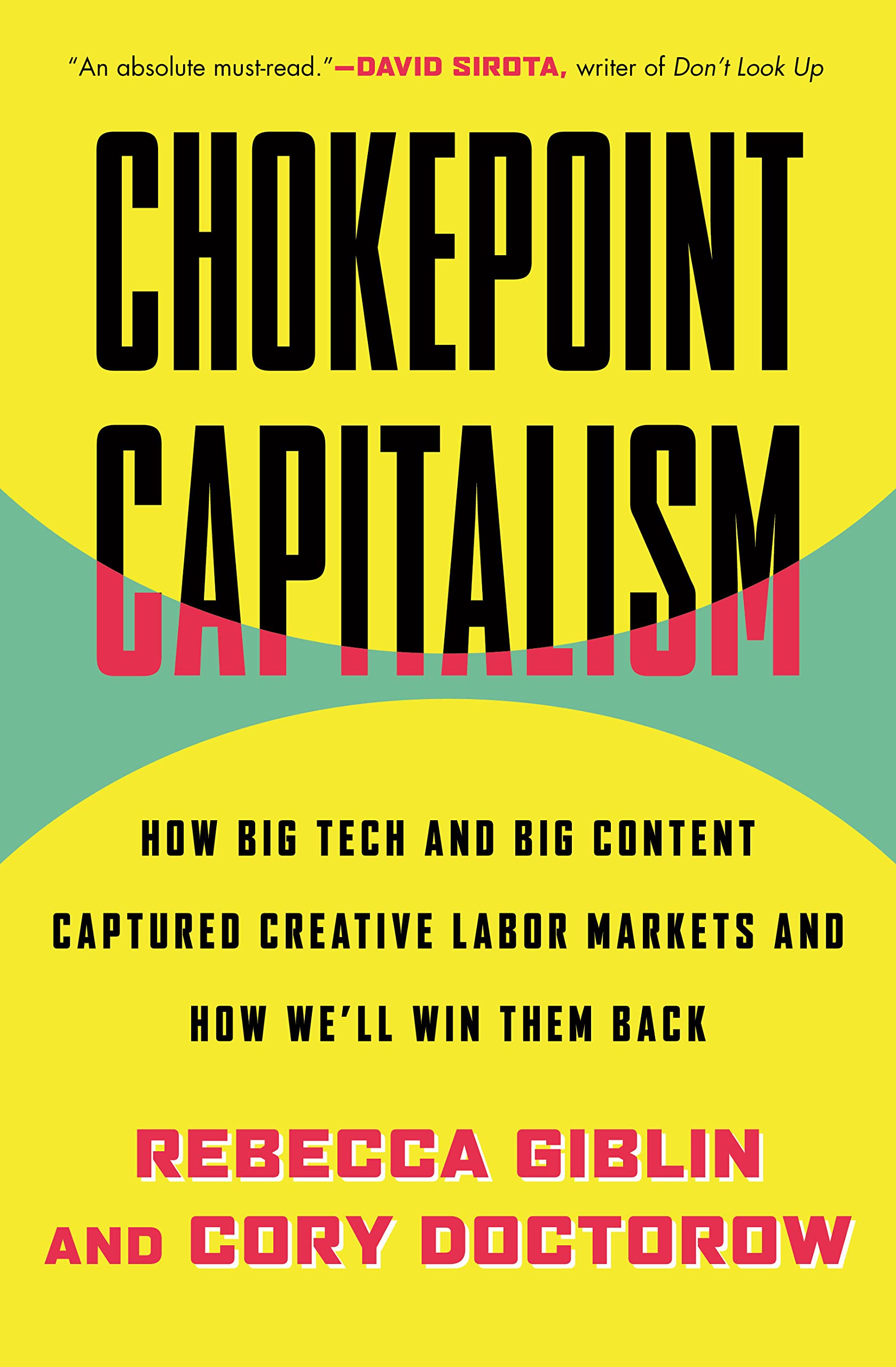
Louis-Philippe V ronneau: Book Review: Chokepoint Capitalism, by Rebecca Giblin and Cory Doctorow

Two weeks ago, I had the chance to go see Cory Doctorow at my local independent bookstore, in Montr al. He was there to present his latest essay, co-written with Rebecca Giblin1. Titled Chokepoint Capitalism: How Big Tech and Big Content Captured Creative Labor Markets and How We'll Win Them Back, it focuses on the impact of monopolies and monopsonies (more on this later) on creative workers. The book is divided in two main parts: A picture of the book cover Although Doctorow is known for his strong political stances, I have to say I'm quite surprised by the quality of the research Giblin and he did for this book. They both show a pretty advanced understanding of the market dynamics they look at, and even though most of the solutions they propose aren't new or groundbreaking, they manage to be convincing and clear. That is to say, you certainly don't need to be an economist to understand or enjoy this book :) As I have mentioned before, the book heavily criticises monopolies, but also monopsonies a market structure that has only one buyer (instead of one seller). I find this quite interesting, as whereas people are often familiar with the concept of monopolies, monopsonies are frequently overlooked. The classic example of a monopsony is a labor market with a single employer: there is a multitude of workers trying to sell their labor power, but in the end, working conditions are dictated by the sole employer, who gets to decide who has a job and who hasn't. Mining towns are good real-world examples of monopsonies. In the book, the authors argue most of the contemporary work produced by creative workers (especially musicians and writers) is sold to monopsonies and oligopsonies, like Amazon2 or major music labels. This creates a situation where the consumers are less directly affected by the lack of competition in the market (they often get better prices), but where creators have an increasingly hard time making ends meet. Not only this, but natural monopsonies3 are relatively rare, making the case for breaking the existing ones even stronger. Apart from the evident need to actually start applying (the quite good) antitrust laws in the USA, some of the other solutions put forward are: Overall, I found this book quite enjoying and well written. Since I am not a creative worker myself and don't experience first-hand the hardships presented in the book, it was the occasion for me to delve more deeply in this topic. Chances are I'll reuse some of the expos s in my classes too.

  1. Professor at the Melbourne Law School and Director of the Intellectual Property Research Institute of Australia, amongst other things. More on her here.
  2. Amazon owns more than 50% of the US physical book retail market and has an even higher market share for ebooks and audiobooks (via Audible). Not only this, but with the decline of the physical book market, audiobooks are an increasingly important source of revenue for authors.
  3. Natural monopolies happen when it does not make economic sense for multiple enterprises to compete in a market. Critical infrastructures, like water supply or electricity, make for good examples of natural monopolies. It simply wouldn't be efficient to have 10 separate electrical cables connecting your house to 10 separate electric grids. In my opinion, such monopolies are acceptable (and even desirable), as long as they are collectively owned, either by the State or by local entities (municipalities, non-profits, etc.).

Dirk Eddelbuettel: RProtoBuf 0.4.20 on CRAN: Maintenance

A new release 0.4.20 of RProtoBuf arrived on CRAN earlier today. RProtoBuf provides R with bindings for the Google Protocol Buffers ( ProtoBuf ) data encoding and serialization library used and released by Google, and deployed very widely in numerous projects as a language and operating-system agnostic protocol. This release is somewhat mechanical and in the spirit of many other recent releases. clang-15 is, as more recent compilers do, more stringent on definitions and wants to see some void in argument-less signatures. Happy to oblige. At the same time, GitHub Actions started to nag us about minimum versions of node code so an upgrade to a newer action is warranted, again as with many other affected packages. We also found another http:// URL hiding somewhere so that was cleaned. Lastly, it appears Protocol Buffers themselves moved on and now need / prefer C++17 so were happy to oblige. The following section from the NEWS.Rd file has full details.

Changes in RProtoBuf version 0.4.20 (2022-11-02)
  • Two function prototype were updated for clang-15.
  • GitHub Actions were updated to checkout version 3.
  • One more http:// URL was updated to https://
  • The package compilation is now donw with C++17 as the Protocol Buffer headers require it (and clang-15 nags otherwise).

Thanks to my CRANberries, there is a diff to the previous release. The RProtoBuf page has copies of the (older) package vignette, the quick overview vignette, and the pre-print of our JSS paper. Questions, comments etc should go to the GitHub issue tracker off the GitHub repo. If you like this or other open-source work I do, you can now sponsor me at GitHub.

This post by Dirk Eddelbuettel originated on his Thinking inside the box blog. Please report excessive re-aggregation in third-party for-profit settings.

Reproducible Builds (diffoscope): diffoscope 226 released

The diffoscope maintainers are pleased to announce the release of diffoscope version 226. This version includes the following changes:
[ Christopher Baines ]
* Add an lzip comparator with tests.
[ Chris Lamb ]
* Add support for comparing the "text" content of HTML files using html2text.
  (Closes: #1022209, reproducible-builds/diffoscope#318)
* Misc/test improvements:
  * Drop the ALLOWED_TEST_FILES test; it's mostly just annoying.
  * Drop other copyright notices from lzip.py and test_lzip.py.
  * Use assert_diff helper in test_lzip.py.
  * Pylint tests/test_source.py.
[ Mattia Rizzolo ]
* Add lzip to debian dependencies.
You find out more by visiting the project homepage.

3 November 2022

Steve Kemp: Alphabetical linting ..

So this week I recycled a talk I'd given in the past, about how even using extremely simple parsers allows a lot of useful static-analysis to be done, for specific niche use-cases. This included examples of scanning comments above classes to ensure they referred to the appropriate object, ensuring that specific function calls always included a specific (optional) parameter, etc. Nothing too complex, but I figured I'd give a new example this time, and I remembered I'd recently written a bunch of functions for an interpreter which I'd ordered quite deliberately. Assume you're writing a BASIC interpreter, you need to implement a bunch of built-in maths functions such as SIN, COS, TAN, then some string-related functions LEFT$, RIGHT$, MID$, etc. When it comes to ordering there are a couple of approaches: Personal preference probably dictates the choice you make, but either way I think it would be rational and obvious that you'd put the functions in alphabetical order:

func ABS( args []primitive.Object) (primitive.Object, error)  
.. 
func COS( args []primitive.Object) (primitive.Object, error)  
.. 
func SIN( args []primitive.Object) (primitive.Object, error)  
.. 
func TAN( args []primitive.Object) (primitive.Object, error)  
.. 
I did that myself, and I wrote a perl-script to just parse the file using a simple regexp "^func\s+([^(]+)\(" but then I figured this was a good time to write a real static-analysis tool. The golang environment is full of trivial little linters for various purposes, and the standard "go vet .." driver makes it easy to invoke them. Realizing that I was going to get driven in the same way it was obvious I'd write something called "alphaVet". So anyway, half written for a talk, half-written because of the name:

Arturo Borrero Gonz lez: New OpenPGP key and new email

Post logo I m trying to replace my old OpenPGP key with a new one. The old key wasn t compromised or lost or anything bad. Is still valid, but I plan to get rid of it soon. It was created in 2013. The new key id fingerprint is: AA66280D4EF0BFCC6BFC2104DA5ECB231C8F04C4 I plan to use the new key for things like encrypted emails, uploads to the Debian archive, and more. Also, the new key includes an identity with a newer personal email address I plan to use soon: arturo.bg@arturo.bg The new key has been uploaded to some public keyservers. If you would like to sign the new key, please follow the steps in the Debian wiki.
-----BEGIN PGP PUBLIC KEY BLOCK-----
mQINBGNjvX4BEADE4w5x0SQmxWLAI1R17RCC98ngTkD/FMyos0GF5xmv0VJeLYhw
x6oJRmiNGHY8+gjq7SyVCWmlwbLKBEPFNI1k5WcrTB+ClgGkWB5KBnbLKm6CSP4N
ccSbrUQrZW+zxk3Q5h3CJljZpmflB2dvRfnDMSSaw8zOc37EtszW3AVVKNYAu3wj
mXpfwI72/OSELhSvhkr51L+ZlEYUMCITeO+jpiWsnU+sA8oKKPjW4+X8cjrN4eFa
1PAPILDf+Omst5SKM2aV5LGZ8rBzb5wNJF6yDexDw2XmfbFWLOfYzFRY6GTXJz/p
8Fh6O1wkHM9RnwmesCXTtkaGQsVFiVsoqGFyzrkIdWPUruB3RG5EzOkapWi/cnbD
1sy7yrUgy99Ew5yzmLaZ40hmRyq/gBBw4yRkdQaddbkErx+9hT+2tJELa5wrmWkb
FtaVZ38xC6gacOZqRjp0Xqtr0jobI0vED8vzIyY0zJwWM0Hu6qqq4hkLWZHjCy8a
T5Oe/Cb78Kqwa2mzJfncDahPxcgxpnbkYdvKokRtNBDftLVEz+Do8Dczw7Me4BoK
HmU8wLyeGeDTmeoBXpxKH90T+rQokgsiiD13bWZ+nBxILun1tjOTVVONG6SHdP3f
unolq8SU3K+m67lLa+pWjyYcNRS2OTWGOz/1zsH2R39ZOyfGD09/10aAKwARAQAB
tC1BcnR1cm8gQm9ycmVybyBHb256YWxleiA8YXJ0dXJvLmJnQGFydHVyby5iZz6J
AlQEEwEKAD4WIQSqZigNTvC/zGv8IQTaXssjHI8ExAUCY2O9fgIbAwUJA8JnAAUL
CQgHAwUVCgkICwUWAgMBAAIeAQIXgAAKCRDaXssjHI8ExCZdD/9Z3vR4sV7vBED4
+mCjdNWWf/mw5YlkZo+XQiMVVss4HfQLdt7VxXgGdcOz5Hond9ax3+qeCEo4DdXq
TC0ACpSCu/TPil6vzbE/kO6i6a4oZjFyteAbbcMXP35stbtDM0U5EZH0adIKknfF
msIPTIdJ/dpkcshtBJIoPqjuuTEBa7bF3OYCajHVqwP4Wsgjy4TvDOwl3hy7bhrQ
ZZHqbh7kW40+alQYaJ8jDvbDh/jhN1/pEiZS9ETu0JfBAF3PYPRLW6XedvwZiPWd
jTXwJd0E+vN5LE1Go8OaYvZb9iitZ21UaYOUnFuhw7SEOSQGfEUBs39+41gBj6vW
05HKCEA6kda9NpfptMbUoSSU+hwRfNA5TdnlxtcRv4NqUigzqa1LoXLdxTsyus+K
BL7dRpKXc72JCrEA3vClisD2FgsxLLRCCSDVM8UM/it/YW7tv42XuhQkTW+okQX4
c5laMzTL+ZV8UOoshseTDOsQsdXhskdnWbnuSwAez2/Dd1gHczuN/+lPiiEnyaTF
XgH17K/F25+92MmwPQcFRVPQcYcbyx1VylA6aCgK6gOEqHCejlZv5XLouzbQh1j1
k6MjUR1ncz8vPV5xSuOMAISqozJ9GxUZT2O3o9Vc9pNg5UEzqTvyURgLOdie8yM4
T93S3nKuHVZ++ZVxEOlPnfEfbFP+xbQrQXJ0dXJvIEJvcnJlcm8gR29uemFsZXog
PGFydHVyb0BkZWJpYW4ub3JnPokCVAQTAQoAPhYhBKpmKA1O8L/Ma/whBNpeyyMc
jwTEBQJjY73LAhsDBQkDwmcABQsJCAcDBRUKCQgLBRYCAwEAAh4BAheAAAoJENpe
yyMcjwTEMKQQAIe18Np+jdhwxHEFZNppBQ69BtyrnPQg4K5VngZ0NUZdVi+/FU7q
Tc9Z1qNydnXgmav3dafL2/l5zDX9wz7mQD2F0a6luOxZwl1PE6iP5f3cUD7uC9zb
148i1bZGEJbO4iNZKTlJKlbNR9m1PG47pv964CHZnNGp6lsnEspxe2G8DJD48Pje
gbhYukgOtIhQ1CaB1fc8aVwZvXZVSbNBLAqp7pAGhTFJqzHE8/U0sn1/V/wPzFAd
TZtWzKfYAkIIFJI5Rr6LVApIwIe7nWymTdgH4crCd2GZkGR+d6ihPKVSxUAUfoAx
EJQUSJY8rYi39gSDhPuEoK8BYXS1nWFGJiNV1o8xaljQo8rNT9myCaeZuQBLX41/
LRzK4XrxYPvjZpKNucc7fSK+UFriQGzdcAaWtW45Kp/8GmAoLVyCD0DPZNWNJdxp
IORhB33aWakhvDKgaLQa16MJ8fSc3ytn/1lxWzDXA1j05i81y/AOKPtCwBKzQWPF
biuZs3kJgZagLq6L6VOQDHlKqf+jqfl1fWeo04iDg98e0TYKABUfiTz8/MdQcV/X
8VkCgtuZ8BcPPyYzBjvuXWZTvdu0n2pikqAPL4u2cbWfD8JIP2AVCJp9HMGKvENo
XcJgY4h6T3rrC/9EidxECfXlsDbUJxLq0WfJLik84+LRtde3kZiReaIRtC5BcnR1
cm8gQm9ycmVybyBHb256YWxleiA8YXJ0dXJvQG5ldGZpbHRlci5vcmc+iQJUBBMB
CgA+FiEEqmYoDU7wv8xr/CEE2l7LIxyPBMQFAmNjvd8CGwMFCQPCZwAFCwkIBwMF
FQoJCAsFFgIDAQACHgECF4AACgkQ2l7LIxyPBMSP/g/+MHmxCAi/X+NMHodg9Qou
wEG4Vf1uluAE6c+c1QECCdtSsRjBs1dZoJzGsA23t4LWqluyaptuLDWJQEz+EVKR
mG0bvvropNaoOEShnY069pg7lUHuO/GLeDRhfEH3KT45sIVbLly8QkoGaINSCDLe
RBNaHC6feIC8NfQzQEt72nbi4SgdSQUg0F3lj4WxxECVhXsw/YCqh1d3QYqwRVEE
lCGQ4EbavjtRhO8U7dcL1VwHemKHNq3XvM3PJf1OoPgxWqFW5rHbAdlXdN3WAI6u
DAy7kY+qihz3w6rIDTFq6I3YBTrZ44J+5mN21ZC2iDXAsa/C3Uam0vFsjs/pizuq
WgGI9Vmsyap+bOOjuRSX4hemZoOT4a2GC723fS1dFresYWo3MmwfA3sjgV5tK3ZN
XIpxYIvi6HAHLOAarDaE8Sha1GHvrmPwfZ+cEgTL0mqW3efSF3AFmGHduMB+agzK
rM9sksrRQhbY2fHnBLo1t06SQx3rmhlz5mD1ljQEIzna9D6QKleRu4hgImRLHnCB
CN3o+mZa1MHhaIFzViaD2i3Fv2+bYgT7vnS4QAneLW8O/ZgpAc2MUxMoci5JNyfJ
mWdae7Kbs4Z8rrt/mH2gYyioSB0po4VtVwKWEUW9cLtZusA6mFnMviFpfjakb9TX
MimBAv9hAYpxd+HdfHinmqS0MEFydHVybyBCb3JyZXJvIEdvbnphbGV6IDxhYm9y
cmVyb0B3aWtpbWVkaWEub3JnPokCVAQTAQoAPhYhBKpmKA1O8L/Ma/whBNpeyyMc
jwTEBQJjY735AhsDBQkDwmcABQsJCAcDBRUKCQgLBRYCAwEAAh4BAheAAAoJENpe
yyMcjwTEGooP/20PR5N34m7CNtyaO96H5W0ULuAuSNuoXaKWDo5LGU6zzDriXbIu
ryYtR66vWF5suf7fHZYX8Ufq4PEsG1UNYEGA9hnjPg3oVwGzBJI7f6Rl2P5Pc8wJ
Eq2kN/xKmfUKIrvgh1f5xgFqC4hzcLDkVlLsPowZWfep8dLY4mtVrsrCD1URhelw
zRDGZ3rTVHWXmfXbSHWR2bgZIIrCtVF8BHStg5b6HuAWpj4Oa0eMfBde0N2RZkLE
ye/r2y/lraHfpT7MXnRMcEmltrv8fic7yvj/Nh4ESWr7UmfbV+GiSw9dc/AlVMXM
ihaW0eXv4F5uMtLJOiqI7bv3UfWSvoqwf2a8EPnzOeBBHhQOOJN7O4UzKBK5GAO8
C3k0I1AV3cTmrXrqT/5yoYAHSekDFCIPES//6Y/pO0ITtCbXkA5e8vaulJbtyXpE
g0Z7I7M1kikL6reZ2PuzsR0psEb/x81bWXODIegyOJolPXMRAY7n9J0xpCnSW9yr
CN4j6YT3Oame04JslwX5Xg1cyheuiusotETYNSKRaGaYBCxYffOWoTLNIBa+RCGc
SVOzJq5pd8fVRM1h2ZZFnfpPJBUb62qPsbk6VwmesGoGevB70zcNQYEI+c35kRfM
IOuJWRIN3Wxx0rpxb5E3i/3TASHM86Dix1VW9vsC/atGU/cgaoTOiNVztDdBcnR1
cm8gQm9ycmVybyBHb256YWxleiA8YXJ0dXJvLmJvcnJlcm8uZ2xlekBnbWFpbC5j
b20+iQJUBBMBCgA+FiEEqmYoDU7wv8xr/CEE2l7LIxyPBMQFAmNjvg8CGwMFCQPC
ZwAFCwkIBwMFFQoJCAsFFgIDAQACHgECF4AACgkQ2l7LIxyPBMS7NA/9F7OL/j7a
xnTDjxAHEiyrCzrBQc/DEAM/yim8E+0UBeTJSZR/bShtbvLbSukeL43tKksPhN/X
skjRF8sJ8KWUnpmSWjv1DQTh7AtkJqACnq7+VtQZq3yuKUCNRNpM8lSFxtmYDUqE
XXD4eMXKoJfdphQ+qpViba+RGXg6sd69Dq739zT/OFMuKZ33z8h7hVNXmoWGcBz6
txvN3cWVJhTLdiBvtn38/0dX7IupQLypLOtP0oZdjoUjkRxTo5biOxt3hUGnxS4x
97PPeRGc4j7lv5ADwFV8bo+g54ZMGRjOcyZmA7dlWFN51JrTx3udW2jgXkYqm7UM
xP4lNwDs9TmT3jan6wR08uwlDakOXfDm3gCQEviN+350sJs2tY+JKBN4QR7NpqeU
2aDFOo0G/0ggf0QbFsMkaTSozerVHRGXMdAi+pbYA6pPWPu8lHIkvvdoj4xUu+Ko
cHX0DCRxmL9mylTbZEanrp5gSpne79McrkbQX2/Yc8lWykCtL5/jHVTD4iNiO5Rf
IJYPAVmC2nlj2URfzwGjjoL5apTStZfng4H2Ccq+3cmhwOXI7pb+PsGeI5PND00A
qHFxe590HFhPxLHoftMIlspstoCvHYGcWQxHNbXW6ccmhHdNYT8Pn4ecKgfr6pCt
0ysilOD2ppPJ88hffKA4nTdtX2Tz2ZwOYwG5Ag0EY2O9fgEQALrapVuv1IcLDit8
9gejdA/Dtlufb2/baImVaQD+dTx2QdMxxEiNKl00a5OhMzXDj9tFrB1Lv4z0t8cY
iDJ+NuydDGgz3MlJgWW0GlpAz8yiul2iqTnkWl3cWeiI+VaX8wzL+acmmkPvlrN8
hM7I55BPr8uBWVIQ7VDmI+ts8gi73xE+Etzzrh13GSSnnYnezfGUQrNfYFcip7D0
hB3bpUIGiPdQ45vSZqXUQx/B6FlabiIGRau8Rt4vaEBGXGFZ9rIR+rMJWx6GqYX4
uY1KM2JZ3SKHk++MWGYdzHdM2oaP6xckZq+u/WiwutkYLLO2hnr03lcAu1IDT1C1
YNPrbTKfqUt+3r0oUK5BrG1Cjdc1mZqcXzYcexOLp79FJLb0t5wPdfgU8dT10kjE
uQxeSYiS4oSpikVQkKoFk++/U95d/z/y/81A6v+cfRus6mW+wRSFSwks7Q5ct7zW
UyKELLC4i4EDgnJXmavVcBD0TWzhH/rZpz9FsO4Mb18IYwbV1/144019/RjiPk5Z
MMNdsjorjV2MtrCIoeAGRgZhbFP2P7CcZOp6ZWzjj40ENlElbLp3VCfkYcTiPHJv
2iaiDz2Mhfmhb1Q/5d/a9tYTYINPmv2QVo+m5Zf+1/U29d2HZMRhD4aqDsivvgtd
GpAnKeus6ePSMqpwjO6v2bmQhjpbABEBAAGJAjwEGAEKACYWIQSqZigNTvC/zGv8
IQTaXssjHI8ExAUCY2O9fgIbDAUJA8JnAAAKCRDaXssjHI8ExA5AD/9VWS1/jHM9
aE3HKCDL4CpiXQPc4ds+3/ft6LXwuCMA/tkt8I4svKZGCCi/X5NfiQetVD+cSzVO
nmloctMt/24yjnGNNSFsDozkn/RqzZIhLJBI69gX4JWR4wpeh4kXMItNM5ZlYw3H
DmuLrf/ey8E2NzbFdzj1VQNoENuwtL2pIJrvK92AcS7acvP0FpiS8riLc5a933SW
oPgelQ1j/04WAH8cyKXB/pruq3OhtK0/b8ylIeI0f7a57dxQj5wysyBVKl+EJd/n
UhypVqMDRWL7N0FttGb9gZ6OVvQnt7iwbtS3tYqAK479+GZwi/Wh/RB2dCDyz8jk
zE0j6y7huP4XzpbBbPVntLDdVAYmpW6iIaTWYxlu79FEUw4JmZdY7hJoEDpHuDIz
ylo0YQgjnRfRfWSdnGCosFrY5UgThPVTaQAILCPtdVyWY4/6s1UaeNs3H0PRA5mz
UT4vDKxGq9gXHnE+qg3dfwMcLR3cDPPWUFVeTfNitZ3Y9eV7SdbQXt5NeOXzFadz
DBc9ZzNx3rBEyUUooU0MEmbltyUFM7R/hVcdpFxs12SgHrvgh13tuxVVVNBXTwwo
pSxmap42vHJERQ8ZJQ4lrvnxNZcuwLHSZK7xVzb0b/1wMooNnhw18vlStMWQJwKl
DiXs/L/ifab2amg9jshULAPgVSw7QeP2OQ==
=UABf
-----END PGP PUBLIC KEY BLOCK-----
If you are curious about what that long code block contains, check this https://cirw.in/gpg-decoder/ For the record, the old key fingerprint is: DD9861AB23DC3333892E07A968E713981D1515F8 Cheers!

Alastair McKinstry: New Planning and Environment Court will reform planning appeals pro...

New Planning and Environment Court will reform planning appeals process #GreensInGovernment The Green Party has fulfilled an important Programme for Government commitment following the cabinet's decision to establish a new division of the High Court to specialise in environmental and planning issues. This is a major reform that will allow planning law to operate in a more efficient and environmentally friendly manner. Steven Matthews TD, Green Party Spokesperson for Planning and Local Government, explained the aim of the new court; The goal is to ensure that our judicial system has the capacity to decide cases as quickly as possible within a growing and increasingly complex body of Irish and EU environmental law. Timely access to justice is a cornersto ne of the effective rule of law and an international legal commitment Ireland has entered under the Aarhus Convention. This is extremely pressing given the urgent need to ease the pressure on the housing system and develop the infrastructure we need to transition to a zero-carbon economy." The Green Party is committed to ensuring the new Court will have the resources to fulfil its role. The Government will pass new legislation to allow the number of judges to be increased and provide the necessary exchequer funding to pay for these judges. The new Court will hear all the cases currently taken by the High Court s Commercial Planning and Strategic Infrastructure Development List and other major environmental cases. This is likely to include all major infrastructure cases as well as many cases relating to EU Environmental Law such as Environmental Impact Assessment, Strategic Environmental Assessment, Birds/Habitats, the Water Framework Directive and the Industrial Emissions Directive.

Alastair McKinstry: Department of Education confirms 12,544 Ukrainian pupils currently ...

Department of Education confirms 12,544 Ukrainian pupils currently enrolled in Irish schools #GreensInGovernment The Department of Education can confirm that as of 1 November, 12,544 Ukrainian pupils have been enrolled in schools across Ireland. Out of that figure, 7,948 of these pupils have been accommodated in primary schools while 4,596 pupils have enrolled in post-primary schools. To assist with the transition of Ukrainian refugees and their families into Irish schools Regional Education and Language Teams (REALT) continue to operate, hosted by the 16 regional education and training boards around Ireland and staffed by regionally based education support personnel.
These teams are ensuring that clear, accessible information flows are in place between schools, local education support services and national support structures in relation to people arriving from Ukraine. Information for parents in Ukrainian and Russian on accessing school places is available on gov.ie/Ukraine. The Department will continue to publish figures on the enrolment of Ukrainian children each month.

Russ Allbery: Review: Carpe Jugulum

Review: Carpe Jugulum, by Terry Pratchett
Series: Discworld #23
Publisher: Harper
Copyright: 1998
Printing: May 2014
ISBN: 0-06-228014-7
Format: Mass market
Pages: 409
Carpe Jugulum is the 23rd Discworld novel and the 6th witches novel. I would not recommend reading it before Maskerade, which introduces Agnes. There are some spoilers for Wyrd Sisters, Lords and Ladies, and Maskerade in the setup here and hence in the plot description below. I don't think they matter that much, but if you're avoiding all spoilers for earlier books, you may want to skip over this one. (You're unlikely to want to read it before those books anyway.) It is time to name the child of the king of Lancre, and in a gesture of good will and modernization, he has invited his neighbors in Uberwald to attend. Given that those neighbors are vampires, an open invitation was perhaps not the wisest choice. Meanwhile, Granny Weatherwax's invitation has gone missing. On the plus side, that meant she was home to be summoned to the bedside of a pregnant woman who was kicked by a cow, where she makes the type of hard decision that Granny has been making throughout the series. On the minus side, the apparent snub seems to send her into a spiral of anger at the lack of appreciation. Points off right from the start for a plot based on a misunderstanding and a subsequent refusal of people to simply talk to each other. It is partly engineered, but still, it's a cheap and irritating plot. This is an odd book. The vampires (or vampyres, as the Count wants to use) think of themselves as modern and sophisticated, making a break from the past by attempting to overcome such traditional problems as burning up in the sunlight and fear of religious symbols and garlic. The Count has put his family through rigorous training and desensitization, deciding such traditional vulnerabilities are outdated things of the past. He has, however, kept the belief that vampires are at the top of a natural chain of being, humans are essentially cattle, and vampires naturally should rule and feed on the population. Lancre is an attractive new food source. Vampires also have mind control powers, control the weather, and can put their minds into magpies. They are, in short, enemies designed for Granny Weatherwax, the witch expert in headology. A shame that Granny is apparently off sulking. Nanny and Agnes may have to handle the vampires on their own, with the help of Magrat. One of the things that makes this book odd is that it seemed like Pratchett was setting up some character growth, giving Agnes a chance to shine, and giving Nanny Ogg a challenge that she didn't want. This sort of happens, but then nothing much comes of it. Most of the book is the vampires preening about how powerful they are and easily conquering Lancre, while everyone else flails ineffectively. Pratchett does pull together an ending with some nice set pieces, but that ending doesn't deliver on any of the changes or developments it felt like the story was setting up. We do get a lot of Granny, along with an amusingly earnest priest of Om (lots of references to Small Gods here, while firmly establishing it as long-ago history). Granny is one of my favorite Discworld characters, so I don't mind that, but we've seen Granny solve a lot of problems before. I wanted to see more of Agnes, who is the interesting new character and whose dynamic with her inner voice feels like it has a great deal of unrealized potential. There is a sharp and condensed version of comparative religion from Granny, which is probably the strongest part of the book and includes one of those Discworld quotes that has been widely repeated out of context:
"And sin, young man, is when you treat people as things. Including yourself. That's what sin is." "It's a lot more complicated than that " "No. It ain't. When people say things are a lot more complicated than that, they means they're getting worried that they won t like the truth. People as things, that's where it starts."
This loses a bit in context because this book is literally about treating people as things, and thus the observation feels more obvious when it arrives in this book than when you encounter it on its own, but it's still a great quote. Sadly, I found a lot of this book annoying. One of those annoyances is a pet peeve that others may or may not share: I have very little patience for dialogue in phonetically-spelled dialect, and there are two substantial cases of that here. One is a servant named Igor who speaks with an affected lisp represented by replacing every ess sound with th, resulting in lots of this:
"No, my Uncle Igor thtill workth for him. Been thtruck by lightning three hundred timeth and thtill putth in a full night'th work."
I like Igor as a character (he's essentially a refugee from The Addams Family, which adds a good counterpoint to the malicious and arrogant evil of the vampires), but my brain stumbles over words like "thtill" every time. It's not that I can't decipher it; it's that the deciphering breaks the flow of reading in a way that I found not at all fun. It bugged me enough that I started skipping his lines if I couldn't work them out right away. The other example is the Nac Mac Feegles, who are... well, in the book, they're Pictsies and a type of fairy, but they're Scottish Smurfs, right down to only having one female (at least in this book). They're entertainingly homicidal, but they all talk like this:
"Ach, hins tak yar scaggie, yer dank yowl callyake!"
I'm from the US and bad with accents and even worse with accents reproduced in weird spellings, and I'm afraid that I found 95% of everything said by Nac Mac Feegles completely incomprehensible to the point where I gave up even trying to read it. (I'm now rather worried about the Tiffany Aching books and am hoping Pratchett toned the dialect down a lot, because I'm not sure I can deal with more of this.) But even apart from the dialect, I thought something was off about the plot structure of this book. There's a lot of focus on characters who don't seem to contribute much to the plot resolution. I wanted more of the varied strengths of Lancre coming together, rather than the focus on Granny. And the vampires are absurdly powerful, unflappable, smarmy, and contemptuous of everyone, which makes for threatening villains but also means spending a lot of narrative time with a Discworld version of Jacob Rees-Mogg. I feel like there's enough of that in the news already. Also, while I will avoid saying too much about the plot, I get very suspicious when older forms of oppression are presented as good alternatives to modernizing, rationalist spins on exploitation. I see what Pratchett was trying to do, and there is an interesting point here about everyone having personal relationships and knowing their roles (a long-standing theme of the Lancre Discworld stories). But I think the reason why there is some nostalgia for older autocracy is that we only hear about it from stories, and the process of storytelling often creates emotional distance and a patina of adventure and happy outcomes. Maybe you can make an argument that classic British imperialism is superior to smug neoliberalism, but both of them are quite bad and I don't want either of them. On a similar note, Nanny Ogg's tyranny over her entire extended clan continues to be played for laughs, but it's rather unappealing and seems more abusive the more one thinks about it. I realize the witches are not intended to be wholly good or uncomplicated moral figures, but I want to like Nanny, and Pratchett seems to be writing her as likable, even though she has an astonishing lack of respect for all the people she's related to. One might even say that she treats them like things. There are some great bits in this book, and I suspect there are many people who liked it more than I did. I wouldn't be surprised if it was someone's favorite Discworld novel. But there were enough bits that didn't work for me that I thought it averaged out to a middle-of-the-road entry. Followed by The Fifth Elephant in publication order. This is the last regular witches novel, but some of the thematic thread is picked up by The Wee Free Men, the first Tiffany Aching novel. Rating: 7 out of 10

2 November 2022

Antoine Beaupr : A typical yak shaving session

Someone recently asked what yak shaving means and, because I am a professional at this pastime, I figured I would share my most recent excursion in the field. As a reminder, "yak shaving" describes a (anti?) pattern by which you engage in more and more (possibly useless) tasks that lead you further and further away from your original objective. The path I took through the yak heard is this:
  1. i wondered if i can use my home network to experiment with another VPN software (e.g. Wireguard instead of IPsec)
  2. then i tried Tailscale because I heard good things about it, and they have an interesting approach to opensource
  3. I wasn't happy with that, so i tried an IPv6 tunnel
  4. that broke after a few minutes, so i went on to try deploying Wireguard with Puppet), which involved reviewing about 4 different Puppet modules
  5. while I was there, I might as well share those findings with the community, so I publish that as a blog post
  6. someone else mentions that Nebula (from Slack) is a thing, but after investigation, it's not well packaged in Debian, so didn't test it, but add it to the blog post
  7. now that I found the right Puppet module, I tried to deploy it with Puppet's g10k, which requires me to input a checksum
  8. I got lazy and figured if i would put the checksum wrong, it would tell me what the right checksum was, but it didn't: instead it silently succeeded instead of failing, which seemed really bad
  9. then I looked upstream for such a bug report and saw that the Debian package was many versions behind and, because I'm on the Golang packaging team, I figured I would just do the upgrade myself
  10. then there were problems with the Debian-specific patch trying to disable network tests, so i rewrote the patch
  11. ... but ended up realizing basically all tests require the network, so I just disabled the build-time tests
  12. ... but then tried to readd it to Debian CI instead, which didn't work
At that point, I had given up, after shaving a 12th yak. Thankfully, a kind soul provided a working test suite and I was able to roll back all those parenthesis and:
  1. test the g10k package and confirm it works (and checks the checksums)
  2. upload the package to the Debian archive
  3. deploy the package in my Puppet manifests
  4. deploy a first tunnel
You'll also notice the work is not complete at all. I still need to: Also notice the 8th yak, above, which might be a security issue. I wasn't able to confirm it, because g10k does some pretty aggressive caching, and I could "reproduce" it in the sense that the checksum wasn't checked if it exists in the cache. So it might have just been that I had actually already deployed the module before adding the checksum... but I still had that distressing sentiment:
<anarcat> there's a huge yak breathing down my neck with "CVE" written in large red letters on the side
<anarcat> i'm trying to ignore it, it stinks like hell
Hopefully it's nothing to worry about. Right? Riiight. Oh. And obviously, writing this blog post is the sugar on top, the one last yak that is self-documented here.

Robert McQueen: Many thanks & good luck to Neil McGovern

As President of the GNOME Foundation, I wanted to post a quick note to pass on the thanks from the Board, the Foundation staff team and membership to our outgoing Executive Director, Neil McGovern. I had the pleasure of passing on GNOME s thanks in person at the Casa Bariachi this summer at GUADEC in Guadelajara, at the most exellent mariachi celebration of GNOME s 25th Anniversary.  Kindly they stopped the music and handed me the microphone for the whole place, although I think many of the other guests celebrating their own birthdays were less excited about Neil s tenure as Executive Director and the Free and Open Source desktop in general.


Neil s 6-month handover period came to an end last month and he handed over the reins to myself and Thibault Martin on the Executive Committee, and Director of Operations Rosanna Yuen has stepped up to act as Chief of Staff and interface between the Board and the staff team for the time being. Our recruitment is ongoing for a new Executive Director although the search is a little behind schedule (mostly down to me!), and we re hugely grateful to a few volunteers who have joined our search committee to help us source, screen and interview applicants.

I have really enjoyed working closely with Neil in my time on the GNOME board, and we are hugely grateful for his contributions and achievements over the past 5 years which I posted about earlier in the year. Neil is this month starting a new role as the Executive Director of Ruby Central. Our very best wishes from the GNOME community and good luck with your new role. See you soon! (also posted to Discourse if you wish to add any thanks or comments of your own)

Ben Hutchings: Debian LTS work, October 2022

In October I was not assigned additional time by Freexian's Debian LTS initiative, but carried over 9 hours from September and worked all those hours. I updated the linux (4.19) package to the latest stable update, but didn't upload it. I merged the latest bullseye security update into the linux-5.10 package, uploaded that, and issued DLA-3173-1.

1 November 2022

Dirk Eddelbuettel: tint 0.1.4 on CRAN: Miscellaneous Updates

A new version 0.1.4 of the tint package arrived at CRAN today. tint provides a style not unlike Tufte for use in html and pdf documents created from markdown. The github repo shows several examples in its README, more as usual in the package documentation. This is the first release in over two years and it brings a few incremental changes which are described in detail below. The trigger was an email from CRAN desiring compacted pdf files inside the package sources. Which, coincidentally, was made a default about a year ago in the build.r script from littler I use to make packages. But as we had not updated tint this has not reached CRAN. So there. The set of changes follows, which includes a helpful contributed PR for which we are always thankful. I also improved table rendering, most other changes are packaging mechanics.

Changes in tint version 0.1.4 (2022-11-01)
  • Added continuous integration at GitHub using run.sh
  • Non-margin reference in html mode now have an improved display (David Selby and Dirk in #47)
  • The LaTeX package array is now installed for improved table support (Dirk addressing #48)
  • Minor updates made the package directory and README.md
  • GitHub Actions were updated to checkout version 3.
  • Several http:// URLs were updated to https://

Courtesy of CRANberries, there is a comparison to the previous release. More information is on the tint page. For questions or comments use the issue tracker off the GitHub repo.

This post by Dirk Eddelbuettel originated on his Thinking inside the box blog. Please report excessive re-aggregation in third-party for-profit settings.

Dirk Eddelbuettel: RcppXts 0.0.5 on CRAN: Maintenance

A new maintenance release 0.0.6 of RcppXts is now on CRAN. The RcppXts package demonstrates how to access the export C API of xts which we contributed a looong time ago. This release, like so many these days, was triggered by clang-15 wanting to see a void in an otherwise argument-less signature. We also updated a GitHub Action to avoid another nag from there. The NEWS entries follow.

Changes in version 0.0.6 (2022-08-05)
  • One function prototype was updated for clang-15.
  • GitHub Actions were updated to checkout version 3.

Courtesy of my CRANberries, there is also a diffstat report for this release. A bit more information about the package is available here as well as at the GitHub repo. If you like this or other open-source work I do, you can now sponsor me at GitHub.

This post by Dirk Eddelbuettel originated on his Thinking inside the box blog. Please report excessive re-aggregation in third-party for-profit settings.

Paul Tagliamonte: Decoding LDPC: k-Bit Brute Forcing

Before you go on: I've been warned off implementing this in practice on a few counts; namely, the space tradeoff isn't worth it, and it's unlikely to correct meaningful errors. I'm going to leave this post up, but please do take the content with a very large grain of salt!
My initial efforts to build a PHY and Data Link layer from scratch using my own code have been progressing nicely since the initial BPSK based protocol I ve documented under the PACKRAT series. As part of that, I ve been diving deep into FEC, and in particular, LDPC. I won t be able to do an overview of LDPC justice in this post with any luck that ll come in a later post to come as part of the RATPACK series, so some knowledge is assumed. As such this post is less useful for those looking to learn about LDPC, and a bit more targeted to those who enjoy talking and thinking about FEC.
Hey, heads up! - This post contains extremely unvalidated and back of the napkin quality work without any effort to prove this out generally. Hopefully this work can be of help to others, but please double check anything below if you need it for your own work!
While implementing LDPC, I ve gotten an encoder and checker working, enough to use LDPC like a checksum. The next big step is to write a Decoder, which can do error correction. The two popular approaches for the actual correction that I ve seen while reading about LDPC are Belief Propagation, and some class of linear programming that I haven t dug into yet. I m not thrilled at how expensive this all is in software, so while implementing the stack I ve been exploring every shady side ally to try and learn more about how encoders and decoders work, both in theory - and in practice.

Processing an LDPC Message Checking if a message is correct is fairly straightforward with LDPC (as with encoding, I ll note). As a quick refresher given the LDPC H (check) matrix of width N, you can check your message vector (msg) of length N by multipling H and msg, and checking if the output vector is all zero.
 // scheme contains our G (generator) and
 // H (check) matrices.
 scheme :=  G: Matrix ... , H: Matrix ... 
// msg contains our LDPC message (data and
 // check bits).
 msg := Vector ... 
// N is also the length of the encoded
 // msg vector after check bits have been
 // added.
 N := scheme.G.Width
// Now, let's generate our 'check' vector.
 ch := Multiply(scheme.H, msg)
We can now see if the message is correct or not:
 // if the ch vector is all zeros, we know
 // that the message is valid, and we don't
 // need to do anything.
 if ch.IsZero()  
// handle the case where the message
 // is fine as-is.
 return ...
 
// Expensive decode here
This is great for getting a thumbs up / thumbs down on the message being correct, but correcting errors still requires pulling the LDPC matrix values from the g (generator) matrix out, building a bipartite graph, and iteratively reprocessing the bit values, until constraints are satisfied and the message has been corrected. This got me thinking - what is the output vector when it s not all zeros? Since 1 values in the output vector indicates consistency problems in the message bits as they relate to the check bits, I wondered if this could be used to speed up my LDPC decoder. It appears to work, so this post is half an attempt to document this technique before I put it in my hot path, and half a plea for those who do like to talk about FEC to tell me what name this technique actually is.

k-Bit Brute Forcing Given that the output Vector s non-zero bit pattern is set due to the position of errors in the message vector, let s use that fact to build up a table of k-Bit errors that we can index into.
 // for clarity's sake, the Vector
 // type is being used as the lookup
 // key here, even though it may
 // need to be a hash or string in
 // some cases.
 idx := map[Vector]int 
for i := 0; i < N; i++  
// Create a vector of length N
 v := Vector 
v.FlipBit(i)
// Now, let's use the generator matrix to encode
 // the data with checksums, and then use the
 // check matrix on the message to figure out what
 // bit pattern results
 ev := Multiply(scheme.H, Multiply(v, scheme.G))
idx[ev] = i
 
This can be extended to multiple bits (hence: k-Bits), but I ve only done one here for illustration. Now that we have our idx mapping, we can now go back to the hot path on Checking the incoming message data:
 // if the ch vector is all zeros, we know
 // that the message is valid, and we don't
 // need to do anything.
 if ch.IsZero()  
// handle the case where the message
 // is fine as-is.
 return ...
 
errIdx, ok := idx[ch]
if ok  
msg.FlipBit(errIdx)
// Verify the LDPC message using
 // H again here.
 return ...
 
// Expensive decode here
Since map lookups wind up a heck of a lot faster than message-passing bit state, the hope here is this will short-circuit easy to solve errors for k-Bits, for some value of k that the system memory can tolerate.

Does this work? Frankly I have no idea. I ve written a small program and brute forced single-bit errors in all bit positions using random data to start with, and I ve not been able to find any collisions in the 1-bit error set, using the LDPC matrix from 802.3an-2006. Even if I was to find a collision for a higher-order k-Bit value, I m tempted to continue with this approach, and treat each set of bits in the Vector s bin (like a hash-table), checking the LDPC validity after each bit set in the bin. As long as the collision rate is small enough, it should be possible to correct k-Bits of error faster than the more expensive Belief Propagation approach. That being said, I m not entirely convinced collisions will be very common, but it ll take a bit more time working through the math to say that with any confidence. Have you seen this approach called something official in publications? See an obvious flaw in the system? Send me a tip, please!

Jonathan Dowland: Halloween playlist 2022

I hope you had a nice Halloween! I've collected together some songs that I've enjoyed over the last couple of years that loosely fit a theme: ambient, instrumental, experimental, industrial, dark, disconcerting, etc. I've prepared a Spotify playlist of most of them, but not all. The list is inline below as well, with many (but not all) tracks linking to Bandcamp, if I could find them there. This is a bit late, sorry. If anyone listens to something here and has any feedback I'd love to hear it. (If you are reading this on an aggregation site, it's possible the embeds won't work. If so, click through to my main site) Spotify playlist: https://open.spotify.com/playlist/3bEvEguRnf9U1RFrNbv5fk?si=9084cbf78c364ac8; The list, with Bandcamp embeds where possible: Some sources

  1. Via Stuart Maconie's Freak Zone
  2. Via Mary Anne Hobbs
  3. Via Lose yourself with
  4. Soma FM - Doomed (Halloween Special)

Russ Allbery: Review: What Makes This Book So Great

Review: What Makes This Book So Great, by Jo Walton
Publisher: Tor
Copyright: January 2014
ISBN: 0-7653-3193-4
Format: Hardcover
Pages: 447
Jo Walton, in addition to being an excellent science fiction and fantasy writer, is a prodigious reader and frequent participant in on-line SFF book discussion going back to the Usenet days. This book is a collection of short essays previously published on Tor.com between July 2008 and February 2011. The unifying theme is that Walton regularly re-reads her favorite books, and each essay (apart from some general essays on related topics) is about why this specific book is one that she re-reads, and (as the title says) what makes it so great. Searching for the title of one of the essays turns it up on Tor.com still, so this is one of those collections that you don't have to buy since you can read its contents on-line for free. That said, it looks like these essays were from before Tor.com started classifying posts into series, so it's going to be challenging to track them down in the huge number of other articles Walton has written for the site. (That said, you can't go far wrong by reading any of her essays at random.) I read these essays as they were originally published, so this was also a re-read for me, but it had been a while. I'm happy to report that they were just as much fun the second time. In the introduction and in the final essay of this collection, Walton draws a distinction between what she's doing, criticism, and reviewing. As someone else who writes about books (in a far more amateur fashion), I liked this distinction. The way I'd characterize it is that criticism is primarily about the work: taking it apart to see what makes it tick, looking for symbolism and hidden meanings, and comparing and contrasting other works that are tackling similar themes. I've often finished a work of criticism and still had no idea if the author enjoyed reading the work being criticized or not, since that isn't the point. Reviewing is assistance to consumers and focuses more on the reader: would you enjoy this book? Is it enjoyable to read? Does it say something new? What genre and style is it in, so that you can match that to your tastes? Talking about books is neither of those things, although it's a bit closer to reviewing. But the emphasis is on one's personal enjoyment instead of attempting to review a product for others. When I talk about books with friends, I talk primarily about what bits I liked, what bits I didn't like, where the emotional beats were for me, and what interesting things the book did that surprised me or caught my attention. One can find a review in there, and sometimes even criticism, but the focus and the formality is different. (And, to be honest, my reviews are more on the "talking about the book" side than fully proper reviews.) These essays are indeed talking about books. They're all re-reads; in some cases the first re-read, but more frequently the latest of many re-reads. There are lots of spoilers, which makes for bad reviews (the target audience of a review hasn't read the book yet) but good fodder for conversations about books. (The spoilers are mostly marked, but if you're particularly averse to spoilers, you'll need to read carefully.) Most of the essays are about a single book, but there are a few on more general topics, such as Walton's bafflement that anyone would skim a novel. Since these are re-reads, and the essays collected here are more than a decade old, the focus is on older books. Some of them are famous: Vinge's A Fire Upon the Deep and A Deepness in the Sky, early Le Guin, Samuel Delaney's SF novels, Salmon Rushdie's Midnight's Children. Some of them are more obscure. C.J. Cherryh, for example, is a writer who never seems to get much on-line attention, but who is one of Walton's favorites. Most of the essays stand alone or come in small clusters about a writer, often sprinkled through the book instead of clumped together. (The book publishes the essays in the same order they originally appeared on Tor.com.) The two largest groups of essays are re-readings of every book in Steven Brust's Vlad Taltos universe (including Brokedown Palace and the Paarfi books) up to Jhegaala, and every book in Lois McMaster Bujold's Miles Vorkosigan series up to Diplomatic Immunity. This is fitting: those are two of the great series of science fiction, but don't seem to be written about nearly as much as I would expect. There are over 130 essays in a 447 page book, so there's a lot of material here and none of them outlive their welcome. Walton has a comfortable, approachable style that bubbles with delight and appreciation for books. I think it's impossible to read this collection without wanting to read more, and without adding several more books to the ever-teetering to-read pile. This is perhaps not the best source of reading recommendations if you dislike spoilers, although it can be used for that if you read carefully. But if you love listening to conversations about the genre and talking about how books bounce off each other, and particularly if you have read most of these books already or don't mind spoilers, this collection is a delight. If you're the type of SFF reader who likes reading the reviews in Locus or is already reading Tor.com, highly recommended. Rating: 8 out of 10

Paul Wise: FLOSS Activities October 2022

Focus This month I didn't have any particular focus. I just worked on issues in my info bubble.

Changes

Issues

Review

Administration
  • Debian BTS: unarchive/reopen/triage bugs for reintroduced packages nautilus-image-converter, swift-im, runit-services
  • Debian IRC: removed 2 spammers from OFTC, disable anti-spam channel modes for some channels
  • Debian servers: restart processes due to OOM
  • Debian wiki: approve accounts

Communication
  • Initiate discussion about the apt hook protocol
  • Respond to queries from Debian users and contributors on the mailing lists and IRC

Sponsors All work was done on a volunteer basis.

Louis-Philippe V ronneau: Montreal's Debian & Stuff - October 2022

Our local Debian user group gathered on Sunday October 30th to chat, work on Debian and do other, non-Debian related hacking :) This time around, we met at EfficiOS's1 offices. As you can see from the following picture, it's a great place and the view they have is pretty awesome. Many thanks for hosting us! The view from EfficiOS' offices, overlooking the Mont-Royal This was our 4th meeting this year and once again, attendance was great: 10 people showed up to work on various things. Following our bi-monthly schedule, our next meeting should be in December, but I'm not sure it'll happen. December can be a busy month here and I will have to poke our mailing list to see if people have the spoons for an event. This time around, I was able to get a rough log of the Debian work people did: pollo: mjeanson: viashimo: lavamind: anarcat: babelouest: tvaz: As always, thanks to the Debian project for granting us a budget to buy some food!

  1. Makers of the awesome LTTng project, amongst other things.

Dirk Eddelbuettel: RcppRedis 0.2.2 on CRAN: Maintenance and Enhancement

A new minor release 0.2.2 of our RcppRedis package arrived on CRAN this evening. RcppRedis is one of several packages connecting R to the fabulous Redis in-memory datastructure store (and much more). RcppRedis does not pretend to be feature complete, but it may do some things faster than the other interfaces, and also offers an optional coupling with MessagePack binary (de)serialization via RcppMsgPack. The package has carried production loads for several years now. This packages now brings a neat enhancement to the real-time data plotter code (and example) I have been using with for a while now. Paul Murrell kindly suggested dev.hold() and dev.flush() when I inquired how to minimize flicker from frequent updated. And this is perfect. I can now keep several data displays on during market hours without being distracted by flicker . It just updates, smooth as silk. Also included in the release are the usual two updates so en vogue these days: a (sole) sprinkling of void to appease clang-15, and an update the GitHub Action for checkout. Both silence some nags we would rather not see. The detailed changes list follows.

Changes in version 0.2.2 (2022-10-31)
  • Thanks to a suggestion by Paul Murrell, the real-time chart demo now uses dev.hold() and.flush() for flicker-free updates.
  • One function prototype was updated for clang-15.
  • GitHub Actions were updated to checkout version 3.

Courtesy of CRANberries, there is also a diffstat report for this release. More information is on the RcppRedis page. If you like this or other open-source work I do, you can now sponsor me at GitHub.

This post by Dirk Eddelbuettel originated on his Thinking inside the box blog. Please report excessive re-aggregation in third-party for-profit settings.

Next.

Previous.