Search Results: "ema"

12 March 2015

Marko Lalic: solicit - an HTTP/2 Library for Rust

For quite some time now, I've been following Rust, a new(ish) programming language by Mozilla. It's been around for a while, but recently it's been attracting a lot of buzz. Around the new year, I finally decided to take a deeper look into the language. I find that the best way to learn a new programming language is to simply dive in and try to build something nontrivial. At that point I'd also been interested in learning more about the specifics behind the new HTTP/2 spec, so I decided to combine the two... The result is a (work in progress) client library for HTTP/2 written in Rust, which can be found at this GitHub repository: https://github.com/mlalic/solicit What follows is a description of what I aim to achieve with the library, as well as an overview of its current design. If that doesn't interest you, you can just check out the GitHub repo for some examples or the source code itself. Goals Given that there are already some fairly popular HTTP libraries for Rust (hyper leading the way), I decided that I wouldn't aim to replace them. Rather, the idea is to focus on the lower levels of the HTTP/2 protocol what is essentially another transport protocol and expose an API that allows those libraries to use an HTTP/2 connection to send requests and receive responses. HTTP/2 doesn't change the semantics of the protocol, so once any HTTP/1.1 library gets the raw headers and body, it should be able to represent the response regardless of the fact that it came on an HTTP/2 connection. The same holds for sending requests: only the representation of the request changes, not its content. There are some minor differences, such as HTTP/2 doing away with the reason phrases being part of the response, but those were only meant to be human readable and "MUST NOT" have had any influence on the semantics of the response. Therefore, the primary goal for the library is to provide an API for using an HTTP/2 connection on the lowest level, but making it easy for clients to customize or augment any particular step of handling a response, without having to know the details of functionality below the layer they want to customize. As an example, if one wanted to build a client that sends out progress notifications for downloads, it wouldn't be good if they needed to muck about with raw HTTP/2 frames ideally, they'd only need to implement a new way to handle incoming data chunks for streams. The same applies for implementing a client that streams the download into a file (instead of saving it in memory) or one that sends the chunks to a different component for processing as soon as they're received (e.g. parsing HTML). Since the Rust standard library only exposes blocking IO primitives, I decided to base this library on blocking IO, as well. However, the goal was to make it flexible enough so that clients that would like to allow multiple requests to be sent concurrently on the same HTTP/2 connection can be built, but without the library itself spawning any threads. Finally, on a less conceptual level (and more of an implementation level), the code should have extensive test coverage. Design The library is split into several layers, each of which provides services to the one above it. A brief description of each layer follows. Transport Layer This layer provides the API for raw byte stream communication with the peer. Essentially, it's a wrapper around the particular transport protocol that is used for the HTTP/2 connection. As the HTTP/2 spec allows the transport protocol to be either a cleartext TCP connection or a TLS-protected one, those are the ones that need to be implemented at this level. The API of the layer is represented by a single trait TransportStream that simply requires io::Read and io::Write to be implemented and (for now) provides a single convenience method based on the underlying io::Read implementation. For a clear-text TCP connection, the only thing that was required to implement it was one line of code:
impl TransportStream for TcpStream  
HTTP/2 Connection Layer The connection layer provides an API for reading and writing to a raw HTTP/2 connection. This means reading and writing HTTP/2 frames, not arbitrary bytes. Each HTTP/2 frame has to follow the same basic structure(a 9-byte header followed by a sequence of byte representing the payload of the frame). This is represented by the RawFramestruct. Each HTTP/2 frame type can have its own specific format for the content of the payload and assign meaning to the flags found in the header. Therefore, each frame needs to have its own implementation that can parse a RawFrame or return an error if the raw frame does not represent a valid frame of that type. Some common methods that each frame type implementation needs to support are given by the Frametrait that must be implemented by the implementations. Finally, the HttpConnectionstruct handles reading the byte stream from the underlying TransportStream instance, correctly delineating frames and parsing them into the appropriate frame type implementation (by delegating to the correct Frame implementation based on the frame type found in the header). Obviously, varying the implementation of the transport layer is a matter of choosing the appropriate TransportStream implementation. This includes using mock implementations for testing the HttpConnection itself. HTTP/2 Client Connection The ClientConnectionbuilds upon the HttpConnection by using it to expose functionality that is specific to the client side of an HTTP/2 connection. This includes sending requests and reading responses. The struct takes care of creating frames that need to be sent for a given request (including HPACK header encoding) and shipping them off to the server (using the underlying HttpConnection instance). As for handling a response, the ClientConnection expects to get an instance of a struct implementing the Sessiontrait when constructed. This trait essentially defines a number of callbacks: methods that will be called on this instance when the corresponding event occurs in the ClientConnection. Therefore, the ClientConnection understands the semantics of the particular frames that it reads (e.g. performs the decoding of the HEADERS frames' payloads, passing the raw data received in a DATA frame to the session, etc.). However, it does not know anything about streams; it only passes the stream ID up to the session layer, without thinking about whether the stream is open, valid, etc. HTTP/2 Session As mentioned in the previous section, each ClientConnection requires an instance of a struct implementing the Sessiontrait to be passed to it at construction time. The Session trait defines a number of callbacks that are invoked in the appropriate moments during the processing of frames read on a client connection. For example, new_headers (takes a list of heaers and a stream on which they were received) or new_data_chunk (a buffer and a stream on which the data arrived). The session is in charge of handling these events as they arise. It is up to it to decide what (if anything) should be done with the data that it receives. There is a default implementation of the Session trait (unimaginatively named DefaultSession), which provides an implementation that tracks which streams are currently open and delegates the processing of new events on particular streams to instances of a Streamtrait. This allows for client implementations to simply vary the implementation of a Stream that they provide to the DefaultSession in order to change how a particular part of a response is handled, but let the DefaultSession take care of tracking which streams are open and valid. Different implementations of a Session still can exist, if the particular client needs more fine-grained customization over how these events are handled, but for most purposes the default session, along with Stream customization should probably be enough. HTTP/2 Stream Again, as mentioned previously, the DefaultSessionimplementation of the Session trait relies on a Streamtrait providing the handling for events arising on individual streams. This level should be the one that gets customized most often in alternate implementations. A default stream implementation DefaultStreamhandles the messages by building up a response in-memory. Different implementations could instead send progress notifications on an associated channel, for instance. HTTP/2 Client The final layeris that of a client that exposes methods that would usually be expected for a client HTTP library: sending requests, obtaining responses. This layer is not the primary focus, though, and it only exposes two simple implementations that showcase how the lower level APIs can be used to build a client. The second purpose it fulfills is as a "sanity check" that the APIs actually do allow the goals to be met. Therefore, one of the clients allows for requests to be sent from concurrently running threads and the responses to those requests to be obtained asynchronously (in the form of a Future<Response>). However, the responses are basic and very raw: they are stored fully in memory (not available until they've been read until the end) and both the body, as well as the headers, exposed as raw byte sequences. As an example how this clientcan be used (as well as the simpler single-threaded version), check out the Examplessection in the GitHub repository's README file. Future Work Refactoring APIs As the project was started as a Rust learning exercise, the initial APIs are slightly awkward and fairly inefficient to work with. For example, the solicit::hpackmodule requires headers to be represented as a tuple of Vec<u8>, which means that whenever we need to encode a header list, even though their values might be (statically known) byte sequence literals, such as (b":method", b"GET"), we need to make a bunch of to_vec calls on the &[u8]s before passing them to the encoder, leading not only to a really ugly and tedious way of obtaining the encoded representation of the headers, but also to a lot of unnecessary allocations. Another API that will see some refactoring and improvement is the TransportStream, as well as the HttpConnection in order to make it possible to have separate threads perform reads and writes on the connection. Currently, the socket is owned by the HttpConnection instance and all writes and reads require a &mut reference, making this impossible. This change would tackle this by embracing Rust's new try_clone method on the TcpStream into the TransportStream and refactoring the HttpConnection to allow splitting it into a write and read handle. HTTP/2 Features As already mentioned, only a small subset of the full HTTP/2 spec is currently implemented, so, obviously, implementing the rest of it falls under the most important future work. Some near- to mid-term priorities that will be tackled are: Obviously, those aren't all the features of HTTP/2, but it's a rough list of things I'm planning on working on myself as the next steps. Integration With an (existing?) HTTP Library I would like it if in the end the library or at least some of its pieces ended up being used in the scope of one of the fully featured HTTP libraries. If there's any interest in this, I wouldn't mind putting in some extra legwork to help make it happen. Conclusion While I'm certain that there can be better, more efficient, more elegant implementations, I've had a lot of fun working on this so far (learning new things is always fun!) and if nothing else I'll continue in order to gain the deepest possible understanding of HTTP/2. For anyone that might have read all the way through, thanks for reading and I'm open for any sort of feedback!

Erich Schubert: The sad state of sysadmin in the age of containers

System administration is in a sad state. It in a mess.
I'm not complaining about old-school sysadmins. They know how to keep systems running, manage update and upgrade paths.
This rant is about containers, prebuilt VMs, and the incredible mess they cause because their concept lacks notions of "trust" and "upgrades".
Consider for example Hadoop. Nobody seems to know how to build Hadoop from scratch. It's an incredible mess of dependencies, version requirements and build tools.
None of these "fancy" tools still builds by a traditional make command. Every tool has to come up with their own, incomptaible, and non-portable "method of the day" of building.
And since nobody is still able to compile things from scratch, everybody just downloads precompiled binaries from random websites. Often without any authentication or signature.
NSA and virus heaven. You don't need to exploit any security hole anymore. Just make an "app" or "VM" or "Docker" image, and have people load your malicious binary to their network.
The Hadoop Wiki Page of Debian is a typical example. Essentially, people have given up in 2010 to be able build Hadoop from source for Debian and offer nice packages.
To build Apache Bigtop, you apparently first have to install puppet3. Let it download magic data from the internet. Then it tries to run sudo puppet to enable the NSA backdoors (for example, it will download and install an outdated precompiled JDK, because it considers you too stupid to install Java.) And then hope the gradle build doesn't throw a 200 line useless backtrace.
I am not joking. It will try to execute commands such as e.g.
/bin/bash -c "wget http://www.scala-lang.org/files/archive/scala-2.10.3.deb ; dpkg -x ./scala-2.10.3.deb /"
Note that it doesn't even install the package properly, but extracts it to your root directory. The download does not check any signature, not even SSL certificates. (Source: Bigtop puppet manifests)
Even if your build would work, it will involve Maven downloading unsigned binary code from the internet, and use that for building.
Instead of writing clean, modular architecture, everything these days morphs into a huge mess of interlocked dependencies. Last I checked, the Hadoop classpath was already over 100 jars. I bet it is now 150, without even using any of the HBaseGiraphFlumeCrunchPigHiveMahoutSolrSparkElasticsearch (or any other of the Apache chaos) mess yet.
Stack is the new term for "I have no idea what I'm actually using".
Maven, ivy and sbt are the go-to tools for having your system download unsigned binary data from the internet and run it on your computer.
And with containers, this mess gets even worse.
Ever tried to security update a container?
Essentially, the Docker approach boils down to downloading an unsigned binary, running it, and hoping it doesn't contain any backdoor into your companies network.
Feels like downloading Windows shareware in the 90s to me.
When will the first docker image appear which contains the Ask toolbar? The first internet worm spreading via flawed docker images?

Back then, years ago, Linux distributions were trying to provide you with a safe operating system. With signed packages, built from a web of trust. Some even work on reproducible builds.
But then, everything got Windows-ized. "Apps" were the rage, which you download and run, without being concerned about security, or the ability to upgrade the application to the next version. Because "you only live once".
Update: it was pointed out that this started way before Docker: Docker is the new 'curl sudo bash' . That's right, but it's now pretty much mainstream to download and run untrusted software in your "datacenter". That is bad, really bad. Before, admins would try hard to prevent security holes, now they call themselves "devops" and happily introduce them to the network themselves!

Gergely Nagy: Lost in a maze, looking for cheese

ApologyAs a twisted turn of fate, I need to start my platform with an apology. Last year, I withdrew my nomination, because my life turned upside down, and the effects of that are still felt today, and will continue to have a considerable footprint for the rest of my life. But this is not what I want to apologise for! I want to apologise because my nomination, my platform, and my plans are rather uncommon - or so I believe. Unlike past Project Leaders, if elected, I will not have as much time to travel, as some of them. Nor will I have the resources to do all the things one may expect from a Project Leader. But - as you'll read later - I consider this both the biggest weakness and the greatest strength of my platform.Furthermore, I will not be available from the second half of the voting period until after the new Project Leader's term starts: I'll be getting married, and will enjoy a nice honeymoon, and as such, my email will remain unread from the 9th of April until we're back on the 21st of April.On the mouse behind the keyboardMy name is Gergely Nagy, or algernon, for those of you who may know me by my online presence. I used to be a lot of things: a flaming youth, an application manager, package maintainer, upstream, ftp-assistant, a student, a mentor, a hacker. In the end, however, I am but a simple, albeit sometimes crazy person. I imagine, a lot of people reading this will not know me, and that is actually not only fine, but in my case, desirable.The Role of the Project LeaderThe role of the Project Leader, what people perceive about the role, and what is actually done by one single person changed dramatically over time. In some ways for the better, some ways for the worse. It should be sufficiently clear by now that if we combine all the things past Project Leaders have done, and what people expect the Project Leader to do, then not even all the time in the world would be enough to accomplish everything. On the other hand, we should not cut the responsibilities back to constitution-granted ones only.There has been some discussion about this very topic on debian-project@, back in February, with excellent observations by both past Project Leaders and the current one. I encourage my dear readers to stop reading this platform now, and read at least Lucas's mail. I'll be right here when you get back.Back? Good.You may notice that unlike in previous years, I do not have a Grand Vision, not in the same sense at least. No matter what I envision, however noble that vision may be, it is not the Project Leader's job to save the world, so to say. While I still believe that we have serious problems with motivation, inspiration and innovation within the project, the Project Leader is the wrong person to try and solve these issues with.Apart from the constitutionally required responsibilities, the primary purpose of the Project Leader in my opinion, is to be an enabler: the Project Leader is not a front runner to lead the herd to victory, but a gentle shepherd to make them happy.HappyThere are many ways to make people happy. One such way is to enable them to pursue their passion - and not just enable them, but encourage and fuel that passion, too! -, to remove barriers, to empower them, or in a lot of cases, to include them in the first place. My vision is a project that is greater than just an amazing distribution. More than a role model for technical excellence. I want to do away with territorial pissings (with which I don't mean to imply that this would be the general atmosphere within the project - far from it!), and would rather see a warm, welcoming culture within the project - the kind of "I'm home!" feeling I had at the DebConfs I had the privilege to attend -, on public and private media alike.That is the vision I have, but I can't do it. At best, I can hope to enable people much better at the these things to do what needs to be done. I wish to take the burden of administration, bureaucracy off their shoulders, so they can focus on what they do best. I feel that this is the most important part of being a Project Leader: to enable the project to grow. And this is why I feel that most of you not knowing my name is an advantage here: When you look at a beautiful flower, you admire the flower itself, rarely the gardener.In the endI wish to be the Project Leader no one remembers. I'd rather see people remember all the great things the Project - as a whole - accomplished, for there are many. My purpose is to let You pursue your passion, which in turn enables even more people to pursue their happiness, and allows the greater Free Software community to bask in the warm glow of accomplished dreams.

10 March 2015

Joey Hess: 7drl 2015 day 4 coding through exhaustion

Slow start today; I was pretty exhausted after yesterday and last night's work. Somehow though, I got past the burn and made major progress today. All the complex movement of both the player and the scroll is finished now, and all that remains is to write interesting spells, and a system for learning spells, and to balance out the game difficulty.
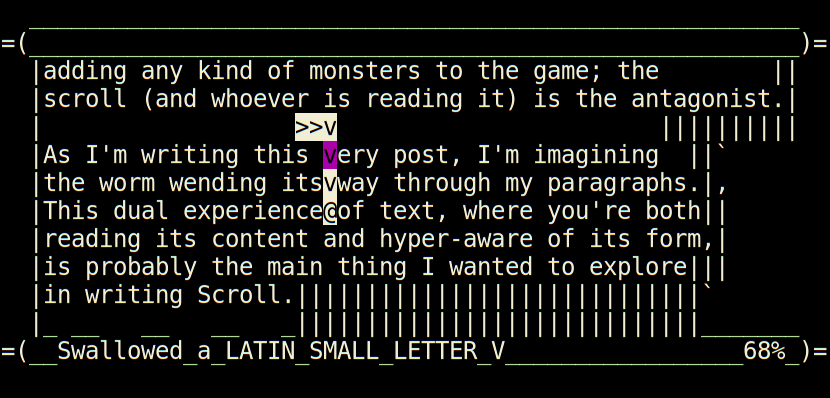
I haven't quite said what Scroll is about yet, let's fix that: In Scroll, you're a bookworm that's stuck on a scroll. You have to dodge between words and use spells to make your way down the page as the scroll is read. Go too slow and you'll get wound up in the scroll and crushed. The character is multiple chars in size (size is the worm's only stat), and the worm interacts with the scroll in lots of ways, like swallowing letters, or diving through a hole to the other side of the scroll. While it can swallow some letters, if it gets too full, it can't move forward anymore, so letters are mostly consumed to be used as spell components. I think that I will manage to get away without adding any kind of monsters to the game; the scroll (and whoever is reading it) is the antagonist. As I'm writing this very post, I'm imagining the worm wending its way through my paragraphs. This dual experience of text, where you're both reading its content and hyper-aware of its form, is probably the main thing I wanted to explore in writing Scroll. As to the text that fills the scroll, it's broadly procedurally generated, in what I hope are unusual and repeatedly surprising (and amusing) ways. I'm not showing any screenshots of the real text, because I don't want to give that surprise away. But, the other thing about Scroll is that it's scroll, a completely usable (if rather difficult..) Unix pager!

9 March 2015

Ulrike Uhlig: Final report from the Outreach Program round 9

Between december 9th 2014 and march 9th 2015 I ve been working as an intern for Debian on Improving AppArmor support in Debian. Progress Before the internship started, I had no clue about AppArmor at all. Reading the Wikipedia page and the AppArmor wiki did barely enlighten me. At least, until I got my hands dirty and installed and activated it. I was able to do this only because there was already some basic documentation on the Debian wiki on how to get AppArmor running on a Debian system. When the internship started I felt a little bit lost. I started to read the documentation and to play around with some AppArmor profiles. But the error messages I saw and the profiles I opened for reading overwhelmed me. What did all these lines mean? Then one mentor briefed me about the current status of AppArmor in Debian. I took many notes and tried to bring some order into the information I was being given. These notes became the first page of the documentation and my first blog post.
Surprise: suddenly I was in the middle of knowing what we were talking about and how the next few weeks would look like. To start with, I have set up a test environment and continued to test some of the profiles which came with the packages I had installed, namely apparmor-profiles-extra which provided me with a profile for Pidgin. I was very much interested in securing this several thousand lines long C-code application on my machine! As a Pidgin user, I noticed immediately that one of my favourite features pidgin blinklight threw an error in the logs. I tried to fix it on my test VM and eventually made it work. Now knowing that such fixes should first be done upstream, i cloned the corresponding upstream repository and sent my first patch. It was not easy at first to switch to another VCS than Git, although I had been using Bazaar and Subversion years ago. Shortly afterwards, I saw my patch showing up on the upstream mailing list, and some days later it got merged. That was a huge encouragement. I was now able to write more documentation on how to contribute upstream. In order to organize the documentation, we ve set up some User Stories. I did not know about this tool before and had quite a hard time to grasp all the details but it proved to be very useful as some pages started to become long and confusing. Writing the documentation took up a lot of time, but before being able to write anything down, I needed to work everything out! This way I incidentally learned how to interact with many parts of Debian s infrastructure: While playing around with the tools provided to inspect AppArmor status on the system, I even accidentally found a little bug in one of the upstream tools. It got fixed very quickly after I mentioned it on the AppArmor team s mailing list. Organization Although I was uncomfortable with this in the beginning, we organized public meetings every two weeks on IRC. These meetings were also attended by MeetBot who took care of taking notes and leaving a trace of our discussions.
Based on the meetings, I maintained a progress page and todo list on the Debian wiki, which helped us to know which tasks were planned for the next two weeks. Before each meeting I sent a status update to the mailing list, so the mentors could catch up with my work. During the meetings I was not only asked to provide feedback on progress but also on mentoring itself. It proved to be very useful to be able to say where I was stuck and if the mentoring process worked out well enough (it did!).
Furthermore, I got regular, detailed and pedantic (thanks for trying to push me to perfection!) feedback on the team s mailing list. The mentors had introduced me on the upstream IRC channel in the beginning, so most of the people who are active there knew about my existence, something which also proved to be handy! Future The internship time is over, but some work remains to be done. As a new member of the AppArmor Packaging team, I am committed to make it happen: Thanks I feel much more confident after these three months, technically but also personally. Thank you: Holger Levsen and intrigeri for mentoring and encouraging me on this journey and to upstream contributors Christian Boltz, Steve Beattie (and everybody else I might forget here) for providing help and feedback. The Debian community (OPW organizers, sponsors, Alioth maintainers, planet.debian.org maintainers although my posts don t show up anymore :( -and others) has been very friendly and welcoming and I am very happy to be part of it.

8 March 2015

Carl Chenet: Verify your backups or lose them all

Follow me on Identi.ca or Twitter or Diaspora*diaspora-banner As a good sysadmin, you thought you had backups for your server but you didn t verify them before the major migration you attempted? When you need them, they re empty or full of useless files. And now it s too late
nobackup

Wen you discover that you don t have usable backups lesjoiesdusysadmin.fr

You won t guess how often this situation occurs. Backup Checker is a command line software developed in Python 3.4 on GitHub (stars appreciated :) ) allowing users to verify the integrity of archives (tar, gz, bz2, lzma, zip, tree of files) and the state of the files inside an archive in order to find corruptions or intentional of accidental changes of states or removal of files inside an archive. github-logo Install Backup Checker from PyPI The easiest way to install Backup Checker is from PyPi using the following command:
$ pip3.4 install backupchecker
Debian Wheezy and Squeeze packages for Backup Checker Backup Checker Debian packages are now available for your stable servers Wheezy and Squeeze in the MyTux Debian repositories. Debian Squeeze Just copy/paste the following command on your server to add the MyTux Debian Squeeze repository and install Backup Checker:
apt-key adv --keyserver pgp.mit.edu --recv-keys 2B24481A \
&& echo "deb http://debian.mytux.fr squeeze main" > /etc/apt/sources.list.d/mytux.list \
&& apt-get update \
&& apt-get install backupchecker
debian-squeeze-toy Debian Wheezy Just copy/paste the following command on your server to add the MyTux Debian Wheezy repository and install Backup Checker:
apt-key adv --keyserver pgp.mit.edu --recv-keys 2B24481A \
 && echo "deb http://debian.mytux.fr wheezy main" > /etc/apt/sources.list.d/mytux.list \
 && apt-get update \
 && apt-get install backupchecker
wheezy Using Backup Checker 2 steps are needed to secure your backups. First you need to generate the configuration files of your backups, using the following command: $ backupchecker -G /backups/backup-08032015.tar.gz This generates 2 files /backups/backup-08032015.conf and /backups/backup-08032015.list you need to store in order to verify this archive later (the -O option lets you define a custom location to store the files). Second step is to verify your backup. It is as simple as: $ backupchecker -c /etc/backupchecker/backup-08032015.conf -l /var/log/backupchecker.log Then check if warnings have been sent to /var/log/backupchecker.log. Really simple isn t it? Scripting this command, your backups are now verified and secured. If any modification occurs, it will be detected and pinpointed. What do you thing about it? As usual, any feedback is welcome, through bug reports, emails of the author or comments on this blog. Several companies now use Backup Checker to secure their backups. Let us know if we can help you.

7 March 2015

Andrew Pollock: [tech] Honey, I wrote my first Chrome extension!

I love reading Linux Weekly News. It's a great source of high quality Linux and FOSS journalism, and I've been a subscriber for years. One mild annoyance I have with the site is the way articles are cross-linked. All the article URIs are in the format /Article/531114/, which isn't particularly descriptive about that article's content. When faced with an article that links to another article, with perhaps a word of anchor text, it's hard to tell if the new article is worth opening in a tab, is indeed already open in a tab, or has been previously read. (Yes, the "visited link" colour can help to a small degree, but even then, it doesn't tell you which previously read article it is). This is what God the W3C invented the title attribute for. Back in April 2011, I emailed Jonathan Corbet and asked if his content management system could just do this, but it was apparently a bit tricky, and it got filed in the "feature request" bucket. I was sufficiently irritated by this deficiency last Monday, when doing some heavy reading on a topic, and so I decided to take matters into my own hands, and also learn how to write a Chrome Extension into the bargain. I was delighted to have scratched the itch under 24 hours later and developed something that solved my particular problem - lwn4chrome I'm calling it. I'm just finalising an icon for it, and then I'll have a stab at putting it in the Chrome Web Store as a freebie. I might even have a crack at writing a Firefox extension as well for completeness, but I suspect the bulk of LWN's readership is using Chrome or Chromium.

6 March 2015

Eddy Petri&#537;or: Occasional Rsnapshot v1.3.1

I was writing in the previous post about Occasional Rsnapshot and how I ended up writing it.

Just before releasing v1.2.1 I realized it would make sense Semantic Versioning which, in just a few words means:
Given a version number MAJOR.MINOR.PATCH, increment the:
MAJOR version when you make incompatible API changes,
MINOR version when you add functionality in a backwards-compatible manner, and
PATCH version when you make backwards-compatible bug fixes.
I just released Occasional Rsnapshot v1.3.1 which mainly fixed issue 4:
When deciding to do a backup for interval INT, there should be a check that the oldest snapshot in INT-1 interval is older than the threshold for the INT interval. Otherwise the INT interval will be populated with backups more frequent than desired and it is possible older backups in INT interval to completely lost.
The condition should be:
ts(oldest(INT-1)) - ts(newest(INT)) >= threshold(INT)
For example:
  • if weekly.0 is from 15th of February and daily.6 is from 17th of February, weekly should not be triggered, but
  • if weekly.0 is from 15th of February and daily.6 is from 23rd of February, weekly shall be triggered
This extra check should probably added in can_backup_interval.
It was a small bug, but it might have lead to losing important older backups because newer and more frequent backups would be pushed from hourly, interval by interval up to the yearly interval, in spite of the fact that the distance between backups wouldn't have been respecting the upper interval minimum distance in time.

There was also a small syntax bugfix, but functionally nothing has changed because bash was doing the right thing even with that small error.

If you have started using Occasional Rsnapshot, you definitely want now Occasional Rsnapshot v1.3.1. If you haven't started and you don't have backups, please start doing backups, and while you're at it, you might want to try Occasional Rsnapshot (with Rsnapshot).

Rapha&#235;l Hertzog: My Free Software Activities in February 2015

My monthly report covers a large part of what I have been doing in the free software world. I write it for my donators (thanks to them!) but also for the wider Debian community because it can give ideas to newcomers and it s one of the best ways to find volunteers to work with me on projects that matter to me. Debian LTS This month I have been paid to work 14.5 hours on Debian LTS. I worked mostly on CVE triage (41 commits in the security tracker) and organizational issues. One maintainer complained that he had not been kept in the loop for an LTS update of his package. After some discussion, I decided to change the way I did CVE triage so that any time that I add a package to our list of packages needing an update, I also send a mail to the maintainer, thus offering him the opportunity to step in. To make this sustainable, I wrote a small helper script that will generate a mail out of a template. And to kickstart the process I mailed all maintainers of packages that were already listed in our queue of packages to update. To improve the email generated, I requested a JSON export of the security tracker data (see discussions in #761859). In the mean time, Holger worked on this already and after a few iterations we did converge on an output format that will be really useful both for my needs in terms of CVE triage but also for the Package Tracker to be able to display the list of security vulnerabilities affecting each release (see #761730). Last but not least, I don t want to be the only one doing CVE triage for our LTS release so I documented the process in our wiki page. As a side note, I sponsored an e2fsprogs update prepared by Nguyen Cong and I sent the DLA for the embargoed samba update that had been prepared by Ivo de Decker (thanks to both of them!). Tryton Like last month, I invested again a copious amount of time on Tryton, fixing some bugs that were affecting me and improving the French chart of accounts to properly manage purchases and sales within the European Union. Here are some links for more details: Debian I did some work on Distro Tracker, I fixed #777453 (password reset not working because the generated email was using an invalid From email) and #779247 (obsolete build reproducibility action items were not dropped). I also started to work on restructuring the mail handling in distro-tracker (cf #754913) but it s not public yet. While I have no plans to stop contributing to Debian (it s part of my day job!), I reduced my non-work related involvement by officially recognizing that I was no longer properly assuming some of my responsibilities and that I was following too many mailing lists and RSS feeds. The most notable changes are that I removed myself from the maintenance of dpkg, developers-reference, quilt, sql-ledger, and a few perl/python modules. Misc Voting software. Part of the reason why I m reducing my involvement in Debian is that I got more involved in Nouvelle Donne (a French political party) and in particular in the handling of its digital infrastructure (currently running on Ubuntu, doh!). As part of this, I was looking for free software to handle secure votes and elections (and if possible adhering to the principles of liquid democracy). There s no perfect solution and no clear winner. That said I started following the evolution of AgoraVoting because it seems to have a good momentum and has some interesting features (it already supports votes with ranked choices, supports good crypto, has been used for elections involving large numbers of voters in the context of Podemos in Spain). But it still has some ways to go to establish itself as a truly international and community-backed project. GDM bug. Due to my work on Kali, I filed a bug against GDM (this one has been quickly fixed upstream, it s still open in Debian) and another one against accountsservice to request the possibility to define the default graphical session. Dirvish formula for Salt. I contributed another formula to manage backups with dirvish. Thanks See you next month for a new summary of my activities.

One comment Liked this article? Click here. My blog is Flattr-enabled.

Steve Kemp: Free hosting, and key-signing

Over the past week I've mailed many of the people who had signed my previous GPG key and who had checked my ID as part of that process. My intention was to ask "Hey you trusted me before, would you sign my new key?". So far no replies. I may have to be more dedicated and do the local-thing with people. In other news Bytemark, who have previously donated a blade server, sponsored Debconf, and done other similar things, have now started offering free hosting to Debian-developers. There is a list of such offers here: I think that concludes this months blog-posting quota. Although who knows? I turn 39 in a couple of days, and that might allow me to make a new one.

3 March 2015

Daniel Pocock: Wrong day or wrong volcano?

On our last visit to Chile, we stayed in Pucon for a few days and went to climb the Villarrica volcano: It is demanding (1500 meter rise in elevation from the bus stop, crampons must be worn on the glacier) but the view is breathtaking. While we were there, another nearby volcano erupted. Today, Villarrica Volcano had its turn:

2 March 2015

Carl Chenet: Backup Checker 1.2 : verify remote backups

Follow me on Identi.ca or Twitter or Diaspora*diaspora-banner Backup Checker is a command line software developed in Python 3.4, allowing users to verify the integrity of archives (tar,gz,bz2,lzma,zip,tree of files) and the state of the files inside an archive in order to find corruptions or intentional of accidental changes of states or removal of files inside an archive. The major feature of this new version is the ability of Backup Checker to use Unix streams. Using classic Unix tools like OpenSSH or wget, Backup Check is able to verify a remote tar. gz,bz2,xz archive. The following example verifies a tar.gz archive located on remote server through SSH: $ ssh -q server "cat /tmp/backup.tar.gz" ./backupchecker.py -c . -
Another short example with the FTP protocol, to verify a tar.bz2 archive located on a remote server through FTP:
$ wget --quiet -O - ftp://user:pass@server/backup.tar.gz   ./backupchecker.py -c . -
Moreover in this release, a new option configuration-name allows the user to define a custome name for the files generated by Backup Checker (default is defined from the name of the archive using the -g or -G options). It is a major step for Backup Checker. It is indeed easier and easier to use Backup Checker in your own scripts, allowing to fully automate your backup controls. Several companies now use Backup Checker to secure their backups. Let us know if we can help you. As usual, any feedback is welcome, through bug reports, emails of the author or comments on this blog.

1 March 2015

Thorsten Alteholz: My Debian Activities in February 2015

FTP assistant Processing the new queue got off the ground again. This month I marked 154 packages for accept and rejected 20 packages. Some emails I got were rather funny and people are very creative when trying to interpret the license of upstream. But hey, most of the time upstream has a reason to choose a specific wording. You can try to interpret those words, but don t waste your time. Better ask upstream about their intention and whether this fits into the world of Debian. It only sounds strange when upstream publishes their stuff under licenseA and wants to distribute their files under licenseB but insists on keeping the wording of licenseA. That s life! Squeeze LTS This was my eighth month that I did some work for the Squeeze LTS initiative, started by Raphael Hertzog at Freexian. This month I got assigned a workload of 14.5h and I spent these hours to upload new versions of: For whatever reason, the DLA-145-2 didn t reach debian-lts-announce. As the listmaster didn t find any reason for this (at least the other emails all appeared), I think there has been some extraterrestrial influence ( The Truth Is Out There ). Anyway, I also worked on an upload for binutils, but one patch is a real 100kB-beast. Meanwhile I am down to only one regression in one source file, so I hope that there will be an upload in March. I also uploaded one DLA for libgtk2-perl ([DLA 161-1] libgtk2-perl security update although no LTS sponsor indicated any interest. Other packages I didn t do any work on other packages, but looking at the bug count, the number of bugs has increased. So, sorry, if you sent in a bug report and I didn t answer. It is not forgotten. Donations After adding some micro payment buttons to my blog in January, I already got a donation of 20 in February. I really appreciate this and I feel vindicated that my contributions to Debian are still useful.

28 February 2015

Ben Hutchings: Debian LTS work, February 2015

This was my third month working on Debian LTS, and the first where I actually uploaded packages. I also worked on userland packages for the first time. In the middle of February I finished and uploaded a security update for the kernel package (linux-2.6 version 2.6.32-48squeeze11, DLA 155-1). I decided not to include the fix for CVE-2014-9419 and the large FPU/MMX/SSE/AVX state management changes it depends on, as they don't seem to be worth the risk. The old patch system used in linux-2.6 in squeeze still frustrates me, but I committed a script in the kernel subversion repository to simplify adding patches to it. This might be useful to any other LTS team members working on it. In the past week I uploaded security updates for cups (version 1.4.4-7+squeeze7, DLA 159-1) and sudo (1.7.4p4-2.squeeze.5, DLA 160-1). My work on the cups package was slowed down by its reliance on dpatch, which thankfully has been replaced in later versions. sudo is a more modern quilt/debhelper package, but upstream has an odd way of building manual pages. In the version used in squeeze the master format is Perl POD, while in wheezy it's mandoc, but in both cases the upstream source includes pre-generated manual pages and doesn't rebuild them by default. debian/rules is supposed to fix this but doesn't (#779363), so I had to regenerate 'by hand' and fold the changes into the respective patches. Finally, I started work on addressing the many remaining security issues in eglibc. Most of the patches applied to wheezy were usable with minimal adjustment, but I didn't have time left to perform any meaningful testing. I intend to upload what I've done to people.debian.org for testing by interested parties and then make an upload early in March (or let someone else on the LTS or glibc team do so). Update: I sent mail about the incomplete eglibc update to the debian-lts list.

Petter Reinholdtsen: The Citizenfour documentary on the Snowden confirmations to Norway

Today I was happy to learn that the documentary Citizenfour by Laura Poitras finally will show up in Norway. According to the magazine Montages, a deal has finally been made for Cinema distribution in Norway and the movie will have its premiere soon. This is great news. As part of my involvement with the Norwegian Unix User Group, me and a friend have tried to get the movie to Norway ourselves, but obviously we were too late and Tor Fosse beat us to it. I am happy he did, as the movie will make its way to the public and we do not have to make it happen ourselves. The trailer can be seen on youtube, if you are curious what kind of film this is. The whistle blower Edward Snowden really deserve political asylum here in Norway, but I am afraid he would not be safe.

Zlatan Todori : Interviews with FLOSS developers: Joey Hess

Edit: Now translated to Chinese. Thanks zhang wei! There is really hardly a better way to open a series of interviewing with developers behind Free Libre Open Source Software project, then with incredible mind such as Joey Hess. To write his contributions to Free software ecosystem, especially in Debian, would be a book by itself. His impact exceeds even his projects - people literally follow his blog posts to see what he is doing and how is he living. A hacker from cabin. If you really need to have a picture of true hacker, then Joey is the one. As this isn't a book I will just mention few projects that he has been behind - git-annex, ikiwiki, etckeeper, debian installer, parts of dpkg, debhelper, devscripts, taskel. So without further waiting here it is. Picture of Joey Hess me: Who are you? joeyh: I'm Joey -- https://joeyh.name/ me: How did you start programming? joeyh: Atari 130XE which came with BASIC and a boring word processor and not much else. No other friends had one, so the only way to get software was to type in demo programs from manual and then begin to change and write my own. So, the easy way to learn. Also some Logo in school. me: How would you now advise others to start programming? joeyh: Difficult question, it seems much harder to get an intimate understanding of things than when I started, and much harder to be motivated to program when there's so much stuff easily available. Maybe simple bare-metal systems like Arduino coupled with real-world interaction are the answer. I've recently been mentoring my nephew who is learning python and Python the Hard Way has gotten him far impressively fast. me: Setup of your development machine? joeyh: Lenovo laptop de-spywared with Debian unstable, xmonad, xfce, vim. me: Your thoughts on Purism (the open hardware laptop initiative that got recently funded on CrowdSupply)? joeyh: I don't know much about that one, but it seems that consumer level hardware has gotten so low quality, and so closed and untrustworthy that it makes sense to either build alternatives that are open, or pick out, as a community, the stuff we can adapt to our needs and concentrate on it. Several projects are trying, I hope they succeed. me: How do you see future of Debian development? joeyh: Well, I've mostly stopped worrying about it. If you look back at my presentations at the past 2 or 3 DebConfs, you'll find my best thoughts on the matter. me: You retired as Debian developer - do you intend sometime soon to come back and/or do you plan to join some other communities? joeyh: It would be glorious to come back, wouldn't it? But I don't think I will. Can't step in the same river twice, and all. Instead, Debian will probably have to put up with me as an annoying upstream author who doesn't ship tarballs, but does ship debian/ directories, and as a bug reporter who enjoys reporting amusing bugs like -0 NaN. I seem to have more time to spend in other online communities since I left Debian, but in a more diffuse way. Maybe that's just what it's like, to be involved in Free Software but not in the embrace of a big project like Debian. me: Some memorable moments from Debian conferences? joeyh: There are so many! Picnicing on berries and tamales at the Portland farmer's market right outside the venue; rainbows and bonfire in Switzerland after crazy busy days; impromptu pipe organ repair in a weird night venue in Edinburgh; walking through Porto Alegre at night with Ian Murdock and how humble he was about what he'd started; hacking all night in Spain; failing to sleep through midnight sun and incessent partying Finland; hanging out in the hotel lobby in Atlanta where we designed Build-Depends. me: Are you a gamer? Valve Steam games are offered for free to Debian Developers - do you use steam and play Valve games? joeyh: I've played through Half Life and Portal, but nethack has claimed more of my time. I mostly enjoy short, indie games, or games that tell us something new about the medium of games, A recent favorite was A Dark Room. But really, I have more pure fun playing real world Tabletop games with friends, like Carcassanne Discovery and Hive. In March, I am going to try to write a roguelike game in one week, in Haskell, for the Seven Day Roguelike Challenge and I'll be blogging about my progress daily. me: You are nowdays a Haskell hacker (git-annex) - what would you like to say about this language and how does it compare to Python, C, JavaScript, Ruby and Perl? joeyh: Not just git-annex; all my current projects are written in Haskell. I think it's amazing how much we expect programmers to keep in their heads while writing code. Is that buffer going to overflow? Is changing the value of that global variable going to break some other part of the code? Is that input sanitized yet? Did that interface change? Haskell solves some of these outright, but more, it makes you start noticing this kind of pervasive issue, and it provides ways to completely eliminate a class of problems from your code. For example http://joeyh.name/blog/entry/making_propellor_safer_with_GADTs_and_type_families/. The class of bugs I avoided there had never affected my code even once, but it was still worth preventing that whole class of bugs, so I don't have to worry about them ever again. me: Would you suggest Haskell as first language to learn especially for those that have an itch for mathematics? joeyh: I think that can work well. Or it can go other the way -- I had an affinity to mathematics when I was young, but it got knocked out of me in the way that happens to many people, and languages like perl and C don't do much to make you want to learn more about higher-order math. I've been picking up a bit more here and there via Haskell. me: How do you compare your productivity in Haskell compared to your Perl days? joeyh: It's very different; I'm a very different programmer now. I probably would bang out quick hacks more quickly when I was writing Perl. But, they tended to stay quick hacks. Now, I might take a little longer to get there, but the code seems a lot more solid, while also being more malleable to turn into larger or different programs. I'm also a lot more drawn toward writing software libraries. me: Can you describe your philosophy of life (you live in cabin, in forest, using a lot of solar power - many people are intrigued (including myself) what drives you towards that kind of life and how does it impact your overall quality of life and happiness. Looking the todays modern predator capitalistic society, in which you could easily earn more then $10.000 a month, you seem to be an anarchist and very humble human)? joeyh: I want to build worthwhile things that might last. Which is super hard in the world of software, both because it's hard to think far ahead at all, and because most jobs don't emphasize that kind of real value. I've been lucky and bootstrapped up to a point where I've been able to work full time on free software for years, and I'm willing to forgo a lot to continue that. Living in the woods without modern conveniences is great, because it's quiet and you can think as much as you like; the internet is just as close as it is anywhere else (maybe a bit slower); and when you've spent too much time quietly thinking you'll need to go chop wood, or haul water, or jump in the river to cool off, depending on the season. (Humble? Like most programmers, I am internally a flaming tower of ego...)
Vote on Hacker News

Mathieu Parent: Hello Planet Debian

After more than five years of being a Debian developer, here is my first post on Planet Debian! I currently maintain 165 packages. My focus has changed since 2009, but those are still mostly sysadmin packages: Now that the first post is online, I will try to keep up!

26 February 2015

Daniel Pocock: PostBooks accounting and ERP suite coming to Fedora

PostBooks has been successful on Debian and Ubuntu for a while now and for all those who asked, it is finally coming to Fedora. The review request has just been submitted and the spec files have also been submitted to xTuple as pull requests so future upstream releases can be used with rpmbuild to create packages. Can you help? A few small things outstanding:
  • Putting a launcher icon in the GNOME menus
  • Packaging the schemas - they are in separate packages on Debian/Ubuntu. Download them here and load the one you want into your PostgreSQL instance using the instructions from the Debian package.
Community support The xTuple forum is a great place to ask any questions and get to know the community. Screenshot Here is a quick look at the login screen on a Fedora 19 host:

25 February 2015

Eddy Petri&#537;or: Occasional Rsnapshot v1.3.0

It is almost exactly 1 year and a half since I came up with the idea of having a way of making backups using Rsnapshot automatically triggered by my laptop when I have the backup media connected to my laptop. This could mean connecting a USB drive directly to the laptop or mounting a NFS/sshfs share in my home network. Today I tagged Occasional Rsnapshot the v1.3.0 version, the first released version that makes sure even when you connect your backup media occasionally, your Rsnapshot backups are done if and when it makes sense to do it, according to the rsnapshot.conf file and the status of the existing backups on the backup media.

Quoting from the README, here is what Occasional Rsnapshot does:

This is a tool that allows automatic backups using rsnapshot when the external backup drive or remote backup media is connected.

Although the ideal setup would be to have periodic backups on a system that is always online, this is not always possible. But when the connection is done, the backup should start fairly quickly and should respect the daily/weekly/... schedules of rsnapshot so that it accurately represents history.

In other words, if you backup to an external drive or to some network/internet connected storage that you don't expect to have always connected (which is is case with laptops) you can use occasional_rsnapshot to make sure your data is backed up when the backup storage is connected.

occasional_rsnapshot is appropriate for:
  • laptops backing up on:
    • a NAS on the home LAN or
    • a remote or an internet hosted storage location
  • systems making backups online (storage mounted locally somehow)
  • systems doing backups on an external drive that is not always connected to the system
The only caveat is that all of these must be mounted in the local file system tree somehow by any arbitrary tool, occasional_rsnapshot or rsnapshot do not care, as long as the files are mounted.

So if you find yourself in a simillar situation, this script might help you to easily do backups in spite of the occasional availability of the backup media, instead of no backups at all. You can even trigger backups semi-automatically when you remember to or decide is time to backup, by simply pulging in your USB backup HDD.

But how did I end up here, you might ask?

In December 2012 I was asking about suggestions for backup solutions that would work for my very modest setup with Linux and Windows so I can backup my and my wife's system without worrying about loss of data.

One month later I was explaining my concept of a backup solution that would not trust the backup server, and leave to the clients as much as possible the decision to start the backup at their desired time. I was also pondering on the problems I might encounter.

From a security PoV, what I wanted was that:
  1. clients would be isolated from each other
  2. even in the case of a server compromise:
      • the data would not be accessible since they would be already encrypted before leaving the client
      • the clients could not be compromised


    The general concept was sane and supplemental security measures such as port knocking and initiation of backups only during specific time frames could be added.

    The problem I ran to was that when I set up this in my home network a sigle backup cycle would take more than a day, due to the fact that I wanted to do backup of all of my data and my server was a humble Linksys NSLU2 with a 3TB storage attached on USB.

    Even when the initial copy was done by attaching the USB media directly to the laptop, so the backup would only copy changed data, the backup with the HDD attached to the NSLU2 was not finished even after more than 6 hours.

    The bottleneck was the CPU speed and the USB speed. I tried even mounting the storage media over sshfs so the tiny xscale processor in the NSLU2 would not be bothered by any of the rsync computation. This proved to an exercise in futility, any attempt to put the NSLU2 anywhere in the loop resulted in an unacceptable and impractically long backup time.

    All these attempts, of course, took time, but that meant that I was aware I still didn't have appropriate backups and I wasn't getting closer to the desired result.

    So this brings us August 2013, when I realized I was trying to manually trigger Rsnapshot backups from time to time, but having to do all sorts of mental gymnastics and manual listing to evaluate if I needed to do monthly, weekly and daily backups or if weekly and daily was due.

    This had to stop.
    Triggering a backup should happen automatically as soon as the backup media is available, without any intervention from the user.
    I said.

    Then I came up with the basic concept for Occasional Rsnapshot: a very silent script that would be called from cron every 5 minutes, would check if the backup media is mounted, if is not, exit silently to not generate all sorts of noise in cron emails, but if mounted, compute which backup intervals should be triggered, and trigger them, if the appropriate amount of time passed since the most recent backup in that backup interval.

    Occasional Rsnapshot version v1.3.0 is the 8th and most recent release of the script. Even if I used Occasional Rsnapshot since the day 1, v1.3.0 is the first one I can recommend to others, without fearing they might lose data due to it.

    The backup media can be anything, starting from your regular USB mounted HDD, your sshfs mounted backup partition on the home NAS server to even a remote storage such as Amazon S3 online storage, and there are even brief instructions on how to do encrypted backups for the cases where you don't trust the remote storage.

    So if you think you might find anything that I described remotely interesting, I recommend downloading the latest release of Occasional Rsnapshot, go through the README and trying it out.

    Feedback and bug reports are welcome.
    Patches are welcomed with a 'thank you'.
    Pull requests are eagerly waited for :) .

    Andrew Cater: Cubietruck now running Debian :)

    Following a debootstrap build of sid on one machine to complete the cross-compilation of mainline u-boot, I managed to get vanilla Debian installed on my Cubietruck

    A USB-serial cable is a must for the install and for any subsequent major reconfiguration as the stock Debian installer does not have drivers for the video / audio. Various Cubietruck derivative distributions do - but the Sunxi kernel appears flaky

    All was fine for a few days, then I decided to try and configure the Wifi by hand configuring /etc/network/interfaces and wpasupplicant files. I managed to break the network connectivity by doing things in a hurry and typing blind. I'd put it into the appropriate closed metal case so was rather stuck.

    A friend carefully took the case apart by easing off the metal cover plates, removed two screws holding the whole thing together and precision drilled the metal cover plates on one side so that four screws can be undone and the entire inner part of the case can slide out as one while the other metal clover plate remains captive. He will follow this procedure with his two later.

    Very pleased with the way it's turned out. The WiFi driver has non-free firmware but I now have a tiny, silent machine, drawing about 3W tops and both interfaces are now working.


    Next.

    Previous.