Search Results: "bod"

14 February 2011

Gunnar Wolf: Subsidizing private education?

Hrmh... I am listening to a local news radio station. Of course, what I am about to write lacks information and insight but it follows a conversation I have had with several groups of friends. Our de-facto president has decreed that the tuition for private schools will be deducted from the Impuesto sobre la renta (revenue/profit tax) up to a given tuition level (IIRC up to MX$2000 a month per child per school). The interviewed subsecretary said they expect this deduction will reach MX$13,000 million, around US$1,000 million. This is, about a third of what is assigned to the National University (UNAM). At a first sight, this sounds good. However, I just thought about a discussion I have had with many friends. This money the government will hand back to the taxpayers has to be cut from somewhere (after all, we are not in a country with huge superavit or anything like that). Why does this sound unfair ot me? Because it benefits the few in perjudice of the many. I did a quick search, and found this work based on numbers published by INEGI ten years ago: According to the last table, the money spent on private education was between 5% and 10% of that spent on public education Of course, it is almost impossible to infer the number of students from this alone. I know I could find authoritative data on this regard by searching a bit more, but after all I don't want to spend all (work!) evening on a blog post unless it creates some discussion. Lets say, just for the sake of the exercise, that this means that ~3% of the country's students learn in a private school. In Mexico, the quality of the basic public education (primary/secondary, ages 6 to 18) has fallen hugely in the last decades. Even when I was to school (but not when my parents), the first subjective sign that a family had broken the low-income barrier is that they were finally able to send their children to private schools. Because, no matter how bad they are, public schools are perceived to be worse. Of course, I was among the "lucky" ones to be in a private school. Higher education (universitary level) is still way better ranged. Anyway... I want to get this post over with. Why do I oppose this subsidies/tax devolution? Because it will lead to widen the difference between private and public education. And because it will be benefical only for medium-high and high classes People who are formaly employed (as I am) do not present a tax declaration, so we won't get any deductions. Between and of the country's economically active population work informally (from selling in the street to covering up huge transactions in large locals). Most of the population don't (directly) pay "impuesto sobre la renta", and will not get the benefit of this subsidy. This money has to be taken from other sources in order to be given to private education. If the government wants to improve the education for everybody, why not assign it to the public sector? To specific areas in the public sector, if they don't want to hand it over to the (yes, very, incredibly) corrupt SNTE (National Union of Education Workers)?

Steve McIntyre: He's gone

I mentioned last night that Dad was on his way out, and that we were all hoping it would end soon for him. Well, thankfully it did. He was clearly waiting for my stepmum to come back in to see him this morning; he left us at 11:35 today, at peace and in no pain. Thanks to everybody for your messages of support, they're very appreciated. It's hard to lose somebody close, and it helps to know that your friends are thinking of you.

Nikita Youshchenko: Lost n900

This is a wonderful beginning of the week. I ve lost my n900. Most likely, case was not properly mounted on my belt today, and fell down at some point. Chance to get device back is near-zero. It does not respond to calls to itself ( off or out of network coverage ) so likely somebody found it, and turned it off and/or replaced SIM, etc. I ve used it for more than a year. It had lots of customizations, large chat logs, and lots of other data. And it was tightly integrated into my day-to-day life.
Some backups are available but not very recent. And not sure that these backups could be used to recover things into other device and, given all those recent news about Nokia, it is definitely unwise to buy a new n900, as well as any other Nokia device. This blog will unlikely get any more n900-related posts. I m quite frustrated, and can t do anything useful already for several hours :( .

Clint Adams: Itamae, itamae

C: Heyward's - Johnson C. C: Rosedale's - downtown O: Gates - 3205 Main
Servicio mesa (21.00) $8.00
Bebidas (21.00) $8.00
Copa salentein (21.00) $27.00
Provoleta (21.00) $24.00
Asado de tira (21.00) $45.00

12 February 2011

Michal Čihař: More on sf.net git notifications

As I've already written, SourceForge.Net has limited things which you can do on git/mercurial servers and one of the things they have prohibited is sending emails. This is one of few things which almost every projects uses so it has brought quite obvious reaction, people are reporting bugs that it stopped to working. The major reason for reporting bug is that this change was not at all communicated to users (nor users nor project admins), so it was just a surprise and every body expects bug and not this kind of reply. As I don't have way to reopen the ticket, I had to open another one, that the documentation is wrong and I hope the reply will be slightly better. SF.net, if you still don't believe people used this feature quite a lot, just look at number of bug reports you have in your tracker right now...

Filed under: English Phpmyadmin 0 comments Flattr this!

Evgeni Golov: Privacy-over-IP does not exist

Did not exist.Will never exist.There was quite a lot of buzz about privacy with that new IPv6 thingy. Some say it is bad, as you will have a static address. Some say the privacy extensions will fix everything. I say: lemme rant ;)First of all, that was the internet, when I started using it back in 1999:
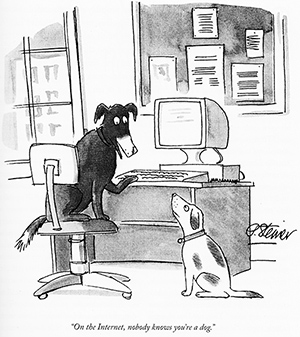
 [  New Yorker Magazine, March 1993] On the Internet nobody knows that you are a dog'
[ New Yorker Magazine, March 1993] On the Internet nobody knows that you are a dog And that s the internet today:

robcottingham.ca - How the hell does Facebook know I'm a dog?
[ robcottingham.ca] How the hell does Facebook know I m a dog?

Well, I d say that s not correct. Even in 1999 facebook could know you are a dog (if you ignore the fact, that there was no facebook in 1999), it s just noone really cared about it. But let s start from the beginning :)An IP-address is a 32-bit integer

An IP-address is technically a 32-bit integer, formatted into 4 8-bit parts (you can read more about IPv4 at Wikipedia), which makes a total of 4,294,967,296 possible IP-addresses. Your ISP has a range in this address-space it can give to its customers (you). My ISP (Unitymedia) owns about 300,000 IP-addresses (based on the RIPE database), which is about 0.007% of the whole address-space. If you look at the RIPE page, you see two common netname prefixes (DE-KNRW and DE-IESY-HFC) which match two regions of Germany where my ISP has its customers (Unitymedia is a merge of ish and iesy). What does that mean? It means one can map a Unitymedia customer into one of these regions, even if he would change his IP-address (Unitymedia uses DHCP with high lease-times, so this does not happen actually). It does not map the customer to a dog yet, but I bet real GeoIP databases can map them correctly to a city (I didn t try much, but this site suggests it works: http://www.ip-adress.com/?lc=en at least they map me correctly to Duesseldorf).Dynamic IP-addresses do not improve privacy

Given the above facts, even if Unitymedia would give me a new IP-address every X hours (many DSL-providers have X=24), it is still possible to map me into a set of about 150,000 users (here user means customer, there still may be multiple computers connected via the same line). I would even go further and say the set is much smaller, as I think I am not able to get every free IP-address from DE-KNRW-*, as these should be bound to cities/regions (GeoIP databases exist, you rememember?) and I do not move with my line.Routers and reverse DNS kill privacy

Currently, my IP-address is 62.143.232.104, which has a reverse DNS entry ip-62-143-232-104.unitymediagroup.de and does not say anything about me or my location, besides of the obvious Unitymedia customer . But look at the traceroute:

4  7111A-MX960-01-ae5.frankfurt.unity-media.net (80.81.192.181)
5  13NOC-MX960-01-ae8.kerpen.unity-media.net (80.69.107.26)
6  1411G-MX960-01-ae9.neuss.unity-media.net (80.69.107.2)
7  1411J-MX960-01-ae1.bilk.unity-media.net (80.69.107.70)
8  PH-1411J-uBR10k-06-Te-1-2-0.bilk.unity-media.net (80.69.102.106)
Frankfurt is about 250km from here, Kerpen about 60, Neuss about 10 and Bilk is a part of the city I live in, about 4km away from my home. I guess you get the idea :)Browsers kill privacy tooDo I have to say more than a link to https://panopticlick.eff.org/? My Chromium scores one in 1,400,000. How much IP-addresses did I have to hide in again?We are at the dog level now, dogs use BoneOS with FireBark, not Linux with Chromium :)IPv6 kills cute kittensOh, and privacy, because with IPv6, there are 2^128 IPv6-addresses out there, of which your provider will maybe own a /32 (2^96 addresses) and give you a /48 (2^80 addresses) or (more likely) /64 (2^64 addresses). Then you enable the great IPv6 privacy extensions (RFC4941) and happily hide in your own assigned subnet, still being a customer of your ISP, still living in the same city and using your old browser It s just about mapping subnets instead of individual IP-addresses then. And we can t get lower as the dog levelPeople can annoy meI did not write all this to teach you, you can do yourself with Wikipedia and RFCs. There is a person out there, who thinks using a random name, mail address and twitter account could fool me into thinking that s a new, yet unknown, person to me. Well, I am not stupid, sorry. When you comment on my blog, your IP-address is logged, when I approve the comment, I often look at the reverse DNS and the whois entry of that IP-address (sorry, I AM paranoid). I even might check my webserver logs (or Piwik) where did you come from (Google etc), writing accidentally in your comment does not help :) Also, if you are trying to fool me, don t use your own computer, running Windows 7 and Firefox which I installed. Oh, and probably do not use your home line which I used to login into my admin-area using my unique Chromium ;)Sorry Hanna Lena, the chicken has just eaten her own eggs And yes, one can track down a single person on this big thing called internet, IPv6 will not change this (in any direction).

Julien Blache: forked-daapd: future directions

I ve got a few mails lately enquiring about the lack of visible activity on forked-daapd in recent times. Well, for one, I ve been busy with other things, but there s also been some non-public activity. So, here s what should happen in the next few months, in no particular order: The database overhaul will bring a much-needed speedup on small devices and big libraries. It s being worked on, but it ground to a halt with new year and all. Hopefully it ll resume soon. I m also giving up on ffmpeg for metadata extraction. It doesn t work well at all (as everybody knows by now) and it s actually getting worse and worse. With the ffmpeg takeover/fork (call it whatever you want) it s unclear what s going to happen on this front. So I m giving up and the metadata scanner will probably switch to using TagLib (one more dependency, yay). Last, but definitely not least, the libdispatch codebase should finally see the light at the end of the tunnel in the coming months. I ve been working on this since July last year, moving away from libevent. If you never heard about libdispatch, or Grand Central Dispatch, read my previous post on the subject. I ll talk about it in more details at a later date. Finally, as far as Squeeze is concerned, I plan to provide forked-daapd backports as long as it ll be practical to do so. This is it for now. I don t have a one more thing in my sleeve, sorry. Time is at a premium right now, so big things have to wait.

Erich Schubert: Joerg Schilling stilly spreading FUD

J rg Schilling is still spreading FUD (currently on an openSuSE list):
There is a social issue with Debian that attacks OSS projects _because_ they use the GPL. Please do not follow these attacks without asking a lawyer.
The removal of cdrecord has been the best reaction to these issues, since apparently working with him is impossible. In this thread, he again manages to accuse everybody else of lying and being incompetent. This clearly shows that you cannot work with him, and the only viable way is ignoring him as far as possible.
It also speaks of a hurt ego in a probably narcisstic person (after all, he seems to think everybody else is incompetent and lying - but I am not a psychologist, so this is not a diagnosis!).
Let me just point out one fact:
By not shipping his current cdrecord, we can obviously not violate any even just potentially invalid license. The way Debian is dealing with this issue is legally undoubtedly correct: obviously, we are not oblieged to include his software.
On the long run, I assume that Debian will also get rid of cdrkit/wodim. In my opinion, this is just a legacy code until we can switch to libburnia entirely, and we should now try to drop cdrkit/wodim as well in order to ship "wheezy" without it.
Since we cannot work with J rg, the only sane way is to try to completely remove any code he wrote from our systems so we have no reason whatsoever to communicate with him.
cdrecord is dead, long live libburnia.
I expect to see lots of FUD from him in the post comments any time soon ... but I do not care: I don't use his software. My current laptop doesn't even have a CD drive ... and despite his claims, the Debian versions of cdrecord and wodim worked perfectly for me when I was still burning CDs.
My only advice to you is to ignore him as far as possible. It will not get you anywhere, it is just a waste of time. In fact, I shouldn't have wasted the time it took me to write this blog post.

11 February 2011

Joachim Breitner: First day of GNUnify 11

The first day of GNUnify 11 has passed. My talk on Haskell went, as far as I can tell, well. Attendance was good (rough estimate: just above 50), although it was not as packed as later talks, and there some questions being asked. There were some technical problems with the microphone, I m not sure how that affected the people sitting in the rear rows. Also, I fear that the video recording of the talk might have suffered we will see. Later throughout the afternoon and evening I would repeatedly find myself cornered by five to ten students of SICSR who would question me about Haskell (Why should I learn it, where is it used, how is different from Java?) mostly volunteers who were busy and thus unable to attend the session. I think I got some of them at least curious about Haskell. I did attend a talk on virtualization and a short demo of GNOME 3 and otherwise just talked to people or sat in the speakers corner. The pampering by the organizers continued if I would stand for half a second with a slightest, even false, hint of help-needing on my face, they would ask me if I need any thing. When I pass they would step back to free the path. It made me feel a bit uneasy, but I figured that normal behavior in the Indian culture and they, being hosts to me, would not feel comfortable any other way. We had dinner at the side of the pool of the Symbiosis university, and more interesting talk happened. So far, nobody seemed to be interested in GPG keysigning, maybe I should give a talk about GPG and the web of trust next time.

Michal Čihař: Debian packages for sale

I've decided to try to get rid of some more Debian packages. The main reason being that I don't use MPD anymore so following packages are for sale: I will continue to upload new versions (should there be any) until somebody steps up, but that's pretty much all I can do. PS: And there is still gpointing-device-settings for sale as well.

Filed under: Debian English 2 comments Flattr this!

Pau Garcia i Quiles: Nokia + Microsoft WTF

We just learned about the Nokia and Microsoft strategic partnership today and many people are concerned. I think the agreement is worrying for Qt, but even more worrying for Nokia. I foresee an exodus of current developers and Nokia mobile device users. Many Windows developers will come. Hopefully? I really wonder who is actually benefited by this strategic partnership. Nokia already had many mobile devices with Symbian, one with Maemo (and there could have been many more with Maemo, but for some unknown reason there weren t) and Meego could have been adopted already (but again, for some reason, Nokia had not). On the other hand, Microsoft had an operating system but no users. Virtually nobody wanted Windows 7. It was either Android or your own solution (MeeGo, WebOS, Bada, etc). In my opinion, the next move we will see is Microsoft buying Nokia to be able to compete one-to-one with Apple and Google. I think it will not take too longer, probably they are just waiting for Nokia stock to fall a bit more. So what should have been the change of direction Nokia should have done a few years ago? In my opinion, when Nokia acquired TrollTech, they should have released at least 10 devices with Qtopia. Immediately. And dump Maemo. In parallel, they could have added more and more Maemo features to Qtopia. By doing that, they would have had a good mobile operating system and applications in no time. There was even an X11 compatibility layer for Qtopia back then. I did not understand why Nokia adopted Qt and went on with Maemo and Meego based on Gtk+, and tried to keep as much backwards compatibility (regarding to source compatibility, development methodology,e tc) with devices which barely had users (N770, N800 and N810). I think noone understood that move. From my point of view, that was a waste of time, money and effort, which ultimately led to Nokia s demise. PS: Yes, I still am a KDE on Windows developer and part of the Debian Qt-KDE team

10 February 2011

Russell Coker: LCA2011, Harassment, etc

The conference LCA 2011 had an anti-harassment policy [1] which was violated by a keynote speech. The speaker and the conference organisers apologised, but of course the matter didn t end there.Discussion continued on the lca-chat list (for conference delegates) [2], on the Linux-aus list (for members of Linux Australia the parent body of the LCA conference) [3], and in some blog posts.There is also some discussion on an LWN article that is linked from an ITWire article [4].I think that the policy was reasonable and from all the descriptions it seems to have worked reasonably well. With such things there are always possibilities to tweak things, so probably there will be future policies which are better in some ways, but it seemed to do the job. The way that the LCA organisers handled the situation was appropriate. In the discussion there were some comments with logical failures that I think need further analysis, I ll summarise them one per paragraph with the heading being a para-phrase of the claim.Is it Offensive?A particularly relevant blog post is Skud s post about avoiding the use of the word offense [5]. In the various discussions about the speech in question most of the people who disapprove of the erotic images don t use the word offense , this is presumably due in part to the influence of Skud s post. This hasn t stopped people claiming that the debate is about whether the images are offensive, I m not sure if this is a deliberate straw-man attack or just cluelessness.The anti-harassment policy does use the word offensive in two places, I think that this was a mistake but it doesn t detract from the overall meaning of the document.Is it Harassment?There was some discussion about whether the actions in question were harassment. Wordnet s definition of harassment includes the act of tormenting by continued persistent attacks and criticism . It seems unlikely that any of the people in the audience who objected to the erotic content in the lecture slides had never seen unwanted erotic material before. So I think that it s worth considering this incident as just another entry in a list of similar incidents that some of the delegates have experienced, and thus as a continuation of persistent attacks IE harassment. Melissa McEwan s post about the variety of harassment that she has received from men is worth reading in this regard [6].I think that a reasonable analogy here is the school bullying campaigns that were experienced by many members of the Linux community when they were younger. School bullying in most cases is not about a small number of extreme incidents, but about a large number of small incidents each of which when considered independently can be rationalised as something that isn t significant (excusing such incidents independently is what allows bullying to be rife in most schools). In many cases of high school bullying the victim is blamed for supposedly over-reacting after a reaction is compared to some small incident at the end of a long harassment campaign, some of the criticism of the Geek Feminists seems to echo this pattern.It seems to me that some of the more dismissive comments which demonstrated a lack of regard for the experiences of other people can reasonably be considered as harassment too (which is also something that Melissa McEwan mentions). Note that I am specifically not advocating that the discussion be shut down, merely that the people who claim that it s only the (supposed) opinion of the majority that matters are part of the problem. However the fact that the apology for the talk received applause from the majority of the audience seems to indicate that the majority is in fact in favor of the anti-harassment policy.Derald Wing Sue, Ph.D. and David P. Rivera (a doctoral candidate in counseling psychology) have written a couple of interesting short articles about this for Psychology Today. Bullying and Microaggressions describes bullying as more than physical violence and also discusses adult bullies [7]. The Power to Define Reality describes the way that the experiences of people who lack power can have the reality of their experiences denied [8] this one really relates to some of the discussions about harassment.But it s Legal!It has been claimed that the legal system works well in Australia and that Australian law should be the only necessary guide to content. A trivial counter-case that was noted in the discussion is the fact that pure sales presentations are not accepted at LCA and such presentations are certainly legal! There is a good precedent for prohibiting things that are legal as part of the conference speaker agreement.More generally the legal system changes slowly and still infringes on what many people in our community regard as basic human rights. There is no reason why an Australian conference should have as it s standards the bare minimum that is required by Australian law.It was pointed out that workplace social norms translate well between cultures, they are usually more stringent than Australian law requires and Australian workplace law is a lot more stringent than the laws relating to conferences and other public events. It seems to me that a presentation which would result in a visit from HR if given at the office shouldn t be regarded as suitable for a conference such as LCA.But there is a Balance of Men and Women in Erotic Pictures!The complaints are not about a lack of balance in the erotic material, but it s presence there at all. Defending the slides on the basis that there was a supposed balance of male and female misses the point that most people just want no erotic material in presentations at conferences.Also it seems to me that if there are pictures which aren t offensive then the way to demonstrate this would be to publish them and say look, they aren t offensive . If it takes 600 words in a blog post to justify the use of some images then that alone seems to be evidence that the images were poorly chosen.But the talk was EffectiveSome of the people who have commented on this issue mentioned that they couldn t remember what was said when the images in question were displayed. When images from the talk are remembered and the main content of the talk isn t that seems to be a failure of the talk.When a major sponsor of the conference complains and requests that the talk video never be published that also seems like a major failure of the talk.I think that the effective talks are ones that educate people and inspire them to do something positive and useful. A talk that inspires a discussion about whether the speaker deserves censure doesn t seem effective.There are claims that there is no way the talk could have made the point as well if it wasn t for the images in question. But I can t believe that someone who is capable enough to get awarded a keynote speaking position at a conference such as LCA is incapable of finding other images to make the same point.But Similar Images are on MTVWhen people want MTV content they can watch MTV.Why Can t we just try Educating Men?It was claimed that education works in dealing with such issues in corporate environments and sporting clubs. My observation of the corporate environment is that such training must be extremely rare in Australia, the Netherlands, and probably the UK due to the fact that none of my employers have done it. I have heard first-hand reports of diversity training from people who work in the US. I expect that the fact that people who fail diversity training in a corporate environment get a meeting with HR is a major factor in it s effectiveness.The long email discussions and blog comment threads when these incidents happen could theoretically be used as training. But when you have some men using multiple mailing lists and dozens of posts arguing without appearing to learn it seems clear that they are not about to learn anything no matter what education is offered. It seems to me that you could broadly divide the free software community into two groups, those who want to learn how to do things better (but who are unlikely to make gross errors anyway), and those who won t learn.Besides, having a keynote speaker at a major conference apologise should be educational.But Clueless Nerds Hit on GirlsI don t know why every discussion about the treatment of women ends up getting a mention of this supposed issue.But Women Could make False AccusationsIn any classification system you have to make some sort of balance between false-positives and false-negatives. If the aim is to get zero false-positives then the incidence of false-negatives will increase. So if the aim was to never ever have a false accusation brought against a man for sexual harassment then the vast majority of real harassment cases would result in no action at all.I don t think it s reasonable to expect that most women who are mistreated should suffer in silence just to reduce the possibility that men might be falsely accused.The Rape Statistics cited in the discussion may be InaccurateThere is no possible way of interpreting rape statistics to make it not be a serious problem, now matter how you analyse the available information it happens far too often and has a significant impact on the victim. Also the suggested reinterpretation of the statistics didn t contradict the claim that it is likely that there are multiple rape victims attending LCA. So interpreting the statistics in a different way to get different numbers doesn t change anything. Trying to diminish the significance of rape generally doesn t support any other arguments that you might make.There are things that you can just discuss for the heck of it and things which should be discussed with care (if at all) to avoid needlessly hurting people. In these sorts of discussions the right thing to do is to avoid debating the numbers as much as possible.I think that the numbers produced by RAINN [9] are as good as we can get.But I am very supportive of women in our communityIf you spend all your time arguing with women and don t listen to what they have to say then you really aren t supporting them.ConclusionAfter publishing this post I ll email the URL to a few of the men who helped inspire it, I will explain how disappointed I am and how I expect better from them. I encourage others to do the same.Also when such discussions happen I encourage men to vote in favor of the positions advocated by women. Writing a message that addresses points in the debate can be difficult and if the debate is rapid then you may find that every point that you might make has been made by someone else. But in that case just posting to agree with the women can really mean a lot.

Charles Plessy: Chain reaction

Now that maintain several dozens of packages in Debian, I think twice before uploading a new one. Does it have a future, a public ? Some of the packages I prepare are available on git.debian.org, and are listed in Debian Med's tasks pages. It would not take me long to finish most of them, but that does not take into account the time others will spend on it. They will make our archive bigger and our quality tests longer to execute. Somebody will translate their description. Somebody else will perhaps write a security patch someday, or a patch to make the package compilable with a new version of GCC. All in all, each package has a footprint in Debian's ecosystem. That footprint starts early, as soon as the package is sent to the NEW queue. For instance, I kept by mistake some old content in the copyright file of clustalw, that was recently freed and has to go through the NEW queue to be transferred from the non-free to the main area of our archive. That costed a small of exchange of emails, that could have been avoided. Our packages should be perfect, but that is difficult to achieve alone. For that reason, I proposed two years ago a package review system, that functions like a chain reaction. The principle is simple. After uploading to the NEW queue, download two neighbor packages and check their copyright file. The errors found can be corrected by their maintainer before the the FTP team inspects it, which save their time. For instance, after uploading tabix, I found an error in mediathekview, that was corrected. That compensates for my mistake with clustalw. If each person receiving a package review does a review of two other packages, that will create a chain reaction that will clean the queue from the simplest mistakes, leaving only the really problematic cases. As Torsten noted recently, the NEW queue is getting long. So how about trying to help ?

8 February 2011

Christoph G hre: Squeeze finally landed

Half a year after I found three Squeezes in my luggage, some more of these cute green guys landed at FOSDEM.

Thanks to Gavin for the fun and all involved Debian people for Squeeze!
landed squeezes

Mike Hommey: Knowing how much disk seeks hurt

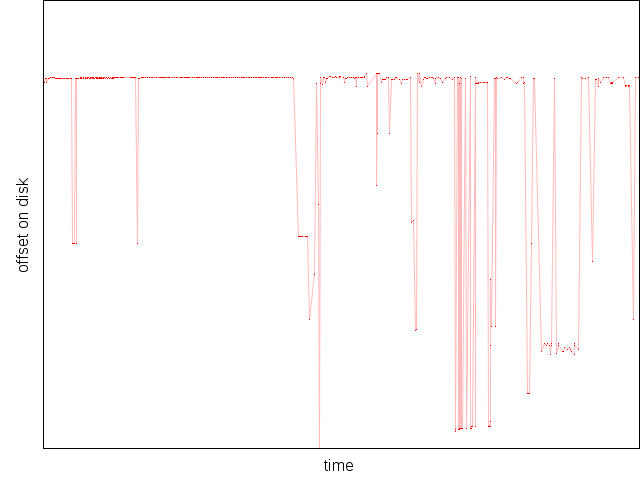
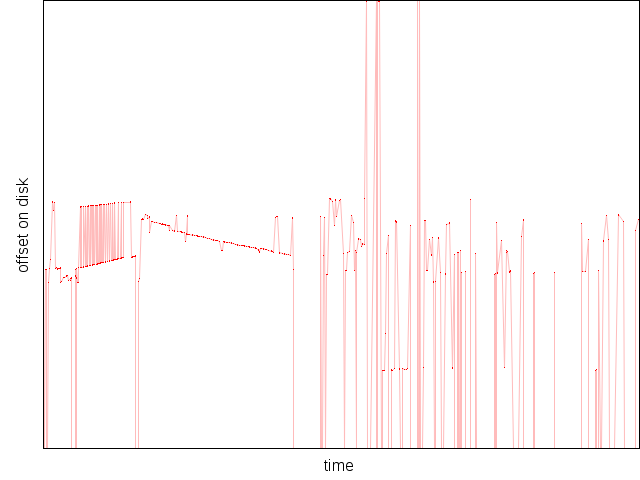
We all know disk seeks hurt. But we usually don t have a precise idea how much. How about getting that idea? Here is a little experiment I ran a few days ago. I took the output from the systemtap script tracking I/O I wrote, on a Firefox startup after boot. Each line of that output, which gives a timestamp (which we don t care about here), a file name, and an offset, represents a 4096 bytes read (one page). The first set of data points I got is how much time it takes to reproduce this read pattern after a reboot, and how that compares to Firefox startup time. For what it s worth, I did group following reads, to avoid doing too many system calls, and also avoided kernel readahead by using direct I/O, meaning I would only read exactly what the kernel reads when Firefox normally starts. All the following tests were done under the usual conditions (see previous posts), but I limited the tests to the x86-64 architecture, because all that really matters is the disk. I ll mention, however, that the amount of data read in these tests is 34,729,984 bytes, and that the original I/O pattern looks like this: Zooming around the main location where most I/O happen, we can see the pattern is still bumpy: This somehow looks familiar, doesn t it? We already know for a fact that even these patterns that, on the whole disk, look like pretty much insignificant, have an important impact on startup time. Try to imagine what kind of difference could be observed if we were reordering all these reads. Anyways, back to that I/O simulation, we first need to see how far it is from the actual Firefox startup. We would rather that simulated I/O + warm startup/hot cache end up close to the real thing. However, we need to keep in mind, as we saw in a previous post, that CPU scaling, when mixed with I/O, has an influence on startup time. Warm startup not involving I/O, the CPU can run at maximum speed the whole time. As such, for a fair comparison, we need to compare to cold startup time with the CPU forced at maximum speed, which we saw is faster than startup time with CPU scaling.
Average time (ms)
Simulated cold startup 2,764.26 0.42%
Warm startup 250.74 0.18%
Simulated cold + warm 3015
Real cold startup 3087.47 0.31%
Difference 72.47 (2.35%)
Close enough, I d say. The difference is most probably caused by metadata reads and a few other things, that isn t in the systemtap script scope. Now we know our simulated I/O is close to reality, what happens if we reorder all these reads according to the position on disk?
Average time (ms) Corresponding transfer rate
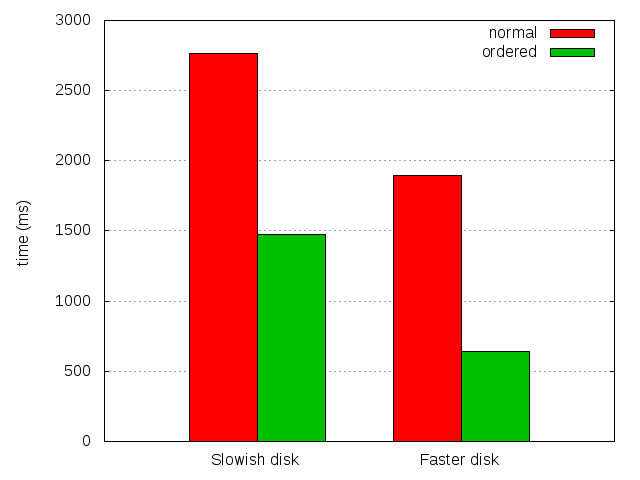
Simulated I/O 2,764.26 0.42% 12.56 MB/s
Reordered I/O 1,473.34 0.43% 23.57 MB/s
Difference 1,290.92 (46.7%) n/a
That s almost twice as fast ! And the disk doesn t even have a big throughput (around 30MB/s). Let s see what it does with a disk with a bigger throughput (85MB/s).
Average time (ms) Corresponding transfer rate
Simulated I/O 1,898.66 0.16% 18.29 MB/s
Reordered I/O 644.0 0.15% 53.93 MB/s
Difference 1,254.66 (66.08%) n/a
That s almost three times as fast ! The faster the disk, the bigger the improvement we can get by reordering and grouping I/O, which is not unexpected, but here we can see how much having to go back and forth on the disk hurt badly. Obviously, the numbers from the faster disk can t be directly compared to the ones from the slower disk, because the data was not arranged the same way on the disk, and file system fragmentation, as well as how the file system is filled also have their own share to add to the problem. And because it s more impressive to see on a graph than in a result table: Disks seeks hurt. Badly.

Jonathan McDowell: My Squeeze upgrade notes

I did my first upgrade of a lenny box to squeeze today; a test server in work. All went pretty smoothly but I had a handful of things I had to frob manually that I thought I'd write up here: I think that's pretty smooth overall; kudos to all those involved. I've a few more boxes to upgrade, but they're all more likely to have people complaining at me if there are hiccups so they'll have to wait until I have a suitable block of time set aside.

7 February 2011

Pau Garcia i Quiles: Luggage and RyanAir

FOSDEM ended yesterday and here I am sitting at Charleroi Airport (also known as Brussels South , quite a misleading name given that it s 80 Km from Brussels). I have already passed all controls, check-in and everything. While I wait for boarding, I am watching the shameful spectacle of airport personnel (let me reiterate that: airport personnel, not Ryanair s) enforcing RyanAir s 10 Kg cabin baggage limit. According to RyanAir, they want to minimize the weight the plane carries to use less fuel. So far, so good. Here is what I have seen: people who do not carry any baggage (very few, they have probably checked it in because it exceeded size or weight), people who are below the 10 Kg limit and people who are way over it (and have been told to check luggage in). I am OK with those cases. There is still a fourth case: people who are slightly over 10 Kg. I ve seen a woman whose bag was 10.15 Kg to be told to pay 20 EUR to check her bag, or go back to the RyanAir desk to check-in the bag. She opened her bag, took a scarf, put it on and now the bag matched the weight limit. Yes, RyanAir is charging 20 EUR/Kg for hand baggage from 10 Kg on. What a rip-off. A couple of East-European girls were about 1 Kg in excess each. They put a couple of extra jumpers on and now baggage was under 10 Kg. Many people were about 1 Kg in excess. When they were told their suitcase better got lighter or pay 20 to 40 EUR. Most of them just took something (camera, food, slippers, whatever) and put in the pockets of their coats. Fortunately, RyanAir is not charging for body and clothes weight (yet?). In all those cases the plane will end up transporting the same weight and RyanAir won t get one more dime, so why RyanAir? Why are you such a shameful company? Why are you enforcing ludicrous and pointless policies? Don t you know after passing the control everybody just put everything back into the suitcase? Of course you do. So after watching this ridiculous spectacle go on for a while, I had a devious idea: let s organize a fat people conference and fly them all over to and from using RyanAir. Further, all of them should carry exactly 10 Kg hand baggage.

6 February 2011

Matthew Palmer: My Goals for Wheezy

Inspired by some chatter in IRC, and encouraged to post by Paul Wise, here are my personal goals (in no particular order) during the Wheezy development cycle: So, I've shown you mine, will you show me yours?

Charles Plessy: Long life to Squeeze !

Debian just published Squeeze today. It is an excellent release, that I hope I will keep for a long time on my machines. Among the improvements, boot has been accelerated. On my laptop with a second hand SSD, it only takes 20 seconds to see the login screen. I was amazed when I saw this for the first time. I was often upgrading from Stable to Testing quite quickly, to install more recent versions of desktop applications. But the backports change the game. I hope that I will not switch to Testing before one year or two. For Squeeze, I will also prepare backports for the packages I maintain. I hope that more people will enjoy them. Most of these packages are independant from the graphical system, and more in general from its core. The backports will allow to use recent version of these packages on top of a stable distribution. Since Lenny, Debian Med displays the contents of its metapackages with tasks pages, that include draft packages as well. Not all will make it in Debian, and I would like to have the feedback from our users to better chose our priorities. Contact us on the debian-med@lists.debian.org mailing list ! These new packages will also be distributed for Squeeze through the backports. Thanks again to everybody who contributed to the release of Squeeze !

Debian News: Debian 6.0.0, codename Squeeze, is out!

After two years of intense work, the Debian project has published a new stable release.

You are welcome to read the full release announcement to get an overview of the changes, the installation manual if you are doing a fresh installation and the release notes before upgrading your systems.

Choose your preferred installation media from http://deb.li/squeeze Squeeze Countdown

Also, don t miss checking out the new design of the Debian website, Debian Wiki, Debian Lists Archive, Debian Planet , package information system and Debian Git web.

Thank you to everybody who made it possible!

Next.

Previous.