Search Results: "ag"

14 February 2007

Matt Brown: Dell - Carbon Neutrality

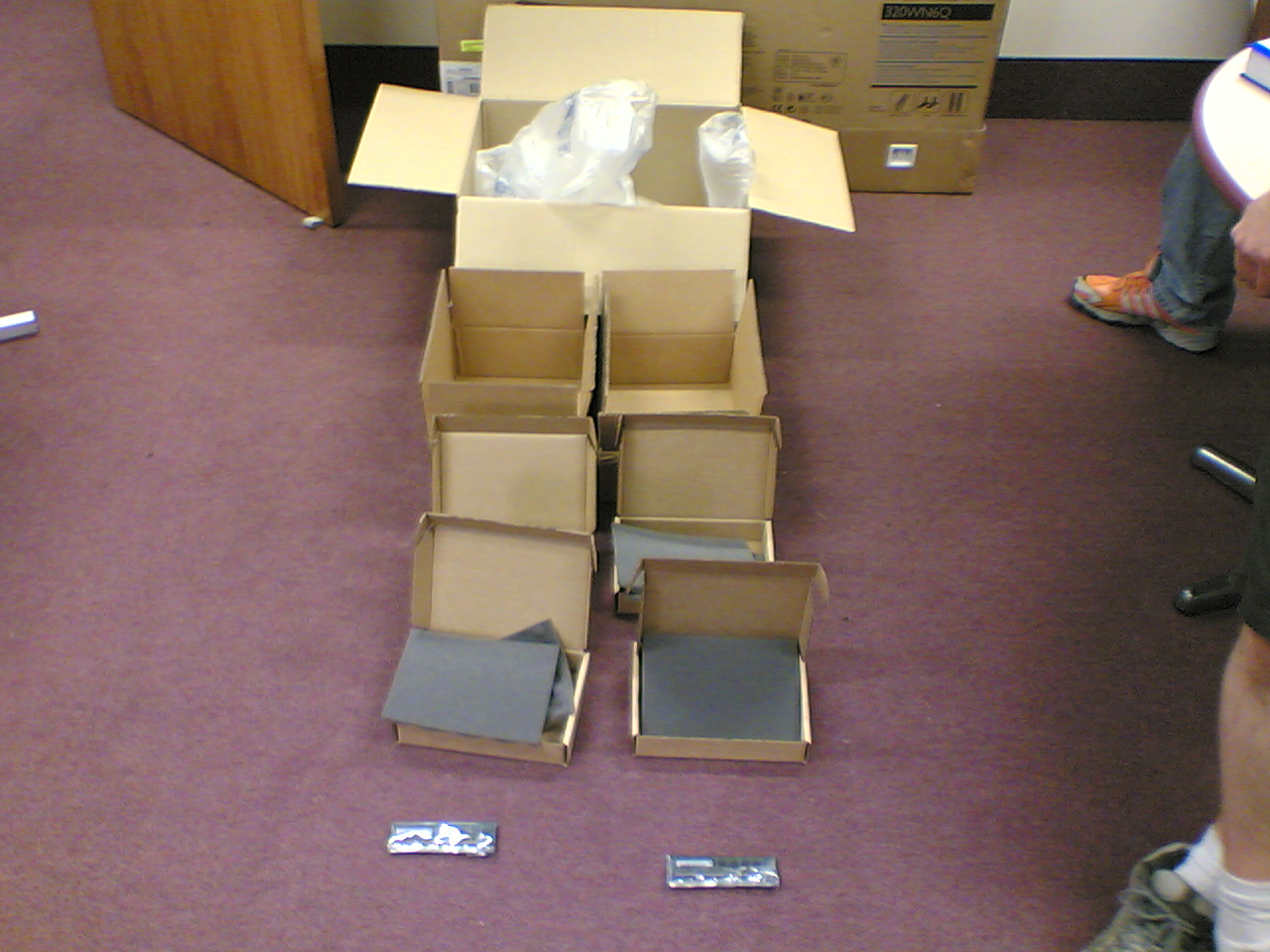
About a month ago Dell announced with great fan-fare that they were the first computer company that offered their customers the chance to be carbon neutral, by planting trees to offset the carbon dioxide generated in producing a years worth of electricity for the computer. Nice idea. They’re lucky that they specifically didn’t mention packaging, and saving the forests. I was down in Hamilton today for work, and a box from Dell arrived with two sticks of RAM for a new Dell server. We’re talking standard 1GB ECC sticks of ram. The packaging for these two unremarkable sticks of memory amounted to no less than seven boxes of increasing size (think japanese dolls), 8 peices of packaging foam, and one long strip of “air bubbles”. Two of the boxes contained absolutely nothing except for packaging foam, and were just used to pad out the medium size boxes, so that the boxes containing the actual ram didn’t bounce around. The two sticks could easily have fit in just one of the smaller boxes! The waste is unbelievable, see the picture below with your own eyes.

dell carbon neutral?
click for fullsize image
With the number of trees that died to support this packaging effort, I sure hope that the $6 I pay to make my desktop carbon neutral plants a lot more trees than is strictly necessary!

Benjamin Mako Hill: A Definition of Free Cultural Works

Last year, I announced a project to bring together artists, content creators, and others who care about freedom to come up with a clear set of goals around which a social movement for essential freedoms around culture might be based. There has been a lot of discussion and a number of important changes to the document over the last year. A few days ago, we finally released "1.0" of our definition with this announcement:
A diverse group of writers has released the first version of the "Definition of Free Cultural Works." The authors have identified a minimum set of freedoms which they believe should be granted to all users of copyrighted materials. Created on a wiki with the feedback of Wikipedia users, open source hackers, artists, scientists, and lawyers, the definition lists the following core freedoms:
  • The freedom to use and perform the work
  • The freedom to study the work and apply the information
  • The freedom to redistribute copies
  • The freedom to distribute derivative works.
Inspired by the Free Software Definition and the ideals of the free software and open source movements, these conditions are meant to apply to any conceivable work. In reality, these freedoms must be granted explicitly by authors, through the use of licenses which confer them. On the website of the definition a list of these licenses can be found. Furthermore, authors are encouraged to identify their works as Free Cultural Works using a set of logos and buttons. The definition was initiated by Benjamin Mako Hill, a Debian GNU/Linux developer, and Erik M ller, an author and long-time Wikipedia user. Wikipedia already follows similar principles to those established by the definition. Angela Beesley, Wikimedia Advisory Board Chair and co-founder of Wikia.com; Mia Garlick, general counsel of Creative Commons; and Elizabeth Stark of the Free Culture Student Movement acted as moderators, while Richard Stallman of the Free Software Foundation and Lawrence Lessig of Creative Commons provided helpful feedback. As more and more people recognize that there are alternatives to traditional copyright, phrases like "open source," "open access," "open content," "free content," and "commons" are increasingly used. But many of these phrases are ambiguous when it comes to distinguishing works and licenses which grant all the above freedoms, and those which only confer limited rights. For example, a popular license restricts the commercial use of works, whereas the authors believe that such use must be permitted for a work to be considered Free. Instead of limiting commercial use, they recommend using a clever legal trick called "copyleft:" requiring all users of the work to make their combined and derivative works freely available. M ller and Hill encourage authors to rethink copyright law and use one of the Free Culture Licenses to help build a genuine free and open culture.
If you haven't yet, please check out the project at freedomdefined.org. If you're still curious feel free to read about my motivation and why I think that everyone should stand up for what they feel are essential freedoms.

MJ Ray: Darling cheese head SPI was yards too greasy

SPI's February meeting (agenda) on Friday is approaching and the board seems to have gone all evasive and yeti-like. For yet another month, I've heard nothing in response to simple questions and over on debian-vote, board members posted a bizarre claim about how SPI acts for debian and a direction back to SPI so I've asked the board to confirm SPI's view of debian but this is all yards too greasy, really. I'm getting quite irritated with the question-avoiding and red tape from the board, as you can maybe tell from the tone of:
"In case anyone hasn't noticed, it seems very difficult to get anything like a straight answer out of most of the current SPI board lately. Try it for yourself. Fun for all the debian family. Knock one over, win a coconut and five tons of flax!"
There only seems to be one responsive sane board member at present and that's just not enough to ensure SPI members can exercise their right to oversee the board's work. SPI seems to be going delinquent again. Please correct it before it does much damage. Please, debian, postgresql and GNUstep developers in particular, please request your contributing membership and help get this organisation back on track. Post title is from cult advert Me ears are alight

13 February 2007

Simon Huggins: Use a redirect, Luke.

Ingo, why don't you just redirect people to the new location redirecting feeds to their new location. That way on some aggregators like rawdog you'll just get the updated URLs all set with no manual adjustments at all. This post is also a hint that after deliberations I moved from planet to rawdog. It's neat and in Debian. Might have to try to write a plugin so I can read friend's livejournal posts with it too soon.

Ingo Juergensmann: Buildd.Net: new arm subarch added - armel

Aurelien Jarno asked me to add another arm port to Buildd.Net, namely armel - a new ABI version for newer little endian based arm boxes. Read more about that new arch in the Debian Wiki.Anyway, here it is: armel page on Buildd.Net - have fun!

Evan Prodromou: 24 Pluvi se CCXV

Good news for the Prodromou family in Montreal: we've been doing house-hunting in Montreal for the last 6 weeks, and yesterday we made an offer on a cottage in the Plateau Mont-Royal, near Metro Mont-Royal. We found out last night that the offer had been accepted! the house we plan to buy The house has 3 bedrooms on the ground floor and a big open-plan living area on the second floor. It's really spacious and nice, with a couple of balconies and a small yard in the back. The street is very quiet, and the house is about block from the south Laurier Metro entrance, and block from a playground on rue Bienville. All in all, we're crazy about the neighborhood and we really like the house itself. Note that the house has two front doors; it's because it's a converted duplex, combined into one house now. I think it'll be very convenient when we have guests come over for parties and brunches; two doors, no waiting. This has been the culmination of a long build-up. When we got married in 2004, a lot of people gave us checks instead of gifts, and we put that money into a fund for the down payment. We're pretty grateful for the help of friends and family in buying this house. Now we go into the weird and complicated process of actually making the transaction. I'm kind of amazed how many steps there are, but I'm also amazed that Quebec hasn't added on 12 more complicated and unnecessary steps on top of the normal ones. tags:

Drive time We're waiting for our realtor to come by so we can sign some (more) papers, then we're heading off to New York City for LinuxWorld OpenSolutions Summit. I'm going to be on an "Ask the Experts" panel talking about Web APIs and the programmable Web. It should be pretty fun. The drive's going to take a while, though, and it's going to be pretty cold. On the positive side, we'll see our friends Jen and Massoud in Queens, who we haven't seen for a year. tags:

Benjamin Mako Hill: Ubucon

I'm coming down to New York this Friday for the second Ubuncon. Ubucon is a small(ish) user organized and oriented Ubuntu "unconference." Apparently, that means that it's not very organized -- which adds flexibility and is considered a good thing! Both Ubucons to date have been held at Google offices. This one will be held in the Google office in New York City. I'll be giving at least one talk. In all likelihood, I will be giving a talk about participation in the Ubuntu community and another more technical crash introductory course in building Ubuntu packages. Finally, I've had Pearson's ship a dozen or so copies of the Official Ubuntu Book which I'll be signing and handing out. If you want to go, you should check out the schedule, and the info pages in the wiki and maybe even RSVP. You will need a LP/wiki account to do so. See you in New York! Please contact me if you want to get together while I'm in New York.

Miriam Ruiz: Threads considered harmful (what about coroutines?)

In 2006, Edward A. Lee wrote The Problem With Threads (PDF), in which he observes that threads remove determinism and open the door to subtle yet deadly bugs. While the problems are maybe manageable on single core systems, threads on multicore systems are likely to magnify the problems out of control. According to Wikipedia, coroutines are “program components that generalize subroutines to allow multiple entry points and suspending and resuming of execution at certain locations”. Coroutines are well-suited for implementing more familiar program components such as cooperative tasks, iterators, infinite lists, and pipes. Coroutines are more generic than subroutines. The start of a coroutine is the first point of entry, and places within a coroutine following returns (yields) are subsequent points of entry. Coroutines are also a lot faster than processes or threads switch, since there is no OS kernel involvement for the operation. Even though coroutines are supported in some high-level languages, there doesn’t seem to be an standard implementation of them in C or C++. The first time I heard about coroutines were in Lua. Since then, I’ve been trying to find a good solution for using them in C. Simon Tatham proposes a way of implementing them with a combination of subroutines and macros, but I think that, even creative and clean, this is a dirty approach for real code. What about handling with errors in the code? I still have nightmares when I have some problem to debug in STL-based code. Cryptic, the least. Due to the limitations of standard C libraries, some authors have written their own libraries for coroutines:

Jurij Smakov: SCALE highlights

I had a chance of visiting the annual South California Linux Expo (SCALE) over the weekend. It was fun, as usual. People at Gentoo booth were emerging something continuously, NetBSD people had their traditional toaster running NetBSD, FreeBSD had some pretty funky crowd, and Debian booth was too small to accomodate all the people :-) . Newbie-friendly FreeSpire had some very enthusiastic folks, showing off their new Click and Run service. They got pretty excited when I mentioned debtags to them. Krugle is a relatively new source code search engine with some nice features. Unfortunately, they were not indexing the Debian’s code repositories, but promised to fix it ASAP (and add support for crawling git repositories as an added bonus). Zenoss presented their impressive open-source monitoring system, and I had a chance to fiddle with the new TrollTech’s Linux-powered GreenPhone. Coming with its own software development kit, this gadget has some serious geek-appeal, however at a price tag of $700 I’m afraid I’ll have to pass for now. And it was exciting to learn that there are still people who feel like writing their own OS pretty much from scratch.
There was one inquiry regarding the Debian’s accessibility features for the visually impaired. Unfortunately, it turned out that the Speakup-enabled kernel flavour we used to have in Sarge is no longer available in Etch. I think that reintroducing it (at least, for i386) should be a release goal for Lenny, I’ll definitely try to see what I can do about it.

Wouter Verhelst: Eww

For a project at work, I needed to write some application that would talk to sockets and store some state. So, I was facing a dilemma here: either use the cumbersome C API to libdb, or try to figure out a way to be able to talk to many sockets all at once from perl while still being able to use buffered PerlIO. I chickened out.
wouter@country:~$ perldoc perlembed
Fast forward half a day, and I now have an application that will use perl to talk to libdb, and that will use C to talk to a number of sockets. I feel dirty now. But it seems to work...

12 February 2007

Jesus Climent: Long time no blog.

I have not been blogging for some time now, due to several things: On unrelated news, if you can stand a bit of disgusting scenes and a bit of perversions of the original book, you HAVE to go see Perfume. WOW.

Christian Perrier: fr: 99.858%, cs: 93.351%, de: 81.634%, sv: 79.566%, vi: 78.259%

libapache-mod-backhand upload bumps our stats a little. New planned uploads (and 100%, hopefully) for next Thursday after the end of the call for translation updates I posted for wmmoonclock, atokx and atokx2. The list of "bad boys" is shortening down quickly, now. Today's NMUs: plan, atftp, mediamate. Today's uploads by maintainers after a little nag from me: gnumeric.

Kartik Mistry: At Ahmedabad..

* Things are going slow & smooth here. Except, I was too much shocked by death of my grandmother at Palanpur. I have already written about this at my Gujarati blog. * LDTP, Festival-* already entered in unstable and I need to fix why it is throwing ‘dh_pysupport -a commad not found error’ in all architechtures. * No connectivity. Hope that this will resolve soon :(

Russell Coker: John Howard is bizarre

Our despicable prime minister said "I think that would just encourage those who wanted completely to destabilise and destroy Iraq, and create chaos and victory for the terrorists to hang on and hope for (an) Obama victory".

That statement is wrong in many ways, firstly the US (with Australian help) has destabilised and destroyed Iraq already. Claiming that removing US troops at this stage will do any further harm is unproven (and except for the Kurdish area extremely unlikely). Trying to link a presidential candidate with a terrorist organisation is the worst type of dirty politics.

Texas Republican senator John Cornyn requested that the Australian government stay out of US politics. It sounds like a reasonable request. But I wonder whether John Cornyn got involved when the US ambassador spoke out against the leader of the Labor party at the last Australian Federal election...

Senator Obama suggested that if John Howard wants to criticise his policies in Iraq then he should first send another 20,000 Australian troops (there are currently 140,000 US troops compared to 1,400 Australians). According to the CIA World Fact Book Australia has a population of 20.3M while the US has a population of 298.4M. If the ratio of serving soldiers was to match the populations then Australia would have 9,500 troops in Iraq. If Australia was to be a full military partner of the US (but scaled down due to the smaller population) and therefore had troops in South Korea, Japan, and Germany then the number of Australian troops committed might be closer to the 20,000 number cited.

But this is no criticism of Senator Obama. For a number that was made up to demonstrate his point that Australia is not pulling it's weight in Iraq it's a quite reasonable estimate.

The US Democrat Senator Ron Wyden correctly described Howard's comment as "bizarre". This may become a catch-phrase for the Howard regime (as the Bush regime is described as a "miserable failure").

Johnny seems to think that it's in his best interests to send Australians to fight a war that has no benefit for Australia (or the US for that matter), but he doesn't have the guts to do it properly. Fortunately for him the Bush regime understands his position and allows him to send a token force to demonstrate support without the risk of any significant number of casualties or having to conscript soldiers.

This mutual meddling in elections is a demonstration of the way Bush and Howard conspire against the interests of the Australian and US citizens. Both countries need governments that look after the interests of their citizens at home and let the UN take a larger role in world issues.

Christine Spang: Term Goes On

In MIT-land, IAP is over, and classes have been running again for a week. This term I’m doing things such as learning Scheme in the intro CS class 6.001, “The Structure and Interpretation of Computer Programs” — otherwise known as SICP. No DrScheme jokes. Ari, this means you. IAP was great fun — it’s kind of a like a mini-summer in between terms. I played in a LARP, participated in the MIT Mystery Hunt on the same team as Mako, and made a robot. But now it’s back to the grindstone. But I’m looking forward to this term more than I was last term. (Famous last words.)

Christine Spang: Armagetron Advanced and Debian

News flash: gamers and Tron fans everywhere can rejoice; Armagetron Advanced will soon be up-to-date once more in Debian! The last time a new upstream version (0.2.7.0) was uploaded was almost two years ago now, and while the Debian package has languished in neglect, upstream has chugged on, fixing bugs and adding new awesomeness to the game. Just recently, the old maintainer orphaned the package, and since I use it anyway I’ve adopted it and given it some much-needed love. The new version is 0.2.8.2.1, what an, er, long version number. The new packages have been renamed from armagetron[-foo] to armagetronad[-foo] to reflect upstream’s name change. They include upstream improvements such as the addition of maps and improved graphics code, as well as packaging improvements like a new initscript for the server and rewritten, up-to-date manpages. While the new packages have been uploaded to experimental, they’re stuck in NEW due to the binary name changes. So, grab the x86 or x86-kfreebsd packages from here and test, test, test! (Yes, I run a kfreebsd machine. I wanted something eclectic for a non-essential, moderately old dual-core x86 box. Also, I’ll probably compile amd64 packages soon, but the amd64-machine I can use to build them on is currently in a half-installed state, which I need to fix before that. You can always build from source.) I’ve cleared with the security team that it won’t get in the way of anything and will probably be uploading to unstable as soon as there’s been some more testing to look for major problems. And since the newest version contains fixes for the security bugs affecting the old version, I’m going to snoop around and judge the [in]sanity level of porting back the security fixes for etch, since the new version will at most be unofficially backported to etch. Go, er, take a break in between fixing RC bugs. And test, test, test!

Felipe Augusto van de Wiel: 12 Feb 2007

Frustration...

No Primary MX for a while
Since last thursday (2007-02-08) my main MX server was stopped to get some maintainance (IDE problems, could be the hard disk, IDE cables or something else, amazing ahm?), anyway, we moved the important stuff away from the line, did our homework testing the secondary MX and stopped the machine. Until now the DataCenter didn't told me when the machine should be back and I'm really hoping to get it back by tomorrow (2007-02-12).

In the meanwhile, the messages are safe, waiting in a temporary queue, we are not expecting to have a downtime of four long days. Anyway, I will need to catch up with my mail in the next days, I'm trying to keep up-to-date using the web archives and doing l10n stuff for Debian. :-(

11 February 2007

Martin F. Krafft: Adding a note for IE users

I am not a web site designer, but occasionally I'll find myself creating a new website. No matter how ambitious I may be, it won't take long until I trip over Internet Explorer's pathetic XHTML+CSS handling. For sites that are not classified "business," I have long been using a little note at the top of pages, which would use the * html body hack along with display:none to display only in IE, simply because I can't be bothered and do not have the time to write hacks to cater for the family of broken browsers Microsoft forces upon most of the WWW users. This note would alert the reader that s/he'd be able to read all content, but as long as s/he'd be using an inferior browser, the layout and design would be off. There were three problems with this approach: text-mode browsers, search engines, and IE 7.0: text-mode browsers and search engines got to see the text (as they don't process CSS, generally), and I could not figure out how to prevent IE7 from hiding the note the massively skilled and capable Microsoft programmers fixed the oh-so-handy * html body hack and thus prevented CSS to be catered for the broken MS browsers, even though they still need cludges all over the place. I am sure it was just a side effect of clumsiness, but it's now fixed (as opposed to the million other bugs that persist). So today I sat down and implemented a Javascript solution, which uses the DOM to insert content, if it determined that it's running on Internet Explorer. I could have used the <!--[if IE]> ... <![endif]--> construct, but that only works on Windows and not on the Mac. Thus, the Javascript solution is better as it will reach more Internet Explorer users. I ended up using innerHTML, which is a non-DOM Microsoft hack, but in the end, I am coding this only for the Microsoft browsers, so I can just as well use their stuff. Note that you are welcome to use this script under the terms of the Artistic Licence 2.0. You will, however, need to ensure that the insertNote() function gets called after the DOM has loaded. I use this event handler for that. You can see the script in action on my Debian site, using a little hack to display it even in non-IE browsers. Suggestions welcome! NP: Amorphis / Elegy Update: lots of people have contacted me to let me know that the note was visible in Opera and Firefox and so on and so forth. This is due to the ?ie-note query string in the URL, which I added to allow non-IE visitors to view the note (for whatever reason). Simply remove the query string and visit the page directly and you will not see the note unless you are using Internet Exploder.
Evan Prodromou: 22 Pluvi se CCXV

Interesting point from Network World entitled Wikipedia: On the skids?. Apparently Florence Devouard, chairperson of the Wikimedia Foundation board, said that the recent US$1M donations round will only cover a portion of the site's US$5M operating expenses. I find the numbers a little funny -- according to the Wikimedia Foundation finance report, operating expenses for 2006 were around US$800K. I realize that the site's traffic has nearly doubled since this time last year, and that they're hiring more full time staffers, but that still puts the project's expenses at under US$2M. I'm not sure I understand how the US$5M number was calculated. I think the Wikimedia Foundation could be a much bigger and globally more important organization. With advertising on Wikipedia, to the tune of an estimated US$100M, the Wikimedia Foundation would have enough money to support its Web site and tens of millions more to buy Open Content paperback books for poor children in developing countries. tags:

Stefano Zacchiroli: rhythmbox gstreamer pipeline

Looking for a Gstreamer Pipeline for Remote Audio with Rhythmbox Dear Lazyweb, i'm looking for a gstreamer custom pipeline for configuring Rhythmbox so that I can execute it remotely via X and deliver audio to the local machine. Can you help me out? In exchange to your help I offer: Now, would you be so kind in giving me back another pipeline? :-) PS oh, yes, a way to configure the remote Rhytmbox so that the local esd server is used would be fine too ...

Next.

Previous.