Abhijith PA: Laptop refreshment
I recently bought a refurbished thinkpad x260. If you have read my
post of my <a href= <!DOCTYPE html>
Laptop refreshment
I recently bought a refurbished thinkpad x260. If you have read my
post of my <a href= <!DOCTYPE html>
Laptop refreshment
| Publisher: | Night Shade Books |
| Copyright: | 1988 |
| Printing: | 2008 |
| ISBN: | 1-59780-099-6 |
| Format: | MOBI |
| Pages: | 449 |
He hurled thunders and lightnings with renewed fury. The whole damned universe was out to frustrate him. XII Fulminata! What the hell? Was some malign force ranged against him? That was his most secret fear. That somehow someone or something was using him the way he used so many others.(Yes, this is one of the main characters throwing a temper tantrum with a special effects machine.) In a book of 450 pages, there are 151 chapters, and most chapters switch viewpoint characters. Most of them also end with a question or some vaguely foreboding sentence to try to build tension, and while I'm willing to admit that sometimes works when used sparingly, every three pages is not sparingly. This book is also weirdly empty of description for its size. We get a few set pieces, a few battles, and a sentence or two of physical description of most characters when they're first introduced, but it's astonishing how little of a mental image I had of this universe after reading the whole book. Cook probably describes a Guardship at some point in this book, but if he does, it completely failed to stick in my memory. There are aliens that everyone recognizes as aliens, so presumably they look different than humans, but for most of them I have no idea how. Very belatedly we're told one important species (which never gets a name) has a distinctive smell. That's about it. Instead, nearly the whole book is dialogue and scheming. It's clear that Cook is intending to write a story of schemes and counter-schemes and jousting between brilliant characters. This can work if the dialogue is sufficiently sharp and snappy to carry the story. It is not.
"What mischief have you been up to, Kez Maefele?" "Staying alive in a hostile universe." "You've had more than your share of luck." "Perhaps luck had nothing to do with it, WarAvocat. Till now." "Luck has run out. The Ku Question has run its course. The symbol is about to receive its final blow."There are hundreds of pages of this sort of thing. The setting is at least intriguing, if not stunningly original. There are immortal warships oppressing human space, mysterious Outsiders, great house politics, and an essentially immortal alien warrior who ends up carrying most of the story. That's material for a good space opera if the reader slowly learns the shape of the universe, its history, and its landmarks and political factions. Or the author can decline to explain any of that. I suppose that's also a choice. Here are some things that you may have been curious about after reading my summary, and which I'm still curious about after having finished the book: What laws do the Guardships impose and what's the philosophy behind those laws? How does the economic system work? Who built the Guardships originally, and how? How do the humans outside of Canon Space live? Who are the Ku? Why did they start fighting the humans? How many other aliens are there? What do they think of this? How does the Canon government work? How have the Guardships remained technologically superior for four thousand years? Even where the reader gets a partial explanation, such as what Web is and how it was built, it's an unimportant aside that's largely devoid of a sense of wonder. The one piece of world-building that this book is interested in is the individual Guardships and the different ways in which they've handled millennia of self-contained patrol, and even there we only get to see a few of them. There is a plot with appropriately epic scope, but even that is undermined by the odd pacing. Five, ten, or fifty years sometimes goes by in a sentence. A war starts, with apparently enormous implications for Canon Space, and then we learn that it continues for years without warranting narrative comment. This is done without transitions and without signposts for the reader; it's just another sentence in the narration, mixed in with the rhetorical questions and clumsy foreshadowing. I would like to tell you that at least the book has a satisfying ending that resolves the plot conflict that it finally reveals to the reader, but I had a hard time understanding why the ending even mattered. The plot was so difficult to follow that I'm sure I missed something, but it's not difficult to follow in the fun way that would make me want to re-read it. It's difficult to follow because Cook doesn't seem able to explain the plot in his head to the reader in any coherent form. I think the status quo was slightly disrupted? Maybe? Also, I no longer care. Oh, and there's a gene-engineered sex slave in this book, who various male characters are very protective and possessive of, who never develops much of a personality, and who has no noticeable impact on the plot despite being a major character. Yay. This was one of the worst books I've read in a long time. In retrospect, it was an awful place to start with Glen Cook. Hopefully his better-known works are also better-written, but I can't say I feel that inspired to find out. Rating: 2 out of 10
mrcal-stereo --viz stereo.
The next pressing thing is improved documentation. The tour of mrcal is still a
good overview of some of the functionality that makes mrcal unique and far
better than traditional calibration tools. But it doesn't do a good job of
demonstrating how you would actually use mrcal to diagnose and handle common
calibration issues. I need to gather some releasable representative data, and
write docs around that.
Then I'm going to start finishing the big new features in the roadmap (these are
all already functional, but need polish):
But this again does not help me apart from setting some kind of background of where we are.) I have on this blog also shared how Africans have been setting new records in transparency and they did it almost 5 years back. For those new to the blog, African countries have been now broadcasting proceedings of their SC for almost 5 years now. I noticed it when privacy law was being debated and a few handles that I follow on Twitter and elsewhere had gone and given their submission in their SC. It was fascinating to not only hear but also read about the case from multiple viewpoints.
And just to remind people, I am sharing all of this from Pune, Maharashtra which is the second-biggest city in Maharashtra that has something like six million people and probably a million or more transitory students, and casual laborers but then again that doesn t help me other than providing a kind of context to what I m sharing..
Now a couple of years back or more I had asked mum to make a will. If she wanted to bequeath something to somebody else she could do that, had shared about that. There was some article in Indian Express or elsewhere that told people what they should be doing, especially if they had cost the barrier of age 60. Now for reasons best known to her, she refused and now I have to figure out what is the right way to go about doing things.
P.S. I haven t shared any book reviews this week as this post itself has become too long. I probably may blog about a couple of books in the next couple of days, till later.
| Series: | Discworld #21 |
| Publisher: | Harper |
| Copyright: | 1997 |
| Printing: | May 2014 |
| ISBN: | 0-06-228020-1 |
| Format: | Mass market |
| Pages: | 455 |
Not a muscle moved on Rust's face. There was a clink as Vimes's badge was set neatly on the table. "I don't have to take this," Vimes said calmly. "Oh, so you'd rather be a civilian, would you?" "A watchman is a civilian, you inbred streak of pus!"Vimes is also willing to think of a war as a possible crime, which may not be as effective as Vetinari's tricky scheming but which is very emotionally satisfying. As with most Pratchett books, the moral underpinnings of the story aren't that elaborate: people are people despite cultural differences, wars are bad, and people are too ready to believe the worst of their neighbors. The story arc is not going to provide great insights into human character that the reader did not already have. But watching Vimes stubbornly attempt to do the right thing regardless of the rule book is wholly satisfying, and watching Vetinari at work is equally, if differently, enjoyable. Not the best Discworld novel, but one of the better ones. Followed by The Last Continent in publication order, and by The Fifth Elephant thematically. Rating: 8 out of 10
I recently upgraded my laptop to a Lenovo T14s Gen3 AMD and I am happy to report that it works just fine with Debian/unstable using a 5.19 kernel.
The only issue is that some firmware files are still missing and I had to install them manually.
Updates are needed for the firmware-amd-graphics package (#1019847) for the Radeon 680M GPU (AMD Rembrandt) and for the firmware-atheros package (#1021157) for the Qualcomm NFA725A Wi-Fi card (which is actually reported as a NFA765).
s2idle (AKA "modern suspend") works too, and a ~10 seconds delay on resume has been removed by setting iommu=pt on the kernel command line.
For improved energy efficiency it is recommended to switch from the acpi_cpufreq CPU frequency scaling driver to amd_pstate. Please note that so far it is not loaded automatically.
As expected, fwupdmgr can update the system BIOS and the firmware of the NVMe device. Everybody should do it immediately, because there are major suspend bugs with BIOS releases earlier than 1.25.
Armadillo is a powerful and expressive C++ template library for linear algebra and scientific computing. It aims towards a good balance between speed and ease of use, has a syntax deliberately close to Matlab, and is useful for algorithm development directly in C++, or quick conversion of research code into production environments. RcppArmadillo integrates this library with the R environment and language and is widely used by (currently) 1023 packages other packages on CRAN, downloaded 26.4 million times (per the partial logs from the cloud mirrors of CRAN), and the CSDA paper (preprint / vignette) by Conrad and myself has been cited 497 times according to Google Scholar.
This release reflect as new upstream release 11.4.0 Conrad made recently. It turns out that it triggered warnings under g++-12 for about five packages in the fortify mode default for Debian builds. Conrad then kindly addressed this with a few fixes.
The full set of changes (since the last CRAN release 0.11.2.4.0) follows.
Courtesy of my CRANberries, there is a diffstat report relative to previous release. More detailed information is on the RcppArmadillo page. Questions, comments etc should go to the rcpp-devel mailing list off the R-Forge page. If you like this or other open-source work I do, you can sponsor me at GitHub.Changes in RcppArmadillo version 0.11.4.0.1 (2022-10-01
- Upgraded to Armadillo release 11.4.0 (Ship of Theseus)
- faster handling of compound expressions by
sum()- extended
pow()with various forms of element-wise power operations- added
find_nan()to find indices of NaN elements- Also applied fixes to avoid g++-12 warnings affecting just a handful of CRAN packages.
This post by Dirk Eddelbuettel originated on his Thinking inside the box blog. Please report excessive re-aggregation in third-party for-profit settings.
It's time for another update on Debian's firmware GR. I wrote about
the
problem back
in April and about the vote
itself a
few days back.
Voting closed last night and we have
a result!
This is unofficial so far - the official result will
follow shortly when the Project Secretary sends a signed mail to
confirm it. But that's normally just a formality at this point.
A Result!
The headline result is: Choice 5 / Proposal E
won: Change
SC for non-free firmware in installer, one installer. I'm
happy with this - it's the option that I voted highest, after
all. More importantly, however, it's a clear choice
of direction, as I was hoping for. Of the 366 Debian Developers who
voted, 289 of them voted this option above NOTA and 63 below, so it
also meets the 3:1 super-majority requirement for amending a Debian
Foundation Document (Constitution
section 4.1.3).
So, what happens next?
We have quite a few things to do now, ideally before the freeze for
Debian 12 (bookworm),
due January
2023. This list of work items is almost
definitely not complete, and Cyril and I are aiming
to get together this week and do more detailed planning for the d-i
pieces. Off the top of my head I can think of the following:
Hello everyone. I am back to bringing KDE to your desktops in a variety of formats. I am always working on Debian packages, but now I will be working diligently to get these packages in Debian proper. Along with Debian packaging, I will be working on getting KDE into a variety of new packaging formats that are self contained packages of awesomeness. These formats are Snaps, Appimages and Flatpacks. I am starting with Snaps because I started the effort many years ago, but didn t have the time to keep them up. As such, they are in a sad state, so I am working hard with Jonathan and ppd to get them back in shape. Keep an eye out in your favorite store for shiny new apps from KDE! https://snapcraft.io/search?q=KDE https://www.appimagehub.com/find?search=KDE https://flathub.org/apps/search/KDE Our latest snap releases can be found here:
Last year I wrote about a subset of the vim plugins I was using,
specifically those created by master craftsman Tim
Pope. Off and on since then I've reviewed
the other plugins I use and tried a few others, so I thought I'd
write about them.
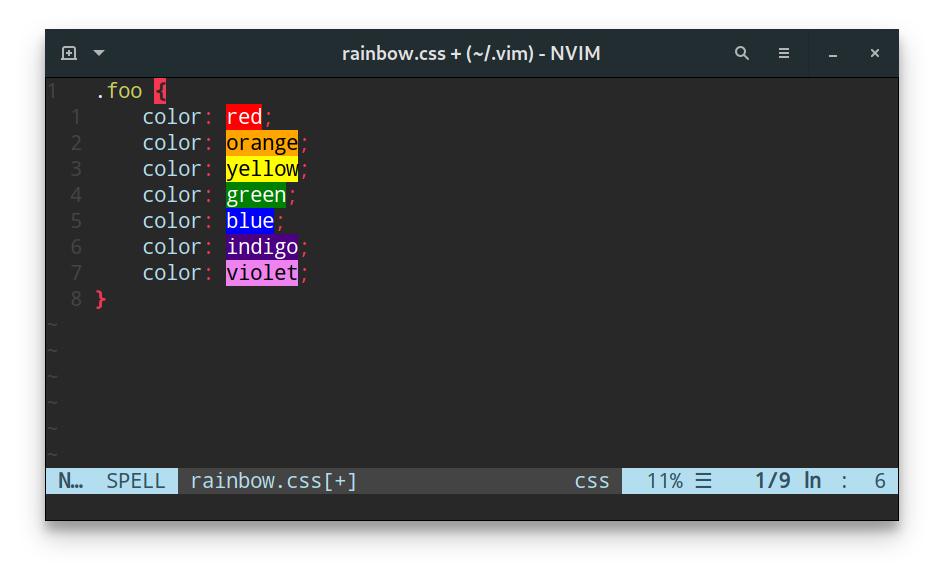
vim-css-color is a simple plugin that
recognised colour names specified in CSS-style: e.g. 'red', '#ff0000',
'#rgb(255,0,0)' etc., and colours them accordingly. True to its name,
once installed it's active when editing CSS files, but it's also supported
for many other file types, and extending it further is not hard.
:wq for today.
223. This version includes the following changes:
[ Chris Lamb ]
* The cbfstools utility is now provided in Debian via the coreboot-utils
Debian package, so we can enable that functionality within Debian.
(Closes: #1020630)
[ Mattia Rizzolo ]
* Also include coreboot-utils in Build-Depends and Test-Depends so it is
available for the tests.
[ Jelle van der Waa ]
* Add support for file 5.43.
root@emma:/home/anarcat/bin# ./puppet-package-check -v
listing puppet packages...
listing apt packages...
loading apt cache...
0 unmanaged packages found
A messy workstation will look like this:
root@curie:/home/anarcat/bin# ./puppet-package-check -v
listing puppet packages...
listing apt packages...
loading apt cache...
288 unmanaged packages found
apparmor-utils beignet-opencl-icd bridge-utils clustershell cups-pk-helper davfs2 dconf-cli dconf-editor dconf-gsettings-backend ddccontrol ddrescueview debmake debootstrap decopy dict-devil dict-freedict-eng-fra dict-freedict-eng-spa dict-freedict-fra-eng dict-freedict-spa-eng diffoscope dnsdiag dropbear-initramfs ebtables efibootmgr elpa-lua-mode entr eog evince figlet file file-roller fio flac flex font-manager fonts-cantarell fonts-inconsolata fonts-ipafont-gothic fonts-ipafont-mincho fonts-liberation fonts-monoid fonts-monoid-tight fonts-noto fonts-powerline fonts-symbola freeipmi freetype2-demos ftp fwupd-amd64-signed gallery-dl gcc-arm-linux-gnueabihf gcolor3 gcp gdisk gdm3 gdu gedit gedit-plugins gettext-base git-debrebase gnome-boxes gnote gnupg2 golang-any golang-docker-credential-helpers golang-golang-x-tools grub-efi-amd64-signed gsettings-desktop-schemas gsfonts gstreamer1.0-libav gstreamer1.0-plugins-base gstreamer1.0-plugins-good gstreamer1.0-plugins-ugly gstreamer1.0-pulseaudio gtypist gvfs-backends hackrf hashcat html2text httpie httping hugo humanfriendly iamerican-huge ibus ibus-gtk3 ibus-libpinyin ibus-pinyin im-config imediff img2pdf imv initramfs-tools input-utils installation-birthday internetarchive ipmitool iptables iptraf-ng jackd2 jupyter jupyter-nbextension-jupyter-js-widgets jupyter-qtconsole k3b kbtin kdialog keditbookmarks keepassxc kexec-tools keyboard-configuration kfind konsole krb5-locales kwin-x11 leiningen lightdm lintian linux-image-amd64 linux-perf lmodern lsb-base lvm2 lynx lz4json magic-wormhole mailscripts mailutils manuskript mat2 mate-notification-daemon mate-themes mime-support mktorrent mp3splt mpdris2 msitools mtp-tools mtree-netbsd mupdf nautilus nautilus-sendto ncal nd ndisc6 neomutt net-tools nethogs nghttp2-client nocache npm2deb ntfs-3g ntpdate nvme-cli nwipe obs-studio okular-extra-backends openstack-clients openstack-pkg-tools paprefs pass-extension-audit pcmanfm pdf-presenter-console pdf2svg percol pipenv playerctl plymouth plymouth-themes popularity-contest progress prometheus-node-exporter psensor pubpaste pulseaudio python3-ldap qjackctl qpdfview qrencode r-cran-ggplot2 r-cran-reshape2 rake restic rhash rpl rpm2cpio rs ruby ruby-dev ruby-feedparser ruby-magic ruby-mocha ruby-ronn rygel-playbin rygel-tracker s-tui sanoid saytime scrcpy scrcpy-server screenfetch scrot sdate sddm seahorse shim-signed sigil smartmontools smem smplayer sng sound-juicer sound-theme-freedesktop spectre-meltdown-checker sq ssh-audit sshuttle stress-ng strongswan strongswan-swanctl syncthing system-config-printer system-config-printer-common system-config-printer-udev systemd-bootchart systemd-container tardiff task-desktop task-english task-ssh-server tasksel tellico texinfo texlive-fonts-extra texlive-lang-cyrillic texlive-lang-french texlive-lang-german texlive-lang-italian texlive-xetex tftp-hpa thunar-archive-plugin tidy tikzit tint2 tintin++ tipa tpm2-tools traceroute tree trocla ucf udisks2 unifont unrar-free upower usbguard uuid-runtime vagrant-cachier vagrant-libvirt virt-manager vmtouch vorbis-tools w3m wamerican wamerican-huge wfrench whipper whohas wireshark xapian-tools xclip xdg-user-dirs-gtk xlax xmlto xsensors xserver-xorg xsltproc xxd xz-utils yubioath-desktop zathura zathura-pdf-poppler zenity zfs-dkms zfs-initramfs zfsutils-linux zip zlib1g zlib1g-dev
157 old: apparmor-utils clustershell davfs2 dconf-cli dconf-editor ddccontrol ddrescueview decopy dnsdiag ebtables efibootmgr elpa-lua-mode entr figlet file-roller fio flac flex font-manager freetype2-demos ftp gallery-dl gcc-arm-linux-gnueabihf gcolor3 gcp gdu gedit git-debrebase gnote golang-docker-credential-helpers golang-golang-x-tools gtypist hackrf hashcat html2text httpie httping hugo humanfriendly iamerican-huge ibus ibus-pinyin imediff input-utils internetarchive ipmitool iptraf-ng jackd2 jupyter-qtconsole k3b kbtin kdialog keditbookmarks keepassxc kexec-tools kfind konsole leiningen lightdm lynx lz4json magic-wormhole manuskript mat2 mate-notification-daemon mktorrent mp3splt msitools mtp-tools mtree-netbsd nautilus nautilus-sendto nd ndisc6 neomutt net-tools nethogs nghttp2-client nocache ntpdate nwipe obs-studio openstack-pkg-tools paprefs pass-extension-audit pcmanfm pdf-presenter-console pdf2svg percol pipenv playerctl qjackctl qpdfview qrencode r-cran-ggplot2 r-cran-reshape2 rake restic rhash rpl rpm2cpio rs ruby-feedparser ruby-magic ruby-mocha ruby-ronn s-tui saytime scrcpy screenfetch scrot sdate seahorse shim-signed sigil smem smplayer sng sound-juicer spectre-meltdown-checker sq ssh-audit sshuttle stress-ng system-config-printer system-config-printer-common tardiff tasksel tellico texlive-lang-cyrillic texlive-lang-french tftp-hpa tikzit tint2 tintin++ tpm2-tools traceroute tree unrar-free vagrant-cachier vagrant-libvirt vmtouch vorbis-tools w3m wamerican wamerican-huge wfrench whipper whohas xdg-user-dirs-gtk xlax xmlto xsensors xxd yubioath-desktop zenity zip
131 new: beignet-opencl-icd bridge-utils cups-pk-helper dconf-gsettings-backend debmake debootstrap dict-devil dict-freedict-eng-fra dict-freedict-eng-spa dict-freedict-fra-eng dict-freedict-spa-eng diffoscope dropbear-initramfs eog evince file fonts-cantarell fonts-inconsolata fonts-ipafont-gothic fonts-ipafont-mincho fonts-liberation fonts-monoid fonts-monoid-tight fonts-noto fonts-powerline fonts-symbola freeipmi fwupd-amd64-signed gdisk gdm3 gedit-plugins gettext-base gnome-boxes gnupg2 golang-any grub-efi-amd64-signed gsettings-desktop-schemas gsfonts gstreamer1.0-libav gstreamer1.0-plugins-base gstreamer1.0-plugins-good gstreamer1.0-plugins-ugly gstreamer1.0-pulseaudio gvfs-backends ibus-gtk3 ibus-libpinyin im-config img2pdf imv initramfs-tools installation-birthday iptables jupyter jupyter-nbextension-jupyter-js-widgets keyboard-configuration krb5-locales kwin-x11 lintian linux-image-amd64 linux-perf lmodern lsb-base lvm2 mailscripts mailutils mate-themes mime-support mpdris2 mupdf ncal npm2deb ntfs-3g nvme-cli okular-extra-backends openstack-clients plymouth plymouth-themes popularity-contest progress prometheus-node-exporter psensor pubpaste pulseaudio python3-ldap ruby ruby-dev rygel-playbin rygel-tracker sanoid scrcpy-server sddm smartmontools sound-theme-freedesktop strongswan strongswan-swanctl syncthing system-config-printer-udev systemd-bootchart systemd-container task-desktop task-english task-ssh-server texinfo texlive-fonts-extra texlive-lang-german texlive-lang-italian texlive-xetex thunar-archive-plugin tidy tipa trocla ucf udisks2 unifont upower usbguard uuid-runtime virt-manager wireshark xapian-tools xclip xserver-xorg xsltproc xz-utils zathura zathura-pdf-poppler zfs-dkms zfs-initramfs zfsutils-linux zlib1g zlib1g-dev
Yuck! That's a lot of shit to go through.
Notice how the packages get sorted between "old" and "new"
packages. This is because popcon is used as a tool to mark which
packages are "old". If you have unmanaged packages, the "old" ones are
likely things that you can uninstall, for example.
If you don't have popcon installed, you'll also get this warning:
popcon stats not available: [Errno 2] No such file or directory: '/var/log/popularity-contest'
The error can otherwise be safely ignored, but you won't get "help"
prioritizing the packages to add to your manifests.
Note that the tool ignores packages that were "marked" (see
apt-mark(8)) as automatically installed. This implies that you
might have to do a little bit of cleanup the first time you run this,
as Debian doesn't necessarily mark all of those packages correctly on
first install. For example, here's how it looks like on a clean
install, after Puppet ran:
root@angela:/home/anarcat# ./bin/puppet-package-check -v
listing puppet packages...
listing apt packages...
loading apt cache...
127 unmanaged packages found
ca-certificates console-setup cryptsetup-initramfs dbus file gcc-12-base gettext-base grub-common grub-efi-amd64 i3lock initramfs-tools iw keyboard-configuration krb5-locales laptop-detect libacl1 libapparmor1 libapt-pkg6.0 libargon2-1 libattr1 libaudit-common libaudit1 libblkid1 libbpf0 libbsd0 libbz2-1.0 libc6 libcap-ng0 libcap2 libcap2-bin libcom-err2 libcrypt1 libcryptsetup12 libdb5.3 libdebconfclient0 libdevmapper1.02.1 libedit2 libelf1 libext2fs2 libfdisk1 libffi8 libgcc-s1 libgcrypt20 libgmp10 libgnutls30 libgpg-error0 libgssapi-krb5-2 libhogweed6 libidn2-0 libip4tc2 libiw30 libjansson4 libjson-c5 libk5crypto3 libkeyutils1 libkmod2 libkrb5-3 libkrb5support0 liblocale-gettext-perl liblockfile-bin liblz4-1 liblzma5 libmd0 libmnl0 libmount1 libncurses6 libncursesw6 libnettle8 libnewt0.52 libnftables1 libnftnl11 libnl-3-200 libnl-genl-3-200 libnl-route-3-200 libnss-systemd libp11-kit0 libpam-systemd libpam0g libpcre2-8-0 libpcre3 libpcsclite1 libpopt0 libprocps8 libreadline8 libselinux1 libsemanage-common libsemanage2 libsepol2 libslang2 libsmartcols1 libss2 libssl1.1 libssl3 libstdc++6 libsystemd-shared libsystemd0 libtasn1-6 libtext-charwidth-perl libtext-iconv-perl libtext-wrapi18n-perl libtinfo6 libtirpc-common libtirpc3 libudev1 libunistring2 libuuid1 libxtables12 libxxhash0 libzstd1 linux-image-amd64 logsave lsb-base lvm2 media-types mlocate ncurses-term pass-extension-otp puppet python3-reportbug shim-signed tasksel ucf usr-is-merged util-linux-extra wpasupplicant xorg zlib1g
popcon stats not available: [Errno 2] No such file or directory: '/var/log/popularity-contest'
Normally, there should be unmanaged packages here. But because of the
way Debian is installed, a lot of libraries and some core packages are
marked as manually installed, and are of course not managed through
Puppet. There are two solutions to this problem:
apt-mark auto $(./bin/puppet-package-check grep -o 'lib[^ ]*')
... but if you trust that most of that stuff is actually garbage that
you don't really want installed anyways, you could just mark it all
as automatically installed:
apt-mark auto $(./bin/puppet-package-check)
In my case, that ended up keeping basically all libraries (because of
course they're installed for some reason) and auto-removing this:
dh-dkms discover-data dkms libdiscover2 libjsoncpp25 libssl1.1 linux-headers-amd64 mlocate pass-extension-otp pass-otp plocate x11-apps x11-session-utils xinit xorg
You'll notice xorg in there: yep, that's bad. Not what I wanted. But
for some reason, on other workstations, I did not actually have
xorg installed. Turns out having xserver-xorg is enough, and that
one has dependencies. So now I guess I just learned to stop worrying
and live without X(org).
apt install $PKG on every package in the
manifest, one at a time. While the overhead of apt is generally
small, when you add things like apt-listbugs, apt-listchanges,
needrestart, triggers and so on, it can take forever setting up a
new host.
So for initial installs, it can actually makes sense to skip the queue
and just install everything in one big batch.
And because the above tool inspects the packages installed by Puppet,
you can run it against a catalog and have a full lists of all the
packages Puppet would install, even before I even had Puppet
running.
So when reinstalling my laptop, I basically did this:
apt install puppet-agent/experimental
puppet agent --test --noop
apt install $(./puppet-package-check --debug \
2>&1 grep ^puppet\ packages
sed 's/puppet packages://;s/ /\n/g'
grep -v -e onionshare -e golint -e git-sizer -e github-backup -e hledger -e xsane -e audacity -e chirp -e elpa-flycheck -e elpa-lsp-ui -e yubikey-manager -e git-annex -e hopenpgp-tools -e puppet
) puppet-agent/experimental
That massive grep was because there are currently a lot of
packages missing from bookworm. Those are all packages that I have
in my catalog but that still haven't made it to bookworm. Sad, I
know. I eventually worked around that by adding bullseye sources so
that the Puppet manifest actually ran.
The point here is that this improves the Puppet run time a lot. All
packages get installed at once, and you get a nice progress bar. Then
you actually run Puppet to deploy configurations and all the other
goodies:
puppet agent --test
I wish I could tell you how much faster that ran. I don't know, and I
will not go through a full reinstall just to please your
curiosity. The only hard number I have is that it installed 444
packages (which exploded in 10,191 packages with dependencies) in a
mere 10 minutes. That might also be with the packages already
downloaded.
In any case, I have that gut feeling it's faster, so you'll have to
just trust my gut. It is, after all, much more important than you
might think.
It figures out what you ve done manually, stores it locally in a Git repository, generates code that s able to recreate your efforts, and helps you deploy those changes to productionThat tool has unfortunately been abandoned for a decade at this point. Also note that the
AutoRemove::RecommendsImportant and
AutoRemove::SuggestsImportant are relevant here. If it is set to
true (the default), a package will not be removed if it is
(respectively) a Recommends or Suggests of another package (as
opposed to the normal Depends). In other words, if you want to also
auto-remove packages that are only Suggests, you would, for example,
add this to apt.conf:
AutoRemove::SuggestsImportant false;
Paul Wise has tried to make the Debian installer and debootstrap
properly mark packages as automatically installed in the past, but his
bug reports were rejected. The other suggestions in this section are
also from Paul, thanks!
You re in a cafe or a hotel, trying to use the provided wifi. But it s not working. You discover that port 80 and port 443 are open, but the wifi forbids all other traffic.
Never mind, start up your hippotat client. Now you have connectivity. Your VPN and SSH and so on run over Hippotat. The result is not very efficient, but it does work.Story In early 2017 I was in a mountaintop cafeteria, hoping to do some work on my laptop. (For Reasons I couldn t go skiing that day.) I found that local wifi was badly broken: It had a severe port block. I had to use my port 443 SSH server to get anywhere. My usual arrangements punt everything over my VPN, which uses UDP of course, and I had to bodge several things. Using a web browser directly only the wifi worked normally, of course - otherwise the other guests would have complained. This was not the first experience like this I d had, but this time I had nothing much else to do but fix it. In a few furious hacking sessions, I wrote Hippotat, a tool for making my traffic look enough like ordinary web browsing that it gets through most stupid firewalls. That Python version of Hippotat served me well for many years, despite being rather shonky, extremely inefficient in CPU (and therefore battery) terms and not very productised. But recently things have started to go wrong. I was using Twisted Python and there was what I think must be some kind of buffer handling bug, which started happening when I upgraded the OS (getting newer versions of Python and the Twisted libraries). The Hippotat code, and the Twisted APIs, were quite convoluted, and I didn t fancy debugging it. So last year I rewrote it in Rust. The new Rust client did very well against my existing servers. To my shame, I didn t get around to releasing it. However, more recently I upgraded the server hosts my Hippotat daemons run on to recent Debian releases. They started to be affected by the bug too, rendering my Rust client unuseable. I decided I had to deploy the Rust server code. This involved some packaging work. Having done that, it s time to release it: Hippotat 1.0.0 is out. The package build instructions are rather strange My usual approach to releasing something like this would be to provide a git repository containing a proper Debian source package. I might also build binaries, using
sbuild, and I would consider actually uploading to Debian.
However, despite me taking a fairly conservative approach to adding dependencies to Hippotat, still a couple of the (not very unusual) Rust packages that Hippotat depends on are not in Debian. Last year I considered tackling this head-on, but I got derailed by difficulties with Rust packaging in Debian.
Furthermore, the version of the Rust compiler itself in Debian stable is incapable of dealing with recent versions of very many upstream Rust packages, because many packages most recent versions now require the 2021 Edition of Rust. Sadly, Rust s package manager, cargo, has no mechanism for trying to choose dependency versions that are actually compatible with the available compiler; efforts to solve this problem have still not borne the needed fruit.
The result is that, in practice, currently Hippotat has to be built with (a) a reasonably recent Rust toolchain such as found in Debian unstable or obtained from Rust upstream; (b) dependencies obtained from the upstream Rust repository.
At least things aren t completely terrible: Rustup itself, despite its alarming install rune, has a pretty good story around integrity, release key management and so on. And with the right build rune, cargo will check not just the versions, but the precise content hashes, of the dependencies to be obtained from crates.io, against the information I provide in the Cargo.lock file. So at least when you build it you can be sure that the dependencies you re getting are the same ones I used myself when I built and tested Hippotat. And there s only 147 of them (counting indirect dependencies too), so what could possibly go wrong?
Sadly the resulting package build system cannot work with Debian s best tool for doing clean and controlled builds, sbuild. Under the circumstances, I don t feel I want to publish any binaries.kinetic-system fits, and the handling of Marcus-Hush-Chidsey (or Marcus "distribution of states") kinetics for electron transfers.
Column and row names
This release greatly improves the handling of column and row names, including commands to easily modify them, the possibility to use Ruby formulas to change them, and a much better way read and write them to data files. Mastering the use of column names (and to a lesser extent, row names) can greatly simplify data handling, especially when dealing with files with a large number of columns.
Complex numbers
Version 3.1 brings in support for formulas handling complex numbers. Although it is not possible to store complex numbers directly into datasets, it is easy to separate them in real and imaginary parts to your liking.
Scripting improvement
Two important improvements for scripting are included in version 3.1. The first is the possibility to define virtual files inside a script file, which makes it easy to define subfunctionsto run using commands like run-for-each. The second is the possibility to define
variablesto be reused later (like the script arguments) using the new command let. There are a lot of other new features, improvements and so on, look for the full list there. About QSoas
WARNING[360166]: loader.c:2487 in load_modules: Module 'chan_sip' has been loaded but was deprecated in Asterisk version 17 and will be removed in Asterisk version 21.
WARNING[360174]: chan_sip.c:35468 in deprecation_notice: chan_sip has no official maintainer and is deprecated. Migration to
WARNING[360174]: chan_sip.c:35469 in deprecation_notice: chan_pjsip is recommended. See guides at the Asterisk Wiki:
WARNING[360174]: chan_sip.c:35470 in deprecation_notice: https://wiki.asterisk.org/wiki/display/AST/Migrating+from+chan_sip+to+res_pjsip
WARNING[360174]: chan_sip.c:35471 in deprecation_notice: https://wiki.asterisk.org/wiki/display/AST/Configuring+res_pjsip
and so I decided it was time to stop postponing the
overdue migration
of my working setup from
chan_sip
to
res_pjsip.
It turns out that it was not as painful as I expected, though the
conversion script bundled with
Asterisk
didn't work for me out of the box.
asterisk -r):
sip set debug on
now lives behind this command:
pjsip set logger on
sip.conf was:
[2000]
; Snom 300
type=friend
qualify=yes
secret=password123
encryption=no
context=full
host=dynamic
nat=no
directmedia=no
mailbox=10@internal
vmexten=707
dtmfmode=rfc2833
call-limit=2
disallow=all
allow=g722
allow=ulaw
[2001]
; Snom D715
type=friend
qualify=yes
secret=password456
encryption=no
context=full
host=dynamic
nat=no
directmedia=yes
mailbox=10@internal
vmexten=707
dtmfmode=rfc2833
call-limit=2
disallow=all
allow=g722
allow=ulaw
and that became the following in pjsip.conf:
[transport-udp]
type = transport
protocol = udp
bind = 0.0.0.0
external_media_address = myasterisk.dyn.example.com
external_signaling_address = myasterisk.dyn.example.com
local_net = 192.168.0.0/255.255.0.0
[2000]
type = aor
max_contacts = 1
[2000]
type = auth
username = 2000
password = password123
[2000]
type = endpoint
context = full
dtmf_mode = rfc4733
disallow = all
allow = g722
allow = ulaw
direct_media = no
mailboxes = 10@internal
auth = 2000
outbound_auth = 2000
aors = 2000
[2001]
type = aor
max_contacts = 1
[2001]
type = auth
username = 2001
password = password456
[2001]
type = endpoint
context = full
dtmf_mode = rfc4733
disallow = all
allow = g722
allow = ulaw
direct_media = yes
mailboxes = 10@internal
auth = 2001
outbound_auth = 2001
aors = 2001
The different direct_media line between the two phones has to do with how
they each connect to my Asterisk
server
and whether or not they have access to the Internet.
extensions.conf from:
[speeddial]
exten => 1000,1,Dial(SIP/2000,20)
exten => 1001,1,Dial(SIP/2001,20)
to:
[speeddial]
exten => 1000,1,Dial($ PJSIP_DIAL_CONTACTS(2000) ,20)
exten => 1001,1,Dial($ PJSIP_DIAL_CONTACTS(2001) ,20)
I have not yet dug into what this changes or why it's necessary and so feel
free to leave a comment if you know more here.
sip.conf:
[general]
register => tls://555123_myasterisk:password789@vancouver2.voip.ms
externhost=myasterisk.dyn.example.com
localnet=192.168.0.0/255.255.0.0
tcpenable=yes
tlsenable=yes
tlscertfile=/etc/asterisk/asterisk.cert
tlsprivatekey=/etc/asterisk/asterisk.key
tlscapath=/etc/ssl/certs/
[voipms]
type=peer
host=vancouver2.voip.ms
secret=password789
defaultuser=555123_myasterisk
context=from-voipms
disallow=all
allow=ulaw
allow=g729
insecure=port,invite
canreinvite=no
trustrpid=yes
sendrpid=yes
transport=tls
encryption=yes
to the following in pjsip.conf:
[transport-tls]
type = transport
protocol = tls
bind = 0.0.0.0
external_media_address = myasterisk.dyn.example.com
external_signaling_address = myasterisk.dyn.example.com
local_net = 192.168.0.0/255.255.0.0
cert_file = /etc/asterisk/asterisk.cert
priv_key_file = /etc/asterisk/asterisk.key
ca_list_path = /etc/ssl/certs/
method = tlsv1_2
[voipms]
type = registration
transport = transport-tls
outbound_auth = voipms
client_uri = sip:555123_myasterisk@vancouver2.voip.ms
server_uri = sip:vancouver2.voip.ms
[voipms]
type = auth
password = password789
username = 555123_myasterisk
[voipms]
type = aor
contact = sip:555123_myasterisk@vancouver2.voip.ms
[voipms]
type = identify
endpoint = voipms
match = vancouver2.voip.ms
[voipms]
type = endpoint
context = from-voipms
disallow = all
allow = ulaw
allow = g729
from_user = 555123_myasterisk
trust_id_inbound = yes
media_encryption = sdes
auth = voipms
outbound_auth = voipms
aors = voipms
rtp_symmetric = yes
rewrite_contact = yes
send_rpid = yes
timers = no
The TLS method line is needed since the default in Debian OpenSSL is too
strict. The timers
line is to prevent outbound calls from getting dropped after 15 minutes.
Finally, I changed the Dial() lines in these extensions.conf blurbs from:
[from-voipms]
exten => 5551231000,1,Goto(2000,1)
exten => 2000,1,Dial(SIP/2000&SIP/2001,20)
exten => 2000,n,Goto(in2000-$ DIALSTATUS ,1)
exten => 2000,n,Hangup
exten => in2000-BUSY,1,VoiceMail(10@internal,su)
exten => in2000-BUSY,n,Hangup
exten => in2000-CONGESTION,1,VoiceMail(10@internal,su)
exten => in2000-CONGESTION,n,Hangup
exten => in2000-CHANUNAVAIL,1,VoiceMail(10@internal,su)
exten => in2000-CHANUNAVAIL,n,Hangup
exten => in2000-NOANSWER,1,VoiceMail(10@internal,su)
exten => in2000-NOANSWER,n,Hangup
exten => _in2000-.,1,Hangup(16)
[pstn-voipms]
exten => _1NXXNXXXXXX,1,Set(CALLERID(all)=Francois Marier <5551231000>)
exten => _1NXXNXXXXXX,n,Dial(SIP/voipms/$ EXTEN )
exten => _1NXXNXXXXXX,n,Hangup()
exten => _NXXNXXXXXX,1,Set(CALLERID(all)=Francois Marier <5551231000>)
exten => _NXXNXXXXXX,n,Dial(SIP/voipms/1$ EXTEN )
exten => _NXXNXXXXXX,n,Hangup()
exten => _011X.,1,Set(CALLERID(all)=Francois Marier <5551231000>)
exten => _011X.,n,Authenticate(1234)
exten => _011X.,n,Dial(SIP/voipms/$ EXTEN )
exten => _011X.,n,Hangup()
exten => _00X.,1,Set(CALLERID(all)=Francois Marier <5551231000>)
exten => _00X.,n,Authenticate(1234)
exten => _00X.,n,Dial(SIP/voipms/$ EXTEN )
exten => _00X.,n,Hangup()
to:
[from-voipms]
exten => 5551231000,1,Goto(2000,1)
exten => 2000,1,Dial(PJSIP/2000&PJSIP/2001,20)
exten => 2000,n,Goto(in2000-$ DIALSTATUS ,1)
exten => 2000,n,Hangup
exten => in2000-BUSY,1,VoiceMail(10@internal,su)
exten => in2000-BUSY,n,Hangup
exten => in2000-CONGESTION,1,VoiceMail(10@internal,su)
exten => in2000-CONGESTION,n,Hangup
exten => in2000-CHANUNAVAIL,1,VoiceMail(10@internal,su)
exten => in2000-CHANUNAVAIL,n,Hangup
exten => in2000-NOANSWER,1,VoiceMail(10@internal,su)
exten => in2000-NOANSWER,n,Hangup
exten => _in2000-.,1,Hangup(16)
[pstn-voipms]
exten => _1NXXNXXXXXX,1,Set(CALLERID(all)=Francois Marier <5551231000>)
exten => _1NXXNXXXXXX,n,Dial(PJSIP/$ EXTEN @voipms)
exten => _1NXXNXXXXXX,n,Hangup()
exten => _NXXNXXXXXX,1,Set(CALLERID(all)=Francois Marier <5551231000>)
exten => _NXXNXXXXXX,n,Dial(PJSIP/1$ EXTEN @voipms)
exten => _NXXNXXXXXX,n,Hangup()
exten => _011X.,1,Set(CALLERID(all)=Francois Marier <5551231000>)
exten => _011X.,n,Authenticate(1234)
exten => _011X.,n,Dial(PJSIP/$ EXTEN @voipms)
exten => _011X.,n,Hangup()
exten => _00X.,1,Set(CALLERID(all)=Francois Marier <5551231000>)
exten => _00X.,n,Authenticate(1234)
exten => _00X.,n,Dial(PJSIP/$ EXTEN @voipms)
exten => _00X.,n,Hangup()
Note that it's not just replacing SIP/ with PJSIP/, but it was also
necessary to use a format supported by
pjsip
for the channel since SIP/trunkname/extension isn't supported by pjsip.
Next.