Search Results: "ema"

2 April 2015

Ben Hutchings: Debian LTS work, March 2015

This was my fourth month working on Debian LTS. I was assigned 14.5 hours by Freexian's Debian LTS initiative, but I only worked 11.5 as I had a week's holiday and then was ill for part of this week. eglibc My first task was to complete the eglibc update that I began at the end of February. There were a few unexpected failures in the regression test suite, but on inspection these turned out to be quirks of the build environment: With those changes, the regression test results are the same as for previous package versions. (There is still one 'unexpected' failure, but I didn't investigate because it is not a regression within squeeze.) I reviewed the backported patches again to check as well as I could that they did not depend on other upstream changes, and they did not seem to. I also received positive feedback from further testing - I can't find the message now, but I think it was that the Univention application test suite passed with the updated eglibc package installed. With that confirmation and no regressions reported, I uploaded eglibc 2.11.3-4+deb6u5 and issued DLA 165-1. freetype A large number of vulnerabilities in font file parsing in Freetype were reported by Mateusz Jurczyk. I think these were less critical in squeeze than in wheezy, because while current web browsers use Freetype to render untrusted 'web fonts' we don't support any web browsers in squeeze LTS. But it seemed like they ought to be fixed anyway, and it was not too hard to backport the patches included in the wheezy security update. Freetype doesn't have a regression test suite and I didn't have samples of the broken fonts, so I came up with some ad hoc tests for regressions. I viewed several of each of the affected font formats with the ftview demo application. I then wrote a script to match up the dependencies of a package (in this case, libfreetype6) with those used by Freexian's customers; the top results were fontconfig, xfonts-utils and imagemagick. So I ran some basic tests against each of the affected formats with each of these (fc-list, mkfontscale, and the simple text label recipe for ImageMagick) and found no regression. Uploaded freetype 2.4.2-2.1+squeeze5 and issued DLA 185-1.

1 April 2015

Joey Hess: I am ArchiveTeam

This seems as good a day as any to mention that I am a founding member of ArchiveTeam. ArchiveTeam logo Way back, when Geocities was closing down, I was one of a small rag-tag group who saved a copy of most of it. That snapshot has since generated more publicity than most other projects I've worked on. I've heard many heartwarning stories of it being the only remaining copy of baby pictures and writings of deceased friends, and so on. It's even been the subject of serious academic study as outlined in this talk, which is pretty awesome. Jason Scott in full stage regalia I'm happy to let this guy be the public face of ArchiveTeam in internet meme-land. It's a 0.1% project for me, and has grown into a well-oiled machine, albeit one that shouldn't need to exist. I only get involved these days when there's another crazy internet silo fire drill and/or I'm bored. (Rumors of me being the hand model for ArchiveTeam are, however, unsubstantiated.) Relevant XKCD

Raphael Geissert: Special guest for the Lyon minidebconf, 2015

It appears that this year's MiniDebconf in Lyon, France is going to have a very special guest. After enjoying so much the Q&A held at Debconf14, Linus Torvalds has decided to make a quick detour from a trip to Europe to bring the opportunity for another session with the Debian community.

The event has yet to appear in the MiniDebconf agenda. Rumor has it that the hurds of fans that tend to attend his events pose a logistics and safety challenge, reason why the event might only appear in the agenda a couple of days before the event.
Lyon being such an easy place to get by train, flight, car, and even by boat, it is understandable and should be expected that a great number of people attend the minidebconf only for his very session.

If you have not yet registered, I'd recommend you to do so now and to book your travel and accommodation ASAP, before everything is overpriced due to high demand.

See you in ten days!

P.S. kudos to the organizers!

Lars Wirzenius: Obnam 4.1 released

It is with great pleasure and satisfaction that I release version 4.1 of Obnam, my backup program. This version includes a radically innovative approaches to data compression and de-duplication, as well as some other changes and bug fixes. Major user-visible changes: Minor user-visible changes: Bug fixes:

31 March 2015

Zlatan Todori : Interviews with FLOSS developers: Francesca Ciceri

Debian and FLOSS community don't only occupy coding developers. They occupy people who write news, who talk about FLOSS, who help on booths and conferences, who create artistic forms of the community and so many others that contribute in countless ways. A lady, that is doing many of that is Francesca Ciceri, known in Debian as MadameZou. She is non-packaging Debian Developer, a fearless warrior for diversity and a zombie fan. Although it sounds intimidating, she is deep caring and great human being. So, what has MadaZou to tell us? Picture of MadameZou Who are you? My name is Francesca and I'm totally flattered by your intro. The fearless warrior part may be a bit exaggerated, though. What have you done and what are you currently working on in FLOSS world? I've been a Debian contributor since late 2009. My journey in Debian has touched several non-coding areas: from translation to publicity, from videoteam to www. I've been one of the www.debian.org webmasters for a while, a press officer for the Project as well as an editor for DPN. I've dabbled a bit in font packaging, and nowadays I'm mostly working as a Front Desk member. Setup of your main machine? Wow, that's an intimate question! Lenovo Thinkpad, Debian testing. Describe your current most memorable situation as FLOSS member? Oh, there are a few. One awesome, tiring and very satisfying moment was during the release of Squeeze: I was member of the publicity and the www teams at the time, and we had to pull a 10 hours of team work to put everything in place. It was terrible and exciting at the same time. I shudder to think at the amount of work required from ftpmaster and release team during the release. Another awesome moment was my first Debconf: I was so overwhelmed by the sense of belonging in finally meeting all these people I've been worked remotely for so long, and embarassed by my poor English skills, and overall happy for just being there... If you are a Debian contributor I really encourage you to participate to Debian events, be they small and local or as big as DebConf: it really is like finally meeting family. Some memorable moments from Debian conferences? During DC11, the late nights with the "corridor cabal" in the hotel, chatting about everything. A group expedition to watch shooting stars in the middle of nowhere, during DC13. And a very memorable videoteam session: it was my first time directing and everything that could go wrong, went wrong (including the speaker deciding to take a walk outside the room, to demonstrate something, out of the cameras range). It was a disaster, but also fun: at the end of it, all the video crew was literally in stitches. But there are many awesome moments, almost too many to recall. Each conference is precious on that regard: for me the socializing part is extremely important, it's what cements relationships and help remote work go smoothly, and gives you motivation to volunteer in tasks that sometimes are not exactly fun. You are known as Front Desk member for DebConf's - what work does it occupy and why do you enjoy doing it? I'm not really a member of the team: just one of Nattie's minions! You had been also part of DebConf Video team - care to share insights into video team work and benefits it provides to Debian Project? The video team work is extremely important: it makes possible for people not attending to follow the conference, providing both live streaming and recording of all talks. I may be biased, but I think that DebConf video coverage and the high quality of the final recordings are unrivaled among FLOSS conferences - especially since it's all volunteer work and most of us aren't professional in the field. During the conference we take shifts in filming the various talks - for each talk we need approximately 4 volunteers: two camera operators, a sound mixer and the director. After the recording, comes the boring part: reviewing, cutting and sometimes editing the videos. It's a long process and during the conference, you can sometimes spot the videoteam members doing it at night in the hacklab, exhausted after a full day of filming. And then, the videos are finally ready to be uploaded, for your viewing pleasure. During the last years this process has become faster thanks to the commitment of many volunteers, so that now you have to wait only few days, sometimes a week, after the end of the conference to be able to watch the videos. I personally love to contribute to the videoteam: you get to play with all that awesome gear and you actually make a difference for all the people who cannot attend in person. You are also non-packaging Debian Developer - how does that feel like? Feels awesome! The mere fact that the Debian Project decided - in 2009 via a GR - to recognize the many volunteers who contribute without doing packaging work is a great show of inclusiveness, in my opinion. In a big project like Debian just packaging software is not enough: the final result relies heavily on translators, sysadmins, webmasters, publicity people, event organizers and volunteers, graphic artists, etc. It's only fair that these contributions are deemed as valuable as the packaging, and to give an official status to those people. I was one of the firsts non-uploading DD, four years ago, and for a long time it was just really an handful of us. In the last year I've seen many others applying for the role and that makes me really happy: it means that finally the contributors have realized that they deserve to be an official part of Debian and to have "citizenship rights" in the project. You were the leading energy on Debian's diversity statement - what gave you the energy to drive into it? It seemed the logical conclusion of the extremely important work that Debian Women had done in the past. When I first joined Debian, in 2009, as a contributor, I was really surprised to find a friendly community and to not be discriminated on account of my gender or my lack of coding skills. I may have been just lucky, landing in particularly friendly teams, but my impression is that the project has been slowly but unequivocally changed by the work of Debian Women, who raised first the need for inclusiveness and the awareness about the gender problem in Debian. I don't remember exactly how I stumbled upon the fact that Debian didn't have a Diversity Statement, but at first I was very surprised by it. I asked zack (Stefano Zacchiroli), who was DPL at the time, and he encouraged me to start a public discussion about it, sending out a draft - and helped me all the way along the process. It took some back and forth in the debian-project mailing list, but the only thing needed was actually just someone to start the process and try to poke the discussion when it stalled - the main blocker was actually about the wording of the statement. I learned a great deal from that experience, and I think it changed completely my approach in things like online discussions and general communication within the project. At the end of the day, what I took from that is a deep respect for who participated and the realization that constructive criticism does require certainly a lot of work for all parts involved, but can happen. As for the statement in itself: these things are as good as you keep them alive with best practices, but I think that are better stated explicitly rather than being left unsaid. You are involved also with another Front Desk, the Debian's one which is involved with Debian's New Members process - what are tasks of that FD and how rewarding is the work on it? The Debian Front Desk is the team that runs the New Members process: we receive the applications, we assign the applicant a manager, and we verify the final report. In the last years the workflow has been simplified a lot by the re-design of the nm.debian.org website, but it's important to keep things running smoothly so that applicants don't have too lenghty processes or to wait too much before being assigned a manager. I've been doing it for a less more than a month, but it's really satisfying to usher people toward DDship! So this is how I feel everytime I send a report over to DAM for an applicant to be accepted as new Debian Developer: Crazy pic How do you see future of Debian development? Difficult to say. What I can say is that I'm pretty sure that, whatever the technical direction we'll take, Debian will remain focused on excellence and freedom. What are your future plans in Debian, what would you like to work on? Definetely bug wrangling: it's one of the thing I do best and I've not had a chance to do that extensively for Debian yet. Why should developers and users join Debian community? What makes Debian a great and happy place? We are awesome, that's why. We are strongly committed to our Social Contract and to users freedom, we are steadily improving our communication style and trying to be as inclusive as possible. Most of the people I know in Debian are perfectionists and outright brilliant in what they do. Joining Debian means working hard on something you believe, identifying with a whole project, meeting lots of wonderful people and learning new things. It ca be at times frustrating and exhausting, but it's totally worth it. You have been involved in Mozilla as part of OPW - care to share insights into Mozilla, what have you done and compare it to Debian? That has been a very good experience: it meant have the chance to peek into another community, learn about their tools and workflow and contribute in different ways. I was an intern for the Firefox QA team and their work span from setting up specific test and automated checks on the three version of Firefox (Stable, Aurora, Nightly) to general bug triaging. My main job was bug wrangling and I loved the fact that I was a sort of intermediary between developers and users, someone who spoke both languages and could help them work together. As for the comparison, Mozilla is surely more diverse than Debian: both in contributors and users. I'm not only talking demographic, here, but also what tools and systems are used, what kind of skills people have, etc. That meant reach some compromises with myself over little things: like having to install a proprietary tool used for the team meetings (and getting crazy in order to make it work with Debian) or communicating more on IRC than on mailing lists. But those are pretty much the challenges you have to face whenever you go out of your comfort zone . You are also volunteer of the Organization for Transformative Works - what is it, what work do you do and care to share some interesting stuff? OTW is a non profit organization to preserve fan history and cultures, created by fans. Its work range from legal advocacy and lobbying for fair use and copyright related issues, developing and maintaining AO3 -- a huge fanwork archive based on open-source software --, to the production of a peer-reviewed academic journal about fanworks. I'm an avid fanfiction reader and writer, and joining the OTW volunteers seemed a good way to give back to the community - in true Debian fashion . As a volunteer, I work for the Translation Committee: we are more than a hundred people - divided in several language teams - translating the OTW website, the interface of AO3 archive, newsletter, announcements and news posts. We have a orga-wide diversity statement, training for recruits, an ever growing set of procedures to smooth our workflow, monthly meetings and movie nights. It's an awesome group to work with. I'm deeply invested in this kind of work: both for the awesomeness of OTW people and for the big role that fandom and fanworks have in my life. What I find amazing is that the same concept we - as in the FLOSS ecosystem - apply to software can be applied to cultural production: taking a piece of art you love and expand, remix, explore it. Just for the fun of it. Protect and encourage the right to play in this cultural sandbox is IMO essential for our society. Most of the participants in the fandom come from marginalised group or minorities whose point of view is usually not part of the mainstream narratives. This makes the act of writing, remixing and re-interpreting a story not only a creative exercise but a revolutionary one. As Elizabeth Minkel says: "My preferred explanation is the idea that the vast majority of what we watch is from the male perspective authored, directed, and filmed by men, and mostly straight white men at that. Fan fiction gives women and other marginalised groups the chance to subvert that perspective, to fracture a story and recast it in her own way." In other words, "fandom is about putting debate and conversation back into an artistic process". On a personal side - you do a lot of DIY, handmade works. What have you done, what joy does it bring to you and share with us a picture of it? I like to think that the hacker in me morphs in a maker whenever I can actually manipulate stuff. The urge to explore ways of doing things, of create and change is probably the same. I've been blessed with curiousity and craftiness and I love to learn new DIY techniques: I cannot describe it, really, but if I don't make something for a while I actually feel antsy. I need to create stuff. Nowadays, I'm mostly designing and sewing clothes - preferably reproductions of dresses from the 40s and the 50s - and I'm trying to make a living of that. It's a nice challenge: there's a lot of research involved, as I always try to be historically accurate in design, sewing tecniques and material, and many hours of careful attention to details. I'm right in the process of make photoshoots for most of my period stuff, so I'll share with you something different: a t-shirt refashion done with the DebConf11 t-shirt! (here's the tutorial) T-shirt pic

Dirk Eddelbuettel: R / Finance 2015 Open for Registration

The annoucement below just went to the R-SIG-Finance list. More information is as usual at the R / Finance page.
Registration for R/Finance 2015 is now open! The conference will take place on May 29 and 30, at UIC in Chicago. Building on the success of the previous conferences in 2009-2014, we expect more than 250 attendees from around the world. R users from industry, academia, and government will joining 30+ presenters covering all areas of finance with R. We are very excited about the four keynote presentations given by Emanuel Derman, Louis Marascio, Alexander McNeil, and Rishi Narang.
The conference agenda (currently) includes 18 full presentations and 19 shorter "lightning talks". As in previous years, several (optional) pre-conference seminars are offered on Friday morning. There is also an (optional) conference dinner at The Terrace at Trump Hotel. Overlooking the Chicago river and skyline, it is a perfect venue to continue conversations while dining and drinking. Registration information and agenda details can be found on the conference website as they are being finalized.
Registration is also available directly at the registration page. We would to thank our 2015 sponsors for the continued support enabling us to host such an exciting conference: International Center for Futures and Derivatives at UIC Revolution Analytics
MS-Computational Finance and Risk Management at University of Washington Ketchum Trading
OneMarketData
RStudio
SYMMS On behalf of the committee and sponsors, we look forward to seeing you in Chicago! For the program committee:
Gib Bassett, Peter Carl, Dirk Eddelbuettel, Brian Peterson,
Dale Rosenthal, Jeffrey Ryan, Joshua Ulrich
See you in Chicago in May!

This post by Dirk Eddelbuettel originated on his Thinking inside the box blog. Please report excessive re-aggregation in third-party for-profit settings.

30 March 2015

Matthias Klumpp: Limba Project: Another progress report

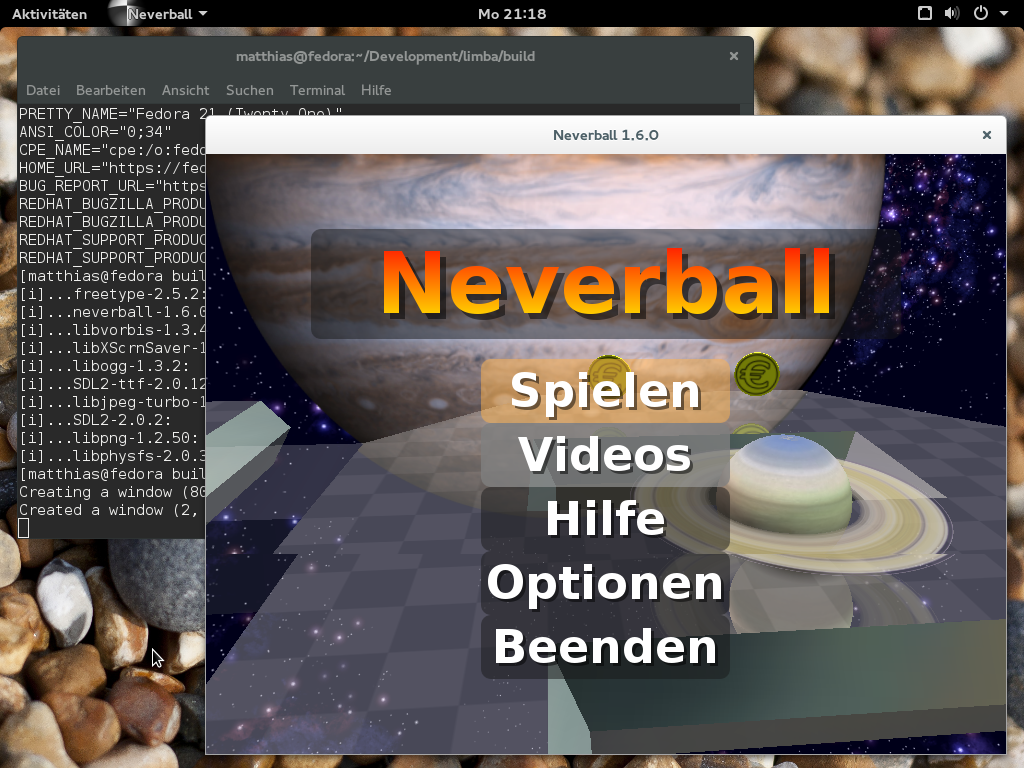
And once again, it s time for another Limba blogpost :-)limba-small Limba is a solution to install 3rd-party software on Linux, without interfering with the distribution s native package manager. It can be useful to try out different software versions, use newer software on a stable OS release or simply to obtain software which does not yet exist for your distribution. Limba works distribution-independent, so software authors only need to publish their software once for all Linux distributions. I recently released version 0.4, with which all most important features you would expect from a software manager are complete. This includes installing & removing packages, GPG-signing of packages, package repositories, package updates etc. Using Limba is still a bit rough, but most things work pretty well already. So, it s time for another progress report. Since a FAQ-like list is easier to digest. compared to a long blogpost, I go with this again. So, let s address one important general question first: How does Limba relate to the GNOME Sandboxing approach? (If you don t know about GNOMEs sandboxes, take a look at the GNOME Wiki Alexander Larsson also blogged about it recently) First of all: There is no rivalry here and no NIH syndrome involved. Limba and GNOMEs Sandboxes (XdgApp) are different concepts, which both have their place. The main difference between both projects is the handling of runtimes. A runtime is the shared libraries and other shared ressources applications use. This includes libraries like GTK+/Qt5/SDL/libpulse etc. XdgApp applications have one big runtime they can use, built with OSTree. This runtime is static and will not change, it will only receive critical security updates. A runtime in XdgApp is provided by a vendor like GNOME as a compilation of multiple single libraries. Limba, on the other hand, generates runtimes on the target system on-the-fly out of several subcomponents with dependency-relations between them. Each component can be updated independently, as long as the dependencies are satisfied. The individual components are intended to be provided by the respective upstream projects. Both projects have their individual up and downsides: While the static runtime of XdgApp projects makes testing simple, it is also harder to extend and more difficult to update. If something you need is not provided by the mega-runtime, you will have to provide it by yourself (e.g. we will have some applications ship smaller shared libraries with their binaries, as they are not part of the big runtime). Limba does not have this issue, but instead, with its dynamic runtimes, relies on upstreams behaving nice and not breaking ABIs in security updates, so existing applications continue to be working even with newer software components. Obviously, I like the Limba approach more, since it is incredibly flexible, and even allows to mimic the behaviour of GNOMEs XdgApp by using absolute dependencies on components. Do you have an example of a Limba-distributed application? Yes! I recently created a set of package for Neverball Alexander Larsson also created a XdgApp bundle for it, and due to the low amount of stuff Neverball depends on, it was a perfect test subject. One of the main things I want to achieve with Limba is to integrate it well with continuous integration systems, so you can automatically get a Limba package built for your application and have it tested with the current set of dependencies. Also, building packages should be very easy, and as failsafe as possible. You can find the current Neverball test in the Limba-Neverball repository on Github. All you need (after installing Limba and the build dependencies of all components) is to run the make_all.sh script. Later, I also want to provide helper tools to automatically build the software in a chroot environment, and to allow building against the exact version depended on in the Limba package. Creating a Limba package is trivial, it boils down to creating a simple control file describing the dependencies of the package, and to write an AppStream metadata file. If you feel adventurous, you can also add automatic build instructions as a YAML file (which uses a subset of the Travis build config schema) This is the Neverball Limba package, built on Tanglu 3, run on Fedora 21: Limba-installed Neverball Which kernel do I need to run Limba? The Limba build tools run on any Linux version, but to run applications installed with Limba, you need at least Linux 3.18 (for Limba 0.4.2). I plan to bump the minimum version requirement to Linux 4.0+ very soon, since this release contains some improvements in OverlayFS and a few other kernel features I am thinking about making use of. Linux 3.18 is included in most Linux distributions released in 2015 (and of course any rolling release distribution and Fedora have it). Building all these little Limba packages and keeping them up-to-date is annoying Yes indeed. I expect that we will see some bigger Limba packages bundling a few dependencies, but in general this is a pretty annoying property of Limba currently, since there are so few packages available you can reuse. But I plan to address this. Behind the scenes, I am working on a webservice, which will allow developers to upload Limba packages. This central ressource can then be used by other developers to obtain dependencies. We can also perform some QA on the received packages, map the available software with CVE databases to see if a component is vulnerable and publish that information, etc. All of this is currently planned, and I can t say a lot more yet. Stay tuned! (As always: If you want to help, please contact me) Are the Limba interfaces stable? Can I use it already? The Limba package format should be stable by now since Limba is still Alpha software, I will however, make breaking changes in case there is a huge flaw which makes it reasonable to break the IPK package format. I don t think that this will happen though, as the Limba packages are designed to be easily backward- and forward compatible. For the Limba repository format, I might make some more changes though (less invasive, but you might need to rebuilt the repository). tl;dr: Yes! Plase use Limba and report bugs, but keep in mind that Limba is still in an early stage of development, and we need bug reports! Will there be integration into GNOME-Software and Muon? From the GNOME-Software side, there were positive signals about that, but some technical obstancles need to be resolved first. I did not yet get in contact with the Muon crew they are just implementing AppStream, which is a prerequisite for having any support for Limba[1]. Since PackageKit dropped the support for plugins, every software manager needs to implement support for Limba.
So, thanks for reading this (again too long) blogpost :) There are some more exciting things coming soon, especially regarding AppStream on Debian/Ubuntu! [1]: And I should actually help with the AppStream support, but currently I can not allocate enough time to take that additional project as well this might change in a few weeks. Also, Muon does pretty well already!

24 March 2015

Daniel Pocock: The easiest way to run your own OpenID provider?

A few years ago, I was looking for a quick and easy way to run OpenID on a small web server. A range of solutions were available but some appeared to be slightly more demanding than what I would like. For example, one solution required a servlet container such as Tomcat and another one required some manual configuration of Python with Apache. I came across the SimpleID project. As the name implies, it is simple. It is written in PHP and works with the Apache/PHP environment on just about any Linux web server. It allows you to write your own plugin for a user/password database or just use flat files to get up and running quickly with no database at all. This seemed like the level of simplicity I was hoping for so I created the Debian package of SimpleID. SimpleID is also available in Ubuntu. Help needed Thanks to a contribution from Jean-Michel Nirgal Vourg re, I've just whipped up a 0.8.1-14 package that should fix Apache 2.4 support in jessie. I also cleaned up a documentation bug and the control file URLs. Nonetheless, it may be helpful to get feedback from other members of the community about the future of this package:
  • Is it considered secure enough?
  • Have other people found it relatively simple to install or was I just lucky when I tried it?
  • Are there other packages that now offer such a simple way to get OpenID for a vanilla Apache/PHP environment?
  • Would anybody else be interested in helping to maintain this package?
  • Would anybody like to see this packaged in other distributions such as Fedora?
  • Is anybody using it for any online community?
Works with HOTP one-time-passwords and LDAP servers One reason I chose SimpleID is because of dynalogin, the two-factor authentication framework. I wanted a quick and easy way to use OTP with OpenID so I created the SimpleID plugin for dynalogin, also available as a package. I also created the LDAP backend for SimpleID, that is available as a package too. Works with Drupal I tested SimpleID for login to a Drupal account when the OpenID support is enabled in Drupal, it worked seamlessly. I've also tested it with a few public web sites that support OpenID.

DebConf team: Working towards a child-friendly DebConf (Posted by Martin Krafft)

The Debian Project will celebrate its 22nd birthday during DebConf15 in Heidelberg in August 2015. At this age, it s unsurprising that children of Debian contributors have attended our developer conference for several years. Going with the times, we would like to work further towards making DebConf15 a child-friendly (parents-friendly) conference. The conference venue is far away from traffic, self-contained, and there is a dedicated children s play room. There are green areas around, and the Heidelberg Zoo is literally within sight of the venue. We haven t yet discussed deals with them, but we could. In short: if you d like to attend DebConf, but you are yet unsure what to do with your children bring your kids along! The hostel has a number of 3 and 4 bed-rooms with en-suite bathrooms, plus a good supply of cots available for the very little ones. We will allocate such rooms to families exclusively for your privacy (subject to availability, so please register yourself ASAP, and include a note about your kids). We are maintaining answers to commonly-asked questions on the wiki. Please let us know if anything is missing, and feel free to update the page yourself. We would also like to explore additional possibilities to make it easier for parents to participate in the conference. At the moment, we re still scouting for ideas and there are already a number of promising leads. To help us figure out what we d best offer, we need to know about the demand. If you are planning to bring your children, or if you re thinking about it, please drop a short note with number and ages and any other relevant information to kids@debconf.org. Your mail will be read by a few parents involved in the organisation of DebConf15 and we will obviously keep your data private. We also created a (publicly archived) mailing list to discuss options and keep people updated on our plans. Please subscribe yourself to the list, if interested, and feel free to write to debconf-kids@lists.debian.org with any questions or ideas you might have.

23 March 2015

Martin-Éric Racine: This and That

I haven't blogged anything in months and figured that now might be a good time to get around that. Here it goes:
Free Software
While I occasionally upgrade the packaging of the software I maintain at Debian to keep up with best practices, my activity downsizing goes on. Simply put: I never had any ambition to become a Debian Developer. My involvement has always remained pragmatic and mostly from the perspective of packaging software that I found useful. Even then, my motivation for doing that keeps on dwindling into nothingness, because key pieces of software keep on breaking, whenever someone upstream decides to reinvent the wheel.
For instance, GNOME no longer works at all on Geode chipsets and it barely works on Nouveau chipsets. This happened as soon as GNOME 3.14 was uploaded into unstable, right before the freeze started. Then again, I wouldn't jump to a conclusion that GNOME itself might be at fault, since Plymouth also stopped working on the same two video platforms at the same time. For all we know, this could be caused by some changes in the X.Org server code. Bugs were filed, additional information was provided, but no fix has taken place.
Given how Geode and Nouveau represent 80% of my hardware investment (my Intel laptop being the sole exception), it essentially means that the upcoming Debian "stable" is useless for me. Now try and remain motivated, even just as a mere Free Software end-user. At this point, I'm done.
Politics
Finland is holding national elections this April. I still have no idea who I'll vote for this time. The guy I voted for last time has become a career politician with an inflated ego and zero connection to the average Finn's aspirations and worries. Meanwhile, two friends are standing as candidates: one who is a razor-sharp fact finder and who is a proven pragmatic decision-maker, but whose values are slightly off with mine, and one whose actions come straight from the heart but whose concept of today's Finnish reality leaves a lot to be desired.
National Defence
There's been a lot of recent articles about how former hardware and locations of the Finnish defence forces and border guards have been sold, often for peanuts, to Russian interests. In some cases, we're only talking about buildings formerly used for on-site staff accommodations. In other cases, former patrol boats and navy harbours changed hands. Now, to top it all, it appears that our north-western neighbour, Norway, has sold a former submarine base to German investors who, in turn, leased it to you guessed it Russian interests.
Looking at Russian actions in Ukraine, I cannot help but feel great concern that strategic locations are falling into potentially dangerous hands. Just seeing the picture of a former navy harbour with a handful of patrol boats on standby, right on the Finnish coastline, half-way between Helsinki and Turku, was a sobering experience. While the whole idea of shooting at people even invading armies gives me the creeps, at this point, I cannot help but start pondering whether defending this country might in fact be an occupation worth training for.
Employment
It has now been 6 years since I held my last dayjob. Since then, the only thing I've found is an unpaid training in the national bureaucracy. I've also freelanced as an actor and model, but that barely brought me pocket change, if even that. Seeing my face on posters advertising a movie I participated in last year was indeed nice, getting some media attention in connection to that too, but it hasn't lead to additional gigs. As far as I can tell, this was just my Warholian 15 minutes of fame.
However, there's a larger issue at stake. Newspapers recently published an employment statistics map for Nordic countries and the truth couldn't be more bleak: while Norway and Sweden's employment figures are nearly spotless for almost every province, those of Finland are save for a couple of mildly successful provinces outright catastrophic. Given this and despite feeling relatively happy living in Finland and having developed a will to defend this country from an eventual Russian assault, I've come to the conclusion that I would be better off going West, with a strong preference for Norway.
Now, the main question is, doing what? 6 years later, I have strong doubts that I would be remotely considered for any high-tech job. Besides, come to think of it, I wouldn't want any new office job. Off the top of my head, my idea of a cool job that would allow me to stay physically fit would be working as a tourist guide in Lapland. However, if Norway is anything like Finland, someone probably needs a dozen of permits of all sorts (first aid certification, C or even D class driving license, college degree in tourism, etc.) that I cannot afford. What then?

22 March 2015

Rhonda D'Vine: Yasmo

Friday the 13th was my day. In so many different ways. I received a package which was addressed to Rhonda D'Vine with a special hoodie in it. The person at the post office desk asked me whether it was for my partner, my response was a (cowardly) "no, it's my pseudonym" but that settled any further questions and I got my package. Later I received an email which made me hyper happy (but which I can't share right now, potentially later). In the evening there was the WortMacht FemSlam (WordMight FemSlam) poetry slam to which the host asked me to attend just the day before. I was hyper nervous about it. The room was fully packed, there were even quite some people who didn't have a place to sit and were standing at the side. I presented Mermaids because I wasn't able to write anything new on the topic. One would think I am attached enough to the poem by now to not be nervous about it, but it was the environment that made my legs shake like hell while presenting. Gladly I hope it wasn't possible to see it enough under my skirt, but given that it was the first time that I presented it in my home town instead of the "anonymous" internet made me extra anxious. In the end I ended up in place 5 of 7 attendees, which I consider a success given that it was the only text presented in English and not in typical poetry slam style.
(Small addition to the last part: I've been yesterday to the Free Hugs Vienna event at the Schloss Sch nbrunn, and one of the people I hugged told me I know you, I've seen you at the FemSlam!. That was extra sweet. :)) I'm happy that I was notified about the FemSlam on such short notice, it was a great experience. So today's entry goes out to the host of that event. This is about Yasmo. One can just be envious about what she already accomplished in her still young life. And she is definitely someone to watch out for in the years to come. I have to excuse to my readers who don't understand German yet again, but I'll get back to something English next time, I promise. :) Like always, enjoy!

/music permanent link Comments: 0 Flattr this

Lars Wirzenius: Obnam 1.9 released (backup software)

I have just released version 1.9 of Obnam, my backup program. See the website at http://obnam.org for details. The new version is available from git (see http://git.liw.fi) and as Debian packages from http://code.liw.fi/debian. Due to the freeze of Debian for the jessie release, I've not uploaded this version to Debian yet (not experimental and not backports). This is the first Obnam release since May 13, 2014, 313 days ago. That's a long time. I make no excuses: Obnam is a hobby project, which I work on when I have the time and energy. The past year has been very /interesting/ year for me, in all sorts of stressful ways: I've changed jobs, moved to another country, and dealt with the loss of a close relative. Because of this, I've not been able to spend as much time on Obnam as I'd like. The NEWS file extract below gives the highlights of what has happened to Obnam during this time. There's been a lot of things, actually. My plans for Obnam next are mainly centered around performance. This will require developing a new repository format, to allow things that are not possible with the current format. For example, the current format stores each data chunk in its own file in the repository, and that is quite wasteful when live data files (and therefore their chunks) are quite small. As preparation for this work, the silly-looking "simple" format has been added, mostly to make sure the internal code infrastructure is ready to support multiple repository formats in the same Obnam version. Those interested in discussing ways to make Obnam fast should join the obnam-dev mailing list. Version 1.9, released 2015-03-22 New features: Minor changes: Bug fixes:

20 March 2015

Zlatan Todori : Interviews with FLOSS developers: Laura Arjona

One of fresh additions to Debian, that is showing Debian's commitment to diversity in all fields is Laura Arjona Reina. A helpful hand on channels and a great flux of FLOSS energy she brings with herself. Although applied for non-packaging Debian Developer status, Laura does recognize that there are still some technical aspects what must grasp on. Her dedication to FLOSS and trying to solve some of its issues is astonishing, as this woman is doing a lot of self-hosting and system administration. Yes, you read it right - she does all of that and still applied for non-packaging Debian Developer. She is perfect example how FLOSS enhances humans in many ways. Hello Laura. Picture of Laura Who are you? I am Laura Arjona, I work as IT assistant at Technic University of Madrid, I am married and I have a son, and I use and promote free (libre) software both at job and at home and with friends. I have a nice time contributing in Debian and other FLOSS projects but I always want to do more than what I manage to actually do (I hope I can improve that, as time goes by... and maybe when I get retired I am the SuperLArjona that you wrote about!). What parts of FLOSS community are you engaged? I use Debian, and CyanogenMod + F-Droid in my phone. I coordinate the translation of the Debian website into Spanish, help with FSFE website translation too, and translate some other free software (GNU MediaGoblin, F-Droid, Android apps that I use, web services that we use at work...). I use and promote some free social networks: pump.io, GNU Social, and XMPP. My work/friends environment is mostly Windows/Android so I try to find/promote libre software replacements or interesting applications for them. I give free FLOSS stickers to everybody showing interest for libre software, and a nice Debian sticker if they finally install it in their computers. Setup of your main machine? My machine is a humble Compaq Mini 110C laptop (32bits, Atom N270@1.60GHz, 1GB RAM) and I have Debian Jessie (future-stable ATM) with xfce on it. I'm not tied to particular tools, for example I use Mousepad for editing here in my xfce, Kate in my desktop at work, nano in the server. The only "tuning" that I always do is to set a dark background for terminals and text editors, but I don't even switch to a desktop dark theme... (BTW I love Jessie's theme, "Lines"!). I know there are awesome pieces of software out there (hey emacs-org-mode!), but I just don't have fun having to learn them by myself (no LUG near, I'm afraid...). Some memorable moments from Debian conferences? I've only been at Barcelona MiniDebConf Women 2014 and it was great. It was memorable that I promoted the keysigning for that MiniDebConf, and came home with lots of signatures and papers to verify and sign... and then I was not remembering my GPG main key passphrase! so I hid under my desk for two months, and then, decided to start again (created a new key and tried to meet some Debian people in Madrid...). So I guess I should go to some (Mini)DebConf again. You are currently involved in process of becoming non-packaging Debian Developer - what made you take that step? I began translating in 2011, and since then, I enjoyed contributing in Debian (women, l10n-es, website, publicity). I'm quite regular with the translation work, and applying for DD is a plan to 'force' myself to find chunks of time to contribute more in the other areas too. I also believe that applying I may help other people to also apply or get more involved or become more visible. So here I am. Although you applied for non-packaging Debian Developer you recognize that there is still a technical learning curve in Debian even for that - what are the technical aspects a non-Developer should grasp? Well, I suppose it depends on the area you are contributing. In Publicity you find repositories in git (bits.debian.org), and subversion (Debian Project News). The website uses CVS (www.debian.org)... So you need the basics of 3 different version control systems to commit your changes (or send them to the mailing list and wait somebody to commit them). We use a mail robot to coordinate the translation work, so you need to write the subject with a certain format, and some people complains when somebody send mail in HTML (plain text is preferred). There are some other tools such as IRC and GPG that I began using just for contributing to Debian. Once that you learn them a bit and you learn how Debian works, you understand they are the great tools and you get in love (hey meetbot and KGB! hey i18n.debian.org!), but I wonder how people with no technical background, or even Computer Engineering students nowadays, accostumed to instant messaging in the mobile, fancy web interfaces and so on, look at these tools and just don't even try. How do you see future of Debian development? I don't know, Debian is huge... Some areas in which I hope we, as a community, find the way to work more: packaging (or help configuring) web applications or network services, provide LTS support, and keep on improving outreach/diversity. What are your future plans in Debian, what would you like to work on? In the Spanish team area, my plan is to go on translating the website, jump more often into translating package descriptions too, and help first-time-contributors to keep themselves involved. In the website and publicity teams, I hope I manage to put some weekly time to help with pending tasks/bugs, and serve as liaison with the other areas in which I'm involved (women, l10n, contributors...). If I become DD, I would like to create/adopt some data sources for contributors.debian.org, or convince people to do it I'm not sure if I will be able to attend DebConf some year; meanwhile, at least, I'll continue trying to help with the blog and promotion (as -publicity-team member). Why should developers and users join Debian community? What makes Debian a great and happy place? For using it: the desktop experience has improved very much in the last years, there's a clear separation between free and non-free software so the Debian users always know where are we, and there is wide documentation (in English, at least. Probably in other languages too). For getting involved: I like very much that you can lurk what almost everybody does: just join some mailing lists or IRC channels, the Debian people work in the open. So you know a bit where are you jumping in. Later you learn that everything is easier than what was looking from the outside, because you make friends and with friends everything is better.
Contributions made to Debian have many chances to reach a very wide community: Debian users, upstream projects, and the hundreds of derivatives. It's a quite horizontal, decentralized organization (that has its downsides too, but I can live with them). Is there something you would change in FLOSS ecosystem? We need much more internationalization and localization efforts. People don't need English for using libre software nowadays in their desktop, it's one of our big strenghts, but they definitely need English for using libre software for Android, or solving problems with the libre software they use in your computers/devices, or to contribute to any community. I think we need more local groups for user support/outreach, more libre-software-based translation tools and online services (replacements for Google Translator, for Transifex...),and more internationalization and localization efforts (manuals, websites... not only the software itself). If we work hard in this area, we'll gain much more users and much more contributors. Why does privacy matter to you? I have a son, at our family we interchange photos, and sometimes I have private conversations using the smartphone, mail or other internet services. I want to have the chance that the day that I (or my family) need privacy, we can have it easily. And I want that the people that really need privacy today, have proper tools at their hand. So I try to use PGP, selfhost my multimedia website, use decentralized, free software based networks and XMPP mobile apps... to help those projects to thrive. I try do my part of the network effect! You are being upset with rise of Github - why is that and what would change would you like to see? I totally agree with Mako's essay "Free software needs free tools". Yes, many nonfree web services are easier and have better features right now, but the key is that only dogfooding can change that, the same like changed it with the GNU/Linux desktop and Open/LibreOffice for example...
I would like to see more people trying to selfhost, use and promote libre software based forges, so in addition to avoid vendor lock in and win consistency in our discourse, we polish the available tools and eventually win the battle also in the technical side. You are hosting yours own instances of Mediagoblin - as it is not officially packaged in Debian yet, how do you manage it and how would you encourage others to do it? I followed the MediaGoblin documentation for its last stable release, and hanged on the IRC channel when in doubts/problems. It was not so hard, because it's well documented for Debian systems, and most of the dependencies are already packaged (in stable and testing). MediaGoblin is in its way to stretch too (thanks simonft and the rest of people working on this!). I'm documenting my adventures with selfhosting in [my blog (http://larjona.wordpress.com), but I need to write more often, and put more time in my small server (now I try to selfhost my git projects with cgit, and I want to setup an XMPP server and Etherpad Lite too). You are trying to resolve with self-hosting personal issues with services such as WhatsUp and other non-free parts of our everyday lives- what issues are you hitting on during your way and how do you resolve them? "#iloveemail", but people don't love it anymore, it seems... I've researched a bit about instant messaging to try to propose alternatives to WhatsApp to my family and friends. It seems Conversations with a community XMPP server where to create multi user chat rooms can be a replacement, so my plan is to try during this year. Meanwhile, I've setup the MediaGoblin site so I upload the photos there instead of sending them with the phone, and for the 1-to-1 chat I try to move people to Kontalk (instant messaging, GPG, photos, voice notes...). For the videocalls, I promote Jitsi or just point people to meet.jit.si/FancyNameofChatRoom. I have account and owndrive.com and will try to host Owncloud too. We'll see what happens. You are interested in radio shows - what drives you into that field and will we see soon any podcasts from Laura? I like to talk and I'm not a shy person, so the few times that in any of my social groups there was a chance to "talk in the radio", I volunteered and enjoyed. This has been, in my life, 6 or 7 times (in Spanish, talking about social activism or politics. No records, though!). Some months ago the people of "El Binario" invited me to talk at "findenegro" about pump.io and free networks (in Spanish), I accepted and had a very nice time (audios in my mediagoblin). I wish I have more free time to listen to podcasts and maybe to join some other people to participate in a program in a regular basis. OTOH, my son asks for a tale almost each day... I follow one of Gianni Rodari "The grammar of fantasy"'s approach: take some day-to-day facts and add something unexpected and crazy, and tailor a short story. Maybe I could record them and publish in my MediaGoblin... Of course their literary quality is not even near to Gianni Rodari's but people that listened to them when I was storytelling (in the metro, my mother at home, some friends...) say they are fun and interesting. Who knows! Work of Laura's son

Lucas Nussbaum: Several improvements to UDD s Bug Search and Maintainer Dashboard

Several improvements have been made to UDD s Bug Search and Maintainer Dashboard recently. On the Maintainer Dashboard side, the main new feature is a QA checks table that provides an overview of results from lintian, reproducible builds, piuparts, and ci.debian.net. Check the dashboard for the Ruby team for an example. Also, thanks to Daniel Pocock, the TODO items can now be exported as iCalendar tasks. Bugs Search now has much better JSON and YAML outputs. It s probably a good start if you want to do some data-mining on bugs. Packages can now be selected using the same form as the Maintainer Dashboard s one, which makes it easy to build your own personal bug list, and will suppress the need for some of the team-specific listings. Many bugs have been fixed too. More generally, thanks to the work of Christophe Siraut, the code is much better now, with a clean separation of the data analysis logic and the rendering sides that will make future improvements easier. As the reminder, it s quite easy to hack on UDD (even if you are not a DD). Please report bugs, including about additional features you would like to see!

18 March 2015

Mario Lang: Call for Help: BMC -- Braille Music Compiler

Since 2009, I am persuing a personal programming project. As I am not a professional programmer, I have spent quite a lot of that time exploring options. I have thrown out about three or four prototype implementations already. My last implementation seems to contain enough accumulated wisdom to be actually useful. I am far from finished, but the path I am walking now seems relatively sound. So, what is this project about? I have set myself a rather ambitious goal: I am trying to implement a two-way bridge between visual music notation and braille music code. It is called BMC (Braille Music Compiler). My problem: I am, as some of you might remember, 100% blind. So I am trying to write a translator between something I will never see directly, and its counterpart representation in a tactile encoding I had to learn from scratch to be able to work on this project. Braille music code is probably the most cryptic thing I have ever tried to learn. It basically is a method to represent a 2-dimensional structure like staff-notation as a stream of characters encoded in 6-dot braille. As the goal above states, I am ultimately trying to implement a converter that works both ways. One of my prototypes already implemented reading digital staff notation (MusicXML) and transcribing it to Braille. However, to be able to actually understand all the concepts involved, I ended up starting from the other end of the spectrum with my new implementation: parsing braille music code and emitting digital staff notation (LilyPond and MusicXML). This is a rather unique feature, since while there is commercial (and very expensive) software out there to convert MusicXML to braille music code, there is, as far as I know, no system that allows to input un-annotated braille music code and have it automatically converted to sighted music notation. So the current state of things is, that we are able to read certain braille music code formats, and output either reformatted (to new line-width) braille music code, LilyPond or MusicXML. The ultimate goal is to also implement a MusicXML reader, and convert the data to something that can be output as braille music code. While the initial description might not sound very hard, there are a lot of complications arising from how braille music code works, which make this quite a programming challenge. For one, braille music note and rest values are ambigious. A braille music note or rest that looks like a whole can mean a whole or 16th. A braille music note or rest that looks like a half can mean a half or a 32nd. And so on. So each braille music code value can have two meanings. The actual value can be caluclated with a recursive algorithm that I have worked out from scratch over the years. The original implementation was inspired by Samuel Thibault (thanks!) and has since then evolved into something that does what we need, while trying to do that very fast. Most input documents can be processed in almost no time, however, time signatures with a value > 1 (such as 12/8) tend to make the number of possible choices exploed quite heavily. I have found so far one piece from J.S. Bach (BWV988 Variation 3) which takes about 1.5s on my 3GHz AMD (and the code is already using several CPU cores). Additionally, braille music code supports a form of "micro"-repetitions which are not present in visual staff notation which effectively allow certain musical patterns to be compressed if represented in braille. Another algorithmically interesting part of BMC that I have started to taclke just recently is the linebreaking problem. Braille music code has some peculiar rules when it comes to breaking a measure of musical material into several lines. I ended up adapting Donald E. Knuth's algorithm from Breaking Paragraphs into Lines for fixed-width text. In other words, I am ignoring the stretch/shrink factors, while making use of different penalty values to find the perfect solution for the problem of breaking a paragraph of braille music code into several lines. One thing that I have learnt from my perivous prototype (which was apparently useful enough to already acquire some users) is that it is not enough to just transcribe one format to another. I ultimately want to store meta information about the braille that is presented to the user such that I can implement interactive querying and editing features. Braille music code is complicated, and one of the original motivations to work on software to deal with it was to ease the learning curve. A user of BMC should be able to ask the system for a description of a character at a certain position. The user interface (not implemented yet) should allow to play a certain note interactively, or play the measure under the cursor, or play the whole document, and if possible, have the cursor scroll along while playback plays notes. These features are not implemented in BMC yet, but they have been impleemnted in the previous prototype and their usefulness is apparent. Also, when viewing a MusicXML document in braille music code, certain non-structural changes like adding/removing fingering annotations should be possible while preserving unhandled features of the original MusicXML document. This also has been implemented in the previous prototype, and is a goal for BMC.
I need your help The reason why I am explaining all of this here is that I need your help for this project to succeed. Helping the blind to more easily work with traditional music notation is a worthwhile goal to persue. There is no free system around that really tries to adhere to the braille music code standard, and aims to cover converting both ways. I have reached a level of conformance that surpasses every implementation of the same problem that I have seen so far on the net. However, the primary audience of this software is going to be using Windows. We desperately need a port to that OS, and a user interface resembling NotePad with a lot fewer menu entires. We also need a GTK interface that does the same thing on Linux. wxWindows is unfortunately out of question, since it does not provide the same level of Accessibility on all the platforms it supports. Ideally, we'd also have a Cocoa interface for OS X. I am afraid there is no platform independent GUI framework that offers the same level of Accessibility on all supported platforms. And since much of our audience is going to rely on working Accessibility, it looks like we need to implement three user interfaces to achieve this goal :-(. I also desperately need code reviews and inspiration from fellow programmers. BMC is a C++11 project heavily making use of Boost. If you are into one of these things, please give it a whirl, and emit pull requests, no matter how small they are. While I have learnt a lot in the last years, I am sure there are many places that could use some fresh winds of thought by people that are not me. I am suffering from what I call "the lone coder syndrome". I also need (technical) writers to help me complete the pieces of documentation that are already lying around. I have started to write a braille music tutorial based on the underlying capabilities of BMC. In other words, the tutorial includes examples which are being typeset in braille and staff notation, using LilyPond as a rendering engine. However, something like a user manual is missing, basically, because the user interface is missing. BMC is currently "just" a command-line tool (well enough for me) that transcribes input files to STDOUT. This is very good for testing the backend, which is all that has been important to me in the last years. However, BMC has reached a stage now where its functionality is likely useful enough to be exposed to users. While I try to improve things steadily as I can, I realize that I really need to put out this call for help to make any useful progress in a foreseeable time. If you think it is a worthwhile goal to help the blind to more easily work with music notation, and also enable communication between blind and sighted musicians in both ways, please take the time and consider how you could help this project to advance. My email address can be found on my GitHub page. Oh, and while you are over at GitHub, make sure to star BMC if you think it is a nice project. It would be nice if we could produce a end-user oriented release before the end of this year.

15 March 2015

Dimitri John Ledkov: My IDE needs a makeover

Current SetupI am a Linux Distribution Engineer and work on arbitrary open source projects. Mostly I'm patching/packaging existing things, and sometimes start fresh projects.

My "IDE", or rather I shall say "toolbox" is rather sparse:

  • GNOME Terminal
  • Google Chrome
  • GNU Emacs
  • GCC toolcahin with GDB
  • Python3 - iPython, iPdb, pyflakes
  • git, GNU bazaar
There are a few things that annoy me, and should be done better these days.

Documentation
I lookup documentation mostly with Google Chrome. This includes the texinfo renderings of the docs. There are a few reasons for that. First of all my developer machine is not polluted with all the dev packages under the sun, instead I compile practically everything in a chroot. And most of the time chroots have much newer versions of everything (from gcc & automake, to boost and whatever other dependencies are in use). However I would like to have easy generic lookup builtin for common things that I lookup in the references and which have not changed for a long time:
  • gcc builtins & defines
  • glibc functions
  • automake/autoconf functions definitions
Given that my preferred editor is Emacs, it should be natural to use info' mode to look things up. However, the rendering there is archaic and is really hard to read. At least when visiting the HTML renderings, the function names are in bold and stand out from the rest of the description.

Ideally I would have unified place to lookup docs, instead of using Google Chrome and navigating: gnu.org, gnome.org, readthedocs.org, freedesktop.org.

Project Management
I really hate "traditional" IDEs that create and pollute the working directories with random extra files. My project management tool is VCS, thus .git should be automatically recognized as a "project". I should be able to navigate repository files, have them scanned for tab-completion and jumping to symbols and the like. At the moment, I exit the editor and use git grep to find things and open those files in the editor again. I don't use any tagging systems at the moment, ideally git repository would be scanned and Exuberant Tags (this seems to be the latest hotness in tagging space) stored inside the .git directory automatically.

"SDK" aware aka chroot support
The IDE should be aware of chroots, how to compile things in a chroot and ideally how to compile packages with sbuild, mock or obs build (these are apt, yum and zypper preferred solutions for package compilation). Most importantly to use those chroots to tag includes headers for tab completion.

Shell
Gnome Terminal is good enough for my needs. I do have a problem of too many terminal windows... I have tried Terminator (a tiling single-window / multiple-tabs terminal). However during development the things I use shell for, should be part of the IDE directly: changing projects, opening/closing/navigating/creating files, invoking build, invoking debug, "refactoring" (sed). I think I do want to try out a pull-down terminal for temporal look-ups together with a tiling "main" terminal. Or ideally ditch it all together. Emacs does provide multiple terminals, but when I did that I ended up with "inception" -> launching an instance of emacs, inside the terminal, inside emacs...

Conclusion
If anybody has tips or suggestions do share. I will investigate and experiment with all of the above, and see if I can experiment and find new cool things that work better than my current setup.


14 March 2015

Bits from Debian: apt install dpl-candidate: Gergely Nagy

0. Who are you and what's your history with Debian Project? I'm a little mouse behind a keyboard, going by the nickname "algernon". I used to be a lot of things: a flaming youth, an application manager, package maintainer, upstream, ftp-assistant, a student, a mentor, a hacker. In the end, however, I am but a simple, albeit sometimes crazy person. I did a number of things within Debian - mostly small and marginal things, mind you. With a little break, I've been here for over a decade, and am planning to stay for at least another. 1. What's your most proud moment as Debian Developer? At last year's LinuxTag, I was wandering around a stand where they sold Raspberry Pis (with cases and other accessories). I had a nice chat with one of the staffers there, inquired about the price (including the case, of course), and a few other things. He asked a few things back: what I'll be using it for, and so on. After it turned out that I'm a Debian Developer, and syslog-ng hacker, he went to the back, and emerged a few minutes later with a boxed up Pi, and gave it to me as a gift, for working on Debian. This was an incredibly touching moment, in many, many ways. 2. In your opinion what is the strongest part of Debian Project? That's hard to say, to be honest. There are a good number of things Debian is incredibly strong at, and it would be hard to arbitrarily pick one. Quality, responsibility, safety, predictability are all areas we are very good at. But those are the qualities of the OS. As a project, we are remarkably well organised, given the volunteer & distributed nature of the project. 3. And what is the weakest part of Debian Project? While we can resolve and work with technical issues in a reasonable manner, the project as a whole is rather lacking in all other areas. To grow beyond being the creators of the Universal OS, we, as a project, need to pursue goals beyond the OS. Being part of GSoC and Outreachy are great steps forward. But we still have a lot of internal issues that need to be resolved. Areas such as innovation, team work, where we're in dire need of improvement. 4. How do you intend to resolve the weakest part? As explained in my platform, my primary goal is to remove roadblocks. The DPL can do very little alone, his time and powers are better spent on enabling those who have the required skills and desires, to pursue those. 5. DPL term lasts for one year - what would you challenge during that term and what have you learned from previous DPL's? The most valuable thing I learned from past DPLs is that the expectations are sky-high, yet, a significant portion of what the DPL does is very different than what I imagined in past years. I'd like to challenge the status quo of the DPL being a nearly full-time job. 6. What motivates you to work in Debian and run for DPL? I'm in it for the fame and glory, of course! And because my Tamagotchi told me to. But on a more serious tone, my main motivation to work on Debian is because contributing makes me happy. It satisfies my hunger for doing useful work. Debian is - in my opinion - the perfect platform to give back to the wider Free Software community. Similarly, my motivation to run for DPL is to allow Debian to be a stronger member of that greater

Bits from Debian: apt install dpl-candidate: Neil McGovern

0. Who are you and what's your history with Debian Project? My name's Neil, I've been involved with Debian for over 10 years now. I've held a variety of roles, from the SPI board, writing policy and secure testing team, to being one of the Release Managers for Squeeze and Wheezy. 1. What's your most proud moment as Debian Developer? Probably the release of Squeeze, my first as RM. It was the end of a great effort to get the release out. I particularly remember at the end of DebConf 10 in New York going to the local Disney store and buying every single small squeeze plush toy they had, so I could send a thank you gift to the rest of the release team! Another perhaps was when I first got my Debian kilt. 2. In your opinion what is the strongest part of Debian Project? I think this is our social contract. It guides us, and is what we all agree on. This is our promise to ourselves, to the wider open source community and to our users. 3. And what is the weakest part of Debian Project? At a push, I'd say it's the variety of packages we have in the archive. I'm not sure it's weakness, but it's certainly a challenge. It becomes exponentially harder to ensure that everything integrates well as you add more packages. To have made it do so this far is quite impressive. 4. How do you intend to resolve the weakest part? Well, see the section in my platform on PPAs, and modernising our build and infrastructure system Wouldn't it be great if you could stage a package against all of stable, testing and unstable, and see what fails to build and where, with live build logs on all architectures? 5. DPL term lasts for one year - what would you challenge during that term and what have you learned from previous DPL's? I think my primary role as DPL for 2015 would be to get a great start of development for Stretch. The start of a new release cycle is the exact time to implement wide changes that are potentially disruptive. Every couple of years we seem to relax after the release, rather than get geared up for the next one, and then time passes, and plans slip, and before we know it, the freeze is fast approaching. If we start planning /now/, then we can hopefully enter the freeze with fewer RC bugs, which should be great news for everyone! For the second part, I've talked to a lot of the previous DPLs, and worked with them in one role or another. The main thing I was told was that I shouldn't try and do everything I planned on. It's hard work, and all sorts of things pop up that derail your original plans. 6. What motivates you to work in Debian and run for DPL? The people involved. I've met and worked with some of my greatest friends due to the project. The work, dedication and commitment of those over the years is outstanding. Most of these people are still with us, and unfortunately, a few are not. Whenever I'm feeling disheartened or annoyed, usually due to a giant flame-war then I simply remember that what we're doing is truly remarkable, and the effort that everyone has put in over the years isn't something that should be taken for granted.

Niels Thykier: Imminent steep decline in RC bugs affecting Jessie need more RC bug fixes

Earlier today, I posted a mail to debian-devel about how approximately 25 RC bugs affecting Jessie have been unblocked. As mentioned, I planned to age some of them. The expected result is that about 18 of them will migrate tonight and the remaining 7 of them will migrate tomorrow night. After that, there are no more RC bugs waiting for the RT to unblock them! The only remaining item on the list is cgmanager, for which we are requesting a t-p-u (maintainer already contacted about it). If you want a release sooner, please have a look at the list of remaining RC bugs or/and start testing upgrades. In other news, the glibc regression got fixed. The new version of glibc has already been approved by us. It is now waiting for the debian-installer team to testing it and approve it.
Filed under: Debian, Release-Team

13 March 2015

Dirk Eddelbuettel: Why Drat? A Guest Post by Steven Pav

Editorial Note: The following post was kindly contributed by Steven Pav.

Why Drat? After playing around with drat for a few days now, my impressions of it are best captured by Dirk's quote:
It just works.

Demo To get some idea of what I mean by this, suppose you are a happy consumer of R packages, but want access to, say, the latest, greatest releases of my distribution package, sadist. You can simply add the following to your .Rprofile file:
drat::add("shabbychef")
After this, you instantly have access to new releases in the github/shabbychef drat store via the package tools you already know and tolerate. You can use
install.package('sadists')
to install the sadists package from the drat store, for example. Similarly, if you issue
update.packages(ask=FALSE)
all the drat stores you have added will be checked for package updates, along with their dependencies which may well come from other repositories including CRAN.

Use cases The most obvious use cases are:
  1. Micro releases. For package authors, this provides a means to get feedback from the early adopters, but also allows one to push small changes and bug fixes without burning through your CRAN karma (if you have any left). My personal drat store tends to be a few minor releases ahead of my CRAN releases.
  2. Local repositories. In my professional life, I write and maintain proprietary packages. Pushing package updates used to involve saving the package .tar.gz to a NAS, then calling something like R CMD INSTALL package_name_0.3.1.9001.tar.gz. This is not something I wanted to ask of my colleagues. With drat, they can instead add the following stanza to .Rprofile: drat:::addRepo('localRepo','file:///mnt/NAS/r/local/drat'), and then rely on update.packages to do the rest.
I suspect that in the future, drat might be (ab)used in the following ways:
  1. Rolling your own vanilla CRAN mirror, though I suspect there are better existing ways to accomplish this.
  2. Patching CRAN. Suppose you found a bug in a package on CRAN (inconceivable!). As it stands now, you email the maintainer, and wait for a fix. Maybe the patch is trivial, but suppose it is never delivered. Now, you can simply make the patch yourself, pick a higher revision number, and stash it in your drat store. The only downside is that eventually the package maintainer might bump their revision number without pushing a fix, and you are stuck in an arms race of version numbers.
  3. Forgoing CRAN altogether. While some package maintainers might find this attractive, I think I would prefer a single huge repository, warts and all, to a landscape of a million microrepos. Perhaps some enterprising group will set up a CRAN-like drat store on github, and accept packages by pull request (whether github CDN can or will support the traffic that CRAN does is another matter), but this seems a bit too futuristic for me now.

My wish list In exchange for writing this blog post, I get to lobby Dirk for some features in drat:
  1. I shudder at the thought of hundreds of tiny drat stores. Perhaps there should be a way to aggregate addRepo commands in some way. This would allow curators to publish their suggested lists of repos.
  2. Drat stores are served in the gh-pages branch of a github repo. I wish there were some way to keep the index.html file in that directory reflect the packages present in the sources. Maybe this could be achieved with some canonical RMarkdown code that most people use.

This post by Dirk Eddelbuettel originated on his Thinking inside the box blog. Please report excessive re-aggregation in third-party for-profit settings.

Next.

Previous.