Search Results: "dom"

5 April 2011

Cyril Brulebois: Running X from LXC

Mandatory warning: What follows is for testing only, and insecure (root all over the place, giving access to host devices from the container, etc.). Problem of the day Giving Linux containers a try Getting devices Example, with a Radeon card, KMS enabled, let s assume those devices are wanted:
crw-rw---- 1 root video 226, 0 Apr  5 02:34 /dev/dri/card0
crw-rw---- 1 root video  29, 0 Apr  5 02:34 /dev/fb0
crw------- 1 root root    4, 7 Apr  5 02:34 /dev/tty7
crw------- 1 root root    4, 8 Apr  5 02:34 /dev/tty8
Note the major, minor right between owner groups and dates, and edit the config file accordingly, adding those lines (watch the syntax, it doesn t like extra whitespaces):
lxc.cgroup.devices.allow = c 226:0 rwm
lxc.cgroup.devices.allow = c 29:0 rwm
lxc.cgroup.devices.allow = c 4:7 rwm
lxc.cgroup.devices.allow = c 4:8 rwm
Once the container restarted, create the devices:
cd /dev
mkdir -p dri
mknod -m 666 dri/card0 c 226 0
mknod -m 666 fb0       c 29 0
mknod -m 666 tty7      c 4 7
mknod -m 666 tty8      c 4 8
Getting serious Enjoy:
export DISPLAY=:0
awesome &
# this is not a benchmark:
glxgears &
# direct rendering:
glxinfo egrep '(direct renderer)'
which printed here:
direct rendering: Yes
OpenGL renderer string: Gallium 0.4 on ATI RS690

3 April 2011

Raphaël Hertzog: March 2011 wrap up

Since I m soliciting donations to support my Debian work, the least I can do is explain what I do. You can thus expect to see an article like this one every month. Multi-Arch work I updated the code to use another layout for the control files stored in /var/lib/dpkg/info/. Instead of using a sub-directory per architecture (arch/package.type), we decided to use package:arch.type but only for packages which are Multi-Arch: same. dpkg is taking care to rename the files the first time it is executed with write rights and then updates /var/lib/dpkg/info/format to remember that the upgrade has been done and that we can rely on the new structure. I filed a few bugs on packages that are improperly accessing those internal files instead of using the appropriate dpkg-query interface. I sent a heads-up mail on -devel to make other people aware of those problems in the hope to discover most of them as early as possible. After that, the work stalled because Guillem went away for 2 weeks and thus stopped his review of my work. I hope he will quickly resume the review and that we will get something final this month. With the arrival of dpkg 1.16.0, it s now possible to start converting libraries to multi-arch even if full multi-arch support has not yet landed in dpkg proper. See http://wiki.debian.org/Multiarch/Bootstrapping for the detailed plan. If you re curious about Multi-Arch, you might want to read this article of Steve Langasek as well. Bug triage for dpkg in launchpad At the start of the month, there was close to 500 bugs reported against the dpkg package in Launchpad. Unfortunately most of it is noise many of the reported bugs are misfiled, they show an upgrade problem of a random package and that upgrade problem confuses update-manager which tries to configure an already configured package. This generates a second error that apport attributes to dpkg and the resulting bug report is thus filed on dpkg. There are literally hundreds of those that have to be reclassified. Michael Vogt and Brian Murray did some triaging, and I also spend quite some hours on this task. It s a bit frustrating as I tend to mark many reports Incomplete because there s no way they can be acted upon and many of them are so old that the reporter is unlikely to be able to provide supplementary information. But in the middle of this noise, there are some useful bug reports, like LP#739179 which enabled me to fix a regression even before it reached Debian Unstable (because Ubuntu runs a snapshot of dpkg with multiarch support). I subscribed to the Launchpad bugs for dpkg via the Debian Package Tracking System (thanks to the derivatives-bugs keyword) and will try to keep up with the incoming reports. Misc dpkg work The ftpmasters came up with a request for a new field (see 619131) in source packages. After a quick discussion and a round of review on debian-policy@l.d.o, I implemented the new Package-List field. This should allow the ftpmasters to save some time in NEW processing, but we deferred the change for the next dpkg version (1.16.1) to ponder a bit more on the design of the field. I also fixed a bunch of bugs (#619541, #605719, #598922, #616096) and merged a patch of Mark Hymers to recognize the new Built-Using field. Developers-reference work The review process for changes to the developers-reference is not working as it should. And I suffered from it while trying to integrate the patch I wrote for the Developer duties chapter (see #548867). We purposely changed the maintainer field from debian-doc to debian-policy in the hope to have more reviews of suggested changes and to seek some sort of consensus before committing anything. But we don t get more reviews and deciding to commit a patch is now even harder than it was (except for trivial stuff where personal opinions can t interfere). In my case, I only got the feedback of Charles Plessy which was very mixed to say the least. I tried to improve my patch based on what he expressed but I also clearly disagreed with some of his assertions and was convinced that my wording was in line with the dominant point of view within Debian. We tried to involve the release team in the discussion because most of what I documented was about helping making stable release happen, but nobody of the team answered. Instead of letting the situation (and my patch) rot, I solicited feedback from the DPL and from another developers-reference editor to see whether my patch was an improvement or not. After some more time, I went ahead and committed it. It was not pleasant for anyone. I don t know how we can improve this. Contrary to the policy, the developers-reference is a document that is not normative, I believe the result is better when we put some soul into it. But it s a real challenge when you seek a consensus and that the interest in reviewing changes is so low. DVD shop listed on debian.org In February, I launched a DVD shop whose benefits are used to fund my Debian work. Shortly after the launch I used the official form to be added to the official listing of Debian CD vendors and offered a few suggestions to deal with vendors who are selling unofficial images (with firmware in my case). A few weeks later, I got no answers: neither for my request nor for my suggestions, I mailed the cdvendors@debian.org team directly asking for a status update and quickly got an answer suggesting that Simon Paillard usually does the work and can t process the backlog due to some injury. At this point no concerns had been raised about adding me to the list. To save some time and some work for the team, I added myself to the list since I had commit rights and I informed them that I did it, so that they can review it. Shortly after I did that, Martin Zobel Helas objected to my addition. I cleared some misunderstandings but the discussion also lead to some changes to please everybody: the listing now indicates that some images are unofficial and I have prepared a special landing page for people coming from the Debian website through this listing. Debian column on OMG! Ubuntu I have always been a firm believer that it s important for Debian to reach out to the widest public with its message of freedom. Thus when Benjamin Humphrey contacted the debian-publicity team to find volunteers to write a Debian column on OMG! Ubuntu, I immediately jumped in. I wrote 4 articles over there. The tone is very different from my articles on my blog and I like that duality. Check out Debian is dying! Oh my word!, Debian or Ubuntu, which is the best place to contribute?, Are you contributing your share? and Ubuntu s CTO reveals DEX: an effort to close the gap with Debian. It s a great win-win situation, OMG! Ubuntu benefits from my articles, Debian s values are relayed further, and OMG! Ubuntu s large audience also helps me develop my own blog. Work on my book I had lots of paperwork to do this month (annual accounting stuff for my company) and I did not have as much time as I hoped for my book. Still I have a updated a few more chapters of my French book and I certainly hope to complete the update during April. This means that the work on the English translation could start in may. Work on my blog Just like for my book, it has been relatively difficult for me to cope with my policy of two articles every week. But I still managed to get quite some good stuff out. I interviewed Christian Perrier (Debian s translation coordinator) and also Bdale Garbee (chair of Debian s technical committee). I finished my series of Debian Cleanup Tips with 2 supplementary articles: The removal of firmware is causing troubles to quite some users so I wrote an article explaining how to deal with the problem. A regular reader also asked me to write an article about Jigdo, I executed myself because it was a good idea and that he has been very nice with me: Download ISO images of Debian CD/DVD at light speed with Jigdo. Last but not least, I shared my package maintainer pledge which inspired my developers-reference patch (see discussion above). Thanks Many thanks to all the people who showed their appreciation of my work. The 324.37 EUR that you gave me in February represented 2 days and a half of my time that I have spent working on the above projects. See you next month for a new summary of my activities.

2 comments Liked this article? Click here. My blog is Flattr-enabled.

Craig Small: Gjay 0.3.2 released

After getting past a series of silly errors gjay version 0.3.2 is now available. The source code was uploaded to SourceForge and the debian package has been uploaded to the FTP master site. This version fixes the linking bug that have been extensively reported in a lot of Debian packages. This is where you are using symbols of a library from another but not explicitly linking to it. It means some versions of GCC will fail to link. gjay will now create playlists for Music Player Daemon or mpd and get mpd to run them too. It does need for mpd and gjay to be on the same computer, or at least the same directory structure, so both programs know what file is. While gjay has a full view of the filesystem, mpd uses a relative one off its own concept of a root directory. As a result of the two music players, both the audacious and mpd client libraries are not linked to gjay but are linked at runtime using dlsym(). It means you don t need the audacious libraries if you like mpd or vice versa. I m not that experienced in using dlsym so hopefully I ve not stuffed it up; it works for me! In theory, gjay could pass its playlists onto other music players. The problem is knowing how to get the list into the player. After it does its sorting and randomising, gjay ends up with a linked list of file-names. Now for audacious or (with some caveats) mpd it is pretty simple because they use file-names but others don t do this. If you know how it is done with your favourite player then let me know.

Francois Marier: Encrypted system backup to DVD

Inspired by World Backup Day, I decided to take a backup of my laptop. Thanks to using a free operating system I don't have to backup any of my software, just configuration and data files, which fit on a single DVD.

In order to avoid worrying too much about secure storage and disposal of these backups, I have decided to encrypt them using a standard encrypted loopback filesystem.

(Feel free to leave a comment if you can suggest an easier way of doing this.)

Cryptmount setupInstall cryptmount:
apt-get install cryptmount
and setup two encrypted mount points in /etc/cryptmount/cmtab:
backup  
dev=/backup.dat
dir=/backup
fstype=ext2 fsoptions=defaults cipher=aes

keyfile=/backup.key
keyhash=sha1 keycipher=des3


testbackup
dev=/cdrom/backup.dat
dir=/backup
fstype=ext2 fsoptions=defaults cipher=aes

keyfile=/cdrom/backup.key
keyhash=sha1 keycipher=des3

Initialize the encrypted filesystemMake sure you have at least 4.3 GB of free disk space on / and then run:
mkdir /backup
dd if=/dev/zero of=/backup.dat bs=1M count=4096
cryptmount --generate-key 32 backup
cryptmount --prepare backup
mkfs.ext2 -m 0 /dev/mapper/backup
cryptmount --release backup

Burn the data to a DVDMount the newly created partition:
cryptmount backup
and then copy the files you want to /backup/ before unmounting that partition:
cryptmount -u backup
Finally, use your favourite DVD-burning program to burn these two files:

Test your backupBefore deleting these two files, test the DVD you've just burned by mounting it:
mount /cdrom
cryptmount testbackup
and looking at a random sampling of the files contained in /backup.

Once you are satisfied that your backup is fine, umount the DVD:
cryptmount -u testbackup
umount /cdrom
and remove the temporary files:
rm /backup.dat /backup.key

31 March 2011

Jordi Mallach: A tale of Trist nia and its Quadrennial Royal Ball

In one of the corners of what is now know as Europa, there was a rich, prosperous and beautiful kingdom known as Trist nia. In the past, not that long ago, it had been a number of smaller kingdoms and caliphates, all with their own cultures, religions and ways of life. Wars, and series of marriages of convenience eventually configured what ended up being the united kingdom of Trist nia. Throughout the years, some of the unified cultures grew and flourished, while others struggled to survive in their ever-shrinking areas of influence. A required introduction Sometimes, the minor cultures would suffer due to oppression coming from the delegates of the King, who would ban any expression of these cultures, as they were seen as a potential threat to the kingdom's stability and unity. For example, just a few decades before the main subject of this tale, the predecessor of the incumbent King took power by force, after crushing everyone who opposed his uprise during a bloody and hard civil war. His reign was ruthless and he imposed draconian laws uppon his people: usage and teaching of the minor languages was banned, and everyone was forced to use the language of the Centr lia region, in public or private. After four decades, the majority of the Tristanian people were sick enough of the situation to consider standing against their fear of the regime and demand freedom, but repression prevailed until the old general died. His place was taken by the King's grandson even if the people had expressed, just before the Great War, that they had had enough kings and demanded a ruler they could choose directly. Of course, the new King seemed a lot nicer than who they had been suffering for ages, so when asked if they accepted the new situation, an overwhelming majority said yes . However, there was a region, Verd lia, where the majority said no . Things were actually more complicated. Verdalians formed a traditional, proud society, and while the years of oppression had undoubtedly weakened it, they had managed to preserve their very unique culture, language and traditions healthy. The Verdal language was really weird to the ears of Centr lians and even other minor cultures of the Kingdom, and erudites struggled to find its real origins, not being able to reach plausible conclusions. Verdanians, as we already know, were a traditional society, living in a land of deep and poorly connected valleys. Little they knew or cared about the complicated matters of Centr lia and other regions. What made them happy was to take care their sheep and cows, keep a good fire in their living room and, every now and then, enjoy one of their log cutting contests. The impositions of the former dictator were too much for them, and some of them started sabotaging, assaulting and killing some of the dictator's soldiers, agents and officers. This was a huge risk at the time; getting caught meant death penalty for sure, and at first, even people from other regions were in favour of these actions. However, this popular support greatly diminished when the new King took the throne, as these minority continued with the killings, while most of the people saw it was no longer justified. The Royal Ball One of the very first measures the young King introduced was to organise the Royal Ball of Trist nia , a major event through which the people of the different regions would be able to elect their delegates to the Crown. Every four years, a Great Ball contest would happen in Centr lia, and the winners would be able to decide by their own on some of the matters that affected their region. Verdanians would send a few teams of dancers, each of which came from different towns or areas. Some Verdanian teams were happy about the King and the new political situation, but other teams weren't so much. And some others, while being simple non-violent dancers, were known to be supporters of the violent minority who kept on harassing, assaulting and even killing in their struggle for freedom of Verd nia . The Verdanian groups aligned with the different culture of Verd nia (including those who were said to support the violent) tended to get a lot more points in the dancing contest, and a majority of the elected delegates were appointed by them, making it easier to pass laws and edicts that favoured protection of their ways, traditions and language. No matter how hard they tried, the dancing groups closer to Centr lia kept losing to the majority. After many years of dance contests, these groups used their closeness to the King's court to pass the Ball Law of Tristanian, that would ban any dancing group which didn't condemn the assaults and killings that kept happening in Verd nia. The unsurprising result was that, with less dancing groups participating in the following Royal Ball, the Verdanian majority was broken and new delegates, friendly of the Centralian officers, were elected. Many people who had been in favour of assaults and killings began to question this strategy, and this political movement's unity started to break. In the end, the dancers decided to part ways with the violent; they wanted to dance in the next ball, and to do so, they wrote a letter to the King, in which they explicitly expressed their rejection of violent ways, and their embracing of dancing as the only means to drive their political agenda. An objective reading of the new Ball Law clearly showed that this was enough: the text only said the requisite for a dancing group was to disavow all kinds of violence. This wasn't really expected in Centr lia, so they started to add new requirements in an attempt to keep this group from the contest: their decisive majority in Verd nia was at stake. The Royal Ball was nearing and registrations for the contest would soon close. The Centralian government first argued that the dancing group should reject the violence coming from the Verdanian extremists in particular. The dancers did it. Then they argued that the dancers were the same people who had been supporting violence in Verd nia for years, and obviously their violence rejection statement was a lie. The dancers struggled to find new dancers who had not been involved in past dances. But it was not enough. They then claimed that this dance group should be quarantined for four years, until they could prove they really were serious about their new non-violent ideas. The dance group made a plea to the Trist nian Supreme Counsel, a group of sixteen experts in law of the Kingdom, and argued that all of these draconian requirements were not part of the law that was being enforced by the King. Their appeal to the elder counselors was in vain, though. They ruled this dancing group was as criminal as the violent minority they had once supported, and should by no means take part in the Royal Ball. As a last, desperate measure, the dancing group reached an agreement with other Verdanian dancers to join forces. They would adopt a new name and new dancing costume colours. Many feared this would only end up in the ban of the other dancing group. Unfortunately, the end of this story has not been written yet, but it will be completed very soon. Only time will tell if things continue being very sad and unfair in Trist nia, or if the dance contest will once again be impartial, with legitimate results.

30 March 2011

Alejandro Rios P.: Linux guy working in a Windows desktop

After >7 years of working on my own Linux machine, I now have to work on a Windows XP laptop for my new employer.

It's been almost a week and a half now, and I think I'm starting to get used to it (as far as a Gnome user can be), thanks to the following tools, that I had to install in order to survive and not getting mad:


There is also a GEdit for windows, but I seldom use it.

29 March 2011

Steve Langasek: Multiarch Monomania

So the other day, I was able to do this in an Ubuntu natty amd64 chroot for the first time.
# cat > /etc/apt/apt.conf.d/multiarch-me
APT::Architectures   "amd64"; "i386";  ;
^D
# cat >> /etc/dpkg/dpkg.cfg
foreign-architecture i386
^D
# apt-get update
# apt-get install flashplugin-installer:i386
Reading package lists... Done
Building dependency tree       
Reading state information... Done
[...]
The following NEW packages will be installed:
  flashplugin-installer:i386 flashplugin-nonfree:i386 gcc-4.5-base:i386
  libatk1.0-0:i386 libavahi-client3:i386 libavahi-common-data:i386
  libavahi-common3:i386 libc6:i386 libcairo2:i386 libcomerr2:i386
  libcups2:i386 libdatrie1:i386 libdbus-1-3:i386 libdrm2:i386
  libegl1-mesa:i386 libexpat1:i386 libfontconfig1:i386 libfreetype6:i386
  libgcc1:i386 libgcrypt11:i386 libgdk-pixbuf2.0-0:i386 libgl1-mesa-glx:i386
  libglib2.0-0:i386 libgnutls26:i386 libgpg-error0:i386 libgssapi-krb5-2:i386
  libgtk2.0-0:i386 libgtk2.0-common libice6:i386 libjasper1:i386
  libjpeg62:i386 libk5crypto3:i386 libkeyutils1:i386 libkrb5-3:i386
  libkrb5support0:i386 libnspr4:i386 libnspr4-0d:i386 libnss3:i386
  libnss3-1d:i386 libpango1.0-0:i386 libpcre3:i386 libpixman-1-0:i386
  libpng12-0:i386 libselinux1:i386 libsm6:i386 libsqlite3-0:i386
  libstdc++6:i386 libtasn1-3:i386 libthai-data libthai0:i386 libtiff4:i386
  libudev0:i386 libuuid1:i386 libx11-6:i386 libx11-data libx11-xcb1:i386
  libxau6:i386 libxcb-dri2-0:i386 libxcb-render0:i386 libxcb-shape0:i386
  libxcb-shm0:i386 libxcb-xfixes0:i386 libxcb1:i386 libxcomposite1:i386
  libxcursor1:i386 libxdamage1:i386 libxdmcp6:i386 libxext6:i386
  libxfixes3:i386 libxft2:i386 libxi6:i386 libxinerama1:i386 libxrandr2:i386
  libxrender1:i386 libxt6:i386 libxxf86vm1:i386 x11-common zlib1g:i386
0 upgraded, 78 newly installed, 0 to remove and 3 not upgraded.
Need to get 15.1 MB/15.6 MB of archives.
After this operation, 48.9 MB of additional disk space will be used.
Do you want to continue [Y/n]?
It is a truly heady experience, after so many years of talking about the need to properly support multiarch in Debian and Ubuntu, to see support for cross-installation of packages come to fruition. If you've talked to me any time in the past couple of weeks and noticed it's a little hard to get me to change the subject, well, that's why. Many who have grown accustomed to Debian and Ubuntu's lack of support for installing i386 packages on amd64 (or vice versa) may wonder what the fuss is about. (Whereas others who are well versed in distributions such as Red Hat and SuSE may laugh and wonder what took us so long...) So maybe a few words of explanation are in order. If you've ever installed ia32-libs on an amd64 machine anywhere; if you've ever noticed a bug where ia32-libs didn't work right because of wrong system paths, or had to file a request for another library to be added to ia32-libs because it wasn't included in the set of libraries Debian decided to package up in this grotesque, all-in-one 32-bit compatibility bundle; if you've ever decided not to install a 64-bit OS on your perfectly 64-bit-capable hardware because of concern that you wouldn't be able to run $random32-bitonly_application; multiarch is for you. If you've gotten stuck maintaining a lib32foo "biarch" package in Debian due to popular demand, multiarch is definitely for you. :) If you've ever cross-compiled software for a different Debian architecture than the one you were running, multiarch is for you. If you've ever wanted to run binaries for a different architecture under emulation, and found it awkward to set up the library dependencies, multiarch is for you, too. Because although the .deb world may be a little late to the party, we're also naturally taking things much further than anyone's done with rpm. Multiarch won't just give you the ability to install 32-bit libs on 64-bit systems; it'll give you the ability to install libs for any known architecture on any system. And a whole lot of pain just falls out of the equation in the process. A cross-compiling environment looks the same as a native-compiling environment. An emulated system looks the same as a native system. We can start to seriously consider cross-grading systems from one architecture to another. And all this is happening now. The groundwork is there in Ubuntu natty. Wheezy will be the release that brings multiarch to Debian. When dpkg 1.16.0 is uploaded to unstable real soon now, the bootstrapping will begin. I am immensely grateful to everyone who's helped make multiarch a reality - to Tollef, Matt and others for seeding the vision; Aurelien, Matthias and Arthur for their work to ready the toolchain; David and Michael for the apt implementation; Guillem and Raphael for the dpkg implementation, and Linaro's support to help make this possible; and the many other developers who've helped to refine this design over the years in numerous other BoFs, sessions and mailing list threads. I'm excited to find out what the Debian community will do with multiarch now that it's upon us. Christian, maybe you should start a pool for how long it will take before all the libraries shipped in ia32-libs have been converted to multiarch and we can drop ia32-libs from the archive?

28 March 2011

Raphaël Hertzog: People behind Debian: Bdale Garbee, chair of the technical committee

Bdale is a long-time Free Software believer, he has been contributing even before Debian existed in the prehistoric era of free software. :-) Anyone who went to a big Free Software conference has seen one of his colorful t-shirts. Or maybe you have heard the story where he got his beard shaved by Linus Torvalds to raise funds to protect the Tasmanian Devil. More seriously Bdale has played and continue to play a number of important roles in the Debian community. He also represents one of the biggest corporate sponsors (both for DebConf and for the servers that Debian owns): Hewlett Packard. My questions are in bold, the rest is by Bdale. Who are you? I made my first personal contribution of source code to what we now call Free Software in 1979. I started with HP in 1986 and for nearly a decade have served the company as Chief Technologist for Open Source & Linux. I am president of Software in the Public Interest, which is the umbrella organization providing legal and financial existence for Debian in the USA. I also represent users, developers, and Debian interests on a number of boards including at the Linux Foundation and the Freedombox Foundation. I m happily married with two children. Many people in Debian have met some or all of my family. They all joined me for Debconf in Edinburgh, and my daughter Elizabeth also attended in Caceres and New York. I joined Debian in 1994. I ve been responsible for a number of packages essential to our base system continuously since that time. But I ve also contributed to the project in many other ways over the years. I ran the first server that was fully dedicated to Debian. Ideas of mine influenced the development of project infrastructure, from the early design of our mirror network to structuring the archive around a package pool . I started or made significant early contributions to 5 ports of Debian to non-i386 architectures. I served as Debian Project Leader (DPL) in 2002-2003, was acting Secretary for a while, and have served on the Technical Committee for a number of years. Over the years, I ve also had some interesting hobbies. I helped design, build, and program pieces of various amateur radio satellites. I enjoy making physical things, and have many tools for working in wood and metals. My son and I are very active in the world of high power model rockets. And with my partner (and fellow Debian developer!) Keith Packard I m now running a small business making and selling open hardware and open source avionics for hobby rockets. You can read more about that at http://altusmetrum.org. You re the chair of the Debian technical committee. Can you quickly explain the role of this committee? I think many people assume the Technical Committee has a larger role in Debian than it really does. Section 6 of Debian s constitution defines the official role of the Technical Committee. Most importantly, the committee exists as a last resort place to resolve technical conflicts between Debian developers that they are unable to resolve by themselves. Most of the power in Debian is left in the hands of individual developers, who are usually able to collaborate with each other to make good technical decisions. So the Technical Committee s resolution process has only rarely been needed, which I think is a very good thing. From my point of view, the technical committee is not working. In many cases, the committee does not take any (timely) decision and just waits until the underlying situation has evolved to a point where the intervention of the committee is no longer needed. Do you agree with this and how can you explain it? I think it s very important for all of us to remember that everyone working on Debian does so voluntarily, and people who volunteer their time generally deserve a measure of respect and appreciation for their efforts. No issue is brought to the Technical Committee unless resolving it is expected to be really difficult, or at least contentious. And often, the issues brought to the committee have been as much or more about personality than technology. That makes some of them really hard to solve. So I do not agree that the technical committee is not working. It seems to me that the decisions that bog down and take a long time are the ones where arguments start out or become emotional instead of technical. In this context, if committee members can help lead public and private discussions in a way that causes a situation to evolve to the point where a decision is no longer needed, that may be healthier for the project in the long term than a quick vote that satisfies some contributors at the expense of others. The last important change that was made to try to revive the committee was the addition of two new members (Don Armstrong and Russ Allbery). Is there anything else that could be tried? The biggest improvement I could personally wish for is something people sending issues to the committee can help with. As the ultimate technical decision making body for a project whose output is mostly software, the more a request can be put in terms of a decision about source code, the easier it will be for us to make a decision. That won t always be possible, but when we re forced to try and dream up alternatives and then figure out whether anyone would actually be willing to write the code to implement those alternatives, the process takes a lot longer than choosing between competing patch sets or deciding whether a patch should be included. Besides your role in the technical committee, you have held the role of mediator/facilitator/advisor on numerous occasions. Because you re an old wise bearded guy who travels a lot and knows many Debian contributors I would like to thank you for all this work that few people notice. Are there been times where this has been a real burden for you? Thank you for mentioning this. I ve put a lot of my heart into Debian over the years, largely because it s a project and a community that continues to amaze and inspire me. I feel fortunate to have been able to meet and work on Debian with so many outstanding people from around the world. Many are now my friends, with all the silly and serious things being a friend implies. I ve been asked for and have given advice many times. I ve helped celebrate birthdays, marriages, new jobs, and the arrival of children. Sadly, I have also found myself having to try and find the right words to mark the loss of some of these friends The only time any of this feels like a burden is when there s some important problem that many people care about, that I m working behind the scenes to help fix, but can t really talk about publicly without causing more harm than good. It s distressing to have people think you don t care or aren t helping, when really you re doing everything you possibly can just not in a publicly visible way. Of course I understand that this is an impossible situation. If you can t see what s happening, there s no way to know if something is happening or not. That s why I advocate doing as much as possible in Debian, and SPI, and everywhere else I contribute in as open a way as possible. You have been Debian Project Leader and you promoted the vision of Debian as the Universal Operating System. What does universal mean for you? The biggest thing to me at the time was the idea that Debian could be anything. Those who chose to work on Debian would ultimately determine what Debian became. I also wanted to make sure we thought about as broad a set of potential users and collaborators as possible. But this vision provided a framework for pursuing a whole range of worthwhile increases in Debian s scope of utility, some of which I articulated in my DPL platforms, some others put forward. Internationalization, porting to more supported architectures, our inclusive and evolving approaches to accepting new developers and new packages, and so forth. I think this vision has served us well, and it pleases me that it has stayed a part of our collective thinking for so long. We re again in Debian s electoral period, what do you think of the work done by the current DPL? I m very happy with what I ve observed of Stefano s activities during his first year as DPL. He has an obvious enthusiasm for Debian, communicates well both in one to one interactions and in front of a crowd, and I think represents Debian very well. It is interesting that he s running unopposed for re-election this year. I choose to interpret that as evidence he s doing a good job, the project is running well, and nobody feels the need to try and take the job away From him. I m glad he s willing to continue in this role for another year. What s the most important thing that Debian should achieve in the wheezy timeframe? I don t yet have a very crisp personal wish-list for wheezy. But I would certainly like to see multiarch support finally completed! I m also very interested to see what comes from the CUT work. You have been an early supporter of multiarch , a project to allow easy installation of foreign architecture packages. It s on good track for Wheezy. Do you think it s an important milestone? My original motivation for requesting multiarch support was to enable support for 32-bit x86 binaries on ia64 Itanium systems, in the time leading up to the sarge release. I ended up creating the ia32-libs package, which I m not proud of. The emergence of 64-bit extensions to x86 (the amd64 architecture) made this a much broader issue. Today, I run a 64 bit kernel and a 32 bit user space on my notebook. There are problems with just moving entirely to 64 bit but I would like to be able to run some applications that work with large data sets in full 64 bit mode!
Thank you to Bdale Garbee for the time spent answering my questions. I hope you enjoyed reading his answers as I did. Subscribe to my newsletter to get my monthly summary of the Debian/Ubuntu news and to not miss further interviews. You can also follow along on Identi.ca, Twitter and Facebook.

4 comments Liked this article? Click here. My blog is Flattr-enabled.

25 March 2011

Dirk Eddelbuettel: R inside Qt: A simple RInside application

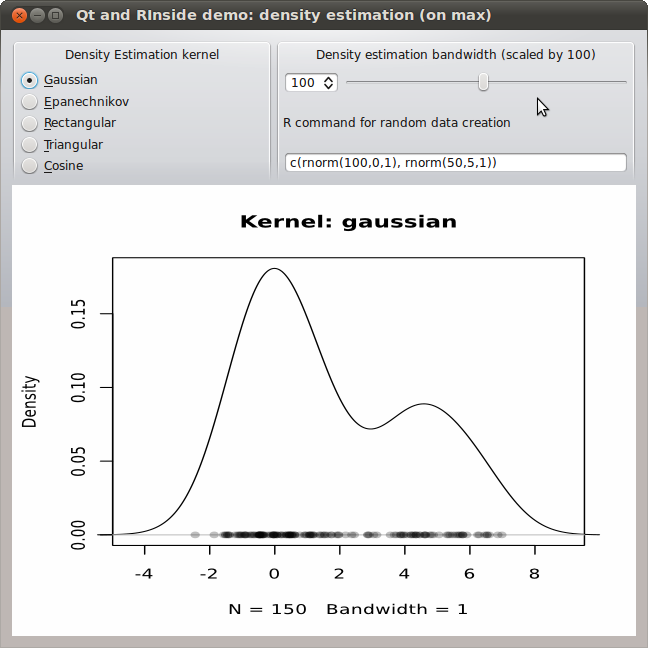
The RInside package makes it pretty simple and straightforward to embed R, the wonderful statistical programming environment and language, inside of a C++ application. This uses both the robust embedding API provided by R itself, and the higher-level abstractions from our Rcpp package. A number of examples are shown on this blog both here and here as well as on the RInside page; and the source package actually contains well over a dozen complete examples which cover anything from simple examples to parallel use via MPI for parallel computing. Beginning users sometimes ask about how to use RInside inside larger projects. And as I had meant to experiment with embedding inside of the powerful Qt framework anyway, I started to dabble a little. A first result is now in the SVN sources of RInside. My starting point was the classic tkdensity demo that comes with R itself. It is a good point of departure as Tcl/Tk makes it very portable---in fact it should run on every platform that runs R---and quite expressive. And having followed some of the GUI experiments around R over the years, I have also seen various re-implementations using different GUI frameworks. And so I am adding mine to this body of work: Example of embedding R via RInside into a Qt C++ application: density estimation for a mixture The problem I addressed first was actual buildability. For the RInside examples, Romain and I provide a Makefile that just works by making calls to R itself to learn about flags for R, Rcpp and RInside such that all required headers and libraries are found. That is actually relatively straightforward (and documented in our vignettes) but a little intimidating at first---which is why a ready-made Makefile is a good thing. Qt of course uses qmake and the .pro files to encode / resolve dependencies. So task one was to map what our Makefile does into its variables. Turns out that wasn't all that hard:
## -*- mode: Makefile; c-indent-level: 4; c-basic-offset: 4;  tab-width: 8; -*-
##
## Qt usage example for RInside, inspired by the standard 'density
## sliders' example for other GUI toolkits
##
## Copyright (C) 2011  Dirk Eddelbuettel and Romain Francois
TEMPLATE =              app
HEADERS =               qtdensity.h 
SOURCES =               qtdensity.cpp main.cpp
QT +=                   svg
## comment this out if you need a different version of R, 
## and set set R_HOME accordingly as an environment variable
R_HOME =                $$system(R RHOME)
## include headers and libraries for R 
RCPPFLAGS =             $$system($$R_HOME/bin/R CMD config --cppflags)
RLDFLAGS =              $$system($$R_HOME/bin/R CMD config --ldflags)
RBLAS =                 $$system($$R_HOME/bin/R CMD config BLAS_LIBS)
RLAPACK =               $$system($$R_HOME/bin/R CMD config LAPACK_LIBS)
## if you need to set an rpath to R itself, also uncomment
#RRPATH =               -Wl,-rpath,$$R_HOME/lib
## include headers and libraries for Rcpp interface classes
RCPPINCL =              $$system($$R_HOME/bin/Rscript -e \'Rcpp:::CxxFlags\(\)\')
RCPPLIBS =              $$system($$R_HOME/bin/Rscript -e \'Rcpp:::LdFlags\(\)\')
## for some reason when building with Qt we get this each time
## so we turn unused parameter warnings off
RCPPWARNING =           -Wno-unused-parameter 
## include headers and libraries for RInside embedding classes
RINSIDEINCL =           $$system($$R_HOME/bin/Rscript -e \'RInside:::CxxFlags\(\)\')
RINSIDELIBS =           $$system($$R_HOME/bin/Rscript -e \'RInside:::LdFlags\(\)\')
## compiler etc settings used in default make rules
QMAKE_CXXFLAGS +=       $$RCPPWARNING $$RCPPFLAGS $$RCPPINCL $$RINSIDEINCL
QMAKE_LFLAGS +=         $$RLDFLAGS $$RBLAS $$RLAPACK $$RCPPLIBS $$RINSIDELIBS
## addition clean targets
QMAKE_CLEAN +=          qtdensity Makefile
The double dollar signs and escaping of parentheses are a little tedious, but hey it works and expands the compiler and linker flags such that everything <emjust works="Works">. The code itself is pretty straightforward too. We instantiate the RInside object as well as the main Qt application object. We then instantiate a new object of class QtDensity that will launch the main widget; it is given a reference to the RInside object.
// -*- mode: C++; c-indent-level: 4; c-basic-offset: 4;  tab-width: 8; -*-
//
// Qt usage example for RInside, inspired by the standard 'density
// sliders' example for other GUI toolkits
//
// Copyright (C) 2011  Dirk Eddelbuettel and Romain Francois
#include <QApplication>
#include "qtdensity.h"
int main(int argc, char *argv[])
 
    RInside R(argc, argv);  		// create an embedded R instance
    QApplication app(argc, argv);
    QtDensity qtdensity(R);
    return app.exec();
 
The definition of the main object is pretty simple: a few private variables, and a few functions to interact with the GUI and get values from the radio buttons, slider or input field---as well as functions to update the chart or re-draw the random variables.
// -*- mode: C++; c-indent-level: 4; c-basic-offset: 4;  tab-width: 8; -*-
//
// Qt usage example for RInside, inspired by the standard 'density
// sliders' example for other GUI toolkits
//
// Copyright (C) 2011  Dirk Eddelbuettel and Romain Francois
#ifndef QTDENSITY_H
#define QTDENSITY_H
#include <RInside.h>
#include <QMainWindow>
#include <QHBoxLayout>
#include <QSlider>
#include <QSpinBox>
#include <QLabel>
#include <QTemporaryFile>
#include <QSvgWidget>
class QtDensity : public QMainWindow
 
    Q_OBJECT
public:
    QtDensity(RInside & R);
private slots:
    void getBandwidth(int bw);
    void getKernel(int kernel);
    void getRandomDataCmd(QString txt);
    void runRandomDataCmd(void);
private:
    void setupDisplay(void);    // standard GUI boilderplate of arranging things
    void plot(void);            // run a density plot in R and update the
    void filterFile(void);      // modify the richer SVG produced by R
    QSvgWidget *m_svg;          // the SVG device
    RInside & m_R;              // reference to the R instance passed to constructor
    QString m_tempfile;         // name of file used by R for plots
    QString m_svgfile;          // another temp file, this time from Qt
    int m_bw, m_kernel;         // parameters used to estimate the density
    QString m_cmd;              // random draw command string
 ;
#endif
Lastly, no big magic in the code either (apart from the standard magic provided by RInside). A bit of standard GUI layouting, and then some functions to pick values from the inputs as well as to compute / update the output. One issue is worth mentioning. The screenshot and code show the second version of this little application. I built a first one using a standard portable network graphics (png) file. That was fine, but not crisp as png is a pixel format so I went back and experimented with scalable vector graphics (svg) instead. One can create svg output with R in a number of ways, one of which is the cairoDevice package by Michael Lawrence (who also wrote RGtk2 and good chunks of Ggobi). Now, it turns out that Qt displays the so-called SVG tiny standard whereas R creates a fuller SVG format. Some discussion with Michael reveals that one can modify the svg file suitably (which is what the function filterFile below does) and it all works. Well: almost. There is a bug (and Michael thinks it is the SVG rendering) in which the density estimate does not get clipped to the plotting region.
// -*- mode: C++; c-indent-level: 4; c-basic-offset: 4;  tab-width: 8; -*-
//
// Qt usage example for RInside, inspired by the standard 'density
// sliders' example for other GUI toolkits -- this time with SVG
//
// Copyright (C) 2011  Dirk Eddelbuettel and Romain Francois
#include <QtGui>
#include "qtdensity.h"
QtDensity::QtDensity(RInside & R) : m_R(R)
 
    m_bw = 100;                 // initial bandwidth, will be scaled by 100 so 1.0
    m_kernel = 0;               // initial kernel: gaussian
    m_cmd = "c(rnorm(100,0,1), rnorm(50,5,1))"; // simple mixture
    m_R["bw"] = m_bw;           // pass bandwidth to R, and have R compute a temp.file name
    m_tempfile = QString::fromStdString(Rcpp::as<std::string>(m_R.parseEval("tfile <- tempfile()")));
    m_svgfile = QString::fromStdString(Rcpp::as<std::string>(m_R.parseEval("sfile <- tempfile()")));
    m_R.parseEvalQ("library(cairoDevice)");
    setupDisplay();
 
void QtDensity::setupDisplay(void)   
    QWidget *window = new QWidget;
    window->setWindowTitle("Qt and RInside demo: density estimation");
    QSpinBox *spinBox = new QSpinBox;
    QSlider *slider = new QSlider(Qt::Horizontal);
    spinBox->setRange(5, 200);
    slider->setRange(5, 200);
    QObject::connect(spinBox, SIGNAL(valueChanged(int)), slider, SLOT(setValue(int)));
    QObject::connect(slider, SIGNAL(valueChanged(int)), spinBox, SLOT(setValue(int)));
    spinBox->setValue(m_bw);
    QObject::connect(spinBox, SIGNAL(valueChanged(int)), this, SLOT(getBandwidth(int)));
    QLabel *cmdLabel = new QLabel("R command for random data creation");
    QLineEdit *cmdEntry = new QLineEdit(m_cmd);
    QObject::connect(cmdEntry,  SIGNAL(textEdited(QString)), this, SLOT(getRandomDataCmd(QString)));
    QObject::connect(cmdEntry,  SIGNAL(editingFinished()), this, SLOT(runRandomDataCmd()));
    QGroupBox *kernelRadioBox = new QGroupBox("Density Estimation kernel");
    QRadioButton *radio1 = new QRadioButton("&Gaussian");
    QRadioButton *radio2 = new QRadioButton("&Epanechnikov");
    QRadioButton *radio3 = new QRadioButton("&Rectangular");
    QRadioButton *radio4 = new QRadioButton("&Triangular");
    QRadioButton *radio5 = new QRadioButton("&Cosine");
    radio1->setChecked(true);
    QVBoxLayout *vbox = new QVBoxLayout;
    vbox->addWidget(radio1);
    vbox->addWidget(radio2);
    vbox->addWidget(radio3);
    vbox->addWidget(radio4);
    vbox->addWidget(radio5);
    kernelRadioBox->setMinimumSize(260,140);
    kernelRadioBox->setMaximumSize(260,140);
    kernelRadioBox->setSizePolicy(QSizePolicy::Fixed, QSizePolicy::Fixed);
    kernelRadioBox->setLayout(vbox);
    QButtonGroup *kernelGroup = new QButtonGroup;
    kernelGroup->addButton(radio1, 0);
    kernelGroup->addButton(radio2, 1);
    kernelGroup->addButton(radio3, 2);
    kernelGroup->addButton(radio4, 3);
    kernelGroup->addButton(radio5, 4);
    QObject::connect(kernelGroup, SIGNAL(buttonClicked(int)), this, SLOT(getKernel(int)));
    m_svg = new QSvgWidget();
    runRandomDataCmd();         // also calls plot()
    QGroupBox *estimationBox = new QGroupBox("Density estimation bandwidth (scaled by 100)");
    QHBoxLayout *spinners = new QHBoxLayout;
    spinners->addWidget(spinBox);
    spinners->addWidget(slider);
    QVBoxLayout *topright = new QVBoxLayout;
    topright->addLayout(spinners);
    topright->addWidget(cmdLabel);
    topright->addWidget(cmdEntry);
    estimationBox->setMinimumSize(360,140);
    estimationBox->setMaximumSize(360,140);
    estimationBox->setSizePolicy(QSizePolicy::Fixed, QSizePolicy::Fixed);
    estimationBox->setLayout(topright);
    QHBoxLayout *upperlayout = new QHBoxLayout;
    upperlayout->addWidget(kernelRadioBox);
    upperlayout->addWidget(estimationBox);
    QHBoxLayout *svglayout = new QHBoxLayout;
    svglayout->addWidget(m_svg);
    QVBoxLayout *outer = new QVBoxLayout;
    outer->addLayout(upperlayout);
    outer->addLayout(svglayout);
    window->setLayout(outer);
    window->show();
 
void QtDensity::plot(void)  
    const char *kernelstrings[] =   "gaussian", "epanechnikov", "rectangular", "triangular", "cosine"  ;
    m_R["bw"] = m_bw;
    m_R["kernel"] = kernelstrings[m_kernel]; // that passes the string to R
    std::string cmd1 = "Cairo(width=6,height=6,pointsize=10,surface='svg',filename=tfile); "
                       "plot(density(y, bw=bw/100, kernel=kernel), xlim=range(y)+c(-2,2), main=\"Kernel: ";
    std::string cmd2 = "\"); points(y, rep(0, length(y)), pch=16, col=rgb(0,0,0,1/4));  dev.off()";
    std::string cmd = cmd1 + kernelstrings[m_kernel] + cmd2; // stick the selected kernel in the middle
    m_R.parseEvalQ(cmd);
    filterFile();               // we need to simplify the svg file for display by Qt 
    m_svg->load(m_svgfile);
 
void QtDensity::getBandwidth(int bw)  
    if (bw != m_bw)  
        m_bw = bw;
        plot();
     
 
void QtDensity::getKernel(int kernel)  
    if (kernel != m_kernel)  
        m_kernel = kernel;
        plot();
     
 
void QtDensity::getRandomDataCmd(QString txt)  
    m_cmd = txt;
 
void QtDensity::runRandomDataCmd(void)  
    std::string cmd = "y <- " + m_cmd.toStdString();
    m_R.parseEvalQ(cmd);
    plot();                     // after each random draw, update plot with estimate
 
void QtDensity::filterFile()  
    // cairoDevice creates richer SVG than Qt can display
    // but per Michaele Lawrence, a simple trick is to s/symbol/g/ which we do here
    QFile infile(m_tempfile);
    infile.open(QFile::ReadOnly);
    QFile outfile(m_svgfile);
    outfile.open(QFile::WriteOnly   QFile::Truncate);
    
    QTextStream in(&infile);
    QTextStream out(&outfile);
    QRegExp rx1("<symbol"); 
    QRegExp rx2("</symbol");    
    while (!in.atEnd())  
        QString line = in.readLine();
        line.replace(rx1, "<g"); // so '<symbol' becomes '<g ...'
        line.replace(rx2, "</g");// and '</symbol becomes '</g'
        out << line << "\n";
     
    infile.close();
    outfile.close();
 
What the little application does is actually somewhat neat for the few lines. One key features is that the generated data can be specified directly by an R expression which allows for mixtures (as shown, and as is the default). With that it easy to see how many points are needed in the second hump to make the estimate multi-modal, and how much of a distance between both centers is needed and so on. Obviously, the effect of the chosen kernel and bandwidth can also be visualized. And with the chart the being a support vector graphics display, we can resize and scale at will and it still looks crisp. The code (for both the simpler png variant and the svg version shown here) is in the SVN repository for RInside and will be in the next release. Special thanks to Michael Lawrence for patiently working through some svg woes with me over a few emails.

Update: Some typos fixed.

Update 2: Two URLs corrected.

23 March 2011

Matthew Garrett: HTC are still incredible fuckheads

Update: Despite another email yesterday reasserting the 90-120 days lie, the source code has now landed on HTC's site.

As has been discussed before, HTC have a somewhat "interesting" interpretation of the GPL that allows them to claim they don't need to provide source code until between 90 and 120 days after the release of binaries. It's probably noteworthy that the FSF (who, you know, wrote the license and all) disagree with this interpretation, as do the kernel copyright holders (who, you know, wrote the code that the license covers) I've talked to about it. Anyway, after a pile of screaming and shouting from all sides HTC have tended to release their source code in a timely manner. So things seemed better.

HTC released the Thunderbolt last week and we're back to the 90-120 day song and dance. It's probably worth remembering that by behaving in this way HTC gain a competitive advantage over any vendors who obey the terms of their license - HTC can incorporate improvements made by others without releasing their own until through a significant portion of the lifecycle of their phone.

As far as I'm concerned, every single Thunderbolt sold so far embodies a copyright infringement. Wilfully engaging in copyright infringement for commercial benefit is typically frowned upon by courts, especially if by doing so a foreign company is gaining commercial advantage over a domestic one. If you think Microsoft's patent assault on Android is a problem, just imagine what they could do if they hired one significant Linux kernel developer and used their copyrights to attack the overwhelming majority of Android vendors who fail to comply with the GPL. It probably wouldn't be industry ending (companies would merely have improve their compliance procedures) but it'd do a huge deal of damage in the short term. It's insane for companies to behave this way. Don't reward them by giving them your money.

I'll be talking about this at the Linux Foundation Collaboration Summit next month, along with an update on my study of the compliance of Android tablets. I'm hoping that there'll be further developments after that.

(comment count unavailable Comments Comment on this)

Kumar Appaiah: Review of "Linux Shell Scripting Cookbook"

I have been reading Linux Shell Scripting Cookbook by Sarath Lakshman, published by Packt, for a while. While most people I know learn shell scripts themselves, I was looking to refresh my concepts a little as well as have a reference lying around on the table for fast access. Since I was asked to review it for someone else, I thought I might as well post the review here.First of all, let me remark by saying that shell scripting is something learned more on a need basis than as a tool to solve the main problem. People would seldom write shell scripts as standalone programs (exceptions exist). However, what makes shell scripting invaluable to know is the fact that knowing some tricks can save several minutes, or hours, of work by automating and simplifying certain tasks, generally (but not restricted to) file management and data processing. Linux Shell Scripting Cookbook does go quite far in pursuing this goal, and is appropriate for both beginners who are looking to gain dexterity in shell scripting, as well as intermediate users who wish to polish their skills. The book also can double up as a quick reference, though I would argue that the "Advanced Bash Scripting Guide" would suit that more.At the outset, the author clarifies that the focus will be on Bash. This, people may or may not like, but the fact that bash has become ubiquitous in terms of the available shells on Unix-like systems today, starting out with bash is not a bad thing to do. Besides, learning other shell scripting languages while knowing bash isn't too hard, since the paradigm remains the same.Let's go through the books from the aspects I found most relevant.OrganizationThe book is organized into chapters based more on utility than scripting concepts themselves, although the language aspects are brought onto the reader gradually. For instance, the examples in the first chapter focus more on the basic data elements (variables, arrays, functions etc.) as well as operators (for numbers, files etc.), and all the examples demonstrate simple usage of these concepts, and he further chapters build upon these in a gradual manner.At the same time, if the reader has some familiarity with shell scripting and needs to only refresh or learn a certain concept, he/she needs to just read the relevant chapter. It is not too difficult to grasp the examples of the later chapters, provided some basic shell knowledge is assumed.Content and PresentationA positive trait in the presentation of this book is that it is all based on practical everyday examples which, with minor adaptation, can be used by many for their own daily tasks. For instance, there are several examples which describe searching for and processing files, which, I'd imagine, many users would want to do on a regular basis. Thus, providing realistic examples allows the book to double its utility. The language and approach used is simple and conversational, and the presentation is very clear, with each idea being described as a problem statement followed by a "How to do it" section with the actual code, and ending with a discussion of the nitty-gritties of the code. It is easy to go for a quick scan for those in a hurry, while those who with to read in more detail will not be disappointed either.The book also covers a wide array of applications. For instance, there are examples on automating fetching web pages and processing them, demonstrations of parsing and simplifying and even some queries around databases wrapped around in shell. It also spans to utilities and tasks connected to statistics, backups, compression, version control and many more.Breadth and DepthThe book goes into a fair amount of detail in terms of describing the shell scripting concept under consideration. The examples used go into a fair amount of detail in order to describe to the user all the aspects involved in the method or command being used. The concepts described are fairly complete, and would be sufficient for the reader to use immediately or with just a little bit of fine tuning. In terms of breadth, the book covers most of the features of shell scripting while also describing the various facilities the shell provides access to in a Unix-like environment. Thus, the book does not disappoint in this front either.In summary...In summary, probably the only thing I'd have liked to see more of is some emphasis on how to write more efficient shell scripts. Granted, most of the shell scripts described in the book are very simple and succinct, but a some words on how loops can be made better, or how to spot situations where pipes are not needed to solve a problem etc. might have been a nice addition. Some explanation of differences with dash, tcsh, zsh etc. might also have been nice, since a lot of users have different default shells. But all this isn't going to prevent me from giving this book a high rating, since it delivers quite well on the promises it makes at the beginning.This is definitely a good book to have near your desk, and kudos to the author for having taken the effort to put it together. I would highly recommend it to the beginner and occasional shell user for a thorough read, and to an intermediate to have on his/her desk for borrowing the cool scripting ideas and applications the author has written in this book.

Gerfried Fuchs: LXC and NAT on notebook

Yesterday I was hinted towards lxc when I wondered what happened to openvz in unstable (which unfortunately isn't documented at all in the kernel changelogs, but that's a different story). So I started off taking a look. From a bit of experimenting around with it I consider it something that I want to play more with, and I want to share the problems I stumbled upon with you so that you don't have to figure them out on your own. First of all, LXC uses the cgroup kernel facility for resource management. The according file system isn't mounted by default, and LXC doesn't care for where it is mounted, it just needs to be. It seems like /sys/fs/cgroup seems to be the proper place (see 601757), so add the line cgroup /sys/fs/cgroup cgroup defaults 0 0 to your /etc/fstab file and sudo mount cgroup it. Next, it seems like bridging is the defacto standard for networking with lxc, but given that I want to use it on my notebook while being mobile I can't bind the bridge to any specific interface. To make this happen, one needs the bridge-utils package installed, and secondly, this is the path that I chose. I've added to /etc/network/interfaces this snippet:
auto br0
iface br0 inet static
    bridge_maxwait 0
    bridge_ports dummy0
    address 10.80.80.1
    netmask 255.255.255.0
This will bring up the bridge and act as gateway. For the running system, call sudo ifup br0. To make the host universally being able to work as gateway, of course ip_forward needs to be enabled. For this I added the line net.ipv4.ip_forward=1 to /etc/sysctl.d/local.conf (and for the running system, echo 1 into /proc/sys/net/ipv4/ip_forward). As I am using ferm for configuring the firewall on my notebook I have to add some parts into its configuration. This is the raw part that needs to get added, mix it into your existing configuration:
table filter  
    chain INPUT  
        # allow DNS queries from LXContainers
        proto (udp tcp) dport domain source 10.80.80.0/24 ACCEPT;
     
    chain FORWARD  
        # allow LXContainers into the net
        source 10.80.80.0/24 ACCEPT;
     
 
table nat  
    chain POSTROUTING  
        # NAT LXContainers
        source 10.80.80.0/24 MASQUERADE;
     
 
For DNS I installed dnsmasq so that I won't have to touch the /etc/resolv.conf inside the containers whenever I switch networks. So far for the host part, now to the actual containers. There is the /usr/lib/lxc/templates/lxc-debian helper script which uses debootstrap to create you a lenny chroot at least in the squeeze package this is hardwired, likewise with using cdn.debian.net. Copy the script and edit it to your likes if you feel like it. From what I understood it expects you to store the containers below /var/lib/lxc, I haven't yet tested for different places. So this was my commandline for that:
sudo /usr/lib/lxc/templates/lxc-debian -p /var/lib/lxc/vm0 A while later you'll end up below that directory with two entries: The config file and the rootfs subdirectory which is actually the bootstrapped distribution part. Now comes the configuration of the container. Open the config file with your favorite editor and add the following lines to the end:
lxc.utsname = vm0
lxc.network.type = veth
lxc.network.flags = up
lxc.network.link = br0
# lxc.network.name = eth0
lxc.network.hwaddr = 00:FF:80:80:80:80
lxc.network.ipv4 = 10.80.80.80/24
The network.name part is commented out, it defaults to that name internally; you though can change it to whatever you prefer. Caution, even though this is the documented approach, it does not work for Debian containers. It will always try to get its IP address through dhcp, lxc.network.ipv4 has no meaning for us. We need to change inside the rootfs the file etc/network/interfaces to read like this instead:
auto lo
iface lo inet loopback
auto eth0
iface eth0 inet static
   address 10.80.80.80
   netmask 255.255.255.0
   gateway 10.80.80.1
I suggest to keep the config and the interfaces file aligned with respect to the ipv4 setting so if this gets fixed upstream you won't stumble into any surprises. Also like mentioned before, we need to change the nameserver entries inside the rootfs file etc/resolv.conf to read nameserver 10.80.80.1. Now it's time to start it up and log in! sudo lxc-start -n vm0 -d will start the container in the background, and sudo lxc-console -n vm0 will give you the login to the container. The default password for the root user is root, obviously you want to change that before you install any networking services into the container like ssh-server. In case you want to quit from that console notice the message upon starting it, it's bound to <Ctrl+a q>. One more issue that I had: The default route wasn't set. I had to manually call ip r a default via 10.80.80.1 dev eth0 to be able to use the network inside the container. It seems to be related to that netbase isn't installed by default. If you install it the default route will be set upon starting the container automatically. This should get you started, there is of course more to explore and experiment with. Actually it is also suggested to create a tarball from your vm0 after you did the basic setup and installed the basic components you want to have around so you won't have to bootstrap over and over again. Do this after you have shut down the container, either through a halt from a container shell or through sudo lxc-stop -n vm0. The tarball can then get extracted to a different directory and just needs minor tweaks in the config and rootfs/etc/network/interfaces file to not create any clash with other containers (lxc.rootfs, lxc.mount.entry, lxc.utsname, lxc.network.hwaddr and ipv4 address). About limiting the containers, you can do it dynamically through the cgroup file system, and set it permanently through the config file. See man lxc.conf about these settings, amongst others. Enjoy, use, experiment. With sudo lxc-checkconfig you will see what your kernel actually supports for your LXCs. You will most probably notice the missing for the memory controller, this is tracked in the Debian bug report 534964.

/debian permanent link Comments: 6 Flattr this

22 March 2011

Pietro Abate: Xen brouter setup

A while ago I received a new desktop machine (8 cores, 8Gb of memory ...) at work. Since for the moment I kinda happy to work on my laptop using an external screen, I decided to put the hw to a good use and to explore a bit more some more exotic (at least for me) xen features. In particular I spend half a day playing with different xen network settings. The bridge model, that should work out of the shelf, is the easiest one. To setup this up, you basically need to specify a couple of options in the xend-config file and you're done. This is the "default" network configuration and is should work out of the box in most situations. Using this method, since all VMs' interfaces are bridged together (surprise !) with the public interface, your network card is left in promiscuous mode (not a big problem if you ask me...). Once your VMs are up, you can then decided to use your default dhcp server, autoconf your VMs with ipv6 only, or do nothing as you please. An other popular method, albeit a bit more complex, is to setup a natted network using the script network-nat (this one is an evolution of the third method that is 'network-routed') . I played with it, but since I wanted to have all my DomU on the same subnet, this setup wasn't satisfying for me. In particular, by default, 'network-nat' assigns a different subnet to each DomU. Using the natted set up you can also configure a local dhcp server to give private IPs to your VMs all done transparently by the xen network scripts. I've noticed that there is a bug in the xen script that does not make it very squeeze friendly. Since the default dhcp server in squeeze is isc-dhcp and few configuration files got shuffled in the process (notably /etc/dhcp3.conf is not /etc/dhcp/dhcp.conf) , the script needs a little fix to work properly. I'll report this bug sometimes soon... Goggling around I found a different setup that is called brouter, that is a hybrid between a bridge configuration and a routed configuration. This is the original (??) article well hidden in an old suse wiki.
 
I've done few modifications here to add natting. So basically, all virtual interfaces connected each to one DomU are linked together by a bridge (xenbr0). The bridge with address 10.0.0.1 is also the router of the subnet. All DomU are configured to used dhcp that assigns a new ip and specifies the router of the subnet. The dhcp server is configured to answer requests only on the xenb0 interface avoiding problems on the public network... routing is configured using iptables :
iptables -t nat -A POSTROUTING -o $ netdev -j MASQUERADE
iptables -A FORWARD -i $ bridge -j ACCEPT
echo 1 >/proc/sys/net/ipv4/ip_forward
/etc/init.d/isc-dhcp-server restart
Note that since the dhcp server is configured to give addresses only on the virtual network, we need to restart it after creating the bridge interface, otherwise isc-dhcp-server will refuse to run. Mum says that I should configure the bridge in /etc/network/interfaces to make the dhcp server happy at startup, but I felt a bit lazy, so I let to task to xen... In the next episode, I'll add ipv6 connectivity to the virtual subnet and then start playing with puppet... ipv6 is almost done, puppet... I started with the doc... The complete script from the suse wiki and with my modifications is below (only lightly tested):
#!/bin/sh
#============================================================================
# Default Xen network start/stop script.
# Xend calls a network script when it starts.
# The script name to use is defined in /etc/xen/xend-config.sxp
# in the network-script field.
#
# This script creates a bridge (default xenbr$ vifnum ), gives it an IP address
# and the appropriate route. Then it starts the SuSEfirewall2 which should have
# the bridge device in the zone you want it.
#
# If all goes well, this should ensure that networking stays up.
# However, some configurations are upset by this, especially
# NFS roots. If the bridged setup does not meet your needs,
# configure a different script, for example using routing instead.
#
# Usage:
#
# vnet-brouter (start stop status) VAR=VAL *
#
# Vars:
#
# bridgeip Holds the ip address the bridge should have in the
# the form ip/mask (10.0.0.1/24).
# brnet Holds the network of the bridge (10.0.0.1/24).
#
# vifnum Virtual device number to use (default 0). Numbers >=8
# require the netback driver to have nloopbacks set to a
# higher value than its default of 8.
# bridge The bridge to use (default xenbr$ vifnum ).
#
# start:
# Creates the bridge
# Gives it the IP address and netmask
# Adds the routes to the routing table.
#
# stop:
# Removes all routes from the bridge
# Removes any devices on the bridge from it.
# Deletes bridge
#
# status:
# Print addresses, interfaces, routes
#
#============================================================================

#set -x

dir=$(dirname "$0")
. "$dir/xen-script-common.sh"
. "$dir/xen-network-common.sh"

findCommand "$@"
evalVariables "$@"

vifnum=$ vifnum:-0
bridgeip=$ bridgeip:-10.6.7.1/24
brnet=$ brnet:-10.6.7.0/24
netmask=$ netmask:-255.255.255.0
bridge=$ bridge:-xenbr$ vifnum

##
# link_exists interface
#
# Returns 0 if the interface named exists (whether up or down), 1 otherwise.
#
link_exists()

if ip link show "$1" >/dev/null 2>/dev/null
then
return 0
else
return 1
fi


# Usage: create_bridge bridge
create_bridge ()
local bridge=$1

# Don't create the bridge if it already exists.
if [ ! -d "/sys/class/net/$ bridge /bridge" ]; then
brctl addbr $ bridge
brctl stp $ bridge off
brctl setfd $ bridge 0
fi
ip link set $ bridge up


# Usage: add_to_bridge bridge dev
add_to_bridge ()
local bridge=$1
local dev=$2
# Don't add $dev to $bridge if it's already on a bridge.
if ! brctl show grep -wq $ dev ; then
brctl addif $ bridge $ dev
fi


# Usage: show_status dev bridge
# Print interface configuration and routes.
show_status ()
local dev=$1
local bridge=$2

echo '============================================================'
ip addr show $ dev
ip addr show $ bridge
echo ' '
brctl show $ bridge
echo ' '
ip route list
echo ' '
route -n
echo '============================================================'
echo ' '
iptables -L
echo ' '
iptables -L -t nat
echo '============================================================'


op_start ()
if [ "$ bridge " = "null" ] ; then
return
fi

create_bridge $ bridge

if link_exists "$bridge"; then
ip address add dev $bridge $bridgeip
ip link set $ bridge up arp on
ip route add to $brnet dev $bridge
fi

if [ $ antispoof = 'yes' ] ; then
antispoofing
fi
iptables -t nat -A POSTROUTING -o $ netdev -j MASQUERADE
iptables -A FORWARD -i $ bridge -j ACCEPT
echo 1 >/proc/sys/net/ipv4/ip_forward
/etc/init.d/isc-dhcp-server restart


op_stop ()
if [ "$ bridge " = "null" ]; then
return
fi
if ! link_exists "$bridge"; then
return
fi

ip route del to $brnet dev $bridge
ip link set $ bridge down arp off
ip address del dev $bridge $bridgeip
##FIXME: disconnect the interfaces from the bridge 1st
brctl delbr $ bridge
/etc/init.d/isc-dhcp-server restart


case "$command" in
start)
op_start
;;

stop)
op_stop
;;

status)
show_status $ netdev $ bridge
;;

*)
echo "Unknown command: $command" >&2
echo 'Valid commands are: start, stop, status' >&2
exit 1
esac

Michal &#268;iha&#345;: phpMyAdmin translation status

We're heading to release candidates for phpMyAdmin 3.4.0, so the translators have less time to make the translations better. There are still 13 translations at 100%: There are still lot of translations which would need some love, for example: Recently, new people started to work on Bulgarian and Brazilian Portuguese translations, so we will hopefully have these two on the list soon as well. You can help make translation to your language better! If your language is missing just let me know (either in comments or by email).

Filed under: English Phpmyadmin 1 comments Flattr this!

19 March 2011

David Welton: You win some, you lose some

A bit more than a month ago, I had the random idea to try building and selling a web site, at the same time. The idea was that the more people bid, and requested features, the more I'd work on it. It didn't work out. I got a bit of money out of it, but certainly not enough to cover my time at an hourly rate. I suppose the lesson is that a month simply isn't a lot of time for something to mature: it'd probably be best to work on something on and off for a year, give it some time for traffic to build up, and so on, if the goal is to sell it. However, in any case, I think I'm pretty convinced that my next projects, like LiberWriter, will involve for-pay products. At heart, I'm not really a business guy, so picking the simplest possible business model probably makes sense: you pay me, I give you something. Hopefully, I'll be able to write about those in the "you win some column", but I thought I'd let people know how the experiment went.

Gunnar Wolf: Starting work on KindleClip

Starting work on KindleClip
Quite probably, the best thing got for myself during the last year was my Kindle. I just love it! It has changed the way I interact with knowledge, and saved me from hours of boredom. But it has also taught me the value of scribbling along the book pages and of underlining passages. Yes, I hold a deep regard for my regular (paper) books, and I never scribble on them, not even on text books. In any case, I can scribble on a post-it or something like that. Still, when you underline or comment on a passage in the Kindle, what can you do with your annotation? Well, not much. Annotations (called clippings in Kindlespeak) are stored on an easily accessible My Clippings.txt text file, very easy to parse and work with. So, I devoted yesterday evening to coming up with a first prototype of an app that I think can be very useful if you use clippings extensively: It displays each clipping with its base information separately, allows you to filter on the specific book to which each clipping is related as well as on the clipping type. So, if it interests you, clone it away from github!
git://github.com/gwolf/kindleclip.git
Written in Ruby, Gtk (Glade). No further libraries are (currently?) needed. The code is far from beautiful, but is a first stab towards functionality. Any comments welcome!

18 March 2011

Steve Kemp: nodejs is fun

A while back I was working on a mod_rewrite compatible proxy server written in C. The reason for this is that my current webhost uses Apache2 in front ofa number of thttpd processes, and I'd like to remove apache and use something smaller/faster/neater. Dividing things up I'm running about ten domains, and only around half of them use mod_rewrite rules - small enough perhaps to port the rules, large enough to make it annoying. Upon reflection I think the thing to do is to replace apache with javascript - via node.js. Writing proxies with node.js is almost ridiculously simple - in fact doing anything HTTP-like is very very simple thanks to the bundled libraries. Time will tell whether this is a waste of time or not, but I'm confident I could listen upon *:80 and route requests to localhost:N for a few domains. As a trivial toy I wrote a simple transforming proxy last night which performed simple rewrites as it passed traffic about. Another fun, and possibly useful, thing I put together was a node.js port of the simple httpstat.us website. That server would have been easy to write in any number of languages, but in node it was almost too easy. Update - here is my rewriting node.js-based reverse-proxy. ObQuote: "I just need you to stop being nice to me unless you're gonna marry me. " - He's just not that into you.

15 March 2011

Michal &#268;iha&#345;: phpMyAdmin translation status

Last weekend we've released phpMyAdmin 3.4.0-beta4, hopefully last beta and there are still lot of translations missing. The only new complete translation compared to last week is German, so we now have 13 translations at 100%: There are still lot of translations which would need some love, for example: I'm happy that not only translation status is improving, but some translators also reviewed older translations, so that it is more consistent. The great work in this area was done in Russian. And of course there is still great ongoing effort on Urdu translation. You can help make translation to your language better! If your language is missing just let me know (either in comments or by email).

Filed under: English Phpmyadmin 0 comments Flattr this!

11 March 2011

Guido G nther: git-buildpackage tip #4: creating remote repositories

In order to ease creation of remote repositories to publish your Debian packaging work git-buildpackage ships gbp-create-remote-repo: If you run
gbp-create-remote-repo --remote-url-pattern='ssh://git.debian.org/home/users/agx/public_git/%(pkg)s.git'
from inside a git repository it will create a remote repository on git.debian.org in the given directory, push your debian, upstream and pristine-tar branches into it and set up branch tracking so you can easily use gbp-pull or git pull to update your local repository from there. '%(pkg)s' will be replaced by the source packages name. If you want to be more explicit you can use:
gbp-create-remote-repo --remote-url-pattern='ssh://git.debian.org/home/users/agx/public_git/foo.git'
so no substitution will take place. In case you only want to push to that repository but not pull from there you can use the --no-track option so gbp-create-repo won't set up any branch tracking. If you specify the remote-url-pattern via gbp.conf calling:
gbp-create-remote-repo
is enough to create a repo on your favorite git server. The default is to create new repositories in the collab-maint repository on alioth.debian.org. This feature is available in your $PATH since 0.5.16 (it was shipped in examples/ before) and was inspired by the Debian OCaml Maintainers dom-new-git-repo work. This blog is flattr enabled.

8 March 2011

Michal &#268;iha&#345;: phpMyAdmin translation status

Another week is over and it's time to spam^W look again at state of translations for phpMyAdmin 3.4. There are no changes to list of complete translations, so we still have 12 translations at 100%: There are still lot of translations which would need some love: And I'm really happy to see progress of some exotic languages (at least for me) such as Urdu. You can help make translation to your language better! If your language is missing just let me know (either in comments or by email).

Filed under: English Phpmyadmin 2 comments Flattr this!

Next.

Previous.